
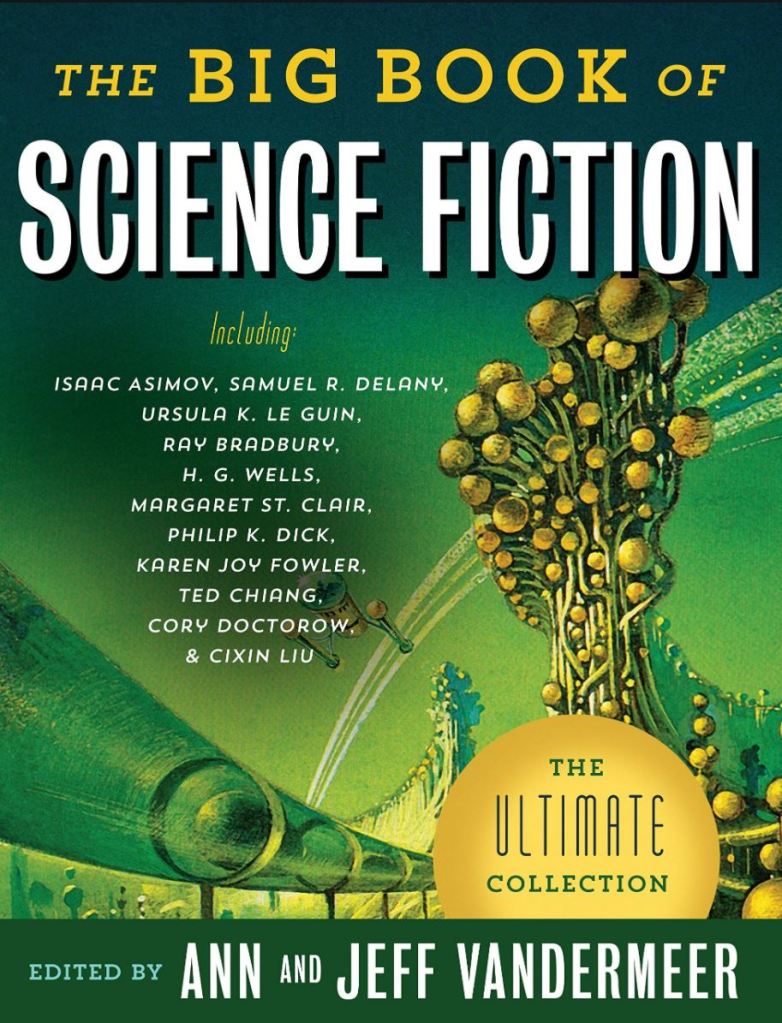
Group Read 27: The Big Book of Science Fiction
Story #47 of 107: “Day Million” by Frederik Pohl
“Day Million” by Frederik Pohl comes in at #25 on Dave Hook’s 125 Top SF Stories list. That’s pretty good for a story that appeared in a third-rate men’s magazine back in 1966. I was 14, so I wasn’t buying Rogue at the time, although I would have been mightily excited to have any men’s magazine back then. (Full nostalgic disclosure – I wouldn’t have read “Day Million” or any of the printed matter.) I did read World’s Best Science Fiction: 1967 edited by Wollheim and Carr, which reprinted the story, but I don’t remember reading “Day Million.” When I reread that anthology last year I remembered most of the stories, but not that one. Either I didn’t like it and skipped it, or it was so over my head that it made no impression.
When I finally got around to reading “Day Million” a few years ago I was impressed. And I’m still impressed. Pohl’s speculation about the far future and post-humans is quite nifty, and I think his philosophical points are still valid today. However, I’m not so sure it’s a short story. If the table of contents had listed it as nonfiction, and the editor introduced it as a speculative essay about future sex and romance I wouldn’t have quibbled.
Pohl tells us about Dora and Don in this hipster-voice that’s 50% of the entertainment value of the story. Of course, I don’t know if hipster would have been the right word for 1966. Playboy, the famous competitor of Rogue, promoted itself as the sophisticated guide for the swinging male, AKA, The Playboy Philosophy. I wonder if Pohl originally submitted “Day Million” hoping it would run right after the centerfold.
I thought Pohl’s idea of imagining day million was brilliant, although I’m not so sure humans will be around for our millionth day, and if we are, be that different. A lot of science fiction written since “Day Million” seems to assume we will — does that mean Pohl set the trend? Many modern stories have post-humans like those in “Day Million.” And Pohl seems pre-enlightened for our emerging acceptance of transexuals.
I’m not really attacking this story when I quibble about it sounding like an essay. Pohl knows how to tell a real story. Pohl is jazzing out by rifting on the structure of storytelling, but I also think he’s cheating. I’m talking about the old rule of show, don’t tell. Infodumping is telling a story. And this story is all infodumping. Pohl tells us that Dora and Don have a genuine relationship. It would have been masterful storytelling if Pohl have shown Dora and Don being in love so we truly felt and understood it, and not just told to us by a smart-alec narrator begging us to disbelieve him.
Pohl should have taken the time to give us The Crying Game, but revealing Dora’s lack of X-chromosome in some less crude but clever science-fictional way. And as we’ve already learned way sooner than day million, that a beautiful transexual female isn’t hard to accept. It would actually be much harder to make his readers believe an amphibious post-human would be attracted to cyborg post-human. Even harder to make believable, is showing people in the future being emotionally satisfied with a virtual mate.
Remember, Pohl only tells us these things will be true. Intellectually, we might want to believe the future will offer all these possibilities, but when it comes down to it, Pohl never even offers us any intellectual evidence, much less triggers emotional resonance through showing us dramatic evidence.
James Wallace Harris, 11/19/21






 Classics of Science Fiction