For thirty-five years (1984-2018) I depended on Gardner Dozois to tell me about the state of short science fiction in his annual The Year’s Best Science Fiction. After he died, there were still many best-of-the-year anthologies to consult, but none had the extensive wrap-up of the year in science fiction that Dozois produced. By 2024 some of those anthologies have died off, making me wonder if the science fiction short story is dying off too.
Print magazines have lost subscribers for decades, and influential online publishers continually complain about a lack of funding. Today I read an article in Business Insider about how the plurality of companies selling online makes it hard to know what to buy. My theory is there are too many publishers for science fiction short stories. It’s great for new writers wanting to get published, but it’s bad for us readers because we’re reading stories that would have remained in the slush pile decades ago.
Before the internet, fans of short science fiction bought The Magazine of Fantasy & Science Fiction, Analog, Asimov’s, and an occasional original anthology like Orbit. There were semi-pro magazines, but few read them. Because there were fewer slots where a story could appear the competition to get into one was greater.
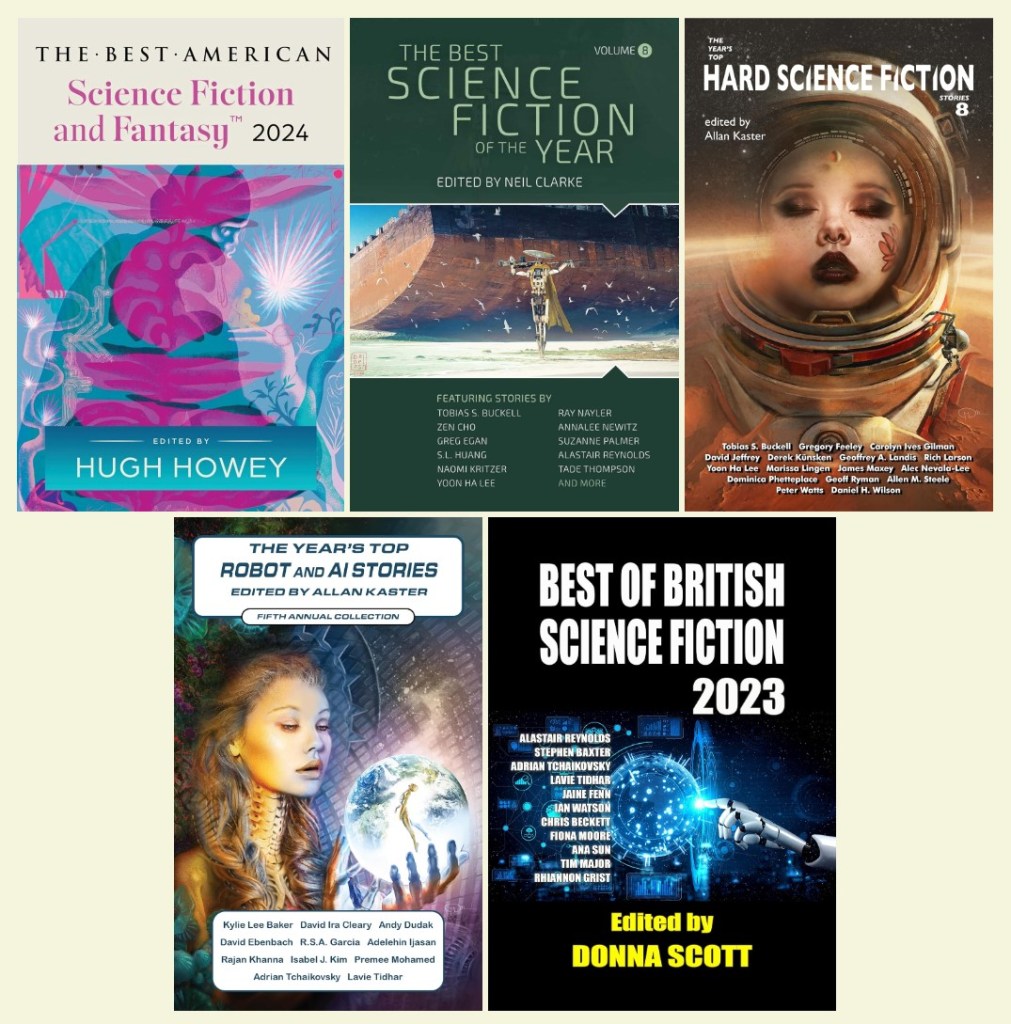
John Joseph Adams in The Best American Science Fiction and Fantasy 2024 gives a fair overview of science fiction short story publishers. His anthology publishes twenty stories each year. Ten science fiction and ten fantasy. As the series editor, he picks 80 stories to give to the guest editor, who picks the 20 that are published. Here are the publications he used, with the number of stories included in the 80 in parentheses.
Lightspeed (7)
Clarkesworld (5)
Uncanny (5)
Beneath Ceaseless Skies (4)
The Magazine of Fantasy & Science Fiction (4)
Reactor (formally Tor.com) (4)
Asimov’s Science Fiction (3)
The Sunday Morning Transport (3)
Fantasy Magazine (2)
McSweeney’s (2)
Bourbon Penn (1)
Cast of Wonders (1)
Escape Pod (1)
FIYAH (1)
Nightmare (1)
PseudoPod (1)
The Dark (1)
Since this is only 46 stories, the other 34 must have come from author collections and original anthologies. Adams said he also read these periodicals:
Analog
Apex Magazine
Apparition Lit
Baffling Magazine
The Kenyon Review
khōréō
Vastarien
Weird Horror
This doesn’t cover all the publishers of short science fiction. By the way, some of these periodicals are for fantasy and horror. I only care about science fiction, so I’m disappointed with every other story in The Best American Science Fiction and Fantasy 2024. You can read Adams’s introduction by reading the sample at Amazon. It’s mostly about his selection process but it gives a good insight into what’s being published.
Because so many science fiction short stories are being published I’ve given up trying to follow the genre during the year by reading the periodicals. I just wait for the annual best-of-the-year anthologies. I occasionally buy F&SF, Analog, or Asimov’s, but F&SF has too little SF, Analog has too many minor stories, and Asimov’s has become rather hit-and-miss. I can’t but wonder if they’d get better stories if the online markets didn’t exist.
Neil Clarke’s The Best Science Fiction of the Year: Volume 8 is more to my taste, but it’s over a year behind. Volume 8 covering 2022 stories, came out in September 2024.
Clarke reports finding a huge number of print magazines:
Analog
Asimov’s
Bourbon Penn
Clarkesworld
Cossmass
Infinities
Dark Matter
The Dread Machine
Dreamforge
Fusion
Fragment
Galaxy’s Edge
Infinite Worlds
Lady Churchhill’s Rosebud Wristlet
Luna Station Quarterly
The Magazine of Fantasy and Science Fiction (F&SF)
Interzone
Metaphorosis
On Spec
Planet Scumm
Pulphouse
Pulp Literature
Reckoning
Shoreline of Infinity
Space and Time
Underland Arcana
Weird Tales
Wyldblood
That blows my mind. I never see most of those titles. Clarke’s State of the Union of SF short stories is comprehensive. I guess he’s the new Gardner Dozois. Even if you don’t buy Clarke’s anthology, you can read his introduction in the sample at Amazon. I won’t summarize what he says, it covers what my title above claims but only hints at. Go read his overview.
Allan Kaster publishes two best-of-the-year anthologies. They showcase SF stories about hard science fiction and AI/robots. Kaster comes closest to what I want to read. I think Kaster succeeds because he defines his science fiction narrowly and only publishes twelve to fifteen stories. Before Gardner Dozois blew up the size of annual best-of-the-year SF anthologies, editors like Donald Wollheim, David Hartwell, and Terry Carr just picked ten to fifteen stories each year too. Check out his two series: The Year’s Top Hard Science Fiction Stories and The Year’s Top AI and Robot Stories.
There is an overwhelming number of science fiction short stories to read coming out. In that regard, the industry is doing great. Remember the lament in Business Insider, there are too many sellers. It makes selecting difficult and lowers overall quality. Back in 1953, there was an SF magazine boom, with over forty titles published. That boom crashed because the genre couldn’t support that many titles. I wonder if that will be true today? Or does the Internet allow for countless tiny markets supported by a handful of faithful fans? If that’s true, it might be better to ignore the larger genre, and just find a comfortable niche.
Science fiction is best when it’s full of wonder. When I first read The Time Machine by H. G. Wells, I was awed by the idea of time travel, but two other ideas wowed me even more. Wells got me to imagine future human evolution and posthumans, and he introduced me to the idea that the Earth would someday end. It was easier to imagine the Earth being created, but it was overwhelming to think about it dying.
Hothouse by Brian W. Aldiss is one of the great works of the Dying Earth subgenre of science fiction. There are various ideas about what constitutes a dying Earth setting. Some people consider it to happen when humanity dies off. I like to think it’s when the Earth is about to be destroyed. That’s the approach Aldiss takes in Hothouse. He tells us the Sun will go nova in a few generations, but Aldiss doesn’t quite take us to Earth’s death
Jack Vance’s famous novel The Dying Earth (1950) is set in the far future, too. The sun is nearing the end of its life, and the Earth and humanity have drastically changed. In The Time Machine, the Time Traveler visits the far future just before the sun, as a red giant destroys the Earth. In The Night Land (1912) by William Hope Hodgson, the Sun Is going dark, and humanity is almost gone.
Only Wells and Aldiss imagined the final productions of evolution. Olaf Stapledon pictures eighteen more species of humans coming after us in Last and First Men (1930). Aldiss imagines a variety of descendants for humanity in Hothouse, all exceedingly small. He also imagines the plant kingdom going bonkers, which reminded me of The Forgotten Planet (1954) by Murray Leinster. That novel was based on three stories, first published in 1920, 1921, and 1953. It was about a world we had colonized. Those explorers eventually evolved becoming tiny beings, competing with giant plants and insects for survival.
I reread Hothouse by Brian W. Aldiss because it was recently released in an audiobook edition on October 15, 2024. It’s a novel I’ve been waiting years to hear. I first read Hothouse in 1996 and thought it was an amazing story full of colorful imagery and adventure. I wanted to see it as a movie because of Aldiss’ powerful visual imagination. After I got into audiobooks in 2002, I wanted to reread all my favorite science fiction books by listening to them. I finally got my wish with Hothouse, with excellent narration by Nick Boulton.
In this fix-up novel, the sun is swollen, and Earth’s rotation is locked so only one side faces the Sun. The Moon trails the Earth’s orbit in a Trojan orbit that keeps it stationary in the sky. Earth is a riot of vegetation that has supplanted most of the animal kingdom. Humans have evolved into tiny beings one-fifth our size, while insects have grown monstrously large. Plants have mutated into countless strange configurations, including those that traverse between the Earth and the Moon on giant webs.
Hothouse is a fixup novel composed of five stories that appeared in The Magazine of Fantasy & Science Fiction in 1961.
“Hothouse” (novelette)
“Nomansland” (novelette)
“Undergrowth” (novella)
“Timberline” (novelette)
“Evergreen” (novella)
Hothouse was originally published in the United States as The Long Afternoon of Earth in a slightly abridged format. At the 1962 Worldcon, the five stories as a series won the Hugo Award for best short story. I prefer the forgotten American title, it’s more poetic.
I thoroughly enjoyed listening to this novel, but it didn’t have the impact it had on first reading. (Imagine watching The Sixth Sense for a second time.) Aldiss produces some wonderful science fictional ideas in this story, ones I won’t mention because that might spoil the story. This is one of those tales you should experience without knowing too much. The story feels like a children’s fantasy with all the funny names for evolution’s new creations, but I believe Aldiss was serious in trying to make it science fiction.
Think of the writing challenge of describing an impossible-to-imagine far future. Jack Vance pictured humans with magical powers as if evolution would eventually create them. Magic makes his Dying Earth stories fun, but not realistic. William Hope Hodgson imagined Earth in darkness where humanity clings to one giant city. I guess Clarke did that too. Aldiss imagines species descendants from us living in another kind of Garden of Eden, a very violent one. We could call it Darwin’s Eden, rather than God’s.
Hothouse is mostly a forgotten classic. I seldom meet people who have read it. Brian W. Aldiss’s reputation and back catalog aren’t well-remembered in today’s popular culture. Now that several of his books have been republished in audio, I’m giving him another chance. I hope other SF fans do too.
My favorite work by Aldiss is “An Appearance of Life” which I’ve reviewed three times. I keep hoping to find more Aldiss stories that impress me as much. Hothouse comes close. So does “The Saliva Tree.” Greybeard isn’t on the same level as those tales, but it’s still thought-provoking.
“Earth for Inspiration” is a comic science fiction story by Clifford Simak set millions of years into the future about a science fiction writer and his robot visiting a forgotten Earth. The pair go there hoping to find inspiration to write new science fiction stories. You can read it online in the April 1941 issue of Thrilling Wonder Stories.
I read “Earth for Inspiration” by Clifford D. Simak because I read When the Fires Burn High and the Wind is From the North: The Pastoral Science Fiction of Clifford D. Simak by Robert J. Ewald. I bought that book after I read and reviewed A Heritage of Stars by Simak which made me want to know more about Clifford D. Simak. I mentioned my interest in Simak on the Clifford Donald Simak Facebook group and the Ewald book was one of two books about Simak that was recommended. I forgot I already owned the second book, Clifford Donald Simak: An Affectionate Appreciation by Francis Lyall. I haven’t read that one yet because I leant it to my friend Mike who had recently read the twelve volumes of Simak’s short stories. Mike is who got me to read A Heritage of Stars in the first place. I guess that puts me into some kind of inspiration loop.
A Heritage of Stars involved a post-apocalyptic America with few humans and some robots. In that story, most robots had been destroyed except for their brain cases which were saved as trophies after a war with the robots. Unknown to the humans, the robots continued to be conscious inside their brain cases for a thousand years. That idea of a conscious mind without outside sensory data intrigued me. Then I read in the Ewald monograph about “Earth for Inspiration,” involved a dying Earth, robots, and isolated robot brain cases. I had to read it. The story is also included in Simak’s collection Earth for Inspiration and Other Stories: The Complete Short Fiction of Clifford D. Simak Volume Nine. Amazon now sells 14 volumes in the complete stories. Audible.com now offers ten of those volumes in audiobook editions.
Version 1.0.0
Most of the famous science fiction short stories we remember from the 1940s were first published in Astounding Science Fiction. Thrilling Wonder Stories was aimed at younger, less educated science fiction fans, and we seldom see reprints from that pulp magazine. For the most part, its stories are less sophisticated with far more action. And that’s true for “Earth for Inspiration.” I thought it was a funny story, but somewhat simple and hyper paced. It has an old fashion voice because of all old-timey colloquialisms. Simak is known for his pastoral prose and midwest settings.
“Earth for Inspiration” was more fun than I expected to find in Thrilling Wonder. Usually, when we think about robots in science fiction, we think of Isaac Asimov, but I’m seeing how important robots were to Simak stories.
When I read it with my eyes, “Earth is Inspiration” felt like cliched pulp science fiction from the 1930s. However, when I listened to the story after buying the audiobook edition, I thought the writing was much better than my first impression, except for all the saidisms. (I think the worse was — “Look at that, will you!” he jubilated.) The second reading with my ears made me notice how many ideas Simak was using to develop the story. It’s a satire on writing science fiction, maybe even the first example of recursive science fiction.
However, “Earth for Inspirations” gives us a few clues about how Clifford D. Simak thought when comparing them to his other work. The more Simak I read, the more I spot common ideas, characters, and elements that he used and reused.
The Ewald monograph has a few pages of biographical information, almost just a list of dates. Most of the 155 pages describe Simak’s stories and novels. I was hoping to find a biography of Simak, something like William H. Patterson did for Heinlein, but such a book doesn’t exist as a far as I can tell for Simak. Second to that, I was hoping to find an analysis of the impact of Simak’s stories, like what Alexei and Cory Panshin did for Heinlein, Asimov, and van Vogt in The World Beyond the Hill. It’s not that either. When the Fires Burn High and the Wind is From the North, is a standalone journal, volume 73 of The Milford Series: Popular Writers of Today. The content is like Alva Rogers A Requiem for Astounding, which is a description of the stories in all the issues of Astounding Science Fiction in chronological order.
I thought it fascinating that Simak was thinking of robots in the same way in 1941 and 1977. He obviously had a fondness for the idea of robots and had developed an idea of what they would be like early in his career and stuck with it until he died. Robots were faithful servants who were also friends. Simak imagines them with bodies that can break down, but with nearly indestructible brain cases. I assume those brain cases have an internal power supply that could last for millions of years. A couple years ago I read a collection called The Complete Robot by Isaac Asimov. I wonder if Simak has enough robot stories to warrant such a collection?
Reading Simak, we can assume he didn’t like cities or corporations and had a low opinion of mankind’s ability to survive in the long run. Although, “Earth for Inspiration” is set millions of years in the future after humans have colonized the galaxy, but long after we’ve used up Earth’s resources and abandoned it.
The first scene of “Earth for Inspiration” opens with a short tale about a robot named Philbert who became inert after his body rusted up. Eventually, his body rusted away and Philbert lived inside his braincase for millions of years. This reminds me of the Tin Woodsman of Oz.
The second scenes jumps to Jerome Duncan, a once successful science fiction writer who is again getting rejection slips after a successful career. Duncan lives millions of years from now. It’s amusing that Simak thinks science fiction will last that long.
Anyway, Duncan’s robot Jenkins suggests going to Earth to get inspiration for writing a new story. Jenkins is also the name of the robot in City, Simak’s most famous book, a fix-up-novel. Duncan is famous for writing Robots Triumphant. I won’t tell you what it was about because it becomes part of the story.
The next scene has Duncan and Jenkins arriving on Earth with a lot of camping equipment and meeting an old-timer, Hank Wallace, who has been waiting for new tourists for over a thousand years. He manages the Galactic Trainsport station, but no one informed him that the line had been shut down a thousand years earlier. Duncan and Jenkins had hired a private rocket. This points to another idea that Simak loved, that humans would eventually have very long lives. In this story, we last for ten thousand years. And his second most famous novel, Way Station, is about an old-timer who manages a transport station and who doesn’t age. By the way, the old-timer in that novel was named Enoch Wallace.
Should we assume that Simak had been thinking about writing his most famous novels for years?
I don’t think I should tell you any more of “Earth for Inspiration.” It’s a fun enough story so that I shouldn’t spoil it for you. I’ll just hint at a few more scenes. Earth in the far future is dry, and has lost most of its air. There’s a confrontation with humans living in primitive tribes in dry deep sea canyons where the air is thicker. That makes it a dying Earth story. There are slapstick scenes with a crazy robot and another confrontation with horde of runaway robots.
“Earth for Inspiration” has decent humor, although not sophisticated. It would make a great humorous episode for Love Death & Robots. The humor is slapstick Sheckley with a touch of Frederic Brown’s ironic weirdness. I’m not sure if Simak intended it to be entirely comic, although, he probably did, but I bet a lot of young readers in 1941 took it straight realistic action.
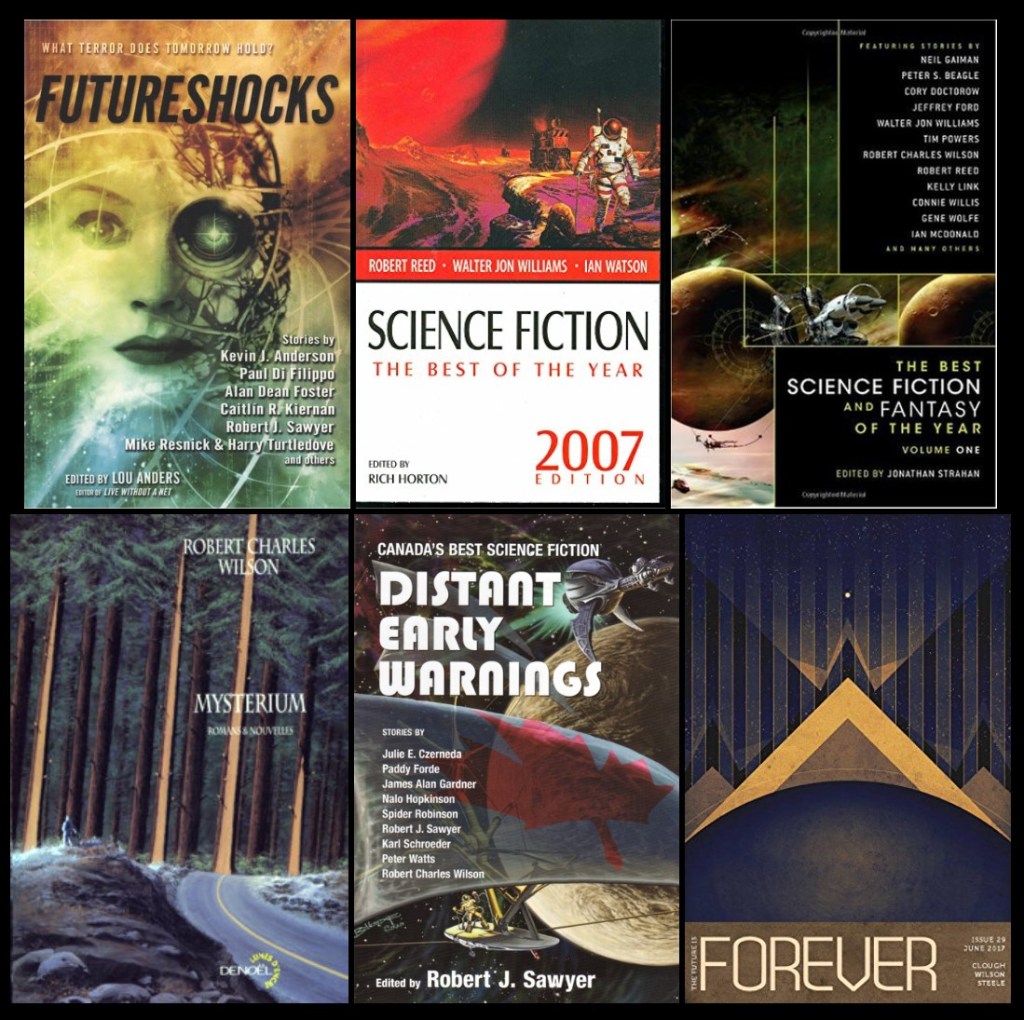
Today I read “The Cartesian Theater” by Robert Charles Wilson for our discussion group. That Facebook group is reading one story every Sunday from Science Fiction: The Best of the Year: 2007 edited by Rich Horton. I got a big kick out of “The Cartesian Theater” and wanted to hear it on audio. But when I went looking for an audiobook that included it, I couldn’t find one. Bummer.
My inner reading voice is nothing compared to the professional narrators who read audiobooks. I read “The Cartesian Theater” in Horton’s 2007 best-of-the-year anthology which I own in paperback. When I write about a story I like I want to help people find a copy to read. It’s always great when I can put a link to where it can be read or heard online. You can read the Horton anthology at Archive.org if you have set up a free account. You can read the Jonathan Strahan anthology for free if you subscribed to Kindle Unlimited. It’s $11.99 to buy that anthology for the Kindle. The one Wilson story collection shown above is a French edition. All those other editions will require tracking down used physical copies. For most people, this won’t be an easy story to find.
Most bookworms don’t read short stories, and short stories don’t make much money for publishers either. Short stories are a kind of training ground for novelists. Often when a writer becomes a success their short stories are collected, and even kept in print. And sometimes those collections have audiobook editions. If there was The Best of Robert Charles Wilson audiobook I would have bought it today. I would have also bought The Best of Charles Sheffield this week if it existed on audiobook. I did listen to my audiobook copy of The Best of Connie Willis twice this week to read “Even the Queen” and “Death on the Nile.” The narration was perfect for each, and I got so much more out of the story than when I just read them on paper.
The best narrators do voices for each character. That highlights the dramatic quality of stories that my inner voice doesn’t generate. But more than that, audiobooks are read much slower than my inner reading voice, sounding out every word, and that makes an enormous difference. When I read, I read too fast, often skipping words. I can’t help myself, I read too fast. I miss clues to what’s happening. Listening makes me pay attention to every word. And I’m very disciplined in my listening. If I miss something I hit the jump back button.
“The Cartesian Theater” is about a world where everyone lives on a guaranteed income and economic activity is driven by robots. People still make extra money, usually from creating something entertaining. (Picture everyone being a YouTuber or something like it.) In the story an anonymous rich person hires Lada Joshi to track down an elusive artist, Jafar Bloom, and offer to back a showing of his work with no strings attached. Joshi hires Toby Paczovski, an operative skilled finding people living on the dole who don’t want to be found. And then she had Toby find Philo Novembre, a retired philospher, to get him to attend the first showing of the “Cartesian Theater.” What Bloom has create is a device that proves something philosophical, something that science can’t prove. I don’t want to say too much.
Beside coming up with a nice gimmick for the premise of the story, Wilson creates an interesting setting, a setting that our world seems to be heading towards. AI and robots do most of the real work, pushing people onto the dole. The robots aren’t considered sentient. That’s the trouble with AI robots. If they ever become sentient we can’t make them our slaves. In Wilson’s society they seem to be on the cusp of awareness. Humans in this story also have a lot of smart technology that supplement their bodies. And in Wilson’s world, a certain amount of brain activity can be duplicated in machine. Toby’s grandfather is dead, but enough of his memories hang around so Toby can still talk to him. The whole story is a Cartesian theater. And it has a nice surprise ending I didn’t guess.
Is this story worth keeping in print? Should it be available for the Kindle and on Audible? I don’t know. Such publishing might be a money loser. Which short stories should be preserved? And which should we forget?
We also read “Georgia On My Mind” by Charles Sheffield which won the Hugo and Nebula awards for best novelette back in 1994. You’d think every award winner should be preserved. It is in a collection called Georgia On My Mind and Other Places which can be read on Archive.org or bought for the Kindle for $5.99. But no audiobook. It was originally published in the January 1993 issue of Analog.
I loved “Georgia On My Mind” even more than “The Cartesian Theater.” Sheffield uses a narrative structure that was common in the pulps before WWII, where a mystery is discovered in a far distant place on Earth. In this case New Zealand. The story is set in modern times. We seldom believe such mysteries are possible anymore. But in the old days, readers loved these setups where the story felt possible. In this case, in a rundown tool shed to an old farm house in a remote part of New Zealand, Bill Rigley finds pieces of Charles Babbage’s computer from the 19th century, along with old letters, and information about programming. The mystery is how did Babbage’s work get to New Zealand and why.
If you like a Weird Tales type of story, computers and computer history, and even a bit of recursive science fiction, then you should like “Georgia On My Mind.” I think Sheffield rush the story at the end. He should have kept the slow pace and followed through on the setup and made this story a novel. I dislike the title, but it fits the cutsy ending. However, I didn’t want a cutsy ending. Obviously, Sheffield didn’t want to write a whole novel, and wrapped up the story with a direct appeal to science fiction fans. I wanted a Weird Tales ending. Still, I got a big kick out of this story.
It’s sad to think these two stories will be forgotten. They just aren’t easy to find. I think what’s needed is for Audible to publish all the best-of-the-year anthologies, from 1939 to the present. That would put most great short SF in audiobook print. At least do the Asimov/Greenberg/Silverberg books covering 1939-1964. Then Wollheim from 1965 to 1990. The 14 Carr anthologies, and all the Gardner Dozois anthologies. Or get some young editor to create new anthologies for each year.
If Audible doesn’t want to keep best-of-the-year anthologies in print, I think they should at least put all the Hugo and Nebula winners and finalists in audiobook print. That would catch “Georgia on My Mind” but not “The Cartesian Theater.”
JWH
p.s. I haven’t been blogging as much lately. I’m just getting old and running out of energy. Finishing this short blog gave me a sense of accomplishment.
I’ve been on a vacation from reading science fiction but yesterday I read two SF stories to see if I wanted to come home. The first was “The Year Without Sunshine” by Naomi Kritzer published online at Uncanny Magazine. The second was “Detonation Boulevard” by Alastair Reynolds published online at Tor.com now called Reactor. The Kritzer story has won both the Hugo and Nebula awards, and the Reynolds story has the pole position in Best of British Science Fiction 2023 edited by Donna Scott.
What struck me about both were the gender generalizations I could make about each. I know it’s sexist to make generalizations about gender but how do you explain the differences I sense in post-apocalyptic books written by women and those by men?
“The Year Without Sunshine” is about a neighborhood that experiences a small, maybe temporary, apocalypse. The story is very readable, uplifting, moving, positive, and suggests people will cooperate to survive. It made me tear up many times. However, it ignores the common tropes of post-apocalyptic fiction that American men use in related stories where civilization collapses. In those stories it’s time to whip out the guns and go full auto on being Darwinian.
I felt “The Year Without Sunshine” leaned towards the feminine side of things because I enjoy the sub-genre of post-apocalyptic fiction, and the examples I can recall written by women are different than the ones I can recall by American men. I also sense a difference between American and British post-apocalyptic novels. Most American post-apocalyptic novels written by guys bring back the Wild West, usually with a Mad Max tone. Whereas many British post-apocalyptic novels could be called cozy catastrophes.
Examples of post-apocalyptic novels written by women that pop into my mind are Station Eleven by Emily St. John Mandel, Memoirs of a Survivor by Doris Lessing, Life as We Knew It by Susan Beth Pfeffer, The Age of Miracles by Karen Thompson Walker. A couple recent British post-apocalyptic novels that come to mind are The Hopkins Manuscript by R. C. Sherriff and Survivors by Terry Nation (the basis of a BBC TV show back in the 1970s).
Naomi Kritzer presents a view in her story that I feel is both feminine and more mature than most typical science fiction. She presents a realistic future with what I consider unrealistic hope. Alaistair Reynolds presents a completely fantasy future that’s squarely aimed at the stereotype story for boys.
While reading “The Year Without Sunshine,” which I loved, Kritzer’s male characters were too nice, even the ones that were supposed to be bad. I can’t but believe that they were how Kritzer hoped guys would act in her fictionalized situation. Unfortunately, tough times are when the true nature of males will come through. I’d say the 2023 film Leave the World Behind is more like how I predict things will happen, especially the scene when the characters played by Mahershala Ali and Ethan Hawke confront the Kevin Bacon character hoping to barter for medicine. That’s how men will be when they are still somewhat civilized and rational, but I also expect the real reality will be like The Road by Cormac McCarthy. In “The Year Without Sunshine” too many people readily want to help Susan, who has COPD, and either give or trade her canisters of propane to keep her oxygen generator going. I don’t think that would happen. But it is the way mature people should wish it will be.
I’m not criticizing Kritzer’s story when I claim some of her males act unrealistic in that situation. I have my fantasies and my speculations, and they are different from the kinds of science fiction I’ve read, and I believe because I’m male. I could be wrong, and people, all people will act more like Kritzer’s characters in such a real-life situation.
“A Year Without Sunshine” is immensely popular and loved. It’s the kind of story that readers of The New Yorker would have enjoyed too because it’s SF that’s relevant to today and to literary readers.
In “Detonation Boulevard” Alastair Reynolds gives us the boys fantasy of space travel. It’s a visually exciting story that would make an eye-popping science fiction film. Just study the above artwork for it from Reactor. Imagine a race under a sky full of Jupiter! When I was twelve, I would have loved this story and considered it thrilling. Cyborgs on Io, a moon of Jupiter, race gigantic moon buggies completely around its circumference. At 72, that seemed silly. Like Kritzer’s hopeful fantasy for how people should act when civilization collapses, Reynolds is a hopeful fantasy for the future when we can have car races all over the solar system. But it is also an unrealistic fantasy that ignores the reality of space exploration and ignores all the scientific extrapolations about the future of Earth. It’s what boys want, of all ages.
Without giving too much of a spoiler, I did like the mature insight of the older cyborg and how it tried to pass it on to the younger one. Reynolds offers us a twist near the end, but I thought it contrived for modern audiences.
I remember back in the 1970s there were several articles in mainstream magazines by major literary writers attacking science fiction for being immature, claiming the genre offered power fantasies for adolescent boys. Readers and writers in the genre were outraged and insulted, but there is a certain amount of truth in those attacks. It’s interesting at the same time those criticisms were being made Ursula K. Le Guin and Joanna Russ were publishing works that began to mutate the genre towards more maturity.
Back in the late 1950s, my sister Becky and I formed two clubs. She called hers the Please and Thank You Club for the girls on our street, and I called my club The Eagles club for us boys. “The Year Without Sunshine” would fit nicely in a Please and Thank You Club, while Detonation Boulevard” would fit in with the Eagles.
I’m currently reading My Brilliant Friend by Elene Ferrante and Rabbit, Run by John Updike while on vacation from science fiction. It’s interesting to compare the gender perspectives of their characters to those in science fiction. Ferrante begins her book with two eight-year-old girls whose perceptions of the world were far more mature than I was at that age. I know it’s sexist to observe differences in males and females, but whenever I read literary work by women writers, I’m described powers of observations regarding other people’s emotions that I’ve never had. I saw that in Kritzer’s story too, but not Reynold’s.
It’s like trying to imagine how dogs perceive the world through smells when their sense of smell is thousands of times more powerful than ours. I can’t help but believe I am blind to things that women can perceive. Sure, it could just be me. And sure, it’s possible that plenty of males have this skill too, or plenty of females don’t. There are people who have theorized that Elena Ferrante could be a male. She has kept her identity secret. However, most of her fans hate that idea because they consider Ferrante such a perfect example of female perception. I guess it’s theoretically possible for a male writer to perfectly imitate the best female writer – but I doubt it. Reynolds tries to portray a female character in his story, but I don’t think he even came close.
I have heard, in person, and online, many males criticize the state of modern science fiction bellyaching that women writers have taken over and changed the genre. The genre is constantly evolving, and improving, and I think it’s possible that some of those improvements are due to female insight. But what has gone missing that the males want back?
Unfortantely, I think it’s what was bad about science fiction, something I once loved, and something that only a few girls admired at the time. Part of it is illustrated by “Detonation Boulevard.” And that is the immature childhood dreams of science fiction. We just don’t want to grow up, and that’s the old style science fiction that guys mostly loved, and some girls did too, both now and then. That quality is irrisistable fun and make believe. It’s why Transformers were so popular. It’s why the comic book culture has gained appeal with all ages and genders. It’s why we don’t want to grow up and adolescence now extends for decades. It’s why people are addicted to video games and crave virtual reality. Science fiction was always the 12-year-old boy’s daydreaming come true. It’s also why young wives want to divorce their immature husbands. However, that immaturity of story action is widely popular, even with girls and women.
But it ain’t helpful for growing up in a the real world. It doesn’t matters in a story like “Detonation Boulevard,” but it does in stories like “A Year Without Sunshine.” That story has no alpha males, no assholes that demand or take what they want. And those kind of guys will show up with things fall apart. It had a couple of teens that lamely tried to take what they wanted, but that made the story somewhat less realistic. There’s also a different between vicarious violence for fun, and fictional violence that portrays the real world.
I guess I’m making a case for more realism in science fiction. I think young people, of either gender, want less realism. But isn’t it the realistic details of “A Year Without Sunshine” that made it worthy of a Hugo and Nebula? To make his story somewhat realistic, Reynolds had to have cyborgs rather than humans. But wouldn’t two AI robots competing on Io been even more realistic, more gritty, hard, and believable, especially if we were shown how their knowledge and ability to perceive reality was hundreds of time more powerful than human beings? Robots are perfect for Io, we’re not. We still want to be the heroes of space exploration, but I don’t think we will.
I’m also listening to the audiobook of A City On Mars by Kelly and Zack Weinersmith. It’s subtitle is: Can We Settle Space, Should We Settle Space, and Have We Really Thought This Through? Kelly Weinersmith is a professor of biosciences and she takes a long hard look at the final frontier dream. Her husband Zack illustrates the book. On the dedication page she writes:
The book brings realism to the dreams of science fiction and space enthusiasts. Even pointing out some harsh truths, I think the Weinersmiths are still overly optimistic. I’ve been reading widely on the possibilities of space exploration and the limitations of what we have to work with leave little room for what science fiction has dreamed. But even if technology could give us the colonization of Mars, only delusional people will want to live there.
I know it’s sexist to say women writers have something to offer that is unique to them, but I think we need their gender’s perspective. But I also think even more, we need more maturity of the kind they have. Maybe I’m too old to be reading a children’s literature. Maybe it’s unfair to be inside stories for children expecting more grownup’s perspectives.
When I read these two stories this weekend I felt I was reading the fantasies from two different genders of young people, stories for girls and boys. Two stories that imagined a positive future, although one was more realistic and mature than the other.
Sure, my sample size is two, but they’re consistent with many other science fiction stories I’ve read. Personally I think the genders are no closer in understanding each other than the Democrats and Republicans, and that all youth, and most adults have a grasp of reality that’s only slightly superior to reality TV. We just aren’t a rational species. Most people accept that fantasy and science fiction are merely ways to pretend, especially for children, but I believe what we pretend, especially as children, says something about how we will think when we grow up.
Both “A Year Without Sunshine” and “Detonation Boulevard” are good stories. I just enjoyed “A Year Without Sunshine” a great deal more. Is it sexist of me to say I like it more because it offers a female perspective I don’t get in post-apocalyptic tales written by males?
If you disagree that there is a difference go read “A Boy and His Dog” by Harlan Ellison, and then read “A Year Without Sunshine.” I can’t find an online copy, but here’s an audio reading at YouTube. It also won a Nebula award, and was nominated for a Hugo. I can’t believe Ellison hasn’t been canceled because of this story. You might have it in one of these anthologies. I can’t believe I once admired this story – it’s truly repellant.
“Enchanted Village” by A. E. van Vogt has been extensively reprinted. It first appeared in the July 1950 issue of Other Worlds Science Fiction. I just read the story in Possible Worlds of Science Fiction edited by Groff Conklin. I first read it in The Great SF Stories 12 (1950) edited by Isaac Asimov and Martin H. Greenberg several years ago, although today, I had no memory of reading it before. I can’t tell if it’s a forgettable story, or I’m just forgetting everything.
Bill Jenner is the lone survivor of the first mission to Mars after his rocket crashes. Jenner crosses hundreds of miles of Martian desert on foot with just a bit of food and one bag of water. Jenner thinks he’s saved when he stumbles upon a deserted alien village.
The story is nicely told. Who doesn’t love a Robinson Crusoe type story? Isn’t that why The Martian by Andy Weir was a bestseller and blockbuster? “Enchanted Village” takes a left turn though, one that reminds me of Solaris by Stanislaw Lem. It’s amusing how A. E. van Vogt anticipated so many modern science fiction stories (Forbidden Planet, Star Trek, Alien, etc.).
Jenner eventually realizes the village is an organism or machine, even an intelligent one, and he must learn to communicate with it. The village produces food automatically in low troughs but is poison to Jenner. Through a series of observations Jenner discovers the village could make food for him, but he doesn’t have enough human food for it to model.
Now here is where you should leave this essay if you don’t want spoilers.
“Is it possible?” is the number one criterion I use to define and judge science fiction. All too often science fiction readers are given magic rather than honest speculation. There is nothing wrong with magic in a story if you enjoy fantasies, but the belief in magic is why our species never grows up. To me, fantasy is the fentanyl of fiction. It will make you feel great, but eventually, it will kill you.
The surprise ending of “Enchanted Village” is when Bill Jenner dies, he wakes up to discover he’s a kind of creature that can consume the nourishment the village provides. Bill Jenner is reborn. We are not told how. We are not told anything, but that Jenner now has sharp teeth and a snout allowing him to slurp up the alien food. I pictured the reborn Jenner looking like a lizard creature, suitable for the dry Martian desert.
The alien village is like Jesus, or other deities that tell us to accept them and be saved. Van Vogt’s use of the word enchanted should have warned us this was a story about magic. I don’t know if van Vogt was intentionally parodying religion, or he just needed a quick ending to sell a story. It’s interesting to compare “Enchanted Village” to “A Martian Odyssey” by Stanley G. Weinbaum. That story has strange aliens that accomplish bizarre feats, but I believe it’s within the realm of possibility, and honest science-fictional speculation.
Even with my criticism, I enjoyed the story. It’s the old fashion kind of pre-NASA science fiction I’ve always liked most. But then, science fiction was my substitute for religion. I wanted to believe in the fantasies that science fiction sold me. If we could only fly beyond the Earth, they would all come true. I never really wanted to grow up in Earthly reality but be reborn in outer space. I’ve always known that science fiction was just storytelling, but it did leave me with a kind of secret hope that I should have ignored. There’s a reason Marx said religion was the opiate of the masses, it’s because it makes us want to believe in magic. There’s a safe kind of making believing while turning pages, but if you let science fictional beliefs go beyond them, they can be dangerous.
If you think I’m being silly, read “Racked by Pain and Enraptured by a Right-Wing Miracle Cure” from yesterday’s New York Times. It’s quite moving, and I feel deserves some kind of journalism award. These people hope for a science fictional cure, ones I’ve seen in science fiction stories.
I’m getting worried that I’m becoming too critical of science fiction, and I should stop reviewing it. I don’t want to come across as a downer. I know science fiction should be judged just on its merit as a story, but I can’t help but evaluate it psychologically and philosophically as a kind of hope for the future. I assume my growing doubts and rejection of SF is because I’m getting older and thinking about how things have impacted me psychologically.
I’ve become overly critical of science fiction lately, and that worries me. Too much of what I read feels childish, simplistic, and obvious. I mentioned this to my friend Mike, and he pointed out that most of science fiction isn’t particularly good, and that’s true of all forms of literature, not just science fiction. That reminded me of Sturgeon’s Law — “ninety percent of everything is crap.”
I started thinking about that. When you’re a kid, the first ten science fiction books you read are all fantastic. But as you get older, you start encountering books that aren’t as exciting. As we age, we become more discerning, and eventually jaded. That’s my problem, I’m old, jaded, and have read too much science fiction. Every new story I read must live up to all the best science fiction stories I’ve ever read.
I think we need to amend Sturgeon’s Law. It needs a sliding scale. When you’re young, 10% is crap. In middle age, it might be 50%. However old Sturgeon was when he made his law, it was 90%. But at 72, I feel it’s 99%. And that’s depressing me.
Mike also gave me the solution. He said he and his wife are rewatching their favorite movies because many films they were trying were disappointing.
Because I’m in a short story reading group on Facebook, I’ve read about fifteen hundred stories in the last four years. I’ve just ODed on SF. Obviously, I need to cut way back on my sci-fi reading, explore other kinds of reading, and when I do read science fiction, read, or reread, the classics. Focus on what’s good and stop trying to read everything in the genre.
The reality is I’m getting old and don’t have that much reading time left, so why not concentrate on the best? I also need to explore new reading territory. I’m currently reading Volume 11 of The Story of Civilization by Will and Ariel Durant. I started with the last volume simply because it was on sale at Audible. I know practically nothing about European history, so it’s extremely fascinating. I’m supplementing the book with The Great Courses lecture series: Living the French Revolution and the Age of Napoleon, taught be Suzanne M. Desan, Ph.D. Professor, University of Wisconsin, Madison. I access The Great Courses Plus through Amazon Prime for $7.99 a month.
What I’m learning is blowing my mind, kind of how I felt when I first discovered science fiction. The I-should-have-had-a-V8-slap-to-the-head takeaway here is “It’s new ideas stupid.”
And that’s my real problem with being old and having read too much science fiction. I seldom find something new in the genre anymore. I need to give it a rest. I can’t give it up completely, so I’m going to concentrate on studying the classics. Go deep instead of chasing novelty.
This will have a positive side effect. I need to thin out my book collection. That’s another thing about getting old. A lifetime accumulation of junk starts to become a burden. I’ll keep the classics and jettison the rest. This reminds me of Destination Moon, an old science fiction film from the early 1950s. A crew on the first rocket ship to the Moon uses up too much fuel on landing and can’t take off again. The solution is to jettison everything they can, including space suits, and even the radio to reduce their mass to match the fuel that is left. That’s a great metaphor for getting old. It gets harder and harder to take off. The solution is to lighten the load.
“Another Word for Map is Faith” by Christopher Rowe first appeared in the August 2006 issue of The Magazine of Fantasy and Science Fiction. You can read it here and listen to it here. I’m not sure if I would call this story science fiction or fantasy, but it’s a “What if the power of faith in Jesus were real and scientists from different scientific disciplines were disciples” kind of story. The story attempts, I believe, to surprise us like “The Nine Billion Names of God” or “The Star” by Arthur C. Clarke, and Philip Jose Farmer’s “Sail On, Sail On.” However, the surprise was a letdown for me, yet the story does have a neat religious take on things.
“Another Word for Map is Faith” is about a young geography professor named Sandy and a group of her graduate students who are out in the field studying cartography. Their faith in Jesus tells them that Jesus wants geography to match the maps they have in old books. That is a neat metaphor for those who believe in the literal interpretation of The Bible.
Evidently, society has suffered some kind of collapse. It doesn’t seem to be from war or disease, in fact, it might be due to the balkanization of Christianity, where diverse groups feel that Jesus intended something different. I don’t know if “Another Word for Map is Faith” is an antireligious story, or just a religious idea expressed in a story.
This story is all about its speculative ideas with little characterization, setting, or worldbuilding. I wish Rowe had fleshed out the conflicts between the different believers in Jesus rather than depending on a surprise ending. I’m surprised our current society isn’t more segmented by what the faithful believe — just remember all the religious wars of history.
I wanted “Another Word for Map is Faith” to be more literary to make the story more valuable. The ideas are good, but the presentation isn’t strong enough to make it memorable. Contrast it with “Servants of the Map” by Andra Barrett. Unfortunately, I can’t link to that story to read online. However, you can use the “Read sample” feature at Amazon to read the first several pages to get an idea of how the writing differs from “Another Word for Map is Faith.”
Here are samples of how each story opens. First “Another Word for Map is Faith” and second “Servants of the Map.” Both stories are about surveyors in an exotic location. Both are concerned with maps. Both involve a mystery. Rowe’s prose is nice enough but lacks the richness of Barrett’s. Barrett has more concrete details, and that makes an enormous difference. I don’t mean to be too hard on Rowe. My main complaint about science fiction is it focuses too much on a science fictional idea and not enough on giving the story the texture of reality. Both stories are a kind of fantasy. However, Barrett makes her made up tale more realistic with the increased density of significant details.
I read this story because my science fiction short story group is going to discuss it soon. Unfortunately, “Another Word for Map is Faith” only reinforces my current dissatisfaction with science fiction. The story isn’t bad at all for what’s being published within the science fiction genre. It was anthologized in three of the best-of-the-year anthologies. But it is no match for literary work like “Servants of the Map.”
There is nothing wrong with science fiction, but if you only read science fiction and fantasy, you’ll miss the full spectrum of what fiction can produce.
I’ve been trying to lay off science fiction for a while, but I haven’t gone completely cold turkey. Every once in a while I’ll open an anthology and try reading a story to see if any are worth returning to my addiction. Time after time I’ve only found watery beer and went back to literary fiction and nonfiction. Today I read “The Alley Man” by Philip José Farmer. That story is pure SF heroin, you can shoot it up here.
“The Alley Man” is a masterpiece. What’s ironic is it may not even be science fiction or fantasy. Like most great fiction, it’s ambiguous. Old Man Paley may or may not be a Neanderthal. He may or may not be immortal. He is one ugly dude who lives in a shanty at a dump with two old women way past their prime. The June 1959 cover illustration of the story in The Magazine of Fantasy and Science Fiction is misleading. Paley only has one arm, having lost the other arm in an epic battle with Cro Magnon men, or a railroad accident.
“The Alley Man” is lovely character development and storytelling. The story has a prose density that most science fiction stories lack. There is great complexity in Old Man Paley. I remember reading this story decades ago, when I was a science fiction true believer, so I assumed Old Man Paley was immortal. But with this reading I realized that Farmer had something far more multiplex in mind. I consider “The Alley Man” on par with “Fondly Fahrenheit” by Alfred Bester, “Coming Attraction” by Fritz Leiber, and “The Moon Moth” by Jack Vance.
Why did I like this story so much, when so many other science fiction stories have been a disappointment to me? I really enjoyed the characterization and prose. But I also liked the fact it was set on Earth and in the present. Even though it was published in 1959, it still felt like it could have happened in 2024. It wasn’t about the future, space travel, aliens, or robots, which I feel are themes that have been over-explored in SF.
“The Alley Man” makes me want to read more short fiction by Philip José Farmer.
But for now, I’m going back to the short novel I was reading, Gentlemen Prefer Blondes by Anita Loos, a 1925 comic novel. I’m not ready to go back to a steady diet of science fiction just yet, but I will sample it from time to time.
I got the idea to read Gentlemen Prefer Blondes from this YouTuber.
I was going to take a break from reading Dangerous Visions because it was depressing me, but I found “A Toy for Juliette” a fitting inspiration for a sermon I wanted to write. I’ve been reading Golden Multitudes: The Story of Best Sellers in the United States by Frank Luther Mott, which inspired me to buy and start reading The Sentimental Novel in America 1789-1860 by Herbert Ross Brown. Both books give impressions about how Americans, and I presumed other people around the world, got into reading fiction.
Printing began in the 15th century at a time when most people didn’t read. Storytelling has been around since we lived in caves. Although there were works in Japan and China that could be called novels long before the printing press, in Europe and America, the novel seemed to emerge with Don Quixote in 1605. What we think of as the modern novel matured in the 18th century.
Frank Luther Mott’s book, Golden Multitudes describes the kind of books people read in America before Ben Franklin printed Pamela by Samuel Richardson in 1745. Some considered Pamela, first published in England in 1740, to be the first English novel. Before this novel, Americans mostly read books on morality. The colonies were settled by various religious groups, so that’s kind of logical. Mott says the first American bestseller was The Day of Doom by Rev. Michael Wigglesworth. It was written in verse, and it was all about the horrible things that would happen to people in hell. The excerpts and quotes Mott gave from this poem made me think early Americans were fixated on horror.
To keep this sermon short, I need to cover the following decades quickly. Fiction slowly emerged out of all this moralistic reading. Another bestseller was The Pilgrim’s Progress from This World, to That Which Is to Come by John Bunyan in 1678. This book is an allegory that begins with a dream. But the point is, Bunyan spiffed up moralizing with a story and characters.
Pamela became a huge bestseller in America and Europe after 1740 because Richardson made moralizing every more entertaining. One reason Pamela is given credit for being one of the first English novels is because Richardson invents a lot of storytelling techniques we use today. After the success of Pamela countless imitators began producing similar type stories, and the focus on moralizing became less, and the shift to pure storytelling became common.
At that time, many intellectuals began protesting, claiming fiction was corrupt and corrupting. Magazines and newspapers ran articles about how fiction was ruining young people’s minds, especially young girls. That made me think about how people worry about smartphones and video games corrupting young people today. But those fiction protesters were crushed by bookworms wanting more fiction.
By the time the 19th century rolled around, especially after Edgar Allan Poe, many stories became free of moralization. Kids and adults devoured fiction about violence, horror, the supernatural, and other evil things in the world. Which is why Robert Bloch is a popular writer, and why people enjoy stories like “A Toy for Juliette.”
The problem is I don’t. I don’t like horror. And I can’t understand why other people do. Although Susan and I are currently watching Why Women Kill, which could be described as comic horror. Fiction writers have a tough time producing stories that don’t involve the horrible aspects of life. Fiction is often an art form about the ugliness of humanity, but isn’t the best fiction about transcendence of those horrors?
I quite enjoy reading Pamela. I’m only about half finished, but then the book is over forty hours long on audio. I admire Richardson for embedding his moral lessons into his story. The story is about 15-year-old girl servant efforts to avoid being raped by her employer. On one hand, the novel could be considered a handbook for girls warning them about all the ways guys will trick them into having sex. On the other hand, it’s rather entertaining to read about all the schemes Mr. B used to seduce Pamela. The novel is also entertaining because I’m watching Richardson invent plotting and characterization.
When reading “A Toy for Juliette” I was seeing the refinement of centuries of storytelling. But Bloch completely ignores moralizing. He returns to the purity of telling gruesome stories around a campfire. However, I miss moralizing. Bloch makes no effort to explain the psychology of Jack or Juliette. He makes no moral judgments on their actions. He just accepts that those kinds of people exist.
Sociologists claim there is no correlation between the consumption of violent entertainment and committing violence, but I find that hard to believe. But then, from Harlan Ellison’s introduction about Robert Bloch, he seems like a very nice guy — kind, considerate, and generous.
Maybe, “A Toy for Juliette” depresses me because it reminds me that there are people like that in this world. And it bothers me that people find stories about such people entertaining. But as I admitted, Susan and I found a comedy about murder fun. And even the Puritans, with all their emphasis on living a pure life, sure did love to read about the gruesome aspects of going to hell.
Back in the 1960s, I learned from health food nuts, “You are what you eat.” And from computer school I learned GIGO – garbage in garbage out. I can’t help but wonder if those 18th and 19th century pundits who attacked fiction weren’t right. Why should we pollute our mind with a story about a sadist being sadistically killed by another sadist? I guess I could claim Bloch was preaching that we reap what we sow, but I don’t think it’s true. I think people enjoy seeing Juliette get ripped by the Ripper.
Still, I find “A Toy for Juliette” a virus in my mind. I find reading nonfiction about the horrors of humanity enough of an education about the reality of humanity. Why do we want reminders of such horrors in our escapism? But we do. Think about all the fiction you consume. How much of it involves acts we’d be terrified of if they happened to us? Why do we dwell on the horrible?






 Classics of Science Fiction