This morning, I read an email from a discussion group that mentioned Fitz-James O’Brien (1826-1862). You can sample his fiction at Project Gutenberg.
One member posted a link to a review of a new three-volume collection of his stories at The New York Review of Books. The review implied that O’Brien is little known, but several folks in the group quickly claimed they knew who he was. But that’s logical, our group is devoted to fiction in old magazines. I’ve even read some of O’Brien’s stories because they show up in science fiction anthologies, and I collect those. (See my post on 19th Century Science Fiction Short Stories.)
But this got me to thinking. How many people would know who Fitz-James O’Brien and read any of his stories? Then I asked myself, how many people read short stories? And of those, how many read old short stories? It’s one thing to read the short story in the latest issue of The New Yorker, and it’s another thing to read short stories originally published in the 19th century. Yes, some people still read Edgar Allan Poe, but how many outside of school?
I’ve always been a fan of science fiction magazines. When I was young, some of the top titles had over 100,000 subscribers. Over my lifetime, I’ve watched their subscriber base dwindle to well below 10,000.
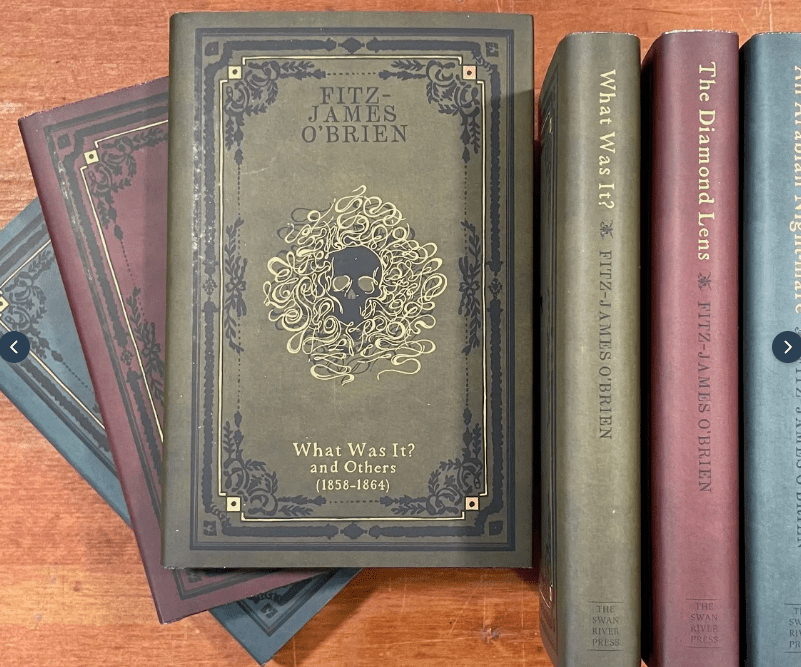
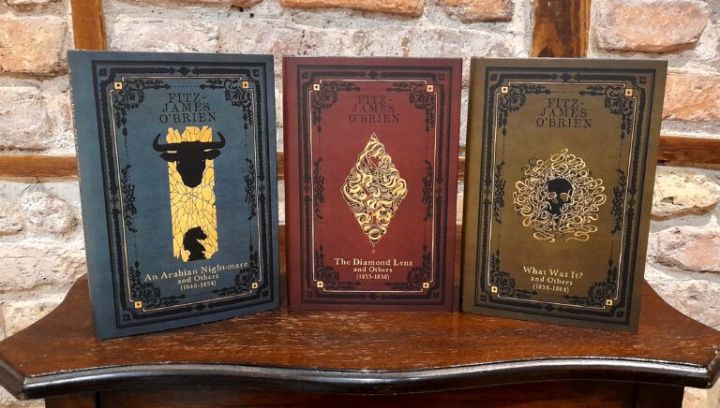
It appears the three-volume Collective Speculative Works by Fitz-James O’Brien will be limited to 300 copies. Does that mean the publisher thinks fewer than 300 people in the world are interested in reading O’Brien’s stories? Or that some kind of marketable ploy? I don’t know. 300 is 0.0000036% of the world’s population. That’s one tiny subculture!
Almost half of the respondents haven’t read any books in over a year: 48.5%
Print books were the most read books: 35.4%
The 65+ age group recorded the highest population of print book readers: 45.1%
The 45-54 age group contains the highest population of non-readers: 60.9%
Males recorded a slightly higher population of non-readers compared to females: 51.4%
The article reported that the Pew Research Center found that 64% of Americans read at least one book in the previous year. That’s a lot more than I expected, and it disagrees with their own poll.
This suggests there are many kinds of readers, and that made me speculate about possible names to give different types of readers. I’m not very good at creating fun labels, but here’s my lame attempt.
Non-readers (0 books per year)
Casual readers (1-11 books per year)
Steady readers (read a book a month)
Bookworms (read a book a week)
Super Bookworms (read two or more books a week)
This doesn’t say anything about the kinds of books they read. Someone who reads over a hundred books a year might never encounter the name Fitz-James O’Brien. In one of my older essays, I speculated that the average reader could not list more than one hundred titles from novels from the 19th century. And I listed the hundred I thought would be the most common. I doubt most people would come even close to recalling one hundred titles from the 19th century.
Outside of people I know in my discussion groups that specialize in old fiction, I doubt I have ever met anyone in my life who has read a story by Fitz-James O’Brien.
What possible name could we give to people who do? Bookworm is the tag that most people give to obsessive readers. But for every 1,000 bookworms, is there even one who reads old short stories from the 19th century? I know a fair number of people like me who love science fiction short stories from the 20th century, and I also know a smaller group who love short stories published in pulp magazines (mainly from 1900 to 1950). But how many people are we talking about? I asked CoPilot, and it estimates that the number is below 20,000 for people who read and collect old pulp fiction. That’s .0059% of the current U.S. population.
Would the word aficionado apply here? Here are some other words that CoPilot helped me find. Maybe we could use each for a different type of reader.
Aficionado
Enthusiast
Devotee
Connoisseur
Curator
Archivist
Bibliophile
Esotericist
Antiquarian
Obscurist
Archaeologist
We could use all these words to describe someone who would buy Collective Speculative Works by Fitz-James O’Brien.
At one time, I would have ordered this set. However, I’ve now reached an age where I’m trying to get rid of books rather than collect. But that set does call to me. Actually, what I would really like is digital scans of the periodicals where his stories were first published. I’ve collected scans of most science fiction magazines from the 20th century, but have next to nothing from the 19th century on my hard drive.
How many people are like me who love reading old magazines?
I’m sure it’s less than .006% of the population. What nickname would you give to such people? My wife would probably say, “A nut.”
Humans have created artificial realities long before computers. I define artificial realities as cognitive models that claim to describe reality that have no basis in reality. In crude terms, it’s shit we make up, believe to be true, act like it’s real, but isn’t. I like Philip K. Dick’s definition of reality: “Reality is that which, when you stop believing in it, doesn’t go away.”
Science fiction has created a number of artificial realities we hope will become real. One desire is for a galactic civilization, or galactic empire. Often with artificial realities we try to make them real. For centuries traveling to the Moon was an artificial reality. Then it became real on July 20, 1969.
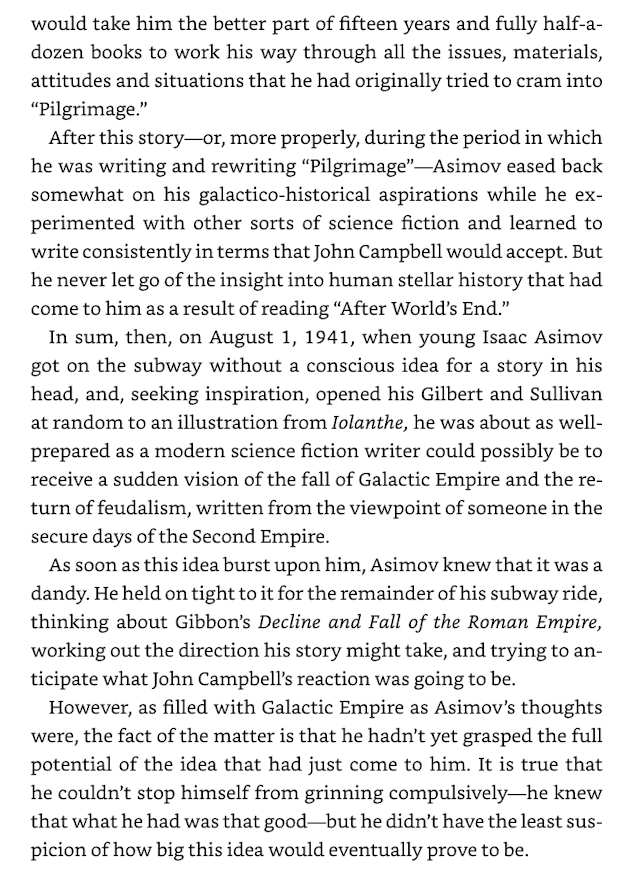
When I read “Foundation” by Isaac Asimov I wondered if he was ground zero for the idea of a galactic empire? I knew there was earlier science fiction stories that imagined the galaxy occupied by other intelligent beings. And there were stories about humans exploring the galaxy, and even having wars with other intelligent beings. But had any writer imagined humans colonizing the entire galaxy?
Today, that idea firmly exists as an artificial reality in our culture. Many people assume in the future humanity will spread across the Milky Way. It’s a kind of faith. We see it especially in Star Trek and Star Wars, but also in books like the Culture series by Iain Banks.
Like any artificial reality, I assume one person got the ball rolling. Was that Isaac Asimov? Like all the famous explorers looking for the source of the Nile, I wonder if I can find the source of galactic civilizations or galactic empires.
The oldest surviving artificial realities are myths and religions. Artificial realities start in one mind as ideas, and are spread as memes. Each person who spreads the memes mutates the artificial reality slightly. That’s why there were many forms of Christianity in the first century, and why they are so different from all the forms of Christianity in the twenty-first century. Reading books about the origins of Christianity or how the Old Testament came into being is a black hole of fascinating research.
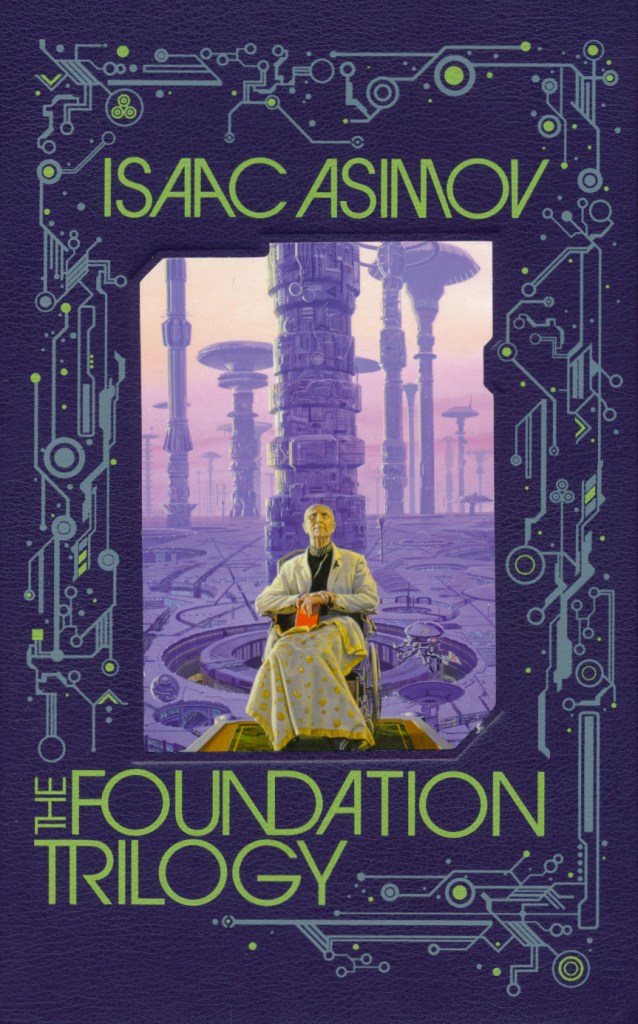
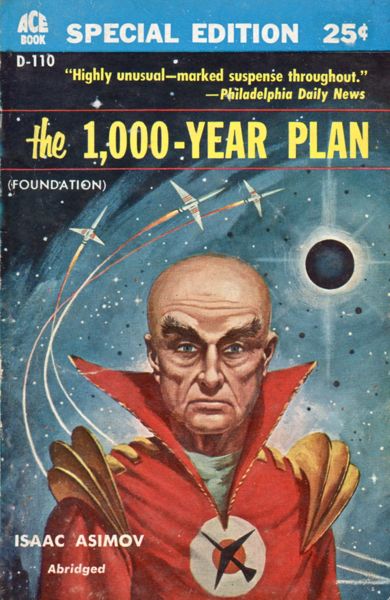
In 2015 and 2025, I tried to reread The Foundation Trilogy. I’m embarrassed to admit this, but I just hated that much-loved science fiction classic. In both attempts, I couldn’t get past the first book. All I could focus on were its flaws.
That bothered me. Was I being unfair to the book? What was I missing that so many readers found in this story? When Paul Fraser came up with a great idea for a group read at the Best Science Fiction and Fantasy Short Fiction Facebook group, I decided to give the trilogy one more chance.
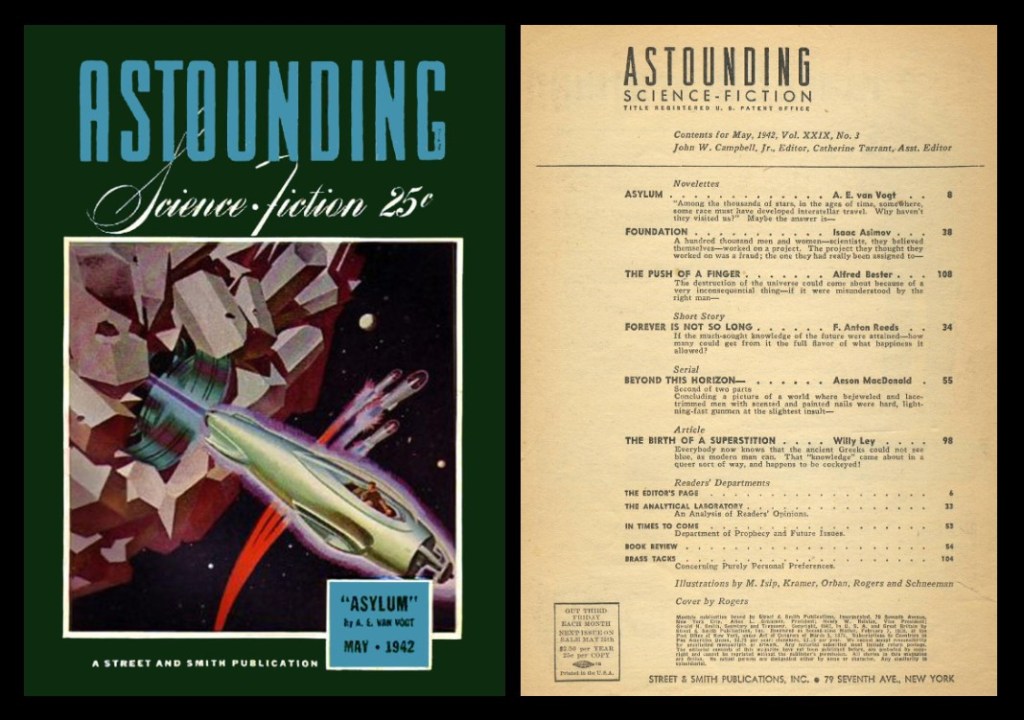
Paul suggests we read The Foundation Trilogy as it was originally published in Astounding Science-Fiction back in the 1940s. That gave me an idea. I would read the stories in the order they were published. I would seek to enjoy them as the fans originally did, as they were published one by one in Astounding Science-Fiction. Furthermore, I would try my damndest to get what Asimov was doing.
Wikipedia nicely lays out the publication history of the Foundation Trilogy in this table:
Collections
Astounding Science Fiction
Published
Book title
Story retitle
Original title
Published
Original trilogy
1951
Foundation
“The Psychohistorians”
—
“The Encyclopedists”
“Foundation”
May 1942
“The Mayors”
“Bridle and Saddle”
June 1942
“The Merchant Princes”
“The Big and the Little”
August 1944
“The Traders”
“The Wedge”
October 1944
1952
Foundation and Empire
“The General”
“Dead Hand”
April 1945
“The Mule”
“The Mule”
November 1945 December 1945
1953
Second Foundation
“Part I: Search by the Mule”
“Now You See It…”
January 1948
“Part II: Search by the Foundation”
“…And Now You Don’t”
November 1949 December 1949 January 1950
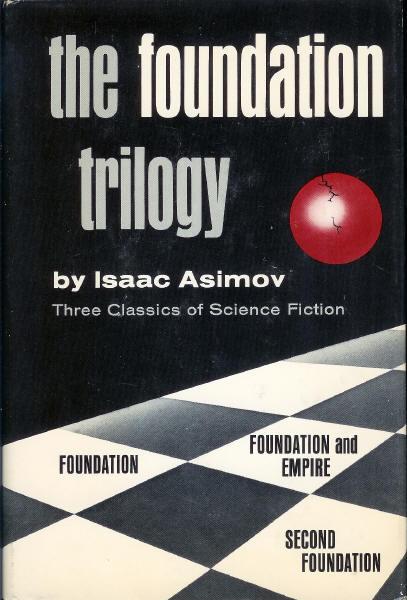
In the 1960s, I read The Foundation Trilogy when I bought the one-volume edition from the Science Fiction Book Club. At the time, I was unaware that many of the classic science fiction stories I was reading in book form were first published in magazines. Nor did I know about the concept of the fix-up novel. I didn’t question what I read. I just consumed it. (I recently wrote about this in “Reading at 13 vs. 73.”)
I can remember how thrilled I was by the first story, “The Psychohistorians,” which was set on the planet Trantor. And I liked all the pseudo-encyclopedia intros. The other stories didn’t stick with me. I remember the trilogy as an epic idea and visualized Trantor and Terminus existing in a galaxy with humans living on twenty-five million worlds.
In 2015, I reread Foundation, the first book in the trilogy. By then, I knew all about pulp magazines and fix-up novels. Foundation was obviously five separate, standalone stories. The first story was again impressive, the second was still interesting, but the rest were tedious. I was shocked that this famous book was so annoying to read. I gave it one star on Goodreads. I didn’t go on to reread the other two books.
Over the years, I’ve talked to so many science fiction fans who loved The Foundation Trilogy. It was the first series to be given a special Hugo Award. Recently, I watched a YouTube video about the Top 20 SF Series, and The Foundation series came in fourth. (Really, it was second after Dune. #1 were Star Wars books, and #2 were Star Trek books, and I don’t consider them a proper SF series. The host said that 20 million copies of The Foundation series have been sold.
So, why don’t I like it? And why did so many people love it? Was it because it first instilled the artificial reality of galactic civilization into their minds? This made me wonder if I could put myself in their shoes as they read the Foundation stories.
To get into the character of a 1940s science fiction fan, I intentionally skipped the first story in the book. I began my reading with “Foundation” from the May 1942 issue of Astounding Science-Fiction. I wanted to feel like I was living back in 1942, encountering the series for the first time. To see if Asimov rewrote the story for the hardback, I read the magazine with my eyes, but listened to the story with an audiobook edition.
In creative writing classes, we’re urged to start our stories in the middle of the action to avoid boring the reader with introductory material. This is exactly what Isaac Asimov did. However, when Asimov published Foundation as a book, he wrote an introductory story, “The Psychohistorians.” Out of the nine short stories, novelettes, and novellas in the Foundation Trilogy, “The Psychohistorians” was my favorite.
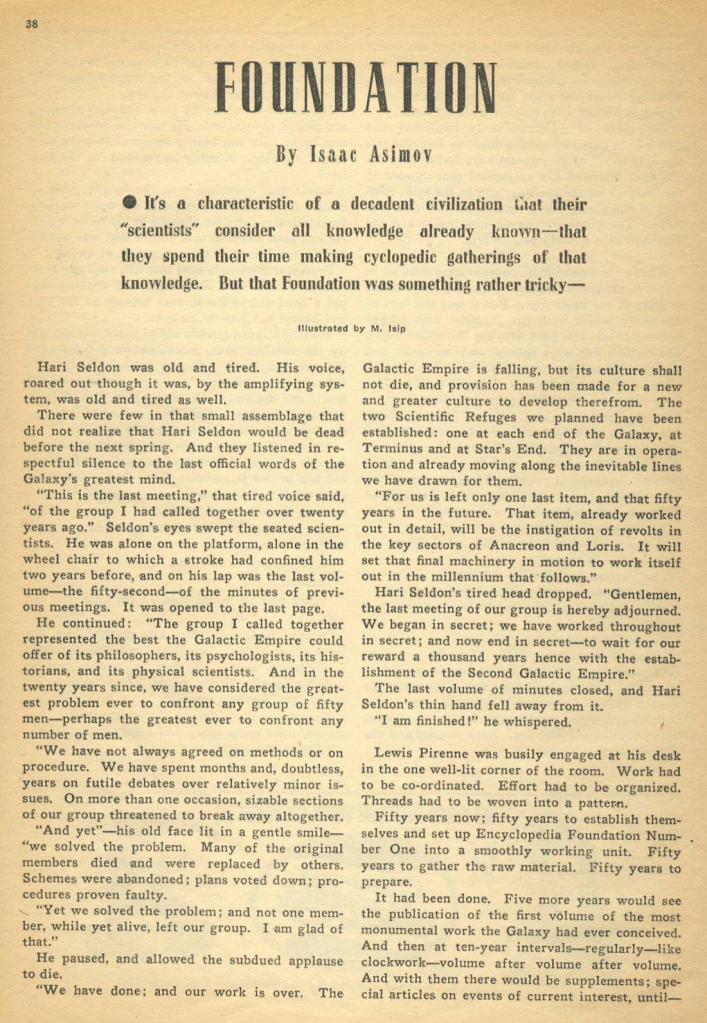
Asimov opened “Foundation” with this introduction on the first page. This is how we learn about Hari Seldon and his plan. This is how the series began in 1942, in just thirteen short paragraphs. We never see Trantor or meet Gaal Dornick. Our first real character is Salvor Hardin. In the book form, “The Psychohistorians” replaced this intro.
Most readers assume Asimov had just become a better writer by the time he wrote “The Psychohistorians” for the hardback. I’m not so sure. I feel I loved “The Psychohistorians” so much more because the Empire was more interesting than Terminus. Trantor is far more fascinating than any other setting in the trilogy. Asimov has claimed that the series was inspired by his discussions with John W. Campbell, Jr., and reading The History of the Decline and Fall of the Roman Empire by Edward Gibbon. But be honest, don’t most people love reading about Rome in its glory days?
As a young reader in the 1960s, I remember being blown away by the idea of a galactic civilization. But the stories of its fall didn’t make a lasting impression on me. I’m not sure, but I believe I read The Foundation Trilogy before seeing Star Trek in 1966. It might have been my first introduction to the idea of a galactic civilization. Was it to readers back in the 1940s?
To get into the spirit that I wanted to achieve, I need to forget all of this. I need to put myself back in 1942. I’d be reading the May issue of ASF just five months after the U.S. declared war on Germany and Japan. Let’s imagine I’m in the golden age of science fiction, and I’m 12 years old. How would “Foundation” WOW! me?
If you read Hari Seldon’s speech above, we don’t get what the empire is like. We only learn that it’s collapsing. The only empire I might have known about at that age in 1942 was the British Empire, due to watching Gunga Din. I doubt I would know anything about Rome.
I guess that I, and other readers, would have gotten a strong sense of wonder rush thinking about the galaxy being populated by humans. But was that a new idea? Is there any way to find out? I thought I’d poke around and see.
With this issue, Isaac Asimov launched his monumental “Foundation” series with the appearance of the initial novelette of the series, “Foundation.” After tens of thousands of years the Galactic Empire had spread to millions of worlds throughout the galaxy, its power all but absolute, its influence all pervading. The Empire, however, was on the brink of collapse and, with the impending collapse, the universe could be expected to be plunged into at least thirty thousand years of anarchism and barbarism. Hari Seldon, through the application of psychohistory which enables him to predict the future course of history by the interpretation of statistical laws as derived from the inconceivable mass of humanity, foresees this imminent fate of civilization and takes measures to insure the survival of civilization and knowledge through the long dark ages ahead and, if possible, shorten the period of barbarism. He does this by establishing two Foundations at opposite ends of the galaxy: the First Foundation of the Encyclopedists at Terminus, a small system on the edge of the galaxy, the Second Foundation — hidden even from the First — at “Star’s End,” at the “other end of the galaxy.” “Foundation” introduced the basic elements of the plot of the series and recounted the successful resolution of the first of the critical crises predicted by Seldon which the Foundation must surmount in order to carry on the Seldon Plan.
Rogers’ book remembered Astounding issue-by-issue. I had hoped his entry for “Foundation” would have given me his initial reaction, but I feel this quote is heavily influenced by reading the trilogy.
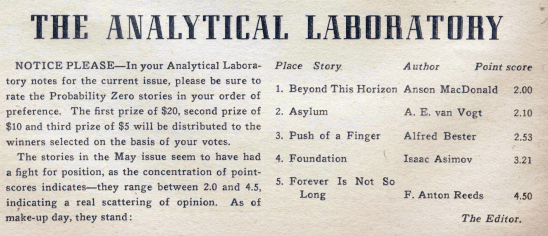
Next, I found the July issue to see how “Foundation” did in The Analytical Laboratory feature, where readers vote for their favorite stories. Evidently, “Foundation” didn’t make much of an impression, since it came in a distant fourth. Nor did it get mentioned in a letter to the Brass Tacks second.
I thought about looking through fanzines at Fanac.org, but I fear what I want might be looking for a needle in a haystack.
My next stop was The World Beyond the Hill by Alexei and Cory Panshin, my favorite book about Astounding during the Golden Age of Science Fiction. It can be checked out from the Archive.org, or ordered from Amazon for the Kindle for $9.99.
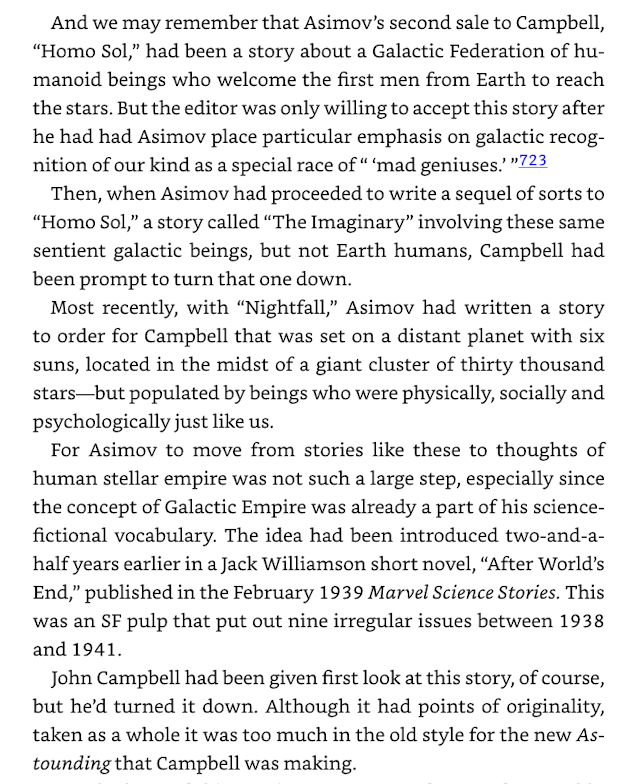
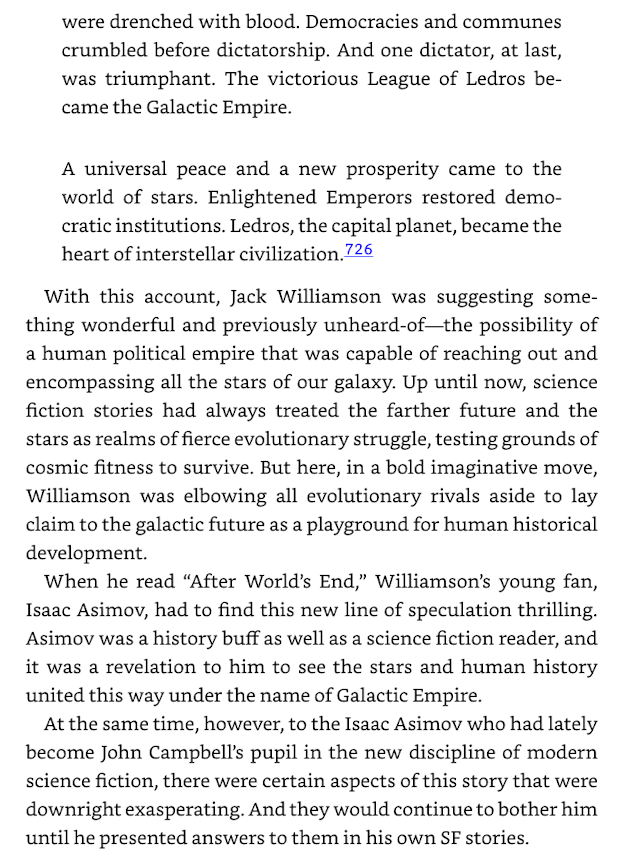
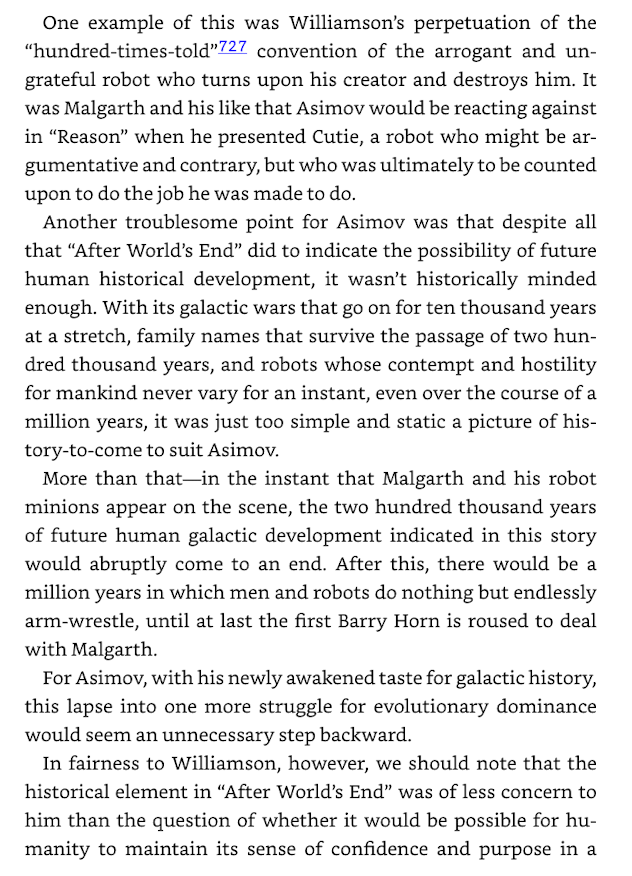
“Chapter 17 – An Empire of Mind” covers how Asimov developed the Foundation series on pages 520-566. If I had read this chapter before rereading “Foundation,” I would have approached the story with far more enthusiasm. Alexei and Cory Panshin describe Asimov’s inspiration and writing process for starting the series. I have read The World Beyond the Hill twice, but I didn’t remember any of this. I especially didn’t remember how Asimov was influenced by “After World’s End,” a short novel by Jack Williamson, which he read in the February 1939 issue of Marvel Science Stories. It also influenced Asimov’s take on robots.
The Panshins got most of details about Asimov working with John W. Campbell from Aismov’s biography, In Memory Yet Green. That book can be checked out from Archive.org.
The Panshins cited “After World’s End” and others as proto-stars that would evolve into galactic empire science fiction.
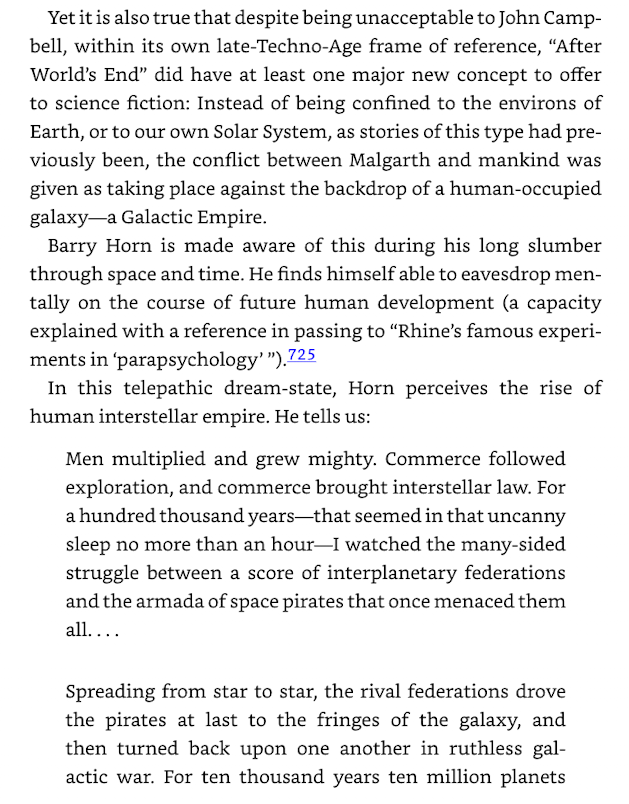
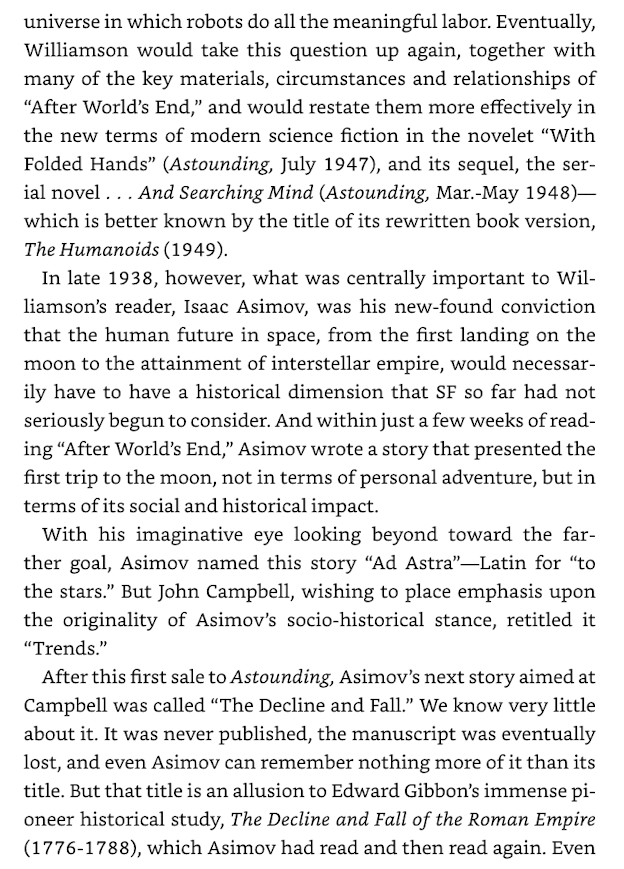
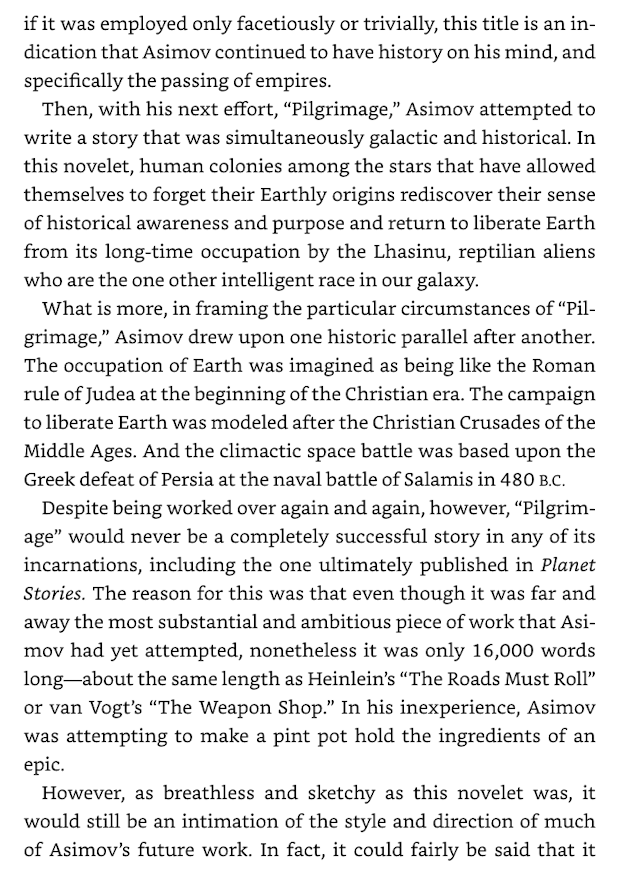
I wish I could reprint the 46 pages from this book because it describes in great detail how Asimov got the idea for a galactic empire. The Panshins showed that Asimov had already started on the idea in earlier stories.
Panshins have this to say, despite the fact that we know E. E. “Doc” Smith, Edmond Hamilton, and John W. Campbell had been publishing stories about humans speeding around the galaxy since the 1920s.
I would love to copy more of the Panshin’s book, but I don’t know if that’s proper. I highly recommend The World Beyond the Hill to anyone interested in learning about the evolution of science fiction in the 1940s.
I haven’t read Gibbon’s six-volume history, but reading the Wikipedia entry, it’s considered lacking in accuracy, and scholars disagree with his thesis that Christianity is to blame for Rome’s decline. The Panshins explores how Asimov’s used religion in the series. They felt Asimov saw it as a positive tool, while Heinlein saw it as a manipulative tool in his stories at the time.
The Panshins go into great detail Asimov’s collaboration with Campbell and how the first two Foundation stories were written, edited and published. Both were finished and sold to Campbell before December 1945. The Panshins then go on to deeply analyze “Foundation” and “Bridle and Saddle.”
I admire this chapter immensely. This is the kind of writing about science fiction history that I’ve always fantasized of achieving myself. I can’t come close. This chapter does give one excellent account of the origins of the idea of galactic empire. However, is it correct? Is it the only one. Many explorers thought they found the source of the Nile only to be proved wrong.
While reading the five stories that make up Foundation, I didn’t find much serious speculation about how a galactic empire would collapse. All of Asimov’s speculations seem rather superficial to me. It’s such a wonderful idea that I’m always disappointed when the individual stories in the first volume don’t live up to the grand vision.
If I studied the series and analyzed it as deeply as the Panshins, I probably would see far more than I have. I know I’m not being fair to the series. I fear my dislike of Asimov’s prose keeps me from enjoying his ideas. The Panshins found many layers of ideas to explore that I missed. I’m sure a scholarly work the size of the trilogy could be written on the Foundation series.
I believe America is beginning its decline. Predicting the future is impossible. We can’t even foretell one year, much less a thousand. But let’s say you’re a science fiction writer and want to set a story one hundred years in our future. How would you set up your story to convey a big picture of how the United States will change? Having a series of short stories is one possible solution.
Each time I read Foundation, I’ve been disappointed that it has no continuing characters. Let me provide an example to make a point. My wife loves TV shows, but I also want to watch movies. Switching between the two formats, I must admit that TV shows, with continuing characters, are far more addictive than movies. Not having characters that last the entire book hurts Foundation. That’s why the miniseries changed the story so drastically.
In 1968, John Brunner published Stand on Zanzibar, envisioning the world of 2010. This was far less ambitious than Asimov. The Foundation series attempts to portray a thousand years of a galactic empire featuring twenty-five million inhabited worlds. I never felt the immensity of such a setting while reading Asimov’s classic. However, Brunner’s technique of combining a novel with continuing characters, interspersed with short stories about people around the world, with samples from newspapers, television shows, radio broadcasts, and journals, and the regular commentary of a shock jock, does give us a complex picture of 2010.
For me, and I mean just me, because I know this series is so beloved, Asimov promised us a trip to Mars but took us on a suborbital flight. The original trilogy never delivers what it promises.
“Foundation” – Astounding (May 1942)
“Foundation,” the story that readers first learned about the Foundation series, didn’t get the cover. Evidently, John W. Campbell, Jr. wasn’t impressed enough. Readers preferred Heinlein, van Vogt, and Bester over Asimov’s story in the July readers’ poll. Not an auspicious beginning. Yet, the series is still admired today, and is even the basis of a television miniseries. And I believe the Foundation stories must have influenced the creation of Star Wars.
For some reason many people love the idea of the galaxy populated by humans. I see that as a growing artificial reality that will continue to build. Whether we make it reality is a whole other issue. I tend to doubt it. I think a future reality with humanity spread across the galaxy is no more real than the past artificial realities of the history of religions.
Note:
Normally, I try to keep my blog posts to 500-1,000 words. Even that is uncommonly long for most blog posts. That’s because internet readers don’t like to spend a lot of time reading any one piece. The internet is a browsing medium.
This piece kept going and going. I finally just had to quit. I feel I could write an entire book just on searching for the origins of specific science fiction concepts. I could have also written a whole book just on the Foundation Trilogy.
I’m old and I have trouble focusing my mind. I also lack the energy to keep working at any one task for long. I’d love to be able to write a book like The World Beyond the Hill but that is impossible at 73. More than likely, I never had the brain power to write such a book at any age. I need to learn how to convey a major insight in a few words.
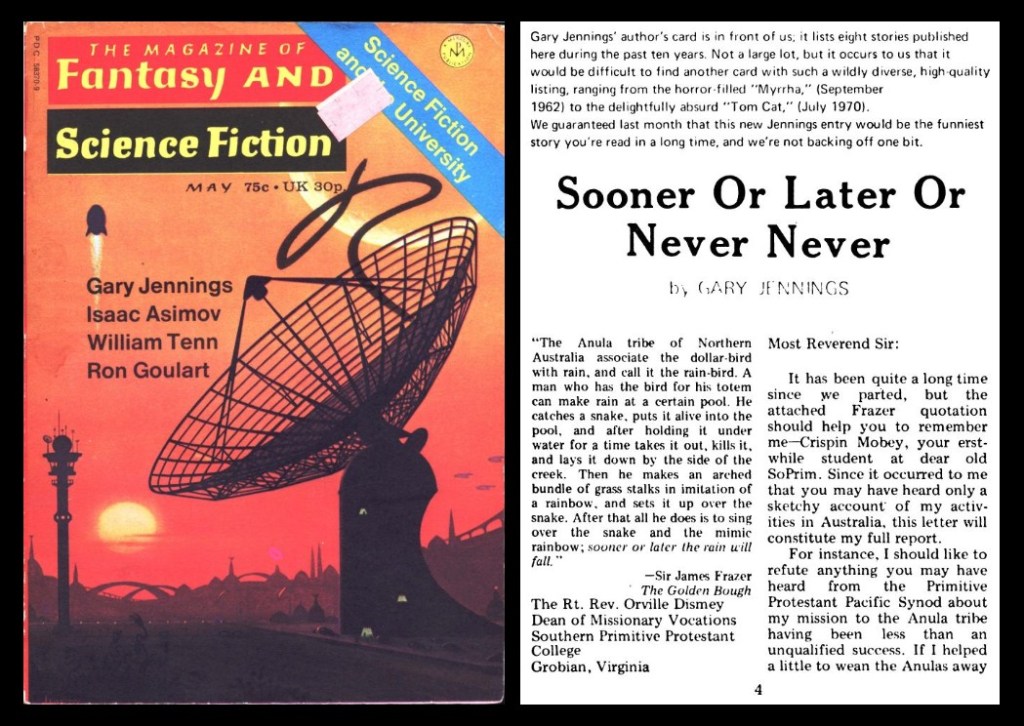
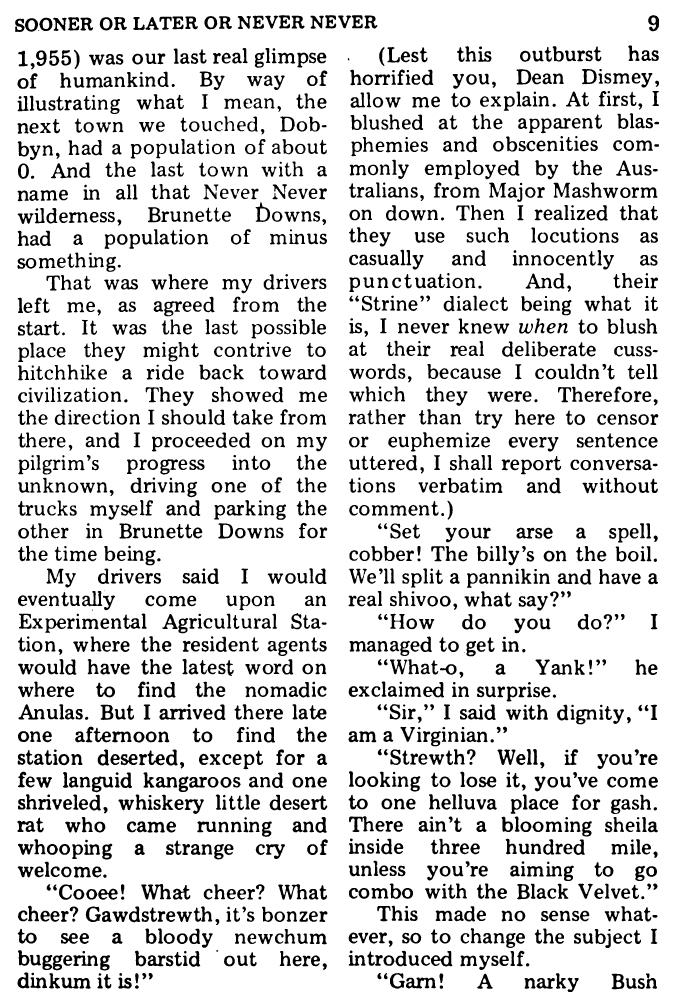
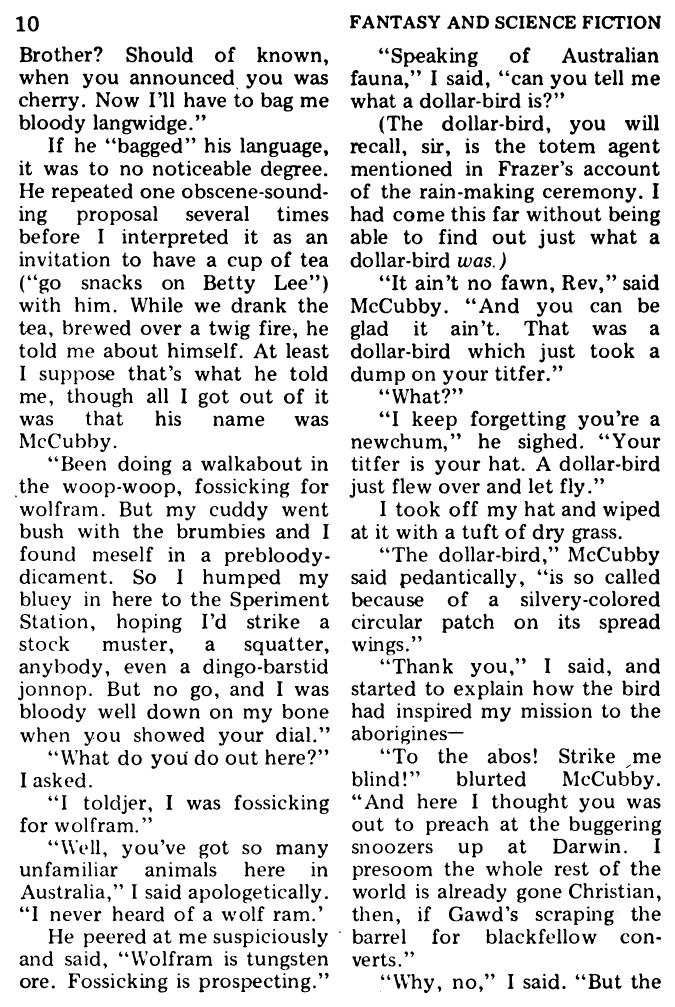
What exactly is fantasy? “Sooner Or Later Or Never Never” by Gary Jennings has no magic, no fantastic creatures. Its setting is present-day Australia. The story is both comic and absurd. Yet, it’s based on a somewhat realistic premise. Yes, the characters and plot are made up, but so is most fiction. I can find no reason to call this a fantasy. I assume Edward L. Ferman published it in the May 1972 issue of The Magazine of Fantasy & Science Fiction because he admired the creative prose — and he had the power to publish it.
“Sooner or Later or Never Never” is told as a letter to The Rev. Orville Dismey, Dean of Missionary Vocations, at the Southern Primitive Protestant Seminary in Grobian, Virginia. Crispin Mobey narrates his effort to bring Christ to the Anula tribe in the Australian outback. Mobey was inspired by a quote from The Golden Bough by Sir James Frazer. The quote describes a ritual Frazer witnessed. Mobey wants to use that ritual to bring Christianity to a rather primitive tribe.
I’ve read “Sooner or Later or Never Never” before, but I’m not sure where and how. I don’t normally read this kind of fiction. However, the prose is quite entertaining. Normally, I dislike dialect, but Jennings captures outback Aussie hilariously. I wish I had an audiobook version.
There is no way I can describe this story, so I’m just going to give you two pages to read as a sample.
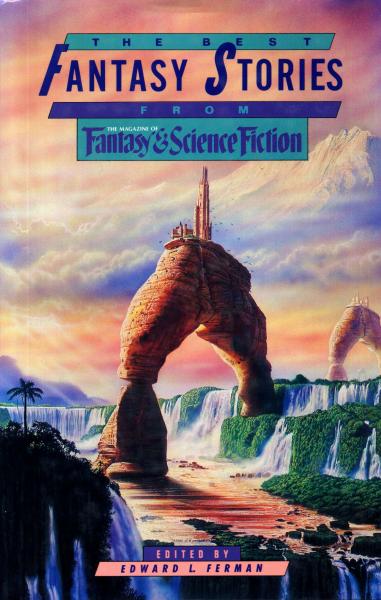
I know this is cheating, but I’m taking the easy way out. I’m posting this merely to encourage people to read this story. I read it today because my Facebook short story club is reading The Best Fantasy Stories from The Magazine of Fantasy and Science Fiction. Reading this 792-page anthology demonstrates the range of what people call fantasy.
I routinely tell people I dislike fantasy. But of the stories we’ve read in this anthology, the ones set in the present about ordinary people have been the most entertaining to read. And the ones that people consider traditional fantasy were no fun to read. I guess when I say I dislike fantasy, I dislike only a subset of the genre.
However, I also think Ferman is cheating to call “Sooner or Later or Never Never” fantasy. It could have been published in almost any kind of fiction magazine.
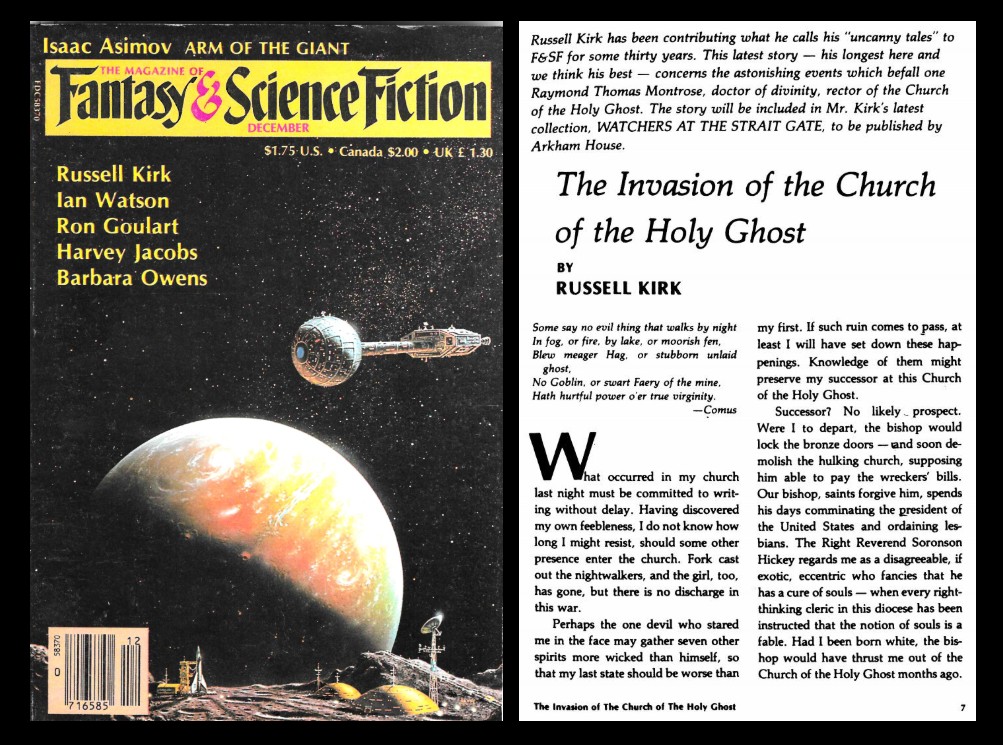
I’m an atheist who doesn’t normally enjoy reading fantasy fiction; however, I found “The Invasion of the Church of the Holy Ghost” by Russell Kirk, a religious ghost story, to be quite entertaining and well-written. The characters of Father Raymond Thomas Montrose and Fork Causland are so well developed that it’s hard not to like this story. Plus, the story is set in a seedy, rundown section of town filled with hustlers, prostitutes, and con men, has all the feel of a Damon Runyon tale.
I had no idea who Russell Kirk was, but after reading about him on Wikipedia, the philosophy behind the story made more sense. Kirk was a major conservative intellectual and a distinguished fellow at the Heritage Foundation. Since I’m a liberal, this doesn’t endear me to him. Kirk was also a convert to Catholicism and enjoyed writing ghost stories.
Kirk’s significant spiritual, political, and philosophical background forces me to look deeper into “The Invasion of the Church of the Holy Ghost.” Kirk was a serious thinker. That makes it hard to dismiss the story as a silly, inconsequential ghost story.
Even while liking “The Invasion of the Church of the Holy Ghost” very much, it proposes ideas I find totally repugnant. Both Father Montrose and Fork Causland are possessed. Kirk suggests that when people do bad things, it’s because they are influenced by evil ghosts, and when they do good things, they are empowered by higher-order beings. He doesn’t specifically say angels, but that’s how I interpreted the story.
In old religious philosophy, good comes from God, and evil from Satan. If humans do good, it’s because of the influence of the divine, and if we do bad, it’s because of the devil working through us. At one point, the normally good Father Montrose starts thinking about raping a young woman. Kirk proposes that those thoughts come from being possessed by an evil spirit.
I don’t believe in free will, but I also refuse to believe that our thoughts and actions originate with ghosts or other metaphysical beings. I don’t know if Russel Kirk believes that either, but “The Invasions of the Church of the Holy Ghost” is based on such a religious foundation. This fantasy is a religious reality to some. On the other hand, it might just be Kirk’s way of scaring us.
However, if I ignore what this story is suggesting, it’s an exceptionally creative work. Russell Kirk does an amazing amount of world-building. When I like fantasy, it’s often because it’s set in our present-day world. For example, It’s a Wonderful Life or The Bishop’s Wife.
Yesterday, I was pondering the value of fiction and nonfiction. Writers of nonfiction strive to be as accurate as possible. We read nonfiction to understand reality. Fiction is elaborate lies, but sometimes fiction writers work to express a truth they perceive at a deep, personal level. Knowing the kind of person Russell Kirk was, I can’t help but believe that he might believe in ghosts and possession.
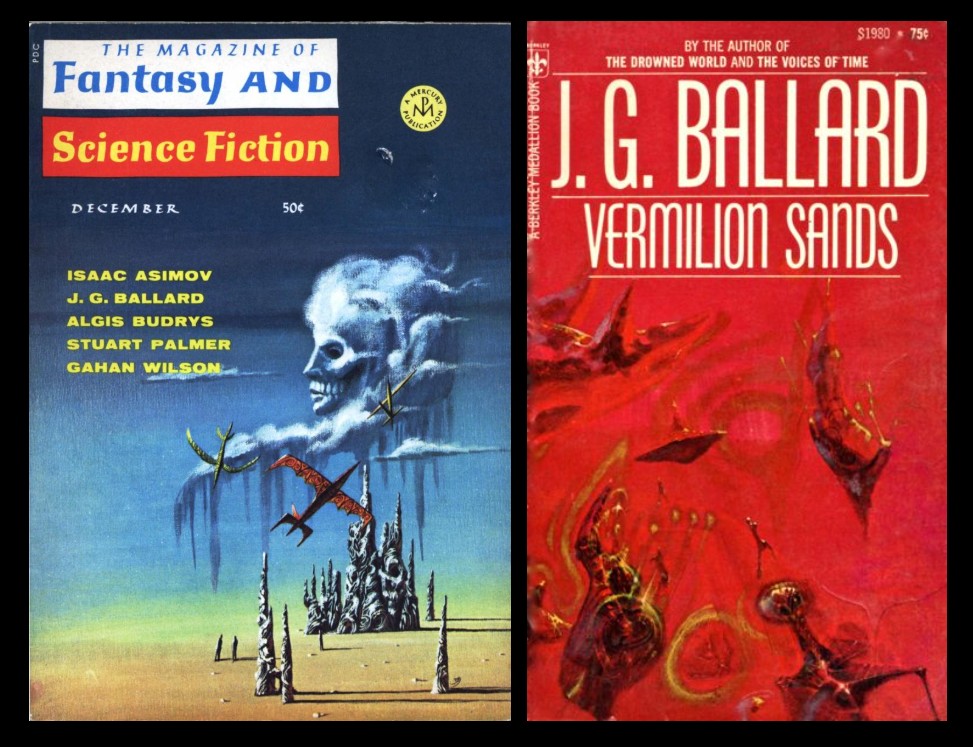
I reread “The Cloud Sculptors of Coral-D” by J.G. Ballard because my short story reading group is reading The Best Fantasy from The Magazine of Fantasy and Science Fiction. Inclusion in this volume suggests its fantasy. However, it was also included in The Great Science Fiction Series edited by Martin H. Greenberg, Joseph Olander, and Frederik Pohl. The story contains no magic, no dragons or elves, and it’s set in our present day, but in a fictional resort called Vermillion Sands.
Vermillion Sands feels like a decadent playground for the rich, which also features the many kinds of parasites that live off the wealthy. It’s also an artist and expat colony. We don’t know its location, but it feels like Palm Springs, California. Many worldly travelers come and go there.
“The Cloud Sculptors of Coral-D” was my first introduction to J. G. Ballard back in the 1960s. Other stories from that setting make up the series, collected into Vermillion Sands.
“Prima Belladonna” (Science Fantasy, December 1956)
“Venus Smiles” (Science Fantasy, June 1957)
“Studio 5, the Stars” (Science Fantasy, February 1961)
“The Thousand Dreams of Stellavista” (Amazing Stories, March 1962)
“The Singing Statues” (Fantastic Stories, July 1962) (not in original collection)
“The Screen Game” (Fantastic Stories, October 1963)
“Cry Hope, Cry Fury!” (F&SF, October 1967)
“The Cloud-Sculptors of Coral D” (F&SF, December 1967)
“Say Goodbye to the Wind” (Fantastic, August 1970)
Wikipedia provides an excellent overview of the stories, highlighting that each dealt with a different artistic medium being affected by technology.
When I first read “The Cloud Sculptors of Coral-D” as a teen, it felt very grown-up to me. The characters were the kinds of people I met growing up in Miami, not the typical heroes of science fiction stories I spent so much time reading. It never occurred to me to think of the story as fantasy, but it didn’t seem like science fiction either. At the time, I was just discovering British science fiction writers like Brian Aldiss and John Brunner and the New Wave SF. The stories were set in the present or near future and took place on Earth. No rockets or robots. Was this actual science fiction?
“The Cloud Sculptors of Coral-D” is about a band of glider pilots who shape clouds with silver iodide. At first, their audience and patrons are people who park their cars along the lagoon road to watch. Eventually, the Garbo-like Leonora Chanel hires them to perform for her party. Sculpting clouds is a neat idea, but far from realistic. Does that make the story science fiction? Ballard does throw in a creature called sand rays, which I suppose are like manta rays that live under the sand instead of the sea. Do they make the story a fantasy?
Science fiction has often been the dumping ground for any kind of weird story that can’t be classified. The Vermillion Sands stories would have been rejected by mainstream and literary magazines. They fit nicely in The Magazine of Fantasy & Science Fiction. They were also published in the British magazine Science Fantasy and the American Fantastic. Only one was published in a straight-ahead science fiction magazine, Amazing Stories. I doubt John W. Campbell would have accepted them in Astounding or Analog. Nor would he have published them in Unknown. I wonder if Rod Serling would have used “The Cloud Sculptors of Coral-D” for The Twilight Zone?
I’m not fond of traditional fantasy, and many of the stories in The Best Fantasy from The Magazine of Fantasy and Science Fiction aren’t enjoyable for me to read. But I did enjoy “The Cloud Sculptors of Coral-D.” The story has a pleasant, surreal feel. The setting is very close to this world, but just a smidge off. I love the artist colony atmosphere, the hint of decadence, the ever-so-slight sense of unreality. The story combines barnstorming, carny folks, and the ugly rich. I visualize it as a cross between early Faulkner and Fellini.
The shortest description would be to say the story has atmosphere.
Ray Bradbury published hundreds of short stories over and over again in various collections. Bradbury and his publishers often repackaged his stories into new collections or reprinted older collections with a slightly different lineup of stories. Ray Bradbury’s bibliography at ISFDB.org is so confusing that we’ve decided to select those collections that will provide the most stories by buying the fewest books.
Mike, the programmer for the Classics of Science Fiction website, coded several programs to find the right combinations of Bradbury collections that would give the widest selection of stories to read. The permutations turned out to be excessively large, so we simplified the procedure.
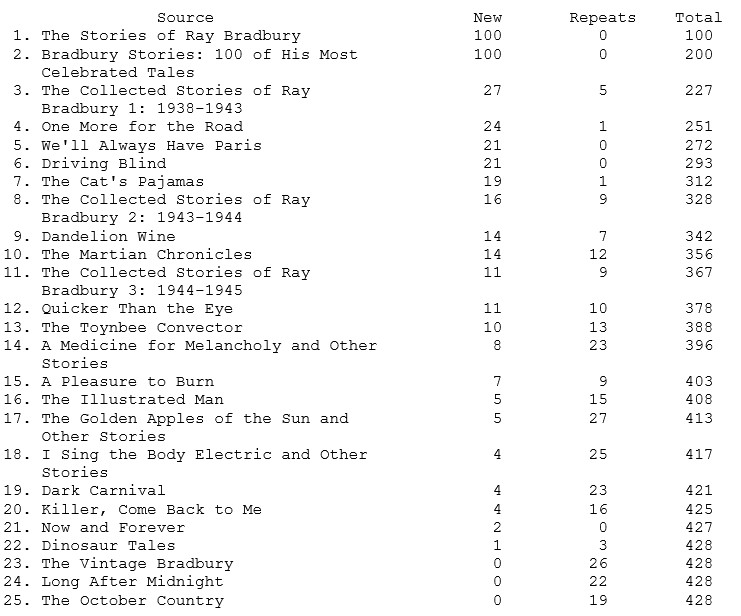
Our solution was to pick the collection that provided the most Bradbury stories. Then add a second collection that provides the most additional stories not in the first collection. Then add the third collection that contributes the next most additional stories, not in the previous two. And so on. Study the table, and the technique will become obvious.
Here are the twenty-five collections we used. We only used collections that are in print, either in hardback, paperback, e-book, or audiobook. Hyperlinks are to Amazon affiliate links.
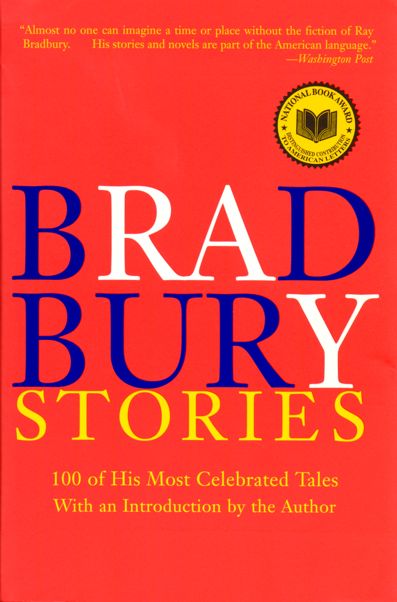
I have not been writing blogs or reading for a couple of weeks. I lost the habit of reading and writing because of a house guest, many visitors, and a more active social life. However, tonight I felt a wistful urge to read a short story. I chose “The Whole Town’s Sleeping” by Ray Bradbury. It was the first story in Ray Bradbury Stories. You can read a PDF copy online here. “The Whole Town’s Sleeping” is not science fiction or fantasy. And I wouldn’t call it horror, although its purpose is to scare. “The Whole Town’s Sleeping” was published in three magazines, McCall’s (1950), Argosy (1951), and Ellery Queen’s Mystery Magazine (1954), indicating its wide appeal. Finally, the story was incorporated into the fixup novel Dandelion Wine in 1957.
For me, “The Whole Town’s Sleeping” was pure nostalgia. It’s a story that made me think about memory and writing. Sure, Bradbury is trying to tell a scary story, like those he heard camping in the woods, but he’s also remembering his past.
Although the story came out in 1950, “The Whole Town’s Sleeping” is set much earlier, in the era of Bradbury’s youth, because Lavinia, Francine, and Helen go to the theater to see a Charlie Chaplin film. That unnamed film could have been Monsieur Verdoux from 1947, but the story’s mood makes me think it might be The Circus (1928) or City Lights (1931). Bradbury was born in 1920, the same year my father was born. I was born in 1951. It feels nostalgic to the small towns I lived in in the 1950s, but it would have been nostalgic to readers in 1950.
Many of Bradbury’s stories were inspired by his youth growing up in Waukegan, Illinois, which he later fictionalized as Green Town. I believe those little towns I lived in hadn’t changed much in twenty years. Back then, I remember walking with my friends to the theater and talking to people sitting on their porches, which made me identify with the story. I remember walking alone along deserted streets late at night like Lavenia and having the same fears as she did.
My past includes living in small towns where all the stores were set on the square or along Main Street, with all the connecting streets occupied by homes. I had a hard time visualizing the ravine that divides Green Town. Although I do remember living in a little town divided by a small lake. It had a tiny waterfall, which scared me at age nine.
There’s not much I want to say about “The Whole Town’s Sleeping,” because I want to talk about reading. Often in my life, I’ve substituted reading for living. There are times when life is uneventful, so reading is exciting. Life experiences are superior to reading, but idle times are great for reading.
However, there are times when life is full, and I wish I were idle reading. We have two worlds to live in, reality and fantasy. Ray Bradbury created a fantasy world for us to enjoy, and it’s fascinating to think about how and why he did that. On one hand, he’s given us a simple story built to scare us. We even know he’s doing it. Readers know the ending will shock them, but we didn’t know how Bradbury would pull it off. It’s the kind of story that we watched on the old TV show Alfred Hitchcock Presents. (It’s even reprinted in one of Hitchcock’s anthologies.)
But that’s only one level. Fiction usually works on multiple levels. Bradbury also works to describe the past, his past, in the kind of detail that will trigger memories in his readers. And there’s a level beyond that which Bradbury entertains us. It’s the writing.
I have had several intense experiences over the last two weeks. They will stay locked in my head because we seldom share intense experiences. If I were a writer, I would write a story about them. That story might even be read by readers who have had similar experiences.
Isn’t that what Ray Bradbury is doing? Do we read to learn about Bradbury’s experiences, or do we read to remember our own?
Often, we use fiction to escape from boredom. But doesn’t fiction work best when it triggers something inside us? When life is full, I shouldn’t crave reading, but I do. Why? Is reading an essential nutrient of the soul that causes us to fall ill if it goes lacking?
I wish I could fictionalize my experiences so I could understand them. Maybe because I don’t, I read other people’s efforts instead.
I’ve been getting back into Ray Bradbury again. I loved The Martian Chronicles and The Illustrated Man when I was young, but then I forgot about Ray Bradbury for a long time. I came late to Fahrenheit 451, and I’m embarrassed to admit it, but I loved the Truffaut film more than the book. In 2015, I reread The Martian Chronicles. I was dazzled. Yet again, I quickly moved on. Bradbury has a sweet quality that I can’t overindulge.
However, over the last five years, I’ve been gorging on science fiction short stories, and I’ve been surprised by how often his stories show up in anthologies. Then, a few weeks ago, I read The Bradbury Chronicles, a biography of Ray Bradbury by Sam Weller. Bradbury’s life was riveting, inspiring me to read more of his work. According to the Library of Congress, Bradbury published over 600 short stories. According to the Weller biography, by the late 1940s, Bradbury was writing and publishing a short story a week.
Piet Nel sent me a spreadsheet with 375 stories from all of Bradbury’s major collection. Piet also said, “Ray Bradbury: The Life of Fiction, by Eller & Touponce (2004), has a comprehensive story list, compiled with academic rigor, up to 2002. It runs to about 400 stories.” So, it’s hard to reconcile the 600 number from the Library of Congress. Piet also sent me the link to Phil Nichols’ site and his Short Story Finder.
Piet also emailed me this comment, which I will quote:
I think it's quite simple. If you read everything collected up to and including 1980, I think you've read as much Bradbury as all but serious experts need to read. The later collections get progressively weaker and the last ones are mostly leftovers. In saying all that, I am referring to the short fiction only. I've never liked the late detective novels because, for me, they seem a bit Nancy Drew-ish.
The short course is simply to read The Stories of Ray Bradbury (1980), which is more essential than Bradbury Stories: 100 of His Most Essential Tales.
The intermediate course is to read The Martian Chronicles, The Illustrated Man, The Golden Apples of the Sun, The October Country, Dandelion Wine (a disguised story collection), A Medicine for Melancholy, The Machineries of Joy, R Is for Rocket (without duplicates), S Is for Space (without duplicates), I Sing the Body Electric!, Long After Midnight, and The Stories of Ray Bradbury (again without duplicates, which leaves about five stories).
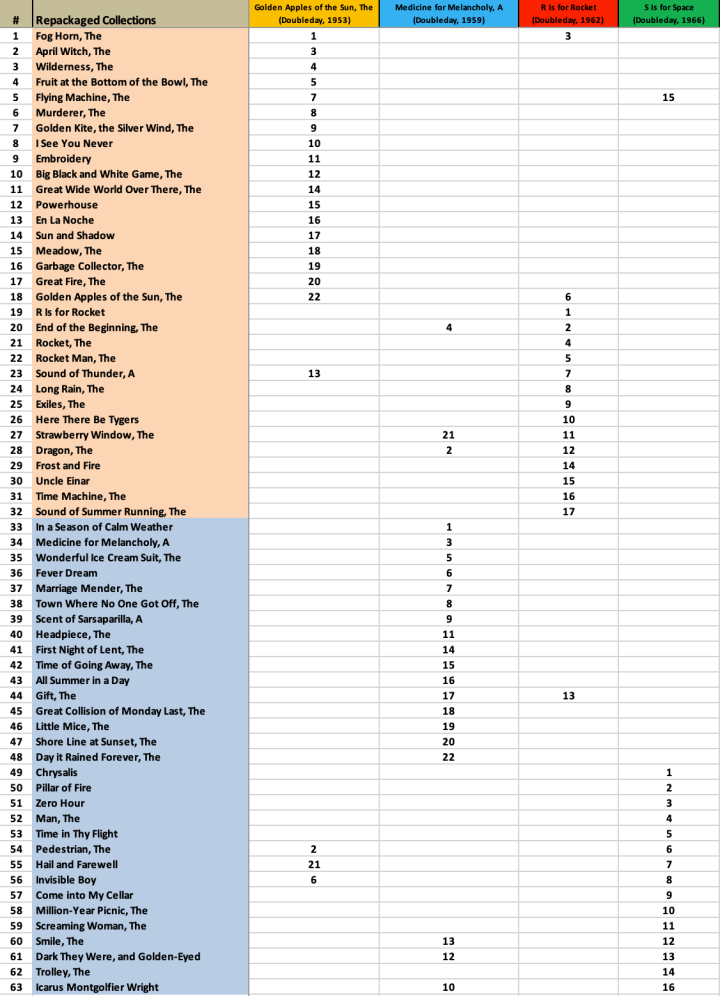
Piet Nel, in our short story reading group, created this graph showing the stories in The Golden Apples of the Sun and Other Stories (peach 1-32) and A Medicine for Melancholy and Other Stories (blue-gray 33-63). Those two collections reprinted many of the stories in the four previous collections (orange, blue, red, green). The numbers in the four earlier collections are the story’s position in the table of contents.
I told my friend Mike, a computer programmer, and he decided that comparing the collections of Ray Bradbury’s short stories is an interesting programming problem.
It all depends on what you want.
All of his stories – would buying all his collections do that?
The best stories – who knows how many collections.
The fewest collections with the least duplicates.
Just science fiction?
Maybe add fantasy?
Just the literary works. Mysteries.
Just in ebook, or audiobook, or in print?
Mike might make this an interactive program if enough people are interested, but for now, he’s just testing the idea by generating reports. Here’s the latest one showing 30 of 1003 combinations generated so far.
As you can see, we’re only working with a handful of his collections, and the maximum number of stories is 256.
-------------------------------------------------------
Group 1

1: Bradbury Stories: 100 of His Most Celebrated Tales
2: Driving Blind
3: The Golden Apples of the Sun and Other Stories
4: I Sing the Body Electric and Other Stories
5: The Illustrated Man
6: The Martian Chronicles
7: A Medicine for Melancholy and Other Stories
8: The Stories of Ray Bradbury

Total unique stories:     256
Total duplicate stories:  100
-------------------------------------------------------
Group 2

1: Bradbury Stories: 100 of His Most Celebrated Tales
2: Driving Blind
3: The Golden Apples of the Sun and Other Stories
4: I Sing the Body Electric and Other Stories
5: The Illustrated Man
6: The Martian Chronicles
7: A Medicine for Melancholy and Other Stories
8: S is for Space
9: The Stories of Ray Bradbury

Total unique stories:     256
Total duplicate stories:  116
-------------------------------------------------------
Group 3

1: Bradbury Stories: 100 of His Most Celebrated Tales
2: Driving Blind
3: The Golden Apples of the Sun and Other Stories
4: I Sing the Body Electric and Other Stories
5: The Illustrated Man
6: The Martian Chronicles
7: A Medicine for Melancholy and Other Stories
8: R is for Rocket
9: The Stories of Ray Bradbury

Total unique stories:     256
Total duplicate stories:  117
-------------------------------------------------------
Group 4

1: Bradbury Stories: 100 of His Most Celebrated Tales
2: Driving Blind
3: The Golden Apples of the Sun and Other Stories
4: I Sing the Body Electric and Other Stories
5: The Illustrated Man
6: The Martian Chronicles
7: A Medicine for Melancholy and Other Stories
8: R is for Rocket
9: S is for Space
10: The Stories of Ray Bradbury

Total unique stories:     256
Total duplicate stories:  133
-------------------------------------------------------
Group 5

1: Bradbury Stories: 100 of His Most Celebrated Tales
2: Driving Blind
3: I Sing the Body Electric and Other Stories
4: The Illustrated Man
5: The Martian Chronicles
6: A Medicine for Melancholy and Other Stories
7: R is for Rocket
8: The Stories of Ray Bradbury

Total unique stories:     253
Total duplicate stories:  88

Group 4 stories that are not in Group 5:
	En la Noche
	The Murderer
	Sun and Shadow
-------------------------------------------------------
Group 6

1: Bradbury Stories: 100 of His Most Celebrated Tales
2: Driving Blind
3: I Sing the Body Electric and Other Stories
4: The Illustrated Man
5: The Martian Chronicles
6: A Medicine for Melancholy and Other Stories
7: R is for Rocket
8: S is for Space
9: The Stories of Ray Bradbury

Total unique stories:     253
Total duplicate stories:  104
-------------------------------------------------------
Group 7

1: Bradbury Stories: 100 of His Most Celebrated Tales
2: Driving Blind
3: The Golden Apples of the Sun and Other Stories
4: The Illustrated Man
5: The Martian Chronicles
6: A Medicine for Melancholy and Other Stories
7: The Stories of Ray Bradbury

Total unique stories:     252
Total duplicate stories:  75

Group 6 stories that are not in Group 7:
	Christus Apollo
	Drink Entire: Against the Madness of Crowds
	The Lost City of Mars
	One Timeless Spring

Group 7 stories that are not in Group 6:
	En la Noche
	The Murderer
	Sun and Shadow
-------------------------------------------------------
Group 8

1: Bradbury Stories: 100 of His Most Celebrated Tales
2: Driving Blind
3: The Golden Apples of the Sun and Other Stories
4: The Illustrated Man
5: The Martian Chronicles
6: A Medicine for Melancholy and Other Stories
7: S is for Space
8: The Stories of Ray Bradbury

Total unique stories:     252
Total duplicate stories:  91
-------------------------------------------------------
Group 9

1: Bradbury Stories: 100 of His Most Celebrated Tales
2: Driving Blind
3: The Golden Apples of the Sun and Other Stories
4: The Illustrated Man
5: The Martian Chronicles
6: A Medicine for Melancholy and Other Stories
7: R is for Rocket
8: The Stories of Ray Bradbury

Total unique stories:     252
Total duplicate stories:  92
-------------------------------------------------------
Group 10

1: Bradbury Stories: 100 of His Most Celebrated Tales
2: Driving Blind
3: The Golden Apples of the Sun and Other Stories
4: The Illustrated Man
5: The Martian Chronicles
6: A Medicine for Melancholy and Other Stories
7: R is for Rocket
8: S is for Space
9: The Stories of Ray Bradbury

Total unique stories:     252
Total duplicate stories:  108
-------------------------------------------------------
Group 11

1: Bradbury Stories: 100 of His Most Celebrated Tales
2: Driving Blind
3: The Golden Apples of the Sun and Other Stories
4: I Sing the Body Electric and Other Stories
5: The Martian Chronicles
6: A Medicine for Melancholy and Other Stories
7: The Stories of Ray Bradbury

Total unique stories:     251
Total duplicate stories:  85

Group 10 stories that are not in Group 11:
	The Concrete Mixer
	Epilogue (The Illustrated Man)
	The Highway
	The Other Foot
	Prologue: The Illustrated Man

Group 11 stories that are not in Group 10:
	Christus Apollo
	Drink Entire: Against the Madness of Crowds
	The Lost City of Mars
	One Timeless Spring
-------------------------------------------------------
Group 12

1: Bradbury Stories: 100 of His Most Celebrated Tales
2: Driving Blind
3: The Golden Apples of the Sun and Other Stories
4: I Sing the Body Electric and Other Stories
5: The Martian Chronicles
6: A Medicine for Melancholy and Other Stories
7: S is for Space
8: The Stories of Ray Bradbury

Total unique stories:     251
Total duplicate stories:  101
-------------------------------------------------------
Group 13

1: Bradbury Stories: 100 of His Most Celebrated Tales
2: Driving Blind
3: The Golden Apples of the Sun and Other Stories
4: I Sing the Body Electric and Other Stories
5: The Martian Chronicles
6: A Medicine for Melancholy and Other Stories
7: R is for Rocket
8: The Stories of Ray Bradbury

Total unique stories:     251
Total duplicate stories:  102
-------------------------------------------------------
Group 14

1: Bradbury Stories: 100 of His Most Celebrated Tales
2: Driving Blind
3: The Golden Apples of the Sun and Other Stories
4: I Sing the Body Electric and Other Stories
5: The Illustrated Man
6: The Martian Chronicles
7: R is for Rocket
8: S is for Space
9: The Stories of Ray Bradbury

Total unique stories:     251
Total duplicate stories:  107

Group 13 stories that are not in Group 14:
	The Headpiece
	In a Season of Calm Weather
	The Little Mice
	The Marriage Mender
	The Time of Going Away

Group 14 stories that are not in Group 13:
	The Concrete Mixer
	Epilogue (The Illustrated Man)
	The Highway
	The Other Foot
	Prologue: The Illustrated Man
-------------------------------------------------------
Group 15

1: Bradbury Stories: 100 of His Most Celebrated Tales
2: Driving Blind
3: The Golden Apples of the Sun and Other Stories
4: I Sing the Body Electric and Other Stories
5: The Martian Chronicles
6: A Medicine for Melancholy and Other Stories
7: R is for Rocket
8: S is for Space
9: The Stories of Ray Bradbury

Total unique stories:     251
Total duplicate stories:  118

Group 14 stories that are not in Group 15:
	The Concrete Mixer
	Epilogue (The Illustrated Man)
	The Highway
	The Other Foot
	Prologue: The Illustrated Man

Group 15 stories that are not in Group 14:
	The Headpiece
	In a Season of Calm Weather
	The Little Mice
	The Marriage Mender
	The Time of Going Away
-------------------------------------------------------
Group 16

1: Bradbury Stories: 100 of His Most Celebrated Tales
2: Driving Blind
3: I Sing the Body Electric and Other Stories
4: The Illustrated Man
5: The Martian Chronicles
6: A Medicine for Melancholy and Other Stories
7: The Stories of Ray Bradbury

Total unique stories:     250
Total duplicate stories:  74

Group 15 stories that are not in Group 16:
	En la Noche
	Here There Be Tygers
	The Murderer
	R is for Rocket
	Sun and Shadow
	The Time Machine

Group 16 stories that are not in Group 15:
	The Concrete Mixer
	Epilogue (The Illustrated Man)
	The Highway
	The Other Foot
	Prologue: The Illustrated Man
-------------------------------------------------------
Group 17

1: Bradbury Stories: 100 of His Most Celebrated Tales
2: Driving Blind
3: I Sing the Body Electric and Other Stories
4: The Illustrated Man
5: The Martian Chronicles
6: A Medicine for Melancholy and Other Stories
7: S is for Space
8: The Stories of Ray Bradbury

Total unique stories:     250
Total duplicate stories:  90
-------------------------------------------------------
Group 18

1: Bradbury Stories: 100 of His Most Celebrated Tales
2: Driving Blind
3: The Golden Apples of the Sun and Other Stories
4: I Sing the Body Electric and Other Stories
5: The Illustrated Man
6: The Martian Chronicles
7: S is for Space
8: The Stories of Ray Bradbury

Total unique stories:     250
Total duplicate stories:  91

Group 17 stories that are not in Group 18:
	The Gift
	The Headpiece
	In a Season of Calm Weather
	The Little Mice
	The Marriage Mender
	The Time of Going Away

Group 18 stories that are not in Group 17:
	En la Noche
	Here There Be Tygers
	The Murderer
	R is for Rocket
	Sun and Shadow
	The Time Machine
-------------------------------------------------------
Group 19

1: Bradbury Stories: 100 of His Most Celebrated Tales
2: Driving Blind
3: The Illustrated Man
4: The Martian Chronicles
5: A Medicine for Melancholy and Other Stories
6: R is for Rocket
7: The Stories of Ray Bradbury

Total unique stories:     249
Total duplicate stories:  63

Group 18 stories that are not in Group 19:
	Christus Apollo
	Drink Entire: Against the Madness of Crowds
	En la Noche
	The Lost City of Mars
	The Murderer
	One Timeless Spring
	Sun and Shadow

Group 19 stories that are not in Group 18:
	The Gift
	The Headpiece
	In a Season of Calm Weather
	The Little Mice
	The Marriage Mender
	The Time of Going Away
-------------------------------------------------------
Group 20

1: Bradbury Stories: 100 of His Most Celebrated Tales
2: Driving Blind
3: The Illustrated Man
4: The Martian Chronicles
5: A Medicine for Melancholy and Other Stories
6: R is for Rocket
7: S is for Space
8: The Stories of Ray Bradbury

Total unique stories:     249
Total duplicate stories:  79
-------------------------------------------------------
Group 21

1: Bradbury Stories: 100 of His Most Celebrated Tales
2: Driving Blind
3: I Sing the Body Electric and Other Stories
4: The Martian Chronicles
5: A Medicine for Melancholy and Other Stories
6: R is for Rocket
7: The Stories of Ray Bradbury

Total unique stories:     248
Total duplicate stories:  73

Group 20 stories that are not in Group 21:
	The Concrete Mixer
	Epilogue (The Illustrated Man)
	The Highway
	The Other Foot
	Prologue: The Illustrated Man

Group 21 stories that are not in Group 20:
	Christus Apollo
	Drink Entire: Against the Madness of Crowds
	The Lost City of Mars
	One Timeless Spring
-------------------------------------------------------
Group 22

1: Bradbury Stories: 100 of His Most Celebrated Tales
2: Driving Blind
3: I Sing the Body Electric and Other Stories
4: The Illustrated Man
5: The Martian Chronicles
6: R is for Rocket
7: S is for Space
8: The Stories of Ray Bradbury

Total unique stories:     248
Total duplicate stories:  78

Group 21 stories that are not in Group 22:
	The Headpiece
	In a Season of Calm Weather
	The Little Mice
	The Marriage Mender
	The Time of Going Away

Group 22 stories that are not in Group 21:
	The Concrete Mixer
	Epilogue (The Illustrated Man)
	The Highway
	The Other Foot
	Prologue: The Illustrated Man
-------------------------------------------------------
Group 23

1: Bradbury Stories: 100 of His Most Celebrated Tales
2: Driving Blind
3: I Sing the Body Electric and Other Stories
4: The Martian Chronicles
5: A Medicine for Melancholy and Other Stories
6: R is for Rocket
7: S is for Space
8: The Stories of Ray Bradbury

Total unique stories:     248
Total duplicate stories:  89

Group 22 stories that are not in Group 23:
	The Concrete Mixer
	Epilogue (The Illustrated Man)
	The Highway
	The Other Foot
	Prologue: The Illustrated Man

Group 23 stories that are not in Group 22:
	The Headpiece
	In a Season of Calm Weather
	The Little Mice
	The Marriage Mender
	The Time of Going Away
-------------------------------------------------------
Group 24

1: Bradbury Stories: 100 of His Most Celebrated Tales
2: Driving Blind
3: The Golden Apples of the Sun and Other Stories
4: I Sing the Body Electric and Other Stories
5: The Illustrated Man
6: The Martian Chronicles
7: R is for Rocket
8: The Stories of Ray Bradbury

Total unique stories:     248
Total duplicate stories:  94

Group 23 stories that are not in Group 24:
	Chrysalis
	Come Into My Cellar
	The Headpiece
	In a Season of Calm Weather
	The Little Mice
	The Marriage Mender
	Pillar of Fire
	The Time of Going Away

Group 24 stories that are not in Group 23:
	The Concrete Mixer
	En la Noche
	Epilogue (The Illustrated Man)
	The Highway
	The Murderer
	The Other Foot
	Prologue: The Illustrated Man
	Sun and Shadow
-------------------------------------------------------
Group 25

1: Bradbury Stories: 100 of His Most Celebrated Tales
2: Driving Blind
3: The Golden Apples of the Sun and Other Stories
4: The Martian Chronicles
5: A Medicine for Melancholy and Other Stories
6: The Stories of Ray Bradbury

Total unique stories:     247
Total duplicate stories:  60

Group 24 stories that are not in Group 25:
	Christus Apollo
	The Concrete Mixer
	Drink Entire: Against the Madness of Crowds
	Epilogue (The Illustrated Man)
	The Highway
	The Lost City of Mars
	One Timeless Spring
	The Other Foot
	Prologue: The Illustrated Man

Group 25 stories that are not in Group 24:
	Chrysalis
	Come Into My Cellar
	The Headpiece
	In a Season of Calm Weather
	The Little Mice
	The Marriage Mender
	Pillar of Fire
	The Time of Going Away
-------------------------------------------------------
Group 26

1: Bradbury Stories: 100 of His Most Celebrated Tales
2: Driving Blind
3: The Golden Apples of the Sun and Other Stories
4: The Martian Chronicles
5: A Medicine for Melancholy and Other Stories
6: S is for Space
7: The Stories of Ray Bradbury

Total unique stories:     247
Total duplicate stories:  76
-------------------------------------------------------
Group 27

1: Bradbury Stories: 100 of His Most Celebrated Tales
2: Driving Blind
3: The Golden Apples of the Sun and Other Stories
4: The Martian Chronicles
5: A Medicine for Melancholy and Other Stories
6: R is for Rocket
7: The Stories of Ray Bradbury

Total unique stories:     247
Total duplicate stories:  77
-------------------------------------------------------
Group 28

1: Bradbury Stories: 100 of His Most Celebrated Tales
2: Driving Blind
3: The Golden Apples of the Sun and Other Stories
4: I Sing the Body Electric and Other Stories
5: The Illustrated Man
6: The Martian Chronicles
7: The Stories of Ray Bradbury

Total unique stories:     247
Total duplicate stories:  78

Group 27 stories that are not in Group 28:
	Chrysalis
	Come Into My Cellar
	The Gift
	The Headpiece
	In a Season of Calm Weather
	The Little Mice
	The Marriage Mender
	Pillar of Fire
	The Time of Going Away

Group 28 stories that are not in Group 27:
	Christus Apollo
	The Concrete Mixer
	Drink Entire: Against the Madness of Crowds
	Epilogue (The Illustrated Man)
	The Highway
	The Lost City of Mars
	One Timeless Spring
	The Other Foot
	Prologue: The Illustrated Man
-------------------------------------------------------
Group 29

1: Bradbury Stories: 100 of His Most Celebrated Tales
2: Driving Blind
3: The Golden Apples of the Sun and Other Stories
4: The Illustrated Man
5: The Martian Chronicles
6: R is for Rocket
7: S is for Space
8: The Stories of Ray Bradbury

Total unique stories:     247
Total duplicate stories:  82

Group 28 stories that are not in Group 29:
	Christus Apollo
	Drink Entire: Against the Madness of Crowds
	The Lost City of Mars
	One Timeless Spring

Group 29 stories that are not in Group 28:
	Chrysalis
	Come Into My Cellar
	The Gift
	Pillar of Fire
-------------------------------------------------------
Group 30

1: Bradbury Stories: 100 of His Most Celebrated Tales
2: Driving Blind
3: The Golden Apples of the Sun and Other Stories
4: The Martian Chronicles
5: A Medicine for Melancholy and Other Stories
6: R is for Rocket
7: S is for Space
8: The Stories of Ray Bradbury

Total unique stories:     247
Total duplicate stories:  93

Group 29 stories that are not in Group 30:
	The Concrete Mixer
	Epilogue (The Illustrated Man)
	The Highway
	The Other Foot
	Prologue: The Illustrated Man

Group 30 stories that are not in Group 29:
	The Headpiece
	In a Season of Calm Weather
	The Little Mice
	The Marriage Mender
	The Time of Going Away
-------------------------------------------------------
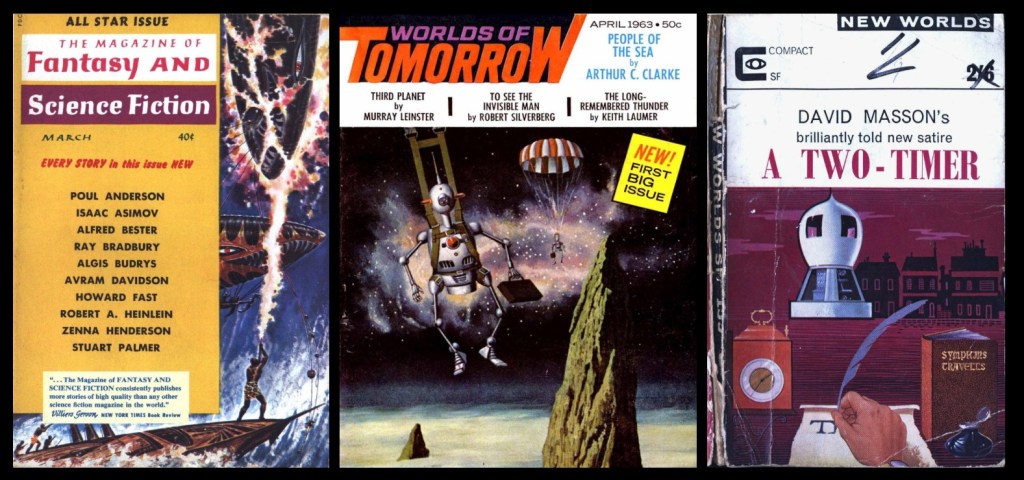
“A Two-Timer” by David I. Masson (New Worlds 159, February 1966) (Amazon)
Back in the sixties, in high school, my friends and I would argue endlessly over science fiction short stories. We didn’t remember them by their title or author, but by whatever neat idea they imagined. I still remember my friend George telling Connell and me about a humorous short story, where a human crewed military spaceship tries to get cooperation from a human colony world where the social norms and economy were wacky. The colonists kept telling the crew “myob” to everything asked. I didn’t learn until years later that this was a famous story by Eric Frank Russell called “… And Then There Were None.” Another story George told us was about an Earthman who fell in love with a girl, and she wanted him to tell him he loved her. But the guy didn’t want to use such a trite phrase, so he left Earth and went all over the galaxy to learn about the preciseness of language. Eventually, he returns to the girl and says, “My dear, I’m rather fond of you.” Of course, the girl was hugely disappointed and rejected the guy. When the guy told his language guru what happened, the guru said, “Lucky devil, vaguely enjoyable was the best I could ever find.” I didn’t discover until decades later that it was “The Language of Love” by Robert Sheckley.”
The point of all this was that we judged science fiction solely on the ideas in the stories, not the plot, characterization, or writing. George read the most and was the best at retelling a story. I think he mainly read anthologies. I read anthologies and magazines. I was more into neat inventions. For example, I told them about the ecologariums in “The Star Pit” by Samuel R. Delany. Connell and I loved Mindswap by Sheckley, and we told everyone about the Theory of Searches. We worked at the Kwik Chek in Coconut Grove, Florida. At the time, its park was a gathering place for would-be hippies. The odds of meeting someone you knew from all over Dade County were increased if you came to the park on Saturdays. That fit Sheckley’s idea that there were optimal places to go if you were searching for someone.
The last three stories we read for the Best Science Fiction and Fantasy Short Fiction Facebook group were all idea stories, the kind my buddies and I would have discussed at Connell’s house on Vista Ct.
“The Certificate” by Avram Davidson is a tight little story about alien invaders who take complete control over humanity, making us their slaves. The aliens create a vast bureaucracy that’s impossible to fight. The aliens also punish us severely if we don’t cooperate. To make matters worse, they have altered us so we heal immediately, so they can torture us over and over again.
The story’s protagonist is Dr. Roger Freeman, who desperately wants a new winter coat. To apply for one involves going through an obstacle course that takes years. But Freeman is finessing the system.
Back in high school, this story would have caused us to argue about how we’d overthrow those aliens. Being young guys, we’d probably claim to know how to start a rebellion, even though Davidson sets up the story to suggest no rebellion is possible. When I read this story this week, the idea didn’t appeal to me much. The story is well-written, with an O. Henry surprise ending. However, it doesn’t offer anything to me as an older reader.
“To See the Invisible Man” by Robert Silverberg seems like a reply to Damon Knight’s classic short story, “Country of the Kind.” Like the Knight story, Silverberg sets up a society with a unique liberal form of punishment. The unnamed first-person narrator is sentenced to a year of invisibility for being cold and detached. He’s not actually made invisible. He’s just branded on the forehead, so anyone who sees him should act like he doesn’t exist. The story is about the psychological changes this character undergoes during the year. The narrator learns that he can steal whatever he wants or visit women’s locker rooms and be completely ignored. But he gets lonely, even desperate for someone to talk to. Silverberg takes us to a different place in his story. His character rebels in a different way by being compassionate.
My buddies and I would have had a lot to say about this story, with each of us coming up with how to handle the punishment. We’d probably argued over whether or not we’d go into the women’s locker room. I would have said that my solution would have been to read science fiction for a year. We did know of “Country of the Kind,” so we would have compared the two, but only about what the two criminals did, not about the writing, plotting, or characterization. Science fiction was about setting up a situation that you could argue over.
“To See the Invisible Man” is a good story. It’s tightly told, immediate, and works. However, it is not nearly as dramatic as “Country of the Kind,” and thus won’t be as memorable.
There’s little likelihood we would have read “A Two-Timer” by David I. Masson in the 1960s because it came out in a British SF magazine. Also, the idea behind this story is probably too subtle for three teenage boys in the 1960s. Joe, the narrator, is a guy from 1683 who steals a time machine and visits 1964. Of course, he doesn’t know it’s a time machine when he discovers it, or comprehends the idea of time travel. He just sees a guy walk away from a weird enclosed chair. He gets in and sees all kinds of dials and buttons labeled with words he doesn’t understand. He pushes a button and goes to 1964. Eventually, Joe figures out how the machine travels in time and space, like the DeLorean in Back to the Future.
The real point of this story is Joe, with his Middle English mind, describing 1964 to the reader. That might have entertained us back in the sixties, but I’m not sure. Old man me, found it very creative. There’s little action in the story. The piece is Masson’s playground for showing off his knowledge about language and history. Present-day me was disappointed that Joe wasn’t inspired to explore time based on his 17th-century knowledge.
I’m getting old and jaded. I find it hard to discover science fiction that thrills me in the remaining years of my life. I’ve loved reading science fiction magazines my whole life, but most of the stories were aimed at readers like my younger self. Masson’s exploration of language is more ambitious and mature than the other two stories, but Masson built his story on a lame plot.
Even though I’ve been reading science fiction for over sixty years, I still want to find stories that thrill me to the same degree as I was at 13. I’m not sure that’s even possible. Breakthrough science fiction novels like Hyperion are rare. But it’s interesting to note that Hyperion would have been a novel that thrilled me and my high school science fiction buddies.
Obviously, many of the stories that wowed me as I grew older would have also thrilled the younger me. For example, “Think Like a Dinosaur” by James Patrick Kelly or “Beggars in Spain” by Nancy Kress.
On the other hand, would “Story of Your Life” by Ted Chiang have inspired our younger selves? We would have avidly talked about translating an alien language, but would we have appreciated the advanced plotting and exceptional writing?
And could we have appreciated “Loneliness Universe” by Eugenia Triantafyllou without having lived through the social media era? Or could my younger self appreciate “Two Truths and a Lie” by Sarah Pinsker, which moved my older self? Wasn’t I mainly moved by the writing? I’m not sure high school Jim could have.
What if we could have read “Press ENTER ■” by John Varley in 1966? Would it blow us kids away like it did me in 1984? Did we need to understand computers and know about the technological singularity first?
I have to assume certain stories in the 1960s were relevant because of my age and current events. That’s why Dangerous Visions was exciting in 1969 but painful to read last year.
I keep looking for old science fiction I missed back then that will thrill me as much now as it would have thrilled me back when — if I had discovered it when I was young. One such book was The Man Who Fell to Earth by Walter Tevis. The trouble is, I think George, Connell, and I would have all thought that story was dull. Isn’t that novel better for the old and jaded?
I need to find cutting-edge science fiction for today that would have thrilled me as a 13-year-old but also a 73-year-old.
By the way, my 1964 self expected a much different 2025 than the one I live in now. There are many nonfiction books about current affairs that, if I could send to my 1964 self, would read more like science fiction than science fiction.
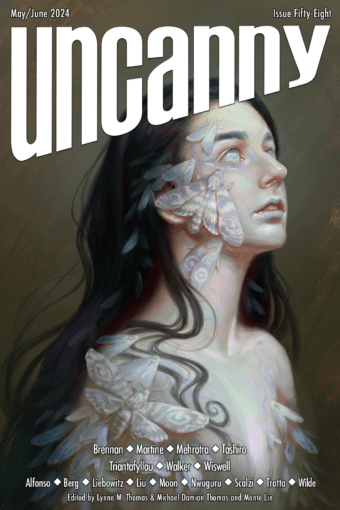
“Loneliness Universe” by Eugenia Triantafyllou appeared in Uncanny (#58, May/June 2024) and is a finalist for the 2025 Hugo Award in the Best Novelette category. You can read or listen to the story online. If you are a member of the 2025 Seattle Worldcon, you can vote for this story through July 23, 2025.
I first learned about the Hugo Awards back in the 1960s. I never attended a Worldcon but always wanted to. I did attend some regional conventions back in the 1970s. I kept up with the Hugo and Nebula awards for most of the 20th century, but slowly lost touch with science fiction and fandom in the 21st century. I discovered “Loneliness Universe” when I read Austin Beeman’s “Reviewing the 2025 Hugo Award Finalists: Best Novelettes” at his website www.shortsf.com.
I’m so impressed with “Loneliness Universe” that I will try to read all the finalists. I might even join the convention as a virtual member and vote. Members get a packet that includes many of the works up for voting. Membership is $50, and adding virtual attendance is another $35. There’s little chance I will physically attend a Worldcon, so that might be my best shot at achieving an old desire.
“Loneliness Universe” is not what I’d call science fiction. Nor would I categorize it as fantasy. One reason I let the science fiction genre pass me by is that it’s no longer what I thought it was supposed to be. That’s not a criticism. I just didn’t feel like keeping up with changing times. However, “Loneliness Universe” is an outstanding work of fiction.
The story begins with an email from Nefeli to Cara dated September 18, 2015. Throughout the story, we get to read email exchanges, but the next one is dated July 5, 2015. I don’t know if this is a spoiler, but the first email is the end of the story. I did not discover right away. In fact, I wouldn’t have discovered it at all if I hadn’t immediately reread the story by listening to it a second time.
I recommend you read this story the first time, then listen to it a second time.
I’m not going to spend much time describing this story. Read it. I will spend some time trying to explain what it’s doing.
There are infinite ways to understand fiction. One way is to think of fiction as a spectrum. At one end are stories where the author sends the readers a message. On the other end of that spectrum are stories where the author creates a story that is just a story.
Think of the first type as a message in a bottle from an individual stranded on a deserted island. And think of the second type as how some people describe God as an artist who created our existence but walked away.
In “Loneliness Universe,” Eugenia Triantafyllou has created a metaphor for our current cultural existence. In this story, Nefeli realizes she is losing physical contact with everyone she knows. She can only communicate with them through email and instant messages. They can leave evidence of their existence, but she no longer communicates with people face-to-face.
The setup for this story reminds me of an experience I had on LSD fifty-five years ago. I thought everyone was in an isolated universe by themselves, and our efforts to communicate in words were no better than writing a message, putting it in a bottle, and throwing it into the sea, hoping for a reply. That each of us was an isolated universe inside our heads. In Eugenia’s story, she imagines we’re all moving into separate universes of a multiverse, and for a while, can communicate via email and instant messages. This sounds science-fictional, but it’s probably more Kafkaesque.
The thing about metaphors is not that they are accurate, true, or valid, but that they make you think about a concept from a new perspective. In recent weeks, I’ve often woken in the middle of the night and thought about all the hundreds of people I’ve known in my lifetime and wondered about what has happened to them. And I ask myself, did we ever really communicate? This is what “Loneliness Universe” is about. Are we on the same wavelength?
Are we ever in the same room at the same time with someone else? If you truly understand this question, I will say those moments of being together are fleeting. Many people want to believe sex is a way to achieve such synchronicity, but that’s not true either. I don’t believe telepathy is possible, but sometimes, when two people have had the same life experiences, they can say just the right words, they know they have achieved a kind of psychic Venn diagram intersection for a fleeting moment.
“Loneliness Universe” is not a perfect story. It’s only as good as you can resonate with what Eugenia Triantafyllou is expressing. I don’t know how well her message in a bottle was decoded by my inner self. We will never be in the same room together. But I’d like to believe I know what she was trying to say.


 Classics of Science Fiction