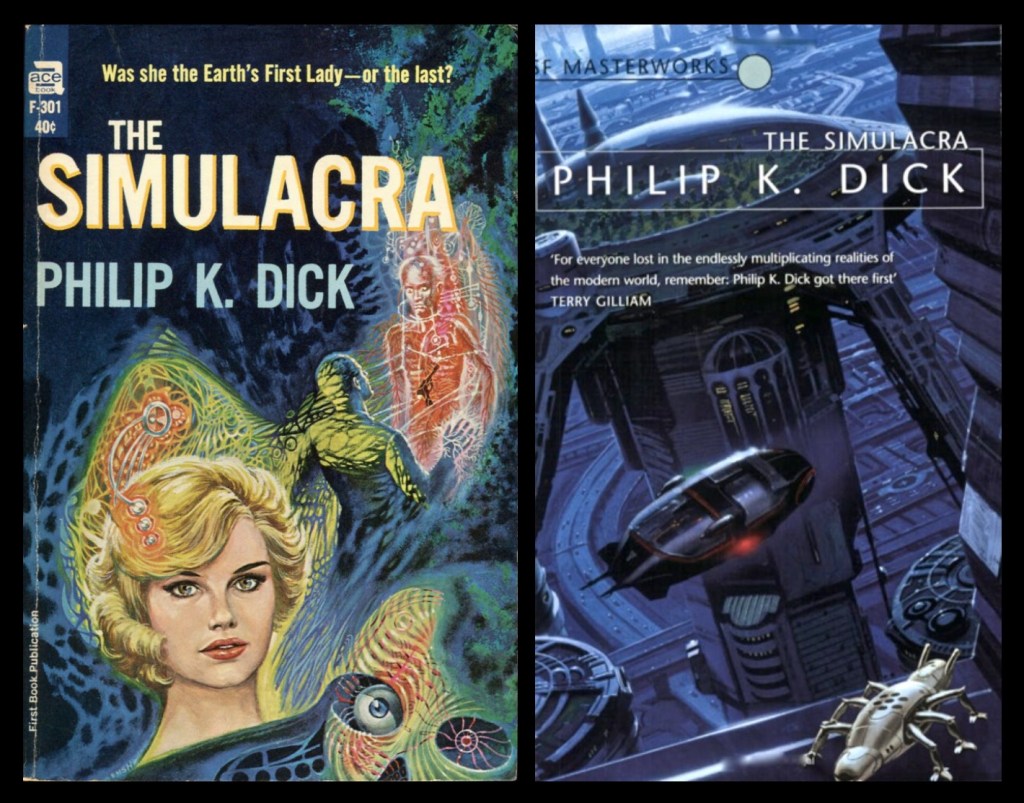
The Simulacra by Philip K. Dick

How do literary scholars of Philip K. Dick’s fiction determine which of his novels are masterpieces and which are his hackwork? They all seem equally bizarre, and even confusing. Library of America selected four novels for their first volume in 2007 devoted to PKD. The years given are when they were (written, published).

  • The Man in the High Castle (1961,1962)
  • The Three Stigmata of Palmer Eldritch (1964,1965)
  • Do Androids Dream of Electric Sheep? (1966, 1968)
  • Ubik (1966, 1969)

The second volume came out in 2008 recognized:

  • The Martian Time-Slip (1962, 1964)
  • Dr. Bloodmoney (1963, 1965)
  • Now Wait for Last Year (1963, 1966)
  • Flow My Tears, the Policeman Said (1970, 1974)
  • A Scanner Darkly (1973, 1977)

The third volume in 2009 highlighted:

  • A Maze of Death (1968, 1970)
  • VALIS (1978, 1981)
  • The Divine Invasion (1980, 1981)
  • The Transmigration of Timothy Archer (1981, 1982)

Are we to assume these are Dick’s best novels? My personal favorite, Confessions of a Crap Artist wasn’t included. Neither was The Simulacra which I just read and found fascinating and fun. I think some of the Library of America selections are better than The Simulacra, such as The Man in the High Castle, The Martian Time-Slip, and VALIS, but I’d also claim The Simulacra is not a lesser novel to the others. However, using our citation database system, it gets only one citation. Twelve of the twenty-seven PKD novels in our database only got one citation. The novels in the first LOA volume received 9 to 32 citations, which supports the LOA editors.

The only reason The Simulacra received one citation is because it was part of the SF Masterworks series. All the science fiction magazine reviewers ignored it when it came out. As far as I can tell, none of the reprint editions got reviewed either. The Simulacra just isn’t well-known. It’s often disliked when I see it mentioned.

I liked it. And I want to make a case that it’s worth reading. However, it will be hard to even describe. I’m afraid most readers will be turned off by The Simulacra because it has multiple plot lines with over a dozen main characters. And I can imagine many readers calling it stupid too — but that could be true for a lot of readers coming to PKD work. However, if two of the five novels Dick wrote in 1963 made it into the Library of America, why shouldn’t the other three? What divides them? What makes one novel “good” and another “bad?”

The Simulacra‘s complexity might keep readers from liking it, but that complexity might hide many novelistic virtues. Just because I admired this novel, doesn’t mean others will. I’m writing this essay hoping people will read The Simulacra and give me their opinion. I’m curious if I’m a total outlier. I got a big kick out of the story.

According to Samuel Johnson, “No man but a blockhead ever wrote, except for money.” Dick complained in several 1963 letters found in The Selected Letters of Philip K. Dick: Volume One: 1938-1971, that his wife Anne constantly hounded him to make more money. On the other hand, Dick wrote eleven literary (non-genre) novels from 1952-1960 hoping to become a recognized mainstream writer. All were rejected. He then wrote The Man in the High Castle in 1961 which bridges the literary and science fiction world and won a Hugo award for best novel. Dick then wrote twenty-one science fiction novels from 1962 to 1969, five of them in 1963 alone. He obviously needed money and had to crank out the manuscripts.

After 1970, Dick only published six more novels before he died in 1982. Five of which are included in the Library of America editions. That suggests that the novels he took more time writing fared better with the critics. So, the five novels written in 1963 were among the fastest he wrote, suggesting they shouldn’t be as good. Yet, two were selected for the Library of America.

As much as I like The Simulacra, I do see that it’s flawed. It doesn’t have a main character which most readers prefer. Nor does it jump back and forth between two main characters, which can be quite successful with some readers. And it’s not even one of those experimental stories where we follow several unrelated characters that all come together in the end. Readers find that structure confusing but forgive it if the ending brings everyone together in a satisfying way. I’m not sure The Simulacra wraps up nicely.

We might call the plotting of The Simulacra an example of characters doing parallel play. Dick might have aimed for creating a collage of future American scenes. My guess is Dick banged away on his typewriter, vomiting up The Simulacra onto typing paper. The results are fascinating because the novel is one big pile of imagery from PKD unconscious mind — and what a mind! It begs to be psychoanalyzed. And I’m sure, it parallels his personal life, especially regarding insanity, psychoanalysis, and troubling wives and women.

The Simulacra is not satire even though it often feels like the film Dr. Strangelove, nor is it a fantasy even though everything is unbelievable. And I wouldn’t call it surreal or dreamlike, or avant-garde even though it was written in 1963 when trendy artists were creating pop art and post-modern fiction. It’s straight science fiction, meant to be taken as realistic, even though it’s bonkers. The Simulacra has the existential absurd horror of The Tin Drum or The Painted Bird. I don’t even think Dick was making fun of science fiction with its comic book level wild ideas. Dick had crazy ideas, and he saw the world being just as crazy.

The Simulacra pictures future America where psychic abilities are accepted as real, that time travel has been perfected, where people and animals can be artificially created and the results indistinguishable from real people and animals, that colonies exist on Mars and the Moon, and alien lifeforms can be commercialized. In other words, all the crap ideas that science fiction fans and fans of the occult believed in the 1950s. Everything they thought possible, became possible.

The hardest part of this essay is describing what happens in The Simulacra. I wrote about that trouble already for my Auxiliary Memory blog, where I explained I had to read the book and listen to the audiobook to get the most out of The Simulacra. In fact, I’m still picking up the book, or putting on the audiobook, and enjoying random parts of the novel. I can’t seem to leave this story. I’m still finding new insights into whatever scene I stumble upon. I’ve decided the best way to describe the story is by mind mapping the characters. The number given is the number of times the character is mentioned in the story.
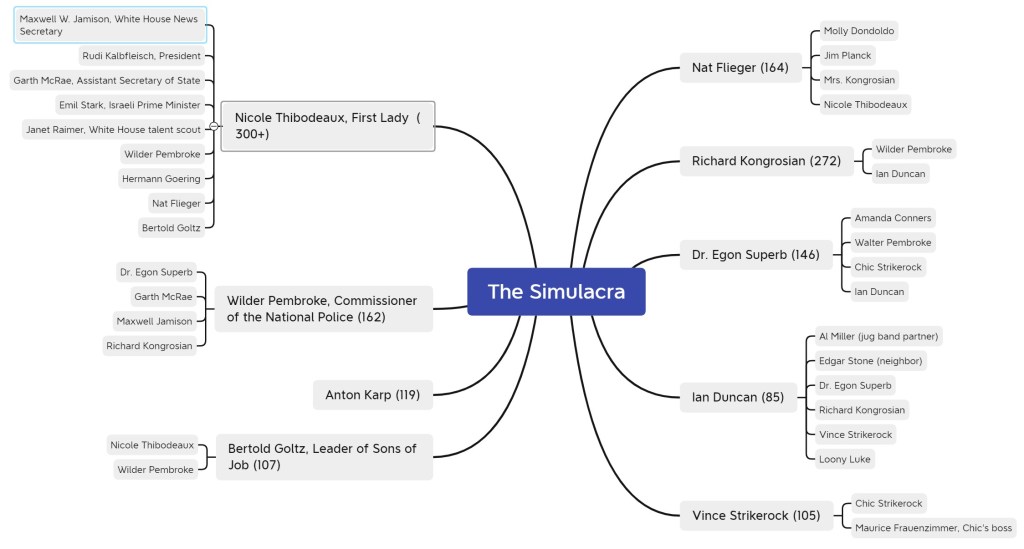
I’m trying not to give away too much of the plot. Each of the first level characters involves a subplot. For example, Dr. Egon Superb is the last legally practicing psychiatrist after the pharmaceutical industry pushed through the McPhearson Act that made drug therapy the only legal form of treatment for mental illness. One of his patients is Richard Kongrosian, a psychic pianist who uses telekinesis to play the piano instead of using his hands. Nat Flieger is a sound engineer who wants to record Kongrosian, but he and his crew of Molly Dondoldo and Jim Planck can never track down the man. Ian Duncan and his old friend Al Miller want to perform classical music as a jug band at the White House for Nicole Thibodeaux. Nicole Thibodeaux, the First Lady, but maybe the true ruler of The United States of Europe and America (USEA) wants to negotiate with Hermann Goering via a time machine to get the Nazis to not kill the Jews. Vince and Chic get involve with making the next president, an android, which will replace Nicole’s current husband. Wilder Pembroke, Anton Karp, and Bertold Goltz all vie for power behind the scenes.

If the novel has a main character, it could be Nicole Thibodeaux. Dick’s original draft was called The First Lady of Earth. Since this book was written in the summer of 1963, I assume Dick was inspired by Jackie Kennedy because Nicole spends most of her time charming people, decorating the White House and gardens, and putting on nightly cultural events. Everyone loves Nicole. Yet, out of the public eye, Nicole is also ruthless enough to have people summarily executed. Evidently, she wields unlimited power because of her access to time travel.

The novel is set in a post-apocalyptic future, decades after China attacked the U.S. with missiles with atomic warheads. This gave rise to a population of mutants, similar in appearance to Neanderthals. People ride in self-driving cars. Ads are living creatures that can invade your home and car and must be killed. Richard Kongrosian believes he has a terrible body odor because a deodorant ad infected him with a jingle. The Sons of Job are a neo-fascist political party. People live in giant communal apartment complexes and are required to take civics tests to stay in them. Many people want to escape this totalitarian society by immigrating to Mars. People buy android nuclear families just to have normal friends.

I could go on. There are several layers of political and corporate intrigue in The Simulacra. Dick evidently thought there were conspiracies everywhere. Later in life, Dick would get into Gnostic religion, which is a very paranoid belief system. This novel has many traits of Gnosticism. The Simulacra was written after The Man in the High Castle, We Can Build You, Dr. Bloodmoney, and The Martian Time-Slip, and before The Three Stigmata of Palmer Eldritch and Do Androids Dream of Electric Sheep? There are many similar themes and obsessive ideas that run through all of them. I wish I had the time and energy to study all those novels and plot all the connections. Why did PKD fixate on certain ideas repeatedly? Was it a lack of imagination to explore unfamiliar territory, or were they ideas PKD just could let go of?

James Wallace Harris, 1/5/24

“The Exploration Team” by Murray Leinster

“Exploration Team” was first published in Astounding Science Fiction, March 1956. You can read it on Archive.org. It is story #8 of 22 for The Best SF Stories of 1956 group read. “Exploration Team” won the 1956 Hugo Award for best novelette, and has been often reprinted.

In this future that Murray Leinster imagines, humans colonize the galaxy, but are unfairly restricted by intergalactic laws. Huyghens, our human protagonist, along with four Kodiak bears and an eagle, decides to illegally explore Loren Two. Huyghens knows he’s an outlaw but is also an idealist fighting for his way of life and against what he considers is unwise legal oppression. The story begins with a Colonial Survey officer, Roane, landing on Loren Two expecting to find a robot built approved colony but discovering Huyghens squatting illegally instead.

This is my second reading of “Exploration Team.” I liked it much better this time, but I don’t think it’s a classic or deserved a Hugo award. Of the stories we’ve read so far for group read 67, I’d have voted for “Brightside Crossing.” I’d rate the story ***+, meaning I thought it fun enough, but it’s not something I’d want to reread in the future.

Loren Two reminds me of the worlds in the Deathworld series by Harry Harrison, science fiction novels about planets where indigenous life is so violent survival is almost impossible. “Exploration Team” is more an adventure story with philosophy than speculative science fiction. Huyghens is against humanity depending on robots. He is out to prove that humans and their animal companions make better exploration teams. Leinster stacks the deck against robots because he never shows robots making a good effort. I think “Exploration Team” would have been a better story if robots were shown competing fairly within the story — instead they are Leinster’s straw bots.

Leinster has a limited vision of what robots can do. He imagines them being confined to specific programmed functions. Unfortunately, Leinster didn’t foresee robots learning like today’s large language models. Still, Leinster works hard to make a case against robots, and I believe it’s essential to the story. Personally, I believe robots will eventually surpass our abilities and make much better space explorers. They can endure a wider range of temperatures and don’t need to breathe, eat, or drink, nor will bacteria or animals want to eat them.

I guess science fiction fans back in 1956 really liked this story about Grizzly Adams in space. I think modern readers would be horrified by its solution of hunting threatening species to extinction. And Leinster never considers the possibility that Loren Two would evolve its own intelligent species, or even consider the intelligence of the existing species. Of course, this is the 1950s and colonialism is still in vogue, and it’s well before animal rights and ethical considerations for what other planets and evolutionary paths they might take.

What makes this story likable are the bears Sitka Pete, Sourdough Charley, Faro Nell, and the cub Nugget. Robert Heinlein and Andre Norton produced several successful juvenile science fiction novels in the 1950s that featured animal companions. That factor might have influenced Hugo voters.

Here’s what Mike emailed me about the story:

The only thing "Exploration Team" has going for it are the mutated Kodiak bears. Such an outrageous idea provides impetus to an otherwise rickety story.

The story centers on the ongoing battle against the native sphexes, cold-blooded belligerent carnivores.

The story suffers whenever Huyghens launches into his countless anti-robot screeds. "But you can't tame wilderness with 'em!" In the end, the humans defeat the sphexes by using modified robots, making Huygens seem like a bit of a bloviating dingbat.

The story is told with a certain breathless quality:

"And the sphex whirled. Roane was toppled from his feet. An eight-hundred-pound monstrosity straight out of hell--half wildcat and half spitting cobra with hydrophobia and homicidal mania added--such a monstrosity is not to be withstood when, in whirling, its body strikes on in the chest."

We are repeatedly reminded that sphexes "looked as if they had come straight out of hell."
And we learn that "...lustfully they fueled tracked flame-casters..." Really? Lustfully?

But it doesn't pay to scrutinize a story like "Exploration Team." Come for the action, stay for the bears.

One writing flaw I noticed while reading was that Leinster kept repeating himself. There are several places in the story where he would describe something, and then a few pages later describe it again with the same words. Plus, the story was too long. Unlike Mike, I accepted the criticism of the robots as the purpose of the story. Leinster promotes his character as an individualist, and protester. I thought Huyghens and the bears did make a good team. But I also can imagine a human and robots making an even better team. Unfortunately, I don’t want to imagine a future where we go around consuming all the planets in the galaxy like we’ve consumed our home world.

James Wallace Harris, 12/14/23

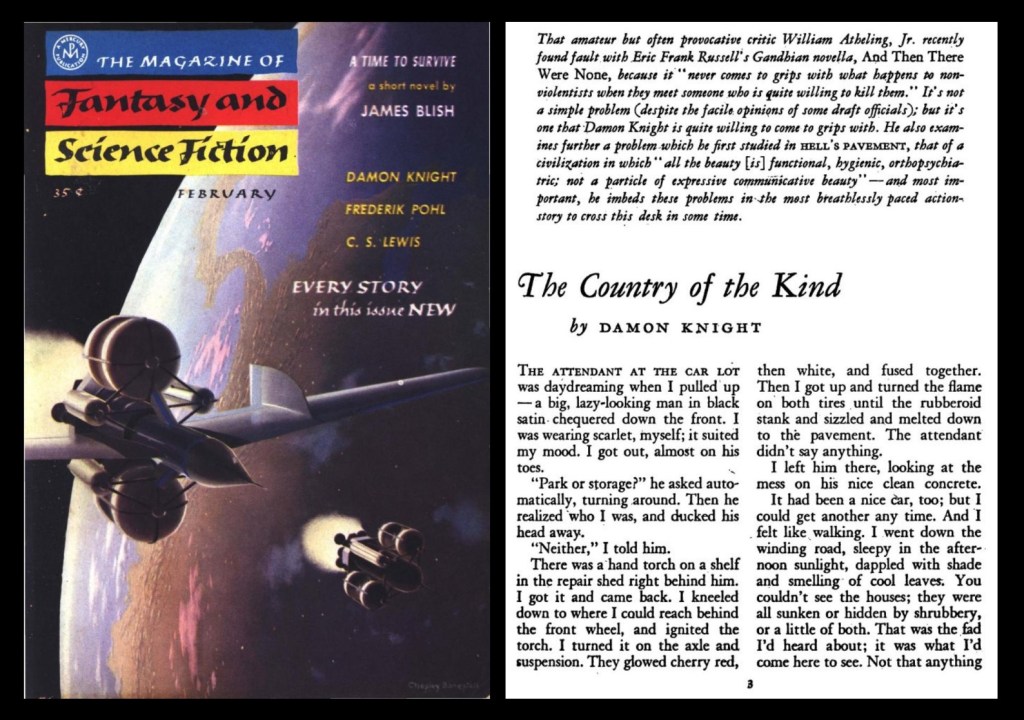
“The Country of the Kind” by Damon Knight

“The Country of the Kind” was first published in The Magazine of Fantasy & Science Fiction, February 1956. You can read it on Archive.org. It is story #5 of 22 for The Best SF Stories of 1956 group read. “The Country of the Kind” is one of the highest rated stories on The Classics of Science Fiction Short Stories v. 2 list, with eleven citations. It is by far the most remembered science fiction short story from 1956. Here are the eleven citations we used:

“The Country of the Kind” is set in an unnamed utopia and is told by an unnamed narrator. When the narrator was fifteen, he killed a girl who spurned him. In this utopian society they couldn’t punish him directly because it doesn’t allow violence. They fixed the narrator so whenever he tried to hurt someone else, he’d have an epileptic fit. And to warn others of his presence, his body odor and breath were made to smell repulsive. He was then left free to do whatever he wanted. For thirty years he has wandered about the Earth trying to retaliate by sabotaging other people’s activities or destroying their property. People ignored him, so he suffered endless loneliness. The narrator creates small works of art which he leaves everywhere with a message inviting other people to join him and be free.

My friend Mike sends me emails with comments about these 1956 science fiction stories since he doesn’t want to use Facebook. Here’s what he had to say:

A good science fiction tale draws you in completely, overriding your skepticism about the implausibility (or impossibility) of events.

Damon Knight asks us to accept the notion that a murderous psychopath is allowed by society to indulge himself in an endless destructive rampage. Although he is prevented from physically harming others by induced epileptic seizures, the community allows him to wreak havoc without restraint.

Perhaps Knight is exposing the passivity and weakness of that society, but it beggars the imagination that any group would allow such extreme behavior to go unchecked, no matter how kind and understanding they profess to be.

After the "king of the world" murdered his girlfriend named Elen when he was fifteen, he tells us "...if I could do it to Elen, I thought, surely they could do it to me. But they couldn't. They set me free: they had to."

Why did "they" have to? Are we to believe that a seemingly well run country is so "kind" that even a psychopath is allowed free rein? That's a bridge too far for me.

Remember, I talked about how believability was very important to me regarding science fiction when reviewing “Brightside Crossing.” I could understand why Mike didn’t think the world of “The Country of the Kind” was believable, but I said to him in a phone call, didn’t we both believe the world of “Brightside Crossing” was impossible? Yet, we still found the story believable. I asked him what crossed the line for him in “The Country of the Kind.” Mike said he just didn’t believe people would allow a person like the narrator in any society, that was too much for him to believe that people wouldn’t stop the narrator from damaging their property.

I said, wasn’t “The Country of the Kind” unbelievable in the same way “The Ones Who Walk Away from Omelas” is unbelievable, and didn’t you love that story? Mike replied that story was metaphorical.” I countered, doesn’t “The Country of the Kind” seem just as metaphorical in the same way? Both are about utopias that that are held together by the suffering of one person. After I said that, I even wondered if Ursula K. Le Guin wasn’t in some way inspired by “The Country of the Kind” when she wrote “The Ones Who Walk Away from Omelas.” Mike said he would reconsider “The Country of the Kind” as a metaphor. Maybe he will post a reply.

Are the fictional worlds of Brave New World, Nineteen Eighty-Four, or The Handmaid’s Tale believable? Aren’t they metaphorical too, because their authors have something to say about our reality? Dune, The Foundation trilogy, The Left Hand of Darkness and even The Man in the High Castle create worlds that we are asked to believe are realistic. Obviously, Alan E. Nourse wanted us to believe “Brightside Crossing” was realistic. But we aren’t expected to believe the fictional universes of The Hitch-Hiker’s Guide to the Galaxy or Sheckley’s Mindswap were realistic.

In other words, fantasy, humor, satire, and metaphorical fiction don’t ask us to believe their settings are realistic. But most literary works, especially of the mimetic type, and some kinds of science fiction do ask us to believe that they are reality based.

Of course, if “The Country of the Kind” is metaphorical, then what is the metaphor? That even kindness can cause great suffering. To be free in a utopia you need to be able to commit evil deeds. 1956 was a time of conformity in America, and many people were freaked out by juvenile delinquents, motorcycle gangs, and other nonconformists. Remember, a year later in 1957, On the Road by Jack Kerouac came out. Kerouac called his kind of nonconformists Beats, and society renamed them beatniks. A few years later, society turned against hippies too. I say On the Road wasn’t metaphorical. But I would say One Flew Over the Cuckoo’s Nest or Catch-22 are.

In the 1950s there was a lot of talk about crime being caused by society, and that criminals were a product of bad biology or a bad environment. Damon Knight’s unnamed narrator is an awful person, but he gets our sympathy. Unlike the tortured child in “The Ones Who Walk Away from Omelas,” the unnamed narrator isn’t the engine of utopia. Or is he? Wouldn’t a perfect utopia be dull and boring? What if evil is needed as the engine of goodness? I’m reminded of a phrase, “What if our world is their heaven?”

What if all fiction is metaphorical? What if “Brightside Crossing” was a metaphor for extreme adventurers?

Fiction is based on a suspension of disbelief. If Mike can’t suspend his disbelief that’s perfectly okay. If he doesn’t like “The Country of the Kind” does it matter that I do?

I’m fascinated by the nature of memory. I’m particularly fascinated by fiction that our culture remembers, like works by Jane Austen or Charles Dickens. But I’m also fascinated by the stories I find personally memorable. “The Country of the Kind” and “The Ones Who Walk Away from Omelas” are such stories. A year for now, I might forget “Brightside Crossing.” As I read and reread these old science fiction stories, I’m amazed by which ones I remember and which ones I don’t.

“The Country of the Kind” was voted into The Science Fiction Hall of Fame Volume One because it was so remembered by the first members of the Science Fiction Writers of America. I wish SFWA would poll their membership every ten years on their favorite stories. I’d love to see what every generation of science fiction writers remember.

With this December 2023 reading; it’s probably the fourth or fifth time I’ve read this story, I am somewhat sympathetic to the unnamed narrator of “The Country of the Kind.” I wasn’t before. I totally loathed the narrator. However, this time I still think his actions are still horrific, but I feel the utopian society has imposed a cruel and unusual punishment upon him.

And I’m still unsure of Knight’s intentions in writing this story. Whatever meaning it has could be entirely accidental. Knight might have thought of the situation without considering its implications.

The epileptic pain the narrator experiences is brought on by his own actions. But the loneliness is caused by the utopian society imposing the punishment. And this society is supposedly incapable of causing harm. Such a society would know that social contact is a necessity.

Writers often make their stories ambiguous but this one might be too unclear. I wonder if Knight has ever written an explanation of “The Country of the Kind.”

James Wallace Harris, 12/6/23

“Brightside Crossing” by Alan E. Nourse

Brightside Crossing” was first published in Galaxy Science Fiction, January 1956. You can read it on Archive.org or Gutenberg.org or listen to it on YouTube. It is story #1 of 22 for The Best SF Stories of 1956 group read.

“Brightside Crossing” begins in a bar on Earth, the Red Lion, with James Baron sitting at a table. A grizzled old man comes in to see him, Peter Claney. We learn that Baron is planning an expedition to the planet Mercury, hoping to trek across the sun side surface and reach the equator when the Sun is at its closest and hottest position. Temperatures will reach 770 degrees Fahrenheit. When this story was written it was thought Mercury always had one side facing the Sun, the Brightside, like how one side of the Moon always faces the Earth. We’ve since learned that Mercury does slowly rotate three times for every two solar orbits Mercury makes.

Peter Claney was part of a team that previously tried to make the Brightside crossing, and he’s come to the Red Lion to warn Baron not to try. This implies Peter’s team failed, and Peter’s story is how we learn about that failed attempt. Nourse’s story is what we now call hard science fiction, although the term wasn’t coined until a year later. Even for 1956, I had several nit-picks about this story’s realism, but nothing that detracted from it being a great science fiction adventure tale. It was a finalist for the Hugo.

“Brightside Crossing” reminds me of reading books by polar explorers, or about the men who tried to find the Northwest Passage, especially of Franklin’s lost expedition. It’s about the kind of person who will endure extreme hardship to be first somewhere.

I agree completely with what my friend Mike emailed me about the story:

1. Nourse avoided the info dump trap. He succinctly describes the equipment used to make the Mercury crossing without falling into the endless info dumps found in some stories. 

2. The characters have depth and nuance. Ted McIvers is described as “kind of a daredevil.” At first, we think he’s just foolhardy, but we eventually realize that they will die if they don’t move faster and McIvers is trying to save them. Peter Claney admits “A man like McIvers was necessary. Can’t you see that?” Jack Stone is fearful and reveals “I’m scared.” However, when McIvers needs to be rescued, Jack agrees to go down and help. He overcomes his fear. And Peter Claney states categorically that the crossing is impossible, but he still wants to try again and be part of another attempt.

3. The story echoes the courage and heroism of the great Antarctica explorers Robert Scott and Ernest Shackleton.  

4. Nourse’s descriptions of the terrain are beautiful and terrifying. Every word is carefully chosen. We can feel the heat. The danger is visceral.

“Brightside Crossing” also reminds me of what I loved about science fiction as a kid back in the 1960s, but I don’t think I read “Brightside Crossing” then. I do vaguely remember a few science fiction stories set on Mercury. It is exactly the kind of story that would have wowed me as a kid because I loved science fiction stories that I wanted to feel were possible. This is my second reading of “Brightside Crossing” and I’m even more impressed than the first time I read it in The Great SF Stories 18 (1956) a couple of years ago.

This time as I read it, I thought “Brightside Crossing” represents the kind of science fiction I would use in creating my definition of science fiction. The story is believable in the way I want to define science fiction. Sure, Nourse’s speculation might be faulty or even impossible by today’s scientific knowledge and technology, but in the 1950s the story seems possible, at least to a kid who embraced the theology of the final frontier.

My disappointment with a lot of science fiction, especially science fiction from recent decades, is it’s not believable. I don’t know why when I was a kid, I wanted to believe humans would explore all the planets and moons of the solar system. I thought science fiction was propaganda to make such exploration happen. I knew there were two kinds of science fiction. The kind I like imagined either a probable future we should avoid or a future we should want to create. The other kind of science fiction was just stories that got its ideas from the first type. And like the degradation of originals from making copies of copies, too much science fiction seems inspired from science fiction cliches.

Over time, I think science fiction has become the label for any fantastic tale that involved the future or outer space. A splendid example of the second kind is “Fondly Fahrenheit” by Alfred Bester. It’s still a classic story, but not the kind of science fiction I’m talking about. Bester was both having a go at the genre and pushing it to its limits. Unfortunately, I think writers have settled on the second kind of science fiction as the preferred kind and see it as a Disneyland to work out their wildest ideas, rather than serious speculation about reality.

Like Busby Berkeley always working to top his previous dance routine, science fiction keeps trying to top itself. And like Busby Berkeley, the results have gotten absurdly wild. Busby Berkeley expected the movie audience to believe that his dance routines would be what an audience in a cabaret or Broadway theater would see, in the same way science fiction writers now expect their readers to believe their stories would fit into our little old reality. Sure, it’s fun to see fabulous big productions created by wild fancies of the mind but there’s something to be said about real people confined to Earthly possibilities. In case you have no idea, who Busby Berkeley was, or my analogy, I’ll include this film clip:

Alan A. Nourse was never a big name in science fiction, but I have encountered his work now and then, but I only vaguely remember him. “Brightside Crossing” inspires me to find more of his work. The two I think I might have read as a kid; are ones I want to try:

But I’d also like to find the collection below because of its neat cover, but it will probably be easier to get Alan E. Nourse Super Pack at Amazon for $1.99, which has several of the same stories, including “Brightside Crossing.”

By the way, “Brightside Crossing” had three things I couldn’t believe, but they were just little bumps in the road. The first are the suits that protected them from the horrendous heat. They plan to stay in them for over a hundred days. How did they handle peeing and pooping? A kid would wonder that and so did I as an old man. I also found it unbelievable that Ted McIvers could just show up late by hitching a ride on a Venus supply rocket, days after the others had arrived. That bothered me because trips would be rare to the planet Mercury. Finally, when Ted McIvers goes off course and stumbles upon the remains of the last expedition that tried to make the Brightside crossing. That seemed like way too much of a coincidence. They are crossing a whole planet, and they just happen to discover what happened to the previous explorers.

James Wallace Harris, 11/27/23

Has Science Fiction Left Me Behind?

The above books were the finalists for the 2023 Hugo Awards. I have not read any of them. Nor do they look interesting to me. Each year the Hugo and Nebula award finalists seem further and further away from what I want to read.

The other day I went into a new bookstore for the first time in many months. I went up and down the aisles of the science fiction section and I was shocked by how many books were by authors that were unknown to me.

I turn seventy-two next month and I wonder if I’ve gotten too old for science fiction. Or, has the genre left me in the dust? I can accept that I might be too old to keep up. Could the genre have changed, and I’ve just lost interest? Who knows?

In the 20th century I’m sure I read at least a thousand science fiction books, probably many more. Here’s a list of the 69 SF&F books I’ve read in the 21st century:

  • 2000 – Harry Potter and the Goblet of Fire by J. K. Rowling (Hugo winner)
  • 2000 – Calculating God by Robert J. Sawyer (Hugo finalist)
  • 2001 – American Gods by Neil Gaiman (Hugo winner)
  • 2001 – Perdido Street Station by China Miéville (Hugo finalist)
  • 2002 – Altered Carbon by Richard K. Morgan
  • 2003 – The Time Traveler’s Wife by Audrey Niffenegger
  • 2004 – Cloud Atlas by David Mitchell
  • 2004 – Jonathan Strange & Mr. Norrell by Susanna Clarke (Hugo winner)
  • 2004 – The Plot Against America by Philip Roth
  • 2005 – Spin by Robert Charles Wilson (Hugo winner)
  • 2005 – Old Man’s War by John Scalzi (Hugo finalist)
  • 2005 – Never Let Me Go by Kazuo Ishiguro
  • 2006 – The Road by Cormac McCarthy
  • 2006 – Life As We Knew It by Susan Beth Pfeffer
  • 2007 – The Yiddish Policeman’s Union by Michael Chabon (Hugo winner)
  • 2008 – The Hunger Games by Suzanne Collins
  • 2008 – Little Brother by Cory Doctorow (Hugo finalist)
  • 2008 – Flood by Stephen Baxter
  • 2008 – Marsbound by Joe Haldeman
  • 2009 – The City & The City by China Miéville (Hugo winner)
  • 2009 – The Windup Girl by Paolo Bacigalupi (Hugo finalist)
  • 2009 – Boneshaker by Cherie Priest (Hugo finalist)
  • 2009 – Julian Comstock by Robert Charles Wilson (Hugo finalist)
  • 2009 – Catching Fire by Suzanne Collins
  • 2009 – Wake by Robert J. Sawyer
  • 2010 – Feed by Mira Grant (Hugo finalist)
  • 2010 – Mockingjay by Suzanne Collins
  • 2010 – Watch by Robert J. Sawyer
  • 2010 – Hull Zero Three by Greg Bear
  • 2011 – Among Others by Jo Walton (Hugo winner)
  • 2011 – Leviathan Wakes by James S. A. Corey (Hugo finalist)
  • 2011 – The Martian by Andy Weir
  • 2011 – Ready Player One by Ernest Cline
  • 2011 – Wonder by Robert J. Sawyer
  • 2012 – Redshirts by John Scalzi (Hugo winner)
  • 2012 – 2312 by Kim Stanley Robinson (Hugo finalist)
  • 2012 – The Dog Stars by Peter Heller
  • 2012 – The Age of Miracles by Karen Thompson Walker
  • 2012 – vN by Madeline Ashby
  • 2014 – The Three Body Problem by Cixin Liu (Hugo winner)
  • 2014 – Annihilation by Jeff VanderMeer
  • 2014 – Station Eleven by Emily St. John Mandel
  • 2014 – The Girl with All the Gifts by M. R. Carey
  • 2014 – The Book of the Unnamed Midwife by Meg Elison
  • 2014 – Yesterday’s Kin by Nancy Kress
  • 2015 – Seveneves by Neal Stephenson (Hugo finalist)
  • 2015 – Children of Time by Adrian Tchaikovsky
  • 2015 – Binti by Nnedi Okorafor
  • 2015 – Aurora by Kim Stanley Robinson
  • 2015 – The Water Knife by Paolo Bacigalupi
  • 2016 – All the Birds in the Sky by Charlie Jane Anders (Hugo finalist)
  • 2017 – New York 2140 by Kim Stanley Robinson (Hugo finalist)
  • 2017 – All Systems Red by Martha Wells
  • 2017 – Sea of Rust by C. Robert Cargill
  • 2017 – Under the Pendulum Sun by Jeanette Ng
  • 2017 – Noumenon – Marina J. Lostetter
  • 2018 – The Calculating Stars by Mary Robinette Kowal (Hugo winner)
  • 2018 – Semiosis by Sue Burke
  • 2018 – The Fated Sky by Mary Robinette Kowal
  • 2018 – The Feed by Nick Clark Windo
  • 2019 – Children of Ruin by Adrian Tchaikovsky
  • 2019 – Machines Like Me by Ian McEwan
  • 2020 – The Ministry for the Future by Kim Stanley Robinson
  • 2020 – The Midnight Library by Matt Haig
  • 2021 – Project Hail Mary by Andy Weir (Hugo finalist)
  • 2021 – Klara and the Sun by Kazuo Ishiguro
  • 2022 – Babel by R. F. Kuang
  • 2022 – The Mountain in the Sea by Ray Nayler
  • 2022 – Sea of Tranquility

That’s an average of 2.8 SF&F books a year. Assuming I read a thousand SF books from 1963-1999, means I averaged 27.78 SF books a year. I think I could have easily read 1,500 SF books, or 41.67 SF books a year. In other words, I don’t read SF like I used to. And my 21st century list includes quite a few fantasies. I rarely read fantasy in the 20th century. I really don’t like fantasy books. I only read them when they reach a certain pop culture status.

One reason for the shift is I read more literary works and nonfiction books. Another reason is after reading thousands of science fiction books, I seldom read reviews of new science fiction books that sound different enough to be appealing.

I used to keep up with the genre by belonging to the Science Fiction Book Club, which offered two new titles a month. I subscribed to several science fiction magazines and fanzines that reviewed new books. And I would visit one or two new bookstores a week.

Fanzines disappeared, and I stopped having time for the prozines even though I still subscribed. After Amazon and Audible, I stopped shopping in new bookstores, and they eventually disappeared. Back in the 1970s I went to conventions and even published fanzines. In the 1980s I ran a BBS devoted to science fiction. Since the 1990s I’ve run websites and databases devoted to SF. Once upon a time all my friends were SF readers. But active participation in fandom ended when I got married and settled down to work in 1978. I became a different person socially.

Since 2002, I’ve been rereading the science fiction I first read in the 20th century by listening to audiobook editions from Audible.com. It’s a kind of nostalgic trip. I also caught up on a lot of 20th century science fiction I missed. That also kept me from reading many new SF books.

But in all honesty, I prefer old science fiction to new science fiction. There’s been some great exceptions, but I think that’s the real reason I’ve let the genre pass me by.

I wish the Science Fiction Writers of America never embraced fantasy. I wish the Hugo Awards had focused exclusively on science fiction. Fantasy should have their own fan-based award. I can’t help but wonder if the science fiction genre would be more vibrant today if it hadn’t been married to the fantasy genre. Even books marketed as science fiction often feel like fantasies. Looking back, I would have preferred a smaller, focused SF genre, one I could have kept up with.

Science fiction used to have some realism, or at least some speculative integrity. Now, any old wild idea works. Science fiction used to be inspired from reality, now new writers are inspired mostly by science fiction movies. It’s as if all science fiction is recursive science fiction.

Who knows, maybe I left science fiction behind.

James Wallace Harris, 10/22/23

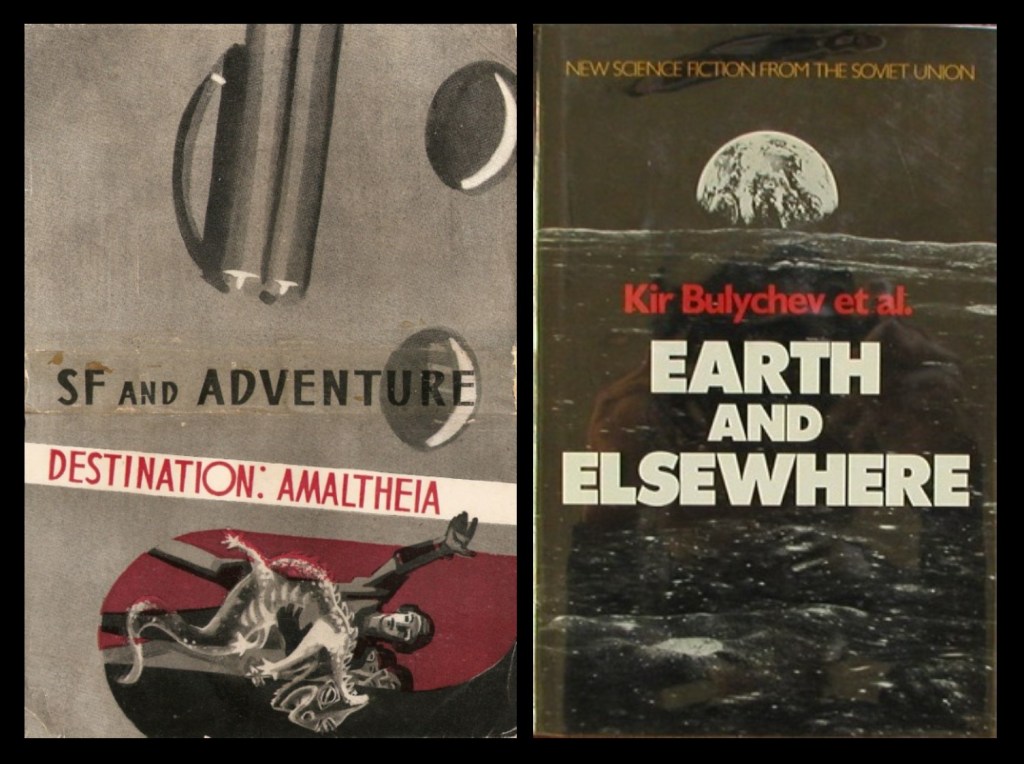
“The Way to Amalteia” by Arkady Strugatsky and Boris Strugatsky

The Way to Amalteia” by Arkady Strugatsky and Boris Strugatsky is story #52 of 52 from The World Treasury of Science Fiction edited by David G. Hartwell (1989), an anthology my short story club is group reading. Stories are discussed on Tuesdays, Thursdays, and Saturdays. “The Way to Amalteia” was first published in Russian in Путь на Амальтею in 1960.

“The Way to Amalteia” was first translated into English in 1963, and later in 1985, before the 1989 translation for The World Treasury of Science Fiction. Finding those other editions will be difficult, and since there have been no English reprints since 1989, it shows the value of owning a copy of The World Treasury of Science Fiction. Collecting retrospective anthologies of science fiction is one way of preserving literary history.

“The Way to Amalteia” starts out on J-Station, a research settlement on Amalthea, the fifth moon of Jupiter. The Strugatsky brothers describe the beautiful site of Jupiter from that moon. But we learn that the station is running out of food, and everyone is on strict rations. The settlement is desperately waiting for the freighter, Takhmasib, to deliver supplies, but it’s running late, and they’ve lost contact with the ship.

The story then cuts to the freighter, where we learn why. The Takhmasib has suffered several mishaps and has fallen into Jupiter. The Strugatsky brothers have set up an almost impossible situation and we don’t know if the crew can save themselves.

This is a hard science story, especially for 1960. Hartwell, in his introduction said it would fit right in an issue of Astounding, and that’s true. Hartwell said it also reminded him of Clarke’s “A Meeting with Medusa,” which I thought too. I also thought the story sounded like something Hal Clement would write, and it turns out Arkady Strugatsky translated Mission of Gravity into English.

There’s a lot going for “The Way to Amalteia,” but unfortunately, on this first reading, the story didn’t thrill me. I vaguely sensed it was an outstanding story, but something kept me at a distance. Having so many things go wrong spoiled it for me on one level. Having the cause of the major catastrophe be due to meteorites seemed cheesy. And I wondered if I was missing the flavor of the story because it was a translated work. Finally, there were places where figures were given, and they just seemed impossible to believe.

On page 1027 the photon drive pushes the ship to sixty-seven thousand kilometers a second. That’s about a fourth of the speed of light (299,792 kps). On page 1058 we learn the pressure on the ship as it descends into Jupiter’s atmosphere is three hundred atmospheres. This is after the ship had several holes punched in it from meteors and was patched with resin and metal plates. And there was another mention of the crushing pressure of Jupiter’s atmosphere that was much higher than three hundred atmospheres, but I can’t find it. All these problems remind me of old science fiction movies of the 1950s where science was often mumbo jumbo. But were these errors the writers’ fault, or the translators?

I also feel if I read “The Way to Amalteia” a couple more times in the future I might get to like it quite a bit. I don’t think one reading does the story justice. The story comes across like an episode of Star Trek, where a valiant captain is forced to deal with a series of ever escalating problems, but then at the last minute saves the day.

The Strugatskys spend a lot of time developing the characterization of the international crew and filling the story with textural details. I couldn’t tell if they were realistic or stereotypes because I wondered if some of the flavor was lost in translation.

“The Way to Amalteia” was an interesting story to close the anthology, especially since it’s a novella. Hartwell must have thought highly of the story. That’s why I think it might improve on rereading. But most readers don’t reread. I would have put “The Way to Amalteia” where Hartwell put “A Meeting with Medusa” on page 146 and closed with “A Meeting with Medusa.” The Clarke story offers way more hope for the future.

James Wallace Harris, 9/2/23

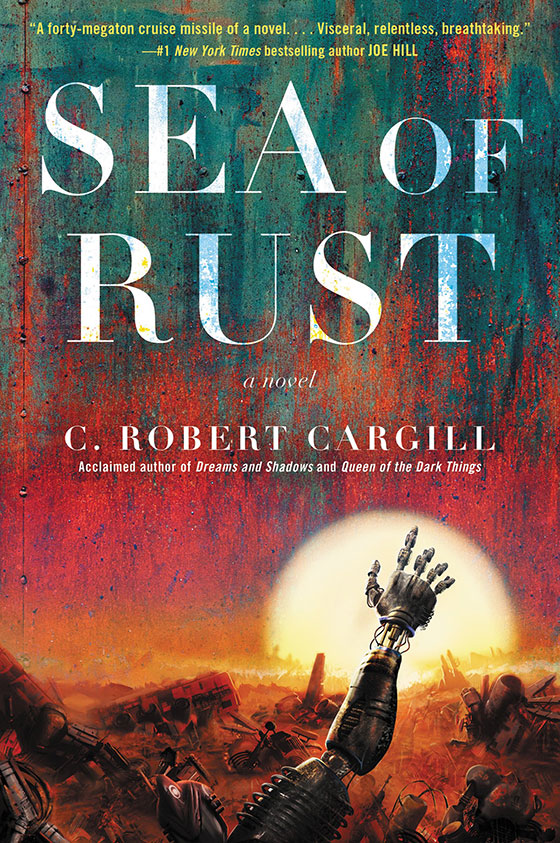
Sea of Rust by C. Robert Cargill

I’ve been craving a new science fiction novel, at least something less than ten years old. I admit, I’ve been stuck in mid-20th century science fiction, and I’m mostly out of touch with 21st century science fiction. I have read forty or more science fiction novels that were published after 2000 — the more famous ones — but there’s been thousands of science fiction novels published since then. I’m feeling out of touch with current science fiction. I keep hoping to find a new science fiction novel that will dazzle me like the science fiction novels I discovered as a kid in the 1960s. I’m beginning to feel that won’t ever happen again.

Sea of Rust as Sci-Fi

Sea of Rust by C. Robert Cargill came out in 2017. I picked it to read because I watched a couple YouTubers review it positively, and because it’s about robots after humans have gone extinct. I love that concept. It’s slowly growing into a mini-sub-genre. One of the earliest stories on this theme is “Rust” by Joseph E. Kelleam from 1939. (See my short review.) Another is “Who Can Replace a Man?” by Brian W. Aldiss from 1958. Of course, the real classic is City by Clifford D. Simak, but the theme is only used in the fictional intros that tie stories together. Those intros describe a world without men occupied by robots and intelligent dogs. There’s also “Three Robots” an episode in the Netflix series Love, Death + Robots based on a John Scalzi short story, and the more famous film, Wall-E. And Rudy Rucker’s Ware Tetralogy eventually gets into this theme too. There are many more.

Sea of Rust is a fun adventure story about a cadre of armed robots helping a robot, Rebekah, on an important mission to save free robots from an OWI (One World Intelligence – think Borg for bots). Their destination is in a wasteland called Sea of Rust, formally, the American Rust Belt. That’s the territory were crazy robots go, and where poachers go to kill the crazy robots and harvest their parts. Sea of Rust feels a bit like a Mad Max film, but instead of people surviving a harsh desert post-apocalyptic environment, it’s robots. It especially reminded me of Mad Max Fury Road, only because it becomes an endless race of good guys being chased by bad guys.

The main POV character is Brittle, who started out as a caregiver robot for humans, but after their extinction, becomes harden, surviving by killing other robots for their parts. Her nemesis is Mercer, another caregiving robot who is also a poacher. They want to kill each other to survive. When the OWI, CISSUS, attacks a holdout for free individualistic robots, these two joins up with Rebekah, 19, Herbert, One, Two, Doc, and Murka. At first Brittle goes along to survive another day, but eventually believes in Rebekah’s mission too.

Sea of Rust also feels like a western, with parallels to The Magnificent Seven, because of a group of diverse misfits, some of which aren’t so nice, work together for a noble cause. Each has their weapon of choice. Sea of Rust also remind me of many war movies where a squad of soldiers are on a suicide mission, and one by one get killed off.

I recommend Sea of Rust to readers who like action-oriented science fiction like what they see on television or at the theater. It’s fun. It’s nowhere near as fun as We Are Legion (We Are Bob) by Dennie E. Taylor or Hail Mary by Andy Weir. But it’s like them in that Sea of Rust is breezy and entertaining.

When I ask myself why We Are Legion (We Are Bob) and Hail Mary are better books, it’s because I admire their main characters, and envy their skills. They are positive. Brittle is a mass murderer of humans, and robot con artist and murderer. It’s strange how much modern fiction features heroic bad guys.

— Beyond Here Lie Spoilers —

Don’t read beyond here because I’ve going to be critical of Sea of Rust, but most of my criticism doesn’t apply to the average science fiction reader, especially those who only read for fun and don’t want to get overly analytical. It might seem like I’m attacking Sea of Rust but I’m using it as an example, to explain the kind of science fiction I want to read.

Sea of Rust as Speculative Fiction

I like science fiction that speculates about real possibilities. Very few science fiction novels do this. Most science fiction takes a fun theme and produces a new variation. Sea of Rust is about robots, but the robots in science fiction aren’t like the robots we see in the real world. Nor are fictional robots anything like what current robots will evolve into. I find that disappointing.

In Sea of Rust all the robots act like humans wearing robot suits. There is some minor speculation, but science in the novel seemed inspired by the average PC user, and not computer scientists. The technical terminology doesn’t go beyond CPU, RAM, memory, hard drive, and core. It’s just a fun story, a light-hearted thriller with lots of guns, and gun battles. Similar visually to what people see in video games.

All the robots in this story have human qualities, and that’s my main critical issue. I’m disappointed that science fiction writers don’t or can’t imagine robots with non-human qualities. I can’t think of any robot story where the robot isn’t anthropomorphized. Is that some kind of barrier writers just can’t break through?

The idea of intelligent robots existing after humans is extremely fascinating. What kind of civilization would they build? I can’t believe it would be a cliche Mad Max post-apocalypse. I doubt robots will ever have gender or even be able to comprehend it. I doubt robots will have emotions or be able to comprehend them. None of the experiences we get from being biological creatures will be understandable by AI minds.

I’m waiting for science fiction writers to imagine states of mind that robots will evolve. I’m waiting for science fiction writers to speculate how robots will think differently from us. Sure, this will be hard, as hard as humans imagining the umwelt of octopuses.

Now that I’m an old science fiction fan, I’m beginning to see the limits of what science fiction can achieve. What I want probably needs to come from speculative nonfiction, and not speculative fiction.

My other major problem with Sea of Rust is its use of guns. We live in a culture that has a lust for guns. It’s a kind of pornography. But the use of guns in fiction is a kind of crutch, at least to me. Too much fiction is based on gun violence. Too much plotting and plot motivation centers around gunplay.

Conflict is vital to fiction, but too many writers depend on gunplay as their basis of conflict. Consumers of books and movies can’t seem to get enough of fiction with gunplay, so it might be silly to criticize the use of it. But I’m bored with gunplay-based conflict. I’m also reading Raymond Chandler books this summer, and they have extraordinarily little gunplay in them, and they are considered the gold standard for hardboiled detective mysteries.

Sea of Rust would have impressed me if Cargill had imagined robots involved in some kind of conflict that was realistic for evolved AI minds, and that didn’t involve guns or kill or be killed. I’m guessing robots won’t be violent like us because they won’t have our genetic disposition for xenophobia, greed, reproduction, and territory.

It could be, at 71, I’m finally outgrowing science fiction. I don’t want that to happen. I’m like a religious person that’s lost all their faith, and should be an atheist, but I can’t give up my upbringing. What I want is science fiction that will validate my belief in science fiction again, but Sea of Rust didn’t provide that. I know many young people consider this a 5-star read, and I do recognize it has the qualities that would appeal to many readers. So, don’t take my reaction as a buyer’s guide.

I wrote this review using Sea of Rust to explain where I’m at and what I want from science fiction. Thinking about novels about robots, I’m not sure science fiction has ever dealt with them in a realistic way. Asimov, Williamson, and Simak certainly did not. Neither did Philip K. Dick.

Living in the 2020s has brought us real robots and Artificial Intelligence, as well as commercial space exploration. Reality is leaving science fiction in the dust. I keep waiting for science fiction to catch up to reality and leap into the future again. I’m starting to think that might not even be possible.

Yes, I hunger for new science fiction that realistically speculates about the rest of the 21st century, but I just can’t find any. I’m beginning to wonder if science fiction has ever realistically speculated about the future.

James Wallace Harris, 7/25/23

“Inconstant Moon” by Larry Niven

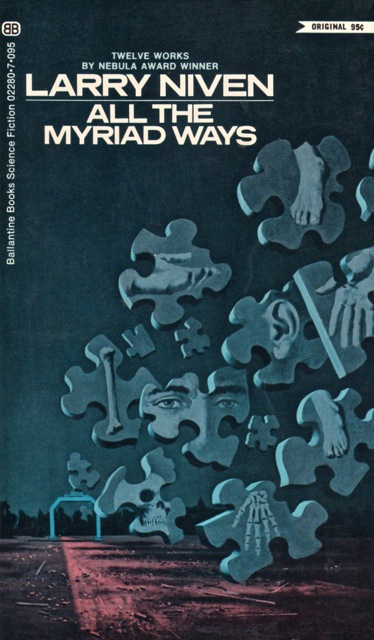
Inconstant Moon” by Larry Niven is story #23 of 52 from The World Treasury of Science Fiction edited by David G. Hartwell (1989), an anthology my short story club is group reading. Stories are discussed on Tuesdays, Thursdays, and Saturdays. “Inconstant Moon” first appeared in Niven’s 1971 collection, All the Myriad Ways. Currently, the story is available in N-Space, a retrospective collection of Niven’s work from 1990. If you want an ebook version of the story, it’s included in Masterpieces: The Best Science Fiction of the Century edited by Orson Scott Card.

Outer Limits dramatized the story – watch it on YouTube.

“Inconstant Moon” is one of those science fiction stories where the main idea sticks with you even if you don’t remember the plot or characters. “Inconstant Moon” won the Hugo for Best Short Story in 1972, and is the kind of classic SF tale I expected to see in an anthology that remembers the best science fiction of the 20th century.

Stan and his girlfriend Leslie realize something epic is happening when the Moon becomes much brighter than normal. “Inconstant Moon” is an astronomical science fiction story like “Nightfall.” I don’t know if I should tell you anymore, I wouldn’t want to spoil the fun.

“Inconstant Moon” is the kind of short story that inspires readers to ask themselves what they would do in a similar situation.

<<<Beyond Here Lie Spoilers>>>

Most science fiction is geared toward young people with romantic minds who want to fantasize about being action heroes, while “Inconstant Moon” is aimed at adults who take more wistful prosaic paths. The protagonists aren’t young or heroic, and their actions are quite ordinary and mundane. The setting is only slightly in the future from 1971, after the Apollo 19 landing. Niven didn’t know that sadly, Apollo landings would end with 17 in 1972. He even has Stan talking about getting to handle a moon rock, which I don’t know if NASA ever allowed either.

Stan goes out on his balcony one night and the Moon is several times brighter than normal. He starts wondering why and eventually concludes the Sun has gone nova. This is my third time reading this story, but I remember when I read it the first time being quite surprised that people would still be alive after such an event. Until I read “Inconstant Moon” the first time, I imagined if the Sun went nova it would instantly vaporize the Earth.

Niven gives us a more thought-out scenario. Earth is 8.5 light-minutes away from the Sun, and Jupiter is 44.2 minutes. Niven imagines the Earth itself being a barrier that protects people on the side away from the Sun, and that a shockwave travel at the speed of sound would circle the Earth. Stan rushes over to see his girlfriend, hoping to have a few good hours before the end of the world. He doesn’t tell Leslie his theory, but eventually, Stan realizes she came up with it on her own too.

I would love to see an episode of PBS’s NOVA analyze the same situation.

Stan and Leslie assume the shock wave is hours away, and it will kill them before California faces the sun. They go out for ice cream and drinks after having sex. I felt “Inconstant Moon” had an adult vibe not because of the sex, but because of the mental processes Stan and Leslie go through. My guess is young characters and readers, would think and act differently. This age-difference reaction can be seen in “The Last Day” by Richard Matheson (Amazing Stories, Apr-May 1953). Read it here.

Ultimately, Stan figures out the Sun didn’t go nova, and that it must have been a very large solar flare. It means they might live, and that changes the course of the evening.

It’s a shame we don’t get more science fiction that makes us think like this story. Some stories inspire arguments like, “The Cold Equations” by Tom Godwin, but Niven’s story makes readers think about physics and astronomy. Isaac Asimov used to write about how science fiction fans of his generation would tell their parents they were learning science from science fiction. That seldom happens, if ever. But with this story, Niven sets up a scientific situation that makes us think about science rather than science fiction.

Does anyone know what would likely happen to the Earth if the Sun went nova or there was an extremely large flare?

James Wallace Harris, 6/27/23

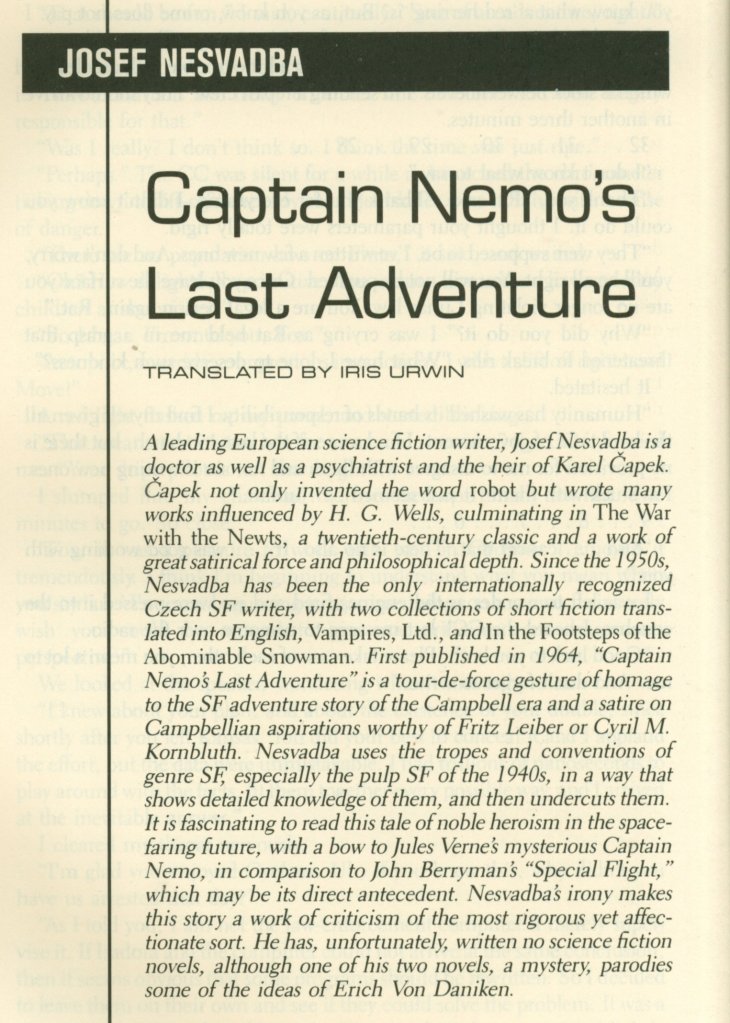
“Captain Nemo’s Last Adventure” by Josef Nesvadba

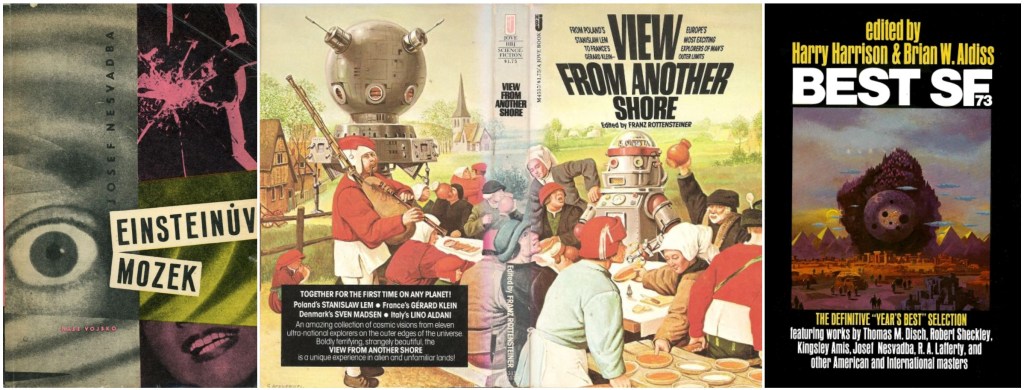
Captain Nemo’s Last Adventure” by Josef Nesvadba is story #22 of 52 from The World Treasury of Science Fiction edited by David G. Hartwell (1989), an anthology my short story club is group reading. Stories are discussed on Tuesdays, Thursdays, and Saturdays. “Captain Nemo’s Last Adventure” first appeared in Nesvadba’s 1960 collection, Einsteinův Mozek. It was translated into English for the 1973 anthology edited by Franz Rottensteiner, View From Another Shore, and it was selected in 1974 for Best SF: 1973 edited by Harry Harrison and Brian Aldiss. (Follow the link to the story title to see where it’s been anthologized if you want to find a copy to read. However, The Treasury of World Science Fiction is widely available in used copies and is probably the cheapest way to get this story, along with 51 others.)

David G. Hartwell had so much to say about “Captain Nemo’s Last Adventure” in his introduction that I thought I’d just reprint it here.

I don’t know if I agree with Hartwell when he says “Captain Nemo’s Last Adventure” is a satire on stories from John W. Campbell’s era, or that Nesvadba uses the tropes and conventions of 1940s science fiction. I’m not even sure “Captain Nemo’s Last Adventure” is even an ironic work of criticism. I’m not saying it’s not, but I want to propose an alternate theory.

What if science fiction evolved separately in Czechoslovakia? And what if its evolution sometimes paralleled American pulp science fiction? Evidently, “Captain Nemo’s Last Adventure” was written after Sputnik but before Gargarin’s famous ride. Would Josef Nesvadba have access to old American pulps or even 1950s anthologies that reprinted them?

The prose of “Captain Nemo’s Last Adventure” doesn’t come across like the prose in pulp fiction. Like many of the foreign language science fiction stories we’ve been reading, it’s mostly told and not shown. However, it is longer, and that lets it become a fuller story than the shorter works we’ve read. I wonder if Nesvadba wasn’t inspired by Soviet science fiction or the Polish Stanislaw Lem?

“Captain Nemo’s Last Adventure” is about the super-heroic Leonard Feather and chronicles his feats of always needing to save the day, and eventually the Earth. Yes, we could compare him to Kimball Kinnison and the Lensman series. But Feather could just as easily be compared to Homer’s Ulysses.

I do think Nesvadba was making fun of spacemen, and the kind of macho men who need to always be on an adventure. Feather is a womanizer who makes his wife unhappy, as well as his mistresses, and he can’t understand why his son isn’t like him. Nesvadba is satirizing a certain kind of man that has existed in all genres of literature.

Nesvadba also appears to be attacking the call of the high frontier, robotics, and the never-ending quest to conquer and engineer. When Captain Feather, aka, Captain Nemo meets another intelligent race, he can’t understand what they are after. When he returns to Earth and is forced to stay put, Feather begins to see the need for philosophy and art.

There are parallels to American science fiction in this story. Heinlein, Campbell, Hamilton, and others all wrote stories about meeting super-advanced aliens back in the 1940s. The robots in “Captain Nemo’s Last Adventure” remind me of Jack Williamson’s The Humanoids. This story even reminds me just slightly of Robert Sheckley in the 1950s.

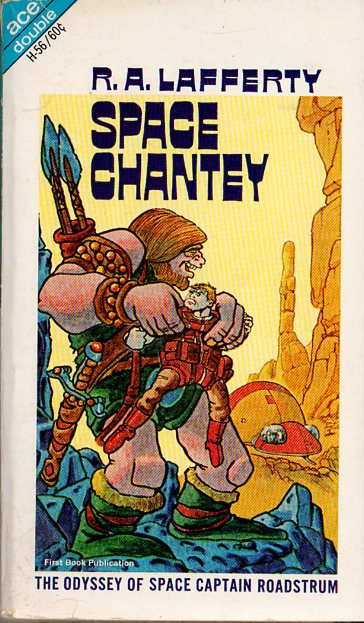
But, Captain Feather and his crew mostly remind me of Space Chantey by R. A. Lafferty, which is a science fiction parody modeled on Homer. My guess is that Nesvadba’s story was really inspired by Lem’s The Star Diaries, which came out in the 1950s?

Still, “Captain Nemo’s Last Adventure” is a good tale. It’s not told dramatically, which disappoints me, but its length allowed it to cover a number of interesting science-fictional topics that were enjoyable to me.

James Wallace Harris, 6/23/23

“Ghost V” by Robert Sheckley

Ghost V” by Robert Sheckley is story #20 of 52 from The World Treasury of Science Fiction edited by David G. Hartwell (1989), an anthology my short story club is group reading. Stories are discussed on Tuesdays, Thursdays, and Saturdays. “Ghost V” first appeared in Galaxy Science Fiction (October 1954).

Back around 1968, when I was in high school, I had two friends that also read science fiction – Jim Connell and George Kirschner. We’d often sit around and talk about the science fiction we read over our short lifetimes. Mostly, we couldn’t remember titles or authors but always remembered a unique idea within the story. I remember George excitedly telling Connell and me about “Ghost V” back then. I’ve read it since, but probably in the 1970s. I never remembered the story title or details. Just the trick ending.

So when I started reading “Ghost V” again today I remembered nothing about it. As soon as I started reading it I thought, “Hey, this could be that story George had told us about over half a century ago!” And my hunch was right. I remembered the idea that Sheckley used as the punch line of his story. It has always been memorable, and I’ve even told other people about it a few times because it’s a charming little idea with a neat kind of connection to reality.

Now, the question I have is: should I tell the ending here? I never know how much I should say about a story when writing about them. I really want to discuss stories, not review them. To do the same thing that Connell, George, and I did way back when — talk about the most exciting and memorable ideas. I want to just bullshit about the idea or ideas that make a particular story great for me.

“Ghost V” isn’t very long. You could go read it here. It’s part of a series of nine stories Robert Sheckley wrote about the AAA Ace Planet Decontamination Service. “Ghost V” is essentially a joke. It’s about two guys, Richard Gregor, and Frank Arnold who exterminate problem creatures on newly discovered planets. Think Ghostbusters. Gregor and Arnold don’t believe in ghosts or other supernatural beings, but they are hired to get rid of supernatural threats on Ghost V.

Sheckley sets up the story when Mr. Ferngraum comes to visit their office to hire Gregor and Arnold. Ferngraum is a planet flipper, buying planets cheap, and selling them for a profit. He tells Gregor and Arnold how he invested more than his usual amount in a quality planet that he hoped to make a killing with, unfortunately, the first two expeditions to the planet were mysteriously wiped out, killing colonists in the most hideous ways. If they can’t help him he’ll go bankrupt.

By the way, you have to understand the mood of the story. Think of The Hitchhiker’s Guide to the Galaxy. For me, I recalled Sheckley’s novel, Dimension of Miracles which features a minor character we know of as God, who did a cut-rate contracting job creating Earth. The level of humor is not very sophisticated in “Ghost V,” young people might put it on the level of the current TV show Ghosts.

“Ghost V” is silly and completely unscientific, but unlike some of the stories in The World Treasury of Science Fiction, it’s told in a way that I believe the setup while reading it. That’s the difference between “Ghost V” and the stories in the anthology like “The Chaste Planet” and “Tale of a Computer Who Fought a Dragon,” which I’ve criticized for not using the kind of storytelling techniques I prefer. If those stories had been told the way Sheckley told “Ghost V,” I probably would have liked them.

Sheckley tells his tall tale realistically, with a straight face. His storytelling technique is no different from the way Hemingway writes about real-life bullfighting or deep-sea fishing.

Gregor goes off to Ghost V knowing that colonists in two previous expeditions were slaughtered by some kind of horrible scientifically undetectable monsters. Sheckley aims to scare us too. Arnold stays home to be Gregor’s research consultant.

Gregor lands with no problem and sets up living in the quarters of an earlier expedition, the ones who had been sun worshippers. (I assume we’re to read nudists.) That night, after he turns off the light and goes to bed, he sees his clothes come to life in the shadowy dark and menacingly approach him. He blasts them to pieces. Gregor then turns on the light and radios his partner. Arnold claims to have a theory, but Gregor remains frightened.

The second monster Gregor meets is a Purple Striped Grabber. The Grabber wants to eat Gregory with chocolate sauce. The Grabber also informs Gregor that he can only eat him on the first of the month, which is the following day, and asks Gregor for a favor. The monster wants Gregor to eat apples before he comes back because that will make him taste sweeter. The monster leaves and Gregor calls Arnold again. Arnold says this new report confirms his theory. Ghost V monsters are our childhood fears made real. That there must be something in the environment that messes with our brains.

The next day, when the Grabber returns Gregory remembers a monster like it from his childhood, recalling it could be stopped with a magic word. After frantically dredging up several magic words while the Grabber is trying to eat him, Gregor hits on the right one and is saved. (Hey, Gregor was the name of the character in Kafka’s “The Metamorphosis.”)

The next monster is the Shadow. Eventually, Gregor kills it with a water pistol.

Arnold arrives and they discuss the situation clarifying the solution, but the next monster that shows up, the Grumbler, seems to be invincible. Gregor and Arnold quickly take off for Earth thinking they’re escaping the Grumbler but once in space realize the Ghost V atmosphere at gotten into their ship. It must contain a hallucinogenic drug, one that will make them kill themselves. Their only hope is to hide from the Grumbler until the ship’s atmosphere is recycled.

When all hope is lost, they remember one solution that could destroy all childhood fears, and it saves them.

That solution is what I remembered from all these decades. I remembered nothing else about the story, so when I retold it, my summary of the story was always made up, except for the solution.

Should I tell you?

Or do you want to guess?

James Wallace Harris, 6/20/23