I’ve realized that I’ve been overindulging in science fiction, so I’ve decided to take a vacation from the genre. Science fiction has been a life-long addiction that I don’t think I can ever give up, but I do need to go into rehab for a while. I don’t know for how long.
I’ve read about fifteen hundred science fiction short stories in the last five years, and I feel like a kid who has snuck off with a whole bag of Oreos. To continue the comparison, science fiction is mostly dessert, and I need to fill up on some real food for a while.
I’m not sure how much I will be posting here in the coming months. I’ll probably still think about science fiction as a topic, and who knows, I might fall off the wagon from time to time.
I’ve been hoping to find a new kind of science fiction. Science fiction is geared to the young, and I’m getting old enough where I can’t pretend that I’m young anymore. I need to find science fiction aimed at people in their social security years. I’ve even thought about trying to write a science fiction novel that’s age appropriate for myself.
Looking back, I rediscovered science fiction in 2002 when I joined Audible.com. It became all too apparent I was reliving my youth by listening to all my favorite science fiction stories I read growing up. Then about five years ago I got into short science fiction and collecting old science fiction magazines and fanzines. Hell, I was then trying to relive my past.
In my youth, science fiction was about the future. Now in my old age, science fiction is about the past. But I’ve burnt out on nostalgia. Living in the 2020s, the future has become hyper-real. There’s too much going on. Reading old science fiction is like being an ostrich sticking its head in a hole in the ground. For years now I’ve been trying to find new science fiction that was relevant to now, but it’s just not there. Modern science fiction merely recycles old science fiction or recapitulates old science fiction. The genre really needs another New Wave.
I’ve thought about creating a taxonomy of science fiction themes and writing a history about how each theme has been rediscovered many times over the last two centuries. But I need some vacation time even before I consider that project.
I own over a thousand nonfiction and literary novels I haven’t read. That’s where I’m heading for my vacation. I’ll report on them at Auxiliary Memory blog.
Too much is happening in the real world right now. Strangely, life is more science fictional than science fiction. Between AI, a shakeup in cosmology, climate change, robots, space exploration, wars, fascism, sexual revolutions, and many possible apocalyptic scenarios, who needs to read science fiction anymore?
Things are about to get heavy in the next few decades. I’m guessing science fiction and fantasy are so damn popular right now because they are a great hideout from reality.
When I began this blog years ago, I theorized that there were three ways to identify all the best science fiction short stories. The first was to read all the science fiction magazines and decide for yourself. The second was to read all the annual best-of-the-year volumes and see if you agreed with those editors. And finally, I suggested just reading a handful of retrospective anthologies that collect the best science fiction of all time. It was all about how much you wanted to read. There are thousands of magazines, between a hundred and two hundred annual volumes, or you could get by with maybe just a handful of retrospective volumes.
After collecting over a thousand issues of old science fiction magazines, most of the annuals and most of the major retrospective anthologies, and reading thousands of stories, I think I can answer the title question.
Just read the retrospective anthologies. But there’s a problem. They still haven’t done the best job of identifying the best stories, and they are mostly out of print.
I’ve loved science fiction magazines my whole life, but the sad truth is they seldom contain classic level stories, and you’re damn lucky if you find one story you love. Usually, you’ll find a couple stories you like, and the rest will be so-so or DNFs. For me, I generally find four or five standout stories in an annual anthology, and the rest are okay. If I’m lucky, there will be one or two great SF stories in a year. Even with the best retrospective anthologies, it’s hard to like every story, but if you find the right editor, maybe half the stories they pick will be your favorites too.
The Classics of Science Fiction Short Stories v. 2 list at CSFquery has been the most effective overall at identifying the most remembered science fiction short stories, 110 stories in all. I’ve had the best luck with this list compared to any other method.
However, v. 2 leaves off a lot of my favorite stories. Using the List Builder function and setting the minimum citations to six creates a list of 220 stories. Many of those extra 110 stories do identify stories I love, but also identify more stories I don’t like. But if we use List Builder to set the cutoff to ten citations, it produces a list of 50 stories. Anyone who reads those fifty stories should have a solid feel for the history of the SF short story. If you click on “Show Citations” you’ll see which anthologies collected those stories.
Szymon Szott wrote a computer program to analyze all the retrospective anthologies we used to create CSFquery to find the minimum number of books to buy to read the most stories from v. 2 of the list. See “The Science Fiction Anthology Problem – Solved” which identifies twenty-two anthologies needed to read all the stories on the original list. The list has been updated with additional stories, so it’s no longer perfect.
The trouble is most of these retrospective anthologies are now out of print. Mark R. Kelly has a wonderful history of science fiction anthologies that’s worth studying. I’ve collected most of them. They aren’t hard to find used, nor are they particularly expensive. The problem is finding just three to five that have most of the stories from v. 2 of the list.
And there’s another problem. Science fiction stories don’t always age well, even the classics. So many of these anthologies will have stories that modern readers will find clunky. For example, Sense of Wonder edited by Leigh Ronald Grossman has thirty-six of the stories on the v. 2 list, the most of any anthology, but it has over a hundred more stories that may not have aged well. (Definitely don’t get the physical book, it’s too heavy to hold and has extremely tiny unreadable print.) The Kindle edition is $29, and that might be too expensive for most people.
You can look at the list of citations we used to create the Classics of Science Fiction Short Stories v. 2 list, and it gives the number of stories that make the final list for each citation. As you will see, anthologists don’t have a great hit rate. We correlate the best with fan polls like SF Lists (98 stories) or Locus 2012 All Century (88 stories). The Hugo award process identified 80 stories on our list, and the Nebula process identified 59.
All this suggests that retrospective anthologies aren’t the best way to survey the classic short stories of the science fiction genre. I wish we could publish an anthology of the top 50 stories from our list, but I have no idea how to go about doing that.
Luckily, many of the stories on the v. 2 list are also available for free online. It takes work to find them, and the online versions aren’t always easy to read. If you really want to find these stories, use our list, and click on the titles. That will take you to the story’s ISFDB listing, which will show all the places the story has been reprinted. With some effort you should be able to track down all the stories.
I was going to take a break from reading Dangerous Visions because it was depressing me, but I found “A Toy for Juliette” a fitting inspiration for a sermon I wanted to write. I’ve been reading Golden Multitudes: The Story of Best Sellers in the United States by Frank Luther Mott, which inspired me to buy and start reading The Sentimental Novel in America 1789-1860 by Herbert Ross Brown. Both books give impressions about how Americans, and I presumed other people around the world, got into reading fiction.
Printing began in the 15th century at a time when most people didn’t read. Storytelling has been around since we lived in caves. Although there were works in Japan and China that could be called novels long before the printing press, in Europe and America, the novel seemed to emerge with Don Quixote in 1605. What we think of as the modern novel matured in the 18th century.
Frank Luther Mott’s book, Golden Multitudes describes the kind of books people read in America before Ben Franklin printed Pamela by Samuel Richardson in 1745. Some considered Pamela, first published in England in 1740, to be the first English novel. Before this novel, Americans mostly read books on morality. The colonies were settled by various religious groups, so that’s kind of logical. Mott says the first American bestseller was The Day of Doom by Rev. Michael Wigglesworth. It was written in verse, and it was all about the horrible things that would happen to people in hell. The excerpts and quotes Mott gave from this poem made me think early Americans were fixated on horror.
To keep this sermon short, I need to cover the following decades quickly. Fiction slowly emerged out of all this moralistic reading. Another bestseller was The Pilgrim’s Progress from This World, to That Which Is to Come by John Bunyan in 1678. This book is an allegory that begins with a dream. But the point is, Bunyan spiffed up moralizing with a story and characters.
Pamela became a huge bestseller in America and Europe after 1740 because Richardson made moralizing every more entertaining. One reason Pamela is given credit for being one of the first English novels is because Richardson invents a lot of storytelling techniques we use today. After the success of Pamela countless imitators began producing similar type stories, and the focus on moralizing became less, and the shift to pure storytelling became common.
At that time, many intellectuals began protesting, claiming fiction was corrupt and corrupting. Magazines and newspapers ran articles about how fiction was ruining young people’s minds, especially young girls. That made me think about how people worry about smartphones and video games corrupting young people today. But those fiction protesters were crushed by bookworms wanting more fiction.
By the time the 19th century rolled around, especially after Edgar Allan Poe, many stories became free of moralization. Kids and adults devoured fiction about violence, horror, the supernatural, and other evil things in the world. Which is why Robert Bloch is a popular writer, and why people enjoy stories like “A Toy for Juliette.”
The problem is I don’t. I don’t like horror. And I can’t understand why other people do. Although Susan and I are currently watching Why Women Kill, which could be described as comic horror. Fiction writers have a tough time producing stories that don’t involve the horrible aspects of life. Fiction is often an art form about the ugliness of humanity, but isn’t the best fiction about transcendence of those horrors?
I quite enjoy reading Pamela. I’m only about half finished, but then the book is over forty hours long on audio. I admire Richardson for embedding his moral lessons into his story. The story is about 15-year-old girl servant efforts to avoid being raped by her employer. On one hand, the novel could be considered a handbook for girls warning them about all the ways guys will trick them into having sex. On the other hand, it’s rather entertaining to read about all the schemes Mr. B used to seduce Pamela. The novel is also entertaining because I’m watching Richardson invent plotting and characterization.
When reading “A Toy for Juliette” I was seeing the refinement of centuries of storytelling. But Bloch completely ignores moralizing. He returns to the purity of telling gruesome stories around a campfire. However, I miss moralizing. Bloch makes no effort to explain the psychology of Jack or Juliette. He makes no moral judgments on their actions. He just accepts that those kinds of people exist.
Sociologists claim there is no correlation between the consumption of violent entertainment and committing violence, but I find that hard to believe. But then, from Harlan Ellison’s introduction about Robert Bloch, he seems like a very nice guy — kind, considerate, and generous.
Maybe, “A Toy for Juliette” depresses me because it reminds me that there are people like that in this world. And it bothers me that people find stories about such people entertaining. But as I admitted, Susan and I found a comedy about murder fun. And even the Puritans, with all their emphasis on living a pure life, sure did love to read about the gruesome aspects of going to hell.
Back in the 1960s, I learned from health food nuts, “You are what you eat.” And from computer school I learned GIGO – garbage in garbage out. I can’t help but wonder if those 18th and 19th century pundits who attacked fiction weren’t right. Why should we pollute our mind with a story about a sadist being sadistically killed by another sadist? I guess I could claim Bloch was preaching that we reap what we sow, but I don’t think it’s true. I think people enjoy seeing Juliette get ripped by the Ripper.
Still, I find “A Toy for Juliette” a virus in my mind. I find reading nonfiction about the horrors of humanity enough of an education about the reality of humanity. Why do we want reminders of such horrors in our escapism? But we do. Think about all the fiction you consume. How much of it involves acts we’d be terrified of if they happened to us? Why do we dwell on the horrible?
We can often find political opinions in science fiction, but in terms of political philosophers, how useful are science fiction writers? I just read “The Last of the Deliverers” by Poul Anderson from the February 1958 issue of The Magazine of Fantasy and Science Fiction. You can read it here. Or find it in these anthologies. It was revised in 1976, but I don’t have a copy to evaluate.
“The Last of the Deliverers” is set after the collapse of the United States and the Soviet Union, in a small village in Ohio. It’s told from the point of view of a nine-year-old boy. The boy describes an old man of one hundred, who the village kids call Uncle Jim, and the day a stranger shows up, another old man named Harry Miller. The two men take an instant dislike to each other because Jim is a capitalist and Harry is a communist. Both men hate the way the village is run and criticize it.
Poul Anderson is well known for believing that feudalism was about the most complex form of government humanity could handle. In this 1958 tale, written in the middle of the cold war between America and Russia, Anderson predicts that both systems would fail. The residents of the small town are quite happy getting by with what they can grow and make themselves, and they share the use of land and some technology. Jim thinks these Americans have become degenerate because they don’t want to get ahead and want more. But the village is happy. Harry thinks there should be more collectivism, but the villagers don’t see the point. These two longest paragraphs by the mayor explain their community.
Anderson isn’t promoting a utopia. His ending is rather cynical and bleak. He knows humans can’t find happiness. Of course, Poul Anderson is no political scientist. He’s using his own opinions about how he thinks things should work. Robert A. Heinlein ruined a lot of his fiction by doing this.
On one hand, I admire Anderson’s speculation and extrapolation. On the other hand, why should I trust his insights? I don’t imagine many readers get their political opinions from science fiction writers, but I do imagine they enjoy stories and writers whose opinions resonate with their own. I do think “The Last of the Deliverers” resonates with 2024.
We do know that George Orwell had brilliant insights about politics in his science fiction novel, Nineteen Eighty-Four. They are very respected. However, do they have objective validity? I don’t know. I’m impressed with the many ideas Orwell presented in his novel, and I can use them to reference real world events, but how useful is that? Many people have trouble today recognizing fascism even when endless experts with all kinds of degrees and political experience lecture about it constantly. Anderson doubted people could maintain a complex society. I doubt whether we can understand any kind of complexity.
I think the average person wants to believe they understand the world around them. That their opinions are valid. And some of those people, including some science fiction writers, want to promote their beliefs in their stories. But should we listen to them?
I feel that both conservatives and liberals get their beliefs from other believers. That all concepts are memes that spread through society. Are there any ways to validate these memes? Science can study certain aspects of reality by experimentation. They get no 100% sure answers, but they do find answers with statistical weight. I’ve not sure political theories can be disproved by the scientific method.
I do agree with a lot of what Poul Anderson says in this story. And I think he knows his wishes for creating a harmonious society are just wishes, because of the ending. World building is easy for science fiction writers, futurists, and political theorists but are their ideas ever more than just sand castles?
Sometime in the recent past I read a story very much like “The Last of the Deliverers.” However, it was set in a village in Russia. They had an American scientist studying collective farming when WWIII happened. He had to stay on. The village got by and found a similar kind of simple harmony that Anderson’s story describes. But then a communist party official finds his way to the village and wants to take over. Like the Anderson story, it allowed capitalism and communism to duke it out in a fictional setting. I wish I could remember that story. I may have even reviewed it. I used to believe my blogs were a form of external memory, but not anymore. Like my regular memory, access is poor, and getting poorer.
It’s becoming increasingly difficult finding science fiction that thrills me. This feels like a crisis of faith since I’ve been a lifelong science fiction reader. I keep asking myself: Is it me or science fiction?
One of the theories I’m working with suggests that I’ve just read too much science fiction. Either I’m old and jaded because I’ve read every variation on a science fictional theme, or I’ve pigged out on the genre for so long that I’m finally made myself sick. Another theory makes me wonder if I’ve just gotten too old and can’t believe in the far-out ideas of science fiction anymore. Aging has made me skeptical. One fear I have is it might be the Williamson effect. I had a friend that before he died lost interest in everything, but it took years, losing interest with the things he loved one by one.
Too disprove I’m infected the Williamson effect; I’ve been scrambling around trying to find a science fiction story that still thrills me. It’s getting harder and harder to find any science fiction story that turns me on. I still find other kinds of fiction thrilling, and I still get intellectually excited over nonfiction. That suggests it might not be the Williamson effect, but I’ve just used up science fiction.
After reading thousands and thousands of science fiction short stories and novels, which shouldn’t be a surprise. Can any genre be infinite in its appeal and scope? Science fiction has always been exciting because it offered ideas I never imagined. Now that I’m 72, it seems like current science fiction is just recycling older science fiction, and that’s getting tiring. And since I’ve lately been reading 19th and early 20th century science fiction, I’ve discovered that the Golden Age of science fiction from the 1940s, 1950s, and 1960s used recycled science fiction concepts too, I’m starting to doubt there are any new science fictional concepts left to thrill me.
For years I’ve been depending on how a story was written to make a science fiction novel feel new and different. For example, The Hopkins Manuscript by R. C. Sherriff, a cozy catastrophe from 1939 charmed me because of its down-to-Earth storytelling. I remember reading Hyperion or Neuromancer when they came out, and how fresh they felt because of their prose style.
For several years I’ve been digging through forgotten authors and their works hoping to find something new and different that’s been neglected by time. For example, I just read Sex and the High Command by John Boyd. Boyd wrote eleven science fiction novels from 1968 to 1978, with the most successful being his first, The Last Starship from Earth. I found that novel tremendously exciting back in the 1960s, so I thought I’d try Sex and the High Command this week, to see if it could rekindle some science fictional thrills. It hasn’t.
Boyd based his story on the classical Greek play, Lysistrata, about Athenian women trying to end the Peloponnesian War by refusing to have sex with men. In Sex and the High Command, women of the world try to bring about world peace when they discover that an anti-aging face cream applied to their genitals rejuvenates their whole body, causes orgasms, and in some cases sets off parthenogenesis. It was later fashioned into a more convenient pill/suppository for widespread use. Women begin thinking they don’t need men, and other women feel this will give them the edge to take over world power and stop war.
The novel is told from the point of view of the panic men of the U.S. military, especially the high command and the White House. Their primary concern is getting laid. I feel this 1970 novel is meant to be a satire in the vein of Dr. Strangelove. The writing style seems inspired by Heinlein serious respect for the Navy blended with Eric Frank Russell’s spoofs on military hierarchy. Like Heinlein, Boyd had served in the Navy.
I tried hard, but Sex and the High Command never catches fire. Is it me, or is it the novel? I don’t know. I wished I had an audiobook edition with a great narrator. I felt Boyd’s prose should be hilarious, but my own inner reading voice just can’t do it justice. If it was produced by Stanley Kubrick, Sex and the High Command might be as funny as Dr. Strangelove.
This suggests another theory about my fading interest in science fiction. I’ve lost interest in science fiction before. The Cyberpunk movement rekindled it in the 1980s. And in 2002, joining Audible let me listen to science fiction, and that gave me twenty years of rediscovering all my old favorite science fiction. Maybe I’m in a down cycle, and after a fallow period, I’ll get back into the genre.
I don’t think so, though. Could Audible have just fueled twenty years of nostalgia for the genre that’s run its course? Getting old has been weird. I feel like I’m going through psychological changes that I never imagined when I was younger. Science fiction appears increasingly to me aimed at youthful minds, and my mind is getting too old for it.
But I have one last theory. The older I get the more I’m getting into the now. Each individual day seems more important. The past and future are becoming less important. The past is all about reconstruction, and the future is all about speculation. Both are abstractions. I have noticed that when I do like science fiction, it’s set closer to the present, like the film Leave the World Behind. One reason I read Sex and the High Command, is because it felt contemporary, although that was marred by pre-1960s attitudes toward women. Boyd was born in 1919.
I’ve discovered that science fiction set in the far future, or far away from Earth has much less appeal to me. Now that I think of it, all the reading I’m still excited with offers some kind of relevance to now. Maybe, this preoccupation with now has made me feel science fiction is irrelevant.
After reading a story about hunting down God and another story about vicious attacks on women, Frederik Pohl anti-prejudice story seems downright pleasant. It is a breezy tale about how people recycle all their old ethnic jokes when NASA brings home a Martian.
“The Day After the Day the Martians Came” reminded me of how things were back in the 1950s and 1960s. People often retold jokes they had heard, and many of them depended on ethnic stereotypes. I seldom hear people tell a joke anymore, and I can only remember one that I heard that I retold in the last few years. It went something like this:
A young guy is out hitchhiking, and he gets a ride with an old man driving a new car. The young guy doesn’t know how to strike up a conversation but finally says, “Aren’t you afraid of giving rides to hitchhikers? They might be a serial killer.” And the old man laughs, “Oh no, I’m not afraid. What are the odds of two serial killers being in the same car?”
Now, that joke is based on a stereotype, but until people start feeling sorry for serial killers, I assume it will be politically correct to use them in a joke. That’s the thing about humor, it usually has a target, and it’s often about cruelty or pain, or someone being the butt of the joke.
Essentially, Pohl’s story is a civil rights tale. It was written during the peak years of the Civil Rights movement. However, its punchline conveys a stereotype about black people. “The Day After the Day the Martians Came” is well-intended, but simplistic. It lacks sophistication.
The setting is a hotel where reporters are staying to report on NASA bringing back a Martian. The hotel is managed by a man, Mr. Mandala, who sounds like he’s from India, who bosses around two black men, one who is the bell captain. Pohl doesn’t use the old word bellboy here. It describes a lobby that is overflowing with reporters who all take turns making up jokes about Martians. We are told Martians are quite ugly and look a lot like seals. All the characters are based on stereotypes. The reporters sound like they came out of the 1940 screwball comedy, His Girl Friday.
It seems rather odd that Pohl is satirizing joke tellers for using stereotypes when his story depends on stereotypes. I wonder if Pohl was aware of this on meta level. I don’t think so. Science fiction evolved out of pulp fiction magazines, and the best pulp fiction writers were brilliant at typing out stories fast and furiously. They depended on stereotypes and caricatures. And like movies from the 1930s and 1940s, readers and audiences loved a good character creatively based on a type, such as a newspaper reporter.
For Pohl to have explored this situation in a deeper way, he would have had to create a unique individual reporter observing a unique individual Martian and realistically portraying unique individual humans reacting to the Martian with specific prejudices regarding specific physical details and characteristics. Something James Joyce or Flannery O’Conner or even Raymond Chandler might have written. I think some New Wave writers knew this in theory, but not in practice.
I’m afraid people will think I’m picking on Dangerous Visions. Ellison claims its stories point to a new way of writing in science fiction, but so far, I don’t think the first three stories have demonstrated a new kind of writing. I think science fiction will change in the decades after the 1960s, but I’m not sure it has changed much in 1967.
For me, the most rewarding pages of Dangerous Visions were the introductions by Harlan Ellison and the afterwards by the authors. When I first read this anthology back in the late 1960s, I felt those introductions gave me insight into the family of science fiction writers, one I wanted to join. At the time I was sixteen and I totally bought Ellison’s enthusiasm and promises. Fifty-six years later, I reacted to this anthology and its stories very differently.
Ellison honors del Rey by putting his story in the pole position, and he praises his friend and mentor Lester for being a giant of the genre. Back in 1968, Lester del Rey was not a major figure to me. I had read some of his Winston Science Fiction juveniles, but unknowingly, because they were published under his pen names. However, one had his name on the cover, Marooned on Mars. It wasn’t a standout, and I didn’t remember he wrote it. Lester del Rey was not a giant in the field to me. Later on, I’d discover he wrote “Helen O’Loy” and “Nerves” when I read The Science Fiction Hall of Fame anthologies. I don’t think Lester del Rey was ever a great writer of science fiction, but he became a great editor and publisher.
Ellison hyped Dangerous Visions for publishing stories that editors couldn’t or wouldn’t because they contained ideas that challenged the norms of society, or were too mature for the typical youthful science fiction reader, or were written in creative styles that average science fiction reader would reject.
“Evensong” is about hunting down a fugitive. That fugitive was God. At sixteen that excited my young atheist mind. But at seventy-two, it felt like Mad Magazine’s Alfred E. Neuman saying, “What, me believe?”
Was that really a dangerous vision that no publisher would accept? Then how could Fred Pohl publish del Rey’s “For I Am a Jealous People!” in Star Short Novels in 1954? In that story, mankind is fighting aliens and learns that God has sided with the enemy, so humans declares God is their enemy too. In other words, del Rey gave Ellison a dangerous vision that he’d already used years earlier.
That’s something I keep finding as I reread Dangerous Visions. Ellison was wrong that science fiction publishers wouldn’t take them. It made me wonder if Ellison could have assembled a reprint anthology called Dangerous Visions and collected all the science fiction stories that were published that had been quite startling for the times. Many classics come to mind that I think had more impact than those in Dangerous Visions, such as “Fondly Fahrenheit” by Alfred Bester and “Lot” by Ward Moore. I also think “For I Am a Jealous People!” is a better story than “Evensong.”
Ellison quotes del Rey’s letter to him about the afterward he wrote for the anthology. I thought this part was rather telling:
The afterword isn’t very bright or amusing, I’m afraid. But I’d pretty much wrapped up what I wanted to say in the story itself. So I simply gave the so-called critics a few words to look up in the dictionary and gnaw over learnedly. I felt that they should at least be told that there is such a form as allegory, even though they may not understand the difference between that and simple fantasy.
I was bothered that del Rey didn’t think critics wouldn’t know what an allegory was and couldn’t tell it from fantasy. That suggests del Rey felt a naive self-importance about his writing. But I also felt that Ellison showed a naive sense of self-importance about Dangerous Visions.
Allegory always seemed to me to be lazy way to tell a story in modern times. And I don’t think “Evensong” is total allegory either because we’re told God’s thoughts and perspective. Would John W. Campbell (Analog), Frederik Pohl (Galaxy), or Edward L. Ferman (F&SF) have rejected “Evensong” in 1967 because it was too dangerous? My guess is they would have run it because of del Rey’s name, although they might have rejected it for being too bland and simple in construction. It’s not a very sophisticated story and comes across as something a precocious student would write who was trying to be daring.
In 1967 revolution and rebellion were in the air. The youth of the 1960s were revolting against the status quo. Looking back, I feel Ellison was trying to do the same thing in the science fiction genre. Ellison was loud, outrageous, and pugnacious, so we might consider him the Abbie Hoffman of the science fiction counter-culture.
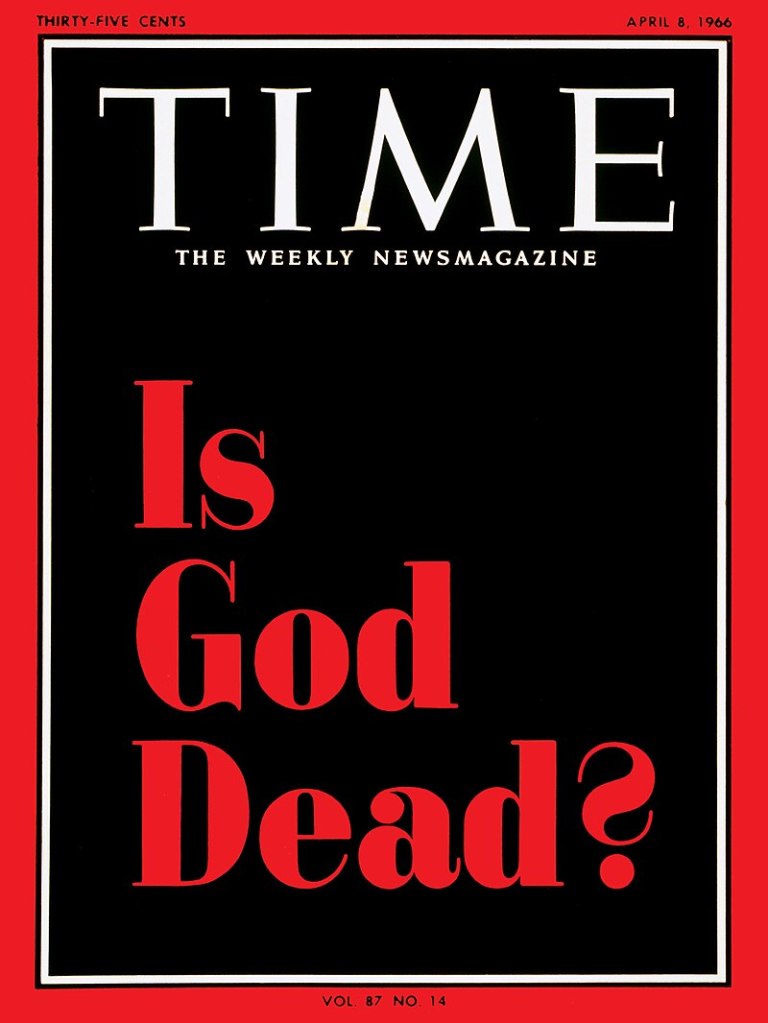
As I go through the stories in Dangerous Visions I’m expecting to find psychological snapshots of Ellison, the genre, the writers, and the times. The April 8, 1966, cover of Time Magazine asked if God was dead. Had del Rey forgotten his earlier story and “Evensong” was merely a science fiction riff on the Time cover?
Were the writers in Dangerous Visions thinking about old science fiction, or current events? Was Dangerous Visions anticipating the future, or reacting to an already fading pop culture rebellion?
“The Man from the Atom” by G. Peyton Wertenbaker was first published in the August 1923 issue of Science and Invention before being reprinted in the first issue of Amazing Stories. All the stories in the famous April 1926 issue of Amazing Stories were reprints. However, Wertenbaker has the honor of having the first original science fiction story, “The Coming of the Ice,” published in Amazing Stories, in the June 1926 issue.
Today I’ve been meditating on the idea of science fiction before science fiction was a concept with a label. People who love to read what we now call science fiction back in April 1926 didn’t know they were science fiction fans because the term didn’t exist. Hugo Gernsback was trying to get people to call it scientifiction, a word hard to say. Putting the names “H. G. Wells,” “Jules Verne,” and “Edgar Allen Poe” on the cover in large red letters was the perfect bait for readers who hankered after what we now call science fiction. Although they misspelled Poe’s middle name.
I’ve always assumed readers who bought the first issue of Amazing Stories discovered the kind of fiction they like by reading magazines and newspapers, including pulps. But checking my database I found 108 titles now considered science ficton (or fantastic) published from 1900-1925. But that brings up another question.
How many people had access to bookstores before 1926? I don’t think paperbacks as we know them existed back then. What percentage of Americans were readers? I just finished reading Chasing the Last Laugh: How Mark Twin Escaped Debt and Disgrace with a Round-the-World Comedy Tour by Richard Zacks. It focuses on the years 1893-1895 and discusses book selling. Publishers sold a significant percentage of Twain’s books via door-to-door salesmen. That suggests bookstores were not common.
My guess is would-be science fiction fans mostly read magazines and newspapers. This was an era when radio was becoming popular, but it wasn’t widely adopted yet. That meant most people got their information about the world from newspapers and magazines.
What did people think of “The Man from the Atom?” By today’s standard it’s both stupid and silly. A guy named Kirby has a friend, Professor Martyn, who is an inventor. Kirby enjoys volunteering to be an experimental subject for the professor’s experiments. In this story he’s invited over to test a machine that can do what Alice in Wonderland experienced when eating the food that made her bigger or smaller. Professor Martyn wants to use the device to explore the stars and atoms.
Wertenbaker was likely inspired by The Girl in the Golden Atom by Ray Cummings, which was serialized in All-Story Magazine in 1919. And Cummings was probably inspired by The Diamond Lens (1858) by Fitz james O’Brien and The Time Machine (1895) by H. G. Wells. And maybe young readers of Amazing Stories had already read those stories. I don’t know if any science fiction story is ever completely original. There are always stories that inspired that story, and if the writer is good, their story inspires future science fiction stories.
Kirby is given a space suit to provide oxygen and protect him from heat and cold. He then presses the button to grow larger, and he expands and expands. First, he steps off the earth, then out of the solar system, and then out of the Milky Way, but that’s not said explicitly. That’s because Edwin Hubble was still proving the existence of galaxies in the 1920s and the nature of The Milky Way.
Like many other stories, Kirby grows until he sees our universe as an atom among many, and then expands until he emerges into the water of another world. He realizes that he could never go back to Earth, and for two reasons. First, he couldn’t pick out the atom that was our universe, and two because expanding evidently meant time speeded up, and he figures he was millions of years into the future.
Ultimately, I liked “The Man from the Atom” even though it’s absolute horseshit. It’s just so damn imaginative for 1926. As the hippies use to say, “‘That’s far out, man!” And what kid hasn’t imagined the solar system as an atom?
Of course, I’m curious if readers back then believed any of this story was possible or scientific? Our knowledge of cosmology and subatomic physics in 1926 wasn’t very much. Wertenbaker was savvy enough to give Kirby a space suit. And he figured expanding meant speeding up time. Kirby had to grow much faster than light.
In the July issue, Gernsback wrote “Fiction Versus Facts” and quotes Wertenbaker. He contrasts scientifiction with “sex-type” literature, which I assume he means stories about romance, and says, “Scientifiction goes out into the remote vistas of the universe, where there is still mystery and so still beauty. For that reason, scientifiction seems to me to be the true literature of the future.” Evidently, right from the beginning readers of Amazing Stories, attracted readers of proto-science fiction that were true believers in human potential.
I’ve been writing about science fiction short stories from 1957 for the past two months, but I realized today I’ve already forgotten most of them. I can’t tell if that memory loss is due to aging or forgettable stories. No science fiction story from 1957 made it to The Classics of Science Fiction Short Stories list. To get on that list a short story needs eight recommendations that we call citations. Here are the 1957 SF stories in our citation database, a total of 43. For our Facebook group discussion we read 23:
The most remembered story by our system was “Call Me Joe” by Poul Anderson. It had six citations. Next was “Omnilingual” by H. Beam Piper with four citations. I remember both of those stories very well because I’ve read them multiple times over the decades. “Call Me Joe” was included in the Science Fiction Hall of Fame volumes, which helps it to be remembered. “Omnilingual” is much less famous, as is its author, H. Beam Piper.
My favorite, and most remembered SF story from 1957 is “The Menace from Earth” by Robert A. Heinlein. Heinlein is famous, and that helps his stories to be remembered. I love and remember this story because I love Heinlein’s juveniles, the twelve YA novels he published in the 1940s and 1950s with Charles Scribner’s Sons. I feel “The Menace from Earth” is the only Heinlein juvenile short story. However, “The Menace from Earth” has not been popular with our group. It only has three citations in CSFquery. If you look at the list of Heinlein’s stories, and sort the list on citations, you’ll see “The Menace from Earth” isn’t one of Heinlein’s most remembered stories.
Dave Hook took a deep dive in 1957 and liked quite a few short stories. He read 102 stories, of which he rated 51 great or superlative. I wasn’t that generous. I wouldn’t call any of these stories great, and I would only use the description superlative for less than a dozen science fiction short stories ever published, such as “Flowers for Algernon,” “Fondly Fahrenheit,” or “Light of Other Days.”
“Omnilingual,” “Call Me Joe,” and “The Menace from Earth” are only very good stories in my opinion, but they are among my all-time favorites.
Besides the three I’ve already mentioned, I think I’ll only remember two others in the future, “The Language of Love” by Robert Sheckley and “Time Waits for Winthrop” by William Tenn, and I thought they were merely good because of their ideas. I say I’ll remember them because I’ve already remembered them for fifty years.
I liked “Small World” by William F. Nolan and “Game Preserve” by Rog Philips because they were gritty and dark. Both of which I read before, but I hadn’t remembered, and I think I’ll soon forget again.
I enjoyed reading all these 1957 stories as I read them. Sadly, most of them just aren’t that memorable.
Starting May 5, 2024, our Facebook group read for Sundays will be Dangerous Visions edited by Harlan Ellison. It will be designated GR76W. I thought I’d announce it today so people will have a week to get a copy of the book. There’s a new edition with a new a foreword and introduction, that also includes the 2002 foreword and introduction, and two forewords from the original 1967 edition. Otherwise, the stories are the same. If you have the older editions already, you can read all the forewords and introductions online at Amazon in the Read Sample feature.
I’m going to go over all those forewords and introductions to analyze all the claims for the book that’s been made since 1967. Dangerous Visions is probably the most famous science fiction anthology ever, yet I’m not sure if it ever lived up to the hype. I’m going to cover the forewords and introductions in reverse order.
Foreword 2: “Harlan and I” by Isaac Asimov
It’s interesting Ellison includes two forewords by Asimov, especially since they’re mainly about the two men trading insults. Asimov does not have a story in this collection, and I’m not sure if Asimov isn’t offering the sales value of his name in exchange for slyly warning the reader about Harlan Ellison, who wasn’t famous in 1967, and is one pugnacious little guy.
As we’ll come to see, Dangerous Visions is really all about Harlan Ellison. The success of this anthology is due completely to Ellison’s force of will. And this new 2024 edition is a tribute to his memory. I highly recommend renting Dreams with Sharp Teeth, a documentary about Harlan Ellison. It’s $3.99 at Amazon. Here’s a trailer.
Foreword 1: “The Second Revolution” by Isaac Asimov
In this forward Asimov talks about himself, which was typical, and about the history of science fiction leading up to 1967. Asimov describes Campbell’s Golden Age as the First Revolution in science fiction, and what we’ll be reading in this anthology represents the Second Revolution in science fiction. Readers back in 1967 didn’t know it yet, but this new type of SF will soon be labelled The New Wave in science fiction, something Michael Moorcock and the writers at New Worlds in England had already exploring since the early sixties, and that Judith Merril would call The New Thing in her 1968 anthology England Swings SF. What was great fun was reading all the arguments over New vs. Old in Science Fiction Review in the coming years. That was a fanzine published by Richard Geis that won many Hugo awards. You can read old issues of that fanzine here.
Since its publication, Dangerous Visions has gotten the reputation for being a groundbreaking anthology of New Wave writing. I don’t think Ellison anticipated that. He aimed to be groundbreaking, but I don’t think he intended to start the new wave in science fiction.
Introduction to the 2002 Edition by Harlan Ellison
In this piece, Ellison does a lot of bragging, but it’s been thirty-five years, and he knows how successful and influential Dangerous Visions has been. He asserts that the anthology was a milestone, not because his ego believes it, but because everyone else believes it. But he also says:
Did this really happen? I think over the thirty-three weeks we’ll be discussing Dangerous Visions we need to decide if Ellison was right or not. Was Dangerous Visions the shape of things to come in science fiction? And did the old-style science fiction die off? Personally, I believe readers tried New Wave science fiction, digested it, and then spit out the rest. What happened was another new wave hit in the 1980s after Star Wars came out, when new writers, often with university creative writing experience, entered the genre, and aimed to write SF best sellers. Their work wasn’t daring or literary, but modern writing styles applied to retreading old science fiction themes.
Foreword to the 2002 Edition by Michael Moorcock
I’m surprised by what Moorcock says. He seems to give Harlan Ellison all the credit for the New Wave without even telling how he got the ball rolling in the first place.
What Ellison did next was the hard bit. By any means he knew—by challenging, by cajoling, by flattery and by confrontation—he persuaded the most brilliant Anglophone writers to raise their own standards and offer the world their personal best. He paid them top dollar for it, too—exceeding his publisher’s budget and reaching deep into his own pockets. And he didn’t stop there. He wrote a commentary, beginning with an introduction and running through the whole book, talking about his contributors, their talent and their potential. Singlehandedly he produced a new benchmark, demanding that in future nothing anyone of any ambition did should fall below that mark. He did what we had, as visionaries, wanted to do. He changed our world forever. And ironically, it is usually a mark of a world so fundamentally altered—be it by Stokely Carmichael or Martin Luther King, Jr. or Lyndon Johnson, or Kate Millett—that nobody remembers what it was like before things got better. That’s the real measure of Ellison’s success.
I believe that we need to remember this while we read the stories from Dangerous Visions. Was Moorcock, right? Did the DV writers set a new standard for writing science fiction? Did it change the genre?
Introduction to the Blackstone Publishing Edition of The Dangerous Visions Trilogy by J. Michael Straczynski
Straczynski greatly admired Harlan Ellison, and he’s doing everything he can to elevate and remember Ellison for new editions of the Dangerous Visions anthologies, and a greatest hits collection of Ellison’s own stories.
Straczynski talks about how writers in America have faced censorship and self-censorship. He puts Ellison and Dangerous Visions into a much larger context. He brings up Ralph Ellison, J. D. Salinger, John Steinbeck, F. Scott Fitzgerald, and Harper Lee. Has any science fiction writer ever been in that league of writers?
In the original foreword Ellison claims that science fiction writers couldn’t write what they wanted because science fiction magazine editors wouldn’t or couldn’t accept stories about certain topics. It’s also implied that old style science fiction was poorly written. I think as we discuss the Dangerous Visions stories 2024, we need to judge them by those two assertions.
My goal for this group read is to decide if the stories in Dangerous Visions couldn’t be expressed or published before 1967, and were they written to a higher literary standard that uplifted the genre. Was the anthology truly ground breaking, or just a tremendous sales pitch by Harlan Ellison?







 Classics of Science Fiction