Frankenstein Dreams


by James Wallace Harris

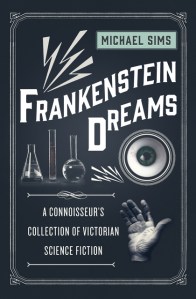
Frankenstein Dreams edited by Michael SimsMichael Sims has a new volume in his series Connoisseur’s Collection called Frankenstein Dreams. These anthologies are aimed at bookworms who love short stories from the 1800s, and this volume features science fiction that Charlotte Brontë or Charles Dickens might have read. Sims has now produced four of these Connoisseur’s Collections of Victorian fiction. The earlier ones were The Dead Witness for detective fiction, Dracula’s Guest for vampire stories, and The Phantom Coach for ghost stories. Michael Sims is probably most known for his 2011 book, The Story of Charlotte’s Web. Sims writes nonfiction on a variety of subjects, and the stories in Frankenstein Dreams are annotated by his scholarly insight that reveals a close psychic connection with the 19th century.

I listened to Frankenstein Dreams, narrated marvelously by Tim Campbell. I find hearing 19th-century literature far more rewarding when read by a professional because my inner reading voice always sounds too modern. The real value of this book is time traveling back to the nineteenth century to learn how science fictional ideas we believe originated in the twentieth century are older than we thought. That’s enlightening on many levels.

Take for instance the 1895 story, “A Wife Manufactured to Order” by Alice W. Fuller, about a man who buys a mechanical bride because he fears a real wife will crimp his routine. How many stories, movies, and television shows have dealt with this idea since? Was Alice Fuller’s story the first? Or is the idea even older, and we don’t know it because of collective forgetfulness?

Have you seen Blade Runner 2049? What exactly are replicants? Aren’t they closer to Frankenstein’s monster than robots? Mary Shelley came up with that idea in 1818. Two other stories in the collection also deal with creating artificial people with biology rather than mechanics.

One of my favorite stories in the collection is “Man-Bats on the Moon” by Richard Adams Locke excerpted from a series of six fake news articles published in 1835. Today this is known as the Great Moon Hoax, and it was as much of a sensation in its day as Orson Welles fooling people with H. G. Wells. Of course, if you are young enough you might not know about the famous 1938 radio broadcast.  Frankenstein Dreams constantly reveals how most pop culture is lost in time.

Sims collects fifteen short stories and five excerpts from classic novels to illustrate a broad selection of science fictional ideas imagined long before the term science fiction was coined. Most of the short story authors are unknown today, which is a shame because their stories reveal what wonderful imaginations they had.

However, Edward Page Mitchell might merit literary rediscovery, because he was a prolific writer who wrote about many ideas that Verne and Wells are currently remembered for. You can find five of his stories here, two of which were used in Frankenstein Dreams. My favorite was “The Senator’s Daughter” which was first published in 1879 and must have been mindblowing to readers of its day. Mitchell imagined a future 1935 America conquered by the Chinese. It includes a political party based on vegetarianism, with radicals in the party who worry about plant consciousness and eat only artificially produced pills. Citizens of Mitchell’s imaginary future travel by what sounds like a hyperloop train, and he describes a prison system that uses suspended animation instead of jail. “The Senator’s Daughter” also deals with race and gender issues very advanced for its era.

I was thoroughly delighted by Frankenstein Dream, listening to it every morning while exercising, or in the afternoons on my bike ride. My knowledge of the 19th century is mostly shaped by a couple dozen classic novels, many of which were written by just two authors, Jane Austen and Charles Dickens. Listening to the stories by these forgotten women and men broaden my perspective on that century.

I realized folks in the past thought about fantastic possibilities and imaginary futures just as much as we do today. It makes me wonder if our science fiction will be forgotten by future generations and we will only be remembered for our realistic fiction. I wonder if the readers of tomorrow will believe their science fictional speculations original because their pop culture will have forgotten ours?

Reprinted from Book Riot – 6/14/18

Empire Star and The Star Pit

A variation of this essay first appeared at Book Riot.

Empire Star by Samuel R DelanyEmpire Star and “The Star Pit” by Samuel R. Delany are my favorite science fiction stories from the 1960s. When I first discovered science fiction in the early 1960s I was inspired by the 1950s science fiction of Robert A. Heinlein. But after The Beatles, Bob Dylan, and the Jefferson Airplane, when the 1960s became The Sixties, Samuel R. Delany became my science fiction guru. Those were crazy times to grow up, especially after Timothy Leary. Empire Star and “The Star Pit” help me make more sense of the chaos than anything else I read. Is it possible to learn from a science fiction book? I’ve always believed I learned more from these two stories than all the other thousands of science fiction stories I’ve read. But did I?

Can reading ever substitute for experience? Is there ever a time when book knowledge beats knowledge gained through living? Because it’s impossible to do everything in life, most of us live vicariously through reading. Can we ever learn about living from reading fictionalized experiences?

Book v. experience came up recently in an argument with my old friend Connell. We were talking about another friend Janis moving to Mexico, and I wondered if I would like living in Mexico. Connell said traveling to another country changes people in ways that are impossible to know without actually going. Since I’ve never traveled out of the country but often read books by people that do, I argued that we should be able to gain some sense of traveling from reading. Connell told me I was fooling myself.

I probably am but I want to believe books can convey a degree of actual experience. This got me thinking. My conclusion is experiencing comes in two kinds – what we feel and what we think about those feelings. I concur with Connell that books can’t recreate the feeling of an experience. On the other hand, I think it’s obvious that books can convey information we learn from our experiences. And, here’s my hypothesis: novels should be able to describe feelings in such a way that we can relate them to our own experiences and feelings.

Understanding this issue will teach us about the limitations of fiction and nonfiction. Fiction has always given us the illusion that we travel in space and time. Is knowledge gained from reading totally fiction, or can fiction convey truths about an experience?

Janis has been to Mexico many times and has even lived there for six months. She knows what it feels like. I bought her a book, A Better Life for Half the Price by Tim Leffel, a guy who writes about how to live abroad, and who lives in Mexico. His book, in 316 pages, distils Leffel’s experiences into useful knowledge that can be passed on in words. He also relates the experiences of many American expats living abroad.

Janis found his very useful. This kind of practical information based on experience is something nonfiction books do very well, but what about the feelings Connell was talking about? Can we read memoirs and novels that will prepare us for what emotions we might actually experience?

For example, can a book describe the frustration at failing to do normal social tasks because we don’t know the language? Or convey the loneliness that comes from being surrounded by people you can’t talk to? Or the cultural shock of being with people whose politics, pop culture, religion, sports, music, etc. have absolutely no overlap with your own?

How often have you felt that a novel transmitted a deep emotional insight about life? We often talk about books and movies in terms of emotional responses. Is this an illusion? Can fiction be a Rosetta stone for feelings?

Connell and I continually refer to one book we both read fifty years ago, Empire Star by Samuel R. Delany. Delany was a child prodigy, and his early books reflect his experiences of exploring a larger, more exciting adult world filled with other prodigies, some more dazzling than he. Delany was hanging around Greenwich Village when Bob Dylan showed up. Delany was probably in the most exciting place on Earth (NYC) in his early twenties, and that was reflected in his 1960s science fiction. It’s why I considered Delany the most creative science fiction writer at the time.
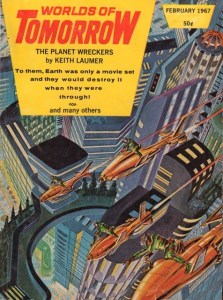
Worlds of Tomorrow February 1967Delany was a decade older than Connell and me, so we used his books as guides to experiences that were out of our league. This was especially true for Empire Star/Babel-17, and “The Star Pit” (found in the collection Aye, and Gomorrah).

We feel Chip Delany wrote about important life-altering events in the 1960s he experienced in his mid-twenties that we translated and understood in our mid-teens. Is that possible? We didn’t even know at the time that Delany was African-American and gay. However, we felt his stories conveyed genuine emotional experiences that we could learn from.
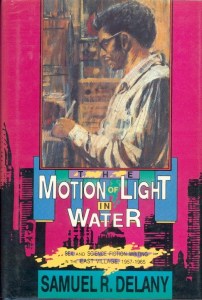
The Motion of Light in WaterIn 1988 Delany published The Motion of Light in Water: Sex and Science Fiction Writing in the East Village a memoir about his life during the years he wrote his early science fiction. Delany just published In Search of Silence: The Journals of Samuel R. Delany, Volume 1, 1957-1969. So we have both the fictionalized and nonfiction account of Delaney’s experiences. Connell and I have always believed Delany was giving us insight into his real-life experiences coded into fiction. Here’s what he says in Motion:

But no simple, sensory narrative can master what it purports—whether it be a hitchhiking trip to Texas or the memories that remain from such a trip twenty-five years later. That age-old philosophical chestnut, the Problem of Representation (in its twin forms, the Problem of Verification and the Problem of Exhaustiveness) makes mastery as such a non-problem, with no need of haute théorie. Theodore Sturgeon’s fine insight is perhaps germane here: the best writing does not reproduce—or represent—the writer’s experience at all. Rather it creates an experience that is entirely the reader’s, forged and fashioned wholly from her or his knowledge, of her or his memories, by her or his ideology and sensibility, and demonstrably different for each—but which (according to the writer’s skill) is merely as meaningful (though not necessarily meaningful in the same way) as the writer’s, merely as vivid.

In short, writing creates not a representation of the writer’s world but a model of the writer’s purport. (It creates a re-presentation, in a different form, of the reader’s world.)

This belief is reinforced because Delany had characters in different books have similar insights. I know I will never know what it’s like to be Samuel R. Delany. But can Delany transmit an emotional insight that I can recognize when I experience a similar situation in my life? Or can he describe a personal experience that I empathize enough to feel I’ve learned something?

Humans are not telepaths – but how much can we connect psychically in words? Is it ten percent? One percent? One thousandth of a percent? Just how much can a black gay man growing up in Harlem as a gifted teenager in the 1950s tell two straight teens growing up in white Miami in the 1960s that were C+ students? I think a great deal.

I admit Connell is right. To know what living in another country is like requires going there. But I want to believe books can give us something! I’m a lifelong bookworm. I have to believe books convey more than facts and figures, that they can create pseudo-emotions that trigger artificial experiences that can change us.

The next part of this essay is where it gets hard. I want to use one concept that Delaney used in Empire Star about simplex, complex, and multiplex, and try to prove my point. I believe Delany encoded a great deal of emotional experience into a cheap 1966 paperback science fiction book. Empire Star was a 102-page novella, one-half of an Ace Double. It wasn’t a prestigious literary novel from Charles Scribner’s Sons or an avant-garde work of art from Grove Press. It was a 45-cent paperback masterpiece.

Delany dealt with three reoccurring themes: naïve characters thrown into a complex world, characters being complexly confused by matching their experiences with others, and characters who are amazed by meeting wiser characters who apparently know the impossible. Delany called these mindsets simplex, complex, and multiplex (think multidimensionally complex). Connell and I have applied Delany’s insight from Empire Star in countless ways over the last half-century.

I can’t even explain this deep insight with so few words. You will need to read Empire Star. However, I do believe Delany’s observation of three mindsets and how they work can be applied anywhere without knowing how he specifically learned them. For example, once you get the hang of what he’s talking about, it makes understanding our bizarre politically polarized world easier.

In our argument, Connell asserts that travel is one of the primo methods for promoting multiplex thinking. This is exactly what Delany did in his stories. It’s also what Joseph Campbell describes The Hero With a Thousand Faces. What I tried to argue back that Connell didn’t believe, is reading can do this too. Connell said this was me rationalizing my self-consciousness over the lack of foreign travel. And that’s true, but it’s also true most of what we know about reality comes from reading.

Whether it’s from living or reading we all encounter new experiences going through the mental stages of simplex, complex and multiplex insights. A great writer can take us through them just like real world experiences can. Sure the gold standard of experience is real life. And for many people, real life and travel stay at the simplex level anyway. Complexity and multiplexity come from analyzing and abstracting our real world experiences.

No one today can travel to first century Rome. We will never know what it feels like to live in a city in the past. Yet, it’s my claim that reading a few books can tell us more about life then than most of its inhabitants ever knew while living.

Again, it’s abstractions versus feelings. But here’s the thing about being human, we only feel in the moment, in the eternal now, everything we remember feeling is an abstraction. And books can code that. But Connell’s argument included the fact that travel changes us. To make my rebuttal requires books being able to change us. Do they? How often have you said, or heard someone say, a book changed their life? I think they do. I won’t know what Connell thinks until he reads this essay.

Have you read books about life in other countries or visitors to them that you later verified by traveling yourself? Post a comment.

— James Wallace Harris
Star Maker: Science Fiction or Spiritual Woo-Woo?

Back in 1937, Olaf Stapledon walked up to the writer’s Homeplate and pointed to the sky. He heard the announcer say he was signaling to hit one into the stands. Olaf shook his head and pointed higher. The announcer claimed he was going to hit one out of the park. Olaf shook his head again and made a big circle with the end of the bat. The announcer laughed saying he was going to hit one into orbit. When the pitch came the ball disappeared. No one knew where it went. But Olaf had hit one out of the galaxy with Star Maker.

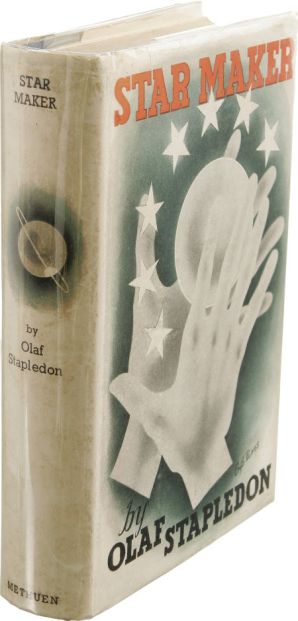
star-maker-first-editionYears earlier, in 1930, Stapledon had written Last and First Men, a “novel” that spanned two billion years and covered the evolution of 18 species of humans. That epic sweep of future history would be but a single vibration of an atomic clock within the scope of Star Maker. The unnamed narrator of Star Maker is really Olaf Stapledon as he travels through vast expanses multi-dimensional multiverses of spaces and times via what was once called astral projection.
It’s hard to believe science fiction readers embrace him as a pioneer of their genre. Stapledon is closer to the writers of the Vedas, William Blake, Dante, and John Milton than he is to Kim Stanley Robinson or Octavia Butler. But anyone who reads Star Maker will call it science fiction. That’s because many of the concepts science fiction owns today were first suggested in Star Maker. Once you read Stapledon you see where Arthur C. Clarke got his ideas for Childhood’s End and 2001: A Space Odyssey. Yet, those are just two obvious examples.

Olaf Stapledon strove to describe a spiritual reality. I use the word reality to mean everything – universe, multiverses, other dimensions, time, multiple-time streams, the infinity of many-world hypothesis, and anything we’ve yet to imagine. The Star Maker is what some would call God, but the label God is too small for Stapledon. Stapledon imagined the Star Maker being indifferent to his creations, using evolution as its artist’s brush to paint an endless infinity of cosmoses. Star Maker the novel imagines just what some of those creations would be like. This is where the science fiction comes in. Stapledon envisions life on other worlds produced through different paths taken by evolution and then scales it up to interplanetary travel, galactic civilizations, hive minds, terraforming, planetary and stellar engineering, artificial life, higher states of being, all the way up to the Star Maker.

Tragically, Olaf Stapledon is a writer known to damn few readers. Even his biographer, Robert Crossley, apologizes for writing Olaf Stapledon: Speaking for the Future in 1994 about an unknown person. Crossley had to learn to stop worrying about his obscure subject after hearing so many people reply to him, “Olaf who?” Stapledon should be remembered as a significant philosopher of the 20th century, but he’s not. He’s remembered by a small cadre of science fiction readers, and not many of those.

Anyone who studies science fiction will know why Star Maker is such an important novel in the history of the genre. Star Maker isn’t really a novel or science fiction but that’s where it’s been pigeonholed by history’s cleanup crew. Star Maker is a novel Hermann Hesse would have written if he had read Pierre Teilhard de Chardin after doing Ketamine with John C. Lilly in a sensory deprivation tank. Read Lilly’s Programming and Metaprogramming in the Human Biocomputer to fully understand that last sentence.

Out of the billions of individual our species produces we get a handful of visionaries who think larger than all the rest, like those who wrote The Vedas. (The universe of The Book of Genesis is tiny in comparison.) Stapledon saw reality in a truly cosmic way – but is his work science fiction or spiritual woo-woo? Stapledon was a philosopher who had a humanistic spiritual streak. Obviously, Stapledon wanted humans to have a purpose in this giant reality – but that’s wishful thinking if you truly understand evolution.

Creationists and proponents of Intelligent Design hate evolution because they instinctively understand evolution invalidates the need for a creator. Stapledon didn’t accept that and makes evolution the tool of the Star Maker (God). Spiritual people want to believe that humans have souls that will travel on after death. Star Maker is no different from Seth Material books by Jane Roberts or The Urantia Book. That’s why I compare him to Pierre Teilhard de Chardin and John Lilly. These are all people who believe in a vast spiritual multiverse that has a workable cosmology like our universe.

The purpose of science fiction is to imagine aspects of reality in stories before science discovers and validates those aspects. Fantasy stories are either based on myths, religion, or fantasies that have no grounding in reality. For Star Maker to be science fiction we have to accept theories about spiritualism which Stapledon did but I don’t. If you understand science God, gods, vampires, ghosts, souls, angels, etc. don’t exist at all.

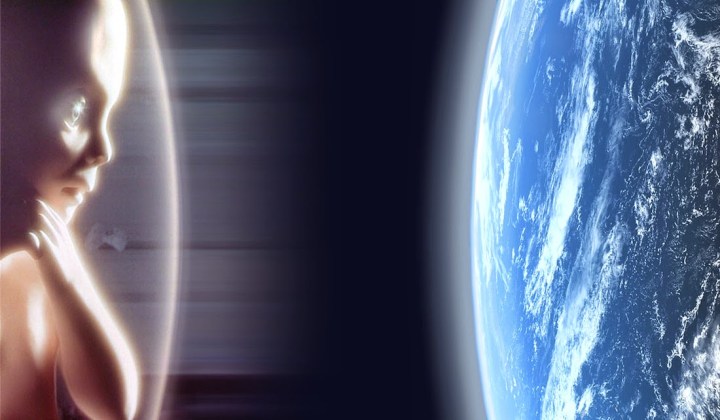
2001-Starchild-and-Earth

Stapledon probably didn’t believe in those things either but wanted a spiritual multiverse that co-existed with science. His work predicts that we will find spiritual states of being in the future via evolution. Is that any different from Arthur C. Clarke’s Starchild or Theodore Sturgeon’s hive mind in More than Human? Modern science fiction, for the most part, rejects these ideas as religious in nature, and thus not scientific. Modern science fiction imagines human minds being downloaded into artificial realities or robotic bodies. The goals are the same but the predicted methods differ. Whether or not these new hopes are validated by science are yet to be seen.

In Star Maker, Stapledon as the unnamed narrator astral travels to nearby stellar systems to study life on other planets. Eventually, he co-inhabits the mind of another being on a distant planet. Together they take off for other worlds, gathering other like-minded minds to form a gestalt intelligence. As they evolve they perceive greater intelligences in the galaxy and beyond, subsuming each along the way. This super-being travels up and down the time line and eventually meets with the Star Maker, who has no interest in them. The Star Maker is a God indifferent to the beings who have evolved out of his creations. The Star Maker is unknowable – all the beings of evolution can really see are small fraction of its infinite creations.

This all sounds both science fictional and woo-woo! Stapledon makes the same kind of observation about our species as Yuval Noah Harari makes in Sapiens and Homo Deus. This is why most science fiction readers have trouble reading his books, they really are philosophical speculations about the nature of homo sapiens rather than a novel. But I believe that anyone who wants to understand the heart of science fiction needs to read Stapledon. Jules Verne was the father of technological science fiction, H. G. Wells was the father of philosophical science fiction, Edgar Rice Burroughs was the father of adventure science fiction, and Olaf Stapledon was the father of spiritual science fiction. See Center for Future Consciousness for a real-world group that follows this philosophy.

Many of the ideas used in later science fiction stories are found in the Star Maker. Stapledon’s contemporaries writing in the same vein were E. E. “Doc” Smith and Edmond Hamilton, and their stories barely scratched the territory Stapledon covered in Star Maker. Smith and Hamilton were considered far-out thinkers to American pulp readers, however, Stapledon goes way beyond what they imagined. Stapledon thought of terraforming planets, intelligent suns, much bigger space battles, genetic engineering, all kinds of space drives, beings of endless variety, all kinds of weird alien sex, symbiotic telepathic relationships, galactic civilizations rising and falling, beings who develop technological longevity and beings who free themselves from physical reality – to list them all is exhausting and beyond the abilities of my memory.

When Bob Dylan wrote, “A Hard Rain’s a-Gonna Fall” he said, “Every line in it is actually the start of a whole new song. But when I wrote it, I thought I wouldn’t have enough time alive to write all those songs so I put all I could into this one.” That’s how reading Star Maker feels. It’s one long narrative that could have been hundreds of science fiction stories and novels. I doubt Stapledon thought of himself as science fiction writer, but since no one else is claiming him, I think it’s fine for our genre to latch onto him.

Recommended Reading

Before the Golden Age — Old SF Online

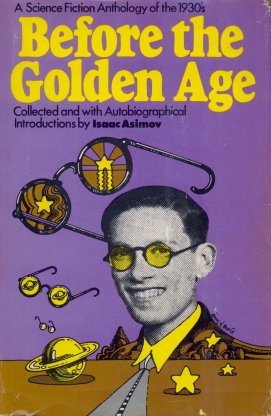
Before_the_Golden_AgeVery few science fiction fans read science fiction from the 1930s anymore. Back in 1974, Isaac Asimov edited a wonderful anthology, Before the Golden Age, where he collected the stories he fondly remembered from that decade during his adolescence. Unfortunately, that anthology is long out-of-print. That’s a shame. The trouble with great anthologies is they are seldom reprinted. I assume because the editors only buy rights to reprint for a specific length of time. I’d love if Audible.com could do an audio book edition of Before the Golden Age (or other classic SF anthologies), but I think that would be impossible.
My online science fiction book club has decided to read one story a week from Before the Golden Age. A handful of us owns the anthology. A couple of people said they would try and get it from the library. But to encourage the other members to read the stories, we’re trying to find online reprints of the stories. Back in 2010, Johnny Pez found 7 of the 25 online. His blog post inspires me to see how many are available in 2017. Several of his links no longer work. I found 12.

Below is the table of contents for Before the Golden Age. I’m going to hyperlink the short story title to information about the story. I’ll link the author’s name to information about the author. In the last column, I’ll give links to any online reprints of the story first, second, a link to ISFDB to see where the story has been anthologized over the decades, or third will be a link to the cheapest edition I can find if there’s no free edition.

In the last few years, websites reprinting whole issues of old pulp magazines have been popping up. I think that’s a wonderful service. I assume anything I find in the first few pages of Google returns is legal. If not, let me know and I’ll take down the link.

Story Author Online Source or ISFDB
The Man Who Evolved Edmond Hamilton YouTube, PulpMags
The Jameson Satellite Neil R. Jones Gutenberg
“Submicroscopic” Capt. S. P. Meek ISFDB
“Awlo of Ulm” Capt. S. P. Meek ISFDB
“Tetrahedra of Space” P. Schuyler Miller Comic Book+
“The World of the Red Sun” Clifford D. Simak Comic Book+
Tumithak of the Corridors Charles R. Tanner 99 cent ebook
The Moon Era Jack Williamson Comic Book+
The Man Who Awoke Laurence Manning Comic Book+
“Tumithak in Shawm” Charles R. Tanner 99 cent ebook
“Colossus” Donald Wandrei ISFDB
“Born of the Sun” Jack Williamson ISFDB
Sidewise in Time Murray Leinster ISFDB
Old Faithful Raymond Z. Gallun ISFDB
The Parasite Planet Stanley G. Weinbaum Gutenberg
Proxima Centauri Murray Leinster ISFDB
“The Accursed Galaxy” Edmond Hamilton ISFDB
He Who Shrank Henry Hasse Johnny Pez
The Human Pets of Mars Leslie Frances Stone Archive.org
The Brain Stealers of Mars John W. Campbell, Jr. Archive.org
Devolution Edmond Hamilton SeaRider, ISFDB
Big Game Isaac Asimov ISFDB
“Other Eyes Watching” John W. Campbell, Jr. ISFDB
Minus Planet John D. Clark ISFDB
Past, Present, and Future Nat Schachner Gutenberg
The Men and the Mirror Ross Rocklynne ISFDB

Many stories from the early 1930s are out of copyright, which is why we see whole pulps from that era online. But that doesn’t explain all the pulps that are online from the 1950s. I hope those sites are legal and stay up because they are becoming the only way to read old science fiction stories. They are also cultural artifacts showing a history of a subculture.

If you look at the ISFDB links you’ll see most of these stories have not been reprinted often. Some only appeared in their original pulp magazine and Before the Golden Age.

Most of these stories are crudely told, which probably explains why modern readers don’t read them. However, they do have a vitality for science fictional ideas. I imagine back in the 1930s there were few Americans thinking about these concepts. Now, most of these ideas are mundane even for children’s books and television shows.

I enjoy reading these old stories because they give me a sense of how science fiction evolved. I’m reading New Atlantis, a four-volume history of the scientific romance by Brian Stableford, which chronicles science fiction older than that found in Before the Golden Age. Stableford is reviewing writers that inspired the writers that inspired Asimov. When you look at a bigger history of science fiction, these 1930s stories are important, even though most SF fans would find them unreadable today. Sure, the writing is clunky, and the storytelling unsophisticated, but give them a try. You might be surprised.

— James Wallace Harris (Auxiliary Memory)

Guest Reviews at Classics of Science Fiction

When Mike and I created this site last year I expected to start rereading the classics of science fiction and reviewing them here. I’m now writing for four sites and have learned that it will take more time than I thought to complete all my ambitions. (I do hope to review Star Maker by Olaf Stapledon fairly soon.)

However, the other day I got a comment on Auxiliary Memory from a blogger, Tony Stewart, mentioning his reviews of science fiction. I clicked over to his site to read his take on A Case of Conscience by James Blish. I liked he was an older SciFi fan finding a stash of packed-away SF paperbacks and rereading them. I also liked that Tony gave his honest appraisal of the story. Too often we assume classics are perfect books.

That gave me an idea. If I can’t always find the time to write reviews myself then maybe I could Tom Sawyer some other folks. Or at least ask for reprints in exchange for links back to their blogs. I wrote Tony and he liked the idea. The first review I read is now reprinted here.

Now I’m looking for other reviews to reprint, and maybe even new columnists too. For now, we want to stick with the books on the Classics of Science Fiction list, but that might change. I’m also open to reviews of what I call “Forgotten Science Fiction” – those old stories that were once popular but are only remembered fondly by few fans today.

I’m looking for two kinds of reviewers. First, I really enjoy reading what older fans think when they revisit a book that wowed them in their youth. Second, I’m curious what younger readers feel when reading classic science fiction for the first time. Do the stories still hold up? How to they compare to current science fiction?

If you’re interested, drop us a line at classicsofsciencefiction at outlook dot com.

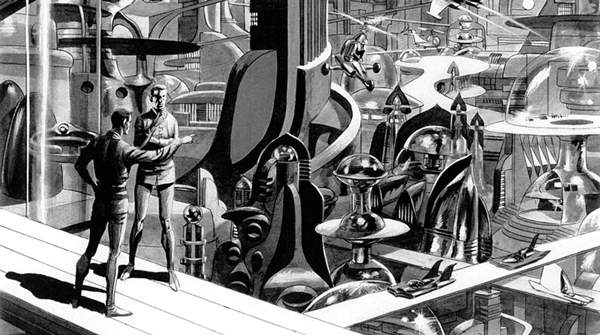
Wally-Wood-Galaxy-Oct-1958

[Wally Wood: Galaxy Art and Beyond]