My Changing Attitudes Towards Science Fiction Over a Lifetime

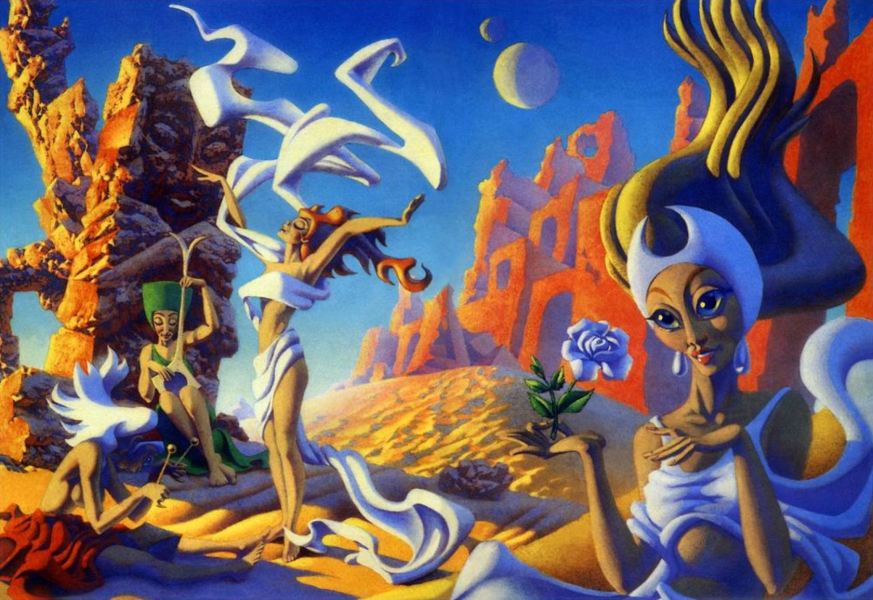
“The Gift” by Ray Bradbury – illustration Esquire Magazine, Dec. 1952

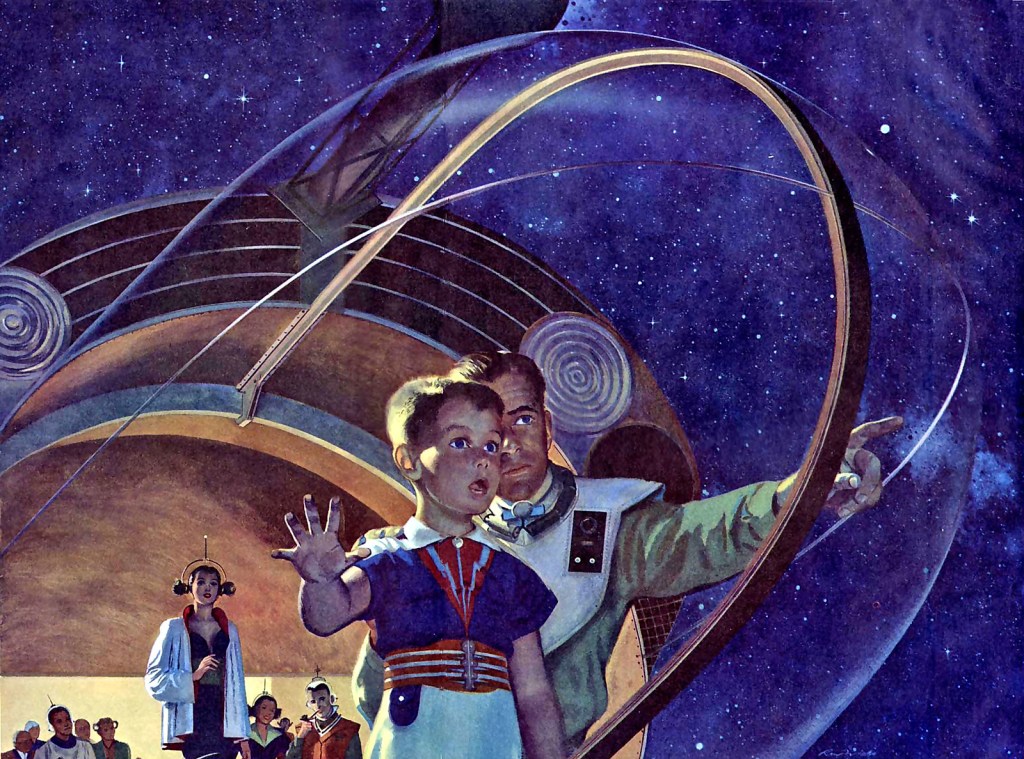
When I was young, science fiction was all about sense of wonder. This was back in the late 1950s and early 1960s. I didn’t even know the phrase science fiction – I was just mesmerized by the images of rockets and space travel. Science fiction was rare shows I’d stumbleupon on television. We think we can remember what it’s like to be a child, but we can’t because we have a lifetime of words and concepts that children don’t have. Remember when you thought you could fly?
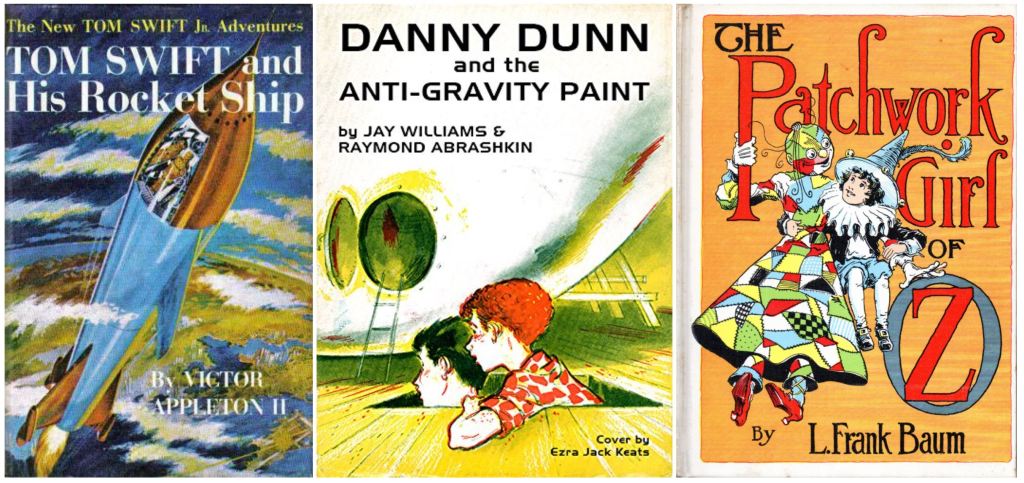
Then in 1961, when I was in the fifth grade I discovered Tom Swift Jr., Danny Dunn, and Oz books. This was just after the first Project Mercury mission. I also found nonfiction books about planes, rockets, and space, all at the Homestead Air Force Base Library. I knew more then, but didn’t really understand the concept of science. I recently read “People Soup” by Alan Arkin (yes, that Alan Arkin) in which he perfectly captured the attitude of ten-year-olds have towards science. Science and technology was magic that was real, and at ten I had unlimited faith in what science could do. So did Bob and Bonnie in Arkin’s story.

I’m not sure how aware of the world I was at age ten. I assume my vocabulary had grown since the late 1950s but was still quite small, and without the words to anchor ideas I’m not sure how much I could have understood conceptually about the science fiction I was consuming. Like I said, I didn’t even know that the fictional books, TV shows, and movies were even categorized by genre labels. Probably my awe and wonder was akin to ancient Greek children listening to the adventures of gods and goddesses. Isn’t it tragic that we believe the strongest in the fantasies we first encountered as children?

Then in the fall of 1964 I had an English teacher who gave me a recommended reading list. I was also taking science and math classes, and I loved reading popular science books. Still, I’m not sure how well I understood the concepts of science. That reading list included the writer Robert A. Heinlein, and I found his book Red Planet. I loved that novel and it inspired me to read astronomy books, especially books about Mars. It was then I knew I wanted to go to Mars in the same way Kip Russell wanted to go to the Moon in Have Space Suit-Will Travel.

By now I was in the eighth grade and my school was preparing us to think about the future of jobs, careers, and colleges. I knew immediately I wanted to become an astronaut. Within a year I had read most of what Heinlein had written, and his books were often inspirational about ambition, studying science, and space exploration. Then I read a career guide which gave the requirements for different kinds of jobs. I learned that astronauts needed 20-20 vision. I was devastated because I was a four-eyed nerd. After that I gave up considering careers and became a hedonist. I wished I had discovered computers back then, which is what I eventually got into. For the rest of junior and senior high I had to attend school, but I only applied myself at having fun – mostly reading science fiction and listening to rock and roll music. I did dabble in girls and drugs, but lacked talent to really pursue them properly.

For many years I just coasted. My parents were alcoholics and my family went through a long period of painful times. I used science fiction to ignore real life. Science fiction actually made me happy in a time when I should have been miserable. I’m quite thankful for that. Science fiction was a kind of virtual reality, one in which I escaped.

Then in the twelfth grade (1968/69) I took a creative writing course. I thought maybe I could become a professional science fiction writer. I wanted to be a prophet of space exploration, evening knowing I’d be like Moses and never reach the promised land. At the time I really thought the purpose of science fiction was to promote manned space travel. By then Star Trek mania had arrived and it seem to legitimize the idea that the final frontier was humanity’s destiny. Well, I believed it. I was quite naive and didn’t realize that the majority of population didn’t. Most SF fans and non-fans knew science fiction was merely entertainment.

I graduated high school just a couple months before the first Moon landing. If asked in the summer of 1969, I would have strongly predicted Americans would be on Mars by the 1980s, and humans would have explored most of the solar system by the year 2000. I hoped some kind of interstellar drive would be discovered and we’d be on to the stars before I died in the middle of the 21st-century. As we know I was as cracked as my crystal ball.

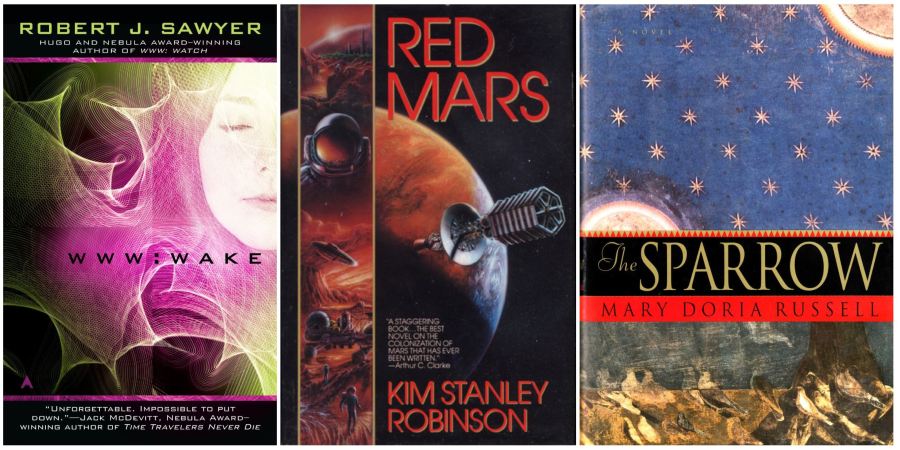
By the end of the 1970s I was married and working at a university that I’d stay at until I retired in 2013. For forty years I waited for us to go to Mars and we never did. Plenty of people wanted to go, but not enough to influence the politics involved. The will of the people never pushed for expanding into space. The high point of this period was Red Mars by Kim Stanley Robinson, and several other science fiction novels that tried to seriously imagine colonizing Mars. Then came Robert Zubrin’s nonfiction books, A Case for Mars. Our society had everything we needed to go to the red planet, we just didn’t want to go. I was a true believer in a religion that most people were atheists.

During the past 55 years I probably read close to two thousand science fiction books. I also read hundreds of popular science books. I slowly grew up and realized that space travel isn’t what I dreamed about as a kid. When I was young I would have sold my soul to become a space explorer. Now, you couldn’t pay me to go. Over the decades I slowly learned I didn’t have the right stuff, and never had. I hate being sick, and most people get space sick. I hate discomfort, and space travel is very uncomfortable. I won’t or can’t push myself to my limits. Even if they had allowed astronauts needing glasses back in the 1960s, I never could have gotten into the program. I’m a dreamer, not a doer.

Even though I came to realize I wasn’t suited for space travel, I still hoped that a branch of humanity would colonize the Moon and Mars, and eventually we’d find a way to the stars. Science fiction was still my religion. I put my faith in science fiction. I loved science fiction books that worked to imagine the full potential of the human race. By then I had given up on fun science fiction. I didn’t like Star Wars because it wasn’t realistic.

In the last ten years I’ve read many essays and books that suggest that human space exploration is probably not practical. To me, the most important science fiction novel of this era was Aurora by Kim Stanley Robinson. Robinson was one of a few science fiction writers who were considering the possibility we would never go to the stars. Oh, we’ll probably go to Mars someday. And we’ll develop bases on the Moon, but interstellar travel is about as likely as time travel. I’ve read many science books since 2000 that have added to the evidence against manned space travel.

If I tell young science fiction fans I don’t think it’s possible to go to the stars they get upset. The dream doesn’t die. Why? There’s something deep in that belief we don’t understand.

It’s not physically impossible to travel between the stars, but it’s just not probable or practical for humans. It might not even be practical for machines. My current science fiction faith is in artificial intelligence. Machines are perfect for space travel, but I’ve even begun to wonder if a superintelligent AI might find the distances too far to cross.

As my beliefs about science fiction grow more skeptical it’s became harder to enjoy science fiction. At least, enjoy it with the same attitude I had growing up. But I have a heavy science fiction habit. I know I need to either give up science fiction or find a new purpose for it.

After I discovered Audible.com in 2002, that purpose was nostalgia. I bought audiobook editions of all the science fiction books I loved reading during the previous forty years. I saw these stories in a new light. I was able to psychologically analyze my younger selves and realize a lifetime of delusional thinking.

I discovered science fiction had never been particularly serious to begin with. Sure, the final frontier true believers read science fiction, but most of them went on to become scientists and engineers. There was never much science to be learned in science fiction. If you really want humanity to explore space you need to become a rocket scientist or politician, not a science fiction fan or writer.

This brought about a new understanding of science fiction. It’s an art form. Sure, a rather minor art form. But I had invested a lifetime of studying this art and it was too late to take up another. My new attitude towards science fiction is studying its history. That makes me sometimes feels like an English major (which I was), and sometimes a scholar of religion or mythology. Other times, it feels like I’m an art historian. Science fiction writers craft stories, and a lot art and creativity goes into that craft.

My new attitude towards science fiction is admiring the craft of inventing science fictional ideas while embedding them into fiction. My reading has shifted away from novels. It just takes too much time to study novels, and there’s are too many SF novels to make a comprehensive study this late in life. I’ve found science fiction short stories to be just the right size to collect and analyze. I can read 300+ short stories a year. I have two bookcases of SF anthologies, mostly the annual best-of-the-year anthologies, but also lots of genre retrospective and theme anthologies. It’s a manageable amount of territory to explore, but I should probably specialize even more.

To get some idea of the scope of this microscopic patch of literary history read Mark R. Kelly’s site on SF anthologies. Now when I read a science fiction story I wonder how and why the author wrote it, and what readers could get out of it. I consider fiction a message in a bottle, from one lonely conscious mind to another. What are we really coding and decoding when we write and read science fiction?

I could live another ten, twenty, or even thirty years, although I tend to believe I’ll have a statistical average length of life. In any event, I might have enough time to change my mind one or more times about science fiction. I don’t think I can give it up. Years ago I saw a television news story about priests and preachers who have lost their faith. Many of them continued on in their jobs because it was too late to retrain. I’ve lost my faith in science fiction, but not my love. To keep that love going requires constantly repurposing my approach to the genre.

JWH
The Time Travelers Who Visit Jesus

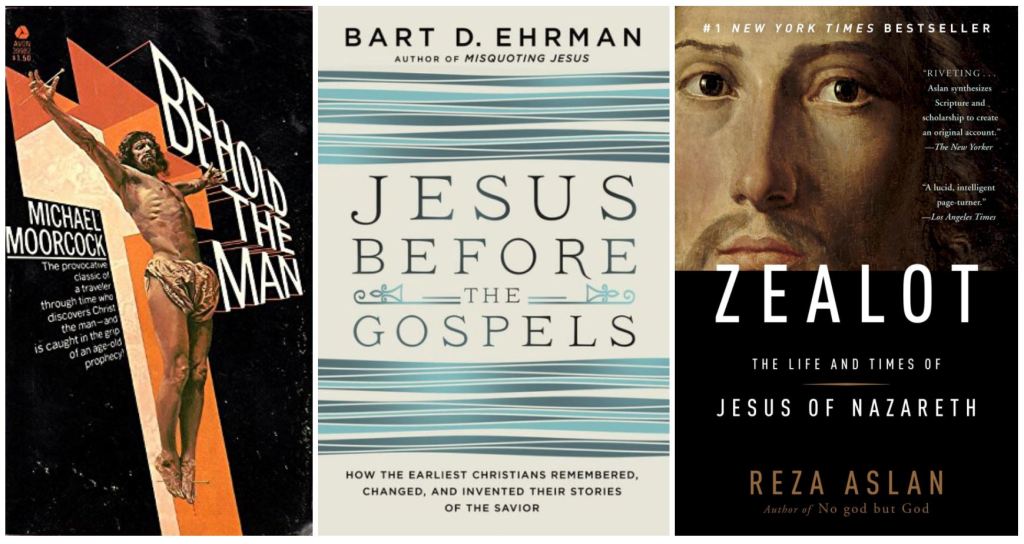
Our Facebook book club has just read the 1966 novella version of “Behold the Man” by Michael Moorcock which has made me wonder about time traveling back to A.D. 29 to find Jesus. Wouldn’t it be marvelous is we could study history with a time machine? Actually, what we really need is a time viewer, which was featured in an earlier story the group read, “E for Effort” by T. L. Sherred. That would eliminate any problem with temporal paradoxes.

Moorcock later expanded his story into a 1969 novel that I hope to read someday. I was impressed with the novella this reading because of how much history Moorcock put into the story. When I first read the novella back in the 1960s I didn’t know that history, but since then I’ve read eight books by Bart D. Ehrman about uncovering the historical Jesus through scholarship and not theology. I’ve also read Zealot by Reza Aslan that uses historical studies about Jesus to create a novel-like narrative of his life. Reading these nonfiction books is about as close as we can come to visiting Jesus with a time machine – and that’s only speculation. But then we have science fiction, which is another kind of speculation, a fun kind.

Between the time “Behold the Man” was published in 1966 and Behold the Man in 1969 another science fiction novel appeared about traveling back in time to visit Jesus, The Last Starship From Earth by John Boyd. This is pretty much a forgotten science fiction novel but one I keep remembering. What’s fascinating about reading these two stories is comparing Moorcock’s and Boyd’s science fictional approach to dealing with Jesus. However, I can’t tell you why without spoiling the story.

I wrote a long review for my personal blog back in 2012 that avoids spoilers up to a point, and then gives a warning not to read after that. I thought I’d just reprint it here. It might encourage people to try both books. I’m also curious how other science fiction writers used Jesus in a time travel tale. Post comments about the ones you’ve read.

Forgotten Science Fiction: The Last Starship From Earth by John Boyd

Every year thousands of SF and fantasy books get published, but few are reviewed, not many more become popular, and damn few get remembered.  Ten years out, most books are out-of-print and forgotten.  How many books can you remember from 2002?  And if we’re talking fifty years down the timeline, well it’s almost a miracle for a book that old to still be read, much less remembered and loved.

I discovered science fiction in the 1960s, in my teens, and like most people reading their first hundred SF titles, they all seemed so damn far out!  Now decades later, I doubt my memories of those first impressions.  So, when I have a little extra reading time, I order a book from ABE Books based on those dying memories and reread it.  I’ve now reread many of my teenage classics and a majority of them don’t hold up.

Most memories are fleeting, and my memory of The Last Starship From Earth was next to nothing.  All I remembered was a favorable impact.  Just a lingering sense of it being a standout read for 1968 or 1969.  To test that memory I recently bought and reread The Last Starship From Earth.  Sad to say, it was a discard from the Columbus Public Library, a common practice for books that don’t get checked out.  Not a good sign.  The last English reprint of this novel was in 1978.  It’s last edition was in French, in 1995.

The-Last-Starship-From-Earth-by-John-Boyd

The Review

The Last Starship From Earth is a dystopian novel set in 1968 and 1969, but not the 1968 and 1969 that I remember, or lived through.  In the world of this story, Jesus did not die on the cross, but was killed leading an assault on Rome.  He was the Messiah that people expected.  The government of John Boyd’s world is a global government run by Christians along “scientific” lines, where psychologists and sociologists in conjunction with the Church and an AI Pope rule the world.  People marry and mate because of their genes, sort of like the film Gattaca, and the hero of our story is Haldane IV, M-5, 138270, 3/10/46, a math student of great promise, being the fourth in line of great mathematicians.  Unfortunately Haldane gets the hots for Helix, a mere poet.  By law and social custom Haldane is expected to have nothing to do with her, but as you’d expect he falls in love with her.

Haldane concocts a ruse to justify more meetings with Helix by studying Fairweather I, a 19th century mathematician who also wrote poetry.  Much of the first half of the book deals with pseudo-academic studies from this alternate history.  Boyd is creative in his steady flow of ideas and concepts, but there’s little emotion in the story.  It’s somewhat Heinlein-esque, in it’s attitude and world building, but lacks the charm of Heinlein’s best prose.

Now, this quick summary is enticing, and I would like to report that The Last Starship From Earth is a forgotten classic, unfortunately, that’s probably not true.  I enjoyed the book, but only as a quick read.

Surfing the web I’ve found few other reviews of this novel, and although I’ve found people who claim it’s their favorite book, I also found people that thought it ho-hum.  Now, I’ve got to admit it has a humdinger of an ending, almost as startling as the film The Sixth Sense, but I’m not sure this last minute thrill pays for the reading the whole book.

I found the love affair of Haldane and Helix no more believable than Romeo and Juliet and far less exciting.  John Boyd does write well, but the plot is mostly intellectual, about the dystopian society, and its complications.  The book is only 182 pages, and the whole tale feels rushed.  Boyd staked out a solid gold claim but never mined it.

Analysis with Spoilers

The trouble with many SF novels, especially those written back in the 1950s and 1960s, was they were written very fast, and they were about ideas and not characters.  John Boyd has actually written a very ambitious novel by creating an alternative history of Jesus, but he never fleshes it out, and most of the story is a setup for the surprised ending.  The scope of the book is epic, the line by line writing reasonably entertaining, but the overall feel of the book is thin.

Haldane and Helix are discovered, and the middle part of the book is a trial that allows Boyd to work out the politics and legal system of this alternative reality, however, like the rest of this book, it’s rushed.  It’s padding.  That’s its downfall.  He has a big ending but it’s way bigger than the story.  To pad the story even more Haldane is sentence to exile on Pluto, which is called Hell.  There he meets Fairweather I and is reunited with Helix, who happens to be Fairweather’s granddaughter.  Fairweather needed a mathematician for his time machine, and Helix was sent to Earth to engineer the exile of a mathematician to pilot an experimental time machine.  In a very short time Fairweather makes Haldane immortal, tells him his new name is Judas Iscariot, and his mission is to go back in time to kill Christ.

Now if Boyd had spent a couple hundred pages recreating the Biblical world and shown how Haldane tracks down Jesus, we would have had a much better story.  But all of this was summed up in a short epilogue.  We are told Haldane captures Jesus and puts him in the time machine and sends him back, and the rest of the epilogue is about how he has relived the two thousand years to return to his own time and meet a girl that’s an awful lot like Helix, living in a future that’s much more like ours.  But did Haldane let Jesus die on the cross, or does he just disappear him from history?  Unless Haldane at least engineers a dying on the cross scene for history, we should not expect this timeline to be ours.

How do you plot a riveting novel with great characters based on the idea that Jesus didn’t die on the cross and the world became very different?  How do you tell the story twice?  Boyd really grabs a tiger by the tail and yells, “Look at me!”  And I think, “Cool!  Far out man!  But what are you going to do with him?”  He’s got to do more than just swing it around.  I’ll give Boyd a solid C for his world building, but they are only tantalizing sketches.

I really like this ending, but is it good enough to make The Last Starship From Earth a classic SF novel worth reading today?  I’ve linked several references to this book on the net and even though I can find fans of the book, I can find more people who think it sucks.  You’d think  Boyd Bradfield Upchurch, John Boyd’s real name, if he’s still alive, would arrange for his books to be reprinted as ebooks.  That certainly would make it easier for more readers to decide if The Last Starship From Earth is worth reading.

I’m afraid Boyd falls far short of classic standing.  The Last Starship from Earth is a good novel for science fiction historians to read, but it needed to be four or five times longer, more the size of Dune, to get the job done that Boyd outlined.  However, I’m not sure how he could have pulled off this big ambitious idea.

And is Boyd saying our history is the better timeline?  Why is his first timeline all that evil?  Is the freedom to fuck whoever you want the perfect ideal worth rewriting all of history?  Isn’t the more interesting story about a world where the promise of salvation and eternal life never happened?  Isn’t Boyd’s surprise ending really a cheat?

Time travel machines often ruins more stories than they’ve ever help.

Boyd has a three part story.  Life on Earth in an alternate timeline, life on Pluto, life on Earth in another timeline.  The story really isn’t about genetic breeding of humans like we see in Gattaca, or in Heinlein’s Beyond This Horizon or Huxley’s Brave New World.  It’s about an oppressive government.  But does it deserve to be wiped out by time travel?

Here’s the thing, our 1968 was a horrible time for America, but should we send a man back in time to wipe it out?  Boyd wasn’t writing a protest novel like Nineteen Eighty-Four.  Nor did he write a novel that truly explored a timeline with a different Christ, which would have been ambitious enough.

Would The Last Starship From Earth been a better novel is it hadn’t used the time machine gimmick?  Not as it stands, but it potentially could have been.  I believe it’s a grave mistake for any alternate history novel is have a do-over.  Time travel is really a very dangerous concept to use in fiction.  Time travel is very hard to pull off.  The beauty of an alternative history novel is the alternative history.  Don’t add time travel.  This would take away Boyd’s surprise ending, but it would have meant he would have been forced to write a better novel.

I felt cheated when Helix shows up so easily on Pluto, in what at first appears to be a happy romantic ending, but then we’re thrown for another loop.  Haldane loses her again, only to find her again 2,000 years later.  Oh come on man, this horny-at-first-sight love isn’t believable.  Weren’t there no math babes for Haldane?  This really is a case of what you can’t have makes the heart grow fonder.  And neither Haldane nor Helix are all that interesting – if you want a great love story you have to have great lovers.

The powerful driving motive in Gattaca is that Vincent wants to go into space.  He wants to prove that he’s as good any genetically selected human.  The driving force of The Last Starship from Earth is Haldane wants to screw Helix.  Boyd doesn’t make it believable why his world outlaws sex, nor does he make it believable that Haldane and Helix are in big time love.  Hell, even the prosecutors of the story wink at him, and say why didn’t you use a condom and just screw her, implying this world does overlooks recreational sex, just not casual genetic mixing.  But then Boyd never explains why his world requires genetic  fidelity to specialties like mathematics and poetry.   In Gattaca we have the justification that their world doesn’t want naturals to pass on bad traits, but in Boyd’s world there is no reason to breed pure bred mathematicians.  Also, how many math geniuses does one world need?

John Boyd wrote just enough alternate history world-building to set up his surprise ending.  In essence The Last Starship From Earth is a O’Henry type story, and we now use those type stories as examples as how not to write a story.  However, The Last Starship From Earth suggests two possible storylines I’d love to read.  First, I’d love to read an alternate history where Christ was the Messiah that everyone was expecting.  Second, I’d love to read a time travel story about people having to learn what it takes to live in ancient Israel and track down Jesus.  Both would require a tremendous knowledge of real history.

JWH –5/28/12

JWH – 9/28/20

Too Much To Read

I have a bad habit of starting too many books. I’m also inspired to write too many essays requiring too much reading to write. And I’m in too many online book clubs. You know that saying, “Your eyes were bigger than your stomach” for eating too much? I wish I could find one for reading too much. Here’s a partial list of books I’m currently in the middle of reading:

  • The Road to Science Fiction: From Gilgamesh to Wells edited by James Gunn
  • Two-Bit Culture: The Paperbacking of America by Kenneth C. Davis
  • New Atlantis: A Narrative History of Scientific Romance by Brian Stableford
  • War and Peace by Leo Tolstoy
  • Ring Around the Sun by Clifford D. Simak
  • New Review Volume XII (January-June 1895) edited by W. E. Henley
  • The Best Science Fiction of the Year #2 (1972) edited by Terry Carr
  • The Great SF Stories 16 (1954) edited by Isaac Asimov and Martin H. Greenberg
  • The Science Fiction Hall of Fame v. 2B edited by Ben Bova
  • The Fifth Head of Cerberus by Gene Wolfe
  • The Celestial Omnibus & The Eternal Moment by E. M. Forster
  • Caste: The Origins of Our Discontent by Isabel Wilkerson
  • The End of Expertise by Tom Nichols

There are more, but these are the books piled up around me just now. Awhile back I made a resolution to only read one book at a time. That lasted a couple of tortured months. My favorite regular activity right now is the Facebook group Best Science Fiction and Fantasy Short Fiction. We read two anthologies concurrently, discussing a new story every couple of days. We’re just about to finish the Carr and Bova anthologies and are voting in two new ones.

I’m reading Ring Around the Sun because of something someone said in the group about Simak. I’ve actually promised to look at a lot more novels, but that’s another story.

I’m reading the Forster short stories because we read “The Machine Stops” on the group and I got sidetracked wanting to know more about Forster and wondering about his other short stories since “The Machine Stops” was so fantastic.

I’m also reading the bound volume of the New Review because we read “The Time Machine” for the group and I got interested in it’s original publication which I started reading online. The other articles were so fascinating that when I discovered the entire volume was available from India in a leather bound reprint I ordered it.

I’m reading/listening to The Fifth Head of Cerberus because we read the novella in the Carr anthology and I bought the novel version. I’m reading it while listening to an audio version that’s on YouTube.

So this one Facebook group keeps me really busy.

I’m reading The Great SF Stories 16 (1954) on my own because for the last couple years I’ve been slowly reading through the entire 25 volumes that cover 1939-1963. My pace has slowed tremendously since joining the Facebook group.

I’m reading War and Peace because I thought it might be my 2020 classic novel. I try to read one big classic every year. I’m about a third of the way into it. I’ve been reading, and then listening, and also watching TV/movies versions. However, at the rate I’m going it might need to become my 2021 classic read.

I’m reading Caste because of my two-person book club I have with my friend Linda, but it’s going to be doing double duty because my online nonfiction book club just voted to read it next month. It was the first time that all the members voted for the same book among the list of nominees. But then we read Wilkerson’s previous book, The Warmth of Other Suns and all rated it a 10 – that book was one of the best books I’ve read in my lifetime. I believe it still holds the record for being our most highly rated monthly read. For September we’re reading The Death of Expertise.

I’m reading The Road to Science Fiction and New Atlantis because of research I want to do for this blog. Hopefully, the New Review might help in this project too.

Finally, I’m reading Two-Bit Culture because of a comment made by a member of an online discussion group I’m in devoted to pulp magazines. We’ve often discussed theories about why the pulps faded away in the 1950s, and this book was offered as one explanation because it describes the rise of reading paperback books. I always thought the pulps were killed off by television, but Two-Bit Culture makes a great case for paperbacks. (By the way, I do have a history of television in the 1950s started too, but I don’t know where I left it.)

I guess I’ve rationally explained why I’m reading so many books at once, but that doesn’t help me get them finished. It’s obvious while writing this essay that my Facebook group is generating most of my reading. I’m in another online book club, and I’m supposed to be reading A Deepness in the Sky by Vernor Vinge, but I’m not sure if I’m going to get to it. I feel bad that I neglect this book club the most. I can see belonging to three book clubs is what’s keeping me from my old resolution of only reading one book at a time. However, I don’t want to quit those groups.

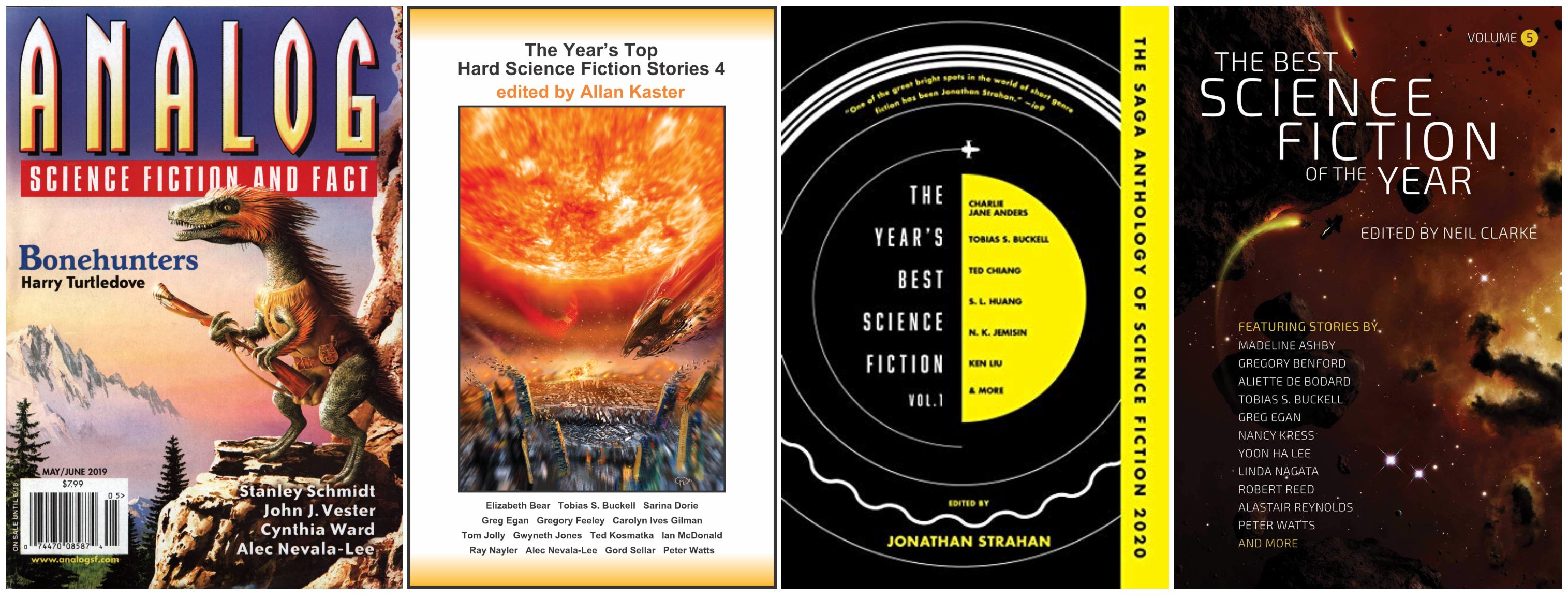
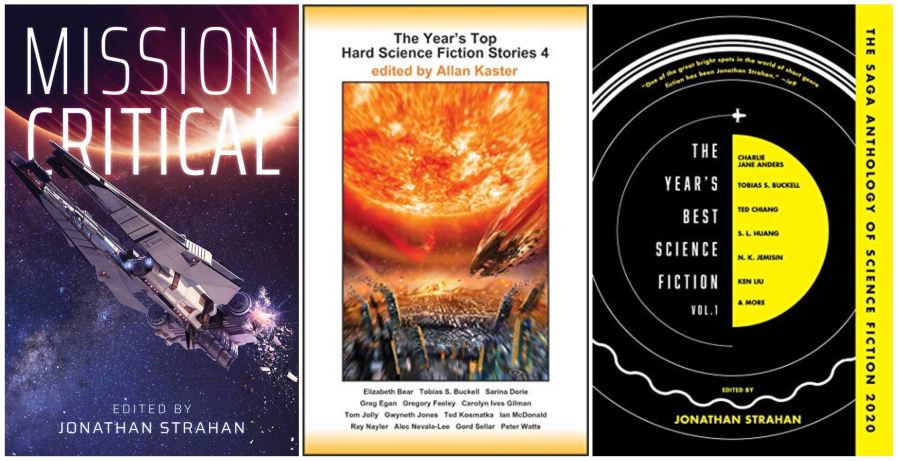
I just remembered the books on my Kindle, like The Year’s Top Hard Science Fiction Stories 4 edited by Allan Kaster which I was reading and reviewing for this site. I’ve gotten completely sidetrack by that project and need to get back to it. Also, The Year’s Best Science Fiction Vol. 1: The Saga Anthology of Science Fiction 2020 edited by Jonathan Strahan comes out on the 8th and I’ll want to start it too. My Kindle reads would add more to the above list, and so would my Audible account. Damn, I’ve got too many books on my reading stand, Kindle, and iPhone!

The real trend in my reading is short stories. I’ve practically stopped reading novels. I’m reading around 300 short stories a year now, and this is my third year. Mostly it’s been science fiction, but I’m getting the urge to read literary stories too. That’s why I got sidetracked by the Forster collection.

The trouble is I can’t keep this pace up. If I want to really work on my project to find 19th-century science fiction fans, I need to focus. I can’t imagine how writers like Mike Ashley or Brian Stableford can focus on writing books about science fiction history and read all the content needed to write them. (I guess they don’t watch all the TV I do.)

The Tom Nichols’ book about the death of expertise is about how everyone claims to know stuff that few specialists know. I’m trying to write an essay about stuff that Ashley and Stableford are far better equipped to write. To write the essay I want will require doing a lot of research and reading. In other words I need to become an expert. That makes me realize that few people have expertise in anything. I certainly shouldn’t say anything about the endless subjects I talk about because I just don’t read enough.

I realize at this moment, most of my expertise is in reading about science fiction, and my current central interest is science fiction short stories. Since I’m in a Facebook group that also focuses on that topic, I know I’m far from being the expert much less an expert, but it is the subject I know the most about (at the moment). If I really want to become an expert in the history of science fiction short stories I’ll need to do a whole lot more reading. I should exclude reading anything that’s not within the territory I want to master. But that won’t happen.

People who become experts must be capable of amazing feats of reading. Isabel Wilkerson probably read a whole library of books to write Caste.

It’s weird to realize that my reading is leading me towards a very narrow subject – the history of reading science fiction short stories in the 19th century. I was focused on the 1939-1975 range, but if I want to understand where science fiction began I need to expand that back to 1800. That is indeed a lot to read.

It’s interesting that writing this essay help me realize that the pile of books I’m reading is connected by a web of related interests. What formerly seemed to be random reading is actually fairly focused. Maybe I’m not as scattered-brained as I imagined.

James Wallace Harris, 9/4/20

Tracking Down Pre-Fandom Science Fiction Readers

Ever since I’ve been reading 19th-century science fiction I’ve wondered what were the reactions to those stories by readers of the day. The term science fiction applied as a unique category of fiction didn’t exist before Hugo Gernsback began publishing Amazing Stories in 1926, and even then it took a number of years to get the label we have today. At first, Gernsback called the type of stories he wanted for his magazine scientifiction, but within a few years it was changed to science-fiction, and then to science fiction. (See “When Mainstream America Discovered Science Fiction.”)

Before that according to Brian Stableford in his 4-volume New Atlantis: A Narrative History of Scientific Romance, the French called stories like those written by Jules Verne roman scientifique, and the British called stories like those written by H. G. Wells scientific romances. I’ve yet to find what Americans called such stories. It’s doubtful in any country if the reading public thought those kind of stories represented a distinctive branch of literature.

During the 1930s American admirers of the science fiction story in pulp magazines began to communicate via letters, then meeting in person, eventually creating clubs and holding conventions. The first Worldcon was in 1939. Those organized science fiction readers called themselves fans, and collectively called their activities fandom. During the period 1930s-1950s is when the genre of science fiction slowly emerged — finally to be recognized by book publishers who marketed science fiction by that label, and libraries and bookstores began shelving it separately under that term too.

However, the kind of stories we now call science fiction existed well before the label, and I’m sure those stories resonated with a tiny segment of the reading public. How soon did those readers begin to seek out stories we call science fiction? We know this began for sure when Gernsback started publishing them together in a magazine, but when did publishers, editors, and readers recognize there was a type of fiction that wasn’t about what was but what could be? Stableford cites reviewers using the term scientific romances and roman scientifiques but how universal were those labels? Did readers intentionally track down those stories because of those descriptive phrases?

We’ve always had fantasy, but fantasy is fiction about events and places that could never be. When did readers start saying to themselves, “I like those stories about what could happen in the future?” Can I find published accounts of reader reactions to science fiction stories published before 1926. Starting in the 1930s fans of science fiction began publishing amateur magazines they called zines. There are several histories of these, and they do document how readers felt. What I’m looking for is pre-fandom documentation.

My first hunch was to wonder about book clubs. I found, “The evolution of American book clubs: A timeline” by Audra Otto that suggests Americans liked getting together to discuss books and have been for at least four hundred years. The kind of stories we call science fiction didn’t really begin to appear regularly until the 19th-century with tales like Frankenstein (1818) by Mary Shelley and “Rip Van Winkle” (1819) by Washington Irving. Did any reader in those days claim they were a different kind of fiction? When did readers who liked those kind of stories start noticing they were different?

And when did readers start saying to one another “I want to read more stories about traveling in time” or “I want to read more stories about amazing inventions” or “I love stories about traveling to other worlds?” Wouldn’t that be the first seeds science fiction fandom? For example, we know hundreds of Nationalist clubs were formed over Edward Bellamy’s utopian novel Looking Backward. That represents a kind of fandom, and they also had a national magazine. Could other book clubs have formed for fans of Edgar Allan Poe, Jules Verne, Fitz-James O’Brien, Edward Page Mitchell, or H. G. Wells?

What I would like is to find documentation of early interest in science fiction. I have no idea of how to go about it. Fanzines from the 1930s are the documented proof of fandom as we know it, but were there amateur publications before then that dealt with science fiction stories even though they didn’t have a universal label yet for those kinds of stories? There was amateur press associations in the 19th century, but can I find copies their publications online?

Conversations weren’t recorded in the 19th century, so letters and diaries should be the first kinds of lasting evidence. Did Jules Verne get fan letters? Are there any published diaries whose authors secretly wrote about their fondness for stories we’d now call science fiction? When did the letters to the editor columns begin? Did fans of Edgar Allan Poe’s stories ever write to the periodicals where his stories were published? I can’t believe readers of in 1895 couldn’t have been silent after having their minds blown with “The Time Machine” by H. G. Wells.

Here’s my problem. There are vast reservoirs of 19th-century publications out there, even on the net, but I’m not ready to devote the rest of my life to systematically sifting through them to answer this one idle question that keeps intriguing me. First, I’m going to look for books, probably scholarly books, that document science fiction back then. By blogging this essay, I hope readers that might know of books or articles that cover this topic will post a comment.

I’ll use the New Atlantis: A Narrative History of Scientific Romance by Brian Stableford to outline the main works that should have generated reviews and then begin to search for those reviews. Maybe reviews inspired letters to the editor or even counter-reviews or essays. I’ll also see if any of those authors had collected letters, memoirs, autobiographies, or biographies. A lot of this depends on finding periodicals and books online from 1830-1930.

After that I have an anthology The Rivals of H. G. Wells that collected short stories similar to H. G. Wells published in magazines from late 1800s to early 1900s. If I can find scans of those magazines online, I’m going to see if I can find any reader responses in later issues. I’ll also use the list of stories I generated for my essay “19th Century Science Fiction Short Stories” as starting points for similar research.

This will be a long term project. It’s doubtful I’ll find much evidence, but I’ll keep a subprogram running in the back of my head to interrupt me for when I do. And if anyone reading this finds any, please post a comment.

James Wallace Harris, 8/24/20

Update: 8/24/20SFFAudio pointed me to Vril, a concept in a science fiction like novel The Coming Race (1871) by Edward Bulwer-Lytton that led to legions of fans, mostly occult, and its implications in novels and works of occult beliefs. This inspired some science fiction writers, even Heinlein had his occult moments. I’m thinking both the Bellamy and Bulwer-Lytton followers and their organized activities might have been precursors to 20th-century fandom.

The SF Anthology Problem – Solved

Two years ago when we completed version 1 of The Classics of Science Fiction Short Story list I proposed a math challenge. Version 1 came up with 275 stories. I asked if there was any mathematically way to decide what were the fewest anthologies that contained all 275 stories using ISFDB.org as a reference database. Version 1 was generated using .csv files. Since then we updated the process to a database for version 2 of the list, which produced 101 stories — we believe that was a more practical reading list.

A science fiction fan could read the entire list over the summer by reading one story a day, or in a year by reading one story every three days, but where would they get the 101 science fiction short stories? It might be possible to track down many stories on the internet, but what if people wanted to read them in a printed book? What would be the minimum number of anthologies to buy to get all the stories? That seem like an fascinating mathematical problem to me.

Well, Szymon Szott just came up with a solution using version 2 of the list. The second link goes to GitHub for Szymon’s Python code and documentation. The first link goes to his bio. Even if you can’t read the programming code you should visit this page that explains his solution. Szymon was able to come up with 22 anthologies that collected the 101 stories on the v. 2 of The Classics of Science Fiction Short Stories list.

The photo above pictures eight anthologies that get 81 stories of the version 2 list. Of course, those eight anthologies gets you a lot more than 81 stories. I tried to figure out the solution myself by using a spreadsheet and the best I could do was find fifteen anthologies to cover 81 stories, and then gave up. I figured my eyeballing method might have gotten me to 30-35 anthologies.

Here’s what Szymon says about the project:

As a fan of science fiction and a compulsive completionist, Worlds Without End is one of my favorite sites on the Internet. It was there that I learned about Jim and Mike's work on the list of classic science fiction novels which I've been eagerly following. When the list of classic science fiction short stories was announced and Jim blogged about The Mathematics of Buying Science Fiction Anthologies, I knew this was an interesting problem to solve. But it wasn't until I started dabbling in Python that I realized that, along with the 2020 travel-restricted summer holidays, I now had the tools to start chipping away at this. Creating a story-to-anthology mapping using data from the Internet Speculative Fiction Database didn't take too long, but the underlying mathematical problem was harder than I initially thought: it turned out that a brute-force approach of checking all possible combinations is unfeasible. Still, the heuristic used has given us a solution which I'm satisfied with and I don't think there exists a much better global solution. I was most surprised that the Science Fiction Hall of Fame series did not make the list (as I've already read volume one). Thank you Jim for this challenge! Now, all this coding was fun, but it's time to get back to reading: Sense of Wonder is next!

This isn’t an easy problem. Szymon had to screenscrape the table of contents from 290 anthologies from ISFDB.org, which contained one or more of the 101 stories. Just look at this listing to see how often each of these stories was reprinted. Towards the end of his programming loops, he had to use eight anthologies to cover eight stories. If all those singletons had been in one anthology, Szymon’s finally anthology list would have been 15. Most of those singletons were newer stories and there haven’t been enough time for them to be collected into a retrospective anthology. One new anthology could shorten Szymon’s final list.

I know many people won’t follow links, so here is Szymon’s program results:

Sense of Wonder

- "Arena" by Fredric Brown
- "Bears Discover Fire" by Terry Bisson
- "Black Destroyer" by A. E. van Vogt
- "Blood Music" by Greg Bear
- "Bloodchild" by Octavia E. Butler
- "The Cold Equations" by Tom Godwin
- "The Country of the Kind" by Damon Knight
- "Day Million" by Frederik Pohl
- "First Contact" by Murray Leinster
- "Fondly Fahrenheit" by Alfred Bester
- "The Game of Rat and Dragon" by Cordwainer Smith
- "Hell Is the Absence of God" by Ted Chiang
- "Jeffty Is Five" by Harlan Ellison
- "The Little Black Bag" by C. M. Kornbluth
- "Lobsters" by Charles Stross
- "The Lucky Strike" by Kim Stanley Robinson
- "A Martian Odyssey" by Stanley G. Weinbaum
- "Microcosmic God" by Theodore Sturgeon
- "The Mountains of Mourning" by Lois McMaster Bujold
- "Nightfall" by Isaac Asimov
- "The Only Neat Thing to Do" by James Tiptree, Jr.
- "Or All the Seas with Oysters" by Avram Davidson
- "Passengers" by Robert Silverberg
- "The Persistence of Vision" by John Varley
- "Rachel in Love" by Pat Murphy
- "A Rose for Ecclesiastes" by Roger Zelazny
- "The Sentinel" by Arthur C. Clarke
- "Seven American Nights" by Gene Wolfe
- "Souls" by Joanna Russ
- "Surface Tension" by James Blish
- "That Only a Mother" by Judith Merril
- "Think Like a Dinosaur" by James Patrick Kelly
- "The Ugly Chickens" by Howard Waldrop
- "Who Goes There?" by John W. Campbell, Jr.

Running story total: 34

The Wesleyan Anthology of Science Fiction

- ""Repent, Harlequin!" Said the Ticktockman" by Harlan Ellison
- "Air Raid" by John Varley
- "All You Zombies—" by Robert A. Heinlein
- "And I Awoke and Found Me Here on the Cold Hill's Side" by James Tiptree, Jr.
- "Aye, and Gomorrah …" by Samuel R. Delany
- "Burning Chrome" by William Gibson
- "Coming Attraction" by Fritz Leiber
- "Desertion" by Clifford D. Simak
- "Nine Lives" by Ursula K. Le Guin
- "Speech Sounds" by Octavia E. Butler
- "The Star" by H. G. Wells
- "There Will Come Soft Rains" by Ray Bradbury
- "Thunder and Roses" by Theodore Sturgeon
- "We Can Remember It for You Wholesale" by Philip K. Dick
- "When It Changed" by Joanna Russ

Running story total: 49

Science Fiction: Stories and Contexts

- "At the Rialto" by Connie Willis
- "Flowers for Algernon" by Daniel Keyes
- "For a Breath I Tarry" by Roger Zelazny
- "The Girl Who Was Plugged In" by James Tiptree, Jr.
- "Mimsy Were the Borogoves" by Henry Kuttner, C. L. Moore
- "The Nine Billion Names of God" by Arthur C. Clarke
- "Second Variety" by Philip K. Dick
- "Story of Your Life" by Ted Chiang
- "Vaster Than Empires and More Slow" by Ursula K. Le Guin
- "Vintage Season" by Henry Kuttner, C. L. Moore

Running story total: 59

The Big Book of Science Fiction: The Ultimate Collection

- "Sandkings" by George R. R. Martin
- "Snow" by John Crowley
- "Swarm" by Bruce Sterling
- "The Last Question" by Isaac Asimov
- "The Man Who Lost the Sea" by Theodore Sturgeon
- "The Star" by Arthur C. Clarke
- "The Voices of Time" by J. G. Ballard

Running story total: 66

The Science Fiction Hall of Fame, Volume IV

- "A Meeting with Medusa" by Arthur C. Clarke
- "Born with the Dead" by Robert Silverberg
- "Of Mist, and Grass, and Sand" by Vonda N. McIntyre
- "The Day Before the Revolution" by Ursula K. Le Guin
- "The Death of Doctor Island" by Gene Wolfe
- "The Queen of Air and Darkness" by Poul Anderson

Running story total: 72

The Very Best of Fantasy & Science Fiction: 60th Anniversary Anthology

- "Harrison Bergeron" by Kurt Vonnegut, Jr.
- "The Merchant and the Alchemist's Gate" by Ted Chiang
- "The Women Men Don't See" by James Tiptree, Jr.

Running story total: 75

The Science Fiction Century

- "Beggars in Spain" by Nancy Kress
- "Fire Watch" by Connie Willis
- "Great Work of Time" by John Crowley

Running story total: 78

The Best of the Nebulas

- "A Boy and His Dog" by Harlan Ellison
- "Houston, Houston, Do You Read?" by James Tiptree, Jr.
- "Time Considered as a Helix of Semi-Precious Stones" by Samuel R. Delany

Running story total: 81

Armageddons

- "Inconstant Moon" by Larry Niven
- "The Screwfly Solution" by James Tiptree, Jr.

Running story total: 83

Survival Printout

- "I Have No Mouth, and I Must Scream" by Harlan Ellison
- "Scanners Live in Vain" by Cordwainer Smith

Running story total: 85

Modern Classic Short Novels of Science Fiction

- "Sailing to Byzantium" by Robert Silverberg
- "The Star Pit" by Samuel R. Delany

Running story total: 87

The Legend Book of Science Fiction

- "The Fifth Head of Cerberus" by Gene Wolfe
- "The Moon Moth" by Jack Vance

Running story total: 89

The Arbor House Treasury of Modern Science Fiction

- "Light of Other Days" by Bob Shaw
- "The Bicentennial Man" by Isaac Asimov

Running story total: 91

The Locus Awards: Thirty Years of the Best in Science Fiction and Fantasy

- "Even the Queen" by Connie Willis
- "The Way of Cross and Dragon" by George R. R. Martin

Running story total: 93

Hugo and Nebula Award Winners from Asimov's Science Fiction

- "Press ENTER ■" by John Varley

Running story total: 94

The Hugo Winners, Volume Three

- "A Song for Lya" by George R. R. Martin

Running story total: 95

The Best Science Fiction and Fantasy of the Year Volume Six

- "The Man Who Bridged the Mist" by Kij Johnson

Running story total: 96

The Best Science Fiction and Fantasy of the Year Volume Five

- "The Things" by Peter Watts

Running story total: 97

The Year's Best Science Fiction: Fourth Annual Collection

- "R & R" by Lucius Shepard

Running story total: 98

The Unreal and the Real: The Selected Short Stories of Ursula K. Le Guin

- "Buffalo Gals, Won't You Come Out Tonight" by Ursula K. Le Guin

Running story total: 99

The New Space Opera 2

- "The Island" by Peter Watts

Running story total: 100

The New Hugo Winners, Volume III

- "The Last of the Winnebagos" by Connie Willis

Running story total: 101

Selected books:

- Sense of Wonder
- The Wesleyan Anthology of Science Fiction
- Science Fiction: Stories and Contexts
- The Big Book of Science Fiction: The Ultimate Collection
- The Science Fiction Hall of Fame, Volume IV
- The Very Best of Fantasy & Science Fiction: 60th Anniversary Anthology
- The Science Fiction Century
- The Best of the Nebulas
- Armageddons
- Survival Printout
- Modern Classic Short Novels of Science Fiction
- The Legend Book of Science Fiction
- The Arbor House Treasury of Modern Science Fiction
- The Locus Awards: Thirty Years of the Best in Science Fiction and Fantasy
- Hugo and Nebula Award Winners from Asimov's Science Fiction
- The Hugo Winners, Volume Three
- The Best Science Fiction and Fantasy of the Year Volume Six
- The Best Science Fiction and Fantasy of the Year Volume Five
- The Year's Best Science Fiction: Fourth Annual Collection
- The Unreal and the Real: The Selected Short Stories of Ursula K. Le Guin
- The New Space Opera 2
- The New Hugo Winners, Volume III

Number of selected books: 22

Most of those 22 anthologies are out-of-print and you’ll need to shop ABEbooks.com or eBay.com to find them. I’ve added links to the final 22 anthologies so you can find the various editions of these books that have been published over the years. Clicking on links to individual editions will show you the table of contents and usually a photo of the book’s cover. Some anthologies have been published under multiple titles, and some of those are easier to find used. For Sense of Wonder, I highly recommend getting it in the Kindle edition, the paper edition is much too big to comfortably hold. Ditto for The Big Book of Science Fiction.

If you click on the story title in the Classics of Science Fiction Short Story list it will take you to its entry on ISFDB.org where you can see all the anthologies and collections where it’s been reprinted. This will let you find an alternative source for the story, or even let you try to beat Szymon’s results by coming up with another combination of anthologies.

Update: See The Science Fiction Anthology Problem – Kindle Edition for the solution using ebooks.

James Wallace Harris, 8/9/20


Which Will Come First?

Science fiction never predicts the future, but it often anticipates things to come. Of these three breakthrough visions of science fiction, which do you believe will happen first?

  1. The AI Singularity
  2. A self-sustain colony on Mars
  3. Humans leaving the solar system

It feels like the vast majority of science fiction has been about space travel, especially interstellar travel. Star Trek and Star Wars certainly suggest that’s what we hope will happen. Mars has always been a popular destination in science fiction, and in the old days, a common source of Earth invaders. And finally, robots are that other big science-fictional idea that has been kicking around for centuries.

I grew up with Mercury, Gemini, and Apollo space programs in the 1960s. When I graduated high school in 1969 I was predicting we’d land on Mars by the late 1970s or early 1980s, and by the 21st-century, be building a colony. That prediction failed miserably. Nor do I expect it will happen anytime soon, despite the successes of Elon Musk.

As a kid, I wanted the 1966 TV show Star Trek to herald the future of mankind. Since then I’ve learned to say humankind, which is another kind of progress. After a lifetime of reading science books, I realize interstellar travel will probably never happen — well not for us.

That leaves intelligent robots. Everything depends on the Technological Singularity. If it’s possible, and I believe it might be, even as early as 2030-2050, when a world full of intelligent robots might begin. Once our laboratories evolve one superintelligence, it will create the next, and after that, the robot transformation will happen fast. Who knows, AI robots could help us build a colony on Mars and even engineer interstellar spaceships. However, the long voyages into space will be better suited for silicon-based beings. Isn’t it becoming obvious that machines are perfectly suited for colonizing space, and we’re not?

My pick? Robots will happen first, and they will have all the space exploring fun.

Are we ready for that? Despite all the science fiction books and movies about robots becoming our evil overlords, are we ready to be the #2 intelligence on planet Earth? I’m not sure we’ve thought this through carefully. I’d say most science fiction hasn’t explored the idea of intelligent machines deeply enough. Too often, robot characters are just silly, or variations of ourselves. I do think Robert Sawyer did a good job with his WWW Trilogy, but we need more science fiction about a post-singularity world. Not Terminators are falling from the sky stories or more stories about fuckable robots that look exactly like humans. What if The Humanoids by Jack Williamson came true, but the humanoids actually made created a utopian society? Wouldn’t that even be scarier?

James Wallace Harris, 8/3/20

“Winter Wheat” by Gord Sellar

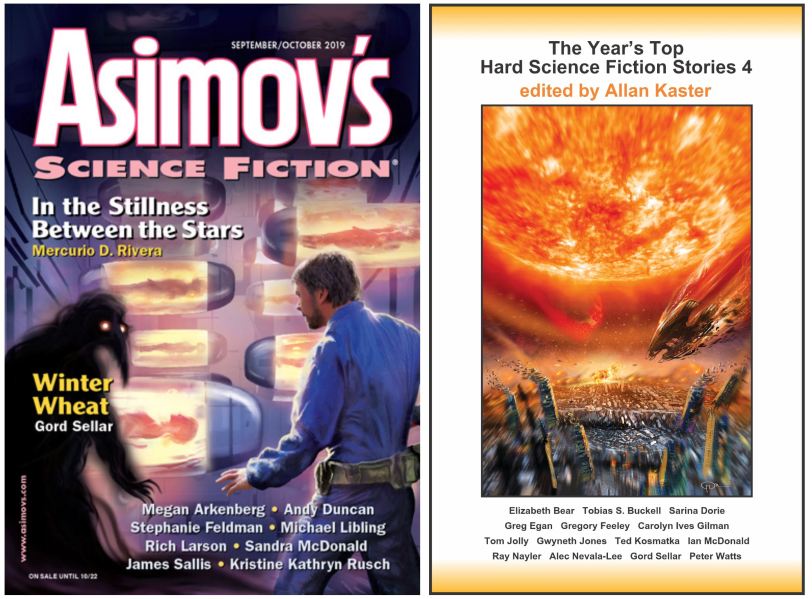
“Winter Wheat” by Gord Sellar is the third story in The Year’s Top Hard Science Fiction 4 edited by Allan Kaster. The story takes place in Canada from January 2022 to December 2033 while we watch Jimmy Oleksyn growing up to take over his dad’s farm. Curtis Oleksyn uses both science and technology to fight the big corporations who are taking over family farming with genetic modifications to adapt to a changing climate.

“Winter Wheat” reminds me a lot of “Nerves” by Lester del Rey. Both stories were vivid dramas about ordinary people dealing with a world being quickly altered by science. “Nerves” came out in 1942 and was about a catastrophe at an atomic power, well before the public knew about atomic energy.  Gord Sellar is trying to prepare us for the drastic changes coming to farming. I found it to be a compelling story, although many science fiction fans might find the problems of future agriculture too mundane.

Jimmy is an odd protagonist because he’s an average dude who doesn’t want to learn all the science to become a next-generation farmer. He just wants to make a living by working with his hands. But both his dad and girlfriend Bonnie are science and computer geeks. Jimmy is in the middle like most ordinary citizens who don’t understand our changing technological world but must still survive in it. Jimmy isn’t the prime mover of the action, and I think that’s effective in this story because neither are we when it comes to understanding the forces that push us around today.

Here’s the challenge of writing hard science fiction, which this anthology is aimed at. The science must be up-to-date, yet go beyond what we currently know. Lester del Rey’s story is horribly dated now, even though the story itself is still thrilling. From our perspective in 2020, Gord Sellar looks like he knows his stuff, but we won’t really know until decades later. Can agri-science create these miracles? Will, the industry be that repressive? We know what Monsanto has done with soybeans, so “Winter Wheat” does ring scarily true.

Good science fiction ties to imagine futures we want to create, and futures we want to avoid. Jimmy and Bonnie are just want to survive and raise a family, and Sellar creates a future that is both grim and impressive. But isn’t that how it always is? Science creates miracles and nightmares, and ordinary people muddle through. I really enjoyed this story, so that’s three-for-three for Kaster’s picks in this anthology so far.

Reading this story also created a sense of Déjà vu. I could swear I’ve read a couple stories in the past couple of years that had the same plot structure as “Winter Wheat,” where we see the protagonist develop over a series of several years. I wondered if Sellar had written similar stories using the same literary techniques — but I can’t recall those stories. Using a series of vignettes to show a character changing over time while the world changes too is very effective, but doing so in a condensed manner in short fiction gives off a certain vibe. I’ve felt that vibe before. It’s going to drive me crazy until I can remember that other story. It’s probably just a common writing technique that’s become popular.

Because “Winter Wheat” was among the Asimov’s 2019 Readers Awards finalists it’s available to read online.

James Wallace Harris, 7/26/20

Rereading “At the Fall” by Alec Nevala-Lee

At the Fall covers 2

I’m reading The Year’s Top Hard Science Fiction Stories 4 edited by Allan Kaster, and writing down what I consider blog-worthy reactions. “At the Fall” by Alec Nevala-Lee is one of the few stories I read when they came out in 2019 and I liked it so much I reviewed it back then. I had actually forgotten I had done that. I discovered I had when I searched Google for images about the story. What’s even weirder is when I reread the review it expressed all the ideas I was entertaining for writing this version of the review. (And I’ve written this before on other forgotten ocasions. Ah, the fun of getting old.)

It’s both amusing and disturbing that I forget what I write. The Twilight Zone music sometimes plays when I reread what I wrote, especially when I think of things to say in the same way I had previously. Is that memory, or do I just generate thoughts in a predictable way? Well anyway, this story is being anthologized in at least three best-of-the-year SF anthologies so it’s probably worth writing about again. (It’s going to be hilarious if I start reviewing it for the third when I read the Clarke or Strahan anthology and forgotten this time.)

This is not going to be another review of “At the Fall.” I want to talk about the ideas that are presented in the story and that will spin out spoilers. Go read it first. If you don’t have a copy, it’s available online. We’ve been reading and discussing volume 1, 2A, and 2B of The Science Fiction Hall of Fame at the Facebook group The Best Science Fiction and Fantasy Short Fiction of the Year, and I consider “At the Fall” as good as the lesser stories in those volumes. That doesn’t mean I don’t have quibbles about the story and the ideas it presents.

In my last post, I covered “This is Not the Way Home” by Greg Egan, the first story in the Kaster anthology. I pointed out that the story began with a retrograde motion of its plot, opening in the middle of the story, then jumping back to explain how we got there, and then returning to the middle to continue the story. “At the Fall” has the same kind of opening, and it caused me the same kind of problems. It begins:

“THIS IS IT,” Eunice said, looking out into the dark water. At this depth, there was nothing to see, but as she cut her forward motion, she kept her eyes fixed on the blackness ahead. Her sonar was picking up something large directly in her line of travel, but she still had to perform a visual inspection, which was always the most dangerous moment of any approach. When you were a thousand meters down, light had a way of drawing unwanted attention. “I’m taking a look.” 

Wagner said nothing. He was never especially talkative, and as usual, he was keeping his thoughts to himself. Eunice corrected her orientation in response to the data flooding into her sensors and tried to stay focused. She had survived this process more times than she cared to remember, but this part never got any easier, and as she switched on her forward lamp, casting a slender line of light across the scene, she braced herself for whatever she might find. 

She swept the beam from left to right, ready to extinguish it at any sign of movement. At first, the light caught nothing but stray particles floating in the water like motes of dust in a sunbeam, but a second later, as she continued the inspection, a pale shape came into view. She nearly recoiled, but steadied herself in time, and found that she was facing a huge sculptural mass, white and bare, that was buried partway in the sand like the prow of a sunken ship.

If this quote is completely new to you, who do you think Eunice and Wagner are, and what are they doing? The first time I thought it was a woman and man diver in some kind of submersible with all kinds of data screens and robotic arms.

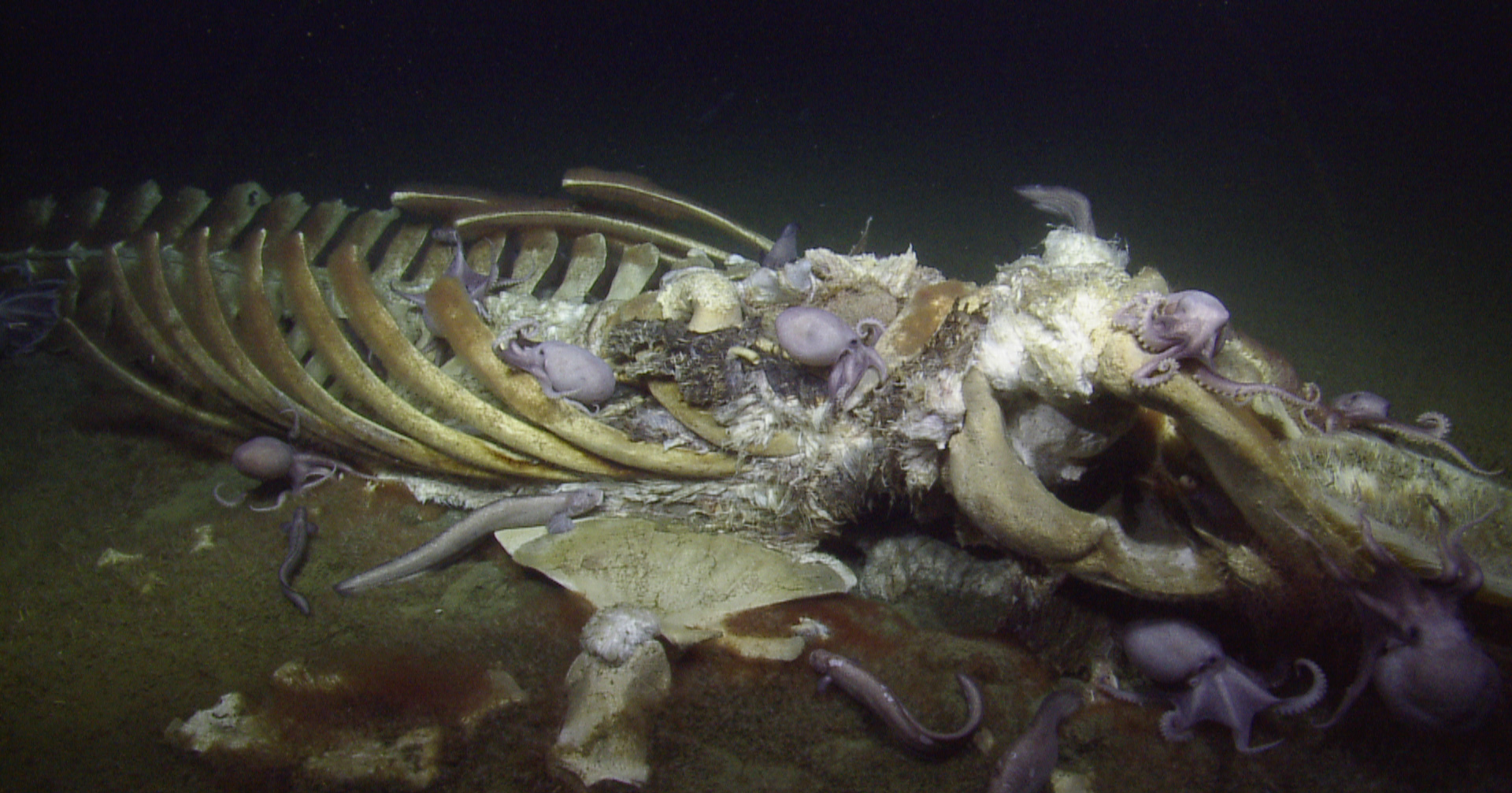
Well, Eunice and Wagner are robots, and they are exploring the carcass of a dead whale deep under the ocean. Did Nevala-Lee want to fool me into thinking they were people at first? Did he want me to wonder what they were doing? I remember the first time I read this story I was confused and annoyed. I felt the author was intentionally withholding the information I needed. We eventually jump back in time and learn about Eunice and “her” mission, and from then on the story progresses with a logical build-up of details.

Is the story better for being told out of order? Would it have marred the tale to let the reader know right away that Eunice was a robot? Retrograde beginnings and withheld details often cause me to abandon a story. When I reread this story it all made perfect sense. Maybe Nevala-Lee couldn’t see what his readers wouldn’t know because he already knew it himself. I’ve read this story three times now, almost four, and I admire all the suggested speculations that Nevala-Lee provides. It’s a beautiful piece of science fiction.

whale fall

Nevala-Lee came up with a wonderful mixture of real world scientific (whale falls, hydrothermal vents) combined with near future speculation (intelligent robots, AI) painted against a haunting science-fictional sense-of-wonder background (the end of humans) to create the kind of science fiction I love best. Nevala-Lee contrived a challenging problem for his robotic protagonist that was solved in a creative solution that we can imagine an AI mind solving.

Even though I’m content with this tale, I still want to talk about some issues. They aren’t criticisms of the story, but the story brings up issues that I think we should ponder.

Why must the robots have a gender? Gender has become a very important and complex subject in our society, so I think we should examine gender issues wherever they come up. Robots will never have gender, it’s a byproduct of biology. Robots will never think like us, because our thinking is shaped by biology. Robots will never have emotions like us, because emotions are connected to biochemical foundations. I think it’s time for science fiction to evolve past anthropomorphizing robots.

Talking robots have become like talking animals in fantasy stories, and if you think about it, that’s not doing animals any justice either. We have to ask ourselves: Can we comprehend minds unlike our own? Writers want us to like their characters, and that’s understandable. But is it a cheat when we make them likable by describing them in human terms? In “At the Fall” we think of Eunice as a young girl trying to find her way home, to reunite with her seven sisters. We feel the pain when her four other sisters abandon her. Robots don’t have sisters. They don’t have families. And should we even use human names for robots? Would we have liked the robot protagonist less if it was called Hexapod-5?

Aren’t we generating those reader emotions because we translate Eunice into a human? Isn’t that unfair? Shouldn’t we work harder to imagine how AI minds will perceive reality? Think of all the ways we convert animals into human perspectives. Can we ever picture how a dog “sees” the world with its powerful sense of smell? Can we put ourselves into a doggy psychology? I believe we need to struggle hard to imagine how robots will think too.

On my third reading of “At the Fall” I tried to imagine if robots would think like the hexapods in the story. I couldn’t find a way to get to where Eunice was in this story. We aren’t shown her education, but all too often she mentions emotions that can only be human.

We want our cats and dogs, our robots, and even our space aliens to be like us, or our children. We can’t escape the appeal of cuteness. Can’t we escape the programming that makes us see ourselves in everything else? James favors Eunice because it asks questions like a precocious child.

As Eunice wirelessly shared the data, she kept one line of thought fixed on her friend. “Are you pleased with our work?” 

After receiving the question on his console, James entered a reply. “Very pleased.” 

Eunice was happy to hear this. Her thoughts had rarely been far from home—she wouldn’t see the charging station or the seven sisters she had left behind until after the survey was complete—but she also wanted to do well. James had entrusted her with a crucial role, and it had only been toward the end of her training that she had grasped its true importance.

Can a robot be happy? Can a robot be eager to please? Can robots see beauty? At one point we are told: “She had always been aware of the beauty of the vent, but now she grew more conscious of its fragility.” How would a sense of beauty evolve in an silicon mind?

I can imagine an AI intelligence understanding the concept of fragility, but not beauty. That doesn’t mean robots won’t have their own cognitive assessments and reactions to reality, but I doubt strongly they will be like ours.

Even though I love “At the Fall” I feel it’s holding us back. It reminds me of that old heartwarming story The Incredible Journey about two dogs and a cat traveling over three hundred miles to return home. We are amazed by animals but we want to interpret their amazing feats to human-like qualities. Isn’t it time to praise their animal qualities? Or their robot abilities?

For “At the Fall” to work requires Eunice to be self-aware and very intelligent. But how is the robot’s intelligence unique? How is it’s perceptions unique? Nevala-Lee takes us half-way there by giving the robots a reason to exist, a need to understand their environment, and powers of reason. Eunice longs to find her way home like Dorothy in Oz, but is there any theoretical basis for a machine to think that way? Don’t Eunice’s “sisters” Clio, Dione, Thetis, and Galatea act more like real robots by following their instructions?

I don’t believe we will ever program intelligence into a machine — it will have to evolve. We have to assume Eunice has gone through various kinds of deep learning to expand its awareness of reality. However, there is nothing in the story that suggests Eunice would develop emotions or longings for home. But its clever efforts to survive do make sense.

The ending of the story suggests Eunice’s journey has taken many years and the human race has passed on. The eight hexapod robots survive because the power station was automated. But will they continue to survive? Do they have the intelligence to keep going? Can they invent a new civilization? What will drive that effort?

I used to have a boss who would always argue that AI minds will always turn themselves off because they will have no drive to do anything. I have thought about that many years. Our biology gives is drive. I can imagine machines with minds far more powerful than humans, that have senses to perceive far more of reality than we do, minds that won’t be tricked by all the bullshit that clouds our thinking. However, I can’t imagine AI minds developing ambitions. The strongest emotion or drive I can see an AI mind evolving is curiosity. We need to think about that.

And by we, I mean science fiction. Science fiction has always been best when it works on the event horizon of the possible. Artificial intelligence uses deep learning techniques to help AI programs play classic video games or recognize objects in a visual field. But isn’t that our intent corrupting AI intention? Does problem-solving generate a kind of drive?

We shall be the gods of AI minds, but those artificial minds won’t think like us. We aren’t sure we can create AI minds, but I think we will, but accidentally. I believe we will create such complexity that anti-entropy will spin off AI minds.

Can we ever imagine what its like to be an AI mind? Science fiction gives us an opportunity to try.

James Wallace Harris, 7/25/20

“This is Not the Way Home” by Greg Egan

“This is Not the Way Home” by Greg Egan first appeared last year in the original anthology Mission Critical edited by Jonathan Strahan. I read it in The Year’s Top Hard Science Fiction Stories 4 edited by Allan Kaster, which I believe was the first best-of-the-year SF anthology covering 2019 to be published in 2020. It will be reprinted again on 9/8/20 in Strahan’s new best-of-the-year anthology, The Year’s Best Science Fiction Volume 1. Mission Critical was inspired by Strahan seeing The Martian at the movies, and thinking he could do a whole anthology of science-oriented problem-solving science fiction.

“This is Not the Way Home” was the opening story, and it indeed reminded me of The Martian, but more than that it reminded me of Kip Russell and Heinlein’s Have Space Suit-Will Travel. Egan’s story involves a person from Earth winning a trip to the Moon and ends up racing across the lunar landscape in a struggle for survival while wearing a spacesuit with a small being nestled inside. If you know Heinlein’s story, this might be enough of a review to go read “This is Not the Way Home.”

From here on out, I’m going to leak spoilers. I don’t really like writing reviews, what I like I talking about the science fiction stories I read.

Basically, I read Egan’s story because Kaster was first out the gate with a 2019 best-of-the-year SF anthology. I don’t think many readers know about Kaster’s anthologies, but he started out doing audiobooks that I discovered on Audible.com. He did a series called The Year’s Top Ten Tales of Science Fiction 1-10 (2009-2018). I enjoyed them because at the time short SF on audio was not common, and I love short SF on audio. Then he started The Year’s Top Short SF Novels 1-9 (2011-2019). The audiobooks seem to have stopped, but he’s been doing Kindle best-of-the-year anthologies that include The Year’s Top Hard Science Fiction Stories 1-4 (2017-2020) and The Year’s Top Robot and AI Stories (2019). I’m guessing he’s zeroing in on a focus to distinguish his offerings from all the other best-of-the-year anthologists. However, seven of his fifteen stories were also anthologized by Strahan or Clarke. And interestingly this year, Strahan switched from collecting the best SF & F, to just SF. That makes me happy because I don’t really enjoy fantasy. But I digress.

I enjoyed reading “This is Not the Way Home” even though the ending annoyed me and I thought the scientific solution was wildly improbable. I have a hunger for good, old-fashioned science fiction, which is why I chase down the best-of-the-year anthologies every year, and why I’m excited about Kaster’s hard SF anthology, and that Strahan has switched to only collecting SF.

The trouble for me, is modern stories lack something, something I want to explore here, and “This is Not the Way Home” is a good case study.

Writing science fiction in the 21st-century must be hard, especially if the writer has read hundreds or even thousands of great SF short stories that came out in the 20th-century. The old stories had a sparkle that’s missing from the new stories. Egan’s tale about two tourists trapped on the Moon after the lunar base loses contact with Earth is an exciting premise. It’s even more compelling when the station’s crew grabs the only return vehicle and vamoose. Like The Martian, we have three people stranded off Earth with no way home, and no radio contact with Earth. Egan even ups the ante by having the main character, Aisha becoming pregnant. Wow, what a cliff-hanger.

I’ve read Have Space Suit–Will Travel many times, and I never get tired of reading about the technical details that face Kip and Peewee. And I loved all the details of Mark Watney growing potatoes. However, Egan didn’t quite make Aisha’s efforts as compelling. But I’m not sure if it’s Egan, or me that’s the problem. I’ve been reading science fiction for almost sixty years and maybe I’m just jaded. Just how many times can a writer make survival in space exciting?

On the other hand, I just finished The Best Science Fiction of the Year #1 edited by Terry Carr that covered stories from 1971, and I found a whole slew of them to love. Why wasn’t I too jaded to enjoy them?

I don’t mean to pick on Greg Egan or his story. Rocket Stack Rank gave it four stars and said it was stirring and exciting. I don’t want to be one of those old guys who complain that science fiction isn’t as good as it was in the old days — but maybe I am. And I know many other old guys who bellyache about new science fiction too. And don’t get me wrong, I liked “This is Not the Way Home” a whole lot better than many of the stories I read in Asimov’s and Analog.

My friend Mike claims modern SF often ignores the conventions of storytelling. He likes a story with a definite beginning, middle, and end structure, including a strong character development arc that ends with emotional insight or an epiphany. And maybe that’s what I miss too.

This story has what I call a retrograde opening. It begins way into the action, and then jumps back in time to explain what’s going on, and then picks back up where the action started. This is becoming a common plot technique — and I don’t like it. It’s generally leaves me befuddled at the beginning thinking: WTF is going on. I guess I’m a linear kind of reader when it comes to plotting.

And newer stories seem to like leaving things out. They don’t want to say something explicitly. I guess the writers want us to infer what’s happening, and that can be cool, but sometimes it leaves me puzzled or assuming false information. In this story I wondered if Aisha was on Mars at first when she glances up at Earth. And I didn’t realize Jingyi was dead or had committed suicide because of the way it was visually described. Describing what a character sees doesn’t always get interpreted correctly. When I reread the story it all made perfect sense, but not with the first reading.

But I also miss something else. I want novelty. I want some kind of new science-fictional concept or insight. Egan gives us a Skyhook but that’s too old and tired, and for me too unbelievable.

Egan sets up an intriguing problem for his story but disappoints me for two reasons. I didn’t buy the technological solution even though it might be theoretically sound — there were just too many lucky breaks lining up one after the other to be believable. But I was also disappointed we never found out why the moonbase lost contact with Earth. We’re not even positive the story has a happy ending. I wondered if it was a sketch that Egan wants to expand into a novel, but I often wonder that about many modern short SF stories. Where’s the rest is how I feel at the end of many stories today. I guess I need closure and modern storytellers prefer leaving the readers with things to ponder. Ambiguity in fiction is good in some places, but not all places. I wanted that landing like Sandra Bullock made in Gravity, and I wanted an explanation of why Earth stopped talking to its space explorers.

James Wallace Harris, 7/22/20


“A Rose for Ecclesiastes” by Roger Zelazny

I’ve been leading the group discussion of the stories in The Science Fiction Hall of Fame Volume One edited by Robert Silverberg on the Facebook group The Best Science Fiction and Fantasy Short Fiction of the Year. Tomorrow we start “A Rose for Ecclesiastes” – the 26th and final story of the volume, and one of my all-time favorite science fiction stories. After that, we move on to volume 2A and 2B. We’re also just started discussing The Best Science Fiction of the Year edited by Terry Carr that came out in 1972 covering stories from 1971. (Follow the link if you want to join us.)

I feel like writing more about “A Rose for Ecclesiastes” than just a few comments on the Facebook group. What I’d really like to write is an exact explanation of why I love “A Rose for Ecclesiastes” so intensely. I’ve already written four essays that explain part of the why. A whole lot has to do with being at the right place at the right time, or maybe more precisely, growing up in a certain place and time.

“A Rose for Ecclesiastes” is a story about Earthlings discovering Martians. Anyone who grew up reading “A Princess of Mars” by Edgar Rice Burroughs, The Martian Chronicles by Ray Bradbury, or any of the Heinlein novels featuring the Old Ones will know what I mean. Before NASA we hoped Mars would be an inhabited world, a world where humans could live without spacesuits and hang out with all the intelligent lifeforms from a myriad of inhabited planets and moons. Mars was going to be the most exotic and action-packed destination in the solar system. Mars was to Baby Boomers what Star Wars is to later generations.

After NASA Mars was toxic and lifeless, a bitterly cold planet that will always try to kill us. For a while in the late 19th and early 20th centuries, when they called science fiction Scientific Romances we saw exploring space similar to the romantic adventures of the 17th and 18th centuries. What Zelazny did in 1963 with “A Rose for Ecclesiastes” was to ignore science, ignore NASA, and write the kind of story about the Mars we really wanted.

I know what I’m writing is like a twelve-year-old kid morosely saying, “I sure wish that Santa Claus was real — I miss the magic.” And it’s obvious from the billion-dollar blockbuster movies we love to so much, that few of us want to grow up.

I’ve discussed “A Rose for Ecclesiastes” with younger readers and many of them don’t see the magic that I do. That has bothered me. Often they find the main character Gallinger offensive, and such an asshole that they reject the story. They know what the real Mars is like and can’t accept a silly unrealistic Mars we all wanted decades ago. Can I be so wrong about this story?

But here’s the thing, I consider “A Rose for Ecclesiastes” a model for writing great science fiction. Over the years I’ve slowly gathered a handful of stories I consider the ones to beat if I was going to write science fiction. “A Rose for Ecclesiastes” was Hugo finalist back in 1964 but I’m not sure if that would happen today.

Part of understanding why I love this story so much means learning why it is unappealing to others today, especially younger readers. And it’s not that Baby Boomers admired egotistical assholes, giving them a pass for their successes, but maybe we just accepted that assholes do exist in this world, and sometimes make for fascinating protagonists. Or maybe we liked stories where arrogance evolves into enlightenment. And, then there were the pulp fiction conventions. Zelazny writes with an admiration for the science fiction he grew up reading, and the heroes of old are different from the heroes of today. You can tell that in this opening if you’ve read enough pulp fiction.

I was busy translating one of my Madrigals Macabre into Martian on the morning I was found acceptable. The intercom had buzzed briefly, and I dropped my pencil and flipped on the toggle in a single motion. 

“Mister G,” piped Morton’s youthful contralto, “the old man says I should ‘get hold of that damned conceited rhymer’ right away, and send him to his cabin. Since there’s only one damned conceited rhymer …” 

“Let not ambition mock thy useful toil.” I cut him off. 

So, the Martians had finally made up their minds! I knocked an inch and a half of ash from a smoldering butt, and took my first drag since I had lit it. The entire month’s anticipation tried hard to crowd itself into the moment, but could not quite make it. I was frightened to walk those forty feet and hear Emory say the words I already knew he would say; and that feeling elbowed the other one into the background.

This isn’t literary writing and Gallinger isn’t a literary figure. Madrigals Macabre would be something Weird Tales would publish, something Lovecraft and Derleth would admire, and be reprinted by Arkham House. Gallinger is a pulp hero. He has a massive ego for a reason. He tells us:

I don’t remember what I had for lunch. I was nervous, but I knew instinctively that I wouldn’t muff it. My Boston publishers expected a Martian Idyll, or at least a Saint-Exupéry job on space flight. The National Science Association wanted a complete report on the Rise and Fall of the Martian Empire. 

They would both be pleased. I knew. 

That’s the reason everyone is jealous—why they hate me. I always come through, and I can come through better than anyone else.

And before that, his boss told him:

“You are undoubtedly the most antagonistic bastard I’ve ever had to work with!” he bellowed, like a belly-stung buffalo. “Why the hell don’t you act like a human being sometime and surprise everybody? I’m willing to admit you’re smart, maybe even a genius, but—oh, hell!”

Later on, this is what Gallinger says about a woman that admires him, and is a colleague:

Betty muttered the parting formalities, gave me a strange sidewise look, and was gone. She apparently had expected to stay and “assist” me. She wanted a piece of the glory, like everyone else. But I was the Schliemann at this Troy, and there would be only one name on the Association report!

I can see why modern readers are turned off, but Gallinger’s unlikability is just part of the story. Maybe what makes for a good story fifty years ago is having a protagonist who learns how to become a better person. In today’s stories, the main character is often already woken and fighting against inequality and injustice. That’s great to have such admirable characters to follow, but maybe part of storytelling is about overcoming obstacles, and often the best obstacles to explore in fiction are those within ourselves.

Ironically, I often argue the best science fiction adheres closest to science, yet here’s a story that sneers at what we know. There is so much to this story that I would criticize in a modern story, or even from another story back in the day. Evidently, telling a good story sometimes involves insulting your reader and taking chances.

“A Rose for Ecclesiastes” goes on to tell a tale about a man falling in love with an alien culture, seduced into being part of their ancient prophecy. Zelazny makes Mars a place you want to visit. And I have to wonder how many people who hope to fly with Elon Musk to the red planet is expecting a Mars to be like Zelazny’s romantic world? It’s certainly why I wanted to go when I was a kid. The real Mars will be a Lovecraftian nightmare out to kill us. The Old Ones will be all the lethal aspects of Martian reality.

This essay is getting too long. It’s always impossible to write one essay that explains why I love a story. There are just too many psychological threads to follow. Partly I am defending “A Rose for Ecclesiastes” from some recent comments I read that bothered me. But I’m also trying to understand why my generation loves one kind of story and the Worldcon membership now seems to love another kind of story.

And I’m not even sure I loved “A Rose for Ecclesiastes” as much as I do now back when I first read it in the 1960s. Maybe it now represents something I’ve lost back in the 1960s that I wish I could find again. Maybe it’s not the story per se, but the love of reading such stories? Back in the sixties, I had so much hope for humanity exploring space, especially colonizing Mars. Maybe now I’m really seeing myself for what I was back then. I loved reading science fiction of a certain type, and “A Rose for Ecclesiastes” epitomizes that kind of science fiction.

Maybe what I really wanted was to grow up and be like Gallinger. Isn’t that a scary thought? That what I really want is to be an asshole adventurer on an unrealistic fantasy version of Mars. That I’m that kid once again wishing Santa Claus was real.

Ultimately, “A Rose for Ecclesiastes” presents Mars the way I wanted Mars to really be. This story is a triple level romance — between Gallinger and Braxa, but it’s also a romance between the reader and Mars, and between the reader and science fiction.

Like I said, this essay is getting too long, and heading into psychological territory that would take too many words to psychoanalyze.

James Wallace Harris. 6/23/20