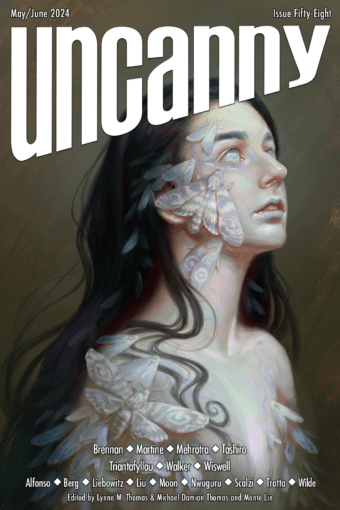
“Loneliness Universe” by Eugenia Triantafyllou

“Loneliness Universe” by Eugenia Triantafyllou appeared in Uncanny (#58, May/June 2024) and is a finalist for the 2025 Hugo Award in the Best Novelette category. You can read or listen to the story online. If you are a member of the 2025 Seattle Worldcon, you can vote for this story through July 23, 2025.

I first learned about the Hugo Awards back in the 1960s. I never attended a Worldcon but always wanted to. I did attend some regional conventions back in the 1970s. I kept up with the Hugo and Nebula awards for most of the 20th century, but slowly lost touch with science fiction and fandom in the 21st century. I discovered “Loneliness Universe” when I read Austin Beeman’s “Reviewing the 2025 Hugo Award Finalists: Best Novelettes” at his website www.shortsf.com.

I’m so impressed with “Loneliness Universe” that I will try to read all the finalists. I might even join the convention as a virtual member and vote. Members get a packet that includes many of the works up for voting. Membership is $50, and adding virtual attendance is another $35. There’s little chance I will physically attend a Worldcon, so that might be my best shot at achieving an old desire.

“Loneliness Universe” is not what I’d call science fiction. Nor would I categorize it as fantasy. One reason I let the science fiction genre pass me by is that it’s no longer what I thought it was supposed to be. That’s not a criticism. I just didn’t feel like keeping up with changing times. However, “Loneliness Universe” is an outstanding work of fiction.

The story begins with an email from Nefeli to Cara dated September 18, 2015. Throughout the story, we get to read email exchanges, but the next one is dated July 5, 2015. I don’t know if this is a spoiler, but the first email is the end of the story. I did not discover right away. In fact, I wouldn’t have discovered it at all if I hadn’t immediately reread the story by listening to it a second time.

I recommend you read this story the first time, then listen to it a second time.

I’m not going to spend much time describing this story. Read it. I will spend some time trying to explain what it’s doing.

There are infinite ways to understand fiction. One way is to think of fiction as a spectrum. At one end are stories where the author sends the readers a message. On the other end of that spectrum are stories where the author creates a story that is just a story.

Think of the first type as a message in a bottle from an individual stranded on a deserted island. And think of the second type as how some people describe God as an artist who created our existence but walked away.

In “Loneliness Universe,” Eugenia Triantafyllou has created a metaphor for our current cultural existence. In this story, Nefeli realizes she is losing physical contact with everyone she knows. She can only communicate with them through email and instant messages. They can leave evidence of their existence, but she no longer communicates with people face-to-face.

The setup for this story reminds me of an experience I had on LSD fifty-five years ago. I thought everyone was in an isolated universe by themselves, and our efforts to communicate in words were no better than writing a message, putting it in a bottle, and throwing it into the sea, hoping for a reply. That each of us was an isolated universe inside our heads. In Eugenia’s story, she imagines we’re all moving into separate universes of a multiverse, and for a while, can communicate via email and instant messages. This sounds science-fictional, but it’s probably more Kafkaesque.

The thing about metaphors is not that they are accurate, true, or valid, but that they make you think about a concept from a new perspective. In recent weeks, I’ve often woken in the middle of the night and thought about all the hundreds of people I’ve known in my lifetime and wondered about what has happened to them. And I ask myself, did we ever really communicate? This is what “Loneliness Universe” is about. Are we on the same wavelength?

Are we ever in the same room at the same time with someone else? If you truly understand this question, I will say those moments of being together are fleeting. Many people want to believe sex is a way to achieve such synchronicity, but that’s not true either. I don’t believe telepathy is possible, but sometimes, when two people have had the same life experiences, they can say just the right words, they know they have achieved a kind of psychic Venn diagram intersection for a fleeting moment.

“Loneliness Universe” is not a perfect story. It’s only as good as you can resonate with what Eugenia Triantafyllou is expressing. I don’t know how well her message in a bottle was decoded by my inner self. We will never be in the same room together. But I’d like to believe I know what she was trying to say.

I know full well that can be a delusion.

That’s also the dark bleakness of her ending.

James Wallace Harris, 5/1/25

“Watershed” by James Blish

Group Read 92 (#05 of 25)

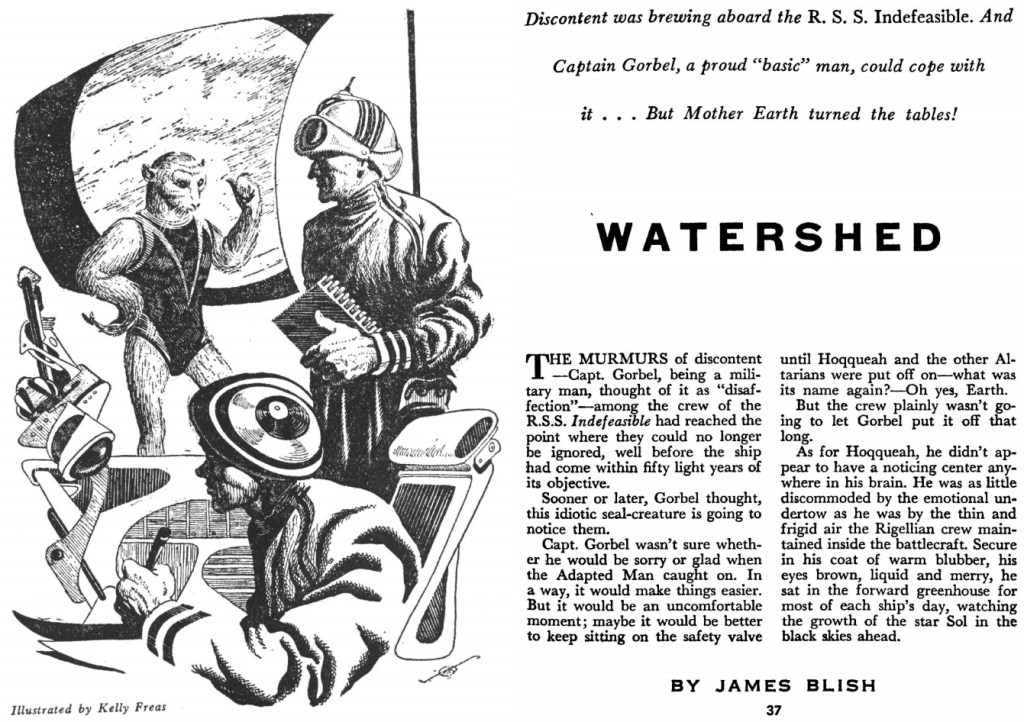
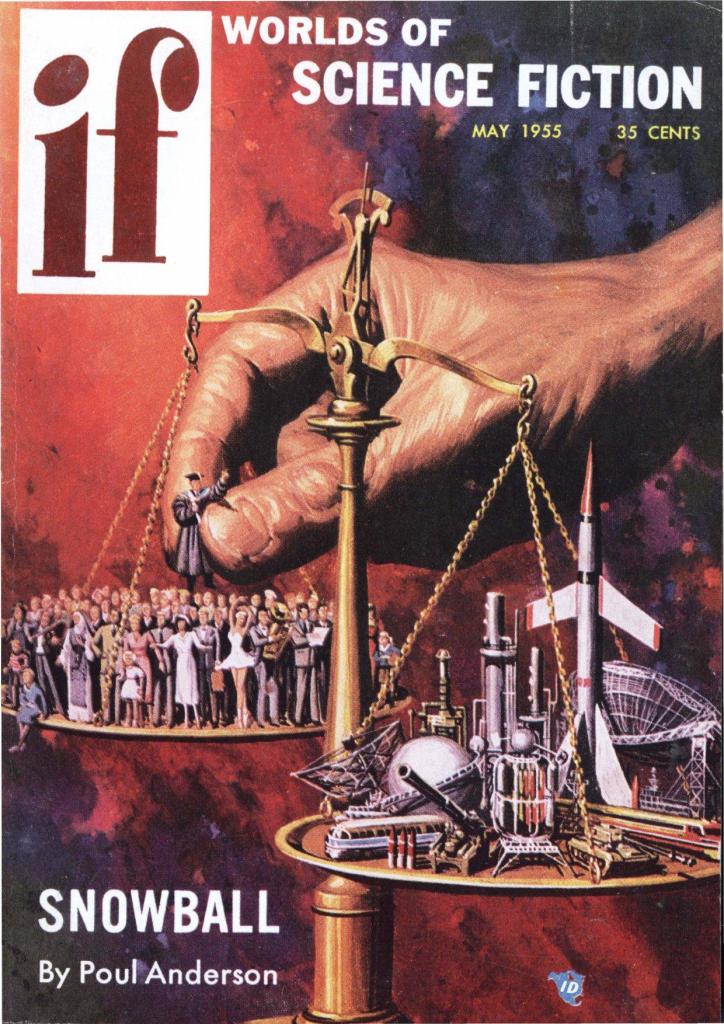
“Watershed” by James Blish was first published in IF Worlds of Science Fiction (May 1955). You can read it online here. “Watershed” became part of James Blish’s The Seedling Stars, a collection of short stories about adapting humans to new environments. The most famous story of the collection is the classic “Surface Tension.” Unfortunately, “Watershed” is not in print except for Supermen: Tales of a Posthuman Future, a 2002 anthology edited by Gardner Dozois.

“Watershed” is a rather preachy tale, not a thrillingly dramatic story like “Surface Tension.” Capt. Gorbel of the spaceship R.S.S. Indefeasible is traveling to Earth to deliver new colonists, but it’s not what you think. Humans have long colonized the galaxy, and the environment of Earth can no longer sustain “standard form” humans. Gorbel is going to Earth to deliver colonists that look like seals, but are considered just as human as we are, well, that’s by the standards of political correctness of their day.

The adapted human is Hoqqueah. He likes to sit in the forward greenhouse and stare into space as the ship approaches Earth. However, the standard form crew considers itself superior to the adapted humans. Averdor doesn’t like that Hoqqueah spends so much time in the greenhouse, and is annoyed by his constant talking. Averdor tries to convince Gorbel to forbid the adapted humans from using the greenhouse.

Hoqqueah knows of this prejudice, and he tells the Captain a story about Earth. He explains that Earth was the original home of all humans. He also tells how humans have found many planets that couldn’t support the standard human body, so they adapted humans to new forms. The concept is called pantropy. (That link gives several classic examples in SF.)

However, this is 1955, and we must ask ourselves if this story is about space exploration. The famous civil rights case, Brown v. Board of Education, happened in 1954. To be fair to James Blish, he had been exploring pantropy since 1942. But then Blish has Hoqqueah tell Captain Gorbel about prejudice against dark skin humans on old Earth.

The kicker to this story is that the standard form is now the minority.

“Watershed” has nice sentiments, but not much of a story. It’s told, not shown. It would have been far better if it had been dramatized. We don’t get to know Hoqqueah or what it’s like to be a seal person. And why, if standard form humans can’t handle Earth, how can the adapted men of his kind handle the spaceship with Gorbel and Averdor?

I recommend reading “Surface Tension” to understand what I mean by telling the story with drama. You can read it in the August 1952 issue of Galaxy Magazine.

James Wallace Harris, 4/30/25

“The Last Day” by Richard Matheson

Group Read 92 (#04 of 25)

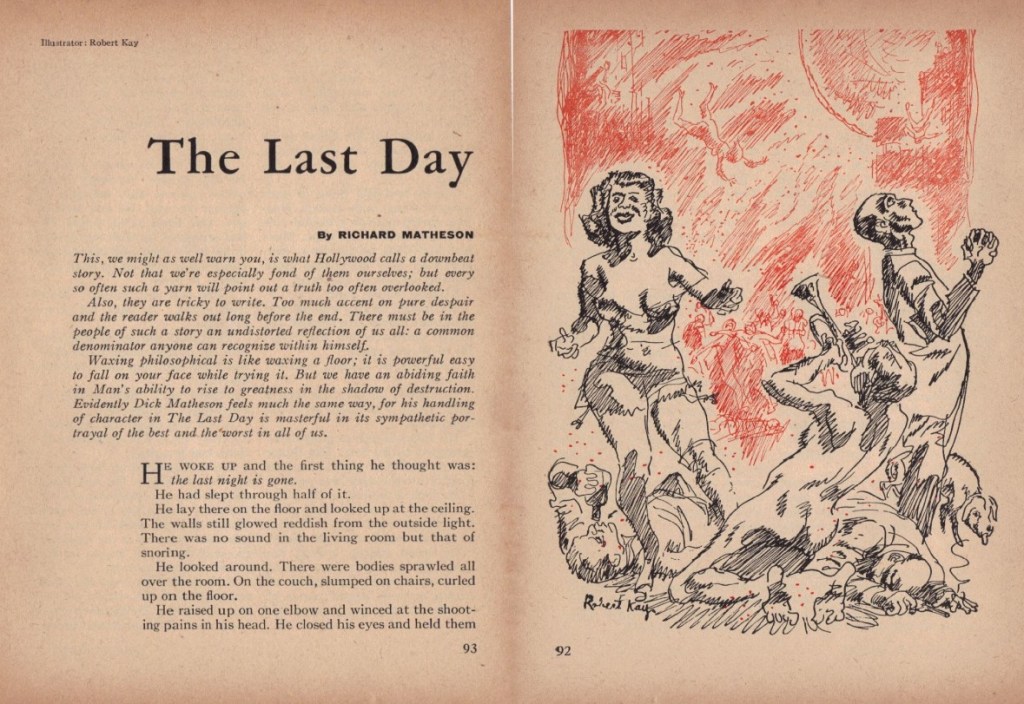
“The Last Day” by Richard Matheson was first published in the April-May 1953 issue of Amazing Stories. You can read it online here. Or you can buy The Best of Richard Matheson in various media editions here. Or look at its reprint history to see if you already own it in an anthology.

Our reading group is reading 25 short stories recommended by five group members. They are stories we haven’t read as a group, but ones the five people thought we shouldn’t miss. I didn’t submit this time, but “The Last Day” would have been one of the stories I would have submitted. Three of my favorite SF short stories from 1953 are “The Last Day,” “Lot” by Ward Moore, and “Deadly City” by Paul W. Fairman. I admire these stories because they were so gritty, even brutal.

Science fiction has often dealt with post-apocalyptic stories but “The Last Day” is about the end of the world. Some astronomical object is about to crash into the Earth. It’s not specified. The story begins in the morning of the last day and ends in the evening just before the end of everything on Earth.

I have often read and thought about surviving an apocalypse. I have often contemplated my own death. And I’ve always been fascinated by stories about people with a terminal illness and what they did with their remaining days.

But I haven’t thought about what I would do if everyone had just one day to live. It’s a neat concept to ponder. After reading “The Last Day” I’m not sure I’d need to read another story on the same idea. “The Last Day” gets the job done so nicely that I can’t imagine anyone topping it.

For this reading, I read the story with my eyes and then listened to it with my ears. I was impressed by its drama. Richard Matheson is famous for writing over a dozen episodes of The Twilight Zone. Many of Matheson’s stories and novels were adapted for television and the movies, and he wrote many screenplays. Matheson knows how to create drama.

“The Last Day” begins with Richard waking up in a room full of passed-out people. Several are naked, and it’s obvious that a drunken orgy had taken place the night before. When Richard goes into the bathroom to clean up a bit, he finds a dead man in the tub. Richard enters the kitchen where a friend, Spencer, is frying eggs. By now, we’ve realized that life on Earth is about to end.

Richard wishes he were with Mary, a woman he loved but didn’t commit to. His friend Norman comes into the kitchen and tells Richard he wants to go see his mother. Norman asks Richard if he wants to see his mother. Richard dreads the idea because he knows his mother will preach religion at him, and he doesn’t want to hear it.

After Spencer leaves to have more sex with a woman who wants everyone to watch, Norman begs Richard to drive him to his mother’s house. We learn that riots are going on all over the city. Many people have committed suicide, but others run wild, murdering each other.

All of this is amazingly adult for a science fiction story in 1953, especially published in a magazine mostly read by young adults. That issue seemed atypical for Amazing Stories. It also had stories by Robert A. Heinlein, Theodore Sturgeon, and Murray Leinster. It was edited by Howard Browne. I feel I need to reevaluate that era of the magazine. 1953 was a boom year for science fiction magazines. I’ve written about it before. I believe the Cold War had a significant impact on the genre that year. Just look at some of the other notable stories from 1953.

Richard eventually finds his mother at his sister’s house. There’s a poignant scene of his sister and her husband getting their daughter to take sleeping pills, and Richard watching all three commit suicide. And finally, Richard has a moving moment with his mother while they wait to die.

The story is cleanly told. Direct. It covers many bases without getting wordy. 5-stars.

James Wallace Harris, 4/29/25

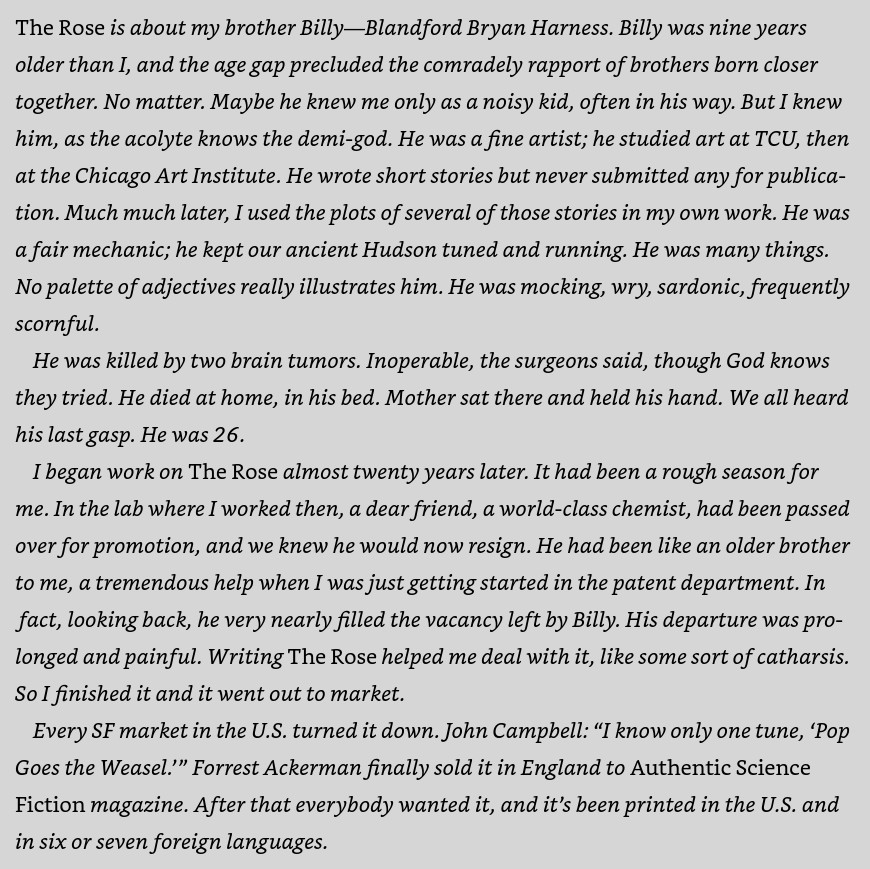
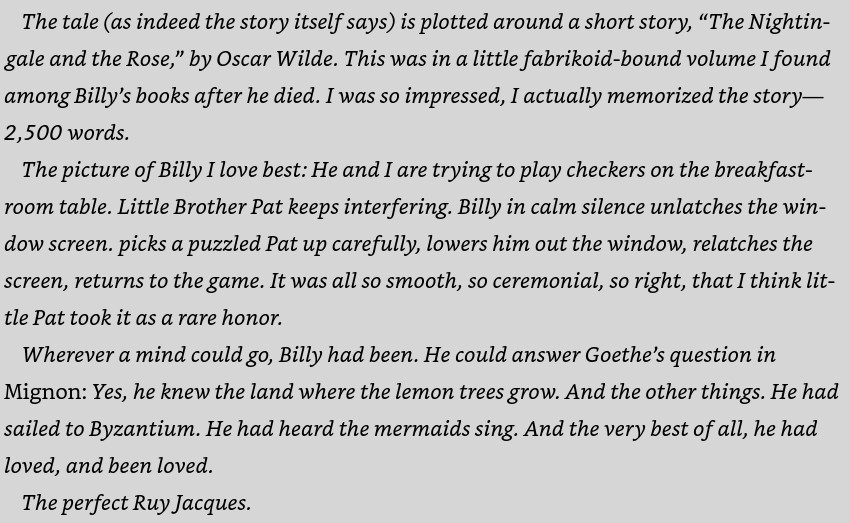
“The Rose” by Charles L. Harness

Group Read 92 (#03 of 25)

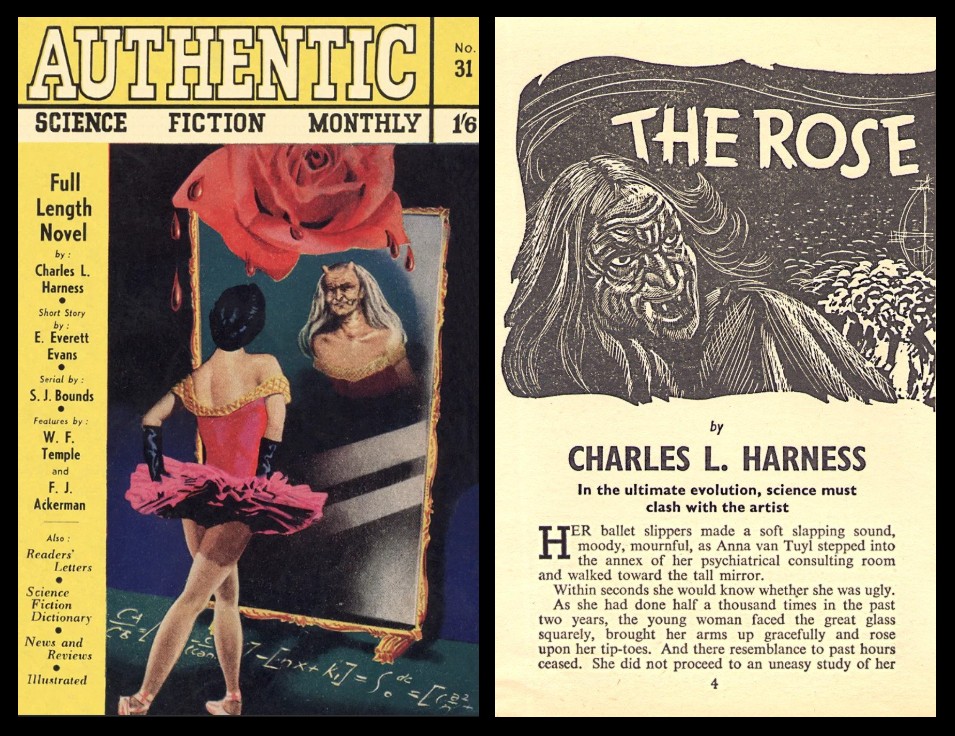
“The Rose” by Charles L. Harness was first published in Authentic Science Fiction Monthly (No. 31, March 1953). You can read it online here. Our Facebook group is discussing 25 stories suggested by five members that we haven’t discussed before. Paul Fraser has recommended “The Rose” in comments, but it’s never been up for a group discussion. I’ve tried to read “The Rose” twice before but got bogged down. The story is long, a novella, and it’s dense.

“The Rose” is one of the most ambitious science fiction novellas I’ve ever read. I’m glad that I finally finished it. This is exactly what I was hoping for from our member-recommended group read, a standout science fiction work I haven’t read. One good enough to merit rereading.

The story reminds me of what other writers explored in the years after 1953, works by Theodore Sturgeon, J. G. Ballard, Robert Silverberg, Jack Vance, and Roger Zelazny. “The Rose” has seldom been reprinted, but the most significant anthology to remember it is The Science Fiction Century, edited by David G. Hartwell.

“The Rose” is available as The Rose, a standalone Kindle novel for 99 cents. They say it’s 192 pages, but I can’t tell if it’s expanded from the novella. The UK edition says it’s just 88 pages, so it’s probably the same as the novella.

But for $1 more, you can get the Kindle edition of The Ornament of His Profession for $1.99, which includes “The Rose” and several other stories by Harness. I just discovered I already own that edition in my Kindle Library. Probably, I bought it when Paul recommended “The Rose” the first time.

Both have the same introduction to “The Rose:”

Because “The Rose” appeared in Authentic Science Fiction Monthly, I thought Harness was British, but his Wikipedia page says he was American. I recommend taking the time to read his entry because it made me want to read more of what Charles L. Harness wrote. His science fiction sounds fascinating, but I’ve only read a couple of his shorter works. I may, or may not have read Flight Into Yesterday/Paradox Men. I also recommend reading “The Novels of Charles Harness” by Rich Horton.

Describing “The Rose” is going to be difficult. Anna van Tuyl is a psychiatrist. She’s also a ballet dancer, composer, and choreographer. Anna was once beautiful, but now she is hunched back and has two horn-like structures growing from her forehead. The story is about Anna’s efforts to finish the score for a ballet called Nightingale and the Rose. As the introduction tells us, it’s plotted around a short story, “The Nightingale and the Rose” by Oscar Wilde. Anna is mentally blocked from composing the score’s climax.

Anna’s friend, Max Bell, a psychogeneticist, recommends Anna to Martha Jacques, wife of Ruy Jacques. Martha is a brilliant scientist working on an advanced weapon, and Ruy is an artist. Ruy has also become disfigured by a hump and horns, and recently lost the ability to read and write. Max Bell tricks Anna into meeting Ruy Jacques, where she falls in love with him. Ruy is an over-the-top, outrageous character — narcissistic, insane, and brilliant to the nth degree.

It turns out that Martha is obsessively jealous of Ruy and is hesitant to hire Anna. Throughout the story, Martha and Ruy have one never-ending argument about art versus science. This is one of the many reasons “The Rose” is so dense to read. Harness throws out all kinds of ideas and theories about art and science. Ruy believes artists have long known everything scientists eventually discover.

To complicate the story further, Ruy and Anna are emerging supermen, or examples of Homo superior. They are developing psychic powers, but these are strange powers. Harness has taken on the task of showing how advanced humans will think. Much of his speculation is psychobabble and pseudo-science, but there’s a kind of elegance to his thinking. Harness uses 1953 art theory, combined with a fair knowledge of classical music, ballet, and other arts, to contrast with scientific and mathematical ideas of the time. Reading Charles L. Harness suggests he was a cultured man, better educated than the average science fiction writer. But then, science fiction writers are often great autodidatics and bullshitters. Harness had degrees in chemistry and the law and worked as a patent attorney.

Harness also complicates his story by paralleling the plot of the novella with the plot of the fictional ballet. And Ruy and Anna work to live out their own artistic creation.

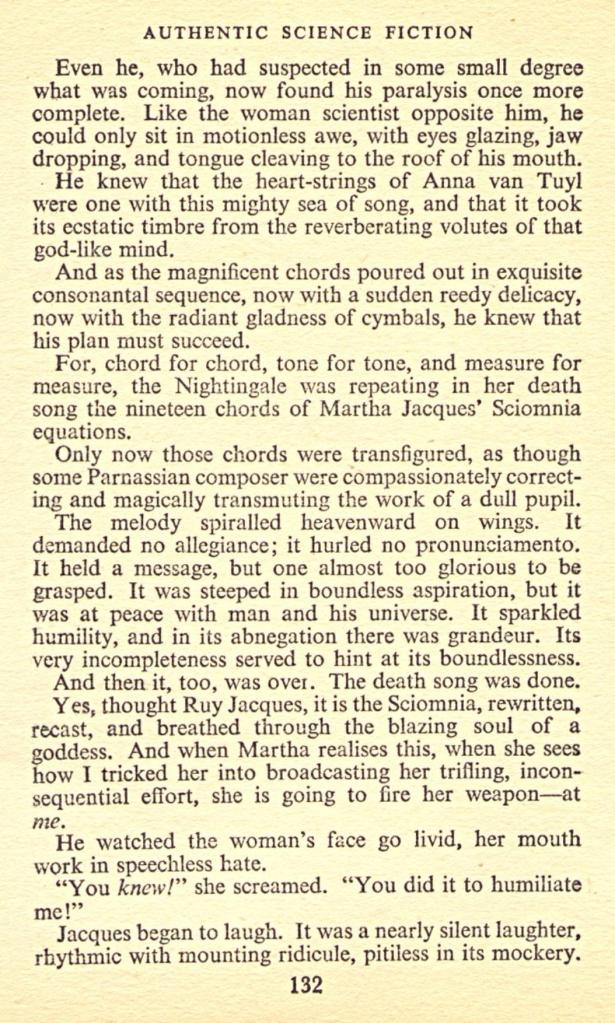
It took me a while to embrace Harness’s prose. You have to read it slowly because he intends so much with each sentence. Here’s one sample.

“The Rose” is definitely a story I look forward to rereading someday. I’d love to hear a professional narrator read it in an audiobook. “The Rose” doesn’t emotionally enchant me like “The Star Pit” by Samuel R. Delany or “A Rose for Ecclesiastes” by Roger Zelazny does. It’s about as intellectually impressive as “The Darfsteller” by Walter M. Miller, Jr., another long science fiction story about artists and performers I admire but don’t quite love.

My opinion might change with another reading of “The Rose.” Right now, it doesn’t quite make the five-star rating. I think the density of the prose keeps me from embracing the characters. I never liked Anna or Ruy, only admired them as interesting characters. This might be due to the story being too tightly plotted. Harness wanted his characters to act out a ballet they were creating, and you get the feeling that Anna and Ruy are acting for Harness, not themselves.

James Wallace Harris, 4/26/25

“The Listening Child” by Margaret St. Clair

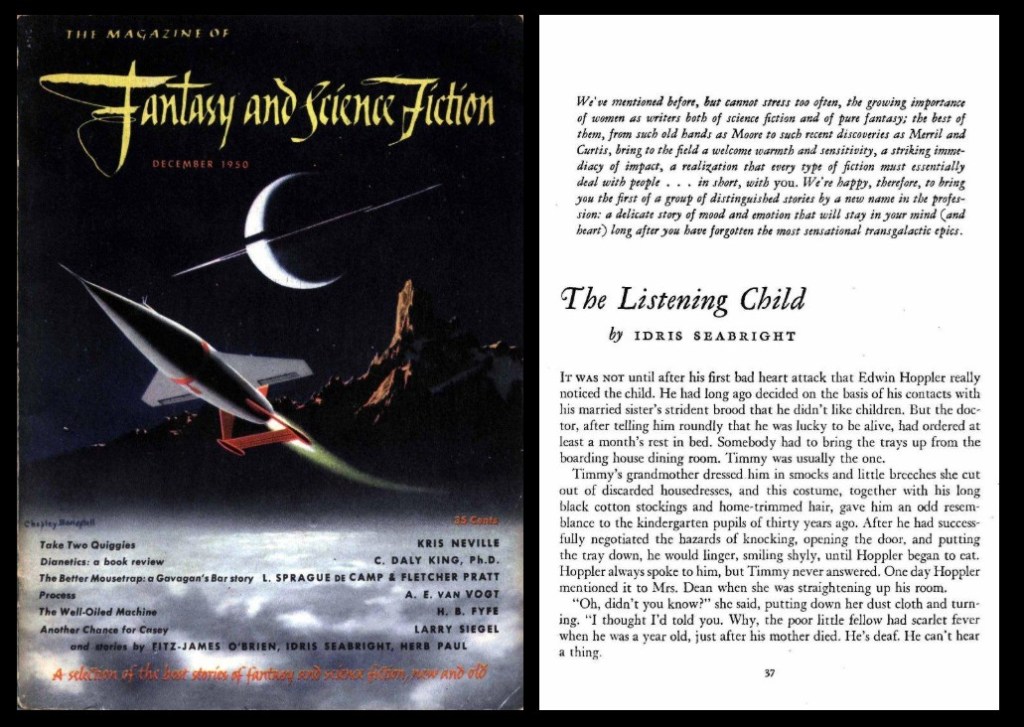
“The Listening Child” was first published in The Magazine of Fantasy and Science Fiction (December 1950) by Margaret St. Clair using the pseudonym Idris Seabright. You can read it online here. It is short story #1 of 25 that our Facebook group will be discussing as Group Read 92. (See the reading schedule at the end of this review.) Group Read 92 consists of 25 stories picked by five group members that we haven’t read before. That was a challenge since we’ve been discussing a short story daily for years. The group is public.

In the 1950s, extrasensory perception (ESP) was a popular theme in science fiction and fantasy magazines. It was often speculated that people with physical or mental abnormalities might have additional senses to compensate for the loss of one of their primary senses. I assume the assumption came from blind people who had keener hearing.

After Hiroshima, science fiction and comic book writers often used radiation as a cause of ESP. However, in the 1930s and 1940s, John W. Campbell was impressed by the Rhine experiments, and science fiction writers often supposed that advanced aliens had psychic powers. Arthur C. Clarke, who was normally a hard SF writer, proposed that the evolution of human development led to ESP in two of his most famous novels, Childhood’s End and 2001: A Space Odyssey. Soft science and fantasy writers leaned towards psi-powers in physically and mentally damaged humans, like Theodore Sturgeon’s More Than Human.

Margaret St. Clair imagines a deaf mute having a rather unique ESP talent. Timmy can “hear” when death is near. Many famous stories personify death, so this isn’t too out there, but it’s not as believable as other ESP talents, even though it is well proven that ESP does not exist. Still, hearing death makes for a nice story idea.

St. Clair’s setup for her story is rather quaint. Edwin Hoppler is 63 and suffers from a weak heart. He lives in a boarding house. Boarding houses have disappeared, but were common in old movies and science fiction short stories before the 1960s. Quite a few episodes of The Twilight Zone were set in boarding houses. It’s a shame they don’t still exist. Living with several other individuals who ate communal meals fixed by a nice old lady sounds pleasant.

Timmy is the landlady’s grandson, and Edwin feels sorry for him. Edwin befriends Timmy when he realizes that the other kids don’t play with Timmy. Edwin notices that Timmy “listens” intently at times, and eventually notices that these listening moments precede a person or animal dying. Edwin decides to use Timmy as the canary in a coal mine to detect his own impending heart episodes.

“The Listening Child” is a pleasant little story, but rather slight. Timmy and Edwin are only developed enough as characters to present the idea for the story. There’s little conflict or tension. The story also lacks color or voice. The idea is slight, but writers can flesh out simple ideas into complex characterization and plots. For example, compare it to “Jeffty is Five” by Harlan Ellison. Jeffty is a boy who is perpetually five, and always lives in the year he was five, with the popular culture never changing. Or read “Baby is Three” by Theodore Sturgeon; it’s tremendously dramatic for a boy with psychic powers talking to a psychiatrist.

I don’t want to tell you the ending, but I expected St. Clair thought her readers would find it emotional and poignant. It was presented too casually for me to be moved, but I’m curious if other members from our short story reading group will be moved. I wanted the ending to be like in Platoon when we see Elias still alive, and the emotional impact we felt watching him die.

I’m working on a project to find my all-time favorite science fiction stories I’ve read over the past sixty years. Identifying such stories means learning what makes a story work. Most published stories succeed at a basic three-star level, which is how I’d rate “The Listening Child.”

For this story to reach the four-star level, Timmy and Edwin would need to become vivid characters. To make it to a five-star story would require elevating the story gimmick of hearing death into something metaphorical and philosophical that I would want to contemplate over several readings.

James Wallace Harris, 4/21/25

Group Read 92 Schedule

  • 01 (04/22/25) – The Listening Child, by Margaret St. Clair (ss) F&SF, December 1950 (DH)
  • 02 (04/24/25) – Brightness Falls from the Air, by Margaret St. Clair (ss) F&SF, April 1951 (FP)
  • 03 (04/26/25) – The Rose, by Charles L. Harness (na), Authentic Science Fiction, 15 March 1953 (PF)
  • 04 (04/29/25) – The Last Day, by Richard Matheson (ss), Amazing, April/May 1953 (FP)
  • 05 (05/01/25) – Watershed, by James Blish (ss), If, May 1955 (RH)
  • 06 (05/03/25) – The Certificate, by Avram Davidson (ss), F&SF, March 1959 (FP)
  • 07 (05/06/25) – To See the Invisible Man, by Robert Silverberg (ss), Worlds of Tomorrow, April 1963 (FP)
  • 08 (05/08/25) – A Two-Timer, by David I. Masson (nv), New Worlds 159, February 1966 (PF)
  • 09 (05/10/25) – The Adventuress, by Joanna Russ (nv), Orbit 2, ed. Damon Knight (Putnam, 1967) (RH)
  • 10 (05/13/25) – No War, or Battle’s Sound, by Harry Harrison (nv), If, October 1968 (FP)
  • 11 (05/15/25) – The Milk of Paradise, by James Tiptree, Jr. (ss), Again, Dangerous Visions, ed. Harlan Ellison (Doubleday, 1972) (RH)
  • 12 (05/17/25) – Pale Roses, by Michael Moorcock (nv), New Worlds 7, ed. Hilary Bailey & Charles Platt (Sphere, 1974) (PF)
  • 13 (05/20/25) – Concepts, by Thomas M. Disch (nv), F&SF, December 1978 (PF)
  • 14 (05/22/25) – Gate of Faces, by Ray Aldridge (nv), F&SF, April 1991 (PF)
  • 15 (05/24/25) – On Sequoia Time, by Daniel Keys Moran (ss), Asimov’s, September 1996 (PN)
  • 16 (05/27/25) – Journey into the Kingdom, by M. Rickert (nv), F&SF, May 2006 (PN)
  • 17 (05/29/25) – Roxie, by Robert Reed (ss), Asimov’s, July 2007 (PN)
  • 18 (05/31/25) – 26 Monkeys, Also the Abyss, by Kij Johnson (ss), Asimov’s, July 2008 (DH)
  • 19 (06/03/25) – Passage of Earth, by Michael Swanwick (ss), Clarkesworld 91, April 2014 (PN)
  • 20 (06/05/25) – Cimmeria, by Theodora Goss (ss), Lightspeed 50, July 2014 (RH)
  • 21 (06/07/25) – Sadness, by Timons Esaias (ss), Analog, July/August 2014 (RH)
  • 22 (06/10/25) – Ten Poems for the Mossums, One for the Man, by Suzanne Palmer (nv), Asimov’s, July 2016 (PN)
  • 23 (06/12/25) – The Secret Lives of the Nine Negro Teeth of George Washington, by P. Djèlí Clark (ss), Fireside Magazine, February 2018 (DH)
  • 24 (06/14/25) – The Virtue of Unfaithful Translations, by Minsoo Kang (nv), New Suns, ed. Nisi Shawl (Solaris, 2019) (DH)
  • 25 (06/17/25) – One Time, a Reluctant Traveler, by A. T. Greenblatt (ss), Clarkesworld 166, July 2020 (DH)

“All Summer in a Day” by Ray Bradbury

Screenshot

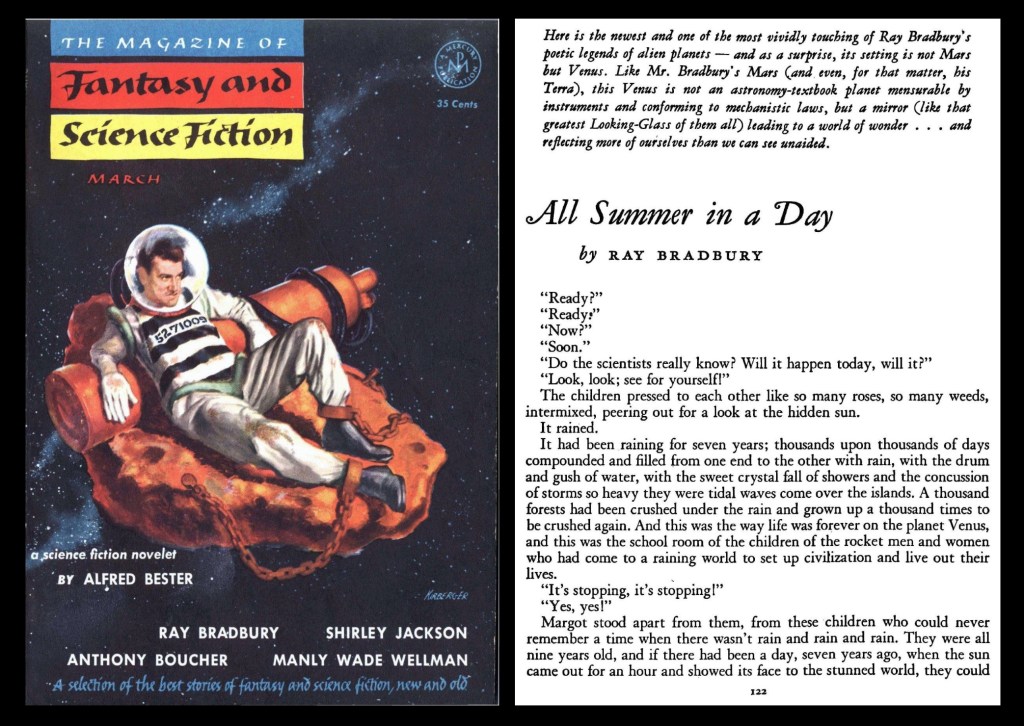
I’ve been rereading Ray Bradbury short stories, and I’m amazed at how well they hold up even when the science is beyond dated. Ray Bradbury is quite cruel to us readers in “All Summer in a Day.” In fact, I had to stop reading when I knew where the story was going, I just didn’t want to go there. I waited a couple of days to finish this fifteen-minute story on audio.

At first the kids in “All Summer in a Day” reminded me of Charles Schultz’s Peanuts characters, but then it was obvious they associated with bad kids from stories by Charles Beaumont or Shirley Jackson.

Remember when Lou Grant told Mary Richards she had spunk? And then Lou said, “I hate spunk.” Well, “All Summer in a Day” has a punch in the gut, and I should say “I hate a punch in the gut,” but when it comes to short stories, a punch in the gut is a good thing. Isn’t that weird. Why do we admire a great punch in the gut from a short story? Why is it so satisfying?

“All Summer in a Day” is set on Venus where it rains continuously except for a two-hour window of clear weather and sunshine every seven years. In a classroom the kids are talking about the impending summer. One girl, Margot, was born on Earth and didn’t come to Venus until she was four. She could remember sunshine and tried to describe it to her classmates who didn’t remember the sun because they were born on Venus. They were just two the previous summer day. They didn’t believe Margot. They resented that she knew something special. So, just before the sun was to come out, they locked Margot in a closet. All the other kids got to see the sun, and it was everything and more that Margot had tried to describe to them.

The children completely forgot about Margot while they cavorted through their brief summer day. When the rain and clouds returned, they remembered Margot and let her out.

This is a simple story about how children are cruel to each other. It’s about being the nail that sticks up. It’s about knowing the undescribable. Does the setting on Venus really matter? It makes the story science fiction so Ray Bradbury can sell it to a science fiction magazine, but does it really matter to the story? Charles Schultz could have done such a story about how the Peanuts gang mistreated Charlie Brown, and may have many times, I just can’t cite a specific panel.

I’m in the process of rereading my favorite science fiction stories and trying to understand why they are my favorites. Writing ability accounts for some of the reasons, but triggered emotions count for many too. I wish I could say I understood every cog in this story, but I don’t. What I do recognize is Ray Bradbury has a set of skills to tell a story in a way that makes it stand out. Not only that, but his stories also endure.

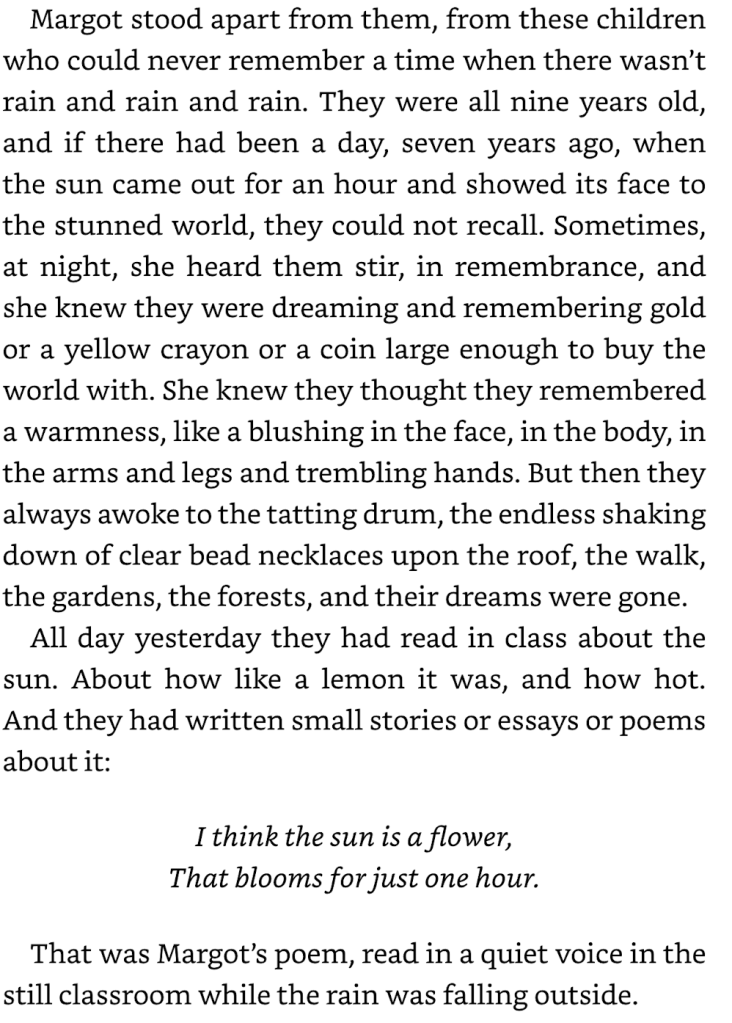
As I reread this story I didn’t remember the details, but either I guessed or remembered what was going to happen to Margot. That’s why I stopped listening to it. But when I returned to the story, I kept thinking to myself: “How is Margot going to react?” I was surprised that Bradbury didn’t give us Margot’s reaction. He left that up to us. That’s another tool in his writing toolbox. Writers don’t have to tell us everything. Bradbury does tell us this about Margot:

Because I just finished reading a biography of Ray Bradbury I know he was an odd child that stood out to his classmates. He also like to write poetry. Bradbury doesn’t have to tell us that this story is for us loners and oddballs, the ones other kids considered weird. When I was growing up, I didn’t know anyone else who read science fiction. Science fiction was like the sun appearing on Venus to me. I tried to explain its appeal to other kids, but they just thought I was a zero. I didn’t make a science fiction reading friend until the tenth grade when I met James Joseph Andrew Connell, III. The experience of meeting another science fiction fan is why Among Others by Jo Walton won the Hugo, Nebula, and British Fantasy Award. Zenna Henderson made a whole writing career out of telling stories about oddballs.

Even in the 1940s Ray Bradbury knew that being labeled a science fiction writer would hurt his career. Bradbury authored stories for all kinds of markets and genres, but when he wrote science fiction, he knew he had to be different. Back in the 1950s he might have been the best-known science fiction writer in America, but many science fiction readers didn’t consider his work science fiction. Bradbury wanted to be a writer like Sherwood Anderson, Ernest Hemingway, or Thomas Wolfe, someone who was just called a writer.

The reason “All Summer in a Day” is good is because of the parts that aren’t science fiction. The reasons why some science fiction fans dismissed him was for the science fiction parts. The obvious lesson here for would-be science fiction writers, is don’t worry about the science fictional aspects but focus on the universal human appeal.

James Wallace Harris, 4/11/25


How to Judge Hack Writing?

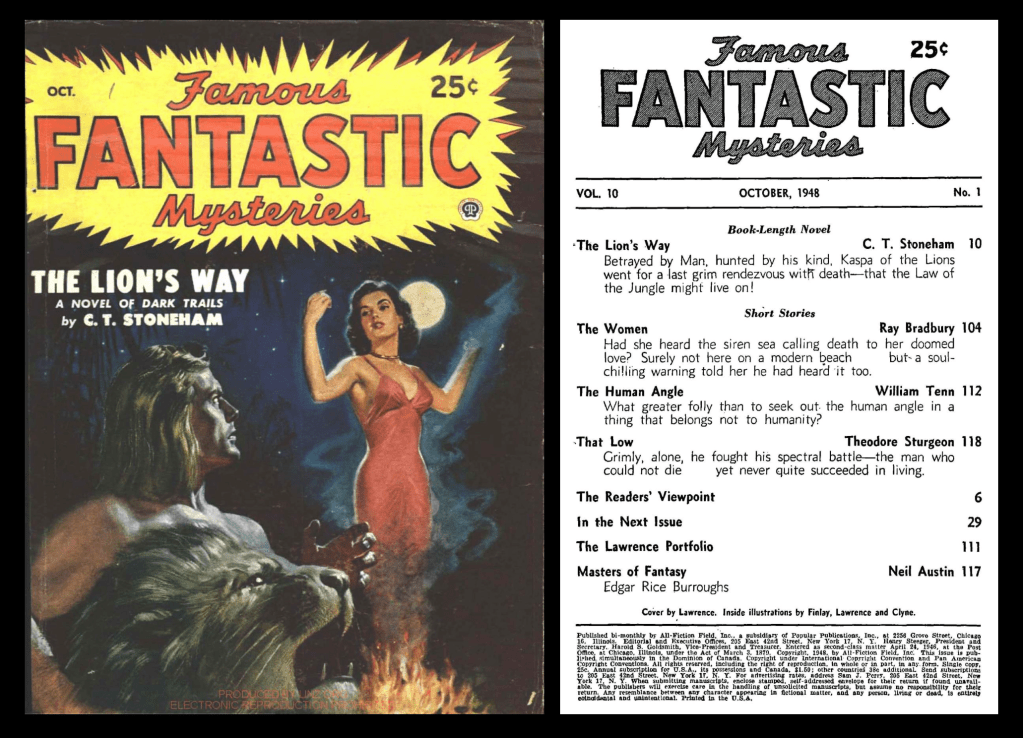
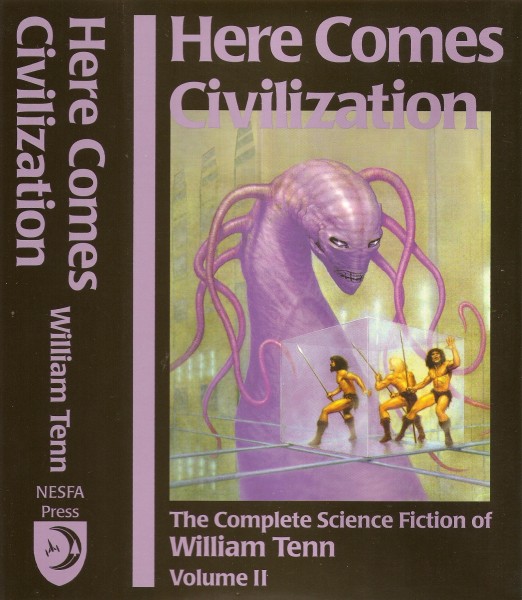
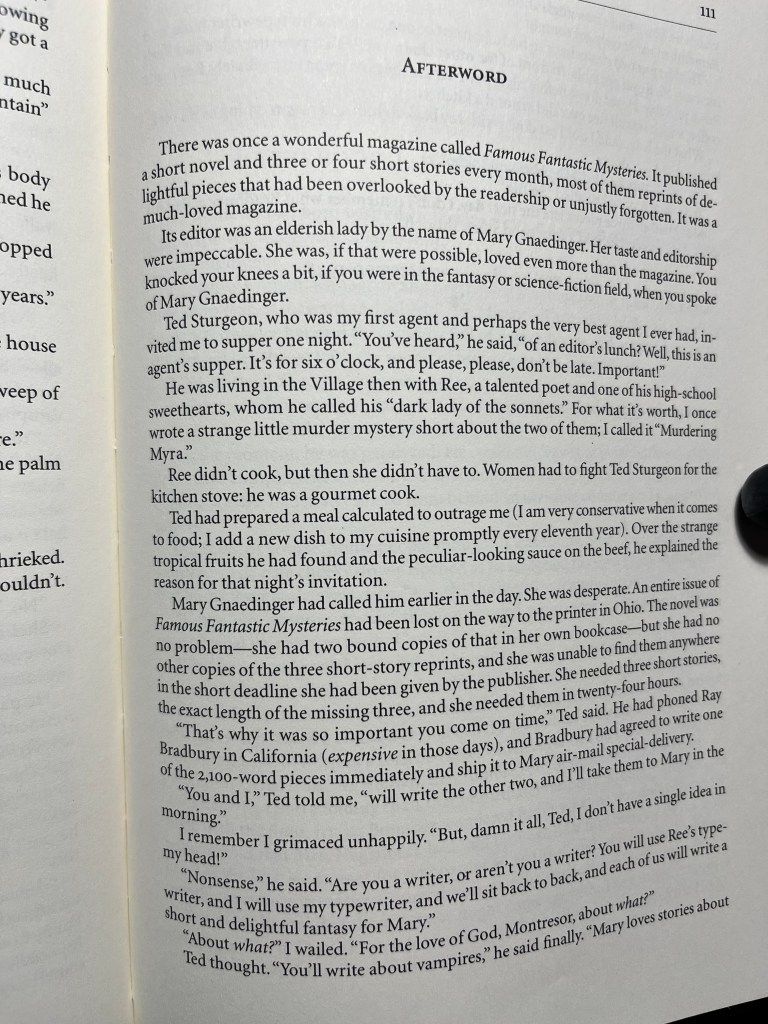
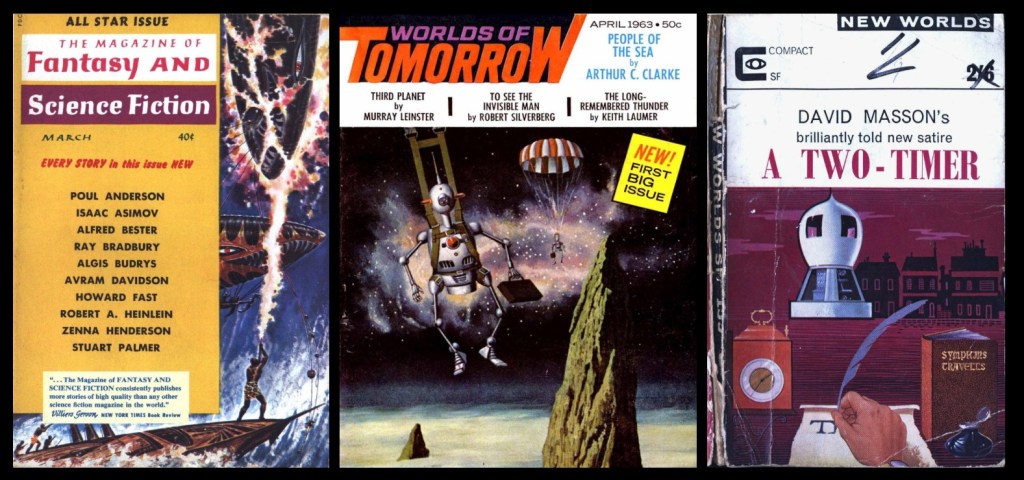
My friend Mike recently told me an anecdote from Here Comes Civilization: The Complete Science Fiction of William Tenn Volume 2. It was in the afterward to the story “The Human Angle.” It seems Ted Sturgeon invited William Tenn over for dinner with a hidden agenda. When Tennn arrived, Sturgeon told him that Mary Gnaedinger, the editor of Famous Fantastic Mysteries needed three short stories by tomorrow and they would write two of them that night. Ray Bradbury was going to write the third and air mail it special delivery to Mary from California. (See the “Afterward” below for the full tale.)

Tenn, Sturgeon, and Bradbury did come through in twenty-four hours and their stories were printed in the October 1948 issue of Famous Fantastic Mysteries. You can read that issue at Archive.org.

There were many legendary science fiction writers (and pulp writers) who bragged they could crank out a short story in a day, or a novel in a weekend. But is this hack writing any good? That’s hard to say. What is good? All three stories, “The Women,” “The Human Angle,” and “That Low” were readable stories and even entertaining. However, they are also quite forgettable. But not completely forgettable. Follow the links to view their reprint histories.

Men and women who wanted to make a living writing science fiction back in the 1930s, 1940s, and 1950s had to produce a lot of content. Many science fiction writers made a half-ass living churning out short stories for magazines. But are these speedy productions worth your time to read today? That depends.

Short stories can achieve several levels of quality and recognition. Getting published in a magazine is the first rung up in a ladder of publishing success. The next step up in recognition of quality is being nominated for an award or getting reprinted in an anthology, especially an annual best-of-the-year anthology. Winning an award is another step up. After that, recognition comes slowly. Having an author include a story in one of their short story collections at least says the author is proud of that story. But having a story reprinted in a retrospective or theme anthology means the story stands out over the other stories that came out in the year it was first published. Even greater recognition is when a short story is used in a textbook and taught in school or optioned for a film or television show.

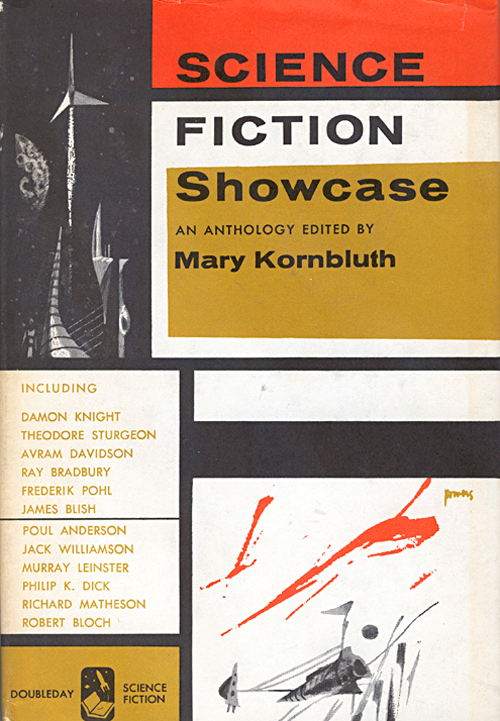
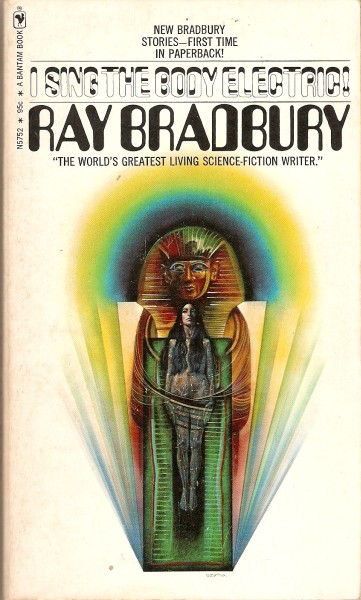
The Bradbury and Tenn were anthologized in a few minor theme anthologies as well as a few author collections. Bradbury included “The Women” in his famous I Sing the Body Electric collection. Tenn used “The Human Angle” for the title of a collection. Sturgeon’s story was reprinted in Mary Kornbluth’s Science Fiction Showcase, which was a special anthology probaby to help the widow of C. M. Kornbluth. “That Low” was only reprinted in Sturgeon’s complete stories series, suggesting that Sturgeon never liked it much. They were not major stories. However, these stories were sold several times, and they are in print today.

But back to my title question: How to judge hack writing. First, we must consider what kind of reader you are. Are you an indiscriminate reader, like someone who comes home from work and turns on the television and quickly finds something to watch by flipping through the channels? Or, are you the kind of person who Googles to find the critically admired shows that just came out this month? Maybe, you’re the person who looks at lists of the best TV series of all-time hoping to find something amazing to watch.

The Bradbury, Tenn, and Sturgeon stories are perfectly good stories if you’re capable of being entertained by an average episode of an average TV series. And that might be good enough for most people. But if you’re the kind of person who thinks in terms of the “Ten Best Episodes of The Twilight Zone,” these stories don’t even come close. And, if you compare them to “Fondly Fahrenheit” by Alfred Bester, or “The Story of Your Life” by Ted Chiang, or “The Ones Who Walked Away from Omelas” by Ursula K. Le Guin, then they aren’t even in the same galaxy.

I’ve developed a rating system I sometimes use in group discussions about short stories. One star is an amateur effort, and two stars is a story that still needs work and shouldn’t have been published. I seldom even mention these stories. Three stars to me is a professional story acceptable for magazine publishing. Four stars is a story that is good enough for me to look forward to rereading. Five stars is a story I’ve read many times and consider a classic.

Hack writers can routinely crank out three-star stories. The stories by Bradbury, Tenn, and Sturgeon are all three-star stories. I didn’t mind reading them, but at my age, they are a waste of my precious reading time – a commodity that’s dwindling. They were fun to look up and read because of Tenn’s anecdote about how and why they got written, but that’s about all.

When I’m restless, I still enjoy reading old science fiction anthologies. I have trouble watching TV, but I can still read for fun. I enjoy looking for gems. The trouble is I seldom find stories like “The Star Pit” by Samuel R. Delany or “Flowers for Algernon” by Daniel Keyes. But that’s what I’m really hoping to find, stories that work at that level.

I also want to know why and how stories work at the highest level of short story writing. I assume there must be definable qualities I can list, but I can’t list those qualities now. I plan to study my favorite 5-star stories and make a list in the future.

I will say the Bradbury story had the most writing qualities of the three stories. It had the most emotional tension. It had the most vivid details. It had the most poetic imagery. I cared for the wife in the black bathing suit. And it was the least predictable of the three stories.

The Tenn story was a vampire story. It has an unusual setting for a vampire story, which was a plus, and it had a different kind of vampire, another plus. But it was the most predictable of the three stories, and the least developed. Bradbury just had way more tension and conflict in his story. Sturgeon’s ending was the most surprising, but it wasn’t a very insightful surprise.

The obvious thing I can say about hack writing is it needs more drafts. Many hack stories could have been far better if they had baked longer in the oven. Writers who are proud of their first-draft writing might regularly sell their work, but it will never be considered great. A good example is Barry Malzberg. Some of his stories and novels are quite appealing, but none of them are books I want to reread. The absolute measure of great fiction is how often readers reread such work.

Robert Silverberg at the beginning of his career cranked out science fiction. Some of it was readable, but neither memorable nor something I’d want to reread. Then at the end of the sixties he changed. I assume he spent more time rewriting, although in some of those same years he cranked out four novels. But Downward to the Earth was different. I’ve read it twice and look forward to rereading it again.

I’m currently reading book 20 of The Great SF Stories 1-26 (1939-1964) edited by Isaac Asimov and Martin H. Greenberg with Robert Silverberg doing #26 with Greenberg after Asimov died. I’ve been reading them in order, along with the other best of the year anthologies that covered the same year. For any given year, I’d say there were less than five stories that I’d rate 5-stars. On average I’d say it’s two 5-star stories in each year. Most of the other stories are 3-stars and 4-stars.

I’m not sure if there are even three hundred 5-star stories in all the years of science fiction. Most would-be science fiction writers who achieve some success publish a handful of stories before starting on novels. I’m not sure if hack writers still exist. There are bestselling writers who crank out one or two novels a year who might be considered hack writers because of their productivity, but I don’t know if they are hack writers like Philip K. Dick, Ray Bradbury, Clifford Simak, Harlan Ellison, Robert Silverberg, and Theordore Sturgeon were early in their career when they could publish a dozen short stories and a couple of novels in a year. Ray Bradbury was quite proud of selling one short story a week pace, and he published in both the pulps and slicks.

Just because a story was written fast, doesn’t mean it’s bad. But the odds of it being great are low. I’m in a handful of online groups whose members love short fiction. There are many readers out there who appreciate good hack writing, especially those old readers who love pulp fiction. I don’t want to criticize such stories and their fans. I have often enjoyed a fun average story, but I’ve forgotten thousands of them.

James Wallace Harris, 4/9/25

“The Million Year Picnic” by Ray Bradbury

Screenshot

“The Million Year Picnic” by Ray Bradbury is about as famous to science fiction readers as O’Henry’s “The Gift of the Magi” is to English majors. “The Million Year Picnic” was first published in the Summer 1946 issue of Planet Stories. (Read it online here.)

However, most readers know “The Million Year Picnic” as “October 2026: The Million-Year Picnic” from The Martian Chronicles. Most modern readers think The Martian Chronicles is so out of date scientifically that they don’t consider it science fiction but fantasy. But it is science fiction, and “The Million Year Picnic” is a classic, touching on several iconic themes of the genre.

“The Million Year Picnic” was published just one year after Hiroshima, making it one of the earliest stories about humanity destroying the Earth with atomic weapons. But we don’t know that right away. When we begin reading the story, Bradbury voices his story with a quaint tone, almost like a parable, sounding like Mr. Rogers’ Neighborhood. A father, mother, and their three sons have just landed on Mars. They decide to go fishing. The narrative pacing seems only a few steps up from “See Dick run.”

Back in the 1940s, throughout the 1950s, and even into the 1960s, it was popularly considered that there was life on Mars or had once been, even intelligent life. This is partly due to H. G. Wells and Giovanni Schiaparelli, an Italian astronomer who convinced the world that he saw canals on Mars. Until July 1965 when Mariner 4 showed us a couple dozen grainy pictures of Mars that looked like the Moon, we had so much hope for Mars.

Science fiction writers loved to imagine Mars occupied with all kinds of beings and ancient civilizations. The common belief was Mars was a cold dying cold world and Venus was a hot young jungle world. Ray Bradbury wrote many stories based on these assumptions. In 1950 Bradbury published a collection of his stories about Mars as The Martian Chronicles, a “fix-up” novel. (In 2009, Subterranean Press published The Martian Chronicles: The Complete Edition, which claimed to collect all of Bradbury’s stories about Mars. I’d love to have a copy, but the cheapest copy I can find online is $1,300.) Because “The Million Year Picnic” was so popular it had already been reprinted three times before The Martian Chronicles. And it has been extensively reprinted ever since.

Bradbury also reprinted “The Million Year Picnic” in his collection: S is for Space. Most of Bradbury’s science fiction was found in four collections when I was growing up: The Martian Chronicles, The Illustrated Man, S is for Space, and R is for Rocket. Bradbury quit writing science fiction for the most part in the 1950s and went on to write fantasy, horror, and mainstream fiction after that. I read “The Million Year Picnic” this week because the Facebook group Best Science Fiction and Fantasy Short Fiction is reading 12 science fiction stories by Ray Bradbury that they haven’t read before. Here’s the discussion schedule.

But back to the story. After the family sets out on a boat on a Martian canal to go fishing we slowly learn that “The Million Year Picnic” is a post-apocalyptic tale. But we don’t discover it right away. The three boys are all excited. Timothy, the oldest carefully watches his father, trying to learn what’s happening. As they travel down the canal they pass by countless old cities where Martians once lived. Some cities are just mounds, while others have grand skylines. The dad promises his boys he will show them the Martians, and they get excited.

Along the way, we discover “The Million Year Picnic” follows another hoary old science fiction theme, the retelling of Adam and Eve. This idea had become so overused that by the 1960s writer’s guidelines for magazines would state “no Adam and Eve stories.”

I don’t know how many times I’ve read “The Million Year Picnic.” But back in the early 1960s when I first discovered it, I still believed in Martians on Mars. I was so into Mars, that as a kid, I thought my goal in life was to get there. So when I read the story I focused on the dead Martian civilization. That’s what made the story exciting. I too wanted to see the Martians. And that’s how I always remember this story, especially the surprise ending, which was quite clever.

However, on this rereading, I realized that I had forgotten Bradbury’s serious point. Bradbury was a nostalgic writer, even as a young man. He grew up in the 1920s and 1930s and his stories often have the feel of that era, like watching old black and white Frank Capra movies. Many of his Martian stories transplant small midwestern downs to Mars. But Bradbury wrote “The Million Year Picnic” with an undercurrent of horror and even cynicism. The quaint family on Mars has fled an Earth where humanity has destroyed itself in a nuclear war.

When the Dad realizes the radio signals from Earth have gone silent he tells his boys that one day their grandchildren might hear radio signals again. When I read that I thought about Adam and Eve and their sons and how Biblical skeptics always asked “Where did the wives of Adam and Eve’s sons come from?”

I’m always amused and fascinated by what I remember and don’t remember from stories when I reread them. The gimmick ending of “The Million Year Picnic” overshadows all my memories. I had completely forgotten this was a post-apocalyptic story. In other words, I remembered the positive and forgot the negative. I also forgot how many Biblical allusions where were in the story.

Bradbury solves the wives’ problem. In the end, we learn that another family had also secretly prepared to go to Mars when armageddon began, this one had four daughters.

Now that number is interesting. Bradbury even tells us it will be a problem. I think he’s hinting at the old Cain and Abel conflict. Humans don’t change and even if we start over we’ll have violence and wars again. We know two if not three of the sons will want that extra wife.

Every time I reread a Ray Bradbury story I tell myself I need to get into Ray Bradbury in a big way. I even bought three biographies of the man: Becoming Ray Bradbury and Ray Bradbury Unbound by Jonathan R. Eller, and The Ray Bradbury Chronicles by Sam Weller – but I haven’t read them yet. I also bought two giant collections of his stories for the Kindle: The Stories of Ray Bradbury and Bradbury Stories: 100 of His Most Celebrated Tales. And on audio, I bought The Martian Chronicles and The Illustrated Man, which I have listened to. I also bought Golden Apples of the Sun and Other Stories and A Medicine for Melancholy and Other Stories on audio which reprints much of what was in R is for Rocket and S is for Space.

The problem is I always go on to read other science fiction. Rereading “The Million Year Picnic” makes me want to delve into Bradbury once again, and read or reread all these books I’ve collected. Even though I’m retired and have all my time free, I can’t seem to find the time to pursue this project. I’m hoping the Facebook group reading of Bradbury will get me going.

If you’re a fan of listening to short stories, I recommend two giant collections of Ray Bradbury on audio that repackages four of Bradbury’s early collections. #1-32 is The Golden Apples of the Sun and Other Stories (1997), and #33-63 is A Medicine for Melancholy and Other Stories (1998). I wish Bradbury Stories: 100 of His Most Celebrated Stories (2003) were on audio, but it is not. (Table courtesy of Piet Nel.)

James Wallace Harris, 3/20/25

CAMP CONCENTRATION by Thomas M Disch

The first time I read Camp Concentration by Thomas M. Disch, I was around 20 and proud of myself for reading one of those New Wave science fiction novels I had been reading about in fanzines. It wasn’t much fun to read. It was overly intellectual – well beyond my level of comprehension. After reading thousands of other books over the last fifty-plus years, Camp Concentration made much more sense. I actually enjoyed the story. I enjoyed it a lot. But please, don’t buy a copy without carefully reading this review.

It’s important to know that Camp Concentration first appeared in the July, August, September, and October 1967 issues of New Worlds. It suggests it was written in 1966 or early 1967 and published first in England, in a magazine that promoted the New Wave. To fully appreciate this novel, you must remember when it was written and what happened in the United States in 1966 and 1967. The first hardback came out in England in 1968, and it wasn’t until 1969 when it was published in America. I didn’t read it until after the 1971 Avon paperback, cover shown above.

I’d love to hear an audiobook version of Camp Concentration. However, a highly skilled narrator would be needed to handle all the accents, poetry, foreign language quotes, and characterizations. It would also make a wonderful movie. Unfortunately, the audience for either the audiobook or film would be small.

Back in the 1970s Camp Concentration was greatly admired. Philip K. Dick loved the book so much he promoted to friends and suggested it be made into a movie to a producer interested in his own work. But there’s a bizarre story here. Dick, who was paranoid, started seeing things in Camp Concentration and wrote a letter to the FBI claiming it had secret intel. You can read that letter here. Eventually, Disch found out about this and didn’t take it kindly. Wikipedia describes what happened:

I mention this early in the review because it helps set up how strange Camp Concentration is as a novel. It’s quite readable, but it has so many references to literature, music, philosophy, poetry, etc., that you might feel it has some deeper message. Even though I just finished the novel, I’m already looking forward to rereading it again. However, before I can do that, I need to study first. At minimum I should read Christopher Marlowe’s play Doctor Faustus, and Thomas Mann’s novel Dr. Faustus. In fact, I need to go through Camp Concentration, make a list of all the works Disch mentions, and at least read their Wikipedia pages about them.

Louis Sacchetti is a conscientious objector, and Camp Concentration is the journal he writes while imprisoned in two locations. Disch wrote the novel while LBJ was president, and before Nixon. The story is set somewhat in the future, and Robert McNamara is President. McNamara was the Secretary of Defense under JFK and LBJ. McNamara played a major role in promoting the Vietnam War. To get the fullness of Camp Concentration, you need to read the Wikipedia link to McNamara. It also helps to see The Fog of War: Eleven Lessons from the Life of Robert S. McNamara, a 2003 Academy Award winning documentary.

Camp Concentration is a deeply cynical view of the United States in 1967. Louis is a war resister, at first imprisoned in an ordinary prison. He accepts that. But the novel is about when he is transferred to another prison, a military prison, where an experimental drug is used on the inmates by the U.S. Army. Most of the prisoners had committed crimes while in the Army, but Louis is a special civilian prisoner. The army believes it has synthesized a drug that will enhance intelligence. It was derived from a strain of syphilis.

The U.S. Army conducted experiments with LSD from 1955 to 1967. From 1932 to 1972, the U.S. government studied the effects of syphilis on black people after telling them they were being treated. These are just two examples of unethical experiments by our government. It’s not hard to believe the setup for Camp Concentration.

Camp Concentration reminds some readers of Flowers for Algernon because it’s about a treatment that makes people smarter. Over one hundred journal entries, we see Louis and the other prisoners change and become brilliant. I felt the characters did change, but my friend Mike, who got me to reread the novel, says he didn’t. Writers find it hard to describe humans with superintelligence. I’ve written about that recently. I thought Disch pulled it off, Mike didn’t.

Most of the novel is intellectual discussions about art, literature, poetry, theater, music, religion, philosophy, Alchemy, and other medieval beliefs. Mike thought all this discussion was boring, I was fascinated. I feel it helps to have a classical education to appreciate Camp Concentration. I don’t, but I’ve read enough to wish I had.

While reading Camp Concentration I was reminded of another book I read in the 1970s, Where the Wasteland Ends: Politics and Transcendence in Post Industrial Society by Theodore Roszak. I’m not saying the two books are about the same things, but as the characters evolve intellectually, they start sounding like Roszak.

Read Disch’s Wikipedia entry, you’ll see that Thomas M. Disch and Louis Sacchetti have much in common. Louis is a poet, and Disch wrote The Castle of Indolence: On Poetry, Poets, and Poetastes.

In the novel, the drug makes the test subject smarter, but it also kills them within months. As the characters grow more brilliant, they realize they have much more to live for and become bitter. Disch appears to equate higher IQ with depression and cynicism.

Disch does not suggest that superintelligence leads to super-powers. The test subjects only become more academic in their communication with each other. As they evolve mentally, their use of intellectual ideas to express themselves becomes more dense. This is subtle, and it may be hard to believe they are more intelligent. It seems that most of their references are to ideas covered in Classical studies or Medieval studies.

If you are prone to depression, I would not read this novel. If you are among the faithful, I would not read this novel. If you prefer tightly plotted stories, that are easy to read, and enjoy action, don’t buy this book.

On the other hand, if you’re into the history of science fiction, the New Wave, or the 1960s, Camp Concentration might be a good one to read. Science fiction changed in 1967-1968. I believe several young prodigies like Disch and Delany took the genre in new directions, and older writers like Silverberg, Brunner, and Ellison decided they were tired of where science fiction was going too.

Camp Concentration is available at Amazon.com (Kindle $5.99, Trade paper $15.00)

Reviews:

New Worlds (December 1968)

Amazing Stories (January 1970)

Analog (March 1972)

Science Fiction: The 100 Best Novels by David Pringle ($1.99 Kindle)

James Wallace Harris, 3/11/25

If We Can’t Imagine Human Superintelligence Can We Describe It in Fiction?

In Ted Chiang’s impressive overview of human superintelligence in science fiction, he mentions that John W. Campbell Jr. rejected a story by Vernor Vinge about a character with human superintelligence because no one can write such a story. (Vinge had proposed a sequel to “Bookworm, Run!“) The implication: since none of us know what being superintelligent is like subjectively, we can’t describe it. That’s silly. Campbell had been publishing a magazine describing space travel decades before NASA, or atomic bombs before 1945, or robots long before Roombas.

British journalist Ed Yong describes the umwelt of many species in his book An Immense World. How each organism views reality from its collection of sense organs is called umwelt. We might not be able to imagine being a dog, but we can analyze a dog’s senses and speculate what they can perceive.

Shouldn’t we assume science fiction can speculate on a human being with superintelligence by what it’s capable of perceiving and what it does with those perceptions? I’m guessing John W. Campbell assumed that a dog couldn’t imagine what it’s like to be a human. But is that really true? A dog might not comprehend humans reading a book, but I’m sure they understand much about us in their own special way. In fact, they might observe qualities about us that we’re unaware of.

Astounding Science Fiction in the 1950s was full of stories about ESP and other psychic abilities. Campbell called such abilities psionics. Throughout the history of science fiction, writers have speculated that superhumans would have god-like powers. I’ve written about science fiction and human superintelligence before and described many of the most famous of these stories. See: “Science Fiction and Human Evolution” and “The Origins of Higher Intelligence in Science Fiction.” The genre has a long history of attempting what Campbell supposedly told Vinge he couldn’t.

Strangely, hard science fiction writer Arthur C. Clarke wrote two classic novels about superhumans: Childhood’s End and 2001: A Space Odyssey. Clarke gave no scientific explanation of how people might transform into next-stage humans. Clarke’s new humans were almost impossible to imagine. They are god-like to us. This is fun but gives us little to speculate about realistically.

Greg Bear imagines a new strain of virus affecting pregnant women causing a mutation in Darwin’s Radio. Children born of these women are more intelligent, have greater disease resistance, and can communicate non-verbally. This isn’t hard to imagine. Current humans show a tremendously wide spectrum of intelligence and physical health. And some humans are far better at communicating than others, especially via body language and empathy.

Nancy Kress imagines genetic engineering creating a new species of humanity in Beggars in Spain. Their key feature was needing less sleep. This gave them more time to learn, work, and compete. It’s easy to imagine this adaptation and how these new humans would do better than ordinary humans.

The movie Gattaca imagined a future society where normal humans competed with humans with carefully selected genes. The improved humans had the same human frailties, but out-competed normal humans for the better jobs. They were better-looking, smarter, more athletic, and had greater discipline. That’s not hard to imagine.

In Flowers for Algernon by Daniel Keyes, Charlie Gordon undergoes an operation that advances his IQ. At the beginning, Clarlie works as a janitor and is cognitively challenged. The operation allows him to learn new things, and eventually become a super-genius. His new attributes are not beyond belief. Charlie learns new languages, achieves great academic success, and becomes tremendously productive. Charlie doesn’t develop ESP or godlike powers, but achieves the maximum levels of current human skills and traits. This is believable and easy to imagine.

Homo sapiens are only slightly improved over Neanderthals, but those improvements let us do so much more. For us to describe Homo superior we only need to imagine slight enhancements to our species and speculate about what impact they would have.

Some humans have tetrachromacy, which means they can detect four primary colors rather than three. Other people have eidetic memory. Stephen Wiltshire, an autistic savant, can draw detailed images of cities from memory after just a helicopter ride. All the traits that Human 2.0 might have are already showing up in us now. Conversely, all the traits that won’t emerge are those we lack precursors for now.

That’s why I think it’s silly to imagine humans evolving to have telepathy or be able to teleport at will. Those are comic book ideas. Campbell was both too hopeful and too naive about human evolution. He expected “The Man Who Evolved” by Edmond Hamilton. At best, I think we’ll get Gattaca.

One problem with evolving our current abilities is that we often see cognitive issues associated with people with extreme examples of those abilities. Can a perfect memory be imperfect? Can we be too smart? I’ve known many people far ahead of me in many skills. I can’t fathom general and special relativity. Does that mean Albert Einstein was a 2.0 human?

Until recently, I thought the human race was evolving slowly on average. But current events make me think we’re regressing. Some people already have superintelligence compared to others. It could be the evolution of our species won’t be by quantum leaps, but slow adaptation of biological trial and error. Much of science fiction is just fun bullshit speculation. We need to distinguish between fantasy and scientific possibilities.

Personally, I feel our role in evolution was to evolve machine intelligence. I don’t believe humans will ever become giant brains with tiny bodies, nonphysical beings, or something like Q from Star Trek: The Next Generation. It’s interesting that Greg Bear and Nancy Kress in their novels, had normal humans wanting to wipe out the new humans before they got established.

Lester del Rey summed us up nicely in “For I Am a Jealous People!” Our creator and descendants need to watch out.

I don’t see why Campbell rejected Vernor Vinge’s idea of writing a sequel to “Bookworm, Run!” Campbell had already published Slan by A. E. van Vogt and many other stories featuring human superintelligence.

James Wallace Harris, 3/9/25