
A science fiction story’s impact depends on when it’s read. Readers reading “If This Goes On —” by Robert A. Heinlein in the February and March 1940 issues of Astounding Science Fiction would have reacted to the story much differently than I did reading it in the mid-sixties. I felt like I was living in the “Crazy Years” that Heinlein predicted for America in his Future History, and I could believe a second American revolution followed by a theocracy could be in my future too. And I can still believe that happening today. Are we still in the “Crazy Years?”
I’m watching Ken Burns’s new documentary series, The U.S. and the Holocaust, which reveals a much different America than I was taught in history classes, but one that those 1940 readers of Astounding would have known as real life. That documentary series is an excellent companion to my study of early Heinlein.
Reading “If This Goes On —” today changes the story’s impact again. Not, because anything has changed politically, but because I have a lifetime of reading under my belt and I know of much better-written stories on the same theme.
“If This Goes On —” is the perfect example of why science fiction goes out of fashion. Science fiction keeps evolving. Yes, Heinlein gave us the startling idea of a theocracy overtaking the United States, but since then Margaret Atwood took the same idea and devised a much better story with The Handmaid’s Tale. Atwood’s worldbuilding, writing, characterization, and storytelling far exceed Heinlein’s.
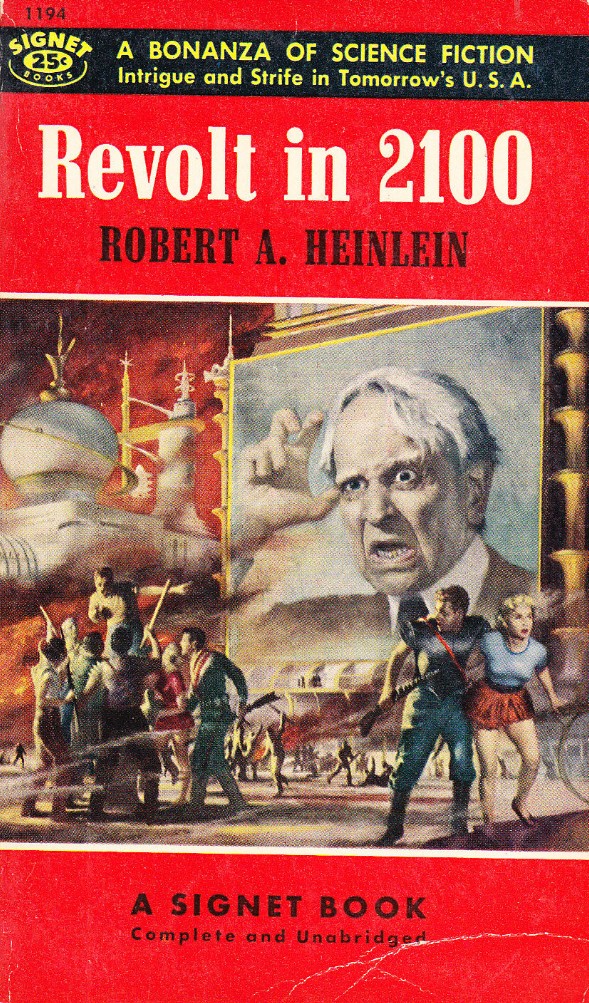
“If This Goes On —” was later revised and expanded for the collection Revolt in 2100. In 1967 it was included in The Past Through Tomorrow which collected Heinlein’s Future History stories. Revolt in 2100 is currently in print for the Kindle and Audible, and contains two other short stories, “Coventry” and “Misfit.” It’s a shame that The Past Through Tomorrow hasn’t stayed in print. I wish I had both an ebook and audiobook edition of it.
“If This Goes On —” as revised is considered a novel, but I’m not sure how long the two-part serial was in 1940. It may have been just a long novella. It would have been Heinlein’s first published novel if it was novel-length.
The setting for “If This Goes On —” is three generations after a theocracy has taken over the United States and is about an underground cabal that works to overthrow it. The focus of the story is all over the place. The story is told in the first person by John Lyle, a West Point trained guard at the Palace of the Prophet Incarnate in New Jerusalem. While on guard duty he has a brief encounter with Sister Judith, a virgin on her way to service the Prophet. As in many Heinlein stories, Lyle falls in love with her immediately.
Judith is able to avoid a fate worse than death twice with the implication she wants to be with John Lyle, and Lyle and his roommate Zeb concoct a plan to rescue her. This plan goes awry and John and Zeb must join the opposition cabal. From there the story becomes a thriller with John Lyle acting like a proto-James Bond for a chapter. That part of “If This Goes On —” reminded me of “Gulf” which Heinlein would write at the end of the 1940s. This chapter lets us know that America’s theocracy is a well-developed police state, but one where most people are happy.
The story then slows down for many chapters allowing Heinlein to preach about freedom and some of his other pet subjects, including nudism. I never noticed what a nut Heinlein was about naked bodies when I was a kid. I wonder if readers in the 1940s picked up on that? Heinlein uses John Lyle as an innocent who must learn the ropes from his world-wise friend Zeb. So the rest of the story is a kind of a letdown. Sure, Heinlein has the cabal overthrow the theocracy, but it’s all done too quickly and easily. And the dying love that John Lyle felt for Judith, is unsatisfactorily waved off. That was annoying because Heinlein asked us to believe at the beginning of the story that John Lyle would throw away a promising military career and a faith he completely embraced after one encounter with Sister Judith.
That’s something I’m learning about Heinlein from this current study. Throughout his writing career, he produced stories where people fell instantly in love and even married right away, yet he never gives us believable reasons for their love. Heinlein also expects us to hate his bad guys with little justification too. In his later novels, he just refers to them as the Black Hats.
Even though I’m complaining about the parts I didn’t like, I have to also mention that Heinlein had a way of jumping in and immersing the reader into a completely new world. Most of my disappointment with the story came from Heinlein not delving deeper into this world. Here’s the opening page from the original 1940 version that was significantly rewritten for the book version.
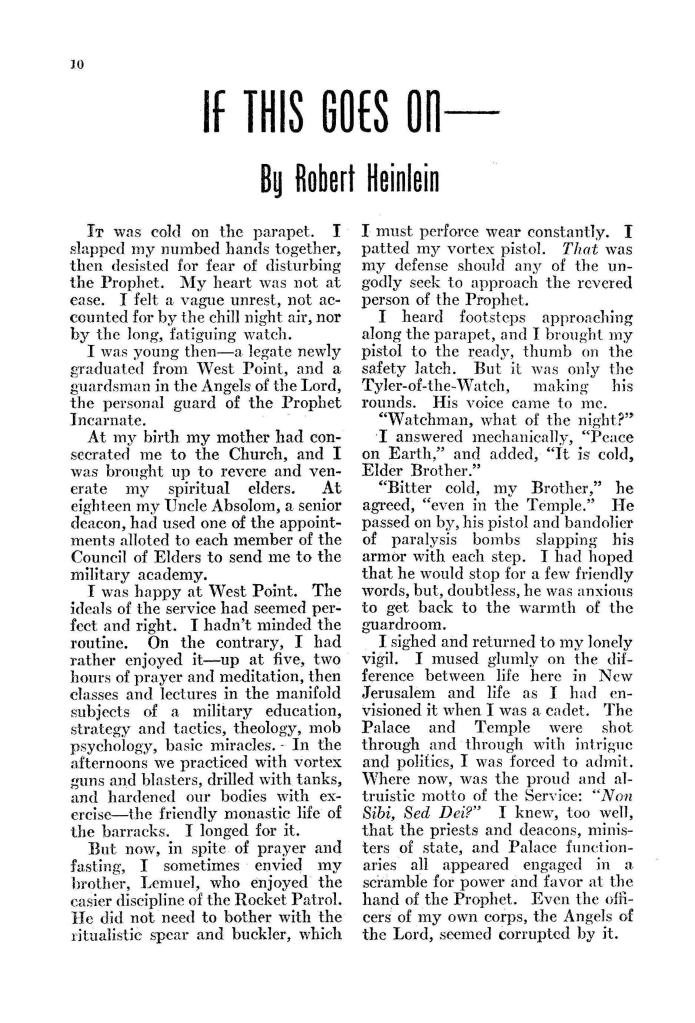
When I first read “If This Goes On —” when I was a young teen, just the idea of an American theocracy was enough to make me admire the story. And the idea that the United States went through the “Crazy Years” was enough to make me excited about Heinlein’s Future History concept. But now, after decades of reading more evolved science fiction, I can see what little world-building Heinlein put into these stories. And after decades of reading literary novels, I can also see what little characterization he put into them too.

I assume if a young person today reads “If This Goes On —” and they’re not very picky or sophisticated about what they read, they might like this old 1940 novel. It has a number of elements popular in modern YA dystopias. The important when factor applies to both when in the development of the reader, and when in the development of our society. Since we’re politically in a time when some people want a theocracy “If This Goes On —” becomes relevant again. And if you’re young, naive, and unsophisticated, and feel oppressed by the current political situation, “If This Goes On —” could be a relevant read to you too.
I just think it’s a shame that “If This Goes On —” is so poorly written and underdeveloped. Novels like The Handmaid’s Tale or Little Brother by Cory Doctorow would be much better substitutes for young readers today. John Lyle and Zeb are in their early twenties, graduates of West Point, so “If This Goes On —” is not a YA novel, however, it feels like one. If Heinlein had fleshed out his American theocracy and truly developed his young characters fighting against it, “If This Goes On —” could have been a significant novel that we should remember. It’s not.
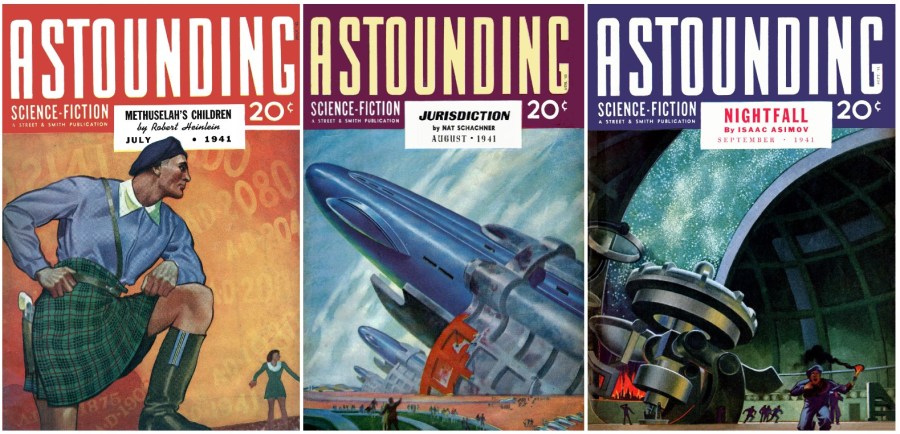
I think readers of 1940s Astounding sensed that Heinlein was onto something. “If This Goes On —” threw out enough ideas to excite those readers. And since they were pulp readers, they didn’t expect much in the way of literary development.
While watching the Ken Burns documentary, I wondered how close we were to a Protestant theocracy in 1940? I’m also reading The Plot Against America by Philip Roth which covers the same time period as the documentary. I’m not sure Heinlein had the writing chops, or the guts to write a novel like Roth’s, but can you imagine what readers of Astounding would have thought if The Plot Against America was serialized in that magazine in 1940?
James Wallace Harris, 9/20/22








 Classics of Science Fiction