“How Erg the Self-Inducting Slew a Paleface” by Stanislaw Lem

How Erg the Self-Inducting Slew a Paleface” by Stanislaw Lem is story #47 of 52 from The World Treasury of Science Fiction edited by David G. Hartwell (1989), an anthology my short story club is group reading. Stories are discussed on Tuesdays, Thursdays, and Saturdays. “How Erg the Self-Inducting Slew a Paleface,” a 1964 Polish story was first published in English in Mortal Engines in 1971.

I won’t argue that “How Erg the Self-Inducting Slew a Paleface” is not science fiction, because people are tired of me doing that, but just listen to this audiobook version of the story in Mortal Engines.

I found Lem’s prose charming and dazzling, and “How Erg the Self-Inducting Slew a Paleface” is a fun fairytale about a cybernetic king who captures a human for his collection of curiosities. Unfortunately, the wily human tricks the king’s daughter into giving him her windup key and forces the king into letting him go. But the human doesn’t keep his part of the bargain to return the key. The princess winds down, and the king announces to his kingdom that anyone who returns the key can marry his daughter.

Hartwell’s introduction makes me wonder why he included this story in his anthology.

My hunch as I read “How Erg the Self-Inducting Slew a Paleface” was Lem holds science fiction in contempt, and his story is poking fun at science fiction readers. Now, that’s not saying this story isn’t impressive. Of course, Lem shows quite a bit of disdain for humanity too. But read this page to see if you agree with me. This could be my own aging cynicism reading into Lem, so you decide.

I liked this story despite it not being the kind of story I wanted to find in this anthology.

James Wallace Harris, 8/22/23

p.s. – I missed reviewing several stories from The World Treasury of Science Fiction because I’ve been having back trouble and can’t sit at the computer for long, and for two weeks we lost our connection to the internet. I might go back and review them in the future.

“Weihnachtabend” by Keith Roberts

If not read carefully, “Weihnachtabend” by Keith Roberts will come across as just another alternate history about Hitler winning WWII. “Weihnachtabend” is more subtle, it’s an alternate history where England and German never fought, but made an alliance, and eventually ruled over Europe together. They called their alliance the Two Empires, graphically symbolizing it with the Lion, and the Eagle.

I have read many books and watched many movies and television shows set in England in the mid-20th century. And one historical event that has come up often is when Neville Chamberlain signed the Munich Agreement in 1938. Roberts imagines what if peace between Germany and England had played out, and, if the English fascists had come to power. In the alternate history timeline of this story the Munich Agreement is The Cologne settlement.

Roberts writes beautifully, painting with impressionistic details rather than flatly telling us what happened.

“Weihnachtabend” by Keith Roberts is story #44 of 52 from The World Treasury of Science Fiction edited by David G. Hartwell (1989), an anthology my short story club is group reading. Stories are discussed on Tuesdays, Thursdays, and Saturdays. “Weihnachtabend” was first published in New Worlds Quarterly 4 (1972) edited by Michael Moorcock. You can read it here. “Weihnachtabend” is also in The Grain Kings, which collects seven of Keith Roberts stories. It’s currently available for $1.99 at Amazon for the Kindle edition.

I highly recommend reading “Weihnachtabend” before reading my essay for two reasons. First, this story is a masterpiece of alternate history and is well-worth reading. Second, it’s a test of reading ability. The story is not hard to read, but instead of just telling what’s happening, Keith Roberts gives us pieces to put a mental jigsaw puzzle together. The story is dense with clues and implications about history and people.

“Weihnachtabend” tested my reading ability, and I didn’t do very well on my first reading. The title means Christmas Eve — I had to look that up. I read the story slowly, trying my best to understand it, but it wasn’t until afterwards that all the subtle aspects were revealed when I read Paul Kincaid’s review. I was further enlightened by Joachim Boaz’s review.

Clarity came with my second reading, and even then, I’m not sure I saw everything Roberts intended. I’m learning in old age that fiction needs two readings before you begin to understand it. It’s a shame that knowledge has come so late in life. No matter how hard I try to become a better reader, and I’ve been trying my whole life, the only thing I keep learning is how bad my reading ability still is and how much more I need to learn.

Keith Roberts’ fiction is a great test for understanding what you read. I’ve read his fix-up novel Pavane and a couple other stories. His prose is dense with layers and depth. Roberts also has a great imagination and creates beautifully visual scenes. If only someone would film his stories.

“Weihnachtabend” opens as Richard Mainwaring and Diane Hunter approach Wilton Great House while riding in a chauffeured Mercedes. Right from the beginning Roberts presents the constant presence of paranoia. Richard notices that the communication channel between the back of the car and the chauffeur is always open, and the chauffeur is listening. Before they get to the country house — I picture it as a manor house of the aristocracy, they come to a wall with watchtowers and pillboxes, and guards with machine guns. The guards speak German.

Richard gives his identity card which says: “Die rechte Hand des Gesandten.” We learn that Richard is the right-hand man of the messenger, and we’re eventually told his title is “Personal Assistant to the British Minister of Liaison.” The identity card also tells the guard Miss Hunter is from his department. (I’ve completely forgotten my high school German, so I had to depend on Google to translate. Knowledge of most of the German phrases in the story aren’t needed to understand the story, but not all.)

Diane is extremely nervous, but then so is Richard. Why is he nervous if he’s a top dog in the ruling political party? Diane is a beautiful blonde who Richard had known long ago. She belongs to someone he knew, a man named James, but for this trip, she is with him.

As the story progresses, we learn we’re in England, but it’s years after the period we know as WWII. England and Germany rule Europe. They fear America. But for some reason, the alliance is dominated by Germany, and the English leadership speak German. There is unrest in England and elsewhere, but the leadership maintains order much like the authoritarian rule in Nineteen Eighty-Four. At the top is King Edward VIII and a Fuehrer named Ziegler (I think. It’s confusing about what happened to Hitler, or who is the Fuehrer. Hess is deputy Fuehrer.) We know it’s decades later because they have large screen televisions, and rollneck shirts. I assume this means a turtleneck which was trendy in the 1960s, and around the time Roberts wrote the story.

Roberts doesn’t have a specific message in this story. He just paints a tableau. Richard, in the end, has something to say to the reader, but what he says, we’ve known all along from our history.

What makes the story compelling to read is figuring out what is happening to Richard. At first, it’s just a Christmas Eve party for extraordinarily rich people. Richard is given a Lamborghini by his boss. There is a description of a brutal hunt, and a bizarre Christmas tradition for children. Richard and Diane have sex, and we feel they are old lovers who are finally going to get together. Then Diane disappears and Richard becomes unhinged, eventually confronting his boss with a Lüger.

As I’ve said, the story has many layers. Like in Philip K. Dick’s novel, The Man in the High Castle, there’s a meaningful-to-the-story book like The Grasshopper Lies Heavy. However, instead of being from another timeline, Toward Humanity is from Richard’s own timeline. The writer’s name is Geissler, and his book is banned. Richard finds this dangerous volume planted in his room. It’s published by the Freedom Front. Richard doesn’t know if his party is testing him or if the opposition is trying to recruit him.

And Richard wonders why he’s so lucky to suddenly acquire a beautiful blonde. Is she who she says she is, or is she a plant from his party to test him, or an agent of the Freedom Front? Blondes are a reward to good party men, easily bought and traded. When Richard’s blonde goes missing everyone wants to pretend, she never existed.

Along the way, we are given clues about this world with quotes from Toward Humanity. Here are three quotes:

The Cologne settlement, though seeming to offer hope of security to Jews already domiciled in Britain, in fact paved the way for campaigns of intimidation and extortion similar to those already undertaken in history, notably by King John. The comparison is not unapt; for the English bourgeoisie, anxious to construct a rationale, discovered many unassailable precedents. A true Sign of the Times, almost certainly, was the resurgence of interest in the novels of Sir Walter Scott. By 1942 the lesson had been learned on both sides; and the Star of David was a common sight on the streets of most British cities.

---

In 1940, her Expeditionary Force shattered, her allies quiescent or defeated, the island truly stood alone. Her proletariat, bedeviled by bad leadership, weakened by a gigantic depression, was effectively without a voice. Her aristocracy, like their Junker counterparts, embraced coldly what could no longer be ignored; while after the Whitehall Putsch the Cabinet was reduced to the status of an Executive Council …

 
---

Against immeasurable force, we must pit cunning; against immeasurable evil, faith and a high resolve. In the war we wage, the stakes are high; the dignity of man, the freedom of the spirit, the survival of humanity. Already in that war, many of us have died; many more, undoubtedly, will lay down their lives. But always, beyond them, there will be others; and still more. We shall go on, as we must go on, till this thing is wiped from the earth. Meanwhile, we must take fresh heart. Every blow, now, is a blow for freedom. In France, Belgium, Finland, Poland, Russia, the forces of the Two Empires confront each other uneasily. Greed, jealousy, mutual distrust; these are the enemies, and they work from within. This, the Empires know full well. And, knowing, for the first time in their existence, fear …

We doubt Richard is persuaded by this political rhetoric. The ending of the story is quite dramatic. The final scene also reminds me of the final message of Nineteen Eighty-Four. I must wonder if Keith Roberts was commenting on the current political climate in England of 1972 when and where he wrote “Weihnachtabend.”

I know in 2023 there is much distrust of government everywhere. Was Robert’s paranoia any different than an average citizen? Who really controls us?

James Wallace Harris, 8/16/23

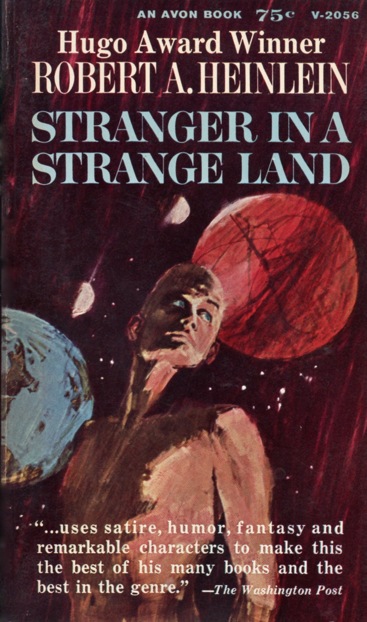
How Should We Judge Heinlein’s Stranger in a Strange Land in 2023?

I recently watched a devastating “review” of Stranger in a Strange Land on YouTube. (Watch it below.) The short film summarized the plot of the novel, but in a way that made the story ridiculous. When I first watched it, I didn’t think the sarcasm and satire was unfair. I first read Stranger in 1965 when I was thirteen, and I loved it. I’ve reread it many times over the decades, but with each rereading I became more disappointed with the story. So, the criticisms made by Overly Sarcastic Productions resonated with the memories I have of listening to the audiobook version in 2004, and my last reading in 1991. Even though Robert A. Heinlein is still my favorite science fiction writer; I haven’t liked his books published after 1959 for a long time. However, I’m wondering if I shouldn’t reevaluate that dislike.

Today, I started reading A Martian Named Smith by William H. Patterson, Jr., the man who wrote a two-volume biography of Heinlein and who edited The Heinlein Journal. I wouldn’t call Robert A. Heinlein: In Dialogue with His Century an official biography, but it was written with the support of Virginia Heinlein. Patterson makes a great case that Heinlein was trying something quite different with Stranger, and it shouldn’t be judged like traditional science fiction. Patterson considers Stranger to be a classic satire, and that the satire has a different structural form than the novel.

In the 1960s and 1970s, Stranger in a Strange Land might have been the most famous science fiction novel. It was a cult classic on college campuses and embraced by many in the counterculture. I’m not sure Heinlein liked that. It was also embraced by the growing libertarian political movement. The more Heinlein was embraced by the Right, the more readers on the Left moved away from his works. That put me in a bind. I’m liberal. What eventually happened is I focused on his books published before 1960.

But I thought of something today. Stranger in a Strange Land could be considered an early work of New Wave Science Fiction, at least by some of its goals. The New Wave movement wanted science fiction to move away from pulp writing, escape from the old tropes in science fiction, embrace the latest literary standards, experiment in new forms of writing styles, deal with emerging social issues, and be more relevant. Heinlein was obviously doing all that with Stranger in a Strange Land. The New Wave was mostly out of England, and on the left politically. Heinlein made public proclamations that divided the science fiction community between conservative and liberal, so no one considered him New Wave at the time.

Patterson, in A Man Named Smith makes a very intellectually grounded case that Stranger in a Strange Land works on multiple levels, some of which are deep and seldom observed. What if Patterson is right? What if my liberal leanings are prejudicing me from giving the novel a fair chance? To find out I’ll need to reread the book, even both versions, and read Patterson’s book, along with other critical works and studies on the novel. That will be a huge project. That means this blog post will have another ongoing series — and I have too many of those unfinished right now. I’ve been meaning to get back to my Rereading Heinlein project. I expected to reread Stranger in a Strange Land after I read everything Heinlein wrote before it. I’m still stuck in 1940, where I planned to read “The Devil Makes the Law” (renamed “Magic, Inc.”) next.

I also got inspired to reread Stranger in a Strange Land this week when I watched the above video review. Then I read an essay on Book Riot where the writer was proposing to replace eight classic literary novels, four of which are among my favorites. I wrote about this on Auxiliary Memory, where I criticized younger writers for wanting to replace older books they hated, with newer books they loved. I said, if you want to replace a classic, it should be from the same years as the original work and cover the same thematic territory — that classics are how we view the past.

Then I read Joachim Boaz’s review of Davy by Edgar Pangborn. He called it a masterpiece. That led me to finding my copy of Davy and begin reading. It’s quite an impressive novel, but what’s interesting is its overlap with Stranger in a Strange Land. Both are about young males and their education before they become revolutionaries and try to create new social systems. Both these books precede the counterculture of the 1960s by just a few years. At first, I wondered if modern woke readers would accept Davy as a substitute science fiction classic for Stranger in a Strange Land. But if you read my essay linked above, you’ll see that I don’t believe in removing classics from the canon, but adding works that will supplement that.

I believe Stranger in a Strange Land, Davy, and The Man Who Fell to Earth by Walter Tevis make an interesting trilogy of works that reflect the early 1960s in science fiction. To write that will be another huge writing job that will take a lot of researching, reading, and writing. And I unfortunately have dwindling physical and psychic energy.

When I was growing up in the 1950s and 1960s Heinlein was considered the top science fiction author by most readers, even if they didn’t like his books. He was just that successful. He was made the first Grand Master by the SFWA in 1974.

Ever since Stranger in a Strange Land was first published, it was considered controversial, and even polarizing. Since the 1960s, Heinlein’s reputation has been in decline, but that might be relative. So many new writers have had so much success that Heinlein just had much more competition. However, in the 21st century there does seem to be a growing dislike of Heinlein among younger readers.

I love studying how books become popular and how they are slowly forgotten. Is Heinlein and Stranger on their way out? Or is there something to that novel that will keep people reading it for another century? I want to think about that.

Right now, people focus on Heinlein’s flaws. But what about Heinlein’s virtues?

I also want to think about the differences between what makes a literary novel a classic and what makes a science fiction novel a classic. There is an overlap in reasons, but each form has its unique qualities that determine whether they will become a classic novel. I believe literary novels must give significant insight into their story’s physical setting, and both the time in which the story is set, and when it was written.

We judge science fiction stories over their plots and ideas. But what if what makes a classic science fiction novel the same as what makes a classic literary novel? What does Stranger in a Strange Land say about America in 1961, and the decade before when Heinlein was writing it? My guess is it is something like what Pangborn and Tevis were saying. It’s going to take a lot of deep reading for me to find out.

James Wallace Harris, 8/12/23

“Poor Superman” by Fritz Leiber

Poor Superman” by Fritz Leiber is story #34 of 52 from The World Treasury of Science Fiction edited by David G. Hartwell (1989), an anthology my short story club is group reading. Stories are discussed on Tuesdays, Thursdays, and Saturdays. “Poor Superman” was initially titled “Appointment in Tomorrow” and published in Galaxy Science Fiction (July 1951). It was reprinted and retitled in the 1952 anthology hardback Tomorrow the Stars edited by Robert A. Heinlein. You can read the story online at Project Gutenberg. You can listen to a radio show adaption of “Appointment in Tomorrow” from X Minus One. You can find ebook editions here to download.

I will refer to the story as “Poor Superman” instead of its original title “Appointment in Tomorrow.”

I read “Poor Superman” years ago when I read The Best Science Fiction Stories: 1952 edited by Everett F. Bleiler and T. E. Dikty. I didn’t remember anything from then when I read it again yesterday, on Friday. After that second reading, I had a vague feeling of reading it before and thinking it a so-so story. But this time I thought there was more there, but found the story confusing to read. I started thinking about it. Then today, Saturday, I read it again, and it all clicked. I would have said on my first reading I would have given the story 3 stars. On the second reading, I realized it was approaching 4 stars. On my third reading, it’s a 5-star story. I believe I needed to know what was in the story before I could understand reading each line of the story. Now it works word by word, line by line.

Fritz Leiber’s story, “Coming Attraction” is one of my all-time favorite science fiction short stories. It appeared a year earlier than “Poor Superman” in Galaxy. David Hartwell in his introduction suggests that they are both set in the same fictional post-WWIII universe, but I thought “Poor Supermen” only hinted at a few of the ideas from the earlier story.

Unfortunately, where “Coming Attraction” was dazzling, vivid, and dramatic on first reading, “Poor Superman” was talky, full of infodumps, and somewhat confusing on first reading. My second reading was really like another first reading. However, on this second reading, I sensed it was a far more ambitious story. “Coming Attraction” is about a British man meeting a woman in New York City in post-atomic war WWIII. It’s about a personal conflict between two men and a woman. “Poor Superman” involves a power struggle at the top of society between the Thinkers, who currently influence the party in the Whitehouse, and scientists who wish to unmask the frauds the Thinkers are perpetrating to maintain that political power.

It took a third reading to get who was who, all the implications, and to understand the reasons for all the infodumps. “Poor Superman” is an attack on science fiction, science fiction fans, as well as other kinds of believers, including religious, political, and philosophical. It’s more than cynical, it’s harshly realistic. You might think that Lieber supports science and scientists, but he’s brutal on them too.

Now “Poor Superman” needs a lot of setting up to really appreciate. It helps to know what was going on at Astounding Science Fiction magazine, where the editor John W. Campbell, and many of his writers were promoting the pseudo-science Dianetics. Many science fiction writers and readers from the 1940s believed that mankind was about to discover vast psychic powers that would change the world. Leiber doubts this.

Here’s how Leiber described his post-WWIII America of this story:

It was America approaching the end of the Twentieth Century. America of juke-box burlesque and your local radiation hospital. America of the mask-fad for women and Mystic Christianity. America of the off-the-bosom dress and the New Blue Laws. America of the Endless War and the loyalty detector. America of marvelous Maizie and the monthly rocket to Mars. America of the Thinkers and (a few remembered) the Institute. "Knock on titanium," "Whadya do for black-outs," "Please, lover, don't think when I'm around," America, as combat-shocked and crippled as the rest of the bomb-shattered planet.

In the real world of 1951, the cold war was heating up, now with two superpowers with atomic bombs, both of which were racing to develop a thermonuclear weapon. The United States was consumed by anti-communist fervor, with the HUAC witchhunts well underway. Americans were paranoid and frightened — grasping at religion, the occult, UFOs, ESP, faith healing, science fiction, and other forms of quackery. Many science fiction stories during these years were written about civil wars fought by the faithful against scientists. Heinlein was predicting his “Crazy Years” stories in his Future History series. Andre Norton would soon publish The Stars Are Ours! about scientists being hunted down after a theocracy takes over America. Leigh Brackett would publish The Long Tomorrow in 1955, about America reverting to an Amish-like society.

I wish Leiber hadn’t named his Dianetics-driven characters Thinkers. It’s too easy to confuse them with the Scientists, whom most people think of as big thinkers. I wished he had called them the Psychics, Mentalists, or something closer to what they represented. It’s a shame he couldn’t have called them The Scientologists – I don’t think they were using that name yet in 1951, but that label perfectly describes his characters. What would you think about reading “Poor Superman” today if he had written a story about Scientists versus Scientologists?

In “Poor Superman” the Thinkers believe they are developing powerful mental abilities. Americans believe that Thinkers are superior, and they influence political power. The Thinkers maintain the public belief in their superiority by claiming to have a giant two-floor-sized supercomputer that can answer all questions, and by faking space missions to Mars where they claim spiritually advanced Martians with ESP powers are teaching them their secrets which they will soon give to everyone.

This is a great setup for a story. The Galaxy editors introduced it with two questions: “Is it possible to have a world without moral values? Or does lack of morality become a moral value, also?” Think about those two questions. They are perfect for asking ourselves in 2023. It’s possible to substitute Donald Trump and his MAGA followers for the Thinkers in “Poor Superman.” If you do, it might make you admire “Poor Superman” more. And anyone reading or rereading Stranger in a Strange Land should get to know “Poor Superman” first.

The trouble is, I found “Poor Superman” confusing to read at first. Of course, this might be entirely my fault. There were too many weird made-up names that I couldn’t keep up with. I kept forgetting which character belong to which group. And there were times I just didn’t get the scene. It wasn’t until my third reading that “Poor Superman” became crystal clear like “Coming Attraction.”

An example of confusion from Friday’s reading is when they give questions to the supercomputer, Maize.

From a new Whitehouse, the President and his general staff observe while the daily questions are submitted to Maize, in what I assume is broadcast to Americans too. Instead of typing the questions, the questions are entered by taping. My guess is Leiber meant to imply writing in the future is done on spools of magnetic tape. But that’s only a guess. Then we are told:

Meanwhile the question tape, like a New Year's streamer tossed out a high window into the night, sped on its dark way along spinning rollers. Curling with an intricate aimlessness curiously like that of such a streamer, it tantalized the silvery fingers of a thousand relays, saucily evaded the glances of ten thousand electric eyes, impishly darted down a narrow black alleyway of memory banks, and, reaching the center of the cube, suddenly emerged into a small room where a suave fat man in shorts sat drinking beer.

He flipped the tape over to him with practiced finger, eyeing it as a stockbroker might have studied a ticker tape. He read the first question, closed his eyes and frowned for five seconds. Then with the staccato self-confidence of a hack writer, he began to tape out the answer.

For many minutes the only sounds were the rustle of the paper ribbon and the click of the taper, except for the seconds the fat man took to close his eyes, or to drink or pour beer. Once, too, he lifted a phone, asked a concise question, waited half a minute, listened to an answer, then went back to the grind.

Until he came to Section Five, Question Four. That time he did his thinking with his eyes open.

The question was: "Does Maizie stand for Maelzel?"

He sat for a while slowly scratching his thigh. His loose, persuasive lips tightened, without closing, into the shape of a snarl.

Suddenly he began to tape again.

"Maizie does not stand for Maelzel. Maizie stands for amazing, humorously given the form of a girl's name. Section Six, Answer One: The mid-term election viewcasts should be spaced as follows...."

But his lips didn't lose the shape of a snarl.

What I didn’t realize on my first reading today was the fat man in shorts was answering the questions for Maize. It’s obvious when I reread it, but it wasn’t on first reading. I thought he was a computer operator that retyped the questions into the computer. What we learn from this is the Thinkers are faking they have a supercomputer.

We also learn they are faking missions to Mars. An astronaut and his cat go up and just orbit the Earth while biding time. He pretends to have gone to Mars.

A scorecard of the characters:

  • Jorj Helmuth – Thinker (40 years old, with a body of 20, and a mind of 60)
  • President of the U.S. and staff – unnamed
  • Maizie – supercomputer AI (faked)
  • Morton Opperly – wise old physicist
  • Williard Farquar – young ambitious physicist
  • Jan Tregarron – fat man in loud shorts who is the mastermind of the Thinkers
  • Miss Arkady “Caddy” Simms – seductress, spy, femme fatale

In a conversation between Morton Opperly and Williard Farquar, we learn something about the conflict between Thinkers and Scientists:

"But what are we to do?" Farquar demanded. "Surrender the world to charlatans without a struggle?"

Opperly mused for a while. "I don't know what the world needs now. Everyone knows Newton as the great scientist. Few remember that he spent half his life muddling with alchemy, looking for the philosopher's stone. Which Newton did the world need then?"

"Now you are justifying the Thinkers!"

"No, I leave that to history."

"And history consists of the actions of men," Farquar concluded. "I intend to act. The Thinkers are vulnerable, their power fantastically precarious. What's it based on? A few lucky guesses. Faith-healing. Some science hocus-pocus, on the level of those juke-box burlesque acts between the strips. Dubious mental comfort given to a few nerve-torn neurotics in the Inner Cabinet—and their wives. The fact that the Thinkers' clever stage-managing won the President a doubtful election. The erroneous belief that the Soviets pulled out of Iraq and Iran because of the Thinkers' Mind Bomb threat. A brain-machine that's just a cover for Jan Tregarron's guesswork. Oh, yes, and that hogwash of 'Martian wisdom.' All of it mere bluff! A few pushes at the right times and points are all that are needed—and the Thinkers know it! I'll bet they're terrified already, and will be more so when they find that we're gunning for them. Eventually they'll be making overtures to us, turning to us for help. You wait and see."

"I am thinking again of Hitler," Opperly interposed quietly. "On his first half dozen big steps, he had nothing but bluff. His generals were against him. They knew they were in a cardboard fort. Yet he won every battle, until the last. Moreover," he pressed on, cutting Farquar short, "the power of the Thinkers isn't based on what they've got, but on what the world hasn't got—peace, honor, a good conscience...."

But what appeals to me, is Fritz Leiber’s take on science fiction and science fiction fans. Over the past couple of years, as I’ve been reading, and rereading 1950s science fiction, I keep getting hints that some science fiction writers were developing cynical attitudes towards the genre. At one point, Jorj Helmuth thinks to himself:

He switched out all the lights and slumped forward, blinking his eyes and trying to swallow the lump in his throat. In the dark his memory went seeping back, back, to the day when his math teacher had told him, very superciliously, that the marvelous fantasies he loved to read and hoarded by his bed weren't real science at all, but just a kind of lurid pretense. He had so wanted to be a scientist, and the teacher's contempt had cast a damper on his ambition.

Then in a desperate speech to Jan Tregarron, Jorj Helmuth explains why he created the Thinkers:

"Our basic idea was that the time had come to apply science to the life of man on a large scale, to live rationally and realistically. The only things holding the world back from this all-important step were the ignorance, superstition, and inertia of the average man, and the stuffiness and lack of enterprise of the academic scientists— their worship of facts, even when facts were clearly dangerous." 

"Yet we knew that in their deepest hearts the average man and the professionals were both on our side. They wanted the new world visualized by science. They wanted the simplifications and conveniences, the glorious adventures of the human mind and body. They wanted the trips to Mars and into the depths of the human psyche, they wanted the robots and the thinking machines. All they lacked was the nerve to take the first big step— and that was what we supplied."


You can see L. Ron Hubbard here. You can see John W. Campell. And maybe even some Robert A. Heinlein.

There’s a reason why the story was retitled “Poor Superman.” And there’s a good reason why H. L. Gold didn’t want to use that title. Any science fiction fan would understand what it meant in 1951.

I need to read “Poor Superman” again. The ending is not ambiguous, but I wonder if it shouldn’t be. Poor Superman turns out to be Jorj Helmuth because Caddy puts the gun in Jan Tregarron’s hand. But if we weren’t told that one bit of information, and we only knew Caddy had the gun, who would have been Poor Superman? Jan or Jorg? Jan acts like a Nazi, and they thought of themselves as supermen too.

This is a great story. It just took three readings to discover that. I wonder what more readings will reveal. I need to read more stories by Fritz Leiber, especially more of his work from the 1950s.

James Wallace Harris, 7/22/23
“The Public Hating” by Steve Allen”

The Public Hating” by Steve Allen is story #33 of 52 from The World Treasury of Science Fiction edited by David G. Hartwell (1989), an anthology my short story club is group reading. Stories are discussed on Tuesdays, Thursdays, and Saturdays. “The Public Hating” was first published in Bluebook (January 1955). It was reprinted in Judith Merril’s first annual anthology, S-F: The Year’s Greatest Science-Fiction and Fantasy.

Again, we have a non-SF writer writing an excellent work of science fiction. I was also surprised that “The Public Hating” was so well-written and succinct. I never thought of Steve Allen as a writer. I know he was the creator and first host of The Tonight Show back in 1953. I’ve seen film clips of Steve Allen for years but never really knew who he was. I read his Wikipedia entry and was amazed. Besides all the television shows he created, he composed more than 8,500 songs and published more than 50 books. The guy was a whirlwind of productivity. The Wikipedia piece makes me want to watch his old TV shows. Steve Allen’s shows from the 1950s set up much of what we came to watch later.

The Bluebook intro says “The Public Hating” is Steve Allen’s first short story. Fiction Mag Index lists only a handful of short stories by Allen but does list “The Public Hating” first. Wikipedia shows that most of his books were nonfiction, and fiction writing wasn’t common with Allen.

My guess is because Steve Allen was such a great comedian and a great writer of comic material that he was also a great mimic. “The Public Hating” reads very much like something Ray Bradbury would have written. Allen was well-known for his political views, a famous liberal, and a skeptic, so writing a short story about public hating just after many of the famous HUAC hearings is obvious.

“The Public Hating” is typical science fiction for the 1950s, something that could have been published in Galaxy or F&SF. The structure of the story is dramatic but with a certain amount of infodumping. Like much science fiction of that time, it depends on explaining a made-up scientific concept — that groups of people can project an extrasensory force. People are executed in stadiums by having large crowds think about the exact punishment. Allen imagines in 1955 that in a future set in 1978 that large crowds can focus their hate.

I read “The Public Hating” thinking it was still a story of our times. It strangely resonates with a Carl Sagan quote I read today, from The Demon-Haunted World.

“I have a foreboding of an America in my children’s or grandchildren’s time – when the United States is a service and information economy; when nearly all the key manufacturing industries have slipped away to other countries when awesome technological powers are in the hands of a very few, and no one representing the public interest can even grasp the issues; when the people have lost the ability to set their own agendas or knowledgeably question those in authority when, clutching our crystals and nervously consulting our horoscopes, our critical faculties in decline, unable to distinguish between what feels good and what’s true, we slide, almost without noticing, back into superstition and darkness.”

I believe “The Public Hating” is more than satire. I believe it was a warning. That Allen like Sagan feared the world was reverting backward into the superstitious times of the Inquisition. I believe what the Trump years have taught us is that we’re always been there.

James Wallace Harris, 7/20/23

Adult Science Fiction

John Brunner was the James Burke (Connections) of science fiction about the near future. Brunner was a polymath who used his diverse sources of knowledge to write four novels (Stand on Zanzibar (1968), The Jagged Orbit (1969), The Sheep Look Up (1972), and The Shockwave Rider (1975)) that extrapolated on everything he knew to envision the early 21st century. No one can predict the future, and Brunner gets all the details wrong in these novels, yet they eerily foretell the problems we face today. They are sometimes called Brunner’s Club of Rome Quartet, inspired by the famous Club of Rome from the 1960s, a think tank devoted to global problems of that day. Its most famous report, The Limits of Growth has been vilified over the decades, but time has proven it wasn’t wrong.

Brunner obviously wanted us to confront those problems before they happened. Of course, we haven’t. Even though some of Brunner’s novels won critical praise when they came out and Stand on Zanzibar won a Hugo, they were never popular. Brunner aimed as high as George Orwell, but his books never reached Nineteen Eighty-Four‘s impact. The Jagged Orbit was nominated for the Nebula and won the BSFA award, The Sheep Look Up was nominated for the Nebula, and The Shockwave Rider came in 2nd for the Locus Award for SF Novel. These four novels were mostly respected by critics, but they never became popular with science fiction readers. And as many brilliant science fiction writers know, science fiction gets no respect outside the genre.

I’ve always considered those Brunner novels to be adult science fiction and most science fiction fans don’t want adult literature. Most science fiction fans read science fiction for fun, for escape, and aren’t looking for serious speculation about present-day life or the near future.

When I use the term adult science fiction, I don’t mean Sci-Fi with X-rated content. Young adult fiction has become very popular and successful, even with adult readers. Young adult fiction usually means protagonists are in their teens. But I think the label should apply to any theme or subject that mostly appeals to young adults. Most science fiction is aimed at adolescent readers, or older readers who prefer not to grow up. And in our society, adolescence has extended into the twenties, and even later for many people. There are some awfully big kids still playing with their Star Wars toys.

To me, adult literature deals with the problems of being an adult in our current reality. That apparently doesn’t leave much territory for adult science fiction since it’s usually not set in our current reality. But let me give you an example of how a novel set in the future can be adult science fiction.

The Shockwave Rider came out in 1975, and its setting is the United States in the early 21st century. In other words, our current reality. Now I don’t mean adult science fiction is only stories set in our current day, the setting can be anytime or place in the universe so long as the reader finds something useful in the story that gives insight into being an adult. The Shockwave Rider was adult science fiction in 1975 and will probably continue to be for years to come. Unfortunately, after decades of knowing about the problems presented in the novel, we ignore them. We don’t want to grow up.

Brunner’s novel is extrapolation. He was inspired by the 1970 nonfiction book, Future Shock by Alvin Toffler. Brunner asked: how can humans survive in a world that is growing ever more complex and stressful, living with ever more information, coexisting with computers and automation, dealing with environmental decline, epic natural catastrophes, growing insanity, political corruption, constant surveillance, and ever-changing job requirements. Exactly, what we’re experiencing now. Brunner asks how society and citizens cope?

The plot of The Shockwave Rider deals with Nick Haflinger, who is a computer hacker on the run. He was a prodigy raised by the government to be an elite leader in the future, but he rejects that upbringing, and escapes. The plot is complicated by flashbacks. Part of the narrative deals with Nick being psychoanalyzed after being recaptured. While he is on the run he meets Kate Grierson, a brilliant young woman who gets Nick faster than he gets himself. While they are on the run they live in two different utopian communes that offer alternative lifestyles to what the cyber-controlled government wants.

Throughout the course of the novel, Brunner throws out concepts and gadgets he thinks will be developed by the early 21st century. He was right in imagining we’d have a gadget-oriented future, but for the most part, he pictured us with different kinds of gadgets. However, Brunner almost imagines the smartphone. He pictures a palm size with a flip-up screen. Nick does much of his hacking on such a device. People do have desktop-type computers too in The Shockwave Rider, but Brunner pictures them as smart network terminals. That’s because in the 1960s and early 1970s time sharing computers were all the rage. He doesn’t foresee the laptop.

Even though The Shockwave Rider was hard to read, confusing at times plotwise, and with less than fully developed characters, it is chock full of brilliant speculation. Reading it made me realize just how hard Brunner thought about the future, and how hard we should have been thinking about it too. The tragedy of our times is we knew all this bad stuff was coming and we didn’t do shit about it.

Cli-Fi is becoming more common now, but it’s not always handled in a serious way. Often it’s just a setting for young adult adventure. The best current example, which I would consider an adult science fiction novel is The Ministry for the Future by Kim Stanley Robinson.

The Shockwave Rider is not the kind of science fiction most science fiction fans want to read. They want adventure, rebellion, thrill rides, etc. Young people love blows against the empire stories. If you’re reading a story about zooming around the galaxy, then you’re reading young adult fiction. If you’re reading about surviving in dystopia, that’s not ours, then you’re reading young adult fiction. If you’re reading about being an old person whose mind is downloaded into a clone body, then you’re reading young adult fiction. Most far-out science fictional ideas are ones that appeal to the young adult in us. And I’m not being critical. I still love that stuff too, and I’m 71.

The Shockwave Rider is hard to read. Not just because it explores surviving in this reality, but because its storytelling structure is convoluted and hard to understand. Today, this novel is mostly unknown, but what little fame it does have, is because it’s credited as a work of proto-cyberpunk fiction. And Brunner gets credit for the term “computer worm.” But it’s much more than that.

Brunner was one of those writers who was way smarter than his readers. He was smarter than most people. Unfortunately, being smart doesn’t bring happiness. From 1968-1975, Brunner wrote a series of novels in which he seriously worried about life in the 21st century. There’s a monograph on Brunner in the Modern Masters of Science Fiction series called John Brunner by Jad Smith that I found rewarding. In some ways, Brunner comes across as a tragic figure in this study.

Brunner’s books are full of ideas, and reading about them made me want to read them. Unfortunately, they often fail to entertain. And I think that’s why most adult science fiction fails. It’s hard to pull off a serious book about serious problems and still be entertaining. It can be done. Nineteen Eighty-Four is an excellent example. So is Earth Abides by George R. Stewart.

True adult literature tends to come across as biographical because becoming an adult involves becoming mature. In adult novels, we learn so much about the main character and their growth that we feel we know them. Brunner never could bring this off. His characters are adults, and they struggle with adult problems, but we never feel them growing or even being real. They are puppets Brunner uses to act out situations he wants to intellectually explore.

Science fiction writers have the problem that they are seldom taken seriously by the literary world. They often complain that this lack of recognition keeps them from becoming financially successful. This was true of Brunner too. Despite winning awards and gaining a certain amount of respect and fame within the genre, his writing never provided the kind of money and respect he thought he deserved. I’ve wondered if it’s time to reevaluate Brunner’s work.

I found it very difficult to get into The Shockwave Writer. I had to try several times. I had to push myself to keep reading, but as I went along it became more rewarding. The Shockwave Writer is not a page-turner. But neither are Edith Wharton and Henry James. I don’t think his work will ever appeal to science fiction fans who crave young adult science fiction. And I don’t think there are many fans of adult science fiction. Kim Stanley Robinson writes adult science fiction and gets a certain amount of recognition. But his books just aren’t fun to read like the science fiction books that are popularly discussed on YouTube.

Ultimately, I’m not sure science fiction is the venue for adult literature. Brunner should have written speculative nonfiction. Science fiction works best at delighting our youthful sense of wonder. Aging makes us cynical and realistic.

For now, my favorite example of adult science fiction is Earth Abides. Its main character, Isherwood Williams, grows throughout the novel, and the ending is especially adult. But I’m open for you to leave comments about SF novels you think are adult in the comments.

James Wallace Harris, 7/18/23

“The Muse” by Antony Burgess

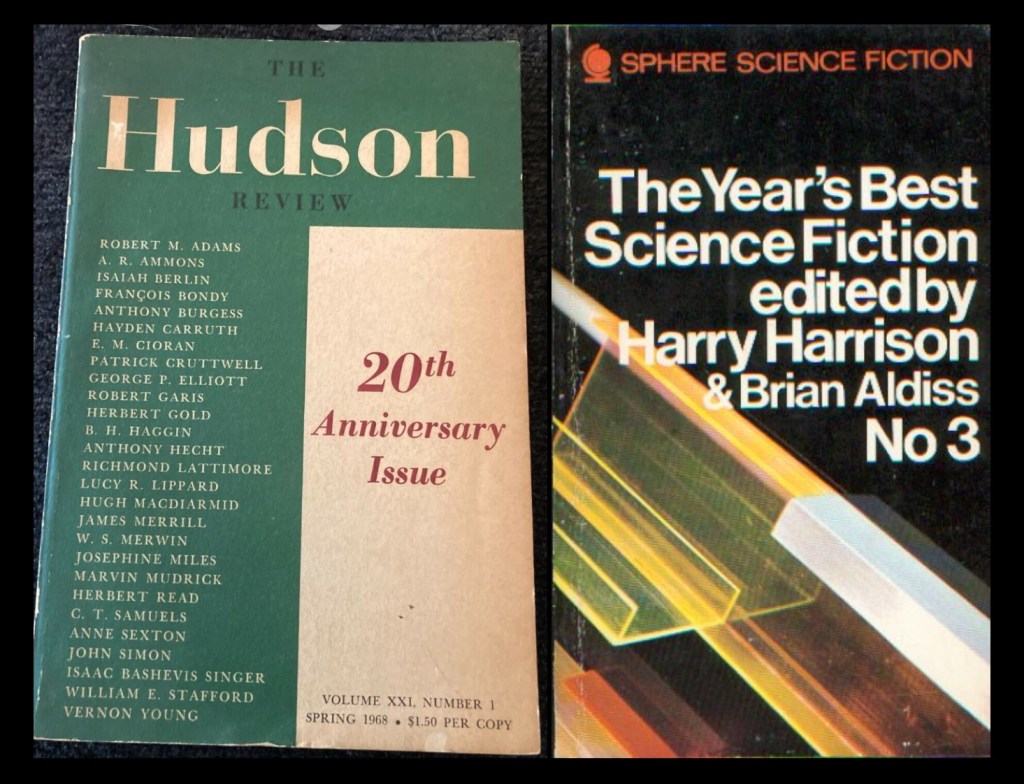
“The Muse” by Ray Anthony Burgess is story #32 of 52 from The World Treasury of Science Fiction edited by David G. Hartwell (1989), an anthology my short story club is group reading. Stories are discussed on Tuesdays, Thursdays, and Saturdays. “The Muse” was first published in The Hudson Review (Spring 1968), a literary journal. It was reprinted in Best SF: 1969 edited by Harry Harrison and Brian Aldiss.

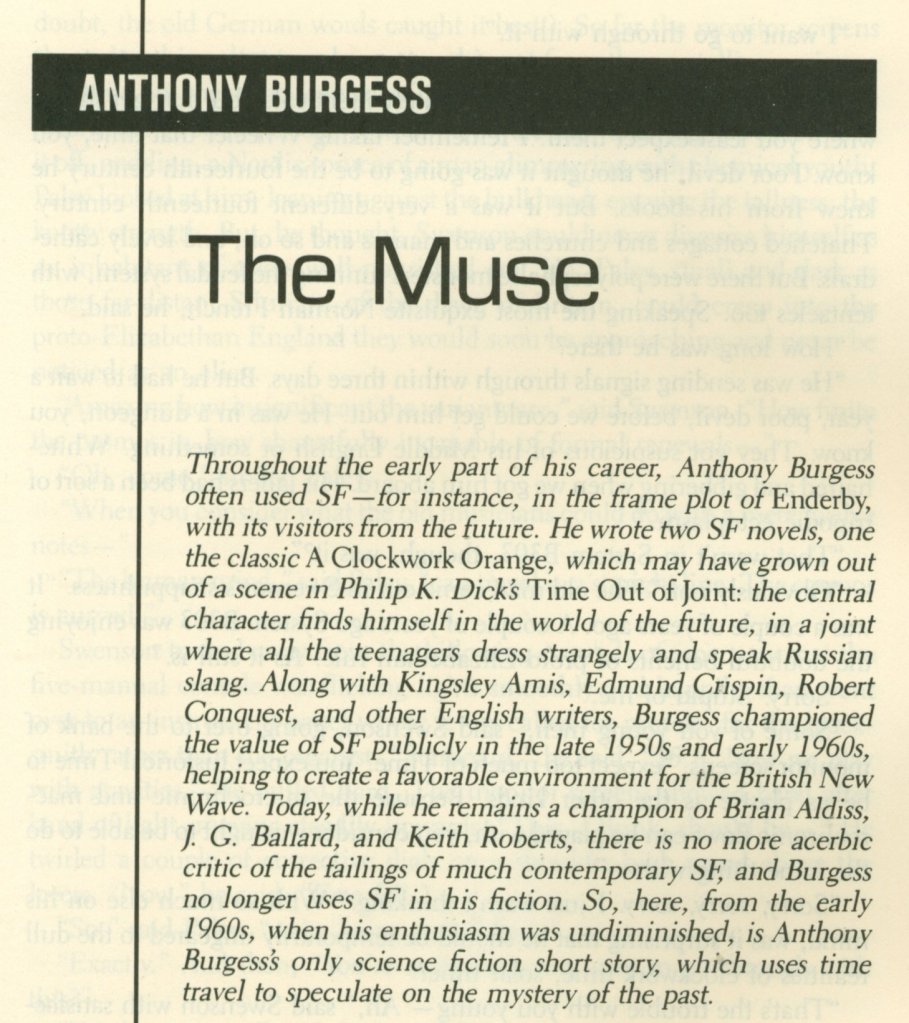
“The Muse” is an honest-to-God science fiction story written by a literary writer. Not only that but Anthony Burgess speculates like a true science fiction writer. Burgess comes up with his own unique form of time travel. It’s a variation of the many-worlds theory, but it’s uniquely his. I was quite impressed.

In David Hartwell’s introduction, he describes Anthony Burgess’s short exploration of science fiction early in his career before giving up on the genre.

A scholar named Paley, we assume from our Earth, travels across space to a system called B303, which orbits another Earth, one very much like ours, except in their evolutionary development, they have only evolved until the time of Shakespeare. Paley is one of those people who really want to know who wrote Shakespeare.

Unfortunately, for Paley, this Earth isn’t quite like ours, and humans have a few extra eyes that give their world a nightmare quality to people from our world.

From reading “The Muse” I could sense that Burgess understood the potential of writing science fiction. And he knew he had to tell his story as if his theoretical world really existed. No pussyfooting around. No smirking and winking at the audience. No, “Look at me MA! I’m being so fucking clever.” No “I’m smarter than you, with a better education from a goddamn Ivy League school.”

Burgess looked at science fiction, saw the rules of the game, and played by those rules. He got down to our level of maturity and babbled in our lingo. I’m impressed.

I was also impressed that he went on to write mostly books that weren’t science fiction. Science fiction is a black hole for most writers. They fall in and can’t get out. Science fiction has tremendous limitations. I believe writers destroy their potential if they only write science fiction.

While you read “The Muse” pay attention to what it does, and what it can’t do. Like in the story, science fiction would be one alternate Earth, but there are an infinite number of alternate Earths where there are other things more interesting than science fiction.

James Wallace Harris, 7/18/23

A Time Before Science Fiction

I believe young people can’t imagine what life was like before the Internet, smartphones, or personal computers. I can’t imagine what my parents’ lives were like living before television, or my grandmother’s life before airplanes, cars, radios, movies, and all the inventions that my parents grew up with. My mother’s mother was born in 1881.

Lately, I’ve been trying to imagine what life was like before science fiction. There have always been stories that had science-fictional elements. Isn’t Noah’s Ark really a post-apocalyptic tale? I’m talking about science fiction as a defined category, a genre.

Life Magazine had to explain science fiction to its readers in its May 21, 1951 issue. It covered books, magazines, movies, and even fandom. Science fiction as a term had been used for the genre for about twenty years before that, but mainly in pulp magazines, and with a very small group of Americans. It’s like how the internet and network computers were used by a small subset of the population for a couple decades before the public was introduced to the World Wide Web with Mosaic in 1993. (See my essay: “When Mainstream America Discovered Science Fiction.”)

I’m theorizing it was the paperback book that got America to discover science fiction. The technology of the mass-market paperback was like when the technology of the Netscape browser got America to discover the World Wide Web.

I consider the science fiction pulp magazines of 1926-1950 to be like the internet before the World Wide Web when few people used it and all the tools were text-based. In the late 1940s and early 1950s science fiction fans created small-press publishing houses to reprint pulp magazine science fiction stories in hardback. Print runs were typically 1,500-3000, and the books were sold mainly to fans, and some libraries. I consider this era to be like the short-lived Gopher technology on the internet. (See my essay: “Remember Fantasy Press, Arkham House, Primes Press, Gnome Press, Shasta Publishers, and Others.”)

My guess is the American public noticed science fiction when science fiction movies came out in the early 1950s and when Ballantine Books, Ace Books, Pocket Books, and others brought out lines of paperback books devoted to science fiction in 1953. Movies were everywhere, and twirling paperback racks were everywhere. By the way, there was a time before mass-market paperbacks. Paperbacks as we know them began appearing in the late 1930s, were widely distributed to soldiers during WWII, and exploded on the scene in the early 1950s. Read Two-Bit Culture: The Paperbacking of America by Kenneth Davis for an excellent history of the paperback.

My guess is if you asked the average American what science fiction was before 1950 most would not know, and some might say when you mentioned space travel, “You mean that Buck Rogers stuff?” My parents grew up before science fiction. I was born in 1951, and I didn’t understand the term until 1963 when I was eleven. I had encountered plenty of science fiction on television, but I didn’t think of it as a specialized subject, genre, or art form. I didn’t go to a new bookstore until 1967 when I was 16. My first bookstores were all used bookstores, and I didn’t discover them until 1965.

Even though I was born in 1951, after the time I said was the beginning of the time when the American public started to think of science fiction as a thing, I didn’t learn it myself until 1963, and even then I had to figure it out on my own. It wasn’t until 1964 that I discovered science fiction sections in libraries. Because I had trouble comprehending science fiction as a genre in 1963 at age 11, I imagine many people in the 1950s and 1960s still didn’t comprehend it fully either.

I don’t think it was until the 1970s, when shopping malls became common, and chain bookstores were popping up everywhere, that the public began to see science fiction book sections. The used and new bookstores I shopped at in the 1960s had science fiction sections, but the bookstores were tiny, and the science fiction sections were really just two or three shelves of books. Before March 1967 I had no friends who read science fiction. That’s when I met my lifelong friend Jim Connell. Before that, the only science fiction fan I met was on a Greyhound Bus, when I struck up a conversation with a soldier.

I have to wonder what the average American thought when they saw Destination Moon in 1950 or The Day the Earth Stood Still in 1951? Was it mind-blowing? Or just silly kid stuff? I remember talking to my grandmother in 1968 about the space program and the planned Moon landing. She said it wouldn’t happen, that God would stop it.

It’s hard for me to imagine life before I was born in 1951. I think it’s harder for anyone growing up in the 21st century. We get our conception of life before 1950 in old movies, mainly ones in black and white. And think about it — have you ever seen any character in any of those old movies ever mention science fiction, or even talk about a science-fictional subject?

It was a different world back then. A much different world. A world most of us can’t comprehend. But try to imagine people of different ages visiting a drugstore back in 1953 and finding these books on a twirling rack. Especially, people who lived in small towns and suburbs. Imagine young kids, working-class men, and young housewives. What would they think if they picked up one of these books? And what would it do if they bought one, took it home, and read it?

When I read Red Planet by Robert A. Heinlein in 1964 when I was twelve, that was when I knew science fiction was my genre. I was a convert. Even by 1964, the percentage of science fiction converts in the American population was very small. And the conceptual umwelt I experienced from reading that 1949 book in 1964 must have been far different from the mind-expanding experiences of twelve-year-olds reading it in 1949, or even what Heinlein felt writing it. When did you discover science fiction as a genre, and what was the book that converted you?

I picked 1953 as the year America discovered science fiction because that’s when Ballantine Books and Ace Books began publishing science fiction, and near the beginning of the general paperback boom. Science fiction paperbacks existed before 1953, but they were much fewer. 1953 was also a boom year for science fiction magazines. (See my essay: The 1953 SF&F Magazine Boom.)

I wrote this essay because I’m learning that the umwelt of every person is different. Not only for how we perceive reality but how our biological sensory inputs lead to comprehending different abstract concepts. We have a tendency to assume everyone sees and knows what we know, and that’s so wrong. What’s amusing me to contemplate is thinking about how we perceive things at different ages and in different generations. Science fiction is just one example. What’s weird to grasp is authors work to code their umwelt into a story but the umwelt the reader decodes isn’t the same. I wish I could have gotten my parents and grandparents to read one of my favorite science fiction books when I was a kid and then ask each of them how they interpreted it.

James Wallace Harris, 7/15/23

“Zero Hour” by Ray Bradbury

Zero Hour” by Ray Bradbury is story #30 of 52 from The World Treasury of Science Fiction edited by David G. Hartwell (1989), an anthology my short story club is group reading. Stories are discussed on Tuesdays, Thursdays, and Saturdays. “Zero Hour” was first published in Planet Stories (Fall 1947). The most famous place to read it is in Bradbury’s classic, The Illustrated Man.

I thought as I was reading “Zero Hour” this morning, “Hey, here’s a Bradbury story I haven’t read before!” Yesterday, I bought Bradbury Stories: 100 of His Most Celebrated Tales for $1.99 for the Kindle edition so I’d have his stories on my phone. That worked out well since I decided to read “Zero Hour” at 5:30am this morning while I was still in my sleeping chair. I love having a library that’s always with me.

But when I checked ISFDB.org I realized I’ve read it at least two times before. I read The Illustrated Man in 1969 when the movie version came out. I might have read it again when I bought The Illustrated Man on audio. And I read it when I read The Great SF Stories 9 (1947). Two definite times, maybe a third.

So, why didn’t I remember reading it this morning? It’s a wonderful story. “Zero Hour” has a very similar ending to “The Veldt” which is also in The Illustrated Man, and that’s a story I always remember. Maybe “The Veldt” just hogged those neurons allocated to Bradbury.

“Zero Hour” is about a little girl, Mink, under 10, who her mother thinks has an imaginary friend — a Martian. The story is told from the point of view of the mother, Mrs. Morris, watching Mink and her friends play outside. Mrs. Morris interviews Mink about the game when Mink comes in for lunch. It’s called “Invasion.” Mrs. Morris learns from Mink that only kids under 10 can play because older kids are too critical. Bradbury has often written about the enchanting time of childhood when believing was real.

I don’t want to say any more, because I don’t want to spoil your enjoyment of reading this wonderful little story.

I’ve always admired Ray Bradbury, especially when I was young. However, I never considered him a regular science fiction writer. He was always a horse of a different color. Bradbury’s sense of science is on the magic side of the spectrum. Ray Bradbury is closer to L. Frank Baum than Robert A. Heinlein. Bradbury seemed old even when he was young.

Ray Bradbury was born nostalgic. Mentally, he seemed to live in the 1930s or earlier. Even though he became famous for writing about rockets and space travel, it was from a nostalgic perspective, and not from being futuristic.

“Zero Hour” is a beautiful story about childhood and motherhood. It may have Martians invading Earth, it may have children who kill their parents, and it may have futuristic gadgets, but it’s really a view of Norman Rockwell’s America in the 1930s. Buck Rogers shaped his future, not Heinlein. Sure, “Zero Hour” has the twisted humorous horror of Charles Adams and Gahan Wilson, but essentially it’s a story about being a child of wonder.

My guess is I didn’t remember “Zero Hour” because Bradbury was prolific and many of his stories were similar in theme, so they blur together. However, after reading “Zero Hour” I wanted to read the other 99 Bradbury stories in that collection.

James Wallace Harris, 7/13/23

Which Writers Would Be Included In A Group Biography/History of 1950s Science Fiction?

The World Beyond the Hill by Alexei and Cory Panshin and Astounding Alec Nevala-Lee were two huge histories of science fiction in the 1940s. Both books focused on the magazine Astounding Science-Fiction, where John W. Cambell was a genre-shaping editor. The Panshins concentrated on three writers: Heinlein, Asimov, and van Vogt, while Nevala-Lee dwelt on Heinlein, Asimov, and L. Ron Hubbard. The Panshins volumes were more about the stories, with some biographical details. Nevala-Lee spent more words on the biographies of the four men, with less prose about their stories. Combined, the two volumes make a great overview of Astounding Science-Fiction in the 1940s.

What if a similar group biography/history was written about science fiction in the 1950s? I already own a bookcase full of books about science fiction but they aren’t the kind I want. The book I ache to read is a biography/history on the impact of science fiction in the 1950s that’s as impressive as biographies/histories written by Walter Isaacson, Robert A. Caro, or Doris Kerns Goodwin. I want to read a biography/history that would make the subject interesting to the general reader. I just finished Tune In by Mark Lewisohn, a giant history of The Beatles that only covered their career until 1962. That’s the kind of high-quality biography/history of 1950s science fiction I want to read.

Alec Nevela-Lee’s biographies approach that league. He could write the book I want, but I don’t think he would because he probably knows the market for such a volume isn’t very big. And I wonder if science fiction fans would want a history of science fiction in the 1950s by him. His books Astounding and Inventor of the Future were hard on his subjects. I thought them honest appraisals, but he may have done in John W. Campbell’s reputation, and he didn’t help Heinlein’s or Asimov’s. I ended up feeling Buckminister Fuller was brilliant but not very successful, and a bit of a nut or crank after reading Inventor of the Future. However, any honest biography of the influential science fiction writers of the 1950s is going to unearth some worms.

The whole phenomenon of science fiction in the 1950s could be fascinating to the general reader if it was written in the right way. Look how pervasive science fiction has become. Science fiction as a subculture actually had a far more lasting cultural impact than The Beats in the 1950s and The Hippies in the 1960s, yet those movements are more studied and written about. Organized science fiction fandom has since inspired many other forms of organized fandoms. There are connections between science fiction and the space program and computers, both of which also started in the 1950s. And as a pop culture art, science fiction might be bigger than rock. Rock music is fading, while science fiction is still big business.

So, who were the movers, shakers, and creators of 1950s science fiction? I don’t think the major players are as obvious as they were in the 1940s.

As a science fiction fan back in the 1960s I was commonly told that Heinlein, Asimov, and Clarke were the Big Three Authors of science fiction. Looking at our CSFquery database, which uses various forms of citations to remember short stories and novels, I’m not sure it backs up that common knowledge. Look at the results. I’ve set the citation level at 3 or more citations. (Short stories are within double quotes, and novels are italicized. Clicking on the number of citations will show you the individual citations.)

The three writers with the most citations were Heinlein with eleven, and Bradbury and Asimov with eight each. However, some of those cited stories first appeared in the 1940s. After that, three authors have six titles on the list: Alfred Bester, C. M. Kornbluth, and Fritz Leiber.

Before looking at this data, I would have said Philip K. Dick, Alfred Bester, John Wyndham, and Walter M. Miller, Jr. were the breakout science fiction authors of the 1950s. Another indication of their popularity is how many photographs I can find of these men, especially ones taken in the 1950s. I’m guessing since photographs are hard to find, then details about their lives will be just as hard to find. That suggests any history of science fiction that focuses on anyone other than Heinlein, Bradbury, and Asimov will be covering events in the shadows of history.

If we alter the search to allow any work with two or more citations we see other authors standing out, but I’m not sure if it would change the overall apparent rankings. Thirteen women writers are on this list, but none have very many stories listed. I’m afraid the 1950s was still a male-dominated decade for science fiction.

And what about editors? Many histories of science fiction claim that John W. Campbell wasn’t as influential in the 1950s. But who was then? H. L. Gold at Galaxy is often mentioned. Anthony Boucher, and maybe J. Francis McComas at The Magazine of Fantasy and Science Fiction. There were dozens of science fiction magazines published during the 1950s, and I’m not sure if any other editor stood out. But then I haven’t researched it. However, I would say the 1950s were still a magazine-driven era for science fiction.

The Panshins and Nevala-Lee had Astounding Science-Fiction to anchor their history/biographies of the 1940s. The Magazine of Fantasy and Science Fiction, Galaxy, and Astounding Science Fiction dominated the 1950s, but there were many other magazines that published significant science fiction and influenced the genre. I don’t know if a history of science fiction of the 1950s could be as focused as The World Beyond the Hill and Astounding. The genre just exploded in too many different directions.

The small press or fan press science fiction publishers of the 1950s are legendary, especially to collectors, but I don’t know if any of their editors had that much influence. I would think the editors at Doubleday and the Science Fiction Book Club could be a consideration if I knew who they were. Another consideration is Donald A. Wollheim. His work at Ace Books was both influential and widespread.

If a single volume could be written about science fiction in the 1950s it might need to be divided into twelve chapters, one for each year, or into 120 chapters, based on the months. A linear progression through the decade might be the best way to capture the history of science fiction in the 1950s. And the book would have to be big, maybe a thousand pages.

There is one significant book about science fiction history in the 1950s that I know about, Transformations: The Story of the Science Fiction Magazines – From 1950 to 1970 by Mike Ashley. I have quite a few other books that cover that era in science fiction, but none are of the scope I’m talking about. I wish Ashley’s books were available in cheap Kindle editions so more people would read them.

And should we also add the impact of the movies and television? Should we consider George Pal and Rod Serling as movers and shakers of 1950s science fiction, for this book I want to read? An Astounding-like biography/history of science fiction in the 1960s would include Gene Roddenberry and one for the 1970s would have to include George Lucas and Steven Spielberg.

I wish I had the skill and stamina to write a history of science fiction in the 1950s. I’m in awe of the work done by the Panshins and Nevala-Lee. I would love to read a book about 1950s science fiction like I’ve described, so if you’re a writer looking for a topic, here’s one. I don’t know how many copies it would sell. Sadly, the audience for such a history is getting old and dying. I wrote this essay to gauge interest in such a book, but I’m not finding much so far. However, a good biographer can make any person or topic into a page-turner.

James Wallace Harris, 7/11/23