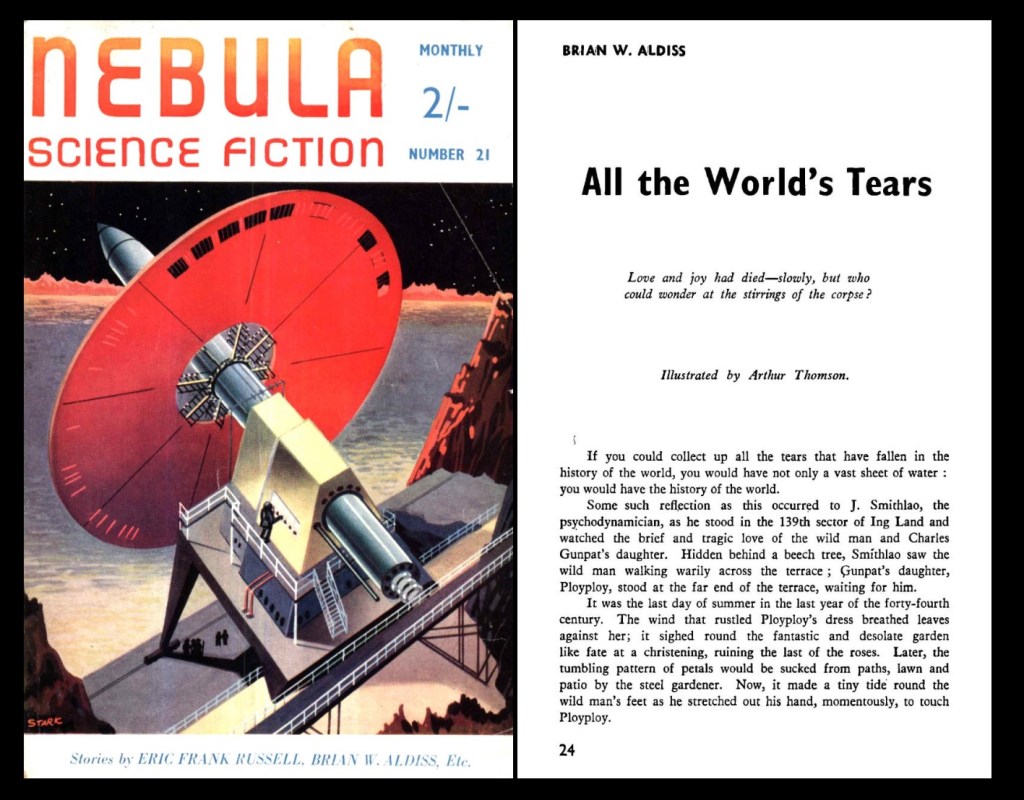
“All the World’s Tears” by Brian W. Aldiss

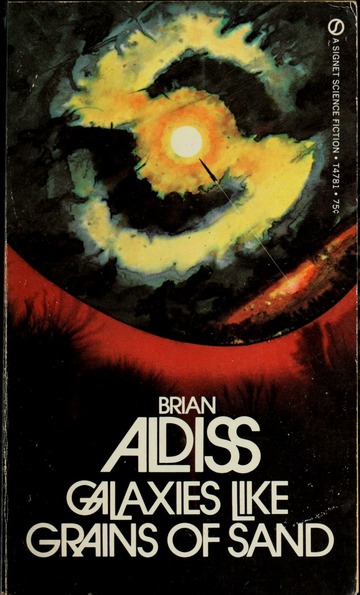
All the World’s Tears” by Brian W. Aldiss was first published in Nebula Science Fiction 21 in 1957. It has been rarely anthologized, but frequently reprinted in collections of stories by Aldiss. Older American science fiction fans might remember reading it in Galaxies Like Grains of Sand (1960). However, that collection has been republished many times with varying numbers of stories. I don’t recommend the current Kindle edition because it leaves off the story titles, uses the theme titles instead, and runs the intros into the beginnings of the stories. It’s readable but annoying.

You can read “All the World’s Tears” in Nebula Science Fiction 21. You can read a review of Galaxies Like Grains of Sand at Science Fiction and Other Suspect Ruminations.

Galaxies Like Grains of Sand is a fixup novel with a mosaic story composed of eight or nine unrelated short stories glued together by imaginative introductions. Sort of like Simak’s City. It feels like a cross between Last and First Men and The Dying Earth.
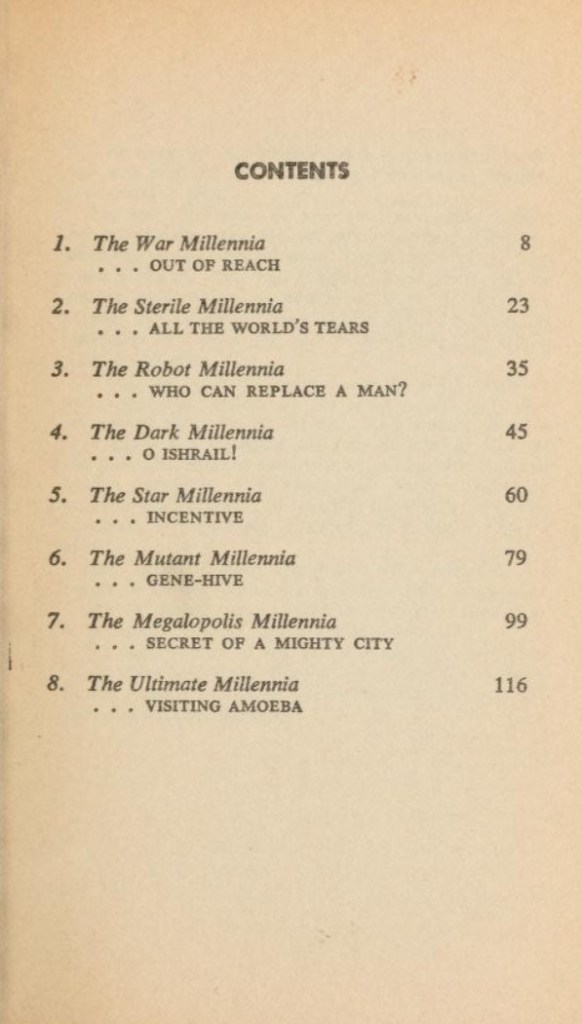
“All the World’s Tears,” is the second story, under the theme “The Sterile Millennia.” For being such a short short story is dense with ideas, atmosphere, and imagery. The opening sequence, tells us the ending but we won’t know that until we get to the last page and read it. Aldiss has painted a future Earth of stark contrasts. The setting is the far future, the last day of summer of the 44th century. Earth no longer supports billions of humans, just hundreds remain, living in a high-tech society under the control of robots. No one is poor, but civilization is in decay.

Robots control every intent of peapods, bees, birds, and ants. The agricultural land is impoverished, yet wild mother nature is encroaching everywhere. I have to wonder if this is the mid-way point between the mid-20th century and the future of the Hothouse stories Aldiss would soon write.

Strangely, the robots do everything, yet are rather dumb. They monitor all activity, yet talk between each other in clumsy English and can be easily fooled. At one point, a man evades security robots by holding tree branches and telling the robots he’s a rose bush.

Aldiss’ prose suggests vivid scenes for paintings and films. Aldiss is quite imaginative. Both Hothouse and Galaxies Like Grains of Sand could be the basis for wonderful animated films for adults.

“All the World’s Tears” feature four human characters and several robots. The main character of focus of Ployploy. She is a young woman who is considered mentally deficient for being kind and barred from having children. However, Ployplay is well-loved by her father Charles Gunpat. She is judged a hereditary throwback because she is white and can’t express herself with hate and aggression. I can’t but wonder if Aldiss isn’t being racist here by suggesting non-white people are the genetic aggressors. Although he could also be suggesting that whiteness disappeared as the world’s population homogenized, and aggression was another trait that emerged after thousands of years of endless wars.

Observing Ployploy is a visitor, J. Smithloa, who is hired to visit Gunpat’s estate. He is a professional insulter, hired to fire up people’s aggression so they will mate and work to keep civilization going. The fourth character is a wild man sneaking onto Gunpat’s estate. He lives outside the control of the cyber-controlled state and wants Ployploy to run off with him.

Aldiss envisions the future as being extremely regulated, and high-tech, yet, falling into decay, near the end of mankind’s reign on Earth. Wild nature will soon overrun what is left of our civilization. Not only is Aldiss’ picture of our future bleak, but the couple we want to escape this horrible society die tragically.

Why did Aldiss write this story? Why is he so pessimistic? Over the past couple of years, I’ve become a fan of Brian W. Aldiss. Sometimes his works seem more adult, more mature than American science fiction. I assume in the 1950s, Aldiss extrapolated human aggression constantly evolving through natural selection into what he projects in “All the World’s Tears.” I have not read all the stories in Galaxies Like Grains of Sand, but the ones I have contain the same Darwinian cynicism about the future. In these stories, it’s a red tooth and claw existence.

I read this story years ago, and then yesterday, and again today. Each time I found more little nuggets of speculation. The story is both slight and deep. Aldiss included in his collection Man in His Times: The Best Science Fiction of Brian W. Aldiss, a collection I’m group reading on Facebook.

James Wallace Harris, 7/9/23
“The Lens” by Annemarie van Ewyck

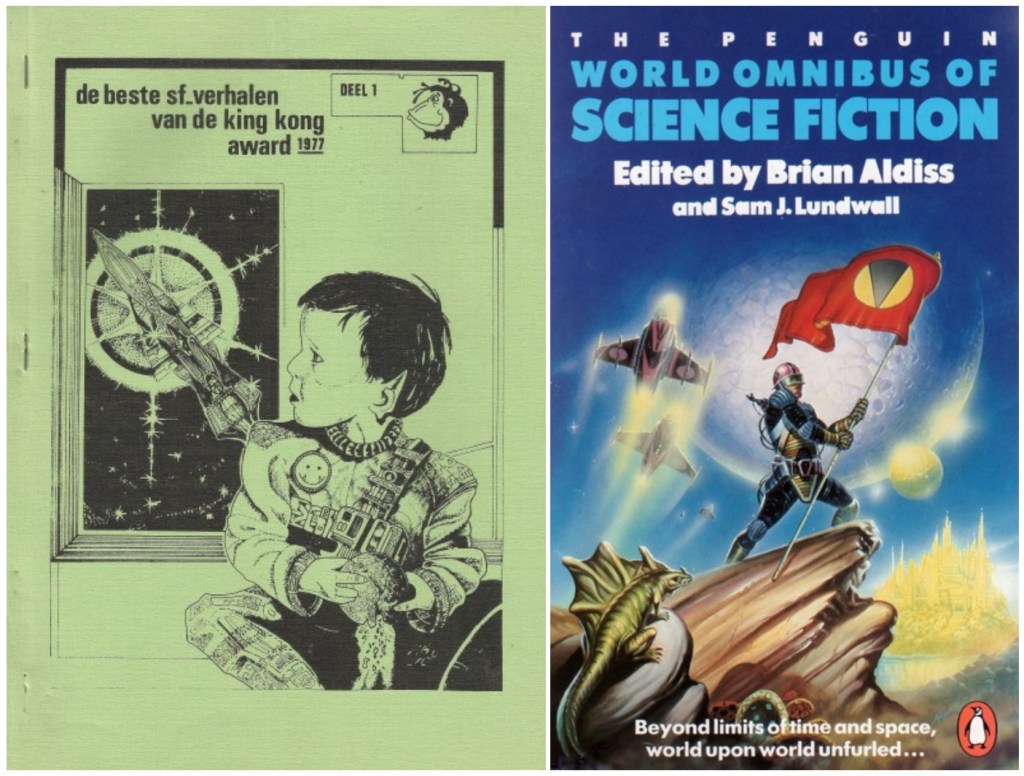
The Lens” by Annemarie van Ewyck is story #28 of 52 from The World Treasury of Science Fiction edited by David G. Hartwell (1989), an anthology my short story club is group reading. Stories are discussed on Tuesdays, Thursdays, and Saturdays. “The Lens” first appeared in Dutch in De beste sf-verhalen van de King Kong award 1977, deel 1 (Dec. 1977/Jan. 1978). In 1986 it was reprinted in English in The Penguin World Omnibus of Science Fiction edited by Brian W. Aldiss and Sam J. Lundwall.

Annemarie van Ewyck was Annemarie Pauline van Ewijck (1943-2017). She only has three short stories listed in ISFDB and was mainly an editor and columnist. The periodical above where the story first appeared looks like a fanzine to me.

Once again, I find it interesting that my take on a story is different from Hartwell’s. More and more, I’m realizing that The World Treasury of Science Fiction (1989) seems like a precursor to The Big Book of Science Fiction (2016) and that I’m out of touch with both editors. I might just be out of touch with the genre in general. However, with “The Lens” I believe it’s a perfect story for this anthology, and it’s my kind of science fiction.

Here’s Hartwell’s intro:

I thought “The Lens” was quite a nice story, especially effective for being so short, but I didn’t think “The Lens” reflected the mood, tone, or concerns of 1950s science fiction. I don’t know if that era can be generalized, and I wonder if there really is a general style to post-Anglo-American post-New Wave works. “The Lens” doesn’t feel like Bradbury, Zelazny, or Sturgeon to me at all but it does remind me of James Tiptree, Jr., but also Ursula K. Le Guin.

In other words, “The Lens” reminds me of 1970s science fiction written by women, which it is, but can we generalize on that? Is there a common denominator? I don’t think so, other than a female character in an alien society feeling the shock of otherness after undergoing an alien rite. But isn’t that theme also explored by Jack Vance in “The Moon Moth” or Downward To the Earth by Robert Silverberg?

As the years go by, I’m less inclined to believe there was much of a New Wave in science fiction, despite the efforts of Michael Moorcock, Judith Merril, and J. G. Ballard. Yes, there were some experimental efforts, like the kind we saw in New Worlds, England Swings, and Dangerous Visions, but that kind of experimentation had been going on in the literary world for a long time. I believe by the 1960s and 1970s the genre was just getting more diverse writers, and better writers in general, writers who were willing to try different ways to tell a story. By then writing programs were flourishing everywhere.

I also know people get tired of me bellyaching about some stories in these anthologies not being science fiction. That’s not because of how they were written, or by who. I believe science fiction represents a state of mind, and “The Lens” is definitely science fiction, and fits within that state of mind.

The first-person narrator, Dame Ditja, a diplomat, is returning from Earth to Mertcha after visiting their dying mother. We know things are very different when we learn her mother died at age 286. I liked how Dame Ditja described her relationship with their mother and their interaction with the other passengers on the ship. She is returning to the city of Tiel where she is the Head of Cultural Liason.

On Mertcha, the aliens have three arms and three legs, and their architecture and philosophy reflect that difference. Dame Ditja has decided to request a permanent assignment to Mertcha, which she now thinks of as home. She expected to be met at the spaceport by Mik, a local who is her driver and friend, however, a substitute driver meets her instead. That driver thinks she is an ordinary tourist and takes her to a holy place that is a main tourist attraction for people from Earth.

At the Holy Place of Tiel, Dame Ditja has a transcendental experience, one of ecstasy, one that is usually experienced by certain believers in this alien culture. While having this experience, Dame Ditja realizes that radical monks of this faith have trapped some tourists from Earth to hold hostage, and Dame Ditja comes out of her trance and carefully, but forcefully, frees them in a diplomatic coup.

This achievement gets her offered more prestige assignments, and Dame Ditja changes her mind and plans to leave, even though all through the story she wanted to stay.

The ending is strange. Because of the incident at the Holy Place of Thiel, Dame Ditja no longer feels like Mertcha is her home, and thus feels compelled to leave. It appears Dame Ditja wants to die, and she feels she can only die in a place she considers home. I’m not sure why she wants to die or is ready to die, but I wonder if it’s because people live too long in this fictional future?

After reading this story twice I feel it’s closest in style and tone to some stories I’ve read by Brian W. Aldiss. On the first reading, I would have rated this story ***+ but on my second reading, I feel it’s a **** story.

James Wallace Harris, 6/8/23

“The Dead Past” by Isaac Asimov

The Dead Past” by Isaac Asimov is story #27 of 52 from The World Treasury of Science Fiction edited by David G. Hartwell (1989), an anthology my short story club is group reading. Stories are discussed on Tuesdays, Thursdays, and Saturdays. “The Dead Past” first appeared in Astounding Science Fiction (April 1956). I can find no ebook or audiobook edition of this story.

Normally, I don’t link to the Internet Archive because I worry it’s going to be taken down. But for “The Dead Past” you can read it here in a scan of the April 1956 Astounding.

Let’s imagine that “The Dead Past” is a robot Isaac Asimov built. This robot has a specific function, to trigger certain ideas and emotions in readers. I believe we can understand this story in terms of the motors and gears Asimov used to design his robot.

  1. The first motor is Arnold Potterley, Ph.D., a Professor of Ancient History. Arnold is obsessed with ancient Carthage. He desperately wants to use a time viewer to prove that specific history about Pre-Roman Carthage is untrue, and were lies created by their enemies the Greeks and Romans.
  2. The second motor is academic control, as viewed through The Department of Chronoscopy, which has the power to view the past using the science of neutrinics, an area of physics created by a man named Sterbinski.
  3. The third motor is Jonas Foster, a new instructor in the physics department.
  4. The first gear system is a dystopian society that rigidly controls all academic research. Asimov used this feature to satirize the real-life academic bureaucracy that he had to deal with. Arnold fights against this bureaucracy to get access to the time viewer to do his research. Jonas becomes intrigued with why the bureaucracy suppresses the time viewer. The two men’s motives mess to work together secretly to build their own time viewer.
  5. The fourth motor is Caroline Potterley, Arnold’s wife. She is obsessed with the death of their child, Laurel, who died twenty years earlier at age 3. She wants the time viewer to see Laurel again.
  6. The second gear system is the mystery of Laurel’s death. Arnold is afraid that if Caroline could see the event he might be blamed. I believe Asimov added this system to his machine because he wanted an emotional component.
  7. The fifth motor is Ralph Nimmo, a popular science writer.
  8. The third gear system links Ralph and Jonas and allows Asimov to express views on science writers, as well as enable the building of a home time viewer.
  9. The sixth motor is Thaddeus Araman, Department Head of the Division of Chronoscopy. He is in charge of suppressing the technology of time viewing for a very specific reason.
  10. The last gear is between Arnold, Caroline, Jonas, and Thaddeus. The first three want to view the past, and the last wants to stop them. The why is the revelation of the story.

“The Dead Past” is one of Asimov’s better stories, even a favorite to some. I liked it quite a lot but found it clunky. The driving force behind Arnold is to prove ancient Carthage didn’t practice child sacrifice, and the driving force behind Caroline is to see her dead child again. Jonas is so intrigued by a possible conspiracy theory that he throws over his budding career in physics. I thought all three of these fictional motives were melodramatic. They do work, adding complexity and emotion to a rather dry final idea, but it’s a shame that Asimov didn’t come up with a more sophisticated emotional linkage.

I think Asimov would have shown more finesse if he had foreshadowed the ending. There is a cross-link between Arnold’s and Caroline’s desire to see the past, but neither predicts the real reason why Thaddeus wants to suppress the time viewer. This might be simplistic on my part, but if Arnold, Caroline, and Jonas each had a reason to use the time viewer, and one of their reasons should have foreshadowed the real reason why Thaddeus thought the time viewer was so dangerous. I believe the story would have been tighter if Jonas has wanted to use the time viewer to uncover the conspiracy, and Caroline wanted to use it to spy on Arnold and Jonas.

I don’t think Asimov was a very mature person. From what I’ve read about him, and from reading his stories, he comes across as a rather clever child prodigy who as an adult had trouble comprehending human relationships. This is often reflected in his stories. His fiction focuses on ideas, and his characters are constructed to present those ideas. In “The Dead Past,” Asimov tries harder than usual to present adult emotions, but they come across as contrived. Still, “The Dead Past” is a good example of Asimov trying to overcome his weakness. I give him credit for that.

Two or three years ago I read or reread all of Asimov’s robot stories. They were all hampered by this problem. I could always see how Asimov added human emotion to his stories. When I was young, that effort worked unseen, but as I got older, the stories succeeded in their ideas but felt clunky in their efforts to deal with genuine humans and relationships. In fact, I was sometimes horrified by some of Asimov’s emotional conclusions – but that’s for another essay.

“The Dead Past” is a nicely worked-out science fiction story. Asimov adds psychological depth to a neatly complex plot. Unfortunately, he uses B-movie creativity for creating the psychological drivers of this story.

Finally, regarding “The Dead Past,” I want to make a protest, or maybe a lament. This is my third reading of the story, and this time I wanted to read “The Dead Past” with my eyes, and then listen to it again from an audiobook. But I could find no audiobook edition. Nor could I find an ebook edition. This annoyed and depressed me. “The Dead Past” is one of Asimov’s best works of short fiction. You can find it in print in The Complete Stories, Volume 1. There are US and UK versions on Amazon, but they don’t have the same number of pages, so I don’t know which to recommend. However, used copies of the US edition are quite common and much cheaper.

I now prefer consuming fiction via ebooks and audiobooks. I hate that Asimov’s short fiction, as well as other science fiction writers’ short fiction, is either not available or is no longer available in these formats. A friend eventually found an epub version for me to read, and that visually easier-to-read format made reading the story far more enjoyable.

I recently noticed that all English language versions of Brian W. Aldiss audiobooks have been pulled from Audible. Classic old science fiction is slowly disappearing. There’s still plenty to buy and read, but it’s disappearing at the edges. I hate that.

James Wallace Harris, 7/6/23

.

“Inconstant Moon” by Larry Niven

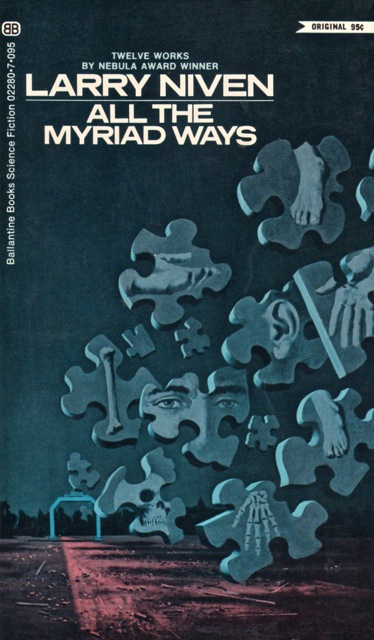
Inconstant Moon” by Larry Niven is story #23 of 52 from The World Treasury of Science Fiction edited by David G. Hartwell (1989), an anthology my short story club is group reading. Stories are discussed on Tuesdays, Thursdays, and Saturdays. “Inconstant Moon” first appeared in Niven’s 1971 collection, All the Myriad Ways. Currently, the story is available in N-Space, a retrospective collection of Niven’s work from 1990. If you want an ebook version of the story, it’s included in Masterpieces: The Best Science Fiction of the Century edited by Orson Scott Card.

Outer Limits dramatized the story – watch it on YouTube.

“Inconstant Moon” is one of those science fiction stories where the main idea sticks with you even if you don’t remember the plot or characters. “Inconstant Moon” won the Hugo for Best Short Story in 1972, and is the kind of classic SF tale I expected to see in an anthology that remembers the best science fiction of the 20th century.

Stan and his girlfriend Leslie realize something epic is happening when the Moon becomes much brighter than normal. “Inconstant Moon” is an astronomical science fiction story like “Nightfall.” I don’t know if I should tell you anymore, I wouldn’t want to spoil the fun.

“Inconstant Moon” is the kind of short story that inspires readers to ask themselves what they would do in a similar situation.

<<<Beyond Here Lie Spoilers>>>

Most science fiction is geared toward young people with romantic minds who want to fantasize about being action heroes, while “Inconstant Moon” is aimed at adults who take more wistful prosaic paths. The protagonists aren’t young or heroic, and their actions are quite ordinary and mundane. The setting is only slightly in the future from 1971, after the Apollo 19 landing. Niven didn’t know that sadly, Apollo landings would end with 17 in 1972. He even has Stan talking about getting to handle a moon rock, which I don’t know if NASA ever allowed either.

Stan goes out on his balcony one night and the Moon is several times brighter than normal. He starts wondering why and eventually concludes the Sun has gone nova. This is my third time reading this story, but I remember when I read it the first time being quite surprised that people would still be alive after such an event. Until I read “Inconstant Moon” the first time, I imagined if the Sun went nova it would instantly vaporize the Earth.

Niven gives us a more thought-out scenario. Earth is 8.5 light-minutes away from the Sun, and Jupiter is 44.2 minutes. Niven imagines the Earth itself being a barrier that protects people on the side away from the Sun, and that a shockwave travel at the speed of sound would circle the Earth. Stan rushes over to see his girlfriend, hoping to have a few good hours before the end of the world. He doesn’t tell Leslie his theory, but eventually, Stan realizes she came up with it on her own too.

I would love to see an episode of PBS’s NOVA analyze the same situation.

Stan and Leslie assume the shock wave is hours away, and it will kill them before California faces the sun. They go out for ice cream and drinks after having sex. I felt “Inconstant Moon” had an adult vibe not because of the sex, but because of the mental processes Stan and Leslie go through. My guess is young characters and readers, would think and act differently. This age-difference reaction can be seen in “The Last Day” by Richard Matheson (Amazing Stories, Apr-May 1953). Read it here.

Ultimately, Stan figures out the Sun didn’t go nova, and that it must have been a very large solar flare. It means they might live, and that changes the course of the evening.

It’s a shame we don’t get more science fiction that makes us think like this story. Some stories inspire arguments like, “The Cold Equations” by Tom Godwin, but Niven’s story makes readers think about physics and astronomy. Isaac Asimov used to write about how science fiction fans of his generation would tell their parents they were learning science from science fiction. That seldom happens, if ever. But with this story, Niven sets up a scientific situation that makes us think about science rather than science fiction.

Does anyone know what would likely happen to the Earth if the Sun went nova or there was an extremely large flare?

James Wallace Harris, 6/27/23

Resonating With Malzberg

The writer I feel the most philosophically in tune with at the moment is Barry N. Malzberg, especially while reading his 2018 collection of columns from Baen’s Universe (2007-2010) and Galaxy’s Edge (2010-2017) titled The Bend at the End of the Road. I woke up this morning thinking I would write an essay titled “The Skeptics of Science Fiction” about science fiction writers who have come to doubt their genre, or “Why I Read Science Fiction in My Seventies” about how I no longer read science fiction to enjoy the story but to study each story as part of a science fiction history.

Malzberg’s essays do both, and I might still write those essays even though I feel Malzberg has already blazed those trails thoroughly. I have not finished the over forty essays in the collection, but I’ve read enough to sense a common feeling that I think Malzberg and I share about science fiction. I’m going to try and describe that feeling. Malzberg is 12 years older than I am, far more knowledgeable about science fiction, and further down the road of experience.

What I say won’t be what Malzberg says, but I think we’re in the same club. There’s enough resonance that I must wonder if we aren’t in essential agreement. I am not paraphrasing his book, but I’m going to describe how I feel which I believe is how he might feel using different words. Which may be how you feel and convince you to buy his book.

Our reality does not come with a prescribed meaning or purpose. We are all existentialists who must create our own meaning in life. When I was twelve I rejected the religion that was being forced on me and embraced science fiction instead. It wasn’t conscious on my part, and only understandable in hindsight but it’s understandable for the times, 1963. Science fiction, if you understand how I read it makes a good substitution for religion. I thought science fiction was a roadmap to reality and it became my mentor and guidance counselor.

Over the decades I realized this was silly, but I never could shed my love of science fiction. It was my chosen compass and I couldn’t stop using it to guide me even though I eventually became an atheist of my chosen religion. Science fiction promised transcendence and I never forgot that hope. I am like the characters in Hermann Hesse’s Journey to the East who have fallen off the path of enlightenment but achingly and vaguely remember it, and who keep searching to find it again.

Now that I’m older and rereading the science fiction from the 1940s, 1950s, 1960s, and 1970s, the works that shaped my soul, I’ve discovered how I was programmed and have been deprogramming myself. However, I just can’t let my love of those works go. I no longer admire them for what they meant to me when I was young but find meaning in understanding them as a subject of literary scholarship.

Malzberg goes back again and again to examine old science fiction stories that we both read, admired, or disliked. He keeps finding new personal revelations in that effort, and that’s where I’m at too. I often share his insights in stories I’ve reread and am intrigued by the insights in the stories I haven’t, but now plan to.

An important part of the equation is aging. Malzberg and I revere old science fiction and feel modern science fiction has lost its way. But young readers have become the new faithful and reject old science fiction, the old faith. I grew up at a time when science fiction was the bible stories preaching the gospel of the final frontier. The reality of space travel and science fiction parted from each other decades ago. And what science fiction has become is something I can’t believe in.

So Malzberg, and I, and I imagine many others from our generations, have become scholars of science fiction. We’re non-believers like Bart D. Ehrman who specializes in Biblical studies. On one hand, we enjoy the storytelling techniques of a bygone era and we like to understand the stories in their historical context. On the other hand, we are self-psychoanalyzing our own youth and development.

We used to believe we were part of an important movement, but now realize it was very tiny. And that our movement was taken over by the entertainment industry and made into a new opium of the masses.

We all want to believe what we love to read. We all want to believe we have something in common with authors whose fiction and nonfiction we think we agree with. We can never know what something meant in their writing, but human nature makes us want to find people like ourselves. For a while, science fiction gave some of its fans hope of transcendence and a shared belief system. Like most beliefs in this reality, it was mostly illusions, if not all.

I don’t think I could ever write a proper review of The Bend at the End of the Road because Malzberg covers too many topics that I’d want to discuss in detail. I could probably write at least one essay, if not several from reading each of his essays.

James Wallace Harris, 6/24/23

“The Phantom of Kansas” by John Varley

The Phantom of Kansas” by John Varley is story #21 of 52 from The World Treasury of Science Fiction edited by David G. Hartwell (1989), an anthology my short story club is group reading. Stories are discussed on Tuesdays, Thursdays, and Saturdays. “The Phantom of Kansas” first appeared in Galaxy Science Fiction (February 1976). It is currently available in The John Varley Reader: Thirty Years of Short Fiction. That collection is available on paper, as an ebook, and as an audiobook (18 stories — 26 hours and 36 minutes).

A science fiction writer is like an artist with a blank canvas, they can paint anything they can see or imagine. When you look at composing science fiction that way, you have to wonder why some authors put more on their canvas and others less, and where the images come from. With, “The Phantom of Kansas” John Varley decided to lay out his canvas with a series of related science-fictional scenes.

The setting is the Moon — after aliens have taken over the Earth and pushed humans out across the solar system — part of Varley’s Eight Worlds series. Now this image is enough to fill a whole canvas but is merely a small object in the background in this painting. Varley wisely chose not to do an elaborate alien invasion mural, those were old and tired even back in 1976. We are told it’s November 342, so I assume humanity restarted the clock when our home world was snatched away from us. This aspect of the painting does intrigue me, and I wish I could see that section of the canvas expanded.

The plot is a murder mystery. The protagonist, a woman named Fox, has just been revived in a clone body and learns she’s been murdered three times before. So she’s actually Fox 4. Because some murderers in this future like to permanently kill people, they must kill the person and destroy the memory cube that backs up their personality. This murderer has failed three times, why? Fox is told she should expect to be murdered again unless the police can find the murderer first. She doesn’t want to become Fox 5. This is a solid subject for a painting and I would have been satisfied if it was the subject of the whole canvas. However, I wouldn’t have been that impressed, not like I am with the additional imagery Varley squeezes in.

For Varley, this unique murder mystery wasn’t enough to dominate his canvas. We see Fox is an artist who engineers weather dramas. This requires quite a bit of world-building on Varley’s part. Humans who live on the Moon mainly live underground, but they crave being out in nature like humans did on Earth. So giant artificial environments are created that replicate various natural settings from old Earth. Varley calls disneylands. Fox is working on a giant storm symphony that spawns several tornadoes for a disneyland that’s a replica of the Kansas prairie.

The Kansas disneyland is a hollowed-out cylinder twenty kilometers beneath Clavius. It’s two-hundred and fifty kilometers in diameter, and five kilometers high. That’s a huge feat of super-science engineering.

Now this is interesting. Those pesky aliens got rid of humans and all our artifacts on Earth so they could enjoy nature. The human refugees in space long for the wonders of Mother Nature. What should we feel about that revealed in the painting? Back in 1976 when I was young I was dying to go into space, but now in 2023 and I’m old, you couldn’t pay me to go there. Mother nature is the place to be.

But Varley isn’t finished with adding subjects with his brush. He paints another character onto his canvas that vividly stands out, the Central Computer. Varley portrays the computer as it, which I like. Gender is a biological trait. And like Mike in The Moon is a Harsh Mistress, this computer is a quite charming and appealing image.

And there is one other aspect that reminds me of Heinlein. People can change gender. Fox has been a he in the past. And, at first, I thought this was just another added detail in Varley’s scene, but it turns out to be an essential plot element.

I’ve seen “The Phantom of Kansas” before, decades ago, and it impressed me then, except that it depends on one of my least favorite scenarios in science fiction, brain downloading and uploading. And I like that theme even less this time. However, it’s needed for the plot, so I begrudgingly accepted it.

In my judgment of art, science fiction scenes are somewhat realistic paintings, inspired by what we see in reality, whereas fantasy scenes are modern art, paintings inspired by inner visions. I liked this painting better this time because I viewed the painting as a fantasy. It’s a clever image of a murder mystery derived from an interesting series of what-if mental conjectures.

Ultimately, the painting, “The Phantom of Kansas” is elegantly symmetrical. Like any good mystery, all the clues were there, even if they were highly contrived.

James Wallace Harris, 6/22/23

“Two Dooms” by C. M. Kornbluth

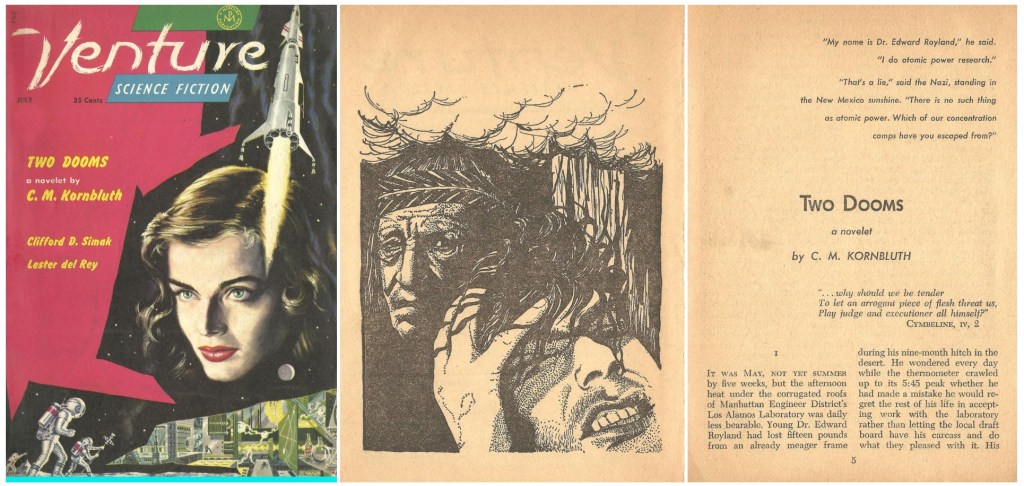
Two Dooms” by C. M. Kornbluth is story #17 of 52 from The World Treasury of Science Fiction edited by David G. Hartwell (1989), an anthology my short story club is group reading. Stories are discussed on Tuesdays, Thursdays, and Saturdays. “Two Dooms” was first published in Venture Science Fiction (July 1958). “Two Dooms” was a posthumously published story since Kornbluth had died earlier that year in March. (By the way, “Two Dooms” is available in The Best of C. M. Kornbluth which is selling today at Amazon for 99 cents for the Kindle edition.)

I finally struck gold. I read these old anthologies hoping to find great science fiction stories I’ve missed, and “Two Dooms” is one such work. I can’t believe I missed it. My memory is faulty, so I could have read it. Decades ago I owned A Mile Beyond the Moon, Kornbluth’s collection that first put the story in book form. I’ve also owned, The Best of C. M. Kornbluth for decades, as well as both the hardback and audiobook of His Share of the Glory: The Complete Short Science Fiction of C. M. Kornbluth, and three anthologies in which “Two Dooms” has been anthologized. Kornbluth is one of those authors I’ve always meant to dive into and read all their stories but never have. “Two Dooms” makes me regret that.

The best way I can describe “Two Dooms” that will make you read it is to say: “Two Dooms” is probably the story that inspired Philip K. Dick to write The Man in the High Castle. I have no way of knowing if PKD read “Two Dooms” but it really feels like it. I’m not saying Dick copied Kornbluth, but like many science fiction stories, many writers read about a juicy idea and want to use it too, but in their own way.

And it’s not just that Dick’s novel and Kornbluth’s novella are alternative histories where Germany and Japan win WWII and occupy the United States — several writers have explored that idea, it’s that each writer chose a mystical philosophy to flavor their story. PKD uses the I Ching and Kornbluth uses Hopi Indians and psychedelic medicine. Both authors gave a low-level view of the occupation. Both authors were concerned with the little people at ground level rather than the big historical perspective. But finally, I think the stories feel similar because both writers were tortured souls.

Kornbluth’s POV character is Dr. Edward Royland, a young physicist working at Los Alamos, New Mexico on the Manhattan Project during WWII. It’s early on, and they aren’t even sure they can build a bomb. Royland isn’t happy with his job, especially working in the miserable heat. One day after work he drives into the desert to meet his friend Charles Miller Nahataspe, a Hopi Indian shaman. This part of the story reminds me tremendously of Carlos Castanada’s books. Kornbluth gives us a fair amount of information about how the Hopi see reality differently from us and even claims the Theory of Relativity is something Hopi understand as children because they have no concept of time like we do. I wonder what books Kornbluth read that inspired him to write this part?

Nahataspe gives Royland some dried, blacken mushrooms. He tells Royland because he doesn’t see reality clearly, they will be safe to experience — that Royland’s cloudy vision of reality will protect him. But Nahataspe was wrong, Royland’s vision isn’t cloudy, and the magic mushrooms take him into the future where the Axis powers rule America.

It’s interesting to compare Kornbluth’s and Dick’s methods of getting their characters into an alternate history. Kornbluth uses the old-fashion literary technique of putting his character to sleep and having them wake up in a new world. Dick begins his story in the alternate history, and one of the amusing aspects of his method, is his characters speculate about our reality.

In olden times, the first-person account was considered the gold standard of believability. That’s why so many old novels have a frame where we learn how the story came about. Modern storytelling has dropped the frame. But with “The Two Dooms” Kornbluth needs Royland to go and come back, and using mystical Native American magic works well as a frame.

Both stories tell what living under Germans and Japanese would be like, and that’s where the two stories differ. While under Japanese rule, Royland spends his time with Chinese peasants, but when he’s on the other side, he spends time with higher-ranking Germans. Kornbluth stereotypes his nationalistic characterizations, but it’s not done in a simple way. I did feel that Kornbluth did quite a lot of research on this story, especially the parts about Los Alamos and the Hopi Native Americans. Since I recently read a nonfiction book about the Manhattan Project, I thought Kornbluth captured some interesting historical details.

I especially like when Kornbluth described a roomful of women as the computer department and Royland wished he had an analog differentiator. All through “Two Dooms” Kornbluth mentions details that entertained me. For example, when Royland leaves his office at the end of the day, Kornbluth says, “Mechanically he locked his desk drawers and his files, turned his window lock, and set out his waster-paper basket in the corridor.” It’s the detail of the waste-paper basket and window that impressed me. Royland’s work is top secret, so it’s logical he would lock his files. But if everything is locked up, how can custodians empty the trash? And it’s 103 degrees at 5:45, so we know the windows are open, and it would be important to lock them too.

Here’s the scene where Royland first enters Nahataspe hut. Notice all the little details Kornbluth sticks in here. Also, notice the humor.

I’ve really got to read more Kornbluth. I’ve been thinking that since I watched Bookpilled’s review of The Best of C. M. Kornbluth. It impressed me that a young guy in his thirties found so much to admire in a mostly forgotten science fiction writer that died over sixty years ago. (Also reviewed are Hothouse, Blood Music, and Nova.)

James Wallace Harris, 6/13/23

What Did Alfred Bester Think of Science Fiction?

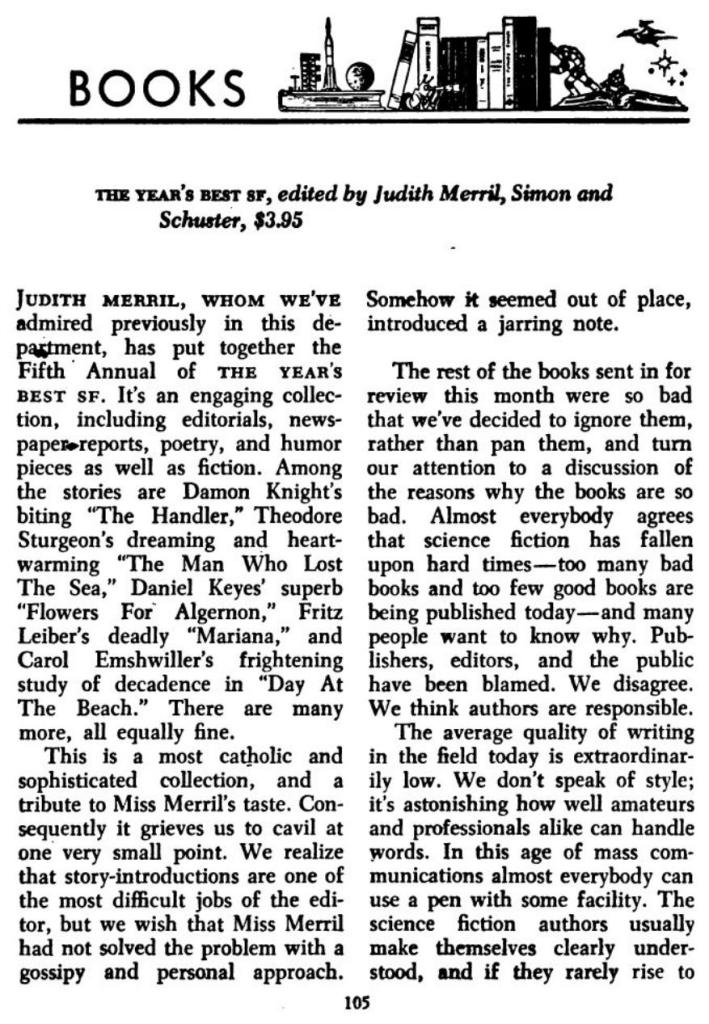
I’ve recently reviewed two short stories by Alfred Bester lately where I wondered if Bester didn’t reveal an undercurrent of disdain for the science fiction genre within his brilliant science fiction. Those two stories were “The Men Who Murdered Mohammed” and “5,271,009.” But I also discovered an essay I wrote a few years ago that I’ve completely forgotten, “Blows Against The Empire: Alfred Bester’s 1953 Critique of Science Fiction.” This essay might duplicate what I said before, but I’m using new evidence.

Whenever I read a science fiction story by Alfred Bester I sense a sneer behind his dazzling storytelling. Almost like God chuckling at us behind his creation. Is that just me?

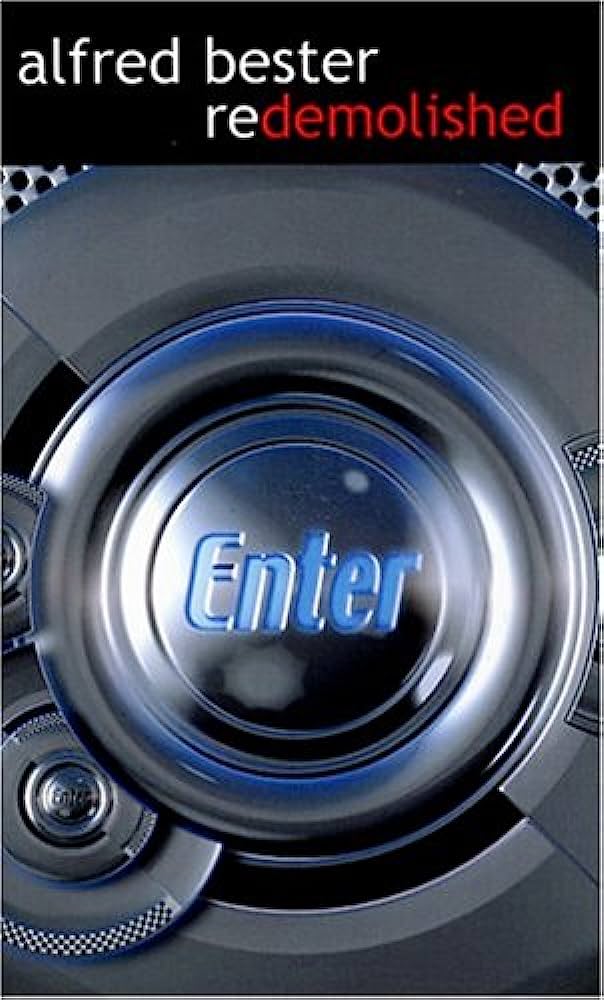
I went off to find out more about Bester and discovered what I needed in a forgotten volume on my shelf, Redemolished. It’s a collection of unreprinted short stories and essays. One essay that stood out for me was, “A Diatribe Against Science Fiction,” which reprints most of Bester’s February 1961 “Books” column from The Magazine of Fantasy and Science Fiction. (Redemolished says May 1961, but it’s wrong.) (The link above is to the collection on Amazon, and the Kindle edition is fairly cheap. I recommend it to fans of Bester.)

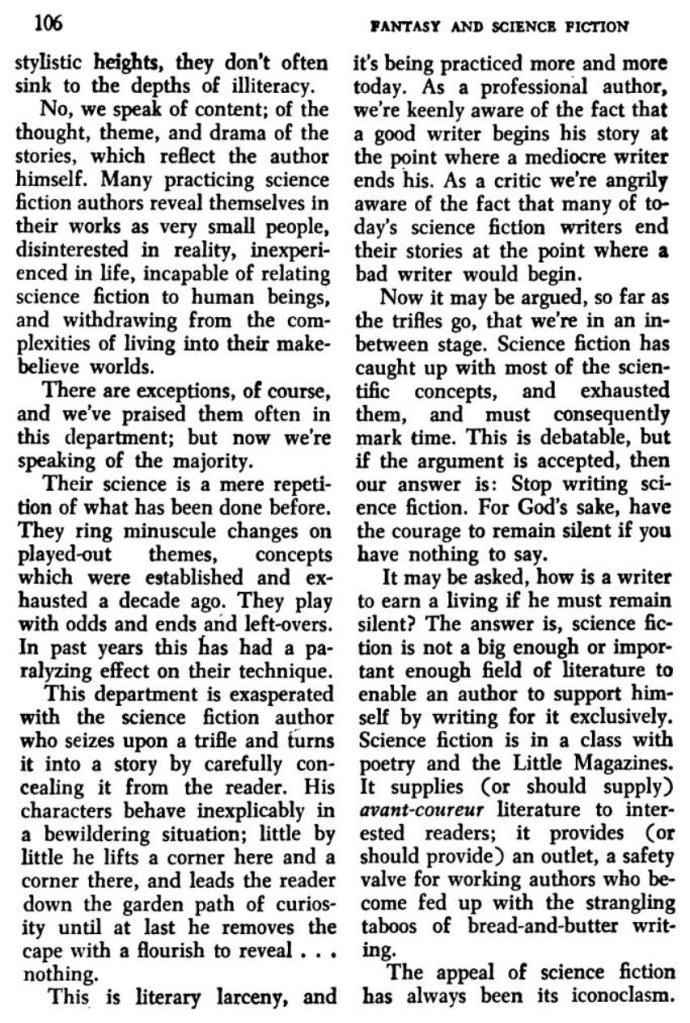
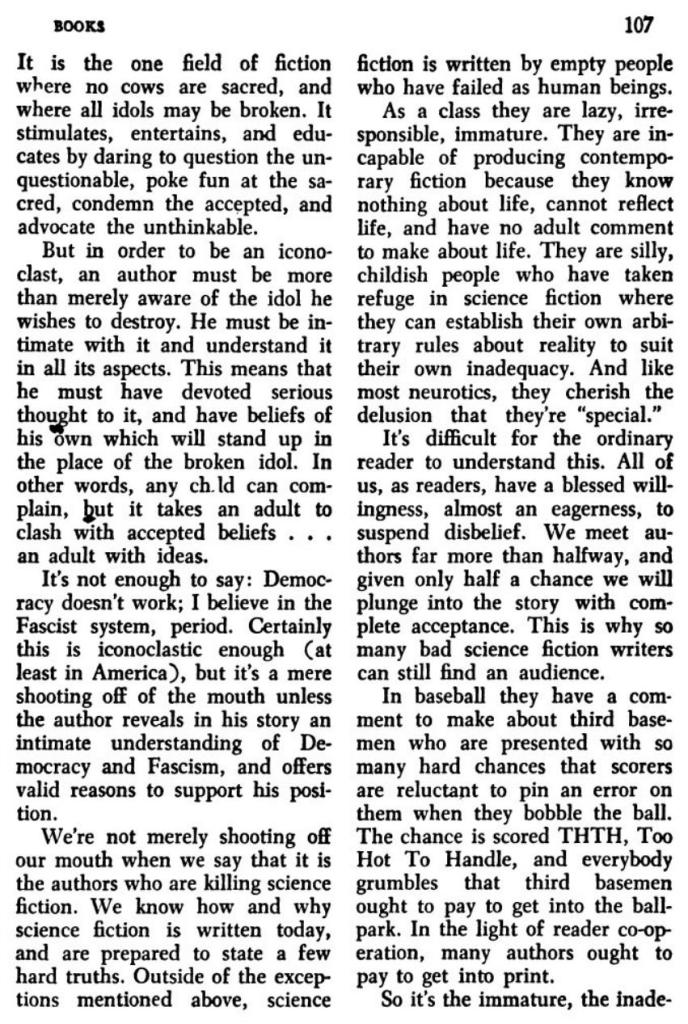
I’m going to post scans of pages from F&SF (and hope I won’t get into any copyright trouble) because I believe Bester’s real feelings about science fiction comes through in them. It’s less than four pages.

Ignore the first paragraph about Merril’s book, although it does point to some classic science fiction short stories that Bester admires, ones I admire too.

Notice that Bester puts the blame on science fiction writers. He does say that most writers, amateur or professional, can write, but that’s not the problem. And for my point, I’m not really concerned about Bester attacking writers. I’m suggesting you pay attention to his tone. It’s the same tone that comes through in his fiction — I think.

Note the line, “Many practicing science fiction authors reveal themselves in their works as very small people, disinterested in reality, inexperienced in life, incapable of relating science fiction to human beings, and withdrawing from the complexities of living into their make-believe worlds.” Ouch. Reminds me of that Saturday Night Live skit where William Shatner tells the Trekkies to get a life.

Now Bester does make criticisms of writing that I agree with but again, that’s not my point here. I’m trying to gather evidence for how Bester felt when writing his stories. Bester’s stories are extremely clever, so I can’t help but feel that Bester felt he was a giant among the pygmies.

Note the dig where Bester says good writers begin their stories where mediocre writers end their stories, but science fiction writers end their stories where bad writers begin. This could be valid criticism but it’s also pretty dang harsh. Few writers come close to ever writing something as good as “Fondly Fahrenheit.” Who knows, maybe Bester is trying to give new writers some tough love — that he wants to help them out. But his next two paragraphs are equally harsh, even telling potential writers to stop writing science fiction.

Bester then goes into describing science fiction as a genre for writers to be iconoclasts – “It is one field of fiction where no cows are sacred, and where all idols can be broken. It stimulates, entertains, and educates by daring to question the unquestionable, poke fun at the sacred, condemn the accepted, and advocate the unthinkable.”

Wow, is that what Bester thinks he’s doing? His stories are bitter satires. And here’s where I often detect an attack on the genre. Satire has to have an object to attack, and sometimes I think Bester is attacking science fiction. Evidently, even our genre can’t be a sacred cow.

Is he just attacking science fiction writers? Or is it also the readers?

Bester says, “We’re not merely shooting off our mouth when we say that it is the authors who are killing science fiction. We know how and why science fiction is written today, and are prepared to state a few hard truths. Outside of the exceptions mentioned above, science fiction is written by empty people who have failed as human beings.” Damn, now that’s one helluva of a zinger.

But then we get to this attack on science fiction writers – and readers.

Finally, we finish up with an ending that reminds me that Bester left the genre not long after this, and wrote and edited Holiday from 1963 to 1971 when it folded. He then returned to write science fiction. However, the novels written after this, never gain the fame of The Demolished Man and The Stars My Destination.

There are several more essays in Redemolished where Bester attacks science fiction. One, “The Perfect Composite Science Fiction Author” claims to praise seven science fiction writers, but damn, if that’s praise, I’m not sure any of those writers would want it. It’s in the March 1961 issue of F&SF, in case you have a copy.

I plan to read all of Redemolished, and Bester’s two collections I own, Starlight, an old SFBC omnibus that reprints two early paperback collections, and Virtual Unrealities, which is currently in print. However, that will take some time.

James Wallace Harris, 6/11/23

“The Chaste Planet” by John Updike

“The Chaste Planet” by John Updike is story #13 of 52 from The World Treasury of Science Fiction edited by David G. Hartwell (1989), an anthology my short story club is group reading. Stories are discussed on Tuesdays, Thursdays, and Saturdays. “The Chaste Planet” was initially published in The New Yorker (11/10/75).

“The Chaste Planet” isn’t much of a science fiction short story — it’s more of an effort to be a humorous essay that riffs on a decent science-fictional idea but I thought pulled off in a crummy way. What if there were aliens who obsessed over music like humans obsess over sex? John Updike is a literary writer, who has criticized our genre in the past, so I can’t believe he takes his story very seriously. And I’m not talking about the concept, but the execution of the concept as science fiction.

And it’s hard to take this story seriously when it begins, “In 1999, space explorers discovered that within the warm, turbulent, semi-liquid immensity of Jupiter, a perfectly pleasant little planet twirled, with argon skies and sparkling seas of molten beryllium.” I assume he was imagining a planet orbiting inside Jupiter’s atmosphere. But wouldn’t that be another moon? And wouldn’t the atmosphere cause enough friction to quickly de-orbit this world? The planet was called Minerva.

This planet is inhabited by eighteen-inch-tall beings with six toothpick-thin legs. These creatures reveal no sign of sexual reproduction, but it is eventually learned that music is everything to their culture, including forms of kinkiness. At best this story is cute, but even that’s a stretch. It’s the kind of story that people who don’t read science fiction think is science fiction. I find such efforts insulting.

I don’t know why Hartwell included this story in The World Treasury of Science Fiction other than to capitalize on Updike’s name. Harry Harrison and Brian Aldiss had “The Chaste Planet” in their annual Best SF: 75, and I assume for the same exact reason. I consider it a pathetic gesture of “See, even famous literary authors write science fiction!”

When I was young back in the 1970s when this kind of thing was popular. Many in the genre wanted academic recognition and respect. I also thought it wonderful our genre was finally being accepted. But there was a writer or critic back then that rejected these efforts at critical recognition. I wish I remembered who it was, but he (maybe she) said something like this: “Throw science fiction back in the gutter where it belongs.”

Now that I’m older, I agree with that. If Robert Sheckley had written “The Chaste Planet” it would have been entertaining in the way I expect science fiction to entertain, and not some literary effort at slumming.

James Wallace Harris, 6/3/23

“The New Prehistory” by René Rebetez-Cortes

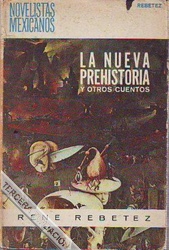
“The New Prehistory” by René Rebetez-Cortes is story #9 of 52 from the anthology The World Treasury of Science Fiction edited by David G. Hartwell (1989) that my short story club is group reading. Stories are discussed on Tuesdays, Thursdays, and Saturdays. “The New Prehistory” was evidently first published as a short story in a periodical in 1964 according to the only record I can find. It was collected in La Nueva Prehistoria Y Otros Cuentos in 1967, translated as The New Prehistory and Other Tales by René Rebetez. The site linked above lists 19 short stories, all labeled science fiction.

According to David Hartwell in his introduction to the story, “The New Prehistory” was translated by Damon Knight and was first published in 1972. So the publishing history varies. Hartwell says Rebetez-Cortes was Columbian but the cover of the author collection above suggests something different. Google says he was born in Subachoque, Columbia in 1933 and died on December 30, 1999, in Isla de Providencia, Columbia.

“The New Prehistory” is a very short literary allegory that could be called introverted horror. It’s about a man going to a movie but hates waiting in line. He steps away from the line while watching his friend wait in the queue. Then the line becomes possessed by some unseen force and all the people in the line start acting like they’re part of one giant snake-like organism. People who stood in groups became giant amoeba-like organisms. Individuals stayed individuals. Eventually, the new giant organisms take over the world and hunt the individuals.

Even though a lot of people are calling “The New Prehistory” science fiction I’m not. It’s the kind of fantastic story I heard read in creative writing classes from high school to graduate school. In every writing class there always seemed to be one student who everyone thought was brilliant who would write these kinds of fantastic allegories. They were popular with both the teachers and students because they always seemed so damn clever.

I believe writers, and even oral storytellers, have always used the fantastic in their tales. But that doesn’t mean they are science fiction. Some scholars in science fiction have been trying to claim more territory for the genre for decades. They want to both up the reputation of the genre and claim more types of stories as ours. When I was young, I agreed with this. I wanted the genre to have prestige. But after a lifetime of reading, I realize I’m a consumer of science fiction and I want real science fiction, not ersatz sci-fi.

Science fiction is impossible to define so editors can call anything they want science fiction, but as a consumer, I know what I want, and this kind of story is not it. I remember when I was young back in the 1960s and wondering what science fiction must be like written in other countries in other languages. Then in the early 1970s, we got some Soviet science fiction anthologies and I got my wish. Slowly, the idea of world science fiction has grown, but all too often I believe editors have grabbed anything they could to fill their anthologies. I think that’s a disservice to the genre, and dishonesty to the literary world.

I know that other SF readers will accept these stories as science fiction because their definitions of the genre are different. And that’s cool. The reality is we don’t all think alike. But I would like to think that science fiction was a term with validity and to me, the intent of the genre is more specific, even quite narrow.

Just because a story has elements of the fantastic doesn’t make it science fiction or fantasy. I also believe fantasy as a genre covers definite territory too. As an emerging bookworm back when I was in grade school, I’d go up and down the library shelves looking for certain kinds of stories. Stories about space travel, robots, new technology, and time travel. They were always about the future, or they were set in current times when things changed. “The New History” is set in current times and things changed, but I still don’t consider it science fiction. Why? Because of the tone of the story.

I never believed while reading the story that people could become group organisms. If the author had made some kind of case for that it would have been science fiction. But that wasn’t his intent. He was obviously making a case about the horrors of being in a group. As an introvert, I completely understand that angle. It’s a good story for that purpose. But that’s a completely mundane purpose. Science fiction is not about the mundane. Science fiction is about the far out, but as a real possibility, even in humor. I never thought the people in “The New Prehistory” were becoming group monsters, nor did I think the author wanted us to believe that. I felt the author was giving us an allegory about how he felt about the real world.

For me, science fiction has to be about what the real world could become. The fantasy genre is about make-believe worlds, but believable worlds within their own concepts. I know most science fiction is unbelievable, or has become so. For me to think of it as science fiction, I have to believe it’s possible, or at least think people once thought it possible.

James Wallace Harris, 5/25/23