Has Science Fiction Left Me Behind?

The above books were the finalists for the 2023 Hugo Awards. I have not read any of them. Nor do they look interesting to me. Each year the Hugo and Nebula award finalists seem further and further away from what I want to read.

The other day I went into a new bookstore for the first time in many months. I went up and down the aisles of the science fiction section and I was shocked by how many books were by authors that were unknown to me.

I turn seventy-two next month and I wonder if I’ve gotten too old for science fiction. Or, has the genre left me in the dust? I can accept that I might be too old to keep up. Could the genre have changed, and I’ve just lost interest? Who knows?

In the 20th century I’m sure I read at least a thousand science fiction books, probably many more. Here’s a list of the 69 SF&F books I’ve read in the 21st century:

  • 2000 – Harry Potter and the Goblet of Fire by J. K. Rowling (Hugo winner)
  • 2000 – Calculating God by Robert J. Sawyer (Hugo finalist)
  • 2001 – American Gods by Neil Gaiman (Hugo winner)
  • 2001 – Perdido Street Station by China Miéville (Hugo finalist)
  • 2002 – Altered Carbon by Richard K. Morgan
  • 2003 – The Time Traveler’s Wife by Audrey Niffenegger
  • 2004 – Cloud Atlas by David Mitchell
  • 2004 – Jonathan Strange & Mr. Norrell by Susanna Clarke (Hugo winner)
  • 2004 – The Plot Against America by Philip Roth
  • 2005 – Spin by Robert Charles Wilson (Hugo winner)
  • 2005 – Old Man’s War by John Scalzi (Hugo finalist)
  • 2005 – Never Let Me Go by Kazuo Ishiguro
  • 2006 – The Road by Cormac McCarthy
  • 2006 – Life As We Knew It by Susan Beth Pfeffer
  • 2007 – The Yiddish Policeman’s Union by Michael Chabon (Hugo winner)
  • 2008 – The Hunger Games by Suzanne Collins
  • 2008 – Little Brother by Cory Doctorow (Hugo finalist)
  • 2008 – Flood by Stephen Baxter
  • 2008 – Marsbound by Joe Haldeman
  • 2009 – The City & The City by China Miéville (Hugo winner)
  • 2009 – The Windup Girl by Paolo Bacigalupi (Hugo finalist)
  • 2009 – Boneshaker by Cherie Priest (Hugo finalist)
  • 2009 – Julian Comstock by Robert Charles Wilson (Hugo finalist)
  • 2009 – Catching Fire by Suzanne Collins
  • 2009 – Wake by Robert J. Sawyer
  • 2010 – Feed by Mira Grant (Hugo finalist)
  • 2010 – Mockingjay by Suzanne Collins
  • 2010 – Watch by Robert J. Sawyer
  • 2010 – Hull Zero Three by Greg Bear
  • 2011 – Among Others by Jo Walton (Hugo winner)
  • 2011 – Leviathan Wakes by James S. A. Corey (Hugo finalist)
  • 2011 – The Martian by Andy Weir
  • 2011 – Ready Player One by Ernest Cline
  • 2011 – Wonder by Robert J. Sawyer
  • 2012 – Redshirts by John Scalzi (Hugo winner)
  • 2012 – 2312 by Kim Stanley Robinson (Hugo finalist)
  • 2012 – The Dog Stars by Peter Heller
  • 2012 – The Age of Miracles by Karen Thompson Walker
  • 2012 – vN by Madeline Ashby
  • 2014 – The Three Body Problem by Cixin Liu (Hugo winner)
  • 2014 – Annihilation by Jeff VanderMeer
  • 2014 – Station Eleven by Emily St. John Mandel
  • 2014 – The Girl with All the Gifts by M. R. Carey
  • 2014 – The Book of the Unnamed Midwife by Meg Elison
  • 2014 – Yesterday’s Kin by Nancy Kress
  • 2015 – Seveneves by Neal Stephenson (Hugo finalist)
  • 2015 – Children of Time by Adrian Tchaikovsky
  • 2015 – Binti by Nnedi Okorafor
  • 2015 – Aurora by Kim Stanley Robinson
  • 2015 – The Water Knife by Paolo Bacigalupi
  • 2016 – All the Birds in the Sky by Charlie Jane Anders (Hugo finalist)
  • 2017 – New York 2140 by Kim Stanley Robinson (Hugo finalist)
  • 2017 – All Systems Red by Martha Wells
  • 2017 – Sea of Rust by C. Robert Cargill
  • 2017 – Under the Pendulum Sun by Jeanette Ng
  • 2017 – Noumenon – Marina J. Lostetter
  • 2018 – The Calculating Stars by Mary Robinette Kowal (Hugo winner)
  • 2018 – Semiosis by Sue Burke
  • 2018 – The Fated Sky by Mary Robinette Kowal
  • 2018 – The Feed by Nick Clark Windo
  • 2019 – Children of Ruin by Adrian Tchaikovsky
  • 2019 – Machines Like Me by Ian McEwan
  • 2020 – The Ministry for the Future by Kim Stanley Robinson
  • 2020 – The Midnight Library by Matt Haig
  • 2021 – Project Hail Mary by Andy Weir (Hugo finalist)
  • 2021 – Klara and the Sun by Kazuo Ishiguro
  • 2022 – Babel by R. F. Kuang
  • 2022 – The Mountain in the Sea by Ray Nayler
  • 2022 – Sea of Tranquility

That’s an average of 2.8 SF&F books a year. Assuming I read a thousand SF books from 1963-1999, means I averaged 27.78 SF books a year. I think I could have easily read 1,500 SF books, or 41.67 SF books a year. In other words, I don’t read SF like I used to. And my 21st century list includes quite a few fantasies. I rarely read fantasy in the 20th century. I really don’t like fantasy books. I only read them when they reach a certain pop culture status.

One reason for the shift is I read more literary works and nonfiction books. Another reason is after reading thousands of science fiction books, I seldom read reviews of new science fiction books that sound different enough to be appealing.

I used to keep up with the genre by belonging to the Science Fiction Book Club, which offered two new titles a month. I subscribed to several science fiction magazines and fanzines that reviewed new books. And I would visit one or two new bookstores a week.

Fanzines disappeared, and I stopped having time for the prozines even though I still subscribed. After Amazon and Audible, I stopped shopping in new bookstores, and they eventually disappeared. Back in the 1970s I went to conventions and even published fanzines. In the 1980s I ran a BBS devoted to science fiction. Since the 1990s I’ve run websites and databases devoted to SF. Once upon a time all my friends were SF readers. But active participation in fandom ended when I got married and settled down to work in 1978. I became a different person socially.

Since 2002, I’ve been rereading the science fiction I first read in the 20th century by listening to audiobook editions from Audible.com. It’s a kind of nostalgic trip. I also caught up on a lot of 20th century science fiction I missed. That also kept me from reading many new SF books.

But in all honesty, I prefer old science fiction to new science fiction. There’s been some great exceptions, but I think that’s the real reason I’ve let the genre pass me by.

I wish the Science Fiction Writers of America never embraced fantasy. I wish the Hugo Awards had focused exclusively on science fiction. Fantasy should have their own fan-based award. I can’t help but wonder if the science fiction genre would be more vibrant today if it hadn’t been married to the fantasy genre. Even books marketed as science fiction often feel like fantasies. Looking back, I would have preferred a smaller, focused SF genre, one I could have kept up with.

Science fiction used to have some realism, or at least some speculative integrity. Now, any old wild idea works. Science fiction used to be inspired from reality, now new writers are inspired mostly by science fiction movies. It’s as if all science fiction is recursive science fiction.

Who knows, maybe I left science fiction behind.

James Wallace Harris, 10/22/23

When Writing “An Appearance of Life” How Many SF Concepts Did Brian Aldiss Consider?

I’ve written about “An Appearance of Life” twice before. See “‘An Appearance of Life’ by Brian W. Aldiss” and “Who Were the Korlevalulaw?” I’ve read this story four times before, and for this fifth reading I’m looking deeper into what Aldiss was hoping to communicate. I don’t think we get everything with one reading of a story, or even two or three. This essay is about the value of rereading.

You can read “An Appearance of Life” at Archive.org if you have a free account.

For this reading I wanted to observe as many science-fictional concepts Aldiss was presenting in the story as I could spot. I’m doing this for several reasons. First, I want to show how science fiction builds on past science fiction. Second, I want to show how a reader’s previous reading experience can add to the current reading experience. Third, I want to show just how many new situations a science fiction writer must imagine building a new story. Fourth, I want to see if there are things I missed from earlier readings.

  1. Lost ancient alien civilization. I first encountered this theme with After Worlds Collide, but it also made famous with the film The Forbidden Planet. One of my favorite SF themes. The first part of “An Appearance of Life” uses this old theme and Aldiss calls that lost alien civilization the Korlevalulaw.
  2. On the planet Norma, less than a thousand light-years from Earth, a giant museum is being created to house artifacts from countless alien and human civilizations. The planet was once part of the Korlevalulaw galactic civilization. The museum is put inside a giant building that circles the entire planet, dividing it from land area to the north, and ammonia ocean to the south. This idea is new to me, so I’ll credit it to Aldiss’ imagination. However, megastructures are common in science fiction. This one reminds me of a smaller version of Ringworld.
  3. Aliens as demons. Little is known of the Korlevalulaw. Sometimes they are pictured as demons. That reminded me of Childhood’s End. But I’ve read several SF stories over the years that suggested ancient demons were aliens.
  4. Aliens as gods. Sometimes the Korlevalulaw are pictured as gods. This reminds me of Lovecraft’s ancient elder gods, and other SF stories, as well as Chariots of the Gods.
  5. Aliens in SF come from our deepest subconscious thoughts. And like God and gods, we expect them to return, to judge and punish us.
  6. Ultimate evolution. We imagine all the reasons why the Korlevalulaw disappeared. They gave up written language and evolved beyond physical bodies into pure mind, they left this universe, they committed species suicide. All these speculations are common in science fiction stories.
  7. The narrator, called The Seeker, comes from a planet where people seldom see each other, except for when they meet to breed. This reminds me of The Naked Sun.
  8. The Seeker stands next to his spaceship looking up at the giant museum building lying under a purple sun. Such immense vistas are often shown in SF paintings.
  9. An android greets the Seeker. Androids work tirelessly building the museum’s collections. Twenty human women supervise them. The androids provide the Seeker with a vehicle to ride inside the museum. The giant building is made of a single piece of imperviable metal, forming a 16,000-kilometer band around the planet. Such indestructible alloy and super-science architecture is common in SF stories. I’m especially reminded me of The Day the Earth Stood Still.
  10. The building feels immense on the inside, and it’s mostly empty though the humans have been piling up exhibits for ten centuries. The Seeker feels a sense of infinity inside the building. SF writers in the 1930s and 1940s liked to imagine giant awe-inspiring scenes. Even though this story was published in 1976, after Aldiss had gone through his New Wave period, it harkens back to the 1930s and Thrilling Wonder Stories. In some ways he’s following in the footsteps of Stanley Weinbaum.
  11. The Korlevalulaw building gives the Seeker a sense of infinity, causing him to feel insignificant and “clausagoraphobia.” Interesting made-up word by Aldiss.
  12. The Seeker has specialized training in concepts we don’t understand, but it gives him the power to see connections that others don’t. Humanity has created countless subdivisions in every discipline, and the Seeker can envision relationships across boundary lines. Heinlein often created generalists in the age of specialists.
  13. The Seeker came to the museum with several research assignments from institutions, universities, and individuals. For example, one assignment was to study whether the human voice was getting quieter over the centuries.
  14. The Seeker spends days studying the museum, living out of his car. At one point, he talks to a female android who is setting up an exhibit of extinct micro-organisms. I wonder why the android is female. Are there male androids. And why are the supervisors human females? Does Aldiss picture this place like many old science fiction movies from the 1950s where human males discover societies run by females. Does Aldiss visualize his scenes or expect his readers to visualize them? Is the Seeker male? Is Aldiss suggesting all posthumans are female?
  15. The Seeker contemplates the umwelt of androids. He assumes their sense of reality is much larger than ours. He also assumes their activities make them happy. This is the first time I can remember a SF writer considering the umwelt of anything.
  16. On the fifth day the Seeker studies ships and experiences nosthedony. This is a word Aldiss coined to mean “the pleasure of studying old objects.” See this blog post.
  17. The Seeker talks about the First Galactic Era, where men and their wives explored the galaxy in primitive machines. The Seeker notes this was also the time that human pair-bonding broke down and humanity began to mature.
  18. While exploring a five-person spaceship where all the occupants had died of a malfunction of the oxygen producing system, he finds a small gold band with a crude inscription. He wonders if it was a contraceptive device. Of course, we assume it’s a wedding band.
  19. The Seeker asks an eye about the ring. The eye appears to be something like security camera/Alexa/AI able to answer questions about things in the museum. He is told the band is a wedding ring, and what wedding rituals were.
  20. The story shifts from the Korlevalulaw to ancient humans. We assume the Seeker is a posthuman. This is a neat trick. I’ve always loved reading science fiction about extinct alien civilizations, and now I’m reading about extinct humans.
  21. The Seeker thinks of the ring as a form of communication. It signals a relationship status. He also wonders if the pair bonding broke when the occupants of the ship died.
  22. The Seeker finds a photograph of a couple, we assume connected to the ring. The Seeker notes the photograph is flat, suggesting they have higher tech photographs. He also notes their appearance wasn’t bad looking, as if ancient humans looked different from posthumans. This reminds me of “The Time Machine.” Was Wells the first writer to deal with posthumans?
  23. The Seeker remembers being told by another Seeker, a woman, that the secret of the universe might be locked away in the museum. Our Seeker told the woman Seeker the secret would be more likely found after the museum is complete. She argues that it would be better to find it now, when there is less to look through. He argues back the idea that there is a secret to the universe is a human construct. She replied, human or from the mind that created humans. I don’t remember contemplating this short bit of conversation before. Humans do believe that there is a secret to the universe, and some humans believe it comes from God. It’s interesting that Aldiss suggests that posthumans will no longer believe in such secrets. It’s also interesting to think posthumans will be two degrees from God or the concept of God.
  24. On the sixth day the Seeker explores the ships of the Second Galactic Era. They are up to five kilometers long. Reading the words “on the sixth day” reminds me of The Book of Genesis. I wonder if Aldiss intended that.
  25. The Seeker talks about how in the Second Era humans tried and failed to create galactic civilizations but failed because distance and relativity wouldn’t allow it. He said it was then that humans became comfortable being who they were. It was a time when the species put away its childish things. Aldiss is very philosophical and speculative here. He’s also taking a swipe at science fiction, but it infers a lot of cherish science fictional fantasies are childish.
  26. The Seeker surveys shelves of possessions these people had. He noted that during the childish period humans were overwhelmed by possessions. The Seeker thinks: “These long-dead people had seemingly thought of little else but possession in one form or another; yet, like androids in similar circumstances, they could not have recognized the limitations of their own umwelt.” This is fascinating. I did not notice this in my earlier readings. Last year I read An Immense World by Ed Yong, and it was all about the umwelt in people and animals. That book made me think a lot about the concept of umwelt, which I had heard of before, but never studied. It’s fascinating that Aldiss was focused on the concept back in 1976.
  27. The Seeker finds a cube with a button. When pressed, the cube says, “You are not my husband, Chris Mailer. I talk only to my husband. Switch off and set me right way up.” The Seeker tells the cube her husband died 65,000 years ago.
  28. The Seeker asks the museum about the cube and is told it is a “holocap.” That a copy of the woman’s brain has been embedded into the cube. Downloading brains has become quite a common theme in science fiction over the last several decades. It’s been around at least since the Professor Jameson stories from the 1930s.
  29. The Seeker is told the cube was taken from a small armed scout ship orbiting the planet Scundra. It had been to the planet and was returning to its mother ship when it blew up. Scundran extremists had planted a bomb on it. In retaliation, the planet was sterilized by a virus from the mother ship. The virus got loose on the mother ship, and everyone died. The planet, scout ship, and mother ship had been ignored for centuries. The cube had come from the scout ship.
  30. The museum gives him a history of the planet. At one time the Soviet India had settled it, but there had been a war. The planet was currently unhabituated and was an automated farming planet.
  31. The Seeker contemplates the destruction of Scundra and eventually wonders if something similar could have happened to the Korlevalulaw. That Scundra had died over fighting for possessions.
  32. The Seeker also wonders about the relationship between the organic and the inorganic of the universe.
  33. The androids are unpacking objects taken from Scundra and the Seeker unwraps one from the apartment of a married couple, Jean, and Lan Gopal. It was another holocap, but a much more sophisticated one. It lit up when the Seeker accidentally pressed a small button. It gave the impression of a man’s head. It said, “This holocap is intended only for my ex-wife, Jean Gopal. I have no business with you. Switch off and be good enough to return me to Jean. This is Chris Mailer.” This holocap projected the appearance of Chris Mailer.
  34. The Seeker contemplated the coincidence. Noted that Jean had been young, and Chris much older. He decides to reunite them. Jean’s cube had been found on the planet and Chris’s cube was found on the scout ship. They had been on opposing sides of a war.
  35. After 650 centuries he put the two cubes together on a shelf about a meter apart. Aldiss dismissed the unbelievable coincidence because the androids were unpacking crates from the same locations.
  36. We are told of the conversation. We’re also told the Seeker did not understand the dynamics of the relationship because they are primitive beings. Jean’s cube was older, and her holographic head wasn’t as well defined as Chris’s holographic image. But Jean appeared younger. She apologized for breaking up the marriage but claimed to have been young and foolish.
  37. For Jean, it’s been 12 years. Chris talks about regret and Jean’s affair with Gopal. Chris speaks of receiving her holocap fifteen years ago. So, it’s been at least twenty-seven years since they broke up. Jean appears to want to get back together. Chris hopes that Gopal made her forget him. Chris admits they are enemies in the conflict. Then we learn that Jean sent her holocap from Earth. Evidently, in the subsequent years she and Gopal moved to Scundra.
  38. Eventually, the Seeker comprehends the two holocaps were not conversing, but merely repeating their messages. Jean’s message had been recorded before the divorce, while Chris’s message was recorded long afterwards. Chris had been traveling with Jean’s holocap for years. He had joined space mercenaries after the divorce.
  39. The Seeker saw that they could not get beyond their limited roles in life. And understanding those roles might be beyond him. And understanding the Korlevalulaw might be the same too.
  40. This revelation makes the Seeker say he had found the secret of the universe. That humans were just a projection of the Korlevalulaw, without free will. That humans are like the two holocaps. They really can’t communicate with each other, only say what they’ve been programmed to say. This was a powerful insight for Aldiss, but not for me. I still not sure I “got” the story as he intended.
  41. The Seeker starts doubting this insight. Then Aldiss says something absolutely true. We contain an umwelt but not a universe. This is an interesting distinction about our senses. We don’t look out onto reality, but instead model reality inside our head with limited sensory input. Basically, our sense of reality is biological VR. Is that what Aldiss was getting at in 1976?
  42. In the end, the Seeker leaves Norma but does not go home. He finds a planet without people to exile himself. He’s afraid his insight is a virus that could infect all of humanity and destroy it. It’s damn strange that I’m ending on #42, after the Seeker has found the meaning of the universe. Did the Seeker leave humanity on the seventh day?

“An Appearance of Life” is one of my all-time favorite science fiction stories. However, you probably won’t be able to find a copy. It’s rarely been reprinted. I considered violating copyright law and making a pdf for you all, but I’m afraid the estate of Brain W. Aldiss would sue me.

I hope I have shown that this story requires a deep experience of science fiction to appreciate. I also hope I have convinced you of the value of rereading. If you’ve only read “An Appearance of Life” once, did you get all of this?

James Wallace Harris, 10/13/23

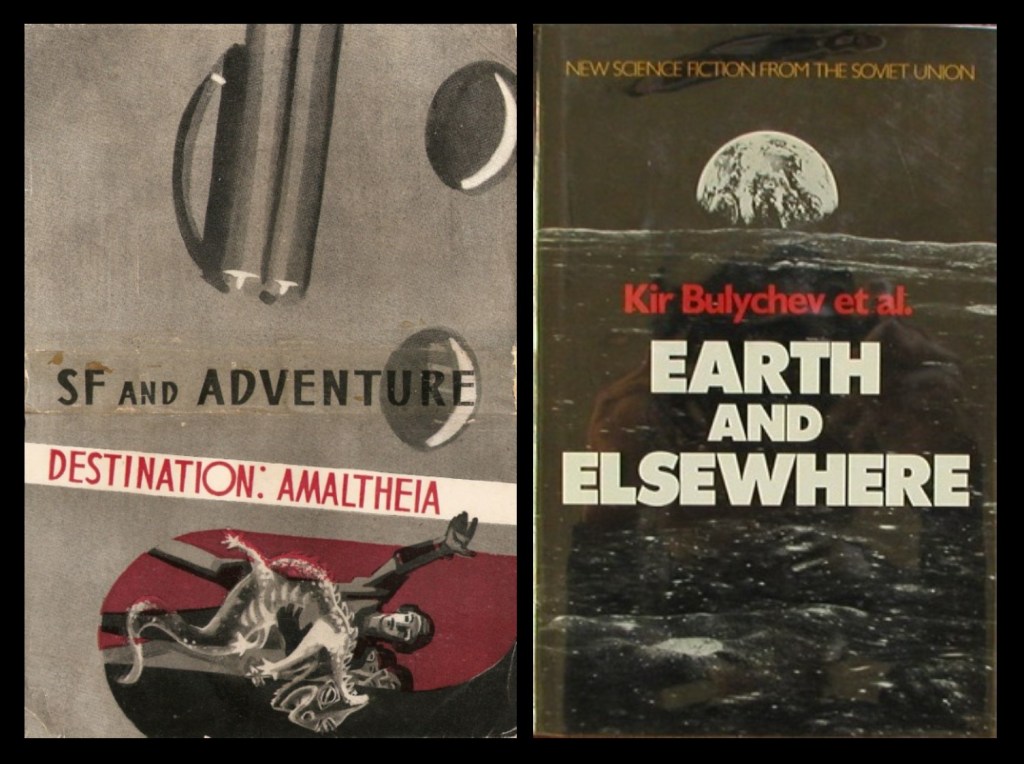
“The Way to Amalteia” by Arkady Strugatsky and Boris Strugatsky

The Way to Amalteia” by Arkady Strugatsky and Boris Strugatsky is story #52 of 52 from The World Treasury of Science Fiction edited by David G. Hartwell (1989), an anthology my short story club is group reading. Stories are discussed on Tuesdays, Thursdays, and Saturdays. “The Way to Amalteia” was first published in Russian in Путь на Амальтею in 1960.

“The Way to Amalteia” was first translated into English in 1963, and later in 1985, before the 1989 translation for The World Treasury of Science Fiction. Finding those other editions will be difficult, and since there have been no English reprints since 1989, it shows the value of owning a copy of The World Treasury of Science Fiction. Collecting retrospective anthologies of science fiction is one way of preserving literary history.

“The Way to Amalteia” starts out on J-Station, a research settlement on Amalthea, the fifth moon of Jupiter. The Strugatsky brothers describe the beautiful site of Jupiter from that moon. But we learn that the station is running out of food, and everyone is on strict rations. The settlement is desperately waiting for the freighter, Takhmasib, to deliver supplies, but it’s running late, and they’ve lost contact with the ship.

The story then cuts to the freighter, where we learn why. The Takhmasib has suffered several mishaps and has fallen into Jupiter. The Strugatsky brothers have set up an almost impossible situation and we don’t know if the crew can save themselves.

This is a hard science story, especially for 1960. Hartwell, in his introduction said it would fit right in an issue of Astounding, and that’s true. Hartwell said it also reminded him of Clarke’s “A Meeting with Medusa,” which I thought too. I also thought the story sounded like something Hal Clement would write, and it turns out Arkady Strugatsky translated Mission of Gravity into English.

There’s a lot going for “The Way to Amalteia,” but unfortunately, on this first reading, the story didn’t thrill me. I vaguely sensed it was an outstanding story, but something kept me at a distance. Having so many things go wrong spoiled it for me on one level. Having the cause of the major catastrophe be due to meteorites seemed cheesy. And I wondered if I was missing the flavor of the story because it was a translated work. Finally, there were places where figures were given, and they just seemed impossible to believe.

On page 1027 the photon drive pushes the ship to sixty-seven thousand kilometers a second. That’s about a fourth of the speed of light (299,792 kps). On page 1058 we learn the pressure on the ship as it descends into Jupiter’s atmosphere is three hundred atmospheres. This is after the ship had several holes punched in it from meteors and was patched with resin and metal plates. And there was another mention of the crushing pressure of Jupiter’s atmosphere that was much higher than three hundred atmospheres, but I can’t find it. All these problems remind me of old science fiction movies of the 1950s where science was often mumbo jumbo. But were these errors the writers’ fault, or the translators?

I also feel if I read “The Way to Amalteia” a couple more times in the future I might get to like it quite a bit. I don’t think one reading does the story justice. The story comes across like an episode of Star Trek, where a valiant captain is forced to deal with a series of ever escalating problems, but then at the last minute saves the day.

The Strugatskys spend a lot of time developing the characterization of the international crew and filling the story with textural details. I couldn’t tell if they were realistic or stereotypes because I wondered if some of the flavor was lost in translation.

“The Way to Amalteia” was an interesting story to close the anthology, especially since it’s a novella. Hartwell must have thought highly of the story. That’s why I think it might improve on rereading. But most readers don’t reread. I would have put “The Way to Amalteia” where Hartwell put “A Meeting with Medusa” on page 146 and closed with “A Meeting with Medusa.” The Clarke story offers way more hope for the future.

James Wallace Harris, 9/2/23

“Party Line” by Gérard Klein

Party Line” by Gérard Klein is story #49 of 52 from The World Treasury of Science Fiction edited by David G. Hartwell (1989), an anthology my short story club is group reading. Stories are discussed on Tuesdays, Thursdays, and Saturdays. “Party Line” was first published in French in Fiction (March 1969). It was translated into English in 1976 for The Best from the Rest of World: European Science Fiction edited by Donald A. Wollheim.

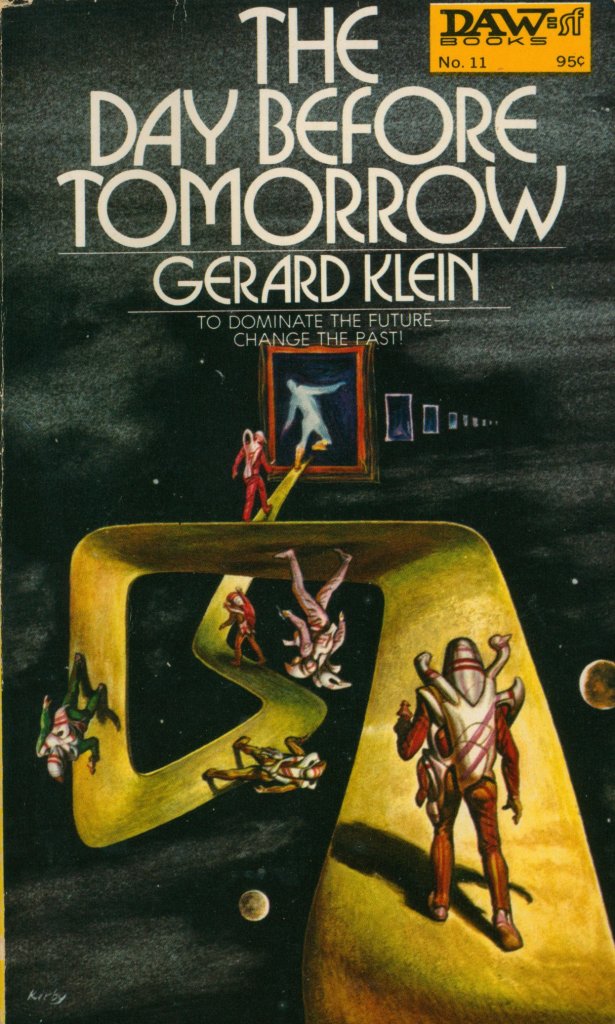
This is the second appearance of Gérard Klein in The World Treasury of Science Fiction. See my earlier review of “The Valley of Echoes.” After I read that story, I bought two of Klein’s novels, but I haven’t read them yet. I’m not sure I would have done that after only reading “Party Line.” However, one of those novels, The Day Before Tomorrow has a blurb that could fit with “Party Line” — “To Dominate the Future — Change the Past.”

“Party Line” uses one of my favorite science fictional concepts — having a future older-self influence a younger-self. Jerome Bosch is working in his office when he receives two phone calls on two separate phones. The phone in the left hand tells him he’s going to receive a terrific opportunity, and the one is the right warns against taking it.

Jerome Bosch is also a writer. He fantasizes at work about having all his time free to write. And I must wonder if Klein was working in his office one day, daydreaming this idea about himself and deciding to work it into a story. At first, it felt like “Party Line” was something Philip K. Dick would write. But then the dominant mood of the story shifted to indecision, paranoia, and fear, which is still PKD’s territory, but the story felt weirdly different, more like Kafka.

The first caller calls back and tells Jerome if he will only do what he says, his books will be made into movies, he will become rich and famous, and have lots of women. Then the other caller calls back and tells him something terrible will happen. For the rest of the story Jerome can’t decide.

I liked “Party Line” until I got to the end. Unfortunately, it’s one of those stories that promises a lot, but doesn’t know how to deliver on its promises. “Party Line” does have an ending, but one, I thought Klein had to scrounge up when he discovered he had painted himself into a corner.

I wrote an older self advises younger self story when I was at Clarion West. The problem is people seldom take advice. I wondered if someone would take advice from themselves. Klein complicates the idea by having two versions of his future self give him advice. That created a lot of tension for the story, but I wonder if “Party Line” would have been better if Jerome had only gotten one phone call from the future. How many people would jump at getting everything they wanted if they got a message from their future self?

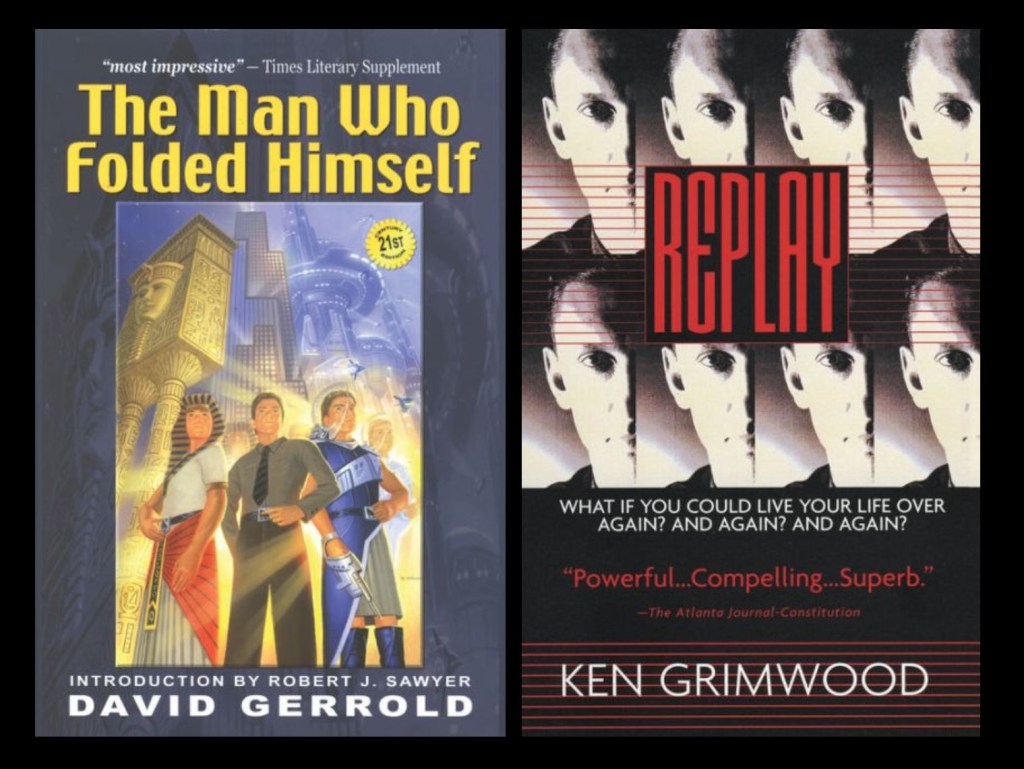
The idea of an older version of a person trying to influence their younger self is a challenging problem for writers. David Gerrold did an excellent job with it in The Man Who Folded Himself. But to fully explore the idea, I think people should read Replay by Ken Grimwood. It’s not the same exact idea, but it works out the same philosophical problem. The idea needs novel length to work out.

I believe my disappointment with “Party Line” is because Gérard Klein should have made it into a novel and worked out a satisfying ending. However, I might reread “Party Line” in the future and see it differently. Maybe my future self will understand it better.

James Wallace Harris, 8/26/23

“Weihnachtabend” by Keith Roberts

If not read carefully, “Weihnachtabend” by Keith Roberts will come across as just another alternate history about Hitler winning WWII. “Weihnachtabend” is more subtle, it’s an alternate history where England and German never fought, but made an alliance, and eventually ruled over Europe together. They called their alliance the Two Empires, graphically symbolizing it with the Lion, and the Eagle.

I have read many books and watched many movies and television shows set in England in the mid-20th century. And one historical event that has come up often is when Neville Chamberlain signed the Munich Agreement in 1938. Roberts imagines what if peace between Germany and England had played out, and, if the English fascists had come to power. In the alternate history timeline of this story the Munich Agreement is The Cologne settlement.

Roberts writes beautifully, painting with impressionistic details rather than flatly telling us what happened.

“Weihnachtabend” by Keith Roberts is story #44 of 52 from The World Treasury of Science Fiction edited by David G. Hartwell (1989), an anthology my short story club is group reading. Stories are discussed on Tuesdays, Thursdays, and Saturdays. “Weihnachtabend” was first published in New Worlds Quarterly 4 (1972) edited by Michael Moorcock. You can read it here. “Weihnachtabend” is also in The Grain Kings, which collects seven of Keith Roberts stories. It’s currently available for $1.99 at Amazon for the Kindle edition.

I highly recommend reading “Weihnachtabend” before reading my essay for two reasons. First, this story is a masterpiece of alternate history and is well-worth reading. Second, it’s a test of reading ability. The story is not hard to read, but instead of just telling what’s happening, Keith Roberts gives us pieces to put a mental jigsaw puzzle together. The story is dense with clues and implications about history and people.

“Weihnachtabend” tested my reading ability, and I didn’t do very well on my first reading. The title means Christmas Eve — I had to look that up. I read the story slowly, trying my best to understand it, but it wasn’t until afterwards that all the subtle aspects were revealed when I read Paul Kincaid’s review. I was further enlightened by Joachim Boaz’s review.

Clarity came with my second reading, and even then, I’m not sure I saw everything Roberts intended. I’m learning in old age that fiction needs two readings before you begin to understand it. It’s a shame that knowledge has come so late in life. No matter how hard I try to become a better reader, and I’ve been trying my whole life, the only thing I keep learning is how bad my reading ability still is and how much more I need to learn.

Keith Roberts’ fiction is a great test for understanding what you read. I’ve read his fix-up novel Pavane and a couple other stories. His prose is dense with layers and depth. Roberts also has a great imagination and creates beautifully visual scenes. If only someone would film his stories.

“Weihnachtabend” opens as Richard Mainwaring and Diane Hunter approach Wilton Great House while riding in a chauffeured Mercedes. Right from the beginning Roberts presents the constant presence of paranoia. Richard notices that the communication channel between the back of the car and the chauffeur is always open, and the chauffeur is listening. Before they get to the country house — I picture it as a manor house of the aristocracy, they come to a wall with watchtowers and pillboxes, and guards with machine guns. The guards speak German.

Richard gives his identity card which says: “Die rechte Hand des Gesandten.” We learn that Richard is the right-hand man of the messenger, and we’re eventually told his title is “Personal Assistant to the British Minister of Liaison.” The identity card also tells the guard Miss Hunter is from his department. (I’ve completely forgotten my high school German, so I had to depend on Google to translate. Knowledge of most of the German phrases in the story aren’t needed to understand the story, but not all.)

Diane is extremely nervous, but then so is Richard. Why is he nervous if he’s a top dog in the ruling political party? Diane is a beautiful blonde who Richard had known long ago. She belongs to someone he knew, a man named James, but for this trip, she is with him.

As the story progresses, we learn we’re in England, but it’s years after the period we know as WWII. England and Germany rule Europe. They fear America. But for some reason, the alliance is dominated by Germany, and the English leadership speak German. There is unrest in England and elsewhere, but the leadership maintains order much like the authoritarian rule in Nineteen Eighty-Four. At the top is King Edward VIII and a Fuehrer named Ziegler (I think. It’s confusing about what happened to Hitler, or who is the Fuehrer. Hess is deputy Fuehrer.) We know it’s decades later because they have large screen televisions, and rollneck shirts. I assume this means a turtleneck which was trendy in the 1960s, and around the time Roberts wrote the story.

Roberts doesn’t have a specific message in this story. He just paints a tableau. Richard, in the end, has something to say to the reader, but what he says, we’ve known all along from our history.

What makes the story compelling to read is figuring out what is happening to Richard. At first, it’s just a Christmas Eve party for extraordinarily rich people. Richard is given a Lamborghini by his boss. There is a description of a brutal hunt, and a bizarre Christmas tradition for children. Richard and Diane have sex, and we feel they are old lovers who are finally going to get together. Then Diane disappears and Richard becomes unhinged, eventually confronting his boss with a Lüger.

As I’ve said, the story has many layers. Like in Philip K. Dick’s novel, The Man in the High Castle, there’s a meaningful-to-the-story book like The Grasshopper Lies Heavy. However, instead of being from another timeline, Toward Humanity is from Richard’s own timeline. The writer’s name is Geissler, and his book is banned. Richard finds this dangerous volume planted in his room. It’s published by the Freedom Front. Richard doesn’t know if his party is testing him or if the opposition is trying to recruit him.

And Richard wonders why he’s so lucky to suddenly acquire a beautiful blonde. Is she who she says she is, or is she a plant from his party to test him, or an agent of the Freedom Front? Blondes are a reward to good party men, easily bought and traded. When Richard’s blonde goes missing everyone wants to pretend, she never existed.

Along the way, we are given clues about this world with quotes from Toward Humanity. Here are three quotes:

The Cologne settlement, though seeming to offer hope of security to Jews already domiciled in Britain, in fact paved the way for campaigns of intimidation and extortion similar to those already undertaken in history, notably by King John. The comparison is not unapt; for the English bourgeoisie, anxious to construct a rationale, discovered many unassailable precedents. A true Sign of the Times, almost certainly, was the resurgence of interest in the novels of Sir Walter Scott. By 1942 the lesson had been learned on both sides; and the Star of David was a common sight on the streets of most British cities.

---

In 1940, her Expeditionary Force shattered, her allies quiescent or defeated, the island truly stood alone. Her proletariat, bedeviled by bad leadership, weakened by a gigantic depression, was effectively without a voice. Her aristocracy, like their Junker counterparts, embraced coldly what could no longer be ignored; while after the Whitehall Putsch the Cabinet was reduced to the status of an Executive Council …

 
---

Against immeasurable force, we must pit cunning; against immeasurable evil, faith and a high resolve. In the war we wage, the stakes are high; the dignity of man, the freedom of the spirit, the survival of humanity. Already in that war, many of us have died; many more, undoubtedly, will lay down their lives. But always, beyond them, there will be others; and still more. We shall go on, as we must go on, till this thing is wiped from the earth. Meanwhile, we must take fresh heart. Every blow, now, is a blow for freedom. In France, Belgium, Finland, Poland, Russia, the forces of the Two Empires confront each other uneasily. Greed, jealousy, mutual distrust; these are the enemies, and they work from within. This, the Empires know full well. And, knowing, for the first time in their existence, fear …

We doubt Richard is persuaded by this political rhetoric. The ending of the story is quite dramatic. The final scene also reminds me of the final message of Nineteen Eighty-Four. I must wonder if Keith Roberts was commenting on the current political climate in England of 1972 when and where he wrote “Weihnachtabend.”

I know in 2023 there is much distrust of government everywhere. Was Robert’s paranoia any different than an average citizen? Who really controls us?

James Wallace Harris, 8/16/23

How Should We Judge Heinlein’s Stranger in a Strange Land in 2023?

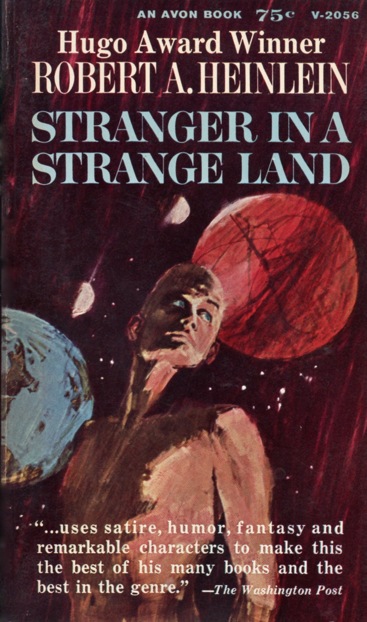
I recently watched a devastating “review” of Stranger in a Strange Land on YouTube. (Watch it below.) The short film summarized the plot of the novel, but in a way that made the story ridiculous. When I first watched it, I didn’t think the sarcasm and satire was unfair. I first read Stranger in 1965 when I was thirteen, and I loved it. I’ve reread it many times over the decades, but with each rereading I became more disappointed with the story. So, the criticisms made by Overly Sarcastic Productions resonated with the memories I have of listening to the audiobook version in 2004, and my last reading in 1991. Even though Robert A. Heinlein is still my favorite science fiction writer; I haven’t liked his books published after 1959 for a long time. However, I’m wondering if I shouldn’t reevaluate that dislike.

Today, I started reading A Martian Named Smith by William H. Patterson, Jr., the man who wrote a two-volume biography of Heinlein and who edited The Heinlein Journal. I wouldn’t call Robert A. Heinlein: In Dialogue with His Century an official biography, but it was written with the support of Virginia Heinlein. Patterson makes a great case that Heinlein was trying something quite different with Stranger, and it shouldn’t be judged like traditional science fiction. Patterson considers Stranger to be a classic satire, and that the satire has a different structural form than the novel.

In the 1960s and 1970s, Stranger in a Strange Land might have been the most famous science fiction novel. It was a cult classic on college campuses and embraced by many in the counterculture. I’m not sure Heinlein liked that. It was also embraced by the growing libertarian political movement. The more Heinlein was embraced by the Right, the more readers on the Left moved away from his works. That put me in a bind. I’m liberal. What eventually happened is I focused on his books published before 1960.

But I thought of something today. Stranger in a Strange Land could be considered an early work of New Wave Science Fiction, at least by some of its goals. The New Wave movement wanted science fiction to move away from pulp writing, escape from the old tropes in science fiction, embrace the latest literary standards, experiment in new forms of writing styles, deal with emerging social issues, and be more relevant. Heinlein was obviously doing all that with Stranger in a Strange Land. The New Wave was mostly out of England, and on the left politically. Heinlein made public proclamations that divided the science fiction community between conservative and liberal, so no one considered him New Wave at the time.

Patterson, in A Man Named Smith makes a very intellectually grounded case that Stranger in a Strange Land works on multiple levels, some of which are deep and seldom observed. What if Patterson is right? What if my liberal leanings are prejudicing me from giving the novel a fair chance? To find out I’ll need to reread the book, even both versions, and read Patterson’s book, along with other critical works and studies on the novel. That will be a huge project. That means this blog post will have another ongoing series — and I have too many of those unfinished right now. I’ve been meaning to get back to my Rereading Heinlein project. I expected to reread Stranger in a Strange Land after I read everything Heinlein wrote before it. I’m still stuck in 1940, where I planned to read “The Devil Makes the Law” (renamed “Magic, Inc.”) next.

I also got inspired to reread Stranger in a Strange Land this week when I watched the above video review. Then I read an essay on Book Riot where the writer was proposing to replace eight classic literary novels, four of which are among my favorites. I wrote about this on Auxiliary Memory, where I criticized younger writers for wanting to replace older books they hated, with newer books they loved. I said, if you want to replace a classic, it should be from the same years as the original work and cover the same thematic territory — that classics are how we view the past.

Then I read Joachim Boaz’s review of Davy by Edgar Pangborn. He called it a masterpiece. That led me to finding my copy of Davy and begin reading. It’s quite an impressive novel, but what’s interesting is its overlap with Stranger in a Strange Land. Both are about young males and their education before they become revolutionaries and try to create new social systems. Both these books precede the counterculture of the 1960s by just a few years. At first, I wondered if modern woke readers would accept Davy as a substitute science fiction classic for Stranger in a Strange Land. But if you read my essay linked above, you’ll see that I don’t believe in removing classics from the canon, but adding works that will supplement that.

I believe Stranger in a Strange Land, Davy, and The Man Who Fell to Earth by Walter Tevis make an interesting trilogy of works that reflect the early 1960s in science fiction. To write that will be another huge writing job that will take a lot of researching, reading, and writing. And I unfortunately have dwindling physical and psychic energy.

When I was growing up in the 1950s and 1960s Heinlein was considered the top science fiction author by most readers, even if they didn’t like his books. He was just that successful. He was made the first Grand Master by the SFWA in 1974.

Ever since Stranger in a Strange Land was first published, it was considered controversial, and even polarizing. Since the 1960s, Heinlein’s reputation has been in decline, but that might be relative. So many new writers have had so much success that Heinlein just had much more competition. However, in the 21st century there does seem to be a growing dislike of Heinlein among younger readers.

I love studying how books become popular and how they are slowly forgotten. Is Heinlein and Stranger on their way out? Or is there something to that novel that will keep people reading it for another century? I want to think about that.

Right now, people focus on Heinlein’s flaws. But what about Heinlein’s virtues?

I also want to think about the differences between what makes a literary novel a classic and what makes a science fiction novel a classic. There is an overlap in reasons, but each form has its unique qualities that determine whether they will become a classic novel. I believe literary novels must give significant insight into their story’s physical setting, and both the time in which the story is set, and when it was written.

We judge science fiction stories over their plots and ideas. But what if what makes a classic science fiction novel the same as what makes a classic literary novel? What does Stranger in a Strange Land say about America in 1961, and the decade before when Heinlein was writing it? My guess is it is something like what Pangborn and Tevis were saying. It’s going to take a lot of deep reading for me to find out.

James Wallace Harris, 8/12/23

“Poor Superman” by Fritz Leiber

Poor Superman” by Fritz Leiber is story #34 of 52 from The World Treasury of Science Fiction edited by David G. Hartwell (1989), an anthology my short story club is group reading. Stories are discussed on Tuesdays, Thursdays, and Saturdays. “Poor Superman” was initially titled “Appointment in Tomorrow” and published in Galaxy Science Fiction (July 1951). It was reprinted and retitled in the 1952 anthology hardback Tomorrow the Stars edited by Robert A. Heinlein. You can read the story online at Project Gutenberg. You can listen to a radio show adaption of “Appointment in Tomorrow” from X Minus One. You can find ebook editions here to download.

I will refer to the story as “Poor Superman” instead of its original title “Appointment in Tomorrow.”

I read “Poor Superman” years ago when I read The Best Science Fiction Stories: 1952 edited by Everett F. Bleiler and T. E. Dikty. I didn’t remember anything from then when I read it again yesterday, on Friday. After that second reading, I had a vague feeling of reading it before and thinking it a so-so story. But this time I thought there was more there, but found the story confusing to read. I started thinking about it. Then today, Saturday, I read it again, and it all clicked. I would have said on my first reading I would have given the story 3 stars. On the second reading, I realized it was approaching 4 stars. On my third reading, it’s a 5-star story. I believe I needed to know what was in the story before I could understand reading each line of the story. Now it works word by word, line by line.

Fritz Leiber’s story, “Coming Attraction” is one of my all-time favorite science fiction short stories. It appeared a year earlier than “Poor Superman” in Galaxy. David Hartwell in his introduction suggests that they are both set in the same fictional post-WWIII universe, but I thought “Poor Supermen” only hinted at a few of the ideas from the earlier story.

Unfortunately, where “Coming Attraction” was dazzling, vivid, and dramatic on first reading, “Poor Superman” was talky, full of infodumps, and somewhat confusing on first reading. My second reading was really like another first reading. However, on this second reading, I sensed it was a far more ambitious story. “Coming Attraction” is about a British man meeting a woman in New York City in post-atomic war WWIII. It’s about a personal conflict between two men and a woman. “Poor Superman” involves a power struggle at the top of society between the Thinkers, who currently influence the party in the Whitehouse, and scientists who wish to unmask the frauds the Thinkers are perpetrating to maintain that political power.

It took a third reading to get who was who, all the implications, and to understand the reasons for all the infodumps. “Poor Superman” is an attack on science fiction, science fiction fans, as well as other kinds of believers, including religious, political, and philosophical. It’s more than cynical, it’s harshly realistic. You might think that Lieber supports science and scientists, but he’s brutal on them too.

Now “Poor Superman” needs a lot of setting up to really appreciate. It helps to know what was going on at Astounding Science Fiction magazine, where the editor John W. Campbell, and many of his writers were promoting the pseudo-science Dianetics. Many science fiction writers and readers from the 1940s believed that mankind was about to discover vast psychic powers that would change the world. Leiber doubts this.

Here’s how Leiber described his post-WWIII America of this story:

It was America approaching the end of the Twentieth Century. America of juke-box burlesque and your local radiation hospital. America of the mask-fad for women and Mystic Christianity. America of the off-the-bosom dress and the New Blue Laws. America of the Endless War and the loyalty detector. America of marvelous Maizie and the monthly rocket to Mars. America of the Thinkers and (a few remembered) the Institute. "Knock on titanium," "Whadya do for black-outs," "Please, lover, don't think when I'm around," America, as combat-shocked and crippled as the rest of the bomb-shattered planet.

In the real world of 1951, the cold war was heating up, now with two superpowers with atomic bombs, both of which were racing to develop a thermonuclear weapon. The United States was consumed by anti-communist fervor, with the HUAC witchhunts well underway. Americans were paranoid and frightened — grasping at religion, the occult, UFOs, ESP, faith healing, science fiction, and other forms of quackery. Many science fiction stories during these years were written about civil wars fought by the faithful against scientists. Heinlein was predicting his “Crazy Years” stories in his Future History series. Andre Norton would soon publish The Stars Are Ours! about scientists being hunted down after a theocracy takes over America. Leigh Brackett would publish The Long Tomorrow in 1955, about America reverting to an Amish-like society.

I wish Leiber hadn’t named his Dianetics-driven characters Thinkers. It’s too easy to confuse them with the Scientists, whom most people think of as big thinkers. I wished he had called them the Psychics, Mentalists, or something closer to what they represented. It’s a shame he couldn’t have called them The Scientologists – I don’t think they were using that name yet in 1951, but that label perfectly describes his characters. What would you think about reading “Poor Superman” today if he had written a story about Scientists versus Scientologists?

In “Poor Superman” the Thinkers believe they are developing powerful mental abilities. Americans believe that Thinkers are superior, and they influence political power. The Thinkers maintain the public belief in their superiority by claiming to have a giant two-floor-sized supercomputer that can answer all questions, and by faking space missions to Mars where they claim spiritually advanced Martians with ESP powers are teaching them their secrets which they will soon give to everyone.

This is a great setup for a story. The Galaxy editors introduced it with two questions: “Is it possible to have a world without moral values? Or does lack of morality become a moral value, also?” Think about those two questions. They are perfect for asking ourselves in 2023. It’s possible to substitute Donald Trump and his MAGA followers for the Thinkers in “Poor Superman.” If you do, it might make you admire “Poor Superman” more. And anyone reading or rereading Stranger in a Strange Land should get to know “Poor Superman” first.

The trouble is, I found “Poor Superman” confusing to read at first. Of course, this might be entirely my fault. There were too many weird made-up names that I couldn’t keep up with. I kept forgetting which character belong to which group. And there were times I just didn’t get the scene. It wasn’t until my third reading that “Poor Superman” became crystal clear like “Coming Attraction.”

An example of confusion from Friday’s reading is when they give questions to the supercomputer, Maize.

From a new Whitehouse, the President and his general staff observe while the daily questions are submitted to Maize, in what I assume is broadcast to Americans too. Instead of typing the questions, the questions are entered by taping. My guess is Leiber meant to imply writing in the future is done on spools of magnetic tape. But that’s only a guess. Then we are told:

Meanwhile the question tape, like a New Year's streamer tossed out a high window into the night, sped on its dark way along spinning rollers. Curling with an intricate aimlessness curiously like that of such a streamer, it tantalized the silvery fingers of a thousand relays, saucily evaded the glances of ten thousand electric eyes, impishly darted down a narrow black alleyway of memory banks, and, reaching the center of the cube, suddenly emerged into a small room where a suave fat man in shorts sat drinking beer.

He flipped the tape over to him with practiced finger, eyeing it as a stockbroker might have studied a ticker tape. He read the first question, closed his eyes and frowned for five seconds. Then with the staccato self-confidence of a hack writer, he began to tape out the answer.

For many minutes the only sounds were the rustle of the paper ribbon and the click of the taper, except for the seconds the fat man took to close his eyes, or to drink or pour beer. Once, too, he lifted a phone, asked a concise question, waited half a minute, listened to an answer, then went back to the grind.

Until he came to Section Five, Question Four. That time he did his thinking with his eyes open.

The question was: "Does Maizie stand for Maelzel?"

He sat for a while slowly scratching his thigh. His loose, persuasive lips tightened, without closing, into the shape of a snarl.

Suddenly he began to tape again.

"Maizie does not stand for Maelzel. Maizie stands for amazing, humorously given the form of a girl's name. Section Six, Answer One: The mid-term election viewcasts should be spaced as follows...."

But his lips didn't lose the shape of a snarl.

What I didn’t realize on my first reading today was the fat man in shorts was answering the questions for Maize. It’s obvious when I reread it, but it wasn’t on first reading. I thought he was a computer operator that retyped the questions into the computer. What we learn from this is the Thinkers are faking they have a supercomputer.

We also learn they are faking missions to Mars. An astronaut and his cat go up and just orbit the Earth while biding time. He pretends to have gone to Mars.

A scorecard of the characters:

  • Jorj Helmuth – Thinker (40 years old, with a body of 20, and a mind of 60)
  • President of the U.S. and staff – unnamed
  • Maizie – supercomputer AI (faked)
  • Morton Opperly – wise old physicist
  • Williard Farquar – young ambitious physicist
  • Jan Tregarron – fat man in loud shorts who is the mastermind of the Thinkers
  • Miss Arkady “Caddy” Simms – seductress, spy, femme fatale

In a conversation between Morton Opperly and Williard Farquar, we learn something about the conflict between Thinkers and Scientists:

"But what are we to do?" Farquar demanded. "Surrender the world to charlatans without a struggle?"

Opperly mused for a while. "I don't know what the world needs now. Everyone knows Newton as the great scientist. Few remember that he spent half his life muddling with alchemy, looking for the philosopher's stone. Which Newton did the world need then?"

"Now you are justifying the Thinkers!"

"No, I leave that to history."

"And history consists of the actions of men," Farquar concluded. "I intend to act. The Thinkers are vulnerable, their power fantastically precarious. What's it based on? A few lucky guesses. Faith-healing. Some science hocus-pocus, on the level of those juke-box burlesque acts between the strips. Dubious mental comfort given to a few nerve-torn neurotics in the Inner Cabinet—and their wives. The fact that the Thinkers' clever stage-managing won the President a doubtful election. The erroneous belief that the Soviets pulled out of Iraq and Iran because of the Thinkers' Mind Bomb threat. A brain-machine that's just a cover for Jan Tregarron's guesswork. Oh, yes, and that hogwash of 'Martian wisdom.' All of it mere bluff! A few pushes at the right times and points are all that are needed—and the Thinkers know it! I'll bet they're terrified already, and will be more so when they find that we're gunning for them. Eventually they'll be making overtures to us, turning to us for help. You wait and see."

"I am thinking again of Hitler," Opperly interposed quietly. "On his first half dozen big steps, he had nothing but bluff. His generals were against him. They knew they were in a cardboard fort. Yet he won every battle, until the last. Moreover," he pressed on, cutting Farquar short, "the power of the Thinkers isn't based on what they've got, but on what the world hasn't got—peace, honor, a good conscience...."

But what appeals to me, is Fritz Leiber’s take on science fiction and science fiction fans. Over the past couple of years, as I’ve been reading, and rereading 1950s science fiction, I keep getting hints that some science fiction writers were developing cynical attitudes towards the genre. At one point, Jorj Helmuth thinks to himself:

He switched out all the lights and slumped forward, blinking his eyes and trying to swallow the lump in his throat. In the dark his memory went seeping back, back, to the day when his math teacher had told him, very superciliously, that the marvelous fantasies he loved to read and hoarded by his bed weren't real science at all, but just a kind of lurid pretense. He had so wanted to be a scientist, and the teacher's contempt had cast a damper on his ambition.

Then in a desperate speech to Jan Tregarron, Jorj Helmuth explains why he created the Thinkers:

"Our basic idea was that the time had come to apply science to the life of man on a large scale, to live rationally and realistically. The only things holding the world back from this all-important step were the ignorance, superstition, and inertia of the average man, and the stuffiness and lack of enterprise of the academic scientists— their worship of facts, even when facts were clearly dangerous." 

"Yet we knew that in their deepest hearts the average man and the professionals were both on our side. They wanted the new world visualized by science. They wanted the simplifications and conveniences, the glorious adventures of the human mind and body. They wanted the trips to Mars and into the depths of the human psyche, they wanted the robots and the thinking machines. All they lacked was the nerve to take the first big step— and that was what we supplied."


You can see L. Ron Hubbard here. You can see John W. Campell. And maybe even some Robert A. Heinlein.

There’s a reason why the story was retitled “Poor Superman.” And there’s a good reason why H. L. Gold didn’t want to use that title. Any science fiction fan would understand what it meant in 1951.

I need to read “Poor Superman” again. The ending is not ambiguous, but I wonder if it shouldn’t be. Poor Superman turns out to be Jorj Helmuth because Caddy puts the gun in Jan Tregarron’s hand. But if we weren’t told that one bit of information, and we only knew Caddy had the gun, who would have been Poor Superman? Jan or Jorg? Jan acts like a Nazi, and they thought of themselves as supermen too.

This is a great story. It just took three readings to discover that. I wonder what more readings will reveal. I need to read more stories by Fritz Leiber, especially more of his work from the 1950s.

James Wallace Harris, 7/22/23

“The Muse” by Antony Burgess

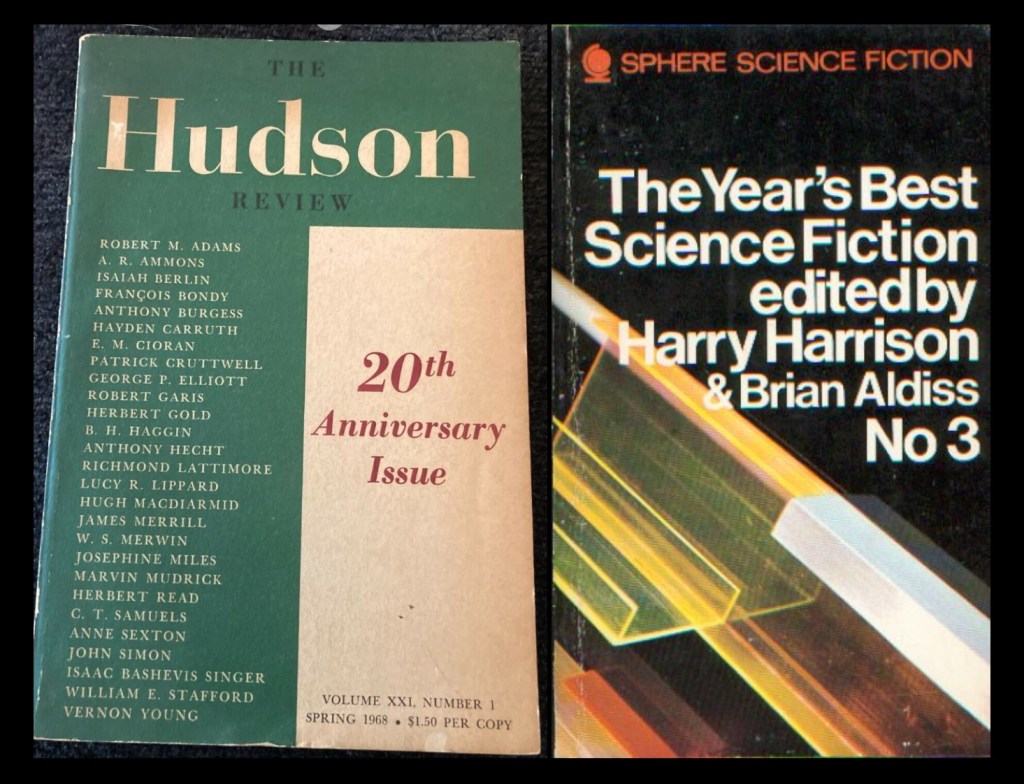
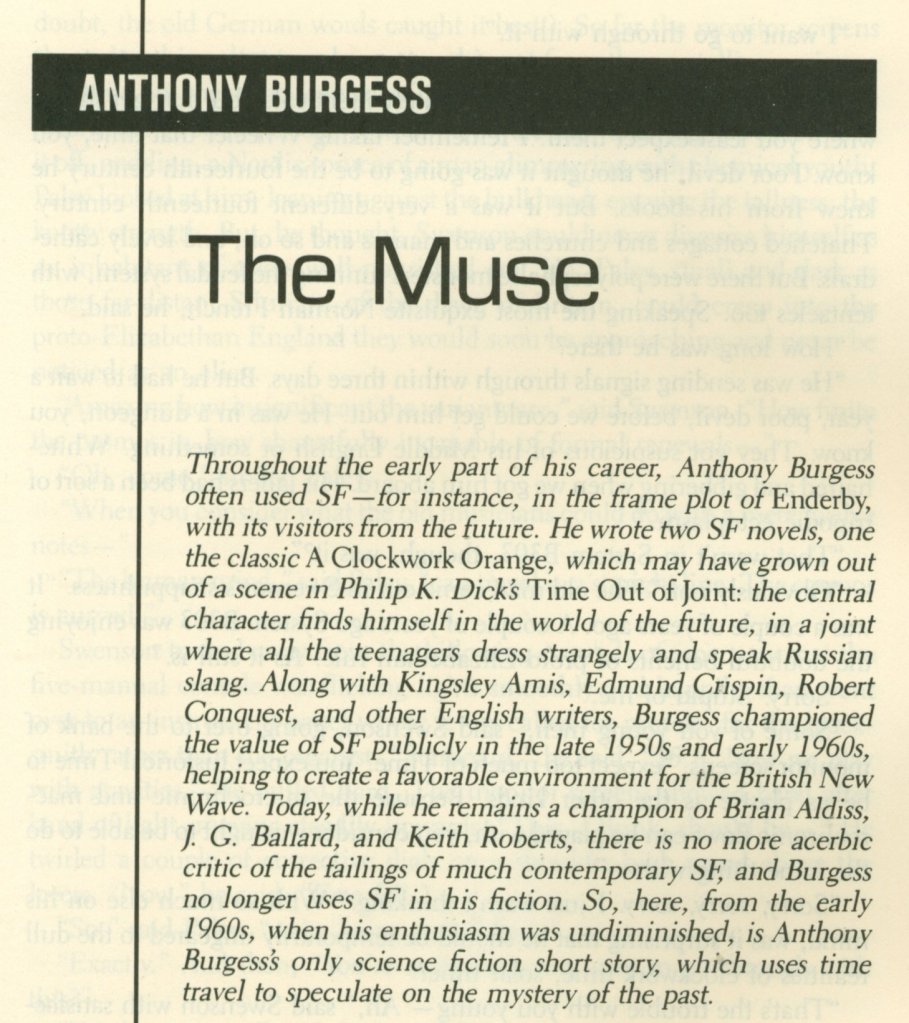
“The Muse” by Ray Anthony Burgess is story #32 of 52 from The World Treasury of Science Fiction edited by David G. Hartwell (1989), an anthology my short story club is group reading. Stories are discussed on Tuesdays, Thursdays, and Saturdays. “The Muse” was first published in The Hudson Review (Spring 1968), a literary journal. It was reprinted in Best SF: 1969 edited by Harry Harrison and Brian Aldiss.

“The Muse” is an honest-to-God science fiction story written by a literary writer. Not only that but Anthony Burgess speculates like a true science fiction writer. Burgess comes up with his own unique form of time travel. It’s a variation of the many-worlds theory, but it’s uniquely his. I was quite impressed.

In David Hartwell’s introduction, he describes Anthony Burgess’s short exploration of science fiction early in his career before giving up on the genre.

A scholar named Paley, we assume from our Earth, travels across space to a system called B303, which orbits another Earth, one very much like ours, except in their evolutionary development, they have only evolved until the time of Shakespeare. Paley is one of those people who really want to know who wrote Shakespeare.

Unfortunately, for Paley, this Earth isn’t quite like ours, and humans have a few extra eyes that give their world a nightmare quality to people from our world.

From reading “The Muse” I could sense that Burgess understood the potential of writing science fiction. And he knew he had to tell his story as if his theoretical world really existed. No pussyfooting around. No smirking and winking at the audience. No, “Look at me MA! I’m being so fucking clever.” No “I’m smarter than you, with a better education from a goddamn Ivy League school.”

Burgess looked at science fiction, saw the rules of the game, and played by those rules. He got down to our level of maturity and babbled in our lingo. I’m impressed.

I was also impressed that he went on to write mostly books that weren’t science fiction. Science fiction is a black hole for most writers. They fall in and can’t get out. Science fiction has tremendous limitations. I believe writers destroy their potential if they only write science fiction.

While you read “The Muse” pay attention to what it does, and what it can’t do. Like in the story, science fiction would be one alternate Earth, but there are an infinite number of alternate Earths where there are other things more interesting than science fiction.

James Wallace Harris, 7/18/23

Which Writers Would Be Included In A Group Biography/History of 1950s Science Fiction?

The World Beyond the Hill by Alexei and Cory Panshin and Astounding Alec Nevala-Lee were two huge histories of science fiction in the 1940s. Both books focused on the magazine Astounding Science-Fiction, where John W. Cambell was a genre-shaping editor. The Panshins concentrated on three writers: Heinlein, Asimov, and van Vogt, while Nevala-Lee dwelt on Heinlein, Asimov, and L. Ron Hubbard. The Panshins volumes were more about the stories, with some biographical details. Nevala-Lee spent more words on the biographies of the four men, with less prose about their stories. Combined, the two volumes make a great overview of Astounding Science-Fiction in the 1940s.

What if a similar group biography/history was written about science fiction in the 1950s? I already own a bookcase full of books about science fiction but they aren’t the kind I want. The book I ache to read is a biography/history on the impact of science fiction in the 1950s that’s as impressive as biographies/histories written by Walter Isaacson, Robert A. Caro, or Doris Kerns Goodwin. I want to read a biography/history that would make the subject interesting to the general reader. I just finished Tune In by Mark Lewisohn, a giant history of The Beatles that only covered their career until 1962. That’s the kind of high-quality biography/history of 1950s science fiction I want to read.

Alec Nevela-Lee’s biographies approach that league. He could write the book I want, but I don’t think he would because he probably knows the market for such a volume isn’t very big. And I wonder if science fiction fans would want a history of science fiction in the 1950s by him. His books Astounding and Inventor of the Future were hard on his subjects. I thought them honest appraisals, but he may have done in John W. Campbell’s reputation, and he didn’t help Heinlein’s or Asimov’s. I ended up feeling Buckminister Fuller was brilliant but not very successful, and a bit of a nut or crank after reading Inventor of the Future. However, any honest biography of the influential science fiction writers of the 1950s is going to unearth some worms.

The whole phenomenon of science fiction in the 1950s could be fascinating to the general reader if it was written in the right way. Look how pervasive science fiction has become. Science fiction as a subculture actually had a far more lasting cultural impact than The Beats in the 1950s and The Hippies in the 1960s, yet those movements are more studied and written about. Organized science fiction fandom has since inspired many other forms of organized fandoms. There are connections between science fiction and the space program and computers, both of which also started in the 1950s. And as a pop culture art, science fiction might be bigger than rock. Rock music is fading, while science fiction is still big business.

So, who were the movers, shakers, and creators of 1950s science fiction? I don’t think the major players are as obvious as they were in the 1940s.

As a science fiction fan back in the 1960s I was commonly told that Heinlein, Asimov, and Clarke were the Big Three Authors of science fiction. Looking at our CSFquery database, which uses various forms of citations to remember short stories and novels, I’m not sure it backs up that common knowledge. Look at the results. I’ve set the citation level at 3 or more citations. (Short stories are within double quotes, and novels are italicized. Clicking on the number of citations will show you the individual citations.)

The three writers with the most citations were Heinlein with eleven, and Bradbury and Asimov with eight each. However, some of those cited stories first appeared in the 1940s. After that, three authors have six titles on the list: Alfred Bester, C. M. Kornbluth, and Fritz Leiber.

Before looking at this data, I would have said Philip K. Dick, Alfred Bester, John Wyndham, and Walter M. Miller, Jr. were the breakout science fiction authors of the 1950s. Another indication of their popularity is how many photographs I can find of these men, especially ones taken in the 1950s. I’m guessing since photographs are hard to find, then details about their lives will be just as hard to find. That suggests any history of science fiction that focuses on anyone other than Heinlein, Bradbury, and Asimov will be covering events in the shadows of history.

If we alter the search to allow any work with two or more citations we see other authors standing out, but I’m not sure if it would change the overall apparent rankings. Thirteen women writers are on this list, but none have very many stories listed. I’m afraid the 1950s was still a male-dominated decade for science fiction.

And what about editors? Many histories of science fiction claim that John W. Campbell wasn’t as influential in the 1950s. But who was then? H. L. Gold at Galaxy is often mentioned. Anthony Boucher, and maybe J. Francis McComas at The Magazine of Fantasy and Science Fiction. There were dozens of science fiction magazines published during the 1950s, and I’m not sure if any other editor stood out. But then I haven’t researched it. However, I would say the 1950s were still a magazine-driven era for science fiction.

The Panshins and Nevala-Lee had Astounding Science-Fiction to anchor their history/biographies of the 1940s. The Magazine of Fantasy and Science Fiction, Galaxy, and Astounding Science Fiction dominated the 1950s, but there were many other magazines that published significant science fiction and influenced the genre. I don’t know if a history of science fiction of the 1950s could be as focused as The World Beyond the Hill and Astounding. The genre just exploded in too many different directions.

The small press or fan press science fiction publishers of the 1950s are legendary, especially to collectors, but I don’t know if any of their editors had that much influence. I would think the editors at Doubleday and the Science Fiction Book Club could be a consideration if I knew who they were. Another consideration is Donald A. Wollheim. His work at Ace Books was both influential and widespread.

If a single volume could be written about science fiction in the 1950s it might need to be divided into twelve chapters, one for each year, or into 120 chapters, based on the months. A linear progression through the decade might be the best way to capture the history of science fiction in the 1950s. And the book would have to be big, maybe a thousand pages.

There is one significant book about science fiction history in the 1950s that I know about, Transformations: The Story of the Science Fiction Magazines – From 1950 to 1970 by Mike Ashley. I have quite a few other books that cover that era in science fiction, but none are of the scope I’m talking about. I wish Ashley’s books were available in cheap Kindle editions so more people would read them.

And should we also add the impact of the movies and television? Should we consider George Pal and Rod Serling as movers and shakers of 1950s science fiction, for this book I want to read? An Astounding-like biography/history of science fiction in the 1960s would include Gene Roddenberry and one for the 1970s would have to include George Lucas and Steven Spielberg.

I wish I had the skill and stamina to write a history of science fiction in the 1950s. I’m in awe of the work done by the Panshins and Nevala-Lee. I would love to read a book about 1950s science fiction like I’ve described, so if you’re a writer looking for a topic, here’s one. I don’t know how many copies it would sell. Sadly, the audience for such a history is getting old and dying. I wrote this essay to gauge interest in such a book, but I’m not finding much so far. However, a good biographer can make any person or topic into a page-turner.

James Wallace Harris, 7/11/23

“The Hurkle is a Happy Beast” by Theodore Sturgeon

The Hurkle is a Happy Beast” by Theodore Sturgeon is story #29 of 52 from The World Treasury of Science Fiction edited by David G. Hartwell (1989), an anthology my short story club is group reading. Stories are discussed on Tuesdays, Thursdays, and Saturdays. “The Hurkle is a Happy Beast” appeared in the very first issue of The Magazine of Fantasy and Science Fiction (Fall 1949) when it had the title The Magazine of Fantasy.

“The Hurkle is a Happy Beast” is a cute story about a creature from another dimension thrown onto Earth. The Hurkle is blue, has six legs, and is kitten-like. It follows a theme of things discovered by humans in the present that come from other times and dimensions, however, it’s not up to the classics of this theme like “Mimsy Were the Borogoves,” “The Twonky,” or “The Little Black Bag.”

Even though “The Hurkle is a Happy Beast” is a slight effort by Sturgeon, it has been often reprinted. However, our discussion group wondered why Hartwell selected a second story by Sturgeon for The World Treasury of Science Fiction. It definitely wasn’t one of Sturgeon’s better efforts.

This listing from CSFQuery shows Sturgeon’s most recognized short stories. If Sturgeon deserved two stories in this monumental anthology, I would have picked “Thunder and Roses” or “A Saucer of Loneliness” because their lengths were close to “The Hurkle is a Happy Beast.” But why give Sturgeon two stories. Wasn’t there a better option from 1949?

Well, not exactly. However, my guess is Hartwell wanted to lighten things up by using Hurkle. To me, the obvious substitute for a cute science fiction story with an animal would be “Bears Discover Fire” by Terry Bisson, unfortunately, it came out the year after Hartwell’s anthology. Another possibility is “The Ugly Chickens” by Howard Waldrop, it came out in 1980, so it was available. Or maybe “The Star Mouse” by Fredric Brown?

“The Hurkle is a Happy Beast” is not a bad story. It’s cute enough, but it’s lightweight. This got me thinking about being a science fiction writer in 1949 and having to crank out short stories to make a living. Imagine sitting at a typewriter and knowing your survival depends on your writing a story that will impress editors and readers. I doubt Theodore Sturgeon was thinking he needed to hit one out of the park for future editors of retrospective anthologies. He just needed to sell a story to earn a penny or two a word. There were damn few science fiction writers who lived solely off selling fiction. Sturgeon may have been one since he was so prolific.

In 1949 Sturgeon sold ten short stories according to ISFDB:

  • “Farewell to Eden” – Invasion From Mars edited by Orson Welles (anthology)
  • “Messenger” – Thrilling Wonder Stories (February 1949)
  • “The Martian and the Moron” – Weird Tales (March 1949)
  • “Prodigy” – Astounding Science Fiction (April 1949)
  • “Die, Maestro, Die!” – Dime Detective (May 1949)
  • “Scars” – Zane Grey’s Western Magazine (May 1949)
  • “Minority Report” – Astounding Science Fiction (June 1949)
  • “One Foot and the Grave” – Weird Tales (September 1949)
  • “The Hurkle is a Happy Beast” – The Magazine of Fantasy (Fall 1949)
  • “What Dead Men Tell” – Astounding Science Fiction (November 1949)

Is it really fair to judge “The Hurkle is a Happy Beast” at all? We think because a story is in Hartwell’s anthology it must be one of the best SF short stories from around the world from the 20th century. But should we think that?

After our reading group has plowed through many of these gigantic SF anthologies I’m starting to wonder about their value and their goals. The Big Book of Science Fiction turns out to be a very accurate title, and by that consideration, an honest one. My problem, and for my fellow group members, I believe, is the phrase “World Treasury” gives us great expectations.

“The Hurkle is a Happy Beast” is a pleasant enough story. I would have been fine reading it in any magazine in 1949. Even though Bleiler & Dikty and later Asimov & Greenberg picked it for their annual best-of-the-year anthologies, which I’ve both read, I don’t think Sturgeon’s story was even at that level. If I had read it in a theme anthology about cute alien creatures it might have been acceptable. It was in two of those, The Science Fiction Bestiary edited by Robert Silverberg, and Zoo 2000 edited by Jane Yolen.

If you follow the links to those two anthologies you’ll find lists of not-so-famous stories. Evidently, this theme isn’t a gold mine for classic SF stories. My favorite alien pet is Willis from Heinlein’s Red Planet. Heinlein and Norton often added cute aliens to their young adult books.

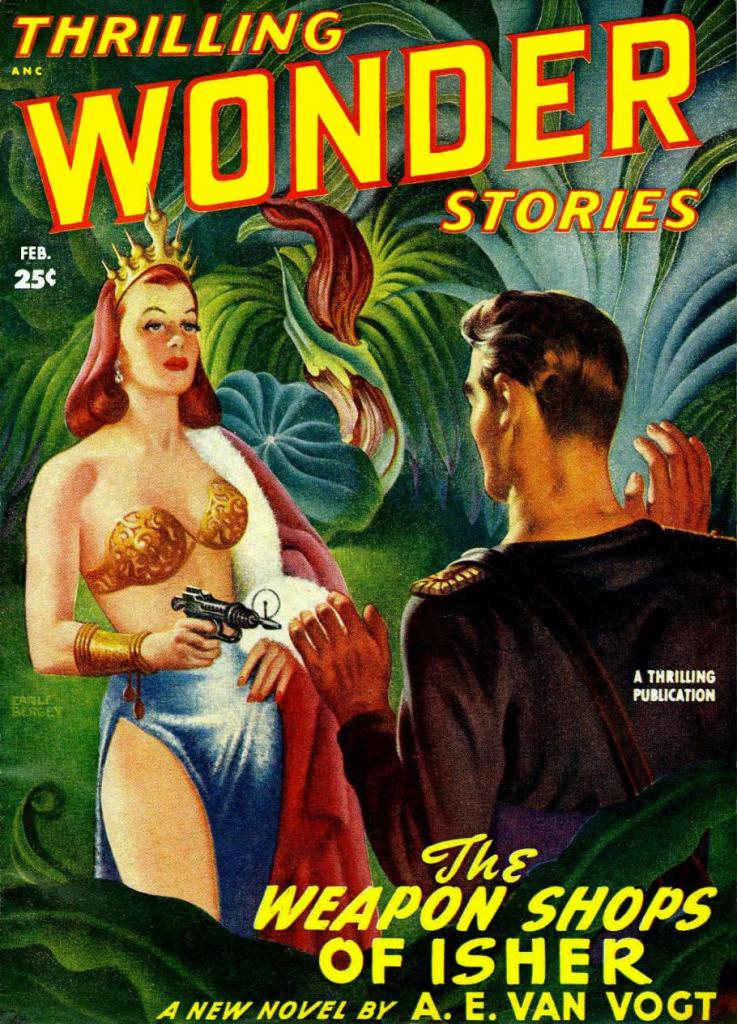
Just for grins, here are some of the covers for Sturgeon’s 1949 publications.

James Wallace Harris, 7/11/23