“Mockingbird” by Walter Tevis

If you’re an old movie fan, either from being old or just because you love old movies, you might know Walter Tevis from his first novel, The Hustler (1959). It was made into a stunning Paul Newman movie. Jeez, that’s a helluva start for a young novelist. Wait, that happened to Larry McMurtry too. (Note to self, see how many young novelists were made famous by Paul Newman, it might be worth a blog.) Tevis’ last novel, The Color of Money (1984) was also made into a movie starring Paul Newman. I’m sure the first and last thing is unique.

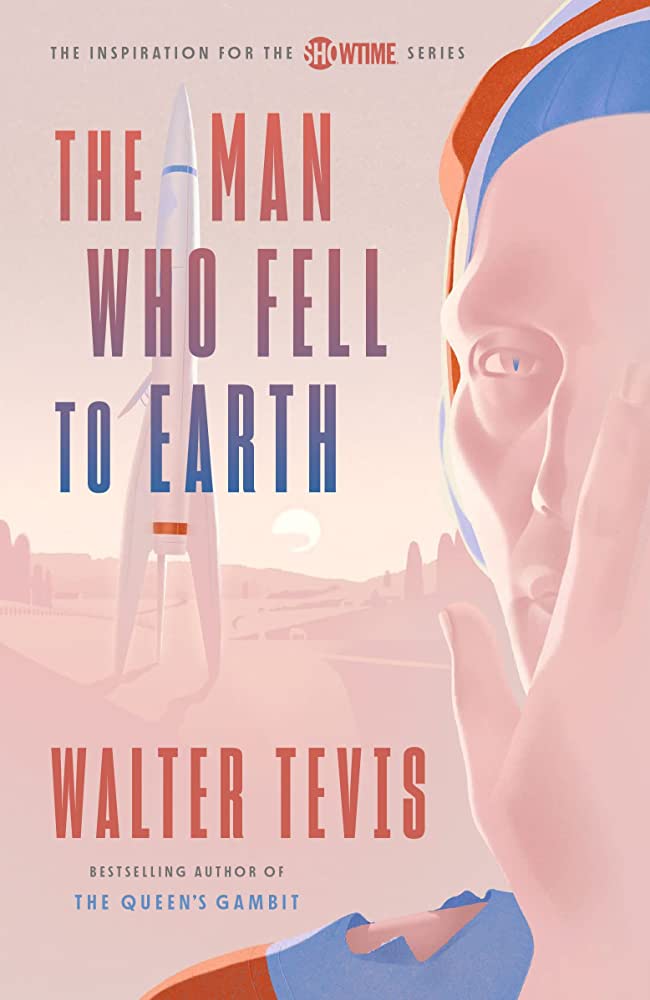
Tevis was forgotten for a while until David Bowie made his second novel, The Man Who Fell to Earth (1963), into a weird quirky flick in 1976. Don’t rush out and watch that movie though, they ruined the book, but do read the novel, it’s quiet and lovely and should resonate with your soul. (You can watch the film afterward to see what Bowie does in the role, and there is another film version and a Showtime TV series to check out too.)

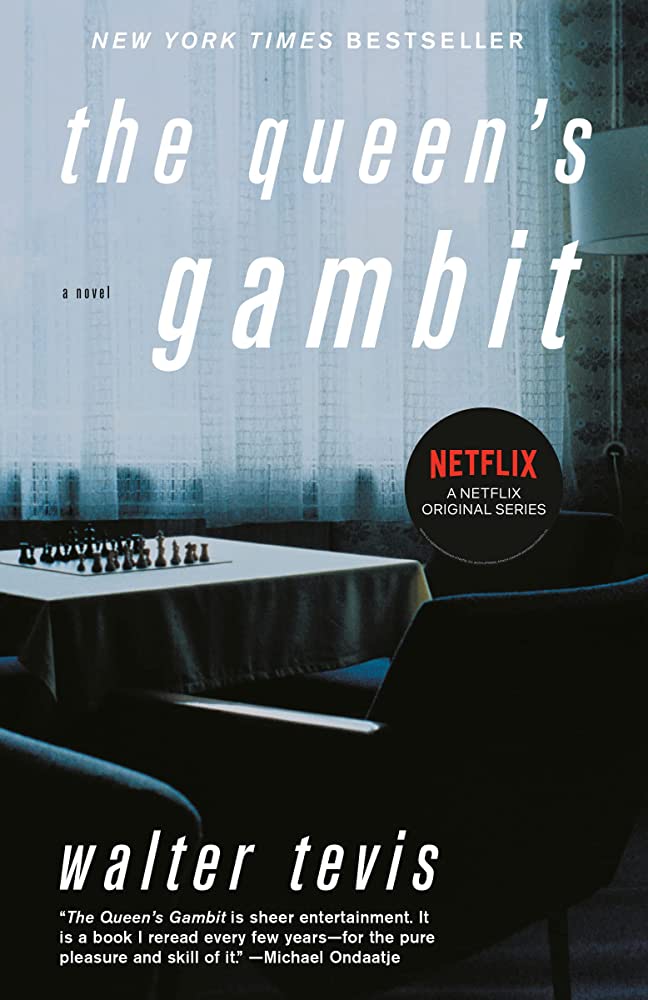
Most young people today will know of Walter Tevis if they read the credits or reviews of Queen’s Gambit (1983), the hit series on Netflix. The TV show is excellent but the book is better. All this media exposure has made Tevis (1928-1984) a minor forgotten writer with some fame.

You might have figured out by now that I’m a fan of Walter Tevis. That’s even more true now that I just finished his 1980 novel Mockingbird. What a strange trip it was. I thought it a perfect novel for the 2020s because it is about artificial intelligence and the decline of the human race and our civilization. Mockingbird is set in the 25th century but I don’t think it will take us that long.

I don’t want to give any spoilers to this novel because it‘s the kind of story that you should just unfold slowly as you read. But I do need to say enough to get you to read Mockingbird. Mockingbird has over two thousand customer ratings on Amazon with a 4.5 average.

For most of the novel Tevis tightrope walks between existentialism and nihilism and has a brush with Christianity. I will tell you the ending made me happy because of how Tevis ties up the story and his philosophical speculations. Tevis doesn’t stick to any one philosophy. He appears to be extrapolating on the decline and corruption of liberal thought but what he projects for conservatives isn’t any better. Walter Tevis was one of those tortured souls that tried mightily to figure out reality in his fiction.

The story opens with Robert Spofforth, a robot who looks like a black man but has an artificial brain. Later in the novel, Spofforth is described as the most beautiful object humans ever created. Bob is a level 9 robot, the most advanced of his kind, but the only unit of this model that hasn’t destroyed himself. He has been programmed so he can’t commit suicide. Currently, he is the Dean of New York University, but he might be the most intelligent and most powerful being left on the planet.

Spofforth hires Paul Bentley to come to New York because he’s the only human being he can find that can read. Bentley’s narrative is the main part of the novel. Paul then meets Mary Lou, an iconoclast living among the sheep, and teaches her to read. But Bob didn’t hire Paul to teach people to read but to translate the intertitles in silent films. Bob doesn’t want humans to learn to read again.

The human population has shrunk from billions to just a few million. Robots care for all their needs, but very poorly because robots are also a declining species. Humans routinely consume drugs, have a lot of casual sex, and pursue inner development.

There are elements in Mockingbird that will remind you of Brave New World and Nineteen Eighty-Four, with a slight hint of The Road. And if you’ve read The Long Tomorrow by Leigh Brackett, Mockingbird reminded me of it too. And there’s a little bit of Cool Hand Luke in the story. (Another Paul Newman connection).

And if that’s not enough to get you to read Mockingbird there’s a cat named Biff. I’m off to read The Steps of the Sun (1983) but it hasn’t gotten kind reviews. I also bought The King is Dead (2023) which reprints his 1981 collection Far from Home and adds many unpublished works.

James Wallace Harris, 5/20/23

“Special Flight” by John Berryman

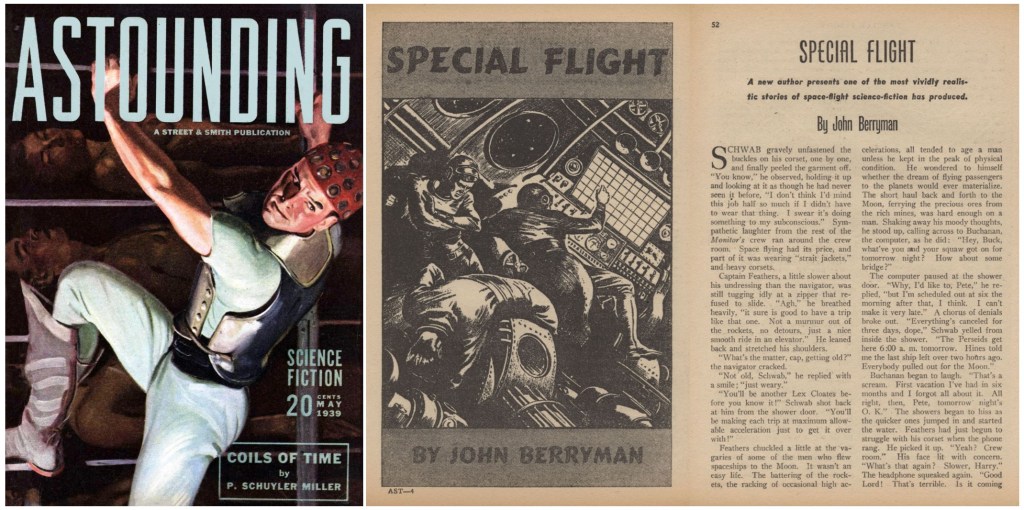
“Special Flight” by John Berryman is story #3 of 52 from the anthology The World Treasury of Science Fiction edited by David G. Hartwell (1989) that my short story club is group reading. Stories are discussed on Tuesdays, Thursdays, and Saturdays.

Editors assembled anthologies to reprint and promote stories they believe people should read — stories they feel should be kept alive. I have to wonder why Hartwell selected “Special Flight” because to most modern readers, or even readers in 1989, the story is a clunker. Kingsley Amis and Robert Conquest selected “Special Flight” for their anthology Spectrum in 1961, but other than those two anthologies no other editors have wanted to save this story from oblivion.

John Berryman, according to ISFDB, only published 21 science fiction stories, and some of them were occasionally reprinted. However, John Berryman is not a name I remember. He is a forgotten author. So why read his story in 2023? I’ve never read “Special Flight” before, or even heard of it, but it’s an impressive science fiction for 1939 if you think about it in a certain way. “Special Flight” was first published in the May 1939 issue of Astounding, just months before the July issue that many consider the first issue of the Golden Age of Science Fiction. Then why didn’t Hartwell choose one of the more famous stories from that year?

Reading “Special Flight” brings up a long queue of questions. The sole quality that makes this story impressive is it tries to scientifically imagine routine space flight in 1939 in a realistic manner. So, do I recommend you track it down and read it? Not really, because it gets the science all wrong. However, if you happened to have an academic bent and like to study science fiction as a subject, then “Special Flight” is an interesting read.

If you’ve ever wondered how people in 1939 imagined space flight actually working, and not just being silly Buck Rogers stuff, “Special Flight” can provide some answers. Berryman was trying to imagine a near future where we mined the Moon for minerals and rocketships were much like merchant ships or cargo aircraft. “Special Flight” reminds me of what Heinlein was trying to do in the 1950s and it also reminds me of the original Star Trek.

Shouldn’t we forgive “Special Flight” for its mistakes if it was solid scientific speculation in 1939? Jules Verne got nothing right scientifically in Journey to the Center of the Earth but it’s still a well-loved story today. Why? Because the storytelling is fun. Then what about the storytelling in “Special Flight?” It’s not bad but it’s not great either. It’s about the level of a science fiction B-movie from 1953. Remember all those old black-and-white movies where the big danger of space flight was meteors? That’s what happens in “Special Flight”

“Special Flight” is action-packed. It’s about an emergency rocket flight to the Moon to save the lives of over a hundred miners. Everything possible that could go wrong does, including a giant tank of milk busting and flowing all over the rocket ship. Berryman spends a lot of his wordage on math and navigation and not that much on characterization. The crew is often knocked around like Captain Kirk and his crew — remember how the actors threw themselves around on the sets of Star Trek? In other words, the action is cheesy. But on the other hand, the focus is on getting to the Moon, and quite a lot of detail that Berryman imagined feels realistic. For instance, Berryman imagines that spaceflight causes tiny blood clots in the brain that produces a list of effects that can make operating a spaceship difficult. He talks about the three-body problem, something I didn’t know about until I read the Cixin Liu book. He imagines an automatic pilot and system that controls chemical rockets to maneuver in space while atomic rockets provide the main thrust using water as fuel. He talks about orbital velocities, g-forces, and take-off speeds. Stuff that just wasn’t in science fiction in the 1930s.

If you like to chart how science fiction evolved or are curious about how people before WWII imagined realistic space travel, then read “Special Flight.” If you’re used to modern well-told science fiction stories, you’ll probably want to skip it.


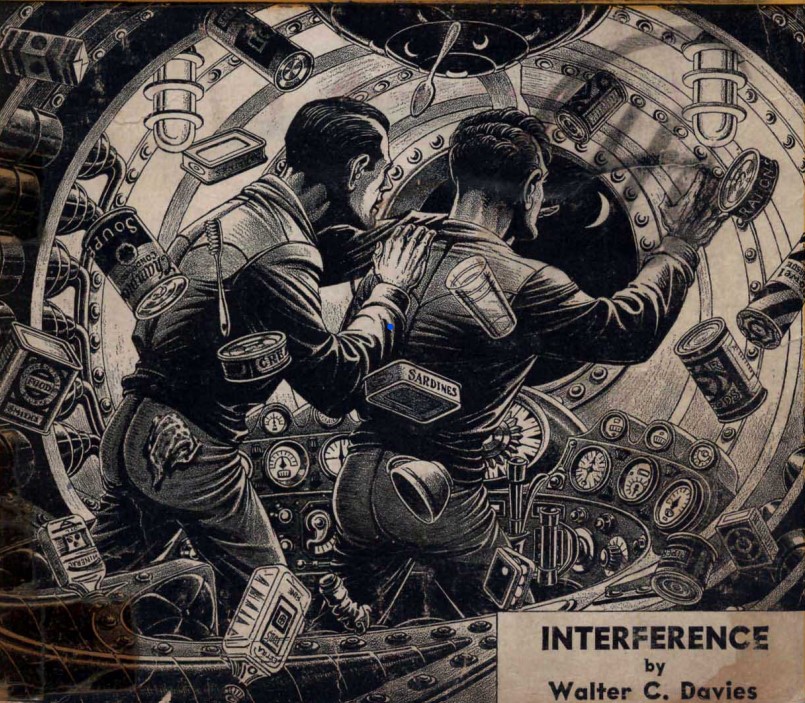
By the way, here’s an illustration from the cover of Cosmic Stories (July 1941) that imagines being in space in a rather realistic way for the time. I do like picturing how people imagined space travel before NASA. That’s why I enjoyed “Special Flight.”

James Wallace Harris, 5/11/23

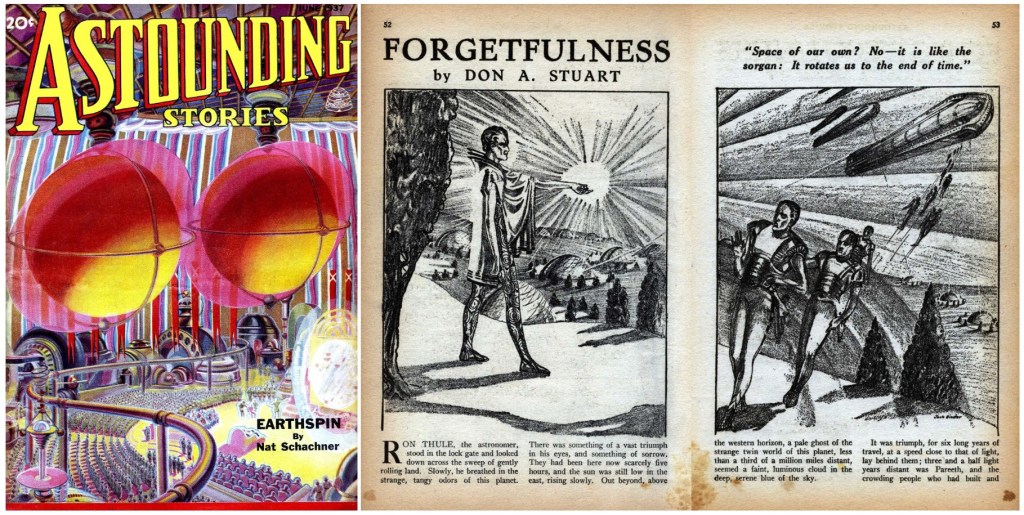
“Forgetfulness” by John W. Campbell

“Forgetfulness” by John W. Campbell, Jr. is story #2 of 52 from the anthology The World Treasury of Science Fiction edited by David G. Hartwell (1989) that my short story club is group reading.

Instead of counting all the titles and authors of science fiction books I’ve read, I’m starting to tally all the far-out concepts science fiction has given me. In “Forgetfulness” John W. Campbell took one of my favorite concepts, walking in ancient dead alien cities, which was probably an old SF concept even in 1937, and gave it a couple twists. It’s going to be impossible to talk about this story without giving spoilers so think of this essay as an analysis of SF concepts and not a review. You can read the story online here, or buy it in a $2.99 Kindle edition of Campbell’s collection Cloak of Aeshir. However, I don’t recommend buying unless you’re a big fan of John W. Campbell.

“Forgetfulness” begins with a spaceship landing on the planet Rhth, one of nine planets in the system. The main point-of-view character is Ron Thule, an astronomer, from the planet Pareeth. They have traveled for six years, in a spaceship 2,500 feet long and 400 feet in diameter, covering 3.5 light-years, traveling at nearly the speed of light. These people from Pareeth are looking for a world to colonize, and are disappointed that Rhth is already inhabited. They hope to settle in the remains of a majestic city that was built by spacing-faring race millions of years ago and discover its secrets.

Try and pronounce Rhth. If nine planets weren’t a giveaway, the name Rhth should be. There they meet Seun, a very tall, graceful human-shaped being, clothed in a golden outfit, with a beautiful colored cape. All the people of Rhth wear gold suits and colored capes and live in opalescent domes twenty to thirty feet in diameter situated under giant green trees near the dead city. The buildings of that titanic city are three thousand feet high, but the winds have filled the streets with five hundred feet of dirt.

Seun has told Ron Thule and the commander of the Pareeth mission, Shor Nun, that the builders of the city had once visited their world. And that their world, Pareeth, once orbited the same sun as Rhth, but had been torn away by a rogue star. This hints that maybe the builders had conducted a kind of panspermia across the galaxy. As the story progresses the achievements of the builders become greater and greater. However, the people of Pareeth eventually discover secrets that can shatter their minds and their hopes.

Most of us find a great sense of wonder reading about the rediscovery of lost cities. So, it’s not a remarkable feat of creativity for a science fiction writer to imagine humans finding long-dead alien cities. Still, it’s one that sets off a powerful sense of wonder and has been used time and again in science fiction.

Campbell puts a twist on this concept, by having aliens discover a city from a long-dead civilization of mankind. John W. Campbell has a reputation that claims he wanted humans to be the galactic crown of creation, and this story supports that. In his earlier story, “Twilight” he had a human time traveler discover a far future deserted human civilization. That gave him a chance to imagine the engineering marvels of what we could achieve someday. In “Forgetfulness” he has aliens discover dead human civilization, but this time, Campbell imagined an even more impressive future for us built by super-science. You should read both stories to see just how hopeful Campbell was for the human race.

Both “Twilight” and “Forgetfulness” could be considered Dying Earth stories, although H. G. Wells in “The Time Machine,” William Hope Hodgson in The Night Land, and Olaf Stapledon in Last and First Men, took that idea, even much further.

Unfortunately, “Forgetfulness” is hard to read. Part of that is due to a dated writing style, but also because Campbell didn’t really have much of a story to tell. They came, they discovered wonders, they were frightened, they were disappointed. There’s no drama or revealed emotions. “Forgetfulness” was reprinted in the classic 1946 anthology Adventures in Time and Space but has been mostly forgotten since. Damon Knight remembered it in his 1966 anthology Cities of Wonder, and Brian Aldiss and Harrison brought it back again in 1973 for The Astounding-Analog Reader. Both are very minor anthologies. The second contained just seven stories from Astounding covering 1937-1941, a rather odd collection.

It’s interesting that a story about remembering has been forgotten. The big concept in “Forgetfulness” is visiting the remains of an astonishing civilization millions of years after its citizens have gone. Campbell puts his own twist on it by having that civilization be a future version of ours. However, there’s another important concept he wanted to get across, and that’s how we forget the past. Shor Nun and Ron Thule can’t understand why Seun doesn’t understand how the city works. But then Campbell reminds us we couldn’t explain the technology of cavemen, or from other periods of human civilization. Remember all the discussions about how did the Egyptians build the pyramids? Well, it turns out Seun has even newer technologies that are even further advanced than the builders and they have merely forgotten earlier primitive technology.

I have to wonder if Arthur C. Clarke’s story “Rescue Party” wasn’t inspired by “Forgetfulness” and “Twilight.” Or that the screenwriters for Forbidden Planet hadn’t read “Forgetfulness” too. Or were their ideas independently invented?

That’s the thing about science fiction. Concepts keep getting reused. Are they forgotten and then reinvented? Or does science fiction evolve over time as concepts merge and mutate? Will some young writer in the 2020s come up with a story about a far-future space race discovering a future Earth and finding the ruins of what our civilization will become? How will this writer imagine the pinnacle of our success? Campbell wanted to believe that humanity will evolve until it has god-like powers. That idea has shown up in science fiction over and over again. But do we still believe that? Right now the peak of our civilization might end this century.

James Wallace Harris, 5/9/23

“Harrison Bergeron” by Kurt Vonnegut

“Harrison Bergeron” is a political satire set in the year 2081. Kurt Vonnegut imagines everyone is not only equal under the law but handicapped to be made equal in all ways. Stronger people are weighed down, talented people are made less talented, and intelligent people have to wear earplugs that make various kinds of noises to distract them from thinking deeply. In this rather short story, George and Hazel Bergeron are watching a ballet on television. They have forgotten their 14-year-old son Harrison has been arrested for being too handsome, too smart, and too strong. During the course of the TV show, their son appears on the ballet stage having escaped to start a rebellion. (You can read it here, or read a detailed synopsis on Wikipedia.)

“Harrison Bergeron” is not a subtle satire, instead it goes for the absurd. It’s a very likable story. Vonnegut tells it in simple language with vivid details. You immediately agree with him that this dystopian world is wrong. This short story has become quite famous, having been adapted to the screen four times. National Review, the conservative magazine founded by William F. Buckley even reprinted the story. The National Review keeps using “Harrison Bergeron” – here’s it being used again in 2015 against economic inequality in “Inching Towards ‘Harrison Bergeron.’

Usually, satire attacks something, and I have to wonder what Vonnegut was attacking. While reading it I thought maybe he was protesting laws designed to create equal opportunity. Then when I read about National Review and that Supreme Court Justice Antonin Scalia quoted the story in PGA Tour, Inc. v. Martin then I began to wonder even more. And it’s referenced in academic papers, including a 2013 one about transgender athletes. I thought Vonnegut was liberal. Wikipedia did say he wasn’t against his story being used in a Kansas court situation, he didn’t agree with their interpretation.

So why have conservatives embraced “Harrison Bergeron” so thoroughly? Are they using its satire the way Vonnegut intended? A site called What So Proudly We Hail promotes the story with a very pointed introduction:

Central to the American creed is the principle of equality, beginning with the notion that all human beings possess certain fundamental rights and equal standing before the law. Our concern for equality has expanded over the past half century to focus also on inequalities in opportunities, wealth, achievement, and social condition. What good is an equal right to pursue happiness if one lacks the native gifts or the social means to exercise it successfully? In this satirical story (1961), set in a future time in which “everybody was finally equal . . . every which way,” Kurt Vonnegut Jr. (1922–2007) challenges our devotion to equality and invites us to consider the costs of pursuing it too zealously. Although the story is not explicitly about racial, ethnic, or gender equality, the questions it provokes about the kind of equality we should want, and the costs of pursuing it, are relevant also to campaigns to eliminate inequalities among racial and ethnic groups or between the sexes. Does the society portrayed here represent a fulfillment of the ideal of equality in the Declaration of Independence, or rather a perversion of the principle? Does opposing invidious distinctions, envy, and feelings of inferiority require reducing all to the lowest common denominator, and is this the true path to “social justice”? Would homogeneity attained by artificially raising up the low, producing a nation of Harrisons rather than a nation of Hazels—a prospect offered by biotechnological “enhancement”—be any more attractive?

The story does resonate with conservative thinking and even more so today. Are there other ways to read it? On the surface, the bad guys in the story are the government and laws that try to make everyone equal in every way. However, was that what Vonnegut was protesting. Was he all fired up and wrote this story the way the conservatives have used it?

I have no idea, but I do wonder about something. Vonnegut’s story is silly, absurd, and far from real. Vonnegut was often silly and absurd. I wonder if he just didn’t get the idea of a government taking the idea that everyone should be equal, and imagining how they could go about making it happen. It was published in a science fiction magazine. If Vonnegut was serious about his satire, why didn’t he publish it in a serious magazine? And back then, bizarre speculation on social change was common in SF stories.

The story came out in 1961, well before the liberal sixties. Eisenhower was probably president when he wrote it. A similar idea about making everyone equal had been used in the 1959 novel, The Sirens of Titan. In the 1950s the main political push to make people equal was providing equal education to African Americans. And that effort was to make people better educated, not dumber. My guess is “Harrison Bergeron” is based on a silly idea that came to Vonnegut and he wrote a story to illustrate it. Conservatives have just run with it.

What’s also interesting is Hazel, the wife, has no handicapping applied to her. She’s average. Was Vonnegut saying something about women? 1961 was also before the Second Wave of feminism in the 1960s. Was he being liberal to make the Handicapper General of the United States, a woman? She had the funny name Diana Moon Glampers? Was this a dig at women?

I don’t think I’ve read “Harrison Bergeron” before. Its basic idea is so memorable that I can’t believe I’d forget it. I could have since it’s been around since the October 1961 issue of The Magazine of Fantasy and Science Fiction. It’s also been reprinted quite often and I could have read it and thought it so absurd as to be completely minor, and did forget it. “Harrison Bergeron” has 9 citations in The Classics of Science Fiction Short Stories v. 2. I just read it because our short story club has just started reading The Treasury of World Science Fiction edited by David G. Hartwell. That anthology is a monster of over one thousand pages of classic science fiction where Hartwell also introduces science fiction from around the world.

Despite its fame, I still think “Harrison Bergeron” is a silly story. I’d only rate it ***+ in my system – three stars mean well-written, and a + means I liked it a lot. Four stars would mean it’s a story I’ll want to reread now and then, and I don’t feel that.

I’m going to try and review as many of the stories as possible from The Treasury of World Science Fiction. I haven’t given up on my Heinlein project, but after gorging on his work for months, I’ve been taking a break. I’ve wanted to get into a science fiction novel I never read but I’m still on a short story kick.

James Wallace Harris, 5/6/23

“Blowups Happen” by Robert A. Heinlein

Only dumbasses, egotists, and the delusional think they can predict the future, although there are a number of professions that try. I do believe Robert A. Heinlein was smart and sane enough to know he couldn’t see beyond the horizon of the moment, but he wrote plenty of stories that tried. “Blowups Happen” is one that stands out. Heinlein’s 1940 novelette imagines the dangers of commercializing atomic energy in peacetime. That was five years before Hiroshima.

I grew up being taught that atomic research during the war was an extremely well-guarded secret. What I didn’t know, and I assume most other people didn’t either, was how much atomic energy was widely discussed before the war. John W. Campbell, Jr. liked to brag about how the FBI came to his offices in 1944 because of Cleve Cartmill’s story “Deadline,” implying the G-men thought it gave away some of the secrets of the atomic bomb. I thought Heinlein’s story felt far more knowledgeable. I now have to assume the well-educated public before WWII knew far more than I ever imagined regarding atomic physics.

“Blowup Happens” is set in the near future from 1940 in the Astounding Science Fiction magazine version, and from 1950 as it was rewritten for the collection, The Man Who Sold The Moon. Those two dates are important because the story is about atomic power, and the magazine version was written before Hiroshima and the book version afterward.

The setup of the story is the United States has come to depend on atomic power even though a breeder reactor in Arizona could theoretically destroy the country or even the planet. The General Superintendent of the plant, King, has to hire one psychiatrist for every three engineers to monitor their work with the reactor because engineers have nervous breakdowns after a short career and must be continually replaced. King brings in Dr. Lentz, one of the country’s top psychiatrists to find ways that allow engineers to handle the stress.

Later in the story, Superintendent King learns that mathematical models that previously showed the reaction in the breeder reactor is probably controlled are wrong. New mathematics prove the reactor could go into a runaway reaction that would destroy the planet. If they bring down the breeder reactor the country would lose a good portion of its industrial power and ruin the economy. King knows the corporation that owns the plant won’t accept the new research because it would be financial ruin for it.

The solution to the problem has been emerging all along in a tangential subplot about two engineers, Erickson and Harper, developing atomic power for rockets.

“Blowups Happen” has a great deal of infodumping where Heinlein tries to educate his readers about the science behind atomic energy. Reading those passages today is tedious unless you are researching early speculation about atomic energy. So, how do we judge “Blowups Happen” as a story in 2022?

We want science fiction that is visionary. We want the future to be exciting. Ultimately, most, if not all science fiction becomes historical curiosities. Time has a way of eroding our genre. I didn’t like “Blowups Happen” when I first read it as a teen back in the 1960s. It was already too dated. Now that I’m rereading it in my seventies in 2022 I have to admire Heinlein’s speculation. “Blowups Happen” is an ambitious story. I’m starting to think science fiction writers are at their most ambitious when they are working closest to the present.

In “Blowups Happen” Heinlein explores the impact of atomic energy before the world is startled by the reality of Hiroshima. Sure, the idea of atomic power had been around since Einstein’s most famous equation. The reason why the science fiction of the 1950s had been so exciting is it just preceded NASA of the 1960s. And the reason why cyberpunk was so exciting in the 1980s is that it just preceded the World Wide Web in the 1990s. Science fiction writers get the details wrong, but they still anticipate the wonder and the chaos. This thought makes me rethink Heinlein’s Stranger in a Strange Land anticipation of the 1960s.

When we judge an old science fiction story for its visionary qualities I think it’s important to look at the story’s original publication. “Blowups Happen” was first published in September 1940. It was first reprinted in The Best of Science Fiction edited by Groff Conklin in 1946, and then in 1950, it was rewritten for The Man Who Sold the Moon. However, for that edition, Heinlein rewrote the story to include the knowledge of the bombing of Hiroshima in 1945. By 1950 the public and science readers knew much more about atomic energy. I’m guessing “Blowups Happen” was already outdated even in 1950.

Ten years makes a lot of difference in a science fiction story, although I doubt anyone in 1940 could have imagined what the next five years would bring, much less ten. Science fiction writers do not and cannot predict the future, but we do have to admire Heinlein for imagining the political implications of a country having atomic energy in 1940, and what the dangers might be for developing peacetime uses of atomic power. He gets the details wrong, but what he gets right is the essence of great science fiction. By the way, in the 1940 version, the power plant is called a bomb, but in 1950 the label was changed to pile. I’m guessing Heinlein imagined the power plant as being a controlled explosion.

Within the 1940 version, Heinlein described a nuclear explosion as “forty million times as explosive as TNT. The figure was meaningless that way. He thought of it, instead, as a hundred million tons of high explosive, two hundred million aircraft bombs as big as the biggest ever used.” To give his readers a better picture, Heinlein has his character say to himself about ordinary big bombs, “He had once seen such a bomb dropped when he had been serving as a temperament analyst for army aircraft pilots. The bomb had left a hole big enough to hide an apartment house. He could not imagine the explosion of a thousand such bombs, much, much less a hundred million of them.”

Then in the 1950 version, the same character thinks of it as “a hundred million tons of high explosive, or as a thousand Hiroshimas.” Heinlein didn’t need to write anything more. By then, readers had seen films about atomic explosions. They knew exactly what that meant, but in 1940 I doubt readers could imagine anything close to reality.

Psychiatry and psychology are so commonly talked about today that we also forget that it was new at one time. I’m an old movie fan, and psychiatry became a hot subject matter for films after WWII and into the 1950s. I’m guessing Heinlein was doing just as much speculation about the future impact of psychiatry as he was doing for atomic energy in “Blowups Happen.” But how sophisticated his Heinlein’s expectations about the field? Heinlein loved popular scientific speculations published in popular books of the 1930s. But he also was a fan of many pseudo-scientific works too, stuff we’d consider New Age today. In his Future History stories, Heinlein seemed just as interested in the soft sciences as the hard sciences.

Heinlein describes Dr. Lentz, the top psychiatrist of the day this way:

Notwithstanding King’s confidence, Lentz did not show up until the next day. The superintendent was subconsciously a little surprised at his visitor’s appearance. He had pictured a master psychologist as wearing flowing hair, an imperial, and having piercing black eyes. But this man was not overly tall, was heavy in his framework, and fat—almost gross. He might have been a butcher. Little, piggy, faded-blue eyes peered merrily out from beneath shaggy blond brows. There was no hair anywhere else on the enormous skull, and the apelike jaw was smooth and pink. He was dressed in mussed pajamas of unbleached linen. A long cigarette holder jutted permanently from one corner of a wide mouth, widened still more by a smile which suggested non-malicious amusement at the worst that life, or men, could do. He had gusto.

Heinlein, Robert. The Man Who Sold the Moon and Orphans of the Sky (p. 131). Baen Books. Kindle Edition. 

Is Heinlein serious about giving us a shrink that goes around in public in his pajamas? Is Heinlein just imagining a colorful future with odd fashions? Or is this satire? Would 1940 science fiction readers believe the fashions we see on TV today? Heinlein had his sociological speculations too. There is another scene at a bar where the atomic energy scientists go to unwind, that features a B-girl who is also a prostitute. Such women were common in the 1930s, but it was a lower-class thing. I got the feeling that Heinlein expected society would change its attitudes toward these women in the future.

But, we’re back to my original question. Is “Blowups Happen” a fun science fiction story to read in 2022? I don’t think so. Scientific lectures can slow a story, or even ruin it, but scientific lectures about out-of-date science are even harder to endure. Would “Blowups Happen” read better today if he had left out all the lectures? They weren’t needed for the story. Lester del Rey’s “Nerves” is another story about atomic energy from the 1940s that’s outdated, but it still works dramatically. It has problems with length, and some plotting, but overall, I remember it being a better story. I don’t know if Heinlein wanted to be educational, show off his knowledge, or provide evidence for his speculation, but I don’t think the story needed those infodumps.

“Blowups Happen” does offer one lesson for would-be science fiction writers. Speculating about the near future will have the greatest impact on current readers, but you risk writing a story with a limited shelf life. Most stories never become classics anyway, so I think Heinlein boosted his career significantly in 1940 by writing “Blowups Happen.” And there is a downside to writing far-future science fiction that’s pure storytelling. I find science fiction that feels like fantasy fiction far less appealing. Although “Blowups Happen” is now just a historical curiosity I still admire it for Heinlein’s ambition. I seldom find science fiction stories with that kind of ambition being written today.

Near-future SF stories with serious speculation do show up but are rare. I am impressed with The Mountain in the Sea by Ray Nayler, and even though it just came out, I’ve already heard good things about it from several readers. There’s something exciting about science fiction that speculates about the near future with ideas that could come true.

James Wallace Harris, 12/12/22

“The Roads Must Roll” by Robert A. Heinlein

“The Roads Must Roll” is one of Heinlein’s most famous shorter works, yet I’ve never been very fond of it. Science fiction writers love to be inventors. They often imagine a gadget and then write a story around their imaginary invention. Secretly, I think they want to think up things before anyone else, and then get credit for them in the future after real inventors get around to building their fictional machines.

In “The Roads Must Roll” Heinlein envisions giant moving walkways, called Roadways or Roadcities, that carry people over vast distances at high speed. Just picture an airport slideway scaled up to take people throughout cities, between cities, and even across the country. To me, it’s always been one of the dumbest ideas Heinlein ever had.

Just contemplate a moving roadway that carries a million passengers a day. If one thing goes wrong, a million people are stranded. It’s much saner to have one car break down and allow 999,999 people to keep on schedule. And what about freight shipping? How do you push boxes or freight containers onto the roadways? Heinlein has passengers getting onto these moving roadways by stepping onto a slow-moving 5-mile-per-hour belt and gradually moving across a series of faster belts until they reach a wide 100-mile-per-hour belt where people can sit, shop, or eat while they travel.

The energy expenditure for such a system would be far greater than having individual cars and trucks. However, Heinlein did imagine these roadways being powered by solar panels. And it’s interesting that Heinlein, who was such an individualist, promoted mass transit for the future.

Once again Heinlein begins his story with a public discussion, a union meeting with an agitator. Heinlein loved public discussions because they give the illusion of drama and action. The plot involves Shorty van Kleeck, the Chief Deputy Engineer, convincing union members they are more important than any other worker in America, so they should be the leaders of America making the important decisions. Van Kleeck proposes a “New Order” in which he plans to be the leader. Concurrent with this action, Larry Gaines, the Chief Engineer of the Diego-Reno Road Town, has to entertain the Minister of Transport for Australia, Mr. Blekinsop, who wants to learn about the rolling roads technology. This allows Heinlein to do a lot of infodumping and describe how the roadcities work. While taking Blekinsop on a trip on a roadway, there is a catastrophic failure, and Gaines leaps into action. Eventually, Gaines meets up with van Kleeck and learns the failure was intentional, a demonstration of power by van Kleeck and his revolutionaries.

Most of the action sequences involve Heinlein showing Gaines’s importance. He’s able to snub the mayor and governor because his experience and knowledge trump everything. This is an annoying trick Heinlein often uses. Heinlein likes to set up superman-like characters who answer to no one. I can’t help but feel that’s how Heinlein felt about himself. It’s rather ironic that Heinlein worshipped the military and often used its structure in his stories, but personality-wise, he was a go-your-own-way kind of guy.

Heinlein was involved in California politics in the 1930s, and he saw a lot of violence, especially union and political violence. I assumed that experience inspired this story. Plus Heinlein was also obsessed with the American Revolution and revolutionaries. My hunch has always been that Heinlein wanted to design a better society. Heinlein pictured the roadway system being managed by the United States Academy of Transport, with workers having ranks.

Heinlein also likes to read books about social theory, and quite often used such theories in his stories. In “The Roads Must Roll” Heinlein even mentions a book by name, Concerning Function: A Treatise on the Natural Order in Society by Paul Decker, published in 1930. In this case, Heinlein is using “The Roads Must Roll” to attack the book.

I can’t find this book on ABEbooks or Wikipedia, nor in a quick search on Google. Google’s top returns deal with “The Roads Must Road.” So I don’t know if this was a real book or not. If anyone knows, leave a comment.

Overall, “The Roads Must Roll” flows along, full of action, and good world-building, with 1940s slang, and wit. Heinlein is a good storyteller, even when I disagree with his speculation. “The Roads Must Roll” was included in The Science Fiction Hall of Fame, Volume One, where science fiction writers voted for their favorite science fiction stories that were published between 1929 and 1964. “The Roads Must Roll” actually came in 7th in the overall voting after “Nightfall,” “A Martian Odyssey,” “Flowers for Algernon,” “Microcosmic God,” “First Contact,” and “A Rose for Ecclesiastes,” and tieing with “”Mimsy Were the Borogoves,” “Coming Attraction,” and “The Cold Equations.” Obviously, “The Roads Must Roll” is a well-loved story by the first generations of science fiction writers.

[I sure would love to know which stories from 1929-1964 science fiction writers working in 2022 would vote for today.]

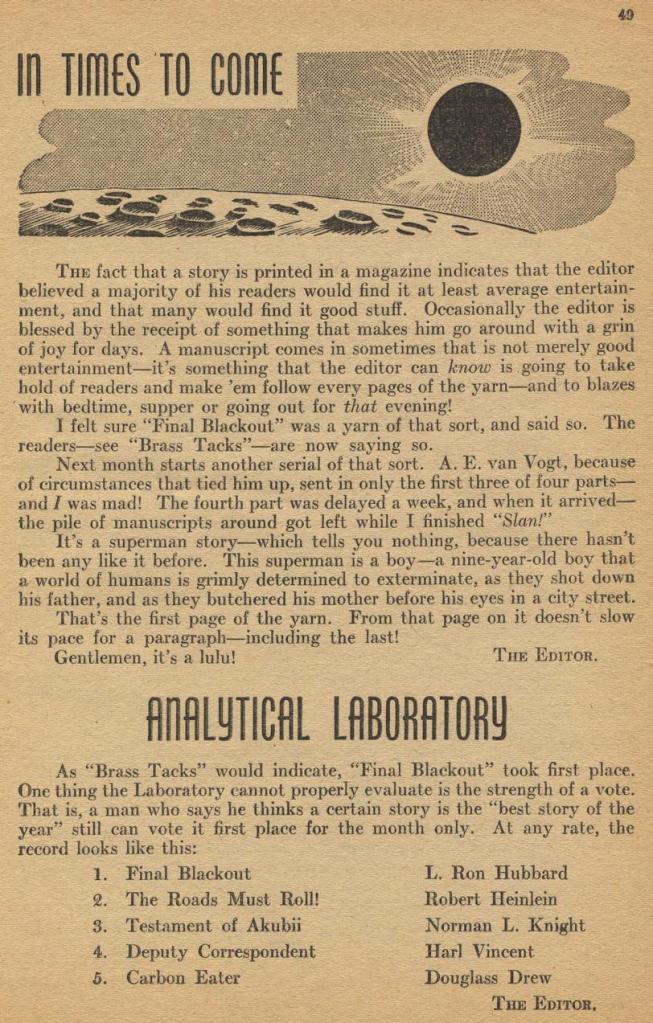
“The Roads Must Roll” came in second in the Analytical Laboratory (August 1940). But then serials usually come in first, and it was a big one, Final Blackout by L. Ron Hubbard. However, a letter writer praised the seriousness of Final Blackout, If This Goes On, and “The Roads Must Roll’ as proof that science fiction wasn’t just escapism. Another reader focused just on Heinlein:

It’s interesting, that on the cover of the June 1940 Astounding, which illustrates “The Roads Must Roll” we see individual vehicles shown in action. I assume they are the support vehicles the maintenance crews use below the rolling roads, and even then, they are not like how I pictured them in the story. The interior illustration got attacked in the letter column as being just a smear. It’s a shame that neither illustration pictures the roadway like Heinlein did in the story.

James Wallace Harris, 11/26/22

“Thy Rocks and Rills” by Robert Ernest Gilbert

How is it possible that I can rate a short story five stars out of five when it took 52 years to be anthologized for the first time? If countless editors passed it over for decades while looking for good SF stories to reprint, how can it possibly be any good? The story I’m talking about is “Thy Rocks and Rills” by Robert Ernest Gilbert. Ever heard of it? Ever heard of Gilbert? I haven’t on both counts.

“Thy Rocks and Rills” was originally published in the September 1953 issue of If. The first time it was reprinted was in 2005 in The World Turned Upside Down edited by Jim Baen, David Drake, and Eric Flint. You can also read the story on Project Gutenberg.

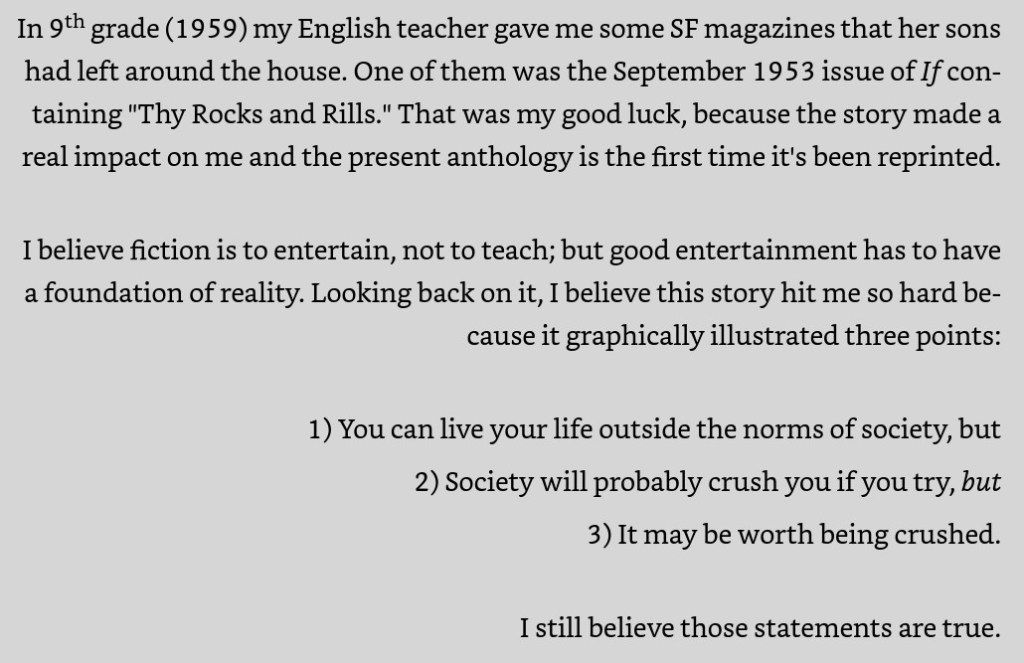
The goal of that anthology was to collect the stories that got the three editors excited about science fiction when they were teens. David Drake gave “Thy Rocks and Rills” this introduction:

I can understand why Drake responded to “Thy Rocks and Rills” that way, but it wasn’t how I reacted.

I’ve owned The World Turned Upside Down for years but I’m just now getting around to reading it because the Facebook group Best Science Fiction and Fantasy Short Fiction is discussing its stories every Tuesday, Thursday, and Saturday.

When I read “Thy Rocks and Rills” yesterday I just thought, “Wow, oh wow!” However, others in the group have not been so enthusiastic. And I can understand that.

I don’t believe fiction can be rated on absolute terms. In fact, my subjective ratings will change every time I reread a story. There are elements in “Thy Rocks and Rills” that would have made me dislike this story on other days, especially the talking bull and calves. Yeah, it has talking farm animals and mules with Appaloosa coloring. If you read the descriptions closely, the male fashions in this future are as gaudy as any Elton John or Prince wore on stage.

“Thy Rocks and Rills” is over-the-top. And it’s from 1953. But it’s also weirdly prophetic. Gilbert predicts a painfully hot future. One where toxic masculinity dominates and everyone is gun crazy. In Gilbert’s future, people are quick-tempered and ready to duel. And most women are condemned to conform to male expectations, making their bodies tiny and slender, staying in their place, and sticking to chirpy women’s talk. Although, some women are different and get into duels with men. The hero of this story is Stonecypher, and this is how Gilbert describes his wife Catriona:

The villain of the story is Dan who makes a legal proposition to Catriona that enrages Stoncypher:

Oh, but the way, the story has ornithopters. I did say it was colorful. The reason we have talking farm animals is because of mutations from radiation. Gilbert is protesting bomb testing. He’s also protesting bullfighting or any kind of arranged animal fights. “Thy Rocks and Rills” is quite woke for 1953. The world-building in this novelette is quite impressive. The basic plot involves Stonecypher getting in a dual and not knowing how to use a gun, and his talking bull wanting to go into the bullfighting ring.

The results were not what I anticipated but they were very satisfying. However, the ending is brutal, but David Drake has already warned us about that. I’m afraid most readers won’t like the ending, but I think it’s realistic. I overcame my dislike of talking animals because this story is gritty and dark, and we’re living in a gritty and dark age, but then so was 1953.

I’m quite fond of science fiction short stories from 1953, especially the grim ones:

  • “Lot” by Ward Moore
  • Deadly City” by Paul W. Fairman
  • “The Last Day” by Richard Matheson
  • “One in Three Hundred” by J. T. McIntosh
  • “A Saucer of Loneliness” by Theodore Sturgeon
  • “A Case of Consciousness” by James Blish
  • “Four in One” by Damon Knight
  • “DP!” by Jack Vance
  • “Imposter” by Philip K. Dick
  • “The Liberation of Earth” by William Tenn
  • The Model of a Judge” by William Morrison

If you know these stories, you’ll understand why I now list “Thy Rocks and Rills” among my favorites of 1953. I linked to the two that are available on Project Gutenberg. Six of them are in The Great SF Stories 15 (1953).

After reading science fiction for sixty years I’m having trouble finding new science fiction that wows me. Reading “Thy Rocks and Rills” Saturday morning gave me the kind of surprises I keep hoping to find in science fiction but seldom do anymore. “Thy Rocks and Rills” is perfect for an anthology called The World Turned Upside Down.

However, I can completely understand if it doesn’t work for you. The success of a story depends largely on what the reader brings to the story. I believe I’m just as cynical now as Gilbert was in 1953 and that made the story work for me. I was tuned into where Gilbert was coming from when he wrote it.

James Wallace Harris, 10/30/22

“Let There Be Light” by Robert A. Heinlein

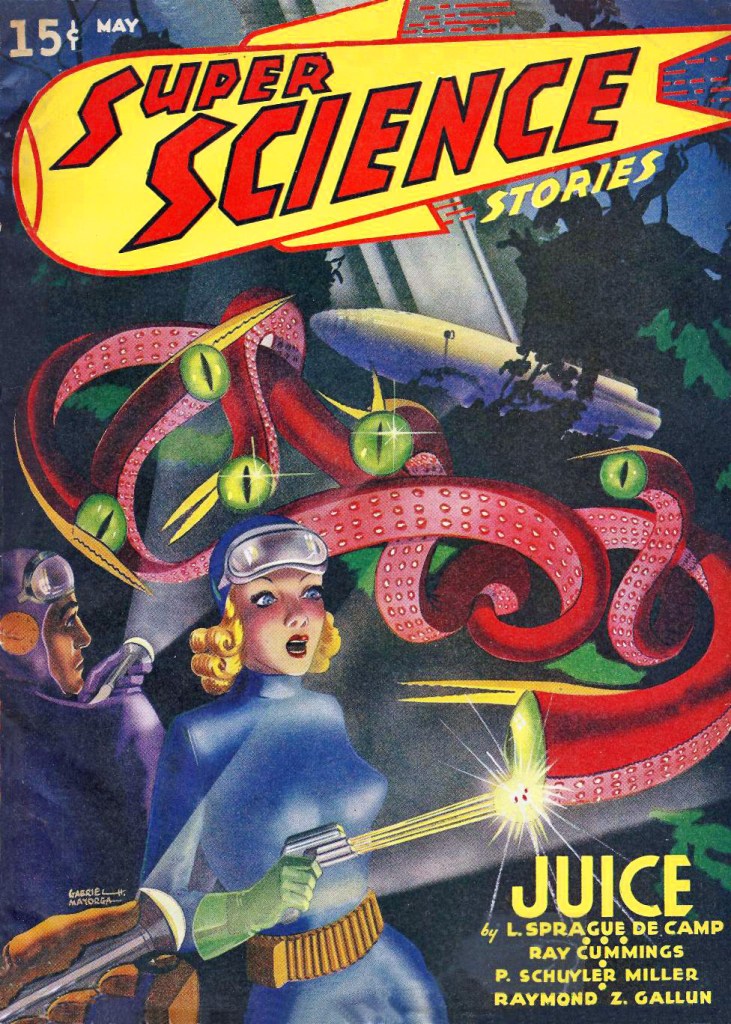
In 1939 Heinlein wrote several stories that were rejected by John W. Campbell. Heinlein wanted to save his name for stories appearing in Astounding and invented pen names for “lesser” publications. I think that was a bad idea. He sold “Let There Be Light” to Frederik Pohl for Super Science Stories and it was run under the Lyle Monroe byline. But if you look at the table of contents below, you’ll see that L. Sprague de Camp and P. Schuyler Miller weren’t protecting their Astounding reputations.

Heinlein should have used his own name for all of his stories. It would have helped out the smaller markets. Frederik Pohl practically begged Heinlein to let him publish it under his real name. Heinlein evidently felt anything Campbell rejected wasn’t first-class and he didn’t want his name associated with such stories. Heinlein obviously wanted to shape his public persona. Doesn’t that reveal a kind of egotism that disassociates flaws from their self-identity? Heinlein is perfect. Who knows who those other guys are?

Even when Campbell published two stories by Heinlein in a single issue he should have put Heinlein’s own name on them. Heinlein would have been an even greater phenomenon than he was, even with his flawed stories. Using all those names split up his reputation and momentum. And Heinlein shouldn’t have assumed Campbell was the arbiter of quality in science fiction.

“Let There Be Light” opens with Dr. Archibald Douglas getting a telegram from Dr. M. L. Martin. Martin informs Douglas “ARRIVING CITY LATE TODAY STOP DESIRE CONFERENCE COLD LIGHT YOUR LABORATORY TEN PM.” Douglas is affronted at the presumption that an unknown character could barge into his lab. Douglas consults Who’s Who in Science, and discovers Martin has a string of degrees and many prestige appointments and papers but is a biologist. Douglas figured a biologist cannot possibly connect to his work in physics.

When Douglas finally meets Martin, M. L. turns out to be Mary Lou, and she’s a beautiful young blonde. This is rather amusing since Heinlein makes all beautiful women redheads after he marries his third wife Virginia. In the 1940 magazine version, Mary Lou is compared to Sally Rand, who Heinlein and his wife Leslyn knew. In the 1950 book version, she’s compared to Marilyn Monroe. I’m surprised he didn’t switch it to a famous redhead. And Mary Lou can’t believe Archie is Dr. Douglas because he looks like a gangster. In the 1940 version, he’s compared to George Raft, but in the book version, no person is mentioned.

Heinlein did some other minor tweaking to the story when it was reprinted in book form. Strangely, the magazine version used the word hell frequently, and I think a damn was in there too, and Heinlein removed them. He also took out some of the gooiest of the sweet talk.

“Let There Be Light” turns into an invention story, but instead of featuring a mad scientist, Heinlein gives us two movie star lookalikes whose dialog sounds like it was written for a 1930s Warner Brothers picture. There’s a fair amount of scientific infodumping which lets the couple invent lighting that sounds like the LED overhead panel in my kitchen, and then solar panels. Of course, this isn’t much of a plot, so Heinlein throws in the conflict of evil corporations keeping innovative inventions off the market to protect the economics of older technology. That’s still not much of a plot.

Heinlein had spent years involved with California politics and was still griping about corruption. Even in the 1960s, I used to hear stories, often from my uncles, about how inventions were kept off the market, such as car engines that could get 200 miles to the gallon. There have always been conspiracy stories. Heinlein expresses other leftist ideas in the story too.

According to William Patterson, “Let There Be Light” was originally titled “Prometheus ‘Carries the Torch'” and it was also rejected by Thrilling Wonder Stories.

“Let There Be Light” isn’t a particularly good story. Its pluses, at least for us today, is it features a positive role for a female character. And it predicts solar power. So why did Campbell reject it? Patterson quotes Campbell’s rejection letter to Heinlein:

So Campbell is afraid of brainy women? That could explain a lot about Astounding/Analog. Heinlein loved brainy women, Leslyn and Virginia proved it. It’s just a shame he couldn’t write better dialogue when it came to men and women. It often seemed like poor dialogue cribbed from B-movie screwball comedies, and in his later novels, flirty dialogue sounded like a twelve-year-old girl trying to write a grownup romance after studying porn films.

Still, I enjoyed the story. It has no lasting value. We can stick a star on it for having a smart woman character, and another for predicting the solar energy industry. But that’s hardly enough to make it a good story for modern readers. Heinlein should have published it with his own name. He should have owned up to it. No one expects a writer to hit one out of the park every time they’re up to bat. And isn’t it odd that he wouldn’t put his name on it in 1940 for a magazine that few people would read, but would admit paternity when it came to a hardback publication in 1950?

Heinlein wasn’t the only contributor showing powerful women, the cover artist paints a fully-clothed woman shooting a BEM.

James Wallace Harris, 10/22/22

“Successful Operation” by Robert A. Heinlein

Robert Heinlein wrote several stories in 1939 that he couldn’t sell to John W. Campbell. This is when he started submitting to the lesser markets, but some stories still didn’t sell. When Ray Bradbury asked Heinlein for a contribution to his fanzine, Heinlein gave Bradbury the short short “Heil!” It was later reprinted in 1970 by Sam Moskowitz in his anthology, Futures to Infinity. Then in 1980 Heinlein included in his grabbag collection, Expanded Universe: The New Worlds of Robert A. Heinlein. Heinlein renamed the story “Successful Operation.”

In the introduction to the story in Expanded Universe Heinlein said he wrote “Heil!” right after “Life-Line.” Heinlein then goes on to complain about people asking writers to contribute free work to various projects. He points out that people don’t ask for free rides from taxi drivers or free food from their grocery stores. The intro has Heinlein talking about the importance of saying no to such requests, and he takes a snipe at science fiction fans, “The chutzpah is endemic in science fiction fans, acute in organized SF fans, and at its virulent worst in organized fans-who-publish-fan-magazines.”

Heinlein really should have said no to Ray Bradbury. “Heil!” is not badly written, but it’s extremely slight, and pulls off a gimmick that only an amateur would think was a good idea. You can read the story in Bradbury’s fanzine, futuria fantasia, v. 1 n. 4 (Spring, 1940). Heinlein doctored the story when he retitled it.

It is common in literary history to read accounts of writers burning unpublished work before their death. Or heirs destroying it right after an author’s death. This horrifies fans and scholars. But reading stories like “Heil!” suggests it might be a worthwhile practice. Not everything a great writer writes will be great.

On the other hand, writers write to make a living, and at the beginning of his career Heinlein was churning out his product. And eventually “Successful Solution” made him some money. Heinlein had 5 Rules for Writing:

  • You must write.
  • You must finish what you start.
  • You must refrain from rewriting except to editorial order.
  • You must put it on the market.
  • You must keep it on the market until sold.

Heinlein blazed onto the science fiction world following these rules, proving quality isn’t always required. Several of Heinlein’s clunkers were published early in his career, but he hid them with pseudonyms. “Heil!” was originally published by Lyle Monroe.

“Successful Operation” is currently in print in paperback, ebook, and audiobook in Expanded Universe: Volume One. For many years Expanded Universe was sold as a single volume, but in recent years it’s split in two. Probably most buyers consider that a ripoff but was probably required for a small publisher like Phoenix Pick. However, the volume will appeal only to hardcore fans of Heinlein and probably shouldn’t be read by casual fans and readers just checking out Heinlein. Much of the content was dredged from stories and essays not previously published, obscurely published, or seldom reprinted.

Anyone visiting an average new bookstore today will probably find few Heinlein titles. This is not the time to promote the dregs of his career.

Yet, that brings up an important question: What works by Heinlein should be on shelves for readers new to Heinlein to discover? Heinlein’s estate and a good editor should really come out with The Best Short Stories of Robert A. Heinlein. That was tried a couple times in England in the 1970s, but their selection was not the best. Most of Heinlein’s classic original collections are still in print, but they are a mixture of great, good, and not-so-good stories.

Of the four short stories I’ve read and reviewed so far, including “Successful Operation,” I might include “Life-Line” and “Requiem” in a best-of volume. But that depends on the page size of the volume. Definites that I’ve reread recently would be “The Menace From Earth” and “All You Zombies …” but I need to keep rereading.

James Wallace Harris, 10/21/22

The Kraken Wakes by John Wyndham

I was in the mood for a really good science fiction novel. One I hadn’t read before. My hunger was for the kind of science fiction that excited me as a kid, so it might need to be old, but it could be new. I find a lot of modern science fiction is often set too far away from now or reality, making them not relevant. I like science fiction when it’s meaningful and not just some fun fantasy. I found the perfect book to satisfy all those desires, The Kraken Wakes by John Wyndham. That novel was first published in 1953, but still impressively relevant in 2022.

I stumbled onto The Kraken Wakes when I glanced at “The First Climate Fiction Masterpiece: On John Wyndham’s 1953 Novel ‘The Kraken Wakes’” from the LA Review of Books. But I just barely looked at that review because I didn’t want any spoilers. I did read that review after reading the novel and it does a thorough job of explaining why the novel is great, however, it does so with many many spoilers. I’ve reached a stage in life when I don’t want to encounter any spoilers for the fiction I read. I’ve come to admire how writers unfold a story, letting us readers absorb what we need to know step-by-step. Too often reviewers ruin that process.

However, not telling what a book is about, makes it hard to review fiction. The Kraken Wakes wowed me. But will knowing that convince you to read it? Most readers like to read certain kinds of novels about certain kinds of subjects. That means I need to tell you just enough to hook you but not enough to spoil any of the fun John Wyndham intended.

Have you ever read The War of the Worlds? I don’t mean seeing any of the movies but actually reading what H. G. Wells wrote. Wells’s writing was excellent. Both books share many similarities, and The Kraken Wakes is a kind of literary reply to that classic novel. However, Wyndham adds a good bit of humor. The story is told from the point-of-view of a very charming young married couple, John and Phyllis Watson. That aspect reminds me of certain movies from the 1940s which featured delightful married couples. The charm and humor are used sparingly because this is a grim tale.

The plot is about an alien invasion but it’s not like American movies about alien invasions. What impressed me was Wyndham’s political and social awareness savviness. This 1953 novel is about science denialism, conspiracy theories, how fake news travels, the ways media shapes a news story, and many other ideas that resonate with today’s world. I don’t know if Wyndham was being satirical or just matter-of-fact about human nature, but he shows more maturity than most SF writers from that era.

I was thoroughly delighted by the novel, and grateful to find there are still science fiction classics from the past I haven’t read. I have read Wyndham’s The Day of the Triffids (1951), The Chrysalids (1955), The Midwich Cuckoos (1957), and Chocky (1968), so I knew the odds were good I’d love The Kraken Wakes.

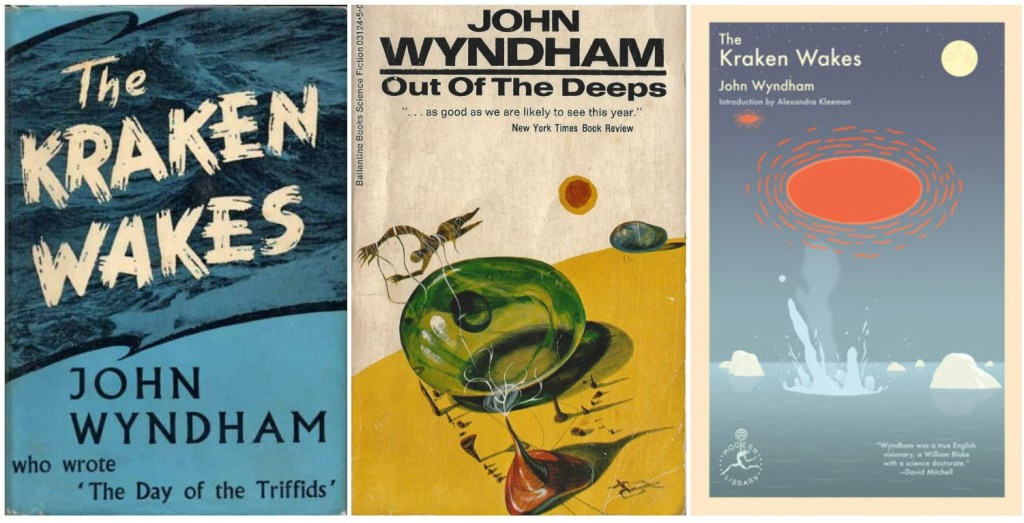
The Kraken Wakes was retitled for American readers as Out of the Deeps, and I’ve learned this morning it was significantly changed for American readers. I find that fascinating. Mark R. Kelly has written about the differences at Black Gate. You’ll want to read that after you’ve read the novel. I listened to the Audible edition read by John Sackville, who does a fantastic job of dramatizing the story. Audible Studies has new editions of many of Wyndham’s famous novels. Modern Library also has new editions, and I’m hoping they are the same, but the audiobook did not include the forward that’s in the Modern Library edition.

There have been several radio versions of the story produced over the years, as well as a video game.

James Wallace Harris, 10/20/22