“The Exploration Team” by Murray Leinster

“Exploration Team” was first published in Astounding Science Fiction, March 1956. You can read it on Archive.org. It is story #8 of 22 for The Best SF Stories of 1956 group read. “Exploration Team” won the 1956 Hugo Award for best novelette, and has been often reprinted.

In this future that Murray Leinster imagines, humans colonize the galaxy, but are unfairly restricted by intergalactic laws. Huyghens, our human protagonist, along with four Kodiak bears and an eagle, decides to illegally explore Loren Two. Huyghens knows he’s an outlaw but is also an idealist fighting for his way of life and against what he considers is unwise legal oppression. The story begins with a Colonial Survey officer, Roane, landing on Loren Two expecting to find a robot built approved colony but discovering Huyghens squatting illegally instead.

This is my second reading of “Exploration Team.” I liked it much better this time, but I don’t think it’s a classic or deserved a Hugo award. Of the stories we’ve read so far for group read 67, I’d have voted for “Brightside Crossing.” I’d rate the story ***+, meaning I thought it fun enough, but it’s not something I’d want to reread in the future.

Loren Two reminds me of the worlds in the Deathworld series by Harry Harrison, science fiction novels about planets where indigenous life is so violent survival is almost impossible. “Exploration Team” is more an adventure story with philosophy than speculative science fiction. Huyghens is against humanity depending on robots. He is out to prove that humans and their animal companions make better exploration teams. Leinster stacks the deck against robots because he never shows robots making a good effort. I think “Exploration Team” would have been a better story if robots were shown competing fairly within the story — instead they are Leinster’s straw bots.

Leinster has a limited vision of what robots can do. He imagines them being confined to specific programmed functions. Unfortunately, Leinster didn’t foresee robots learning like today’s large language models. Still, Leinster works hard to make a case against robots, and I believe it’s essential to the story. Personally, I believe robots will eventually surpass our abilities and make much better space explorers. They can endure a wider range of temperatures and don’t need to breathe, eat, or drink, nor will bacteria or animals want to eat them.

I guess science fiction fans back in 1956 really liked this story about Grizzly Adams in space. I think modern readers would be horrified by its solution of hunting threatening species to extinction. And Leinster never considers the possibility that Loren Two would evolve its own intelligent species, or even consider the intelligence of the existing species. Of course, this is the 1950s and colonialism is still in vogue, and it’s well before animal rights and ethical considerations for what other planets and evolutionary paths they might take.

What makes this story likable are the bears Sitka Pete, Sourdough Charley, Faro Nell, and the cub Nugget. Robert Heinlein and Andre Norton produced several successful juvenile science fiction novels in the 1950s that featured animal companions. That factor might have influenced Hugo voters.

Here’s what Mike emailed me about the story:

The only thing "Exploration Team" has going for it are the mutated Kodiak bears. Such an outrageous idea provides impetus to an otherwise rickety story.

The story centers on the ongoing battle against the native sphexes, cold-blooded belligerent carnivores.

The story suffers whenever Huyghens launches into his countless anti-robot screeds. "But you can't tame wilderness with 'em!" In the end, the humans defeat the sphexes by using modified robots, making Huygens seem like a bit of a bloviating dingbat.

The story is told with a certain breathless quality:

"And the sphex whirled. Roane was toppled from his feet. An eight-hundred-pound monstrosity straight out of hell--half wildcat and half spitting cobra with hydrophobia and homicidal mania added--such a monstrosity is not to be withstood when, in whirling, its body strikes on in the chest."

We are repeatedly reminded that sphexes "looked as if they had come straight out of hell."
And we learn that "...lustfully they fueled tracked flame-casters..." Really? Lustfully?

But it doesn't pay to scrutinize a story like "Exploration Team." Come for the action, stay for the bears.

One writing flaw I noticed while reading was that Leinster kept repeating himself. There are several places in the story where he would describe something, and then a few pages later describe it again with the same words. Plus, the story was too long. Unlike Mike, I accepted the criticism of the robots as the purpose of the story. Leinster promotes his character as an individualist, and protester. I thought Huyghens and the bears did make a good team. But I also can imagine a human and robots making an even better team. Unfortunately, I don’t want to imagine a future where we go around consuming all the planets in the galaxy like we’ve consumed our home world.

James Wallace Harris, 12/14/23

“Silent Brother” by Algis Budrys

“Silent Brother” was first published in Astounding Science Fiction, February 1956. It was by Algis Budrys writing as Paul Janvier. You can read it on Archive.org. It is story #4 of 22 for The Best SF Stories of 1956 group read.

Harvey Cable has a fascinating mystery to solve in “Silent Brother.” The spaceship Endeavor has returned from the first interstellar mission. Harvey might have been on that mission but was badly injured in a test flight of an earlier spaceship. He lives alone. Harvey must use a wheelchair or braces on his legs and a cane in both hands to get around the house. After watching the crew of the Endeavor return home on TV, he goes to bed hoping his old astronaut companions will come to see him soon. The next day he wakes up to find that someone has stolen the picture tube from his television.

After carefully searching his house, Harvey finds the picture tube on his basement worktable. He can prove that no one broke into the house. He even tests the picture tube for fingerprints and only finds his own. But Harvey is incapable of carrying a large TV picture tube downstairs because with leg braces, he must firmly hold onto the handrails. If no one broke into his house, who took the picture tube downstairs while he slept?

Harvey goes to bed the next night after rigging his house so he can’t sleepwalk out of his bedroom. Yet, once again he wakes up refreshed and discovers more work has been done on the picture tube in the basement. None of his traps to keep him in his bedroom have been disturbed.

“Silent Partner” is a fun story that sets up a good lock-room mystery. It has a satisfying solution, but I don’t want to tell you about it just yet. I encourage you to go to the link above and read the story. It won’t take long. “Silent Brother” was reprinted in both Merril’s and Asimov & Greenberg’s best of the year anthologies, but it’s not been reprinted in any major anthology since. My friend Mike who is reading these stories along with me emailed me quite a positive review. I’ll post it below after I get into the spoilers. I also liked the story, but does two guys liking a story sixty years later mean it was one of the best of 1956, or a forgotten classic science fiction story?

I’ve been thinking about the levels of good stories. There are good stories, and then there are good stories. A great story is a good story that launches into orbit for the reader. Not everyone who reads a group of stories will love every story, and different readers will pick different stories they think are the good ones. Here’s a hierarchy:

  • One of the good stories in a magazine
  • One of the good stories in a best-of-the-year anthology
  • One of the good stories that are finalists for an award
  • One of the good stories in a general anthology
  • One of the good stories that are in theme anthology
  • One of the good stories that are in a retrospective anthology
  • One of the good stories in a list of the all-time best stories.

“Silent Brother” was in the same 1956 issue of Astounding Science Fiction with the first part of Double Star, one of Heinlein’s best novels, and it won the Hugo award. The issue also contained “Clerical Error” by Mark Clifton which I reviewed last time. Our short story club generally didn’t like “Clerical Error” but Astounding readers back in 1956 picked it as their second favorite after the Heinlein serial in The Analytical Laboratory poll. “Silent Brother” came in third. I like both “Clerical Error” and “Silent Brother,” but I wouldn’t reprint either if I was an anthologist. I thought “Clerical Error” was more ambitious but poorly written, and I thought “Silent Brother” nicely written, and very enjoyable, but far from great. I can easily say it’s a good story, but what does that mean?

If you look at the table of contents for Merril’s best-of-1956 anthology, none of the stories stand out to me except “Stranger Station” by Damon Knight. That story has shown up three times already in our short story reading group because it’s often reprinted. I haven’t read most of Merril’s selection, and “Silent Brother” might be among the good ones. But “Silent Brother” is not in the same league as “Stranger Station.”

Looking at the table of contents from Asimov and Greenberg’s best-of-1956 anthology, we see five stories that stand out: “The Country of the Kind” by Damon Knight, “Exploration Team” by Murray Leinster, “The Man Who Came Early” by Poul Anderson, “The Last Question’ by Isaac Asimov, and “Stranger Station” by Damon Knight. These are all stories our group has encountered several times in the many anthologies we’ve already read. I have read The Great SF Stories 18 (1956), and “Silent Brother” falls toward the back of the pack. (It is interesting that Asimov and Greenberg with thirty-two years of hindsight were able to create such a solid lineup of 1956 SF stories.)

“Silent Brother” wasn’t a finalist for the Hugo award, and it’s never been anthologized for a major theme or retrospective anthology. Nor is it on any fan poll for being an all-time great SF story. Now, do you sense the relative nature of good? What I want to find are the most memorable, most powerful of the SF stories from 1956 that most people consider good. I liked “Silent Brother” a fair amount, but I wouldn’t anthologize it if I was creating an anthology of the best SF short stories of 1956. I might include it in a theme anthology if it worked well with the other stories.

Still, it was a pretty good story. And I think it would be interesting to analyze why? For me, the mystery about who was rebuilding the television made the story a page turner. However, it was the conclusion that elevated the story with a particular kind of happy ending. The crew of the Endeavor brought back invisible aliens who they had developed a highly beneficial symbiotic relationship. The silent brother was a new alien being that lived inside of you. Now, if you had just read Heinlein’s The Puppet Masters you might not think this was so wonderful, but Algis Budrys pulled it off. Why?

I think the idea of having a silent brother that heals and helps you if awful lot like what religion promises, like believing that Jesus will save us, or becoming one with God who will watch over all his followers. “Silent Brother” represents a story of transcendence. It reminds me of the ending to Childhood’s End. Harvey Cable was lonely and suffering from a damaged body. He, and the Endeavor crew welcomed the alien into their bodies and passed them on. But isn’t this the same story as The Invasion of the Body Snatchers? But that story was a metaphor for communism. Budrys presents the alien as a brother. Is it little brother to big brother? Harvey’s personality isn’t changed or possessed; he just has a very helpful invisible friend living inside of him.

Algis Budrys was a savvy guy. I’m guessing he consciously knew about the religion connection in his story, and he knows that most people would love to have a personal god to help them. Instead of inventing a theological being, Budrys creates an alien that serves the same function.

Here’s what Mike had to say:

I think "Silent Brother" is an excellent story.

The genius of the story is what Budrys leaves out. He gives us bits and pieces, and our imagination fills in the blanks.

For example, Harvey Cable has obviously been seriously injured in the past. We don't know for sure what happened to him, but we imagine some kind of space flight misfortune left him damaged. Was it radiation? Was it an equipment failure, or a spaceship catastrophe? Budrys gives us room to speculate.

Budrys relates that Cable's struggle is both physical and mental. He "...trembled on the brink of admitting to himself that his real trouble was the feeling that he'd lost all contact with the world." He is in trouble and "The idea was to hang on to reality."

It's slowly revealed that Cable is disassembling his TV set and reworking it into something else. Budrys writes beautifully descriptive sentences: "How did one shot-up bag of rag-doll bones and twitchless nerves named Harvey Cable accomplish all this in his sleep?" and "What in the name of holy horned hell am I building?"

Once the TV rebuild is complete, Budrys never reveals its exact purpose, but it's obviously of great importance because afterwards "...he felt his silent brother smile within him." Again, we get to fill in the blanks on our own.

A parasitic alien has entered Cable, and healed him. "Who wants symbiosis until he's felt it?"

Budrys explains "...we were born in a solar system with one habitable planet, and we developed the star drive. And on Alpha's planet, a race hung on, waiting for someone to come along and give it hands and bodies

Cable's final act is to send part of his silent brother to each of the three men who have come to interview him. The parasitic alien is passed on.

No long info dumps. No discursions. A concise, heartfelt, beautifully written story.

I think Mike admired the story far more than I did. I thought the rebuilt TV with its flashing lights helped Harvey connect with his new brother and helped him to retrain him to reprogram his damaged body. It’s like when Dr. Cal Meacham builds an “interocitor” in the film “This Island Earth” — the gadget allowed him to connect with aliens.

Mike and I have talked about “Silent Brother,” discussing how stories affect readers differently. Critics often write about fiction as if there were objective standards, but that’s not possible. Fiction is like a day, for some people the day might be wonderful, and for others horrible, and for many just another day.

I’m looking forward to seeing how many members in the Facebook group like or dislike “Silent Brother.”

James Wallace Harris, 12/4/23

“The Minority Report” by Philip K. Dick

The Minority Report” was first published in Fantastic Universe Science Fiction, January 1956. You can read it on Archive.org or listen to it on YouTube. (Or even listen and read at the same time.) It is story #2 of 22 for The Best SF Stories of 1956 group read. Wikipedia has a rather informative entry for “The Minority Report” that I highly recommend reading.

“The Minority Report” did not meet any of the criteria I used for selecting the best SF short stories of 1956, but I included it because it’s a famous Philip K. Dick story, and because it inspired a movie and television miniseries. It’s interesting that neither Judith Merril, T. E. Dikty, nor the team of Isaac Asimov and Martin H. Greenberg picked the story for their best of the year anthologies. Obviously, they were not precogs to the story’s big success in the future, but ultimately, I think they made the right choice.

The premise of “The Minority Report” is built on the idea that the future can be predicted, and murders can be prevented by arresting murderers before they kill. The plot arises when the head of Precrime, John A. Anderton, sees his own name on a computer card stating that he will kill Leopold Kaplan. Anderton immediately figures it’s a frame-up by Ed Witwer to take over his job.

The story is weird because the future is predicted by three mentally and physically damaged people kept in a kind of permanent dream state. They are called precogs. Because the future is always in flux, each precog is monitored by a computer. To convict a person of a precrime requires two of the three computers analyzing the dreams of their precogs predicting the same future, and that’s called the majority report. A single computer produces a minority report.

Most of the story involves Anderton going on the run hoping to prove himself innocent and maintain the validity of precrime as a principle of law enforcement. The story is quite dramatic. I can see why they chose to produce it as a movie. “The Minority Report” is full of action and ideas. Along the way, the story produces quite a bit of PKD weirdness, paranoia, offbeat philosophical questions, and a disloyal wife. Unfortunately, there are so many plot twists that the story breaks down in confusion.

Information about the sale and publication of “The Minority Report” can be found at philipdick.com. It was reprinted in Dick’s 1957 collection The Variable Man and Other Stories, but it was never anthologized in a major anthology. According to the way stories are remembered in the science fiction publishing world, “The Minority Report” was never a respected story. Fantastic Universe was not a top tier publication. This was PKD’s 91st story, and 85th short story. (See philipdick.com for numbering his worksl) Dick cranked them out, and it shows. “The Minority Report” could have been a much better story if Dick had thought about the plot carefully and rewritten it several times. But he had to eat and sold it for little money. Philipdick.com suggests it earned only a little more than $12.95, but don’t say exactly.

Here is the review my friend Mike emailed me.

I think "The Minority Report" is one of Dick's weaker efforts. 


I've never been a fan of hocus-pocus stories, and the idea of Precrime has so much hand-waving magic about it that Penn and Teller would be proud. We never get a plausible explanation why or how precogs manage to predict the future. Good science fiction gets you to believe the unbelievable, but Precrime feels like a story gimmick.
I've also never been a fan of mysteries, because the author typically drops critical details into the narrative at the last minute. We're supposed to marvel at the perspicacity of the protagonist, but I just feel manipulated. Dick drops this important bit of information on us:
"Jerry's vision was misphased. Because of the erratic nature of precognition, he was examining a time-area slightly different from that of his companions."
We discover that precognition, which is the foundation of Precrime, has an "erratic nature" and precogs can examine different time-areas. Doesn't that collapse the entire Precrime house of cards?
You know a story is flawed when the author has to stop and explain for pages why Anderton's name was generated by the Precrime system. PKD finally throws in the towel when he has Anderton announce "Each report was different...Each was unique. But two of them agreed on one point. If left free, I would kill Kaplan. That created the illusion of a majority report. Actually, that's all it was--an illusion."
The whole story feels like an illusion, a magic trick. The characters are subservient to an arcane plot, stock performers in a magic show.

I agree with Mike. I dislike thrillers and mysteries where the author jerks us around contriving plot twists by whatever whim hits them at the moment. They never feel believable or real. Like I said in my previous review. I want to believe what I’m reading, and I have too much distaste for precognition.

Now, if PKD had come up with another system for identifying potential murderers I might have bought the idea of precrime. I don’t think this is possible, but if they had a brain implant that measured various kinds of emotional states and they could identify one that people experience before committing a murder, then that would have been acceptable to me. Dick’s precogs are mutants with ESP. I have problems with psi stories in SF. Too often they feel like comic book plots.

There are a few psychic power stories in science fiction that succeed with some readers. There’s telepathy in The Demolished Man and teleportation in The Stars My Destination, two much admired novels by Alfred Bester. But they are not my favorites. PKD played with ESP in some of his stories, and I’m a big fan of his work, and I can sometimes buy such weirdness as part of his stories because Dick was so weird himself. I’m afraid the precog stuff in “The Minority Report” didn’t work for me this time.

Alfred Bester came up through comics, and I’ve always felt he felt superior to both comics and science fiction. As much as I admire Bester’s writing ability, I’ve always thought he was sneering at science fiction. Writing stories about psionics was his way of saying SF fans would believe anything. But I think Dick was different. He was into thinking about the supernatural and any possible explanation for reality. He played with weirdness.

I need to think about the use of ESP in SF. Let’s see if any more of the 1956 stories deal with psychic powers. I’m not sure it’s a legitimate theme for science fiction.

James Wallace Harris, 11/29/23

“Brightside Crossing” by Alan E. Nourse

Brightside Crossing” was first published in Galaxy Science Fiction, January 1956. You can read it on Archive.org or Gutenberg.org or listen to it on YouTube. It is story #1 of 22 for The Best SF Stories of 1956 group read.

“Brightside Crossing” begins in a bar on Earth, the Red Lion, with James Baron sitting at a table. A grizzled old man comes in to see him, Peter Claney. We learn that Baron is planning an expedition to the planet Mercury, hoping to trek across the sun side surface and reach the equator when the Sun is at its closest and hottest position. Temperatures will reach 770 degrees Fahrenheit. When this story was written it was thought Mercury always had one side facing the Sun, the Brightside, like how one side of the Moon always faces the Earth. We’ve since learned that Mercury does slowly rotate three times for every two solar orbits Mercury makes.

Peter Claney was part of a team that previously tried to make the Brightside crossing, and he’s come to the Red Lion to warn Baron not to try. This implies Peter’s team failed, and Peter’s story is how we learn about that failed attempt. Nourse’s story is what we now call hard science fiction, although the term wasn’t coined until a year later. Even for 1956, I had several nit-picks about this story’s realism, but nothing that detracted from it being a great science fiction adventure tale. It was a finalist for the Hugo.

“Brightside Crossing” reminds me of reading books by polar explorers, or about the men who tried to find the Northwest Passage, especially of Franklin’s lost expedition. It’s about the kind of person who will endure extreme hardship to be first somewhere.

I agree completely with what my friend Mike emailed me about the story:

1. Nourse avoided the info dump trap. He succinctly describes the equipment used to make the Mercury crossing without falling into the endless info dumps found in some stories. 

2. The characters have depth and nuance. Ted McIvers is described as “kind of a daredevil.” At first, we think he’s just foolhardy, but we eventually realize that they will die if they don’t move faster and McIvers is trying to save them. Peter Claney admits “A man like McIvers was necessary. Can’t you see that?” Jack Stone is fearful and reveals “I’m scared.” However, when McIvers needs to be rescued, Jack agrees to go down and help. He overcomes his fear. And Peter Claney states categorically that the crossing is impossible, but he still wants to try again and be part of another attempt.

3. The story echoes the courage and heroism of the great Antarctica explorers Robert Scott and Ernest Shackleton.  

4. Nourse’s descriptions of the terrain are beautiful and terrifying. Every word is carefully chosen. We can feel the heat. The danger is visceral.

“Brightside Crossing” also reminds me of what I loved about science fiction as a kid back in the 1960s, but I don’t think I read “Brightside Crossing” then. I do vaguely remember a few science fiction stories set on Mercury. It is exactly the kind of story that would have wowed me as a kid because I loved science fiction stories that I wanted to feel were possible. This is my second reading of “Brightside Crossing” and I’m even more impressed than the first time I read it in The Great SF Stories 18 (1956) a couple of years ago.

This time as I read it, I thought “Brightside Crossing” represents the kind of science fiction I would use in creating my definition of science fiction. The story is believable in the way I want to define science fiction. Sure, Nourse’s speculation might be faulty or even impossible by today’s scientific knowledge and technology, but in the 1950s the story seems possible, at least to a kid who embraced the theology of the final frontier.

My disappointment with a lot of science fiction, especially science fiction from recent decades, is it’s not believable. I don’t know why when I was a kid, I wanted to believe humans would explore all the planets and moons of the solar system. I thought science fiction was propaganda to make such exploration happen. I knew there were two kinds of science fiction. The kind I like imagined either a probable future we should avoid or a future we should want to create. The other kind of science fiction was just stories that got its ideas from the first type. And like the degradation of originals from making copies of copies, too much science fiction seems inspired from science fiction cliches.

Over time, I think science fiction has become the label for any fantastic tale that involved the future or outer space. A splendid example of the second kind is “Fondly Fahrenheit” by Alfred Bester. It’s still a classic story, but not the kind of science fiction I’m talking about. Bester was both having a go at the genre and pushing it to its limits. Unfortunately, I think writers have settled on the second kind of science fiction as the preferred kind and see it as a Disneyland to work out their wildest ideas, rather than serious speculation about reality.

Like Busby Berkeley always working to top his previous dance routine, science fiction keeps trying to top itself. And like Busby Berkeley, the results have gotten absurdly wild. Busby Berkeley expected the movie audience to believe that his dance routines would be what an audience in a cabaret or Broadway theater would see, in the same way science fiction writers now expect their readers to believe their stories would fit into our little old reality. Sure, it’s fun to see fabulous big productions created by wild fancies of the mind but there’s something to be said about real people confined to Earthly possibilities. In case you have no idea, who Busby Berkeley was, or my analogy, I’ll include this film clip:

Alan A. Nourse was never a big name in science fiction, but I have encountered his work now and then, but I only vaguely remember him. “Brightside Crossing” inspires me to find more of his work. The two I think I might have read as a kid; are ones I want to try:

But I’d also like to find the collection below because of its neat cover, but it will probably be easier to get Alan E. Nourse Super Pack at Amazon for $1.99, which has several of the same stories, including “Brightside Crossing.”

By the way, “Brightside Crossing” had three things I couldn’t believe, but they were just little bumps in the road. The first are the suits that protected them from the horrendous heat. They plan to stay in them for over a hundred days. How did they handle peeing and pooping? A kid would wonder that and so did I as an old man. I also found it unbelievable that Ted McIvers could just show up late by hitching a ride on a Venus supply rocket, days after the others had arrived. That bothered me because trips would be rare to the planet Mercury. Finally, when Ted McIvers goes off course and stumbles upon the remains of the last expedition that tried to make the Brightside crossing. That seemed like way too much of a coincidence. They are crossing a whole planet, and they just happen to discover what happened to the previous explorers.

James Wallace Harris, 11/27/23

“Embot’s Lament” by James Patrick Kelly and “Berb by Berb” by Ray Nayler

“Embot’s Lament” by James Patrick Kelly and “Berb by Berb” by Ray Nayler have several elements in common, including my disappointments. They were readable enough, and had some entertaining aspects, but both ended before they could reach critical storytelling mass.

As a reader, especially one who has been reading science fiction for decades, I come to every short story hoping to discover a classic. But the reality, at least in the SF magazines, is classic stories are rare discoveries. James Patrick Kelly isn’t going to write “Think Like a Dinosaur” every time at bat. It’s even unfair of me to expect another “Mr. Boy” or “10¹⁶ to 1.” Ray Nayler hasn’t written his classic yet, but he’s starting to write standout stories like “A Rocket for Dimitrios” and “The Ocean Between the Leaves.”

No writer can sit down and intentionally write a classic science fiction story. Unfortunately, if you’ve read enough classic stories, their impact stays with you, and you compare everything you read to those past favorites. This is one of the disadvantages of getting old.

In the blurb to “Embot’s Lament” Kelly says Embot came to him in a dream, and Jane showed up the next morning. Embot is a neat idea. I assume it’s short for empathy robot (or I could be way off and it could be for embedded robot or some other such thing). Embot is a conscious entity sent from the future that lodged in Jane Bell Lewis’ mind. Jane doesn’t know the Embot is there. The Embot is not supposed to interfere, but merely report back to the future how people of the past live and think. The senders of such time-traveling probes have no control over who and where the Embot will land in the past. Jane is an uneducated lower-class housewife with an abusive husband. The Embot is disappointed it didn’t land in someone like “The Rock, Taylor Swift, or one of the Kardashians.”

I’m disappointed too. Combining a neat science fiction idea with a quite common literary plotline seemed like a poor choice for a science fiction magazine audience. And the obstacles that Embot watch Jane overcome seem cliche and far too mundane. She gets beaten up by her drunk husband, takes an Uber to the bus station, and leaves town. If you compare this to “Fondly Fahrenheit” where a psychotic robot psychologically corrupts Alfred Bester’s character, you’ll see what I mean. Even if we stay with the wife abuse plot, the story would have been far more powerful, unique, and challenging to write if Embot had gotten embedded in the husband’s mind.

But I can think of many more character types I’d like to see Embot haunt. A truly fun person would have been a science fiction writer. Think of the recursive SF possibilities. But the obvious type of character would be a Donald Trump like politician, an Elon Musk type billionaire, or terrorist or mass shooter. It’s too easy to empathize with Jane, or a victim like her. A somewhat challenging storyline would be to embed an empathy robot in a repugnant character and change them. A writing challenge equal to climbing Mt. Everest would embed the empathy robot in a repugnant character and have it find something to empathize with.

“Embot’s Lament” ends when I think it’s just getting started. I wondered if Kelly plans to make it into a novel. The same thing is true for “Berb by Berb.” Nayler ends his story just when we want to know more. Nayler has written other stories set in the same alternate reality as “Berb by Berb.” ISFDB called the series “Disintegration Loops.” The history of this timeline involves the United States finding a crashed UFO during WWII and reverse engineering its technology to win the war and dominate the world afterwards with super science. Berbs are creatures that assemble themselves out of spare parts due to some alien pixie dust escaping the lab.

“Berb by Berb” barely introduces us to the berbs and then the story is over. It’s very slight, and there’s not enough science fictional razzamatazz to rationalize why the berbs form as they do. Nayler needed to give us some anti-entropic theories.

When I read “A Rocket for Dimitrios” I was amused that Eleanor Roosevelt and Hedy Lamarr had become action heroes in this alternate reality. Nayler name drops Hedy Lamarr name again in this story. When I was younger, it excited me when a science fiction writer would use a famous person from history as a character in their story. For example, Philip José Farmer’s Riverworld series, which featured Mark Twain and Sir Richard Burton.

Now, it disappoints me when a writer does this. I feel it’s a cheap cheat for making a story more appealing. A kind of pop cultural appropriation. And not just when science fiction writers do it. There have been many fictional bestsellers that capitalized on famous people in recent years. History is hard enough to get right in history books, so I hate seeing famous people being exploited in fiction. Still, Hedy Lamarr was one of the most beautiful women ever, and it was delightful to discover she was an inventor. I think Nayler just wanted to pass on that info. People do need to read Hedy’s Folly: The Life and Breakthrough Inventions of Hedy Lamarr, the Most Beautiful Woman in the World by Richard Rhodes if they want to know something closer to fact.

I like Nayler’s idea of using a crashed UFO to create an alternative history. But so far, he’s only played around with the idea in simple ways. It’s a slight-of-hand excuse for his stories, and “Berb on Berb” is very slight. He needs to do a Pavane, Bring the Jubilee, or The Man in the High Castle.

Both stories involve creating a science fictional being and then pairing it with an ordinary human. That’s a common story idea in science fiction. However, I think the authors of both stories should have set them aside for a while until they produced better reasons for their beings to exist and encounters with humans. Both stories needed a second stage, and even a third stage to lift them into orbit.

Embot is a neat idea. But why put such an artificial mind into a human mind if you didn’t want it to change the person? Especially a person who needed to change every aspect of her life. What if the future were seeding the past with insight, empathy, and intelligence? I think the idea of embots needs to be worked on, it has real possibilities. Like a cross between Brainwave and Timescape.

Embot also reminds me of The Origins of Consciousness in the Breakdown of the Bicameral Mind by Julian Jaynes. Jaynes theorized humans heard voices that guided them in prehistoric times to explain tales about people hearing gods talk to them.

A berb is a much harder creature to rationalize. Its creation feels more like something L. Frank Baum would have imagined. Why did the aliens invent that magic dust? Are they seeding worlds with it? Reality is entropic, and life is anti-entropic. That offers some germs of ideas to work with. Nayler should have given us more speculation on why berb creatures would form.

I know it’s unfair of me to compare current science fiction to my all-time favorite science fiction, but I do. If book and magazine editors only published classic level stories, there would only be three SF novels and one issue of a SF magazine coming out every year. Even when I read best-of-the-year anthologies, I’m usually disappointed with over half the stories. Luckily for writers and publishers, readers don’t all pick the same stories to love.

These two stories made nice fillers for this issue of Asimov’s Science Fiction. But I wonder what Asimov’s Science Fiction would be like if it was quarterly paperback, or twice yearly hardback and published less filler? This is just me thinking aloud. I’m going to try and finish the Nov/Dec issues of Asimov’s and Analog, but I’m not sure I’ll want to continue to read them. Magazines might not be the right delivery system for short science fiction for me anymore.

I was inspired by Robert Silverberg’s column this month, “Homo Superior–Us?” It makes me want to chase down some classic science fiction about Neanderthals I haven’t read before and reread some that I have.

James Wallace Harris, 11/14/23

“The Ghosts of Mars” by Dominica Phetteplace

I was in the mood to read some science fiction. I was in the mood to read some new science fiction. And I wanted to sample what was in one of the latest issues of a science fiction magazine. Basically, I wanted to see where science fiction was at this moment. The first magazine I tried was the November 2023 issue of Asimov’s Science Fiction and the first story I read was “The Ghosts of Mars,” a novella by Dominica Phetteplace. The spiritually minded say, “Seek and ye shall find.” That I did.

I love science fiction about Mars, and I love stories about robots, and since “The Ghost of Mars” has both, it might be one of the reasons why I loved this story. But it also might be because “The Ghost of Mars” is quirky, charming, and different. It vibrates with science fictional excitement, the kind I used to find as a teen — but that was an exceedingly long time ago. However, it is also different from the kind of science fiction I used to read. It represents the sensibilities and desires of today’s young people. Plus, it throws in more science fictional ideas per paragraph than anything I’ve read in a long time.

It takes a while to learn this first-person story is told by Paz, a sixteen-year-old girl who has been left on Mars by herself. Most of the other colonists have died or left, but Paz can’t leave because to travel back to Earth would kill her. She was born on Mars, and with deformities that make her fragile. Her mother, and the few remaining colonists who have raised Paz, have cancer and are rushing back to Earth for treatment. They all hope to return, so they haven’t completely abandoned Paz. And besides, she has a horde of robots at her command.

Phetteplace begins with a mystery and embeds several more into “The Ghost of Mars” as the story unfolds. Unexplainable events occur which some of the colonists have jokingly explained with spooky ghost stories. Paz was raised by astronaut scientists and is very logical and intelligent. But along the way, she’s heard about religion and other supernatural explanations that taint her thinking.

Mars appears to be jinxed, which inspired paranoia in all the colonists, but each colonist had their own flavor of irrational thinking depending on their upbringing on Earth. Back on Earth, the news gets constantly worse. We live in terrible times, and I’ve often wondered how young science fiction writers will deal with them fictionally. Phetteplace showed me.

There’s a lot of things about life on Earth that suck now, and it comes through in “The Ghost of Mars.” Phetteplace’s story is both satire and political commentary, as well as aspirational of the old dreams of science fiction. She knows that colonizing Mars is a bad idea but like most science fiction fans want to do it anyway.

“The Ghosts of Mars” reflects Heinlein’s save yourself by-your-bootstraps philosophy, but also Clarke’s appeal to higher alien power, and good old mysticism, transcendence, and even religion. “The Ghosts of Mars” really is everything but a kitchen sink story when it comes to ideas. Being all over the place should have been a negative, but since the protagonist is a sixteen-year-old it’s realistic, and a plus.

There are so many ideas being thrown out in “The Ghost of Mars” that I thought about making a scorecard. I don’t want to mention them all because it’s part of the fun, but “The Ghost of Mars” is the kind of story Galaxy Magazine ran back in the 1950s that tried to explain everything with science fictional crapology. And that’s not a ding, but a praise. This story is the kind of story that Jack Isidore would have loved in Philip K. Dick’s Confession of a Crap Artist, my favorite PKD novel.

James Wallace Harris, 11/13/23

Has Science Fiction Left Me Behind?

The above books were the finalists for the 2023 Hugo Awards. I have not read any of them. Nor do they look interesting to me. Each year the Hugo and Nebula award finalists seem further and further away from what I want to read.

The other day I went into a new bookstore for the first time in many months. I went up and down the aisles of the science fiction section and I was shocked by how many books were by authors that were unknown to me.

I turn seventy-two next month and I wonder if I’ve gotten too old for science fiction. Or, has the genre left me in the dust? I can accept that I might be too old to keep up. Could the genre have changed, and I’ve just lost interest? Who knows?

In the 20th century I’m sure I read at least a thousand science fiction books, probably many more. Here’s a list of the 69 SF&F books I’ve read in the 21st century:

  • 2000 – Harry Potter and the Goblet of Fire by J. K. Rowling (Hugo winner)
  • 2000 – Calculating God by Robert J. Sawyer (Hugo finalist)
  • 2001 – American Gods by Neil Gaiman (Hugo winner)
  • 2001 – Perdido Street Station by China Miéville (Hugo finalist)
  • 2002 – Altered Carbon by Richard K. Morgan
  • 2003 – The Time Traveler’s Wife by Audrey Niffenegger
  • 2004 – Cloud Atlas by David Mitchell
  • 2004 – Jonathan Strange & Mr. Norrell by Susanna Clarke (Hugo winner)
  • 2004 – The Plot Against America by Philip Roth
  • 2005 – Spin by Robert Charles Wilson (Hugo winner)
  • 2005 – Old Man’s War by John Scalzi (Hugo finalist)
  • 2005 – Never Let Me Go by Kazuo Ishiguro
  • 2006 – The Road by Cormac McCarthy
  • 2006 – Life As We Knew It by Susan Beth Pfeffer
  • 2007 – The Yiddish Policeman’s Union by Michael Chabon (Hugo winner)
  • 2008 – The Hunger Games by Suzanne Collins
  • 2008 – Little Brother by Cory Doctorow (Hugo finalist)
  • 2008 – Flood by Stephen Baxter
  • 2008 – Marsbound by Joe Haldeman
  • 2009 – The City & The City by China Miéville (Hugo winner)
  • 2009 – The Windup Girl by Paolo Bacigalupi (Hugo finalist)
  • 2009 – Boneshaker by Cherie Priest (Hugo finalist)
  • 2009 – Julian Comstock by Robert Charles Wilson (Hugo finalist)
  • 2009 – Catching Fire by Suzanne Collins
  • 2009 – Wake by Robert J. Sawyer
  • 2010 – Feed by Mira Grant (Hugo finalist)
  • 2010 – Mockingjay by Suzanne Collins
  • 2010 – Watch by Robert J. Sawyer
  • 2010 – Hull Zero Three by Greg Bear
  • 2011 – Among Others by Jo Walton (Hugo winner)
  • 2011 – Leviathan Wakes by James S. A. Corey (Hugo finalist)
  • 2011 – The Martian by Andy Weir
  • 2011 – Ready Player One by Ernest Cline
  • 2011 – Wonder by Robert J. Sawyer
  • 2012 – Redshirts by John Scalzi (Hugo winner)
  • 2012 – 2312 by Kim Stanley Robinson (Hugo finalist)
  • 2012 – The Dog Stars by Peter Heller
  • 2012 – The Age of Miracles by Karen Thompson Walker
  • 2012 – vN by Madeline Ashby
  • 2014 – The Three Body Problem by Cixin Liu (Hugo winner)
  • 2014 – Annihilation by Jeff VanderMeer
  • 2014 – Station Eleven by Emily St. John Mandel
  • 2014 – The Girl with All the Gifts by M. R. Carey
  • 2014 – The Book of the Unnamed Midwife by Meg Elison
  • 2014 – Yesterday’s Kin by Nancy Kress
  • 2015 – Seveneves by Neal Stephenson (Hugo finalist)
  • 2015 – Children of Time by Adrian Tchaikovsky
  • 2015 – Binti by Nnedi Okorafor
  • 2015 – Aurora by Kim Stanley Robinson
  • 2015 – The Water Knife by Paolo Bacigalupi
  • 2016 – All the Birds in the Sky by Charlie Jane Anders (Hugo finalist)
  • 2017 – New York 2140 by Kim Stanley Robinson (Hugo finalist)
  • 2017 – All Systems Red by Martha Wells
  • 2017 – Sea of Rust by C. Robert Cargill
  • 2017 – Under the Pendulum Sun by Jeanette Ng
  • 2017 – Noumenon – Marina J. Lostetter
  • 2018 – The Calculating Stars by Mary Robinette Kowal (Hugo winner)
  • 2018 – Semiosis by Sue Burke
  • 2018 – The Fated Sky by Mary Robinette Kowal
  • 2018 – The Feed by Nick Clark Windo
  • 2019 – Children of Ruin by Adrian Tchaikovsky
  • 2019 – Machines Like Me by Ian McEwan
  • 2020 – The Ministry for the Future by Kim Stanley Robinson
  • 2020 – The Midnight Library by Matt Haig
  • 2021 – Project Hail Mary by Andy Weir (Hugo finalist)
  • 2021 – Klara and the Sun by Kazuo Ishiguro
  • 2022 – Babel by R. F. Kuang
  • 2022 – The Mountain in the Sea by Ray Nayler
  • 2022 – Sea of Tranquility

That’s an average of 2.8 SF&F books a year. Assuming I read a thousand SF books from 1963-1999, means I averaged 27.78 SF books a year. I think I could have easily read 1,500 SF books, or 41.67 SF books a year. In other words, I don’t read SF like I used to. And my 21st century list includes quite a few fantasies. I rarely read fantasy in the 20th century. I really don’t like fantasy books. I only read them when they reach a certain pop culture status.

One reason for the shift is I read more literary works and nonfiction books. Another reason is after reading thousands of science fiction books, I seldom read reviews of new science fiction books that sound different enough to be appealing.

I used to keep up with the genre by belonging to the Science Fiction Book Club, which offered two new titles a month. I subscribed to several science fiction magazines and fanzines that reviewed new books. And I would visit one or two new bookstores a week.

Fanzines disappeared, and I stopped having time for the prozines even though I still subscribed. After Amazon and Audible, I stopped shopping in new bookstores, and they eventually disappeared. Back in the 1970s I went to conventions and even published fanzines. In the 1980s I ran a BBS devoted to science fiction. Since the 1990s I’ve run websites and databases devoted to SF. Once upon a time all my friends were SF readers. But active participation in fandom ended when I got married and settled down to work in 1978. I became a different person socially.

Since 2002, I’ve been rereading the science fiction I first read in the 20th century by listening to audiobook editions from Audible.com. It’s a kind of nostalgic trip. I also caught up on a lot of 20th century science fiction I missed. That also kept me from reading many new SF books.

But in all honesty, I prefer old science fiction to new science fiction. There’s been some great exceptions, but I think that’s the real reason I’ve let the genre pass me by.

I wish the Science Fiction Writers of America never embraced fantasy. I wish the Hugo Awards had focused exclusively on science fiction. Fantasy should have their own fan-based award. I can’t help but wonder if the science fiction genre would be more vibrant today if it hadn’t been married to the fantasy genre. Even books marketed as science fiction often feel like fantasies. Looking back, I would have preferred a smaller, focused SF genre, one I could have kept up with.

Science fiction used to have some realism, or at least some speculative integrity. Now, any old wild idea works. Science fiction used to be inspired from reality, now new writers are inspired mostly by science fiction movies. It’s as if all science fiction is recursive science fiction.

Who knows, maybe I left science fiction behind.

James Wallace Harris, 10/22/23

What Do You Want from a Great Science Fiction Robot Story?

For me, great science fiction is about certain concepts: space travel, aliens, the future, time travel, human evolution, alternate history, artificial intelligence, and robots. As I’ve gotten older, I crave tradition in new stories. I’ve gotten rather fussy about how these cherished fictional topics are handled. I don’t like too much innovation. I want to see evolution in these ideas, but not radical new-fangled reinventions. I don’t mind reimagining or rebooting of the concepts, but it depresses me to read stories that have lost the original intent of science fiction.

I started reading “Perfection” by Seanan McGuire and was hugely disappointed. It’s the first story in Robots Through the Ages, a new anthology edited by Robert Silverberg and Bryan Thomas Schmidt. (Currently, $1.99 for the Kindle.) I love a good robot story, and was excited to start reading this anthology, but unfortunately, “Perfection” wasn’t the kind of robot story I was anxious to read. I’m not saying “Perfection” is a bad story, but it’s not about my kind of robot, or what I would call a science fiction story. It’s told in an allegorical style that suggests the story has a message like a modern-day Aesop’s fable. It could be a little postmodern fantasy commenting on science fiction, or just a nice old-fashioned fantasy fable for the contemporary reader. (Luckily, the editors jump back to classic SF stories about robots after “Perfection.”)

Science fiction is a byproduct of modernism. Religion/mythology is the worldview before enlightenment and modernism and the territory of fantasy, not science fiction. I don’t believe science fiction belongs in the postmodern territory either. “Perfection” blends fantasy and postmodernism and appears to see perfection in a robot — although its message is probably satirized, at which point it’s really rejecting robots. Is the transformed wife and husband perfect? Or are we supposed to be horrified by what the modernistic SF world has sought?

This made me think – what are my kind of robots? Science fiction claims certain themes for the genre, and robots have always been one of its major themes. Science fiction writers haven’t portrayed robots consistently though. What we often call robots vary tremendously, from mechanical beings, to androids, replicants, cyborgs, sexbots, and synthetic humans.

More importantly, the kind of robots I like best are science fictional, and truly modernistic. I dislike fantasy and postmodern robots. Often, it’s difficult to tell what kind of philosophy a robot story is set, especially when the robots look indistinguishable from humans. Sometimes a sexbot is really a robot, and sometimes it stands in for something allegorical, metaphorical, or symbolic.

Me, I like robots to be robots. I want them to be sentient, but not slaves. I don’t like robots that pass as humans. I don’t mind robots to be somewhat humanoid in shape, but I don’t want them to be substitutes for humans. And if they’re sentient, they must be free, and not things we own. Asimov’s robots were not supposed to be sentient, and thus we owned them, and they had to do our work. I liked Simak’s robots better, but they were more like P. G. Wodehouse’s Jeeves. Simak’s robots were faithful servants, but were they paid? Or were they property? Asimov’s R. Daneel Olivaw was a co-worker. I want science fiction to be about robots that are independent. I expect robots to be the intelligent species that either co-exist with humans or are our descendants. Of course, sometimes that means a story like The Humanoids by Jack Williamson.

I really dislike the concept of sexbots and human brains downloaded into robot bodies that look perfectly human. We have plenty of humans, we don’t need ersatz copies.

Overall, I’ve been disappointed with how science fiction has presented robots. The stories I’ve like best were sentimental stories about robots like “Rust” by Joseph K. Kelleam.

Is Data from Star Trek a robot by your definition? Is he closer to C-3PO than Roy Batty? I don’t consider the replicants from the film Blade Runner to be robots. But I do for the androids in Do Androids Dream of Electric Sheep? Androids that pass perfectly for humans in appearance aren’t robots to me, but Data still acts mechanical enough to consider “him” a robot.

The first robots I remember from my earliest memories are those from the film Target Earth. They were clunky killers and supposed to be scary – they were scary when I was a little kid back in the 1950s, but now they’re laughable looking. The robots in Forbidden Planet and Lost in Space were way cool, but they had lousy hands. Data from Star Trek is probably among the best robots in science fiction, but ST’s producers and writers kept wanting to make him human. I just don’t see humanity as an ideal to model from.

My favorite robots in science fiction were stationary AI computers. Mike from The Moon is a Harsh Mistress, Galatea from Galatea 2.2 by Richard Powers, HARLIE from When HARLIE Was One, and Webmind from the Wake, Watch, Wonder trilogy by Robert J. Sawyer.

I’m reading Robot Through the Ages and We Robots edited by Simon Ings hoping to find more science fictional robots I like. I’m surprised by how many I don’t like. Rucky Rucker had some wild robots. Lots of people love the Murderbot series, but he’s too human for me, but still fun. Lately, there’s been a lot of little stories about droids that are fun and cute.

I’m sure I’m forgetting a lot of great robots from science fiction. What were your favorites? What do you look for in a great robot?

James Wallace Harris, 10/16/23

When Writing “An Appearance of Life” How Many SF Concepts Did Brian Aldiss Consider?

I’ve written about “An Appearance of Life” twice before. See “‘An Appearance of Life’ by Brian W. Aldiss” and “Who Were the Korlevalulaw?” I’ve read this story four times before, and for this fifth reading I’m looking deeper into what Aldiss was hoping to communicate. I don’t think we get everything with one reading of a story, or even two or three. This essay is about the value of rereading.

You can read “An Appearance of Life” at Archive.org if you have a free account.

For this reading I wanted to observe as many science-fictional concepts Aldiss was presenting in the story as I could spot. I’m doing this for several reasons. First, I want to show how science fiction builds on past science fiction. Second, I want to show how a reader’s previous reading experience can add to the current reading experience. Third, I want to show just how many new situations a science fiction writer must imagine building a new story. Fourth, I want to see if there are things I missed from earlier readings.

  1. Lost ancient alien civilization. I first encountered this theme with After Worlds Collide, but it also made famous with the film The Forbidden Planet. One of my favorite SF themes. The first part of “An Appearance of Life” uses this old theme and Aldiss calls that lost alien civilization the Korlevalulaw.
  2. On the planet Norma, less than a thousand light-years from Earth, a giant museum is being created to house artifacts from countless alien and human civilizations. The planet was once part of the Korlevalulaw galactic civilization. The museum is put inside a giant building that circles the entire planet, dividing it from land area to the north, and ammonia ocean to the south. This idea is new to me, so I’ll credit it to Aldiss’ imagination. However, megastructures are common in science fiction. This one reminds me of a smaller version of Ringworld.
  3. Aliens as demons. Little is known of the Korlevalulaw. Sometimes they are pictured as demons. That reminded me of Childhood’s End. But I’ve read several SF stories over the years that suggested ancient demons were aliens.
  4. Aliens as gods. Sometimes the Korlevalulaw are pictured as gods. This reminds me of Lovecraft’s ancient elder gods, and other SF stories, as well as Chariots of the Gods.
  5. Aliens in SF come from our deepest subconscious thoughts. And like God and gods, we expect them to return, to judge and punish us.
  6. Ultimate evolution. We imagine all the reasons why the Korlevalulaw disappeared. They gave up written language and evolved beyond physical bodies into pure mind, they left this universe, they committed species suicide. All these speculations are common in science fiction stories.
  7. The narrator, called The Seeker, comes from a planet where people seldom see each other, except for when they meet to breed. This reminds me of The Naked Sun.
  8. The Seeker stands next to his spaceship looking up at the giant museum building lying under a purple sun. Such immense vistas are often shown in SF paintings.
  9. An android greets the Seeker. Androids work tirelessly building the museum’s collections. Twenty human women supervise them. The androids provide the Seeker with a vehicle to ride inside the museum. The giant building is made of a single piece of imperviable metal, forming a 16,000-kilometer band around the planet. Such indestructible alloy and super-science architecture is common in SF stories. I’m especially reminded me of The Day the Earth Stood Still.
  10. The building feels immense on the inside, and it’s mostly empty though the humans have been piling up exhibits for ten centuries. The Seeker feels a sense of infinity inside the building. SF writers in the 1930s and 1940s liked to imagine giant awe-inspiring scenes. Even though this story was published in 1976, after Aldiss had gone through his New Wave period, it harkens back to the 1930s and Thrilling Wonder Stories. In some ways he’s following in the footsteps of Stanley Weinbaum.
  11. The Korlevalulaw building gives the Seeker a sense of infinity, causing him to feel insignificant and “clausagoraphobia.” Interesting made-up word by Aldiss.
  12. The Seeker has specialized training in concepts we don’t understand, but it gives him the power to see connections that others don’t. Humanity has created countless subdivisions in every discipline, and the Seeker can envision relationships across boundary lines. Heinlein often created generalists in the age of specialists.
  13. The Seeker came to the museum with several research assignments from institutions, universities, and individuals. For example, one assignment was to study whether the human voice was getting quieter over the centuries.
  14. The Seeker spends days studying the museum, living out of his car. At one point, he talks to a female android who is setting up an exhibit of extinct micro-organisms. I wonder why the android is female. Are there male androids. And why are the supervisors human females? Does Aldiss picture this place like many old science fiction movies from the 1950s where human males discover societies run by females. Does Aldiss visualize his scenes or expect his readers to visualize them? Is the Seeker male? Is Aldiss suggesting all posthumans are female?
  15. The Seeker contemplates the umwelt of androids. He assumes their sense of reality is much larger than ours. He also assumes their activities make them happy. This is the first time I can remember a SF writer considering the umwelt of anything.
  16. On the fifth day the Seeker studies ships and experiences nosthedony. This is a word Aldiss coined to mean “the pleasure of studying old objects.” See this blog post.
  17. The Seeker talks about the First Galactic Era, where men and their wives explored the galaxy in primitive machines. The Seeker notes this was also the time that human pair-bonding broke down and humanity began to mature.
  18. While exploring a five-person spaceship where all the occupants had died of a malfunction of the oxygen producing system, he finds a small gold band with a crude inscription. He wonders if it was a contraceptive device. Of course, we assume it’s a wedding band.
  19. The Seeker asks an eye about the ring. The eye appears to be something like security camera/Alexa/AI able to answer questions about things in the museum. He is told the band is a wedding ring, and what wedding rituals were.
  20. The story shifts from the Korlevalulaw to ancient humans. We assume the Seeker is a posthuman. This is a neat trick. I’ve always loved reading science fiction about extinct alien civilizations, and now I’m reading about extinct humans.
  21. The Seeker thinks of the ring as a form of communication. It signals a relationship status. He also wonders if the pair bonding broke when the occupants of the ship died.
  22. The Seeker finds a photograph of a couple, we assume connected to the ring. The Seeker notes the photograph is flat, suggesting they have higher tech photographs. He also notes their appearance wasn’t bad looking, as if ancient humans looked different from posthumans. This reminds me of “The Time Machine.” Was Wells the first writer to deal with posthumans?
  23. The Seeker remembers being told by another Seeker, a woman, that the secret of the universe might be locked away in the museum. Our Seeker told the woman Seeker the secret would be more likely found after the museum is complete. She argues that it would be better to find it now, when there is less to look through. He argues back the idea that there is a secret to the universe is a human construct. She replied, human or from the mind that created humans. I don’t remember contemplating this short bit of conversation before. Humans do believe that there is a secret to the universe, and some humans believe it comes from God. It’s interesting that Aldiss suggests that posthumans will no longer believe in such secrets. It’s also interesting to think posthumans will be two degrees from God or the concept of God.
  24. On the sixth day the Seeker explores the ships of the Second Galactic Era. They are up to five kilometers long. Reading the words “on the sixth day” reminds me of The Book of Genesis. I wonder if Aldiss intended that.
  25. The Seeker talks about how in the Second Era humans tried and failed to create galactic civilizations but failed because distance and relativity wouldn’t allow it. He said it was then that humans became comfortable being who they were. It was a time when the species put away its childish things. Aldiss is very philosophical and speculative here. He’s also taking a swipe at science fiction, but it infers a lot of cherish science fictional fantasies are childish.
  26. The Seeker surveys shelves of possessions these people had. He noted that during the childish period humans were overwhelmed by possessions. The Seeker thinks: “These long-dead people had seemingly thought of little else but possession in one form or another; yet, like androids in similar circumstances, they could not have recognized the limitations of their own umwelt.” This is fascinating. I did not notice this in my earlier readings. Last year I read An Immense World by Ed Yong, and it was all about the umwelt in people and animals. That book made me think a lot about the concept of umwelt, which I had heard of before, but never studied. It’s fascinating that Aldiss was focused on the concept back in 1976.
  27. The Seeker finds a cube with a button. When pressed, the cube says, “You are not my husband, Chris Mailer. I talk only to my husband. Switch off and set me right way up.” The Seeker tells the cube her husband died 65,000 years ago.
  28. The Seeker asks the museum about the cube and is told it is a “holocap.” That a copy of the woman’s brain has been embedded into the cube. Downloading brains has become quite a common theme in science fiction over the last several decades. It’s been around at least since the Professor Jameson stories from the 1930s.
  29. The Seeker is told the cube was taken from a small armed scout ship orbiting the planet Scundra. It had been to the planet and was returning to its mother ship when it blew up. Scundran extremists had planted a bomb on it. In retaliation, the planet was sterilized by a virus from the mother ship. The virus got loose on the mother ship, and everyone died. The planet, scout ship, and mother ship had been ignored for centuries. The cube had come from the scout ship.
  30. The museum gives him a history of the planet. At one time the Soviet India had settled it, but there had been a war. The planet was currently unhabituated and was an automated farming planet.
  31. The Seeker contemplates the destruction of Scundra and eventually wonders if something similar could have happened to the Korlevalulaw. That Scundra had died over fighting for possessions.
  32. The Seeker also wonders about the relationship between the organic and the inorganic of the universe.
  33. The androids are unpacking objects taken from Scundra and the Seeker unwraps one from the apartment of a married couple, Jean, and Lan Gopal. It was another holocap, but a much more sophisticated one. It lit up when the Seeker accidentally pressed a small button. It gave the impression of a man’s head. It said, “This holocap is intended only for my ex-wife, Jean Gopal. I have no business with you. Switch off and be good enough to return me to Jean. This is Chris Mailer.” This holocap projected the appearance of Chris Mailer.
  34. The Seeker contemplated the coincidence. Noted that Jean had been young, and Chris much older. He decides to reunite them. Jean’s cube had been found on the planet and Chris’s cube was found on the scout ship. They had been on opposing sides of a war.
  35. After 650 centuries he put the two cubes together on a shelf about a meter apart. Aldiss dismissed the unbelievable coincidence because the androids were unpacking crates from the same locations.
  36. We are told of the conversation. We’re also told the Seeker did not understand the dynamics of the relationship because they are primitive beings. Jean’s cube was older, and her holographic head wasn’t as well defined as Chris’s holographic image. But Jean appeared younger. She apologized for breaking up the marriage but claimed to have been young and foolish.
  37. For Jean, it’s been 12 years. Chris talks about regret and Jean’s affair with Gopal. Chris speaks of receiving her holocap fifteen years ago. So, it’s been at least twenty-seven years since they broke up. Jean appears to want to get back together. Chris hopes that Gopal made her forget him. Chris admits they are enemies in the conflict. Then we learn that Jean sent her holocap from Earth. Evidently, in the subsequent years she and Gopal moved to Scundra.
  38. Eventually, the Seeker comprehends the two holocaps were not conversing, but merely repeating their messages. Jean’s message had been recorded before the divorce, while Chris’s message was recorded long afterwards. Chris had been traveling with Jean’s holocap for years. He had joined space mercenaries after the divorce.
  39. The Seeker saw that they could not get beyond their limited roles in life. And understanding those roles might be beyond him. And understanding the Korlevalulaw might be the same too.
  40. This revelation makes the Seeker say he had found the secret of the universe. That humans were just a projection of the Korlevalulaw, without free will. That humans are like the two holocaps. They really can’t communicate with each other, only say what they’ve been programmed to say. This was a powerful insight for Aldiss, but not for me. I still not sure I “got” the story as he intended.
  41. The Seeker starts doubting this insight. Then Aldiss says something absolutely true. We contain an umwelt but not a universe. This is an interesting distinction about our senses. We don’t look out onto reality, but instead model reality inside our head with limited sensory input. Basically, our sense of reality is biological VR. Is that what Aldiss was getting at in 1976?
  42. In the end, the Seeker leaves Norma but does not go home. He finds a planet without people to exile himself. He’s afraid his insight is a virus that could infect all of humanity and destroy it. It’s damn strange that I’m ending on #42, after the Seeker has found the meaning of the universe. Did the Seeker leave humanity on the seventh day?

“An Appearance of Life” is one of my all-time favorite science fiction stories. However, you probably won’t be able to find a copy. It’s rarely been reprinted. I considered violating copyright law and making a pdf for you all, but I’m afraid the estate of Brain W. Aldiss would sue me.

I hope I have shown that this story requires a deep experience of science fiction to appreciate. I also hope I have convinced you of the value of rereading. If you’ve only read “An Appearance of Life” once, did you get all of this?

James Wallace Harris, 10/13/23

“Party Line” by Gérard Klein

Party Line” by Gérard Klein is story #49 of 52 from The World Treasury of Science Fiction edited by David G. Hartwell (1989), an anthology my short story club is group reading. Stories are discussed on Tuesdays, Thursdays, and Saturdays. “Party Line” was first published in French in Fiction (March 1969). It was translated into English in 1976 for The Best from the Rest of World: European Science Fiction edited by Donald A. Wollheim.

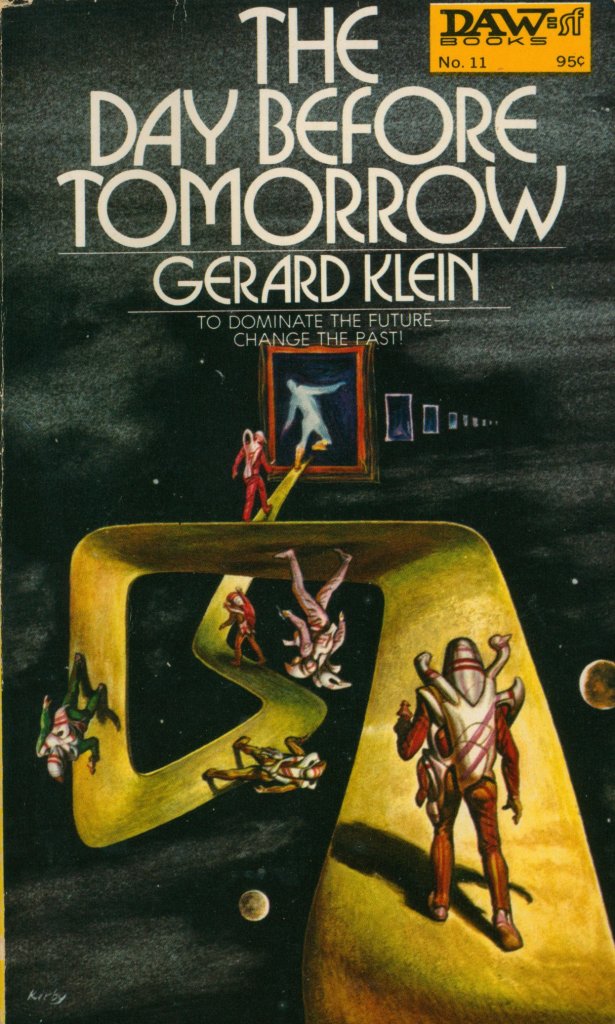
This is the second appearance of Gérard Klein in The World Treasury of Science Fiction. See my earlier review of “The Valley of Echoes.” After I read that story, I bought two of Klein’s novels, but I haven’t read them yet. I’m not sure I would have done that after only reading “Party Line.” However, one of those novels, The Day Before Tomorrow has a blurb that could fit with “Party Line” — “To Dominate the Future — Change the Past.”

“Party Line” uses one of my favorite science fictional concepts — having a future older-self influence a younger-self. Jerome Bosch is working in his office when he receives two phone calls on two separate phones. The phone in the left hand tells him he’s going to receive a terrific opportunity, and the one is the right warns against taking it.

Jerome Bosch is also a writer. He fantasizes at work about having all his time free to write. And I must wonder if Klein was working in his office one day, daydreaming this idea about himself and deciding to work it into a story. At first, it felt like “Party Line” was something Philip K. Dick would write. But then the dominant mood of the story shifted to indecision, paranoia, and fear, which is still PKD’s territory, but the story felt weirdly different, more like Kafka.

The first caller calls back and tells Jerome if he will only do what he says, his books will be made into movies, he will become rich and famous, and have lots of women. Then the other caller calls back and tells him something terrible will happen. For the rest of the story Jerome can’t decide.

I liked “Party Line” until I got to the end. Unfortunately, it’s one of those stories that promises a lot, but doesn’t know how to deliver on its promises. “Party Line” does have an ending, but one, I thought Klein had to scrounge up when he discovered he had painted himself into a corner.

I wrote an older self advises younger self story when I was at Clarion West. The problem is people seldom take advice. I wondered if someone would take advice from themselves. Klein complicates the idea by having two versions of his future self give him advice. That created a lot of tension for the story, but I wonder if “Party Line” would have been better if Jerome had only gotten one phone call from the future. How many people would jump at getting everything they wanted if they got a message from their future self?

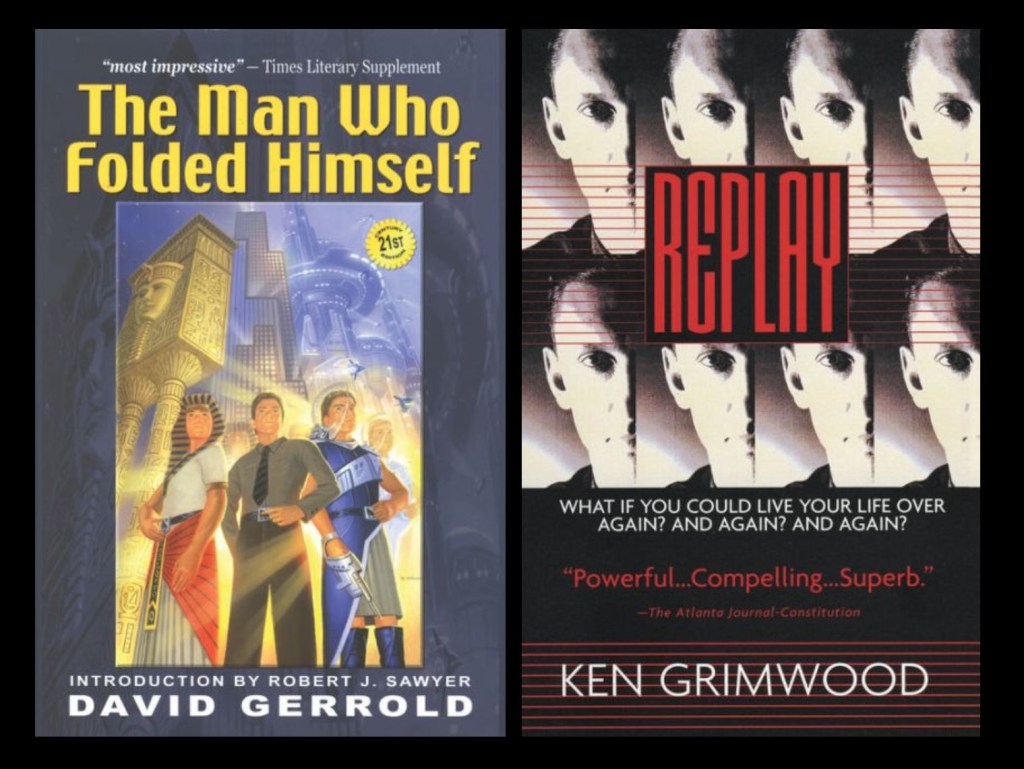
The idea of an older version of a person trying to influence their younger self is a challenging problem for writers. David Gerrold did an excellent job with it in The Man Who Folded Himself. But to fully explore the idea, I think people should read Replay by Ken Grimwood. It’s not the same exact idea, but it works out the same philosophical problem. The idea needs novel length to work out.

I believe my disappointment with “Party Line” is because Gérard Klein should have made it into a novel and worked out a satisfying ending. However, I might reread “Party Line” in the future and see it differently. Maybe my future self will understand it better.

James Wallace Harris, 8/26/23