“Let’s Be Frank” by Brian W. Aldiss

Group Read 72: The Best Science Fiction Stories of 1957

“Let’s Be Frank” by Brian W. Aldiss #08 of 20 (Read)

Fantasy and science fiction are two genres where writers can imagine anything, but strangely we seldom see stories with first-of-their-kind concepts. As The Bible says, there’s nothing new under the sun. However, I think Brian Aldiss has produced a unique idea in “Let’s Be Frank.” If I’m wrong, I’d love to read other takes on this concept.

I’m never sure how much of a story I should give away. “Let’s Be Frank” isn’t an all-time top short story, or even a best of the year story. There’s a reason writing teachers advise their students “Show don’t tell.” Aldiss tells this story. There’s no tension, no drama, no mystery. Aldiss produced his idea and explained how the billions of people on Earth end up with two conscious minds. Maybe that’s enough of a tease to get you to read the story. (Follow the link above.)

It’s a shame that Aldiss didn’t spend more time with his idea and created a version of the story that showed us what it was like to be a consciousness with multiple bodies. You might think I’m talking about a hive mind, but I don’t think I am. “Let’s Be Frank” does suggest a clever kind of telepathy. Can you imagine being in two bodies at once, one in England and one in Spain, with four legs, four arms, four eyes, and two heads?

If ChatGPT was conscious, it might experience something like this. Imagine being in a million bodies having a million conversations simultaneously? ChatGPT does that.

“Let’s Be Frank” isn’t a memorable short story either. Our group is working to identify the best science fiction stories of 1957. I don’t think “Let’s Be Frank” is one. But it is neat. The act of looking for exceptional stories makes me think about what makes a standout work of short fiction. I haven’t read all twenty we’re going to discuss, but I do know that “Call Me Joe” by Poul Anderson, “Omnilingual” by H. Beam Piper, and “The Menace from Earth” by Robert A. Heinlein are the great science fiction stories of 1957. They are the ones to read, reread, and remember.

Yet, what makes those stories great? What’s missing from “Let’s Be Frank” that’s in those stories? Each of those stories have original ideas too, especially Heinlein’s human powered flying on the Moon. They do have drama and characterization. I’m not sure Aldiss could have dramatized “Let’s Be Frank,” but if he could, it would have made all the difference in the world.

James Wallace Harris, 3/28/24

“The Cage” by A. Bertram Chandler

Group Read 72: The Best Science Fiction Stories of 1957

“The Cage” by A. Bertram Chandler #07 of 20 (Read, Listen)

“The Cage” is a fun story, although I’m not sure I would have included it in a best-of-the-year anthology. It’s a puzzle story. Bertram Chandler had a theoretical problem he wanted to present fictionally. How does one intelligent species recognize another intelligent species? It’s a reasonable question, but how do you propose it in a story?

Chandler had to spend most of the short story setting up the problem. If humans arrived on another planet, we’d assume any intelligent alien species would recognize our abilities. Chandler needed to put humans into a situation where our abilities wouldn’t seem obvious at all.

Chandler begins his story by having the interstellar liner Lode Star go off course and land on a young planet with just primitive life forms. The ship must be abandoned when its reactor goes into a runaway chain reaction, and it eventually blows up leaving no trace of the spaceship.

On this planet it mainly rains. The planet’s ecology has evolved some trees and plants, a froglike creature, and lots of fungi. Some fungi provide healthy food for the humans, but other forms of the fungi eat all their clothes and metals, so the castaways end up buck-naked. They can’t even start a fire because of the constant rain.

That’s when another spaceship lands and captures the humans in nets and takes them to another planet. The humans are put into something like a zoo. Finally, the story gets to the problem: How do they let the aliens know they are an advanced intelligent space faring species?

I’ll let you read the story and find out for yourself. But puzzle stories are intended to inspire readers to think of their own solutions.

I thought the aliens would eventually recognize the humans speak a complex language. But I also assume the humans could have made sign language gestures. Their cage had the same environment as the rainy planet, so they couldn’t make a fire, or build anything.

Puzzle stories are rare in science fiction, at least memorable ones. I can’t recall any others at this moment. I vaguely remember a story where a spaceship couldn’t see outside. I think the crew were trying figure out if they were in orbit around a planet.

I asked Copilot to list science fiction stories that proposed a problem. None of the stories it offered are what I was thinking of as a SF problem story. AIs are impressive right now, but they don’t seem to understand science fiction. I guess I’m assuming Copilot is unintelligent because it’s unaware of science fiction plots. But then, Copilot might not recognize me as an intelligent being either.

When you read thousands of science fiction stories you realize just how hard it is to produce an outstanding story. “The Cage” is decent enough. I would have been satisfied if I had read it in the June 1957 issue of The Magazine of Fantasy and Science Fiction. Personally, if I were an editor, I wouldn’t have selected it for any kind of anthology, but it’s been widely anthologized.

I keep waiting for us to discover another SF story with the impact of “Fondly Fahrenheit” or “Coming Attraction” or “Flowers for Algernon.”

James Wallace Harris, 3/26/24

“Between the Thunder and the Sun” by Chad Oliver

While my Facebook group is reading twenty stories selected as the best short science fiction of 1957, I’m also searching for other stories from that year that also deserve to be remembered. I think I found one with “Between the Thunder and the Sun” by Chad Oliver, from the May 1957 issue of F&SF.

The trouble is I can find no other recognition for this story. That makes me doubt my own interest in the story. I want to advocate “Between the Thunder and the Sun” not because it’s an exceptional story but because it tackles a serious subject, one that might be new to science fiction in 1957. If you know of early stories on this theme, leave a comment.

Chad Oliver was an anthropologist who worked at the University of Texas. He wrote a fair amount of science fiction, but I only remember him for Mists of Dawn, a 1952 Winston Science Fiction juvenile I read as a kid. Oliver had more success as a western writer. “Between the Thunder and the Sun” was only anthologized in one notable anthology, The Best from Fantasy and Science Fiction, Seventh Series edited by Anthony Boucher, which is essentially the best of 1957 from F&SF, so it’s picking its own children to praise. Still, I need to remember that anthology in my search for other standout SF stories from 1957.

What makes “Between the Thunder and the Sun” significant is it’s a Prime Directive story, a concept that emerged from Star Trek: The Original Series. Evan Schaefer is a professor contacted secretly about a mission to a planet where the population of intelligent beings were dying off on one continent. Because those beings have not reached a stage where they could survive the culture conflict of meeting a technologically superior species from Earth, it is against all our laws to even contact them, much less help them. However, a secret group wants to break those laws and save those beings. Their method of helping the aliens is to get them to understand ecology, because their current practices are self-destructive. And even still, their altruistic efforts only reinforced the Prime Directive laws.

What made this story stand out to this afternoon was I had just watched a YouTube review of Hard to Be a God by Arkady and Boris Strugatsky, a 1964 Russian novel that was translated into English in 1973 that is also about the Prime Directive. This made me wonder when the concept first appeared in science fiction or as a public concept. I can’t answer that question, but I hope readers of this blog can, and will comment below.

“Between the Thunder and the Sun” is a pleasant enough story to read, but it lacks suspense, drama, tension, and when conflict does arrive near the end, it just happens. Oliver wrote the story as an unfolding narrative. There’s lot of interesting ideas in the story, lots of imaginative details, but the story just doesn’t zing.

Should we remember a science fiction story just for its ideas? If you look at a list of the most remembered SF short stories, they are often based on remarkable ideas. But nearly all of them have remarkable storytelling too.

Neither Judith Merril, T. E. Dikty, or Asimov and Greenberg included “Between the Thunder and the Sun” in their anthologies of the best science fiction stories of 1957. That’s striking out three times. However, Merril did include the story in her honorable mentions.

If you get a chance, read “Between the Thunder and the Sun” and let me know what you think. Here’s the link again.

James Wallace Harris, 3/19/24

“Hunting Machine” by Carol Emshwiller

Group Read 72: The Best Science Fiction Stories of 1957

“Hunting Machine” by Carol Emshwiller #04 of 20 (Read, Listen – @05:40)

“Hunting Machine” by Carol Emshwiller is a rather short, but effective anti-hunting story that was first published in the May 1957 issue of Science Fiction Stories. Ruthie and Joe McAlister are on a three-day hunting trip with a robotic hunting dog rented from the park service. The robot was set by the warden for three birds, two deer and one black bear. However, Joe tinkers with the governor on the robot so he can hunt a 1,500-pound brown bear.

Most of the story is satire about how in the future people bring all kinds of gadgets to make their time in the rugged wilderness as comfortable as staying at home. Because hunting with their automatic rifles and robot is like shooting fish in a barrel, Joe overrides the controls in the robot to make the bear put up a fight. We see some of the story from the robot’s and bear’s perspective, both of which are more in tune with nature. Humans come across as schmucks in this story.

I’ve read “Hunting Machine” before, but it hasn’t stuck in my mind. It’s too slight, too simple, and too obvious. I’m surprised by both T. E. Dikty and Asimov/Greenberg included it in their anthologies that collected the best SF shorts of 1957. That suggests it is liked more than I think it should be. It’s a nice enough little yarn, fine for a magazine, but lacks the punch needed to make it worthy of an anthology in my opinion.

W. M. Irwin felt the story was more than an anti-hunting story, about how sports and outdoor adventures are ruined by automation. I can buy that. I agree with Paul Fraser that the ending was anti-climactic. I wanted the bear to win, to destroy the robot and to kill and eat Ruthie and Joe. And second to that possible ending, I wanted the robot to kill Joe because he was within the new weight limit that Joe had illegally changed. But Carol Emshwiller kept the story lighthearted.

This story should have been published in a hunting magazine in 1957. I’m sure real hunters would have enjoyed the satire even more. I don’t think “Hunting Machine” adds much to our understanding of 1950s science fiction. The definitive 1950s hunting story with a science fiction theme is “A Sound of Thunder” by Ray Bradbury, first published in Collier’s in 1952. It’s about hunting dinosaurs. Following that is “A Gun for Dinosaur” by L. Sprague de Camp, that first appeared in Galaxy in 1956. It’s another hunting story that plays off Hemingway’s classic Africa stories. Finally, there’s yet another classic dino hunt story, “Poor Litte Warrior!” from F&SF in 1958, where Brian Aldiss satirizes the first two.

I’m sure if I made a concentrated effort, I could track down more titles to define hunting as a sub-theme of science fiction. But my memory can’t dredge up any more from my brain, and I’m worn out on Googling.

James Wallace Harris

“The Queer Ones” by Leigh Brackett

Group Read 72: The Best Science Fiction Stories of 1957

“The Queer Ones” by Leigh Brackett #02 of 20 (Read)

Ever wonder why science fiction imprinted on you as a child? Why does the genre appeal so strongly to some people? What’s its subconscious attraction?

Psychoanalyzing 1950s science fiction reveals a deep-rooted desire to contact aliens. UFOs became a mania in that decade, which spilled over into the 1960s. UFO crazies seemed to have disappeared after that. But they’re back today. I do believe that humanity suffers from cosmic loneliness. Or is it something else?

“The Queer Ones” by Leigh Brackett speaks to both xenophobia and loneliness. I’m not going to give spoilers right away, but I recommend you follow the link above and read the story. It offers bit of a mystery, so I don’t want to spoil your reading fun, but I want to have my say eventually. However, “The Queer Ones” fits the mold so well for this kind of 1950s science fiction story, that it might not be much of a mystery for aficionados.

My first reaction to reading “The Queer Ones” was to feel it was a mirror image of Zenna Henderson’s People stories. But instead of finding gentle aliens out in the backwaters of rural American, we encounter thugs from the stars. I’m reminded of Heinlein’s Have Space Suit-Will Travel. Henderson’s aliens are a version of the Mother Thing, while Brackett’s aliens act like Wormface, but they look human. They even coop human lowlifes.

Leigh Brackett takes on the tone of Clifford Simak in “The Queer Ones,” and it’s hugely different from her planetary romances. She can’t seem to resist herself though because romance does sneak in towards the end.

Hank Temple is the owner/editor of a small town, six-page newspaper. Doc Callender contacts Hank about a curious child, Billy Tate. X-rays and bloodwork show this kid to be strangely different. If fact, the doctor had been called in because Bily had been beaten up by other kids for being different. He looked human, but Billy was slight, redheaded, and a tiny bit odd.

As it turns out, Sally Tate is a young country girl who got put in the family way by a fast-talking stranger. Her child, Billy, grew up to become a kid that Sally’s hill country clan intensely disliked. The Doc calls Hank to see if he wants to drive out into the middle of nowhere to meet this backwoods family. That’s when the mystery starts. Hank and Doc’s first theory was Billy was a mutant.

Mutants are another popular theme of 1950s science fiction. The cause of mutant humans in SF is varied, but two reasons were popular. Radiation from atomic bombs, and the emergence of Homo Superior was the other. This also paralleled our fascination with aliens. Either they were monsters, or advanced beings with godlike powers. Both show up in “The Queer Ones.”

However, the beginning flavor of “The Queer Ones” is much different than the flavor at the end the story. Early on, Brackett taps into the kind of atmosphere we find in Way Station by Clifford Simak. I’d call that theme: Aliens Living Hidden Among Us. Other books like that are A Mirror for Observers by Edgar Pangborn, The Man Who Fell to Earth by Walter Tevis, and as I’ve already mentioned, Pilgrimage: The Book of the People by Zenna Henderson. Superman comics did this too. Henderson essentially steals Superman’s origin story for her People stories. And if you remember, quite a few episodes of The Twilight Zone featured beings from beyond living amongst us.

The plot takes a sinister turn when Doc is killed. Hank realizes their snooping has gotten back to Billy’s father. Then the hospital is burned down with Doc’s evidence. That’s when Hank catches his first alien, a young woman, Vadi, who turns out to be the sister to Billy’s father. That’s when Hank realizes that Billy’s father is not another mutant, but an alien.

Hank is turned on by Vadi. Sally Tate, and all the women of her family had been turned on by Billy’s father, who we eventually learned is an alien called Arnek. Now this is an interesting sub-theme of cosmic loneliness. Leigh Brackett doesn’t go into this, but how can Arnek mate with Sally Tate and produce a child? This has come up in later science fiction stories. A theory to answer that question is panspermia. That theory helps to explain why many of the aliens in Star Trek look human, but it also suggests that God or advanced aliens seeded/populated/colonized the galaxy on purpose. Maybe we weren’t meant to be alone and miss our cousins.

This also suggests that our psychological fear of cosmic aloneness can sometimes overcome our ingrained xenophobia. We want the universe, or at least the galaxy, to be inhabited by beings like us. Even reading stories about aliens gone bad fulfill the need to know were not alone.

Let’s backtrack a minute. Did our hangup of being alone in the universe emerge with UFOs in the late 1940s? I don’t think so. Doesn’t the desire for aliens and angels fulfill the same existential craving? And don’t we have stories of humans and angels falling in love with each other, even having sex. The Bishop’s Wife comes to mind, but then there’s Wings of Desire and City of Angels. Ancient literature is full of aliens if you squint at supernatural beings from a certain angle. Isn’t God a kind of top boss alien? The Bible and other ancient religious work often describe whole species of aliens as part of taxonomy of beings not of this Earth. Sure, the Greek gods weren’t light years away, but they were from on high.

Science fiction doesn’t have that many themes. It tends to explore the same ones over and over, and if you look at them in the right way, those themes have always been around, even before science and science fiction. Just imagine how deep they go when you think about Neanderthals encountering Homo sapiens? We hate the other, but we loath the idea of being by ourselves in reality.

Stories like “The Queer Ones” appealed to me as a kid, and I don’t think I’m alone. Shouldn’t we ask why? For all our eight billion, most of us are lonely. Even if we have plenty of family and friends to keep us company, don’t we feel that something is still missing? Don’t we have a longing for something greater? And isn’t the reason so many people believe in God is because they want a personal relationship with a higher being? Wouldn’t you want a personal relationship with an alien?

In the end, Sally runs off to the stars with Arnek, leaving Billy behind. Hank takes Billy to raise him but wishes he had a wife to help. Hank doubts he will ever marry because after kissing Vadi once, he longs for her too much to settle for a human companion. That’s very strange, don’t you think? Is Brackett suggesting that we’re missing a higher spiritual connection because aliens are our true soul mates?

I doubt we’ll ever meet aliens on Earth, or visit them on other worlds, but we might not stay alone for much longer. Artificial intelligence is progressing so fast that we might have new digital friends soon. R. Daneel Olivaw might arrive before we return to the Moon. Science fiction always promised us robots too. I wonder if we’ll encounter any in the next eighteen stories from 1957.

——

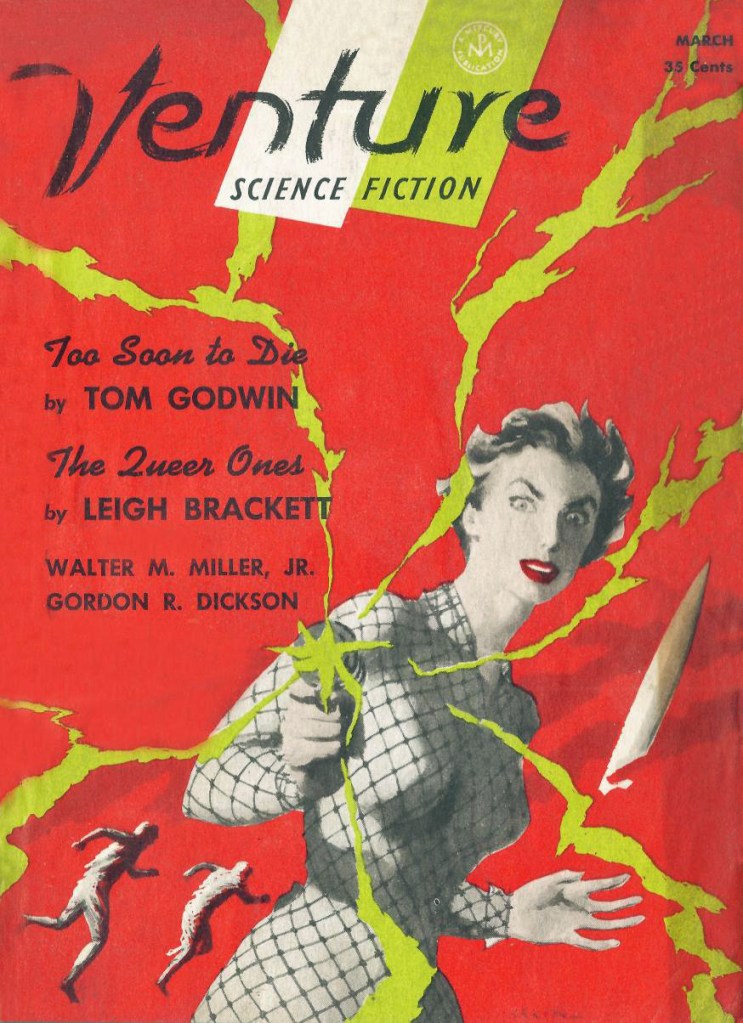
“The Queer Ones” first appeared in the March 1957 issue of Venture Science Fiction. Dave Hook became so entranced by its cover that he researched and wrote “Who is Artist ‘Dick Shelton’.” It’s another fascinating stroll down memory lane if you love old SF magazines and their artists who do their covers and interior illustrations.

James Wallace Harris, 3/13/24

“The Crystal Spheres” by David Brin

The Crystal Spheres” by David Brin was first published in Analog, January 1984. You can read it at Lightspeed Magazine or can listen to it at StarShipSofa. It won the Hugo award in 1985 and won the Analog reader poll for 1984 short stories.

Literary short stories are generally small in scope, covering brief slices of time, using few characters, placed in limited settings, which make an emotional impact from a personal insight. This is my preferred form for a short story, even for science fiction. However, this doesn’t keep science fiction writers from spanning galaxies over eons featuring multiple intelligence species all in under 7,500 words. I loved these epic sci-fi stories when I was young. They had intellectual emotional impact if that makes any sense. Generally, I prefer small personal short stories in my old age, but I still admire the universe spanning imagination displayed in stories like “The Crystal Spheres.”

But something has changed in me as I’ve gotten older.

“The Crystal Spheres” breaks the cardinal rule of fiction writing classes, show don’t tell, but it proves rules can be broken — sometimes. I must wonder if Brin had used 350,000 words and told this story in a 1,000-page epic called The Crystal Spheres, if the sense of wonder would have been any greater? Could Olaf Stapledon have condensed The Last and First Men and Star Maker down to short stories and had them succeed just as well? David Brin does a lot with this short story.

“The Crystal Spheres” answers the question the Fermi Paradox asks: Where is everyone? It borrows an idea from the ancient Greeks, placing around every star a crystal sphere that keeps visitors out. Brin doesn’t go into whether these protective barriers are natural, or God made, or a product of intelligent design, but the end results is it keeps one intelligent space faring species from colonizing the universe like a plague.

This reminds me of the novels Spin by Robert Charles Wilson and Quarantine by Greg Egan, and to a lesser degree, the novel Out of a Silent Planet by C. S. Lewis, but for an odder reason. I read Spin first, and I marveled at the time that Wilson had produced a unique science fictional idea. But evidently, there is a tiny sub-genre of science fiction stories about barriers around the Earth or the solar system. I need to check into its history and look for other examples.

“The Crystal Spheres” evokes both the theological and the teleological. It reminds me of the Omega Point philosophized by Pierre Teilhard de Chardin. Brin thrills his reader with vast theories.

Although “The Crystal Spheres” isn’t a very satisfying short story on the personal insight level, its big fun alluding to many science-fictional concepts. Set in the future after humans have developed star travel, cold sleep, and immortality, it describes how humanity has become depressed because we’re alone in the universe. The story begins when a recently reawaked Joshua learns of a new discovery.

But to put that discovery into context Brin needs to set up a backstory. When humans sent out its first interstellar ship it crashed into an invisible sphere that shattered and created centuries of comets raining down on Earth, nearly wiping us out. Bummer. After things settle down, we start sending out starships again, but they keep crashing into spheres around other solar systems. They don’t break the spheres but do destroy themselves. Eventually, we learn how to avoid crashing into spheres and discover a few inhabited planets, mostly by hive-like beings. When we do discover races like us, we can’t communicate with them. We can listen to their broadcasts which can penetrate out the crystal spheres, but we can’t communicate into the spheres to say “Howdy.”

This throws humanity into a deep depression and most people go into hibernation hoping to wake up one day after we find planets we can visit. The story begins with Joshua learning there’s a solar system with a shattered crystal sphere and several possible planets orbiting that star.

It’s in another galaxy. Joshua and friends go there taking hundreds of years, using four diverse types of faster-than-light travel. When they arrive, they discover an abandoned civilization. I love science fiction about abandoned alien civilizations. At first Joshua and friends don’t know if these aliens have died off, committed species suicide, or just left for parts unknown.

Should I tell you everything? I’ve already told you a lot. I never know how much to give away. I want to discuss stories as if you’ve read them too, but I must assume that most of you haven’t read the story so I should keep from spoiling it. But how much should I tell to entice you into reading the story?

Let’s just talk about what I’ve already revealed. The idea of crystal spheres is a neat way to explain the Fermi paradox. Isaac Asimov even suggests this idea came about at Worldcon with writers suggesting ideas for a story, but he doesn’t specifically say David Brin was in that group.

Brin doesn’t give us any hard science speculation why the crystal spheres would be there, or how they work. It states that physical objects can’t penetrate them from the outside. But we know of extrasolar objects visiting the solar system. But was Oumuamua the first one we detected? Maybe when Brin wrote the story in 1984, no such visitor had been discovered. Or maybe only objects with intelligent beings in them can’t penetrate the spheres? And what about random bodies within the system? Why couldn’t some rock leaving the solar system have broken the crystal sphere long before the first spaceship?

See, that’s the fun thing about science fiction, it makes you question the story. Challenging questions. Sense of wonder questions. And in this case, are the crystal spheres naturally made, or from intelligent design? Now that takes us into some fun speculation. In Quarantine Greg Egan came out with a wonderful idea of why humans are locked out from the rest of the galaxy. I won’t give the answer because that would spoil the whole novel.

“The Crystal Spheres” is the kind of science fiction story that makes us think big, gigantically big. I loved that kind of science fiction when I was young. And reading “The Crystal Spheres” conjured that exciting old feeling. But my older wiser self, is more cynical. All those big sci-fi ideas are just childish fantasies. I have serious doubts we’ll ever make it to Mars, and believe interstellar travel is next to impossible. We can’t even save ourselves from self-destruction, so why imagine such exciting futures?

We face real barriers that keep us from colonizing the planets and traveling to the stars. But they are all within us. Our greed, our xenophobia, our petty resentments, our violent nature, our cancerous consumption of natural resources, and the list goes on and on. Our human nature is the crystal sphere that keeps us here.

I should stop reading science fiction, but I have a life-long addiction I can’t throw off. However, the older I get, the more acutely I recognize my childhood hopes about the future are just fantasies. I now crave realistic science fiction that deals with possible futures. Unfortunately, science fiction is written to sell to young people, and realistic science fiction is too depressing for them.

I got a big kick out of reading “The Crystal Spheres” because it encapsulated so many science fiction fantasies that I once loved. It’s still a wonderful story. But now that I’m old, it has a bittersweet twinge to it.

“The Crystal Spheres” reminds me of one last thing, the famous speech Marlon Brando makes in On the Waterfront, where he says, “You don’t understand! I coulda had class. I coulda been a contender. I coulda been somebody instead of a bum, which is what I am.” It’s sad that humanity won’t become what Brin and science fiction imagines.

James Wallace Harris, 3/8/24

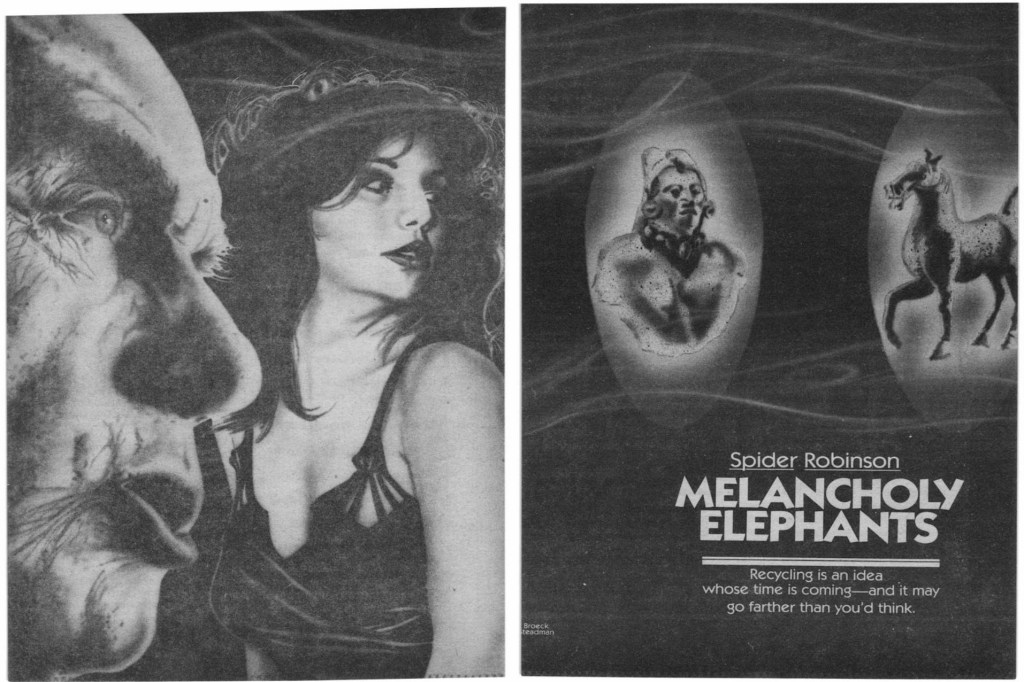
“Melancholy Elephants” by Spider Robinson

Our Facebook group is reading and discussing all the Hugo award winning short stories and novelettes that we’ve haven’t covered in all our previous years. “Melancholy Elephants” by Spider Robinson is a 1983 Hugo winner that I have no memory of even hearing about before. It first appeared in the June 1982 issue of Analog and came in first in the Analog Readers Poll. But then, that’s the fun thing about Group Read 69, we’re discovering stories that should be remembered, or at least consider why they haven’t.

“Melancholy Elephants” is about extending the copyright lifetime. It’s set in the future, and powerful entities want to pass a bill to make copyright perpetual. Dorothy Martin feels this will be a threat to civilization and it’s vital that the bill be stopped. She goes to see a powerful senator she hopes to convince or bribe into killing the proposal.

Most of the story is infodumping about copyright laws. It talks about how there are limits to creativity and if fiction and music are locked down by copyright, it will destroy them. The story even gives examples, including Harlan Ellison and A. E. van Vogt suing movie companies and winning, and George Harrison unconsciously cribbing “He’s So Fine” to write “My Sweet Lord” by the Chiffons. In the future of this story, there will be powerful computer programs that test for previous use and reject copyright violations. Mrs. Martin’s husband committed suicide when he realized his latest and greatest work was inspired by music he heard in childhood.

I don’t see why this story won the Hugo and Analog Readers Award, but then I don’t remember any of the short stories it competed with either. Also, I disagree with Mrs. Martin’s conclusion. I don’t think long copyright terms keeps artists from innovating, but I do think it keeps some works from being remembered. For example, copyright keeps me from linking to a copy of this story for you to read.

What I found fascinating by “Melancholy Elephants” was how much the story felt like a Heinlein story. Spider Robinson was a huge fan and friend of Heinlein, and this story feels like he stole from Heinlein in the same way Harrison appears to have stolen from The Chiffons.

The story starts out with Dorothy Martin killing a mugger. She justifies it because she couldn’t be late with the meeting with the Senator, ruining her only chance of saving the world from a fate worse than death. “Gulf” by Robert A. Heinlein starts with the protagonist causally killing an attacker and justifying it by his righteous cause. And if memory serves me right, the same thing happened in Heinlein’s novel, Friday. Heinlein like to promote the value of his characters beliefs and causes by casually killing people. He equates the end justifies the means with these quick scenes. I always thought they represented massive egos believing their way of thinking puts them above all others.

“Melancholy Elephants” could have been done without the scene of Mrs. Martin killing someone and hiding the body under the car. It gave the story a repulsive beginning. The story really needed to be an essay, but Spider Robinson sells fiction, so he took the idea and fictionalized it much like Robert A. Heinlein would he wanted to promote his beliefs.

Mrs. Martin visits the Senator, who comes across like Heinlein’s Jubal Harshaw. The way she makes her case and the way the Senator makes his is exceedingly Heinleinesque At one point Mrs. Martin tries to buy off the Senator and he explains he can’t be bought off because he’s already been bought off and it would be unethical to go against the original deal. Heinlein was big on representing government as being corrupt and things got done by big egos battling it out. Heinlein loved to write scenes where his character persuades others on a particular super-vital issue. However, Heinlein’s scenes often come across as character promoting their righteousness, rather than logic.

In the end the Senator sees Mrs. Martin’s side of things and reverses himself, but the way he does it also reminds me of Heinlein characters when they do give in.

It’s ironic that “Melancholy Elephants” is about protecting a creative person’s rights to borrow from the art that inspired them because this story is obviously inspired too much by Heinlein.

James Wallace Harris, 3/5/24

Deadly Serious Science Fiction

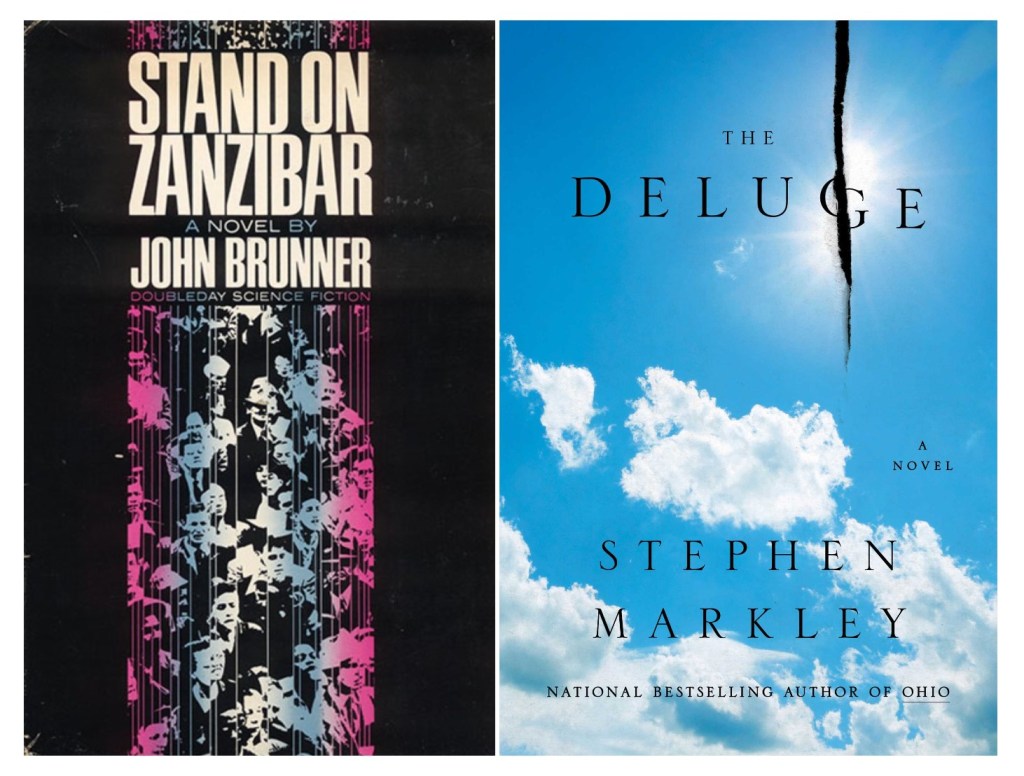
Out of the thousands of science fiction novels I’ve read, I thought Stand on Zanzibar by John Brunner took itself the most seriously. It addressed world problems John Brunner thought threatened humanity in 1968. I read Stand on Zanzibar in 1969 and it made me dread the future he depicted of 2010. It wasn’t the most thrilling SF novel I’ve ever read, nor was it easy to read, but it was most impressive stylistically and made me think about the future more than any other science fiction novel. The Deluge by Stephen Markley now follows in the footsteps of Stand on Zanzibar. Both books describe futures we should want to avoid at all costs. They are deadly serious science fiction.

There aren’t that many serious SF novels that intentionally warn us about the future. Other famous ones are Brave New World by Aldous Huxley, Nineteen Eighty-Four by George Orwell, The Handmaid’s Tale by Margaret Atwood, and The Ministry for the Future by Kim Stanley Robinson.

Everyone wants to predict the future, but that’s impossible, so science fiction writers sometimes extrapolate current trends, fictionalizing a possible near future. This is what both Stand on Zanzibar and The Deluge do. We can judge Brunner’s speculation since we’ve now lived past the time he imagined. He got a lot wrong, but he got other stuff right, especially how terrorism would spread across the world. Stephen Markley speculates about the politics of climate change will play out over the next sixteen years and five presidential elections.

Did Brunner and Markley hope we’d change our ways because we read their books? Markley warns his readers what will happen if we don’t act soon regarding climate change. His book asks: What will it take for humanity to give up fossil fuels? Kim Stanley Robinson does the same thing in The Ministry of the Future. Both novels spend a substantial number of words on terrorism. I really hope that isn’t the incentive that pushes us to change. Can we avoid these horrible futures because we read about them today?

My other review of The Deluge, intended for people who don’t read science fiction, I focused on the question: Can we change? For this review I want to focus on the question: Can science fiction influence society at large? If it can’t, why write such SF novels? Both The Deluge and Stand on Zanzibar are huge ambitious works that use a large cast of characters, shifting points of view, interspersed with chapters of pseudo journalism and pop culture, giving a multifaceted view of the near future. The Deluge is almost nine hundred pages in print and runs nearly forty-one hours on audio. It’s big and profoundly serious.

Serious science fiction often warns us we’re heading towards specific scary futures we could avoid if we make the effort. Do we ever heed such warnings? Scientists currently studying free will say it looks like humans are not in conscious control of our lives. I agree with them. If that’s true, can we change the way we act based on things we read? Maybe the authors of serious science fiction never hoped to change the course of history, but only wanted to appeal to certain individuals and influence their thinking. Are such novels part of an extended conversation about the future taking place in the genre of science fiction? Do they expect their readers to change the world, or just for other novelists in the future to reply? Are books about possible futures just an extended conversation that’s taken place in print?

Wasn’t Orwell’s Nineteen Eighty-Four a reply to Huxley’s Brave New World? Wasn’t John Brunner having his turn in the discussion when he wrote Stand on Zanzibar and his Club of Rome Quartet? And didn’t Margaret Atwood jump into the conversation with The Handmaid’s Tale? And aren’t such nonfiction books of futurism like The Limits of Growth and Future Shock also part of the conversation? I believe Robinson’s and Markley’s books are just the latest things said in a never-ending conversation about the future. Sure, many readers consider these books a genre of gloom and doom, but do they have a greater purpose and impact?

It’s interesting that all the books I’ve mentioned so far worry about issues that we continue to face. Is that because we’ll always face those issues? Or do their authors expect us readers to change the way we live and act and eventually solve these problems?

Science fiction writers and futurists know they can’t predict the future, but do they believe readers can divert the present away from possible futures they fear? Isn’t that a kind of free will? A kind of hope for the group mind? The reason scientists don’t believe individuals have free will is because they detect brain activity at the unconscious level before we think we claim to consciously make our decisions. Isn’t the world of intellectual speculation only a kind of unconscious group mind thought process?

People like to think we can become captains of our fate, so is it surprising that writers might hope that society can consciously choose what it will become? But does a meta-conversation about what human society could or should be really represent a kind of free will? I’m sure in their heart of hearts that Orwell, Brunner, Atwood, and Markley wanted to influence society and avoid the horrors they saw coming.

Self-help books are bestsellers because some people do change their habits, so isn’t that evidence that if enough people read serious science fiction it might influence the larger society? Scientists studying free will say no because the desire to change comes from our unconscious minds. But does that matter if science fiction influences us on a conscious or unconscious level? Isn’t the woken social movement mainly due to reading?

I do believe certain books about the future, both fiction and nonfiction, represent an ongoing conversation, but I don’t know if we change our lives because we listened to the conversation. I’m liberal, and have a lot of liberal friends, who claim to be very worried about climate change, but none of us have tried to significantly shrink our carbon footprint.

Back in 1969 when I read Stand on Zanzibar, I was frightened by Brunner’s vision of the future. Over the decades I’ve read and discussed its ideas on overpopulation and the limits of growth with my friends, but we’ve never acted on those fears. I’ve been talking with people about the dangers of climate change for over twenty years now, but we haven’t done anything significant either. That’s why in my other essay about The Deluge I titled it: “Will People Change vs. Can People Change?

I don’t think we will change. So, why read science fiction that warns us about the future? Likely, we don’t have free will, but we might have an existential awareness of who we are, and I believe books speculating about the future expand that awareness.

Most science fiction is written to entertain. Most science fiction readers seldom read serious science fiction. John Brunner got some critical attention for his Club of Rome Quartet novels, but I’ve read he was depressed because they made no real impact on society. Few writers can achieve George Orwell’s and Margaret Atwood’s social impact.

The Deluge got a fair amount of good mainstream press, but I’m the only person I know who has read it. I doubt Stephen Markley intended it for science fiction readers. He’s a mainstream literary writer. However, because it attempts to do what Brunner did all those decades ago, I believe some science fiction writers will find it interesting.

Reviews of The Deluge:

by James Wallace Harris, 2/29/24

In Which Postapocalyptic Novel Would You Prefer to Live?

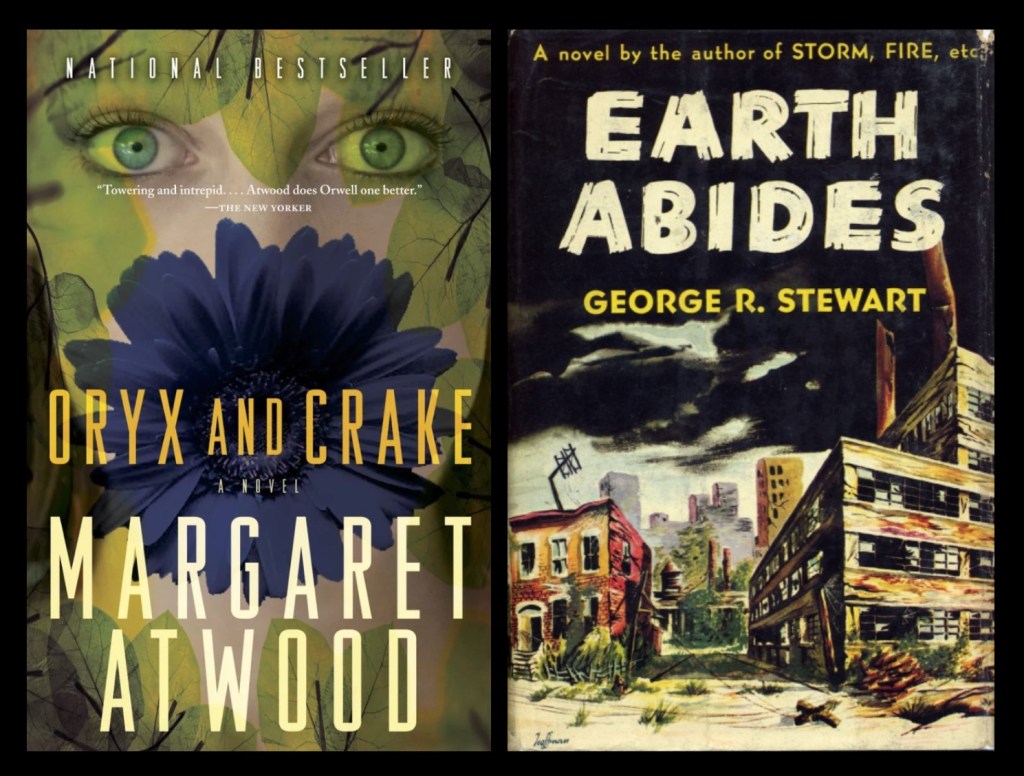
Oryx and Crake by Margaret Atwood is a postapocalyptic novel about humanity being assassinated by a mad genetic engineer. Although well-written and thought-provoking it wasn’t a pleasant read. I doubt any science fiction fan would vicariously put themselves into Atwood’s imagined future. Its narrator, a human survivor nicknamed Snowman, is a rather repulsive individual. This novel might be intellectually stimulating, especially for its thoughts on the evilness of humanity, but it’s not a novel that promises hope for rebuilding the future.

As a young reader of science fiction back in the 1960s, I used to fantasize about what I’d do if I lived in the books I read. Even 1950s post-apocalyptic novels about WWIII left room for me to see positive paths to take. Oryx and Crake was as bleak to me as Cormac McCarthy’s The Road. I admired that novel, but I would never daydream myself into it.

The blurb on the cover above praises Atwood for outdoing Orwell, but not by me. Nineteen Eighty-Four was bleak and depressing, but it was infinitely instructional about avoiding possible futures. Oryx and Crake feels like an oracle of doom. But then I haven’t read Nineteen Eighty-Four in a couple of decades, and at 72 I might find it just as nihilistic as Oryx and Crake.

I’m a connoisseur of after the collapse settings in science fiction. My all-time favorite is Earth Abides by George R. Stewart. In that story, almost everyone dies from an illness and the world reverts to a time when humans are few, becoming hunters and gatherers again.

I’m not saying I’d like to live a tribal existence. No, the postapocalyptic world I’d like to live in, is just after the collapse, where the infrastructure of humanity is still intact. I’d want enough leftover supplies to keep me going for the rest of my life, which might not be more than a decade. When I was younger, the idea of rebuilding civilization appealed to me, but I’m too old for that anymore. But if I were in my twenties, would I fantasize about surviving Atwood’s future?

No, old me would want to live in a nicer post-apocalypse to contemplate the end of our species. In Atwood’s book, she has Snowman contemplating his own fucked up life, while he caretakes a genetically engineered new form of humanity. Atwood imagines our replacements as genetically engineered non-violent humanoid beings called Crakers. These post-humans have a reproductive cycle that removes gender conflict and are peaceful herbivores. I can’t imagine these wimpy creatures surviving the highly aggressive genetically modified animals created in the years before humanity was snuffed out.

In Oryx and Crake Homo sapiens are defined by our worse traits. We deserve our fate in Atwood’s story. And I wouldn’t argue with Atwood. But Atwood’s philosophy makes for a bleak depressing read. The novel has two sequels: The Year of the Flood (2009) and MaddAdam (2013). Even though I was bummed out reading Oryx and Crake, I’m tempted to read the rest of the trilogy just to see if Atwood ever offers her readers hope. I have read that the second volume is about religious people, and that was a frequent theme in 1950s postapocalyptic novels. That tempts me.

Oryx and Crake has got me thinking about the appeal of reading postapocalyptic novels. Why are postapocalyptic settings with zombies so popular with readers today? I’ve never been one to enjoy horror themes. And zombies are so damn yucky. Why would anyone find pleasure putting themselves into such a setting? I must wonder if fans of these stories secretly want to live in a world where they could kill, kill, kill to their heart’s content.

I’m more of a Henry Bemis type myself. I want a nice cozy catastrophe postapocalyptic setting. A peaceful place to meditate on the passing of human existence. When I was younger, I fantasized about playing Tarzan and Jane after the fall of civilization, but now that I’m older, having a faithful dog and robot would be the only companions I’d want. I’d desire a Clifford Simak flavored setting if I were the last man on Earth.

I’m trying not to say end of the world. I dislike that phrase. Humans are so arrogant. They believe when our time is up it’s the end of the world. I think Earth will bop along simply fine without us. Animals and plants would flourish again. The Earth would again teem with life. I can only assume self-aware intelligence was an experiment that failed. Let the robots have the next turn. They might be more compassionate to the animals.

I often write about the difference between old science fiction and new science fiction. In old science fiction we do ourselves in because we’re the stupid violent bastards we are, but there’s not a lot of self-recrimination. In the new science fiction, writers dwell on our evilness. In Atwood’s book, we see two boys, Jimmy (Snowman) and Glenn (Crake), grow up and snuff out humanity. Their formative years were spent watching porn, snuff films, child pornography, playing sick violent video games — just being a couple of gifted brainiacs. They are super intelligent, yet soulless and unlikeable. Jimmy and Glenn use their genius to create and sell ugly products to a world all too anxious to consume them. Sure, that reflects our real world, but does experiencing such in fiction do us any good? Will readers in the future cite Oryx and Crake warnings about genetic engineering? It lacks the symbolism or political resonance of The Handmaid’s Tale.

Atwood’s The Handmaid’s Tale is about another ugly future, but its ugliness offers us inspiration on how to avoid that future? I assume she intended Oryx and Crake to be positive in the same way, but it isn’t. The Handmaid’s Tale inspires us to fix society. Oryx and Crake only make me want to pull the plug on our species.

In most old science fiction novels about after-the-collapse of civilization, we’re shown ideas for starting over. Sure, some of those novels tell us we’re only going to make the same mistakes again, but there is a will to try again. Some of those stories even suggested it might be possible to take different paths. Reading Oryx and Crake left me feeling it’s time to just let go. Let some other species become the crown of creation.

Maybe Atwood put hope in the sequels, so we’d buy them.

Is my pessimism due to my age? Do younger readers find hope in this novel?

James Wallace Harris, 2/16/24

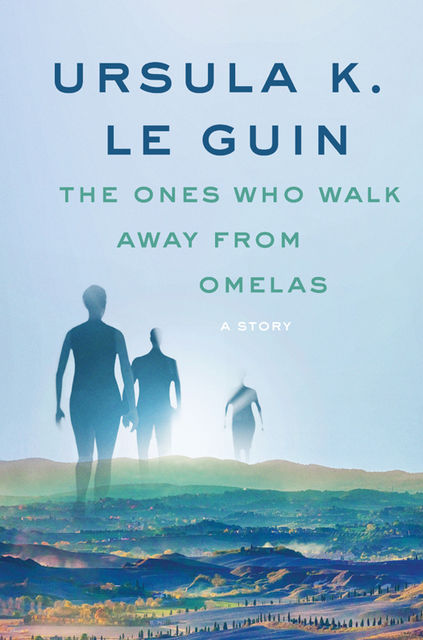
“The Ones Who Walk Away from Omelas” by Ursula K. Le Guin

Today our group, Best Science Fiction and Fantasy Short Fiction, is discussing “The Ones Who Walked Away from Omelas” by Ursula K. Le Guin. It’s part of “Group Read 69 – Previously Unread Hugo Winners.” I can’t believe out of all our previous sixty-eight group reads we haven’t read this 5-star story before. I have written about “The Ones Who Walk Away from Omelas” before in the essay “A Philosophical Conversation Between Two Short Stories.”

“The Ones Who Walk Away from Omelas” is perfect for generating classroom discussions about philosophy. It’s short, only seventeen minutes on audio, and is told as an allegory. Le Guin presents a tiny utopian country where everything is wonderful except for one detail. Happiness in this land depends on the suffering of one child. Nearly everyone in Omelas accepts they must allow one ten-year-old child to suffer horribly, because that suffering allows everyone else living in Omelas to be happy. Of course, as you can guess from the title, some citizens can’t accept this and walk away.

Is Le Guin’s story questioning Christianity and asking why did Jesus suffer for all of us? I don’t think so. Is Le Guin pointing a finger at Capitalism, where the happiness of many depends on the suffering of the economic losers? Maybe. Do you worry about the losers in your society when you’re one of the winners? Is the story also asking how can we have a perfect society if even one person must pay a price? Isn’t it true that in every society some must suffer? Where can those who walk away from Omelas go?

Most people who read “The Ones Who Walk Away from Omelas” focus on the ending, the problem of the suffering child. But in the story’s buildup Le Guin describes what she thinks is a utopian society. Le Guin is challenging her readers to imagine a perfect society too. Le Guin says she doesn’t want clergy or the military, but figures she’ll have to accept orgies and drugs. What would you reject and accept?

I think Le Guin started writing this story wanting to speculate about creating a perfect society, but then realized it couldn’t go anywhere, and then came up with the idea for the suffering child, which led to the idea about those who walk away.

I sense the brilliance of this story wasn’t planned. It’s like my recent discussion of Slaughterhouse-Five. Sometimes a writer accidentally produces a story that works perfectly as a mirror. In my essay, I talked about reading Vonnegut’s classic when I was 18, 55, and 72. With each reading I saw something different about myself. I believe this is also true with “The Ones Who Walk Away from Omelas.” Le Guin has created a mirror for her readers.

However, I do believe there is a universal psychological theme that deals with the suffering of a few that allows for the benefit of the many. I thought that theme was explored twice in 1956 by Damon Knight with “Stranger Station” and “The Country of the Kind.” I even wondered if Le Guin was inspired to write “The Ones Who Walked Away from Omelas” after reading “The Country of the Kind.”

On my other blog, I produced a theory about ChatGPT, and similar AI programs. I’m wondering if our unconscious minds work in the same way AIs based on large language models. Those AI models are trained on millions of pages of text and images using neural networks. We can query those AI models with a prompt. Imagine all the books Ursula K. Le Guin read in her lifetime before writing “The Ones Who Walked Away from Omelas.” Now imagine Le Guin asking herself, “How would a functional utopia work?” Isn’t that the same as prompting an AI model? Her unconscious mind then generated “The Ones Who Walked Away from Omelas.”

Readers add the story to their own mental model and then prompt themselves with a question: “What does this story mean?” Their answers will depend on what they’ve read during their lifetime and how their unconscious mind processed that content.

Instead of asking, “What did Le Guin mean by “The Ones Who Walked Away from Omelas,” we should ask instead: “Why did I interpret the “The Ones Who Walked Away from Omelas” the way I did?”

I’m guessing great writers don’t intend to mean anything specific but aim to excite our unconscious minds into a kind of creativity. In other words. “The Ones Who Walked Away from Omelas” is a bit of prompt engineering, aimed at readers, knowing they each have a mental model that will generate a unique personalized output.

James Wallace Harris, 2/13/24