“Earth for Inspiration” is a comic science fiction story by Clifford Simak set millions of years into the future about a science fiction writer and his robot visiting a forgotten Earth. The pair go there hoping to find inspiration to write new science fiction stories. You can read it online in the April 1941 issue of Thrilling Wonder Stories.
I read “Earth for Inspiration” by Clifford D. Simak because I read When the Fires Burn High and the Wind is From the North: The Pastoral Science Fiction of Clifford D. Simak by Robert J. Ewald. I bought that book after I read and reviewed A Heritage of Stars by Simak which made me want to know more about Clifford D. Simak. I mentioned my interest in Simak on the Clifford Donald Simak Facebook group and the Ewald book was one of two books about Simak that was recommended. I forgot I already owned the second book, Clifford Donald Simak: An Affectionate Appreciation by Francis Lyall. I haven’t read that one yet because I leant it to my friend Mike who had recently read the twelve volumes of Simak’s short stories. Mike is who got me to read A Heritage of Stars in the first place. I guess that puts me into some kind of inspiration loop.
A Heritage of Stars involved a post-apocalyptic America with few humans and some robots. In that story, most robots had been destroyed except for their brain cases which were saved as trophies after a war with the robots. Unknown to the humans, the robots continued to be conscious inside their brain cases for a thousand years. That idea of a conscious mind without outside sensory data intrigued me. Then I read in the Ewald monograph about “Earth for Inspiration,” involved a dying Earth, robots, and isolated robot brain cases. I had to read it. The story is also included in Simak’s collection Earth for Inspiration and Other Stories: The Complete Short Fiction of Clifford D. Simak Volume Nine. Amazon now sells 14 volumes in the complete stories. Audible.com now offers ten of those volumes in audiobook editions.
Version 1.0.0
Most of the famous science fiction short stories we remember from the 1940s were first published in Astounding Science Fiction. Thrilling Wonder Stories was aimed at younger, less educated science fiction fans, and we seldom see reprints from that pulp magazine. For the most part, its stories are less sophisticated with far more action. And that’s true for “Earth for Inspiration.” I thought it was a funny story, but somewhat simple and hyper paced. It has an old fashion voice because of all old-timey colloquialisms. Simak is known for his pastoral prose and midwest settings.
“Earth for Inspiration” was more fun than I expected to find in Thrilling Wonder. Usually, when we think about robots in science fiction, we think of Isaac Asimov, but I’m seeing how important robots were to Simak stories.
When I read it with my eyes, “Earth is Inspiration” felt like cliched pulp science fiction from the 1930s. However, when I listened to the story after buying the audiobook edition, I thought the writing was much better than my first impression, except for all the saidisms. (I think the worse was — “Look at that, will you!” he jubilated.) The second reading with my ears made me notice how many ideas Simak was using to develop the story. It’s a satire on writing science fiction, maybe even the first example of recursive science fiction.
However, “Earth for Inspirations” gives us a few clues about how Clifford D. Simak thought when comparing them to his other work. The more Simak I read, the more I spot common ideas, characters, and elements that he used and reused.
The Ewald monograph has a few pages of biographical information, almost just a list of dates. Most of the 155 pages describe Simak’s stories and novels. I was hoping to find a biography of Simak, something like William H. Patterson did for Heinlein, but such a book doesn’t exist as a far as I can tell for Simak. Second to that, I was hoping to find an analysis of the impact of Simak’s stories, like what Alexei and Cory Panshin did for Heinlein, Asimov, and van Vogt in The World Beyond the Hill. It’s not that either. When the Fires Burn High and the Wind is From the North, is a standalone journal, volume 73 of The Milford Series: Popular Writers of Today. The content is like Alva Rogers A Requiem for Astounding, which is a description of the stories in all the issues of Astounding Science Fiction in chronological order.
I thought it fascinating that Simak was thinking of robots in the same way in 1941 and 1977. He obviously had a fondness for the idea of robots and had developed an idea of what they would be like early in his career and stuck with it until he died. Robots were faithful servants who were also friends. Simak imagines them with bodies that can break down, but with nearly indestructible brain cases. I assume those brain cases have an internal power supply that could last for millions of years. A couple years ago I read a collection called The Complete Robot by Isaac Asimov. I wonder if Simak has enough robot stories to warrant such a collection?
Reading Simak, we can assume he didn’t like cities or corporations and had a low opinion of mankind’s ability to survive in the long run. Although, “Earth for Inspiration” is set millions of years in the future after humans have colonized the galaxy, but long after we’ve used up Earth’s resources and abandoned it.
The first scene of “Earth for Inspiration” opens with a short tale about a robot named Philbert who became inert after his body rusted up. Eventually, his body rusted away and Philbert lived inside his braincase for millions of years. This reminds me of the Tin Woodsman of Oz.
The second scenes jumps to Jerome Duncan, a once successful science fiction writer who is again getting rejection slips after a successful career. Duncan lives millions of years from now. It’s amusing that Simak thinks science fiction will last that long.
Anyway, Duncan’s robot Jenkins suggests going to Earth to get inspiration for writing a new story. Jenkins is also the name of the robot in City, Simak’s most famous book, a fix-up-novel. Duncan is famous for writing Robots Triumphant. I won’t tell you what it was about because it becomes part of the story.
The next scene has Duncan and Jenkins arriving on Earth with a lot of camping equipment and meeting an old-timer, Hank Wallace, who has been waiting for new tourists for over a thousand years. He manages the Galactic Trainsport station, but no one informed him that the line had been shut down a thousand years earlier. Duncan and Jenkins had hired a private rocket. This points to another idea that Simak loved, that humans would eventually have very long lives. In this story, we last for ten thousand years. And his second most famous novel, Way Station, is about an old-timer who manages a transport station and who doesn’t age. By the way, the old-timer in that novel was named Enoch Wallace.
Should we assume that Simak had been thinking about writing his most famous novels for years?
I don’t think I should tell you any more of “Earth for Inspiration.” It’s a fun enough story so that I shouldn’t spoil it for you. I’ll just hint at a few more scenes. Earth in the far future is dry, and has lost most of its air. There’s a confrontation with humans living in primitive tribes in dry deep sea canyons where the air is thicker. That makes it a dying Earth story. There are slapstick scenes with a crazy robot and another confrontation with horde of runaway robots.
“Earth for Inspiration” has decent humor, although not sophisticated. It would make a great humorous episode for Love Death & Robots. The humor is slapstick Sheckley with a touch of Frederic Brown’s ironic weirdness. I’m not sure if Simak intended it to be entirely comic, although, he probably did, but I bet a lot of young readers in 1941 took it straight realistic action.
My friend Mike and I decided to pursue the same reading goal separately, probably because we each discovered book YouTuber Benjamin McEvoy on our own. We both concluded we wanted to become better readers, diving deeper into the books, to develop a note-taking system, and remember more of what we read. Mike brought it all up with me when he told me about reading A Heritage of Stars by Clifford D. Simak. I told him I would read the same book, develop a note system, and then we could compare notes and methods of taking notes when I finished.
Mike also told me about different videos he was watching about taking notes while reading. One covered writing notes in the book while you read. I could never do that. Another suggested stopping at the end of each page you’ve read and jotting down some notes. That’s too much for me. Another suggested making notes after reading each chapter. That’s the method I’m trying here.
A Heritage of Stars came out in 1977, near the end of Simak’s career, and it’s one of many of his forgotten novels. Simak is most famous for his award-winning books City and Way Station. A Heritage of Stars is currently available on Amazon as a $1.99 ebook, but there’s also an audiobook edition on Audible.com. I don’t recommend you buy either until you’ve read some of my notes. A Heritage of Stars is not a worthy read unless you have the right reading background.
I discovered I already owned the Kindle and Audible edition, but I don’t remember reading either, but my reading log says I’ve listened to it twice, first on 12/1/15 and again on 6/1/16. That’s damn weird that I’ve listened to it twice, just six months apart, and don’t remember it at all.
This makes it a perfect book for this experiment in deep reading. One of my goals for becoming a better reader at age 72 is to at least remember that I read the book, and to remember at least one significant detail about the book. My ambition for developing a note taking system is to write down enough to trigger the memory of reading the book.
Starting this goal at 72 is probably a bad idea since I obviously have a memory problem, but that’s also part of my ambition to improve my memory. I want to read fewer books but get so deeply into them that I remember something about them. I’m tired of remembering reading books in the same way I remember each potato chip I’ve eaten.
What’s even crazier, after doing a web search I discovered I wrote a long review of A Heritage of Stars for the Worlds Without End website. This changes the whole deep reading project. If I can’t remember what I read, then note taking becomes more important. I’ve thought in recent years that maybe I need to make a wiki of my thoughts as an external memory. I’ve started using Obsidian, a note taking program that hyperlinks ideas, but I’ve only piddled with it. Obviously, I need to get serious and use it faithfully. This is not the first time I’ve discovered I read a book and wrote a review and completely forgotten both. It’s not even the second or third time. I’ve lost count.
My plan for this essay is to read A Heritage of Stars and take notes chapter by chapter giving a synopsis, my reaction, and maybe some quotes. I’m going to use screenshots for quotes to say me typing. I wish I could write concise synopses like I see in Wikipedia, but that’s going to take some time to train myself.
A Heritage of Stars
Chapter 1
This sets up the story as a post-apocalyptic novel. It also zeroes in on the theme that our civilization is long gone and we’re mostly forgotten. What people know of us is more like the histories of Herodotus or myth.
The image of pyramids of robot brain cases is quite striking. It suggests the collapse might have been due to a war with robots, making this novel a little more appealing to today, since real robots are just around the corner.
Chapter 2
We’re introduced to Thomas Cushing, who farms potatoes. Times are tough, he must fight potato beetles by hand and worries that roving bandits will steal his crop. Food is limited.
Thomas Cushing is also a writer and scholar, who studies Wilson’s history, which was written in ancient times. Cushing has access to Wilson’s notes and contemplates a myth that Wilson left out of his history, one about “the Place of Going to the Stars.”
Cushing is at a university and has access to the library stacks. It might be the last university left, and it’s protected by fortified walls and geography.
Thomas was sponsored by Monty and Nancy Montrose, becoming their unofficial adopted son. As Cushing became a scholar he became obsessed with Wilson’s history, especially about the Place of Going to the Stars.
This chapter reminds me of A Canticle for Leibowitz. Cushing lives a kind of monastic life, doing subsistence farming while also working as a scholar by candlelight reading ancient books. This is one of my favorite themes in science fiction, where people thousands of years in the future try to figure out what our civilization was like.
Chapter 3
We learn that Wilson’s first name is Hiram, and he started his history on the first day of October in 2952 at the University of Minnesota. That’s a thousand years into our future, but our civilization had collapsed five hundred years earlier. Hiram Wilson writes this in his introduction to his history:
We also learn that nearly all texts concerning technology, and any references to technology in other books were destroyed. Wilson is piecing together from scant sources what our technology must have been like. He says the censorship over technology came from extreme fanaticism and hatred. He figured the collapse was due to the depletion of non-renewable resources, pollution of the environment, and massive unemployment. He also deduces that our civilization got too big to manage, especially the corporations and governments. Evidently automation and robots were involved, and there was a revolt. The rebellion destroyed the robots and technology. This caused the collapse that killed billions, and mankind went back to subsistence farming, simple villages, and nomadic raiders. Isolated communities survive behind walls while chaos ruled beyond the walls. Wilson struggles to survive at the university. Evidently some universities were able to create protected communities so mankind could survive the new Dark Ages. Often the universities were the target of attacks and they were destroyed or reduced to tiny enclaves.
This reminds me of The Stars Are Ours by Andre Norton, which was about a post-apocalyptic religious society that hated all science. It also reminds me of The Long Tomorrow by Leigh Brackett.
Chapter 4
We learn that Monty’s full name is Dwight Cleveland Montrose. That Monty and Nancy’s dead son would have been the same age as Thomas Cushing, but he had died of measles, along with sixteen other people in the enclave.
The three talk about the Place of Going to the Stars. We learn that our civilization had gone to the Moon and Mars, and maybe to the stars. Monty and Nancy let Thomas know they understand why he wants to leave and search for the Place of Going to the Stars.
The old couple say they wanted Thomas to stay with them but could see he was restless to find out about the Place of Going to the Stars and suggests he get it out of his system.
Thomas tells the old couple about how he grew up where the farming, fishing, and hunting was good, and he lived in a small community. It’s very prosaic. It describes a way of life that I imagine Clifford Simak did growing up in Wisconsin where he was born in 1904. But we eventually learn that Tom’s family all died. From stories his grandfather told, Thomas learned of the university enclave. After his grandfather died, Thomas traded the farm and left, taking to the road, and leading a life of “woods runner” at age sixteen. But finally remembered the university and went there. Now, he was ready to go roaming again. I figure Thomas is about 21-23.
Chapter 5
The point of view shifts to two aliens, #1 and #2. They refer to the Ancient and Revered (A and R) who is a robot. #1 insists that humanity has reached a decline that it will not recover from. #2 says there might be more than meets the eye because of their interviews with the robots on Earth. #1 replies the Earth’s robots are not reliable because they are incoherent telling meaningless stories.
Of course this reminds me of Simak’s classic fix-up novel, City, where dogs and robots remain on Earth after humanity has gone off to the stars.
Chapter 6
Thomas Cushing is on the move. He silently travels at night across a river, and up a stream to an abandoned city. There he follows a road until he is almost killed by an arrow shot from a device set off by trip wire. After that Thomas must travel over the rough land of decayed houses, fallen trees, and worry about the pits of old basements.
Thomas hears drumming and sounds of a tribal celebration. He sneaks up on their fires and sees primitive dancing around a pyramid of robot skulls. This scares Thomas and he backs off, sneaking away as fast and far as possible. He takes shelter in a depression hidden by a thicket of trees near an abandoned mansion, one that had obviously been looted many times long ago.
I think it’s significant that the city is collapsed and decayed. Simak often writes science fiction about people who live away from cities. In the first City story, written in the 1940s, Simak predicted that our society would spread out and abandon cities because of the helicopter.
There is a common thread in post-apocalyptic stories, a fantasy to live without people, or at least many people. That for readers who love this sub-genre, they have a secret desire for civilization to go away.
When Thomas leaves the thicket the next afternoon an old woman is waiting for him. She calls herself “Ole Meg, the hilltop witch.” She claims she sensed Thomas sneaking through the woods. She tells him he has the mark of greatness. Meg informs Thomas that she is coming with him, along with her horse Andy, and Thomas adamantly refuses. But as we learn in chapter 7, they all go off together to avoid the approaching horde. Meg knows a lot, and has powers.
Chapter 7
We are now in The Wizard of Oz territory. Thomas Cushing is off to see the Place of Going to the Stars and he’s acquired company for his quest, a witch with magical powers and friendly horse.
Chapter 8
This reminds me of all the young adult science fiction I read as a kid that was first published in the 1950s, the Heinlein juveniles, all the early science fiction of Andre Norton, and the Winston Science Fiction series. Of course, it also recalls The Hero With A Thousand Faces by Joseph Campbell about the hero’s journey in storytelling.
Again, this story reminds me of The Wizard of Oz. Thomas is Dorothy, Meg is the Scarecrow, Andy is nothing yet. Soon we will meet the Tins Woodsman.
Simak would have been around seventy-three when he published A Heritage of Stars, around my age right now. Who was he writing for? Is it an escapist fantasy he thought readers wanted, or was it a daydream that he enjoyed himself?
Chapter 9
Thomas scouts ahead leaving Meg and Andy hidden. There’s a nice scene of Thomas observing nature including a fox, deer, and a badger. He also spots a band of twenty riders heading east. This scene is one of two in the book that I thought was well described. For the most part, Simak doesn’t spend much time describing scenes or developing his characters.
Thomas Cushing knows the raiders are heading towards the town where he saw the dancers, figures they plan to sack them. Returning to Meg and Andy, Thomas hears a voice call him for help. It turns out to be a robot named Rollo trapped under a fallen tree because of a tornado. This really is getting into The Wizard of Oz territory. Rollo even has rust problems and has survived for hundreds of years because he’s learned to make lubricant from bear fat. Simak was known for his robots, and this paragraph recalls old science fiction stories. Is Simak trying to recapture his own past?
Like Baum’s Tin Woodsman, Rollo didn’t want to kill humans or animals. But to survive, he defended himself in a bear attack and broke his programming when he killed the bear.
Chapter 10
This chapter is from the perspective of trees. Simak is mystical here.
We’ve had one chapter with two aliens observing us, and now we have a chapter with trees. Civilization is gone. Technology is gone. Humans are roaming bands of plunderers, tribes of living off the land like Native Americans before Europeans, and monastic enclaves of scholars.
Chapter 11
In this chapter Rollo tells us about his past. He was a yard robot before the fall, but he has lived for centuries by avoiding humans for the most part. Rollo is excessively talkative, from all the loneliness. Rollo confirms the stories Thomas has heard about a Place of Going to the Stars. He’s able to give a few additional details, that it’s out on the Great Plains atop Thunder Butte.
Chapter 12
This chapter is another excerpt of Wilson’s History. It’s about psychic powers. ESP was a cherished topic of 1950s science fiction. It was equated with evolved humans. Wilson suggests that our scientific society suppressed psychic abilities, and now that our technological civilization is gone, they have reemerged.
Chapter 13
Rollo tells us about the collapse, how after the collapse humans started destroying the robots, and eventually how people started collecting robot brain cases. He even carries a brain case he’s found. Here we learn something special.
Where is Simak going with the story? Is it just a book he’s thrown together to make another sale, one which is assembled from standard off the shelf parts? Simak dies in 1988, eleven years after this book was published. He’s essentially living in the last decade of his life. Is Simak making a philosophical statement about science fiction in this novel? Or was he like Robert A. Heinlein, who would also die in 1988, writing personal fantasies for his own pleasure? Heinlein’s last books recycled all his old favorite characters he had created. It seems like here, that Simak is recycling all his favorite science fictional concepts. Or do old writers get to a place where they can’t create anything new?
Cushing, Meg, Rollo, and Andy must hide from marauders, about forty strong. After the horde leaves, Cushing finds a leather pouch left behind. It contains some knives, a children’s book, and four maps. One of them shows where Thunder Butte lies, the place Rollo believes is where the Place of Going to the Stars is located. This is another hard-to-believe coincidence in this story, and they eventually stack up.
Chapter 14
The group is crossing some rough land without water. At one point Cushing offers his buckskin pants to make water bags, but the others say he shouldn’t risk weather exposure on the chance they could carry some water. This chapter is about hardships, dealing with heat, drought, rattlesnakes, lack of food, and so on. The Shivering Snake that follows Rollo stays with them now, and they are trailed by shadowy shapes they start calling the Followers who Meg says will eat their souls and minds. Rollo’s bear grease is running out and he hopes to find a grizzly bear. This chapter is full of woo-woo stuff.
Then they come across an old man and his granddaughter. They find the old man, Ezra, standing in a hole staring at sunflowers. It turns out the old man talks to plants, and his granddaughter, Elayne, is some kind of weird psychic. So the motley crew grows to seven.
I have to wonder if Simak was influenced by the New Age book called The Findhorn Garden that came out in the 1970s. I remember people back then talking about plants having consciousness.
Chapter 15
This is another transitional chapter where we mainly learn more about Ezra and Elayne. We also learn that Rollo only wants grizzly bear fat, and now black bear or deer. Thomas tells him all animal fat is the same, but Rollo seems to prefer grizzly bear because they are fierce fighters, and he feels killing an animal should involve some risk to himself.
The Tin Woodsman in The Wizard of Oz did not eat meat and wouldn’t kill animals, or even insects.
Chapter 16
The group finally reach Thunder Butte by are met by five wardens who guard it. The wardens believe for centuries they are the designated guardians of Thunder Butte where strange beings sleep. The sleepers are destined to take over the world from men, so they don’t want anyone to awaken them. The wardens say Thunder Butte is also guarded by intelligent trees and rocks that can move.
Ezra tells the wardens that he can talk to the trees, and they will let them though. It’s quite a coincidence that Cushing and comrades found a person that spoke tree. I wonder if Simak was into plant consciousness. In the 1970s, there were lots of New Age theories about that.
By luck (or coincidence) a grizzly bear attacks the wardens and their horses, and they run off. Rollo, Cushing, and Andy kill the bear, and head towards the trees guarding the Butte.
Chapter 17
They make it the trees that block their way, and the living rocks circle behind our troop of characters. Ezra can talk the trees into letting them pass, which disturbs the wardens who have regathered back a way to watch. There is a bit of mystical mumbo-jumbo. Makes me wonder if Simak was a New Ager himself, or was he just using these ideas because they were popular with young people and the counter-culture.
Chapter 18
This is another transitional chapter where our characters talk philosophy amongst themselves and ponder what has happened to them so far.
Then they discover cylinders hovering above them. They have lots of eyes, but no mouth, yet they broadcast strange speeches to the group.
This is weird gobbledygook. However, it will make more sense when it’s explained in a later chapter. But what is your guess now? Our heroes suffer from all this machine chatter, and again do a lot of speculation amongst themselves.
Chapter 19
Next, our heroes head up the butte towards the buildings they’ve spotted.
Our group finally meets the aliens #1 and #2 that we encountered in that early chapter. They call the aliens collectively, The Team. The aliens tell our humans how they are explorers studying collapsed technological civilizations. One of them believes such civilizations never recover, and the other wonders if it might be possible. They mention the Ancient and Revered, a robot that’s been teaching them about Earth. Our group asks about meeting the A & R, but the aliens tell them it’s hard to get an audience with him. Do I have to say it again? (The Wizard of Oz.)
Chapter 20
Our group explores the outside of the city trying to find a way in. There is a lot of speculation about the city, and history. Cushing finds an immense door. He goes in a way and finds hundreds of shining snakes. He tries to go further in, but can’t. Elayne comes up behind him and tells Cushing that they are standing on the edge of eternity.
This reminds me of Methuselah’s Children by Robert A. Heinlein. At one point, Lazarus Long and gang meet aliens that are so far ahead of humans that meeting them directly face to face causes humans to go insane. Back in the 1940s and 1930s, some science fiction writers worried about meeting advanced beings. But that stopped for the most part in Astounding in the 1950s. Various writers have said that John W. Campbell, Jr. didn’t like the idea of any aliens being superior to humans. Simak, in 1977 hasn’t given up on that idea.
Then a cylinder appeared and informed the group that A and R would like to meet them.
Chapter 21
Three days later, we still haven’t got to meet the Wizard. The Ancient and Revered. But first the group has another conversation with the aliens, #1 and #2. The aliens want to know how humans could imagine being replaced by a later evolved species. The aliens haven’t found that to be a common realization.
This is one of my favorite science fiction themes, but it’s seldom explored in SF.
This chapter goes on with more effort to explore the city, and more conversations with the aliens. Ezra learns that the guardian trees are from outer space. I had already assumed that. The group ponders that. And the living rocks. A lot of this pondering is things I’ve already assumed. Did Simak think only people who didn’t know much about science fiction would be reading this book?
Chapter 22
This chapter involves a long psychic session by Elayne trying to break into the city. She fails. Then Meg tries. She makes psychic contact that she describes as a million little bugs.
Can you guess what this is? I did. I won’t say yet.
At one point, Rollo gives Meg the robot brain case he owns to act as her crystal ball. The robot inside the case combined with Meg’s psychic ability finally contacts the Ancient and Revered. He invited them in.
Chapter 23
The A and R explains everything. The cylinders are space probes returned from the stars, each reporting what they found. Their findings are stored in a giant database, which is what Meg had contacted. The A and R has no machines left that can retrieve information from the database. However, the group figures with more psychics like Meg and Elayne, each with a robot brain case, they could mine the data and start rebuilding civilization.
We learn about the fall of civilization. Our efforts to explore space. And the state of the world. We learn that the A and R has a library that hasn’t been censored of technical information. The group decides they also need to find people who can read.
Chapter 24
Short chapter where Cushing argues he alone must confront the wardens.
Chapter 25
This is a nice chapter. It’s also the second example of good description that I mentioned earlier. Simak also wrote westerns, and you get a feel for that here as Cushing walks into the camp of the wardens. It’s a shame this story didn’t have more of this kind of writing.
There’s a lot of action in this chapter, but ultimately, they fail to convince the wardens to help.
Chapter 26
Everything wraps up here, and it’s incredibly positive and gung-ho. They return to Cushing’s old university to get people who can read. But they still worry about technology.
Most of Simak’s science fiction had an anti-technology feel to it. The Heritage of Stars is an interesting book to read today since civilization is heading towards a collapse just as we’re about to give birth to AI and intelligent robots. This novel is relevant to today, but I also think it might be too dated. The New Age died back in the 1970s. There are esoteric believers still around, but they aren’t common.
Final Thoughts
This novel touches on many of the themes in science fiction. It’s almost like a New Testament of science fiction because of its faith in science fictional ideas. But it’s also transcendental, suggesting there’s more to outer space than stars and planets. There’s a lot of woo-woo in the book.
I’ve read all the Oz books when I was a kid. Back in the 1950s some libraries started banning Oz books because librarians felt those books gave young people unrealistic expectations about life. I completely agree because I embraced those unrealistic expectations when I read the Oz books. And I believe science fiction also promotes the same unrealistic expectations.
I believe The Heritage of Stars is Clifford Simak’s version of Heinlein’s The Number of the Beast. Both books are flawed. Both books are personal fantasies by fantasy writers that reference their own work and the formative fiction they read as kids growing up.
James Wallace Harris, 9/10/24
p.s.
I reread my original review and its very similar to what I’ve written here. I did make at least one mistake. I thought #1 and #2 were robots. On this reading, I don’t think they are. I also thought I’d remember this book, but I didn’t. I did predict I would return to it someday, so I was right on that account.
My last essay, “Will Humanity Ever Give Up Its Faith in Irrational Beliefs?” generated a good discussion on Facebook. It showed that science fiction readers regard the concepts promoted by science fiction in diverse ways. To some, science fiction is only entertaining stories, no more or less. For others, science fiction explores possible inventions and events that fans want to come about in the future.
I was surprised when my friend Mike texted me the following statement:
Mike later said, “I’ve always thought that if I was a fantasy writer and someone started talking about what separates fantasy from science fiction I would have to call bullshit.”
This surprised me. I’ve known Mike for forty years and we’ve always talked about science fiction. I assumed he was like me and thought some of the concepts in science fiction might be plausible someday.
It was then I realized that I had been a science fiction true believer. If you haven’t read The True Believer by Eric Hoffer, I highly recommend it. It came out in 1951, the year I was born and is about the kind of people who cause mass movements. I’ve always thought of science fiction as a mass movement, and not just escapist literature. True believers are often seen as fanatics, but any person who believes in a philosophy or cause with complete faith. I always thought science fiction promoted certain futures and warned us against other futures.
I assume that ardent science fiction fans were also true believers in the possibilities that science fiction explored. The discussion on Facebook made me realize that there are many SF readers that aren’t true believers. I used to be a science fiction true believer and Robert A. Heinlein was my prophet and guru.
I started first grade the month before Sputnik went into orbit and graduated the 12th grade the month before Apollo 11 landed on the Moon. I also grew up with science fiction, rock music, the counterculture, and mind-altering drugs. We thought it was both the dawn of the Age of Aquarius and the dawn of the space age. Maybe I was a dumbass, but I grew up believing that the following things would eventually come true:
We would colonize the solar system, especially the Moon and Mars
We would eventually colonize the galaxy given enough time
We would create self-aware sentient robots
We would create human clones
We would meet other intelligent species from other star systems
We would create a sustainable ecological society
We would expand our lifespans dramatically
We would develop suspended animation
We would uplift other species like dogs, chimps, and dolphins
We would build self-sustainable space colonies
We would develop faster-than-light travel
We would send off generation ships
We would create artificial life
We would create virtual worlds
We would copy our personalities into robots, clones, and digital worlds
We would evolve into posthumans and transhumans
We would make SETI contact with aliens
We would accelerate our IQs
We would have artificial eyes
We would become cyborgs
The list could go on and on. I say if you think that many of the items on this list are possible then you’re probably a science fiction true believer too. I didn’t believe in time travel or matter transmitters would ever be possible, but I’d guess there are those who did.
The trouble is, as I got older, I believed in less and less, until I’m an atheist to my own beliefs. The young me was full of hope, and the old me is full of doubt. And what I’m realizing from the Facebook discussion is many science fiction fans never were true believers. I’m surprised at that.
Years ago, when an early experimental rocket from SpaceX took off and landed on its thrusters, science fiction writer Jerry Pournelle said, “It’s the way God and Heinlein intended rockets to land.” And that resonated deeply because people who grokked that quote were fans of Robert A. Heinlein and grew up reading his books believing that the technology described in his stories could be invented someday.
I discovered Heinlein in 1964 and read the twelve Scribner juveniles that year. By the end of 1965 I had read nearly all his adult work. I was twelve and thirteen and I thought over my lifetime I would see many of Heinlein’s science fictional visions come true. I’m now seventy-two, and I’ve seen a few things come true, but I don’t hold out for much more anymore. I don’t know if my skepticism is caused by old age, or just learning more about science and the way the world works..
Evidently, my buddy Mike wasn’t as gullible as I was.
Am I wrong in assuming that other science fiction fans were true believers too? Are you a true believer, or were you a true believer?
I consider the story of Noah’s Ark one of the oldest science fiction stories because it uses theoretical technology to solve a problem imagined from speculation. That famous story from Genesis was a retelling of an even older story. Well-educated people know that the story of Noah’s Ark is fiction, that the concept is beyond reason, but that doesn’t keep millions of people believing it happened as described. It’s a belief that a certain percent of humanity won’t reject, despite all the logic against it.
The history of our species includes a lengthy list of bullshit concepts that some people continue to embrace no matter how much proof they are given to disprove what they believe. Why is that? And why am I bringing it up on a site devoted to science fiction?
I believe science fiction fans are just as irrational about their beloved beliefs in irrational concepts. And their defense of their beliefs comes down to the same rationale as people who want to believe in religious concepts: faith. We have faith in futures we want to become reality, in the same way that some believers have faith in heaven. We might even be atheists that deny everything metaphysical, but we can’t give up on faster-than-light travel, galactic empires, downloading minds, living in virtual worlds as digital beings, transhumanism, and various methods of achieving immortality, among other things.
We rationalize our faith by embracing the idea that science and technology will evolve to give us everything we want, that they have no limits. We cling to theoretical scientific papers that claim that wormhole travel and warp drives are possible. We love our science fiction novels and movies and can’t bear the idea that the future would be so dull as not give us everything we hope for. We are like the faithful who want eternal life so bad that they can’t imagine anything else is possible.
We cling to our cherished desires for two reasons. First, and foremost, we can’t let go of what we want. We won’t let hope die. We embrace faith in beliefs like we cling to life itself. But second, we believe in the power of the mind. We might not consciously understand this, but we embrace the idea that reality is constructed from thoughts, and like Dorothy’s lessons in The Wizard of Oz, it’s only a matter of believing.
Yesterday, I read a wonderful science fiction story based on this idea, “Hesperia and Glory” by Ann Leckie. You can listen to an audio reading here. Leckie recreates the flavor of Weird Tales, telling about a Martian on Earth who wants to go home. The structure of her narrative, a letter, with eye-witness testimony, was a common technique used in the 19th and early 20th century fiction to convey a sense of “this was real!” But the story is explicitly about the power of thought. Listen to the story. (It’s doubtful, you’ll be able to find a copy to read since it hasn’t been widely reprinted.)
This story reminds me of a personal decision I made over fifty years ago. I was into Eastern religions, esoteric beliefs, New Age psychologies, and hallucinogenic drugs. Many of which promoted the power of the mind. I had some very intense experiences, some of which were quite powerful and scary. I gave up chasing esoteric knowledge because of that fear, with the decision to reject the belief in the power of thought. I decided there was only one reality, and my mind could not alter it. That’s also the decision of the narrator of “Hesperia and Glory.” Like the narrator of this story, I have wondered if my success involves the power of the mind. I can scare myself by contemplating there isn’t a consistent external reality, but infinite realities generated by thoughts.
But see, that’s the thing. It is, or it isn’t. If an external reality exists, and it is described by science and not a creation of thought, then it’s important to give up all the bullshit concepts we keep trying to bring about with our thinking. If people continue to act on believing in their illogical beliefs, we can never construct a truly workable society because we can’t work together. We’re like people living in The City & The City by China Miéville, where there was two realities in one physical location. But that was only two. Imagine the complications of over eight billion realities competing for existence.
And if reality is a construction of thought, then anything is possible, and you really don’t want that. If you think you do, then you haven’t gone very far into thought driven reality. If it’s not madness, we’re in big trouble.
If you study history, you’ll know that societies aren’t stable. Nothing lasts. And it’s because we have too many conflicting beliefs, especially beliefs in bullshit concepts. Even if reality is a consistent externality, it doesn’t mean it can’t be corrupted by false beliefs.
I believe science is the only cognitive tool we’ve developed to consistently explain reality. Myths, religions, philosophy, magic, thought power, esoteric and New Age concepts, etc. all fail. Science if far from perfect, has a tremendously learning curve, and doesn’t give clear easy answers. But we need to become more scientific. I also believe science fiction needs to become more scientific.
Einstein didn’t like quantum physics because of its spooky qualities. Be careful rationalizing your beliefs on quantum physics. Just because observation appears to affect the quantum world doesn’t mean that it does. It might suggest a limitation to observation, or that the quantum world works very differently. We have to be careful with even what science theorizes, because we’re very good at making shit up even when we’re trying not to.
Take for instance warp drives. A recent scientific paper has given a lot of people hope that traveling faster-than-light is possible. But as Sabine Hossenfelder pointed out by close examination of the mathematics of that paper, that the math requires a mass equal to 0.667 mass of the Sun to generate a one kilometer warp field. Watch these two videos and tell me if you really believe warp drives are possible.
Sabine Hossenfelder, a theoretical physicist who has been among a group of scientists recently who have criticized physics for chasing too many theoretical mathematical models. It seems that modern physics, especially partical physics, have gotten a long ways away from experimental science, and they believe that’s dangerous.
I feel science fiction has gotten too far away from science. That science fiction has become a generator of bullshit ideas. Even worse, it’s converting millions to its beliefs in these bogus concepts, and that’s corrupting minds in the same way religion is holding us back. Hardcore science fiction fans bitterly complain about the intrusion of magical fantasy in their genre but they fail to recognize that most of what they call science fiction is science fantasy.
Believing that we’ll invent faster-than-light travel is very close to believing you might find a magic lamp with a wish granting genie. And thinking warp drives are theoretically possible is like defending the idea that all plant and animal life on Earth came from those preserved by Noah in a big boat four thousand years ago.
Just because you’re an atheist regarding religion, and subscribe to The Skeptical Inquirer to debunk pseudo-science, doesn’t mean you’re all scientific and rational when it comes to science fiction.
You may think there is no harm in pretending that our future might lead to something like the Culture novels, but how do you feel about people who claim the Earth is flat, or believe everything they’re told when visiting the Creation Museum? Look what belief in religion has done to us.
Watch these two videos. They are timelines of the evolution of esoteric ideas. Like a snowball rolling downhill growing bigger, these concepts over time have gathered a growing number of believers, and sometimes making huge impact on history.
I’ve been on a vacation from reading science fiction but yesterday I read two SF stories to see if I wanted to come home. The first was “The Year Without Sunshine” by Naomi Kritzer published online at Uncanny Magazine. The second was “Detonation Boulevard” by Alastair Reynolds published online at Tor.com now called Reactor. The Kritzer story has won both the Hugo and Nebula awards, and the Reynolds story has the pole position in Best of British Science Fiction 2023 edited by Donna Scott.
What struck me about both were the gender generalizations I could make about each. I know it’s sexist to make generalizations about gender but how do you explain the differences I sense in post-apocalyptic books written by women and those by men?
“The Year Without Sunshine” is about a neighborhood that experiences a small, maybe temporary, apocalypse. The story is very readable, uplifting, moving, positive, and suggests people will cooperate to survive. It made me tear up many times. However, it ignores the common tropes of post-apocalyptic fiction that American men use in related stories where civilization collapses. In those stories it’s time to whip out the guns and go full auto on being Darwinian.
I felt “The Year Without Sunshine” leaned towards the feminine side of things because I enjoy the sub-genre of post-apocalyptic fiction, and the examples I can recall written by women are different than the ones I can recall by American men. I also sense a difference between American and British post-apocalyptic novels. Most American post-apocalyptic novels written by guys bring back the Wild West, usually with a Mad Max tone. Whereas many British post-apocalyptic novels could be called cozy catastrophes.
Examples of post-apocalyptic novels written by women that pop into my mind are Station Eleven by Emily St. John Mandel, Memoirs of a Survivor by Doris Lessing, Life as We Knew It by Susan Beth Pfeffer, The Age of Miracles by Karen Thompson Walker. A couple recent British post-apocalyptic novels that come to mind are The Hopkins Manuscript by R. C. Sherriff and Survivors by Terry Nation (the basis of a BBC TV show back in the 1970s).
Naomi Kritzer presents a view in her story that I feel is both feminine and more mature than most typical science fiction. She presents a realistic future with what I consider unrealistic hope. Alaistair Reynolds presents a completely fantasy future that’s squarely aimed at the stereotype story for boys.
While reading “The Year Without Sunshine,” which I loved, Kritzer’s male characters were too nice, even the ones that were supposed to be bad. I can’t but believe that they were how Kritzer hoped guys would act in her fictionalized situation. Unfortunately, tough times are when the true nature of males will come through. I’d say the 2023 film Leave the World Behind is more like how I predict things will happen, especially the scene when the characters played by Mahershala Ali and Ethan Hawke confront the Kevin Bacon character hoping to barter for medicine. That’s how men will be when they are still somewhat civilized and rational, but I also expect the real reality will be like The Road by Cormac McCarthy. In “The Year Without Sunshine” too many people readily want to help Susan, who has COPD, and either give or trade her canisters of propane to keep her oxygen generator going. I don’t think that would happen. But it is the way mature people should wish it will be.
I’m not criticizing Kritzer’s story when I claim some of her males act unrealistic in that situation. I have my fantasies and my speculations, and they are different from the kinds of science fiction I’ve read, and I believe because I’m male. I could be wrong, and people, all people will act more like Kritzer’s characters in such a real-life situation.
“A Year Without Sunshine” is immensely popular and loved. It’s the kind of story that readers of The New Yorker would have enjoyed too because it’s SF that’s relevant to today and to literary readers.
In “Detonation Boulevard” Alastair Reynolds gives us the boys fantasy of space travel. It’s a visually exciting story that would make an eye-popping science fiction film. Just study the above artwork for it from Reactor. Imagine a race under a sky full of Jupiter! When I was twelve, I would have loved this story and considered it thrilling. Cyborgs on Io, a moon of Jupiter, race gigantic moon buggies completely around its circumference. At 72, that seemed silly. Like Kritzer’s hopeful fantasy for how people should act when civilization collapses, Reynolds is a hopeful fantasy for the future when we can have car races all over the solar system. But it is also an unrealistic fantasy that ignores the reality of space exploration and ignores all the scientific extrapolations about the future of Earth. It’s what boys want, of all ages.
Without giving too much of a spoiler, I did like the mature insight of the older cyborg and how it tried to pass it on to the younger one. Reynolds offers us a twist near the end, but I thought it contrived for modern audiences.
I remember back in the 1970s there were several articles in mainstream magazines by major literary writers attacking science fiction for being immature, claiming the genre offered power fantasies for adolescent boys. Readers and writers in the genre were outraged and insulted, but there is a certain amount of truth in those attacks. It’s interesting at the same time those criticisms were being made Ursula K. Le Guin and Joanna Russ were publishing works that began to mutate the genre towards more maturity.
Back in the late 1950s, my sister Becky and I formed two clubs. She called hers the Please and Thank You Club for the girls on our street, and I called my club The Eagles club for us boys. “The Year Without Sunshine” would fit nicely in a Please and Thank You Club, while Detonation Boulevard” would fit in with the Eagles.
I’m currently reading My Brilliant Friend by Elene Ferrante and Rabbit, Run by John Updike while on vacation from science fiction. It’s interesting to compare the gender perspectives of their characters to those in science fiction. Ferrante begins her book with two eight-year-old girls whose perceptions of the world were far more mature than I was at that age. I know it’s sexist to observe differences in males and females, but whenever I read literary work by women writers, I’m described powers of observations regarding other people’s emotions that I’ve never had. I saw that in Kritzer’s story too, but not Reynold’s.
It’s like trying to imagine how dogs perceive the world through smells when their sense of smell is thousands of times more powerful than ours. I can’t help but believe I am blind to things that women can perceive. Sure, it could just be me. And sure, it’s possible that plenty of males have this skill too, or plenty of females don’t. There are people who have theorized that Elena Ferrante could be a male. She has kept her identity secret. However, most of her fans hate that idea because they consider Ferrante such a perfect example of female perception. I guess it’s theoretically possible for a male writer to perfectly imitate the best female writer – but I doubt it. Reynolds tries to portray a female character in his story, but I don’t think he even came close.
I have heard, in person, and online, many males criticize the state of modern science fiction bellyaching that women writers have taken over and changed the genre. The genre is constantly evolving, and improving, and I think it’s possible that some of those improvements are due to female insight. But what has gone missing that the males want back?
Unfortantely, I think it’s what was bad about science fiction, something I once loved, and something that only a few girls admired at the time. Part of it is illustrated by “Detonation Boulevard.” And that is the immature childhood dreams of science fiction. We just don’t want to grow up, and that’s the old style science fiction that guys mostly loved, and some girls did too, both now and then. That quality is irrisistable fun and make believe. It’s why Transformers were so popular. It’s why the comic book culture has gained appeal with all ages and genders. It’s why we don’t want to grow up and adolescence now extends for decades. It’s why people are addicted to video games and crave virtual reality. Science fiction was always the 12-year-old boy’s daydreaming come true. It’s also why young wives want to divorce their immature husbands. However, that immaturity of story action is widely popular, even with girls and women.
But it ain’t helpful for growing up in a the real world. It doesn’t matters in a story like “Detonation Boulevard,” but it does in stories like “A Year Without Sunshine.” That story has no alpha males, no assholes that demand or take what they want. And those kind of guys will show up with things fall apart. It had a couple of teens that lamely tried to take what they wanted, but that made the story somewhat less realistic. There’s also a different between vicarious violence for fun, and fictional violence that portrays the real world.
I guess I’m making a case for more realism in science fiction. I think young people, of either gender, want less realism. But isn’t it the realistic details of “A Year Without Sunshine” that made it worthy of a Hugo and Nebula? To make his story somewhat realistic, Reynolds had to have cyborgs rather than humans. But wouldn’t two AI robots competing on Io been even more realistic, more gritty, hard, and believable, especially if we were shown how their knowledge and ability to perceive reality was hundreds of time more powerful than human beings? Robots are perfect for Io, we’re not. We still want to be the heroes of space exploration, but I don’t think we will.
I’m also listening to the audiobook of A City On Mars by Kelly and Zack Weinersmith. It’s subtitle is: Can We Settle Space, Should We Settle Space, and Have We Really Thought This Through? Kelly Weinersmith is a professor of biosciences and she takes a long hard look at the final frontier dream. Her husband Zack illustrates the book. On the dedication page she writes:
The book brings realism to the dreams of science fiction and space enthusiasts. Even pointing out some harsh truths, I think the Weinersmiths are still overly optimistic. I’ve been reading widely on the possibilities of space exploration and the limitations of what we have to work with leave little room for what science fiction has dreamed. But even if technology could give us the colonization of Mars, only delusional people will want to live there.
I know it’s sexist to say women writers have something to offer that is unique to them, but I think we need their gender’s perspective. But I also think even more, we need more maturity of the kind they have. Maybe I’m too old to be reading a children’s literature. Maybe it’s unfair to be inside stories for children expecting more grownup’s perspectives.
When I read these two stories this weekend I felt I was reading the fantasies from two different genders of young people, stories for girls and boys. Two stories that imagined a positive future, although one was more realistic and mature than the other.
Sure, my sample size is two, but they’re consistent with many other science fiction stories I’ve read. Personally I think the genders are no closer in understanding each other than the Democrats and Republicans, and that all youth, and most adults have a grasp of reality that’s only slightly superior to reality TV. We just aren’t a rational species. Most people accept that fantasy and science fiction are merely ways to pretend, especially for children, but I believe what we pretend, especially as children, says something about how we will think when we grow up.
Both “A Year Without Sunshine” and “Detonation Boulevard” are good stories. I just enjoyed “A Year Without Sunshine” a great deal more. Is it sexist of me to say I like it more because it offers a female perspective I don’t get in post-apocalyptic tales written by males?
If you disagree that there is a difference go read “A Boy and His Dog” by Harlan Ellison, and then read “A Year Without Sunshine.” I can’t find an online copy, but here’s an audio reading at YouTube. It also won a Nebula award, and was nominated for a Hugo. I can’t believe Ellison hasn’t been canceled because of this story. You might have it in one of these anthologies. I can’t believe I once admired this story – it’s truly repellant.
“Enchanted Village” by A. E. van Vogt has been extensively reprinted. It first appeared in the July 1950 issue of Other Worlds Science Fiction. I just read the story in Possible Worlds of Science Fiction edited by Groff Conklin. I first read it in The Great SF Stories 12 (1950) edited by Isaac Asimov and Martin H. Greenberg several years ago, although today, I had no memory of reading it before. I can’t tell if it’s a forgettable story, or I’m just forgetting everything.
Bill Jenner is the lone survivor of the first mission to Mars after his rocket crashes. Jenner crosses hundreds of miles of Martian desert on foot with just a bit of food and one bag of water. Jenner thinks he’s saved when he stumbles upon a deserted alien village.
The story is nicely told. Who doesn’t love a Robinson Crusoe type story? Isn’t that why The Martian by Andy Weir was a bestseller and blockbuster? “Enchanted Village” takes a left turn though, one that reminds me of Solaris by Stanislaw Lem. It’s amusing how A. E. van Vogt anticipated so many modern science fiction stories (Forbidden Planet, Star Trek, Alien, etc.).
Jenner eventually realizes the village is an organism or machine, even an intelligent one, and he must learn to communicate with it. The village produces food automatically in low troughs but is poison to Jenner. Through a series of observations Jenner discovers the village could make food for him, but he doesn’t have enough human food for it to model.
Now here is where you should leave this essay if you don’t want spoilers.
“Is it possible?” is the number one criterion I use to define and judge science fiction. All too often science fiction readers are given magic rather than honest speculation. There is nothing wrong with magic in a story if you enjoy fantasies, but the belief in magic is why our species never grows up. To me, fantasy is the fentanyl of fiction. It will make you feel great, but eventually, it will kill you.
The surprise ending of “Enchanted Village” is when Bill Jenner dies, he wakes up to discover he’s a kind of creature that can consume the nourishment the village provides. Bill Jenner is reborn. We are not told how. We are not told anything, but that Jenner now has sharp teeth and a snout allowing him to slurp up the alien food. I pictured the reborn Jenner looking like a lizard creature, suitable for the dry Martian desert.
The alien village is like Jesus, or other deities that tell us to accept them and be saved. Van Vogt’s use of the word enchanted should have warned us this was a story about magic. I don’t know if van Vogt was intentionally parodying religion, or he just needed a quick ending to sell a story. It’s interesting to compare “Enchanted Village” to “A Martian Odyssey” by Stanley G. Weinbaum. That story has strange aliens that accomplish bizarre feats, but I believe it’s within the realm of possibility, and honest science-fictional speculation.
Even with my criticism, I enjoyed the story. It’s the old fashion kind of pre-NASA science fiction I’ve always liked most. But then, science fiction was my substitute for religion. I wanted to believe in the fantasies that science fiction sold me. If we could only fly beyond the Earth, they would all come true. I never really wanted to grow up in Earthly reality but be reborn in outer space. I’ve always known that science fiction was just storytelling, but it did leave me with a kind of secret hope that I should have ignored. There’s a reason Marx said religion was the opiate of the masses, it’s because it makes us want to believe in magic. There’s a safe kind of making believing while turning pages, but if you let science fictional beliefs go beyond them, they can be dangerous.
If you think I’m being silly, read “Racked by Pain and Enraptured by a Right-Wing Miracle Cure” from yesterday’s New York Times. It’s quite moving, and I feel deserves some kind of journalism award. These people hope for a science fictional cure, ones I’ve seen in science fiction stories.
I’m getting worried that I’m becoming too critical of science fiction, and I should stop reviewing it. I don’t want to come across as a downer. I know science fiction should be judged just on its merit as a story, but I can’t help but evaluate it psychologically and philosophically as a kind of hope for the future. I assume my growing doubts and rejection of SF is because I’m getting older and thinking about how things have impacted me psychologically.
Our minds are like large language models (LLM) used in artificial intelligence (AI). We must be exposed to words and concepts before we think about them. Few people can conceive of new concepts on their own. Take for instance the idea of dinosaurs. Can you remember when you first acquired the imagery and ideas about dinosaurs? Or remember the process?
I remember being in elementary school and trading a kid for four plastic dinosaurs. I knew about dinosaurs only vaguely – just a kind of giant animal. The kid told me their names: brontosaurus, triceratops, stegosaurus, and tyrannosaurus. I couldn’t spell those names, or even pronounce them — I might have remembered them at the time as bronto, tops, stego and rex. I didn’t understand about prehistory, or archeology. This might have been after The Flintstones came on TV in 1960 when I was eight or nine, so I probably assumed dinosaurs and people coexisted somewhere. Even then I remember having dreams about dinosaurs when I was six. My dreams were about people living with dinosaurs and having to walk through giant piles of dinosaur shit. They were just humongous creatures that made people feel little.
Unless the concept of dinosaurs come from some kind of ancestral memory, I had learned about them previously somehow. I probably saw them on TV or in a picture book. Like LLMs, my dreams, and conscious concepts about dinosaurs were confused and surreal, sort of like AI art that hallucinating. Eventually, around the time I was ten, I started reading nonfiction books, and I probably read about dinosaurs. I didn’t understand the timescale or science behind them, even then.
I was twelve before I understood the concept of science fiction. But I had been exposed to many science-fictional concepts before that. I struggle now to recall how rocket ships, space travel, aliens, robots, interplanetary and interstellar travel, apocalypses, and time travel first came into my young mind.
I was born in 1951 but I didn’t learn what “science fiction” meant until 1964. That means before I was thirteen, science fiction as a concept didn’t exist to me even though I encountered science fiction movies, television shows, comics, and books. The school libraries I used didn’t have science fiction sections. The Homestead Air Force base library I used did have a science fiction section, but it was in the adult area, which I didn’t visit until 1964 when I was in the eighth grade.
My earliest introduction to science fiction was in the 1950s where I caught old science fiction movies on television, and from a few TV shows for kids that were science fiction. I’m sure some SF themes came from The Twilight Zone which began in October 1959, around the time I turned eight. I didn’t know what the term science fiction described then even if I heard it. They just had space travel and robots, concepts I liked. In the 5th and 6th grade I occasionally found books with space travel or robots in the school library. I remember going up and down the bookshelves trying to spot them. One of the first books I discovered after Tom Swift Jr. and Danny Dunn, was the When Worlds Collide/Afterwards Worlds Collide omnibus. This was in the sixth grade, and I remember my teacher reading a bit of A Wrinkle in Time after lunch every day. If she mentioned the phrase science fiction, I can’t recall.
Then I found The War of the Worlds, Journey to the Center of the Earth and The Mysterious Island in the Scholastic Books flyer handed out at school in the seventh grade. They were the first science fiction books I owned. Maybe the term was on the cover, but I don’t remember if I noticed. Finally, I found the science fiction section in the eighth grade, and I understood the concept well enough to know that it pointed to the kinds of books I loved to read. I still didn’t understand genre, or anything about the history of science fiction.
However, my point here is even before I read science fiction, I had encountered several of the main concepts of science fiction. I had vague notions of rocket ships long before I understood the solar system or the galaxy. The 1950s was a time when people often talked about UFOs. I had a vague idea about aliens from the skies. One of the scariest films I saw on TV as a kid of the 1953 film, Invader from Mars, about a boy who sees a flying saucer land in a field behind his house. I was about the age of the kid in the film, so I really identified with him. The invaders were taking over the bodies of humans. That was also true of The Invasion of the Body Snatchers (1956). I don’t think aliens were ever good during this period.
There were other science fiction movies I saw before I understood what science fiction was, that had a profound impact on me. They were The Day the Earth Stood Still (1951), Destination Moon (1950), The Beast from 20,000 Fathoms (1953), and Target Earth (1954). I think I saw them when I was in the fifth and sixth grade, but maybe earlier. However, I think I had vague notions about rockets, space travel, and aliens from even earlier sources I can’t remember. I know my parents never mentioned these concepts, nor my teachers. The 1950s weren’t like today where science fiction is everywhere. I didn’t meet another science fiction reader until I was in the tenth grade, in March of 1967. It was the middle of the night, and I was traveling to Miami with my mother and sister on a Greyhound bus, and got to talking to a young guy in the army.
I do know I didn’t understand time travel until after I knew about science fiction. It was when they showed The Time Machine (1960) on NBC’s Saturday Night at the Movies, I think sometime in 1965 or 1966. I was in the ninth grade. The idea just blew me away. I had not read The Time Machine by H. G. Wells before that. I might have been exposed to other time travel stories by then, but I don’t think so because the film really made an impact on me.
I had encountered the concept of surviving in a post-apocalyptic world often in science fiction books and movies, but it wasn’t until I read Earth Abides by George R. Stewart in my second year of college that I truly grokked the concept. And it’s taken me decades of reading to explore all the variations and history of the concept.
If you’ve ever “conversed” with an AI, you’ll know what I’m talking about when I say that you can sense where LLMs get their awareness of a concept by knowing the sources they studied. You can’t really blame AI minds for producing crappy answers when you understand how you got your own crappy versions of concepts.
A lot of people only understand science fiction concepts from watching Star Trek, or other TV shows or movies. I’m sure interstellar travel is a hazy thought in their minds. It’s only until you read books by rocket scientists, astronomers, and physicists that those hazy thoughts crystalize into any kind of detail picture. And realistic understanding takes a lot of work.
One reason why computer scientists are having trouble improving on the accuracy of AI minds is because AI minds go through the same learning process we do, and it’s exceedingly difficult to fill in all the details on any concept, especially when we learn so much from fiction and gossip.
Science fiction generated a lot of concepts people love, but they’re only vaguely conceived, in much the same way as a child goes through processing them. You can deepen your knowledge about all the main science-fictional concepts by reading a lot of science fiction. Like how LLMs learn. But to fully grok these concepts you must read science books, but even popular science books can’t perfectly convey the details of learning science at the experimental and mathematical level, something I’m not sure LLMs can do yet.
I wrote this essay to help me remember. I wanted to remember a time in my childhood when I first encountered different concepts popular in science fiction. But I also wanted to remember the details of my childhood. And I wanted to remember the names of the books and movies. I’m forgetting such details. For several of the movies, I had to use Google and Wikipedia to recall the names of films that I’ve seen many times over my lifetime. I write these essays to keep details in my mind to help me to remember them. If I don’t write these essays I forget more and more.
I find AI and LLMs very enlightening because how they work is close to how we work. I assume that current LLMs aren’t conscious. At one time I wasn’t conscious either. I think self-awareness came to me around age four. But the years between then and adolescence were years of vague awareness of how reality worked. Even at 72, I realize that we never grok anything fully. We’re always filling in more details. It’s quite revealing to do a mental archeological dig into my mind, to explore the layers of awareness. It’s also sobering to discover that many concepts we cling to are vague, even faulty, or fantasies.
This has been a fun exercise, trying to remember when I first experienced the sense of wonder when confronting a new science-fictional idea. I could write a whole lot more, even a long, detailed memoir, and never be finished. But this is enough for now.
Can you remember the evolution of science-fictional concepts in your memory?
The April 8, 1966, cover of Time Magazine asked in large letters: Is God Dead? I would have answered yes, because starting in late 1963, when I turned twelve, I began to struggle with the idea of believing in God. Before I turned fourteen in late 1965, I had decided I was an atheist. It wasn’t an easy decision. Decades later, I realized that I had given up God and had embraced science fiction as a substitute for religion.
If someone had told me that at the time I would have vehemently denied it because I passionately believed I couldn’t be fooled by make believe concepts. I was for science all the way. Of course, when you’re thirteen years old you’re a dumb ass but don’t know it. I couldn’t see I was substituting one set of wishes for another.
If you look at the concept of God as a hypothesis to explain reality, then we would have to say that concept has been rejected long ago by well educated people thinking in complex and multiplex terms. That doesn’t mean that people have stopped believing in God. Nearly every concept every imagined still has its believers. For explaining reality, science surpassed religion a long time ago.
I believe science fiction as a concept that emerged in the 1920s, 1930s, and 1940s proposed a central hypothesis. That humanity was destined to explore the solar system, the galaxy, and even the universe. Science fiction has proposed many possible concepts that may or may not exist or will exist, but space travel is its big idea.
I believe science fiction’s core belief is space is the final frontier, that space travel is humanity’s manifest destiny, and our existential purpose. I was a true believer in that assumption for most of my life. I now doubt it. I’m becoming an atheist to my chosen religion, science fiction.
If you study science, intergalactic travel will be almost impossible. And even the colonization of the solar system really isn’t practical or in the end, desirable. The claim that we need to get all our genetic eggs off one planet really isn’t practical either as we learn just how adapted humans are to Earth.
Science fiction also proposed another hypothesis, that we will build intelligent machines. That looks like it will be proven correct. And it’s obvious that intelligent machines are suited to explore the solar system and even the galaxy.
Like God and religion, there will always be believers because they’re beliefs that appeal to people. I think the Star Trek/Star Wars type believers will keep the space travel belief and the genre alive. However, I think science fiction’s core concept of humanity conquering space is dead for a growing number of once believers.
Where does that leave readers who love reading science fiction? It makes science fiction about zooming around the galaxy into fantasy, and people still love reading fantasy novels. There will always be simplex true believers who refuse to give up their belief in the final frontier, and there will be complex thinkers who argue the pros and cons. But for some, like people who have rejected God as the cause of reality, there are a growing number of people who consider science fiction about space travel dead.
Ever since the French revolution, the idea of creating a society rejecting God and religion has been considered. I think it’s time for the science fiction faithful to consider a future where humans never colonize the planets or go to the stars. I think it’s time to clean out many cherished science fictional concepts. Space travel and time travel appear to be dead or dying. We’ll probably make it to the Moon again, and even Mars, but we’ll discover that neither place is what science fiction promised. It won’t be a big adventure. Religion promised heaven, while science fiction promised the stars as a substitute. Neither will come true. Neither will be our existential purpose. Everywhere we can go in the solar system is just rocks existing in extremely harsh environments unsuitable for humans.
We need to ask: What can we do best in reality? More than likely that means staying on Earth. Ironically, we’re doing everything we can to make it uninhabitable for humans.
The other big hypothesis of science fiction is first contact with aliens. That might happen via SETI and observational astronomy.
The oldest science fictional concept is surviving an apocalypse. That’s a possibility. Science fiction has frequently explored the idea of civilization collapsing, or humans mutating. Since our species has a history of evolving, that’s a practical consideration.
Religion evolves and mutates. Science fiction will too. But I think the core concept of each has died. Religion and science fiction offer comforting beliefs to people who need them. But that doesn’t mean they are realistic or part of reality.
I don’t think most modern readers of science fiction consider it being anything other than entertainment. Hugo Gernsback, John W. Campbell, and Robert A. Heinlein didn’t think that. They believed science fiction was a kind of philosophy, an approach to understanding reality. That belief is dying out.
I feel like a Jesuit who rejects God and religion late in life.
James Wallace Harris, 7/20/24
The 55th anniversary of Apollo 11 landing on the Moon
What would it be like to experience living through an emerging apocalyptic crisis? Forget about sinister aliens conquering the Earth, or silly zombie invasions, or even biker gangs running around in their skimpy S&M outfits. No, what would it be like if civilization collapsed, and you had to live in an emerging dark age? Reading The Memoirs of a Survivor by Doris Lessing will make you think about it.
It’s what the English call a cozy catastrophe. An unspecified crisis happens, and England slowly unravels. An unnamed narrator, of unspecified gender writes in their memoir about living through such an event. They eventually take in a twelve-year-old girl named Emily, and her pet named Hugo. Hugo is sometimes described as looking like a cat or dog, and it sometimes purrs and other times whimpers. Lessing likes to explore both gender and species identity.
The memoirs narrate two story threads. The more interesting of the two involves the narrator watching society fall apart while Emily grows up. The second thread is episodes in the narrator’s fantasy life, which might be called exploring inner space. This is a science fiction novel that was published in 1974, when Ursula K. Le Guin was becoming famous as a women science fiction writer. Lessing’s style is much different from other women writing science fiction in the 1970s. Imagine Virginia Woolf writing a post-apocalyptic novel.
Doris Lessing (1919-2013) was a British novelist who won the Nobel Prize for Literature in 2007. She also wrote several science-fiction novels, including the five-volume Canopus in Argos (1979-1983) series as well as The Memoirs of a Survivor. She was most famous for her novel The Golden Notebook (1962), which is considered a story of inner space written at the dawn of exploring outer space. Lessing was born in what’s now called Iran and grew up in what was called Rhodesia. She moved to England as a young woman, becoming a writer, and radical.
Lessing’s birth was one year before Isaac Asimov’s, so if she had been considered a science fiction writer, she would have been among the Heinlein-Clarke-Asimov generation. However, her science fiction reminds me of the Ballard-Brunner-Aldiss generation. The Memoirs of a Survivor came out in the era of the best-selling nonfiction books about threats to civilization: The Limits of Growth, The Population Bomb, Future Shock. Those same books inspired John Brunner’s novels Stand on Zanzibar, The Jagged Orbit, The Sheep Look Up, and The Shockwave Rider. The 1970s felt like a pre-apocalyptic time, like our 2020s.
The Memoirs of a Survivor is a very British post-apocalyptic novel, far cozier than American novels covering the same theme. American male writers like to imagine life after the apocalypse as a new wild west. American female writers picture things a good less violent but acknowledge our violent heritage. British writers of both genders often write about characters getting along after the collapse. Their novels do have violence, but it’s not all kill-or-be-kill. The Memoir of a Survivor has a small amount of violence, even some guns, but it’s very minimal.
The setting is a city where the lights and water still work, but the economy is coming undone, and refugees from other parts of the country that have totally collapsed, are streaming through on their way north. The unnamed narrator, presumably an older woman because of how she characterizes people and things, watches the slow unfolding of the collapse from her window. The story become more interesting when a man abandons Emily and Hugo to her care.
Lessing is rather ambiguous in The Memoirs of a Survivor. The gender of the narrator isn’t clear, but the narrator’s personality feels like an old woman. Emily is quite well-defined by the narrator, who spends most of her time observing her and Hugo. Lessing had taken in a young adolescent girl, Jenny Diski, for a while in her life, and I assume much of the novel comes from that experience. Although, Lessing had three children of her own, so she had plenty of experience observing children growing up.
There are two parallel stories within the novel. The one I liked best was about Emily, her growth, and her fascination with the hordes of young people streaming through the city. In the other thread, the narrator stares at a wall, and fantasizes about exploring other apartments in the city, where she cleans, repairs, and paints. Lessing has said this is an autobiography of dreams. I felt it was a metaphor for repairing society because the narrator is always trying to renovate the rooms. However, these fantasies are important for the ending.
What’s beautiful about The Memoirs of a Survivor is it describes the early days of an apocalypse. Young people are on the move, anxious to build a new society, while older people huddle in their houses and apartments, trying to maintain and remember the old society. Since I feel we’re in the early years of a slow decline, The Memoirs of a Survivor is an interesting read for our times. Sadly, this book isn’t well known. There’s no ebook or audiobook edition, although it’s still available in trade paper. I looked everywhere for an audiobook edition because the writing is lovely and serene. I wanted to hear this story, rather than read it because I prefer listening to literary writing.
The growth and transformation of Emily is described in psychological detail that is realistic for most young girls of any time. When Emily first saw the refugees, she desperately wanted to join them but felt rebuffed. She decided to make her own clothes, which the narrator and I felt was a way of creating her own identity. At first, her outfits sounded like something Stevie Nicks would have designed for the bedroom, witchy lingerie, but Emily never even wore them outside. Next, her designs seemed like Madonna’s outfits from the early 1980s. Finally, Emily designed something close to punk and grunge. Remember, this novel was written in the early seventies.
The story is noticeably quiet, and the details of Emily’s relationship with her pet, Hugo, are heart wrenching. Emily wants to run away with the young people but can’t go because she knows they will eat Hugo. Obviously, Hugo is her emotional anchor after losing her parents, but she’s moving into the boy-crazy years. Emily, and many of the city girls fall in love with the various young men who are the leaders of the various roving bands, and these young men take advantage of their attractive powers to create harems of little adoring girls. I wonder if that’s how things were in our cave dwelling days — all the young women wanting the alpha male.
Like I said, The Memoirs of a Survivor is not a Mad Max post-apocalypse. Lessing tells us some people have guns, but guns aren’t part of the story. When you read this story it’s not hard to think about people living in Haiti or Sudan, or the many other countries in the world with failing economies, decaying infrastructures, gangs, which send out hordes of refugees into countries with more civilization.
This novel will make you think about what you would do if things fell apart. What if the electricity stopped working and water stopped flowing from your taps? What would you do? Would you join a group marching north to better economies? Or would you hunker down, learning to live with less, giving up money to barter, accepting violence and mob rule? Would you learn how to grow food and make things?
The Memoirs of a Survivor is like Earth Abides by George R. Stewart in that it assumes the young will quickly invent new ways out of the old, while the youngest children, who were never educated, will become feral. Gerald, a young leader whom Emily loves, does everything he can to save these feral children. What would you do with them? Ish, in Earth Abides, had a tremendous insight into their future survival, but I think Lessing’s take was more cynical, and maybe realistic.
I doubt current generations of science fiction readers will find this novel very appealing. I think it’s becoming a forgotten novel. And I tend to feel Lessing is becoming a forgotten writer, even though her name continues to show up now and then, such as this recent piece “10 of the best Booker Prize-nominated books with a political slant” that includes Lessing’s novel, The Good Terrorist.
I would have rated The Memoirs of a Survivor 5-stars if it had only been about Emily and the collapse. The inner space sequences dragged the story down. However, if I reread this book in the future I might like those part better. For now, 4-stars.
There are certain science fictional concepts that are worth a lifetime of contemplation. The apocalypse is one of the oldest. It often involves humanity facing a population collapse, usually along with the fall of civilization, and on rare occasions it explores the idea of the extinction of homo sapiens. Thinking about apocalypses is older than history, with God or gods usually being the cause, but since the Enlightenment we’ve speculated more often about nature destroying us and our societies, and in recent times, we’ve imagined self-destruction on a global level.
I’ve been wondering when the idea of humanity dying off and life marching on without us was first imagined. Humans have always been rather egocentric and assumed we were the crown of creation, and the center of the universe. But 20th century science fiction has sometimes pictured Earth without people. Maybe we’re replaced by mutants, post-humans, robots, intelligent animals, or even imagining life on Earth without sentience.
After London by Richard Jefferies was first published in 1885 that comes near to imagining life on Earth without us in its first five chapters. You can read After London online, download an ebook edition, or listen to an audiobook edition. After London is one of the earliest examples of a post-apocalyptic novel. Set in England hundreds of years after the collapse of civilization, it imagines nature and human society transformed.
Over the past few months, I’ve been reading books about the history of reading. I’m currently listening to Pamela by Samuel Richardson which was first published in 1740. It’s considered by some to be the first English novel. It was the first novel published in America, by Ben Franklin no less, in 1745. This study makes me want to study the earliest examples of science fiction and its major concepts.
The novel has evolved over the centuries, but also, what readers want from novels has evolved too. Before fiction was popular, reading religious texts was popular. Then came what might be called speculative moralizing, which blended storytelling with moral instruction. Eventually, writers and readers dropped most of the sermonizing, and went to straight storytelling.
However, there were writers who liked to speculate about society and the future, which often included philosophy and morality. Utopian novels became a vogue, especially in the 19th century. Some of these novels we’d call science fiction today, but that term didn’t exist when they were written. My theory is science fiction evolved out of certain kinds of fictional speculation in the 19th century.
Richard Jefferies (1848-1887) was a nature writer and novelist, who liked to focus on rural life, and had a bit of a mystic streak. He was also fascinated by catastrophes, which inspired After London. And I assume he read Charles Darwin. Jefferies didn’t like what industrialization was doing to nature so it might be obvious that he fantasized about a world without it. Jefferies could have read The Last Man (1826) by Mary Shelley or read earlier poetry on the subject, especially Le Dernier Homme by Jean-Baptiste Cousin de Grainville, or “Darkness” by Lord Byron.
I’d love to see a history of the idea of the last man on Earth. Even more, I’d love to see a history of speculation about life on Earth after humans are gone. If you know of any, leave a comment below.
Part I (chapters 1-5) of After London is called “The Relapse into Barbarism,” and is the most profound part of the novel. In this section Jefferies imagines what will happen to plant and animal life after the collapse of civilization. He comes close to describing a world without people, but ultimately brings in humanity so he can tell a traditional story. Part 1 is quite detailed about how nature will react when people leave.
By the thirtieth year there was not one single open place, the hills only excepted, where a man could walk, unless he followed the tracks of wild creatures or cut himself a path. The ditches, of course, had long since become full of leaves and dead branches, so that the water which should have run off down them stagnated, and presently spread out into the hollow places and by the corner of what had once been fields, forming marshes where the horsetails, flags, and sedges hid the water.
You can listen to more of this elegant description with the audiobook reading on YouTube:
The first part of After London reminded me of The World Without Us by Alan Weisman, a 2007 nonfiction work that imagined what life on Earth would be like if suddenly all humans disappeared. The book inspired three television series: Life After People, Aftermath: Population Zero, and The Future is Wild. All are available to watch on YouTube. Or read more from the book online.
“Part II: Wild England” is twenty-eight chapters that tell a story set in this future world. It’s about a young man named Sir Felix who goes on an adventure, allowing Jefferies to describe an aristocratic feudal society in a post-apocalyptic England. It’s a fun story, but not philosophically great. Felix is a nerdy guy in a macho society. However, chapters 22-24 have Felix exploring the remains of a decayed city from our civilization. Again, this has become a standard feature in modern post-apocalyptic science fiction. I assume this was inspired by 19th century explorations of ancient Egypt.
Descriptions of dead human or alien civilizations are among my favorite themes in science fiction. There’s something about walking through ancient dead cities that creates a profound sense of wonder in me. I believe that’s why “By the Waters of Babylon” (1937) by Stephen Vincent Benet was so evocative and why “There Will Come Soft Rains” by Ray Bradbury is so beautiful. Of course, Bradbury was inspired by Sara Teasdale’s 1918 poem “There Will Come Soft Rain.” It was composed at the end of WWI and the beginning of the Spanish Flu.
“There Will Come Soft Rains”
There will come soft rains and the smell of the ground, And swallows circling with their shimmering sound;
And frogs in the pools singing at night, And wild plum-trees in tremulous white;
Robins will wear their feathery fire Whistling their whims on a low fence-wire;
And not one will know of the war, not one Will care at last when it is done.
Not one would mind, neither bird nor tree If mankind perished utterly;
And Spring herself, when she woke at dawn, Would scarcely know that we were gone.
I find it utterly serene to meditate on images of Earth without us, which is why I liked the beginning of After London so much, and why I love the book The World Without Us and all the documentaries made from it. If we self-destruct it will be our own fault, and I think we are in the process of doing away with ourselves. I doubt we will go extinct anytime soon, but I do think science fiction should imagine what we might become more realistically. We need more post-apocalyptic novels that moralize, philosophize, and instruct rather than use after-the-collapse settings for adventure stories.
When I was younger, I pictured humans spreading out across the galaxy. I realize that’s as naive as imagining we’ll all go to heaven or flying reindeer. We might get as far as Mars, but I doubt we’ll ever go further. I can imagine us creating a new sentient species of intelligent machines that will explore space. Machines are perfect for space, we’re not.
Richard Jefferies just couldn’t imagine Earth without people. He pictures us regressing to a feudal society. We can read After London and use Sir Felix as a stand in for modern man, or even the average science fiction fan trying to live in that new world. Poul Anderson often wrote about how he believes humanity couldn’t handle complex societies, and that feudal societies were about as complex as we could manage. We’re certainly heading there. It’s a shame we couldn’t build a sustainable global humanistic society.
Richard Jefferies pictures us falling back toward medieval England. If you look around the world right now, just examine what’s happening to the poor in failed states. That’s our future. It’s rather scary. You’d think we’d try to do more to avoid such a fate.
Like I said at the beginning of this essay, contemplating apocalypses is a worthwhile pursuit for a whole lifetime. It’s a shame we’ve turned contemplating the apocalypse into silly escapisms, such as imagining civilization being brought down by zombies, vampires, and sightless aliens. Sure, such stories are fun, but we’re all sitting in deck chairs on the Titanic, shouldn’t authors write stories about how to avoid icebergs? We don’t need to think about zombies getting us, but to live with extreme heat, killer storms, and economic collapses. (Just imagine the United States without home insurance.)
Before people started reading fiction, they read religious speculation that advocated moral living. The earliest forms of fiction included lessons in how to live properly. We might need to go back to that. In the early days of novels, some people wanted to ban frivolous storytelling for the same reason people wanted to keep kids from playing on smartphones. But having fun won out, and fiction jettisoned the instructive element. When I was young, I used to think it absurd that fiction could be considered bad for people. But getting old living in a self-destructive society, I’m changing my mind.
If you know of any science fiction stories that imagine life on Earth without humans leave a comment. Olaf Stapledon’s Last and First Men imagined several post human species. Many science fiction writers have imagined robots replacing us. Clifford Simak’s City uses conversations between intelligent dogs and robots to introduce stories about our species who is no longer on Earth.
Also, if you know of any histories of speculation about the end of the world or human extinction, let me know in the comments too.


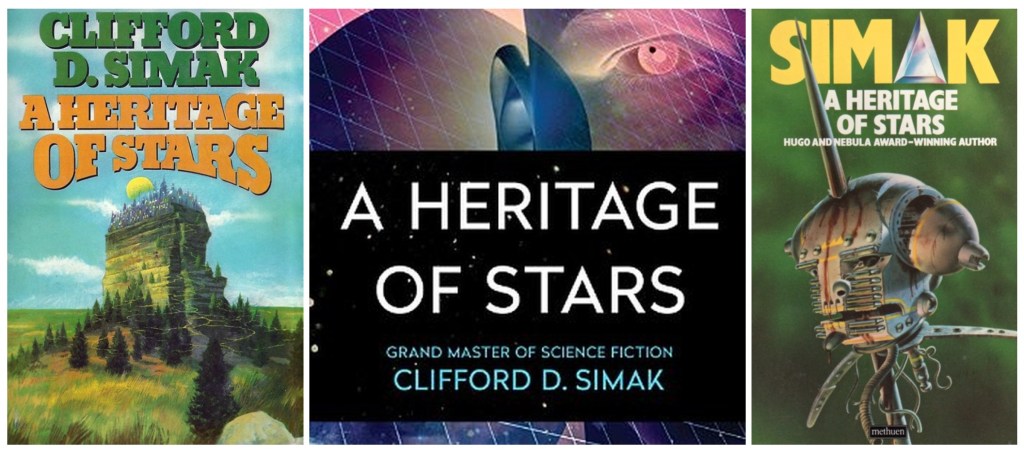


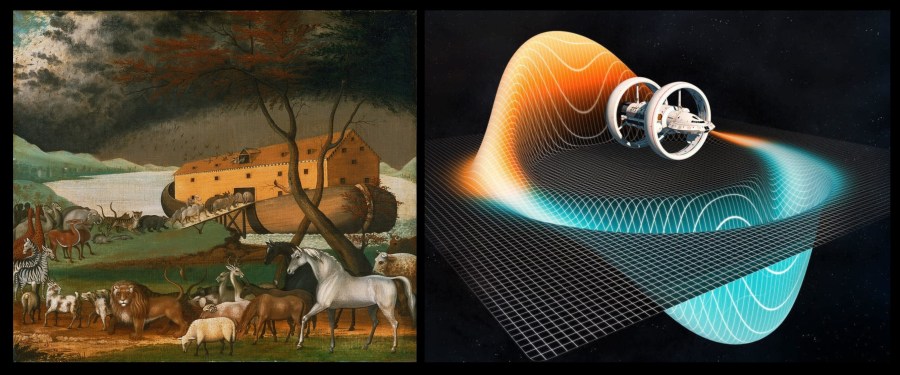


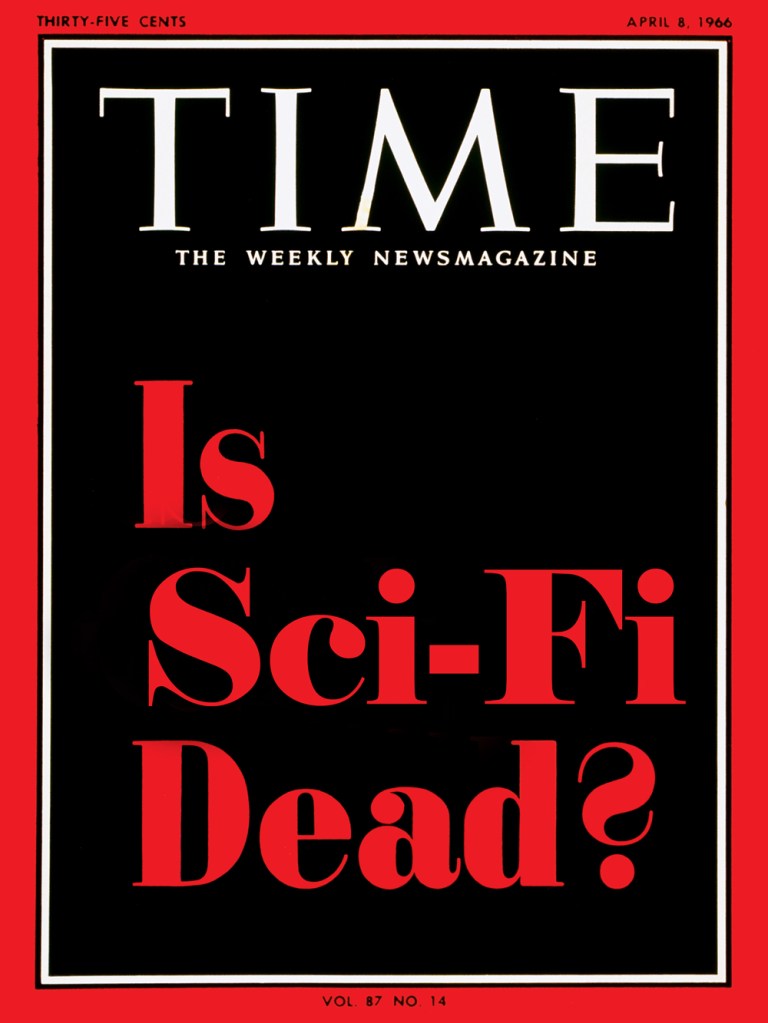
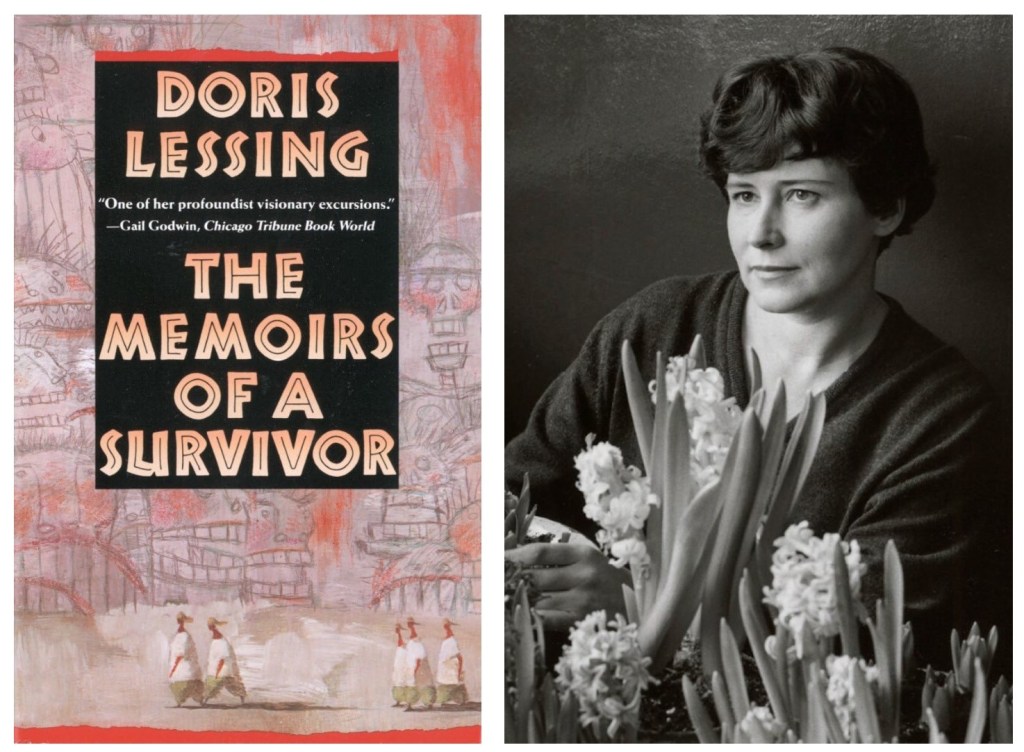


 Classics of Science Fiction