Yesterday while Linda and I were telling each other over the phone what we’ve read this past week I described to her the basic plot and ending to “For I Am A Jealous People!” by Lester del Rey. My description of the story went over with an embarrassing silent response. This happens to me quite often when I describe the plot of a science fiction story to other people. Of course, even while I struggle to explain my enthusiasm for these stories I often hear how stupid they sound with my own ears. Should this tell me something?
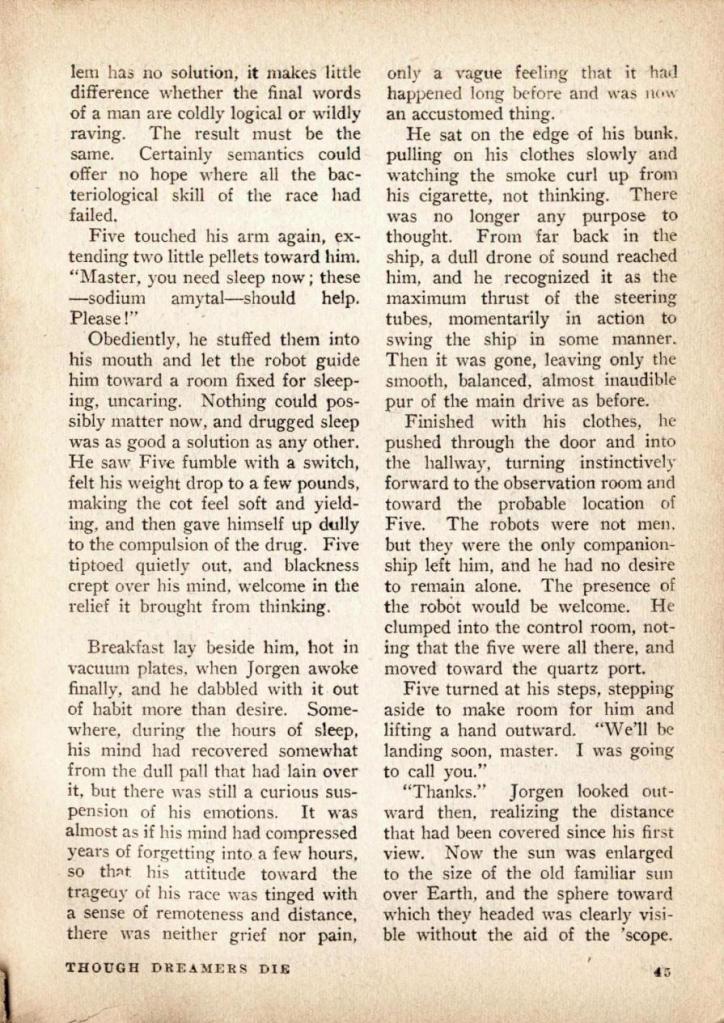
Reading “For I Am A Jealous People!” after reading and reviewing “Though Dreamers Die” revealed that Lester del Rey had improved greatly as a writer from 1944 to 1954. In my review of “Though Dreamers Die,” I complained that it was all ideas with no character or plot development. The heart of “For I Am A Jealous People!” is solid character development well integrated into a tight dramatic plot. In fact, this might be the best story I’ve read by del Rey.
So, why isn’t “For I Am A Jealous People!” more famous and reprinted? Well, if I told you the kicker of the story you might respond with the same dumb silence that Linda gave me. I’m torn as to whether or not I should tell you what happens. It’s a very cool idea if we don’t discuss it verbally. It’s even quite philosophical if you have the background reading to appreciate the story.
It helps to know The Old Testament. It also helps to know about how the Assyrians, Babylonians, and Romans conquered the Israelites and Jerusalem. It also helps to know about how God directed the Jews to destroy various Canaanite cities. I’ll give you a little hint. Lester del Rey compares an alien invasion of Earth to the Jews being a conquered people and how they wondered about God forsaking them.
“For I Am A Jealous People!” is about the Reverend Amos Strong whose town is ravaged by invading aliens from another star system. Amos interprets the invasion as it unfolds by ministering to his flock, praying, interpreting the Bible, and asking God how could this be happening. Eventually, Amos is captured and escapes, but before he can get away, he sees the aliens worshipping at an altar. And it’s a very special altar and what he sees blows his mind.
Del Rey does an amazing job developing Reverend Amos Strong. The aliens and other science-fictional elements of this story aren’t the reason why the story is good. It’s good because of Amos Strong. He’s just as developed as Charlie Gordon in “Flowers for Algernon,” which is the standard I used to judge del Rey last time. Del Rey is no great literary writer, at least compared to his literary writer contemporaries. But for this 1954 science fiction novella, he does a fine job at writing a character-driven SF story.
Then, why isn’t “For I Am A Jealous People!” more famous? If I told you the ending, especially out loud, it would sound stupid. But I think if you read the story, the ending would work very well. Del Rey built a solid foundation for his ending. And I think “For I Am A Jealous People!” is one of the better attempts at integrating religion and science fiction.
To answer the question I asked in my title, I believe it’s because science fiction themes are entertaining speculations for reading, but when considered in the real world they just sound silly. Hearing science-fictional ideas used in stories out loud feels like listening to the guys on The Big Bang Theory argue over a comic book. Science fiction themes are weird and wacky like the metaphysical conversations of potheads. They are closer to dream logic than reality.
But if I was a judge like in the Olympic games back in the 1950s, I’d hold up a card with 9.1 for “For I Am A Jealous People!” I believe del Rey pulled out quite a performance in the science fiction short story writing competition.
I should also say, most stories from The Bible sound pretty damn silly when discussed out loud too.
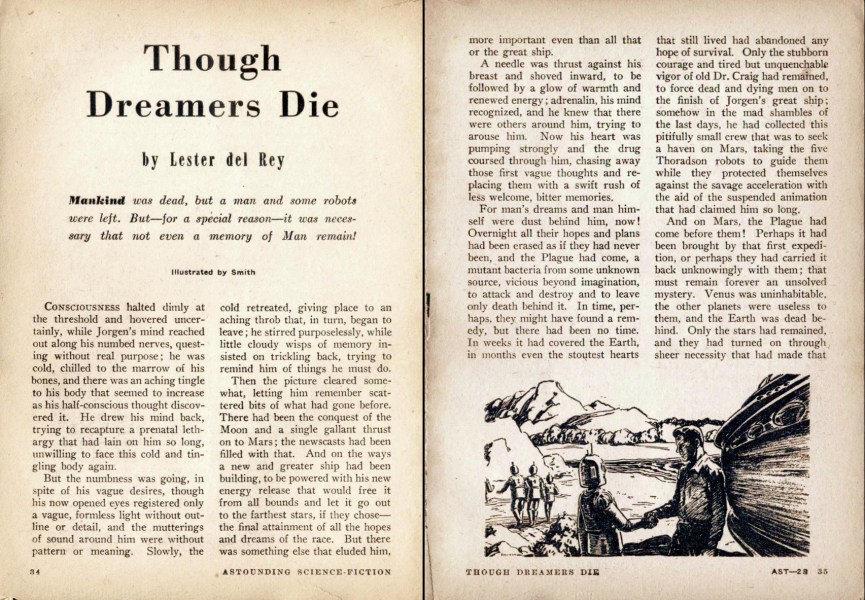
Ideas are the building blocks of science fiction — that’s obvious when you start categorizing science fiction by themes. I’ve been getting into old science fiction theme anthologies and I recently ordered the ten volumes of Asimov’s Wonder Worlds of Science Fiction anthology series edited by Isaac Asimov, Martin H. Greenberg, and Charles G. Waugh. The first story I read by randomly flipping through the first eight volumes I received in the mail was “Though Dreamers Die” by Lester del Rey. It was in volume 9, covering Robots. However, “Though Dreamers Die” first appeared in the February 1944 issue of Astounding Science-Fiction. Read it here.
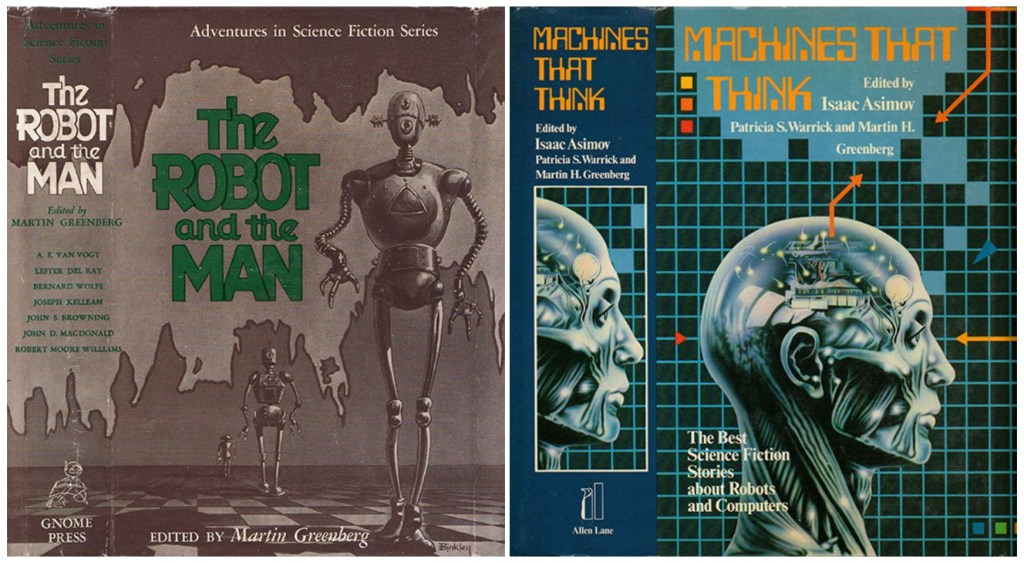
Lester del Rey isn’t well remembered today, except maybe for “Helen O’Loy” another robot story that was included in The Science Fiction Hall of Fame Volume One edited by Robert Silverberg. “Though Dreamers Die” was anthologized in two significant anthologies about robots The Robot and the Man edited by Martin Greenberg and Machines That Think edited by Isaac Asimov, Patricia S. Warrick, and Martin H. Greenberg. Del Rey’s daring story “For I Am a Jealous People!” is included in the 10th volume of this series, covering Invasions. I can’t believe his story “The Day is Done” wasn’t included in the 6th volume for Neanderthals.
To explain why I said ideas are the building blocks of science fiction, I’m going to have to describe the plot of “Though Dreamers Die” in detail, giving all the spoilers. The story is included in the volume for robots but it could have been included in many different theme anthologies.
“Though Dreamers Die” begins with a man named Jorgen regaining consciousness. We’re given some backstory in the narrative. Humans have been wiped out by a plague on Earth, thus we have both a Post-Apocalypse and a Last Man story and maybe even a Dying Earth story. The Dying Earth theme usually involved the far future when Earth is about to be destroyed. Sometimes Dying Earth means the planet is dying, and other times it suggests the human race is dying. Maybe we should just call it End of Humanity themed.
Jorgen is waking up from Suspended Animation or Cold Sleep, another trope of science fiction. In this 1944 story, del Rey has Interstellar Travel limited to the speed of light. Before the plague had nearly wiped out humanity, humans had tried to Colonize Mars, but the plague had found its way there too. So a new design of spaceship was built to be a Space Ark to go to the stars. The humans were put to sleep during the long voyage of Interstellar Exploration which lasted 90 years. The ship was manned by Intelligent Robots who during the voyage developed Artificial Gravity and Controlled Interia.
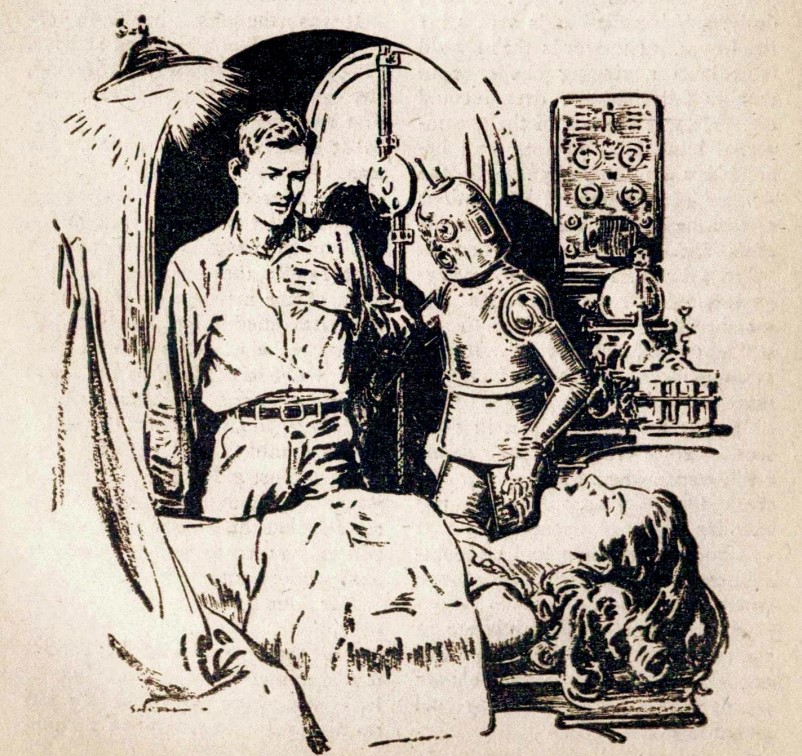
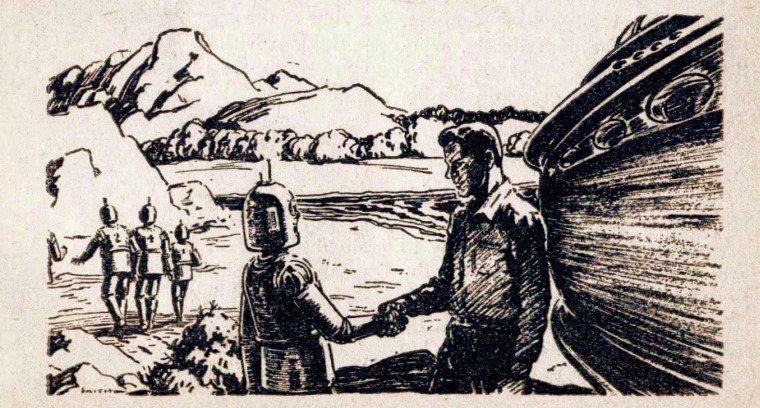
After Jorgen is revived he is told that all the other colonists aboard the ship had died of the plague and he was the only one immune. Jorgen works with five robots that are named One, Two, Three, Four, and Five. They have found a New Earth. It turned out to be a paradise, much like Earth, but with no intelligent life. Jorgen suffers from an Existential Despair in Space of being the Last of Our Species. Robot Five describes to Jorgen how he imagined the new world becoming if humans had survived. This is when Jorgen realizes that Robots are equal to Humans, and Robots are our Descendants and that he shouldn’t despair.
Jorgen tells the robots they should build a Robot Civilization but robot Five says robots could never be happy without humans. This harkens back to Clifford Simak, that Robots are our Faithful Companions. Jorgen orders the robots to lie down and to Memory Wipe everything they know about humans. Jorgen leaves in the spaceship. Before he goes he decides to leave a drawing of the Solar system hoping the robots would one day find the Original Home of Humanity.
“Though Dreamers Die” is overly sentimental and crudely told, it does provide a great deal of wonder. I expect back in 1944 its ideas created quite an impact. And if you read the story closely, you could find many more science-fictional ideas that have become cliche over the years. The story isn’t dramatic. It’s just an unfolding of interlocking concepts. This was common back in the early days of science fiction.
As science fiction evolved, writers had to weave science-fiction ideas into dramatic scenes and intricate plots. That was why Robert A. Heinlein made such an impact when he began publishing in 1939. Lester del Rey achieved this in his novella “Nerves,” which was later expanded into a novel. However, that story has become dated because of our knowledge of atomic energy.
Now that I’m reading all these old science-fiction anthologies I’m noticing how science-fictional ideas were used to construct science-fictional stories. Science fiction that combined ideas and good storytelling techniques didn’t really emerge until the 1950s. A great example is “Fondly Fahrenheit” by Alfred Bester or “The Moon Moth” by Jack Vance when the characters and storytelling became way more important than the SF idea.
Even today, science fiction often feels like a writer came up with an idea and then invented characters and a plot to showcase the idea. We never feel Jorgen is a real person. A counter-example is Charlie Gordon from “Flowers for Algernon.” That story has several science-fictional ideas in it, but what we remember is Charlie and what he felt. Lester del Rey tells us what Jorgen felt, but we never experience his emotions as we do with Charlie Gordon. However, I thought the passage beginning with “Breakfast lay beside him…” was quite good for del Rey at the time.
I wonder how a modern writer would write this same story today? What if it was just one scene, the parting scene, and it had the dramatic impact of the “Tears in the Rain” scene from Blade Runner? With so few words we feel deeply for Roy Batty. And we remember that feeling for the rest of our lives. Could someone make us feel for Jorgen as we do for Charlie Gordon?
Just think of all the ideas I will find in these anthologies, but how many of the stories will have sophisticated storytelling and deep emotional impact? I’ll see and let you know.
Lately, I’ve been reading about the end of the world as we know it. Why is that such a popular fictional theme? Does it reveal a sick side of my personality? Back in 1963, Bob Dylan sang “Talkin’ World War III Blues,” where he dreamed he was the only person left on Earth. A few of the lines that have always stuck with me:
Well, now time passed and now it seems

Everybody’s having them dreams

Everybody sees themselves

Walkin’ around with no one else
No, it wasn’t true everyone was fantasizing about being the last person on Earth, but there sure were a lot of science fiction stories and movies about the end of the world. And I have to admit, I also daydreamed about being the last person on Earth too. I’ve always wondered if many of us, and I include myself, didn’t secretly wish they had the Earth all to themselves. One way of looking at post-apocalyptic novels is to divide them into cozy apocalypses and nightmares. The dividing line is decided by how many people are left. In Mad Max or The Last of Us, there are still too many damn people to make surviving the end world an appealing Walter Mitty escape.
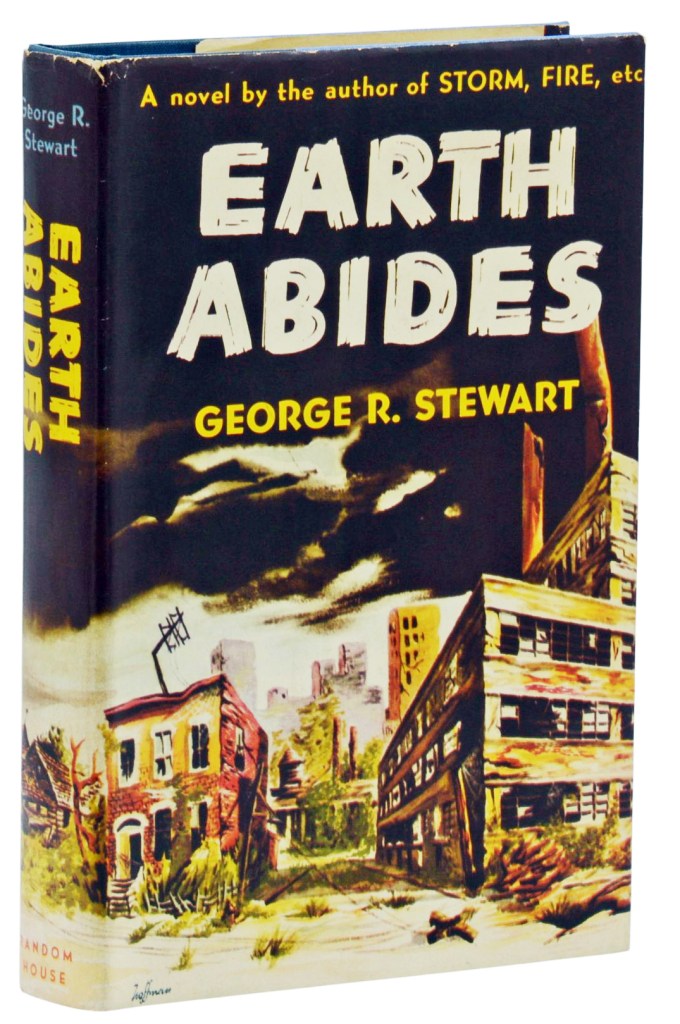
To me, the ideal apocalyptic novel to actually want to experience is Earth Abides by George R. Stewart. The runner-up is Survivors, a BBC television series from 1975. But if I was honest, what I really picture is being Henry Bemis in the famous Twilight Zone episode, “Time Enough At Last,” but not breaking my glasses. Actually, it wouldn’t matter to me because I’m nearsighted and read with books inches from my face. If you haven’t seen that iconic episode, Henry Bemis is the last man on Earth with all the time in the world to read books without being bothered by other people — until he breaks his glasses.
Both Earth Abides and Survivors cover all the philosophical questions about the human race starting over from scratch. It helps to have read or seen Connections by James Burke, a nonfiction book about how hard it would be to rebuild civilization. It’s really a fascinating problem worthy of endless speculation. Earth Abides and Survivors deal with a very similar apocalypse, one where probably less than 1 out of 10,000 people survive, which in a world of 8 billion would mean 800,000 people or in a city of 1 million, 100 people. I believe in the show they suggest only a few thousand survive in all of England. That’s a survival rate of .01 percent.
The bubonic plague at its worse is estimated to kill between 30 and 50 percent. So stories, where very few people survive, probably aren’t realistic. We’re a tough species to wipe out. It is estimated that WWII killed 3% of the population and we bounced back rather quickly and thrived. Of course, in The Bible, Noah and his family were the only survivors of a worldwide flood. Flood stories are much older than The Bible, and are probably the origin of post-apocalyptic fiction. If you go back in time and explore other cultures you can find stories where humans are nearly wiped out, or completely wiped out, or the Earth is completely destroyed. This represents different levels of apocalypses.
In other words, it will take a lot to kill off the human race. Even the asteroid impact that wiped out the dinosaurs didn’t end life on Earth. Some writers have written stories about solar catastrophes that fried our world or wrote about the Moon or a comet slamming into our planet, or even alien invaders blowing us up. Those post-apocalyptic stories deal with starting over on another planet. The first one I read of this kind was When Worlds Collide and its sequel After Worlds Collide by Edwin Balmer and Philip Wylie.
We can call these stories Starting Over Apocalypses or End of the World stories. These are different from Dying Earth stories, which imagine life in the very far future when our planet slowly passes away and the last remains of life cling still. I rather enjoy that theme too. (No, I’m not depressed.)
However, the post-apocalyptic stories I like best are the ones where a few people survive a plague or a war, and they must rebuild society from scratch. My favorites are the books Earth Abides, which I’ve mentioned, and The Hopkins Manuscript by R. C. Sherriff which I reviewed, and the TV series Survivors, which I’ve reviewed before. They have a similar appeal to Robinson Crusoe-type stories (The Swiss Family Robinson by Johann David Wyss or The Mysterious Island by Jules Verne), and they also have the related appeal of first colonizers to other planet stories. Think of Tunnel in the Sky by Robert A. Heinlein or Red Mars by Kim Stanley Robinson.
I believe we can call these post-apocalyptic stories ApocalypseSurvivor Stories or Last People on Earth Stories.
However, most post-apocalyptic stories are about the aftermath of political upheavals, wars, catastrophes, plagues, or alien invasions, where a good portion of the population survives. These stories are about how society changes and people have to live under new norms. Most climate science fiction is of this type. Or living under alien occupation after being conquered. Most of the stories in the post-apocalyptic anthologies I listed the other day are of this type. A good example is The Long Tomorrow by Leigh Brackett where people have become anti-science and anti-technology and revert to Amish-style living after a nuclear war.
Some of these stories could also be called dystopian stories and it’s hard to distinguish between the two. Writers often use some kind of apocalypse to world-build their dystopia. I believe the appeal of reading dystopias is identifying with characters that want to overthrow the dystopia. While the appeal of reading gloomy post-apocalyptic stories is imagining all the horrible things that could happen to society. I’m sure it would be interesting to psychoanalyze readers as to why they consume fiction of either theme. I believe for most YA dystopias it’s the vicarious thrill of being a revolutionary. I call this type of story Blows Against the Empire, which explains the popularity of Star Wars. Young people love to rebel against the status quo.
I call the kind of apocalyptic stories like those that predict life after significant climate change, economic collapse, the AI singularity, etc. If This Goes On Warnings.
As I try to read all those post-apocalyptic anthologies I will probably find other types to classify. Maybe I’ll even keep notes and makes charts and graphs.
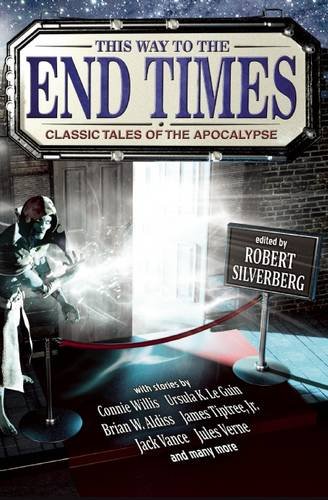
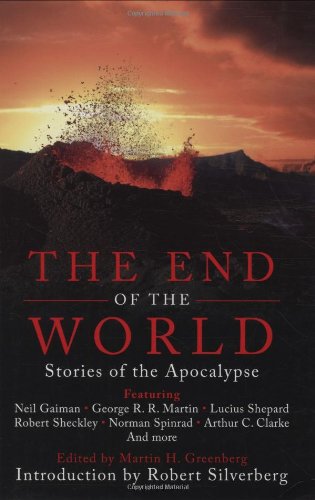
Our reading group on Facebook is considering reading a science fiction theme anthology and I thought I’d look up all the end-of-the-world anthologies devoted the apocalyptic science fiction.
The Year of the Jackpot • (1952) • novelette by Robert A. Heinlein
Last Night of Summer • (1954) • short story by Alfred Coppel
Impostor • (1953) • short story by Philip K. Dick
Rescue Party • (1946) • novelette by Arthur C. Clarke
Omega • (1932) • short story by Amelia Reynolds Long
In the World’s Dusk • (1936) • short story by Edmond Hamilton
This old 1956 paperback is kind of expensive to buy, so not really practical for a group read. We need books that are readily available in libraries or are cheap to buy new or used.
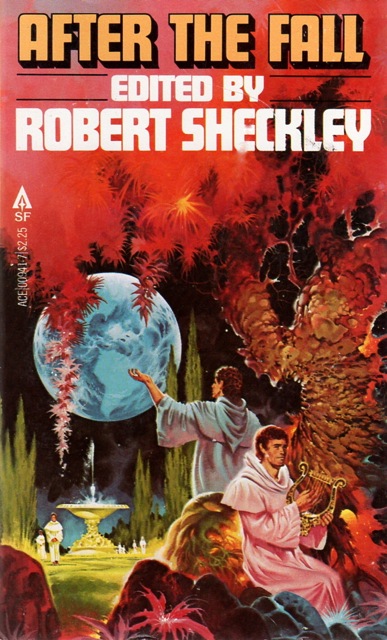
1982: The Last Man on Earth edited by Isaac Asimov, Martin H. Greenberg, and Charles G. Waugh
Introduction (The Last Man on Earth) • (1982) • essay by Isaac Asimov
The Underdweller • (1974) • short story by William F. Nolan (a variant of Small World 1957)
Flight to Forever • (1950) • novella by Poul Anderson
Trouble with Ants • [City] • (1951) • novelette by Clifford D. Simak (a variant of The Simple Way)
The Coming of the Ice • (1926) • short story by G. Peyton Wertenbaker
The Most Sentimental Man • (1957) • short story by Evelyn E. Smith
Eddie for Short • (1953) • short story by Wallace West
Knock • (1948) • short story by Fredric Brown
Original Sin • (1946) • short story by S. Fowler Wright
A Man Spekith • (1969) • novelette by Richard Wilson
In the World’s Dusk • (1936) • short story by Edmond Hamilton
Kindness • (1944) • short story by Lester del Rey
Lucifer • (1964) • short story by Roger Zelazny
Resurrection • (1949) • short story by A. E. van Vogt (variant of The Monster 1948)
The Second-Class Citizen • (1963) • short story by Damon Knight
Day of Judgment • (1946) • short story by Edmond Hamilton
Continuous Performance • (1974) • short story by Gordon Eklund
The New Reality • (1950) • novelette by Charles L. Harness
I’d love it if we voted this one in, but again, it’s out-of-print and too expensive to buy used.
1985: Beyond Armageddon edited by Walter M. Miller Jr. and Martin H. Greenberg
Case 101: Ch’iu-Ch’iu’s Firestorm • poem by uncredited
Alibi • poem by Walter M. Miller, Jr.
Forewarning (an Introduction) • essay by Walter M. Miller, Jr.
Salvador • (1984) • short story by Lucius Shepard
The Store of the Worlds • (1959) • short story by Robert Sheckley
The Big Flash • (1969) • novelette by Norman Spinrad
Lot • [David Jimmon] • (1953) • novelette by Ward Moore
Day at the Beach • (1959) • short story by Carol Emshwiller
The Wheel • (1952) • short story by John Wyndham
Jody After the War • (1972) • short story by Edward Bryant
The Terminal Beach • (1964) • novelette by J. G. Ballard
Tomorrow’s Children • (1947) • novelette by Poul Anderson and F. N. Waldrop
Heirs Apparent • (1954) • novelette by Robert Abernathy
A Master of Babylon • (1966) • novelette by Edgar Pangborn
Game Preserve • (1957) • short story by Rog Phillips
By the Waters of Babylon • (1937) • short story by Stephen Vincent Benét
There Will Come Soft Rains • (1950) • short story by Ray Bradbury
To the Chicago Abyss • (1963) • short story by Ray Bradbury
Lucifer • (1964) • short story by Roger Zelazny
Eastward Ho! • (1958) • short story by William Tenn
The Feast of Saint Janis • (1980) • novelette by Michael Swanwick
“If I Forget Thee, Oh Earth …” • (1951) • short story by Arthur C. Clarke
Case 113: Ch’iu-Ch’iu’s Wow • poem by uncredited
A Boy and His Dog • [Vic and Blood • 2] • (1969) • novella by Harlan Ellison
My Life in the Jungle • (1985) • short story by Jim Aikin
This looks wonderful. Again, out of print. I wonder if I could convince several people to track down a used copy? That’s the weakness of the group. Even though we have hundreds of members, very few members join in the reading and discussion. Participating is depended on the availability of the anthology and I think the age of the stories. I feel most of our members prefer newer stories, while I prefer older ones. There are quite a few copies at ABEbooks for under $10 including shipping.
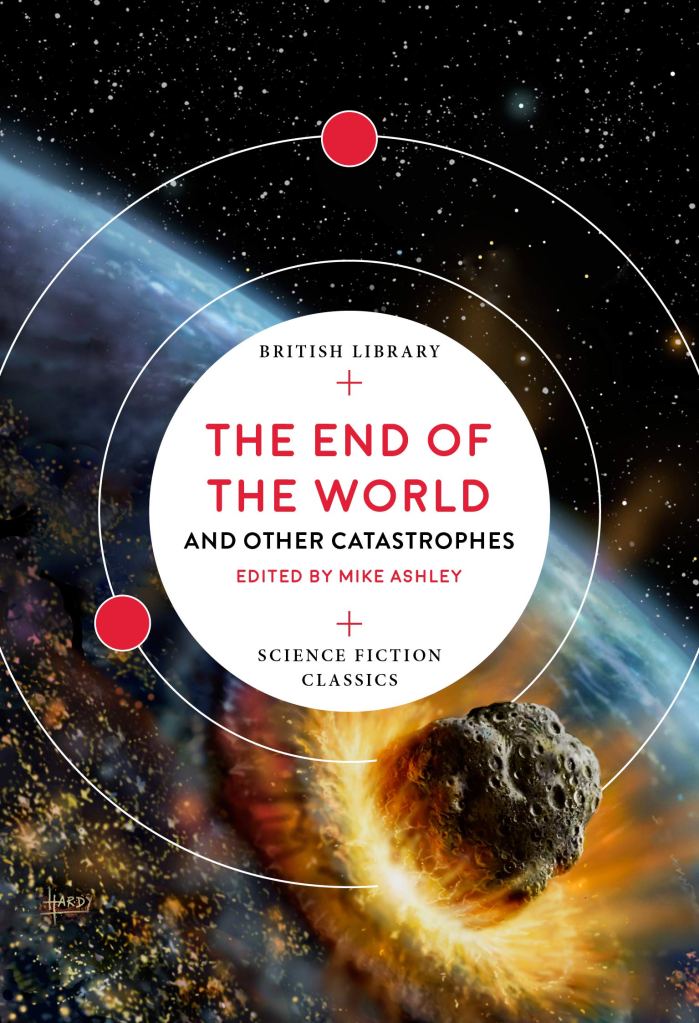
For some reason, ISFDB.org doesn’t have a table of contents for Mike Ashley’s latest end-of-the-world anthology. But you can read about the stories in The BSFA Review. This is another anthology with older stories. That’s great for seeing how the theme evolved.
Timeline of Catastrophe, 2000-2010 • essay by uncredited
Snowmelt • short story by Lane Ashfeldt
Teddy and the Last Girl of Brighton Street • short story by William Wood
The End of the Beginning • poem by George Moore (I)
The Paperless Doctrine of 2152 • short story by Aaron M. Wilson
Origins • short story by Liz R. F. Coley
Ozymandias • (1818) • poem by Percy Bysshe Shelley
Omega Museum • short story by Jaleta Clegg
Turning In • poem by Caitlin Kenzie Scott
Fire and Ice • (1920) • poem by Robert Frost
Under Erasure • short story by Murray Leder
The Star • (1897) • short story by H. G. Wells
Depletion • poem by Mark Brandon Allen
Old Gods at the Armageddon • short story by Jeffery Ryan Long
Helen of Troy • (1911) • poem by Sara Teasdale
Suicide of the World • short fiction by Andre Saglio
Nuclear Winter • poem by Nicolas Samaras
Gip • short story by Mark Taylor (I)
There Will Come Soft Rains • [The Martian Chronicles] • (1950) • short story by Ray Bradbury
The Last Man on Earth • short story by Big Jim Williams
Eclipse • poem by Alicia A. Curtis [as by Alicia Curtis]
The Last Day of Sanity • short story by Darryll B. Snyder
Immutable • poem by Janelle Schwartz
The Last Unicorn • short story by H. L. Liguore
The Last Hours • (1919) • poem by D. H. Lawrence
Cassandra • (1978) • short story by C. J. Cherryh
Cee-Cee was My Dog • poem by John Dudek
水 (mi)? • short story by Jack Frey
My Blue Ribbon Pies • short story by Jacquelyn Fedyk
The Masque of the Red Death • (1845) • short story by Edgar Allan Poe
Finley’s Last Chapter • short fiction by Alexandra Wolfe
Life of a Child • short story by Samantha Boyette
The End of the World • (1911) • essay by Hilaire Belloc
Arturo • short story by M. Sullivan
Going Home • short story by Kodilynn Calhoun
Life Gaped Open • poem by Alan Gann
The Scarlet Plague • (1912) • novella by Jack London
The Last of Everything • poem by Cassandra Consiglio
Corridors • (1982) • short story by Barry N. Malzberg
The Last of the Great Coffee Shop Philosophers • short story by Koos Kombuis
Last Call • short story by Mark Edwards
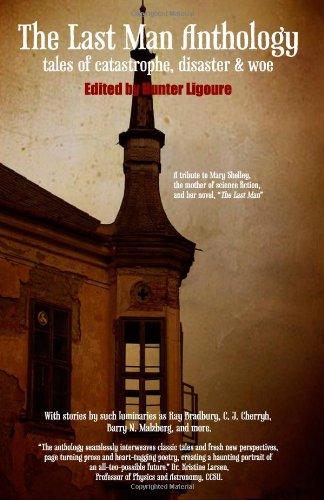
This anthology seems to be more historical and covers territory outside of the science fiction genre. It’s not something the group would read but I think I’ll track down a copy.
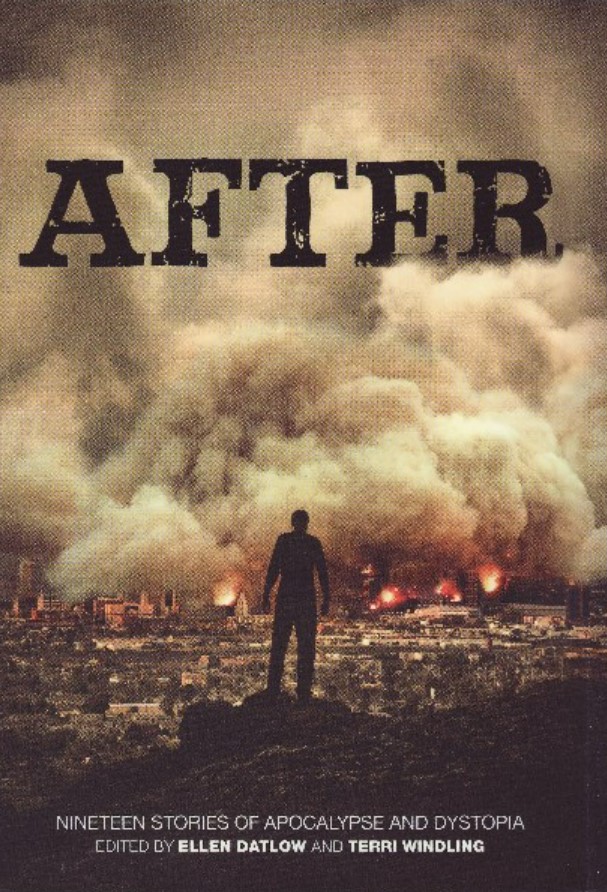
2012: After edited by Ellen Datlow and Terri Windling
The Segment • short story by Genevieve Valentine
After the Cure • novelette by Carrie Ryan
Valedictorian • [The Trojan Girl • 2] • short story by N. K. Jemisin
Visiting Nelson • novelette by Katherine Langrish
All I Know of Freedom • short story by Carol Emshwiller
The Other Elder • juvenile • [Across the Universe] • short story by Beth Revis
The Great Game at the End of the World • novelette by Matthew Kressel
Reunion • short story by Susan Beth Pfeffer
Blood Drive • short story by Jeffrey Ford
Reality Girl • novelette by Richard Bowes
How Th’irth Wint Rong by Hapless Joey @ homeskool.gov • short story by Gregory Maguire
Rust with Wings • [7th Sigma • 0.5] • short story by Steven Gould
Faint Heart • novelette by Sarah Rees Brennan
The Easthound • (2012) • short story by Nalo Hopkinson
Gray • poem by Jane Yolen
Before • short story by Carolyn Dunn
Fake Plastic Trees • novelette by Caitlín R. Kiernan?
You Won’t Feel a Thing • [Shade’s Children milieu] • short story by Garth Nix
The Marker • short story by Cecil Castellucci
This is an original anthology that focuses on the post-apocalypse. I’m not sure if the group has ever read an original anthology.
Science fiction stories are fairytales for teenagers that fuel their imaginations about the future. Science fiction creates myths about tomorrow for each new generation. And science fiction offers both hopes and fears about what’s to come. Readers from each new generation embrace their own flavor of science fiction.
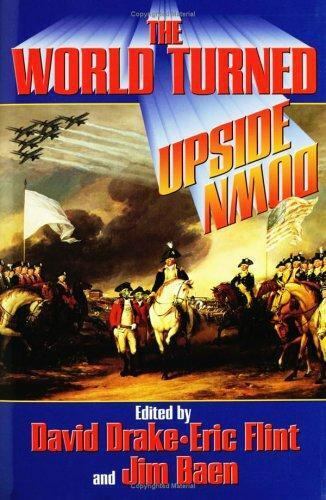
The World Turned Upside Down is an anthology where the editors picked science fiction stories that wowed them when they were teens. Currently available in print for the Kindle for $8.99 or free online for misers and the poor. And for collectors, the hardback is readily available used. I dearly wish there were an audiobook edition because I’d love to hear these stories read by a professional reader.
David Drake (b. 1945) and Jim Baen (b. 1943) are from the Silent Generation (1925-1945). Eric Flint (b. 1947) is from the second year of the Baby Boomers (1946-1964). I was born in 1951, the fifth year. All three editors started reading science fiction in the 1950s and I started in 1962. I believe science fiction fans that discovered the genre in the 1950s and 1960s during the Baby Boomer era imprinted on a certain type of science fiction that’s distinctly different from later generations’ science fiction. I believe the stories in The World Turned Upside Down will appeal the most to Baby Boomers.
One significant extra to this anthology is the personal recollections from the three editors. The introductions and follow-ups are bite-size memoirs. The editorial comments added extra enjoyment to reading this anthology. And I felt on the same wavelength as the editors.
Picture a graph with a bell curve stretched out on the trailing edge. Each year hundreds (thousands?) of science fiction stories are published, but only a small number become popular and are embraced as favorites by a generation. The newest stories are the leading edge of the curve. Then the long stretched-out trailing edge is where stories are remembered as they fade away in pop culture memory. Growing up I mostly read science fiction short stories that were at the peak of the curve. They were mostly 5-20 years old. Now those stories are 55-70 years old.
As I’ve gotten older, that bulge has diminished. In The World Turned Upside Down 5 stories are from the 1930s, 5 from the 1940s, 15 from the 1950s, and 4 from the 1960s. You should be able to visualize the curve just from that tiny bit of data. Readers today from the current generations will like or know very few of these stories. They are now far away from the leading bulge of popular stories. In 20 years, that bulge in the 1950s will thin away in future anthologies. Anthologists whose teen years were during the 1980s or 2010s will seldom pick stories that old.
For the past couple of months, our Facebook group has been reading and discussing the 29 stories from The World Turned Upside Down. I thought the age of the group member had an impact on which stories they liked. Current with reading these old stories on Tuesdays, Thursdays, and Saturdays, we read newer stories from The Good New Stuff edited by Gardner Dozois on Mondays, Wednesdays, and Fridays. I also thought the contrast to it in the comments was age-related. Austin Beeman reviewed The World Turned Upside Downon his blog and overall liked most of the stories, but the stories he responded to best were a bit different from my favorites. And I thought he liked stories in The Good New Stuff a lot more than I did. I believe he’s 25-30 years younger than I am. Jeppe Larsen reviewed the anthology on his blog and liked fewer stories. My hunch is he is younger. But it’s also possible, he’s not young, and like many people, just likes to keep up with the times. I actually prefer the older stuff, even if it feels old. And to also skew my impression, most of the active members are hardcore SF fans that love a wide range of science fiction.
Generally, a great story is usually liked by any age group, but less famous stories seem to have a generational appeal. My guess is writers write under the assumption they are speaking to the current generation but some of them end up speaking across the ages.
The stories in The World Turned Upside Down were first published from 1933 through 1967, but the most common decade represented was the 1950s. Here are the stories with my ratings (1-5 stars).
1930s
Shambleau • (1933) • novelette by C. L. Moore (*****)
Who Goes There? • (1938) • novella by John W. Campbell, Jr. (*****)
Black Destroyer • (1939) • novelette by A. E. van Vogt (*****)
Heavy Planet • (1939) • short story by Milton A. Rothman (***+)
Spawn • (1939) • novelette by P. Schuyler Miller (****+)
My father (b. 1920) would have been a teen when these stories came out. He was from the Greatest Generation (1901-1924). These are also stories that appeared with the generation of First Fandom. Those were the old guys of science fiction when I was a teen. I’m not sure if any of them are around anymore. The star of that era was E. E. “Doc” Smith. Most of the fiction from then felt dated in the 1960s and even more so in the 2020s, even to me, a guy who loves to read old science fiction.
1940s
Quietus • (1940) • short story by Ross Rocklynne (****)
Environment • (1944) • short story by Chester S. Geier (***+)
Rescue Party • (1946) • novelette by Arthur C. Clarke (*****)
Thunder and Roses • (1947) • novelette by Theodore Sturgeon (*****)
The Only Thing We Learn • (1949) • short story by C. M. Kornbluth (***+)
These stories came out during the teen years of the Silent Generation. This has been called The Golden Age of Science Fiction, but people who felt that are mainly dead. Stories collected in anthologies stay around for a few decades, and I was reading these stories as a teen in the 1960s. I thought 1940s SF was science fiction from the good old days. They felt somewhat dated when I read them in the 1960s, but they were still fun. Today, even to me, they feel quite quaint.
1950s
Liane the Wayfarer • (1950) • short story by Jack Vance (****)
Trigger Tide • (1950) • short story by Wyman Guin (***+)
A Pail of Air • (1951) • short story by Fritz Leiber (****+)
All the Way Back • (1952) • short story by Michael Shaara (***+)
Thy Rocks and Rills • (1953) • novelette by Robert E. Gilbert (****+)
Answer • (1954) • short story by Fredric Brown (*****)
The Cold Equations • (1954) • novelette by Tom Godwin (*****)
Hunting Problem • (1955) • short story by Robert Sheckley (****)
A Gun for Dinosaur • (1956) • novelette by L. Sprague de Camp (****)
The Last Question • (1956) • short story by Isaac Asimov (****+)
The Gentle Earth • (1957) • novella by Christopher Anvil (***+)
The Menace from Earth • (1957) • novelette by Robert A. Heinlein (*****)
Omnilingual • (1957) • novelette by H. Beam Piper (*****)
St. Dragon and the George • (1957) • novelette by Gordon R. Dickson (****)
The Aliens • (1959) • novelette by Murray Leinster (****)
Now, these were stories that were often anthologized in the 1960s when I was a teen and a number of them are considered classics. They seem just a little bit old to me when I was a teen. Like 1950s Rock and Rollers, who were in their twenties when I was a teen in the 1960s, but they were still so cool!
1960s
Code Three • (1963) • novella by Rick Raphael (***+)
Turning Point • (1963) • short story by Poul Anderson (***+)
Goblin Night • (1965) • novelette by James H. Schmitz (****)
The Last Command • (1967) • short story by Keith Laumer (****)
It’s interesting that these stories did come out when I was a teen, but they were some of my least favorites in the anthology, although still a lot of fun to read. I’m surprised Flint, Drake, and Baen picked them because none of them became classics. These kinds of stories were the salt of the Earth content of the SF magazines in the 1960s, but not the stories I thought defined the generation. At the time, Samuel R. Delany, Roger Zelazny, J. G. Ballard, and Ursula K. Le Guin were the bright stars in the sky.
Even though fiction being called science fiction was around in the 1920s, 1930s, and 1940s, it wasn’t until the 1950s that the general public recognized it. The 1950s was a boom time for science fiction when it regularly began appearing in book form – both paperback and hardback. Plus, it became popular in the movies and in the early days of television. In 1953 there were three dozen science fiction magazine titles being published. When I grew up stories from the 1950s boom felt like they defined the genre.
I felt the most famous SF from the 1950s would be the classics all my life and into the future. However, I’ve now lived long enough to see those stories age and fade away. It sometimes hurts me to see my favorite science fiction novels and short stories being forgotten, rejected or even vilified. Thisis why it’s difficult to recommend The World Turned Upside Down to younger readers. But I feel its stories capture an era so nicely. The stories aren’t the most famous Baby Boomer science fiction stories, but then the most famous stories are often over-anthologized while so many other good stories need to be remembered. I’m guessing Drake, Flint, and Baen wanted to preserve a picture of our era taken from a different angle. Of the stories I hadn’t read before, I was very glad to be introduced to them.
I would love to review each story one by one and natter about how they each aged and guess how each appealed to their generation. But this post is already longer than what 99% of internet readers read. I know, I’m way too verbose.
Only dumbasses, egotists, and the delusional think they can predict the future, although there are a number of professions that try. I do believe Robert A. Heinlein was smart and sane enough to know he couldn’t see beyond the horizon of the moment, but he wrote plenty of stories that tried. “Blowups Happen” is one that stands out. Heinlein’s 1940 novelette imagines the dangers of commercializing atomic energy in peacetime. That was five years before Hiroshima.
I grew up being taught that atomic research during the war was an extremely well-guarded secret. What I didn’t know, and I assume most other people didn’t either, was how much atomic energy was widely discussed before the war. John W. Campbell, Jr. liked to brag about how the FBI came to his offices in 1944 because of Cleve Cartmill’s story “Deadline,” implying the G-men thought it gave away some of the secrets of the atomic bomb. I thought Heinlein’s story felt far more knowledgeable. I now have to assume the well-educated public before WWII knew far more than I ever imagined regarding atomic physics.
“Blowup Happens” is set in the near future from 1940 in the Astounding Science Fiction magazine version, and from 1950 as it was rewritten for the collection, The Man Who Sold The Moon. Those two dates are important because the story is about atomic power, and the magazine version was written before Hiroshima and the book version afterward.
The setup of the story is the United States has come to depend on atomic power even though a breeder reactor in Arizona could theoretically destroy the country or even the planet. The General Superintendent of the plant, King, has to hire one psychiatrist for every three engineers to monitor their work with the reactor because engineers have nervous breakdowns after a short career and must be continually replaced. King brings in Dr. Lentz, one of the country’s top psychiatrists to find ways that allow engineers to handle the stress.
Later in the story, Superintendent King learns that mathematical models that previously showed the reaction in the breeder reactor is probably controlled are wrong. New mathematics prove the reactor could go into a runaway reaction that would destroy the planet. If they bring down the breeder reactor the country would lose a good portion of its industrial power and ruin the economy. King knows the corporation that owns the plant won’t accept the new research because it would be financial ruin for it.
The solution to the problem has been emerging all along in a tangential subplot about two engineers, Erickson and Harper, developing atomic power for rockets.
“Blowups Happen” has a great deal of infodumping where Heinlein tries to educate his readers about the science behind atomic energy. Reading those passages today is tedious unless you are researching early speculation about atomic energy. So, how do we judge “Blowups Happen” as a story in 2022?
We want science fiction that is visionary. We want the future to be exciting. Ultimately, most, if not all science fiction becomes historical curiosities. Time has a way of eroding our genre. I didn’t like “Blowups Happen” when I first read it as a teen back in the 1960s. It was already too dated. Now that I’m rereading it in my seventies in 2022 I have to admire Heinlein’s speculation. “Blowups Happen” is an ambitious story. I’m starting to think science fiction writers are at their most ambitious when they are working closest to the present.
In “Blowups Happen” Heinlein explores the impact of atomic energy before the world is startled by the reality of Hiroshima. Sure, the idea of atomic power had been around since Einstein’s most famous equation. The reason why the science fiction of the 1950s had been so exciting is it just preceded NASA of the 1960s. And the reason why cyberpunk was so exciting in the 1980s is that it just preceded the World Wide Web in the 1990s. Science fiction writers get the details wrong, but they still anticipate the wonder and the chaos. This thought makes me rethink Heinlein’s Stranger in a Strange Land anticipation of the 1960s.
When we judge an old science fiction story for its visionary qualities I think it’s important to look at the story’s original publication. “Blowups Happen” was first published in September 1940. It was first reprinted in The Best of Science Fiction edited by Groff Conklin in 1946, and then in 1950, it was rewritten for The Man Who Sold the Moon. However, for that edition, Heinlein rewrote the story to include the knowledge of the bombing of Hiroshima in 1945. By 1950 the public and science readers knew much more about atomic energy. I’m guessing “Blowups Happen” was already outdated even in 1950.
Ten years makes a lot of difference in a science fiction story, although I doubt anyone in 1940 could have imagined what the next five years would bring, much less ten. Science fiction writers do not and cannot predict the future, but we do have to admire Heinlein for imagining the political implications of a country having atomic energy in 1940, and what the dangers might be for developing peacetime uses of atomic power. He gets the details wrong, but what he gets right is the essence of great science fiction. By the way, in the 1940 version, the power plant is called a bomb, but in 1950 the label was changed to pile. I’m guessing Heinlein imagined the power plant as being a controlled explosion.
Within the 1940 version, Heinlein described a nuclear explosion as “forty million times as explosive as TNT. The figure was meaningless that way. He thought of it, instead, as a hundred million tons of high explosive, two hundred million aircraft bombs as big as the biggest ever used.” To give his readers a better picture, Heinlein has his character say to himself about ordinary big bombs, “He had once seen such a bomb dropped when he had been serving as a temperament analyst for army aircraft pilots. The bomb had left a hole big enough to hide an apartment house. He could not imagine the explosion of a thousand such bombs, much, much less a hundred million of them.”
Then in the 1950 version, the same character thinks of it as “a hundred million tons of high explosive, or as a thousand Hiroshimas.” Heinlein didn’t need to write anything more. By then, readers had seen films about atomic explosions. They knew exactly what that meant, but in 1940 I doubt readers could imagine anything close to reality.
Psychiatry and psychology are so commonly talked about today that we also forget that it was new at one time. I’m an old movie fan, and psychiatry became a hot subject matter for films after WWII and into the 1950s. I’m guessing Heinlein was doing just as much speculation about the future impact of psychiatry as he was doing for atomic energy in “Blowups Happen.” But how sophisticated his Heinlein’s expectations about the field? Heinlein loved popular scientific speculations published in popular books of the 1930s. But he also was a fan of many pseudo-scientific works too, stuff we’d consider New Age today. In his Future History stories, Heinlein seemed just as interested in the soft sciences as the hard sciences.
Heinlein describes Dr. Lentz, the top psychiatrist of the day this way:
Notwithstanding King’s confidence, Lentz did not show up until the next day. The superintendent was subconsciously a little surprised at his visitor’s appearance. He had pictured a master psychologist as wearing flowing hair, an imperial, and having piercing black eyes. But this man was not overly tall, was heavy in his framework, and fat—almost gross. He might have been a butcher. Little, piggy, faded-blue eyes peered merrily out from beneath shaggy blond brows. There was no hair anywhere else on the enormous skull, and the apelike jaw was smooth and pink. He was dressed in mussed pajamas of unbleached linen. A long cigarette holder jutted permanently from one corner of a wide mouth, widened still more by a smile which suggested non-malicious amusement at the worst that life, or men, could do. He had gusto.

Heinlein, Robert. The Man Who Sold the Moon and Orphans of the Sky (p. 131). Baen Books. Kindle Edition.
Is Heinlein serious about giving us a shrink that goes around in public in his pajamas? Is Heinlein just imagining a colorful future with odd fashions? Or is this satire? Would 1940 science fiction readers believe the fashions we see on TV today? Heinlein had his sociological speculations too. There is another scene at a bar where the atomic energy scientists go to unwind, that features a B-girl who is also a prostitute. Such women were common in the 1930s, but it was a lower-class thing. I got the feeling that Heinlein expected society would change its attitudes toward these women in the future.
But, we’re back to my original question. Is “Blowups Happen” a fun science fiction story to read in 2022? I don’t think so. Scientific lectures can slow a story, or even ruin it, but scientific lectures about out-of-date science are even harder to endure. Would “Blowups Happen” read better today if he had left out all the lectures? They weren’t needed for the story. Lester del Rey’s “Nerves” is another story about atomic energy from the 1940s that’s outdated, but it still works dramatically. It has problems with length, and some plotting, but overall, I remember it being a better story. I don’t know if Heinlein wanted to be educational, show off his knowledge, or provide evidence for his speculation, but I don’t think the story needed those infodumps.
“Blowups Happen” does offer one lesson for would-be science fiction writers. Speculating about the near future will have the greatest impact on current readers, but you risk writing a story with a limited shelf life. Most stories never become classics anyway, so I think Heinlein boosted his career significantly in 1940 by writing “Blowups Happen.” And there is a downside to writing far-future science fiction that’s pure storytelling. I find science fiction that feels like fantasy fiction far less appealing. Although “Blowups Happen” is now just a historical curiosity I still admire it for Heinlein’s ambition. I seldom find science fiction stories with that kind of ambition being written today.
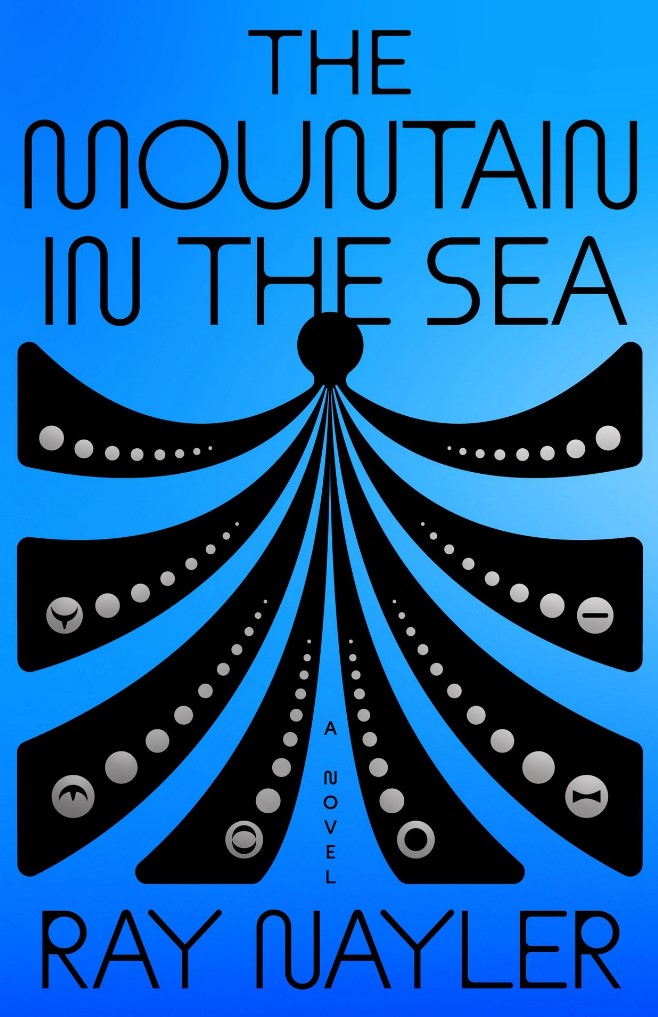
Near-future SF stories with serious speculation do show up but are rare. I am impressed with The Mountain in the Sea by Ray Nayler, and even though it just came out, I’ve already heard good things about it from several readers. There’s something exciting about science fiction that speculates about the near future with ideas that could come true.
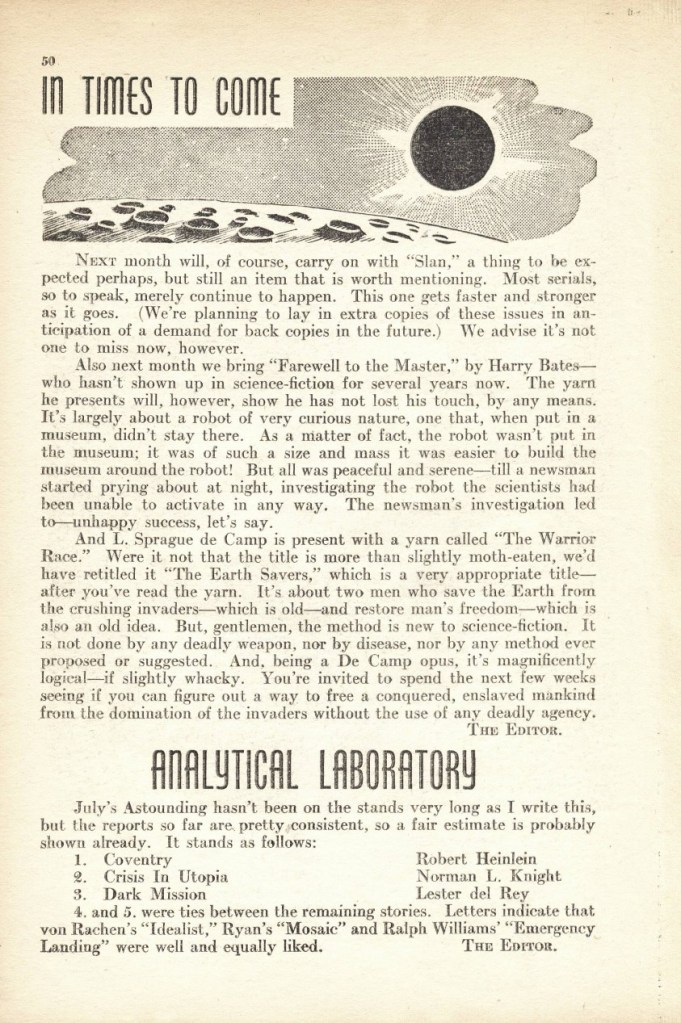
“Coventry” by Robert A. Heinlein first appeared in Astounding Science Fiction in July of 1940 and marks the end of his first year of publishing science fiction with eight stories. “Coventry” is also part of his Future History series and was first published in book form in Heinlein’s collection Revolt in 2100, which is still in print, including audio and ebook.
Heinlein’s legacy suggests he was hardcore libertarian, and that might have been true at times, but not always. “Coventry” shows a streak of liberalism or even utopianism. The “Coventry” of the title refers to land set aside for those citizens who do not want to abide by the Covenant, a future constitution of what the United States became after the Crazy Years. Under the Covenant, all citizens are guaranteed the freedom to pursue their happiness so long as they don’t commit violence against another citizen.
The story begins with the trial of David MacKinnon who is convicted of damaging another citizen’s freedom. David freely admits he punched out a guy but rationalizes he committed no offense because the guy had insulted him. The judge tells him that’s no excuse. I thought this was rather amusing because, in later Heinlein novels, Heinlein’s characters often claim that rudeness should be a capital offense, and sometimes his characters do kill people for being offensive.
David is given a choice: go to Coventry, or submit to psychological reeducation. David has a big ego, and he’s quite self-righteous about his actions, so he accepts being sent to Coventry. However, he has the illusion that it’s a wide-open frontier and he can go there and live in peace like a pioneer of old. He is allowed to take anything he wants into Coventry and converts his savings into fancy camping equipment.
Coventry is behind a giant force-field, and well guarded. David is told he can ask to leave at any time if he’s willing to undergo psychological reeducation. He swears that will never happen, and they open a portal in the barrier just large enough for David to drive his all-terrain vehicle through it. At first, Coventry seems like open free land, but soon David arrives at a guard station where he’s told he must pay customs duty. This enrages him and he refuses. The guards, which he thinks of as thugs, take all his possessions and start dividing them up. Once again, David goes before a court. He soon discovers that there are governments and laws within Coventry, three of them, each with their own approach to how things should be run. David is outraged that Coventry isn’t the unspoiled frontier he imagined. Again, he refuses to cooperate with the local laws and gets himself imprisoned. Eventually, David realizes he was wrong and wants to leave Coventry, but it’s not that easy.
It seems to me, Heinlein uses Coventry to model America in 1940, and the country of the Covenant to model how he imagines life should be in the United States. Heinlein also imagines another near utopia in his early novel Beyond This Horizon (Astounding, April and May 1942). Heinlein’s unpublished novel, For Us the Living written in 1938-1939 is also near utopian. Much of it was recycled for his early stories and Beyond This Horizon.
But after WWII, I’m not sure Heinlein ever imagined a positive big government again. Many of his stories, maybe even most, had characters trying to escape a big government by becoming a space pioneer, or by overthrowing a government. So it’s quite interesting to see Heinlein imagining a large well-run government. Wait — I’ve thought of one exception, Starship Troopers. If you can recall another, leave a comment.
And when I said Heinlein was being near utopian, I don’t mean he was advocating a perfect society, but one that was very well designed and had few problems. Heinlein obviously thought we could do much better than we were in 1940.
One of my friends regularly tells me she wishes the states could be divided up between conservatives and liberals so we didn’t have to live with each other. “Coventry” is Heinlein imagining this wish in a way. Most people accept the big government of the Covenant, while the anti-government folks are sent to a reservation where anything goes. What Heinlein does in the story is say anything goes leads to power structures run by strong men and gives three examples. One is a theocracy made of renegades from his earlier short novel, “If This Goes On—.”
Heinlein’s collection Revolt in 2100 includes “If This Goes On—,” “Coventry,” and “Misfit.” But you really need to read all the other early Future History stories, and to get them you need to track down a used copy of The Past Through Tomorrow. See my “Heinlein’s Super Collections” about which short stories collections to buy used.
Of course, what I’m calling a near utopia Heinlein might call a libertarian society. However, it is a big government running things so everyone is given the maximum freedom to pursue their happiness. I’m not sure theories about small government existed back then, not in the way some conservatives think about it now.
For those Heinlein fans who really want to get into Heinlein’s politics and philosophy, I highly recommend reading “Chapter 5: Heinlein and Civic Society” and “Chapter 6: Heinlein and the Civic Revolution” in Farah Mendlesohn’s The Pleasant Profession of Robert A. Heinlein. I was at first somewhat disappointed with her book because she didn’t go story by story and write about each in depth. But as I write these reviews, I can see of the value of her writing about them theme by theme, referencing the stories by how each fit into Heinlein’s beliefs. It makes it hard to quote her about any particular story, but if you read each of her chapters as a whole, it has an overall cumulative summation of all of Heinlein’s stories.
“Coventry” came in first in the Analytical Laboratory but there were not any devoted letters about it in the letter column. I’ve been a little disappointed with the letter column because Campbell doesn’t give that much space to the discussion of stories. And quite often fans wrote about the artwork instead. At this time, Final Blackout by L. Ron Hubbard was still getting most of the story discussion comments. I need to read that novel. (“Brass Tacks” was divided into two sections. The first part was story comments, and the second section was devoted to science discussion. I think Campbell preferred spending space on this section more.)
I’ve recently turned 71 and beginning to realize, once again, that my taste in science fiction is changing due to aging. I’m in a Facebook group where we read and discuss one science fiction short story a day. That exposes me to many different kinds of science fiction, both old and new, covering the endless possible themes that science fiction explores.
I push myself to read every story, even when I’m not enjoying them. I try to give each story the best possible chance but things are starting to change. That could be for several reasons. After reading a couple thousand SF short stories over the last five years, I might be burning out on certain kinds of science fiction. And I’ve been having health problems, and I only have half the vitality I did just a few years ago. Meaning, I might not have the psychic energy to consume as much science fiction. Ultimately, I believe it’s because getting older is making me more down to Earth, changing what I want from science fiction. Then again, I might be getting old and just losing my patience.
For some of my Facebook comments, I’m starting to use the excuse that I didn’t like the story because it’s science fiction is too far away for me. By that I mean, the setting is too far away in space or time. I’ve never been much of a fan of fantasy, and science fiction that’s far away in space or time feels like fantasy fiction. Some of these stories are beautifully written, with fantastic world-building, and wonderful character development. I should like them just for the storytelling, but I don’t. I feel like I’m wasting my time. I just don’t care about characters that live in unbelievable settings.
I’m not sure this attitude is entirely consistent. I’ve been meaning to reread Hothouse by Brian Aldiss, which is set in the far future and is very fantasy-like. I’ve read it twice in the last half-century, and it’s a beautiful tale. Would I still like a book I loved before if its setting is too far away? I don’t know, but I’ll report if I ever reread it again. Right now, I tend to be forgiving of old science fiction. I’m harder on new science fiction.
I keep trying to read the New Space Opera writers, and I just can’t get into them. I want to read the Culture novels by Ian M. Banks. Theoretically, they’re something I think I’d love, but I just can’t get into them. They are too far away.
This week I started listening to The Mountain in the Sea, Ray Nayler’s first novel I believe. I’m loving it, but then its setting is very near, on Earth, in the foreseeable future. The basic plot is about discovering a species of octopus that are social, tool-making, and developing a language. Since I’ve recently read The Soul of an Octopus by Sy Montgomery and watched My Octopus Teacher on Netflix, Nayler’s speculation is very realistic. And that makes his science fiction very near.
A second major theme of The Mountain in the Sea is artificial intelligence, and Nayler handles it in a very realistic way too, again making his science fiction very near. I’ve been admiring Nayler’s short stories for a while now, but sometimes they are about AI and downloading human minds into machines or people, and I find that science fiction too far away for me. In fact, I dislike the whole theme of brain downloading and uploading.
One thing Nayler does in his novel is quote two future nonfiction books: How Oceans Think by Dr. Ha Nguyen and Building Minds by Dr. Arnkatla Mínervudóttir-Chan in chapter headings. These two authors are also characters in the book. This gives Nayler a clever way to infodump in his story and injects his story with philosophy and science.
There are several other themes in the novel that are valid to us today, slavery, over-fishing, exploiting the environment, loneliness, self-destruction on a personal and species level, and so on. This is a heavy book. I have a few hours left, so I can’t give away the ending, but I’m most anxious to find out what happens.
The Mountain in the Sea reminds me of other great near science fiction novels, such as Stand on Zanzibar by John Brunner, Timescape by Gregory Benford, The Windup Girl by Paolo Bacigalupi, and The Ministry of the Future by Kim Stanley Robinson. It also reminds me of the popular science books by Dr. John C. Lilly, who was a famous dolphin researcher back in the 1960s, and who went on to explore states of inner space. I’m especially reminded of The Mind of the Dolphin: A Nonhuman Intelligence and Programming and Metaprogramming in the Human Biocomputer: Theory and Experiments. Books I read when I was young that has made me think about some of the things which Ray Nayler is making me think about again now that I’m old. It’s interesting that in the 1960s we thought dolphins were the closest intelligent species to us, but now we’re thinking it might be octopuses.
How is it possible that I can rate a short story five stars out of five when it took 52 years to be anthologized for the first time? If countless editors passed it over for decades while looking for good SF stories to reprint, how can it possibly be any good? The story I’m talking about is “Thy Rocks and Rills” by Robert Ernest Gilbert. Ever heard of it? Ever heard of Gilbert? I haven’t on both counts.
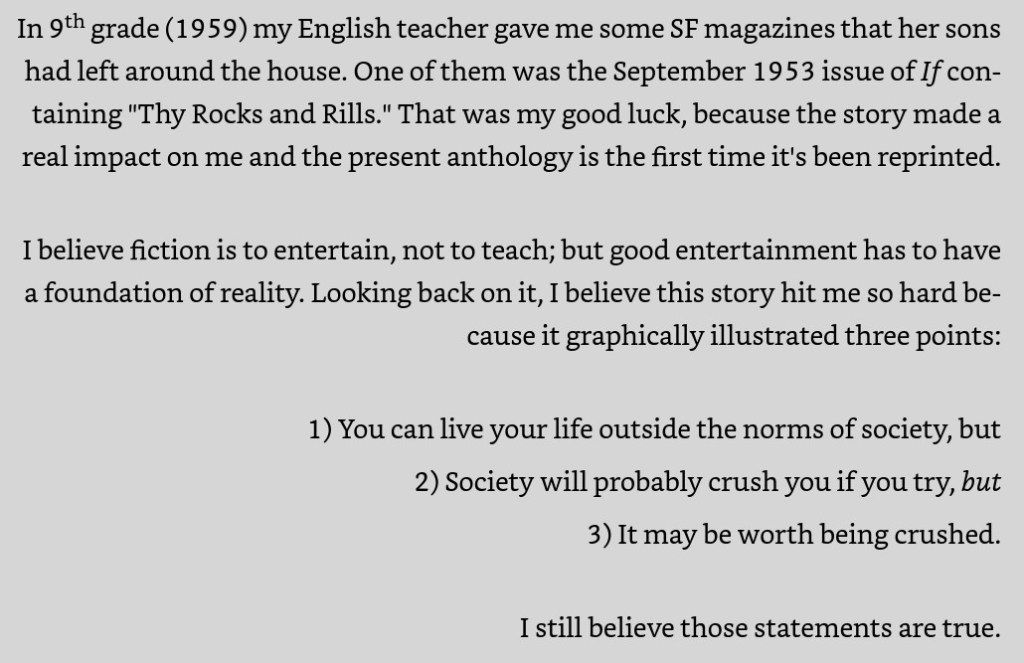
The goal of that anthology was to collect the stories that got the three editors excited about science fiction when they were teens. David Drake gave “Thy Rocks and Rills” this introduction:
I can understand why Drake responded to “Thy Rocks and Rills” that way, but it wasn’t how I reacted.
I’ve owned The World Turned Upside Down for years but I’m just now getting around to reading it because the Facebook group Best Science Fiction and Fantasy Short Fiction is discussing its stories every Tuesday, Thursday, and Saturday.
When I read “Thy Rocks and Rills” yesterday I just thought, “Wow, oh wow!” However, others in the group have not been so enthusiastic. And I can understand that.
I don’t believe fiction can be rated on absolute terms. In fact, my subjective ratings will change every time I reread a story. There are elements in “Thy Rocks and Rills” that would have made me dislike this story on other days, especially the talking bull and calves. Yeah, it has talking farm animals and mules with Appaloosa coloring. If you read the descriptions closely, the male fashions in this future are as gaudy as any Elton John or Prince wore on stage.
“Thy Rocks and Rills” is over-the-top. And it’s from 1953. But it’s also weirdly prophetic. Gilbert predicts a painfully hot future. One where toxic masculinity dominates and everyone is gun crazy. In Gilbert’s future, people are quick-tempered and ready to duel. And most women are condemned to conform to male expectations, making their bodies tiny and slender, staying in their place, and sticking to chirpy women’s talk. Although, some women are different and get into duels with men. The hero of this story is Stonecypher, and this is how Gilbert describes his wife Catriona:
The villain of the story is Dan who makes a legal proposition to Catriona that enrages Stoncypher:
Oh, but the way, the story has ornithopters. I did say it was colorful. The reason we have talking farm animals is because of mutations from radiation. Gilbert is protesting bomb testing. He’s also protesting bullfighting or any kind of arranged animal fights. “Thy Rocks and Rills” is quite woke for 1953. The world-building in this novelette is quite impressive. The basic plot involves Stonecypher getting in a dual and not knowing how to use a gun, and his talking bull wanting to go into the bullfighting ring.
The results were not what I anticipated but they were very satisfying. However, the ending is brutal, but David Drake has already warned us about that. I’m afraid most readers won’t like the ending, but I think it’s realistic. I overcame my dislike of talking animals because this story is gritty and dark, and we’re living in a gritty and dark age, but then so was 1953.
I’m quite fond of science fiction short stories from 1953, especially the grim ones:
If you know these stories, you’ll understand why I now list “Thy Rocks and Rills” among my favorites of 1953. I linked to the two that are available on Project Gutenberg. Six of them are in The Great SF Stories 15 (1953).
After reading science fiction for sixty years I’m having trouble finding new science fiction that wows me. Reading “Thy Rocks and Rills” Saturday morning gave me the kind of surprises I keep hoping to find in science fiction but seldom do anymore. “Thy Rocks and Rills” is perfect for an anthology called The World Turned Upside Down.
However, I can completely understand if it doesn’t work for you. The success of a story depends largely on what the reader brings to the story. I believe I’m just as cynical now as Gilbert was in 1953 and that made the story work for me. I was tuned into where Gilbert was coming from when he wrote it.
Heinlein’s third published story, “Requiem” (Astounding Jan. 1940) is a salute to science fiction fans, or at least that’s how I read it. John W. Campbell, Jr. thought it overly sentimental but decided to run it anyway to see what his readers thought. They didn’t seem to like it either. “Requiem” came in next to last in March’s Analytical Laboratory. “Requiem” even lost to “Robbie” by Isaac Asimov in 2016’s Retro Hugo Awards for 1941, and that’s another overly sentimental tale.
In both cases, my evidence isn’t reliable since the Analytical Laboratory is based on mentions in letters to the editor, which generally favor comments on the serials, and Retro Hugo award voters seldom read all the finalists. They tend to vote for their favorite authors. But it’s the evidence I got, and it’s evidence Heinlein used to measure his success at the time.
I love “Requiem”. It’s a solid, well-constructed story, with vivid characters and a satisfying ending, one with an emotional punch. The story is quite simple. D. D. Harriman is a rich old man who made his pile commercializing space travel. He contacts a couple down-and-out space jockeys, McIntyre the pilot, and Charlie the mechanic, about taking him to the Moon. Harriman has a weak heart and is legally forbidden to travel to space. Harriman promises to finance the whole deal and they get to keep the rocketship which would put them back into space too. The law was correct, Harriman couldn’t handle space travel, and he died right after they land on Luna. But he dies happy and satisfied.
I figured Harriman was a stand-in for Heinlein. Going to the Moon was Heinlein’s lifelong dream, even back in 1940. Heinlein uses Harriman again in 1950 for “The Man Who Sold the Moon.” I bet Heinlein cast himself as Harriman in his own Walter Mitty fantasies, at least until he created Jubal Harshaw. This quote from the story is Heinlein projecting his own personal feelings into the future:
“Captain, it’s the one thing I’ve really wanted to do all my life—ever since I was a young boy. I don’t know whether I can explain it to you, or not. You young fellows have grown up to rocket travel the way I grew up to aviation. I’m a great deal older than you are, at least fifty years older. When I was a kid practically nobody believed that men would ever reach the Moon. You’ve seen rockets all your lives, and the first to reach the Moon got there before you were a young boy. When I was a boy they laughed at the idea.

“But I believed—I believed. I read Verne, and Wells, and Smith, and I believed that we could do it—that we would do it. I set my heart on being one of the men to walk on the surface of the Moon, to see her other side, and to look back on the face of the Earth, hanging in the sky.

“I used to go without my lunches to pay my dues in the American Rocket Society, because I wanted to believe that I was helping to bring the day nearer when we would reach the Moon. I was already an old man when that day arrived. I’ve lived longer than I should, but I would not let myself die . . . I will not!—until I have set foot on the Moon.”

Heinlein, Robert. The Man Who Sold the Moon and Orphans of the Sky (pp. 292-293). Baen Books. Kindle Edition.
William Patterson, Jr. documents two cases that showed Heinlein was an early supporter of space travel outside of science fiction.
Late in January Heinlein joined the new American Interplanetary Society that had been formed in December 1930 in New York, with fourteen charter members. Heinlein had membership number 22. He told people about it in the Navy—Buddy Scoles, especially—and found that he was considered something of a “goof” because rockets were “crazy Buck Rogers stuff”—toys, at best.12 The first bulletin he received from the society contained a report of a visit by French Academician Robert Esnault-Pelterie13 on January 27, 1931, saying he thought it might be possible to travel to the Moon and return as soon as fifteen years from now—1946.

Patterson, William H. . Robert A. Heinlein: In Dialogue with His Century, Volume 1 (p. 148). Tom Doherty Associates. Kindle Edition.
In 1934 after the American Interplanetary Society changed its name to the American Rocket Society. We need to remember, in the 1930s, there was very little rocket development, and Robert H. Goddard’s rockets barely got into the sky, much less leave the Earth. Heinlein had zeroed in on this industry at almost the beginning.
One day at the Denver Athletic Club when he was judging a fencing match, he met Robert Cornog, a young engineer working on Boulder Dam and about to apply for graduate study at the University of California at Berkeley; they found they had the same birthday, five years apart (Cornog was born in 1912)—and both had joined the American Rocket Society. They became friendly thereafter.

Patterson, William H. . Robert A. Heinlein: In Dialogue with His Century, Volume 1 (pp. 166-167). Tom Doherty Associates. Kindle Edition.
And the story, “Requiem” attacks one of Heinlein’s most hated foes, the Nanny State. Luckily, for us, Heinlein didn’t lecture about this but showed it. That’s why writing teachers always bitch about show don’t tell. And it’s the second reason why I admire this story because I did love the sentimentality for my first reason. I admire Heinlein most when he constructs a proper short story, and “Requiem” is one for sure.
Heinlein was an enigma. Throughout his life and work, he rebelled against excess control in the government, yet he worshiped the military way of life, which is extremely regulated. Heinlein’s characters love to follow the rules and find ways to skirt them. The illegal moon rocket site in “Requiem” was later reused in Rocketship Galileo.
But there is a third aspect to “Requiem” that I detect from reading about Heinlein. Heinlein tried his hand at politics in the mid-1930s. And one of the things I’m sure he learned was how to flatter the voters. I believe “Requiem” was a statement of Heinlein’s beliefs and a bit of flattery for science fiction fans. Heinlein was campaigning to be the leader of science fiction. To do that he had to impress the fans with his stories, and himself. This is my first bit of evidence:
They smoked in silence for a while, each thinking about the coming trip and what it meant to him. Old Harriman tried to repress the excitement that possessed him at the prospect of immediate realization of his life-long dream.

“Mr. Harriman—”

“Eh? What is it, Charlie?”

“How does a guy go about getting rich, like you did?”

“Getting rich? I can’t say; I never tried to get rich. I never wanted to be rich, or well known, or anything like that.”

“Huh?”

“No, I just wanted to live a long time and see it all happen. I wasn’t unusual; there were lots of boys like me—radio hams, they were, and telescope builders, and airplane amateurs. We had science clubs, and basement laboratories, and science-fiction leagues—the kind of boys who thought there was more romance in one issue of the Electrical Experimenter than in all the books Dumas ever wrote. We didn’t want to be one of Horatio Alger’s Get-Rich heroes either, we wanted to build spaceships. Well, some of us did.”

“Jeez, Pop, you make it sound exciting.”

“It was exciting, Charlie. This has been a wonderful, romantic century, for all of its bad points. And it’s grown more wonderful and more exciting every year. No, I didn’t want to be rich; I just wanted to live long enough to see men rise up to the stars, and, if God was good to me, to go as far as the Moon myself.” He carefully deposited an inch of white ash in a saucer. “It has been a good life. I haven’t any complaints.”

Heinlein, Robert. The Man Who Sold the Moon and Orphans of the Sky (pp. 300-301). Baen Books. Kindle Edition.
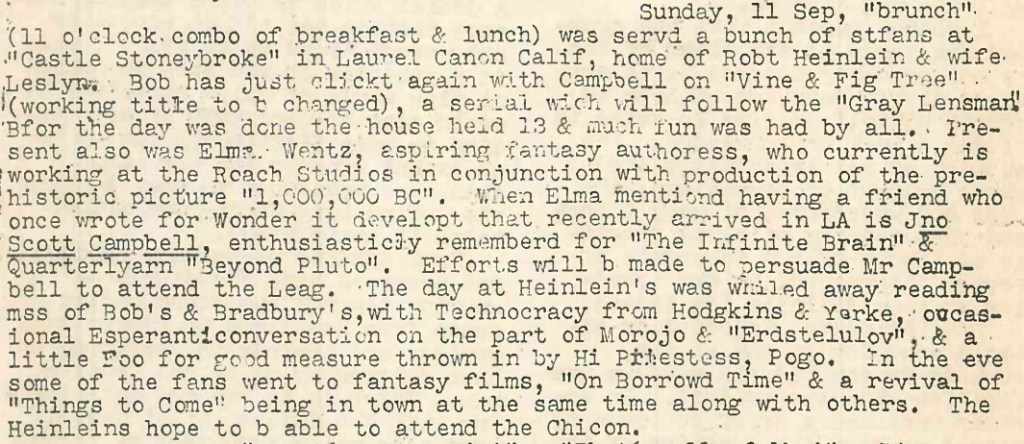
Just before Heinlein wrote “Life-Line” he made contact with Los Angeles science fiction fans. This could have encouraged him to get into writing for science fiction magazines, or Heinlein might have been on a recon mission to get to know the fans. This is from the column “Far West Facts” in the Ad Astra #4, a Chicago fanzine published in November of 1939 by Farwest Jack Erman.
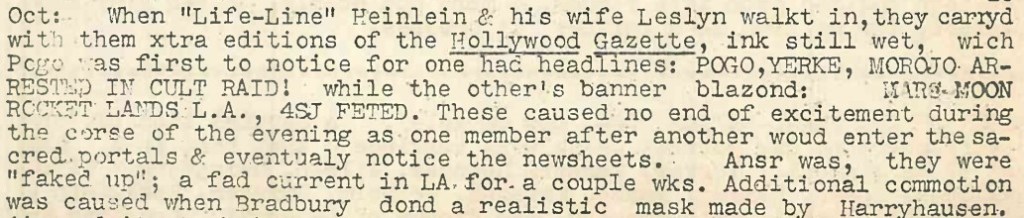
Then from the same column, in issue #5 dated January 1940, we get this tidbit.
I believe Heinlein was older than many of the LASFS fans, and he and Leslyn made an impression by writing up some fake news stories and having them printed as from the local paper. They also impressed the younger fans by hosting a meeting and being gracious and sophisticated hosts. These two instances were before “Misfit” would appear, and a couple of months before “Requiem” would hit the stands.
Heinlein had instant success with “Life-Line” but Campbell returned the first version of “Misfit.” And Campbell had been bouncing other stories Heinlein had been cranking out and so Heinlein was looking at other markets to sell them to, including Fred Pohl’s Astonishing Stories, a bottom-of-the-barrel market. My guess is he felt elated with “Life-Line” but then had a string of rejections, which blew his confidence, and Heinlein started studying the markets and fans. My guess is Heinlein wrote “Requiem” to endear himself to his audience. To show them he was one of them, and he believed in their cause.
Early fans were true believers in the potential of space travel. It’s almost impossible for people today to understand how the average American felt about science fiction. It was that “crazy Buck Rogers stuff.” And if you’ve ever seen a Buck Rogers serial, you’ll know what I mean. And rocket research in the U.S. was barely beginning. It wasn’t until the end of WWII when the world was shocked by atomic bombs and V-2 rockets that science fiction had any public validity. Science fiction fans felt they could see the future.
“Requiem” was Heinlein’s way of telling science fiction fans that they were special. When Heinlein wrote a letter thanking Campbell for buying “If This Goes On—” he submitted “Requiem” and said, “Enclosed is a short [“Requiem”]. I hope you like it. In a way, it’s my pet.”
Campbell bought it right away in August 1939, but said he didn’t like it, but would use it as an experiment to see if the readers would. But evidently, it didn’t go over like he expected. First, Campbell spoiled the story by adding four lines at the end that Heinlein thought completely spoiled the tone of the ending. They were:
Charlie looked toward the relaxed figure propped up on the bed of Lunar pumice, face fixed toward the Earth. "Well,' he grunted, "he hit the Moon—"
I only found one letter that mentions “Requiem.”
That was in the March issue. “If This Goes On—” started serializing in February, and that’s when Heinlein started getting some real notice in the letter column. But again, it was a serial, and they usually got the most attention. It also got him his first cover.
“Requiem” is one of my favorite Heinlein short stories, maybe second to my favorite, “The Menace From Earth.” However, that order might change as I haven’t read many of them for years, and might discover forgotten gems as I reread all of Heinlein’s short stories for this project. I believe Farah Mendlesohn also admired “Requiem” a great deal because she spent many pages in The Pleasant Profession of Robert A. Heinlein discussing the story in her Rhetoric chapter. I would reprint it except its length would probably trigger a copyright violation, but I will copy the first two pages. Campbell wanted to reject “Requiem” because it was too sentimental, but Mendlesohn recognized sentiment as one of Heinlein’s major virtues as a science fiction writer:
As I reread Heinlein, I’m trying very hard to forget the older Heinlein that dominates my memories. We need to remember the young Heinlein. Actually, we need to picture Heinlein as he was when he wrote each story. Most readers expect a story to be self-contained and work as a stand-alone work of art. That’s fine for superficial enjoyment. But I see Heinlein as wanting to influence or even shape the future, and he used science fiction as his tool.
















 Classics of Science Fiction