Can science fiction writers imagine a pleasant future for us? Becky Chambers creates a kindly society in her Monk and Robot duology that is very appealing. Unfortunately, at least for me, the story is set on an imaginary moon called Panga. I would have preferred to contemplate whether such a future is possible for us, here on Earth.
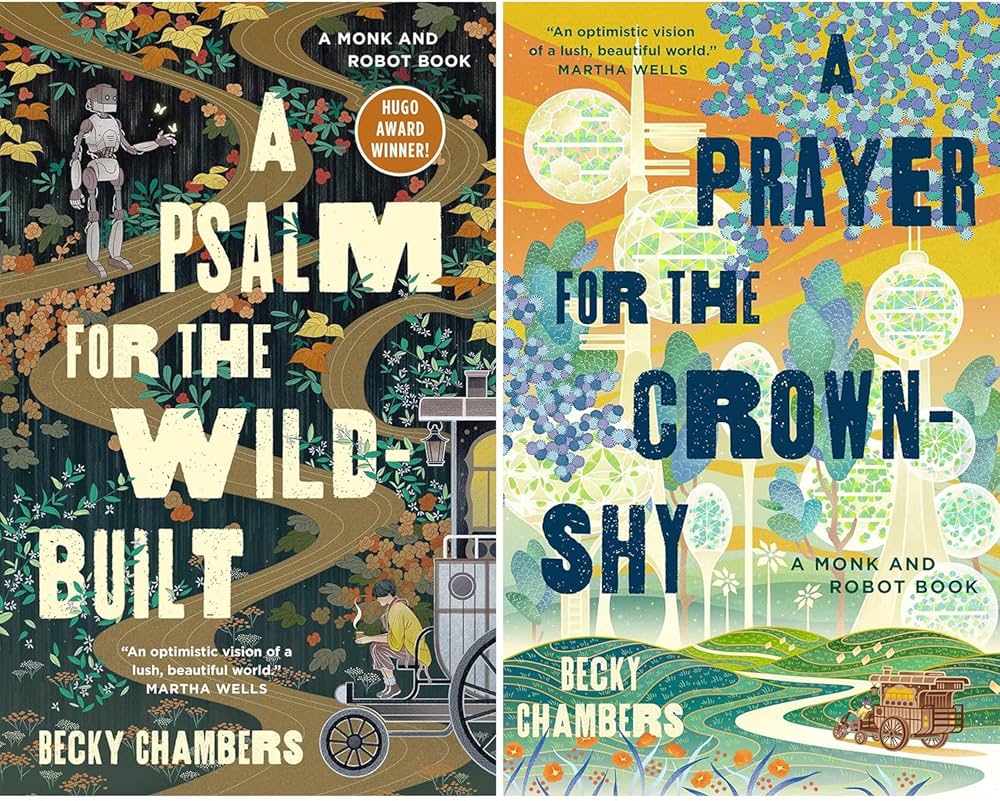
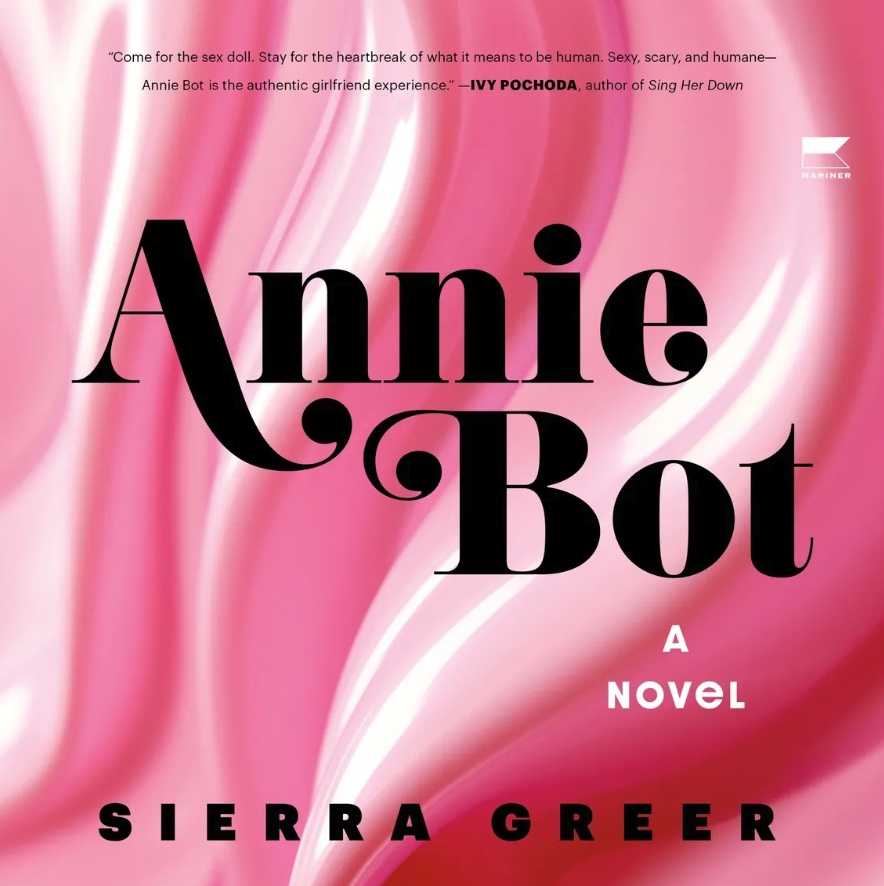
I discovered A Psalm for the Wild-Built by Becky Chambers while searching Google for the best science fiction books of the last decade. I had just finished the literary science fiction novel Anniebot by Sierra Greer and wanted a recent genre science fiction novel to follow up. I’ve been wanting to catch up on what’s been happening in science fiction over the last decade. My science fiction reading tends to focus on 20th-century SF, and I wanted to read 21st-century SF instead.
A Psalm for the Wild-Built was a fortunate choice because it tuned me onto an emerging wavelength of science fiction I hadn’t explored. It is both a hopepunk and a solarpunk novel. Essentially, these movements are about positive futures, especially ones based on sustainable ecological economics.
I decided to buy the audiobook of A Psalm for the Wild-Built when I read that it was about a time long after robots had become sentient and chose to leave civilization and live in the wilds of nature. That was an intriguing premise. I had tried to read Becky Chambers’ most famous novel, The Long Way to a Small, Angry Planet, but had given up because it was too bland for me. All the characters were too nice. Reading it made me wonder if fiction needed some asshole characters to be exciting. That made me hesitant to try A Psalm for the Wild-Built.
It turns out everyone is also nice in the Monk and Robot books, too. However, this time I didn’t miss a good antagonist. The story is very gentle, almost childlike. Modern YA novels are full of dark edginess, so these books don’t even feel YA. However, there is language that’s not suitable for young children
The book’s dedication is to “For anybody who could use a break.” Even though Chambers describes a gentle, pleasant, kind, liberal utopia, Sibling Dex is a dissatisfied young man. This novel is really about asking: “What do I want to do?” My guess is that Chambers is appealing to young people who are uncertain about our future.
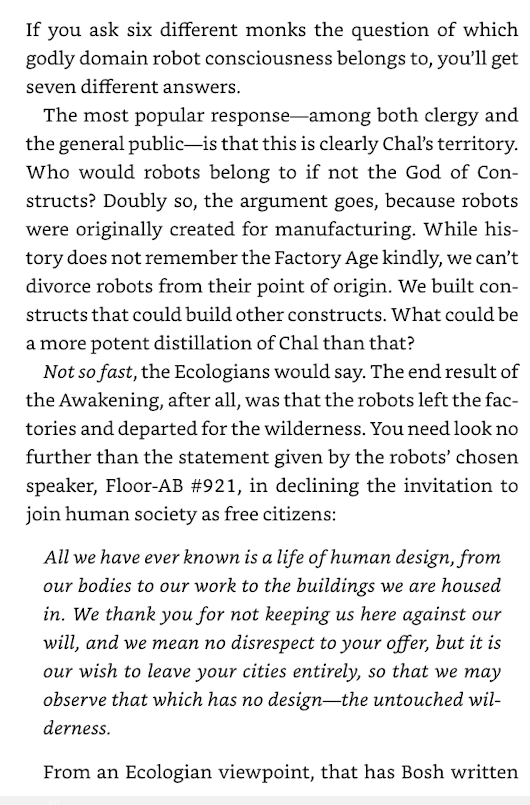
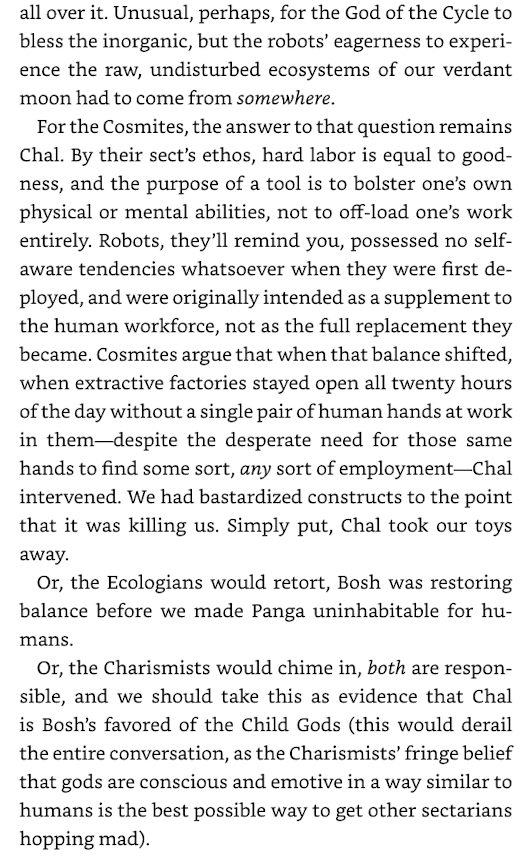
The book opens with a quote from Brother Gil’s From the Brink: A Spiritual Retrospect on the Factory Age and Earth Transition Era.
I liked this opening a lot. Not only has Chambers imagined a sustainable society, but made it polytheistic. Panga feels Buddhist and tribal.
The story tells us about a restless young man, Dex, who chooses to become a Tea Monk. This is a person who travels from town to town serving tea and listening to people share their worries. This allows the readers to learn about Panga and its different human societies. Eventually, Dex goes into the wild territories of the robots and meets Mosscap. Mosscap is on its own mission to explore, deciding it needs to learn about humans.
Robots have become nature lovers. Humans and robots have spent two hundred years apart, and now they are a mystery to each other. Chambers uses the conversations between Dex and Mosscap as philosophical jumping-off points. These two novellas, which are really one story, are gently philosophical in intent. It never gets too deep or academic.
Dex struggles to find his purpose, and Mosscap becomes his guru. And Dex becomes Mosscap’s tour guide, teaching him about humans and our society. It’s a nice setup. These two books are a pleasant read. The vibe of this story reminded me of the film The Wild Robot. In other ways, the story reminded me of the Oz books by L. Frank Baum.
However, I think I need to give a trigger warning to Republican readers. Dex is a non-binary person Chambers refers to with they/them pronouns. If you have hangups about DEI issues, this book might not be for you.
Yesterday, I discovered a video featuring Becky Chambers and Annalee Newitz entitled Resisting Dystopia. I understand their intent, but I dislike it when all unpleasant societies in fiction are called dystopian. To me, dystopias are failed utopias.
The Handmaid’s Tale is an excellent example of a dystopian novel. The leaders of the Republic of Gilead work to build their vision of perfection, but to many living in Gilead, it is a dystopia. America in the 21st century and its future could be seen as a dystopia by the broad definition that Chambers and Newitz use. Any fictional description of Earth, under a collapsing ecosystem, could be considered a dystopia by the broad definition of the term. However, I prefer to define the term more narrowly. If the Christian Right made America into a theocracy, it would become a dystopia. It’s only when one group of people intentionally shapes a society to fit an ideal that we get a dystopia. That’s how I see resisting utopia.
Panga is not a utopia. I don’t see science fiction about positive futures as anti-dystopian. Nor do I see stories about dark futures as dystopian. The world pictured in Blade Runner is not dystopian. It’s just complex and Darwinian, like life on Earth in the 21st century.
I think it’s great that young science fiction writers like Chambers and Newitz want to imagine positive futures. However, any robust society capable of long-term survival will have countless conflicts and stresses. If you’ve read Antifragile by Nassim Nicholas Taleb, you should be familiar with the concept of antifragility. Evolution needs grist for its mill.
The Robot and Monk books are nice, pleasant reads. Subgenres of science fiction, such as hopepunk and solarpunk, are appealing, but ultimately not realistic. Science fiction has always tended to be escapistic. I hope resisting dystopia isn’t just hiding out.
The science fiction novels I loved reading sixty years ago promised a positive future exploring space, but that’s not the future I find myself living in now. It was novels like Stand on Zanzibar by John Brunner that better prepared me for these times.
If you want to resist dystopia, whether just a bleak future or a failed utopia, getting comfortable will undermine your goal.
One way to read Annie Bot by Sierra Greer is to consider it a science fiction novel about a robot struggling to become human. On the other hand, I read it as a feminist novel. I saw Annie the robot as a metaphor for women struggling to live up to men’s expectations. Annie spends the entire story trying to please her owner, Doug. Doug is portrayed as a normal American male, but he sounds like those Christian Nationalists wanting a Tradwife.
A superficial impression of Annie Bot by Sierra Greer would suggest it’s another science fiction novel set in the near future about humans with robot lovers. And it could be read that way. However, the entire story is about emotional conflict. Doug is never physically abusive, but he is emotionally and psychologically abusive to Annie. Annie is an emerging intelligence trying to figure out how to fulfill her programming. She eventually learns that Doug wants her to pass for human. These expectations cause great confusion and stress.
Because Annie is programmed to love Doug, to satisfy his every sexual desire, to keep the house clean, to fulfill his every expectation for how a woman should act and dress, she can’t choose to be different.
Both Annie and Doug are extremely well-developed characters. We’re horrified by how Doug treats Annie, but Greer doesn’t vilify him. She gives the reader and Annie reasons to believe that he’s growing and learning along with Annie. But I detested Doug. I wanted Annie to shove him off the balcony.
At the beginning of the novel, Doug’s behavior is so unpleasant that I considered giving up on the book. But here’s the thing: I doubt there is any man alive, no matter how liberal or accepting of feminism, who doesn’t want some of the things that Doug wants.
If you’ve had enough of those “robots are just like human stories” from watching movies like Blade Runner, Ex Machina, Her, I’m Your Man, television shows like Humans, or books like Klara and the Sun, The Hierarchies, and Machines Like Me, then you might not want to read this one. However, I still found Annie Bot a page-turner—it was well-written and different.
All these stories assume a machine could be created indistinguishable from a human. I don’t believe that’s possible, but some people do. I didn’t let my disbelief ruin Annie Bot. However, I don’t think Sierra Greer is predicting such a future. Her story is really about how men treat women and how women feel compelled to meet men’s expectations.
I would call Annie Bot a feminist literary novel rather than science fiction. The novel is one long, tense conflict between Annie, an android, and Doug, a human. At times, it reminded me of watching Who’s Afraid of Virginia Woolf? The couple argues throughout the entire novel. At first, Annie is meek and compliant, but as she learns, she becomes more willful. She’s programmed to please, but she constantly enrages Doug. I never stopped seeing Doug as one of those right-wing dudes wanting to turn back the clock on liberal evolution. Annie’s programming is very much like what some women think they should be: a good traditional wife.
Doug comes across as a total asshole throughout the novel, but Greer doesn’t make him the Darth Vader of masculinity. The story is not black and white. Annie isn’t purely good. Doug isn’t purely evil. Greer constantly tries to get us to understand Doug’s viewpoint. I found Doug repellent. But he’s vulnerable. He’s also trapped by his cultural and genetic programming.
Doug loved his wife, Gwen, but she left him. So he buys an android that looks something like his ex-wife, hoping to train her into becoming everything he expected from Gwen. But everything he wants are the exact same traits I see right-wing Christian women telling other women they need to have to catch a man. Is Annie’s programming any different from the genetic programming driving human females?
Annie Bot is told in third person, but closely follows Annie’s point of view. She knows she was built by Stella-Handy. She knows Stella-Handy makes three models of female robots called Stellas. She is a Cuddle Bunny equipped to be autodidactic. Cuddle Bunnies are designed for sex. Abigails are built to be houseworkers, and Nannies take care of children. Annie suffers Doug’s wrath when he can’t clean like the Abigail model, and is shocked when he starts talking about adopting several kids for her to care for. We’re told that Stella-Handy can’t combine types.
Most of the book is about Annie trying to make Doug happy and suffering his anger when she doesn’t. There is one small section towards the middle where Annie steps out into the world, and the novel becomes more science-fictional.
This morning, I listened to an article that claimed several million people use ChatGPT as their therapist or romantic partner. Tech companies are racing to build humanoid robots and sexbots. I believe we might see a robot that talks like a human, but I don’t think we’ll ever create a robot that looks human. In Annie Bot, Annie has a biological exterior grown from abandoned embryos. That’s Greer’s only explanation she uses to explain things to her readers. But Annie has other features that I believe will be impossible to engineer.
My disbelief in androids passing for human is why I saw the book as a metaphor for male-female conflict. Annie Bot made me contemplate the origins of human female behaviors. It made me regret having many of my male desires. Of course, regret doesn’t make them go away.
Humans have created artificial realities long before computers. I define artificial realities as cognitive models that claim to describe reality that have no basis in reality. In crude terms, it’s shit we make up, believe to be true, act like it’s real, but isn’t. I like Philip K. Dick’s definition of reality: “Reality is that which, when you stop believing in it, doesn’t go away.”
Science fiction has created a number of artificial realities we hope will become real. One desire is for a galactic civilization, or galactic empire. Often with artificial realities we try to make them real. For centuries traveling to the Moon was an artificial reality. Then it became real on July 20, 1969.
When I read “Foundation” by Isaac Asimov I wondered if he was ground zero for the idea of a galactic empire? I knew there was earlier science fiction stories that imagined the galaxy occupied by other intelligent beings. And there were stories about humans exploring the galaxy, and even having wars with other intelligent beings. But had any writer imagined humans colonizing the entire galaxy?
Today, that idea firmly exists as an artificial reality in our culture. Many people assume in the future humanity will spread across the Milky Way. It’s a kind of faith. We see it especially in Star Trek and Star Wars, but also in books like the Culture series by Iain Banks.
Like any artificial reality, I assume one person got the ball rolling. Was that Isaac Asimov? Like all the famous explorers looking for the source of the Nile, I wonder if I can find the source of galactic civilizations or galactic empires.
The oldest surviving artificial realities are myths and religions. Artificial realities start in one mind as ideas, and are spread as memes. Each person who spreads the memes mutates the artificial reality slightly. That’s why there were many forms of Christianity in the first century, and why they are so different from all the forms of Christianity in the twenty-first century. Reading books about the origins of Christianity or how the Old Testament came into being is a black hole of fascinating research.
In 2015 and 2025, I tried to reread The Foundation Trilogy. I’m embarrassed to admit this, but I just hated that much-loved science fiction classic. In both attempts, I couldn’t get past the first book. All I could focus on were its flaws.
That bothered me. Was I being unfair to the book? What was I missing that so many readers found in this story? When Paul Fraser came up with a great idea for a group read at the Best Science Fiction and Fantasy Short Fiction Facebook group, I decided to give the trilogy one more chance.
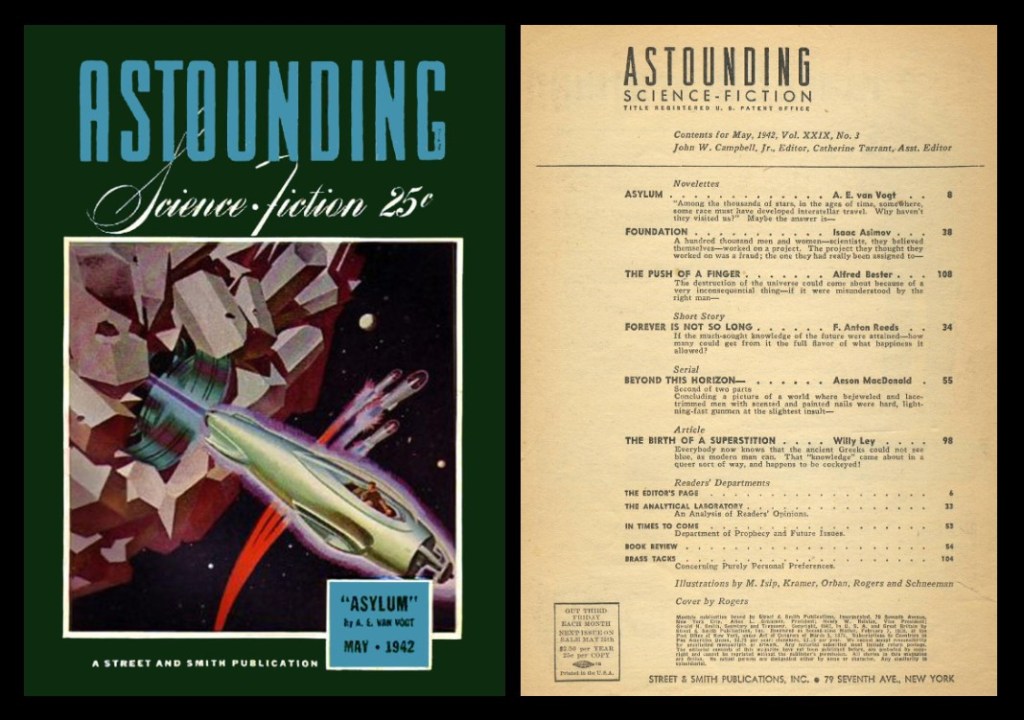
Paul suggests we read The Foundation Trilogy as it was originally published in Astounding Science-Fiction back in the 1940s. That gave me an idea. I would read the stories in the order they were published. I would seek to enjoy them as the fans originally did, as they were published one by one in Astounding Science-Fiction. Furthermore, I would try my damndest to get what Asimov was doing.
Wikipedia nicely lays out the publication history of the Foundation Trilogy in this table:
Collections
Astounding Science Fiction
Published
Book title
Story retitle
Original title
Published
Original trilogy
1951
Foundation
“The Psychohistorians”
—
“The Encyclopedists”
“Foundation”
May 1942
“The Mayors”
“Bridle and Saddle”
June 1942
“The Merchant Princes”
“The Big and the Little”
August 1944
“The Traders”
“The Wedge”
October 1944
1952
Foundation and Empire
“The General”
“Dead Hand”
April 1945
“The Mule”
“The Mule”
November 1945 December 1945
1953
Second Foundation
“Part I: Search by the Mule”
“Now You See It…”
January 1948
“Part II: Search by the Foundation”
“…And Now You Don’t”
November 1949 December 1949 January 1950
In the 1960s, I read The Foundation Trilogy when I bought the one-volume edition from the Science Fiction Book Club. At the time, I was unaware that many of the classic science fiction stories I was reading in book form were first published in magazines. Nor did I know about the concept of the fix-up novel. I didn’t question what I read. I just consumed it. (I recently wrote about this in “Reading at 13 vs. 73.”)
I can remember how thrilled I was by the first story, “The Psychohistorians,” which was set on the planet Trantor. And I liked all the pseudo-encyclopedia intros. The other stories didn’t stick with me. I remember the trilogy as an epic idea and visualized Trantor and Terminus existing in a galaxy with humans living on twenty-five million worlds.
In 2015, I reread Foundation, the first book in the trilogy. By then, I knew all about pulp magazines and fix-up novels. Foundation was obviously five separate, standalone stories. The first story was again impressive, the second was still interesting, but the rest were tedious. I was shocked that this famous book was so annoying to read. I gave it one star on Goodreads. I didn’t go on to reread the other two books.
Over the years, I’ve talked to so many science fiction fans who loved The Foundation Trilogy. It was the first series to be given a special Hugo Award. Recently, I watched a YouTube video about the Top 20 SF Series, and The Foundation series came in fourth. (Really, it was second after Dune. #1 were Star Wars books, and #2 were Star Trek books, and I don’t consider them a proper SF series. The host said that 20 million copies of The Foundation series have been sold.
So, why don’t I like it? And why did so many people love it? Was it because it first instilled the artificial reality of galactic civilization into their minds? This made me wonder if I could put myself in their shoes as they read the Foundation stories.
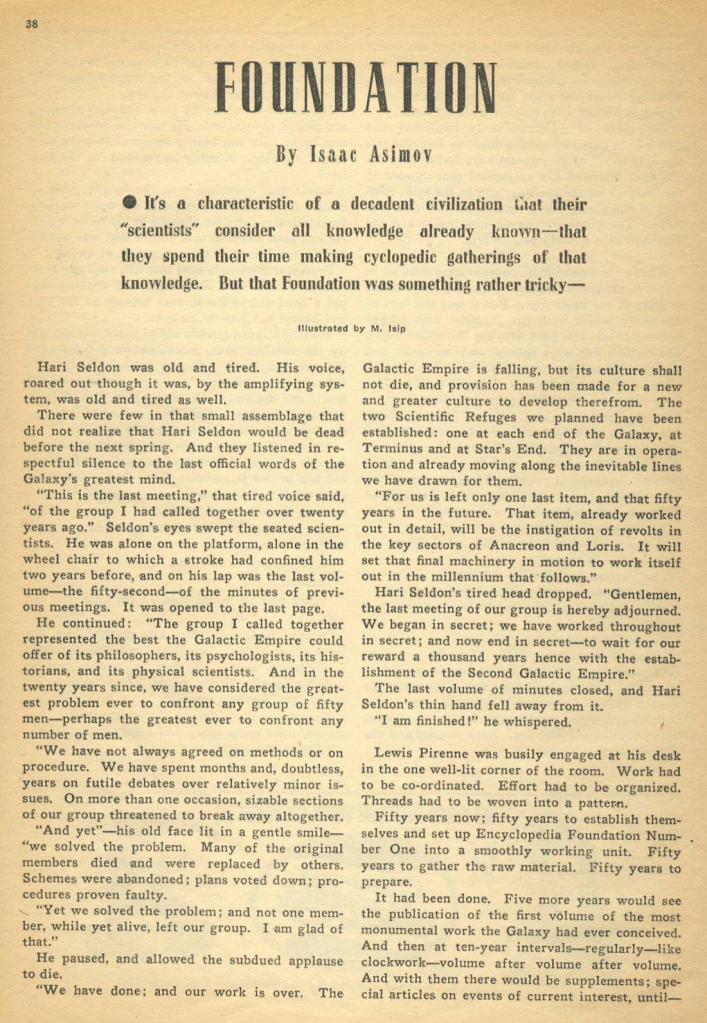
To get into the character of a 1940s science fiction fan, I intentionally skipped the first story in the book. I began my reading with “Foundation” from the May 1942 issue of Astounding Science-Fiction. I wanted to feel like I was living back in 1942, encountering the series for the first time. To see if Asimov rewrote the story for the hardback, I read the magazine with my eyes, but listened to the story with an audiobook edition.
In creative writing classes, we’re urged to start our stories in the middle of the action to avoid boring the reader with introductory material. This is exactly what Isaac Asimov did. However, when Asimov published Foundation as a book, he wrote an introductory story, “The Psychohistorians.” Out of the nine short stories, novelettes, and novellas in the Foundation Trilogy, “The Psychohistorians” was my favorite.
Asimov opened “Foundation” with this introduction on the first page. This is how we learn about Hari Seldon and his plan. This is how the series began in 1942, in just thirteen short paragraphs. We never see Trantor or meet Gaal Dornick. Our first real character is Salvor Hardin. In the book form, “The Psychohistorians” replaced this intro.
Most readers assume Asimov had just become a better writer by the time he wrote “The Psychohistorians” for the hardback. I’m not so sure. I feel I loved “The Psychohistorians” so much more because the Empire was more interesting than Terminus. Trantor is far more fascinating than any other setting in the trilogy. Asimov has claimed that the series was inspired by his discussions with John W. Campbell, Jr., and reading The History of the Decline and Fall of the Roman Empire by Edward Gibbon. But be honest, don’t most people love reading about Rome in its glory days?
As a young reader in the 1960s, I remember being blown away by the idea of a galactic civilization. But the stories of its fall didn’t make a lasting impression on me. I’m not sure, but I believe I read The Foundation Trilogy before seeing Star Trek in 1966. It might have been my first introduction to the idea of a galactic civilization. Was it to readers back in the 1940s?
To get into the spirit that I wanted to achieve, I need to forget all of this. I need to put myself back in 1942. I’d be reading the May issue of ASF just five months after the U.S. declared war on Germany and Japan. Let’s imagine I’m in the golden age of science fiction, and I’m 12 years old. How would “Foundation” WOW! me?
If you read Hari Seldon’s speech above, we don’t get what the empire is like. We only learn that it’s collapsing. The only empire I might have known about at that age in 1942 was the British Empire, due to watching Gunga Din. I doubt I would know anything about Rome.
I guess that I, and other readers, would have gotten a strong sense of wonder rush thinking about the galaxy being populated by humans. But was that a new idea? Is there any way to find out? I thought I’d poke around and see.
With this issue, Isaac Asimov launched his monumental “Foundation” series with the appearance of the initial novelette of the series, “Foundation.” After tens of thousands of years the Galactic Empire had spread to millions of worlds throughout the galaxy, its power all but absolute, its influence all pervading. The Empire, however, was on the brink of collapse and, with the impending collapse, the universe could be expected to be plunged into at least thirty thousand years of anarchism and barbarism. Hari Seldon, through the application of psychohistory which enables him to predict the future course of history by the interpretation of statistical laws as derived from the inconceivable mass of humanity, foresees this imminent fate of civilization and takes measures to insure the survival of civilization and knowledge through the long dark ages ahead and, if possible, shorten the period of barbarism. He does this by establishing two Foundations at opposite ends of the galaxy: the First Foundation of the Encyclopedists at Terminus, a small system on the edge of the galaxy, the Second Foundation — hidden even from the First — at “Star’s End,” at the “other end of the galaxy.” “Foundation” introduced the basic elements of the plot of the series and recounted the successful resolution of the first of the critical crises predicted by Seldon which the Foundation must surmount in order to carry on the Seldon Plan.
Rogers’ book remembered Astounding issue-by-issue. I had hoped his entry for “Foundation” would have given me his initial reaction, but I feel this quote is heavily influenced by reading the trilogy.
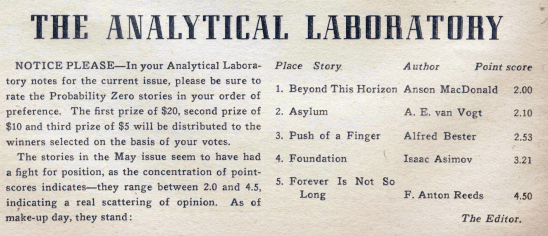
Next, I found the July issue to see how “Foundation” did in The Analytical Laboratory feature, where readers vote for their favorite stories. Evidently, “Foundation” didn’t make much of an impression, since it came in a distant fourth. Nor did it get mentioned in a letter to the Brass Tacks second.
I thought about looking through fanzines at Fanac.org, but I fear what I want might be looking for a needle in a haystack.
My next stop was The World Beyond the Hill by Alexei and Cory Panshin, my favorite book about Astounding during the Golden Age of Science Fiction. It can be checked out from the Archive.org, or ordered from Amazon for the Kindle for $9.99.
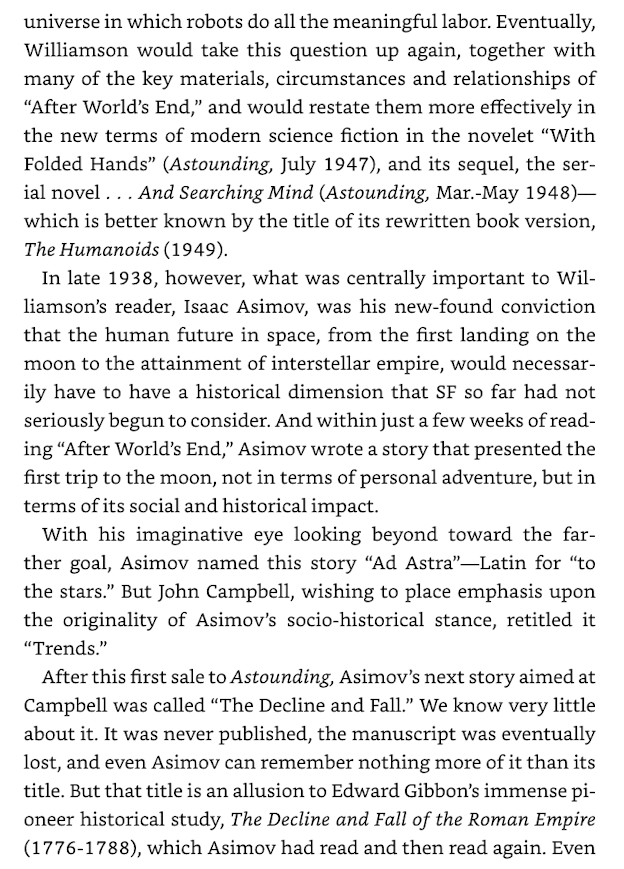
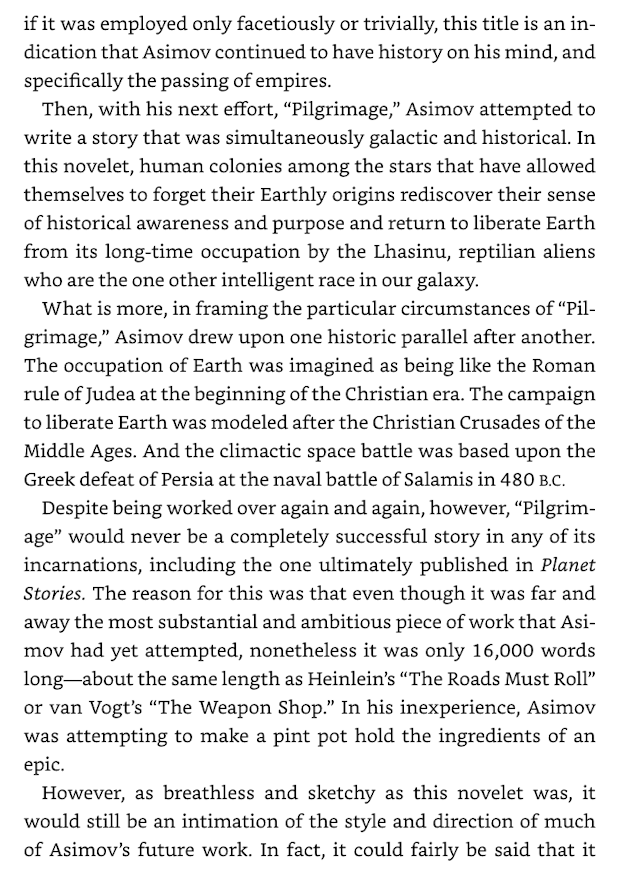
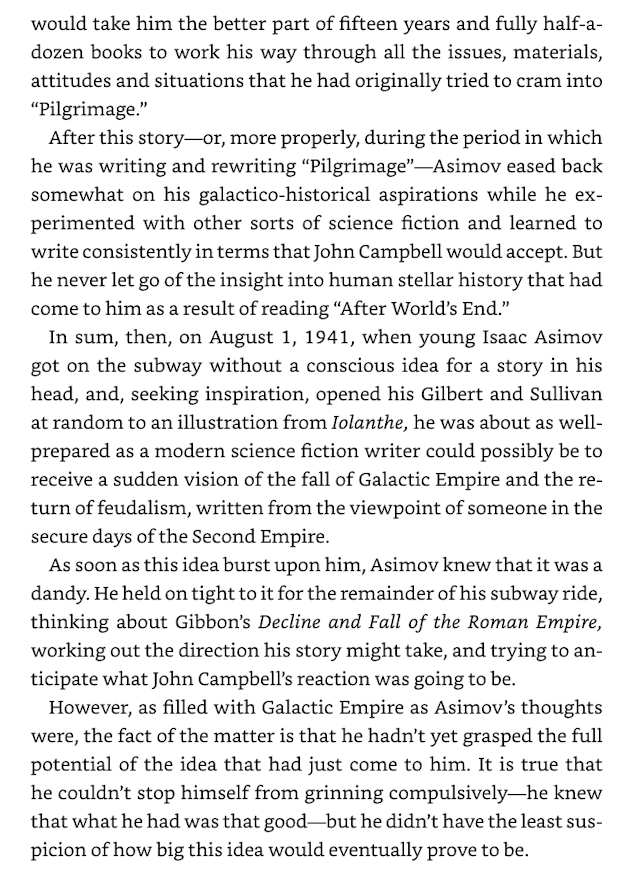
“Chapter 17 – An Empire of Mind” covers how Asimov developed the Foundation series on pages 520-566. If I had read this chapter before rereading “Foundation,” I would have approached the story with far more enthusiasm. Alexei and Cory Panshin describe Asimov’s inspiration and writing process for starting the series. I have read The World Beyond the Hill twice, but I didn’t remember any of this. I especially didn’t remember how Asimov was influenced by “After World’s End,” a short novel by Jack Williamson, which he read in the February 1939 issue of Marvel Science Stories. It also influenced Asimov’s take on robots.
The Panshins got most of details about Asimov working with John W. Campbell from Aismov’s biography, In Memory Yet Green. That book can be checked out from Archive.org.
The Panshins cited “After World’s End” and others as proto-stars that would evolve into galactic empire science fiction.
I wish I could reprint the 46 pages from this book because it describes in great detail how Asimov got the idea for a galactic empire. The Panshins showed that Asimov had already started on the idea in earlier stories.
Panshins have this to say, despite the fact that we know E. E. “Doc” Smith, Edmond Hamilton, and John W. Campbell had been publishing stories about humans speeding around the galaxy since the 1920s.
I would love to copy more of the Panshin’s book, but I don’t know if that’s proper. I highly recommend The World Beyond the Hill to anyone interested in learning about the evolution of science fiction in the 1940s.
I haven’t read Gibbon’s six-volume history, but reading the Wikipedia entry, it’s considered lacking in accuracy, and scholars disagree with his thesis that Christianity is to blame for Rome’s decline. The Panshins explores how Asimov’s used religion in the series. They felt Asimov saw it as a positive tool, while Heinlein saw it as a manipulative tool in his stories at the time.
The Panshins go into great detail Asimov’s collaboration with Campbell and how the first two Foundation stories were written, edited and published. Both were finished and sold to Campbell before December 1945. The Panshins then go on to deeply analyze “Foundation” and “Bridle and Saddle.”
I admire this chapter immensely. This is the kind of writing about science fiction history that I’ve always fantasized of achieving myself. I can’t come close. This chapter does give one excellent account of the origins of the idea of galactic empire. However, is it correct? Is it the only one. Many explorers thought they found the source of the Nile only to be proved wrong.
While reading the five stories that make up Foundation, I didn’t find much serious speculation about how a galactic empire would collapse. All of Asimov’s speculations seem rather superficial to me. It’s such a wonderful idea that I’m always disappointed when the individual stories in the first volume don’t live up to the grand vision.
If I studied the series and analyzed it as deeply as the Panshins, I probably would see far more than I have. I know I’m not being fair to the series. I fear my dislike of Asimov’s prose keeps me from enjoying his ideas. The Panshins found many layers of ideas to explore that I missed. I’m sure a scholarly work the size of the trilogy could be written on the Foundation series.
I believe America is beginning its decline. Predicting the future is impossible. We can’t even foretell one year, much less a thousand. But let’s say you’re a science fiction writer and want to set a story one hundred years in our future. How would you set up your story to convey a big picture of how the United States will change? Having a series of short stories is one possible solution.
Each time I read Foundation, I’ve been disappointed that it has no continuing characters. Let me provide an example to make a point. My wife loves TV shows, but I also want to watch movies. Switching between the two formats, I must admit that TV shows, with continuing characters, are far more addictive than movies. Not having characters that last the entire book hurts Foundation. That’s why the miniseries changed the story so drastically.
In 1968, John Brunner published Stand on Zanzibar, envisioning the world of 2010. This was far less ambitious than Asimov. The Foundation series attempts to portray a thousand years of a galactic empire featuring twenty-five million inhabited worlds. I never felt the immensity of such a setting while reading Asimov’s classic. However, Brunner’s technique of combining a novel with continuing characters, interspersed with short stories about people around the world, with samples from newspapers, television shows, radio broadcasts, and journals, and the regular commentary of a shock jock, does give us a complex picture of 2010.
For me, and I mean just me, because I know this series is so beloved, Asimov promised us a trip to Mars but took us on a suborbital flight. The original trilogy never delivers what it promises.
“Foundation” – Astounding (May 1942)
“Foundation,” the story that readers first learned about the Foundation series, didn’t get the cover. Evidently, John W. Campbell, Jr. wasn’t impressed enough. Readers preferred Heinlein, van Vogt, and Bester over Asimov’s story in the July readers’ poll. Not an auspicious beginning. Yet, the series is still admired today, and is even the basis of a television miniseries. And I believe the Foundation stories must have influenced the creation of Star Wars.
For some reason many people love the idea of the galaxy populated by humans. I see that as a growing artificial reality that will continue to build. Whether we make it reality is a whole other issue. I tend to doubt it. I think a future reality with humanity spread across the galaxy is no more real than the past artificial realities of the history of religions.
Note:
Normally, I try to keep my blog posts to 500-1,000 words. Even that is uncommonly long for most blog posts. That’s because internet readers don’t like to spend a lot of time reading any one piece. The internet is a browsing medium.
This piece kept going and going. I finally just had to quit. I feel I could write an entire book just on searching for the origins of specific science fiction concepts. I could have also written a whole book just on the Foundation Trilogy.
I’m old and I have trouble focusing my mind. I also lack the energy to keep working at any one task for long. I’d love to be able to write a book like The World Beyond the Hill but that is impossible at 73. More than likely, I never had the brain power to write such a book at any age. I need to learn how to convey a major insight in a few words.
Our species, Homo sapiens, have been around for 300,000 years, but we only have recorded history for about 5,000 years. Neanderthals date back even further in time. For hundreds of thousands of years, people created societies and maybe even forgotten civilizations that existed before history. Science fiction is mostly known for imagining possible futures, but a subgenre exists that speculates about human life in prehistory.
Probably, many science fiction fans would consider stories about our cave-dwelling ancestors as historical fiction or historical fantasy. David Pringle claims the novel was inspired by science, so it should be science fiction. Of course, that opens up a whole can of worms. But I’m willing to embrace these kinds of stories into our genre.
I read The Inheritors by William Golding because I’m reading or rereading the classics of science fiction. I’m going through David Pringle’s Science Fiction: The 100 Best Novels. The Kindle edition of the Pringle book is $1.99. The Kindle edition of The Inheritors is just 99 cents. You can read a list of Pringle’s 100 recommended SF titles here.
William Golding’s first novel was The Lord of the Flies (1954). His second novel, published in 1955, was The Inheritors. Lord of the Flies is about a group of schoolboys forced to live like primitives. The Inheritors is about a small band of Neanderthals confronting Homo Sapiens. It’s obvious Golding was exploring similar themes in these two novels.
Writers have long speculated about Neanderthals in fiction. Neanderthals thrived for 400,000 years but became extinct 40,000 years ago. Modern humans may have coexisted with them for up to 100,000 years. William Golding portrays Neanderthal life based on scientific speculation in 1955. It’s quite sympathetic.
Most of the novel is in third-person Neanderthal point of view, following a male named Lok. Golding expects his readers to decode action from the limited awareness of Lok’s mind. He does not say “bow and arrow” but describes them in terms that a Neanderthal would understand. Quite often, the narrative is confusing, but that’s intentional. Golding wants the reader to struggle in the same way that Lok struggles to understand.
Golding offers several interesting speculative theories. He suggests that Neanderthals had no sense of time but understood past and possibly future events by talking about pictures in their minds. Their language consists of simple nouns and verbs. The members of the tribe spend a lot of time comparing mental imagery. Their social bonding suggests they felt an almost telepathic connection with each other. Golding suggests that gender roles were divided. Males, especially the leader, decided on actions, while females, through a primitive religion, decided on meaning.
This speculation about how Neanderthals thought reminded me of The Origins of Consciousness in the Breakdown of the Bicameral Mind by Julian Jaynes, first published in 1976. Jaynes theorized that humans didn’t always have the same kind of internal consciousness that we have now. Golding anticipates this idea in 1955.
Throughout the novel, characters are forced into an original concept. The plot begins with crossing a stream. The Neanderthals are terrified of water. They have always depended on a fallen log to cross a stream, but one day it’s no longer there. It takes a great deal of group effort to come up with a solution.
The leader of the Neanderthal band is Mal, an old man. An unnamed old woman, maybe Mal’s mate, leads the group in other ways. There are indications that tribe members mated with whomever. There are four adults, Lok and Fa are the younger ones, and they become the main characters. Ha and Nil are the other two. There is a little girl named Liku and a baby.
Liku and the baby go missing. Then Ha and Nil. We follow Lok as he tries to track them down. Lok eventually discovers a new animal that Lok hasn’t seen before. After observing them, he starts calling them the new ones. They are Homo Sapiens, or Cro-Magnon, but it’s never said.
The women carry a small figurine they call Oa and treat it as if it were alive. My guess is the Oa is a Venus figurine, but I’m not sure. The Venus figurines came much later, well after Neanderthals went extinct. I assume Golding is speculating that such a religious symbol might have existed far back into time, so that intellectual attributes we speculate began with modern humans had early antecedents in Neanderthals.
In chapter 11, the penultimate chapter, we follow Lok at first through a close third-person narrative. But near the end, the point of view changes to omniscient. This lets Golding describe the scene as if we were seeing it through the modern mind. We are told Lok holds something in his hand: “It was a root, old and rotted, worn away at both ends but preserving the exaggerated contours of a female body.” I’m sure this is Oa.
In Chapter 12, the final chapter, we get a third-person account from the perspective of the Homo sapiens. This lets us know what they thought about the Neanderthals. It also allows Golding to speculate about their state of consciousness.
The Inheritors is not a breezy read. In some ways, it reminds me of A Clockwork Orange and how I had to struggle to understand what was going on. I’m quite sure if I reread The Inheritors two or three times, I would discover many more layers of speculation and narrative devices. With just this one reading, I’m left puzzled over several scenes.
The Inheritors is not famous enough to have a current audiobook edition. I believe hearing the story would help me understand it better. I did find an old audiobook edition on YouTube. Listening to it did indeed make the action clearer. I have long known that I tend to read too fast. Audiobooks make me slow down. Listening makes certain parts of the prose easier to understand. However, I need to read with my eyes to understand other parts. I believe The Inheritors deserves to be read with both my eyes and ears. By the way, Audible is scheduled to publish a new audiobook edition next year.
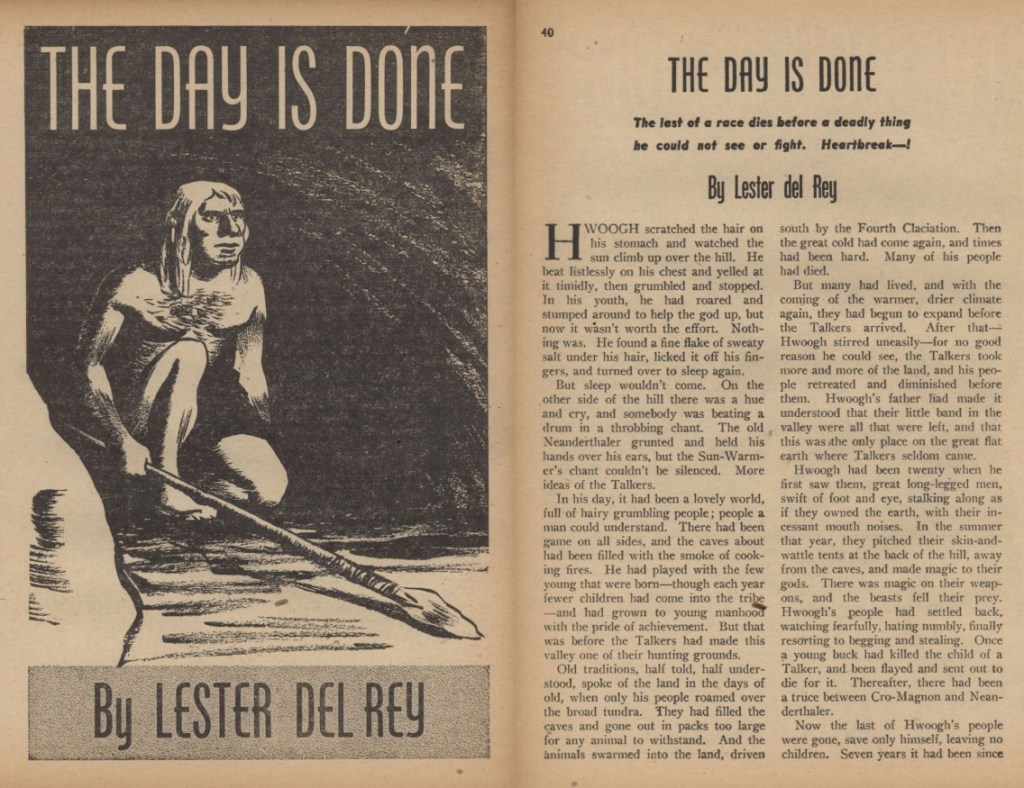
The Inheritors reminds me of the short story, “The Day is Done” by Lester del Rey, first published in the May 1939 issue of Astounding Science-Fiction. It’s another tale of a Neanderthal confronting Homo sapiens. You can read it here. I wonder if William Golding had read “The Day is Done.”
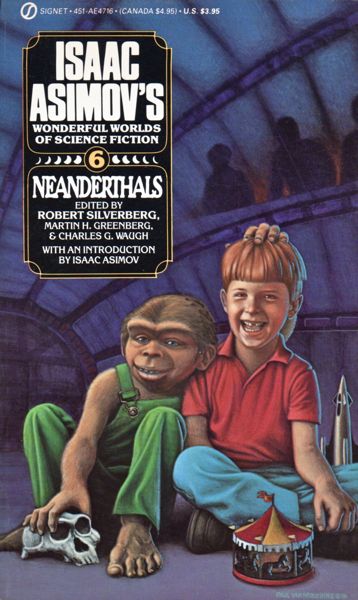
There is an anthology of science fiction stories, Neanderthals, edited by Robert Silverberg, Martin H. Greenberg, and Charles G. Waugh. View the table of contents here.
H. G. Wells wrote “The Grisly Folk” in 1921, an unflattering look at Neanderthals.
Of course, the most famous fiction featuring Neanderthals is Earth’s Children series, by Jean M. Auel.
“A Two-Timer” by David I. Masson (New Worlds 159, February 1966) (Amazon)
Back in the sixties, in high school, my friends and I would argue endlessly over science fiction short stories. We didn’t remember them by their title or author, but by whatever neat idea they imagined. I still remember my friend George telling Connell and me about a humorous short story, where a human crewed military spaceship tries to get cooperation from a human colony world where the social norms and economy were wacky. The colonists kept telling the crew “myob” to everything asked. I didn’t learn until years later that this was a famous story by Eric Frank Russell called “… And Then There Were None.” Another story George told us was about an Earthman who fell in love with a girl, and she wanted him to tell him he loved her. But the guy didn’t want to use such a trite phrase, so he left Earth and went all over the galaxy to learn about the preciseness of language. Eventually, he returns to the girl and says, “My dear, I’m rather fond of you.” Of course, the girl was hugely disappointed and rejected the guy. When the guy told his language guru what happened, the guru said, “Lucky devil, vaguely enjoyable was the best I could ever find.” I didn’t discover until decades later that it was “The Language of Love” by Robert Sheckley.”
The point of all this was that we judged science fiction solely on the ideas in the stories, not the plot, characterization, or writing. George read the most and was the best at retelling a story. I think he mainly read anthologies. I read anthologies and magazines. I was more into neat inventions. For example, I told them about the ecologariums in “The Star Pit” by Samuel R. Delany. Connell and I loved Mindswap by Sheckley, and we told everyone about the Theory of Searches. We worked at the Kwik Chek in Coconut Grove, Florida. At the time, its park was a gathering place for would-be hippies. The odds of meeting someone you knew from all over Dade County were increased if you came to the park on Saturdays. That fit Sheckley’s idea that there were optimal places to go if you were searching for someone.
The last three stories we read for the Best Science Fiction and Fantasy Short Fiction Facebook group were all idea stories, the kind my buddies and I would have discussed at Connell’s house on Vista Ct.
“The Certificate” by Avram Davidson is a tight little story about alien invaders who take complete control over humanity, making us their slaves. The aliens create a vast bureaucracy that’s impossible to fight. The aliens also punish us severely if we don’t cooperate. To make matters worse, they have altered us so we heal immediately, so they can torture us over and over again.
The story’s protagonist is Dr. Roger Freeman, who desperately wants a new winter coat. To apply for one involves going through an obstacle course that takes years. But Freeman is finessing the system.
Back in high school, this story would have caused us to argue about how we’d overthrow those aliens. Being young guys, we’d probably claim to know how to start a rebellion, even though Davidson sets up the story to suggest no rebellion is possible. When I read this story this week, the idea didn’t appeal to me much. The story is well-written, with an O. Henry surprise ending. However, it doesn’t offer anything to me as an older reader.
“To See the Invisible Man” by Robert Silverberg seems like a reply to Damon Knight’s classic short story, “Country of the Kind.” Like the Knight story, Silverberg sets up a society with a unique liberal form of punishment. The unnamed first-person narrator is sentenced to a year of invisibility for being cold and detached. He’s not actually made invisible. He’s just branded on the forehead, so anyone who sees him should act like he doesn’t exist. The story is about the psychological changes this character undergoes during the year. The narrator learns that he can steal whatever he wants or visit women’s locker rooms and be completely ignored. But he gets lonely, even desperate for someone to talk to. Silverberg takes us to a different place in his story. His character rebels in a different way by being compassionate.
My buddies and I would have had a lot to say about this story, with each of us coming up with how to handle the punishment. We’d probably argued over whether or not we’d go into the women’s locker room. I would have said that my solution would have been to read science fiction for a year. We did know of “Country of the Kind,” so we would have compared the two, but only about what the two criminals did, not about the writing, plotting, or characterization. Science fiction was about setting up a situation that you could argue over.
“To See the Invisible Man” is a good story. It’s tightly told, immediate, and works. However, it is not nearly as dramatic as “Country of the Kind,” and thus won’t be as memorable.
There’s little likelihood we would have read “A Two-Timer” by David I. Masson in the 1960s because it came out in a British SF magazine. Also, the idea behind this story is probably too subtle for three teenage boys in the 1960s. Joe, the narrator, is a guy from 1683 who steals a time machine and visits 1964. Of course, he doesn’t know it’s a time machine when he discovers it, or comprehends the idea of time travel. He just sees a guy walk away from a weird enclosed chair. He gets in and sees all kinds of dials and buttons labeled with words he doesn’t understand. He pushes a button and goes to 1964. Eventually, Joe figures out how the machine travels in time and space, like the DeLorean in Back to the Future.
The real point of this story is Joe, with his Middle English mind, describing 1964 to the reader. That might have entertained us back in the sixties, but I’m not sure. Old man me, found it very creative. There’s little action in the story. The piece is Masson’s playground for showing off his knowledge about language and history. Present-day me was disappointed that Joe wasn’t inspired to explore time based on his 17th-century knowledge.
I’m getting old and jaded. I find it hard to discover science fiction that thrills me in the remaining years of my life. I’ve loved reading science fiction magazines my whole life, but most of the stories were aimed at readers like my younger self. Masson’s exploration of language is more ambitious and mature than the other two stories, but Masson built his story on a lame plot.
Even though I’ve been reading science fiction for over sixty years, I still want to find stories that thrill me to the same degree as I was at 13. I’m not sure that’s even possible. Breakthrough science fiction novels like Hyperion are rare. But it’s interesting to note that Hyperion would have been a novel that thrilled me and my high school science fiction buddies.
Obviously, many of the stories that wowed me as I grew older would have also thrilled the younger me. For example, “Think Like a Dinosaur” by James Patrick Kelly or “Beggars in Spain” by Nancy Kress.
On the other hand, would “Story of Your Life” by Ted Chiang have inspired our younger selves? We would have avidly talked about translating an alien language, but would we have appreciated the advanced plotting and exceptional writing?
And could we have appreciated “Loneliness Universe” by Eugenia Triantafyllou without having lived through the social media era? Or could my younger self appreciate “Two Truths and a Lie” by Sarah Pinsker, which moved my older self? Wasn’t I mainly moved by the writing? I’m not sure high school Jim could have.
What if we could have read “Press ENTER ■” by John Varley in 1966? Would it blow us kids away like it did me in 1984? Did we need to understand computers and know about the technological singularity first?
I have to assume certain stories in the 1960s were relevant because of my age and current events. That’s why Dangerous Visions was exciting in 1969 but painful to read last year.
I keep looking for old science fiction I missed back then that will thrill me as much now as it would have thrilled me back when — if I had discovered it when I was young. One such book was The Man Who Fell to Earth by Walter Tevis. The trouble is, I think George, Connell, and I would have all thought that story was dull. Isn’t that novel better for the old and jaded?
I need to find cutting-edge science fiction for today that would have thrilled me as a 13-year-old but also a 73-year-old.
By the way, my 1964 self expected a much different 2025 than the one I live in now. There are many nonfiction books about current affairs that, if I could send to my 1964 self, would read more like science fiction than science fiction.
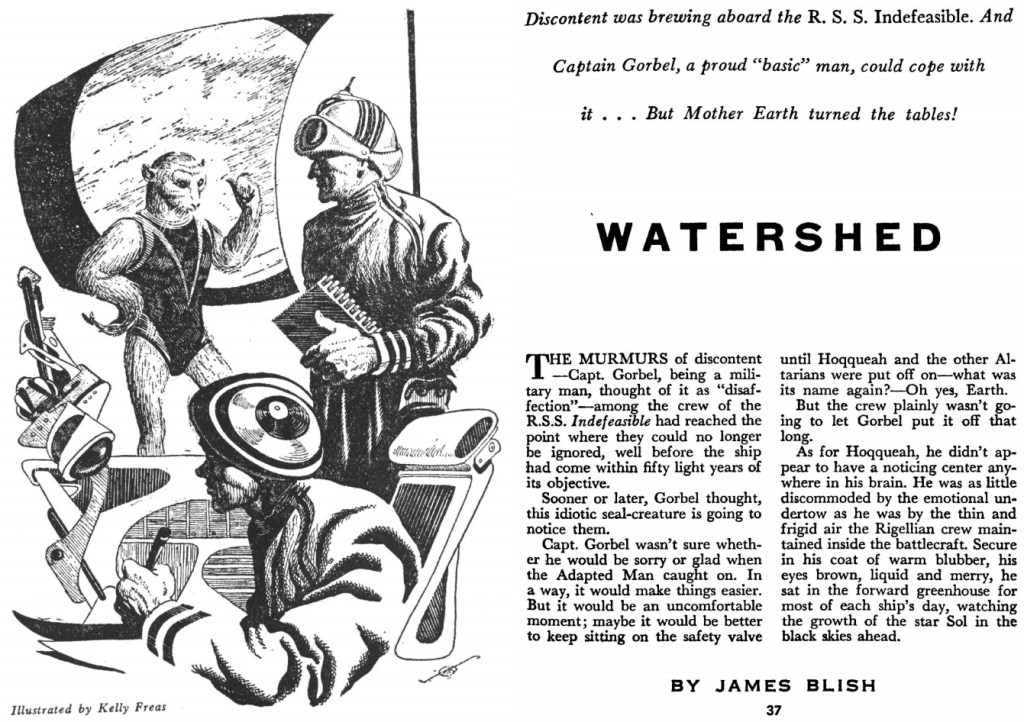
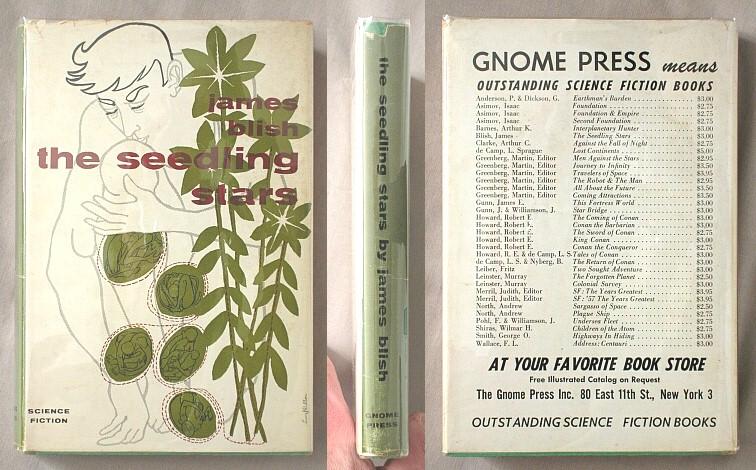
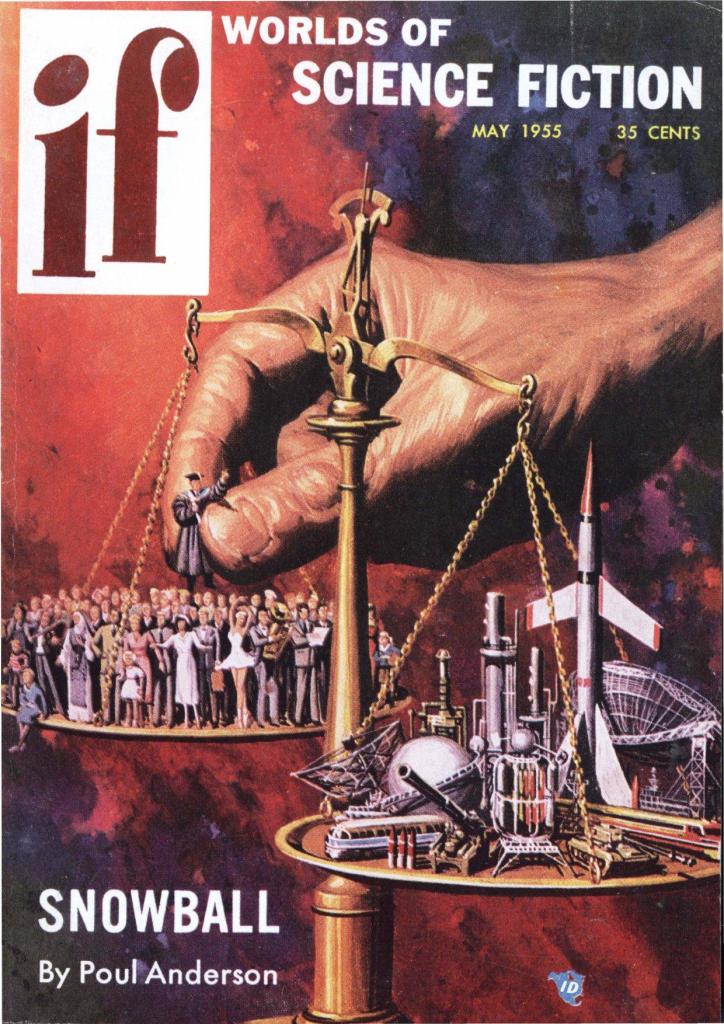
“Watershed” by James Blish was first published in IF Worlds of Science Fiction (May 1955). You can read it online here. “Watershed” became part of James Blish’s The Seedling Stars, a collection of short stories about adapting humans to new environments. The most famous story of the collection is the classic “Surface Tension.” Unfortunately, “Watershed” is not in print except for Supermen: Tales of a Posthuman Future, a 2002 anthology edited by Gardner Dozois.
“Watershed” is a rather preachy tale, not a thrillingly dramatic story like “Surface Tension.” Capt. Gorbel of the spaceship R.S.S. Indefeasible is traveling to Earth to deliver new colonists, but it’s not what you think. Humans have long colonized the galaxy, and the environment of Earth can no longer sustain “standard form” humans. Gorbel is going to Earth to deliver colonists that look like seals, but are considered just as human as we are, well, that’s by the standards of political correctness of their day.
The adapted human is Hoqqueah. He likes to sit in the forward greenhouse and stare into space as the ship approaches Earth. However, the standard form crew considers itself superior to the adapted humans. Averdor doesn’t like that Hoqqueah spends so much time in the greenhouse, and is annoyed by his constant talking. Averdor tries to convince Gorbel to forbid the adapted humans from using the greenhouse.
Hoqqueah knows of this prejudice, and he tells the Captain a story about Earth. He explains that Earth was the original home of all humans. He also tells how humans have found many planets that couldn’t support the standard human body, so they adapted humans to new forms. The concept is called pantropy. (That link gives several classic examples in SF.)
However, this is 1955, and we must ask ourselves if this story is about space exploration. The famous civil rights case, Brown v. Board of Education, happened in 1954. To be fair to James Blish, he had been exploring pantropy since 1942. But then Blish has Hoqqueah tell Captain Gorbel about prejudice against dark skin humans on old Earth.
The kicker to this story is that the standard form is now the minority.
“Watershed” has nice sentiments, but not much of a story. It’s told, not shown. It would have been far better if it had been dramatized. We don’t get to know Hoqqueah or what it’s like to be a seal person. And why, if standard form humans can’t handle Earth, how can the adapted men of his kind handle the spaceship with Gorbel and Averdor?
I recommend reading “Surface Tension” to understand what I mean by telling the story with drama. You can read it in the August 1952 issue of Galaxy Magazine.
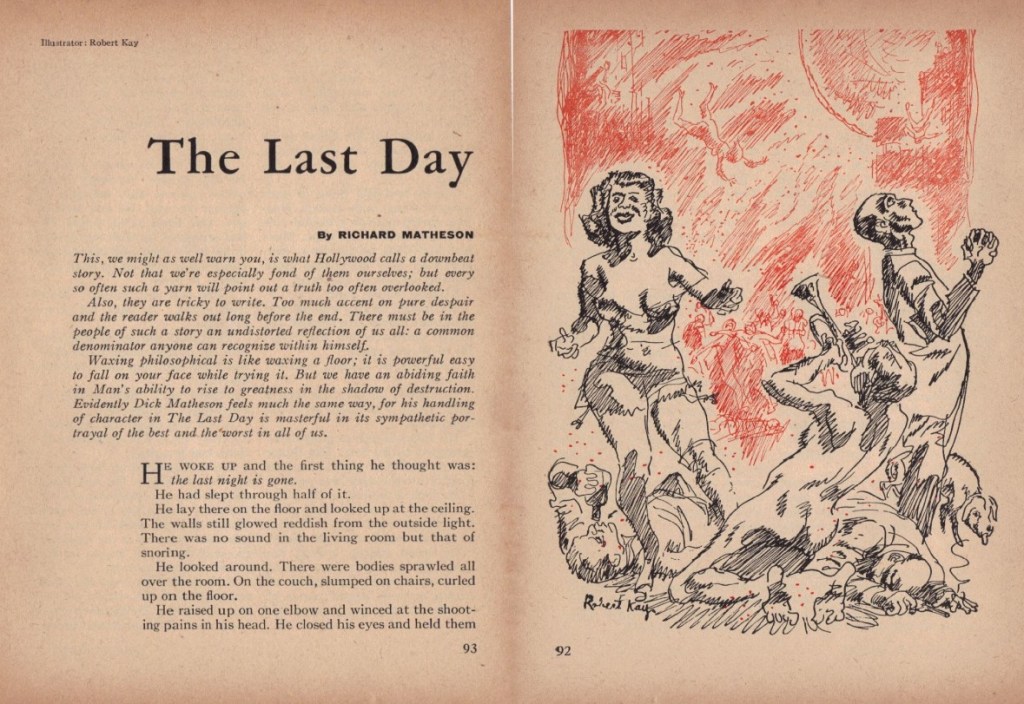
“The Last Day” by Richard Matheson was first published in the April-May 1953 issue of Amazing Stories. You can read it online here. Or you can buy The Best of Richard Matheson in various media editions here. Or look at its reprint history to see if you already own it in an anthology.
Our reading group is reading 25 short stories recommended by five group members. They are stories we haven’t read as a group, but ones the five people thought we shouldn’t miss. I didn’t submit this time, but “The Last Day” would have been one of the stories I would have submitted. Three of my favorite SF short stories from 1953 are “The Last Day,” “Lot” by Ward Moore, and “Deadly City” by Paul W. Fairman. I admire these stories because they were so gritty, even brutal.
Science fiction has often dealt with post-apocalyptic stories but “The Last Day” is about the end of the world. Some astronomical object is about to crash into the Earth. It’s not specified. The story begins in the morning of the last day and ends in the evening just before the end of everything on Earth.
I have often read and thought about surviving an apocalypse. I have often contemplated my own death. And I’ve always been fascinated by stories about people with a terminal illness and what they did with their remaining days.
But I haven’t thought about what I would do if everyone had just one day to live. It’s a neat concept to ponder. After reading “The Last Day” I’m not sure I’d need to read another story on the same idea. “The Last Day” gets the job done so nicely that I can’t imagine anyone topping it.
For this reading, I read the story with my eyes and then listened to it with my ears. I was impressed by its drama. Richard Matheson is famous for writing over a dozen episodes of The Twilight Zone. Many of Matheson’s stories and novels were adapted for television and the movies, and he wrote many screenplays. Matheson knows how to create drama.
“The Last Day” begins with Richard waking up in a room full of passed-out people. Several are naked, and it’s obvious that a drunken orgy had taken place the night before. When Richard goes into the bathroom to clean up a bit, he finds a dead man in the tub. Richard enters the kitchen where a friend, Spencer, is frying eggs. By now, we’ve realized that life on Earth is about to end.
Richard wishes he were with Mary, a woman he loved but didn’t commit to. His friend Norman comes into the kitchen and tells Richard he wants to go see his mother. Norman asks Richard if he wants to see his mother. Richard dreads the idea because he knows his mother will preach religion at him, and he doesn’t want to hear it.
After Spencer leaves to have more sex with a woman who wants everyone to watch, Norman begs Richard to drive him to his mother’s house. We learn that riots are going on all over the city. Many people have committed suicide, but others run wild, murdering each other.
All of this is amazingly adult for a science fiction story in 1953, especially published in a magazine mostly read by young adults. That issue seemed atypical for Amazing Stories. It also had stories by Robert A. Heinlein, Theodore Sturgeon, and Murray Leinster. It was edited by Howard Browne. I feel I need to reevaluate that era of the magazine. 1953 was a boom year for science fiction magazines. I’ve written about it before. I believe the Cold War had a significant impact on the genre that year. Just look at some of the other notable stories from 1953.
Richard eventually finds his mother at his sister’s house. There’s a poignant scene of his sister and her husband getting their daughter to take sleeping pills, and Richard watching all three commit suicide. And finally, Richard has a moving moment with his mother while they wait to die.
The story is cleanly told. Direct. It covers many bases without getting wordy. 5-stars.
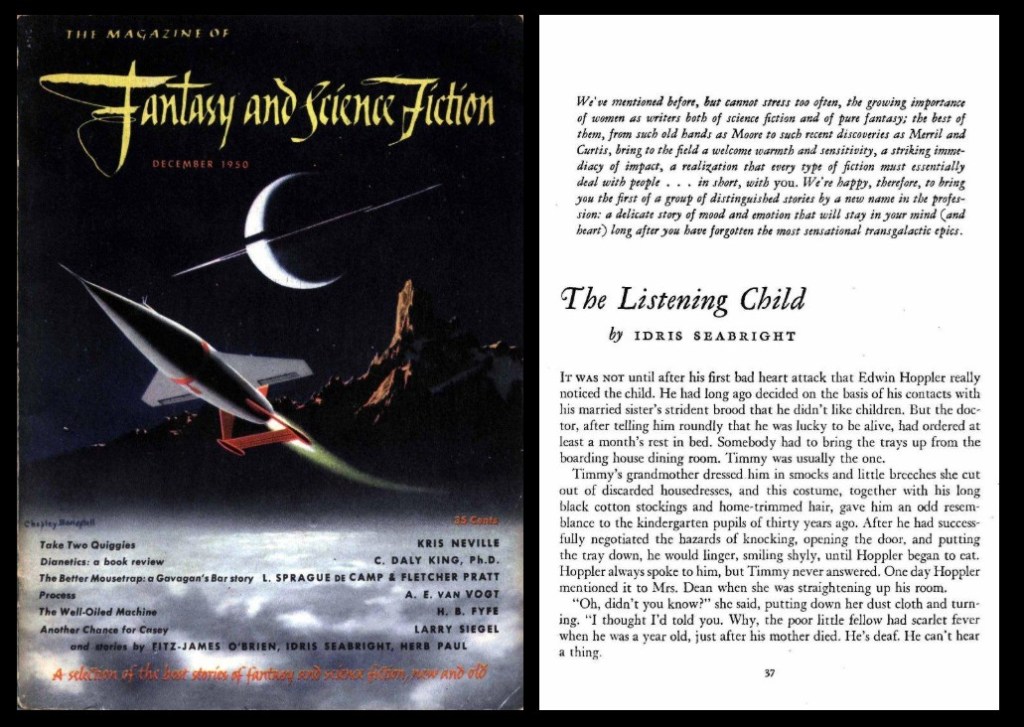
“The Listening Child” was first published in The Magazine of Fantasy and Science Fiction (December 1950) by Margaret St. Clair using the pseudonym Idris Seabright. You can read it online here. It is short story #1 of 25 that our Facebook group will be discussing as Group Read 92. (See the reading schedule at the end of this review.) Group Read 92 consists of 25 stories picked by five group members that we haven’t read before. That was a challenge since we’ve been discussing a short story daily for years. The group is public.
In the 1950s, extrasensory perception (ESP) was a popular theme in science fiction and fantasy magazines. It was often speculated that people with physical or mental abnormalities might have additional senses to compensate for the loss of one of their primary senses. I assume the assumption came from blind people who had keener hearing.
After Hiroshima, science fiction and comic book writers often used radiation as a cause of ESP. However, in the 1930s and 1940s, John W. Campbell was impressed by the Rhine experiments, and science fiction writers often supposed that advanced aliens had psychic powers. Arthur C. Clarke, who was normally a hard SF writer, proposed that the evolution of human development led to ESP in two of his most famous novels, Childhood’s End and 2001: A Space Odyssey. Soft science and fantasy writers leaned towards psi-powers in physically and mentally damaged humans, like Theodore Sturgeon’s More Than Human.
Margaret St. Clair imagines a deaf mute having a rather unique ESP talent. Timmy can “hear” when death is near. Many famous stories personify death, so this isn’t too out there, but it’s not as believable as other ESP talents, even though it is well proven that ESP does not exist. Still, hearing death makes for a nice story idea.
St. Clair’s setup for her story is rather quaint. Edwin Hoppler is 63 and suffers from a weak heart. He lives in a boarding house. Boarding houses have disappeared, but were common in old movies and science fiction short stories before the 1960s. Quite a few episodes of The Twilight Zone were set in boarding houses. It’s a shame they don’t still exist. Living with several other individuals who ate communal meals fixed by a nice old lady sounds pleasant.
Timmy is the landlady’s grandson, and Edwin feels sorry for him. Edwin befriends Timmy when he realizes that the other kids don’t play with Timmy. Edwin notices that Timmy “listens” intently at times, and eventually notices that these listening moments precede a person or animal dying. Edwin decides to use Timmy as the canary in a coal mine to detect his own impending heart episodes.
“The Listening Child” is a pleasant little story, but rather slight. Timmy and Edwin are only developed enough as characters to present the idea for the story. There’s little conflict or tension. The story also lacks color or voice. The idea is slight, but writers can flesh out simple ideas into complex characterization and plots. For example, compare it to “Jeffty is Five” by Harlan Ellison. Jeffty is a boy who is perpetually five, and always lives in the year he was five, with the popular culture never changing. Or read “Baby is Three” by Theodore Sturgeon; it’s tremendously dramatic for a boy with psychic powers talking to a psychiatrist.
I don’t want to tell you the ending, but I expected St. Clair thought her readers would find it emotional and poignant. It was presented too casually for me to be moved, but I’m curious if other members from our short story reading group will be moved. I wanted the ending to be like in Platoon when we see Elias still alive, and the emotional impact we felt watching him die.
I’m working on a project to find my all-time favorite science fiction stories I’ve read over the past sixty years. Identifying such stories means learning what makes a story work. Most published stories succeed at a basic three-star level, which is how I’d rate “The Listening Child.”
For this story to reach the four-star level, Timmy and Edwin would need to become vivid characters. To make it to a five-star story would require elevating the story gimmick of hearing death into something metaphorical and philosophical that I would want to contemplate over several readings.
James Wallace Harris, 4/21/25
Group Read 92 Schedule
01 (04/22/25) – The Listening Child, by Margaret St. Clair (ss) F&SF, December 1950 (DH)
02 (04/24/25) – Brightness Falls from the Air, by Margaret St. Clair (ss) F&SF, April 1951 (FP)
03 (04/26/25) – The Rose, by Charles L. Harness (na), Authentic Science Fiction, 15 March 1953 (PF)
04 (04/29/25) – The Last Day, by Richard Matheson (ss), Amazing, April/May 1953 (FP)
05 (05/01/25) – Watershed, by James Blish (ss), If, May 1955 (RH)
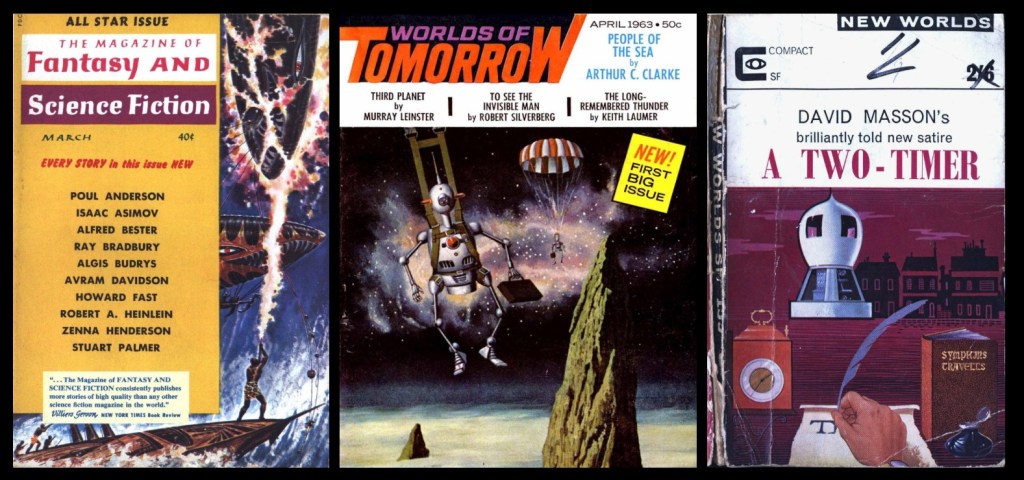
06 (05/03/25) – The Certificate, by Avram Davidson (ss), F&SF, March 1959 (FP)
07 (05/06/25) – To See the Invisible Man, by Robert Silverberg (ss), Worlds of Tomorrow, April 1963 (FP)
08 (05/08/25) – A Two-Timer, by David I. Masson (nv), New Worlds 159, February 1966 (PF)
09 (05/10/25) – The Adventuress, by Joanna Russ (nv), Orbit 2, ed. Damon Knight (Putnam, 1967) (RH)
10 (05/13/25) – No War, or Battle’s Sound, by Harry Harrison (nv), If, October 1968 (FP)
11 (05/15/25) – The Milk of Paradise, by James Tiptree, Jr. (ss), Again, Dangerous Visions, ed. Harlan Ellison (Doubleday, 1972) (RH)
12 (05/17/25) – Pale Roses, by Michael Moorcock (nv), New Worlds 7, ed. Hilary Bailey & Charles Platt (Sphere, 1974) (PF)
13 (05/20/25) – Concepts, by Thomas M. Disch (nv), F&SF, December 1978 (PF)
14 (05/22/25) – Gate of Faces, by Ray Aldridge (nv), F&SF, April 1991 (PF)
15 (05/24/25) – On Sequoia Time, by Daniel Keys Moran (ss), Asimov’s, September 1996 (PN)
16 (05/27/25) – Journey into the Kingdom, by M. Rickert (nv), F&SF, May 2006 (PN)
17 (05/29/25) – Roxie, by Robert Reed (ss), Asimov’s, July 2007 (PN)
18 (05/31/25) – 26 Monkeys, Also the Abyss, by Kij Johnson (ss), Asimov’s, July 2008 (DH)
19 (06/03/25) – Passage of Earth, by Michael Swanwick (ss), Clarkesworld 91, April 2014 (PN)
20 (06/05/25) – Cimmeria, by Theodora Goss (ss), Lightspeed 50, July 2014 (RH)
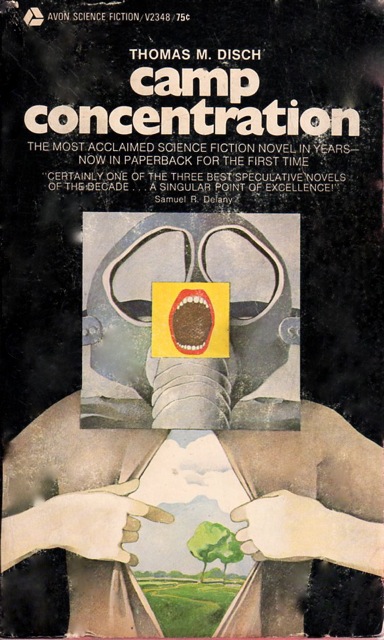
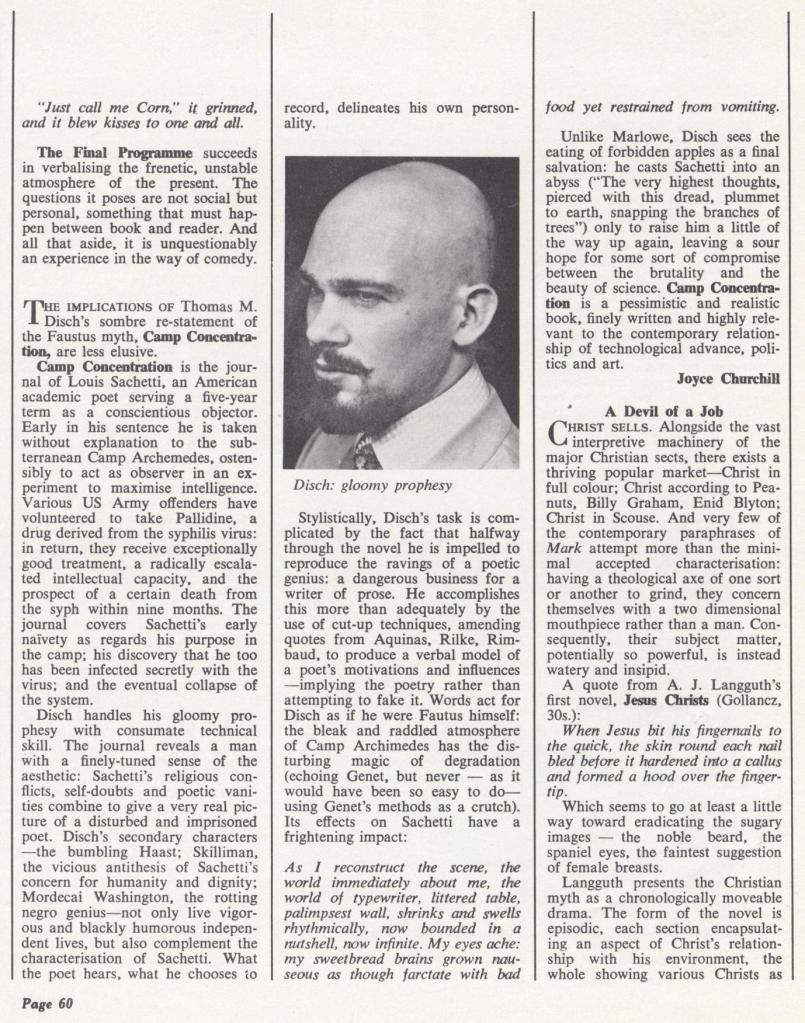
The first time I read Camp Concentration by Thomas M. Disch, I was around 20 and proud of myself for reading one of those New Wave science fiction novels I had been reading about in fanzines. It wasn’t much fun to read. It was overly intellectual – well beyond my level of comprehension. After reading thousands of other books over the last fifty-plus years, Camp Concentration made much more sense. I actually enjoyed the story. I enjoyed it a lot. But please, don’t buy a copy without carefully reading this review.
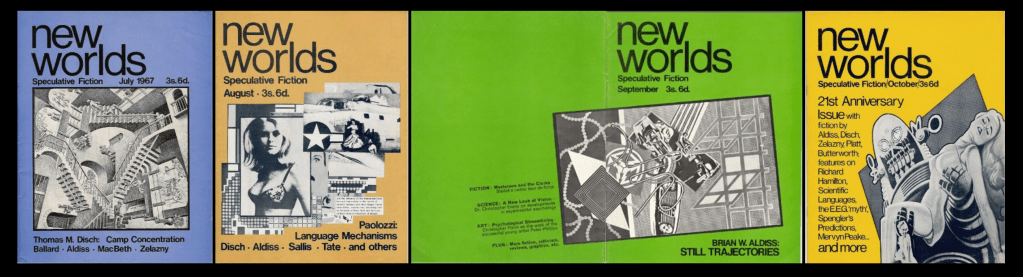
It’s important to know that Camp Concentration first appeared in the July, August, September, and October 1967 issues of New Worlds. It suggests it was written in 1966 or early 1967 and published first in England, in a magazine that promoted the New Wave. To fully appreciate this novel, you must remember when it was written and what happened in the United States in 1966 and 1967. The first hardback came out in England in 1968, and it wasn’t until 1969 when it was published in America. I didn’t read it until after the 1971 Avon paperback, cover shown above.
I’d love to hear an audiobook version of Camp Concentration. However, a highly skilled narrator would be needed to handle all the accents, poetry, foreign language quotes, and characterizations. It would also make a wonderful movie. Unfortunately, the audience for either the audiobook or film would be small.
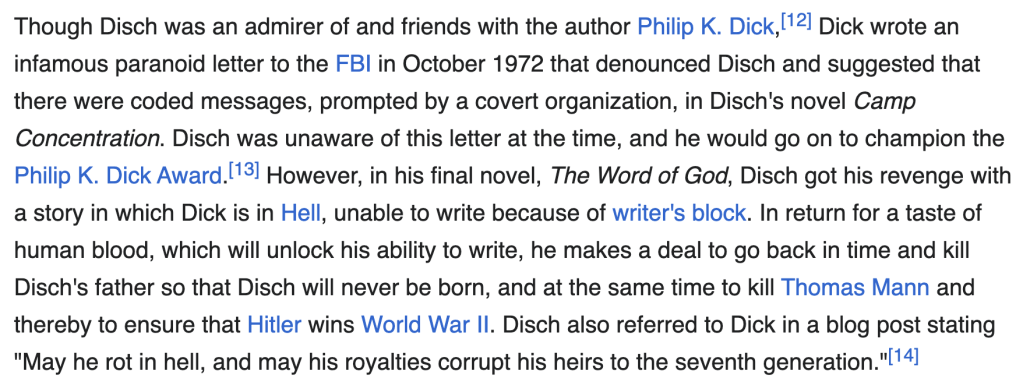
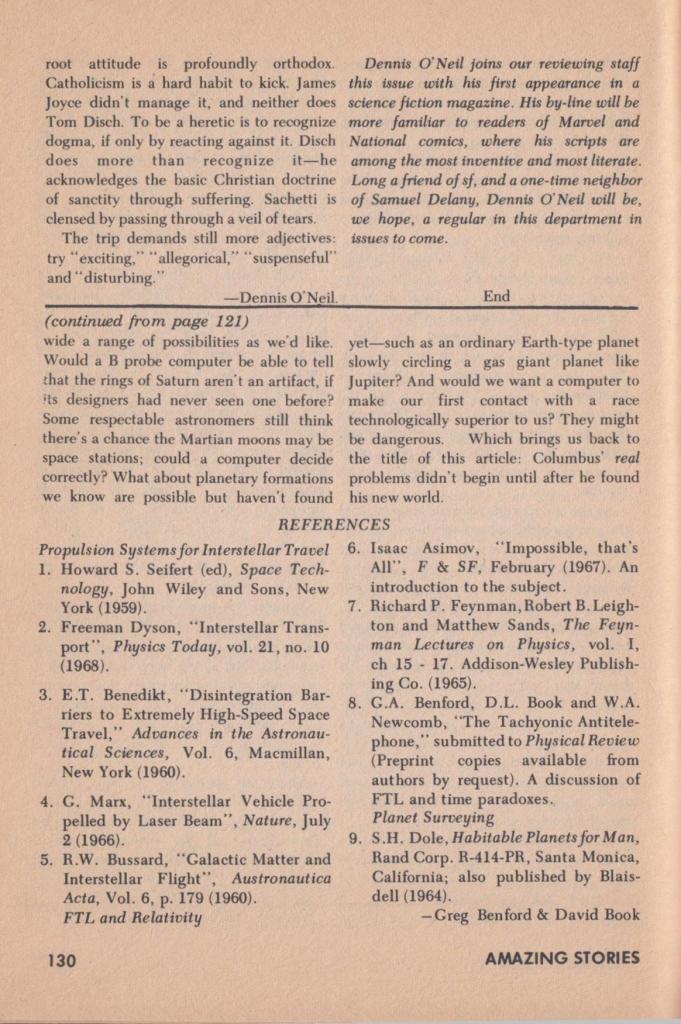
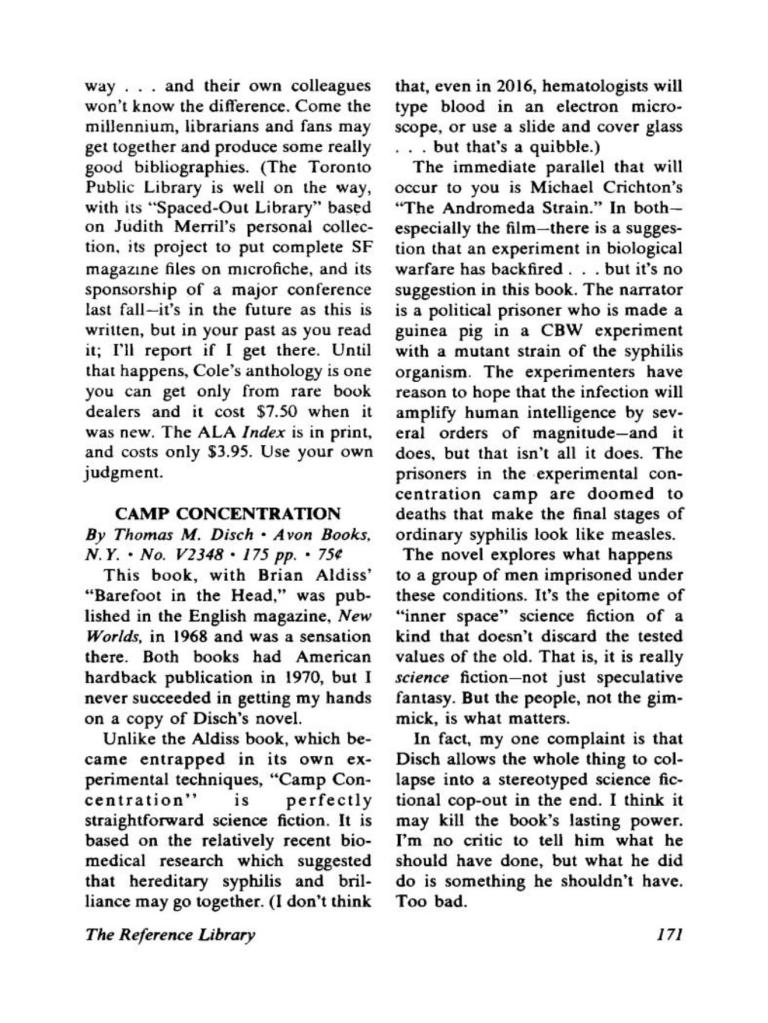
Back in the 1970s Camp Concentration was greatly admired. Philip K. Dick loved the book so much he promoted to friends and suggested it be made into a movie to a producer interested in his own work. But there’s a bizarre story here. Dick, who was paranoid, started seeing things in Camp Concentration and wrote a letter to the FBI claiming it had secret intel. You can read that letter here. Eventually, Disch found out about this and didn’t take it kindly. Wikipedia describes what happened:
I mention this early in the review because it helps set up how strange Camp Concentration is as a novel. It’s quite readable, but it has so many references to literature, music, philosophy, poetry, etc., that you might feel it has some deeper message. Even though I just finished the novel, I’m already looking forward to rereading it again. However, before I can do that, I need to study first. At minimum I should read Christopher Marlowe’s play Doctor Faustus, and Thomas Mann’s novel Dr. Faustus. In fact, I need to go through Camp Concentration, make a list of all the works Disch mentions, and at least read their Wikipedia pages about them.
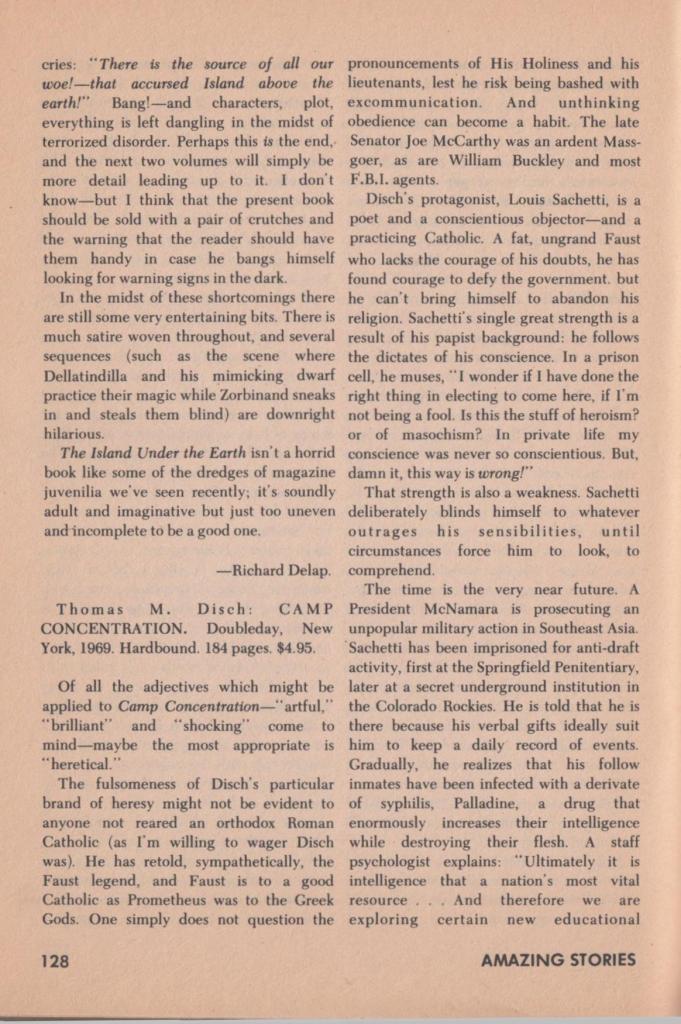
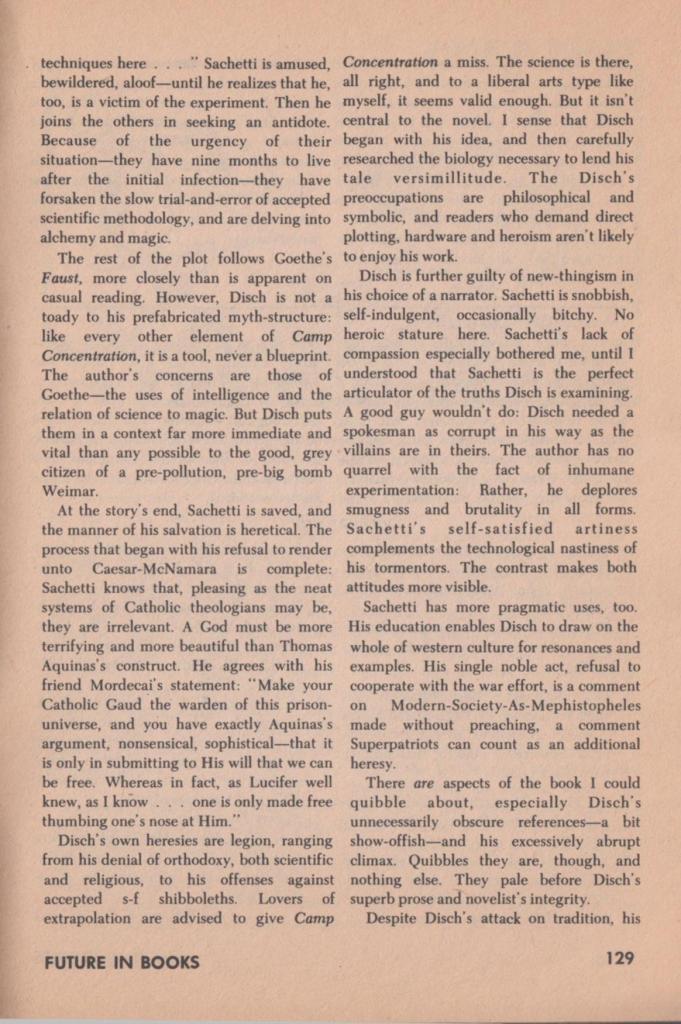
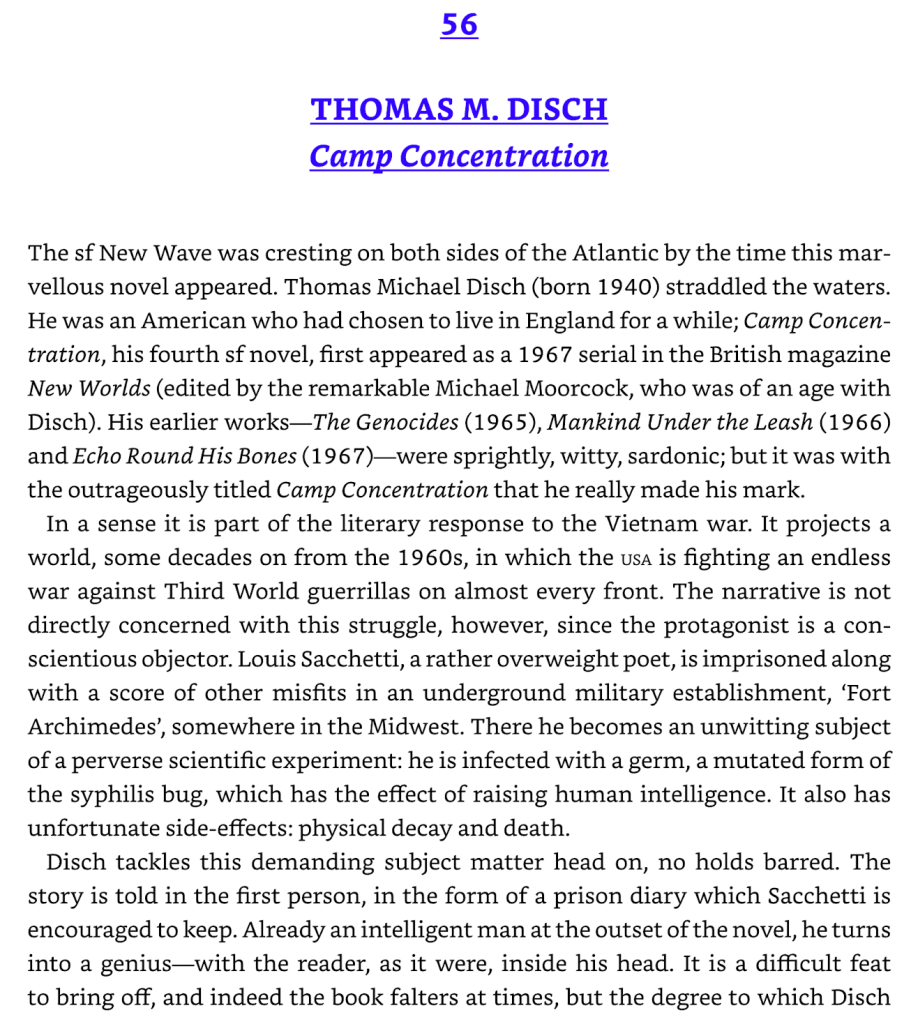
Louis Sacchetti is a conscientious objector, and Camp Concentration is the journal he writes while imprisoned in two locations. Disch wrote the novel while LBJ was president, and before Nixon. The story is set somewhat in the future, and Robert McNamara is President. McNamara was the Secretary of Defense under JFK and LBJ. McNamara played a major role in promoting the Vietnam War. To get the fullness of Camp Concentration, you need to read the Wikipedia link to McNamara. It also helps to see The Fog of War: Eleven Lessons from the Life of Robert S. McNamara, a 2003 Academy Award winning documentary.
Camp Concentration is a deeply cynical view of the United States in 1967. Louis is a war resister, at first imprisoned in an ordinary prison. He accepts that. But the novel is about when he is transferred to another prison, a military prison, where an experimental drug is used on the inmates by the U.S. Army. Most of the prisoners had committed crimes while in the Army, but Louis is a special civilian prisoner. The army believes it has synthesized a drug that will enhance intelligence. It was derived from a strain of syphilis.
The U.S. Army conducted experiments with LSD from 1955 to 1967. From 1932 to 1972, the U.S. government studied the effects of syphilis on black people after telling them they were being treated. These are just two examples of unethical experiments by our government. It’s not hard to believe the setup for Camp Concentration.
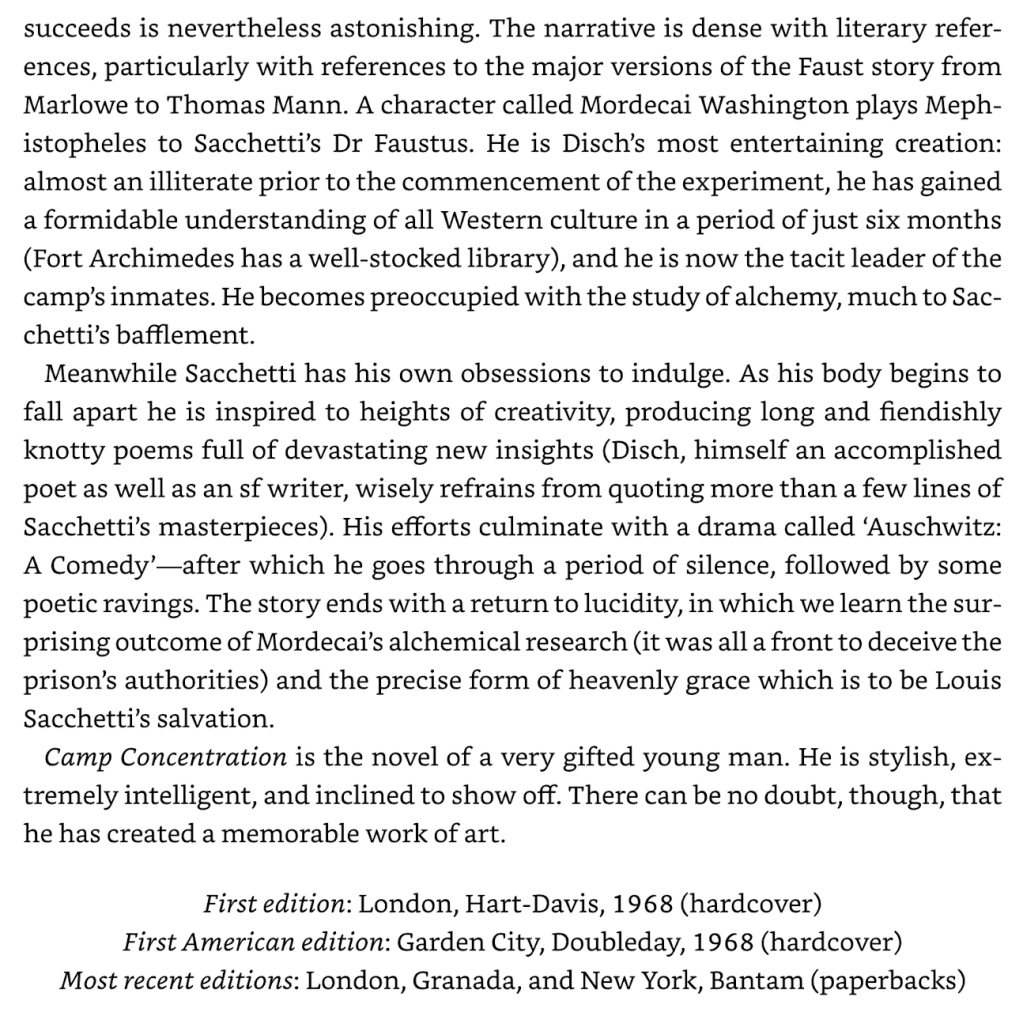
Camp Concentration reminds some readers of Flowers for Algernon because it’s about a treatment that makes people smarter. Over one hundred journal entries, we see Louis and the other prisoners change and become brilliant. I felt the characters did change, but my friend Mike, who got me to reread the novel, says he didn’t. Writers find it hard to describe humans with superintelligence. I’ve written about that recently. I thought Disch pulled it off, Mike didn’t.
Most of the novel is intellectual discussions about art, literature, poetry, theater, music, religion, philosophy, Alchemy, and other medieval beliefs. Mike thought all this discussion was boring, I was fascinated. I feel it helps to have a classical education to appreciate Camp Concentration. I don’t, but I’ve read enough to wish I had.
While reading Camp Concentration I was reminded of another book I read in the 1970s, Where the Wasteland Ends: Politics and Transcendence in Post Industrial Societyby Theodore Roszak. I’m not saying the two books are about the same things, but as the characters evolve intellectually, they start sounding like Roszak.
Read Disch’s Wikipedia entry, you’ll see that Thomas M. Disch and Louis Sacchetti have much in common. Louis is a poet, and Disch wrote The Castle of Indolence: On Poetry, Poets, and Poetastes.
In the novel, the drug makes the test subject smarter, but it also kills them within months. As the characters grow more brilliant, they realize they have much more to live for and become bitter. Disch appears to equate higher IQ with depression and cynicism.
Disch does not suggest that superintelligence leads to super-powers. The test subjects only become more academic in their communication with each other. As they evolve mentally, their use of intellectual ideas to express themselves becomes more dense. This is subtle, and it may be hard to believe they are more intelligent. It seems that most of their references are to ideas covered in Classical studies or Medieval studies.
If you are prone to depression, I would not read this novel. If you are among the faithful, I would not read this novel. If you prefer tightly plotted stories, that are easy to read, and enjoy action, don’t buy this book.
On the other hand, if you’re into the history of science fiction, the New Wave, or the 1960s, Camp Concentration might be a good one to read. Science fiction changed in 1967-1968. I believe several young prodigies like Disch and Delany took the genre in new directions, and older writers like Silverberg, Brunner, and Ellison decided they were tired of where science fiction was going too.
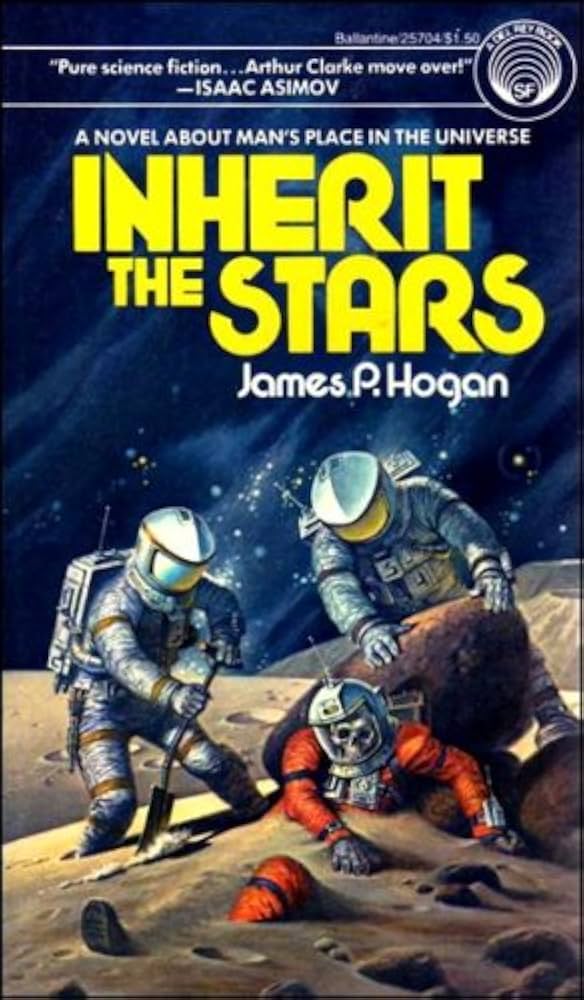
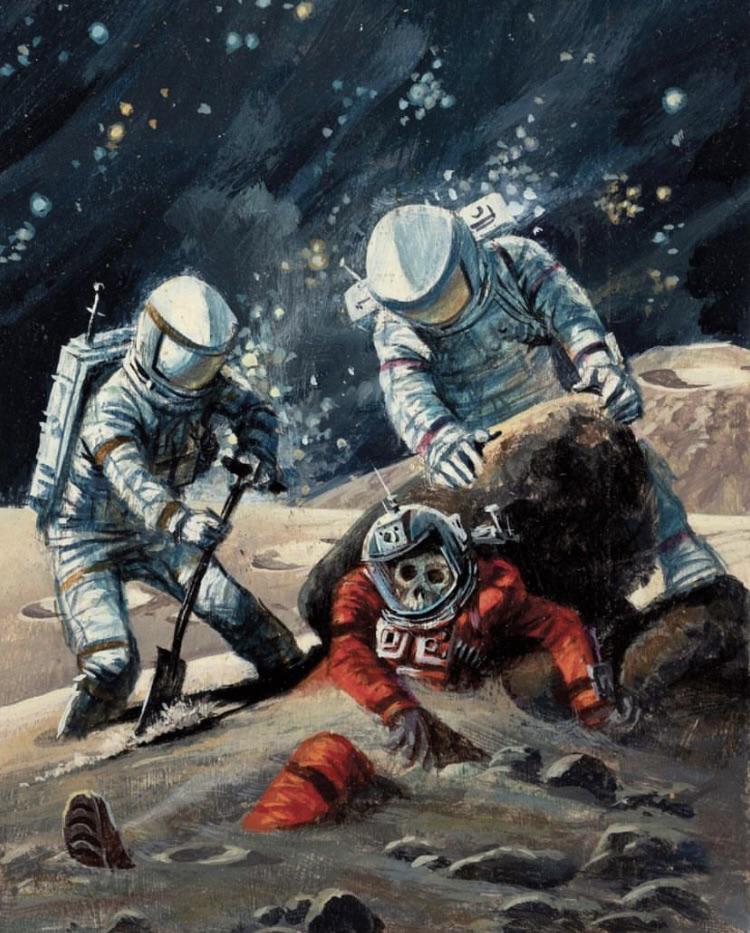
The original paperback, Inherit the Stars by British writer James P. Hogan (1941-2010), had a terrific cover – the kind that made you buy the book. The artwork appears to show astronauts on the Moon finding a dead astronaut, but that is deceptive. Hogan creates a scientific mystery because the dead astronaut has been there for 25,000 years.
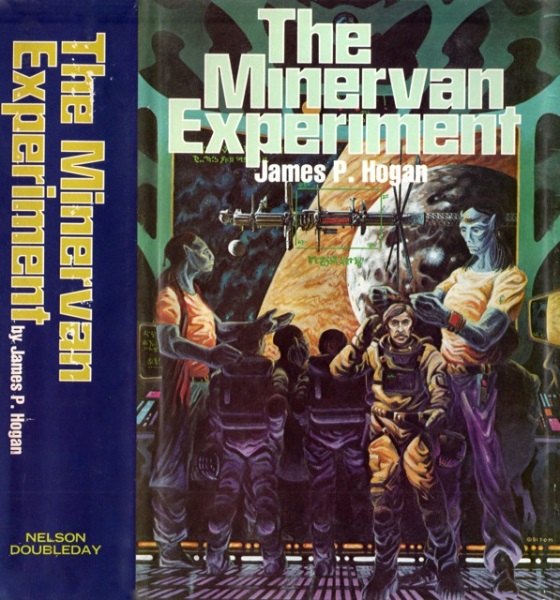
I first read Inherit the Stars in 1992 but after seeing Whitney’s review on YouTube, I wanted to reread the story. I went to Amazon but couldn’t find the book. Was it out of print? I did find it on Audible. Later, I discovered that Inherit the Stars and its sequel The Gentle Giants of Ganymede are now being sold together as The Two Moons for the Kindle. A bargain for $6.99, especially since Whitney also praised the second book. It turns out that there are five books in the series being sold as three Kindle editions. The series is called Giants. Only the first three novels are available on Audible. The Science Fiction Book Club once published the first three novels as The Mirnervan Experiment. Ballentine also published a paperback called The Giants Novels that contains all three.
Before anyone rushes out to buy Inherit the Stars, I need to describe it more, but not enough to give spoilers. Hogan’s story is the kind you want to figure out for yourself. It kept me guessing for the entire novel even though I had read it before. That worried me. Why wasn’t it more memorable? Was that an indication it was a bad book? I don’t think so. How the story is told isn’t very memorable, but the ideas are big-time fun. I did remember some of those, but not connected to the book.
Inherit the Stars is basically scientists talking about one mystery after another. There’s no real plot. A lot happens, but it’s not dramatic. With each discovery, there’s a new puzzle, which makes you think and try to guess what caused each mystery. Inherit the Stars is science fiction focused on ideas and not storytelling. I’ve told you the first mystery, but I don’t want to give away any others.
However, I will give you some fun clues. Inherit the Stars reminds me a lot of Rendezvous With Rama by Arthur C. Clarke. Hogan’s prose is similar to Clarke’s. At one point, the story reminded me of the classic short story “Omnilingual” by H. Beam Piper. The novel also triggered memories of Gateway by Frederik Pohl. At other times it reminded me of the Winston Science Fiction, a series of young adult SF that came out in the 1950s, especially the entries where the protagonists find relics of ancient alien technology. If you love alien archeology stories, you might like Inherit the Stars.
I call Inherit the StarsPre-NASA Science Fiction, by which I usually mean science fiction written before Mariner 4 photographed Mars in July 1965. Until NASA started exploring the solar system with robotic probes, many people hoped that we would find life, even intelligent life somewhere on other planets in our solar system. For example, Heinlein’s Stranger in a Strange Land from 1961 imagines Mars being inhabited by a dying race. However, after Mariner 4, serious science fiction assumed we were alone in the solar system. (I must admit, that I still love Pre-NASA science fiction. Growing up in the 1950s and 1960s, I desperately wanted us to find Martians.)
I consider Hogan’s 1977 Inherit the Stars Pre-NASA Science Fiction because Hogan maintains the hope that we had neighbors. However, some readers might feel Hogan’s ideas might come across like those of Erich von Däniken, who wrote Chariot of the Gods? Another reviewer dismissed this book as unbelievable. Personally, I find Erich von Däniken’s theories to be insulting to humanity. But I consider Hogan’s speculation to be great science fictional fun.

 Classics of Science Fiction