“The Dead Past” by Isaac Asimov

The Dead Past” by Isaac Asimov is story #27 of 52 from The World Treasury of Science Fiction edited by David G. Hartwell (1989), an anthology my short story club is group reading. Stories are discussed on Tuesdays, Thursdays, and Saturdays. “The Dead Past” first appeared in Astounding Science Fiction (April 1956). I can find no ebook or audiobook edition of this story.

Normally, I don’t link to the Internet Archive because I worry it’s going to be taken down. But for “The Dead Past” you can read it here in a scan of the April 1956 Astounding.

Let’s imagine that “The Dead Past” is a robot Isaac Asimov built. This robot has a specific function, to trigger certain ideas and emotions in readers. I believe we can understand this story in terms of the motors and gears Asimov used to design his robot.

  1. The first motor is Arnold Potterley, Ph.D., a Professor of Ancient History. Arnold is obsessed with ancient Carthage. He desperately wants to use a time viewer to prove that specific history about Pre-Roman Carthage is untrue, and were lies created by their enemies the Greeks and Romans.
  2. The second motor is academic control, as viewed through The Department of Chronoscopy, which has the power to view the past using the science of neutrinics, an area of physics created by a man named Sterbinski.
  3. The third motor is Jonas Foster, a new instructor in the physics department.
  4. The first gear system is a dystopian society that rigidly controls all academic research. Asimov used this feature to satirize the real-life academic bureaucracy that he had to deal with. Arnold fights against this bureaucracy to get access to the time viewer to do his research. Jonas becomes intrigued with why the bureaucracy suppresses the time viewer. The two men’s motives mess to work together secretly to build their own time viewer.
  5. The fourth motor is Caroline Potterley, Arnold’s wife. She is obsessed with the death of their child, Laurel, who died twenty years earlier at age 3. She wants the time viewer to see Laurel again.
  6. The second gear system is the mystery of Laurel’s death. Arnold is afraid that if Caroline could see the event he might be blamed. I believe Asimov added this system to his machine because he wanted an emotional component.
  7. The fifth motor is Ralph Nimmo, a popular science writer.
  8. The third gear system links Ralph and Jonas and allows Asimov to express views on science writers, as well as enable the building of a home time viewer.
  9. The sixth motor is Thaddeus Araman, Department Head of the Division of Chronoscopy. He is in charge of suppressing the technology of time viewing for a very specific reason.
  10. The last gear is between Arnold, Caroline, Jonas, and Thaddeus. The first three want to view the past, and the last wants to stop them. The why is the revelation of the story.

“The Dead Past” is one of Asimov’s better stories, even a favorite to some. I liked it quite a lot but found it clunky. The driving force behind Arnold is to prove ancient Carthage didn’t practice child sacrifice, and the driving force behind Caroline is to see her dead child again. Jonas is so intrigued by a possible conspiracy theory that he throws over his budding career in physics. I thought all three of these fictional motives were melodramatic. They do work, adding complexity and emotion to a rather dry final idea, but it’s a shame that Asimov didn’t come up with a more sophisticated emotional linkage.

I think Asimov would have shown more finesse if he had foreshadowed the ending. There is a cross-link between Arnold’s and Caroline’s desire to see the past, but neither predicts the real reason why Thaddeus wants to suppress the time viewer. This might be simplistic on my part, but if Arnold, Caroline, and Jonas each had a reason to use the time viewer, and one of their reasons should have foreshadowed the real reason why Thaddeus thought the time viewer was so dangerous. I believe the story would have been tighter if Jonas has wanted to use the time viewer to uncover the conspiracy, and Caroline wanted to use it to spy on Arnold and Jonas.

I don’t think Asimov was a very mature person. From what I’ve read about him, and from reading his stories, he comes across as a rather clever child prodigy who as an adult had trouble comprehending human relationships. This is often reflected in his stories. His fiction focuses on ideas, and his characters are constructed to present those ideas. In “The Dead Past,” Asimov tries harder than usual to present adult emotions, but they come across as contrived. Still, “The Dead Past” is a good example of Asimov trying to overcome his weakness. I give him credit for that.

Two or three years ago I read or reread all of Asimov’s robot stories. They were all hampered by this problem. I could always see how Asimov added human emotion to his stories. When I was young, that effort worked unseen, but as I got older, the stories succeeded in their ideas but felt clunky in their efforts to deal with genuine humans and relationships. In fact, I was sometimes horrified by some of Asimov’s emotional conclusions – but that’s for another essay.

“The Dead Past” is a nicely worked-out science fiction story. Asimov adds psychological depth to a neatly complex plot. Unfortunately, he uses B-movie creativity for creating the psychological drivers of this story.

Finally, regarding “The Dead Past,” I want to make a protest, or maybe a lament. This is my third reading of the story, and this time I wanted to read “The Dead Past” with my eyes, and then listen to it again from an audiobook. But I could find no audiobook edition. Nor could I find an ebook edition. This annoyed and depressed me. “The Dead Past” is one of Asimov’s best works of short fiction. You can find it in print in The Complete Stories, Volume 1. There are US and UK versions on Amazon, but they don’t have the same number of pages, so I don’t know which to recommend. However, used copies of the US edition are quite common and much cheaper.

I now prefer consuming fiction via ebooks and audiobooks. I hate that Asimov’s short fiction, as well as other science fiction writers’ short fiction, is either not available or is no longer available in these formats. A friend eventually found an epub version for me to read, and that visually easier-to-read format made reading the story far more enjoyable.

I recently noticed that all English language versions of Brian W. Aldiss audiobooks have been pulled from Audible. Classic old science fiction is slowly disappearing. There’s still plenty to buy and read, but it’s disappearing at the edges. I hate that.

James Wallace Harris, 7/6/23

.

“The Gold at the Starbow’s End” by Frederik Pohl

The Gold at the Starbow’s End” by Frederik Pohl is story #24 of 52 from The World Treasury of Science Fiction edited by David G. Hartwell (1989), an anthology my short story club is group reading. Stories are discussed on Tuesdays, Thursdays, and Saturdays. “The Gold at the Starbow’s End” first appeared in Analog (March 1972). It’s currently available in Platinum Pohl: The Collected Best Stories. Right now the Kindle edition is only $3.99. The story is also available as a standalone novella for $2.99 for the Kindle edition, but Kindle Unlimited members can read it for free.

I was surprised to discover that I had never read “The Gold at the Starbow’s End” before, especially since it’s such a great read. I never knew how involved Frederik Pohl was in the history of science fiction until I read his memoir, The Way the Future Was. I haven’t read much of Pohl’s fiction, but whenever the reading group covers one of his stories I’m always impressed. I highly recommend his memoir.

“The Gold at the Starbow’s End” was a finalist for a Hugo and Nebula and came in #1 in the 1973 Locus Poll for best novella. It’s not widely reprinted, probably because it’s so long, but it was included in Wollheinm’s The 1973 World’s Best Annual Best. The World Treasury of Science Fiction from 1989 is the last major anthology that remembers it, which is a shame since the story is so much fun to read.

I’m disappointed there is no audiobook of this story. Before I actually discuss the story, I’d like to talk about that. I love listening to science fiction short stories read by professional narrators. A great reader can make the story come alive in ways my poor internal reading voice can’t. Unfortunately, short stories are the red-headed stepchildren of the literary world. They are lucky if they get reprinted at all.

In the science fiction world, short stories get treated better than other genres — well, it used to be that way. The best stories were often regularly reprinted in retrospective anthologies. Those anthologies don’t get published very often anymore. In times past, there was a huge retrospective anthology about every five years, so over the course of twenty years most of the best science fiction short stories from the past were reprinted. This gave each new generation of readers a chance to read the classics and gain a sense of the evolution of the genre. Unfortunately, those huge retrospective anthologies didn’t stay in print (except for The Science Fiction Hall of Fame volumes 1, 2a, and 2b).

What I would love to see is a ten-volume The Best Science Fiction Short Stories of the 20th Century that would stay in print as printed books, ebooks, and audiobooks. Those volumes should collect these 251 stories. I would buy all ten volumes in all three formats.

Like many classic science fiction stories, “The Gold at the Starbow’s End” is about transcendence, especially the kind readers of Astounding Science-Fiction in the 1940s loved. The story is told through two alternating narratives. First first, are messages sent from the first interstellar mission to Alpha Centauri, crewed by six men and women. The second follows Dieter von Knefhausen, a Dr. Strangelove-like character who advises the president on the mission. Knefhausen designed the mission so the highly intelligent crew wouldn’t have much to do during their ten-year voyage but study. He hoped such isolation and focus would cause them to leap ahead of current scientific knowledge.

While civilization on Earth delines during the ten-year period, civilization on the spaceship Constitution evolves dramatically. “The Gold at the Starbow’s End” reminds me of children in “Mimsy Were the Borogoves,” More Than Human, Childhood’s End, and Valentine Michael Smith of Stranger in a Strange Land. Knefhausen not only reminded me of Dr. Strangelove, but Henry Kissinger. The politics in the Washington side of the story devolve so greatly, that it reminded me of “The Marching Morons” by C. M. Kornbluth.

The Earth side narrative is obvious satire, but what about the spaceship side of the story? It represents the hope of SF fans. Knowing Pohl’s other work, I have to assume it’s also satire, even though it plays up to some of the most treasured ideas in science fiction.

I can’t decide if “The Gold at the Starbow’s End” isn’t Pohl preaching the gospel of science fiction or making fun of it. Science fiction fans have always wanted to be slans. It’s surprising how much Campbell and Heinlein wanted transcendence in the 1940s, and Clarke wanted it in the 1950s and 1960s. Was Pohl continuing the dream in this story, or turning on it?

“The Gold at the Starbow’s End” is so cynical that it’s hard to believe it’s aspirational. And am I being cynical when I wonder if certain science fiction writers like Pohl and Bester are secretly making fun of science fiction by pushing the very emotional buttons in their readers that they themselves are sneering at? Pohl and Bester were way smarter than most of us.

“The Gold at the Starbow’s End” is an outstanding piece of writing on Pohl’s part. Working out how to convey Human 2.0 behavior isn’t easy, and Pohl does an impressive job here. The Washington/Knefhausen side of the story is as equally worked out, revealing the egocentric madness of people in power. I wish Stanley Kubrick could have filmed “The Gold at the Starbow’s End.” It would be a combination of Dr. Strangelove and 2001: A Space Odyssey. And I have to wonder if Pohl wasn’t using both as inspiration.

James Wallace Harris, 6/29/23

“The Phantom of Kansas” by John Varley

The Phantom of Kansas” by John Varley is story #21 of 52 from The World Treasury of Science Fiction edited by David G. Hartwell (1989), an anthology my short story club is group reading. Stories are discussed on Tuesdays, Thursdays, and Saturdays. “The Phantom of Kansas” first appeared in Galaxy Science Fiction (February 1976). It is currently available in The John Varley Reader: Thirty Years of Short Fiction. That collection is available on paper, as an ebook, and as an audiobook (18 stories — 26 hours and 36 minutes).

A science fiction writer is like an artist with a blank canvas, they can paint anything they can see or imagine. When you look at composing science fiction that way, you have to wonder why some authors put more on their canvas and others less, and where the images come from. With, “The Phantom of Kansas” John Varley decided to lay out his canvas with a series of related science-fictional scenes.

The setting is the Moon — after aliens have taken over the Earth and pushed humans out across the solar system — part of Varley’s Eight Worlds series. Now this image is enough to fill a whole canvas but is merely a small object in the background in this painting. Varley wisely chose not to do an elaborate alien invasion mural, those were old and tired even back in 1976. We are told it’s November 342, so I assume humanity restarted the clock when our home world was snatched away from us. This aspect of the painting does intrigue me, and I wish I could see that section of the canvas expanded.

The plot is a murder mystery. The protagonist, a woman named Fox, has just been revived in a clone body and learns she’s been murdered three times before. So she’s actually Fox 4. Because some murderers in this future like to permanently kill people, they must kill the person and destroy the memory cube that backs up their personality. This murderer has failed three times, why? Fox is told she should expect to be murdered again unless the police can find the murderer first. She doesn’t want to become Fox 5. This is a solid subject for a painting and I would have been satisfied if it was the subject of the whole canvas. However, I wouldn’t have been that impressed, not like I am with the additional imagery Varley squeezes in.

For Varley, this unique murder mystery wasn’t enough to dominate his canvas. We see Fox is an artist who engineers weather dramas. This requires quite a bit of world-building on Varley’s part. Humans who live on the Moon mainly live underground, but they crave being out in nature like humans did on Earth. So giant artificial environments are created that replicate various natural settings from old Earth. Varley calls disneylands. Fox is working on a giant storm symphony that spawns several tornadoes for a disneyland that’s a replica of the Kansas prairie.

The Kansas disneyland is a hollowed-out cylinder twenty kilometers beneath Clavius. It’s two-hundred and fifty kilometers in diameter, and five kilometers high. That’s a huge feat of super-science engineering.

Now this is interesting. Those pesky aliens got rid of humans and all our artifacts on Earth so they could enjoy nature. The human refugees in space long for the wonders of Mother Nature. What should we feel about that revealed in the painting? Back in 1976 when I was young I was dying to go into space, but now in 2023 and I’m old, you couldn’t pay me to go there. Mother nature is the place to be.

But Varley isn’t finished with adding subjects with his brush. He paints another character onto his canvas that vividly stands out, the Central Computer. Varley portrays the computer as it, which I like. Gender is a biological trait. And like Mike in The Moon is a Harsh Mistress, this computer is a quite charming and appealing image.

And there is one other aspect that reminds me of Heinlein. People can change gender. Fox has been a he in the past. And, at first, I thought this was just another added detail in Varley’s scene, but it turns out to be an essential plot element.

I’ve seen “The Phantom of Kansas” before, decades ago, and it impressed me then, except that it depends on one of my least favorite scenarios in science fiction, brain downloading and uploading. And I like that theme even less this time. However, it’s needed for the plot, so I begrudgingly accepted it.

In my judgment of art, science fiction scenes are somewhat realistic paintings, inspired by what we see in reality, whereas fantasy scenes are modern art, paintings inspired by inner visions. I liked this painting better this time because I viewed the painting as a fantasy. It’s a clever image of a murder mystery derived from an interesting series of what-if mental conjectures.

Ultimately, the painting, “The Phantom of Kansas” is elegantly symmetrical. Like any good mystery, all the clues were there, even if they were highly contrived.

James Wallace Harris, 6/22/23

“The Blind Pilot” by Nathalie-Charles Henneberg

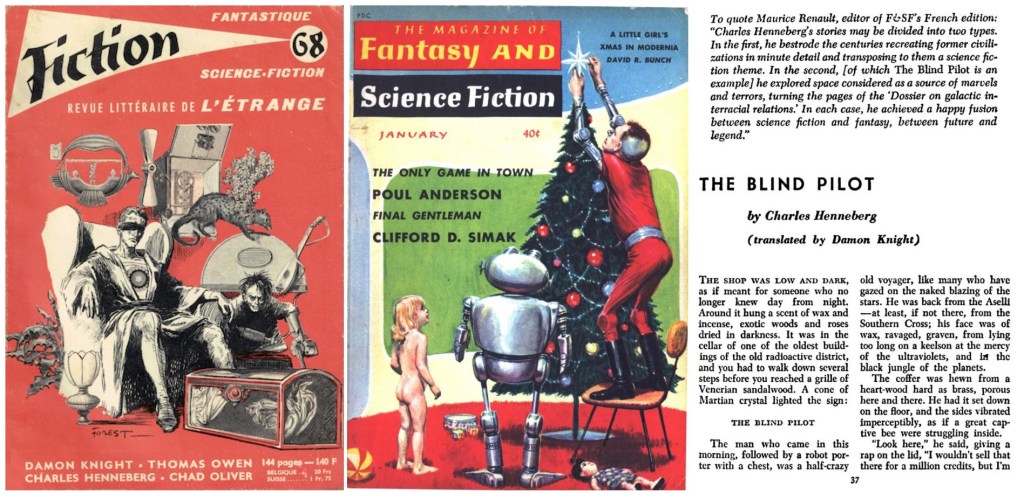
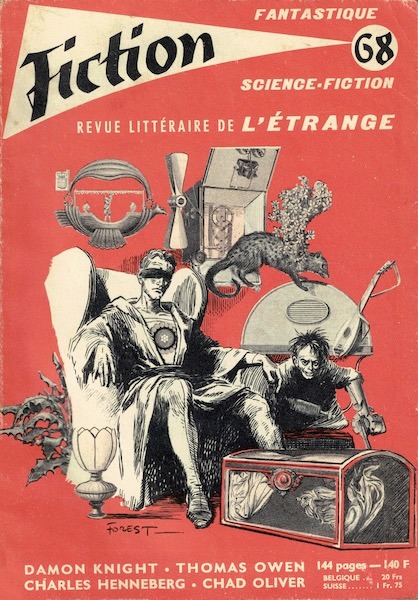
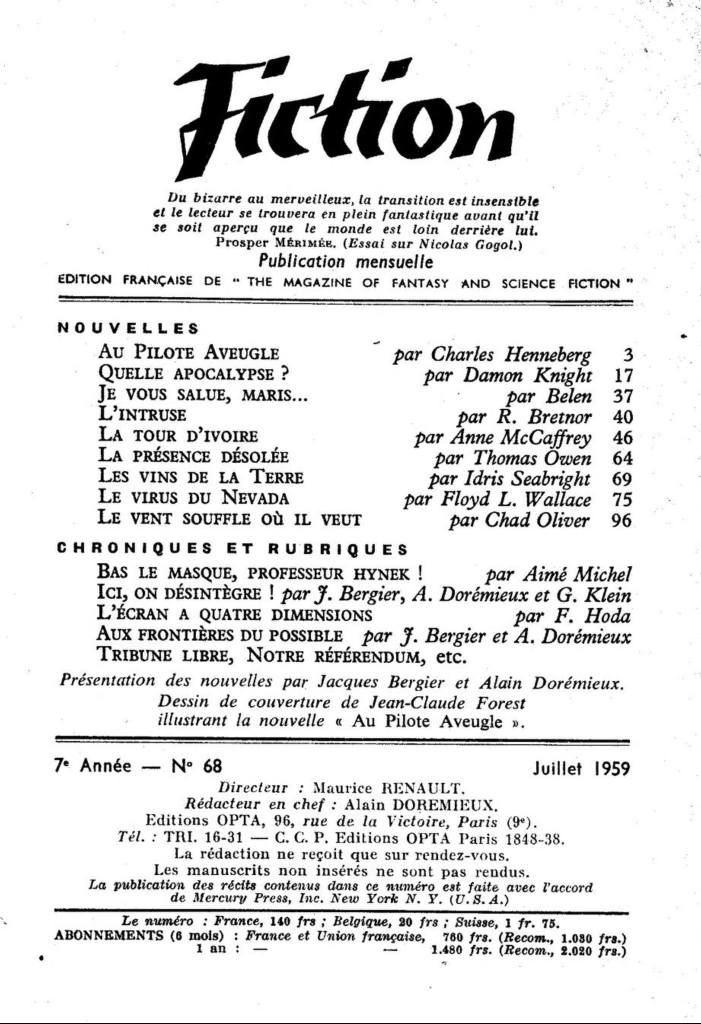
The Blind Pilot” by Nathalie Henneberg is story #14 of 52 from The World Treasury of Science Fiction edited by David G. Hartwell (1989), an anthology my short story club is group reading. Stories are discussed on Tuesdays, Thursdays, and Saturdays. “The Blind Pilot,” translated by Damon Knight from the original French, “Au pilote aveugle“ (Fiction #68, July 1959) was first published in English in The Magazine of Fantasy and Science Fiction (January 1960).

Instead of paraphrasing David Hartwell’s introduction, I’ll just let you read it.

“The Blind Pilot” is real science fiction. Hartwell says it resembles Roger Zelazny’s early work, but it reminded me of a cross between 1950s Alfred Bester and 1960s Samuel R. Delany. Of course, there’s no telling what flavor of writing the original story gave off in the French.

Basically, the story is about an alien who could be from a race of beings that inspired the Siren in Homer’s epic. This idea comes up now and again: fantastic beings in old literature could have been aliens from the stars. To make the story even more exotic, the two humans who encounter the alien are a blind man who used to be a space pilot and his younger brother who is severely crippled. Those two remind me of Delany characters, the alien weirdness reminds me of Bester, and the tie-in to mythology reminds me of Zelazny. But Henneberg couldn’t have known about Delany and Zelazny since the story pre-dates them as writers. That’s why I also say “The Blind Pilot” is real science fiction and not some roped-in foreign literary effort that anthologists want to claim is science fiction.

There were sentences on this page that slightly reminded me of the “Tears in the Rain” scene from Blade Runner.

Even though I consider this story real science fiction and a decent science fiction story, I don’t believe it’s a great SF story. It never takes off, but it does cruise along nicely. A great SF story like “Fondly Fahrenheit,” punches us throughout with unforgettable edginess, while a story like “The Moon Moth” dazzles us constantly with creative imagery. Those stories stay with us. “The Blind Pilot” will fade away quickly.

When you read a lot of science fiction, especially a lot of great science fiction, you realize just how hard it must be to write something spectacular. Our short story club reads anthology after anthology and we often find stories we wonder why they were anthologized at all. Hartwell had certain goals when he aimed to create an anthology that represented science fiction from both the 20th century and stories from around the world. So, far when we’ve read stories from other countries we seldom read ones I think are as great as the best from the English-speaking world. Is that because of translations? Or am I just prejudiced toward my own culture? Maybe, certain SF classics have been burned into my mind, and no new ones, no matter what the language, can compete?

We still have a long way to go in The World Treasury of Science Fiction, so Hartwell still has plenty of opportunity to surprise me. But there’s another problem to consider. I’ve read so many science fiction short stories that I feel that less than 200, maybe even less than 100 stand out from the thousands I’ve read. All too often I feel like I’m comparing all the horses that have won the Kentucky Derby to all the horses that race on any track. And that might not be fair.

But it is what it is. There’s a reason why our method of finding stories for our Classics of Science Fiction Short Story list works so well. When I say a story is only pretty good it’s because I’m comparing them to these stories. The competition is fierce.

James Wallace Harris, 6/6/23

“The New Prehistory” by René Rebetez-Cortes

“The New Prehistory” by René Rebetez-Cortes is story #9 of 52 from the anthology The World Treasury of Science Fiction edited by David G. Hartwell (1989) that my short story club is group reading. Stories are discussed on Tuesdays, Thursdays, and Saturdays. “The New Prehistory” was evidently first published as a short story in a periodical in 1964 according to the only record I can find. It was collected in La Nueva Prehistoria Y Otros Cuentos in 1967, translated as The New Prehistory and Other Tales by René Rebetez. The site linked above lists 19 short stories, all labeled science fiction.

According to David Hartwell in his introduction to the story, “The New Prehistory” was translated by Damon Knight and was first published in 1972. So the publishing history varies. Hartwell says Rebetez-Cortes was Columbian but the cover of the author collection above suggests something different. Google says he was born in Subachoque, Columbia in 1933 and died on December 30, 1999, in Isla de Providencia, Columbia.

“The New Prehistory” is a very short literary allegory that could be called introverted horror. It’s about a man going to a movie but hates waiting in line. He steps away from the line while watching his friend wait in the queue. Then the line becomes possessed by some unseen force and all the people in the line start acting like they’re part of one giant snake-like organism. People who stood in groups became giant amoeba-like organisms. Individuals stayed individuals. Eventually, the new giant organisms take over the world and hunt the individuals.

Even though a lot of people are calling “The New Prehistory” science fiction I’m not. It’s the kind of fantastic story I heard read in creative writing classes from high school to graduate school. In every writing class there always seemed to be one student who everyone thought was brilliant who would write these kinds of fantastic allegories. They were popular with both the teachers and students because they always seemed so damn clever.

I believe writers, and even oral storytellers, have always used the fantastic in their tales. But that doesn’t mean they are science fiction. Some scholars in science fiction have been trying to claim more territory for the genre for decades. They want to both up the reputation of the genre and claim more types of stories as ours. When I was young, I agreed with this. I wanted the genre to have prestige. But after a lifetime of reading, I realize I’m a consumer of science fiction and I want real science fiction, not ersatz sci-fi.

Science fiction is impossible to define so editors can call anything they want science fiction, but as a consumer, I know what I want, and this kind of story is not it. I remember when I was young back in the 1960s and wondering what science fiction must be like written in other countries in other languages. Then in the early 1970s, we got some Soviet science fiction anthologies and I got my wish. Slowly, the idea of world science fiction has grown, but all too often I believe editors have grabbed anything they could to fill their anthologies. I think that’s a disservice to the genre, and dishonesty to the literary world.

I know that other SF readers will accept these stories as science fiction because their definitions of the genre are different. And that’s cool. The reality is we don’t all think alike. But I would like to think that science fiction was a term with validity and to me, the intent of the genre is more specific, even quite narrow.

Just because a story has elements of the fantastic doesn’t make it science fiction or fantasy. I also believe fantasy as a genre covers definite territory too. As an emerging bookworm back when I was in grade school, I’d go up and down the library shelves looking for certain kinds of stories. Stories about space travel, robots, new technology, and time travel. They were always about the future, or they were set in current times when things changed. “The New History” is set in current times and things changed, but I still don’t consider it science fiction. Why? Because of the tone of the story.

I never believed while reading the story that people could become group organisms. If the author had made some kind of case for that it would have been science fiction. But that wasn’t his intent. He was obviously making a case about the horrors of being in a group. As an introvert, I completely understand that angle. It’s a good story for that purpose. But that’s a completely mundane purpose. Science fiction is not about the mundane. Science fiction is about the far out, but as a real possibility, even in humor. I never thought the people in “The New Prehistory” were becoming group monsters, nor did I think the author wanted us to believe that. I felt the author was giving us an allegory about how he felt about the real world.

For me, science fiction has to be about what the real world could become. The fantasy genre is about make-believe worlds, but believable worlds within their own concepts. I know most science fiction is unbelievable, or has become so. For me to think of it as science fiction, I have to believe it’s possible, or at least think people once thought it possible.

James Wallace Harris, 5/25/23

“The Man Who Lost the Sea” by Theodore Sturgeon – 3rd Reading

“The Man Who Lost the Sea” by Theodore Sturgeon is story #6 of 52 from the anthology The World Treasury of Science Fiction edited by David G. Hartwell (1989) that my short story club is group reading. Stories are discussed on Tuesdays, Thursdays, and Saturdays. “The Man Who Lost the Sea” was first published in the October 1959 issue of The Magazine of Fantasy and Science Fiction.

My third reading of “The Man Who Lost the Sea” left my eyes stinging with tears, just like they had for the second reading. Nearly everything I felt while reading the story for the third time I had said in my second review. My first review was all about trying to get everyone to read the story.

I found Sturgeon’s prose while reading “The Man Who Lost the Sea” this time far more vivid than the first two times, and I look forward to reading it again in the future. A couple weeks ago I watched a YouTube video by a guy reviewing classic litature (Joyce, Proust, Pynchon). He said his professor had taught him to really get to know a book required reading it ten times.

I have a self-imposed rule when reading anthologies. Whenever I’m reading a new anthology and it has stories in it that I’ve read before, I reread them — even if they were in the last anthology I just finished. Even if I didn’t like them. Sometimes a story I didn’t like on my first reading, or the second, becomes a favorite.

“The Man Who Lost the Sea” is the kind of story that I use for my 5-star ratings. Those are stories I want to read and reread over my entire lifetime. I’ve probably read “The Man Who Lost the Sea” more than three times because I can’t remember everything I read years or decades ago. I’ve just read and reviewed it three times in a little over two years for this blog. The great thing about doing this blog is documenting my memory, it’s highly unreliable, and getting more so.

Memory is one of my favorite subjects and themes, and “The Man Who Lost the Sea” is also about memory and memories.

James Wallace Harris, 5/17/23

“Triceratops” by Kono Tensei

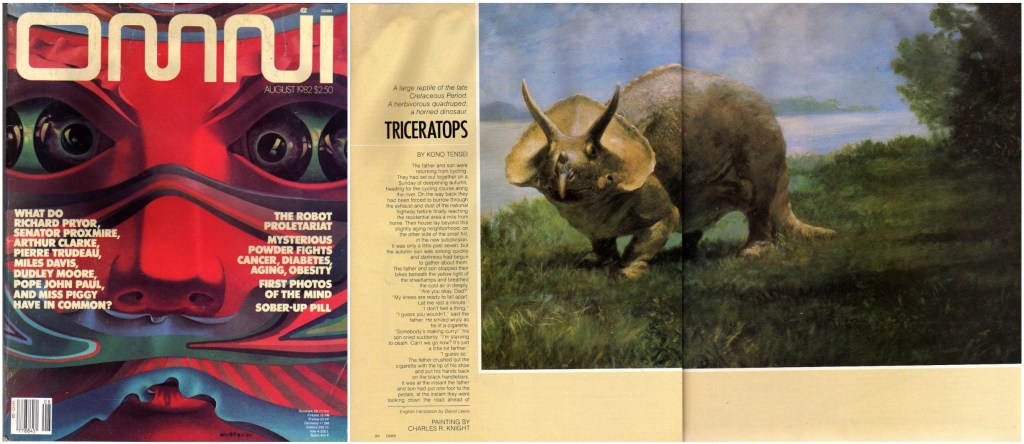
“Triceratops” by Kono Tensei is story #5 of 52 from the anthology The World Treasury of Science Fiction edited by David G. Hartwell (1989) that my short story club is group reading. Stories are discussed on Tuesdays, Thursdays, and Saturdays. “Triceratops” was first published in the August 1982 issue of Omni.

On one level, “Triceratops” isn’t much of a story. Nice enough. Sort of a bland version of Bradbury. A dad and his son are out biking and they see something out of the ordinary. Eventually, they learn it’s a triceratops, and conclude they alone, for some reason that’s not clear, can see into another dimension. Father and son bond over secretly watching a Cretaceous landscape superimposed over their Japanese subdivision.

David Hartwell’s aim is to showcase science fiction from around the world in this anthology, but hopefully, this story isn’t representative of the best SF from Japan or the world. And I’d hate to think Hartwell picked it because he characterizes Japan as a country of big monster fans.

It’s a challenge to find an essay hook for this story. I think I’ll use a video I watched from the Outlaw Bookseller (Steven E. Andrews) this morning on conceptual breakthroughs in science fiction. Andrews begins by talking about the first lines of classic science fiction stories.

The ones we remember have great first lines that announce a paradigm shift. His first example was from Orwell’s Nineteen Eighty-Four, “It was a bright cold day in April, and the clocks were striking thirteen.” The second was from Christopher Priest’s The Inverted World, “I had reached the age of six hundred and fifty miles.”

Unfortunately, Tensei begins his story with “The father and son were returning from cycling.” That’s a rather mundane first sentence. Tensei waits for quite a few paragraphs before bringing on his paradigm shift.

Andrews then goes on to say the best SF stories have a conceptual breakthrough that comes near the end that inspires a sense of wonder. “Triceratops” does depend on a conceptual breakthrough, but it’s in the middle. The father and son decide if they think that the Cretaceous can intersect dimensionally with the present then they can see the two together. The logic of “if you believe it to be true it will be true” isn’t much of a conceptual breakthrough, although the film version of The Wizard of Oz pulled it off nicely.

This is the first story I would have left out of this anthology. Unfortunately, it was the first example of world SF. Not a good start.

I recommend watching the whole video, Top 10 Science Fiction Conceptual Breakthrough Stories: The Elements of Science Fiction Part 1. I should use it as a foundation for evaluating the stories in The World Treasury of Science Fiction. However, it might be aiming too high for the average science fiction story — or should every science fiction story aim to hit one out of the park?

James Wallace Harris, 5/15/23

“Chronopolis” by J. G. Ballard

“Chronopolis” by J. G. Ballard is story #4 of 52 from the anthology The World Treasury of Science Fiction edited by David G. Hartwell (1989) that my short story club is group reading. Stories are discussed on Tuesdays, Thursdays, and Saturdays. “Chronopolis” was first published in the June 1960 issue of New Worlds.

“Chronopolis” is set in the future where society has outlawed keeping time. Ballard imagined a future where our high-tech global civilization collapsed from the complexity of overpopulation. In this new world, the population is much smaller having giving up the rat race.

The story begins in a holding cell. Conrad Newman is awaiting trial for as of yet unspecified crimes. Newman is obsessed with making his south-facing jail cell window into a sundial so he can accurately keep the time while everyone else is unconcerned about when things will happen. Gradually we learn that this society operates without a schedule, and clocks are illegal. They allow timers, which people use to cook eggs, time a math class, or how long they should sleep, but not clocks that force schedules onto life’s activities.

Ballard has come up with a nifty idea. You don’t know if this new world he described is better or worse for not knowing the time, but Conrad Newman is a renegade who secretly embraces keeping time, allowing him to outcompete other people. Newman’s world is the opposite of Harlan Ellison’s “‘Repent, Harlequin!’ Said the Ticktockman.” Conrad Newman is the polar opposite of Everett C. Marm. It’s funny, but we root for each character in their separate stories.

I got to say, I really liked this story a lot even though when you think about it, there’s not much to it. On the one hand, it’s the old fashion kind of science fiction that’s based on a neat idea. On the other hand, it feels different from the other science fiction of 1960 or before. J. G. Ballard is considered one of the pathfinders of the New Wave movement in science fiction in the mid-1960s. “Chronopolis” isn’t really New Wave yet. Probably why it feels different is it’s British science fiction, and British science fiction always felt more grown-up to me.

I’ve only read a couple novels by Ballard, and maybe a dozen short stories, but they’ve all impressed me as being “heavy” in the old hippie sense of the word. I assume that was another way of saying weighty. I recently read “The Terminal Beach” by Ballard and was equally impressed, and it felt equally heavy. Years ago, I bought The Complete Short Stories of J. G. Ballard on audiobook. It’s 55 hours long. I also have it on the Kindle. Whenever one of his stories comes up on the discussion group I like listening to them. They feel mature and atmospheric. I also like reading them because I’m impressed with Ballard’s prose. Each time I read one of his stories, I tell myself I need to listen to the entire 55-hour audiobook and I really want to get into Ballard’s work.

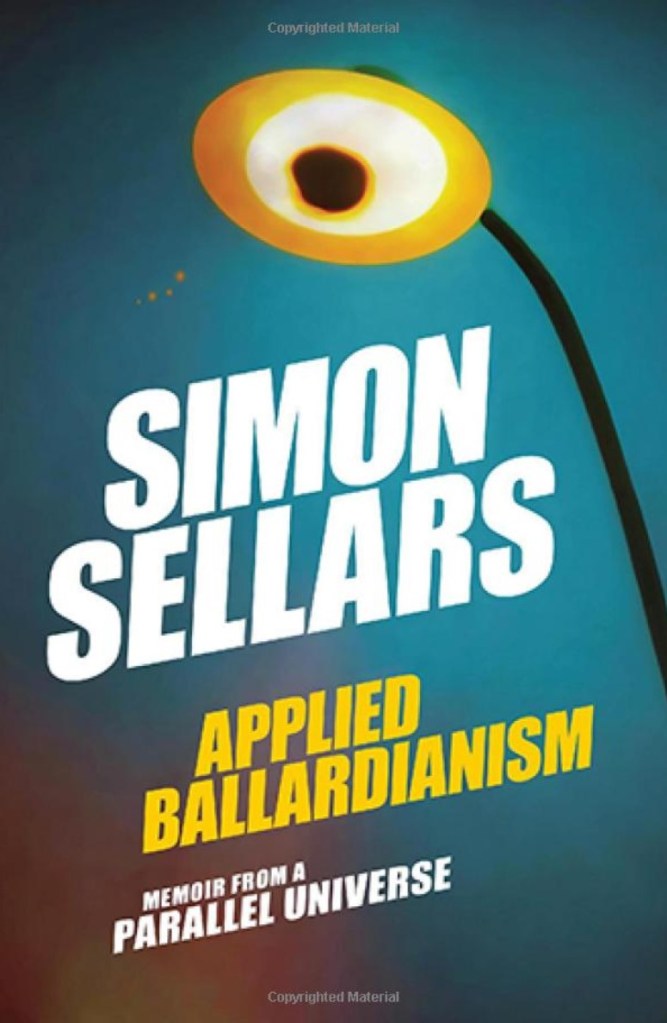
The other day at the Friends of the Library used bookstore I found Applied Ballardianism by Simon Sellars. I couldn’t tell if it was a novel, memoir, monograph, or what, but I bought it. This is how it’s described at Amazon:

An existential odyssey weaving together lived experience and theoretical insight, this startling autobiographical hyperfiction surveys and dissects a world where everything connects and global technological delirium is the norm.

The mediascapes of late capitalism reconfigure erotic responses and trigger primal aggression; under constant surveillance, we occupy simulations of ourselves, private estates on a hyperconnected globe; fictions reprogram reality, memories are rewritten by the future…

Fleeing the excesses of 1990s cyberculture, a young researcher sets out to systematically analyse the obsessively reiterated themes of a writer who prophesied the disorienting future we now inhabit. The story of his failure is as disturbingly psychotropic as those of his magus—J.G. Ballard, prophet of the post-postmodern, voluptuary of the car crash, surgeon of the pathological virtualities pulsing beneath the surface of reality.

Plagued by obsessive fears, defeated by the tedium of academia, yet still certain that everything connects to Ballard, his academic thesis collapses into a series of delirious travelogues, deranged speculations and tormented meditations on time, memory, and loss. Abandoning literary interpretation and renouncing all scholarly distance, he finally accepts the deep assignment that has run throughout his entire life, and embarks on a rogue fieldwork project: Applied Ballardianism, a new discipline and a new ideal for living. Only the darkest impulses, the most morbid obsessions, and the most apocalyptic paranoia can uncover the technological mutations of inner space.

An existential odyssey inextricably weaving together lived experience and theoretical insight, this startling autobiographical hyperfiction surveys and dissects a world where everything connects and global technological delirium is the norm—a world become unmistakably Ballardian.

Some of that description faintly feels like “Chronopolis” but it’s an early story for Ballard, that hints at things to come. Also, by serendipity, I came across this YouTube video by the Outlaw Bookseller on the New Wave. Ballard figures heavily in it. Warning though, this video is one hour and twelve minutes long.

“Chronopolis” is another story that’s pushing me into the world of J. G. Ballard. One of these days, and hopefully soon, I’ll start gorging on Ballard’s books.

James Wallace Harris, 5/12/23

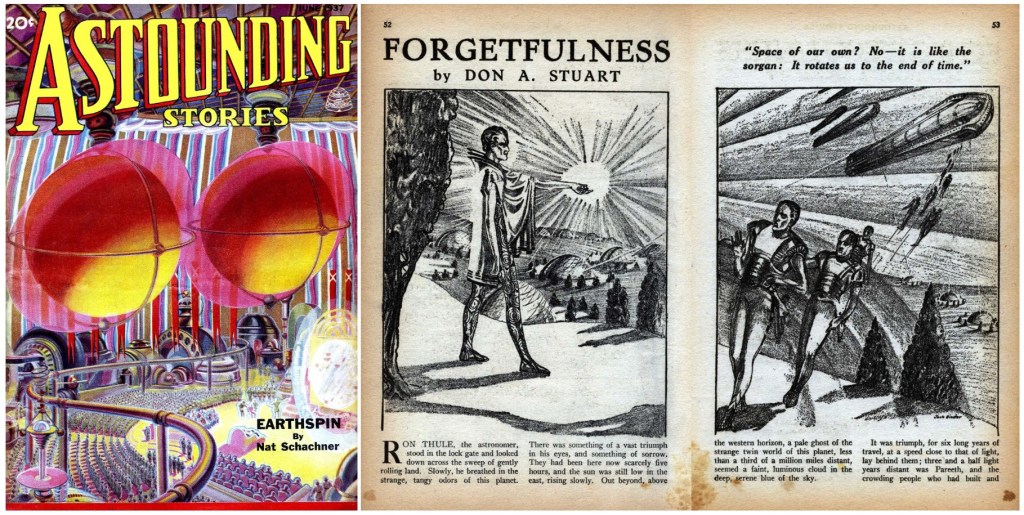
“Forgetfulness” by John W. Campbell

“Forgetfulness” by John W. Campbell, Jr. is story #2 of 52 from the anthology The World Treasury of Science Fiction edited by David G. Hartwell (1989) that my short story club is group reading.

Instead of counting all the titles and authors of science fiction books I’ve read, I’m starting to tally all the far-out concepts science fiction has given me. In “Forgetfulness” John W. Campbell took one of my favorite concepts, walking in ancient dead alien cities, which was probably an old SF concept even in 1937, and gave it a couple twists. It’s going to be impossible to talk about this story without giving spoilers so think of this essay as an analysis of SF concepts and not a review. You can read the story online here, or buy it in a $2.99 Kindle edition of Campbell’s collection Cloak of Aeshir. However, I don’t recommend buying unless you’re a big fan of John W. Campbell.

“Forgetfulness” begins with a spaceship landing on the planet Rhth, one of nine planets in the system. The main point-of-view character is Ron Thule, an astronomer, from the planet Pareeth. They have traveled for six years, in a spaceship 2,500 feet long and 400 feet in diameter, covering 3.5 light-years, traveling at nearly the speed of light. These people from Pareeth are looking for a world to colonize, and are disappointed that Rhth is already inhabited. They hope to settle in the remains of a majestic city that was built by spacing-faring race millions of years ago and discover its secrets.

Try and pronounce Rhth. If nine planets weren’t a giveaway, the name Rhth should be. There they meet Seun, a very tall, graceful human-shaped being, clothed in a golden outfit, with a beautiful colored cape. All the people of Rhth wear gold suits and colored capes and live in opalescent domes twenty to thirty feet in diameter situated under giant green trees near the dead city. The buildings of that titanic city are three thousand feet high, but the winds have filled the streets with five hundred feet of dirt.

Seun has told Ron Thule and the commander of the Pareeth mission, Shor Nun, that the builders of the city had once visited their world. And that their world, Pareeth, once orbited the same sun as Rhth, but had been torn away by a rogue star. This hints that maybe the builders had conducted a kind of panspermia across the galaxy. As the story progresses the achievements of the builders become greater and greater. However, the people of Pareeth eventually discover secrets that can shatter their minds and their hopes.

Most of us find a great sense of wonder reading about the rediscovery of lost cities. So, it’s not a remarkable feat of creativity for a science fiction writer to imagine humans finding long-dead alien cities. Still, it’s one that sets off a powerful sense of wonder and has been used time and again in science fiction.

Campbell puts a twist on this concept, by having aliens discover a city from a long-dead civilization of mankind. John W. Campbell has a reputation that claims he wanted humans to be the galactic crown of creation, and this story supports that. In his earlier story, “Twilight” he had a human time traveler discover a far future deserted human civilization. That gave him a chance to imagine the engineering marvels of what we could achieve someday. In “Forgetfulness” he has aliens discover dead human civilization, but this time, Campbell imagined an even more impressive future for us built by super-science. You should read both stories to see just how hopeful Campbell was for the human race.

Both “Twilight” and “Forgetfulness” could be considered Dying Earth stories, although H. G. Wells in “The Time Machine,” William Hope Hodgson in The Night Land, and Olaf Stapledon in Last and First Men, took that idea, even much further.

Unfortunately, “Forgetfulness” is hard to read. Part of that is due to a dated writing style, but also because Campbell didn’t really have much of a story to tell. They came, they discovered wonders, they were frightened, they were disappointed. There’s no drama or revealed emotions. “Forgetfulness” was reprinted in the classic 1946 anthology Adventures in Time and Space but has been mostly forgotten since. Damon Knight remembered it in his 1966 anthology Cities of Wonder, and Brian Aldiss and Harrison brought it back again in 1973 for The Astounding-Analog Reader. Both are very minor anthologies. The second contained just seven stories from Astounding covering 1937-1941, a rather odd collection.

It’s interesting that a story about remembering has been forgotten. The big concept in “Forgetfulness” is visiting the remains of an astonishing civilization millions of years after its citizens have gone. Campbell puts his own twist on it by having that civilization be a future version of ours. However, there’s another important concept he wanted to get across, and that’s how we forget the past. Shor Nun and Ron Thule can’t understand why Seun doesn’t understand how the city works. But then Campbell reminds us we couldn’t explain the technology of cavemen, or from other periods of human civilization. Remember all the discussions about how did the Egyptians build the pyramids? Well, it turns out Seun has even newer technologies that are even further advanced than the builders and they have merely forgotten earlier primitive technology.

I have to wonder if Arthur C. Clarke’s story “Rescue Party” wasn’t inspired by “Forgetfulness” and “Twilight.” Or that the screenwriters for Forbidden Planet hadn’t read “Forgetfulness” too. Or were their ideas independently invented?

That’s the thing about science fiction. Concepts keep getting reused. Are they forgotten and then reinvented? Or does science fiction evolve over time as concepts merge and mutate? Will some young writer in the 2020s come up with a story about a far-future space race discovering a future Earth and finding the ruins of what our civilization will become? How will this writer imagine the pinnacle of our success? Campbell wanted to believe that humanity will evolve until it has god-like powers. That idea has shown up in science fiction over and over again. But do we still believe that? Right now the peak of our civilization might end this century.

James Wallace Harris, 5/9/23

“Harrison Bergeron” by Kurt Vonnegut

“Harrison Bergeron” is a political satire set in the year 2081. Kurt Vonnegut imagines everyone is not only equal under the law but handicapped to be made equal in all ways. Stronger people are weighed down, talented people are made less talented, and intelligent people have to wear earplugs that make various kinds of noises to distract them from thinking deeply. In this rather short story, George and Hazel Bergeron are watching a ballet on television. They have forgotten their 14-year-old son Harrison has been arrested for being too handsome, too smart, and too strong. During the course of the TV show, their son appears on the ballet stage having escaped to start a rebellion. (You can read it here, or read a detailed synopsis on Wikipedia.)

“Harrison Bergeron” is not a subtle satire, instead it goes for the absurd. It’s a very likable story. Vonnegut tells it in simple language with vivid details. You immediately agree with him that this dystopian world is wrong. This short story has become quite famous, having been adapted to the screen four times. National Review, the conservative magazine founded by William F. Buckley even reprinted the story. The National Review keeps using “Harrison Bergeron” – here’s it being used again in 2015 against economic inequality in “Inching Towards ‘Harrison Bergeron.’

Usually, satire attacks something, and I have to wonder what Vonnegut was attacking. While reading it I thought maybe he was protesting laws designed to create equal opportunity. Then when I read about National Review and that Supreme Court Justice Antonin Scalia quoted the story in PGA Tour, Inc. v. Martin then I began to wonder even more. And it’s referenced in academic papers, including a 2013 one about transgender athletes. I thought Vonnegut was liberal. Wikipedia did say he wasn’t against his story being used in a Kansas court situation, he didn’t agree with their interpretation.

So why have conservatives embraced “Harrison Bergeron” so thoroughly? Are they using its satire the way Vonnegut intended? A site called What So Proudly We Hail promotes the story with a very pointed introduction:

Central to the American creed is the principle of equality, beginning with the notion that all human beings possess certain fundamental rights and equal standing before the law. Our concern for equality has expanded over the past half century to focus also on inequalities in opportunities, wealth, achievement, and social condition. What good is an equal right to pursue happiness if one lacks the native gifts or the social means to exercise it successfully? In this satirical story (1961), set in a future time in which “everybody was finally equal . . . every which way,” Kurt Vonnegut Jr. (1922–2007) challenges our devotion to equality and invites us to consider the costs of pursuing it too zealously. Although the story is not explicitly about racial, ethnic, or gender equality, the questions it provokes about the kind of equality we should want, and the costs of pursuing it, are relevant also to campaigns to eliminate inequalities among racial and ethnic groups or between the sexes. Does the society portrayed here represent a fulfillment of the ideal of equality in the Declaration of Independence, or rather a perversion of the principle? Does opposing invidious distinctions, envy, and feelings of inferiority require reducing all to the lowest common denominator, and is this the true path to “social justice”? Would homogeneity attained by artificially raising up the low, producing a nation of Harrisons rather than a nation of Hazels—a prospect offered by biotechnological “enhancement”—be any more attractive?

The story does resonate with conservative thinking and even more so today. Are there other ways to read it? On the surface, the bad guys in the story are the government and laws that try to make everyone equal in every way. However, was that what Vonnegut was protesting. Was he all fired up and wrote this story the way the conservatives have used it?

I have no idea, but I do wonder about something. Vonnegut’s story is silly, absurd, and far from real. Vonnegut was often silly and absurd. I wonder if he just didn’t get the idea of a government taking the idea that everyone should be equal, and imagining how they could go about making it happen. It was published in a science fiction magazine. If Vonnegut was serious about his satire, why didn’t he publish it in a serious magazine? And back then, bizarre speculation on social change was common in SF stories.

The story came out in 1961, well before the liberal sixties. Eisenhower was probably president when he wrote it. A similar idea about making everyone equal had been used in the 1959 novel, The Sirens of Titan. In the 1950s the main political push to make people equal was providing equal education to African Americans. And that effort was to make people better educated, not dumber. My guess is “Harrison Bergeron” is based on a silly idea that came to Vonnegut and he wrote a story to illustrate it. Conservatives have just run with it.

What’s also interesting is Hazel, the wife, has no handicapping applied to her. She’s average. Was Vonnegut saying something about women? 1961 was also before the Second Wave of feminism in the 1960s. Was he being liberal to make the Handicapper General of the United States, a woman? She had the funny name Diana Moon Glampers? Was this a dig at women?

I don’t think I’ve read “Harrison Bergeron” before. Its basic idea is so memorable that I can’t believe I’d forget it. I could have since it’s been around since the October 1961 issue of The Magazine of Fantasy and Science Fiction. It’s also been reprinted quite often and I could have read it and thought it so absurd as to be completely minor, and did forget it. “Harrison Bergeron” has 9 citations in The Classics of Science Fiction Short Stories v. 2. I just read it because our short story club has just started reading The Treasury of World Science Fiction edited by David G. Hartwell. That anthology is a monster of over one thousand pages of classic science fiction where Hartwell also introduces science fiction from around the world.

Despite its fame, I still think “Harrison Bergeron” is a silly story. I’d only rate it ***+ in my system – three stars mean well-written, and a + means I liked it a lot. Four stars would mean it’s a story I’ll want to reread now and then, and I don’t feel that.

I’m going to try and review as many of the stories as possible from The Treasury of World Science Fiction. I haven’t given up on my Heinlein project, but after gorging on his work for months, I’ve been taking a break. I’ve wanted to get into a science fiction novel I never read but I’m still on a short story kick.

James Wallace Harris, 5/6/23