“The Men Return” by Jack Vance

Group Read 72: The Best Science Fiction Stories of 1957

“The Men Return” by Jack Vance #12 of 20 (ReadListen)

My initial reaction to “The Men Return” was “WTF! Far Out!” It’s not a great SF story, but Vance does produce a different idea.

I’ve often wondered why SF/F writers don’t imagine more far out possibilities when writing fantasy and science fiction because those genres allow for imagining anything. Well, Jack Vance does just that in “The Men Return.” We are told early in the story:

This reminds me of Poul Anderson’s Brain Wave, where our solar system moves into an area of the galaxy with different energy fields and all animal life on Earth becomes five times smarter. It also triggered the memory of Vernor Vinge’s A Fire Upon the Deep and its sequels that features the idea of Zones of Thought, where there are four different regions in the Milky way, each with a different kind of physics. Finally, “The Men Return” made me remember Hothouse by Brian W. Aldiss, and its far future beings.

And until just before the end of “The Men Return,” I thought the story could have been another of Vance’s Dying Earth tales, one closer to the end of humans. It also fits into the Dying Earth theme. Amazon is selling the Kindle edition of The Jack Vance Treasury for $4.99. It collects “The Men Return” and many classic Vance stories, including “Liane the Wayfarer” a classic story from The Dying Earth.

I read “The Men Return” today, and then listened to it, and I’m still not sure what’s happening. There are two groups of beings that talk, but each considers the other group a source of food. The Organisms are named Alpha and Beta. While the Relicts are Finn, our main point-of-view character, two females, Gisa and Reak, and two ancient males, Boad and Tagart. Both groups constantly search for food in a surreal landscape where physics and gravity don’t seem to be working. I might need to read this story several times before I get what Jack Vance was painting in this picture.

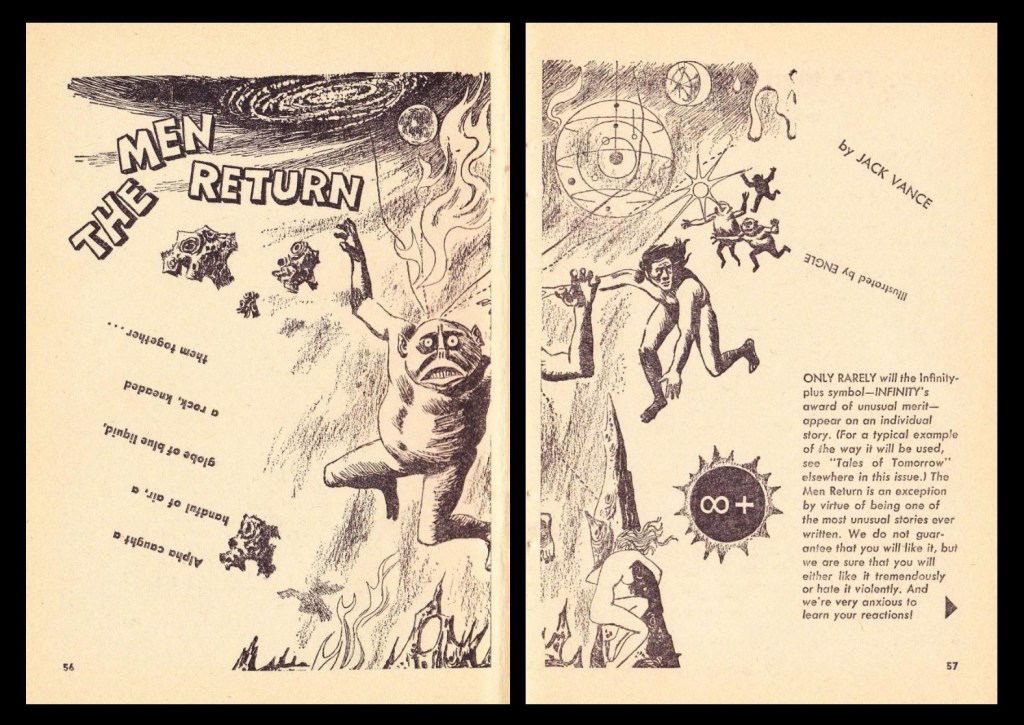
From the story I can’t tell if the two groups are simply different tribes of humans, or if in the far future, humans have evolved into two separate species, or if one of the groups is aliens. The artwork suggests one group is different looking than the other group. I assume the Organisms are either aliens or mutants.

Larry T. Shaw, the editor of Infinity Science Fiction presents “The Men Return” with a new designation, the Infinity + symbol.

Infinity Science Fiction was published from November 1955 through November 1958, and even though it was a second-string SF magazine, it published quite a lot of good science fiction from major names in the genre. The classic SF story, “The Star” by Arthur C. Clarke was published in its first issue.

Shaw’s Infinite + designation reminds me of F. Orlin Tremaine, Astounding Science Fiction second editor, Thought Variant designation for special stories. Asimov wrote “Nightfall” as an imagined Thought Variant story. John W. Campbell later tried to do the same thing with his NOVA designated stories.

Here are the comments Shaw received on “The Men Return” from the October issue.

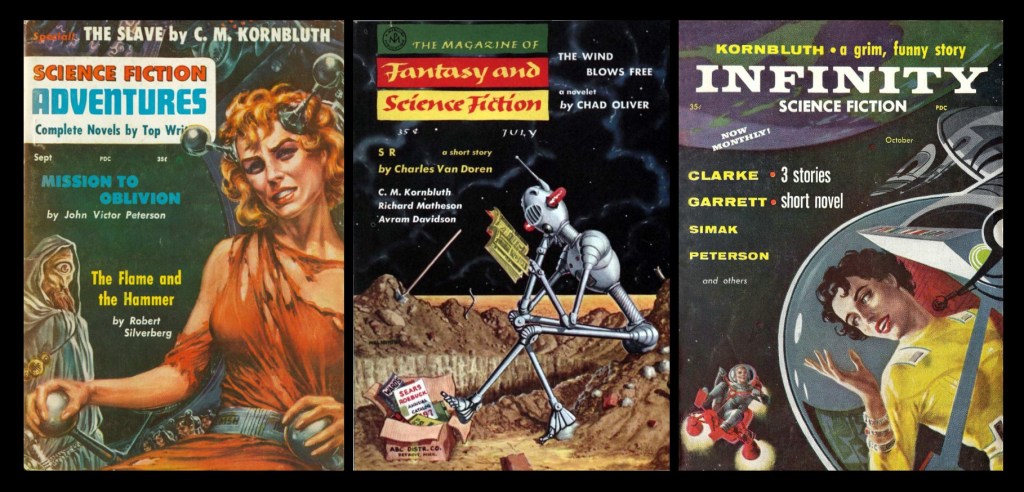
Finally, here’s the cover from the July 1957 issue of Infinity Science Fiction where “The Men Return” appears.

James W. Harris 4/6/24

“Profession” by Isaac Asimov

Group Read 72: The Best Science Fiction Stories of 1957

“Profession” by Isaac Asimov #11 of 20 (ReadListen)

“Profession” isn’t one of Asimov’s well-known stories. It’s not a Foundation or Robot story. The setting is Earth. “Profession” is an SF idea story, and unfortunately, not a particularly exciting one. The idea of writing knowledge directly to the brain is interesting, but how and why it’s used in “Profession” isn’t believable.

Asimov usually wrote idea stories. He seldom developed stories with drama or humor or even satire. I seldom felt anything for most of his characters. “Profession” is about George Platen who wants to become a computer programmer and be sent to another planet. He lives in the future where Earth has colonized many star systems, and they need professionally trained people. Earth has developed a way to educate people by writing directly to the brain, and they export people with extremely specific technical skills. Evidently, Earth has a monopoly on this brain writing technology.

The problem is, one person in 10,000 have a brain that can’t be written to, and they are sent to special institutions where they are told to read and study whatever they want. George is one of these people and is crushed that he can’t achieve his professional dream.

Unfortunately, “Profession” is a short novella, much too long for the solution Asimov eventually gives us. I won’t spoil it though, but I will say Asimov has to stack the deck to pull it off. It’s an unsatisfying ending because the original plot logic is now seen as faulty. In this future, the only education people get is by mind writing. No one wants to put years of studying into any subject because they hate it when they can’t learn instantly.

In other words, Asimov assumes humans will act differently in the future and I don’t think they will, and that spoils his whole premise for the story.

I don’t even remember why I put this story on the list. It did not have even one citation of CSFquery. I just checked and I added “Profession” because Rich Horton picked it in his Hugo nominations for 1957. He even says, “My vote in this category goes to Asimov’s ‘Profession,’ really a quite strong novella.” Just goes to show you how people’s reading reactions are different.

Of the possibilities Rich lists, I would have picked “The Lineman” by Walter M. Miller, Jr. It has some modern-day political correctness problems, but it’s exciting and dramatic. “The Lineman” is about construction crews on the Moon being distracted by a rocket full of prostitutes. You can read it here. Here’s all the novellas that Rich was considered for 1957:

  • “Profession”, by Isaac Asimov (Astounding, July)
  • “The Night of Light”, by Philip José Farmer (F&SF, June) 
  • “The Last Canticle”, by Walter M. Miller, Jr. (F&SF, February) 
  • “The Lineman”, by Walter M. Miller, Jr. (F&SF, August) 
  • “Lone Star Planet”, by H. Beam Piper and John J. McGuire (Fantastic Universe, March)
  • “Get Out of my Sky”, by James Blish (Astounding, January, and February)
  • “Nuisance Value”, by Eric Frank Russell (Astounding, January)

For sheer storytelling, I like all those other writers far better than Asimov. When I was young, Asimov was very appealing because of his ideas, but I never realized how unexciting his stories were back then. He does create interesting setups, but his characters are just chess pieces he moves around to act out an idea. And now that I’m older, I realize most of those ideas weren’t particularly good. Very few of Asimov’s stories had any kind of emotional punch. The one that I remember that does is “The Ugly Little Boy.” It has quite a punch. I also felt some sympathy for the characters in The Naked Sun, but that’s because I read it when I was going through an agoraphobic phase due to a heart arrythmia.

“Profession” does have some neat ideas, but they are tortured to create its plot.

The thing I like best about “Profession” is the Kelly Freas cover. If you loved “Profession” please say so in a comment. Or comment if you agree with me.

James Wallace Harris, 4/5/24

“The Education of Tigress Macardle” by C. M. Kornbluth

Group Read 72: The Best Science Fiction Stories of 1957

“The Education of Tigress Macardle” by C. M. Kornbluth #10 of 20 (ReadListen)

C. M. Kornbluth came out with four short stories in 1957 – “MS. Found in a Chinese Fortune Cookie,” “The Education of Tigress Macardle,” “The Slave,” and “The Last Man Left in the Bar.” None of them stood out as an obvious favorite among readers, with each story having its fans. Isaac Asimov and Martin H. Greenberg couldn’t decide between “The Education of Tigress Macardle” and “The Last Man Left in the Bar” so they published both in The Great SF Stories 19 (1957). Kornbluth died in early 1958, at age 34, so these were the last of his short stories that Kornbluth got to see in print.

I picked “The Education of Tigress Macardle” for the best of 1957 because it had two citations in CSFquery, and the others only had one. However, I’ve had people tell me they preferred either “The Last Man Left in the Bar” or “MS. Found in a Chinese Fortune Cookie.” After reading all three, I feel CSFquery was right, but what do you all think? Follow the links to read the two other stories. I don’t have a link to “The Slave” but it was a novella promoted as a short novel.

Kornbluth was famous for his sharp satire. His brutal wit stabs at several topics in “The Education of Tigress Macardle.” The bit that amused me the most was a throwaway paragraph about the Civil War Book-of-the-Week Club. I chuckled at Mightier than the Sword: A Study of Pens and Pencils in the Army of the Potomac, 1863-1865. There really is a seemingly endless amount published about the Civil War.

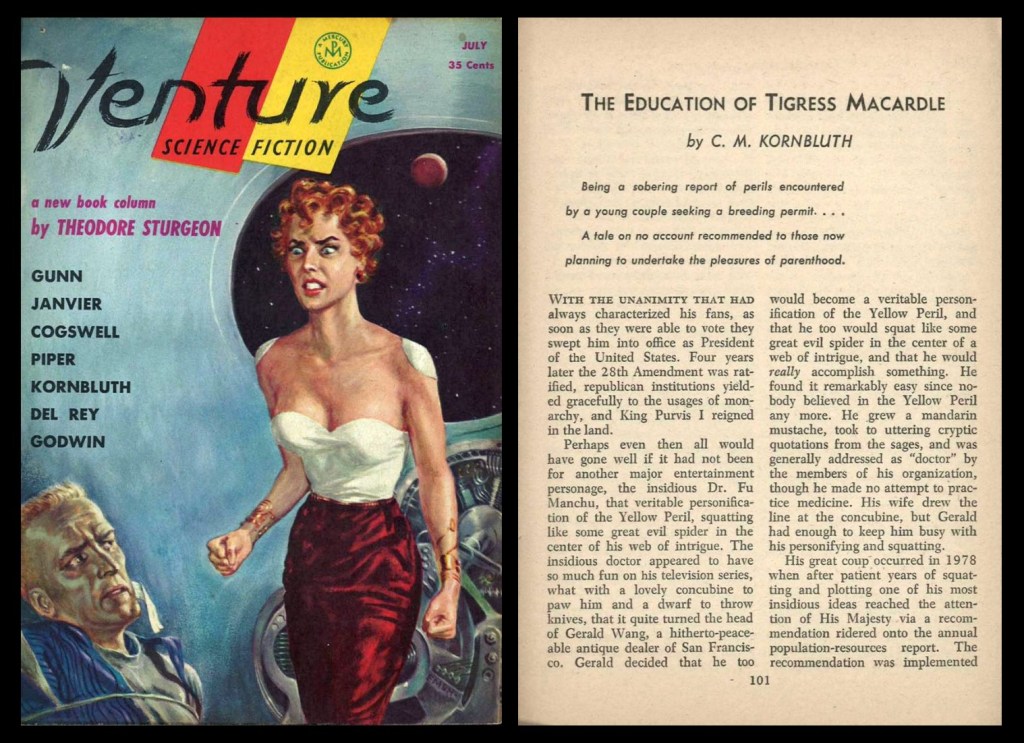
“The Education of Tigress Macardle” begins by informing its readers that in the future, a popular personality was elected President, and he got the 28th Amendment passed that made him King Purvis I. (I hope that’s not prophetic.) King Purvis inspired a guy name Gerald Wang to play at Dr. Fu Manchu and unfold a sneak attack on the United States. We learn all of this because the story is told from the year 2756 A.D. in a class at Columbia University called Chronoscope History Seminar 201. The students of this class watch what happens to George and Diana “the Tigress” Macardle on a chronoscope.

You must read between the lines to pick up all the well-hidden sexual innuendo, and if you miss what little there is, the story might lose a lot of its charm. Kornbluth is aiming at humor, but I’m not sure how many of his jokes I get. George thought he had achieved bachelor nirvana when the Tigress would have sex with him on his bear skin rug in his downtown bachelor pad. Then she whined that she wanted to get married. Then she whined she wanted to have a house in the suburbs. Evidently, George kept getting all the sex he wanted because he kept giving in. Then the Tigress whined to have a baby.

Now here’s where the fun starts. King Purvis degreed that all Americans who wanted to have children must pass a Parental Qualifications Program (P.Q.P.). And Dr. Wang devises a doozy of a potential parent exam that secretly works at his plan to take over America. Parents are given a robotic toddler to take care of for three months. If it’s black box records proper care George and the Tigress will get a permit to breed.

You can imagine the fun Kornbluth provides with this setup. You might not guess the surprise ending. I didn’t.

Another reason I preferred “The Education of Tigress Macardle” over the other two Kornbluth short stories, is because the story is more to the point and clearer. I’m not saying it’s perfectly clear. Kornbluth writing style includes a constant flourish of asides. His prose is baroque with allusions that he hopes will make us smile or admire his wit.

But those filigrees also make it hard to read Kornbluth. Kornbluth relies heavily on things from the future, or beings from other dimensions, or observers from the future. They’re usually a gimmick, a foundation, a diving board, for him to riff with his clever wordiness. Usually, his stories are fun, but seldom have much impact. He has twenty-four stories in CSFquery, but most of them don’t have many citations. I wonder if Kornbluth would have been a good standup comedian. It helps to hear his stories read by a narrator that does voices.

Personally, I believe “The Education of Tigress Macardle” would have been a far superior story if Kornbluth would have hacked off the sections with King Purvis, Gerald Wang, and students from the future. He should have focused entirely on George and the Tigress and spent all his energy making the story subtle, funny, and insightful. The setup with the tryout toddler is great by itself. And he should have worked on the characterizations of George and the Tigress. In 1957 the Playboy bachelor and the emerging liberated woman were ripe for satire.

James Wallace Harris, 4/2/24

“Let’s Be Frank” by Brian W. Aldiss

Group Read 72: The Best Science Fiction Stories of 1957

“Let’s Be Frank” by Brian W. Aldiss #08 of 20 (Read)

Fantasy and science fiction are two genres where writers can imagine anything, but strangely we seldom see stories with first-of-their-kind concepts. As The Bible says, there’s nothing new under the sun. However, I think Brian Aldiss has produced a unique idea in “Let’s Be Frank.” If I’m wrong, I’d love to read other takes on this concept.

I’m never sure how much of a story I should give away. “Let’s Be Frank” isn’t an all-time top short story, or even a best of the year story. There’s a reason writing teachers advise their students “Show don’t tell.” Aldiss tells this story. There’s no tension, no drama, no mystery. Aldiss produced his idea and explained how the billions of people on Earth end up with two conscious minds. Maybe that’s enough of a tease to get you to read the story. (Follow the link above.)

It’s a shame that Aldiss didn’t spend more time with his idea and created a version of the story that showed us what it was like to be a consciousness with multiple bodies. You might think I’m talking about a hive mind, but I don’t think I am. “Let’s Be Frank” does suggest a clever kind of telepathy. Can you imagine being in two bodies at once, one in England and one in Spain, with four legs, four arms, four eyes, and two heads?

If ChatGPT was conscious, it might experience something like this. Imagine being in a million bodies having a million conversations simultaneously? ChatGPT does that.

“Let’s Be Frank” isn’t a memorable short story either. Our group is working to identify the best science fiction stories of 1957. I don’t think “Let’s Be Frank” is one. But it is neat. The act of looking for exceptional stories makes me think about what makes a standout work of short fiction. I haven’t read all twenty we’re going to discuss, but I do know that “Call Me Joe” by Poul Anderson, “Omnilingual” by H. Beam Piper, and “The Menace from Earth” by Robert A. Heinlein are the great science fiction stories of 1957. They are the ones to read, reread, and remember.

Yet, what makes those stories great? What’s missing from “Let’s Be Frank” that’s in those stories? Each of those stories have original ideas too, especially Heinlein’s human powered flying on the Moon. They do have drama and characterization. I’m not sure Aldiss could have dramatized “Let’s Be Frank,” but if he could, it would have made all the difference in the world.

James Wallace Harris, 3/28/24

“The Cage” by A. Bertram Chandler

Group Read 72: The Best Science Fiction Stories of 1957

“The Cage” by A. Bertram Chandler #07 of 20 (Read, Listen)

“The Cage” is a fun story, although I’m not sure I would have included it in a best-of-the-year anthology. It’s a puzzle story. Bertram Chandler had a theoretical problem he wanted to present fictionally. How does one intelligent species recognize another intelligent species? It’s a reasonable question, but how do you propose it in a story?

Chandler had to spend most of the short story setting up the problem. If humans arrived on another planet, we’d assume any intelligent alien species would recognize our abilities. Chandler needed to put humans into a situation where our abilities wouldn’t seem obvious at all.

Chandler begins his story by having the interstellar liner Lode Star go off course and land on a young planet with just primitive life forms. The ship must be abandoned when its reactor goes into a runaway chain reaction, and it eventually blows up leaving no trace of the spaceship.

On this planet it mainly rains. The planet’s ecology has evolved some trees and plants, a froglike creature, and lots of fungi. Some fungi provide healthy food for the humans, but other forms of the fungi eat all their clothes and metals, so the castaways end up buck-naked. They can’t even start a fire because of the constant rain.

That’s when another spaceship lands and captures the humans in nets and takes them to another planet. The humans are put into something like a zoo. Finally, the story gets to the problem: How do they let the aliens know they are an advanced intelligent space faring species?

I’ll let you read the story and find out for yourself. But puzzle stories are intended to inspire readers to think of their own solutions.

I thought the aliens would eventually recognize the humans speak a complex language. But I also assume the humans could have made sign language gestures. Their cage had the same environment as the rainy planet, so they couldn’t make a fire, or build anything.

Puzzle stories are rare in science fiction, at least memorable ones. I can’t recall any others at this moment. I vaguely remember a story where a spaceship couldn’t see outside. I think the crew were trying figure out if they were in orbit around a planet.

I asked Copilot to list science fiction stories that proposed a problem. None of the stories it offered are what I was thinking of as a SF problem story. AIs are impressive right now, but they don’t seem to understand science fiction. I guess I’m assuming Copilot is unintelligent because it’s unaware of science fiction plots. But then, Copilot might not recognize me as an intelligent being either.

When you read thousands of science fiction stories you realize just how hard it is to produce an outstanding story. “The Cage” is decent enough. I would have been satisfied if I had read it in the June 1957 issue of The Magazine of Fantasy and Science Fiction. Personally, if I were an editor, I wouldn’t have selected it for any kind of anthology, but it’s been widely anthologized.

I keep waiting for us to discover another SF story with the impact of “Fondly Fahrenheit” or “Coming Attraction” or “Flowers for Algernon.”

James Wallace Harris, 3/26/24

“You Know Willie” by Theodore R. Cogswell

Group Read 72: The Best Science Fiction Stories of 1957

“You Know Willie” by Theodore R. Cogswell #05 of 20 (Read)

I was disappointed that “You Know Willie” is not science fiction. It’s a story about racism that uses fantasy to make a surprise ending. The story isn’t bad. Both Merril and Asimov/Greenberg included it in their anthologies covering 1957. I remember the racism of the 1950s, and it horrified me as a kid, and I’m white. I remember visiting Mississippi in 1960 and being frightened by the violent emotions of the racists. Such people were sadly all too common. So, I can understand why this story was written. In fact, its fantasy depends on a similar thought I had as a kid.

Back then I wondered what racists would do if they woke up one morning looking like the people they hated. At the time I thought it would cure them of their racist beliefs. Later, when I was a bit older, I wondered if that would be true. Back then I felt if a baby from a fundamentalist protestant family was switched at birth with a baby of a fundamentalist Muslim family, they would grow up to be whatever religion their parents believed.

People seldom break free of their upbringing. That’s why it is important to teach Critical Race Theory. I can remember specific lessons I had as a kid that helped me avoid becoming a racist. I’m not sure a story like “You Know Willie” would have helped. I do remember reading books about race in my late teens, ones that would be banned from classrooms today, that did enlighten me.

I’m sure stories like “You Know Willie” would have made good people feel better about themselves when they read it back in the 1950s, but I don’t think it would have altered the thinking of bad people. I’m sure Cogswell was well-intended when he wrote this story, but he should have aimed higher.

Would racists have a come-to-Jesus moment if they suddenly turned the color of the people they hated? We don’t get to find that out in “You Know Willie.” This story goes for the easy win and doesn’t explore anything deeper. Willie experiences a kind inverse Golden Rule — have others do unto you what you have done to others. We saw the surprise ending coming from a long way off.

For this story to be truly memorable, we needed Willie to have lived long enough to see how a change in color would have affected his thinking. For me, the story brings up the ugliness of racism only to play it for a laugh. I didn’t like that.

James Wallace Harris, 3/23/24

“Between the Thunder and the Sun” by Chad Oliver

While my Facebook group is reading twenty stories selected as the best short science fiction of 1957, I’m also searching for other stories from that year that also deserve to be remembered. I think I found one with “Between the Thunder and the Sun” by Chad Oliver, from the May 1957 issue of F&SF.

The trouble is I can find no other recognition for this story. That makes me doubt my own interest in the story. I want to advocate “Between the Thunder and the Sun” not because it’s an exceptional story but because it tackles a serious subject, one that might be new to science fiction in 1957. If you know of early stories on this theme, leave a comment.

Chad Oliver was an anthropologist who worked at the University of Texas. He wrote a fair amount of science fiction, but I only remember him for Mists of Dawn, a 1952 Winston Science Fiction juvenile I read as a kid. Oliver had more success as a western writer. “Between the Thunder and the Sun” was only anthologized in one notable anthology, The Best from Fantasy and Science Fiction, Seventh Series edited by Anthony Boucher, which is essentially the best of 1957 from F&SF, so it’s picking its own children to praise. Still, I need to remember that anthology in my search for other standout SF stories from 1957.

What makes “Between the Thunder and the Sun” significant is it’s a Prime Directive story, a concept that emerged from Star Trek: The Original Series. Evan Schaefer is a professor contacted secretly about a mission to a planet where the population of intelligent beings were dying off on one continent. Because those beings have not reached a stage where they could survive the culture conflict of meeting a technologically superior species from Earth, it is against all our laws to even contact them, much less help them. However, a secret group wants to break those laws and save those beings. Their method of helping the aliens is to get them to understand ecology, because their current practices are self-destructive. And even still, their altruistic efforts only reinforced the Prime Directive laws.

What made this story stand out to this afternoon was I had just watched a YouTube review of Hard to Be a God by Arkady and Boris Strugatsky, a 1964 Russian novel that was translated into English in 1973 that is also about the Prime Directive. This made me wonder when the concept first appeared in science fiction or as a public concept. I can’t answer that question, but I hope readers of this blog can, and will comment below.

“Between the Thunder and the Sun” is a pleasant enough story to read, but it lacks suspense, drama, tension, and when conflict does arrive near the end, it just happens. Oliver wrote the story as an unfolding narrative. There’s lot of interesting ideas in the story, lots of imaginative details, but the story just doesn’t zing.

Should we remember a science fiction story just for its ideas? If you look at a list of the most remembered SF short stories, they are often based on remarkable ideas. But nearly all of them have remarkable storytelling too.

Neither Judith Merril, T. E. Dikty, or Asimov and Greenberg included “Between the Thunder and the Sun” in their anthologies of the best science fiction stories of 1957. That’s striking out three times. However, Merril did include the story in her honorable mentions.

If you get a chance, read “Between the Thunder and the Sun” and let me know what you think. Here’s the link again.

James Wallace Harris, 3/19/24

“The Mile-Long Spaceship” by Kate Wilhelm

Group Read 72: The Best Science Fiction Stories of 1957

“The Mile-Long Spaceship” by Kate Wilhelm #03 of 20 (Read)

I’ve read “The Mile-Long Spaceship” before, in The Great SF Stories 19 (1957) edited by Isaac Asimov and Martin H. Greenberg. I read it again today as it appeared in the April 1957 issue of Astounding Science Fiction. Then reread it again. I’m still not sure I got exactly what Wilhelm intended. I’m especially confused by the ending. I tried finding reviews of this story, but only found a couple, and neither reviewer seemed to care much for this tale and didn’t dwell on understanding it. However, Richard A. Lupoff liked the story so much that he picked it for his collection What If? an anthology of stories he believed should have won a Hugo for the years 1952-1958.

“The Mile-Long Spaceship” is about telepathy. Allan Norbett had a car accident, and while he was in a coma for six days, his mind roamed the galaxy, and he found a mile-long spaceship. That’s one explanation. Another is, while Allan Norbett was in a coma, aliens in a mile-long spaceship made telepathic contact with him, and that made Allan believe his mind roamed the galaxy while he was in a coma. There’s a subtle difference there, but it might matter.

The story’s third person point of view shifts back and forth between closely following Allan when he’s conscious back on Earth, when his mind is traveling around the galaxy, and closely following the aliens on the mile-long spaceship.

From Allan’s perspective, he’s having some wild dreams. But when he’s dreaming, he enjoys speeding around the galaxy with an eye-less perspective. Allan thinks this mind viewing is better than eye viewing because he sees a broader field of view that is sharper and more detailed.

However, when we’re with the aliens on the mile-long spaceship, we’re listening to a conversation between the captain, astrogator, telepath, psychologist, and ethnologist. The captain is anxious to find Earth because he believes his race must always be the superior race and plans to make us their slaves. The astrogator struggles to find where Earth is located from what the telepath can read in Allan’s mind. Allan doesn’t know much about astronomy. The psychologist wants to interpret the telepath’s reports as if they were analyzing the chaotic dreams of an inferior species. The ethnologist also tries to understand our civilization from what the telepath reports of Allan’s memory of our history. However, the telepath feels Allan is more evolved than what the captain wants to believe or what the psychologist assumes to be true, but neither will believe him.

The reason I wonder if Allan is mentally space traveling on his own is because he sees things when the mile-long spaceship isn’t around. I was never sure if he had that power, or if the telepath was putting those scenes into his mind.

Eventually, the aliens get Allan to watch lessons on astronomy using a three-dimensional screen, but Allan gets bored. So, the captain orders the telepath to secretly suggest to Allan to study astronomy. However, when Allan gets out of the hospital, he takes night courses in atomic energy.

When the captain hears this, we get this ending: “Quietly the captain rolled off a list of expletives that would have done justice to one of the rawest space hands. And just as quietly, calmly, and perhaps, stoically, he pushed the red button that began the chain reaction that would completely vaporize the mile-long ship. His last breath was spent in hoping the alien would awaken with a violent headache. He did.”

I can’t make absolute sense of this ending.

Why would this captain blow up his ship? At one point Wilhelm says they might be a million light years away, so the mile-long spaceship would not even be in the Milky Way galaxy. Has the captain decided that Allan has been spying on them, inspiring him to study atomic weapons?

“The Mile-Long Spaceship” deals with one of the major science fiction themes of the 1950s, telepathy. And it’s also about first contact, a major subtheme.

Starting in the 1930s and peaking in the 1950s, science fiction often portrayed advanced intelligences as having telepathy or ESP (extrasensory powers). Sometimes this is referred to as psionics. Did the captain of the mile-long spaceship suddenly realize that they had discovered a race of beings with latent ESP? On the mile-long spaceship, only the telepath has psionic power, and its apparently only telepathy. Allan seems to have the ability to see at a distance, which could be a more powerful talent.

Personally, in our real world, I believe ESP is pure fantasy. But it does make for some wonderful science fiction stories. My favorite of such stories is Time for the Stars (1956) by Robert A. Heinlein. In that story, Heinlein proposes that twins could have telepathy, and that telepathy isn’t affected by Einstein’s speed limit. In Heinlein’s fictional future, we build slower-than-light spaceships, and make one twin a crew member, and the other a receiver back on Earth. Or put one twin on one spaceship and the second on another spaceship. This creates what Ursula K. Le Guin did with her concept of the ansible.

In “The Mile-Long Spaceship” telepathy is evidently instantaneous, like how Heinlein imagined. Of course, not much is explained. Why doesn’t the telepath on the mile-long spaceship hear the voices of billions when he’s listening in on Earth? This is why I think Wilhelm is suggesting that Allan has mental powers and finds the mile-long spaceship, and that’s when the telepath detects him.

Wilhelm’s story is also a first contact story, and she mentions this old issue: Do we want an intelligent species from another star system to know we’re here? Since the captain blows up his ship, he’s obviously afraid that Allan will discover their existence and home world. But from Allan perspective, he was just having vivid dreams. The telepath knew that, but he didn’t convince the captain not to press the self-destruct button.

Evidently, the captain felt any possibility was too much of a risk. This reminds me of the film Oppenheimer when General Groves overhears scientists taking bets on whether the first atomic bomb will set off a chain reaction that will ignite the world. Oppenheimer explains to the panic general that the likelihood is near zero, but not zero.

The captain obviously thought the chances of us finding them was not zero, so he’s takes no chances. Now that’s my interpretation. But I’m not confident with it because Wilhelm never explains why.

What’s interesting is science fiction seldom deals with ESP anymore. It’s still used mostly in comic books and fantasy, but not very often in science fiction. Nor do we worry as much about giving away Earth’s location in first contact stories.

A whole monograph could be written on ESP/Psionics in science fiction, and another on first contact stories. I believe the public became skeptical of ESP after scientific studies investigating it produced zero evidence And nowadays, first contact stories are usually about the problem of overcoming language barriers, spreading microbes, or conflicting cultures and psychologies. I wonder if we’re less paranoid?

James Wallace Harris, 3/15/24

“The Queer Ones” by Leigh Brackett

Group Read 72: The Best Science Fiction Stories of 1957

“The Queer Ones” by Leigh Brackett #02 of 20 (Read)

Ever wonder why science fiction imprinted on you as a child? Why does the genre appeal so strongly to some people? What’s its subconscious attraction?

Psychoanalyzing 1950s science fiction reveals a deep-rooted desire to contact aliens. UFOs became a mania in that decade, which spilled over into the 1960s. UFO crazies seemed to have disappeared after that. But they’re back today. I do believe that humanity suffers from cosmic loneliness. Or is it something else?

“The Queer Ones” by Leigh Brackett speaks to both xenophobia and loneliness. I’m not going to give spoilers right away, but I recommend you follow the link above and read the story. It offers bit of a mystery, so I don’t want to spoil your reading fun, but I want to have my say eventually. However, “The Queer Ones” fits the mold so well for this kind of 1950s science fiction story, that it might not be much of a mystery for aficionados.

My first reaction to reading “The Queer Ones” was to feel it was a mirror image of Zenna Henderson’s People stories. But instead of finding gentle aliens out in the backwaters of rural American, we encounter thugs from the stars. I’m reminded of Heinlein’s Have Space Suit-Will Travel. Henderson’s aliens are a version of the Mother Thing, while Brackett’s aliens act like Wormface, but they look human. They even coop human lowlifes.

Leigh Brackett takes on the tone of Clifford Simak in “The Queer Ones,” and it’s hugely different from her planetary romances. She can’t seem to resist herself though because romance does sneak in towards the end.

Hank Temple is the owner/editor of a small town, six-page newspaper. Doc Callender contacts Hank about a curious child, Billy Tate. X-rays and bloodwork show this kid to be strangely different. If fact, the doctor had been called in because Bily had been beaten up by other kids for being different. He looked human, but Billy was slight, redheaded, and a tiny bit odd.

As it turns out, Sally Tate is a young country girl who got put in the family way by a fast-talking stranger. Her child, Billy, grew up to become a kid that Sally’s hill country clan intensely disliked. The Doc calls Hank to see if he wants to drive out into the middle of nowhere to meet this backwoods family. That’s when the mystery starts. Hank and Doc’s first theory was Billy was a mutant.

Mutants are another popular theme of 1950s science fiction. The cause of mutant humans in SF is varied, but two reasons were popular. Radiation from atomic bombs, and the emergence of Homo Superior was the other. This also paralleled our fascination with aliens. Either they were monsters, or advanced beings with godlike powers. Both show up in “The Queer Ones.”

However, the beginning flavor of “The Queer Ones” is much different than the flavor at the end the story. Early on, Brackett taps into the kind of atmosphere we find in Way Station by Clifford Simak. I’d call that theme: Aliens Living Hidden Among Us. Other books like that are A Mirror for Observers by Edgar Pangborn, The Man Who Fell to Earth by Walter Tevis, and as I’ve already mentioned, Pilgrimage: The Book of the People by Zenna Henderson. Superman comics did this too. Henderson essentially steals Superman’s origin story for her People stories. And if you remember, quite a few episodes of The Twilight Zone featured beings from beyond living amongst us.

The plot takes a sinister turn when Doc is killed. Hank realizes their snooping has gotten back to Billy’s father. Then the hospital is burned down with Doc’s evidence. That’s when Hank catches his first alien, a young woman, Vadi, who turns out to be the sister to Billy’s father. That’s when Hank realizes that Billy’s father is not another mutant, but an alien.

Hank is turned on by Vadi. Sally Tate, and all the women of her family had been turned on by Billy’s father, who we eventually learned is an alien called Arnek. Now this is an interesting sub-theme of cosmic loneliness. Leigh Brackett doesn’t go into this, but how can Arnek mate with Sally Tate and produce a child? This has come up in later science fiction stories. A theory to answer that question is panspermia. That theory helps to explain why many of the aliens in Star Trek look human, but it also suggests that God or advanced aliens seeded/populated/colonized the galaxy on purpose. Maybe we weren’t meant to be alone and miss our cousins.

This also suggests that our psychological fear of cosmic aloneness can sometimes overcome our ingrained xenophobia. We want the universe, or at least the galaxy, to be inhabited by beings like us. Even reading stories about aliens gone bad fulfill the need to know were not alone.

Let’s backtrack a minute. Did our hangup of being alone in the universe emerge with UFOs in the late 1940s? I don’t think so. Doesn’t the desire for aliens and angels fulfill the same existential craving? And don’t we have stories of humans and angels falling in love with each other, even having sex. The Bishop’s Wife comes to mind, but then there’s Wings of Desire and City of Angels. Ancient literature is full of aliens if you squint at supernatural beings from a certain angle. Isn’t God a kind of top boss alien? The Bible and other ancient religious work often describe whole species of aliens as part of taxonomy of beings not of this Earth. Sure, the Greek gods weren’t light years away, but they were from on high.

Science fiction doesn’t have that many themes. It tends to explore the same ones over and over, and if you look at them in the right way, those themes have always been around, even before science and science fiction. Just imagine how deep they go when you think about Neanderthals encountering Homo sapiens? We hate the other, but we loath the idea of being by ourselves in reality.

Stories like “The Queer Ones” appealed to me as a kid, and I don’t think I’m alone. Shouldn’t we ask why? For all our eight billion, most of us are lonely. Even if we have plenty of family and friends to keep us company, don’t we feel that something is still missing? Don’t we have a longing for something greater? And isn’t the reason so many people believe in God is because they want a personal relationship with a higher being? Wouldn’t you want a personal relationship with an alien?

In the end, Sally runs off to the stars with Arnek, leaving Billy behind. Hank takes Billy to raise him but wishes he had a wife to help. Hank doubts he will ever marry because after kissing Vadi once, he longs for her too much to settle for a human companion. That’s very strange, don’t you think? Is Brackett suggesting that we’re missing a higher spiritual connection because aliens are our true soul mates?

I doubt we’ll ever meet aliens on Earth, or visit them on other worlds, but we might not stay alone for much longer. Artificial intelligence is progressing so fast that we might have new digital friends soon. R. Daneel Olivaw might arrive before we return to the Moon. Science fiction always promised us robots too. I wonder if we’ll encounter any in the next eighteen stories from 1957.

——

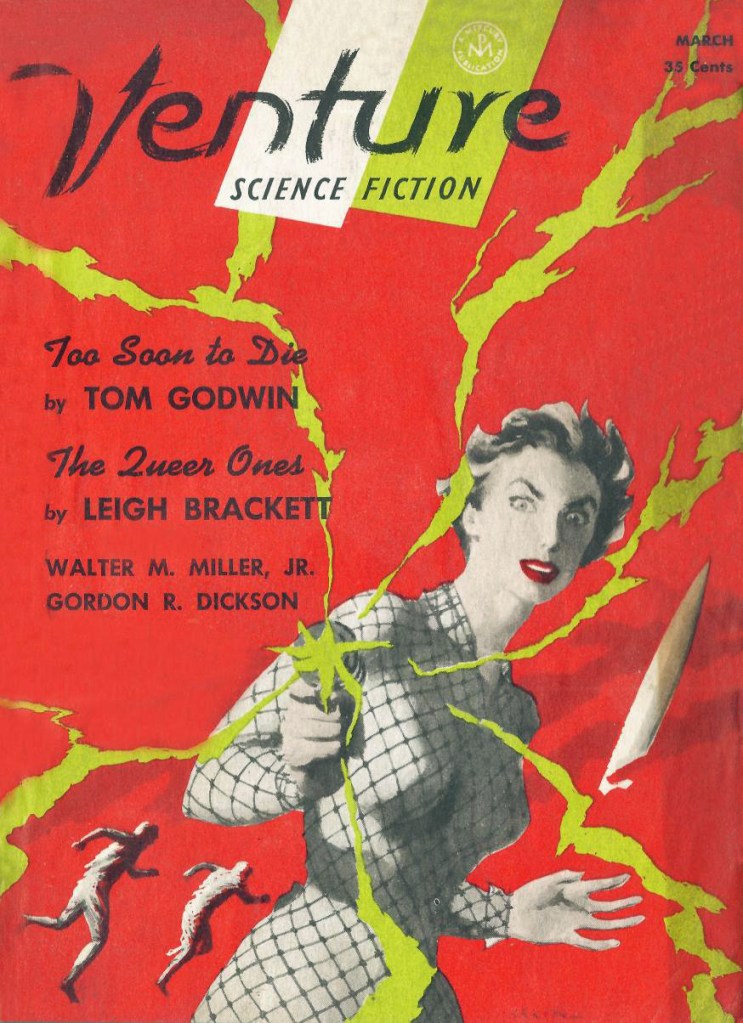
“The Queer Ones” first appeared in the March 1957 issue of Venture Science Fiction. Dave Hook became so entranced by its cover that he researched and wrote “Who is Artist ‘Dick Shelton’.” It’s another fascinating stroll down memory lane if you love old SF magazines and their artists who do their covers and interior illustrations.

James Wallace Harris, 3/13/24

“The Other Celia” by Theodore Sturgeon

Group Read 72: The Best Science Fiction Stories of 1957

“The Other Celia” by Theodore Sturgeon #01 of 20 (Read, Listen)

It’s ironic that in the 1960s I grew up reading 1950s science fiction to imagine the future, but now in the 2020s, I’m reading 1950s science fiction to reconstruct the past. We’re now living in yesterday’s future. When we’re young we think science fiction is all about the future, but when we’re old we realize that everything is about the present. My present is figuring out how the past made me at this moment. My brain is like ChatGPT but trained on decades of science fiction. My hallucinogenic output is shaped by that.

How can old science fiction stories reveal anything about the past? And how can that knowledge reveal anything about who I am at this moment? I can offer a comparison that might answer part of that question. My father died when I was eighteen, in 1970, before I got to really know him. Ever since, I’ve been trying to figure out what my father thought from the clues he left behind. It’s not a particularly revealing method because it’s mostly speculation. Reading old science fiction lets us speculate about what science fiction writers and readers were like when the stories were first written, and maybe what we wanted from them, and why.

I vaguely remember 1957. That September I started the first grade. Sputnik, the first satellite, blasted into orbit the following month, but I don’t remember that. I was only five then. I turned six at the end of November, but it made me no wiser or more aware. “The Other Celia” by Theodore Sturgeon had come out in the March issue of Galaxy Science Fiction, which means it was on the stands in February. At the beginning of 1957 I was in kindergarten. I had no idea that science fiction existed. My favorite show then was Topper. I believe this was before I was aware of rockets, robots, and even dinosaurs. In 2024 rockets and robots are everywhere, and we know a whole lot more about dinosaurs.

My guess from reading about Theodore Sturgeon, and reading his stories, is he barely made a living by writing. He had to crank out stories to buy food and pay the rent. I feel he must have been an autodidactic who knew something about everything. Sturgeon’s stories suggest he’d lived all over, seen a lot, and tried his hand at doing most things too. I assumed Sturgeon combined personal experience and took an occult idea, popular with weirdo thinkers in 1956, and turned it into a science fiction story. It may or may not have symbolized certain kinds of real people.

I do remember that the world was quite a different place in 1957 than it is in 2024. I remember the cars, the houses, the clothes, the people. The setting of “The Other Celia” is a boarding house. My grandmother managed an old apartment building where elderly people like herself lived. I remember staying with her at various times and visiting the old folks there. I can even remember the smells. One old lady I met had been on the Titanic as a child. I imagine Sturgeon stayed in boarding houses and meeting countless interesting people. All, grist for the mill of writing.

I also remember boarding houses from television shows in the 1950s. The rooms at my grandmother’s apartment building were very much like the rooms described in “The Other Celia.” We lived in Miami, and my grandmother’s building was on Eighth Avenue, which is now part of Little Havana. The Miami of the 1950s was far different than the Miami of today. The rooms were warm and musty, without air conditioning. The hallways and stairs were covered with ancient carpets that deaden sound. And all the inhabitants were old. There were transoms above the doors, and residents cranked their windows open wide to let in the breezes. The occupants had basic furnishings, few clothes, lots of photos and knickknacks, and little else. The rooms were mostly filled with memories and solitary people. Today, our everyday lives are crammed with junk, so I doubt young people can imagine how the boarding house people of “The Other Celia” lived back then with so little.

All those memories came back while I read Sturgeon’s story. I’m not going to talk much about the story because I don’t want to spoil it. I thought for sure Sturgeon had painted himself into a corner that he couldn’t get out of but does. I loved the story for the setting and characterization. They are very real. Sturgeon’s solution is fantastic and unreal, and only amusing because it reminds me of the popularity of such wild beliefs back then.

I can’t help but wonder if people who lived in 1950s boarding houses, or old apartment buildings like the one my grandmother managed, read magazines like Galaxy and F&SF? Or only weird kids like me, who became crap artists. I was in high school before I met another science fiction fan. SF readers were rare. Did normal folks back then think about the future or aliens or the supernatural? As I got a little older, I remember chattering away about science fictional stories and concepts. I’m sure the old folks at my grandmother’s apartment thought I was one strange little man.

“The Other Celia” is not really a science fiction story as I think of science fiction today, yet its two citations in CSFquery were One Hundred Years of Science Fiction (1968) edited by Damon Knight and Modern Classics of Science Fiction (1992) edited by Gardner Dozois. The story has been frequently reprinted, lastly in 2023, in the anthology Atomic Werewolves and Man-Eating Plants: When Men’s Adventure Magazines Got Weird. That’s another clue in describing how 1957 was different from today, and how science fiction was different too. Those men’s magazines of the 1950s and 1960s were another strange subculture and model of reality. If you want to get closer to what I’m getting at read Confessions of a Crap Artist by Philip K. Dick. It’s a mainstream novel PKD wrote in 1959, and my favorite of all his novels. To me, it captures the 1950s I remember.

Version 1.0.0

I don’t know why “The Other Celia” was published in Galaxy when it should have been in The Magazines of Fantasy & Science Fiction. Back in the 1950s people were still reading old books and paperbacks by Charles Fort. “The Other Celia” is a Fortean tale. My uncles loved to talk about woo-woo shit like that. The 1950s were when the uneducated found transcendence in UFOs, Edgar Cayce, and Bridey Murphy.

Although, “The Other Celia” isn’t about the future, space travel, robots, it might be about aliens, and it might not. I highly recommend taking the time to read this story. The issue of Galaxy that it’s in, is online, in case you want the whole context.

Theodore Sturgeon does a beautiful job of sucking the reader into a strange mystery by describing the habits of a peculiar character, Slim Walsh. Walsh is a nosy guy, the kind who checks out the medicine cabinet when he uses other people’s bathrooms. He sneaks into other people’s rooms at the rooming house when they are gone. Not to steal, but to just see the secret side of how other people live. The story is about him discovering the very strange lifestyle of Celia Barton.

What’s great about this story is the writing. Sturgeon slowly mesmerizes us with savory details. I would have loved the story even if it didn’t have its fantastic element. “The Other Celia” could have been a literary story, but it didn’t go in that direction. As the story unfolded, I kept wondering where Sturgeon was going to take us. His story was so down to earth that I couldn’t imagine it turning into science fiction or fantasy. Yet, it does, eventually arriving smack dab in Rod Sterling’s territory. “The Other Celia” would have made a classic episode of The Twilight Zone; one Charles Beaumont could have written. Or it could have been a comic strip illustrated by Gahan Wilson or Charles Adams.

“The Other Celia” is a delightful story to begin our group reading of the best science fiction of 1957, not because it’s great science fiction, but because it’s a well-written work by a consummate crap artist. That’s another thing young people today don’t understand. Being a science fiction fan back then made you an outcast, a weirdo, a nerd, a zero. But stories like “The Other Celia” appealed to a certain kind of person, people who loved to watch Alfred Hitchcock Presents (1955-1965) or read EC Comics.

I’m not surprised that Dikty, Merril, nor Asimov and Greenberg left “The Other Celia” out of their anthologies. Yet, it works perfectly for my contention that 1957 was so much different from today. Everyday life in America keeps mutating and transforming. I want the group reading all these 1957 sci-fi stories to help us remember the strange world of science fiction fans back then. But try to reverse the view. Just imagine what the people of 1957 would think about 2024 if we could send a 65″ HDTV to them and let them watch Netflix, Max, Apple TV, and Hulu. We’d scare the bejeezus out of them. They’d think The Garden of Earthly Delights by Hieronymus Bosch a reasonably normal picture of reality.

We now live in a time when almost everyone is a crap artist, of one kind or another.

Just think of all the speculative theories people of 1957 would produce to understand how America turned into what they see in our 2024 television shows. What I want to do is speculate about what life was like in 1957 from reading twenty science fiction stories from that year. It could explain a lot about how we arrived at this present. It’s stranger than The Twilight Zone.

James Wallace Harris, 3/11/24