The State of the Science Fiction Short Story in 2024

For thirty-five years (1984-2018) I depended on Gardner Dozois to tell me about the state of short science fiction in his annual The Year’s Best Science Fiction. After he died, there were still many best-of-the-year anthologies to consult, but none had the extensive wrap-up of the year in science fiction that Dozois produced. By 2024 some of those anthologies have died off, making me wonder if the science fiction short story is dying off too.

Print magazines have lost subscribers for decades, and influential online publishers continually complain about a lack of funding. Today I read an article in Business Insider about how the plurality of companies selling online makes it hard to know what to buy. My theory is there are too many publishers for science fiction short stories. It’s great for new writers wanting to get published, but it’s bad for us readers because we’re reading stories that would have remained in the slush pile decades ago.

Before the internet, fans of short science fiction bought The Magazine of Fantasy & Science Fiction, Analog, Asimov’s, and an occasional original anthology like Orbit. There were semi-pro magazines, but few read them. Because there were fewer slots where a story could appear the competition to get into one was greater.

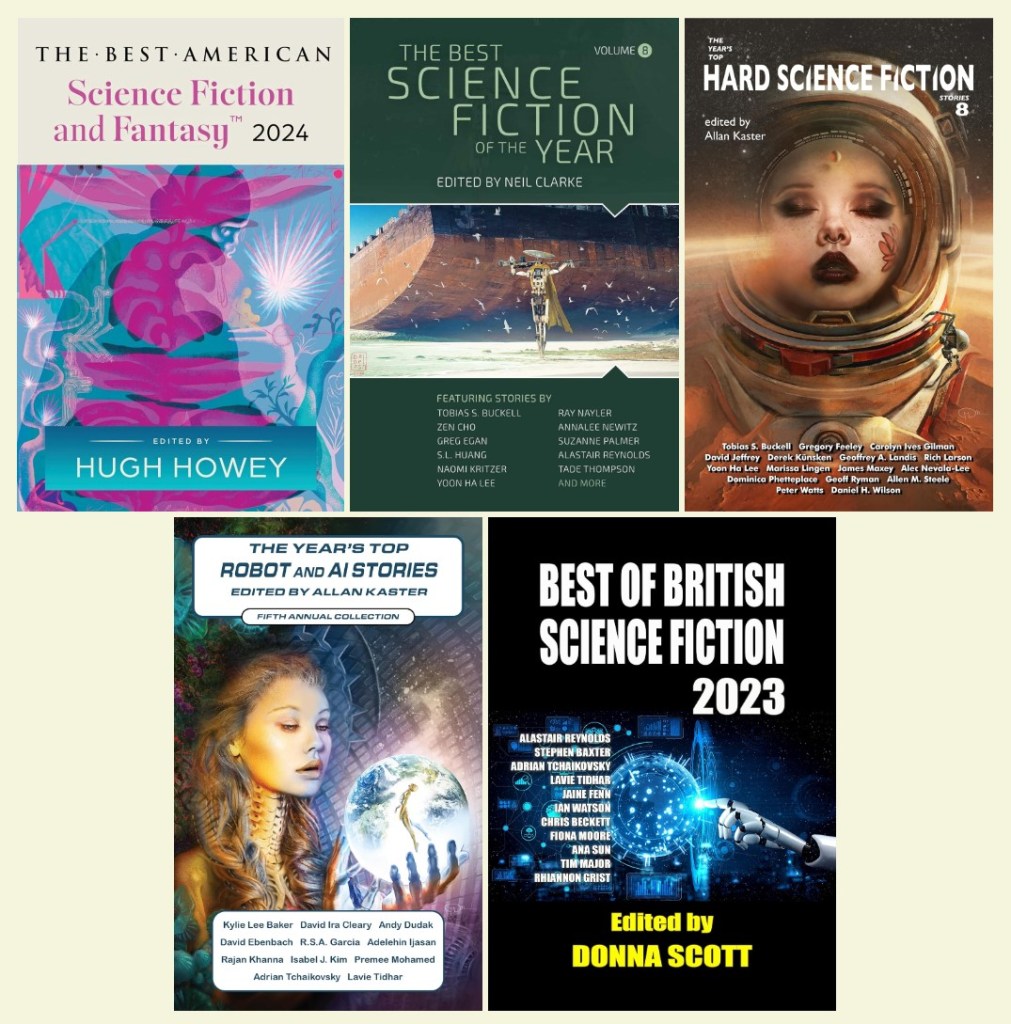
John Joseph Adams in The Best American Science Fiction and Fantasy 2024 gives a fair overview of science fiction short story publishers. His anthology publishes twenty stories each year. Ten science fiction and ten fantasy. As the series editor, he picks 80 stories to give to the guest editor, who picks the 20 that are published. Here are the publications he used, with the number of stories included in the 80 in parentheses.

  • Lightspeed (7)
  • Clarkesworld (5)
  • Uncanny (5)
  • Beneath Ceaseless Skies (4)
  • The Magazine of Fantasy & Science Fiction (4)
  • Reactor (formally Tor.com) (4)
  • Asimov’s Science Fiction (3)
  • The Sunday Morning Transport (3)
  • Fantasy Magazine (2)
  • McSweeney’s (2)
  • Bourbon Penn (1)
  • Cast of Wonders (1)
  • Escape Pod (1)
  • FIYAH (1)
  • Nightmare (1)
  • PseudoPod (1)
  • The Dark (1)

Since this is only 46 stories, the other 34 must have come from author collections and original anthologies. Adams said he also read these periodicals:

  • Analog
  • Apex Magazine
  • Apparition Lit
  • Baffling Magazine
  • The Kenyon Review
  • khōréō
  • Vastarien
  • Weird Horror

This doesn’t cover all the publishers of short science fiction. By the way, some of these periodicals are for fantasy and horror. I only care about science fiction, so I’m disappointed with every other story in The Best American Science Fiction and Fantasy 2024. You can read Adams’s introduction by reading the sample at Amazon. It’s mostly about his selection process but it gives a good insight into what’s being published.

Because so many science fiction short stories are being published I’ve given up trying to follow the genre during the year by reading the periodicals. I just wait for the annual best-of-the-year anthologies. I occasionally buy F&SF, Analog, or Asimov’s, but F&SF has too little SF, Analog has too many minor stories, and Asimov’s has become rather hit-and-miss. I can’t but wonder if they’d get better stories if the online markets didn’t exist.

Neil Clarke’s The Best Science Fiction of the Year: Volume 8 is more to my taste, but it’s over a year behind. Volume 8 covering 2022 stories, came out in September 2024.

Clarke reports finding a huge number of print magazines:

  • Analog
  • Asimov’s
  • Bourbon Penn
  • Clarkesworld
  • Cossmass
  • Infinities
  • Dark Matter
  • The Dread Machine
  • Dreamforge
  • Fusion
  • Fragment
  • Galaxy’s Edge
  • Infinite Worlds
  • Lady Churchhill’s Rosebud Wristlet
  • Luna Station Quarterly
  • The Magazine of Fantasy and Science Fiction (F&SF)
  • Interzone
  • Metaphorosis
  • On Spec
  • Planet Scumm
  • Pulphouse
  • Pulp Literature
  • Reckoning
  • Shoreline of Infinity
  • Space and Time
  • Underland Arcana
  • Weird Tales
  • Wyldblood

That blows my mind. I never see most of those titles. Clarke’s State of the Union of SF short stories is comprehensive. I guess he’s the new Gardner Dozois. Even if you don’t buy Clarke’s anthology, you can read his introduction in the sample at Amazon. I won’t summarize what he says, it covers what my title above claims but only hints at. Go read his overview.

Allan Kaster publishes two best-of-the-year anthologies. They showcase SF stories about hard science fiction and AI/robots. Kaster comes closest to what I want to read. I think Kaster succeeds because he defines his science fiction narrowly and only publishes twelve to fifteen stories. Before Gardner Dozois blew up the size of annual best-of-the-year SF anthologies, editors like Donald Wollheim, David Hartwell, and Terry Carr just picked ten to fifteen stories each year too. Check out his two series: The Year’s Top Hard Science Fiction Stories and The Year’s Top AI and Robot Stories.

There is an overwhelming number of science fiction short stories to read coming out. In that regard, the industry is doing great. Remember the lament in Business Insider, there are too many sellers. It makes selecting difficult and lowers overall quality. Back in 1953, there was an SF magazine boom, with over forty titles published. That boom crashed because the genre couldn’t support that many titles. I wonder if that will be true today? Or does the Internet allow for countless tiny markets supported by a handful of faithful fans? If that’s true, it might be better to ignore the larger genre, and just find a comfortable niche.

James Wallace Harris, 11/10/24

HOTHOUSE by Brian W. Aldiss

Science fiction is best when it’s full of wonder. When I first read The Time Machine by H. G. Wells, I was awed by the idea of time travel, but two other ideas wowed me even more. Wells got me to imagine future human evolution and posthumans, and he introduced me to the idea that the Earth would someday end. It was easier to imagine the Earth being created, but it was overwhelming to think about it dying.

Hothouse by Brian W. Aldiss is one of the great works of the Dying Earth subgenre of science fiction. There are various ideas about what constitutes a dying Earth setting. Some people consider it to happen when humanity dies off. I like to think it’s when the Earth is about to be destroyed. That’s the approach Aldiss takes in Hothouse. He tells us the Sun will go nova in a few generations, but Aldiss doesn’t quite take us to Earth’s death

Jack Vance’s famous novel The Dying Earth (1950) is set in the far future, too. The sun is nearing the end of its life, and the Earth and humanity have drastically changed. In The Time Machine, the Time Traveler visits the far future just before the sun, as a red giant destroys the Earth. In The Night Land (1912) by William Hope Hodgson, the Sun Is going dark, and humanity is almost gone.

Only Wells and Aldiss imagined the final productions of evolution. Olaf Stapledon pictures eighteen more species of humans coming after us in Last and First Men (1930). Aldiss imagines a variety of descendants for humanity in Hothouse, all exceedingly small. He also imagines the plant kingdom going bonkers, which reminded me of The Forgotten Planet (1954) by Murray Leinster. That novel was based on three stories, first published in 1920, 1921, and 1953. It was about a world we had colonized. Those explorers eventually evolved becoming tiny beings, competing with giant plants and insects for survival.

I reread Hothouse by Brian W. Aldiss because it was recently released in an audiobook edition on October 15, 2024. It’s a novel I’ve been waiting years to hear. I first read Hothouse in 1996 and thought it was an amazing story full of colorful imagery and adventure. I wanted to see it as a movie because of Aldiss’ powerful visual imagination. After I got into audiobooks in 2002, I wanted to reread all my favorite science fiction books by listening to them. I finally got my wish with Hothouse, with excellent narration by Nick Boulton.

In this fix-up novel, the sun is swollen, and Earth’s rotation is locked so only one side faces the Sun. The Moon trails the Earth’s orbit in a Trojan orbit that keeps it stationary in the sky. Earth is a riot of vegetation that has supplanted most of the animal kingdom. Humans have evolved into tiny beings one-fifth our size, while insects have grown monstrously large. Plants have mutated into countless strange configurations, including those that traverse between the Earth and the Moon on giant webs.

Hothouse is a fixup novel composed of five stories that appeared in The Magazine of Fantasy & Science Fiction in 1961.

  • “Hothouse” (novelette)
  • “Nomansland” (novelette)
  • “Undergrowth” (novella)
  • “Timberline” (novelette)
  • “Evergreen” (novella)

Hothouse was originally published in the United States as The Long Afternoon of Earth in a slightly abridged format. At the 1962 Worldcon, the five stories as a series won the Hugo Award for best short story. I prefer the forgotten American title, it’s more poetic.

I thoroughly enjoyed listening to this novel, but it didn’t have the impact it had on first reading. (Imagine watching The Sixth Sense for a second time.) Aldiss produces some wonderful science fictional ideas in this story, ones I won’t mention because that might spoil the story. This is one of those tales you should experience without knowing too much. The story feels like a children’s fantasy with all the funny names for evolution’s new creations, but I believe Aldiss was serious in trying to make it science fiction.

Think of the writing challenge of describing an impossible-to-imagine far future. Jack Vance pictured humans with magical powers as if evolution would eventually create them. Magic makes his Dying Earth stories fun, but not realistic. William Hope Hodgson imagined Earth in darkness where humanity clings to one giant city. I guess Clarke did that too. Aldiss imagines species descendants from us living in another kind of Garden of Eden, a very violent one. We could call it Darwin’s Eden, rather than God’s.

Hothouse is mostly a forgotten classic. I seldom meet people who have read it. Brian W. Aldiss’s reputation and back catalog aren’t well-remembered in today’s popular culture. Now that several of his books have been republished in audio, I’m giving him another chance. I hope other SF fans do too.

My favorite work by Aldiss is “An Appearance of Life” which I’ve reviewed three times. I keep hoping to find more Aldiss stories that impress me as much. Hothouse comes close. So does “The Saliva Tree.” Greybeard isn’t on the same level as those tales, but it’s still thought-provoking.

James Wallace Harris, 11/8/24

FUTURES PAST: A Visual History of Science Fiction, Volume 4, 1929: The Gateway to Modern Science Fiction by Jim Emerson

If you love reading about the history of science fiction, you should love reading Jim Emerson’s series Futures Past. I’ve previously reviewed the volumes for 1926 & 1927, and 1928. In the early 1990s Emerson started this project as a fanzine focusing on the history of science fiction, and published four issues: 1926, 1927, 1928, and 1929 before he had to stop. Then a few years ago when he retired Emerson started over with 1926 and expanded each fanzine issue to a softbound book. The latest volume, 1929, is 222 pages. The largest volume yet. Jim says 1929 should be ready to ship in mid-October. You can order pdf, softbound, and hardbound editions here.

Jim writes all the content, and I’m jealous of his knowledge of science fiction’s history. Each volume contains a Year in Review section that covers science fiction books, magazines, plays, and movies of the year, while documenting the people and events related to that year. But more than, that, Emerson includes in each volume a handful of long articles about the history of specific science fictional subjects that lead up to that year.

For example, the 1929 volume has a ninety page overview of women science fiction writers from 1666-1925. I’ve read a lot of SF history and I didn’t know about most of these books or their writers. Our collective culture forgets so much – why did they forget all these women writers?

Other significant articles include the “Evolution of the SF Name” which unearthed far more old examples of the term than I’ve previously known about. In the “Gernsback Bankruptcy” Emerson explains how Hugo Gernsback lost control of Amazing Stories and immediated create Science Wonder Stories. Hugo was a wheeler-dealer, and somewhat shady. Besides his magazines he had a radio station, and was an early broadcaster of TV. It blew my mind that Gernsback was paying himself $50,000 a year. That was a tremendous salary in the 1920s when the average worker was proud to make $25 a week.

I’ve always been fascinated by the history of science fiction. We tend to live in an awareness bubble that extends from decade or two before we start reading science fiction to when we lose contact with the genre as we age out. I grew up in the 1950s, starting to read science fiction in 1962, but I was reading stories that were mostly published in the 1950s, and some from the 1940s. I’m in my seventies now, but I’ve mainly lost contact with what’s going on in the genre in the early 2000s. Futures Past portrays the genre in the 1920s, and very early 1930s, and it’s very different. Have you ever thought about what being a science fiction fan in the Roaring Twenties?

One reason I like reading about the history of science fiction is discovering what science fiction fans and writers were like before my bubble of awareness began. The genre has changed several time over the course of my reading lifetime. And reading Futures Past shows how science fiction changed several times before it became the science fiction I knew as science fiction in the 1960s. Reading through the descriptions of the SF books of 1929, or the descriptions of the SF books written by women from 1666 to 1925 reveals that people have always had a fascinating with the fantastic and they’ve always speculated about the possibilities. But how they speculated depended on the common knowledge of the day. In 1929, people still thought there were things and places on Earth still to be discovered, including other intelligent beings.

Well, 1929 was also when the first science fiction clubs and fanzines were formed. Fandom arose concurrently with the early days of rocketry clubs, which were sprouting up around the world, and Emerson has articles covering the histories of both. All of that is fascinating to me. The 1920s and 1930s were when my parents grew up. I wonder if they even knew about science fiction.

For most science fiction fans this history will be too far in the past. So far in the past that it’s an alien landscape. They might be shocked by the weird ideas writers used to create their science fiction, such as lost races, hidden species, about prehistory civilizations like Atlantis and Mu, rejuvenation, utopias, eugenics, future wars, spiritualism, the occult, strange mutations, and so on. They just didn’t have the science we do now. And they believed that all the planets of the solar systems and their moons could harbor intelligent life.

With the aid of the internet, The Internet Archive, and YouTube, you can read the futures past science fiction in old books, magazines, fanzines, and watch the old movies. Emerson summarizes every issue from six SF magazines from 1929: Amazing Stories, Amazing Stories Quarterly, Science Wonder Stories, Air Wonder Stories, Science Wonder Quarterly, and Weird Tales, and quickly covers several general pulp magazines that featured science fiction. He also reviews the science fiction books that came out that year too. 1929 will go into public domain in January, but most of the magazines are already available online at the Internet Archive. Just search on the magazine’s name plus 1929. Search for book titles on Google and the Internet Archive. Search for the films on YouTube.

By the way, the YouTube channel, Mars Wants Movies, is running a history of science fiction films, and is currently up to the year 1948. It covered the 1920s in six episodes, and devoted a whole episode to 1929. This makes a great supplement to Futures Past with links to those old movies you can watch on YouTube.

Also, you can read the early fanzines at Fanac.org, including The Comet v. 1 n. 1. mentioned in Emerson’s article on the first science fiction clubs.

Here’s Volume 4’s Table of Contents:

I subscribed to Futures Past when it was a fanzine back in the early 1990s. I was disappointed when it stopped publication at 1929. Jim tells me he’s hard at work on 1930 already, and plans to cover many more years in his retirement. I’m really looking forward to the 1930s. I used to think of the 1930s as the early days of science fiction, but Futures Past shows that the origins of science fiction go way back. Emerson’s etomological search for the origins of the phrase science fiction reveals it began way before Amazing Stories.

James Wallace Harris, 10/11/24

“Earth for Inspiration” by Clifford D. Simak

“Earth for Inspiration” is a comic science fiction story by Clifford Simak set millions of years into the future about a science fiction writer and his robot visiting a forgotten Earth. The pair go there hoping to find inspiration to write new science fiction stories. You can read it online in the April 1941 issue of Thrilling Wonder Stories.

I read “Earth for Inspiration” by Clifford D. Simak because I read When the Fires Burn High and the Wind is From the North: The Pastoral Science Fiction of Clifford D. Simak by Robert J. Ewald. I bought that book after I read and reviewed A Heritage of Stars by Simak which made me want to know more about Clifford D. Simak. I mentioned my interest in Simak on the Clifford Donald Simak Facebook group and the Ewald book was one of two books about Simak that was recommended. I forgot I already owned the second book, Clifford Donald Simak: An Affectionate Appreciation by Francis Lyall. I haven’t read that one yet because I leant it to my friend Mike who had recently read the twelve volumes of Simak’s short stories. Mike is who got me to read A Heritage of Stars in the first place. I guess that puts me into some kind of inspiration loop.

A Heritage of Stars involved a post-apocalyptic America with few humans and some robots. In that story, most robots had been destroyed except for their brain cases which were saved as trophies after a war with the robots. Unknown to the humans, the robots continued to be conscious inside their brain cases for a thousand years. That idea of a conscious mind without outside sensory data intrigued me. Then I read in the Ewald monograph about “Earth for Inspiration,” involved a dying Earth, robots, and isolated robot brain cases. I had to read it. The story is also included in Simak’s collection Earth for Inspiration and Other Stories: The Complete Short Fiction of Clifford D. Simak Volume Nine. Amazon now sells 14 volumes in the complete stories. Audible.com now offers ten of those volumes in audiobook editions.

Version 1.0.0

Most of the famous science fiction short stories we remember from the 1940s were first published in Astounding Science Fiction. Thrilling Wonder Stories was aimed at younger, less educated science fiction fans, and we seldom see reprints from that pulp magazine. For the most part, its stories are less sophisticated with far more action. And that’s true for “Earth for Inspiration.” I thought it was a funny story, but somewhat simple and hyper paced. It has an old fashion voice because of all old-timey colloquialisms. Simak is known for his pastoral prose and midwest settings.

“Earth for Inspiration” was more fun than I expected to find in Thrilling Wonder. Usually, when we think about robots in science fiction, we think of Isaac Asimov, but I’m seeing how important robots were to Simak stories.

When I read it with my eyes, “Earth is Inspiration” felt like cliched pulp science fiction from the 1930s. However, when I listened to the story after buying the audiobook edition, I thought the writing was much better than my first impression, except for all the saidisms. (I think the worse was — “Look at that, will you!” he jubilated.) The second reading with my ears made me notice how many ideas Simak was using to develop the story. It’s a satire on writing science fiction, maybe even the first example of recursive science fiction.

However, “Earth for Inspirations” gives us a few clues about how Clifford D. Simak thought when comparing them to his other work. The more Simak I read, the more I spot common ideas, characters, and elements that he used and reused.

The Ewald monograph has a few pages of biographical information, almost just a list of dates. Most of the 155 pages describe Simak’s stories and novels. I was hoping to find a biography of Simak, something like William H. Patterson did for Heinlein, but such a book doesn’t exist as a far as I can tell for Simak. Second to that, I was hoping to find an analysis of the impact of Simak’s stories, like what Alexei and Cory Panshin did for Heinlein, Asimov, and van Vogt in The World Beyond the Hill. It’s not that either. When the Fires Burn High and the Wind is From the North, is a standalone journal, volume 73 of The Milford Series: Popular Writers of Today. The content is like Alva Rogers A Requiem for Astounding, which is a description of the stories in all the issues of Astounding Science Fiction in chronological order.

I thought it fascinating that Simak was thinking of robots in the same way in 1941 and 1977. He obviously had a fondness for the idea of robots and had developed an idea of what they would be like early in his career and stuck with it until he died. Robots were faithful servants who were also friends. Simak imagines them with bodies that can break down, but with nearly indestructible brain cases. I assume those brain cases have an internal power supply that could last for millions of years. A couple years ago I read a collection called The Complete Robot by Isaac Asimov. I wonder if Simak has enough robot stories to warrant such a collection?

Reading Simak, we can assume he didn’t like cities or corporations and had a low opinion of mankind’s ability to survive in the long run. Although, “Earth for Inspiration” is set millions of years in the future after humans have colonized the galaxy, but long after we’ve used up Earth’s resources and abandoned it.

The first scene of “Earth for Inspiration” opens with a short tale about a robot named Philbert who became inert after his body rusted up. Eventually, his body rusted away and Philbert lived inside his braincase for millions of years. This reminds me of the Tin Woodsman of Oz.

The second scenes jumps to Jerome Duncan, a once successful science fiction writer who is again getting rejection slips after a successful career. Duncan lives millions of years from now. It’s amusing that Simak thinks science fiction will last that long.

Anyway, Duncan’s robot Jenkins suggests going to Earth to get inspiration for writing a new story. Jenkins is also the name of the robot in City, Simak’s most famous book, a fix-up-novel. Duncan is famous for writing Robots Triumphant. I won’t tell you what it was about because it becomes part of the story.

The next scene has Duncan and Jenkins arriving on Earth with a lot of camping equipment and meeting an old-timer, Hank Wallace, who has been waiting for new tourists for over a thousand years. He manages the Galactic Trainsport station, but no one informed him that the line had been shut down a thousand years earlier. Duncan and Jenkins had hired a private rocket. This points to another idea that Simak loved, that humans would eventually have very long lives. In this story, we last for ten thousand years. And his second most famous novel, Way Station, is about an old-timer who manages a transport station and who doesn’t age. By the way, the old-timer in that novel was named Enoch Wallace.

Should we assume that Simak had been thinking about writing his most famous novels for years?

I don’t think I should tell you any more of “Earth for Inspiration.” It’s a fun enough story so that I shouldn’t spoil it for you. I’ll just hint at a few more scenes. Earth in the far future is dry, and has lost most of its air. There’s a confrontation with humans living in primitive tribes in dry deep sea canyons where the air is thicker. That makes it a dying Earth story. There are slapstick scenes with a crazy robot and another confrontation with horde of runaway robots.

“Earth for Inspiration” has decent humor, although not sophisticated. It would make a great humorous episode for Love Death & Robots. The humor is slapstick Sheckley with a touch of Frederic Brown’s ironic weirdness. I’m not sure if Simak intended it to be entirely comic, although, he probably did, but I bet a lot of young readers in 1941 took it straight realistic action.

James Wallace Harris

Is It Possible, Or Is It Magic?

“Enchanted Village” by A. E. van Vogt has been extensively reprinted. It first appeared in the July 1950 issue of Other Worlds Science Fiction. I just read the story in Possible Worlds of Science Fiction edited by Groff Conklin. I first read it in The Great SF Stories 12 (1950) edited by Isaac Asimov and Martin H. Greenberg several years ago, although today, I had no memory of reading it before. I can’t tell if it’s a forgettable story, or I’m just forgetting everything.

Bill Jenner is the lone survivor of the first mission to Mars after his rocket crashes. Jenner crosses hundreds of miles of Martian desert on foot with just a bit of food and one bag of water. Jenner thinks he’s saved when he stumbles upon a deserted alien village.

The story is nicely told. Who doesn’t love a Robinson Crusoe type story? Isn’t that why The Martian by Andy Weir was a bestseller and blockbuster? “Enchanted Village” takes a left turn though, one that reminds me of Solaris by Stanislaw Lem. It’s amusing how A. E. van Vogt anticipated so many modern science fiction stories (Forbidden Planet, Star Trek, Alien, etc.).

Jenner eventually realizes the village is an organism or machine, even an intelligent one, and he must learn to communicate with it. The village produces food automatically in low troughs but is poison to Jenner. Through a series of observations Jenner discovers the village could make food for him, but he doesn’t have enough human food for it to model.

Now here is where you should leave this essay if you don’t want spoilers.

“Is it possible?” is the number one criterion I use to define and judge science fiction. All too often science fiction readers are given magic rather than honest speculation. There is nothing wrong with magic in a story if you enjoy fantasies, but the belief in magic is why our species never grows up. To me, fantasy is the fentanyl of fiction. It will make you feel great, but eventually, it will kill you.

The surprise ending of “Enchanted Village” is when Bill Jenner dies, he wakes up to discover he’s a kind of creature that can consume the nourishment the village provides. Bill Jenner is reborn. We are not told how. We are not told anything, but that Jenner now has sharp teeth and a snout allowing him to slurp up the alien food. I pictured the reborn Jenner looking like a lizard creature, suitable for the dry Martian desert.

The alien village is like Jesus, or other deities that tell us to accept them and be saved. Van Vogt’s use of the word enchanted should have warned us this was a story about magic. I don’t know if van Vogt was intentionally parodying religion, or he just needed a quick ending to sell a story. It’s interesting to compare “Enchanted Village” to “A Martian Odyssey” by Stanley G. Weinbaum. That story has strange aliens that accomplish bizarre feats, but I believe it’s within the realm of possibility, and honest science-fictional speculation.

Even with my criticism, I enjoyed the story. It’s the old fashion kind of pre-NASA science fiction I’ve always liked most. But then, science fiction was my substitute for religion. I wanted to believe in the fantasies that science fiction sold me. If we could only fly beyond the Earth, they would all come true. I never really wanted to grow up in Earthly reality but be reborn in outer space. I’ve always known that science fiction was just storytelling, but it did leave me with a kind of secret hope that I should have ignored. There’s a reason Marx said religion was the opiate of the masses, it’s because it makes us want to believe in magic. There’s a safe kind of making believing while turning pages, but if you let science fictional beliefs go beyond them, they can be dangerous.

If you think I’m being silly, read “Racked by Pain and Enraptured by a Right-Wing Miracle Cure” from yesterday’s New York Times. It’s quite moving, and I feel deserves some kind of journalism award. These people hope for a science fictional cure, ones I’ve seen in science fiction stories.

I’m getting worried that I’m becoming too critical of science fiction, and I should stop reviewing it. I don’t want to come across as a downer. I know science fiction should be judged just on its merit as a story, but I can’t help but evaluate it psychologically and philosophically as a kind of hope for the future. I assume my growing doubts and rejection of SF is because I’m getting older and thinking about how things have impacted me psychologically.

James Wallace Harris, 7/29/24

“The Day After the Day the Martians Came” by Frederik Pohl

After reading a story about hunting down God and another story about vicious attacks on women, Frederik Pohl anti-prejudice story seems downright pleasant. It is a breezy tale about how people recycle all their old ethnic jokes when NASA brings home a Martian.

“The Day After the Day the Martians Came” reminded me of how things were back in the 1950s and 1960s. People often retold jokes they had heard, and many of them depended on ethnic stereotypes. I seldom hear people tell a joke anymore, and I can only remember one that I heard that I retold in the last few years. It went something like this:

A young guy is out hitchhiking, and he gets a ride with an old man driving a new car. The young guy doesn’t know how to strike up a conversation but finally says, “Aren’t you afraid of giving rides to hitchhikers? They might be a serial killer.” And the old man laughs, “Oh no, I’m not afraid. What are the odds of two serial killers being in the same car?”

Now, that joke is based on a stereotype, but until people start feeling sorry for serial killers, I assume it will be politically correct to use them in a joke. That’s the thing about humor, it usually has a target, and it’s often about cruelty or pain, or someone being the butt of the joke.

Essentially, Pohl’s story is a civil rights tale. It was written during the peak years of the Civil Rights movement. However, its punchline conveys a stereotype about black people. “The Day After the Day the Martians Came” is well-intended, but simplistic. It lacks sophistication.

The setting is a hotel where reporters are staying to report on NASA bringing back a Martian. The hotel is managed by a man, Mr. Mandala, who sounds like he’s from India, who bosses around two black men, one who is the bell captain. Pohl doesn’t use the old word bellboy here. It describes a lobby that is overflowing with reporters who all take turns making up jokes about Martians. We are told Martians are quite ugly and look a lot like seals. All the characters are based on stereotypes. The reporters sound like they came out of the 1940 screwball comedy, His Girl Friday.

It seems rather odd that Pohl is satirizing joke tellers for using stereotypes when his story depends on stereotypes. I wonder if Pohl was aware of this on meta level. I don’t think so. Science fiction evolved out of pulp fiction magazines, and the best pulp fiction writers were brilliant at typing out stories fast and furiously. They depended on stereotypes and caricatures. And like movies from the 1930s and 1940s, readers and audiences loved a good character creatively based on a type, such as a newspaper reporter.

For Pohl to have explored this situation in a deeper way, he would have had to create a unique individual reporter observing a unique individual Martian and realistically portraying unique individual humans reacting to the Martian with specific prejudices regarding specific physical details and characteristics. Something James Joyce or Flannery O’Conner or even Raymond Chandler might have written. I think some New Wave writers knew this in theory, but not in practice.

I’m afraid people will think I’m picking on Dangerous Visions. Ellison claims its stories point to a new way of writing in science fiction, but so far, I don’t think the first three stories have demonstrated a new kind of writing. I think science fiction will change in the decades after the 1960s, but I’m not sure it has changed much in 1967.

James Wallace Harris, 5/19/24

“The Man from the Atom” by G. Peyton Wertenbaker

“The Man from the Atom” by G. Peyton Wertenbaker was first published in the August 1923 issue of Science and Invention before being reprinted in the first issue of Amazing Stories. All the stories in the famous April 1926 issue of Amazing Stories were reprints. However, Wertenbaker has the honor of having the first original science fiction story, “The Coming of the Ice,” published in Amazing Stories, in the June 1926 issue.

Today I’ve been meditating on the idea of science fiction before science fiction was a concept with a label. People who love to read what we now call science fiction back in April 1926 didn’t know they were science fiction fans because the term didn’t exist. Hugo Gernsback was trying to get people to call it scientifiction, a word hard to say. Putting the names “H. G. Wells,” “Jules Verne,” and “Edgar Allen Poe” on the cover in large red letters was the perfect bait for readers who hankered after what we now call science fiction. Although they misspelled Poe’s middle name.

I’ve always assumed readers who bought the first issue of Amazing Stories discovered the kind of fiction they like by reading magazines and newspapers, including pulps. But checking my database I found 108 titles now considered science ficton (or fantastic) published from 1900-1925. But that brings up another question.

How many people had access to bookstores before 1926? I don’t think paperbacks as we know them existed back then. What percentage of Americans were readers? I just finished reading Chasing the Last Laugh: How Mark Twin Escaped Debt and Disgrace with a Round-the-World Comedy Tour by Richard Zacks. It focuses on the years 1893-1895 and discusses book selling. Publishers sold a significant percentage of Twain’s books via door-to-door salesmen. That suggests bookstores were not common.

My guess is would-be science fiction fans mostly read magazines and newspapers. This was an era when radio was becoming popular, but it wasn’t widely adopted yet. That meant most people got their information about the world from newspapers and magazines.

What did people think of “The Man from the Atom?” By today’s standard it’s both stupid and silly. A guy named Kirby has a friend, Professor Martyn, who is an inventor. Kirby enjoys volunteering to be an experimental subject for the professor’s experiments. In this story he’s invited over to test a machine that can do what Alice in Wonderland experienced when eating the food that made her bigger or smaller. Professor Martyn wants to use the device to explore the stars and atoms.

Wertenbaker was likely inspired by The Girl in the Golden Atom by Ray Cummings, which was serialized in All-Story Magazine in 1919. And Cummings was probably inspired by The Diamond Lens (1858) by Fitz james O’Brien and The Time Machine (1895) by H. G. Wells. And maybe young readers of Amazing Stories had already read those stories. I don’t know if any science fiction story is ever completely original. There are always stories that inspired that story, and if the writer is good, their story inspires future science fiction stories.

Kirby is given a space suit to provide oxygen and protect him from heat and cold. He then presses the button to grow larger, and he expands and expands. First, he steps off the earth, then out of the solar system, and then out of the Milky Way, but that’s not said explicitly. That’s because Edwin Hubble was still proving the existence of galaxies in the 1920s and the nature of The Milky Way.

Like many other stories, Kirby grows until he sees our universe as an atom among many, and then expands until he emerges into the water of another world. He realizes that he could never go back to Earth, and for two reasons. First, he couldn’t pick out the atom that was our universe, and two because expanding evidently meant time speeded up, and he figures he was millions of years into the future.

Ultimately, I liked “The Man from the Atom” even though it’s absolute horseshit. It’s just so damn imaginative for 1926. As the hippies use to say, “‘That’s far out, man!” And what kid hasn’t imagined the solar system as an atom?

Of course, I’m curious if readers back then believed any of this story was possible or scientific? Our knowledge of cosmology and subatomic physics in 1926 wasn’t very much. Wertenbaker was savvy enough to give Kirby a space suit. And he figured expanding meant speeding up time. Kirby had to grow much faster than light.

In the July issue, Gernsback wrote “Fiction Versus Facts” and quotes Wertenbaker. He contrasts scientifiction with “sex-type” literature, which I assume he means stories about romance, and says, “Scientifiction goes out into the remote vistas of the universe, where there is still mystery and so still beauty. For that reason, scientifiction seems to me to be the true literature of the future.” Evidently, right from the beginning readers of Amazing Stories, attracted readers of proto-science fiction that were true believers in human potential.

James Wallace Harris, 5/1/24

“Time Waits for Winthrop” by William Tenn

Group Read 72: The Best Science Fiction Stories of 1957

“Time Waits for Winthrop” by William Tenn #16 of 20 (Read)

Virgil Finlay usually created drawings and paintings that featured beautiful or fantastic subjects, but the interior illustration for “Time Waits for Winthrop” is hideous to see. But then, the 25th-century future William Tenn describes is supposed to be hideous to people from the 20th century, and the title character’s personality is downright hideous too, so Finlay does an excellent job preparing us for the story.

“Time Waits for Winthrop” is a plodding piece of fiction that speculates about the future in ways that make it worth reading, but just barely. That same statement could be made about much of science fiction. It’s a shame that “Time Waits for Winthrop” wasn’t better told because it could have been a genre classic.

The setup for “Time Waits for Winthrop” involves five people from 1958 swapped with five people from 2458 for two weeks. Tenn’s science fictional hypothesis is the future will be so different to us that we’ll find it repulsive. Tenn then plots the story around a clock driven conflict. At the appointed hour of return, all five people from both groups must return to the time travel depo to make the exchange possible. The kicker is Winthrop who loves the 25th century and doesn’t want to return to the 20th century. And the 25th century has one cardinal rule, you can’t make anyone do anything they don’t want to.

This means Dave Pollock, Mrs. Brucks, Mary Ann Carthington, and Oliver T. Meed will be stuck in the future that unnerves them, and the time travelers from the future will be stranded in the past.

“Time Wait for Winthrop” is a rather long story, a novella, and the plot involves the four 20th century people who desparately want to go home each trying to convince Winthrop or someone else to make Winthrop want to return to the 20th century. This gives Willian Tenn a chance to describe the 25th century. Sure, it’s pure speculation from the vantage of 1957, but I thought Tenn imagined some neat possibilities.

The first time I read this story over fifty years ago, I was under twenty, and I didn’t tune into what Tenn was trying to do in his story. I thought “Time Waits for Winthrop” was a somewhat funny potboiler. For my 2024 reading, I saw the story in a completely different light. In my first reading “Time Waits for Winthrop” came across as lame Sheckley. In this reading, “Time Waits for Winthrop” came across as Heinlein trying to be funny.

Winthrop and Mrs. Brucks were the old folks of the five 20th century travelers, and the group of four who wanted to return picked Mrs. Brucks to visit Winthrop and appeal to his moral decency. The other three thought since she was about the same age as Winthrop he would understand her best. Mrs. Brucks was a grandmother of two, and mother of six, and kind and genteel. Everything Winthrop was not.

Winthrop is the only person from the past who embraces all the new ways. It’s a rather wild future where clothes and floors appear to be alive and inanimate objects respond to human needs. You’ll need to read the story to get all the gosh-wow details. Winthrop relishes the opportunities offered and takes advantage of them all. He feels his companions from the past are rigid and scared. After Mrs. Brucks polite pleas, he still refuses. Winthrop says he’s obviously better off as a person in the future than he was in the past. Mrs. Brucks fails in her mission.

Next, Mr. Oliver T. Mead then agrees to plead their case with Mr. Storku, The Chief of Protocol for the State Department. This is where the story took off for me. Mead must track down Storku, but he’s at Shriek Field. In the future, humans are very well adjusted but that’s because they regularly visit Shriek Field or Panic Stadium to experience psychological release and transcendence. This 2024 reading now reminds me of many of the New Age therapies from the 1970s. I didn’t know of their existence the first time I read this story around 1969. Were such techniques already emerging in the 1950s?

Mr. Meads experience at Shriek Field is so prophetic that I decided to reprint those pages. How did Tenn guess this in 1957?

Doesn’t that sound like Primal Scream therapy? I believe Tenn also anticipates therapies like Erhard Seminars Training (EST) and other similar New Age personal development programs. This section of the story goes on for several more pages, and I felt begins the real purpose of the story.

Mr. Mead gets nowhere too.

Next up, the group decides Mary Ann Carthington, a pretty young woman, should try to convince Edgar Rapp from the Temporal Embassy to help them make Winthrop go back. She ultimately locates Rapp, but he’s in a microscopic world battling tiny cellular creatures. This section allows Tenn to explain what individual freedom means in the future. It was here that I was sure I knew what the ending would be, but I was wrong. This is the most fantastic part of the story, because Edgar Rapp can shrink himself down to thirty-five microns. This section reminded me of “Surface Tension” by James Blish, and Fantastic Voyage by Isaac Asimov.

I’ve tried to read “Time Waits for Winthrop” one or two times between 1969 and 2024, and in each case, I thought the story was over long and dragged. I again thought that this reading, but I liked the story a whole lot more this time and was more forgiving. If that trend continues, one day I might actually love “Time Waits for Winthrop.”

The story is episodic. It’s a shame that it wasn’t fleshed out into a short novel and told with more realistic drama that tied the sections together better. Tenn is mainly known for writing short stories, but I absolutely loved his novel Of Men and Monsters, see my review, and heed my warning. Don’t read anything about the book or even the blurbs on the cover, because the book is so much more fun coming to it cold. But my point, that novel is also episodic, but it has a well-integrated plot with lots of drama.

All too often, science fiction writers hacked out their stories. Probably most are just tweaked first drafts. “Time Waits for Winthrop” feels like Tenn sat down one day and came out with the setup, then for four days in a row used four characters to describe a different aspect of an imagined future, then on the last day produced a quick solution to the plot. Now, I might be unfairly damning Tenn because I didn’t experience everything Tenn intended. There’s a whole lot to “Time Waits for Winthrop,” especially when you consider the last section.

Dave Pollock is a young guy who is a science teacher in the 20th century. The group gives him the unpleasant task of consulting the Oracle Machine about their problem. Pollock finds that distasteful because he feels it’s beneath his scientific mind to consult anything with the trappings of primitive religion. I’m guessing Tenn imagined the Oracle Machine as a kind of AI. Tenn even mentions chess in his story and predicts that machines will outplay humans in the future. He also predicts that humans will continue to enjoy playing chess and will even work together with machines to play. And this is what has happened, just sixty years into the future, not five hundred.

Again, the Dave Pollock section gives Tenn another platform to speculate about the future. And like the other three sections, speculation about the future also means commentary on the present. “Time Waits for Winthrop” is a wonderful contrivance for William Tenn to express himself on many topics. Each time he stops to philosophically tap dance, the plot freezes and the story’s momentum slows to a crawl. However, if readers enjoy the philosophical tap dancing, then they might forget the plot is about how to get back to the 20th century.

James Wallace Harris, 4/21/24

“Flight to Forever” by Poul Anderson

Rereading “Flight to Forever” made me realize something about the core of my personality. There are a limited number of science fictional ideas that I resonate with that I like to regularly recall.

I consider “The Time Machine” the epitome of science fiction because it explored so many new science fiction themes. New to me at age twelve, and maybe new to the world in 1895. Poul Anderson’s “Flight to Forever” recalls many of those same ideas. “Flight to Forever” was first published in Super Science Stories, the November 1950 issue. You can read it here, or listen here. I first read it in Year’s Best Science Fiction Novels: 1952 edited by Bleiler and Dikty. I just read it in The Last Man on Earth edited by Asimov, Greenberg, and Waugh. Here’s a listing of other reprintings.

“Flight to Forever” also reminds me of Last and First Men by Olaf Stapledon and Tau Zero, also by Poul Anderson. The writing style, pace, and plotting feels like science fiction from the 1930s. I’m trying to give you enough hints to get you to go read the story before I give spoilers. This cover might also entice you to go read it too, especially if you discovered science fiction before Star Trek.

While reading “Flight to Forever” I kept thinking how it contained several scenes that inspired the kind of sense of wonder I loved experiencing as an adolescent when I first started reading science fiction. I know as an adult that all those mind-blowing concepts are completely unrealistic, just complete bullshit fantasy, but I still love encountering them over and over. Why?

Am I a 72-year-old kid still being enchanted by fairy tales? I like to think of myself as finally growing up and accepting reality for what it is, but I keep retreating into science fiction. Why? Could a good psychiatrist explain the psychology to me? Is it a neurosis? I will admit that science fiction was a coping mechanism for a turbulent adolescence in the 1960s, and maybe it helps me escape the constant chaos in the news of 2020s. Still, that doesn’t explain the specific appeal of science fiction and the way this story triggers my endorphins.

The story begins with Martin Saunders and Sam McPherson setting off in a time machine to travel one hundred years into the future to see why their automatic test time machines haven’t returned. Martin assures his lovely girlfriend Eve Lang that he will return quickly.

Having one’s own time machine is a wonderful fantasy, especially if it’s one you built yourself in your home laboratory. That’s why “The Time Machine” was so appealing. As a kid, I wanted to be Danny Dunn and have access to wonderful time machines and spaceships. It’s why Back to the Future was so much fun in the 1980s even though I was an adult.

Martin and Sam arrive one hundred years into the future without a problem, but when they try to return to their own time, they discover it takes ever more energy to go back in time. They eventually calculate that the amount of energy needed approaches infinity around the seventy-year mark. Poul Anderson has imagined a natural way for time to protect itself from paradoxes. It’s a neat idea.

Martin and Sam decide to head further into the future to see if they can find a time when scientists might know how to break through the going back in time barrier. This is where the story parallels Wells’ unnamed time traveler, stopping now and then to see how society and mankind has changed. This portion of the story also reminds me of Stapledon’s Last and First Men and many science fiction stories about speculated societies.

Sam is soon killed off, so Martin becomes a lone time traveler hoping to find his way back to his beautiful Eve. He acquires another companion, Belgotai, a mercenary from the year 3000 AD. Together they keep going further and further into the future, meeting society after society. They encounter humans that colonize the galaxy, and aliens that conquer Earth. This gives Anderson a chance to dazzle the reader with all kinds of science fictional speculation.

Eventually, Martin and Belgotai join a deposed monarch fighting a renegade galactic empire. That’s when the story becomes an epic space opera. Martin falls for a regal redhead, Empress Taurey. You’d think Martin will settle here, but Anderson has many other adventures for Martin to experience before the story ends. Martin goes further into the future than the time traveler in Wells’ classic story. Like that story, “Flight to Forever” could be considered a dying Earth tale, and it becomes a last man on Earth story too.

I got the feeling Anderson wanted to include every science fictional cliche he could cram into “Flight to Forever.” I won’t tell you anymore. It’s not an exceptional story, but it is appealing. I must wonder if Anderson wasn’t trying to understand the underlying siren song of science fiction when he wrote this story. Of course, he sold it to a cheap market, so he could have been just hacking out a quick novella to thrill kids and pay his rent.

Reading “Flight to Forever” made me wonder if I could collect a small set of stories that pushed all my sense-of-wonder buttons and just reread them whenever I needed therapy. Sort of like what Kip’s father does in Have Space Suit-Will Travel by always rereading Three Men in a Boat by Jerome K. Jerome. I could create a highly distilled tincture of science fiction to consume when needed, sort of like the playlist of my all-time favorite songs on Spotify.

If I did create a playlist of favorite science fiction stories, would I include “Flight to Forever?” I guess not, because I would keep “The Time Machine” instead. That suggests something to me. Haven’t I been reading one science fiction story after another my whole life just to push the same buttons again? Shouldn’t I explore other stimuli to discover other buttons?

“Flight to Forever” is a nice reminder that certain concepts within my brain like to be remembered, at least every now and then. I’m finding a lot of them in the anthology, The Last Man on Earth. It’s amusing to think about, but I have six large bookcases of science fiction that I could probably reduce to a handful of anthologies that would trigger every type of sense of wonder science fiction ever discovered.

I had a friend that died back in the 1990s. Before he died, he lost interest in the many things he cared about over his lifetime. They went one by one, until he only had two loves left, Benny Goodman and Duane Allman. I call this The Williamson Effect. At 72, I feel I’m in the beginning stages of The Williamson Effect. I’m starting to shed interests. I have a long way to go because I’ve collected an exceedingly long list of interests over my lifetime. I don’t count science fiction as just one interest. Rereading “Flight to Forever” made me see science fiction really is many interests, although a finite set.

James Wallace Harris, 4/15/24

“Small World” by William F. Nolan

Group Read 72: The Best Science Fiction Stories of 1957

“Small World” by William F. Nolan #15 of 20 (ReadListen)

I’ve always loved post-apocalyptic novels about the last man on Earth, or at least, the last few people on Earth. I’m not saying I want everyone else to die, but if flying saucers hauled y’all all away, I wouldn’t complain. Ever since I was a kid, the thought of being the only kid in a deserted city was a fun fantasy for fueling daydreaming. The idea that I could roam around and survive by plundering anything I needed from abandoned stores and houses was deliciously appealing. I bet Henry Bemis implanted this idea in me via the 1959 episode of The Twilight Zone, when I was eight.

William F. Nolan imagines a man named Lewis Stillman left alone in Los Angeles after aliens invade in the August 1957 issue of Fantastic Universe. I remember when I first read this story I was genuinely surprised by the ending. If you don’t want me to spoil it, follow your chosen link above before reading any more of this essay.

In 1967 Harlan Ellison edited Dangerous Visions because he claimed science fiction writers couldn’t get certain kinds of science fiction stories published. I call bullshit on that idea. I think his hypothesis was wrong. Nolan produces a nice little gritty dangerous vision in “Small World” in 1957. Of course, he had to write a few thousand words of character development and setting to entertain us before he could pop the surprise.

Stillman hides out in the storm drains of Los Angeles avoiding the invaders. He only comes out at night, and has collected a nice arsenal of weapons, but he survives by going unnoticed. There have been several movies that used those famous storm drains, so I imagined scenes from Them as I read the story.

One night Stillman fondly recalls a three-volume set of medical textbooks that belonged to his father. Stillman had gone to medical school in southern California but had dropped out to become a laborer and work with his hands. Sitting alone in his hideaway, he remembered seeing those books at a used bookstore and decided he wanted to see them again. That night he arms himself and heads out. He finds the books, but they find him.

He was attacked not by aliens, but by children. The aliens had killed everyone over the age of six, so they cities were swarming with feral children. Picture Lord of the Flies. And the children would kill any surviving adult they could find. All along, Nolan had us believing Stillman was hiding from little green men, but he was really hiding from hordes of rugrats.

In the end Stillman starts shooting the tykes to get away. I pictured him blowing away Jerry Mathers, and little Billy Mumy and Angela Cartwright, as well as Jay North. Of course, I would have been the right age too in 1957 if I had lived in LA. Eventually, the children overwhelm Stillman and I assume he was torn apart. But he must have killed a pile of youngsters before they got him.

I wonder why Nolan wrote this story. It’s sick if you think about it, especially since I read it the first time after Sandy Hook. Was he just trying to gross us out? Or did Nolan secretly hate kids? Lord of the Flies came out in 1954, and that could have inspired him. The 1950s was full of public fear regarding juvenile delinquents, so maybe the story was symbolic. And the age group also applied to the early Baby Boomers, so maybe Nolan was trying to be prophetic.

Yes, Ellison was wrong. Science fiction writers often got dangerous visions published. Two of my favorites were “Lot” by Ward Moore, and “The Last Day” by Richard Matheson, both from 1954.

Also from 1954 was “The Good Life” by Jerome Bixby. Maybe it inspired “Small World.” I’ve always found that story too creepy, maybe Nolan was providing us psychological release for that story.

James Wallace Harris, 4/13/24