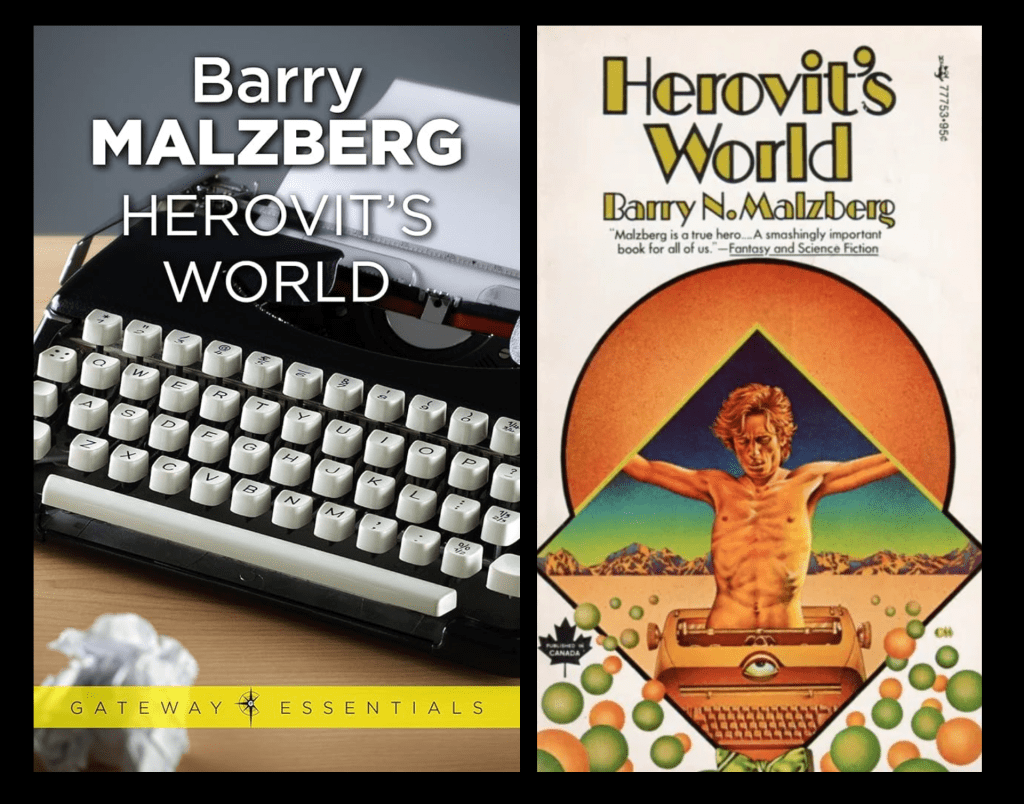
HEROVIT’S WORLD by Barry N. Malzberg

Back in the 1960s when other teens fantasized about becoming rock stars, playing for the NFL, or being seen on the silver screen, I dreamed about becoming a science fiction writer. After reading the 1973 satire on science fiction writers, Herovit’s World by Barry N. Malzberg, I see that I was much better off working with computers at a university for thirty-five years and retiring with a pension. You can currently buy the Kindle edition for $1.99. But read my review carefully before you risk even that little money. It’s a good read for only certain kinds of science fiction fans.

Barry N. Malzberg died on December 19, 2024, at 85. Although prolific, he was never a famous science fiction writer. Malzberg’s most successful books were written in the 1970s, and Barry is mostly forgotten today. He is getting some attention on YouTube as a few reviewers rediscovering him. Malzberg has a reputation as being the curmudgeon of science fiction. Malzberg often relies on satire, but his stories were never fun like the satires of Kurt Vonnegut. Malzberg wrote dark, edgy, and psychological fiction like Philip K. Dick, but he never developed a cult following.

Recently, Bookpilled on YouTube declared that Malazberg was his new favorite science fiction writer. Bookpilled skews towards literary and dark SF, often from the 1970s. But to be honest, Malzberg is very hit-and-miss. Joachim Boaz, a true connoisseur of seventies science fiction, found little to love in The Many Worlds of Barry Malzberg. Boaz considered most stories good but rated “Death to the Keeper” brilliant. Boaz also called Malzberg’s most notable novel Beyond Apollo brilliant, giving it a 5 out of 5 rating.

Be sure to read MPorcius’ extensive review who believes Herovit’s World was overpromoted by Robert Silverberg and Harlan Ellison, but he did like it a lot.

And if you pay attention, Malzberg is mentioned occasionally on YouTube, print reviews, blogs, and podcasts. Three years ago, the biographer Alec Nevala-Lee interviewed Malzberg for two hours.

Herovit’s World is a short novel, 160 pages in paperback, and just under six hours on audio. Jonathan Herovit, our protagonist, has written 92 science fiction novels in the past but struggles to finish his latest book. It’s overdue. He only has thirty pages and his editor is hounding him. His wife is hounding him. He’s stuck in a small apartment with a new baby who cries endlessly. Herovit is approaching forty, well on the road to being an alcoholic, depressed, delusional, and coming apart mentally.

Herovit wants to be like Mack Miller, the fictional action hero of his endless Survey Team novels. Herovit wants to be like the decisive Kirk Poland, his alter-ego and pen name for his books. Jonathan Herovit has turned Kirk Polan into an imaginary friend, one that’s become an abusive second personality.

Malzberg uses this novel to satirize editors, publishers, authors, readers, fans, conventions, writer conferences, writer associations, and the science fiction genre. We never know if Herovit’s World is autobiographical. Herovit is self-loathing. Is this Malzberg confessing his own feelings, or just creating a character. But if you read Malzberg’s three books of essays, The Engines of the Night: Science Fiction in the Eighties (1982), Breakfast in the Ruins (2007), or The Bend at the End of the Road (2019) you’ll get the feeling that he did use his own life for inspiration.

Malzberg is confusing. He has stated that he loves science fiction and the genre. Listen to the podcast above. But science fiction also depressed him, even tormented the poor guy. Herovit’s World is recursive science fiction. That is science fiction about science fiction. Often recursive science fiction is fun, even zany, like What Mad Universe by Fredric Brown or God Bless You, Mr. Rosewater by Kurt Vonnegut. Herovit’s World is full of creative ideas and psychological observations, but they’re not fun. Malzberg feels more like Kafka.

Malzberg and Herovit are hack writers. They pride themselves on cranking out any style or type of fiction and getting paid for first drafts. However, Herovit’s World reads quite well. It has its literary aspects and is full of fun experimentation. I’m glad I read it even though it’s about an unhappy man going down the tubes. And it does make you think about science fiction.

Malzberg was several years younger than Herovit. Herovit’s writing career began in the 1950s, while Malzberg started publishing in the 1960s. Herovit remembers the science fiction magazine boom of 1953. Herovit was a disciple of John Steele, who I assume is based on John W. Campbell. So is Malzberg really making fun of 1950s science fiction? At one point in an argument with his wife Janice, she gives a bit of a speech which might be the key to the whole story:
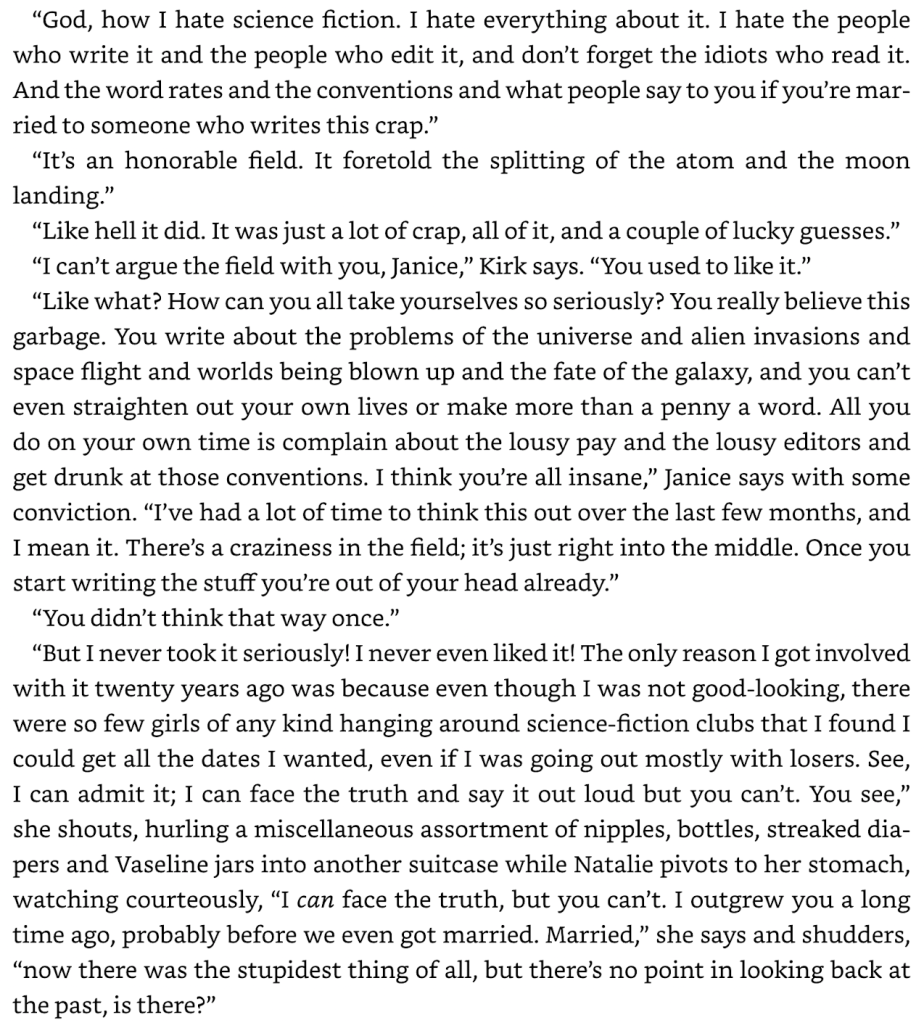
I also remember when there were very few females at science fiction clubs and conventions. Boy have things changed. We must acknowledge that Malzberg skewers SF of the 1950s or 1960s in Herovit’s World. But we should also ask: “How would a disgruntled SF writer skewer the genre today?”

There is a dream sequence late in the novel where Herovit is having tremendous sex with a college coed. He had been invited to a conference and the coed approached him telling Herovit that Kirk Poland was her favorite writer. It turns out she was paid by the university to seduce Herovit so he could be studied for academia. Science fiction was getting noticed by the academic world in the early 1970s. Many writers and fans felt vindicated. However, other writers claimed science fiction was better left in the gutter. Malzberg uses this scene to give his opinion:
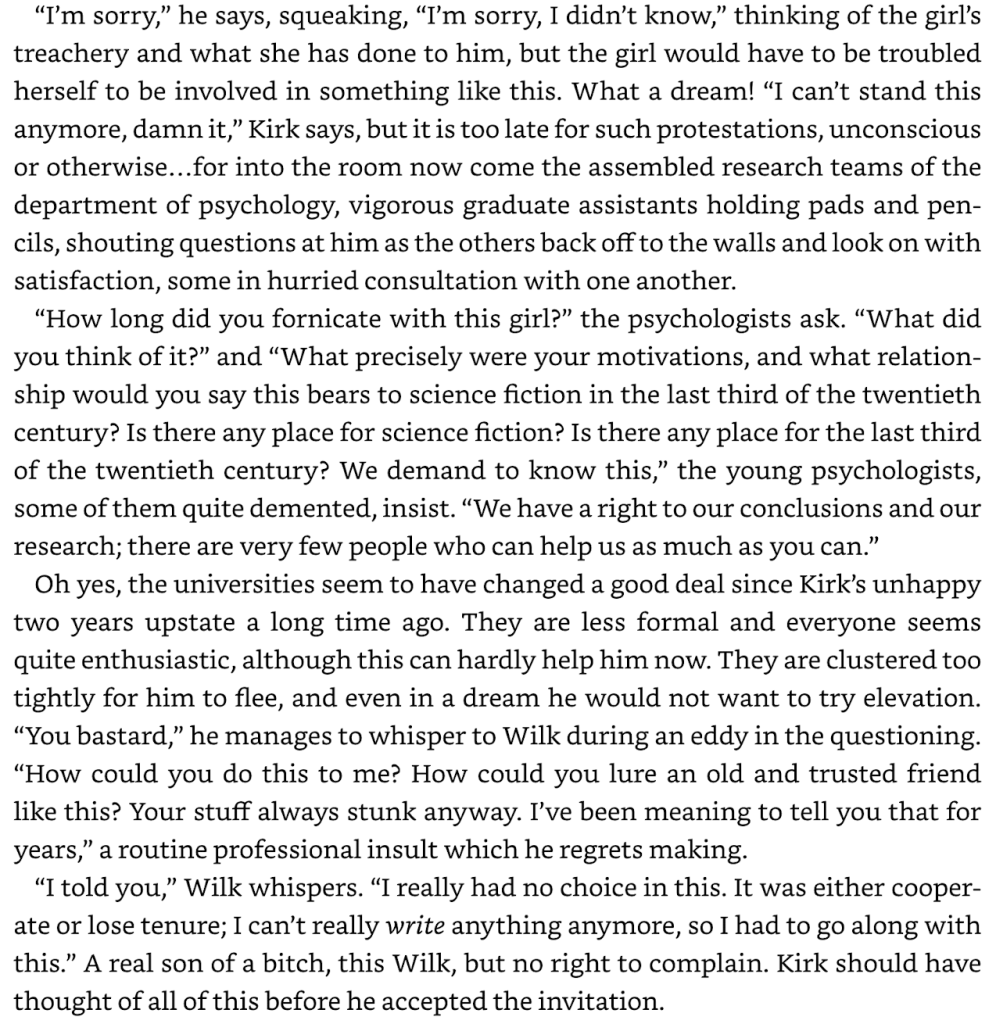
Herovit and Malzberg regretted giving so much of their creative effort to a genre that gets so little respect. They know they are writing escapism for adolescents. I think the genre has changed a lot since the 1970s. It does get more respect and it’s taken more seriously, probably because it deserves it. However, some of Malzberg’s criticisms might still be true, especially once you analyze why certain stories and themes are so popular with science fiction fans.

A good deal of Herovit’s World is about marriage. Herovit routinely cheats on his wife at science fiction conventions and neglects her at home. I’ve heard plenty of gossip about science fiction writers at conventions and conferences. But there is a non-SF connection here. There are many literary novels about blocked writers and failed marriages. I can’t tell if Malzberg is satirizing them too, or padding his SF novel. Both Herovit and Malzberg have bragged about being able to pad their fiction. My favorite novel on this theme is Wonder Boys by Michael Chabon, who writes in literary and SF genres.

Herovit’s World also contains a lot of sex. Malzberg got his start as a writer cranking out soft-core porn paperbacks. I don’t know if he’s saying that science fiction writers are sex obsessed, or sexually frustrated, or if he was merely padding his story because he didn’t have enough to say about science fiction to fill out the novel length. I do know that Portnoy’s Complaint by Philip Roth had come out a few years earlier and had become a bestseller dealing with sex honestly. As they say, “sex sells,” and Malzberg was hoping to break out of the science fiction ghetto.

Overall, Herovit’s World is mildly amusing. Most readers at Goodreads give it three stars, but a few love it giving it five stars. My rating would be ***+. I thought it was written well enough (***) and I liked it (+), but I wouldn’t ever reread it. That’s my main problem with Barry N. Malzberg. His books are interesting, but they never reach my next rating level. I give **** to books I know I’ll want to reread.

If Herovit’s World was less padded with sex scenes and had more satire about science fiction, it could have been a **** novel with me. If Malzberg had tried harder, gone beyond a first draft maybe, and really thought about the purpose of this novel, it could have been far better.

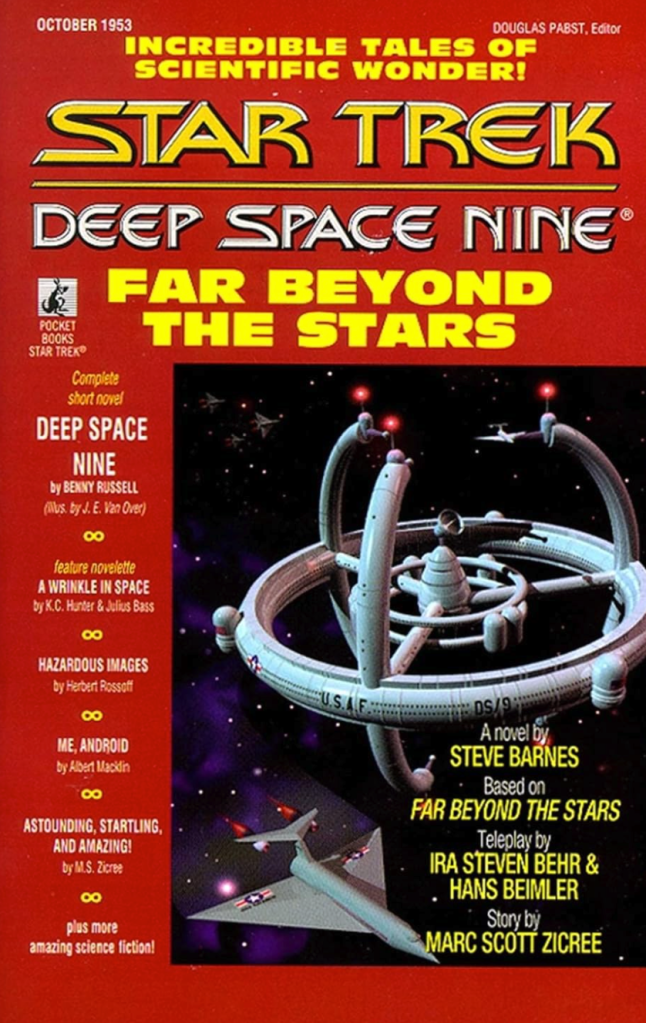
Malzberg focused on the pathetic without ever showing what we love about science fiction. His novel could have been elevated by showing Malzberg/Herovit’s passion for the genre. Far Beyond the Stars by Steven Barnes is a recursive science fiction novel that does just that. The story is a novelization of a Star Trek: Deep Space Nine episode where the DS9 crew are shown working at a 1950s science fiction magazine much like Galaxy Science Fiction. The story criticizes the racism in the genre back then yet still shows a love for science fiction.
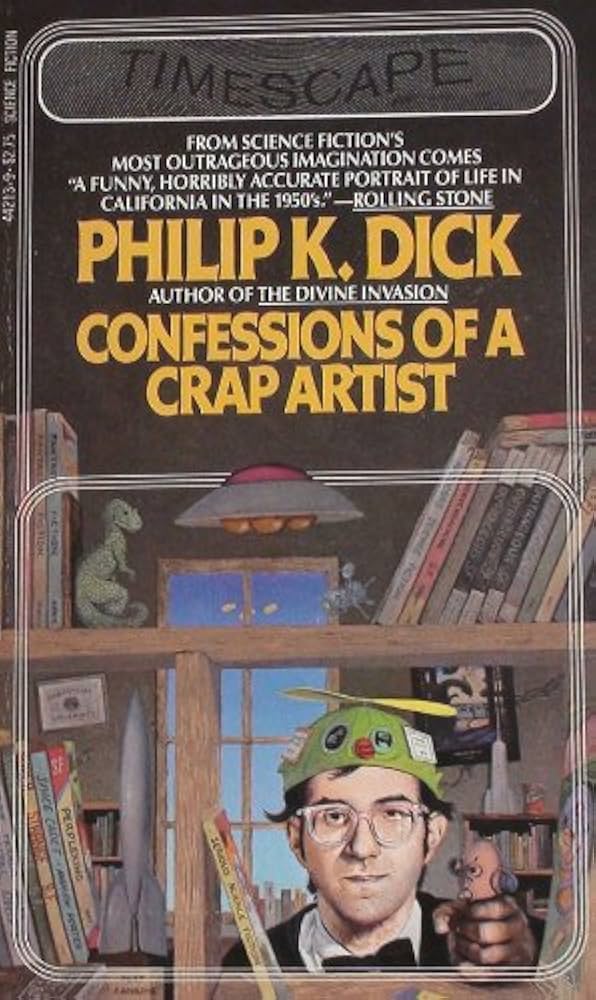
No matter how much I criticize science fiction, I can never forget how much Heinlein’s juveniles meant to me as a kid. I could write a satire on the genre, but I hope I wouldn’t do what Malzberg did in Herovit’s World, by making it all feel slimy and depressing. One reason why my favorite Philip K. Dick novel is Confessions of a Crap Artist is even though it criticizes science fiction fans, it does it with love. It’s a superior recursive science fiction novel.
James Wallace Harris, 2/11/25

“Earth for Inspiration” by Clifford D. Simak

“Earth for Inspiration” is a comic science fiction story by Clifford Simak set millions of years into the future about a science fiction writer and his robot visiting a forgotten Earth. The pair go there hoping to find inspiration to write new science fiction stories. You can read it online in the April 1941 issue of Thrilling Wonder Stories.

I read “Earth for Inspiration” by Clifford D. Simak because I read When the Fires Burn High and the Wind is From the North: The Pastoral Science Fiction of Clifford D. Simak by Robert J. Ewald. I bought that book after I read and reviewed A Heritage of Stars by Simak which made me want to know more about Clifford D. Simak. I mentioned my interest in Simak on the Clifford Donald Simak Facebook group and the Ewald book was one of two books about Simak that was recommended. I forgot I already owned the second book, Clifford Donald Simak: An Affectionate Appreciation by Francis Lyall. I haven’t read that one yet because I leant it to my friend Mike who had recently read the twelve volumes of Simak’s short stories. Mike is who got me to read A Heritage of Stars in the first place. I guess that puts me into some kind of inspiration loop.

A Heritage of Stars involved a post-apocalyptic America with few humans and some robots. In that story, most robots had been destroyed except for their brain cases which were saved as trophies after a war with the robots. Unknown to the humans, the robots continued to be conscious inside their brain cases for a thousand years. That idea of a conscious mind without outside sensory data intrigued me. Then I read in the Ewald monograph about “Earth for Inspiration,” involved a dying Earth, robots, and isolated robot brain cases. I had to read it. The story is also included in Simak’s collection Earth for Inspiration and Other Stories: The Complete Short Fiction of Clifford D. Simak Volume Nine. Amazon now sells 14 volumes in the complete stories. Audible.com now offers ten of those volumes in audiobook editions.

Version 1.0.0

Most of the famous science fiction short stories we remember from the 1940s were first published in Astounding Science Fiction. Thrilling Wonder Stories was aimed at younger, less educated science fiction fans, and we seldom see reprints from that pulp magazine. For the most part, its stories are less sophisticated with far more action. And that’s true for “Earth for Inspiration.” I thought it was a funny story, but somewhat simple and hyper paced. It has an old fashion voice because of all old-timey colloquialisms. Simak is known for his pastoral prose and midwest settings.

“Earth for Inspiration” was more fun than I expected to find in Thrilling Wonder. Usually, when we think about robots in science fiction, we think of Isaac Asimov, but I’m seeing how important robots were to Simak stories.

When I read it with my eyes, “Earth is Inspiration” felt like cliched pulp science fiction from the 1930s. However, when I listened to the story after buying the audiobook edition, I thought the writing was much better than my first impression, except for all the saidisms. (I think the worse was — “Look at that, will you!” he jubilated.) The second reading with my ears made me notice how many ideas Simak was using to develop the story. It’s a satire on writing science fiction, maybe even the first example of recursive science fiction.

However, “Earth for Inspirations” gives us a few clues about how Clifford D. Simak thought when comparing them to his other work. The more Simak I read, the more I spot common ideas, characters, and elements that he used and reused.

The Ewald monograph has a few pages of biographical information, almost just a list of dates. Most of the 155 pages describe Simak’s stories and novels. I was hoping to find a biography of Simak, something like William H. Patterson did for Heinlein, but such a book doesn’t exist as a far as I can tell for Simak. Second to that, I was hoping to find an analysis of the impact of Simak’s stories, like what Alexei and Cory Panshin did for Heinlein, Asimov, and van Vogt in The World Beyond the Hill. It’s not that either. When the Fires Burn High and the Wind is From the North, is a standalone journal, volume 73 of The Milford Series: Popular Writers of Today. The content is like Alva Rogers A Requiem for Astounding, which is a description of the stories in all the issues of Astounding Science Fiction in chronological order.

I thought it fascinating that Simak was thinking of robots in the same way in 1941 and 1977. He obviously had a fondness for the idea of robots and had developed an idea of what they would be like early in his career and stuck with it until he died. Robots were faithful servants who were also friends. Simak imagines them with bodies that can break down, but with nearly indestructible brain cases. I assume those brain cases have an internal power supply that could last for millions of years. A couple years ago I read a collection called The Complete Robot by Isaac Asimov. I wonder if Simak has enough robot stories to warrant such a collection?

Reading Simak, we can assume he didn’t like cities or corporations and had a low opinion of mankind’s ability to survive in the long run. Although, “Earth for Inspiration” is set millions of years in the future after humans have colonized the galaxy, but long after we’ve used up Earth’s resources and abandoned it.

The first scene of “Earth for Inspiration” opens with a short tale about a robot named Philbert who became inert after his body rusted up. Eventually, his body rusted away and Philbert lived inside his braincase for millions of years. This reminds me of the Tin Woodsman of Oz.

The second scenes jumps to Jerome Duncan, a once successful science fiction writer who is again getting rejection slips after a successful career. Duncan lives millions of years from now. It’s amusing that Simak thinks science fiction will last that long.

Anyway, Duncan’s robot Jenkins suggests going to Earth to get inspiration for writing a new story. Jenkins is also the name of the robot in City, Simak’s most famous book, a fix-up-novel. Duncan is famous for writing Robots Triumphant. I won’t tell you what it was about because it becomes part of the story.

The next scene has Duncan and Jenkins arriving on Earth with a lot of camping equipment and meeting an old-timer, Hank Wallace, who has been waiting for new tourists for over a thousand years. He manages the Galactic Trainsport station, but no one informed him that the line had been shut down a thousand years earlier. Duncan and Jenkins had hired a private rocket. This points to another idea that Simak loved, that humans would eventually have very long lives. In this story, we last for ten thousand years. And his second most famous novel, Way Station, is about an old-timer who manages a transport station and who doesn’t age. By the way, the old-timer in that novel was named Enoch Wallace.

Should we assume that Simak had been thinking about writing his most famous novels for years?

I don’t think I should tell you any more of “Earth for Inspiration.” It’s a fun enough story so that I shouldn’t spoil it for you. I’ll just hint at a few more scenes. Earth in the far future is dry, and has lost most of its air. There’s a confrontation with humans living in primitive tribes in dry deep sea canyons where the air is thicker. That makes it a dying Earth story. There are slapstick scenes with a crazy robot and another confrontation with horde of runaway robots.

“Earth for Inspiration” has decent humor, although not sophisticated. It would make a great humorous episode for Love Death & Robots. The humor is slapstick Sheckley with a touch of Frederic Brown’s ironic weirdness. I’m not sure if Simak intended it to be entirely comic, although, he probably did, but I bet a lot of young readers in 1941 took it straight realistic action.

James Wallace Harris

“A Toy for Juliette” by Robert Bloch

I was going to take a break from reading Dangerous Visions because it was depressing me, but I found “A Toy for Juliette” a fitting inspiration for a sermon I wanted to write. I’ve been reading Golden Multitudes: The Story of Best Sellers in the United States by Frank Luther Mott, which inspired me to buy and start reading The Sentimental Novel in America 1789-1860 by Herbert Ross Brown. Both books give impressions about how Americans, and I presumed other people around the world, got into reading fiction.

Printing began in the 15th century at a time when most people didn’t read. Storytelling has been around since we lived in caves. Although there were works in Japan and China that could be called novels long before the printing press, in Europe and America, the novel seemed to emerge with Don Quixote in 1605. What we think of as the modern novel matured in the 18th century.

Frank Luther Mott’s book, Golden Multitudes describes the kind of books people read in America before Ben Franklin printed Pamela by Samuel Richardson in 1745. Some considered Pamela, first published in England in 1740, to be the first English novel. Before this novel, Americans mostly read books on morality. The colonies were settled by various religious groups, so that’s kind of logical. Mott says the first American bestseller was The Day of Doom by Rev. Michael Wigglesworth. It was written in verse, and it was all about the horrible things that would happen to people in hell. The excerpts and quotes Mott gave from this poem made me think early Americans were fixated on horror.

To keep this sermon short, I need to cover the following decades quickly. Fiction slowly emerged out of all this moralistic reading. Another bestseller was The Pilgrim’s Progress from This World, to That Which Is to Come by John Bunyan in 1678. This book is an allegory that begins with a dream. But the point is, Bunyan spiffed up moralizing with a story and characters.

Pamela became a huge bestseller in America and Europe after 1740 because Richardson made moralizing every more entertaining. One reason Pamela is given credit for being one of the first English novels is because Richardson invents a lot of storytelling techniques we use today. After the success of Pamela countless imitators began producing similar type stories, and the focus on moralizing became less, and the shift to pure storytelling became common.

At that time, many intellectuals began protesting, claiming fiction was corrupt and corrupting. Magazines and newspapers ran articles about how fiction was ruining young people’s minds, especially young girls. That made me think about how people worry about smartphones and video games corrupting young people today. But those fiction protesters were crushed by bookworms wanting more fiction.

By the time the 19th century rolled around, especially after Edgar Allan Poe, many stories became free of moralization. Kids and adults devoured fiction about violence, horror, the supernatural, and other evil things in the world. Which is why Robert Bloch is a popular writer, and why people enjoy stories like “A Toy for Juliette.”

The problem is I don’t. I don’t like horror. And I can’t understand why other people do. Although Susan and I are currently watching Why Women Kill, which could be described as comic horror. Fiction writers have a tough time producing stories that don’t involve the horrible aspects of life. Fiction is often an art form about the ugliness of humanity, but isn’t the best fiction about transcendence of those horrors?

I quite enjoy reading Pamela. I’m only about half finished, but then the book is over forty hours long on audio. I admire Richardson for embedding his moral lessons into his story. The story is about 15-year-old girl servant efforts to avoid being raped by her employer. On one hand, the novel could be considered a handbook for girls warning them about all the ways guys will trick them into having sex. On the other hand, it’s rather entertaining to read about all the schemes Mr. B used to seduce Pamela. The novel is also entertaining because I’m watching Richardson invent plotting and characterization.

When reading “A Toy for Juliette” I was seeing the refinement of centuries of storytelling. But Bloch completely ignores moralizing. He returns to the purity of telling gruesome stories around a campfire. However, I miss moralizing. Bloch makes no effort to explain the psychology of Jack or Juliette. He makes no moral judgments on their actions. He just accepts that those kinds of people exist.

Sociologists claim there is no correlation between the consumption of violent entertainment and committing violence, but I find that hard to believe. But then, from Harlan Ellison’s introduction about Robert Bloch, he seems like a very nice guy — kind, considerate, and generous.

Maybe, “A Toy for Juliette” depresses me because it reminds me that there are people like that in this world. And it bothers me that people find stories about such people entertaining. But as I admitted, Susan and I found a comedy about murder fun. And even the Puritans, with all their emphasis on living a pure life, sure did love to read about the gruesome aspects of going to hell.

Back in the 1960s, I learned from health food nuts, “You are what you eat.” And from computer school I learned GIGO – garbage in garbage out. I can’t help but wonder if those 18th and 19th century pundits who attacked fiction weren’t right. Why should we pollute our mind with a story about a sadist being sadistically killed by another sadist? I guess I could claim Bloch was preaching that we reap what we sow, but I don’t think it’s true. I think people enjoy seeing Juliette get ripped by the Ripper.

Still, I find “A Toy for Juliette” a virus in my mind. I find reading nonfiction about the horrors of humanity enough of an education about the reality of humanity. Why do we want reminders of such horrors in our escapism? But we do. Think about all the fiction you consume. How much of it involves acts we’d be terrified of if they happened to us? Why do we dwell on the horrible?

James Wallace Harris, 6/9/24

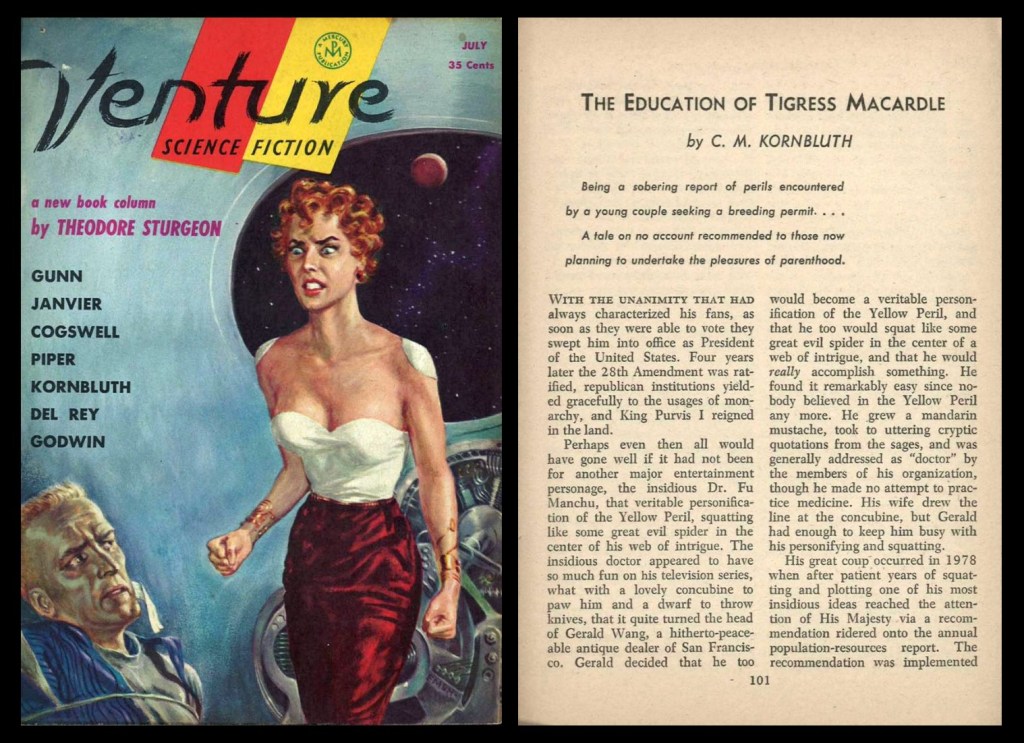
“The Education of Tigress Macardle” by C. M. Kornbluth

Group Read 72: The Best Science Fiction Stories of 1957

“The Education of Tigress Macardle” by C. M. Kornbluth #10 of 20 (ReadListen)

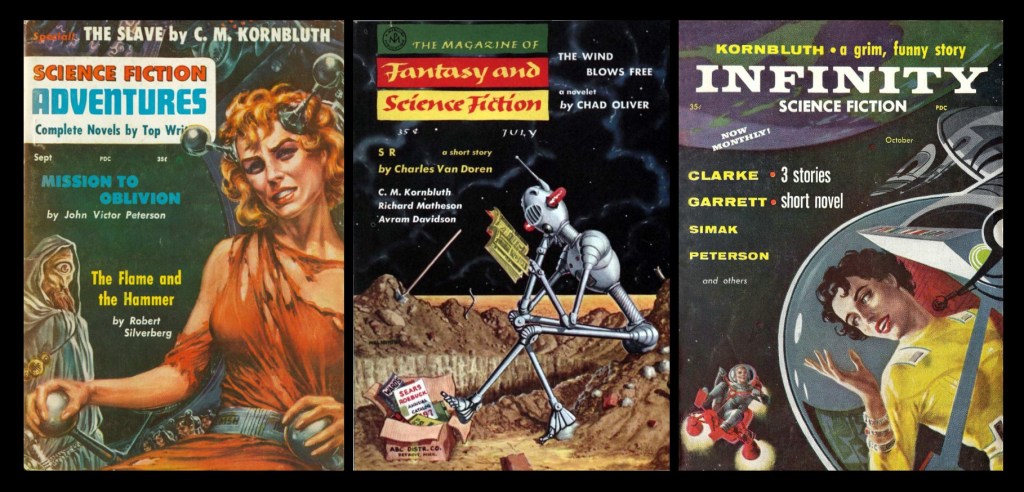
C. M. Kornbluth came out with four short stories in 1957 – “MS. Found in a Chinese Fortune Cookie,” “The Education of Tigress Macardle,” “The Slave,” and “The Last Man Left in the Bar.” None of them stood out as an obvious favorite among readers, with each story having its fans. Isaac Asimov and Martin H. Greenberg couldn’t decide between “The Education of Tigress Macardle” and “The Last Man Left in the Bar” so they published both in The Great SF Stories 19 (1957). Kornbluth died in early 1958, at age 34, so these were the last of his short stories that Kornbluth got to see in print.

I picked “The Education of Tigress Macardle” for the best of 1957 because it had two citations in CSFquery, and the others only had one. However, I’ve had people tell me they preferred either “The Last Man Left in the Bar” or “MS. Found in a Chinese Fortune Cookie.” After reading all three, I feel CSFquery was right, but what do you all think? Follow the links to read the two other stories. I don’t have a link to “The Slave” but it was a novella promoted as a short novel.

Kornbluth was famous for his sharp satire. His brutal wit stabs at several topics in “The Education of Tigress Macardle.” The bit that amused me the most was a throwaway paragraph about the Civil War Book-of-the-Week Club. I chuckled at Mightier than the Sword: A Study of Pens and Pencils in the Army of the Potomac, 1863-1865. There really is a seemingly endless amount published about the Civil War.

“The Education of Tigress Macardle” begins by informing its readers that in the future, a popular personality was elected President, and he got the 28th Amendment passed that made him King Purvis I. (I hope that’s not prophetic.) King Purvis inspired a guy name Gerald Wang to play at Dr. Fu Manchu and unfold a sneak attack on the United States. We learn all of this because the story is told from the year 2756 A.D. in a class at Columbia University called Chronoscope History Seminar 201. The students of this class watch what happens to George and Diana “the Tigress” Macardle on a chronoscope.

You must read between the lines to pick up all the well-hidden sexual innuendo, and if you miss what little there is, the story might lose a lot of its charm. Kornbluth is aiming at humor, but I’m not sure how many of his jokes I get. George thought he had achieved bachelor nirvana when the Tigress would have sex with him on his bear skin rug in his downtown bachelor pad. Then she whined that she wanted to get married. Then she whined she wanted to have a house in the suburbs. Evidently, George kept getting all the sex he wanted because he kept giving in. Then the Tigress whined to have a baby.

Now here’s where the fun starts. King Purvis degreed that all Americans who wanted to have children must pass a Parental Qualifications Program (P.Q.P.). And Dr. Wang devises a doozy of a potential parent exam that secretly works at his plan to take over America. Parents are given a robotic toddler to take care of for three months. If it’s black box records proper care George and the Tigress will get a permit to breed.

You can imagine the fun Kornbluth provides with this setup. You might not guess the surprise ending. I didn’t.

Another reason I preferred “The Education of Tigress Macardle” over the other two Kornbluth short stories, is because the story is more to the point and clearer. I’m not saying it’s perfectly clear. Kornbluth writing style includes a constant flourish of asides. His prose is baroque with allusions that he hopes will make us smile or admire his wit.

But those filigrees also make it hard to read Kornbluth. Kornbluth relies heavily on things from the future, or beings from other dimensions, or observers from the future. They’re usually a gimmick, a foundation, a diving board, for him to riff with his clever wordiness. Usually, his stories are fun, but seldom have much impact. He has twenty-four stories in CSFquery, but most of them don’t have many citations. I wonder if Kornbluth would have been a good standup comedian. It helps to hear his stories read by a narrator that does voices.

Personally, I believe “The Education of Tigress Macardle” would have been a far superior story if Kornbluth would have hacked off the sections with King Purvis, Gerald Wang, and students from the future. He should have focused entirely on George and the Tigress and spent all his energy making the story subtle, funny, and insightful. The setup with the tryout toddler is great by itself. And he should have worked on the characterizations of George and the Tigress. In 1957 the Playboy bachelor and the emerging liberated woman were ripe for satire.

James Wallace Harris, 4/2/24

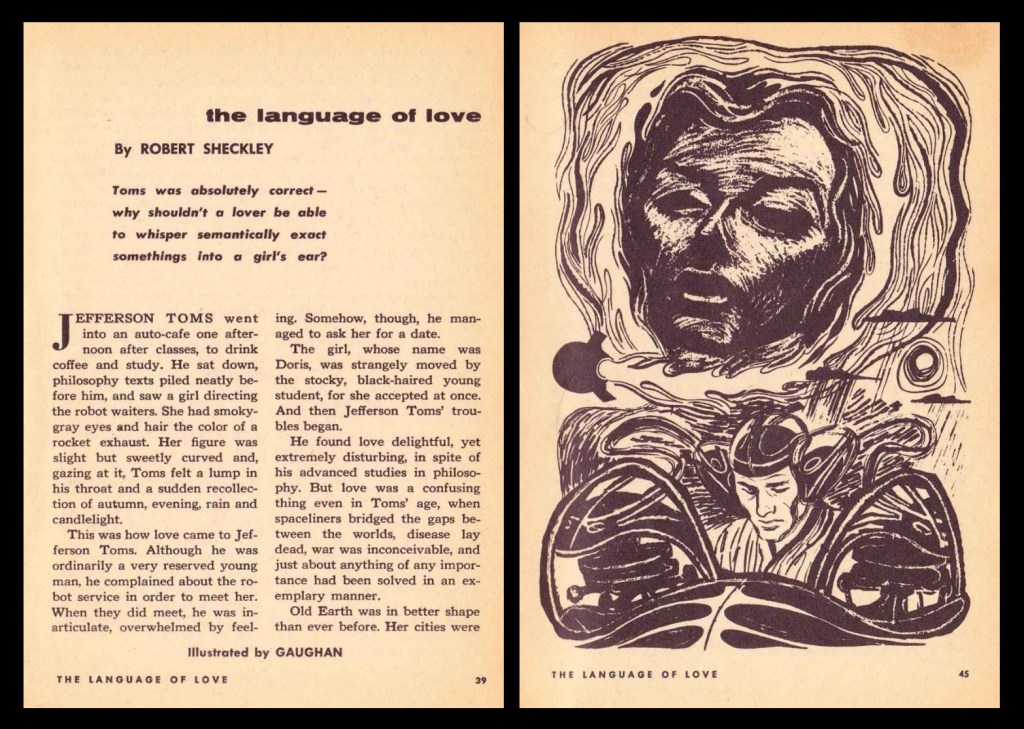
“The Language of Love” by Robert Sheckley

Group Read 72: The Best Science Fiction Stories of 1957

“The Language of Love” by Robert Sheckley #06 of 20 (Read)

I added “The Language of Love” by Robert Sheckley to the list of best science stories of 1957 because me and my high school buddies loved this story back then, and it has stuck with me for over fifty years. I’ve often talked about it to other people. “The Language of Love” is a silly humorous piece that also offers interesting philosophical insights. I won’t talk about them right away because I hope you will go read the story, but I will eventually spoil the ending by explaining the story.

Robert Sheckley is becoming a forgotten science fiction writer and I think that’s sad. Everyone recalls The Hitchhiker’s Guide to the Galaxy when the topic of humor and science fiction comes up, but they should be using Robert Sheckley as the poster boy for funny Sci-Fi instead of Douglas Adams. And don’t get me wrong. I like Douglas Adams too, but Sheckley mined the funny bone of science fiction far deeper and wider.

Sheckley wrote a lot of short stories in the 1950s and 1960s and they just aren’t remembered. Probably he’s remembered, if he’s remembered at all, for two novels, Dimension of Miracles and Mindswap. Both are available on audiobook, and that’s how you should read them. Neil Gaiman introduces the audiobook version of Dimension of Miracles where he tells a funny/sad anecdote about Sheckley. Gaiman produced several audiobooks for Audible where he promotes forgotten titles and authors. You might like to look at that page.

“The Language of Love” is about a young Earth man, Jefferson Toms, who falls for a girl named Doris. He was overwhelmed by what he felt for her, but when Doris expected Jefferson to tell her he loved her he couldn’t. Jefferson wanted to find the perfect words to express exactly what he felt for her. So, he went on a quest across the galaxy to learn everything he could about love and language.

To get you to click on the read link above, I thought I would post the first two pages of the story. Sheckley has a wonderful writer’s voice, and I think you need to hear a bit of it. Maybe that will convey what I mean more than my own words trying to describe it.

When Jefferson returns to Doris and utters the precise words that express his feelings for her, poor Doris is upset. I changed my mind. I won’t give you those words. Or explain the double surprise ending. Just go read the story.

I think “The Language of Love” also captures one of the dominant flavors of Galaxy Science Fiction back in the 1950s. Galaxy loved satire. Often stories in Galaxy were light, jaunty, and sometimes biting. It wasn’t a hard science fiction magazine like Astounding. I’m not sure the type of science fiction Galaxy presented in the 1950s has survived well. H. L. Gold was a much different editor than Frederik Pohl in the 1960s. Only three of the twenty stories our group is reading as the best of 1957 are from Galaxy, I added two of them, “The Language of Love” and “Time Waits for Winthrop” by William Tenn. I added them by abusing my power as moderator. I hope it just isn’t me that fondly remembers this kind of science fiction from the 1950s. I’m looking forward to seeing how the others react.

James Wallace Harris, 3/23/24

“Hunting Machine” by Carol Emshwiller

Group Read 72: The Best Science Fiction Stories of 1957

“Hunting Machine” by Carol Emshwiller #04 of 20 (Read, Listen – @05:40)

“Hunting Machine” by Carol Emshwiller is a rather short, but effective anti-hunting story that was first published in the May 1957 issue of Science Fiction Stories. Ruthie and Joe McAlister are on a three-day hunting trip with a robotic hunting dog rented from the park service. The robot was set by the warden for three birds, two deer and one black bear. However, Joe tinkers with the governor on the robot so he can hunt a 1,500-pound brown bear.

Most of the story is satire about how in the future people bring all kinds of gadgets to make their time in the rugged wilderness as comfortable as staying at home. Because hunting with their automatic rifles and robot is like shooting fish in a barrel, Joe overrides the controls in the robot to make the bear put up a fight. We see some of the story from the robot’s and bear’s perspective, both of which are more in tune with nature. Humans come across as schmucks in this story.

I’ve read “Hunting Machine” before, but it hasn’t stuck in my mind. It’s too slight, too simple, and too obvious. I’m surprised by both T. E. Dikty and Asimov/Greenberg included it in their anthologies that collected the best SF shorts of 1957. That suggests it is liked more than I think it should be. It’s a nice enough little yarn, fine for a magazine, but lacks the punch needed to make it worthy of an anthology in my opinion.

W. M. Irwin felt the story was more than an anti-hunting story, about how sports and outdoor adventures are ruined by automation. I can buy that. I agree with Paul Fraser that the ending was anti-climactic. I wanted the bear to win, to destroy the robot and to kill and eat Ruthie and Joe. And second to that possible ending, I wanted the robot to kill Joe because he was within the new weight limit that Joe had illegally changed. But Carol Emshwiller kept the story lighthearted.

This story should have been published in a hunting magazine in 1957. I’m sure real hunters would have enjoyed the satire even more. I don’t think “Hunting Machine” adds much to our understanding of 1950s science fiction. The definitive 1950s hunting story with a science fiction theme is “A Sound of Thunder” by Ray Bradbury, first published in Collier’s in 1952. It’s about hunting dinosaurs. Following that is “A Gun for Dinosaur” by L. Sprague de Camp, that first appeared in Galaxy in 1956. It’s another hunting story that plays off Hemingway’s classic Africa stories. Finally, there’s yet another classic dino hunt story, “Poor Litte Warrior!” from F&SF in 1958, where Brian Aldiss satirizes the first two.

I’m sure if I made a concentrated effort, I could track down more titles to define hunting as a sub-theme of science fiction. But my memory can’t dredge up any more from my brain, and I’m worn out on Googling.

James Wallace Harris

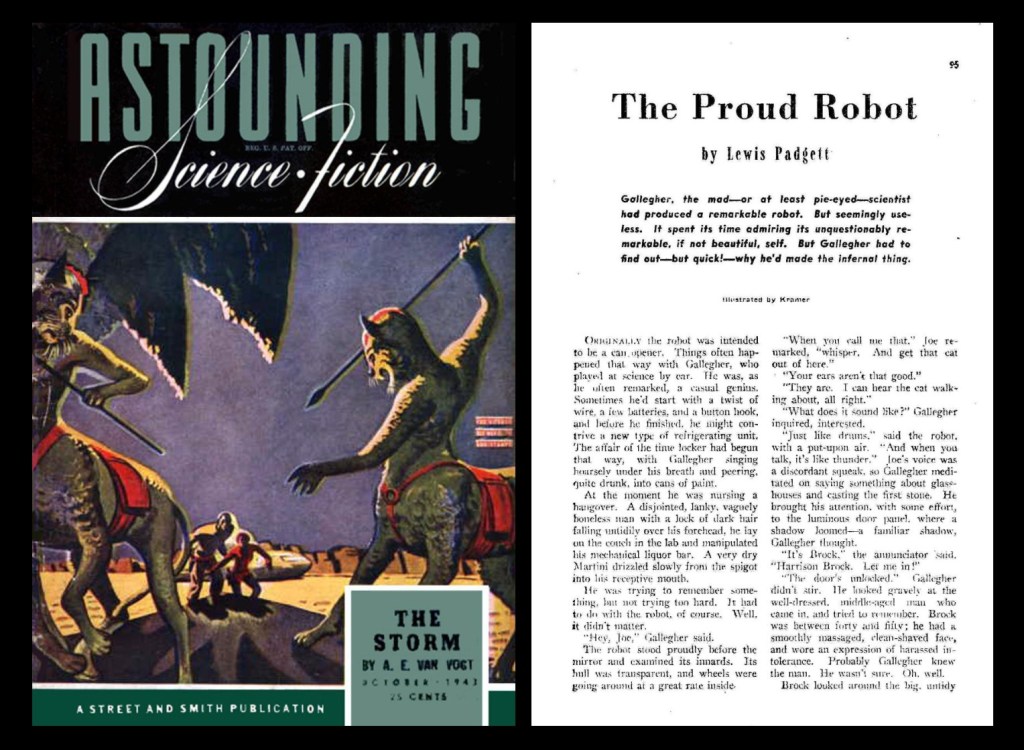
“The Proud Robot” by Lewis Padgett

The Proud Robot” by Lewis Padgett is story #50 of 52 from The World Treasury of Science Fiction edited by David G. Hartwell (1989), an anthology my short story club is group reading. Stories are discussed on Tuesdays, Thursdays, and Saturdays. “The Proud Robot” was first published in Astounding Science-Fiction (October 1943). Lewis Padgett was the pen name of husband-and-wife writers Henry Kuttner and C. L. Moore, but most fans think it was written by Kuttner.

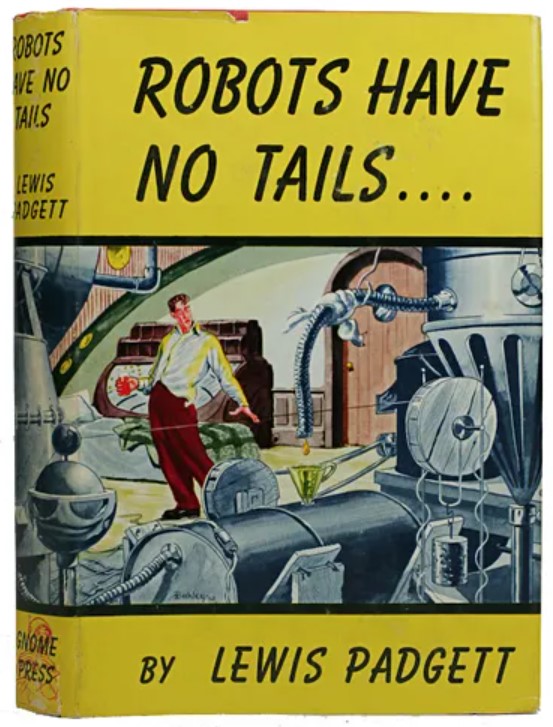
Back in the mid-1970s I discovered Robots Have No Tails in an old library downtown. It was a rebound copy of the original Gnome Press edition without a dustjacket. I read the first story, “The Proud Robot” and loved it because I was also a recent fan of The Thin Man movies with William Powell and Myrna Loy. I mention this because Kuttner obviously based the zany alcoholic mad-scientist Galloway Gallegher on the movie version of Nick Charles. I think most people might agree with me on that. However, I have another theory. I believe Joe, the vain robot was based on Bungle, the glass cat from The Patchwork Girl of Oz by L. Frank Baum. Both the robot and cat had transparent bodies so you could see their insides, and both were obsessed with looking at themselves.

I’ve read “The Proud Robot” several times over the years. Sometimes I like it, and sometimes I don’t — it all depends on my mood. Sometimes a drunk protagonist is amusing, and other times, Gallegher is just too damn annoying. Joe the robot is always annoying — but he was meant to be.

Harrison Brock, a television/movie mogul hires Gallegher to invent technology that will bypass patents that bootleg theaters are using to put his Vox-View Pictures out of business. Gallegher has accomplished the task but doesn’t remember how. Gallagher works when he’s drunk using his subconscious mind as a creative power. Most of the story is about Gallegher trying to remember what he did. All he knows is he came to after building a vain robot. Kuttner wrote a lot of pulp mysteries besides writing science fiction, so this story is really a SF mystery.

The central plot of the story lets Kuttner speculate about the future of television in 1943. He imagines the television industry paying for itself through household subscriptions, which was a path taken in England. He didn’t anticipate the power of commercials. Kuttner also imagined how the movie industry would fight back against television by offering viewers greater technological features to leave their homes. The speculation about the future of TV is fun but isn’t enough to carry the story.

How Gallegher solves the mystery is silly but logical enough within this silly story. Like I said whether this will be amusing will depend on your mood. I wished that I had an audio version of “The Proud Robot” because a good narrator would help me to hear this story in its funniest light.

I’m not keen on Kuttner. My hunch is I like the C. L. Moore part of the team, that’s Lewis Padgett. If a Lewis Padgett story is serious and moving, I assume Moore did most of the writing. If it’s intellectual, silly, or pulpy, I tend to think it’s Kuttner. Our next story, “Vintage Season,” was written by the same team. Because that story is so wonderful, I feel it was mostly written by Moore.

I feel “The Proud Robot” was Kuttner’s hack work, and sometimes, if the mood strikes me, it’s amusing hack work.

James Wallace Harris, 8/29/23

“Captain Nemo’s Last Adventure” by Josef Nesvadba

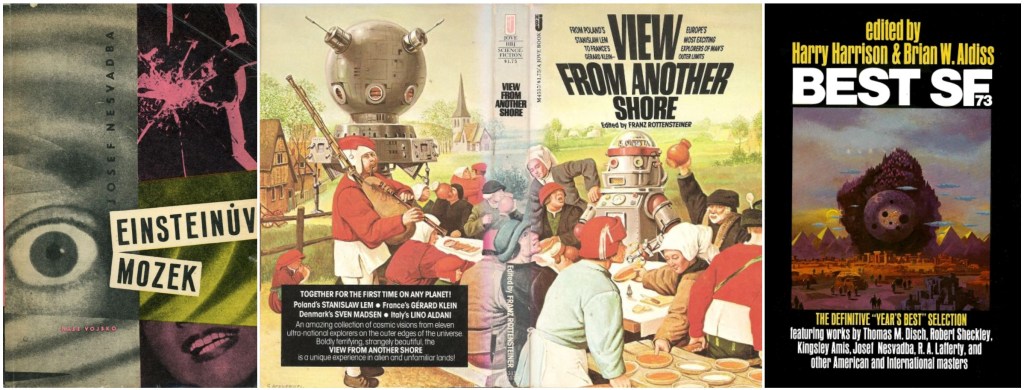
Captain Nemo’s Last Adventure” by Josef Nesvadba is story #22 of 52 from The World Treasury of Science Fiction edited by David G. Hartwell (1989), an anthology my short story club is group reading. Stories are discussed on Tuesdays, Thursdays, and Saturdays. “Captain Nemo’s Last Adventure” first appeared in Nesvadba’s 1960 collection, Einsteinův Mozek. It was translated into English for the 1973 anthology edited by Franz Rottensteiner, View From Another Shore, and it was selected in 1974 for Best SF: 1973 edited by Harry Harrison and Brian Aldiss. (Follow the link to the story title to see where it’s been anthologized if you want to find a copy to read. However, The Treasury of World Science Fiction is widely available in used copies and is probably the cheapest way to get this story, along with 51 others.)

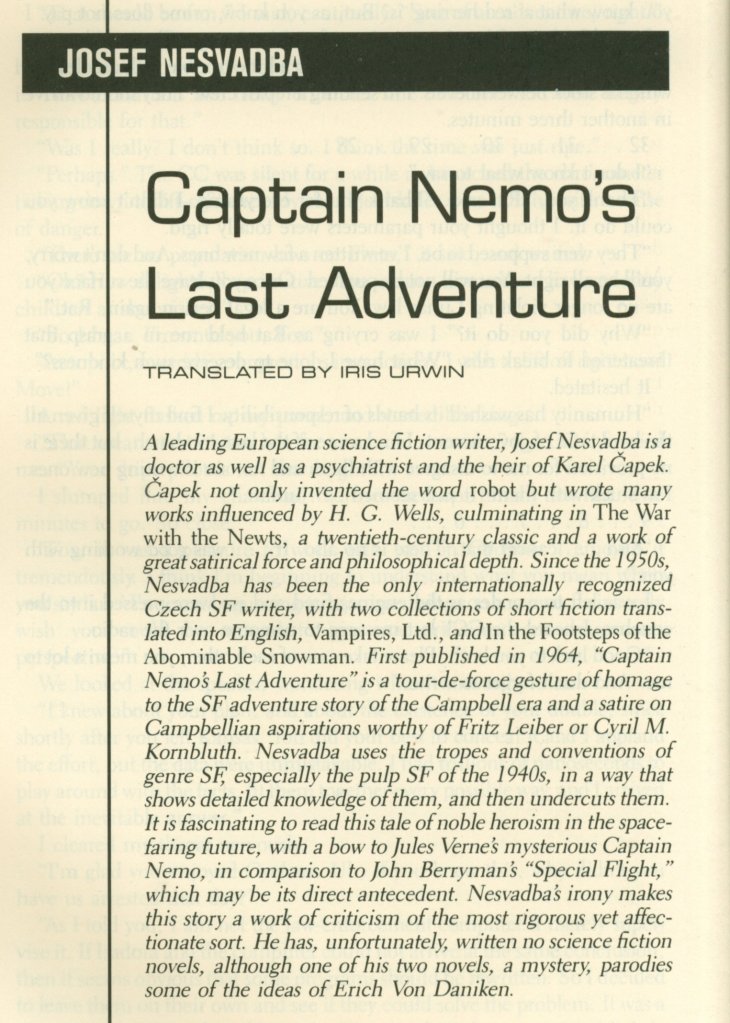
David G. Hartwell had so much to say about “Captain Nemo’s Last Adventure” in his introduction that I thought I’d just reprint it here.

I don’t know if I agree with Hartwell when he says “Captain Nemo’s Last Adventure” is a satire on stories from John W. Campbell’s era, or that Nesvadba uses the tropes and conventions of 1940s science fiction. I’m not even sure “Captain Nemo’s Last Adventure” is even an ironic work of criticism. I’m not saying it’s not, but I want to propose an alternate theory.

What if science fiction evolved separately in Czechoslovakia? And what if its evolution sometimes paralleled American pulp science fiction? Evidently, “Captain Nemo’s Last Adventure” was written after Sputnik but before Gargarin’s famous ride. Would Josef Nesvadba have access to old American pulps or even 1950s anthologies that reprinted them?

The prose of “Captain Nemo’s Last Adventure” doesn’t come across like the prose in pulp fiction. Like many of the foreign language science fiction stories we’ve been reading, it’s mostly told and not shown. However, it is longer, and that lets it become a fuller story than the shorter works we’ve read. I wonder if Nesvadba wasn’t inspired by Soviet science fiction or the Polish Stanislaw Lem?

“Captain Nemo’s Last Adventure” is about the super-heroic Leonard Feather and chronicles his feats of always needing to save the day, and eventually the Earth. Yes, we could compare him to Kimball Kinnison and the Lensman series. But Feather could just as easily be compared to Homer’s Ulysses.

I do think Nesvadba was making fun of spacemen, and the kind of macho men who need to always be on an adventure. Feather is a womanizer who makes his wife unhappy, as well as his mistresses, and he can’t understand why his son isn’t like him. Nesvadba is satirizing a certain kind of man that has existed in all genres of literature.

Nesvadba also appears to be attacking the call of the high frontier, robotics, and the never-ending quest to conquer and engineer. When Captain Feather, aka, Captain Nemo meets another intelligent race, he can’t understand what they are after. When he returns to Earth and is forced to stay put, Feather begins to see the need for philosophy and art.

There are parallels to American science fiction in this story. Heinlein, Campbell, Hamilton, and others all wrote stories about meeting super-advanced aliens back in the 1940s. The robots in “Captain Nemo’s Last Adventure” remind me of Jack Williamson’s The Humanoids. This story even reminds me just slightly of Robert Sheckley in the 1950s.

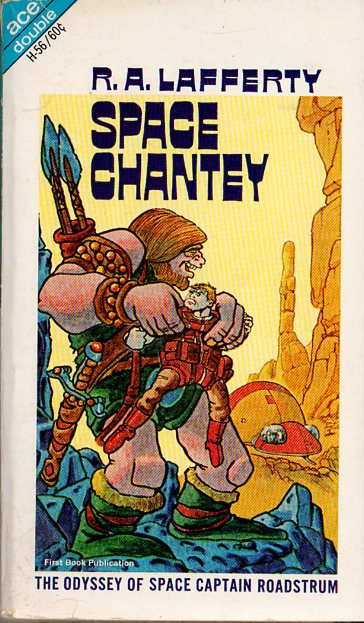
But, Captain Feather and his crew mostly remind me of Space Chantey by R. A. Lafferty, which is a science fiction parody modeled on Homer. My guess is that Nesvadba’s story was really inspired by Lem’s The Star Diaries, which came out in the 1950s?

Still, “Captain Nemo’s Last Adventure” is a good tale. It’s not told dramatically, which disappoints me, but its length allowed it to cover a number of interesting science-fictional topics that were enjoyable to me.

James Wallace Harris, 6/23/23

“Ghost V” by Robert Sheckley

Ghost V” by Robert Sheckley is story #20 of 52 from The World Treasury of Science Fiction edited by David G. Hartwell (1989), an anthology my short story club is group reading. Stories are discussed on Tuesdays, Thursdays, and Saturdays. “Ghost V” first appeared in Galaxy Science Fiction (October 1954).

Back around 1968, when I was in high school, I had two friends that also read science fiction – Jim Connell and George Kirschner. We’d often sit around and talk about the science fiction we read over our short lifetimes. Mostly, we couldn’t remember titles or authors but always remembered a unique idea within the story. I remember George excitedly telling Connell and me about “Ghost V” back then. I’ve read it since, but probably in the 1970s. I never remembered the story title or details. Just the trick ending.

So when I started reading “Ghost V” again today I remembered nothing about it. As soon as I started reading it I thought, “Hey, this could be that story George had told us about over half a century ago!” And my hunch was right. I remembered the idea that Sheckley used as the punch line of his story. It has always been memorable, and I’ve even told other people about it a few times because it’s a charming little idea with a neat kind of connection to reality.

Now, the question I have is: should I tell the ending here? I never know how much I should say about a story when writing about them. I really want to discuss stories, not review them. To do the same thing that Connell, George, and I did way back when — talk about the most exciting and memorable ideas. I want to just bullshit about the idea or ideas that make a particular story great for me.

“Ghost V” isn’t very long. You could go read it here. It’s part of a series of nine stories Robert Sheckley wrote about the AAA Ace Planet Decontamination Service. “Ghost V” is essentially a joke. It’s about two guys, Richard Gregor, and Frank Arnold who exterminate problem creatures on newly discovered planets. Think Ghostbusters. Gregor and Arnold don’t believe in ghosts or other supernatural beings, but they are hired to get rid of supernatural threats on Ghost V.

Sheckley sets up the story when Mr. Ferngraum comes to visit their office to hire Gregor and Arnold. Ferngraum is a planet flipper, buying planets cheap, and selling them for a profit. He tells Gregor and Arnold how he invested more than his usual amount in a quality planet that he hoped to make a killing with, unfortunately, the first two expeditions to the planet were mysteriously wiped out, killing colonists in the most hideous ways. If they can’t help him he’ll go bankrupt.

By the way, you have to understand the mood of the story. Think of The Hitchhiker’s Guide to the Galaxy. For me, I recalled Sheckley’s novel, Dimension of Miracles which features a minor character we know of as God, who did a cut-rate contracting job creating Earth. The level of humor is not very sophisticated in “Ghost V,” young people might put it on the level of the current TV show Ghosts.

“Ghost V” is silly and completely unscientific, but unlike some of the stories in The World Treasury of Science Fiction, it’s told in a way that I believe the setup while reading it. That’s the difference between “Ghost V” and the stories in the anthology like “The Chaste Planet” and “Tale of a Computer Who Fought a Dragon,” which I’ve criticized for not using the kind of storytelling techniques I prefer. If those stories had been told the way Sheckley told “Ghost V,” I probably would have liked them.

Sheckley tells his tall tale realistically, with a straight face. His storytelling technique is no different from the way Hemingway writes about real-life bullfighting or deep-sea fishing.

Gregor goes off to Ghost V knowing that colonists in two previous expeditions were slaughtered by some kind of horrible scientifically undetectable monsters. Sheckley aims to scare us too. Arnold stays home to be Gregor’s research consultant.

Gregor lands with no problem and sets up living in the quarters of an earlier expedition, the ones who had been sun worshippers. (I assume we’re to read nudists.) That night, after he turns off the light and goes to bed, he sees his clothes come to life in the shadowy dark and menacingly approach him. He blasts them to pieces. Gregor then turns on the light and radios his partner. Arnold claims to have a theory, but Gregor remains frightened.

The second monster Gregor meets is a Purple Striped Grabber. The Grabber wants to eat Gregory with chocolate sauce. The Grabber also informs Gregor that he can only eat him on the first of the month, which is the following day, and asks Gregor for a favor. The monster wants Gregor to eat apples before he comes back because that will make him taste sweeter. The monster leaves and Gregor calls Arnold again. Arnold says this new report confirms his theory. Ghost V monsters are our childhood fears made real. That there must be something in the environment that messes with our brains.

The next day, when the Grabber returns Gregory remembers a monster like it from his childhood, recalling it could be stopped with a magic word. After frantically dredging up several magic words while the Grabber is trying to eat him, Gregor hits on the right one and is saved. (Hey, Gregor was the name of the character in Kafka’s “The Metamorphosis.”)

The next monster is the Shadow. Eventually, Gregor kills it with a water pistol.

Arnold arrives and they discuss the situation clarifying the solution, but the next monster that shows up, the Grumbler, seems to be invincible. Gregor and Arnold quickly take off for Earth thinking they’re escaping the Grumbler but once in space realize the Ghost V atmosphere at gotten into their ship. It must contain a hallucinogenic drug, one that will make them kill themselves. Their only hope is to hide from the Grumbler until the ship’s atmosphere is recycled.

When all hope is lost, they remember one solution that could destroy all childhood fears, and it saves them.

That solution is what I remembered from all these decades. I remembered nothing else about the story, so when I retold it, my summary of the story was always made up, except for the solution.

Should I tell you?

Or do you want to guess?

James Wallace Harris, 6/20/23

“The Men Who Murdered Mohammed” by Alfred Bester

The Men Who Murdered Mohammed” by Alfred Bester is story #15 of 52 from The World Treasury of Science Fiction edited by David G. Hartwell (1989), an anthology my short story club is group reading. Stories are discussed on Tuesdays, Thursdays, and Saturdays. “The Men Who Murdered Mohammed” was first published in The Magazine of Fantasy and Science Fiction (October 1958).

Alfred Bester is a weird writer. He doesn’t like to just tell a plain story but works out various weird ways to tell stories cleverly. Bester is best known for writing The Demolished Man and The Stars My Destination, but when the name Alfred Bester comes up, I think of his short story “Fondly Fahrenheit.” That’s Bester’s most famous science fiction short story according to our data. “The Men Who Murdered Mohammed” comes in second with the same data. I wish Hartwell had used “Fondly Fahrenheit” instead of “The Man Who Murdered Mohammed” because Bester gave us a real story with “Fondly Fahrenheit,” even though it’s very weird and tricky to read too.

For me, “The Men Who Murdered Mohammed” comes across like “5,271,009,” my second favorite Bester short story, in that he’s making fun of science fiction. This might be heretical to the science fiction faithful, but I feel Bester looked down on us science fiction readers. “The Men Who Murdered Mohammed” is making fun of time travel stories, while poking the writing of science fiction in the ribs, and giving us a wink-wink. I thought that was also true with “5,271,009” – see my review of that story.

Now, I don’t mind Bester looking down on us. He’s obviously far smarter than me, and our genre does shovel out a lot of silly crap worthy of satire. I’ve taken a graduate course on humor in literature and humor often bites the hand that feeds it.

“The Men Who Murdered Mohammed” is an obvious farce. It’s about a wildly brilliant mad scientist, Henry Hassel, professor of Applied Compulsion at Unknown University. Hassel comes home one day and discovers his red-headed wife in the arms of another man. Instead of yelling, “What the fuck is going on here,” Henry dashes to his lab, invents a time machine, and goes back in time to kill one of his wife’s grandfathers. But upon returning to the scene of the tryst, his red-headed spouse is still smooching another. So Henry goes back and kills one of his wife’s grandmothers. That doesn’t work either. Henry decides he must wipe out a significant event in time to affect the present and goes on a killing spree blasting more and more famous people with his .45 — but with no success. Eventually, Henry meets another time traveler who also claims to have murdered Mohammed. Upon reflection, this leads to new theories about the nature of time and travel within.

It’s a rather stupid theory about time travel that Bester assumes will amuse science fiction readers because it’s clever — and unique. “The Men Who Murdered Mohammed” and “5,271,000” are outright farces. They are fun enough, but they aren’t engaging stories like “Fondly Fahrenheit.” Now, don’t get me wrong, “Fondly Fahrenheit” is batshit crazy — but it has a compelling plot and characters with decent fictional conflicts to solve. Now, that I think about it, I’m sure Bester wrote “Fondly Fahrenheit” at our expense too – thinking science fiction readers will believe anything. And I did with “Fondly Fahrenheit.”

That’s the difference between “Fondly Fahrenheit” and “The Men Who Murdered Mohammed” — while reading “Fondly Fahrenheit” I forget I’m being told a story, I suspended my disbelief, and just get into the story. With “The Men Who Murdered Mohammed” I just read along admiring Bester’s cleverness, never forgetting I’m reading a story, especially a story by a man trying to wow us with his ability to be witty.

A lot of humor fiction is absurd. A lot of literary science fiction is intentionally absurd to be clever. I don’t like that. If I’m reading a story and all I notice is cleverness then I never forget myself and drop into the story. Novels like The Confederacy of Dunces, The Hitch-Hiker’s Guide to the Galaxy, or Mindswap are over-the-top absurd. But I stop looking for how the magician did their tricks and just let myself be fooled. That’s fun.

I never stopped watching Bester do his tricks in “The Men Who Murdered Mohammed.” Oh, it’s still a good story, but its main virtue is cleverness. Unfortunately, cleverness alone is never enough for me, no matter how clever the story gets.

To make my point, here are the first two pages of the story:

Writing the above about “The Men Who Murdered Mohammed” clarifies to myself, the kind of story I want to read. I’ve been starting a lot of novels lately that I give up on quickly. Lately, I’ve been hungry to get into a good novel, but I keep being frustrated by not finding one. Maybe I know a little more about how to spot one I will like.

I’m not saying the tried and true methods of fiction are the only way to tell a story, but for me, I need them. I guess I shouldn’t say Hartwell shouldn’t have included “The Man Who Murdered Mohammed” in The World Treasury of Science Fiction — it’s his anthology, but it does disappoint me. “Fondly Fahrenheit” is Bester’s story to remember. It’s his masterpiece.

James Wallace Harris, 6/7/23