“A Gun for Dinosaur” by L. Sprague de Camp

“A Gun for Dinosaur” was first published in Galaxy Science Fiction, March 1956. You can read it on Archive.org. It is story #9 of 22 for The Best SF Stories of 1956 group read. “A Gun for Dinosaur” was a finalist for the 1956 Hugo Award for best novelette, and has been reprinted often. Read the Wikipedia entry for more details about the history of this story.

The first time I read “A Gun for Dinosaur” I thought it just another ho-hum story of big game hunters time traveling to the past to kill big dinosaurs. It lacked the surprise punch of “A Sound of Thunder” by Ray Bradbury, nor did it have the fun sneering satire of “Poor Little Warrior” by Brian Aldiss. This time around I liked “A Gun for Dinosaur” a lot more, mainly because I paid closer attention to the details L. Sprague de Camp used to paint his story.

It’s interesting that the three stories about time travel and dinosaurs involve big game hunting. Even in de Camp’s 1956 story, he thinks big game hunting has become less popular and must justify the sport in the story. Also, I’m sure de Camp wrote “A Gun for Dinosaur” in a kind of reply to Bradbury’s 1952 “A Sound of Thunder.” By the time Aldiss got around to writing about hunting dinosaurs in 1958, his “Poor Little Warrior” demolishes the theme with biting words. But if you read below, I found eight anthologies devoted to science fiction and dinosaurs. I can’t imagine how the theme could be covered uniquely every time.

“A Gun for Dinosaur” is told within a frame. Time-travel safari guide, Reginald Rivers starts the story by telling a Mr. Seligman why he can’t take him hunting for late-Mesozoic dinosaur. He explains to Seligman that he doesn’t weigh enough to handle a gun powerful enough to kill a dinosaur. First, Rivers goes into describing the kinds of guns needed and why Mr. Seligman is too small and light to use them. To further justify rejecting Mr. Seligman, Rivers tells the story about taking two men, Courtney James, and August Holtzinger, back to the past, and how Holtzinger’s failure to handle a large bore rifle cost him his life, and nearly ruined Rivers’ safari business.

Most of “A Gun for Dinosaur” is Rivers’ account of hunting with James and Holtzinger. It reminds me a bit of Hemingway’s “The Short Happy Life of Francis Macomber.” The story is about human personalities, rather than dinosaurs. De Camp could have written the same essential story set in Africa hunting elephants. I think that’s why I was somewhat bored with the story the first time I read it. Then I glazed over all the dinosaur information to follow the plot. This time I marveled more about the setting and was impressed with the details de Camp had to know to write the story. De Camp later revised the story for his collection Rivers of Time to update the science.

While reading “A Gun for Dinosaur” I kept thinking that I’ve read many science fiction stories about time travel back to the age of dinosaurs, but except for Dinosaur Beach by Keith Laumer and the Bradbury and Aldiss short stories, I couldn’t recall the names of any of the others. With the help of ISFDB.org I found eight anthologies devoted to dinosaurs in science fiction. Although, I don’t know if all of them involve time travel.

Click the links to see the table of contents:

Also, while poking around ISFDB.org I saw that “A Gun for Dinosaur” was first anthologized in The World That Couldn’t Be and 8 Other Novelets from Galaxy edited by H. L. Gold. It reprints nine stories from 1954-1959, three of which I’ve read, and two of which I especially love, “Brightside Crossing” by Alan E. Nourse and “The Music Master of Babylon” by Edgar Pangborn. Since I’ve been reviewing stories from this period, I decided I needed to track down a copy. Checking my Goodreads revealed I already own the paperback — cool!

My buddy Mike, who is reading these stories with me, didn’t really like “A Gun for Dinosaur.”

"A Gun for Dinosaur" is an insubstantial time travel story that reminds me of the Winston book Danger: Dinosaurs! by Richard Marsten (Evan Hunter), which was published a few years before.
Lots of action and dinosaurs and stock characters. It aims low and hits the target.

That could have been my reaction the first time I read “A Gun for Dinosaur.” And Mike is right, the story is full of action with stock characters. However, this time I thought more about how de Camp wrote the story. I believe the story is well told but its quality is not literary, but quality pulp fiction. I like how de Camp mixed African and Indian safari terms into the story. I know L. Sprague de Camp was a world traveler and was quite a scholar. I believe he wrote as much nonfiction as science fiction, and “A Gun for Dinosaur” reflects that. De Camp includes lots of facts without sounding like he’s info-dumping.

I figure I’ll reread “A Gun for Dinosaur” in the future. In the last third of my life, I’ve discovered that fiction, either printed or on screen, gets better on rereading and rewatching. I wonder what Mike would think if he reread “A Gun for Dinosaur” in ten years. I might like it even more in ten years — if I’m around. Come back in a decade and I’ll let you know.

James Wallace Harris, 12/15/23

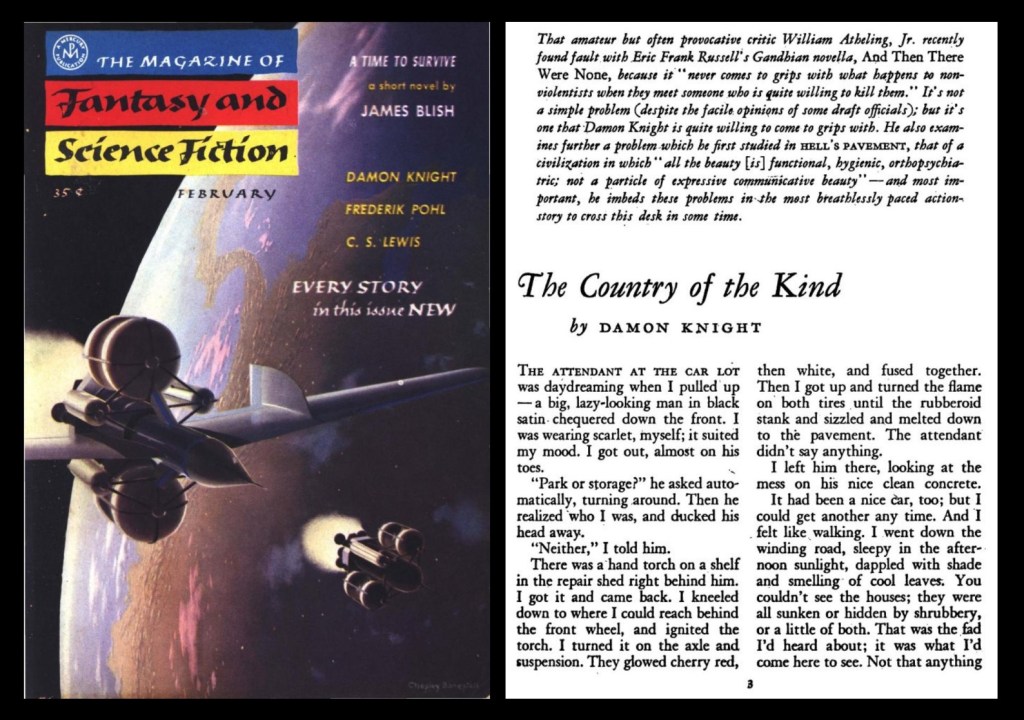
“The Country of the Kind” by Damon Knight

“The Country of the Kind” was first published in The Magazine of Fantasy & Science Fiction, February 1956. You can read it on Archive.org. It is story #5 of 22 for The Best SF Stories of 1956 group read. “The Country of the Kind” is one of the highest rated stories on The Classics of Science Fiction Short Stories v. 2 list, with eleven citations. It is by far the most remembered science fiction short story from 1956. Here are the eleven citations we used:

“The Country of the Kind” is set in an unnamed utopia and is told by an unnamed narrator. When the narrator was fifteen, he killed a girl who spurned him. In this utopian society they couldn’t punish him directly because it doesn’t allow violence. They fixed the narrator so whenever he tried to hurt someone else, he’d have an epileptic fit. And to warn others of his presence, his body odor and breath were made to smell repulsive. He was then left free to do whatever he wanted. For thirty years he has wandered about the Earth trying to retaliate by sabotaging other people’s activities or destroying their property. People ignored him, so he suffered endless loneliness. The narrator creates small works of art which he leaves everywhere with a message inviting other people to join him and be free.

My friend Mike sends me emails with comments about these 1956 science fiction stories since he doesn’t want to use Facebook. Here’s what he had to say:

A good science fiction tale draws you in completely, overriding your skepticism about the implausibility (or impossibility) of events.

Damon Knight asks us to accept the notion that a murderous psychopath is allowed by society to indulge himself in an endless destructive rampage. Although he is prevented from physically harming others by induced epileptic seizures, the community allows him to wreak havoc without restraint.

Perhaps Knight is exposing the passivity and weakness of that society, but it beggars the imagination that any group would allow such extreme behavior to go unchecked, no matter how kind and understanding they profess to be.

After the "king of the world" murdered his girlfriend named Elen when he was fifteen, he tells us "...if I could do it to Elen, I thought, surely they could do it to me. But they couldn't. They set me free: they had to."

Why did "they" have to? Are we to believe that a seemingly well run country is so "kind" that even a psychopath is allowed free rein? That's a bridge too far for me.

Remember, I talked about how believability was very important to me regarding science fiction when reviewing “Brightside Crossing.” I could understand why Mike didn’t think the world of “The Country of the Kind” was believable, but I said to him in a phone call, didn’t we both believe the world of “Brightside Crossing” was impossible? Yet, we still found the story believable. I asked him what crossed the line for him in “The Country of the Kind.” Mike said he just didn’t believe people would allow a person like the narrator in any society, that was too much for him to believe that people wouldn’t stop the narrator from damaging their property.

I said, wasn’t “The Country of the Kind” unbelievable in the same way “The Ones Who Walk Away from Omelas” is unbelievable, and didn’t you love that story? Mike replied that story was metaphorical.” I countered, doesn’t “The Country of the Kind” seem just as metaphorical in the same way? Both are about utopias that that are held together by the suffering of one person. After I said that, I even wondered if Ursula K. Le Guin wasn’t in some way inspired by “The Country of the Kind” when she wrote “The Ones Who Walk Away from Omelas.” Mike said he would reconsider “The Country of the Kind” as a metaphor. Maybe he will post a reply.

Are the fictional worlds of Brave New World, Nineteen Eighty-Four, or The Handmaid’s Tale believable? Aren’t they metaphorical too, because their authors have something to say about our reality? Dune, The Foundation trilogy, The Left Hand of Darkness and even The Man in the High Castle create worlds that we are asked to believe are realistic. Obviously, Alan E. Nourse wanted us to believe “Brightside Crossing” was realistic. But we aren’t expected to believe the fictional universes of The Hitch-Hiker’s Guide to the Galaxy or Sheckley’s Mindswap were realistic.

In other words, fantasy, humor, satire, and metaphorical fiction don’t ask us to believe their settings are realistic. But most literary works, especially of the mimetic type, and some kinds of science fiction do ask us to believe that they are reality based.

Of course, if “The Country of the Kind” is metaphorical, then what is the metaphor? That even kindness can cause great suffering. To be free in a utopia you need to be able to commit evil deeds. 1956 was a time of conformity in America, and many people were freaked out by juvenile delinquents, motorcycle gangs, and other nonconformists. Remember, a year later in 1957, On the Road by Jack Kerouac came out. Kerouac called his kind of nonconformists Beats, and society renamed them beatniks. A few years later, society turned against hippies too. I say On the Road wasn’t metaphorical. But I would say One Flew Over the Cuckoo’s Nest or Catch-22 are.

In the 1950s there was a lot of talk about crime being caused by society, and that criminals were a product of bad biology or a bad environment. Damon Knight’s unnamed narrator is an awful person, but he gets our sympathy. Unlike the tortured child in “The Ones Who Walk Away from Omelas,” the unnamed narrator isn’t the engine of utopia. Or is he? Wouldn’t a perfect utopia be dull and boring? What if evil is needed as the engine of goodness? I’m reminded of a phrase, “What if our world is their heaven?”

What if all fiction is metaphorical? What if “Brightside Crossing” was a metaphor for extreme adventurers?

Fiction is based on a suspension of disbelief. If Mike can’t suspend his disbelief that’s perfectly okay. If he doesn’t like “The Country of the Kind” does it matter that I do?

I’m fascinated by the nature of memory. I’m particularly fascinated by fiction that our culture remembers, like works by Jane Austen or Charles Dickens. But I’m also fascinated by the stories I find personally memorable. “The Country of the Kind” and “The Ones Who Walk Away from Omelas” are such stories. A year for now, I might forget “Brightside Crossing.” As I read and reread these old science fiction stories, I’m amazed by which ones I remember and which ones I don’t.

“The Country of the Kind” was voted into The Science Fiction Hall of Fame Volume One because it was so remembered by the first members of the Science Fiction Writers of America. I wish SFWA would poll their membership every ten years on their favorite stories. I’d love to see what every generation of science fiction writers remember.

With this December 2023 reading; it’s probably the fourth or fifth time I’ve read this story, I am somewhat sympathetic to the unnamed narrator of “The Country of the Kind.” I wasn’t before. I totally loathed the narrator. However, this time I still think his actions are still horrific, but I feel the utopian society has imposed a cruel and unusual punishment upon him.

And I’m still unsure of Knight’s intentions in writing this story. Whatever meaning it has could be entirely accidental. Knight might have thought of the situation without considering its implications.

The epileptic pain the narrator experiences is brought on by his own actions. But the loneliness is caused by the utopian society imposing the punishment. And this society is supposedly incapable of causing harm. Such a society would know that social contact is a necessity.

Writers often make their stories ambiguous but this one might be too unclear. I wonder if Knight has ever written an explanation of “The Country of the Kind.”

James Wallace Harris, 12/6/23

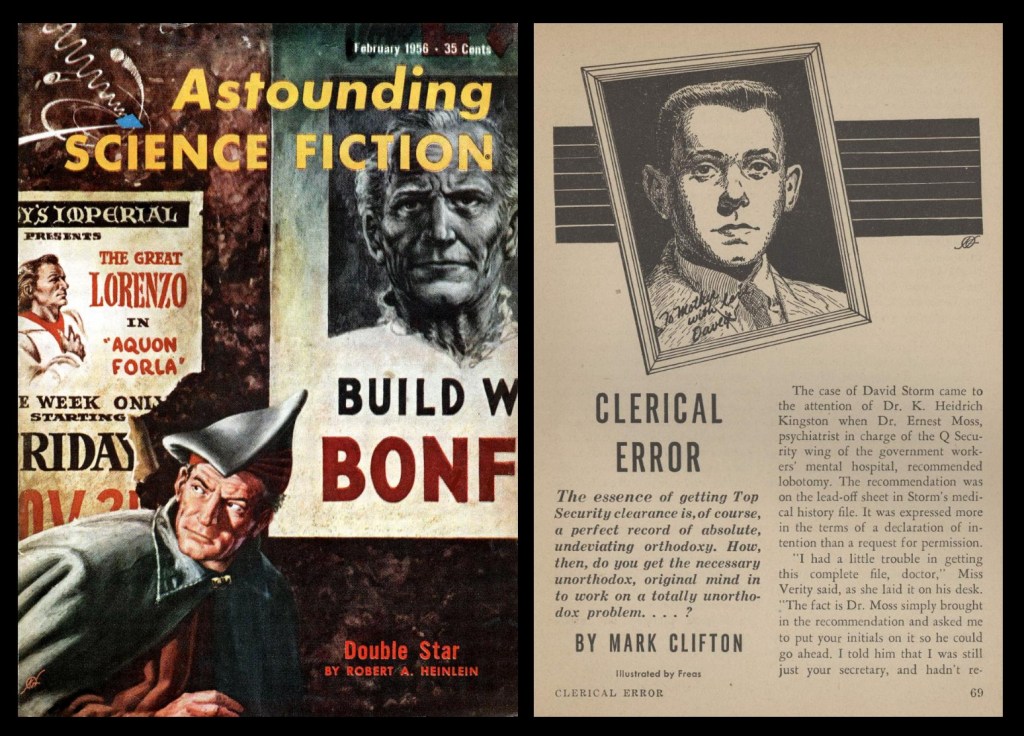
“Clerical Error” by Mark Clifton

“Clerical Error” was first published in Astounding Science Fiction, February 1956. You can read it on Archive.org. It is story #3 of 22 for The Best SF Stories of 1956 group read. I selected “Clerical Error” for our best SF stories of 1956 group read because Asimov and Greenberg, and T. E. Dikty selected this story for their best-of-1956 anthologies, and Judith Merril listed it in her anthology for 1956 as an honorable mention.

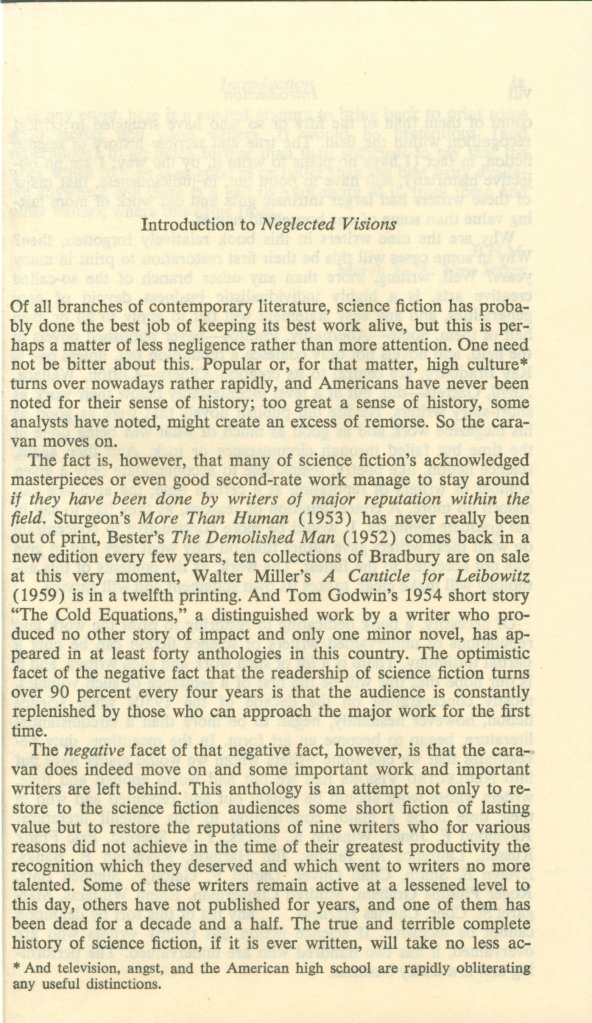
The only significant anthology that reprinted the story was Neglected Visions (1979) edited by Barry Malzberg, Martin H. Greenberg, and Joseph Olander, whose goal was “an attempt to restore the reputations of eight writers who did not achieve the recognition they deserved.” “Clerical Error” was also reprinted at SciFiction.com in 2002, an early internet effort to reprint classic science fiction online. Barry Malzberg also edited The Science Fiction of Mark Clifton back in 1980. Long out of print, but copies are available on ABEbooks.

In other words, “Clerical Error” has its fans who have tried to save it over the years, but the first time I read it, I found the whole beginning muddled, too full of info dumping. This time I also found the first part impenetrable and stopped reading. I then gave it a rest and started researching the story online. I could tell Clifton was trying to do several things at once in the first half of the story. He was setting up the much simpler second half, but he was also using the story to expound on science, scientists, and the perception of science, among other things.

Clifton also worked hard to develop his characters, and convey them psychologically, and even have us understand the psychological understanding of the psychiatrist. But this requires close reading.

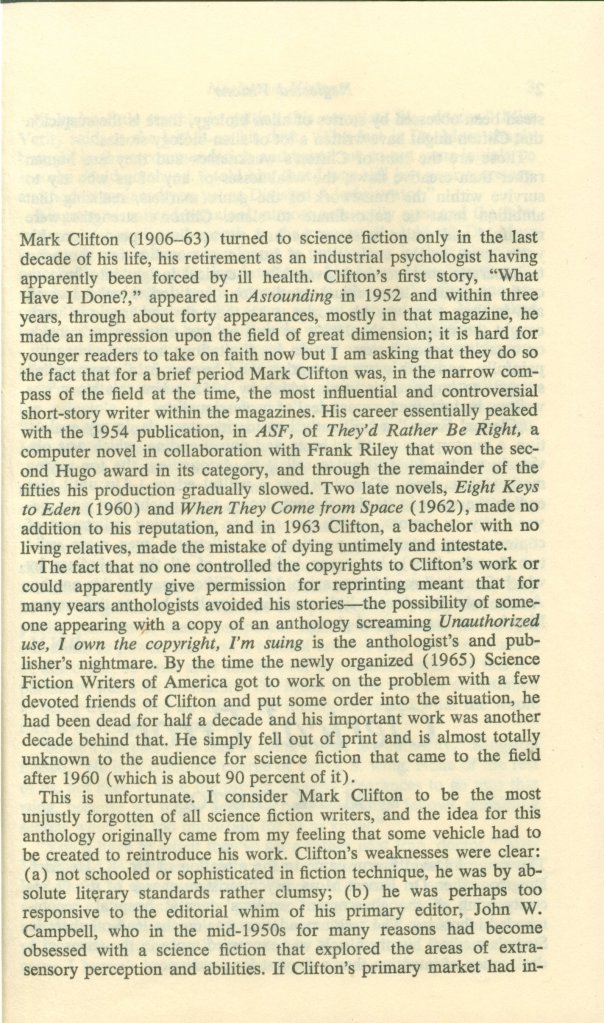
I then read Barry Malzberg’s introduction to “Clerical Error” where he gives us some background on Mark Clifton. After reading that, and thinking about what I had read so far, I went back and started the story for a third time. For some reason I was in the right mood, and I zoned in on what Clifton was doing. This time the story worked great. Here’s Malzberg’s introduction.

I really wanted to hear this story too, but I couldn’t find any audiobook narration of the story. I even downloaded a pirated copy of a Mark Clifton collection in .pdf format and loaded it into the Edge browser which has a very good text to speech function. It works to a degree, but ultimately, I had to give up.

The story’s set up involves a scientist, David Storm, going insane. Because Storm works for the government in a high security job, the government doesn’t want to release him to outside doctors. He babbles about technology that will change the world. Dr. Ernest Moss, the psychiatrist with security clearance in charge of Storm requests that Storm be given a lobotomy. Dr. Kingston, the psychiatrist administrator over Dr. Moss doesn’t want to allow the lobotomy until he understands the case, but he doesn’t have top level security.

Dr. Kingston tries several end-runs around bureaucracy desperately to save Storm. Each step gives Clifton a chance to pontificate about science versus the government. Since Malzberg points out that Clifton was an industrial psychologist, this means his insights have some weight.

One reason why the story is so hard to get into is it digresses in so many directions. Clifton focuses on Dr. Kingston and his secretary Miss Verity. She is the top secretary in the psychiatric division, and Clifton represents them as the two most powerful people in the story. Miss Verity has a mind of her own concerning how things should be done. She wants to protect her boss Dr. Kingston. Dr. Moss tries to bypass Dr. Kingston by trying to get Miss Verity to sign off on the lobotomy for Kingston. That’s when she alerts Kingston to the problem. The rest of the story is Kingston trying to get help for David Storm, which would require sending him to doctors without security clearances.

This is all straightforward. Clifton complicates things by using the power struggle between Kingston and Moss to comment on psychiatry and science. This is why the story is in Astounding, because John W. Campbell Jr. loved these kind of discussion stories that challenge how people think, how they contend with authority, and how the status quo should be questioned.

I can understand how an insane scientist who babbles about government secrets could be a problem, but would a lobotomy even stop him from talking? It could quiet his constant anxiety and rage, but would it erase what he knows? I’m not sure how lobotomies work. Storm has also gone through a series of electroshock treatments that hasn’t shut him up.

Clifton uses “Clerical Error” to promote psychiatry as a science. But he also develops each character with a lot of psychological insight. This adds another layer to the story. And it’s why I said the story is hard to get into. Clifton is doing three things at once. Expressing politics, showcasing psychiatry and psychology, and telling a story. Along the way he also gives several reasons for the title of the story.

Like I said, it all came together for this third reading. I think if I read “Clerical Error” a fourth or fifth time, I’d get even more out of it. There’s a lot to it. It’s a shame that Clifton’s stories aren’t in print. But that’s why we’re doing this group reading for The Best SF Stories of 1956, to find forgotten classics that deserve more attention. I really like what Barry Malzberg said in his introduction to Neglected Visions. I hope he doesn’t mind me reprinting it here.

Unfortunately, Mark Clifton seems to be mostly out of print. You can find his original magazine publications using ISFDB and Archive.com. However, Amazon does have The Second Golden Age of Science Fiction MEGAPACK ®: Mark Clifton for 99 cents. It doesn’t have “Clerical Error,” but it does have a handful of stories and a couple of serials. In 2020 Dover published What Have I Done?: The Stories of Mark Clifton. The paperback is currently $7.48 for 288 pages, but the ebook is $3.99 but claims to only have 21 pages. That worries me. It appears to only be the first story.

James Wallace Harris 11/30/23

“The Minority Report” by Philip K. Dick

The Minority Report” was first published in Fantastic Universe Science Fiction, January 1956. You can read it on Archive.org or listen to it on YouTube. (Or even listen and read at the same time.) It is story #2 of 22 for The Best SF Stories of 1956 group read. Wikipedia has a rather informative entry for “The Minority Report” that I highly recommend reading.

“The Minority Report” did not meet any of the criteria I used for selecting the best SF short stories of 1956, but I included it because it’s a famous Philip K. Dick story, and because it inspired a movie and television miniseries. It’s interesting that neither Judith Merril, T. E. Dikty, nor the team of Isaac Asimov and Martin H. Greenberg picked the story for their best of the year anthologies. Obviously, they were not precogs to the story’s big success in the future, but ultimately, I think they made the right choice.

The premise of “The Minority Report” is built on the idea that the future can be predicted, and murders can be prevented by arresting murderers before they kill. The plot arises when the head of Precrime, John A. Anderton, sees his own name on a computer card stating that he will kill Leopold Kaplan. Anderton immediately figures it’s a frame-up by Ed Witwer to take over his job.

The story is weird because the future is predicted by three mentally and physically damaged people kept in a kind of permanent dream state. They are called precogs. Because the future is always in flux, each precog is monitored by a computer. To convict a person of a precrime requires two of the three computers analyzing the dreams of their precogs predicting the same future, and that’s called the majority report. A single computer produces a minority report.

Most of the story involves Anderton going on the run hoping to prove himself innocent and maintain the validity of precrime as a principle of law enforcement. The story is quite dramatic. I can see why they chose to produce it as a movie. “The Minority Report” is full of action and ideas. Along the way, the story produces quite a bit of PKD weirdness, paranoia, offbeat philosophical questions, and a disloyal wife. Unfortunately, there are so many plot twists that the story breaks down in confusion.

Information about the sale and publication of “The Minority Report” can be found at philipdick.com. It was reprinted in Dick’s 1957 collection The Variable Man and Other Stories, but it was never anthologized in a major anthology. According to the way stories are remembered in the science fiction publishing world, “The Minority Report” was never a respected story. Fantastic Universe was not a top tier publication. This was PKD’s 91st story, and 85th short story. (See philipdick.com for numbering his worksl) Dick cranked them out, and it shows. “The Minority Report” could have been a much better story if Dick had thought about the plot carefully and rewritten it several times. But he had to eat and sold it for little money. Philipdick.com suggests it earned only a little more than $12.95, but don’t say exactly.

Here is the review my friend Mike emailed me.

I think "The Minority Report" is one of Dick's weaker efforts. 


I've never been a fan of hocus-pocus stories, and the idea of Precrime has so much hand-waving magic about it that Penn and Teller would be proud. We never get a plausible explanation why or how precogs manage to predict the future. Good science fiction gets you to believe the unbelievable, but Precrime feels like a story gimmick.
I've also never been a fan of mysteries, because the author typically drops critical details into the narrative at the last minute. We're supposed to marvel at the perspicacity of the protagonist, but I just feel manipulated. Dick drops this important bit of information on us:
"Jerry's vision was misphased. Because of the erratic nature of precognition, he was examining a time-area slightly different from that of his companions."
We discover that precognition, which is the foundation of Precrime, has an "erratic nature" and precogs can examine different time-areas. Doesn't that collapse the entire Precrime house of cards?
You know a story is flawed when the author has to stop and explain for pages why Anderton's name was generated by the Precrime system. PKD finally throws in the towel when he has Anderton announce "Each report was different...Each was unique. But two of them agreed on one point. If left free, I would kill Kaplan. That created the illusion of a majority report. Actually, that's all it was--an illusion."
The whole story feels like an illusion, a magic trick. The characters are subservient to an arcane plot, stock performers in a magic show.

I agree with Mike. I dislike thrillers and mysteries where the author jerks us around contriving plot twists by whatever whim hits them at the moment. They never feel believable or real. Like I said in my previous review. I want to believe what I’m reading, and I have too much distaste for precognition.

Now, if PKD had come up with another system for identifying potential murderers I might have bought the idea of precrime. I don’t think this is possible, but if they had a brain implant that measured various kinds of emotional states and they could identify one that people experience before committing a murder, then that would have been acceptable to me. Dick’s precogs are mutants with ESP. I have problems with psi stories in SF. Too often they feel like comic book plots.

There are a few psychic power stories in science fiction that succeed with some readers. There’s telepathy in The Demolished Man and teleportation in The Stars My Destination, two much admired novels by Alfred Bester. But they are not my favorites. PKD played with ESP in some of his stories, and I’m a big fan of his work, and I can sometimes buy such weirdness as part of his stories because Dick was so weird himself. I’m afraid the precog stuff in “The Minority Report” didn’t work for me this time.

Alfred Bester came up through comics, and I’ve always felt he felt superior to both comics and science fiction. As much as I admire Bester’s writing ability, I’ve always thought he was sneering at science fiction. Writing stories about psionics was his way of saying SF fans would believe anything. But I think Dick was different. He was into thinking about the supernatural and any possible explanation for reality. He played with weirdness.

I need to think about the use of ESP in SF. Let’s see if any more of the 1956 stories deal with psychic powers. I’m not sure it’s a legitimate theme for science fiction.

James Wallace Harris, 11/29/23

“Brightside Crossing” by Alan E. Nourse

Brightside Crossing” was first published in Galaxy Science Fiction, January 1956. You can read it on Archive.org or Gutenberg.org or listen to it on YouTube. It is story #1 of 22 for The Best SF Stories of 1956 group read.

“Brightside Crossing” begins in a bar on Earth, the Red Lion, with James Baron sitting at a table. A grizzled old man comes in to see him, Peter Claney. We learn that Baron is planning an expedition to the planet Mercury, hoping to trek across the sun side surface and reach the equator when the Sun is at its closest and hottest position. Temperatures will reach 770 degrees Fahrenheit. When this story was written it was thought Mercury always had one side facing the Sun, the Brightside, like how one side of the Moon always faces the Earth. We’ve since learned that Mercury does slowly rotate three times for every two solar orbits Mercury makes.

Peter Claney was part of a team that previously tried to make the Brightside crossing, and he’s come to the Red Lion to warn Baron not to try. This implies Peter’s team failed, and Peter’s story is how we learn about that failed attempt. Nourse’s story is what we now call hard science fiction, although the term wasn’t coined until a year later. Even for 1956, I had several nit-picks about this story’s realism, but nothing that detracted from it being a great science fiction adventure tale. It was a finalist for the Hugo.

“Brightside Crossing” reminds me of reading books by polar explorers, or about the men who tried to find the Northwest Passage, especially of Franklin’s lost expedition. It’s about the kind of person who will endure extreme hardship to be first somewhere.

I agree completely with what my friend Mike emailed me about the story:

1. Nourse avoided the info dump trap. He succinctly describes the equipment used to make the Mercury crossing without falling into the endless info dumps found in some stories. 

2. The characters have depth and nuance. Ted McIvers is described as “kind of a daredevil.” At first, we think he’s just foolhardy, but we eventually realize that they will die if they don’t move faster and McIvers is trying to save them. Peter Claney admits “A man like McIvers was necessary. Can’t you see that?” Jack Stone is fearful and reveals “I’m scared.” However, when McIvers needs to be rescued, Jack agrees to go down and help. He overcomes his fear. And Peter Claney states categorically that the crossing is impossible, but he still wants to try again and be part of another attempt.

3. The story echoes the courage and heroism of the great Antarctica explorers Robert Scott and Ernest Shackleton.  

4. Nourse’s descriptions of the terrain are beautiful and terrifying. Every word is carefully chosen. We can feel the heat. The danger is visceral.

“Brightside Crossing” also reminds me of what I loved about science fiction as a kid back in the 1960s, but I don’t think I read “Brightside Crossing” then. I do vaguely remember a few science fiction stories set on Mercury. It is exactly the kind of story that would have wowed me as a kid because I loved science fiction stories that I wanted to feel were possible. This is my second reading of “Brightside Crossing” and I’m even more impressed than the first time I read it in The Great SF Stories 18 (1956) a couple of years ago.

This time as I read it, I thought “Brightside Crossing” represents the kind of science fiction I would use in creating my definition of science fiction. The story is believable in the way I want to define science fiction. Sure, Nourse’s speculation might be faulty or even impossible by today’s scientific knowledge and technology, but in the 1950s the story seems possible, at least to a kid who embraced the theology of the final frontier.

My disappointment with a lot of science fiction, especially science fiction from recent decades, is it’s not believable. I don’t know why when I was a kid, I wanted to believe humans would explore all the planets and moons of the solar system. I thought science fiction was propaganda to make such exploration happen. I knew there were two kinds of science fiction. The kind I like imagined either a probable future we should avoid or a future we should want to create. The other kind of science fiction was just stories that got its ideas from the first type. And like the degradation of originals from making copies of copies, too much science fiction seems inspired from science fiction cliches.

Over time, I think science fiction has become the label for any fantastic tale that involved the future or outer space. A splendid example of the second kind is “Fondly Fahrenheit” by Alfred Bester. It’s still a classic story, but not the kind of science fiction I’m talking about. Bester was both having a go at the genre and pushing it to its limits. Unfortunately, I think writers have settled on the second kind of science fiction as the preferred kind and see it as a Disneyland to work out their wildest ideas, rather than serious speculation about reality.

Like Busby Berkeley always working to top his previous dance routine, science fiction keeps trying to top itself. And like Busby Berkeley, the results have gotten absurdly wild. Busby Berkeley expected the movie audience to believe that his dance routines would be what an audience in a cabaret or Broadway theater would see, in the same way science fiction writers now expect their readers to believe their stories would fit into our little old reality. Sure, it’s fun to see fabulous big productions created by wild fancies of the mind but there’s something to be said about real people confined to Earthly possibilities. In case you have no idea, who Busby Berkeley was, or my analogy, I’ll include this film clip:

Alan A. Nourse was never a big name in science fiction, but I have encountered his work now and then, but I only vaguely remember him. “Brightside Crossing” inspires me to find more of his work. The two I think I might have read as a kid; are ones I want to try:

But I’d also like to find the collection below because of its neat cover, but it will probably be easier to get Alan E. Nourse Super Pack at Amazon for $1.99, which has several of the same stories, including “Brightside Crossing.”

By the way, “Brightside Crossing” had three things I couldn’t believe, but they were just little bumps in the road. The first are the suits that protected them from the horrendous heat. They plan to stay in them for over a hundred days. How did they handle peeing and pooping? A kid would wonder that and so did I as an old man. I also found it unbelievable that Ted McIvers could just show up late by hitching a ride on a Venus supply rocket, days after the others had arrived. That bothered me because trips would be rare to the planet Mercury. Finally, when Ted McIvers goes off course and stumbles upon the remains of the last expedition that tried to make the Brightside crossing. That seemed like way too much of a coincidence. They are crossing a whole planet, and they just happen to discover what happened to the previous explorers.

James Wallace Harris, 11/27/23

When Did Movies and Television First Portray a Science Fiction Fan?

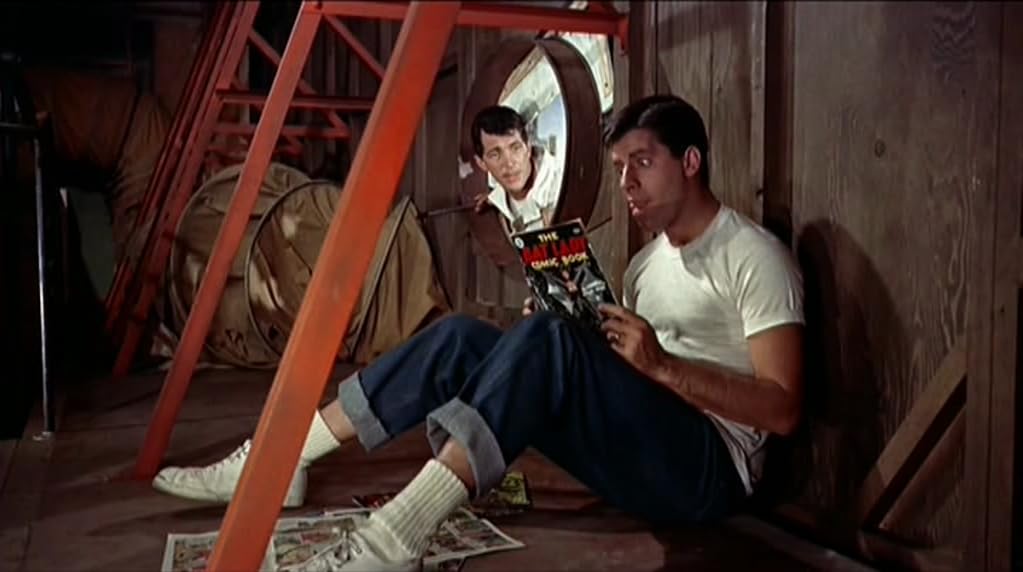
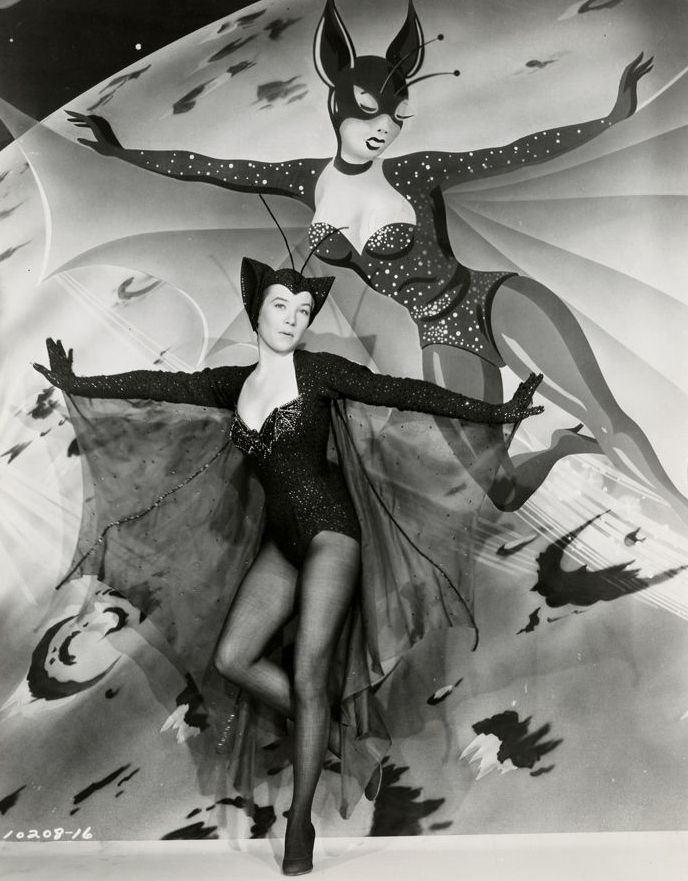
For years I thought Back to the Future was the first film to portray a science fiction fan. That 1985 movie featured Crispin Glover as George McFly, a nerdy kid who grows up to become a science fiction writer. Most of the action was set in 1955. Well, the other night I watched Artists and Models that came out in 1955. It features Jerry Lewis as Eugene, a nerdy guy who loves Bat Lady comics and talks about a lot of crazy science fiction stuff.

In neither role, does the science fiction fan come across as competent. They are goofy space cadets. Is this how the world thinks of us? Life Magazine introduced science fiction fandom to the world in a May 21, 1951, issue. (See my essay that reprints those pages.)

In the late 1950s, Philip K. Dick wrote a mainstream novel about a science fiction fan, Confessions of a Crap Artist. It’s my favorite PKD novel. The book was made into a 1992 French movie I’ve never seen.

Science fiction movies go back to the early days of film making, but readers and writers of science fiction have seldom been portrayed. Can you think of any other examples?

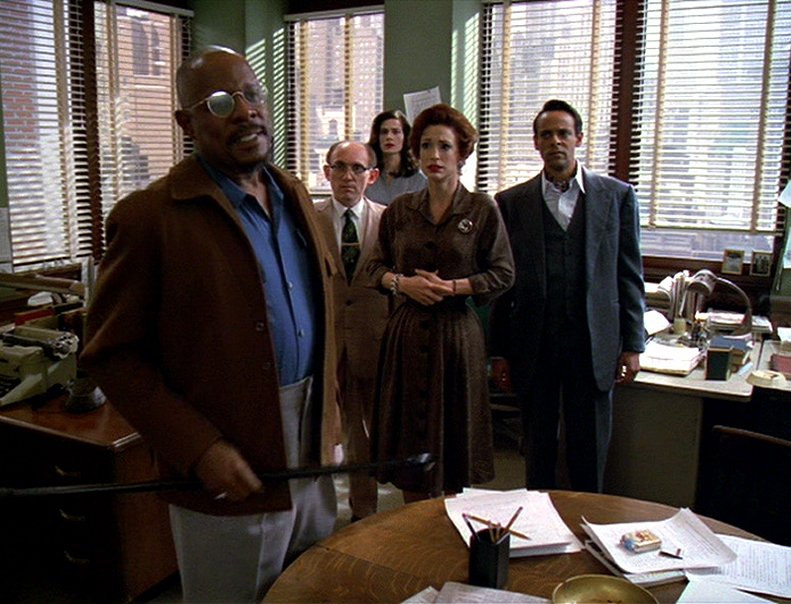
The most loving and positive example of science fiction I can think of is from television, the 1998 episode of Deep Space Nine called “Far Beyond the Stars.” In it, Captain Sisko is shown as a struggling African American science fiction writer working at a Galaxy-like SF magazine in 1953. There’s also a wonderful paperback novelization of the episode by Steven Barnes.

Let me know of any movies or television shows you know about that featured a science fiction reader or writer as a character, or even discussed the subject of science fiction?

James Wallace Harris, 11/1/23

Artists and Models is quite silly, but very colorful. It’s Shirley MacLaine’s second film, and she’s the model for the Bat Lady.

Has Science Fiction Left Me Behind?

The above books were the finalists for the 2023 Hugo Awards. I have not read any of them. Nor do they look interesting to me. Each year the Hugo and Nebula award finalists seem further and further away from what I want to read.

The other day I went into a new bookstore for the first time in many months. I went up and down the aisles of the science fiction section and I was shocked by how many books were by authors that were unknown to me.

I turn seventy-two next month and I wonder if I’ve gotten too old for science fiction. Or, has the genre left me in the dust? I can accept that I might be too old to keep up. Could the genre have changed, and I’ve just lost interest? Who knows?

In the 20th century I’m sure I read at least a thousand science fiction books, probably many more. Here’s a list of the 69 SF&F books I’ve read in the 21st century:

  • 2000 – Harry Potter and the Goblet of Fire by J. K. Rowling (Hugo winner)
  • 2000 – Calculating God by Robert J. Sawyer (Hugo finalist)
  • 2001 – American Gods by Neil Gaiman (Hugo winner)
  • 2001 – Perdido Street Station by China Miéville (Hugo finalist)
  • 2002 – Altered Carbon by Richard K. Morgan
  • 2003 – The Time Traveler’s Wife by Audrey Niffenegger
  • 2004 – Cloud Atlas by David Mitchell
  • 2004 – Jonathan Strange & Mr. Norrell by Susanna Clarke (Hugo winner)
  • 2004 – The Plot Against America by Philip Roth
  • 2005 – Spin by Robert Charles Wilson (Hugo winner)
  • 2005 – Old Man’s War by John Scalzi (Hugo finalist)
  • 2005 – Never Let Me Go by Kazuo Ishiguro
  • 2006 – The Road by Cormac McCarthy
  • 2006 – Life As We Knew It by Susan Beth Pfeffer
  • 2007 – The Yiddish Policeman’s Union by Michael Chabon (Hugo winner)
  • 2008 – The Hunger Games by Suzanne Collins
  • 2008 – Little Brother by Cory Doctorow (Hugo finalist)
  • 2008 – Flood by Stephen Baxter
  • 2008 – Marsbound by Joe Haldeman
  • 2009 – The City & The City by China Miéville (Hugo winner)
  • 2009 – The Windup Girl by Paolo Bacigalupi (Hugo finalist)
  • 2009 – Boneshaker by Cherie Priest (Hugo finalist)
  • 2009 – Julian Comstock by Robert Charles Wilson (Hugo finalist)
  • 2009 – Catching Fire by Suzanne Collins
  • 2009 – Wake by Robert J. Sawyer
  • 2010 – Feed by Mira Grant (Hugo finalist)
  • 2010 – Mockingjay by Suzanne Collins
  • 2010 – Watch by Robert J. Sawyer
  • 2010 – Hull Zero Three by Greg Bear
  • 2011 – Among Others by Jo Walton (Hugo winner)
  • 2011 – Leviathan Wakes by James S. A. Corey (Hugo finalist)
  • 2011 – The Martian by Andy Weir
  • 2011 – Ready Player One by Ernest Cline
  • 2011 – Wonder by Robert J. Sawyer
  • 2012 – Redshirts by John Scalzi (Hugo winner)
  • 2012 – 2312 by Kim Stanley Robinson (Hugo finalist)
  • 2012 – The Dog Stars by Peter Heller
  • 2012 – The Age of Miracles by Karen Thompson Walker
  • 2012 – vN by Madeline Ashby
  • 2014 – The Three Body Problem by Cixin Liu (Hugo winner)
  • 2014 – Annihilation by Jeff VanderMeer
  • 2014 – Station Eleven by Emily St. John Mandel
  • 2014 – The Girl with All the Gifts by M. R. Carey
  • 2014 – The Book of the Unnamed Midwife by Meg Elison
  • 2014 – Yesterday’s Kin by Nancy Kress
  • 2015 – Seveneves by Neal Stephenson (Hugo finalist)
  • 2015 – Children of Time by Adrian Tchaikovsky
  • 2015 – Binti by Nnedi Okorafor
  • 2015 – Aurora by Kim Stanley Robinson
  • 2015 – The Water Knife by Paolo Bacigalupi
  • 2016 – All the Birds in the Sky by Charlie Jane Anders (Hugo finalist)
  • 2017 – New York 2140 by Kim Stanley Robinson (Hugo finalist)
  • 2017 – All Systems Red by Martha Wells
  • 2017 – Sea of Rust by C. Robert Cargill
  • 2017 – Under the Pendulum Sun by Jeanette Ng
  • 2017 – Noumenon – Marina J. Lostetter
  • 2018 – The Calculating Stars by Mary Robinette Kowal (Hugo winner)
  • 2018 – Semiosis by Sue Burke
  • 2018 – The Fated Sky by Mary Robinette Kowal
  • 2018 – The Feed by Nick Clark Windo
  • 2019 – Children of Ruin by Adrian Tchaikovsky
  • 2019 – Machines Like Me by Ian McEwan
  • 2020 – The Ministry for the Future by Kim Stanley Robinson
  • 2020 – The Midnight Library by Matt Haig
  • 2021 – Project Hail Mary by Andy Weir (Hugo finalist)
  • 2021 – Klara and the Sun by Kazuo Ishiguro
  • 2022 – Babel by R. F. Kuang
  • 2022 – The Mountain in the Sea by Ray Nayler
  • 2022 – Sea of Tranquility

That’s an average of 2.8 SF&F books a year. Assuming I read a thousand SF books from 1963-1999, means I averaged 27.78 SF books a year. I think I could have easily read 1,500 SF books, or 41.67 SF books a year. In other words, I don’t read SF like I used to. And my 21st century list includes quite a few fantasies. I rarely read fantasy in the 20th century. I really don’t like fantasy books. I only read them when they reach a certain pop culture status.

One reason for the shift is I read more literary works and nonfiction books. Another reason is after reading thousands of science fiction books, I seldom read reviews of new science fiction books that sound different enough to be appealing.

I used to keep up with the genre by belonging to the Science Fiction Book Club, which offered two new titles a month. I subscribed to several science fiction magazines and fanzines that reviewed new books. And I would visit one or two new bookstores a week.

Fanzines disappeared, and I stopped having time for the prozines even though I still subscribed. After Amazon and Audible, I stopped shopping in new bookstores, and they eventually disappeared. Back in the 1970s I went to conventions and even published fanzines. In the 1980s I ran a BBS devoted to science fiction. Since the 1990s I’ve run websites and databases devoted to SF. Once upon a time all my friends were SF readers. But active participation in fandom ended when I got married and settled down to work in 1978. I became a different person socially.

Since 2002, I’ve been rereading the science fiction I first read in the 20th century by listening to audiobook editions from Audible.com. It’s a kind of nostalgic trip. I also caught up on a lot of 20th century science fiction I missed. That also kept me from reading many new SF books.

But in all honesty, I prefer old science fiction to new science fiction. There’s been some great exceptions, but I think that’s the real reason I’ve let the genre pass me by.

I wish the Science Fiction Writers of America never embraced fantasy. I wish the Hugo Awards had focused exclusively on science fiction. Fantasy should have their own fan-based award. I can’t help but wonder if the science fiction genre would be more vibrant today if it hadn’t been married to the fantasy genre. Even books marketed as science fiction often feel like fantasies. Looking back, I would have preferred a smaller, focused SF genre, one I could have kept up with.

Science fiction used to have some realism, or at least some speculative integrity. Now, any old wild idea works. Science fiction used to be inspired from reality, now new writers are inspired mostly by science fiction movies. It’s as if all science fiction is recursive science fiction.

Who knows, maybe I left science fiction behind.

James Wallace Harris, 10/22/23

What Do You Want from a Great Science Fiction Robot Story?

For me, great science fiction is about certain concepts: space travel, aliens, the future, time travel, human evolution, alternate history, artificial intelligence, and robots. As I’ve gotten older, I crave tradition in new stories. I’ve gotten rather fussy about how these cherished fictional topics are handled. I don’t like too much innovation. I want to see evolution in these ideas, but not radical new-fangled reinventions. I don’t mind reimagining or rebooting of the concepts, but it depresses me to read stories that have lost the original intent of science fiction.

I started reading “Perfection” by Seanan McGuire and was hugely disappointed. It’s the first story in Robots Through the Ages, a new anthology edited by Robert Silverberg and Bryan Thomas Schmidt. (Currently, $1.99 for the Kindle.) I love a good robot story, and was excited to start reading this anthology, but unfortunately, “Perfection” wasn’t the kind of robot story I was anxious to read. I’m not saying “Perfection” is a bad story, but it’s not about my kind of robot, or what I would call a science fiction story. It’s told in an allegorical style that suggests the story has a message like a modern-day Aesop’s fable. It could be a little postmodern fantasy commenting on science fiction, or just a nice old-fashioned fantasy fable for the contemporary reader. (Luckily, the editors jump back to classic SF stories about robots after “Perfection.”)

Science fiction is a byproduct of modernism. Religion/mythology is the worldview before enlightenment and modernism and the territory of fantasy, not science fiction. I don’t believe science fiction belongs in the postmodern territory either. “Perfection” blends fantasy and postmodernism and appears to see perfection in a robot — although its message is probably satirized, at which point it’s really rejecting robots. Is the transformed wife and husband perfect? Or are we supposed to be horrified by what the modernistic SF world has sought?

This made me think – what are my kind of robots? Science fiction claims certain themes for the genre, and robots have always been one of its major themes. Science fiction writers haven’t portrayed robots consistently though. What we often call robots vary tremendously, from mechanical beings, to androids, replicants, cyborgs, sexbots, and synthetic humans.

More importantly, the kind of robots I like best are science fictional, and truly modernistic. I dislike fantasy and postmodern robots. Often, it’s difficult to tell what kind of philosophy a robot story is set, especially when the robots look indistinguishable from humans. Sometimes a sexbot is really a robot, and sometimes it stands in for something allegorical, metaphorical, or symbolic.

Me, I like robots to be robots. I want them to be sentient, but not slaves. I don’t like robots that pass as humans. I don’t mind robots to be somewhat humanoid in shape, but I don’t want them to be substitutes for humans. And if they’re sentient, they must be free, and not things we own. Asimov’s robots were not supposed to be sentient, and thus we owned them, and they had to do our work. I liked Simak’s robots better, but they were more like P. G. Wodehouse’s Jeeves. Simak’s robots were faithful servants, but were they paid? Or were they property? Asimov’s R. Daneel Olivaw was a co-worker. I want science fiction to be about robots that are independent. I expect robots to be the intelligent species that either co-exist with humans or are our descendants. Of course, sometimes that means a story like The Humanoids by Jack Williamson.

I really dislike the concept of sexbots and human brains downloaded into robot bodies that look perfectly human. We have plenty of humans, we don’t need ersatz copies.

Overall, I’ve been disappointed with how science fiction has presented robots. The stories I’ve like best were sentimental stories about robots like “Rust” by Joseph K. Kelleam.

Is Data from Star Trek a robot by your definition? Is he closer to C-3PO than Roy Batty? I don’t consider the replicants from the film Blade Runner to be robots. But I do for the androids in Do Androids Dream of Electric Sheep? Androids that pass perfectly for humans in appearance aren’t robots to me, but Data still acts mechanical enough to consider “him” a robot.

The first robots I remember from my earliest memories are those from the film Target Earth. They were clunky killers and supposed to be scary – they were scary when I was a little kid back in the 1950s, but now they’re laughable looking. The robots in Forbidden Planet and Lost in Space were way cool, but they had lousy hands. Data from Star Trek is probably among the best robots in science fiction, but ST’s producers and writers kept wanting to make him human. I just don’t see humanity as an ideal to model from.

My favorite robots in science fiction were stationary AI computers. Mike from The Moon is a Harsh Mistress, Galatea from Galatea 2.2 by Richard Powers, HARLIE from When HARLIE Was One, and Webmind from the Wake, Watch, Wonder trilogy by Robert J. Sawyer.

I’m reading Robot Through the Ages and We Robots edited by Simon Ings hoping to find more science fictional robots I like. I’m surprised by how many I don’t like. Rucky Rucker had some wild robots. Lots of people love the Murderbot series, but he’s too human for me, but still fun. Lately, there’s been a lot of little stories about droids that are fun and cute.

I’m sure I’m forgetting a lot of great robots from science fiction. What were your favorites? What do you look for in a great robot?

James Wallace Harris, 10/16/23

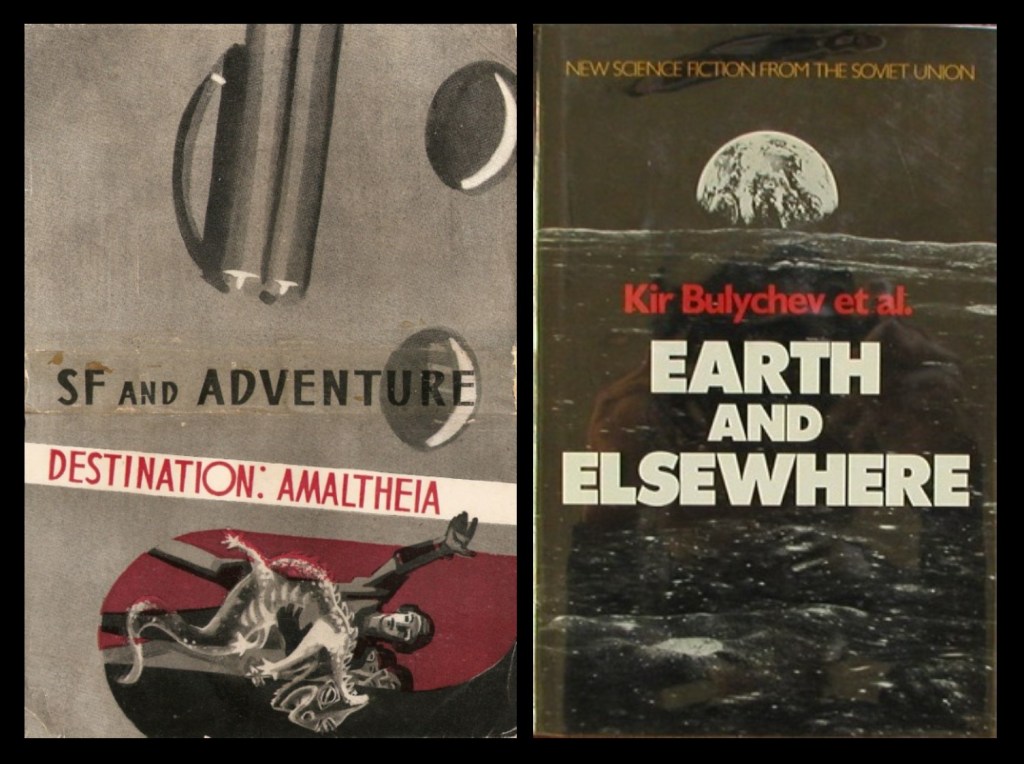
“The Way to Amalteia” by Arkady Strugatsky and Boris Strugatsky

The Way to Amalteia” by Arkady Strugatsky and Boris Strugatsky is story #52 of 52 from The World Treasury of Science Fiction edited by David G. Hartwell (1989), an anthology my short story club is group reading. Stories are discussed on Tuesdays, Thursdays, and Saturdays. “The Way to Amalteia” was first published in Russian in Путь на Амальтею in 1960.

“The Way to Amalteia” was first translated into English in 1963, and later in 1985, before the 1989 translation for The World Treasury of Science Fiction. Finding those other editions will be difficult, and since there have been no English reprints since 1989, it shows the value of owning a copy of The World Treasury of Science Fiction. Collecting retrospective anthologies of science fiction is one way of preserving literary history.

“The Way to Amalteia” starts out on J-Station, a research settlement on Amalthea, the fifth moon of Jupiter. The Strugatsky brothers describe the beautiful site of Jupiter from that moon. But we learn that the station is running out of food, and everyone is on strict rations. The settlement is desperately waiting for the freighter, Takhmasib, to deliver supplies, but it’s running late, and they’ve lost contact with the ship.

The story then cuts to the freighter, where we learn why. The Takhmasib has suffered several mishaps and has fallen into Jupiter. The Strugatsky brothers have set up an almost impossible situation and we don’t know if the crew can save themselves.

This is a hard science story, especially for 1960. Hartwell, in his introduction said it would fit right in an issue of Astounding, and that’s true. Hartwell said it also reminded him of Clarke’s “A Meeting with Medusa,” which I thought too. I also thought the story sounded like something Hal Clement would write, and it turns out Arkady Strugatsky translated Mission of Gravity into English.

There’s a lot going for “The Way to Amalteia,” but unfortunately, on this first reading, the story didn’t thrill me. I vaguely sensed it was an outstanding story, but something kept me at a distance. Having so many things go wrong spoiled it for me on one level. Having the cause of the major catastrophe be due to meteorites seemed cheesy. And I wondered if I was missing the flavor of the story because it was a translated work. Finally, there were places where figures were given, and they just seemed impossible to believe.

On page 1027 the photon drive pushes the ship to sixty-seven thousand kilometers a second. That’s about a fourth of the speed of light (299,792 kps). On page 1058 we learn the pressure on the ship as it descends into Jupiter’s atmosphere is three hundred atmospheres. This is after the ship had several holes punched in it from meteors and was patched with resin and metal plates. And there was another mention of the crushing pressure of Jupiter’s atmosphere that was much higher than three hundred atmospheres, but I can’t find it. All these problems remind me of old science fiction movies of the 1950s where science was often mumbo jumbo. But were these errors the writers’ fault, or the translators?

I also feel if I read “The Way to Amalteia” a couple more times in the future I might get to like it quite a bit. I don’t think one reading does the story justice. The story comes across like an episode of Star Trek, where a valiant captain is forced to deal with a series of ever escalating problems, but then at the last minute saves the day.

The Strugatskys spend a lot of time developing the characterization of the international crew and filling the story with textural details. I couldn’t tell if they were realistic or stereotypes because I wondered if some of the flavor was lost in translation.

“The Way to Amalteia” was an interesting story to close the anthology, especially since it’s a novella. Hartwell must have thought highly of the story. That’s why I think it might improve on rereading. But most readers don’t reread. I would have put “The Way to Amalteia” where Hartwell put “A Meeting with Medusa” on page 146 and closed with “A Meeting with Medusa.” The Clarke story offers way more hope for the future.

James Wallace Harris, 9/2/23

The World Treasury of Science Fiction edited by David G. Hartwell

The World Treasury of Science Fiction edited by David G. Hartwell came out in 1989 and contains over one thousand pages of short science fiction. I call this kind of science fiction anthology a retrospective anthology because it collects fiction that covers a time period rather than theme. Reading it should give SF fans a good sampling of science fiction published around the world from the late 1930s through the 1980s. For other retrospective anthologies see “The Best Science Fiction Short Stories.”

Unfortunately, most of the great retrospective anthologies of science fiction are out-of-print. Our database at CSFquery lists the most frequently reprinted and cited stories. If you click on the title in the list, it will take you to ISFDB and show you all the places a story has been reprinted. This way you can create your own virtual retrospective anthology.

Only 9 of the 52 stories from The World Treasury of Science Fiction made it to our list of Classics of Science Fiction Short Stories. That suggests that most of the stories were Hartwell’s favorites and not popular picks. The anthology is a good read for discovering diverse science fiction.

You can see how many citations each of the 52 stories received here. To see which anthology has the highest percentage of cited stories, see “The SF Anthology Problem Solved.” A list of all the citation sources for short stories is here.

I’ve hyperlinked the stories I’ve reviewed from The World Treasury of Science Fiction.

  1. Harrison Bergeron • (1961) • short story by Kurt Vonnegut, Jr.
  2. Forgetfulness • (1937) • novelette by John W. Campbell, Jr.
  3. Special Flight • (1939) • novelette by John Berryman
  4. Chronopolis • (1960) • novelette by J. G. Ballard
  5. Triceratops • (1982) • short story by Kono Tensei
  6. The Man Who Lost the Sea • (1959) • short story by Theodore Sturgeon
  7. On the Inside Track • (1986) • novelette by Karl Michael Armer
  8. The Golem • (1955) • short story by Avram Davidson
  9. The New Prehistory • (1983) • short story by René Rebetez-Cortes
  10. A Meeting with Medusa • (1971) • novelette by Arthur C. Clarke
  11. The Valley of Echoes • (1973) • short story by Gérard Klein
  12. The Fifth Head of Cerberus • (1972) • novella by Gene Wolfe
  13. The Chaste Planet • (1975) • short story by John Updike
  14. The Blind Pilot • short story by Nathalie-Charles Henneberg]
  15. The Men Who Murdered Mohammed • (1958) • short story by Alfred Bester
  16. Pairpuppets • (1976) • short story by Manuel van Loggem
  17. Two Dooms • (1958) • novella by C. M. Kornbluth
  18. Tale of the Computer That Fought a Dragon • (1977) • short story by Stanislaw Lem
  19. The Green Hills of Earth • (1947) • short story by Robert A. Heinlein
  20. Ghost V • (1954) • short story by Robert Sheckley
  21. The Phantom of Kansas • (1976) • novelette by John Varley
  22. Captain Nemo’s Last Adventure • (1973) • novelette by Josef Nesvadba
  23. Inconstant Moon • (1971) • novelette by Larry Niven
  24. The Gold at the Starbow’s End • (1972) • novella by Frederik Pohl
  25. A Sign in Space • (1968) • short story by Italo Calvino
  26. The Spiral • (1968) • short story by Italo Calvino
  27. The Dead Past • (1956) • novelette by Isaac Asimov
  28. The Lens • (1984) • short story by Annemarie van Ewijck
  29. The Hurkle Is a Happy Beast • (1949) • short story by Theodore Sturgeon
  30. Zero Hour • (1947) • short story by Ray Bradbury
  31. Nine Lives • (1969) • novelette by Ursula K. Le Guin
  32. The Muse • (1968) • short story by Anthony Burgess
  33. The Public Hating • (1955) • short story by Steve Allen
  34. Poor Superman • (1952) • novelette by Fritz Leiber
  35. Angouleme • (1971) • short story by Thomas M. Disch
  36. Stranger Station • (1956) • novelette by Damon Knight
  37. The Dead Fish • (1955) • short story by Boris Vian
  38. I Was the First to Find You • (1977) • short story by Kirill Bulychev
  39. The Lineman • (1957) • novella by Walter M. Miller, Jr.
  40. Tlön, Uqbar, Orbis Tertius • (1962) • short story by Jorge Luis Borges
  41. Codemus • (1976) • short story by Tor Åge Bringsvaerd
  42. A Kind of Artistry • (1962) • novelette by Brian W. Aldiss
  43. Second Variety • (1953) • novelette by Philip K. Dick
  44. Weihnachtsabend • (1972) • novelette by Keith Roberts
  45. I Do Not Love Thee, Doctor Fell • (1955) • short story by Robert Bloch
  46. Aye, and Gomorrah … • (1967) • short story by Samuel R. Delany
  47. How Erg the Self-Inducting Slew a Paleface • (1977) • short story by Stanislaw Lem
  48. Nobody’s Home • (1972) • short story by Joanna Russ
  49. Party Line • (1976) • novelette by Gérard Klein
  50. The Proud Robot • (1943) • novelette by Henry Kuttner
  51. Vintage Season • (1946) • novelette by Henry Kuttner and C. L. Moore
  52. The Way to Amalteia • (1984) • novella by Arkady Strugatsky and Boris Strugatsky

James Wallace Harris, 9/1/23