I’ve been writing about science fiction short stories from 1957 for the past two months, but I realized today I’ve already forgotten most of them. I can’t tell if that memory loss is due to aging or forgettable stories. No science fiction story from 1957 made it to The Classics of Science Fiction Short Stories list. To get on that list a short story needs eight recommendations that we call citations. Here are the 1957 SF stories in our citation database, a total of 43. For our Facebook group discussion we read 23:
The most remembered story by our system was “Call Me Joe” by Poul Anderson. It had six citations. Next was “Omnilingual” by H. Beam Piper with four citations. I remember both of those stories very well because I’ve read them multiple times over the decades. “Call Me Joe” was included in the Science Fiction Hall of Fame volumes, which helps it to be remembered. “Omnilingual” is much less famous, as is its author, H. Beam Piper.
My favorite, and most remembered SF story from 1957 is “The Menace from Earth” by Robert A. Heinlein. Heinlein is famous, and that helps his stories to be remembered. I love and remember this story because I love Heinlein’s juveniles, the twelve YA novels he published in the 1940s and 1950s with Charles Scribner’s Sons. I feel “The Menace from Earth” is the only Heinlein juvenile short story. However, “The Menace from Earth” has not been popular with our group. It only has three citations in CSFquery. If you look at the list of Heinlein’s stories, and sort the list on citations, you’ll see “The Menace from Earth” isn’t one of Heinlein’s most remembered stories.
Dave Hook took a deep dive in 1957 and liked quite a few short stories. He read 102 stories, of which he rated 51 great or superlative. I wasn’t that generous. I wouldn’t call any of these stories great, and I would only use the description superlative for less than a dozen science fiction short stories ever published, such as “Flowers for Algernon,” “Fondly Fahrenheit,” or “Light of Other Days.”
“Omnilingual,” “Call Me Joe,” and “The Menace from Earth” are only very good stories in my opinion, but they are among my all-time favorites.
Besides the three I’ve already mentioned, I think I’ll only remember two others in the future, “The Language of Love” by Robert Sheckley and “Time Waits for Winthrop” by William Tenn, and I thought they were merely good because of their ideas. I say I’ll remember them because I’ve already remembered them for fifty years.
I liked “Small World” by William F. Nolan and “Game Preserve” by Rog Philips because they were gritty and dark. Both of which I read before, but I hadn’t remembered, and I think I’ll soon forget again.
I enjoyed reading all these 1957 stories as I read them. Sadly, most of them just aren’t that memorable.
Starting May 5, 2024, our Facebook group read for Sundays will be Dangerous Visions edited by Harlan Ellison. It will be designated GR76W. I thought I’d announce it today so people will have a week to get a copy of the book. There’s a new edition with a new a foreword and introduction, that also includes the 2002 foreword and introduction, and two forewords from the original 1967 edition. Otherwise, the stories are the same. If you have the older editions already, you can read all the forewords and introductions online at Amazon in the Read Sample feature.
I’m going to go over all those forewords and introductions to analyze all the claims for the book that’s been made since 1967. Dangerous Visions is probably the most famous science fiction anthology ever, yet I’m not sure if it ever lived up to the hype. I’m going to cover the forewords and introductions in reverse order.
Foreword 2: “Harlan and I” by Isaac Asimov
It’s interesting Ellison includes two forewords by Asimov, especially since they’re mainly about the two men trading insults. Asimov does not have a story in this collection, and I’m not sure if Asimov isn’t offering the sales value of his name in exchange for slyly warning the reader about Harlan Ellison, who wasn’t famous in 1967, and is one pugnacious little guy.
As we’ll come to see, Dangerous Visions is really all about Harlan Ellison. The success of this anthology is due completely to Ellison’s force of will. And this new 2024 edition is a tribute to his memory. I highly recommend renting Dreams with Sharp Teeth, a documentary about Harlan Ellison. It’s $3.99 at Amazon. Here’s a trailer.
Foreword 1: “The Second Revolution” by Isaac Asimov
In this forward Asimov talks about himself, which was typical, and about the history of science fiction leading up to 1967. Asimov describes Campbell’s Golden Age as the First Revolution in science fiction, and what we’ll be reading in this anthology represents the Second Revolution in science fiction. Readers back in 1967 didn’t know it yet, but this new type of SF will soon be labelled The New Wave in science fiction, something Michael Moorcock and the writers at New Worlds in England had already exploring since the early sixties, and that Judith Merril would call The New Thing in her 1968 anthology England Swings SF. What was great fun was reading all the arguments over New vs. Old in Science Fiction Review in the coming years. That was a fanzine published by Richard Geis that won many Hugo awards. You can read old issues of that fanzine here.
Since its publication, Dangerous Visions has gotten the reputation for being a groundbreaking anthology of New Wave writing. I don’t think Ellison anticipated that. He aimed to be groundbreaking, but I don’t think he intended to start the new wave in science fiction.
Introduction to the 2002 Edition by Harlan Ellison
In this piece, Ellison does a lot of bragging, but it’s been thirty-five years, and he knows how successful and influential Dangerous Visions has been. He asserts that the anthology was a milestone, not because his ego believes it, but because everyone else believes it. But he also says:
Did this really happen? I think over the thirty-three weeks we’ll be discussing Dangerous Visions we need to decide if Ellison was right or not. Was Dangerous Visions the shape of things to come in science fiction? And did the old-style science fiction die off? Personally, I believe readers tried New Wave science fiction, digested it, and then spit out the rest. What happened was another new wave hit in the 1980s after Star Wars came out, when new writers, often with university creative writing experience, entered the genre, and aimed to write SF best sellers. Their work wasn’t daring or literary, but modern writing styles applied to retreading old science fiction themes.
Foreword to the 2002 Edition by Michael Moorcock
I’m surprised by what Moorcock says. He seems to give Harlan Ellison all the credit for the New Wave without even telling how he got the ball rolling in the first place.
What Ellison did next was the hard bit. By any means he knew—by challenging, by cajoling, by flattery and by confrontation—he persuaded the most brilliant Anglophone writers to raise their own standards and offer the world their personal best. He paid them top dollar for it, too—exceeding his publisher’s budget and reaching deep into his own pockets. And he didn’t stop there. He wrote a commentary, beginning with an introduction and running through the whole book, talking about his contributors, their talent and their potential. Singlehandedly he produced a new benchmark, demanding that in future nothing anyone of any ambition did should fall below that mark. He did what we had, as visionaries, wanted to do. He changed our world forever. And ironically, it is usually a mark of a world so fundamentally altered—be it by Stokely Carmichael or Martin Luther King, Jr. or Lyndon Johnson, or Kate Millett—that nobody remembers what it was like before things got better. That’s the real measure of Ellison’s success.
I believe that we need to remember this while we read the stories from Dangerous Visions. Was Moorcock, right? Did the DV writers set a new standard for writing science fiction? Did it change the genre?
Introduction to the Blackstone Publishing Edition of The Dangerous Visions Trilogy by J. Michael Straczynski
Straczynski greatly admired Harlan Ellison, and he’s doing everything he can to elevate and remember Ellison for new editions of the Dangerous Visions anthologies, and a greatest hits collection of Ellison’s own stories.
Straczynski talks about how writers in America have faced censorship and self-censorship. He puts Ellison and Dangerous Visions into a much larger context. He brings up Ralph Ellison, J. D. Salinger, John Steinbeck, F. Scott Fitzgerald, and Harper Lee. Has any science fiction writer ever been in that league of writers?
In the original foreword Ellison claims that science fiction writers couldn’t write what they wanted because science fiction magazine editors wouldn’t or couldn’t accept stories about certain topics. It’s also implied that old style science fiction was poorly written. I think as we discuss the Dangerous Visions stories 2024, we need to judge them by those two assertions.
My goal for this group read is to decide if the stories in Dangerous Visions couldn’t be expressed or published before 1967, and were they written to a higher literary standard that uplifted the genre. Was the anthology truly ground breaking, or just a tremendous sales pitch by Harlan Ellison?
Rereading “Flight to Forever” made me realize something about the core of my personality. There are a limited number of science fictional ideas that I resonate with that I like to regularly recall.
I consider “The Time Machine” the epitome of science fiction because it explored so many new science fiction themes. New to me at age twelve, and maybe new to the world in 1895. Poul Anderson’s “Flight to Forever” recalls many of those same ideas. “Flight to Forever” was first published in Super Science Stories, the November 1950 issue. You can read it here, or listen here. I first read it in Year’s Best Science Fiction Novels: 1952 edited by Bleiler and Dikty. I just read it in The Last Man on Earth edited by Asimov, Greenberg, and Waugh. Here’s a listing of other reprintings.
“Flight to Forever” also reminds me of Last and First Men by Olaf Stapledon and Tau Zero, also by Poul Anderson. The writing style, pace, and plotting feels like science fiction from the 1930s. I’m trying to give you enough hints to get you to go read the story before I give spoilers. This cover might also entice you to go read it too, especially if you discovered science fiction before Star Trek.
While reading “Flight to Forever” I kept thinking how it contained several scenes that inspired the kind of sense of wonder I loved experiencing as an adolescent when I first started reading science fiction. I know as an adult that all those mind-blowing concepts are completely unrealistic, just complete bullshit fantasy, but I still love encountering them over and over. Why?
Am I a 72-year-old kid still being enchanted by fairy tales? I like to think of myself as finally growing up and accepting reality for what it is, but I keep retreating into science fiction. Why? Could a good psychiatrist explain the psychology to me? Is it a neurosis? I will admit that science fiction was a coping mechanism for a turbulent adolescence in the 1960s, and maybe it helps me escape the constant chaos in the news of 2020s. Still, that doesn’t explain the specific appeal of science fiction and the way this story triggers my endorphins.
The story begins with Martin Saunders and Sam McPherson setting off in a time machine to travel one hundred years into the future to see why their automatic test time machines haven’t returned. Martin assures his lovely girlfriend Eve Lang that he will return quickly.
Having one’s own time machine is a wonderful fantasy, especially if it’s one you built yourself in your home laboratory. That’s why “The Time Machine” was so appealing. As a kid, I wanted to be Danny Dunn and have access to wonderful time machines and spaceships. It’s why Back to the Future was so much fun in the 1980s even though I was an adult.
Martin and Sam arrive one hundred years into the future without a problem, but when they try to return to their own time, they discover it takes ever more energy to go back in time. They eventually calculate that the amount of energy needed approaches infinity around the seventy-year mark. Poul Anderson has imagined a natural way for time to protect itself from paradoxes. It’s a neat idea.
Martin and Sam decide to head further into the future to see if they can find a time when scientists might know how to break through the going back in time barrier. This is where the story parallels Wells’ unnamed time traveler, stopping now and then to see how society and mankind has changed. This portion of the story also reminds me of Stapledon’s Last and First Men and many science fiction stories about speculated societies.
Sam is soon killed off, so Martin becomes a lone time traveler hoping to find his way back to his beautiful Eve. He acquires another companion, Belgotai, a mercenary from the year 3000 AD. Together they keep going further and further into the future, meeting society after society. They encounter humans that colonize the galaxy, and aliens that conquer Earth. This gives Anderson a chance to dazzle the reader with all kinds of science fictional speculation.
Eventually, Martin and Belgotai join a deposed monarch fighting a renegade galactic empire. That’s when the story becomes an epic space opera. Martin falls for a regal redhead, Empress Taurey. You’d think Martin will settle here, but Anderson has many other adventures for Martin to experience before the story ends. Martin goes further into the future than the time traveler in Wells’ classic story. Like that story, “Flight to Forever” could be considered a dying Earth tale, and it becomes a last man on Earth story too.
I got the feeling Anderson wanted to include every science fictional cliche he could cram into “Flight to Forever.” I won’t tell you anymore. It’s not an exceptional story, but it is appealing. I must wonder if Anderson wasn’t trying to understand the underlying siren song of science fiction when he wrote this story. Of course, he sold it to a cheap market, so he could have been just hacking out a quick novella to thrill kids and pay his rent.
Reading “Flight to Forever” made me wonder if I could collect a small set of stories that pushed all my sense-of-wonder buttons and just reread them whenever I needed therapy. Sort of like what Kip’s father does in Have Space Suit-Will Travel by always rereading Three Men in a Boat by Jerome K. Jerome. I could create a highly distilled tincture of science fiction to consume when needed, sort of like the playlist of my all-time favorite songs on Spotify.
If I did create a playlist of favorite science fiction stories, would I include “Flight to Forever?” I guess not, because I would keep “The Time Machine” instead. That suggests something to me. Haven’t I been reading one science fiction story after another my whole life just to push the same buttons again? Shouldn’t I explore other stimuli to discover other buttons?
“Flight to Forever” is a nice reminder that certain concepts within my brain like to be remembered, at least every now and then. I’m finding a lot of them in the anthology, The Last Man on Earth. It’s amusing to think about, but I have six large bookcases of science fiction that I could probably reduce to a handful of anthologies that would trigger every type of sense of wonder science fiction ever discovered.
I had a friend that died back in the 1990s. Before he died, he lost interest in the many things he cared about over his lifetime. They went one by one, until he only had two loves left, Benny Goodman and Duane Allman. I call this The Williamson Effect. At 72, I feel I’m in the beginning stages of The Williamson Effect. I’m starting to shed interests. I have a long way to go because I’ve collected an exceedingly long list of interests over my lifetime. I don’t count science fiction as just one interest. Rereading “Flight to Forever” made me see science fiction really is many interests, although a finite set.
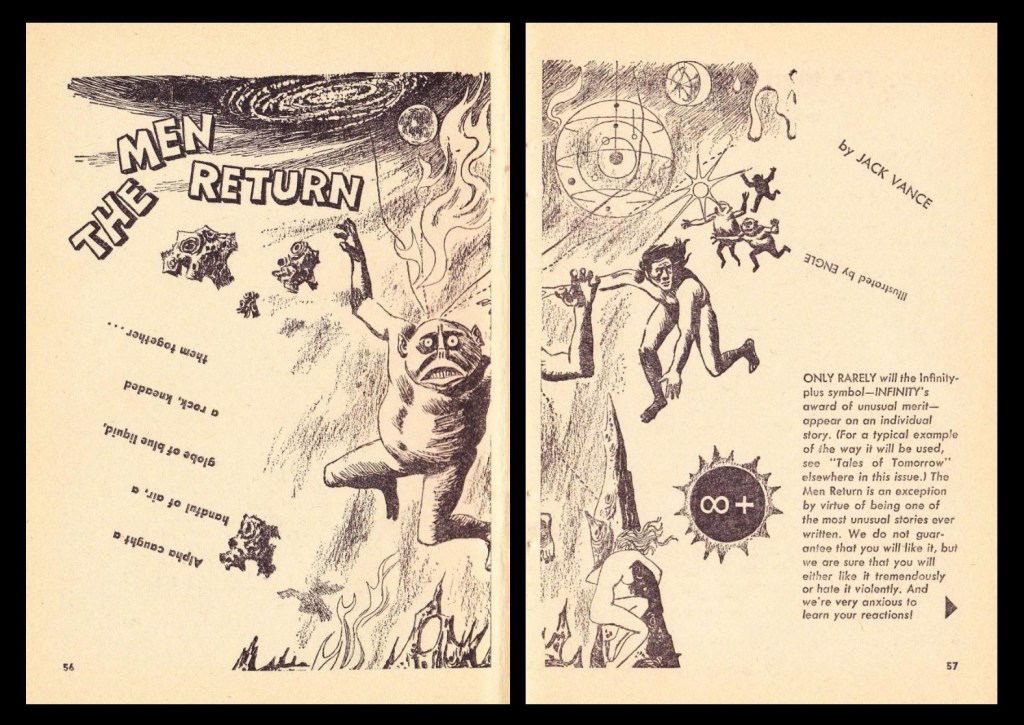
“The Men Return” by Jack Vance #12 of 20 (Read, Listen)
My initial reaction to “The Men Return” was “WTF! Far Out!” It’s not a great SF story, but Vance does produce a different idea.
I’ve often wondered why SF/F writers don’t imagine more far out possibilities when writing fantasy and science fiction because those genres allow for imagining anything. Well, Jack Vance does just that in “The Men Return.” We are told early in the story:
This reminds me of Poul Anderson’s Brain Wave, where our solar system moves into an area of the galaxy with different energy fields and all animal life on Earth becomes five times smarter. It also triggered the memory of Vernor Vinge’s A Fire Upon the Deep and its sequels that features the idea of Zones of Thought, where there are four different regions in the Milky way, each with a different kind of physics. Finally, “The Men Return” made me remember Hothouse by Brian W. Aldiss, and its far future beings.
And until just before the end of “The Men Return,” I thought the story could have been another of Vance’s Dying Earth tales, one closer to the end of humans. It also fits into the Dying Earth theme. Amazon is selling the Kindle edition of The Jack Vance Treasury for $4.99. It collects “The Men Return” and many classic Vance stories, including “Liane the Wayfarer” a classic story from The Dying Earth.
I read “The Men Return” today, and then listened to it, and I’m still not sure what’s happening. There are two groups of beings that talk, but each considers the other group a source of food. The Organisms are named Alpha and Beta. While the Relicts are Finn, our main point-of-view character, two females, Gisa and Reak, and two ancient males, Boad and Tagart. Both groups constantly search for food in a surreal landscape where physics and gravity don’t seem to be working. I might need to read this story several times before I get what Jack Vance was painting in this picture.
From the story I can’t tell if the two groups are simply different tribes of humans, or if in the far future, humans have evolved into two separate species, or if one of the groups is aliens. The artwork suggests one group is different looking than the other group. I assume the Organisms are either aliens or mutants.
Larry T. Shaw, the editor of Infinity Science Fiction presents “The Men Return” with a new designation, the Infinity + symbol.
Infinity Science Fiction was published from November 1955 through November 1958, and even though it was a second-string SF magazine, it published quite a lot of good science fiction from major names in the genre. The classic SF story, “The Star” by Arthur C. Clarke was published in its first issue.
Shaw’s Infinite + designation reminds me of F. Orlin Tremaine, Astounding Science Fiction second editor, Thought Variant designation for special stories. Asimov wrote “Nightfall” as an imagined Thought Variant story. John W. Campbell later tried to do the same thing with his NOVA designated stories.
Here are the comments Shaw received on “The Men Return” from the October issue.
Finally, here’s the cover from the July 1957 issue of Infinity Science Fiction where “The Men Return” appears.
“Profession” by Isaac Asimov #11 of 20 (Read, Listen)
“Profession” isn’t one of Asimov’s well-known stories. It’s not a Foundation or Robot story. The setting is Earth. “Profession” is an SF idea story, and unfortunately, not a particularly exciting one. The idea of writing knowledge directly to the brain is interesting, but how and why it’s used in “Profession” isn’t believable.
Asimov usually wrote idea stories. He seldom developed stories with drama or humor or even satire. I seldom felt anything for most of his characters. “Profession” is about George Platen who wants to become a computer programmer and be sent to another planet. He lives in the future where Earth has colonized many star systems, and they need professionally trained people. Earth has developed a way to educate people by writing directly to the brain, and they export people with extremely specific technical skills. Evidently, Earth has a monopoly on this brain writing technology.
The problem is, one person in 10,000 have a brain that can’t be written to, and they are sent to special institutions where they are told to read and study whatever they want. George is one of these people and is crushed that he can’t achieve his professional dream.
Unfortunately, “Profession” is a short novella, much too long for the solution Asimov eventually gives us. I won’t spoil it though, but I will say Asimov has to stack the deck to pull it off. It’s an unsatisfying ending because the original plot logic is now seen as faulty. In this future, the only education people get is by mind writing. No one wants to put years of studying into any subject because they hate it when they can’t learn instantly.
In other words, Asimov assumes humans will act differently in the future and I don’t think they will, and that spoils his whole premise for the story.
I don’t even remember why I put this story on the list. It did not have even one citation of CSFquery. I just checked and I added “Profession” because Rich Horton picked it in his Hugo nominations for 1957. He even says, “My vote in this category goes to Asimov’s ‘Profession,’ really a quite strong novella.” Just goes to show you how people’s reading reactions are different.
Of the possibilities Rich lists, I would have picked “The Lineman” by Walter M. Miller, Jr. It has some modern-day political correctness problems, but it’s exciting and dramatic. “The Lineman” is about construction crews on the Moon being distracted by a rocket full of prostitutes. You can read it here. Here’s all the novellas that Rich was considered for 1957:
“Profession”, by Isaac Asimov (Astounding, July)
“The Night of Light”, by Philip José Farmer (F&SF, June)
“The Last Canticle”, by Walter M. Miller, Jr. (F&SF, February)
“The Lineman”, by Walter M. Miller, Jr. (F&SF, August)
“Lone Star Planet”, by H. Beam Piper and John J. McGuire (Fantastic Universe, March)
“Get Out of my Sky”, by James Blish (Astounding, January, and February)
“Nuisance Value”, by Eric Frank Russell (Astounding, January)
For sheer storytelling, I like all those other writers far better than Asimov. When I was young, Asimov was very appealing because of his ideas, but I never realized how unexciting his stories were back then. He does create interesting setups, but his characters are just chess pieces he moves around to act out an idea. And now that I’m older, I realize most of those ideas weren’t particularly good. Very few of Asimov’s stories had any kind of emotional punch. The one that I remember that does is “The Ugly Little Boy.” It has quite a punch. I also felt some sympathy for the characters in The Naked Sun, but that’s because I read it when I was going through an agoraphobic phase due to a heart arrythmia.
“Profession” does have some neat ideas, but they are tortured to create its plot.
The thing I like best about “Profession” is the Kelly Freas cover. If you loved “Profession” please say so in a comment. Or comment if you agree with me.
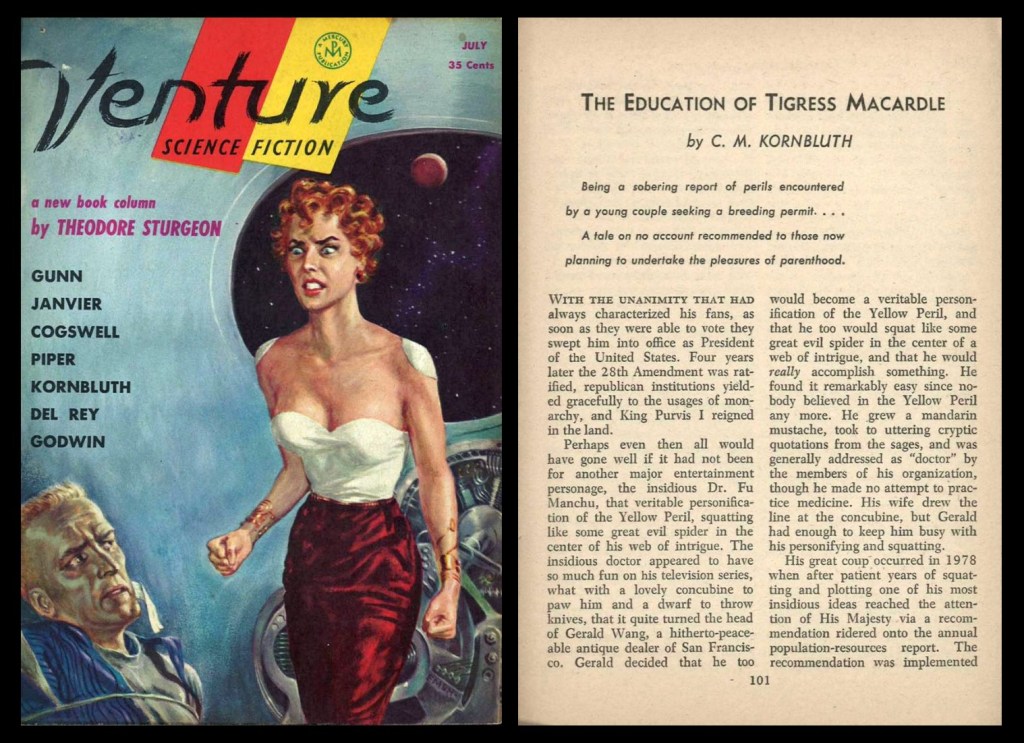
“The Education of Tigress Macardle” by C. M. Kornbluth #10 of 20 (Read, Listen)
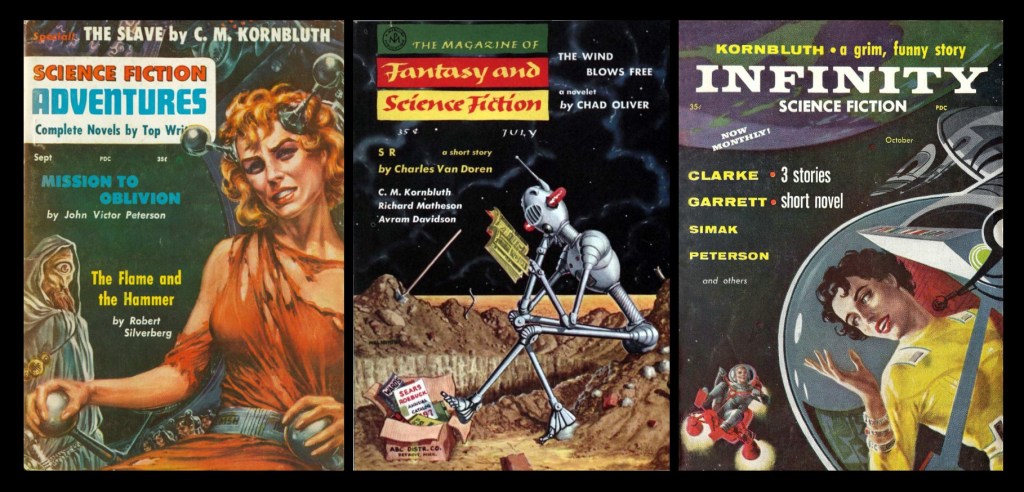
C. M. Kornbluth came out with four short stories in 1957 – “MS. Found in a Chinese Fortune Cookie,” “The Education of Tigress Macardle,” “The Slave,” and “The Last Man Left in the Bar.” None of them stood out as an obvious favorite among readers, with each story having its fans. Isaac Asimov and Martin H. Greenberg couldn’t decide between “The Education of Tigress Macardle” and “The Last Man Left in the Bar” so they published both in The Great SF Stories 19 (1957). Kornbluth died in early 1958, at age 34, so these were the last of his short stories that Kornbluth got to see in print.
I picked “The Education of Tigress Macardle” for the best of 1957 because it had two citations in CSFquery, and the others only had one. However, I’ve had people tell me they preferred either “The Last Man Left in the Bar” or “MS. Found in a Chinese Fortune Cookie.” After reading all three, I feel CSFquery was right, but what do you all think? Follow the links to read the two other stories. I don’t have a link to “The Slave” but it was a novella promoted as a short novel.
Kornbluth was famous for his sharp satire. His brutal wit stabs at several topics in “The Education of Tigress Macardle.” The bit that amused me the most was a throwaway paragraph about the Civil War Book-of-the-Week Club. I chuckled at Mightier than the Sword: A Study of Pens and Pencils in the Army of the Potomac, 1863-1865. There really is a seemingly endless amount published about the Civil War.
“The Education of Tigress Macardle” begins by informing its readers that in the future, a popular personality was elected President, and he got the 28th Amendment passed that made him King Purvis I. (I hope that’s not prophetic.) King Purvis inspired a guy name Gerald Wang to play at Dr. Fu Manchu and unfold a sneak attack on the United States. We learn all of this because the story is told from the year 2756 A.D. in a class at Columbia University called Chronoscope History Seminar 201. The students of this class watch what happens to George and Diana “the Tigress” Macardle on a chronoscope.
You must read between the lines to pick up all the well-hidden sexual innuendo, and if you miss what little there is, the story might lose a lot of its charm. Kornbluth is aiming at humor, but I’m not sure how many of his jokes I get. George thought he had achieved bachelor nirvana when the Tigress would have sex with him on his bear skin rug in his downtown bachelor pad. Then she whined that she wanted to get married. Then she whined she wanted to have a house in the suburbs. Evidently, George kept getting all the sex he wanted because he kept giving in. Then the Tigress whined to have a baby.
Now here’s where the fun starts. King Purvis degreed that all Americans who wanted to have children must pass a Parental Qualifications Program (P.Q.P.). And Dr. Wang devises a doozy of a potential parent exam that secretly works at his plan to take over America. Parents are given a robotic toddler to take care of for three months. If it’s black box records proper care George and the Tigress will get a permit to breed.
You can imagine the fun Kornbluth provides with this setup. You might not guess the surprise ending. I didn’t.
Another reason I preferred “The Education of Tigress Macardle” over the other two Kornbluth short stories, is because the story is more to the point and clearer. I’m not saying it’s perfectly clear. Kornbluth writing style includes a constant flourish of asides. His prose is baroque with allusions that he hopes will make us smile or admire his wit.
But those filigrees also make it hard to read Kornbluth. Kornbluth relies heavily on things from the future, or beings from other dimensions, or observers from the future. They’re usually a gimmick, a foundation, a diving board, for him to riff with his clever wordiness. Usually, his stories are fun, but seldom have much impact. He has twenty-four stories in CSFquery, but most of them don’t have many citations. I wonder if Kornbluth would have been a good standup comedian. It helps to hear his stories read by a narrator that does voices.
Personally, I believe “The Education of Tigress Macardle” would have been a far superior story if Kornbluth would have hacked off the sections with King Purvis, Gerald Wang, and students from the future. He should have focused entirely on George and the Tigress and spent all his energy making the story subtle, funny, and insightful. The setup with the tryout toddler is great by itself. And he should have worked on the characterizations of George and the Tigress. In 1957 the Playboy bachelor and the emerging liberated woman were ripe for satire.
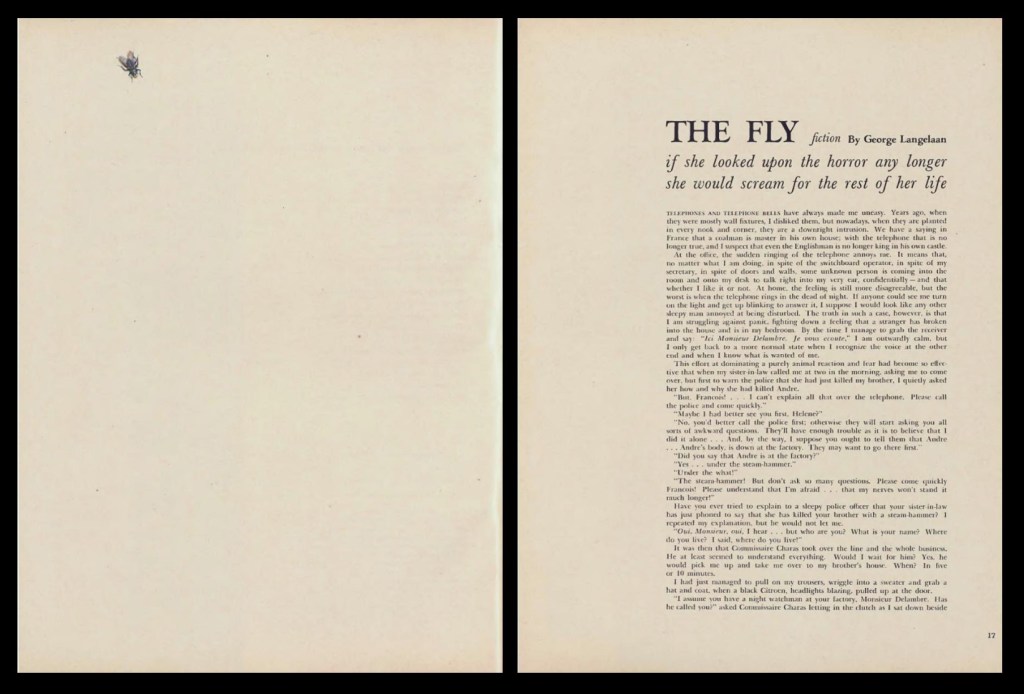
“The Fly” by George Langelaan #09 of 20 (Read, Listen)
“The Fly” by George Langelaan is far more famous as a horror movie than as a science fiction story, but it’s a novelette about a mishap with a matter transmitter, obviously putting it into the territory of science fiction. Judith Merril did include it in her collection of the best SF of 1957, but it’s mostly remembered in horror story anthologies.
I rewatched the original 1958 version of The Fly about a year ago, so it was reasonably fresh in my mind. While reading “The Fly” today I was surprised how well the film stuck to Langelaan’s original story. The film grossed reviewers out back in 1958, but since then it’s become somewhat of a classic. Back in the day, me and my school friends talked quite a lot about the movie version. I’m surprised the original story doesn’t get more recognition.
“The Fly” explores two common science fictional ideas, the matter transmitter, and the mad scientist. I thought the story was well told, but it seemed a bit archaic in its storytelling style. That might be because it’s a translation from the French. I often feel translated stories sound like they are from 19th century Europe. But then, that might be due to most of the translated stories I’ve read were from 19th century Europe. “The Fly” also feels a bit like Edgar Allan Poe to me too. Then again, it might reflect a storytelling style favored by non-English speaking writers. I don’t know since I use no other language but English.
I’m not going to repeat the plot of the story because it’s so famous, and if you haven’t read it, I don’t want to spoil it. Even the concept of a matter transmitter comes up late in the tale. Like many 19th century stories, “The Fly” takes a roundabout way to get to the point. It’s told after the action has happened. I have a theory about that. I believe old timey writers liked to tell stories with an “as heard by” structure. We used to believe that eyewitnesses were the gold standard of implying validity. Francois, tells the story about Helene, his sister-in-law, confessing she murdered his brother. The tale takes a winding path before it gets to the science fictional element.
Matter transmitters were made famous by Star Trek and its transporter. That show has dealt with transmitter mishaps too. But my all-time favorite matter transmitter story is Rogue Moon by Algis Budrys. It works out several fascinating aspects to the concept. Some of those aspects were later made famous in “Think Like a Dinosaur” by James Patrick Kelly. But there is one other story I’d like to mention, that’s a variation of the matter transmitter idea. In “The Four Sided Triangle” by William F. Temple, which uses a matter transmitter as a matter duplicator — an unintended side-effect to avoid in some matter transmitter stories. “The Four Sided Triangle” is a neat little love story that was made into a decent film.
André Delambre in “The Fly” is also a splendid example of a mad scientist in a science fiction. Like many Sci-Fi mad scientists, he works alone and invents something that should require all the resources of creating fusion power. Mad scientists and lone inventors now belong in the realm of fantasy, but there’s something heartwarming about mad scientists to folks who used to wear propeller beanies. I believe that appeal is why we had Doc Brown in Back to the Future. (The mad scientist is a popular idea in children’s stories still.)
In 2019, “The Fly” was reprinted in Promethean Horrors: Classic Tales of Mad Science. I thought that an apt title for anthologizing this story. Unfortunately, the table of contents was disappointing. I was expecting a big anthology full of mad scientist stories. That’s a shame because I would have bought a large retrospective anthology that highlighted the evolution of the mad scientist in science fiction.
I kept thinking about the classics of mad scientist stories and went looking for anthologies that might collect them. I found two.
I went ahead and took a chance on The Mad Scientist Megapack since it was only ninety-nine cents. The Mad Scientist’s Guide to World Domination edited by John Joseph Adams is more money, $11.99 for the Kindle edition. However, there’s an audiobook version, and I might get that. I was disappointed that neither volume collected “The Fly.” If ever there was a mad scientist in science fiction, André Delambre is one. There is one story I know well in the table of contents to The Mad Scientist Megapack, “The Man Who Evolved” by Edmond Hamilton. I hope all the others I haven’t read are in that vein.
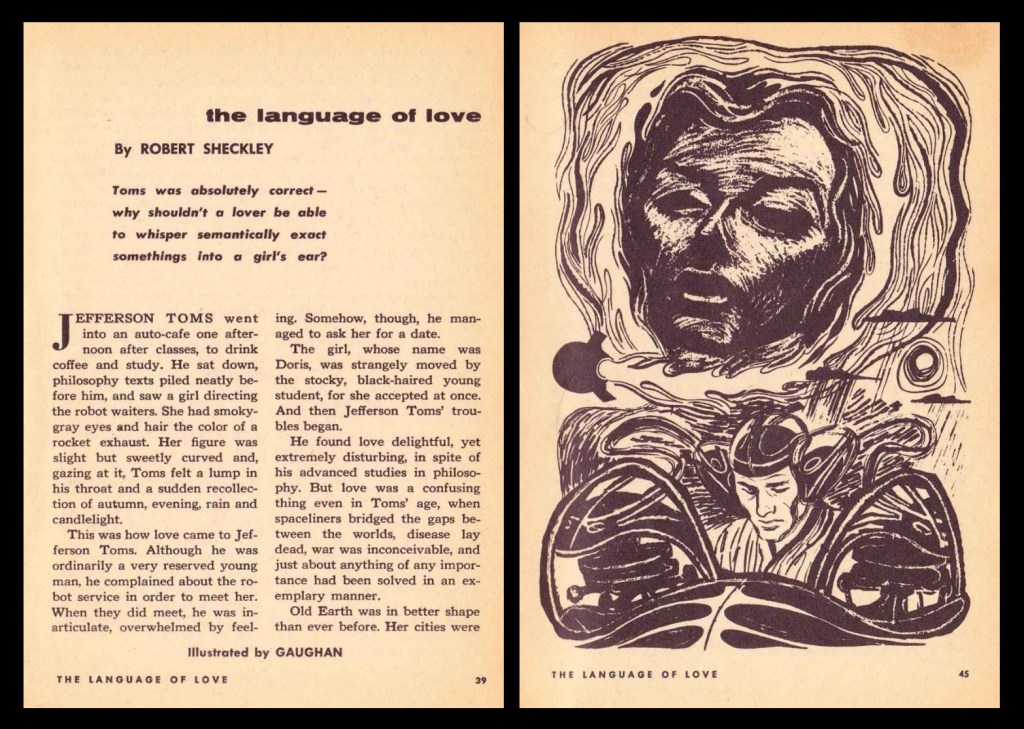
“The Language of Love” by Robert Sheckley #06 of 20 (Read)
I added “The Language of Love” by Robert Sheckley to the list of best science stories of 1957 because me and my high school buddies loved this story back then, and it has stuck with me for over fifty years. I’ve often talked about it to other people. “The Language of Love” is a silly humorous piece that also offers interesting philosophical insights. I won’t talk about them right away because I hope you will go read the story, but I will eventually spoil the ending by explaining the story.
Robert Sheckley is becoming a forgotten science fiction writer and I think that’s sad. Everyone recalls The Hitchhiker’s Guide to the Galaxy when the topic of humor and science fiction comes up, but they should be using Robert Sheckley as the poster boy for funny Sci-Fi instead of Douglas Adams. And don’t get me wrong. I like Douglas Adams too, but Sheckley mined the funny bone of science fiction far deeper and wider.
Sheckley wrote a lot of short stories in the 1950s and 1960s and they just aren’t remembered. Probably he’s remembered, if he’s remembered at all, for two novels, Dimension of Miracles and Mindswap. Both are available on audiobook, and that’s how you should read them. Neil Gaiman introduces the audiobook version of Dimension of Miracles where he tells a funny/sad anecdote about Sheckley. Gaiman produced several audiobooks for Audible where he promotes forgotten titles and authors. You might like to look at that page.
“The Language of Love” is about a young Earth man, Jefferson Toms, who falls for a girl named Doris. He was overwhelmed by what he felt for her, but when Doris expected Jefferson to tell her he loved her he couldn’t. Jefferson wanted to find the perfect words to express exactly what he felt for her. So, he went on a quest across the galaxy to learn everything he could about love and language.
To get you to click on the read link above, I thought I would post the first two pages of the story. Sheckley has a wonderful writer’s voice, and I think you need to hear a bit of it. Maybe that will convey what I mean more than my own words trying to describe it.
When Jefferson returns to Doris and utters the precise words that express his feelings for her, poor Doris is upset. I changed my mind. I won’t give you those words. Or explain the double surprise ending. Just go read the story.
I think “The Language of Love” also captures one of the dominant flavors of Galaxy Science Fiction back in the 1950s. Galaxy loved satire. Often stories in Galaxy were light, jaunty, and sometimes biting. It wasn’t a hard science fiction magazine like Astounding. I’m not sure the type of science fiction Galaxy presented in the 1950s has survived well. H. L. Gold was a much different editor than Frederik Pohl in the 1960s. Only three of the twenty stories our group is reading as the best of 1957 are from Galaxy, I added two of them, “The Language of Love” and “Time Waits for Winthrop” by William Tenn. I added them by abusing my power as moderator. I hope it just isn’t me that fondly remembers this kind of science fiction from the 1950s. I’m looking forward to seeing how the others react.
While my Facebook group is reading twenty stories selected as the best short science fiction of 1957, I’m also searching for other stories from that year that also deserve to be remembered. I think I found one with “Between the Thunder and the Sun” by Chad Oliver, from the May 1957 issue of F&SF.
The trouble is I can find no other recognition for this story. That makes me doubt my own interest in the story. I want to advocate “Between the Thunder and the Sun” not because it’s an exceptional story but because it tackles a serious subject, one that might be new to science fiction in 1957. If you know of early stories on this theme, leave a comment.
Chad Oliver was an anthropologist who worked at the University of Texas. He wrote a fair amount of science fiction, but I only remember him for Mists of Dawn, a 1952 Winston Science Fiction juvenile I read as a kid. Oliver had more success as a western writer. “Between the Thunder and the Sun” was only anthologized in one notable anthology, The Best from Fantasy and Science Fiction, Seventh Series edited by Anthony Boucher, which is essentially the best of 1957 from F&SF, so it’s picking its own children to praise. Still, I need to remember that anthology in my search for other standout SF stories from 1957.
What makes “Between the Thunder and the Sun” significant is it’s a Prime Directive story, a concept that emerged from Star Trek: The Original Series. Evan Schaefer is a professor contacted secretly about a mission to a planet where the population of intelligent beings were dying off on one continent. Because those beings have not reached a stage where they could survive the culture conflict of meeting a technologically superior species from Earth, it is against all our laws to even contact them, much less help them. However, a secret group wants to break those laws and save those beings. Their method of helping the aliens is to get them to understand ecology, because their current practices are self-destructive. And even still, their altruistic efforts only reinforced the Prime Directive laws.
What made this story stand out to this afternoon was I had just watched a YouTube review of Hard to Be a God by Arkady and Boris Strugatsky, a 1964 Russian novel that was translated into English in 1973 that is also about the Prime Directive. This made me wonder when the concept first appeared in science fiction or as a public concept. I can’t answer that question, but I hope readers of this blog can, and will comment below.
“Between the Thunder and the Sun” is a pleasant enough story to read, but it lacks suspense, drama, tension, and when conflict does arrive near the end, it just happens. Oliver wrote the story as an unfolding narrative. There’s lot of interesting ideas in the story, lots of imaginative details, but the story just doesn’t zing.
Should we remember a science fiction story just for its ideas? If you look at a list of the most remembered SF short stories, they are often based on remarkable ideas. But nearly all of them have remarkable storytelling too.
Neither Judith Merril, T. E. Dikty, or Asimov and Greenberg included “Between the Thunder and the Sun” in their anthologies of the best science fiction stories of 1957. That’s striking out three times. However, Merril did include the story in her honorable mentions.
If you get a chance, read “Between the Thunder and the Sun” and let me know what you think. Here’s the link again.
“The Queer Ones” by Leigh Brackett #02 of 20 (Read)
Ever wonder why science fiction imprinted on you as a child? Why does the genre appeal so strongly to some people? What’s its subconscious attraction?
Psychoanalyzing 1950s science fiction reveals a deep-rooted desire to contact aliens. UFOs became a mania in that decade, which spilled over into the 1960s. UFO crazies seemed to have disappeared after that. But they’re back today. I do believe that humanity suffers from cosmic loneliness. Or is it something else?
“The Queer Ones” by Leigh Brackett speaks to both xenophobia and loneliness. I’m not going to give spoilers right away, but I recommend you follow the link above and read the story. It offers bit of a mystery, so I don’t want to spoil your reading fun, but I want to have my say eventually. However, “The Queer Ones” fits the mold so well for this kind of 1950s science fiction story, that it might not be much of a mystery for aficionados.
My first reaction to reading “The Queer Ones” was to feel it was a mirror image of Zenna Henderson’s People stories. But instead of finding gentle aliens out in the backwaters of rural American, we encounter thugs from the stars. I’m reminded of Heinlein’s Have Space Suit-Will Travel. Henderson’s aliens are a version of the Mother Thing, while Brackett’s aliens act like Wormface, but they look human. They even coop human lowlifes.
Leigh Brackett takes on the tone of Clifford Simak in “The Queer Ones,” and it’s hugely different from her planetary romances. She can’t seem to resist herself though because romance does sneak in towards the end.
Hank Temple is the owner/editor of a small town, six-page newspaper. Doc Callender contacts Hank about a curious child, Billy Tate. X-rays and bloodwork show this kid to be strangely different. If fact, the doctor had been called in because Bily had been beaten up by other kids for being different. He looked human, but Billy was slight, redheaded, and a tiny bit odd.
As it turns out, Sally Tate is a young country girl who got put in the family way by a fast-talking stranger. Her child, Billy, grew up to become a kid that Sally’s hill country clan intensely disliked. The Doc calls Hank to see if he wants to drive out into the middle of nowhere to meet this backwoods family. That’s when the mystery starts. Hank and Doc’s first theory was Billy was a mutant.
Mutants are another popular theme of 1950s science fiction. The cause of mutant humans in SF is varied, but two reasons were popular. Radiation from atomic bombs, and the emergence of Homo Superior was the other. This also paralleled our fascination with aliens. Either they were monsters, or advanced beings with godlike powers. Both show up in “The Queer Ones.”
However, the beginning flavor of “The Queer Ones” is much different than the flavor at the end the story. Early on, Brackett taps into the kind of atmosphere we find in Way Station by Clifford Simak. I’d call that theme: Aliens Living Hidden Among Us. Other books like that are A Mirror for Observers by Edgar Pangborn, The Man Who Fell to Earth by Walter Tevis, and as I’ve already mentioned, Pilgrimage: The Book of the People by Zenna Henderson. Superman comics did this too. Henderson essentially steals Superman’s origin story for her People stories. And if you remember, quite a few episodes of The Twilight Zone featured beings from beyond living amongst us.
The plot takes a sinister turn when Doc is killed. Hank realizes their snooping has gotten back to Billy’s father. Then the hospital is burned down with Doc’s evidence. That’s when Hank catches his first alien, a young woman, Vadi, who turns out to be the sister to Billy’s father. That’s when Hank realizes that Billy’s father is not another mutant, but an alien.
Hank is turned on by Vadi. Sally Tate, and all the women of her family had been turned on by Billy’s father, who we eventually learned is an alien called Arnek. Now this is an interesting sub-theme of cosmic loneliness. Leigh Brackett doesn’t go into this, but how can Arnek mate with Sally Tate and produce a child? This has come up in later science fiction stories. A theory to answer that question is panspermia. That theory helps to explain why many of the aliens in Star Trek look human, but it also suggests that God or advanced aliens seeded/populated/colonized the galaxy on purpose. Maybe we weren’t meant to be alone and miss our cousins.
This also suggests that our psychological fear of cosmic aloneness can sometimes overcome our ingrained xenophobia. We want the universe, or at least the galaxy, to be inhabited by beings like us. Even reading stories about aliens gone bad fulfill the need to know were not alone.
Let’s backtrack a minute. Did our hangup of being alone in the universe emerge with UFOs in the late 1940s? I don’t think so. Doesn’t the desire for aliens and angels fulfill the same existential craving? And don’t we have stories of humans and angels falling in love with each other, even having sex. The Bishop’s Wife comes to mind, but then there’s Wings of Desire and City of Angels. Ancient literature is full of aliens if you squint at supernatural beings from a certain angle. Isn’t God a kind of top boss alien? The Bible and other ancient religious work often describe whole species of aliens as part of taxonomy of beings not of this Earth. Sure, the Greek gods weren’t light years away, but they were from on high.
Science fiction doesn’t have that many themes. It tends to explore the same ones over and over, and if you look at them in the right way, those themes have always been around, even before science and science fiction. Just imagine how deep they go when you think about Neanderthals encountering Homo sapiens? We hate the other, but we loath the idea of being by ourselves in reality.
Stories like “The Queer Ones” appealed to me as a kid, and I don’t think I’m alone. Shouldn’t we ask why? For all our eight billion, most of us are lonely. Even if we have plenty of family and friends to keep us company, don’t we feel that something is still missing? Don’t we have a longing for something greater? And isn’t the reason so many people believe in God is because they want a personal relationship with a higher being? Wouldn’t you want a personal relationship with an alien?
In the end, Sally runs off to the stars with Arnek, leaving Billy behind. Hank takes Billy to raise him but wishes he had a wife to help. Hank doubts he will ever marry because after kissing Vadi once, he longs for her too much to settle for a human companion. That’s very strange, don’t you think? Is Brackett suggesting that we’re missing a higher spiritual connection because aliens are our true soul mates?
I doubt we’ll ever meet aliens on Earth, or visit them on other worlds, but we might not stay alone for much longer. Artificial intelligence is progressing so fast that we might have new digital friends soon. R. Daneel Olivaw might arrive before we return to the Moon. Science fiction always promised us robots too. I wonder if we’ll encounter any in the next eighteen stories from 1957.
——
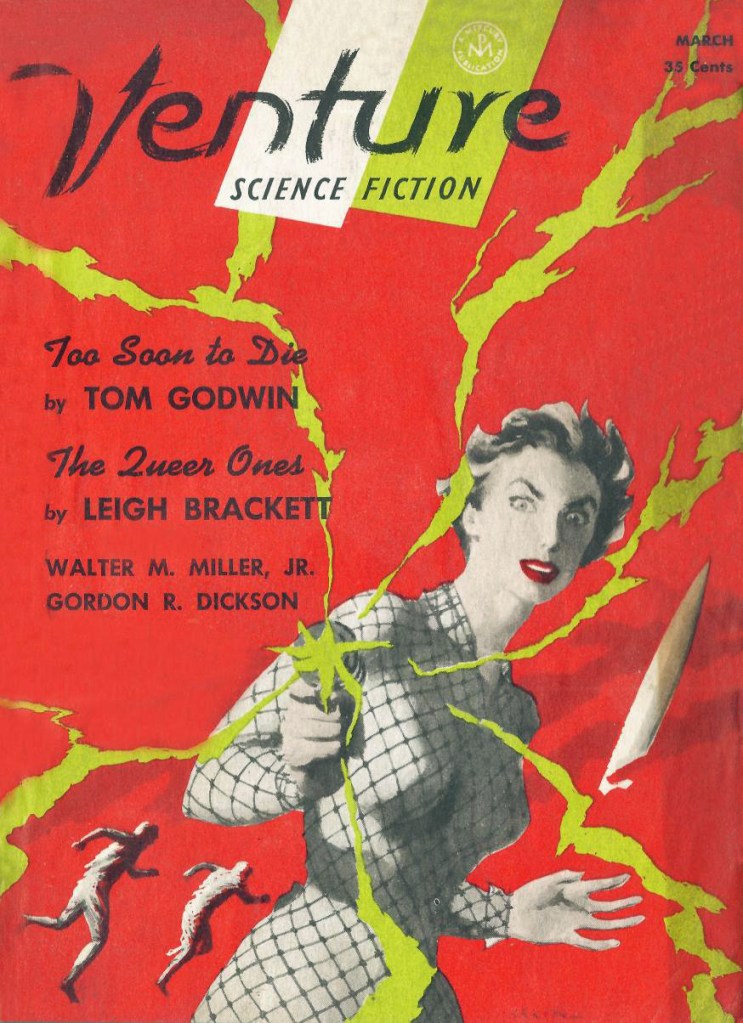
“The Queer Ones” first appeared in the March 1957 issue of Venture Science Fiction. Dave Hook became so entranced by its cover that he researched and wrote “Who is Artist ‘Dick Shelton’.” It’s another fascinating stroll down memory lane if you love old SF magazines and their artists who do their covers and interior illustrations.








 Classics of Science Fiction