I love when I discover a short story that pushes all my buttons. I regret that I didn’t discover such wonderful tales when they were first published, but I do have the consolation as an old jaded reader of finding a story that still thrills me. “The Island of Doctor Death and Other Stories” by Gene Wolfe is one such story that I just read. It’s about a boy, Tackman Babcock, who survives a troubled “family life” by reading science fiction. Since I survived my bumpy upbringing by reading science fiction, I immediately bonded with Tackie.
I know, it has a confusing title. I’ve seen it collected in anthologies for years, and it always sounds like a collection of short stories by the author. When Gene Wolfe created his first short story collection the title became The Island of Doctor Death and Other Stories and Other Stories, as you can see above in the first edition, a 1980 paperback from Pocket Books. The 1997 edition is still available from Amazon. The original story, “The Island of Doctor Death and Other Stories” was first published in Orbit 7 (1970) edited by Damon Knight has been reprinted many times, so you might already own a copy. However, if you just want to quickly enjoy the story right now, it’s available online for free as an audio podcast from PodCastle, episode 171. Just click and take forty-five minutes to hear the story, it has wonderful narration.
Maybe now you’ll understand the confusing title, but you’re probably wondering what book Tackie was reading? If you’d like to read speculation about possible books read the entry for this story at a wiki devoted to Gene Wolfe. I tend to think Wolfe was trying to capture the feel of many novels, stories, and famous characters so readers would imagine the ones they have read. I definitely thought of The Island of Doctor Moreau by H. G. Wells, but I also thought of famous pulp stories, horror films, and cliff-hanging serials.
Wait, you didn’t go listen to the story? Or read it? Or remember reading it, and now you’re confused?
Tackie Babcock lives with his drug addicted mother in an old resort hotel. He isn’t supervised or well cared for, but his mother’s predatory boyfriend Jason, and a couple of aunts (May and Julie) keep an indifferent eye on him. We learn about Tackie’s inner life when Jason steals a paperback book that Tackie asked him to buy. The book has a lurid cover of a muscle bound man in rags battling a horrible half ape-half human creature. For the rest of the story, reality is interrupted by flashes from this novel. Captain Phillip Ransom adrift at sea for nine days arrives at a mysterious island and his captured by the mad Dr. Death, and his experimental creations. Eventually, we learn about other characters from Tackie’s real and imaginary world, including a beautiful native girl, Talar of the Long Eyes that Cpt. Ransom rescues from a fate worse than death. As the story progresses fiction and reality mix, so do who is good and who is bad.
If that doesn’t get you hooked, I don’t know what will. My parents were alcoholics, and we moved around a lot. From the time I started reading science fiction in the 5th grade until graduating, I attended nine different schools in three states. I forgot how many houses I lived in during that period, and I forgot how many times my parents split up. I’ve also forgotten how many drunken parental brawls I had to watch and hear, or how many times I was chauffeured around by drunk drivers. I survived all of that, and remember them as good times because I read science fiction. Without science fiction I’m not sure I would have had a happy childhood. I felt like Robert A. Heinlein was my father figure, Samuel R. Delany was my big brother, and Robert Sheckley was my crazy uncle.
I completely identified with Tackie Babcock. I wish I had read his story in 1970, but I’m thankful I finally found it in 2021.
James Wallace Harris, 3/5/21
p.s. Many of Gene Wolfe’s books including this one are available through Scribd.com, a subscription library. I mention it because I hope Scribd gets enough subscribers to survive. Think of it as Netflix for ebooks and audiobooks.
I’ve been thinking about humor in science fiction. Generally, when we think of funny science fiction we think of Hitchhiker’s Guide to the Galaxy or stories by Robert Sheckley, R. A. Lafferty, or sometimes John Scalzi. But that’s science fiction having fun, what about when the genre is the butt of the humor? For example, westerns were skewered hilariously in Blazing Saddles. Galaxy Quest comes to mind, but then that film was roasting the genre out of fondness. I don’t think Blazing Saddles was an actual tribute to westerns in the same way Galaxy Quest was to science fiction. And what about self-deprecating humor in science fiction. I love recursive science fiction, but most of it celebrates the love of science fiction. I’m curious, do many recursive science fiction stories satirize the genre? I’m not going to answer that extensively in this essay, so don’t get your hopes up. But keep reading for an example of where I’m going.
My problem is sarcasm, satire, and subtle jabs go right over my head (my lady friends take advantage of this). I’ve always seen science fiction as mostly straight stories, well, at least I did. I’ve been reading hundreds of short stories lately, and I’m starting to get suspicious. Every once in a while I wonder if the author has both a pen and pin in hand. As a reader, I felt it was my job to suspend disbelief and let the writer put the story over. Now that I’m writing more about what I read, I’m wondering if I should always look below the surface for different motives the writer might have had for writing their story.
Take this story by Judith Merril, “The Deep Down Dragon.” I read it in Galaxy: Thirty Years of Innovative Science Fiction edited by Frederik Pohl, Martin H. Greenberg, and Joseph D. Olander. What’s unique about this anthology is each story is prefaced with the author’s memory of writing it.
Study that Emsh (Ed Emshwiller) painting above. At first I thought it a clever way to suggest action – a woman had been abducted from a space colony. But then I thought of something, and it became funny, But how could it possibly comic? Obviously a woman has been kidnapped by an alien on a colony world – that’s tragic. But if you know the history of science fiction magazines, and the cliches about covers with BEMs carrying off a scantily clad women, then you might think Emsh is playing around. In case you don’t know the lingo, BEM stands for bug eyed monster. Sex sells, even for science fiction magazines. Why did Emsh leave off the sexy woman and lower the sales of that issue? Because we expected a naked woman he thought might be funny to disappoint us. Sure, the painting is of a serious action scene, a man is running to rescue a woman. Maybe even the editor told him, “No babes.” But I like to think Emsh is also poking fun at science fiction (See the section below, Sex, Nudity, and Prudity in Science Fiction.)
But the ribbing of SF doesn’t end there. Judith Merril tells a serious story about a man rescuing a woman, but it’s a story within a story. In the tale psychologists are showing potential space colonists a scene they’re supposed to react to like an inkblot test. Essentially, the characters are reacting to an animated version of Emsh painting. First, we hear from the woman as she tried to explain why she wasn’t clothed, and why she was wearing high heels in a space habitat. Then we hear a man’s version of the story about how he carefully tracks down the woman and fleeing alien – but he’s obviously an intellectual who over prepares, over thinks, and is not a brawny action-oriented kind of guy. You get the feeling Judith is making fun of SF by having the woman be the stereotype of the woman on SF covers, and the man be the stereotype of SF readers – the ninety-pound weakling/egghead.
Now it’s completely possible to read this story straight, but I found it more fun to think Emshwiller and Merril were poking fun at science fiction. And I found the story I reviewed last time, “Wall of Crystal, Eye of Night” by Algis Budrys more admirable when I assume Budrys wasn’t completely serious either. That he was creating something over the top he knew fans would love. But I have to wonder, was Merril and Budrys also looking down on their readers? Or the genre? I imagine some writers do. And is knowing that important to the story? Sometimes the story is better when we’re in on the laugh.
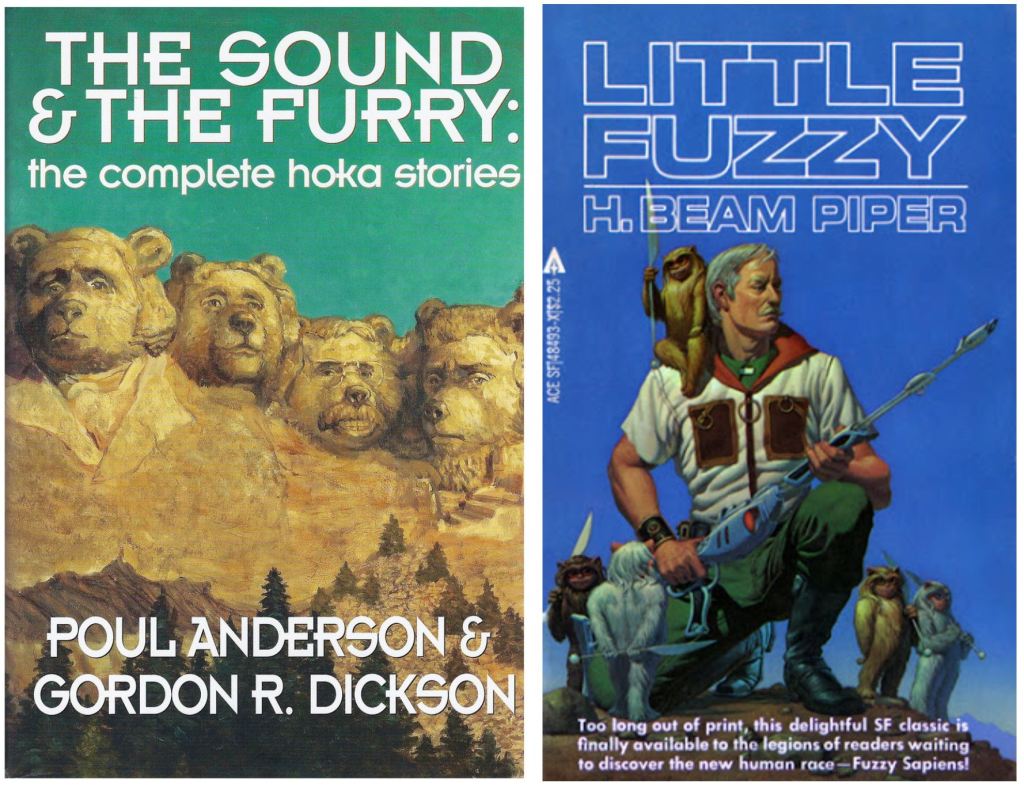
Most humor is in good fun. For example, take these two covers I found when looking for the BEM covers. They play against type.
But when you start looking at covers on science fiction magazines, most of them are deadly serious sense of wonder scenes, or at least heroic action scenes. Generally, when we have humor in our genre, we’re still suppose to take the story seriously, or mostly serious. And by serious, I mean close to realistic. For example, the Little Fuzzy stories by H. Beam Piper have a realistic side, but Poul Anderson’s Hoka stories are just for fun.
As I breezed past hundreds of covers I was disappointed I didn’t find more clever satire. One of my favorites was for “The Pirates of Erastz” by Murray Leinster.
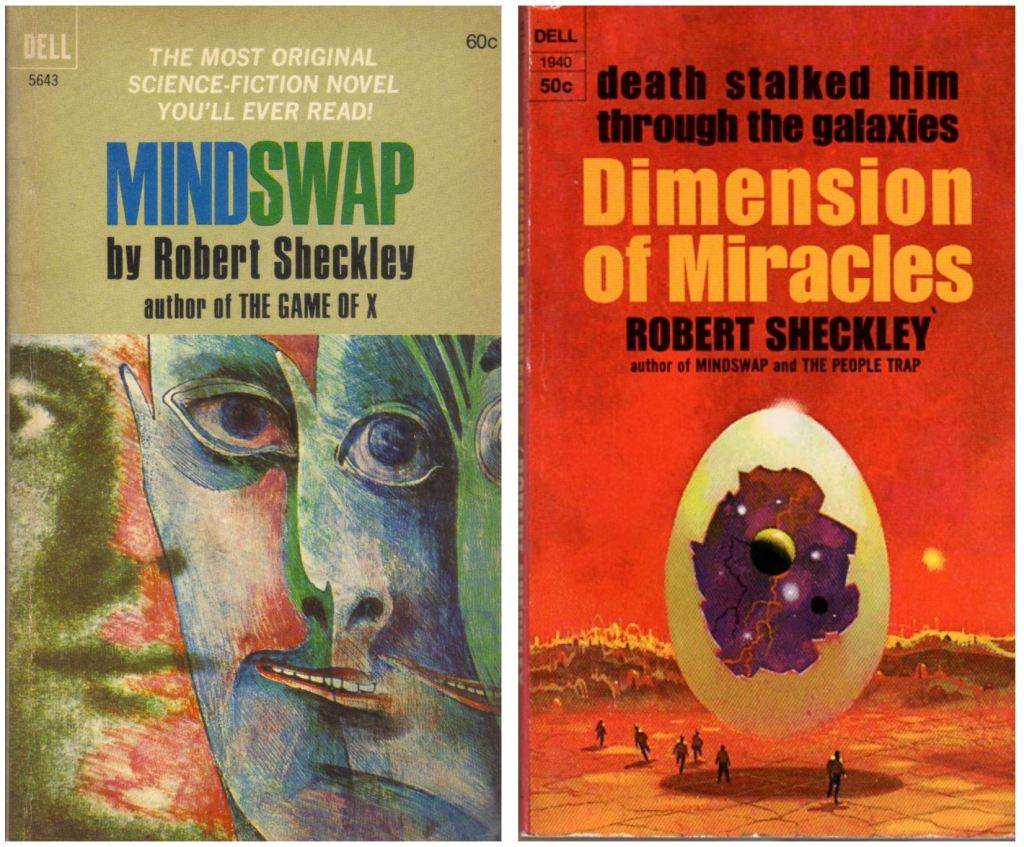
My all-time favorite SF novel is Have Space Suit-Will Travel by Robert A. Heinlein. I’ve always taken it completely straight, but the title is proof enough it’s a spoof and Heinlein was having fun. We science fiction true believers want our fantasies to be possible. No matter how absurd the situation gets in novels like Mindswap and Dimension of Miracles. On one level I still take Sheckley’s story as something that’s possible in our infinite universe. But that requires some major suspension of disbelief.
When a book is obviously funny, we know we shouldn’t take it seriously. But do we always know when we’re reading is something serious? What if it’s sometimes supposed to be funny in places? Or just slyly satirical? I confess here I have been sorely lacking in the ability to spot humor in SF. But now that I’m thinking about it, I’m on the lookout.
Sex, Nudity and Prudity in Science Fiction
While researching this post I also encountered protests against the skimpily dressed women on covers. Over the years I’ve read memoirs by SF writers and readers about how the covers were so embarrassing that they had to hide their SF magazines. Some even tore the covers off them afraid their parents would see them.
Most fans loved sexy (sexist) covers (hey they were adolescent boys), but some didn’t. Here’s a few quotes given to me by a Mr. Lock regarding Weird Tales.
Oct 1933: Here is a word about our covers, from Lionel Dilbeck, of Wichita, Kansas: “But whatever you do, do not continue to disgrace the magazine with naked women as you did in the June and July issues. If you think that the readers want them, have them vote on it. Personally I prefer any kind of monster that it is possible to think of rather than the sexy covers you have been having. And I really hate to tear the covers off the magazine, as that also spoils the looks of them.”
March 1934: Clara L. Heyne, of St. Paul, writes to the Eyrie: “But when I take the magazine to work for reading at noon, I take the cover off because I know how the pictures of nude women affect those who don’t know WT.”
May 1934: Joseph H. Heil, of New York, writes: “Why the nudes? I have noticed that the majority of your readers have resented your cheap-looking covers, and I wish to add my emphatic vote against the continuance of these trashy covers. Looking back on the old issues of WT, I find that they contained none of the nudism of your present-day frontispieces, but, notwithstanding, they were much more interesting, and illustrated the stories much more vividly than today. I was first attracted to your publication (several years ago) by an exciting cover depicting some weird plants over-running the earth. Many people are, I am sure, attracted likewise; but how can you expect to attract the attention of a lover of the weird by the portrayal of a wide-eyed nude, gracefully reclining on stones or silks, as the case may be? Why make your readers tear off your covers in order to take the magazine anywhere, outside the privacy of one’s own home, and even there one has to be careful not to let it lie around where it might be noticed.”
Here’s a quote sent to me by Paul Fraser from Marian Cox in Startling Stories, September 1951.
By the 1950s most SF magazines moved away from the damsel in distress in space. It’s rather amusing though, because those covers are now favorites on Facebook groups devoted to science fiction art.





 Classics of Science Fiction