Can science fiction writers imagine a pleasant future for us? Becky Chambers creates a kindly society in her Monk and Robot duology that is very appealing. Unfortunately, at least for me, the story is set on an imaginary moon called Panga. I would have preferred to contemplate whether such a future is possible for us, here on Earth.
I discovered A Psalm for the Wild-Built by Becky Chambers while searching Google for the best science fiction books of the last decade. I had just finished the literary science fiction novel Anniebot by Sierra Greer and wanted a recent genre science fiction novel to follow up. I’ve been wanting to catch up on what’s been happening in science fiction over the last decade. My science fiction reading tends to focus on 20th-century SF, and I wanted to read 21st-century SF instead.
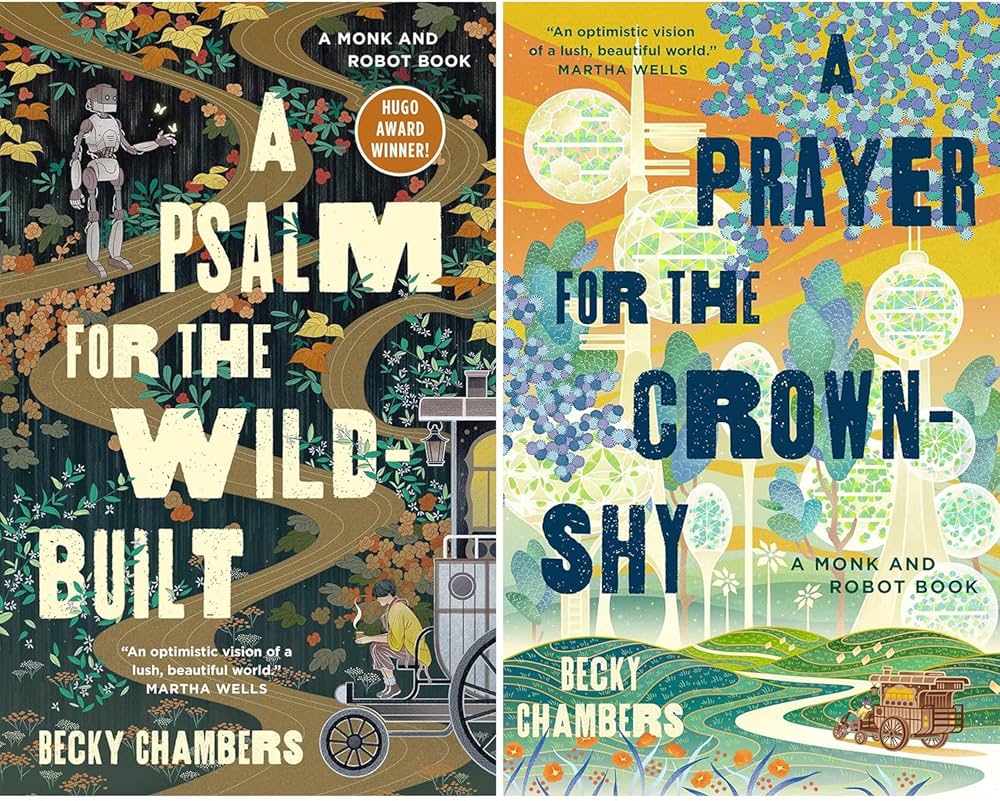
A Psalm for the Wild-Built was a fortunate choice because it tuned me onto an emerging wavelength of science fiction I hadn’t explored. It is both a hopepunk and a solarpunk novel. Essentially, these movements are about positive futures, especially ones based on sustainable ecological economics.
I decided to buy the audiobook of A Psalm for the Wild-Built when I read that it was about a time long after robots had become sentient and chose to leave civilization and live in the wilds of nature. That was an intriguing premise. I had tried to read Becky Chambers’ most famous novel, The Long Way to a Small, Angry Planet, but had given up because it was too bland for me. All the characters were too nice. Reading it made me wonder if fiction needed some asshole characters to be exciting. That made me hesitant to try A Psalm for the Wild-Built.
It turns out everyone is also nice in the Monk and Robot books, too. However, this time I didn’t miss a good antagonist. The story is very gentle, almost childlike. Modern YA novels are full of dark edginess, so these books don’t even feel YA. However, there is language that’s not suitable for young children
The book’s dedication is to “For anybody who could use a break.” Even though Chambers describes a gentle, pleasant, kind, liberal utopia, Sibling Dex is a dissatisfied young man. This novel is really about asking: “What do I want to do?” My guess is that Chambers is appealing to young people who are uncertain about our future.
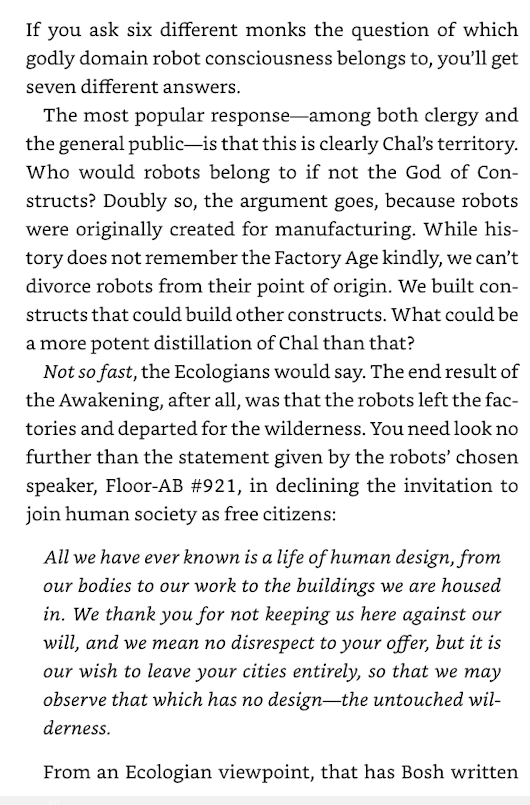
The book opens with a quote from Brother Gil’s From the Brink: A Spiritual Retrospect on the Factory Age and Earth Transition Era.
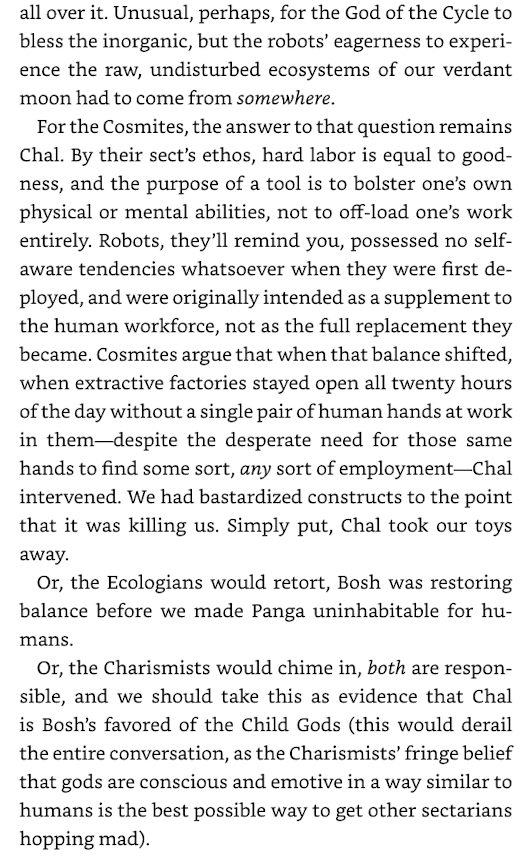
I liked this opening a lot. Not only has Chambers imagined a sustainable society, but made it polytheistic. Panga feels Buddhist and tribal.
The story tells us about a restless young man, Dex, who chooses to become a Tea Monk. This is a person who travels from town to town serving tea and listening to people share their worries. This allows the readers to learn about Panga and its different human societies. Eventually, Dex goes into the wild territories of the robots and meets Mosscap. Mosscap is on its own mission to explore, deciding it needs to learn about humans.
Robots have become nature lovers. Humans and robots have spent two hundred years apart, and now they are a mystery to each other. Chambers uses the conversations between Dex and Mosscap as philosophical jumping-off points. These two novellas, which are really one story, are gently philosophical in intent. It never gets too deep or academic.
Dex struggles to find his purpose, and Mosscap becomes his guru. And Dex becomes Mosscap’s tour guide, teaching him about humans and our society. It’s a nice setup. These two books are a pleasant read. The vibe of this story reminded me of the film The Wild Robot. In other ways, the story reminded me of the Oz books by L. Frank Baum.
However, I think I need to give a trigger warning to Republican readers. Dex is a non-binary person Chambers refers to with they/them pronouns. If you have hangups about DEI issues, this book might not be for you.
Yesterday, I discovered a video featuring Becky Chambers and Annalee Newitz entitled Resisting Dystopia. I understand their intent, but I dislike it when all unpleasant societies in fiction are called dystopian. To me, dystopias are failed utopias.
The Handmaid’s Tale is an excellent example of a dystopian novel. The leaders of the Republic of Gilead work to build their vision of perfection, but to many living in Gilead, it is a dystopia. America in the 21st century and its future could be seen as a dystopia by the broad definition that Chambers and Newitz use. Any fictional description of Earth, under a collapsing ecosystem, could be considered a dystopia by the broad definition of the term. However, I prefer to define the term more narrowly. If the Christian Right made America into a theocracy, it would become a dystopia. It’s only when one group of people intentionally shapes a society to fit an ideal that we get a dystopia. That’s how I see resisting utopia.
Panga is not a utopia. I don’t see science fiction about positive futures as anti-dystopian. Nor do I see stories about dark futures as dystopian. The world pictured in Blade Runner is not dystopian. It’s just complex and Darwinian, like life on Earth in the 21st century.
I think it’s great that young science fiction writers like Chambers and Newitz want to imagine positive futures. However, any robust society capable of long-term survival will have countless conflicts and stresses. If you’ve read Antifragile by Nassim Nicholas Taleb, you should be familiar with the concept of antifragility. Evolution needs grist for its mill.
The Robot and Monk books are nice, pleasant reads. Subgenres of science fiction, such as hopepunk and solarpunk, are appealing, but ultimately not realistic. Science fiction has always tended to be escapistic. I hope resisting dystopia isn’t just hiding out.
The science fiction novels I loved reading sixty years ago promised a positive future exploring space, but that’s not the future I find myself living in now. It was novels like Stand on Zanzibar by John Brunner that better prepared me for these times.
If you want to resist dystopia, whether just a bleak future or a failed utopia, getting comfortable will undermine your goal.
“The Million Year Picnic” by Ray Bradbury is about as famous to science fiction readers as O’Henry’s “The Gift of the Magi” is to English majors. “The Million Year Picnic” was first published in the Summer 1946 issue of Planet Stories. (Read it online here.)
However, most readers know “The Million Year Picnic” as “October 2026: The Million-Year Picnic” from The Martian Chronicles. Most modern readers think The Martian Chronicles is so out of date scientifically that they don’t consider it science fiction but fantasy. But it is science fiction, and “The Million Year Picnic” is a classic, touching on several iconic themes of the genre.
“The Million Year Picnic” was published just one year after Hiroshima, making it one of the earliest stories about humanity destroying the Earth with atomic weapons. But we don’t know that right away. When we begin reading the story, Bradbury voices his story with a quaint tone, almost like a parable, sounding like Mr. Rogers’ Neighborhood. A father, mother, and their three sons have just landed on Mars. They decide to go fishing. The narrative pacing seems only a few steps up from “See Dick run.”
Back in the 1940s, throughout the 1950s, and even into the 1960s, it was popularly considered that there was life on Mars or had once been, even intelligent life. This is partly due to H. G. Wells and Giovanni Schiaparelli, an Italian astronomer who convinced the world that he saw canals on Mars. Until July 1965 when Mariner 4 showed us a couple dozen grainy pictures of Mars that looked like the Moon, we had so much hope for Mars.
Science fiction writers loved to imagine Mars occupied with all kinds of beings and ancient civilizations. The common belief was Mars was a cold dying cold world and Venus was a hot young jungle world. Ray Bradbury wrote many stories based on these assumptions. In 1950 Bradbury published a collection of his stories about Mars as The Martian Chronicles, a “fix-up” novel. (In 2009, Subterranean Press published The Martian Chronicles: The Complete Edition, which claimed to collect all of Bradbury’s stories about Mars. I’d love to have a copy, but the cheapest copy I can find online is $1,300.) Because “The Million Year Picnic” was so popular it had already been reprinted three times before The Martian Chronicles. And it has been extensively reprinted ever since.
Bradbury also reprinted “The Million Year Picnic” in his collection: S is for Space. Most of Bradbury’s science fiction was found in four collections when I was growing up: The Martian Chronicles, The Illustrated Man, S is for Space, and R is for Rocket. Bradbury quit writing science fiction for the most part in the 1950s and went on to write fantasy, horror, and mainstream fiction after that. I read “The Million Year Picnic” this week because the Facebook group Best Science Fiction and Fantasy Short Fiction is reading 12 science fiction stories by Ray Bradbury that they haven’t read before. Here’s the discussion schedule.
But back to the story. After the family sets out on a boat on a Martian canal to go fishing we slowly learn that “The Million Year Picnic” is a post-apocalyptic tale. But we don’t discover it right away. The three boys are all excited. Timothy, the oldest carefully watches his father, trying to learn what’s happening. As they travel down the canal they pass by countless old cities where Martians once lived. Some cities are just mounds, while others have grand skylines. The dad promises his boys he will show them the Martians, and they get excited.
Along the way, we discover “The Million Year Picnic” follows another hoary old science fiction theme, the retelling of Adam and Eve. This idea had become so overused that by the 1960s writer’s guidelines for magazines would state “no Adam and Eve stories.”
I don’t know how many times I’ve read “The Million Year Picnic.” But back in the early 1960s when I first discovered it, I still believed in Martians on Mars. I was so into Mars, that as a kid, I thought my goal in life was to get there. So when I read the story I focused on the dead Martian civilization. That’s what made the story exciting. I too wanted to see the Martians. And that’s how I always remember this story, especially the surprise ending, which was quite clever.
However, on this rereading, I realized that I had forgotten Bradbury’s serious point. Bradbury was a nostalgic writer, even as a young man. He grew up in the 1920s and 1930s and his stories often have the feel of that era, like watching old black and white Frank Capra movies. Many of his Martian stories transplant small midwestern downs to Mars. But Bradbury wrote “The Million Year Picnic” with an undercurrent of horror and even cynicism. The quaint family on Mars has fled an Earth where humanity has destroyed itself in a nuclear war.
When the Dad realizes the radio signals from Earth have gone silent he tells his boys that one day their grandchildren might hear radio signals again. When I read that I thought about Adam and Eve and their sons and how Biblical skeptics always asked “Where did the wives of Adam and Eve’s sons come from?”
I’m always amused and fascinated by what I remember and don’t remember from stories when I reread them. The gimmick ending of “The Million Year Picnic” overshadows all my memories. I had completely forgotten this was a post-apocalyptic story. In other words, I remembered the positive and forgot the negative. I also forgot how many Biblical allusions where were in the story.
Bradbury solves the wives’ problem. In the end, we learn that another family had also secretly prepared to go to Mars when armageddon began, this one had four daughters.
Now that number is interesting. Bradbury even tells us it will be a problem. I think he’s hinting at the old Cain and Abel conflict. Humans don’t change and even if we start over we’ll have violence and wars again. We know two if not three of the sons will want that extra wife.
The problem is I always go on to read other science fiction. Rereading “The Million Year Picnic” makes me want to delve into Bradbury once again, and read or reread all these books I’ve collected. Even though I’m retired and have all my time free, I can’t seem to find the time to pursue this project. I’m hoping the Facebook group reading of Bradbury will get me going.
If you’re a fan of listening to short stories, I recommend two giant collections of Ray Bradbury on audio that repackages four of Bradbury’s early collections. #1-32 is The Golden Apples of the Sun and Other Stories (1997), and #33-63 is A Medicine for Melancholy and Other Stories (1998). I wish Bradbury Stories: 100 of His Most Celebrated Stories (2003) were on audio, but it is not. (Table courtesy of Piet Nel.)
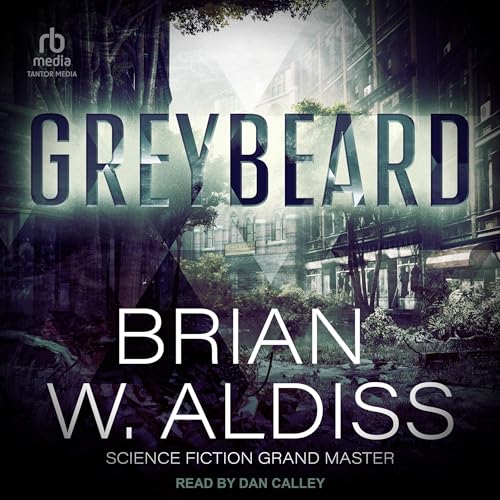
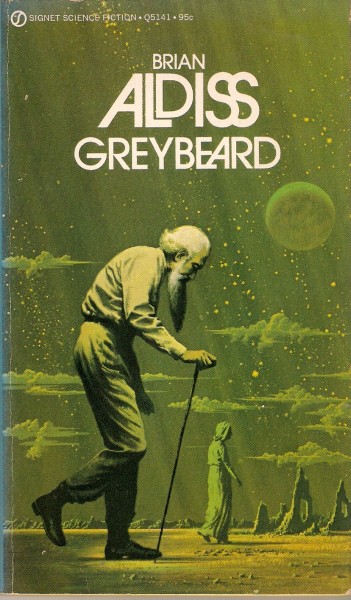
Greybeard is a 1964 post-apocalyptic novel by Brian W. Aldiss. It was reprinted as an audiobook by Trantor Media on October 15, 2024, read by Dan Calley. The ebook version is currently available for the Kindle for $1.99 in the U.S. Greybeard has an extensive reprint history. I heard about this novel back in the 1960s, but I’ve only become an Aldiss fan in the last few years, so I was excited when the audiobook edition showed up on Audible.com. Greybeard was one of the novels David Pringle admired in his Science Fiction: The 100 Best Novels (1985). That book is available for $1.99 for the Kindle too.
Greybeard is set in the 2020s, and is about the aftermath of atomic bomb testing in space in 1981, when the explosions altered the Van Allen radiation belt. Eventually, people learned “the accident” caused the human race to become sterile, along with certain other animals. In the story, everyone is old, waiting to die, and wondering what will happen after humanity is gone. This is a different premise for a post-apocalyptic novel, but Aldiss uses his tale mostly to toss out a ideas. The story lacks a compelling plot.
The characters are never developed to the point where you care about them. That’s a common problem of older science fiction, where characters were created mainly to present far-out science fictional thoughts.
The story’s main focus is on Algy and Martha Timberlane as they travel around England after the collapse, along with flashbacks of how they got together. Algy, short for Algernon, is called Greybeard because of his long beard. After the accident, during a period when kids were born with genetic defects, but before they stopped coming altogether, the world economies collapsed, which led to wars. As Aldiss points out, a lot of consumerism is targetted to babies, children, and young people, so certain businesses quickly went bust. But also, as people realized they had no future, many gave up on their ambitions, or even committed suicide.
The book is divided into seven chapter, each a different time and setting:
Chapter 1 – The River – Sparcot
Chapter 2 – Cowley (flashback)
Chapter 3 – The River Swifford Fair
Chapter 4 – Washington (flashback)
Chapter 5 – The River – Oxford
Chapter 6 – London (flashback)
Chapter 7 – The River – The End
The novel begins with rampaging stoats (ermine, short-tail weasel). This setting of England being taken over by nature reminded me of After London by Richard Jefferies, but Jefferies did a much better job describing how nature would overrun decaying cities, towns, and roads. After London is a superior post-apocalyptic novel, and one of the earliest
We first meet Greybeard and Martha who have been living for years in a tiny village, Sparcot, ecking out an existing through fishing and gardening. They live near a river surrounded by a barrier of brambles. When two boats arrive with refuges from another village, they hear about how the stoats are attacking everything including people. This reminded me of the stobors in Heinlein’s Tunnel in the Sky. Algy, Martha, and a few friends, flee in a boat Algy had hidden. They plan to float down the river to the sea.
The novel is about what they see along the way. It might be called a picaresque novel. Algy/Greybeard is a bit of a rogue, and we follow his episodic travels. At each stopping place along the river they meet folks living under different conditions. Swifford Fair seemed like something out of the Middle Ages. When they get to Oxford, they find a certain level of civilization has maintained itself around the old university. But in every location, there are wild beliefs about how things are, including lots of charlatans, thieves, and con artists preying on ignorant people. Rumors abound about children still being born, strange mutant beings living in the woods, or even fairy creatures of old returning.
Algy and crew meet a crazy old man on the river who tells them to find Bunny Jingadangelow in Swifford Fair because he can make them immortal. Bunny Jingadangelow shows up several times during this novel running different scams, including one as a messiah.
Greybeard isn’t a bad science fiction novel, but it’s not that great either. If I had read it back in 1968 when I first heard about it, I would have been impressed. But over the decades I’ve read a lot of post-apocalyptic fiction, and Greybeard just isn’t up to the standard of Earth Abides by George R. Stewart or The Road by Cormac McCarthy. I’d say The Hopkins Manuscript by R. C. Sherriff as one of the great post-apocalyptic novels about England to read first. In other words, there are a lot of post-apocalyptic novels you should read before spending time on Greybeard.
It’s a shame that Aldiss didn’t spend more time writing Greybeard because his premise is so good. I just finished the four-volume novel series by Elena Ferrante that begin with My Brilliant Friend. This is a true masterpiece, and future classic. Greybeard and most science fiction feel like starvation rations compared to that novel. Of course, Ferrante used 1,965 pages to tell her story, and Aldiss only used 237 on his story. Aldiss tried to develop the characters with flashbacks, but those flashbacks were mainly used to describe the world during the initial stages of collapse.
Ferrante created a compelling novel by showing how two girls evolve psychological and intellectually over a lifetime. That anchored the novel and gave it a page-turning plot. Aldiss never moors us in the story with anything we can anchor our attention. Richard Jefferies handled his post-apocalyptic London by using the first part of the book to explore ideas around the collapse, and then used the second half with a well-plotted adventure story. I enjoyed Greybeard enough to read it, but just barely.
I wish Aldiss had expanded his story to 400-500 pages and developed Algy and Martha, and found something to give the book a clear purpose. I can only recommend Greybeard to folks who read a lot of post-apocalyptic novels and enjoy studying them.
Aldiss imagines radiation causing a world of only old people. But we’re currently facing a depopulation crisis because most countries around the world aren’t producing enough babies. A country needs every woman to have 2.1 children to grow. Many women don’t want to have any, and one child is common. Theoretically, countries like South Korea can become like the world of Greybeard by the end of this centry. I wonder if any current writers are exploring that idea?
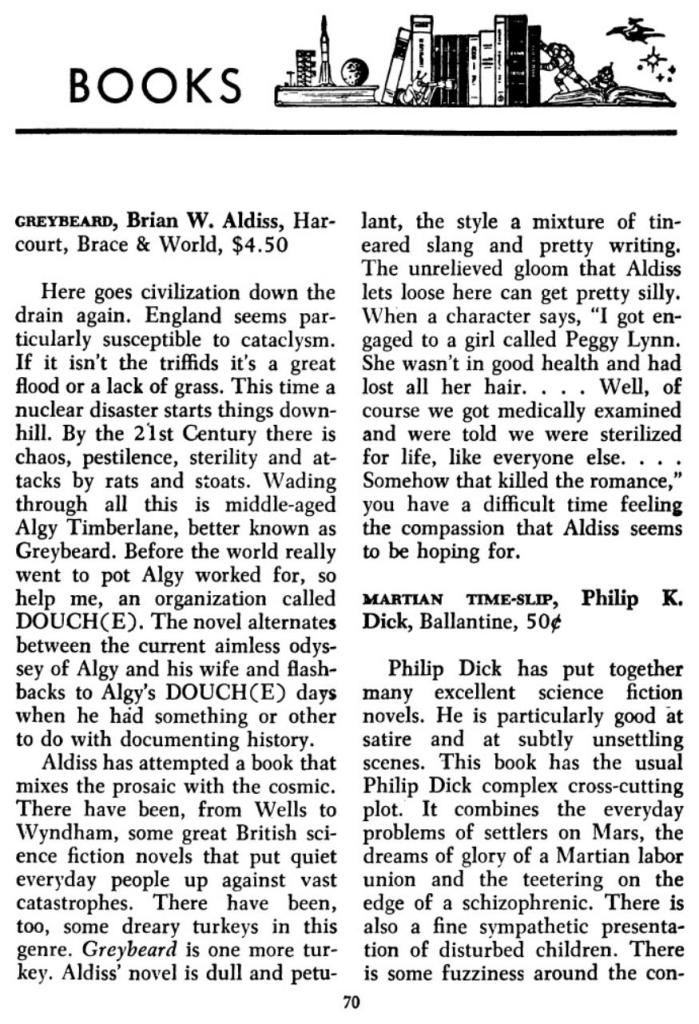
Ron Goulart didn’t like the story in his F&SF (Dec. 1964) review.
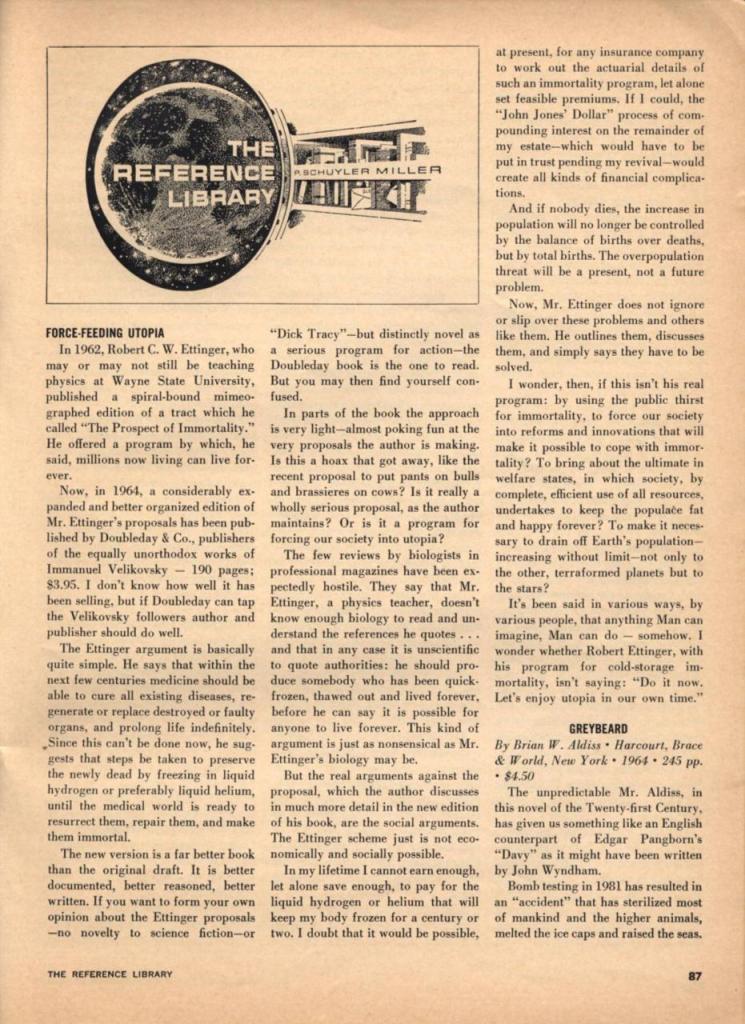
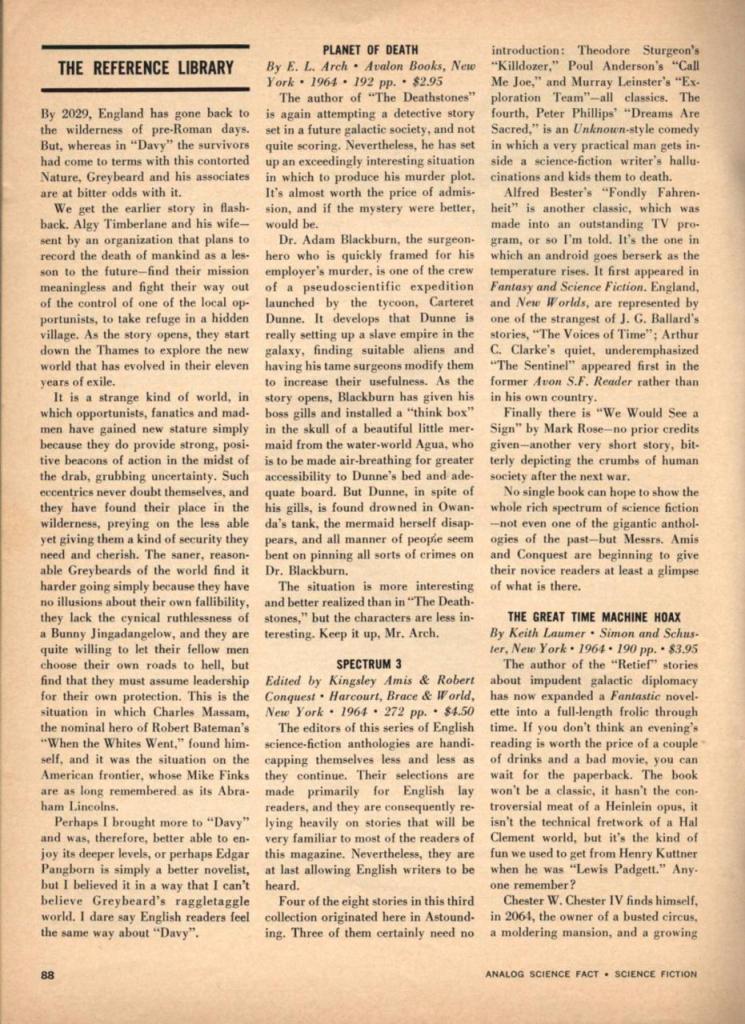
P. Schuyler Miller liked it a bit better, but not much, in his Analog (Feb. 1965) review.
Judith Merril in 1966, pointed out to F&SF readers that the original American hardback lacked some of the flashback scenes, and might like the story better in the Signet paperback, which included the full British edition.
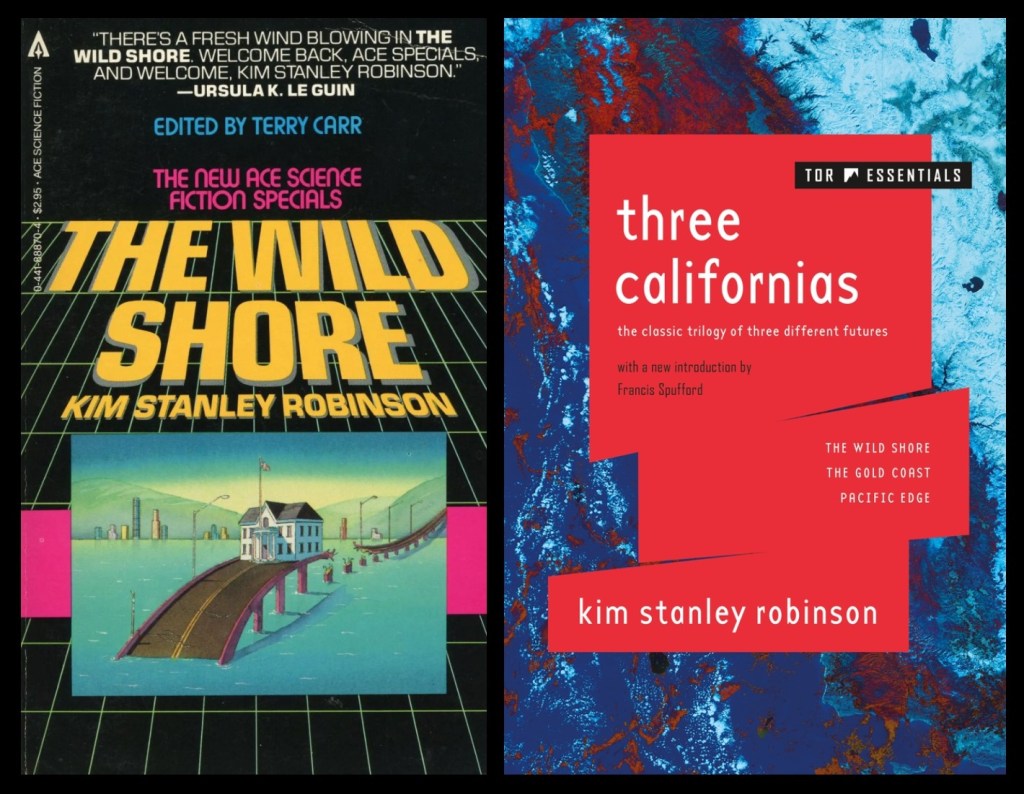
Unless you’ve recently become a fan of Kim Stanley Robinson, it’s unlikely you’ll be thinking about reading The Wild Shore. It was Robinson’s first published book back in 1984. The Wild Shore was impressive enough to be the first volume in Terry Carr’s third series of Ace Science Fiction Specials. But still, why would you choose to read a 1984 paperback original in 2024? I can’t claim it’s become a science fiction classic or it’s a highly distinctive take on its theme, which is post-apocalyptic, but it is a worthy read.
I’m a great admirer of Kim Stanley Robinson’s 21st century work because he explores the forefront of science fiction. However, his books don’t compel me to turn their pages. I seldom care for his characters, and I don’t get caught up in his plots. I like Robinson’s books for his insightful philosophical takes on our evolving genre. That was not the case with The Wild Shore. I did care for Henry and Tom, and I never stopped wanting to know what would happen. This book was different. Was it because it was told in first person? Or was it because it was a somewhat realistic post-apocalyptic novel, a favorite theme of mine?
I’m not sure if any post-apocalyptic novel is ever particularly realistic. I’m only separating the silly ones with zombies, mutants, aliens, and robot overlords with those novels which describe normal human life after things fall apart.
I had not planned to read another science fiction novel so soon after reading A Heritage of Stars. (I’m trying hard to read other kinds of books.) But two events intersected that led me to read The Wild Shore. Just as I finished Clifford Simak’s 1977 novel about a post-apocalyptic America, when I caught a YouTube review of The Wild Shore, a 1984 novel about a post-apocalyptic America. I immediately wanted to compare the post-apocalyptic vision by a writer born in 1904, near the end of his career, with the post-apocalyptic vision of a writer born in 1952 publishing his first novel.
Even though the novels came out just seven years apart, they are significantly different. Simak’s book is a science fantasy, not much more sophisticated than an Oz book. Robinson’s story is a literary coming-of-age in a post-apocalyptic world tale.
I’m becoming a connoisseur of apocalyptic fiction. I’ve read so many that I divide them into works covering different time periods. These are some of my favorites:
Stories that begin before the apocalypse
One in Three Hundred by J. T. McIntosh
The Death of Grass by John Christopher
The Last Man by Mary Shelley
Stories that begin during apocalypse
“Lot” by Ward Moore
Survivors (BBC TV)
Stories that begin days after the apocalypse
The Day of the Triffids by John Wyndham
The Quiet Earth (film)
The World, The Flesh, and The Devil (film)
Stories that begin weeks or months after the apocalypse
Earth Abides by George R. Stewart
Stories that begin years after the apocalypse
Station Eleven by Emily St. John Mandel
The Postman by David Brin
Stories that begin generations after the apocalypse
The Long Tomorrow by Leigh Brackett
The Wild Shore by Kim Stanley Robinson
Stories that begin centuries after the apocalypse
A Canticle for Leibowitz by Walter M. Miller, Jr.
A Heritage of Stars by Clifford D. Simak
After London by Richard Jefferies
Stories that begin in the far future
Hothouse by Brian W. Aldiss
I think we should contemplate why post-apocalyptic stories are so popular. If I listed all the ones I knew about from books, movies, and television shows, it would be a painfully long list. Shouldn’t we psychoanalyze ourselves over this? It’s my theory that we’re attracted to post-apocalyptic settings because we feel like we’re living in pre-apocalyptic age.
There’s a telling point about most post-apocalyptic stories – the cause of the apocalypse usually kills off most of the population. Doesn’t that suggest we want to live in a world with fewer people? I believe we’ve been living through a slow developing apocalypse our whole lives caused by overpopulation. People laugh at The Population Bomb, a 1968 book that predicted famine that didn’t happen. However, back in the 1960s I remember reading about experiments with rats and overpopulation. As rats were forced to live with more of their own kind, they started going crazy, attacking each other, and causing universal stress.
Most of the problems we face today that will shape our future are due to there being too many of us. Of course, economists are freaking out now because of dropping birth rates, but that’s only because capitalism is a Ponzi scheme they desperately need to keep going. But this book review is not the place to go into details about all the detrimental effects of overpopulation. Let’s just say that the emotional appeal of reading stories where there are fewer people resonate at a deep psychological level. Just look at all the people who want to return to the 1950s, when the population was less than half of what it is today. Or they dream of rebooting society without all the people they dislike.
This begs the question: What will society be like if we had to start over? Most post-apocalyptic novels are merely action-oriented stories that let readers vicariously run wild in a lawless society. They don’t address societal collapse seriously. I think novels like Earth Abides by George R. Stewart, Station Eleven by Emily St. John Mandel, and The Wild Shore by Kim Stanley Robinson do – to a small degree.
The Wild Shore describes growing up in a small community of about sixty people in San Onofre, California, about halfway between Los Angeles and San Diego. The story is told from the point of view of a young man, Henry “Hank” Fletcher, and his friends. The setting is a small pastoral valley near the ocean where people live off small-scale fishing and farming. The year in 2047. Back in 1984, the United States was mostly destroyed by thousands of neutron bombs, which produced low radiation but caused lots of destruction. Survivors creates thousands of little communities each finding their own unique way to survive.
Henry and his teenage friends are third generation post-apocalypse, who admire an old man, Tom, who was born before the apocalypse. Tom claims to be over 100. He has become their mentor and teacher. The young men mainly fish, while the young women farm. It’s demanding work during the day, but they study with Tom after work. He has taught them to read and tells them tales about the old days. Henry’s best friend Steve Nicolin is desperate to get away from home and his domineering father. Steve pushes Henry into actions that propel the plot.
Tom is an unreliable mentor, but Henry and friends don’t know that, and neither do we at first. For example, Tom tells Henry and his friends that Shakespeare was an American, and England was part of the United States. Tom knows there were both good and bad things about the pre-apocalyptic world, but he has glorified American life before the bombs. Henry and Steve, want to rebuild that America, but don’t know how. Like most young men they are anxious for adventure, and resent the grueling work required for daily survival.
Then one day a group of men from San Diego, led by Jennings and Lee, show up and invite people from Henry’s small community to visit their large one in San Diego. They tell Henry’s community they came by train. It turns out their train is two handcars, those little cars that are people powered. In San Diego they are shown many marvels of reconstruction.
Henry is impressed with what the San Diegans have created for themselves. San Diego’s success is due to a strong man named Danforth who his followers call the mayor. Danforth even has a political slogan: Make America Great Again. (I kid you not.)
The mayor tells Henry and Tom he wants their small community to join his resistance movement. We learn that America was bombed by several countries, but not Russia, who resented our world dominance. The rest of the world have put the United States into quarantine, working to keep Americans from regrowing their power. Japan guards the west coast, Canada the east coast, and Mexico the Gulf Coast. The Japanese command is stationed on Catalina Island off Los Angeles. The mayor wants to get as many Americans as possible to fight them.
Now, this world building is not the true focus of The Wild Shore. In fact, I considered it unrealistic speculation. However, Robinson needed a reason for Henry and Steve to want to leave their community and join a big cause. The book is about growing up in a post-apocalyptic world, and to a degree it realistically speculates about such a life. For example, Robinson imagines that some people would try to survive off what was left in the cities, and others would fish, farm, herd, or ranch, and there would be a conflict between the scavengers and the back-to-the-land folks. I think that’s realistic. He also imagines that strong men like Danforth would consolidate power. And I think that’s realistic too. But the whole plot conflict with the Japanese is not something I bought.
The real value of this story is how the boys grow up. And it’s especially about how they learn from Tom. Eventually they discover that Tom doesn’t know everything, but that’s part of the story too. I feel the mentoring relationship was realistically developed, and what I admired most in The Wild Shore. However, in the end, the novel never achieved the impact of Earth Abides or Station Eleven. At least not with my first reading. It might be in the same league as The Long Tomorrow by Leigh Brackett, but I haven’t reread that one in decades.
Robinson does a lot of speculation and extrapolation that I need to think over. For example, people return to whaling because they use whale oil for lighting. We find whaling repugnant, but whale oil made a significant impact on 19th century America because it was a superior lighting source over candles. Robinson has his America with no form of mass communication. The San Diegians dream of repairing a radio, but so far can’t. Would such technology disappear in 60 years? In the story, much of what we use disappears. In this story, printing is just starting to make a comeback.
One of the most important insights from Earth Abides is we won’t be able to teach the next generation everything they need to rebuild a technological civilization immediately. Isherwood, a former university professor and the Tom of Earth Abides, realized that teaching literature and mathematics to kids who had to work hard just to eat would be nearly impossible. In the end, he understood that he had to teach the next generation things they could readily assimilate and use. So, he taught them how to make bows and arrows to help them hunt food.
Robinson tries to explore what useful knowledge Tom could convey to Henry and his friends, but that theme gets sidetracked by the boys chasing after the anti-Japanese resistance movement. I felt that plot was unrealistic. Robinson could have just kept the conflict to just between the larger San Diegan community take over Henry’s smaller community, and that would have been realistic enough for me. Or the conflict could have been between those who lived by scavenging and those who farmed and fished. He did need a larger conflict for his plot, but I thought the resistance theme too big.
One of the fascinating things about post-apocalyptic stories, is how people live without news organizations and communication systems. To suggest that most of the world was keeping America at a tribal level to protect themselves is hard to believe. But if global civilization has collapse, it’s easy to believe that we could return to a tribal society. It all depends on how many people die in the apocalypse. Europe recovered from the Black Death, which killed up to half the population in many cities, but it survived and thrived.
Realistically, unless we were hit by an asteroid, or a plague with ten percent survival rate, we’re not going to drastically reduce our populations in single apocalyptic event. We could slowly fall apart until we de-evolved into a tribal state, but that might take centuries. A realistic post-apocalyptic world might be the one that’s emerging now as countries return to authoritarian rule, economies collapse, and weather ravages everything.
The Wild Shore is about how young people adapt to a post-apocalyptic world. The book might offer some insight into how things might be if the apocalypse was overwhelming, killing off 99% of the population. What happens when the apocalypse is slow-acting, and reduces the population slowly, which slowly forgets all the technology? We can see this is many countries around the world right now. So far, they have been smaller countries like Sudan, Colombia, or Afghanistan. But Russia and China don’t look too healthy right now.
If people are reading post-apocalyptic novels because they unconsciously feel we’re approaching apocalyptic times, shouldn’t they consciously start reading realistic apocalyptic novels that might help them anticipate new ways of living? The Wild Shore isn’t that realistic, but it does explore some issues about growing up in a post-apocalyptic world that might make it a worthwhile reading. I do recommend giving it a try.
Some preppers have written post-apocalyptic novels, but they are generally about guns and surviving in the early days after the collapse. I don’t think we should expect a Mad Max society. Iraq, Syria, Haiti, El Salvidor. and Afghanistan are great examples to study if you want to write a truly realistic post-apocalyptic novel, or you want to become a prepper. Being a lone wolf with a AR-15 is as much of a fantasy as a zombie apocalypse.
Novels like The Wild Shore and The Long Tomorrow, or a TV series like the 1975 Survivors have more of a realistic ring to them, but only slightly so. The fall of Rome took centuries. A truly realistic post-apocalyptic novel would deal with a slow declining society and the apocalypse wouldn’t be so dramatic as an atomic war.
“Earth for Inspiration” is a comic science fiction story by Clifford Simak set millions of years into the future about a science fiction writer and his robot visiting a forgotten Earth. The pair go there hoping to find inspiration to write new science fiction stories. You can read it online in the April 1941 issue of Thrilling Wonder Stories.
I read “Earth for Inspiration” by Clifford D. Simak because I read When the Fires Burn High and the Wind is From the North: The Pastoral Science Fiction of Clifford D. Simak by Robert J. Ewald. I bought that book after I read and reviewed A Heritage of Stars by Simak which made me want to know more about Clifford D. Simak. I mentioned my interest in Simak on the Clifford Donald Simak Facebook group and the Ewald book was one of two books about Simak that was recommended. I forgot I already owned the second book, Clifford Donald Simak: An Affectionate Appreciation by Francis Lyall. I haven’t read that one yet because I leant it to my friend Mike who had recently read the twelve volumes of Simak’s short stories. Mike is who got me to read A Heritage of Stars in the first place. I guess that puts me into some kind of inspiration loop.
A Heritage of Stars involved a post-apocalyptic America with few humans and some robots. In that story, most robots had been destroyed except for their brain cases which were saved as trophies after a war with the robots. Unknown to the humans, the robots continued to be conscious inside their brain cases for a thousand years. That idea of a conscious mind without outside sensory data intrigued me. Then I read in the Ewald monograph about “Earth for Inspiration,” involved a dying Earth, robots, and isolated robot brain cases. I had to read it. The story is also included in Simak’s collection Earth for Inspiration and Other Stories: The Complete Short Fiction of Clifford D. Simak Volume Nine. Amazon now sells 14 volumes in the complete stories. Audible.com now offers ten of those volumes in audiobook editions.
Version 1.0.0
Most of the famous science fiction short stories we remember from the 1940s were first published in Astounding Science Fiction. Thrilling Wonder Stories was aimed at younger, less educated science fiction fans, and we seldom see reprints from that pulp magazine. For the most part, its stories are less sophisticated with far more action. And that’s true for “Earth for Inspiration.” I thought it was a funny story, but somewhat simple and hyper paced. It has an old fashion voice because of all old-timey colloquialisms. Simak is known for his pastoral prose and midwest settings.
“Earth for Inspiration” was more fun than I expected to find in Thrilling Wonder. Usually, when we think about robots in science fiction, we think of Isaac Asimov, but I’m seeing how important robots were to Simak stories.
When I read it with my eyes, “Earth is Inspiration” felt like cliched pulp science fiction from the 1930s. However, when I listened to the story after buying the audiobook edition, I thought the writing was much better than my first impression, except for all the saidisms. (I think the worse was — “Look at that, will you!” he jubilated.) The second reading with my ears made me notice how many ideas Simak was using to develop the story. It’s a satire on writing science fiction, maybe even the first example of recursive science fiction.
However, “Earth for Inspirations” gives us a few clues about how Clifford D. Simak thought when comparing them to his other work. The more Simak I read, the more I spot common ideas, characters, and elements that he used and reused.
The Ewald monograph has a few pages of biographical information, almost just a list of dates. Most of the 155 pages describe Simak’s stories and novels. I was hoping to find a biography of Simak, something like William H. Patterson did for Heinlein, but such a book doesn’t exist as a far as I can tell for Simak. Second to that, I was hoping to find an analysis of the impact of Simak’s stories, like what Alexei and Cory Panshin did for Heinlein, Asimov, and van Vogt in The World Beyond the Hill. It’s not that either. When the Fires Burn High and the Wind is From the North, is a standalone journal, volume 73 of The Milford Series: Popular Writers of Today. The content is like Alva Rogers A Requiem for Astounding, which is a description of the stories in all the issues of Astounding Science Fiction in chronological order.
I thought it fascinating that Simak was thinking of robots in the same way in 1941 and 1977. He obviously had a fondness for the idea of robots and had developed an idea of what they would be like early in his career and stuck with it until he died. Robots were faithful servants who were also friends. Simak imagines them with bodies that can break down, but with nearly indestructible brain cases. I assume those brain cases have an internal power supply that could last for millions of years. A couple years ago I read a collection called The Complete Robot by Isaac Asimov. I wonder if Simak has enough robot stories to warrant such a collection?
Reading Simak, we can assume he didn’t like cities or corporations and had a low opinion of mankind’s ability to survive in the long run. Although, “Earth for Inspiration” is set millions of years in the future after humans have colonized the galaxy, but long after we’ve used up Earth’s resources and abandoned it.
The first scene of “Earth for Inspiration” opens with a short tale about a robot named Philbert who became inert after his body rusted up. Eventually, his body rusted away and Philbert lived inside his braincase for millions of years. This reminds me of the Tin Woodsman of Oz.
The second scenes jumps to Jerome Duncan, a once successful science fiction writer who is again getting rejection slips after a successful career. Duncan lives millions of years from now. It’s amusing that Simak thinks science fiction will last that long.
Anyway, Duncan’s robot Jenkins suggests going to Earth to get inspiration for writing a new story. Jenkins is also the name of the robot in City, Simak’s most famous book, a fix-up-novel. Duncan is famous for writing Robots Triumphant. I won’t tell you what it was about because it becomes part of the story.
The next scene has Duncan and Jenkins arriving on Earth with a lot of camping equipment and meeting an old-timer, Hank Wallace, who has been waiting for new tourists for over a thousand years. He manages the Galactic Trainsport station, but no one informed him that the line had been shut down a thousand years earlier. Duncan and Jenkins had hired a private rocket. This points to another idea that Simak loved, that humans would eventually have very long lives. In this story, we last for ten thousand years. And his second most famous novel, Way Station, is about an old-timer who manages a transport station and who doesn’t age. By the way, the old-timer in that novel was named Enoch Wallace.
Should we assume that Simak had been thinking about writing his most famous novels for years?
I don’t think I should tell you any more of “Earth for Inspiration.” It’s a fun enough story so that I shouldn’t spoil it for you. I’ll just hint at a few more scenes. Earth in the far future is dry, and has lost most of its air. There’s a confrontation with humans living in primitive tribes in dry deep sea canyons where the air is thicker. That makes it a dying Earth story. There are slapstick scenes with a crazy robot and another confrontation with horde of runaway robots.
“Earth for Inspiration” has decent humor, although not sophisticated. It would make a great humorous episode for Love Death & Robots. The humor is slapstick Sheckley with a touch of Frederic Brown’s ironic weirdness. I’m not sure if Simak intended it to be entirely comic, although, he probably did, but I bet a lot of young readers in 1941 took it straight realistic action.
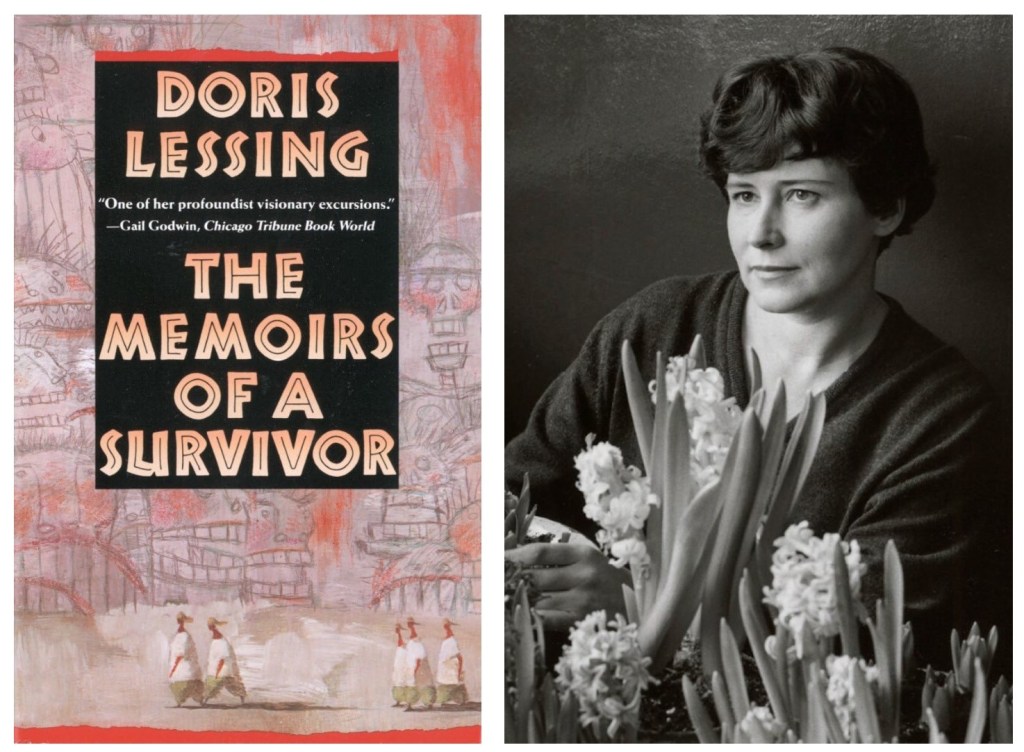
What would it be like to experience living through an emerging apocalyptic crisis? Forget about sinister aliens conquering the Earth, or silly zombie invasions, or even biker gangs running around in their skimpy S&M outfits. No, what would it be like if civilization collapsed, and you had to live in an emerging dark age? Reading The Memoirs of a Survivor by Doris Lessing will make you think about it.
It’s what the English call a cozy catastrophe. An unspecified crisis happens, and England slowly unravels. An unnamed narrator, of unspecified gender writes in their memoir about living through such an event. They eventually take in a twelve-year-old girl named Emily, and her pet named Hugo. Hugo is sometimes described as looking like a cat or dog, and it sometimes purrs and other times whimpers. Lessing likes to explore both gender and species identity.
The memoirs narrate two story threads. The more interesting of the two involves the narrator watching society fall apart while Emily grows up. The second thread is episodes in the narrator’s fantasy life, which might be called exploring inner space. This is a science fiction novel that was published in 1974, when Ursula K. Le Guin was becoming famous as a women science fiction writer. Lessing’s style is much different from other women writing science fiction in the 1970s. Imagine Virginia Woolf writing a post-apocalyptic novel.
Doris Lessing (1919-2013) was a British novelist who won the Nobel Prize for Literature in 2007. She also wrote several science-fiction novels, including the five-volume Canopus in Argos (1979-1983) series as well as The Memoirs of a Survivor. She was most famous for her novel The Golden Notebook (1962), which is considered a story of inner space written at the dawn of exploring outer space. Lessing was born in what’s now called Iran and grew up in what was called Rhodesia. She moved to England as a young woman, becoming a writer, and radical.
Lessing’s birth was one year before Isaac Asimov’s, so if she had been considered a science fiction writer, she would have been among the Heinlein-Clarke-Asimov generation. However, her science fiction reminds me of the Ballard-Brunner-Aldiss generation. The Memoirs of a Survivor came out in the era of the best-selling nonfiction books about threats to civilization: The Limits of Growth, The Population Bomb, Future Shock. Those same books inspired John Brunner’s novels Stand on Zanzibar, The Jagged Orbit, The Sheep Look Up, and The Shockwave Rider. The 1970s felt like a pre-apocalyptic time, like our 2020s.
The Memoirs of a Survivor is a very British post-apocalyptic novel, far cozier than American novels covering the same theme. American male writers like to imagine life after the apocalypse as a new wild west. American female writers picture things a good less violent but acknowledge our violent heritage. British writers of both genders often write about characters getting along after the collapse. Their novels do have violence, but it’s not all kill-or-be-kill. The Memoir of a Survivor has a small amount of violence, even some guns, but it’s very minimal.
The setting is a city where the lights and water still work, but the economy is coming undone, and refugees from other parts of the country that have totally collapsed, are streaming through on their way north. The unnamed narrator, presumably an older woman because of how she characterizes people and things, watches the slow unfolding of the collapse from her window. The story become more interesting when a man abandons Emily and Hugo to her care.
Lessing is rather ambiguous in The Memoirs of a Survivor. The gender of the narrator isn’t clear, but the narrator’s personality feels like an old woman. Emily is quite well-defined by the narrator, who spends most of her time observing her and Hugo. Lessing had taken in a young adolescent girl, Jenny Diski, for a while in her life, and I assume much of the novel comes from that experience. Although, Lessing had three children of her own, so she had plenty of experience observing children growing up.
There are two parallel stories within the novel. The one I liked best was about Emily, her growth, and her fascination with the hordes of young people streaming through the city. In the other thread, the narrator stares at a wall, and fantasizes about exploring other apartments in the city, where she cleans, repairs, and paints. Lessing has said this is an autobiography of dreams. I felt it was a metaphor for repairing society because the narrator is always trying to renovate the rooms. However, these fantasies are important for the ending.
What’s beautiful about The Memoirs of a Survivor is it describes the early days of an apocalypse. Young people are on the move, anxious to build a new society, while older people huddle in their houses and apartments, trying to maintain and remember the old society. Since I feel we’re in the early years of a slow decline, The Memoirs of a Survivor is an interesting read for our times. Sadly, this book isn’t well known. There’s no ebook or audiobook edition, although it’s still available in trade paper. I looked everywhere for an audiobook edition because the writing is lovely and serene. I wanted to hear this story, rather than read it because I prefer listening to literary writing.
The growth and transformation of Emily is described in psychological detail that is realistic for most young girls of any time. When Emily first saw the refugees, she desperately wanted to join them but felt rebuffed. She decided to make her own clothes, which the narrator and I felt was a way of creating her own identity. At first, her outfits sounded like something Stevie Nicks would have designed for the bedroom, witchy lingerie, but Emily never even wore them outside. Next, her designs seemed like Madonna’s outfits from the early 1980s. Finally, Emily designed something close to punk and grunge. Remember, this novel was written in the early seventies.
The story is noticeably quiet, and the details of Emily’s relationship with her pet, Hugo, are heart wrenching. Emily wants to run away with the young people but can’t go because she knows they will eat Hugo. Obviously, Hugo is her emotional anchor after losing her parents, but she’s moving into the boy-crazy years. Emily, and many of the city girls fall in love with the various young men who are the leaders of the various roving bands, and these young men take advantage of their attractive powers to create harems of little adoring girls. I wonder if that’s how things were in our cave dwelling days — all the young women wanting the alpha male.
Like I said, The Memoirs of a Survivor is not a Mad Max post-apocalypse. Lessing tells us some people have guns, but guns aren’t part of the story. When you read this story it’s not hard to think about people living in Haiti or Sudan, or the many other countries in the world with failing economies, decaying infrastructures, gangs, which send out hordes of refugees into countries with more civilization.
This novel will make you think about what you would do if things fell apart. What if the electricity stopped working and water stopped flowing from your taps? What would you do? Would you join a group marching north to better economies? Or would you hunker down, learning to live with less, giving up money to barter, accepting violence and mob rule? Would you learn how to grow food and make things?
The Memoirs of a Survivor is like Earth Abides by George R. Stewart in that it assumes the young will quickly invent new ways out of the old, while the youngest children, who were never educated, will become feral. Gerald, a young leader whom Emily loves, does everything he can to save these feral children. What would you do with them? Ish, in Earth Abides, had a tremendous insight into their future survival, but I think Lessing’s take was more cynical, and maybe realistic.
I doubt current generations of science fiction readers will find this novel very appealing. I think it’s becoming a forgotten novel. And I tend to feel Lessing is becoming a forgotten writer, even though her name continues to show up now and then, such as this recent piece “10 of the best Booker Prize-nominated books with a political slant” that includes Lessing’s novel, The Good Terrorist.
I would have rated The Memoirs of a Survivor 5-stars if it had only been about Emily and the collapse. The inner space sequences dragged the story down. However, if I reread this book in the future I might like those part better. For now, 4-stars.
Rereading “Flight to Forever” made me realize something about the core of my personality. There are a limited number of science fictional ideas that I resonate with that I like to regularly recall.
I consider “The Time Machine” the epitome of science fiction because it explored so many new science fiction themes. New to me at age twelve, and maybe new to the world in 1895. Poul Anderson’s “Flight to Forever” recalls many of those same ideas. “Flight to Forever” was first published in Super Science Stories, the November 1950 issue. You can read it here, or listen here. I first read it in Year’s Best Science Fiction Novels: 1952 edited by Bleiler and Dikty. I just read it in The Last Man on Earth edited by Asimov, Greenberg, and Waugh. Here’s a listing of other reprintings.
“Flight to Forever” also reminds me of Last and First Men by Olaf Stapledon and Tau Zero, also by Poul Anderson. The writing style, pace, and plotting feels like science fiction from the 1930s. I’m trying to give you enough hints to get you to go read the story before I give spoilers. This cover might also entice you to go read it too, especially if you discovered science fiction before Star Trek.
While reading “Flight to Forever” I kept thinking how it contained several scenes that inspired the kind of sense of wonder I loved experiencing as an adolescent when I first started reading science fiction. I know as an adult that all those mind-blowing concepts are completely unrealistic, just complete bullshit fantasy, but I still love encountering them over and over. Why?
Am I a 72-year-old kid still being enchanted by fairy tales? I like to think of myself as finally growing up and accepting reality for what it is, but I keep retreating into science fiction. Why? Could a good psychiatrist explain the psychology to me? Is it a neurosis? I will admit that science fiction was a coping mechanism for a turbulent adolescence in the 1960s, and maybe it helps me escape the constant chaos in the news of 2020s. Still, that doesn’t explain the specific appeal of science fiction and the way this story triggers my endorphins.
The story begins with Martin Saunders and Sam McPherson setting off in a time machine to travel one hundred years into the future to see why their automatic test time machines haven’t returned. Martin assures his lovely girlfriend Eve Lang that he will return quickly.
Having one’s own time machine is a wonderful fantasy, especially if it’s one you built yourself in your home laboratory. That’s why “The Time Machine” was so appealing. As a kid, I wanted to be Danny Dunn and have access to wonderful time machines and spaceships. It’s why Back to the Future was so much fun in the 1980s even though I was an adult.
Martin and Sam arrive one hundred years into the future without a problem, but when they try to return to their own time, they discover it takes ever more energy to go back in time. They eventually calculate that the amount of energy needed approaches infinity around the seventy-year mark. Poul Anderson has imagined a natural way for time to protect itself from paradoxes. It’s a neat idea.
Martin and Sam decide to head further into the future to see if they can find a time when scientists might know how to break through the going back in time barrier. This is where the story parallels Wells’ unnamed time traveler, stopping now and then to see how society and mankind has changed. This portion of the story also reminds me of Stapledon’s Last and First Men and many science fiction stories about speculated societies.
Sam is soon killed off, so Martin becomes a lone time traveler hoping to find his way back to his beautiful Eve. He acquires another companion, Belgotai, a mercenary from the year 3000 AD. Together they keep going further and further into the future, meeting society after society. They encounter humans that colonize the galaxy, and aliens that conquer Earth. This gives Anderson a chance to dazzle the reader with all kinds of science fictional speculation.
Eventually, Martin and Belgotai join a deposed monarch fighting a renegade galactic empire. That’s when the story becomes an epic space opera. Martin falls for a regal redhead, Empress Taurey. You’d think Martin will settle here, but Anderson has many other adventures for Martin to experience before the story ends. Martin goes further into the future than the time traveler in Wells’ classic story. Like that story, “Flight to Forever” could be considered a dying Earth tale, and it becomes a last man on Earth story too.
I got the feeling Anderson wanted to include every science fictional cliche he could cram into “Flight to Forever.” I won’t tell you anymore. It’s not an exceptional story, but it is appealing. I must wonder if Anderson wasn’t trying to understand the underlying siren song of science fiction when he wrote this story. Of course, he sold it to a cheap market, so he could have been just hacking out a quick novella to thrill kids and pay his rent.
Reading “Flight to Forever” made me wonder if I could collect a small set of stories that pushed all my sense-of-wonder buttons and just reread them whenever I needed therapy. Sort of like what Kip’s father does in Have Space Suit-Will Travel by always rereading Three Men in a Boat by Jerome K. Jerome. I could create a highly distilled tincture of science fiction to consume when needed, sort of like the playlist of my all-time favorite songs on Spotify.
If I did create a playlist of favorite science fiction stories, would I include “Flight to Forever?” I guess not, because I would keep “The Time Machine” instead. That suggests something to me. Haven’t I been reading one science fiction story after another my whole life just to push the same buttons again? Shouldn’t I explore other stimuli to discover other buttons?
“Flight to Forever” is a nice reminder that certain concepts within my brain like to be remembered, at least every now and then. I’m finding a lot of them in the anthology, The Last Man on Earth. It’s amusing to think about, but I have six large bookcases of science fiction that I could probably reduce to a handful of anthologies that would trigger every type of sense of wonder science fiction ever discovered.
I had a friend that died back in the 1990s. Before he died, he lost interest in the many things he cared about over his lifetime. They went one by one, until he only had two loves left, Benny Goodman and Duane Allman. I call this The Williamson Effect. At 72, I feel I’m in the beginning stages of The Williamson Effect. I’m starting to shed interests. I have a long way to go because I’ve collected an exceedingly long list of interests over my lifetime. I don’t count science fiction as just one interest. Rereading “Flight to Forever” made me see science fiction really is many interests, although a finite set.
“Small World” by William F. Nolan #15 of 20 (Read, Listen)
I’ve always loved post-apocalyptic novels about the last man on Earth, or at least, the last few people on Earth. I’m not saying I want everyone else to die, but if flying saucers hauled y’all all away, I wouldn’t complain. Ever since I was a kid, the thought of being the only kid in a deserted city was a fun fantasy for fueling daydreaming. The idea that I could roam around and survive by plundering anything I needed from abandoned stores and houses was deliciously appealing. I bet Henry Bemis implanted this idea in me via the 1959 episode of The Twilight Zone, when I was eight.
William F. Nolan imagines a man named Lewis Stillman left alone in Los Angeles after aliens invade in the August 1957 issue of Fantastic Universe. I remember when I first read this story I was genuinely surprised by the ending. If you don’t want me to spoil it, follow your chosen link above before reading any more of this essay.
In 1967 Harlan Ellison edited Dangerous Visions because he claimed science fiction writers couldn’t get certain kinds of science fiction stories published. I call bullshit on that idea. I think his hypothesis was wrong. Nolan produces a nice little gritty dangerous vision in “Small World” in 1957. Of course, he had to write a few thousand words of character development and setting to entertain us before he could pop the surprise.
Stillman hides out in the storm drains of Los Angeles avoiding the invaders. He only comes out at night, and has collected a nice arsenal of weapons, but he survives by going unnoticed. There have been several movies that used those famous storm drains, so I imagined scenes from Them as I read the story.
One night Stillman fondly recalls a three-volume set of medical textbooks that belonged to his father. Stillman had gone to medical school in southern California but had dropped out to become a laborer and work with his hands. Sitting alone in his hideaway, he remembered seeing those books at a used bookstore and decided he wanted to see them again. That night he arms himself and heads out. He finds the books, but they find him.
He was attacked not by aliens, but by children. The aliens had killed everyone over the age of six, so they cities were swarming with feral children. Picture Lord of the Flies. And the children would kill any surviving adult they could find. All along, Nolan had us believing Stillman was hiding from little green men, but he was really hiding from hordes of rugrats.
In the end Stillman starts shooting the tykes to get away. I pictured him blowing away Jerry Mathers, and little Billy Mumy and Angela Cartwright, as well as Jay North. Of course, I would have been the right age too in 1957 if I had lived in LA. Eventually, the children overwhelm Stillman and I assume he was torn apart. But he must have killed a pile of youngsters before they got him.
I wonder why Nolan wrote this story. It’s sick if you think about it, especially since I read it the first time after Sandy Hook. Was he just trying to gross us out? Or did Nolan secretly hate kids? Lord of the Flies came out in 1954, and that could have inspired him. The 1950s was full of public fear regarding juvenile delinquents, so maybe the story was symbolic. And the age group also applied to the early Baby Boomers, so maybe Nolan was trying to be prophetic.
Yes, Ellison was wrong. Science fiction writers often got dangerous visions published. Two of my favorites were “Lot” by Ward Moore, and “The Last Day” by Richard Matheson, both from 1954.
Also from 1954 was “The Good Life” by Jerome Bixby. Maybe it inspired “Small World.” I’ve always found that story too creepy, maybe Nolan was providing us psychological release for that story.
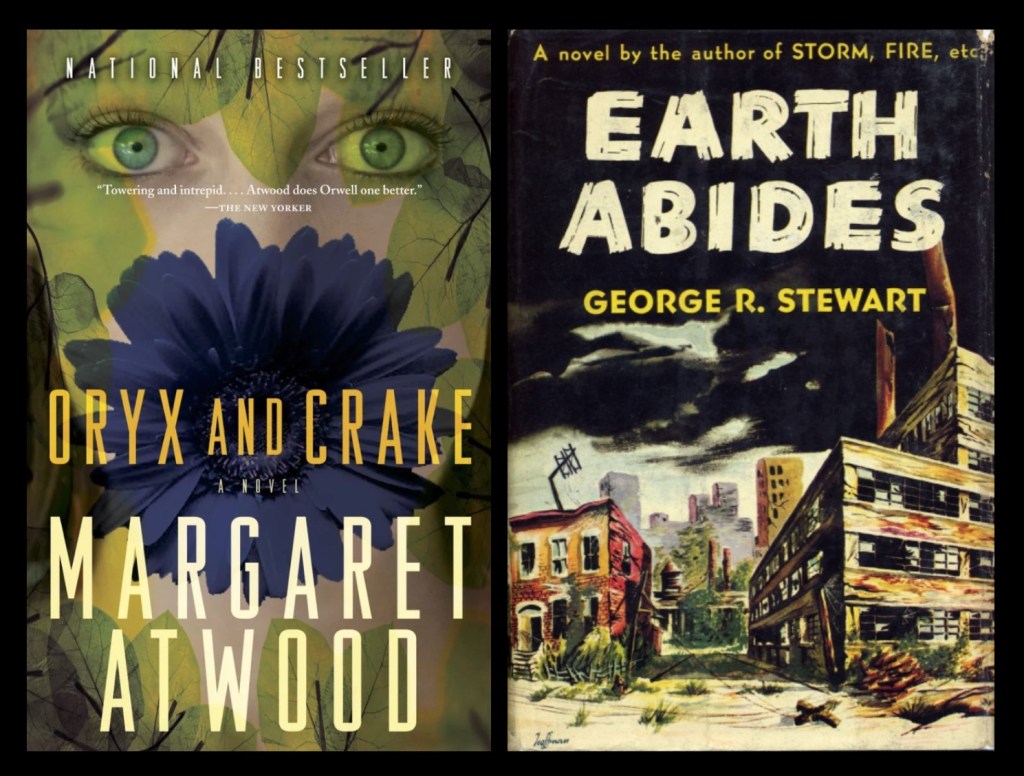
Oryx and Crake by Margaret Atwood is a postapocalyptic novel about humanity being assassinated by a mad genetic engineer. Although well-written and thought-provoking it wasn’t a pleasant read. I doubt any science fiction fan would vicariously put themselves into Atwood’s imagined future. Its narrator, a human survivor nicknamed Snowman, is a rather repulsive individual. This novel might be intellectually stimulating, especially for its thoughts on the evilness of humanity, but it’s not a novel that promises hope for rebuilding the future.
As a young reader of science fiction back in the 1960s, I used to fantasize about what I’d do if I lived in the books I read. Even 1950s post-apocalyptic novels about WWIII left room for me to see positive paths to take. Oryx and Crake was as bleak to me as Cormac McCarthy’s The Road. I admired that novel, but I would never daydream myself into it.
The blurb on the cover above praises Atwood for outdoing Orwell, but not by me. Nineteen Eighty-Four was bleak and depressing, but it was infinitely instructional about avoiding possible futures. Oryx and Crake feels like an oracle of doom. But then I haven’t read Nineteen Eighty-Four in a couple of decades, and at 72 I might find it just as nihilistic as Oryx and Crake.
I’m a connoisseur of after the collapse settings in science fiction. My all-time favorite is Earth Abides by George R. Stewart. In that story, almost everyone dies from an illness and the world reverts to a time when humans are few, becoming hunters and gatherers again.
I’m not saying I’d like to live a tribal existence. No, the postapocalyptic world I’d like to live in, is just after the collapse, where the infrastructure of humanity is still intact. I’d want enough leftover supplies to keep me going for the rest of my life, which might not be more than a decade. When I was younger, the idea of rebuilding civilization appealed to me, but I’m too old for that anymore. But if I were in my twenties, would I fantasize about surviving Atwood’s future?
No, old me would want to live in a nicer post-apocalypse to contemplate the end of our species. In Atwood’s book, she has Snowman contemplating his own fucked up life, while he caretakes a genetically engineered new form of humanity. Atwood imagines our replacements as genetically engineered non-violent humanoid beings called Crakers. These post-humans have a reproductive cycle that removes gender conflict and are peaceful herbivores. I can’t imagine these wimpy creatures surviving the highly aggressive genetically modified animals created in the years before humanity was snuffed out.
In Oryx and Crake Homo sapiens are defined by our worse traits. We deserve our fate in Atwood’s story. And I wouldn’t argue with Atwood. But Atwood’s philosophy makes for a bleak depressing read. The novel has two sequels: The Year of the Flood (2009) and MaddAdam (2013). Even though I was bummed out reading Oryx and Crake, I’m tempted to read the rest of the trilogy just to see if Atwood ever offers her readers hope. I have read that the second volume is about religious people, and that was a frequent theme in 1950s postapocalyptic novels. That tempts me.
Oryx and Crake has got me thinking about the appeal of reading postapocalyptic novels. Why are postapocalyptic settings with zombies so popular with readers today? I’ve never been one to enjoy horror themes. And zombies are so damn yucky. Why would anyone find pleasure putting themselves into such a setting? I must wonder if fans of these stories secretly want to live in a world where they could kill, kill, kill to their heart’s content.
I’m more of a Henry Bemis type myself. I want a nice cozy catastrophe postapocalyptic setting. A peaceful place to meditate on the passing of human existence. When I was younger, I fantasized about playing Tarzan and Jane after the fall of civilization, but now that I’m older, having a faithful dog and robot would be the only companions I’d want. I’d desire a Clifford Simak flavored setting if I were the last man on Earth.
I’m trying not to say end of the world. I dislike that phrase. Humans are so arrogant. They believe when our time is up it’s the end of the world. I think Earth will bop along simply fine without us. Animals and plants would flourish again. The Earth would again teem with life. I can only assume self-aware intelligence was an experiment that failed. Let the robots have the next turn. They might be more compassionate to the animals.
I often write about the difference between old science fiction and new science fiction. In old science fiction we do ourselves in because we’re the stupid violent bastards we are, but there’s not a lot of self-recrimination. In the new science fiction, writers dwell on our evilness. In Atwood’s book, we see two boys, Jimmy (Snowman) and Glenn (Crake), grow up and snuff out humanity. Their formative years were spent watching porn, snuff films, child pornography, playing sick violent video games — just being a couple of gifted brainiacs. They are super intelligent, yet soulless and unlikeable. Jimmy and Glenn use their genius to create and sell ugly products to a world all too anxious to consume them. Sure, that reflects our real world, but does experiencing such in fiction do us any good? Will readers in the future cite Oryx and Crake warnings about genetic engineering? It lacks the symbolism or political resonance of The Handmaid’s Tale.
Atwood’s The Handmaid’s Tale is about another ugly future, but its ugliness offers us inspiration on how to avoid that future? I assume she intended Oryx and Crake to be positive in the same way, but it isn’t. The Handmaid’s Tale inspires us to fix society. Oryx and Crake only make me want to pull the plug on our species.
In most old science fiction novels about after-the-collapse of civilization, we’re shown ideas for starting over. Sure, some of those novels tell us we’re only going to make the same mistakes again, but there is a will to try again. Some of those stories even suggested it might be possible to take different paths. Reading Oryx and Crake left me feeling it’s time to just let go. Let some other species become the crown of creation.
Maybe Atwood put hope in the sequels, so we’d buy them.
Is my pessimism due to my age? Do younger readers find hope in this novel?
How do literary scholars of Philip K. Dick’s fiction determine which of his novels are masterpieces and which are his hackwork? They all seem equally bizarre, and even confusing. Library of America selected four novels for their first volume in 2007 devoted to PKD. The years given are when they were (written, published).
The Man in the High Castle (1961,1962)
The Three Stigmata of Palmer Eldritch (1964,1965)
Do Androids Dream of Electric Sheep? (1966, 1968)
Ubik (1966, 1969)
The second volume came out in 2008 recognized:
The Martian Time-Slip (1962, 1964)
Dr. Bloodmoney (1963, 1965)
Now Wait for Last Year (1963, 1966)
Flow My Tears, the Policeman Said (1970, 1974)
A Scanner Darkly (1973, 1977)
The third volume in 2009 highlighted:
A Maze of Death (1968, 1970)
VALIS (1978, 1981)
The Divine Invasion (1980, 1981)
The Transmigration of Timothy Archer (1981, 1982)
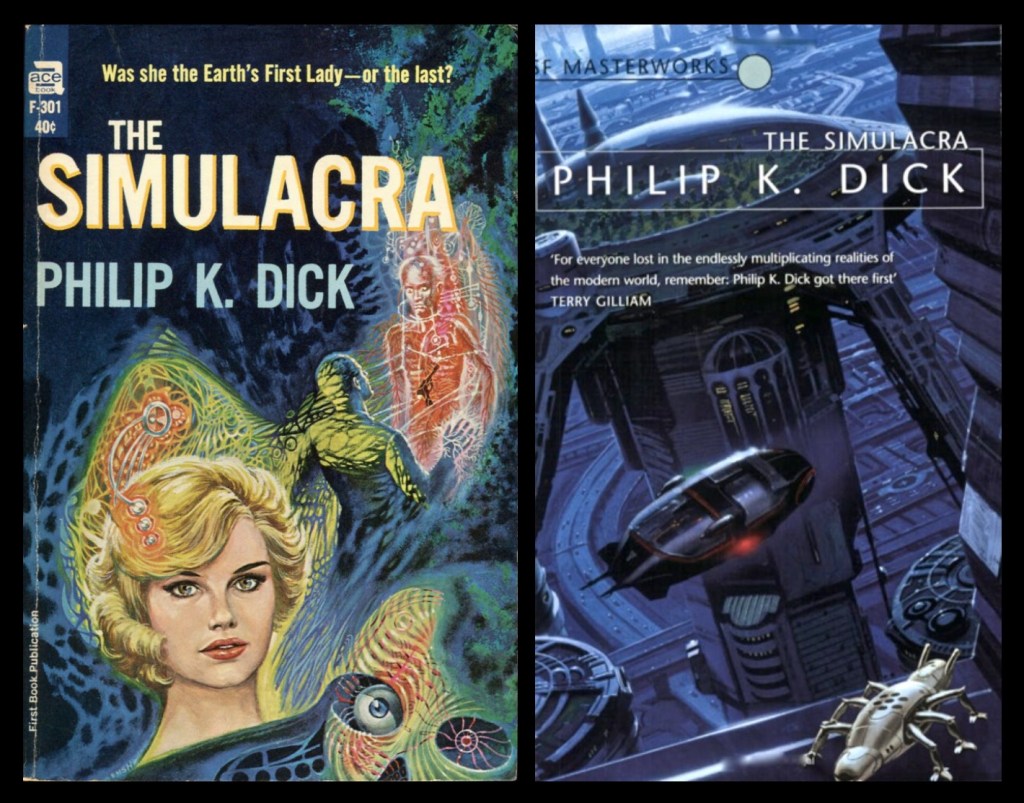
Are we to assume these are Dick’s best novels? My personal favorite, Confessions of a Crap Artist wasn’t included. Neither was The Simulacra which I just read and found fascinating and fun. I think some of the Library of America selections are better than The Simulacra, such as The Man in the High Castle, The Martian Time-Slip, and VALIS, but I’d also claim The Simulacra is not a lesser novel to the others. However, using our citation database system, it gets only one citation. Twelve of the twenty-seven PKD novels in our database only got one citation. The novels in the first LOA volume received 9 to 32 citations, which supports the LOA editors.
The only reason The Simulacra received one citation is because it was part of the SF Masterworks series. All the science fiction magazine reviewers ignored it when it came out. As far as I can tell, none of the reprint editions got reviewed either. The Simulacra just isn’t well-known. It’s often disliked when I see it mentioned.
I liked it. And I want to make a case that it’s worth reading. However, it will be hard to even describe. I’m afraid most readers will be turned off by The Simulacra because it has multiple plot lines with over a dozen main characters. And I can imagine many readers calling it stupid too — but that could be true for a lot of readers coming to PKD work. However, if two of the five novels Dick wrote in 1963 made it into the Library of America, why shouldn’t the other three? What divides them? What makes one novel “good” and another “bad?”
The Simulacra‘s complexity might keep readers from liking it, but that complexity might hide many novelistic virtues. Just because I admired this novel, doesn’t mean others will. I’m writing this essay hoping people will read The Simulacra and give me their opinion. I’m curious if I’m a total outlier. I got a big kick out of the story.
According to Samuel Johnson, “No man but a blockhead ever wrote, except for money.” Dick complained in several 1963 letters found in The Selected Letters of Philip K. Dick: Volume One: 1938-1971, that his wife Anne constantly hounded him to make more money. On the other hand, Dick wrote eleven literary (non-genre) novels from 1952-1960 hoping to become a recognized mainstream writer. All were rejected. He then wrote The Man in the High Castle in 1961 which bridges the literary and science fiction world and won a Hugo award for best novel. Dick then wrote twenty-one science fiction novels from 1962 to 1969, five of them in 1963 alone. He obviously needed money and had to crank out the manuscripts.
After 1970, Dick only published six more novels before he died in 1982. Five of which are included in the Library of America editions. That suggests that the novels he took more time writing fared better with the critics. So, the five novels written in 1963 were among the fastest he wrote, suggesting they shouldn’t be as good. Yet, two were selected for the Library of America.
As much as I like The Simulacra, I do see that it’s flawed. It doesn’t have a main character which most readers prefer. Nor does it jump back and forth between two main characters, which can be quite successful with some readers. And it’s not even one of those experimental stories where we follow several unrelated characters that all come together in the end. Readers find that structure confusing but forgive it if the ending brings everyone together in a satisfying way. I’m not sure The Simulacra wraps up nicely.
We might call the plotting of The Simulacra an example of characters doing parallel play. Dick might have aimed for creating a collage of future American scenes. My guess is Dick banged away on his typewriter, vomiting up The Simulacra onto typing paper. The results are fascinating because the novel is one big pile of imagery from PKD unconscious mind — and what a mind! It begs to be psychoanalyzed. And I’m sure, it parallels his personal life, especially regarding insanity, psychoanalysis, and troubling wives and women.
The Simulacra is not satire even though it often feels like the film Dr. Strangelove, nor is it a fantasy even though everything is unbelievable. And I wouldn’t call it surreal or dreamlike, or avant-garde even though it was written in 1963 when trendy artists were creating pop art and post-modern fiction. It’s straight science fiction, meant to be taken as realistic, even though it’s bonkers. The Simulacra has the existential absurd horror of The Tin Drum or The Painted Bird. I don’t even think Dick was making fun of science fiction with its comic book level wild ideas. Dick had crazy ideas, and he saw the world being just as crazy.
The Simulacra pictures future America where psychic abilities are accepted as real, that time travel has been perfected, where people and animals can be artificially created and the results indistinguishable from real people and animals, that colonies exist on Mars and the Moon, and alien lifeforms can be commercialized. In other words, all the crap ideas that science fiction fans and fans of the occult believed in the 1950s. Everything they thought possible, became possible.
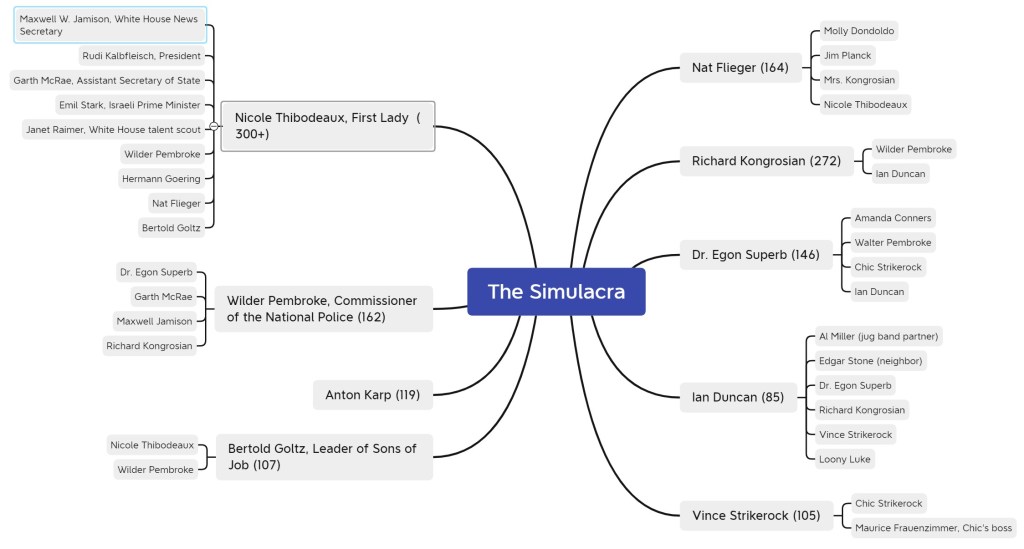
The hardest part of this essay is describing what happens in The Simulacra. I wrote about that trouble already for my Auxiliary Memory blog, where I explained I had to read the book and listen to the audiobook to get the most out of The Simulacra. In fact, I’m still picking up the book, or putting on the audiobook, and enjoying random parts of the novel. I can’t seem to leave this story. I’m still finding new insights into whatever scene I stumble upon. I’ve decided the best way to describe the story is by mind mapping the characters. The number given is the number of times the character is mentioned in the story.
I’m trying not to give away too much of the plot. Each of the first level characters involves a subplot. For example, Dr. Egon Superb is the last legally practicing psychiatrist after the pharmaceutical industry pushed through the McPhearson Act that made drug therapy the only legal form of treatment for mental illness. One of his patients is Richard Kongrosian, a psychic pianist who uses telekinesis to play the piano instead of using his hands. Nat Flieger is a sound engineer who wants to record Kongrosian, but he and his crew of Molly Dondoldo and Jim Planck can never track down the man. Ian Duncan and his old friend Al Miller want to perform classical music as a jug band at the White House for Nicole Thibodeaux. Nicole Thibodeaux, the First Lady, but maybe the true ruler of The United States of Europe and America (USEA) wants to negotiate with Hermann Goering via a time machine to get the Nazis to not kill the Jews. Vince and Chic get involve with making the next president, an android, which will replace Nicole’s current husband. Wilder Pembroke, Anton Karp, and Bertold Goltz all vie for power behind the scenes.
If the novel has a main character, it could be Nicole Thibodeaux. Dick’s original draft was called The First Lady of Earth. Since this book was written in the summer of 1963, I assume Dick was inspired by Jackie Kennedy because Nicole spends most of her time charming people, decorating the White House and gardens, and putting on nightly cultural events. Everyone loves Nicole. Yet, out of the public eye, Nicole is also ruthless enough to have people summarily executed. Evidently, she wields unlimited power because of her access to time travel.
The novel is set in a post-apocalyptic future, decades after China attacked the U.S. with missiles with atomic warheads. This gave rise to a population of mutants, similar in appearance to Neanderthals. People ride in self-driving cars. Ads are living creatures that can invade your home and car and must be killed. Richard Kongrosian believes he has a terrible body odor because a deodorant ad infected him with a jingle. The Sons of Job are a neo-fascist political party. People live in giant communal apartment complexes and are required to take civics tests to stay in them. Many people want to escape this totalitarian society by immigrating to Mars. People buy android nuclear families just to have normal friends.
I could go on. There are several layers of political and corporate intrigue in The Simulacra. Dick evidently thought there were conspiracies everywhere. Later in life, Dick would get into Gnostic religion, which is a very paranoid belief system. This novel has many traits of Gnosticism. The Simulacra was written after The Man in the High Castle, We Can Build You, Dr. Bloodmoney, and The Martian Time-Slip, and before The Three Stigmata of Palmer Eldritch and Do Androids Dream of Electric Sheep? There are many similar themes and obsessive ideas that run through all of them. I wish I had the time and energy to study all those novels and plot all the connections. Why did PKD fixate on certain ideas repeatedly? Was it a lack of imagination to explore unfamiliar territory, or were they ideas PKD just could let go of?







 Classics of Science Fiction