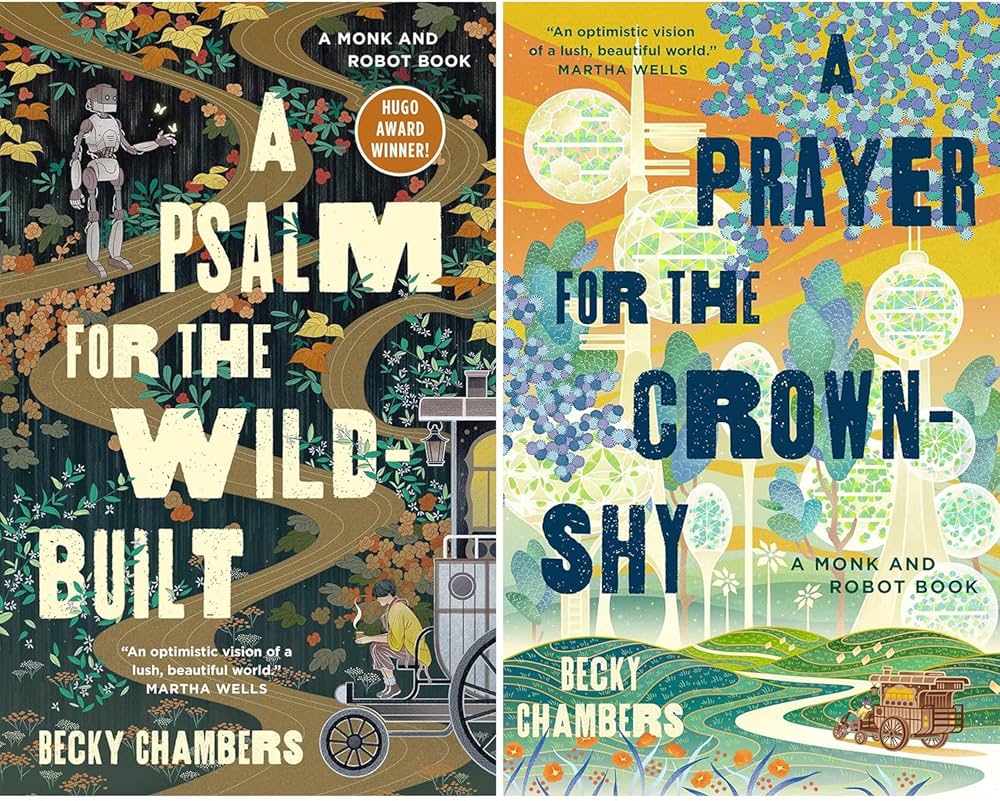
Can science fiction writers imagine a pleasant future for us? Becky Chambers creates a kindly society in her Monk and Robot duology that is very appealing. Unfortunately, at least for me, the story is set on an imaginary moon called Panga. I would have preferred to contemplate whether such a future is possible for us, here on Earth.
I discovered A Psalm for the Wild-Built by Becky Chambers while searching Google for the best science fiction books of the last decade. I had just finished the literary science fiction novel Anniebot by Sierra Greer and wanted a recent genre science fiction novel to follow up. I’ve been wanting to catch up on what’s been happening in science fiction over the last decade. My science fiction reading tends to focus on 20th-century SF, and I wanted to read 21st-century SF instead.
A Psalm for the Wild-Built was a fortunate choice because it tuned me onto an emerging wavelength of science fiction I hadn’t explored. It is both a hopepunk and a solarpunk novel. Essentially, these movements are about positive futures, especially ones based on sustainable ecological economics.
I decided to buy the audiobook of A Psalm for the Wild-Built when I read that it was about a time long after robots had become sentient and chose to leave civilization and live in the wilds of nature. That was an intriguing premise. I had tried to read Becky Chambers’ most famous novel, The Long Way to a Small, Angry Planet, but had given up because it was too bland for me. All the characters were too nice. Reading it made me wonder if fiction needed some asshole characters to be exciting. That made me hesitant to try A Psalm for the Wild-Built.
It turns out everyone is also nice in the Monk and Robot books, too. However, this time I didn’t miss a good antagonist. The story is very gentle, almost childlike. Modern YA novels are full of dark edginess, so these books don’t even feel YA. However, there is language that’s not suitable for young children
The book’s dedication is to “For anybody who could use a break.” Even though Chambers describes a gentle, pleasant, kind, liberal utopia, Sibling Dex is a dissatisfied young man. This novel is really about asking: “What do I want to do?” My guess is that Chambers is appealing to young people who are uncertain about our future.
The book opens with a quote from Brother Gil’s From the Brink: A Spiritual Retrospect on the Factory Age and Earth Transition Era.
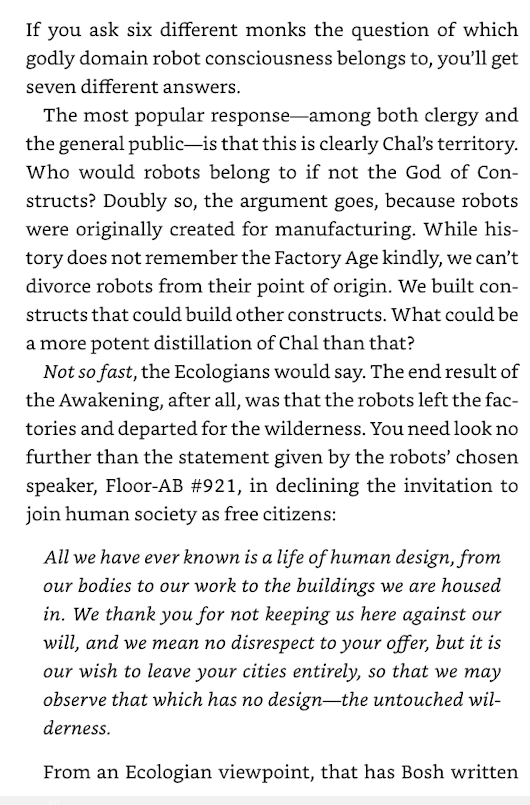
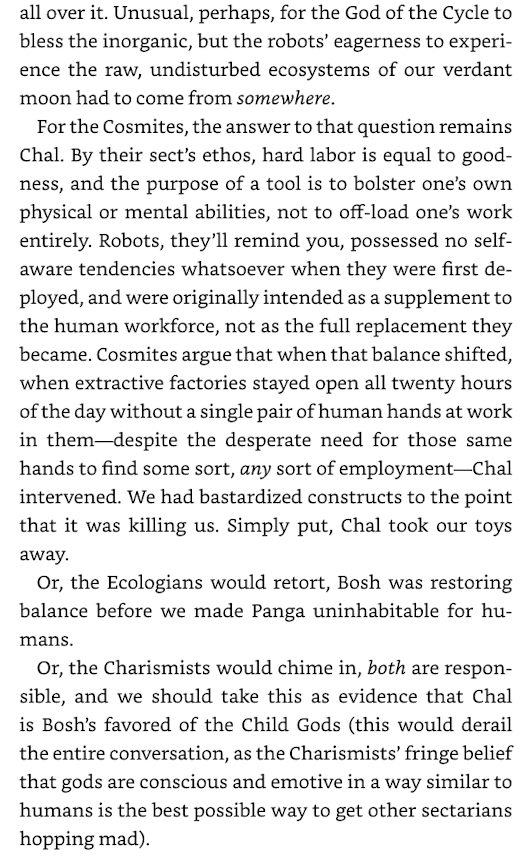
I liked this opening a lot. Not only has Chambers imagined a sustainable society, but made it polytheistic. Panga feels Buddhist and tribal.
The story tells us about a restless young man, Dex, who chooses to become a Tea Monk. This is a person who travels from town to town serving tea and listening to people share their worries. This allows the readers to learn about Panga and its different human societies. Eventually, Dex goes into the wild territories of the robots and meets Mosscap. Mosscap is on its own mission to explore, deciding it needs to learn about humans.
Robots have become nature lovers. Humans and robots have spent two hundred years apart, and now they are a mystery to each other. Chambers uses the conversations between Dex and Mosscap as philosophical jumping-off points. These two novellas, which are really one story, are gently philosophical in intent. It never gets too deep or academic.
Dex struggles to find his purpose, and Mosscap becomes his guru. And Dex becomes Mosscap’s tour guide, teaching him about humans and our society. It’s a nice setup. These two books are a pleasant read. The vibe of this story reminded me of the film The Wild Robot. In other ways, the story reminded me of the Oz books by L. Frank Baum.
However, I think I need to give a trigger warning to Republican readers. Dex is a non-binary person Chambers refers to with they/them pronouns. If you have hangups about DEI issues, this book might not be for you.
Yesterday, I discovered a video featuring Becky Chambers and Annalee Newitz entitled Resisting Dystopia. I understand their intent, but I dislike it when all unpleasant societies in fiction are called dystopian. To me, dystopias are failed utopias.
The Handmaid’s Tale is an excellent example of a dystopian novel. The leaders of the Republic of Gilead work to build their vision of perfection, but to many living in Gilead, it is a dystopia. America in the 21st century and its future could be seen as a dystopia by the broad definition that Chambers and Newitz use. Any fictional description of Earth, under a collapsing ecosystem, could be considered a dystopia by the broad definition of the term. However, I prefer to define the term more narrowly. If the Christian Right made America into a theocracy, it would become a dystopia. It’s only when one group of people intentionally shapes a society to fit an ideal that we get a dystopia. That’s how I see resisting utopia.
Panga is not a utopia. I don’t see science fiction about positive futures as anti-dystopian. Nor do I see stories about dark futures as dystopian. The world pictured in Blade Runner is not dystopian. It’s just complex and Darwinian, like life on Earth in the 21st century.
I think it’s great that young science fiction writers like Chambers and Newitz want to imagine positive futures. However, any robust society capable of long-term survival will have countless conflicts and stresses. If you’ve read Antifragile by Nassim Nicholas Taleb, you should be familiar with the concept of antifragility. Evolution needs grist for its mill.
The Robot and Monk books are nice, pleasant reads. Subgenres of science fiction, such as hopepunk and solarpunk, are appealing, but ultimately not realistic. Science fiction has always tended to be escapistic. I hope resisting dystopia isn’t just hiding out.
The science fiction novels I loved reading sixty years ago promised a positive future exploring space, but that’s not the future I find myself living in now. It was novels like Stand on Zanzibar by John Brunner that better prepared me for these times.
If you want to resist dystopia, whether just a bleak future or a failed utopia, getting comfortable will undermine your goal.
James Wallace Harris, 11/18/25

 Classics of Science Fiction