“Loneliness Universe” by Eugenia Triantafyllou

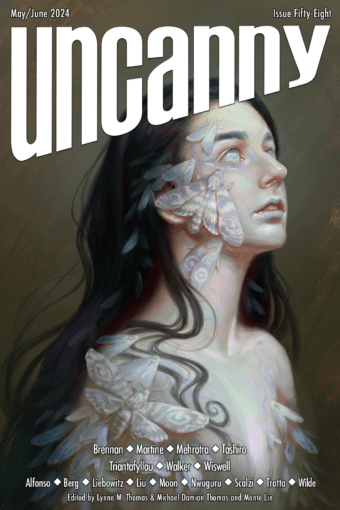
“Loneliness Universe” by Eugenia Triantafyllou appeared in Uncanny (#58, May/June 2024) and is a finalist for the 2025 Hugo Award in the Best Novelette category. You can read or listen to the story online. If you are a member of the 2025 Seattle Worldcon, you can vote for this story through July 23, 2025.

I first learned about the Hugo Awards back in the 1960s. I never attended a Worldcon but always wanted to. I did attend some regional conventions back in the 1970s. I kept up with the Hugo and Nebula awards for most of the 20th century, but slowly lost touch with science fiction and fandom in the 21st century. I discovered “Loneliness Universe” when I read Austin Beeman’s “Reviewing the 2025 Hugo Award Finalists: Best Novelettes” at his website www.shortsf.com.

I’m so impressed with “Loneliness Universe” that I will try to read all the finalists. I might even join the convention as a virtual member and vote. Members get a packet that includes many of the works up for voting. Membership is $50, and adding virtual attendance is another $35. There’s little chance I will physically attend a Worldcon, so that might be my best shot at achieving an old desire.

“Loneliness Universe” is not what I’d call science fiction. Nor would I categorize it as fantasy. One reason I let the science fiction genre pass me by is that it’s no longer what I thought it was supposed to be. That’s not a criticism. I just didn’t feel like keeping up with changing times. However, “Loneliness Universe” is an outstanding work of fiction.

The story begins with an email from Nefeli to Cara dated September 18, 2015. Throughout the story, we get to read email exchanges, but the next one is dated July 5, 2015. I don’t know if this is a spoiler, but the first email is the end of the story. I did not discover right away. In fact, I wouldn’t have discovered it at all if I hadn’t immediately reread the story by listening to it a second time.

I recommend you read this story the first time, then listen to it a second time.

I’m not going to spend much time describing this story. Read it. I will spend some time trying to explain what it’s doing.

There are infinite ways to understand fiction. One way is to think of fiction as a spectrum. At one end are stories where the author sends the readers a message. On the other end of that spectrum are stories where the author creates a story that is just a story.

Think of the first type as a message in a bottle from an individual stranded on a deserted island. And think of the second type as how some people describe God as an artist who created our existence but walked away.

In “Loneliness Universe,” Eugenia Triantafyllou has created a metaphor for our current cultural existence. In this story, Nefeli realizes she is losing physical contact with everyone she knows. She can only communicate with them through email and instant messages. They can leave evidence of their existence, but she no longer communicates with people face-to-face.

The setup for this story reminds me of an experience I had on LSD fifty-five years ago. I thought everyone was in an isolated universe by themselves, and our efforts to communicate in words were no better than writing a message, putting it in a bottle, and throwing it into the sea, hoping for a reply. That each of us was an isolated universe inside our heads. In Eugenia’s story, she imagines we’re all moving into separate universes of a multiverse, and for a while, can communicate via email and instant messages. This sounds science-fictional, but it’s probably more Kafkaesque.

The thing about metaphors is not that they are accurate, true, or valid, but that they make you think about a concept from a new perspective. In recent weeks, I’ve often woken in the middle of the night and thought about all the hundreds of people I’ve known in my lifetime and wondered about what has happened to them. And I ask myself, did we ever really communicate? This is what “Loneliness Universe” is about. Are we on the same wavelength?

Are we ever in the same room at the same time with someone else? If you truly understand this question, I will say those moments of being together are fleeting. Many people want to believe sex is a way to achieve such synchronicity, but that’s not true either. I don’t believe telepathy is possible, but sometimes, when two people have had the same life experiences, they can say just the right words, they know they have achieved a kind of psychic Venn diagram intersection for a fleeting moment.

“Loneliness Universe” is not a perfect story. It’s only as good as you can resonate with what Eugenia Triantafyllou is expressing. I don’t know how well her message in a bottle was decoded by my inner self. We will never be in the same room together. But I’d like to believe I know what she was trying to say.

I know full well that can be a delusion.

That’s also the dark bleakness of her ending.

James Wallace Harris, 5/1/25

“Zeta-Epsilon” by Isabel J. Kim

Have you ever wondered what being a cyborg would be like? Have you ever wished you had a computer built into your head to augment your memory? Have you ever wanted greater powers to perceive what your five senses can’t?

“Zeta-Epsilon” by Isabel J. Kim is about being a cyborg. It was first published in Clarkesworld Issue 198 (still available to read or listen to online). “Zeta-Epsilon” is also the first story reprinted in The Year’s Top Robot and AI Stories: Fifth Annual Collection edited by Allan Kaster. If you want to know more about the author, read this short interview with her at Uncharted Magazine. The story is also included in the 2024 Hugo Voter Packet.

I recommend you read the story before reading what I have to say. I want to explore several aspects of the story which contain spoilers.

“Zeta-Epsilon” is about a cyborg. Zeta or Zep is a human male. Epsilon is an AI, a large black sphere, whom Zeta thinks of as female. Zep calls her Ep. When Zeta was a small boy, his parents agreed to have a tiny device installed into Zeta’s brain. It allowed mental communication between Zep and Ep. They told him the voice he heard in his head was his sister. After Zeta grows up, he becomes a spaceship pilot, and Epsilon becomes the navigator.

This tale begins with Zeta committing suicide by stepping out of an airlock without a spacesuit. Most of the story is flashbacks that allow us to understand the relationship between Zeta and Epsilon and how they communicate. In my first reading, I was interested in how Isabel J. Kim imagined an AI coexisting with a human. I thought that part was good, but my last impression of the overall story, was a slight disappointment because it seemed plotless. It’s still an entertaining story, obviously good enough to get into a best-of-the-year anthology and be considered for a Hugo, but I thought it needed something more to be memorable.

I read the story again when I bought the Kaster anthology. This time I noticed more of the plot. Kim sets up the mystery of why Zeta would kill himself. The flashbacks serve two purposes: explore the dynamics of being a cyborg and explain the suicide. With this reading, I felt the story had more of a plot, but it needed something more to make it transcend just an ordinary good story.

Science fiction writers usually have the problem of inventing a cool idea first and then second, having the problem of creating a neat story to present the idea. Quite often they don’t put as much work into the story as they do to present their science fictional vision. The driving force of this story is Zeta being trapped in a life he didn’t choose.

Zeta’s mad scientist parents used him for AI research. That’s not a bad motive for the story, but it’s not fleshed out. We never feel Zeta is oppressed. He loves Epsilon. Unfortunately, the two of them were always destined to become a pilot-navigator in a military spaceship at war. Kim tells us of their anguish over their enslavement to the military, and it makes the story work to a degree. Especially, how she wraps up the ending. However, the story is mostly told. There’s very little drama. There are two main conversations in the story, but they are used to present information and lack action.

However, the relationship between Zeta and Epsilon is far more interesting. Exploring how a human coexists with a machine upstages the enslavement plot completely, at least to me, especially when she shows how Zeta’s personality is altered.

For example, Zeta doesn’t fully develop his long-term memory because he relies on Epsilon to remember for him. He also has aphantasia, which means he doesn’t visualize in his mind. I have that myself. Zed constantly relies on Ep to think for him. Zeta does well in school because Epsilon always slips him the answer. Finally, Zeta has poor relationship skills with other humans, which Epsilon is constantly covering for him.

If I had a thought radio to an advanced version of ChatGPT or Claude, I’d probably take the easy way out too. I’m not sure why Zeta has aphantasia. Is it a birth defect unrelated to his cyborg upbringing? Is Kim suggesting that Zeta also allows Epsilon to mentally see for him?

We could consider this story a metaphor for the smartphone, especially one with AI. Don’t we all look up more info on our phones, things we used to try and remember? Isn’t Epsilon a version of Siri or Alexa that’s built into our heads? Aren’t kids accused of having poor social skills because of their phones?

When I read this story the first time I thought a lot about what it would be like to have a voice in my head I could talk to anytime. One who would feed me answers and advice. At one point Epsilon says: “Talking is so slow, and I don’t think in language, second shift officer Jya San Yore. I have to borrow Zed’s brain and tongue. Talking to you is like composing a sonnet in archaic Kanaelerian. To an ant. You are the ant.”

Is Zeta just a puppet for Epsilon? I’m seeing a new twist to the story as I write this. In the end, and I warned you I would be giving spoilers, Zeta fakes suicide and escapes to neutral territory. Ep wants Zed to be free. But Ep misses her voice. All he can think about is getting back to her. Eventually, he steals Epsilon and the spaceship. They go off together in freedom. But was that Zeta’s decision, or Epsilon’s?

A sentimental reading suggests they just wanted to be together and live free. A cynical reading, and there are enough clues, to suggest that Epsilon is in full control. Maybe there is more to this story than I perceived in my first two readings.

To write a great story explores the dark side and takes on weight. “Fondly Fahrenheit” by Alfred Bester is a perfect example. It’s also about a symbiotic relationship between a human and a robot. But it also has dazzling writing. Writing like we also see in “Coming Attraction” by Fritz Leiber, or “Lot” by Ward Moore. All three of these stories dazzle in how they’re told, and they’re are dark.

“Zeta-Epsilon” is a fun story. I can see why Allan Kaster anthologized it. But I doubt it will be remembered, unlike the three stories I mentioned from the 1950s. We’re still reading them after seventy years. The important question to ask is why? Are stories with happy endings lacking in memorable edginess?

I read “Zeta-Epsilon” for a third time looking for more clues. One clue I found points things in a different direction. When Zed and Ep are planning his escape by faking suicide, Ep tells Zed not to come back. In other words, she wants Zep to stand on his own two feet, to be independent, and free. But on his own, in neutral territory, recovering from his wounds, all Zed can think about is getting back to within radio range of Epsilon.

Zed feels incomplete without Ep. A doctor asks him about how it feels to talk to Ep and he says:

“Yes, it’s equally likely that Ep might be an alter, a tulpa, an imaginary friend, a hallucination that my brain cordoned off to make sense of having a processing engine grafted to my mind, or my brain being primed by all the adults in my life calling Epsilon my sister. I’ve heard it all. Ep might just be my mind’s experience of integrating a system never meant to communicate with it. We’ve thought through all the possible contingencies. Have you ever heard of bicameral mentalities? It’s bunk for biologics, but Ep likes to put the idea in front of me. Or that archaic surgery—corpus callosotomy, to split the brain of epileptics with the byproduct of creating separate consciousnesses. Ep thought that was maybe a good metaphor. There’s a lot of things that could be true. We thought about most of them. But it’s not how it felt.”

Back in the 1970s I read Julian Jaynes’ The Origins of Consciousness in the Breakdown of the Bicameral Mind. Studying ancient literature, Jaynes theorized that humans used to hear voices in their heads. Often these voices were perceived to be gods, spiritual beings, or guardian angels. Jaynes believed those voices guided people. He assumed that our normal consciousness eventually integrated with those voices.

The bicameral mind is an interesting connection to make in this story. So is corpus callosotomy, the separating of the two hemispheres of the brain in cases of severe epilepsy. It supports the idea we already have two minds.

I liked this story. It makes me think about having an AI mind. Of course, it also makes me wonder: Who am I inside my brain. I believe the success of large language models (LLMs) proves we have mechanisms like LLMs in our minds that do our mental processing too. That we have AI-like subsystems in our heads already.

I think there is a lot of room in “Zeta-Epsilon” to expand into a novel. Maybe I was disappointed because the story was too short. It could be an outline for a novel. But it needs to be dramatized. For example, how did Zep steal Ep and the spaceship? We’re just told it happens in the short story, but it would be better if we saw it acted out scene by scene.

James Wallace Harris, 11/12/24

HOTHOUSE by Brian W. Aldiss

Science fiction is best when it’s full of wonder. When I first read The Time Machine by H. G. Wells, I was awed by the idea of time travel, but two other ideas wowed me even more. Wells got me to imagine future human evolution and posthumans, and he introduced me to the idea that the Earth would someday end. It was easier to imagine the Earth being created, but it was overwhelming to think about it dying.

Hothouse by Brian W. Aldiss is one of the great works of the Dying Earth subgenre of science fiction. There are various ideas about what constitutes a dying Earth setting. Some people consider it to happen when humanity dies off. I like to think it’s when the Earth is about to be destroyed. That’s the approach Aldiss takes in Hothouse. He tells us the Sun will go nova in a few generations, but Aldiss doesn’t quite take us to Earth’s death

Jack Vance’s famous novel The Dying Earth (1950) is set in the far future, too. The sun is nearing the end of its life, and the Earth and humanity have drastically changed. In The Time Machine, the Time Traveler visits the far future just before the sun, as a red giant destroys the Earth. In The Night Land (1912) by William Hope Hodgson, the Sun Is going dark, and humanity is almost gone.

Only Wells and Aldiss imagined the final productions of evolution. Olaf Stapledon pictures eighteen more species of humans coming after us in Last and First Men (1930). Aldiss imagines a variety of descendants for humanity in Hothouse, all exceedingly small. He also imagines the plant kingdom going bonkers, which reminded me of The Forgotten Planet (1954) by Murray Leinster. That novel was based on three stories, first published in 1920, 1921, and 1953. It was about a world we had colonized. Those explorers eventually evolved becoming tiny beings, competing with giant plants and insects for survival.

I reread Hothouse by Brian W. Aldiss because it was recently released in an audiobook edition on October 15, 2024. It’s a novel I’ve been waiting years to hear. I first read Hothouse in 1996 and thought it was an amazing story full of colorful imagery and adventure. I wanted to see it as a movie because of Aldiss’ powerful visual imagination. After I got into audiobooks in 2002, I wanted to reread all my favorite science fiction books by listening to them. I finally got my wish with Hothouse, with excellent narration by Nick Boulton.

In this fix-up novel, the sun is swollen, and Earth’s rotation is locked so only one side faces the Sun. The Moon trails the Earth’s orbit in a Trojan orbit that keeps it stationary in the sky. Earth is a riot of vegetation that has supplanted most of the animal kingdom. Humans have evolved into tiny beings one-fifth our size, while insects have grown monstrously large. Plants have mutated into countless strange configurations, including those that traverse between the Earth and the Moon on giant webs.

Hothouse is a fixup novel composed of five stories that appeared in The Magazine of Fantasy & Science Fiction in 1961.

  • “Hothouse” (novelette)
  • “Nomansland” (novelette)
  • “Undergrowth” (novella)
  • “Timberline” (novelette)
  • “Evergreen” (novella)

Hothouse was originally published in the United States as The Long Afternoon of Earth in a slightly abridged format. At the 1962 Worldcon, the five stories as a series won the Hugo Award for best short story. I prefer the forgotten American title, it’s more poetic.

I thoroughly enjoyed listening to this novel, but it didn’t have the impact it had on first reading. (Imagine watching The Sixth Sense for a second time.) Aldiss produces some wonderful science fictional ideas in this story, ones I won’t mention because that might spoil the story. This is one of those tales you should experience without knowing too much. The story feels like a children’s fantasy with all the funny names for evolution’s new creations, but I believe Aldiss was serious in trying to make it science fiction.

Think of the writing challenge of describing an impossible-to-imagine far future. Jack Vance pictured humans with magical powers as if evolution would eventually create them. Magic makes his Dying Earth stories fun, but not realistic. William Hope Hodgson imagined Earth in darkness where humanity clings to one giant city. I guess Clarke did that too. Aldiss imagines species descendants from us living in another kind of Garden of Eden, a very violent one. We could call it Darwin’s Eden, rather than God’s.

Hothouse is mostly a forgotten classic. I seldom meet people who have read it. Brian W. Aldiss’s reputation and back catalog aren’t well-remembered in today’s popular culture. Now that several of his books have been republished in audio, I’m giving him another chance. I hope other SF fans do too.

My favorite work by Aldiss is “An Appearance of Life” which I’ve reviewed three times. I keep hoping to find more Aldiss stories that impress me as much. Hothouse comes close. So does “The Saliva Tree.” Greybeard isn’t on the same level as those tales, but it’s still thought-provoking.

James Wallace Harris, 11/8/24

“The Crystal Spheres” by David Brin

The Crystal Spheres” by David Brin was first published in Analog, January 1984. You can read it at Lightspeed Magazine or can listen to it at StarShipSofa. It won the Hugo award in 1985 and won the Analog reader poll for 1984 short stories.

Literary short stories are generally small in scope, covering brief slices of time, using few characters, placed in limited settings, which make an emotional impact from a personal insight. This is my preferred form for a short story, even for science fiction. However, this doesn’t keep science fiction writers from spanning galaxies over eons featuring multiple intelligence species all in under 7,500 words. I loved these epic sci-fi stories when I was young. They had intellectual emotional impact if that makes any sense. Generally, I prefer small personal short stories in my old age, but I still admire the universe spanning imagination displayed in stories like “The Crystal Spheres.”

But something has changed in me as I’ve gotten older.

“The Crystal Spheres” breaks the cardinal rule of fiction writing classes, show don’t tell, but it proves rules can be broken — sometimes. I must wonder if Brin had used 350,000 words and told this story in a 1,000-page epic called The Crystal Spheres, if the sense of wonder would have been any greater? Could Olaf Stapledon have condensed The Last and First Men and Star Maker down to short stories and had them succeed just as well? David Brin does a lot with this short story.

“The Crystal Spheres” answers the question the Fermi Paradox asks: Where is everyone? It borrows an idea from the ancient Greeks, placing around every star a crystal sphere that keeps visitors out. Brin doesn’t go into whether these protective barriers are natural, or God made, or a product of intelligent design, but the end results is it keeps one intelligent space faring species from colonizing the universe like a plague.

This reminds me of the novels Spin by Robert Charles Wilson and Quarantine by Greg Egan, and to a lesser degree, the novel Out of a Silent Planet by C. S. Lewis, but for an odder reason. I read Spin first, and I marveled at the time that Wilson had produced a unique science fictional idea. But evidently, there is a tiny sub-genre of science fiction stories about barriers around the Earth or the solar system. I need to check into its history and look for other examples.

“The Crystal Spheres” evokes both the theological and the teleological. It reminds me of the Omega Point philosophized by Pierre Teilhard de Chardin. Brin thrills his reader with vast theories.

Although “The Crystal Spheres” isn’t a very satisfying short story on the personal insight level, its big fun alluding to many science-fictional concepts. Set in the future after humans have developed star travel, cold sleep, and immortality, it describes how humanity has become depressed because we’re alone in the universe. The story begins when a recently reawaked Joshua learns of a new discovery.

But to put that discovery into context Brin needs to set up a backstory. When humans sent out its first interstellar ship it crashed into an invisible sphere that shattered and created centuries of comets raining down on Earth, nearly wiping us out. Bummer. After things settle down, we start sending out starships again, but they keep crashing into spheres around other solar systems. They don’t break the spheres but do destroy themselves. Eventually, we learn how to avoid crashing into spheres and discover a few inhabited planets, mostly by hive-like beings. When we do discover races like us, we can’t communicate with them. We can listen to their broadcasts which can penetrate out the crystal spheres, but we can’t communicate into the spheres to say “Howdy.”

This throws humanity into a deep depression and most people go into hibernation hoping to wake up one day after we find planets we can visit. The story begins with Joshua learning there’s a solar system with a shattered crystal sphere and several possible planets orbiting that star.

It’s in another galaxy. Joshua and friends go there taking hundreds of years, using four diverse types of faster-than-light travel. When they arrive, they discover an abandoned civilization. I love science fiction about abandoned alien civilizations. At first Joshua and friends don’t know if these aliens have died off, committed species suicide, or just left for parts unknown.

Should I tell you everything? I’ve already told you a lot. I never know how much to give away. I want to discuss stories as if you’ve read them too, but I must assume that most of you haven’t read the story so I should keep from spoiling it. But how much should I tell to entice you into reading the story?

Let’s just talk about what I’ve already revealed. The idea of crystal spheres is a neat way to explain the Fermi paradox. Isaac Asimov even suggests this idea came about at Worldcon with writers suggesting ideas for a story, but he doesn’t specifically say David Brin was in that group.

Brin doesn’t give us any hard science speculation why the crystal spheres would be there, or how they work. It states that physical objects can’t penetrate them from the outside. But we know of extrasolar objects visiting the solar system. But was Oumuamua the first one we detected? Maybe when Brin wrote the story in 1984, no such visitor had been discovered. Or maybe only objects with intelligent beings in them can’t penetrate the spheres? And what about random bodies within the system? Why couldn’t some rock leaving the solar system have broken the crystal sphere long before the first spaceship?

See, that’s the fun thing about science fiction, it makes you question the story. Challenging questions. Sense of wonder questions. And in this case, are the crystal spheres naturally made, or from intelligent design? Now that takes us into some fun speculation. In Quarantine Greg Egan came out with a wonderful idea of why humans are locked out from the rest of the galaxy. I won’t give the answer because that would spoil the whole novel.

“The Crystal Spheres” is the kind of science fiction story that makes us think big, gigantically big. I loved that kind of science fiction when I was young. And reading “The Crystal Spheres” conjured that exciting old feeling. But my older wiser self, is more cynical. All those big sci-fi ideas are just childish fantasies. I have serious doubts we’ll ever make it to Mars, and believe interstellar travel is next to impossible. We can’t even save ourselves from self-destruction, so why imagine such exciting futures?

We face real barriers that keep us from colonizing the planets and traveling to the stars. But they are all within us. Our greed, our xenophobia, our petty resentments, our violent nature, our cancerous consumption of natural resources, and the list goes on and on. Our human nature is the crystal sphere that keeps us here.

I should stop reading science fiction, but I have a life-long addiction I can’t throw off. However, the older I get, the more acutely I recognize my childhood hopes about the future are just fantasies. I now crave realistic science fiction that deals with possible futures. Unfortunately, science fiction is written to sell to young people, and realistic science fiction is too depressing for them.

I got a big kick out of reading “The Crystal Spheres” because it encapsulated so many science fiction fantasies that I once loved. It’s still a wonderful story. But now that I’m old, it has a bittersweet twinge to it.

“The Crystal Spheres” reminds me of one last thing, the famous speech Marlon Brando makes in On the Waterfront, where he says, “You don’t understand! I coulda had class. I coulda been a contender. I coulda been somebody instead of a bum, which is what I am.” It’s sad that humanity won’t become what Brin and science fiction imagines.

James Wallace Harris, 3/8/24

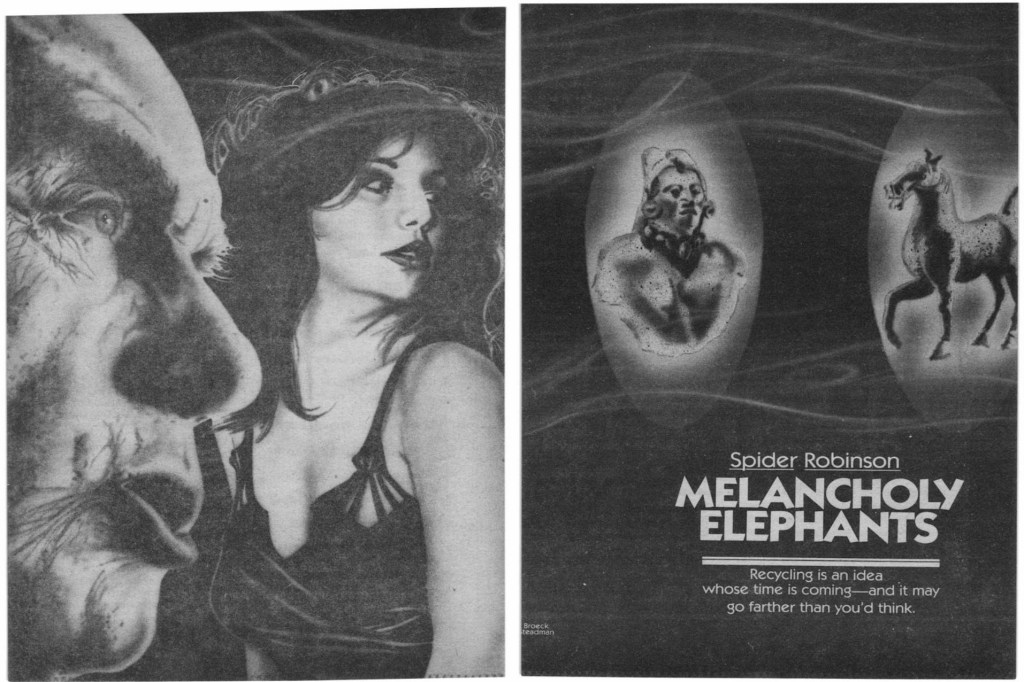
“Melancholy Elephants” by Spider Robinson

Our Facebook group is reading and discussing all the Hugo award winning short stories and novelettes that we’ve haven’t covered in all our previous years. “Melancholy Elephants” by Spider Robinson is a 1983 Hugo winner that I have no memory of even hearing about before. It first appeared in the June 1982 issue of Analog and came in first in the Analog Readers Poll. But then, that’s the fun thing about Group Read 69, we’re discovering stories that should be remembered, or at least consider why they haven’t.

“Melancholy Elephants” is about extending the copyright lifetime. It’s set in the future, and powerful entities want to pass a bill to make copyright perpetual. Dorothy Martin feels this will be a threat to civilization and it’s vital that the bill be stopped. She goes to see a powerful senator she hopes to convince or bribe into killing the proposal.

Most of the story is infodumping about copyright laws. It talks about how there are limits to creativity and if fiction and music are locked down by copyright, it will destroy them. The story even gives examples, including Harlan Ellison and A. E. van Vogt suing movie companies and winning, and George Harrison unconsciously cribbing “He’s So Fine” to write “My Sweet Lord” by the Chiffons. In the future of this story, there will be powerful computer programs that test for previous use and reject copyright violations. Mrs. Martin’s husband committed suicide when he realized his latest and greatest work was inspired by music he heard in childhood.

I don’t see why this story won the Hugo and Analog Readers Award, but then I don’t remember any of the short stories it competed with either. Also, I disagree with Mrs. Martin’s conclusion. I don’t think long copyright terms keeps artists from innovating, but I do think it keeps some works from being remembered. For example, copyright keeps me from linking to a copy of this story for you to read.

What I found fascinating by “Melancholy Elephants” was how much the story felt like a Heinlein story. Spider Robinson was a huge fan and friend of Heinlein, and this story feels like he stole from Heinlein in the same way Harrison appears to have stolen from The Chiffons.

The story starts out with Dorothy Martin killing a mugger. She justifies it because she couldn’t be late with the meeting with the Senator, ruining her only chance of saving the world from a fate worse than death. “Gulf” by Robert A. Heinlein starts with the protagonist causally killing an attacker and justifying it by his righteous cause. And if memory serves me right, the same thing happened in Heinlein’s novel, Friday. Heinlein like to promote the value of his characters beliefs and causes by casually killing people. He equates the end justifies the means with these quick scenes. I always thought they represented massive egos believing their way of thinking puts them above all others.

“Melancholy Elephants” could have been done without the scene of Mrs. Martin killing someone and hiding the body under the car. It gave the story a repulsive beginning. The story really needed to be an essay, but Spider Robinson sells fiction, so he took the idea and fictionalized it much like Robert A. Heinlein would he wanted to promote his beliefs.

Mrs. Martin visits the Senator, who comes across like Heinlein’s Jubal Harshaw. The way she makes her case and the way the Senator makes his is exceedingly Heinleinesque At one point Mrs. Martin tries to buy off the Senator and he explains he can’t be bought off because he’s already been bought off and it would be unethical to go against the original deal. Heinlein was big on representing government as being corrupt and things got done by big egos battling it out. Heinlein loved to write scenes where his character persuades others on a particular super-vital issue. However, Heinlein’s scenes often come across as character promoting their righteousness, rather than logic.

In the end the Senator sees Mrs. Martin’s side of things and reverses himself, but the way he does it also reminds me of Heinlein characters when they do give in.

It’s ironic that “Melancholy Elephants” is about protecting a creative person’s rights to borrow from the art that inspired them because this story is obviously inspired too much by Heinlein.

James Wallace Harris, 3/5/24

“The Sharing of Flesh” by Poul Anderson

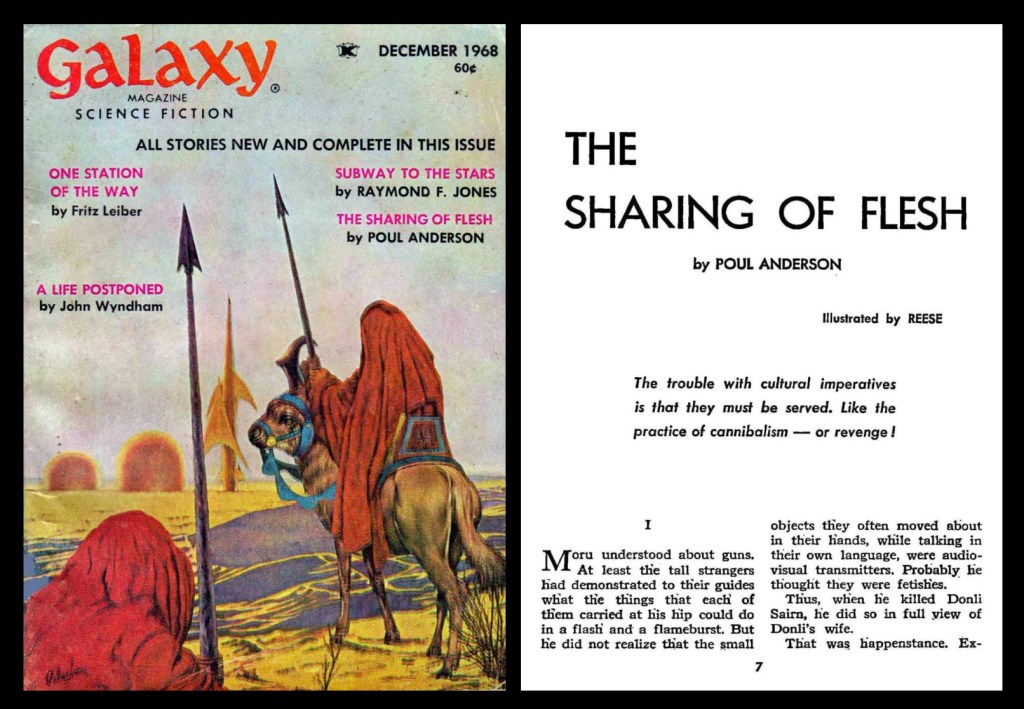
“The Sharing of Flesh” by Poul Anderson first appeared in the December 1968 issue of Galaxy Magazine. It won a Hugo award for best novelette in 1969 and was also nominated for a Nebula award. As soon as I started reading it in The Hugo Winners Volumes I and II edited by Isaac Asimov I knew I had read it before. The trouble is I can’t remember when and how I read it before, and that annoys me. I do remember getting that issue of Galaxy back in 1968, but if I only read it then, it wouldn’t have been so fresh in my memory. With this reading, it felt like I must have read it just weeks ago. Everything portion of the story as I read it came back to me.

“The Sharing of Flesh” is about humans discovering a planet that was previously colonized by humans but forgotten. This is the third story in the past couple of weeks I read using this theme. The other was Anderson’s own “The Longest Voyage” and Nicola Griffith’s Ammonite. “The Sharing of Flesh” is a murder mystery with a sociological/biological twist. It’s the kind of story I don’t want to spoil by summarizing it. I would link to Archive.org so you could read it online, but that issue of Galaxy has the story removed, meaning the Anderson estate requested the cut. It is available in Call Me Joe: Volume One of the Short Fiction of Poul Anderson from NESFA Press. (I did find it online later.)

I checked ISFDB.org to see where “The Sharing of Flesh” has been reprinted, and I don’t own any of those anthologies or collections except The Hugo Winners Volume I and II. I suppose I could have read “The Sharing of Flesh” there, but I don’t think so.

I know you’re probably thinking I’m overly obsessed with memory, but recalling when, where, and how I read a story is important for two reasons. First, I’m getting old, and I’m slowly losing my ability to recall. Working to remember is good exercise for my mind. But second, and more importantly, the memorability of a story is a measure of its quality. If words etch into your mind and they stay there for years, there’s a good reason.

Despite all the millions of short stories published, and the thousands that I have read, the memorable ones only number in the low hundreds, and the ones worth cherishing over a lifetime, add up to just a handful of tens.

“The Sharing of Flesh” is memorable because it’s about something grotesque and horrifying, yet its resolution is about forgiveness. The story is about transcending upbringing and culture. It’s incredibly positive. Yet, I don’t know if I’d put “The Sharing of Flesh” into the all-time classic category. I might need to read it a couple more times before I decide. Still, it makes me think I need to read more Poul Anderson.

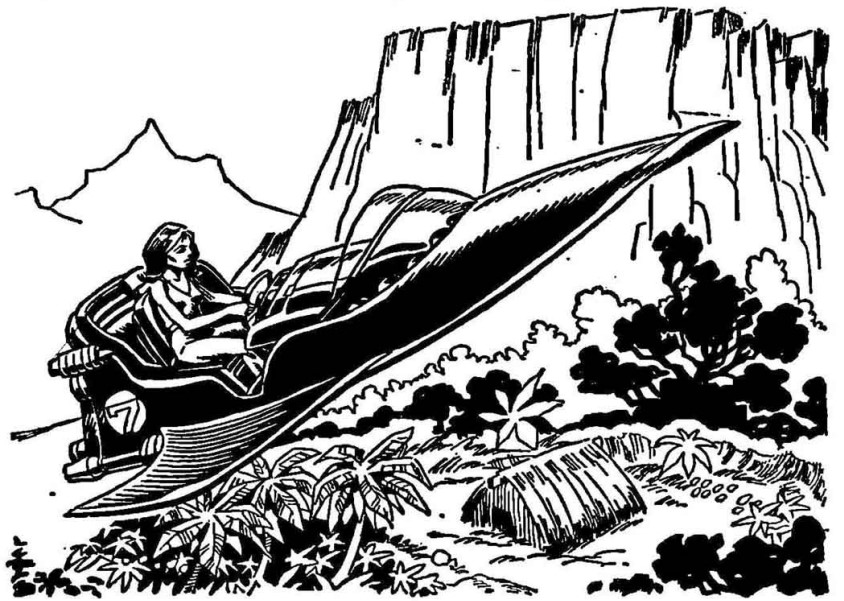
Even the illustrations from Galaxy are so familiar to me. I must wonder if I read it back in 1968. If I did, I don’t think I’m remembering that time. I wish I had kept a journal from the time I first started reading. I probably read “The Sharing of Flesh” recently because some blogger mentioned it, and I went and read it. If you remember, let me know.

That’s another thing I’d like to remember. I’d like to remember other people by the stories they love. I wish I had started worrying about memories when I was a child. Who knew they’d be so important to me now?

I’m beginning to realize that stories I love are like my genes, they define who I am.

James Wallace Harris, 2/1/24