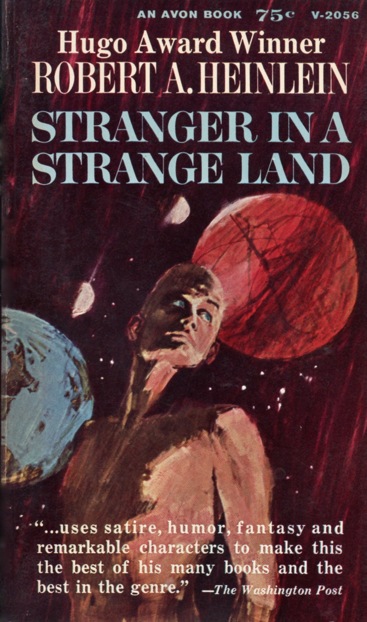
I recently watched a devastating “review” of Stranger in a Strange Land on YouTube. (Watch it below.) The short film summarized the plot of the novel, but in a way that made the story ridiculous. When I first watched it, I didn’t think the sarcasm and satire was unfair. I first read Stranger in 1965 when I was thirteen, and I loved it. I’ve reread it many times over the decades, but with each rereading I became more disappointed with the story. So, the criticisms made by Overly Sarcastic Productions resonated with the memories I have of listening to the audiobook version in 2004, and my last reading in 1991. Even though Robert A. Heinlein is still my favorite science fiction writer; I haven’t liked his books published after 1959 for a long time. However, I’m wondering if I shouldn’t reevaluate that dislike.
Today, I started reading A Martian Named Smith by William H. Patterson, Jr., the man who wrote a two-volume biography of Heinlein and who edited The Heinlein Journal. I wouldn’t call Robert A. Heinlein: In Dialogue with His Century an official biography, but it was written with the support of Virginia Heinlein. Patterson makes a great case that Heinlein was trying something quite different with Stranger, and it shouldn’t be judged like traditional science fiction. Patterson considers Stranger to be a classic satire, and that the satire has a different structural form than the novel.
In the 1960s and 1970s, Stranger in a Strange Land might have been the most famous science fiction novel. It was a cult classic on college campuses and embraced by many in the counterculture. I’m not sure Heinlein liked that. It was also embraced by the growing libertarian political movement. The more Heinlein was embraced by the Right, the more readers on the Left moved away from his works. That put me in a bind. I’m liberal. What eventually happened is I focused on his books published before 1960.
But I thought of something today. Stranger in a Strange Land could be considered an early work of New Wave Science Fiction, at least by some of its goals. The New Wave movement wanted science fiction to move away from pulp writing, escape from the old tropes in science fiction, embrace the latest literary standards, experiment in new forms of writing styles, deal with emerging social issues, and be more relevant. Heinlein was obviously doing all that with Stranger in a Strange Land. The New Wave was mostly out of England, and on the left politically. Heinlein made public proclamations that divided the science fiction community between conservative and liberal, so no one considered him New Wave at the time.
Patterson, in A Man Named Smith makes a very intellectually grounded case that Stranger in a Strange Land works on multiple levels, some of which are deep and seldom observed. What if Patterson is right? What if my liberal leanings are prejudicing me from giving the novel a fair chance? To find out I’ll need to reread the book, even both versions, and read Patterson’s book, along with other critical works and studies on the novel. That will be a huge project. That means this blog post will have another ongoing series — and I have too many of those unfinished right now. I’ve been meaning to get back to my Rereading Heinlein project. I expected to reread Stranger in a Strange Land after I read everything Heinlein wrote before it. I’m still stuck in 1940, where I planned to read “The Devil Makes the Law” (renamed “Magic, Inc.”) next.
I also got inspired to reread Stranger in a Strange Land this week when I watched the above video review. Then I read an essay on Book Riot where the writer was proposing to replace eight classic literary novels, four of which are among my favorites. I wrote about this on Auxiliary Memory, where I criticized younger writers for wanting to replace older books they hated, with newer books they loved. I said, if you want to replace a classic, it should be from the same years as the original work and cover the same thematic territory — that classics are how we view the past.
Then I read Joachim Boaz’s review of Davy by Edgar Pangborn. He called it a masterpiece. That led me to finding my copy of Davy and begin reading. It’s quite an impressive novel, but what’s interesting is its overlap with Stranger in a Strange Land. Both are about young males and their education before they become revolutionaries and try to create new social systems. Both these books precede the counterculture of the 1960s by just a few years. At first, I wondered if modern woke readers would accept Davy as a substitute science fiction classic for Stranger in a Strange Land. But if you read my essay linked above, you’ll see that I don’t believe in removing classics from the canon, but adding works that will supplement that.
I believe Stranger in a Strange Land, Davy, and The Man Who Fell to Earth by Walter Tevis make an interesting trilogy of works that reflect the early 1960s in science fiction. To write that will be another huge writing job that will take a lot of researching, reading, and writing. And I unfortunately have dwindling physical and psychic energy.
When I was growing up in the 1950s and 1960s Heinlein was considered the top science fiction author by most readers, even if they didn’t like his books. He was just that successful. He was made the first Grand Master by the SFWA in 1974.
Ever since Stranger in a Strange Land was first published, it was considered controversial, and even polarizing. Since the 1960s, Heinlein’s reputation has been in decline, but that might be relative. So many new writers have had so much success that Heinlein just had much more competition. However, in the 21st century there does seem to be a growing dislike of Heinlein among younger readers.
I love studying how books become popular and how they are slowly forgotten. Is Heinlein and Stranger on their way out? Or is there something to that novel that will keep people reading it for another century? I want to think about that.
Right now, people focus on Heinlein’s flaws. But what about Heinlein’s virtues?
I also want to think about the differences between what makes a literary novel a classic and what makes a science fiction novel a classic. There is an overlap in reasons, but each form has its unique qualities that determine whether they will become a classic novel. I believe literary novels must give significant insight into their story’s physical setting, and both the time in which the story is set, and when it was written.
We judge science fiction stories over their plots and ideas. But what if what makes a classic science fiction novel the same as what makes a classic literary novel? What does Stranger in a Strange Land say about America in 1961, and the decade before when Heinlein was writing it? My guess is it is something like what Pangborn and Tevis were saying. It’s going to take a lot of deep reading for me to find out.
James Wallace Harris, 8/12/23











 Classics of Science Fiction