1950: FARMER IN THE SKY by Robert A. Heinlein

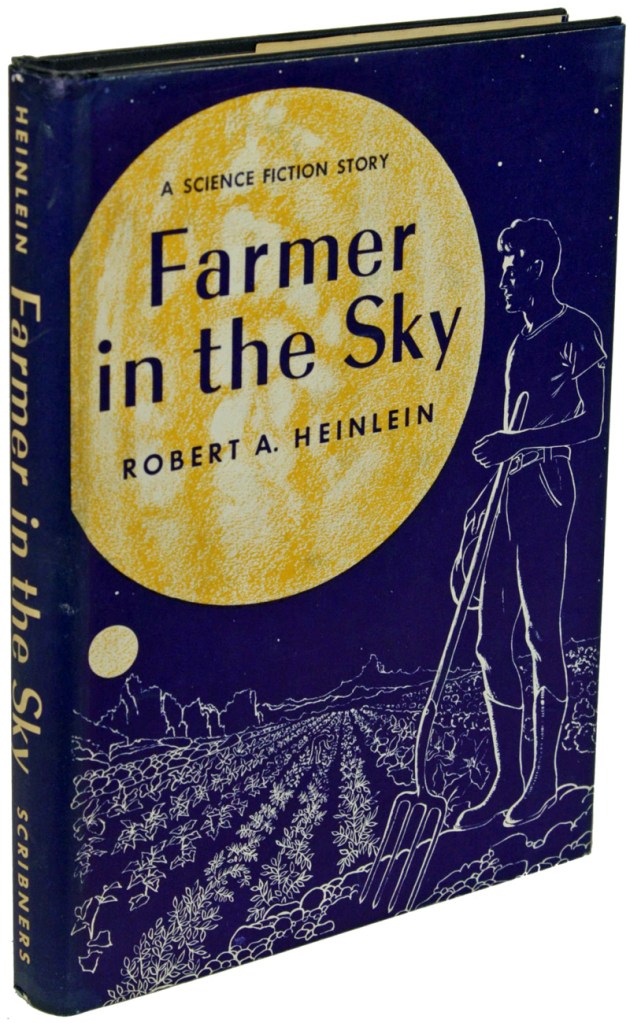
Robert A. Heinlein’s first young adult science fiction novel was published by Charles Scribner’s Sons in 1947. Heinlein imagined a realistic trip to the moon in Rocket Ship Galileo. For his 1948 novel, Space Cadet, Heinlein imagined a far more ambitious future, where humans had colonized Mars and Venus, and had explored all the way out to Pluto. In 1949, he focused on a Mars colony in his novel Red Planet. In 1950, Heinlein had humanity moving further out into the solar system, terraforming Ganymede, a moon of Jupiter, in Farmer in the Sky.

(For some reason, this title is out of print except for an audiobook edition. There isn’t even a Kindle edition. Does that imply it’s no longer popular?)

It’s worth reading the Wikipedia entry for terraforming. They claim Jack Williamson coined the term in 1942 for a story, “Collision Orbit,” published in Astounding Science-Fiction. However, they said the first scientific use of the concept was proposed in 1961 by Carl Sagan, who labeled the concept planetary engineering.

Heinlein uses Farmer in the Sky to significantly explore the idea of terraforming, way ahead of the science community. Of course, he’s turned out to be completely wrong about Ganymede, but then we didn’t know much about that moon in 1950. I don’t think any work of science fiction has dealt with terraforming again so head-on until The Mars Trilogy by Kim Stanley Robinson (1992-1996).

The novel begins on an overpopulated Earth. Bill Lermer and his father, George, decide to emigrate to Ganymede. Life on Earth isn’t bad, but food is carefully rationed. Bill is shocked when he discovers that George is marrying Molly at the last minute. One of the requirements of emigration is being part of a family. Molly has a daughter, Peggy.

When Bill’s new family arrives on Ganymede, they discover pioneering life is hard. The planet’s atmosphere has been undergoing a heating process for years. The air is barely breathable, and it’s cold. Peggy develops health problems because of the thin atmosphere and must stay in a pressurized room. Each new family is assigned land, but it’s just rock. To make it farmable, the rock must be crushed into powder, and then specifically cultured microorganisms, organic waste, and worms are added to convert that powder into soil.

A significant portion of the narrative is about farming. Heinlein emphasizes the hard work involved. He also dramatically illustrates the dangers of living in a geoengineered world. Like his later novel, Tunnel in the Sky, Heinlein puts the pioneer on a pedestal. One of Heinlein’s major themes has been the colonization of space. As a young teen in 1965, I embraced Heinlein’s science fiction stories as a personal philosophy. Heinlein made me believe in the final frontier like Baptists believe in heaven.

Today, millions want to colonize Mars, while others advocate colonizing Titan, a moon of Saturn. In 2025, I no longer see the point. Mars is colder than the pinnacle of Mt. Everest, and living on Titan would be like living in a flask of liquid nitrogen.

Heinlein’s books made horrible places sound appealing. Why? Heinlein transferred his love of the American Revolution and the American frontier to outer space. But it’s not the same. Elon Musk is spending billions to colonize Mars, and it might happen, but I’m not sure people will like Mars once they try to live there.

So, why did I love rereading Farmer in the Sky so much? It’s as realistic as John Carter living on Barsoom. And that might answer my question. Farmer in the Sky is a fun fantasy. But that’s not the answer either. Heinlein has a great deal of sentimentality in his juveniles. Heinlein is not a gripping plot writer. His stories are episodic. Nor is Heinlein a dramatic writer. His characters converse more than they conflict. Often they lecture. But Heinlein has a talent for creating likable characters and placing them into situations that evoke positive emotions.

I would say the Heinlein juveniles work on me in the same way old Frank Capra movies do. Capra was born in 1897, and Heinlein in 1907. They both expressed a sentimental love of America in their work, a kind that existed before World War II. I also see it in the stories of Ray Bradbury. Heinlein’s Ganymede is really Iowa in the 1920s.

I should have moved on from Heinlein after 1966. The world keeps changing, and I should have changed with it. Maybe after this rereading, I’ll move on. Or will I still be rereading these children’s stories in my nineties?

The future I dreamed of at 13 is much different from the one I find myself in at 73. If I had read realistic literary novels from 2025 in 1965, would I have been anxious to grow up and live in that reality? 2025 is more science-fictional than the science fiction I read back then.

James Wallace Harris, 9/27/25

1948: SPACE CADET by Robert A. Heinlein

We often judge old science fiction books by what writers got right about the future. It is equally valuable to understand what they got wrong. In an experiment, disproving a hypothesis is still informative. Robert A. Heinlein was famous in the 1940s for writing a series of science fiction stories he labeled Future History. Heinlein also wrote fourteen young adult novels from 1947 to 1963 that can also be considered another Future History.

I’ve read thousands of science fiction novels and short stories over the past sixty-plus years. I no longer enjoy reading science fiction in the same way I did when I was young. That was when I could forget that I was a reader and immerse myself in the story. Now, when I read science fiction, I’m constantly thinking: What is the writer trying to create, how are they doing it, and why? When I read old science fiction, I think about the year it was written and what the author used as grounds for speculation.

I believe that at one time, Robert A. Heinlein was as brilliant in his speculations as H. G. Wells in his heyday. Space Cadet was written during a particularly stressful time in Heinlein’s life. He had left his second wife, Leslyn, whom he had married in 1932. I do not have the space here to describe how remarkable Leslyn was as a woman in the 1930s. Leslyn had a master’s in philosophy, was politically liberal, and sexually adventurous. Robert and Leslyn had a remarkable fifteen-year relationship, with an enviable social life among highly creative people in Los Angeles. Robert had left Leslyn, waiting for the divorce to allow him to marry his third wife, Virginia (“Ginny”) Gerstenfeld. She became his muse and companion for the rest of his life. (See Robert A. Heinlein: Volume I: Learning Curve, 1907–1948 by William H. Patterson.)

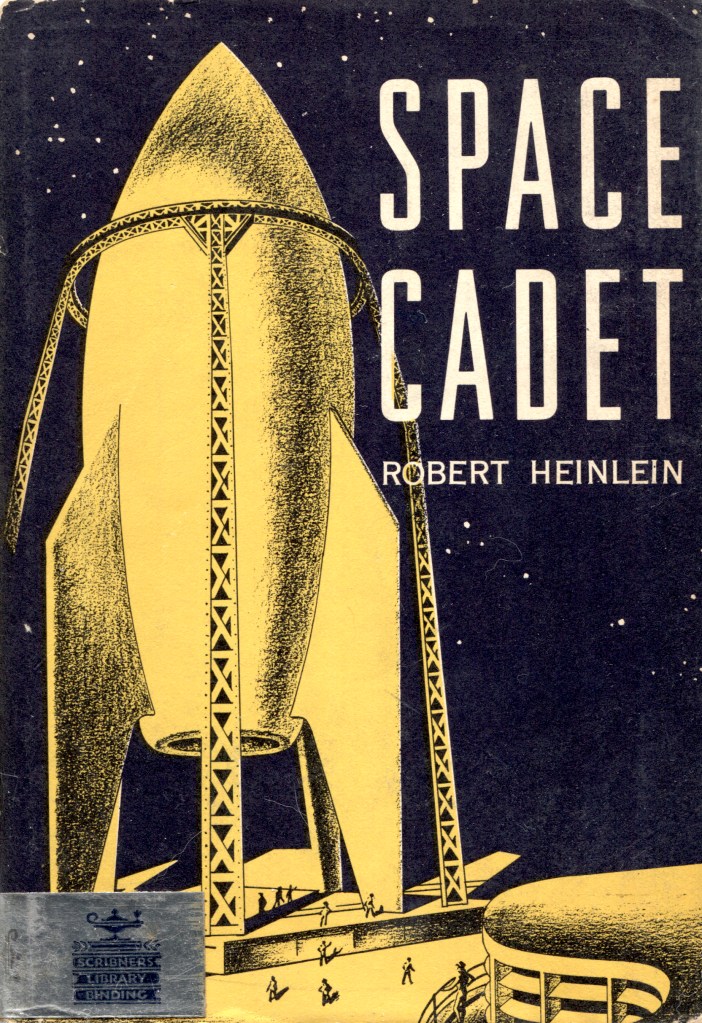
Space Cadet follows four boys, Matt, Tex, Oscar, and Pierre, through a series of episodic adventures as they train in the Interplanetary Patrol. Heinlein was a graduate of the United States Naval Academy and modeled Space Cadet on his training at Annapolis. The story begins on Earth, then moves to a military school in Earth’s orbit. (The boys take leave on a giant space habitat.) Next, the boys are assigned to a rocket searching for a lost exploration vessel in the asteroids. Finally, end up on a rescue mission on Venus. For the most part, the story is a page turner. Each episode combines personal conflicts and learning experiences. Heinlein promotes education, especially in math. Heinlein provides a certain amount of infodumps about space navigation, orbital mechanics, rocket science, space suits, weightlessness, space sickness, and other realistic details involved in exploring space that were usually ignored in science fiction before Heinlein.

The Heinlein juveniles took space exploration seriously, at least by what was known at the time. This was especially true in the early books of the series. However, each book went further away from Earth. Eventually, the series went well beyond anything scientific to explain the methods of transportation used in them. I’ve often felt that Heinlein was focused on the details of realistic space exploration during the late 1940s and early 1950s, but after Sputnik and NASA, Heinlein shifted to making his novels about politics and society. Those later novels might be set in space, but Heinlein no longer concerned himself with the details of rocket science.

Although Heinlein was experiencing the success of his first book being published in 1947, a string of sales to slick magazines, and Hollywood types contacting him about making a movie, he was living in poverty in a tiny trailer. He desperately needed money. Heinlein left California and everyone he knew to hide out in Fort Worth, Texas. He was living in sin with Ginny, his future third wife. They had to keep their relationship secret until the divorce went through with Leslyn. Heinlein felt guilty for abandoning Leslyn, but she had become an uncontrollable alcoholic. Heinlein had met Ginny in Philadelphia while working as a civilian for the war effort. Ginny was a biochemical engineer with math skills who worked well with Heinlein on planning the science in his science fiction. The two of them spent their days in Fort Worth working out the math for the orbital mechanics in Space Cadet. Heinlein’s future depended on this second book for Scribner’s, but he had a difficult time writing it. He claimed that Ginny offered many suggestions that he initially rejected but ultimately used to finish the novel.

In 1948, Heinlein didn’t know his 1947 novel, Rocket Ship Galileo, would be the basis for Destination Moon, the first major science fiction film of the 1950s, and Space Cadet would be connected to Tom Corbett, Space Cadet, a 1950 TV show that influenced later science fiction television. Heinlein had been the star of John W. Campbell’s Astounding Science Fiction in the 1940s. Nor did he have any inclination that his twelve young adult novels for Charles Scribner’s Sons would have such a major impact on readers in the 1950s. In 1947 and 1948, Heinlein was at a low point in his career. He had no idea how big a success his writing would become, or how Ginny would become the love of his life. They believed in a fantastic future of space travel, but they were so poor that they had to sell their belongings to survive.

Heinlein dominated science fiction in the 1950s, like H. G. Wells did in the 1890s. When I reread Heinlein, it’s to see how he changed the course of science fiction. When I was young, I felt Heinlein would one day be considered the Mark Twain of science fiction by the time I got old. That hasn’t happened.

Robert Heinlein’s reputation as a science fiction writer has dropped dramatically over my lifetime. When I was growing up, if two SF fans met, both assumed each other’s favorite author was Heinlein, and they’d argue over who was the next best science fiction writer. Today, many modern readers shun Heinlein, usually for what they believe are Heinlein’s personal views, or because they’ve read one of Heinlein’s later works, and assume all of his books are just as bad. Personally, I dislike all of Heinlein’s books published after The Past Through Tomorrow (1967). I have significant problems with anything he wrote after Starship Troopers (1959) and before he published The Past Through Tomorrow.

Science fiction becomes dated after a few decades, which is the main reason why Heinlein’s fiction is falling out of favor. Only three SF novels from the 19th century are commonly read today: Frankenstein, The Time Machine, and The War of the Worlds. Eventually, I believe fewer than a dozen science fiction novels from the 20th century will be widely read in the 22nd century.

Heinlein will continue to be read until his original fans all die. Then, readers yet to be born will decide if any of his books will be worth reading after that. I’m rereading Heinlein’s books, speculating if they will survive in the future. I started with Heinlein’s first published novel, Rocket Ship Galileo (1947), an essay I already need to revise.

Rereading his second Scribner’s novel, Space Cadet from 1948, it’s easy to dismiss it as a young adult novel for boys. But when you examine it in comparison to science fiction published up until 1948, and consider the philosophical issues it deals with, it’s a standout SF novel.

In judging Heinlein’s long-term prospects, I’ve decided to use H. G. Wells, Aldous Huxley, George Orwell, and George R. Stewart as models, specifically for The Time Machine, The War of the Worlds, Brave New World, Nineteen Eighty-Four, and Earth Abides. Heinlein wanted Starship Troopers, Stranger in a Strange Land, and The Moon is a Harsh Mistress to be the three books by which he would be remembered. Heinlein felt those novels were his most mature works, and which best expressed his views. They are the ones that are still found in bookstores. They are also the Heinlein novels modern readers often dislike.

Heinlein might be right, and those books will be his literary legacy. Heinlein has twenty-nine other books published in his lifetime to consider. I plan to reread nineteen of them as possible works that might be remembered instead. So far, I’ve reread three, and my memory of the others suggests that Heinlein does not have a novel equal to my five models. In terms of ambition and complexity, only Heinlein’s favorite three come close to the five models I’ve chosen in ambition. However, I’m not sure if Heinlein’s philosophical intent in those works will be well-regarded in the future.

I believe there’s another way Heinlein might be remembered. Heinlein will often be discussed in books about science fiction. Heinlein is a significant figure in the evolution of science fiction. For example, in a taxonomy tree showing the evolution of the genre, Starship Troopers will be the main branch for Military SF. Rocket Ship Galileo is situated on a major branch of fiction about the first trip to the Moon. And Space Cadet is a major contribution to exploring the solar system.

In the 21st century, Heinlein is often ignored. Many readers have the prejudice that Heinlein is an unlikable conservative; some even think he’s a fascist and misogynist. But Space Cadet expresses extremely liberal views.

If you read Space Cadet today, it will feel like a simple story for young people that’s quite dated. Readers need to understand events in 1948 to appreciate the novel. Heinlein imagines a need for a world government and an agency to control nuclear weapons. Russia didn’t have the atomic bomb until 1949, but Heinlein was worried about the day when multiple countries had weapons of mass destruction. Throughout the 1940s, Heinlein wrote stories that speculated about how we’d apply atomic energy in peacetime and control nuclear weapons to prevent wars. That’s a heavy topic for fiction found in elementary school libraries.

Heinlein was also concerned with the human race destroying itself. Heinlein believed only one international agency should control nuclear weapons. And if any country violated their policies, their ability to create a nuclear bomb would be targeted with nukes. In an early draft of Space Cadet, Heinlein had Matt, his young protagonist, nuking his hometown. Wisely, Heinlein decided that was too much for a young adult novel and reduced the idea to a bull session between cadets.

To emphasize the importance of this idea, he has the cadets discover evidence that the asteroids are the remains of a planet that blew itself up in an atomic war.

The Interplanetary Patrol is racially integrated. Heinlein makes a point that black males are cadets and officers. The U.S. military integrated in 1948. Heinlein takes this further by emphasizing that intelligent beings on Venus and Mars are equally human, even if they don’t look human. However, human females don’t have equal rights in this story. But Heinlein quickly liberates women in later books in this series. However, even in Space Cadet, the Venusians are a matriarchal society.

Ideas about a space based military from Space Cadet will show up again in Starship Troopers. The novel also has an orbital battle school that prefigures Ender’s Game. And the Interplanetary Patrol will influence several TV shows in the 1950s, which will eventually lead to Star Trek. Of course, Heinlein was inspired by E. E. “Doc” Smith’s Lensman series.

Throughout the novel, Heinlein tosses out ideas that will become part of reality. At the beginning of the story, Matt uses a pocket phone that depends on cell towers. He gets to orbit via a reusable rocket. They are stationed at a geosynchronous orbit. But Heinlein also missed on things, too. In 1948, Heinlein didn’t foresee the impact that computers, networks, and robots would have on our world.

Space Cadet is set in 2075. Heinlein assumes that by then, humanity will have traveled the solar system and settled colonies on the Moon, Venus, Mars, and Ganymede. Heinlein also thought we’d find intelligent life on Venus and Mars, and it once existed on the planet that blew up and became the asteroids. All of Heinlein’s young adult novels have overlapping futures with similar details. That’s why I say they represent another Future History.

Many science fiction writers before 1950, including Ray Bradbury, hoped we’d find Martians and Venusians. I call that kind of thinking pre-NASA science fiction. In the 1960s, when NASA’s probes discovered that those planets were lifeless, I was tremendously disappointed. I still love pre-NASA science fiction. But I have to wonder if younger generations have completely dismissed such stories because of what science has discovered? I must point out that they accept Star Trek and Star Wars. We know those popular series are just as unscientific as pre-NASA science fiction, but they haven’t been rejected. Why?

I doubt many readers will read Heinlein because of his historical value to the genre. Few readers today read E. E. “Doc” Smith, and his series were once beloved. At 73, I sometimes wonder if I shouldn’t give up on Heinlein, too. However, rereading books by Heinlein and Philip K. Dick provides far more enjoyment than reading new science fiction. I both love that and regret it. It reminds me of all my old boomer friends who won’t listen to any music created after 1975. I don’t want to be stuck in pop culture nostalgia, but obviously, I am.

I once read science fiction to think about the future.

I now read science fiction to think about the past.

James Wallace Harris, 9/31/25

1947: ROCKET SHIP GALILEO by Robert A. Heinlein

In The Outliers, Malcolm Gladwell claims that successful people often grew up with mentors. I never had one. Looking back, I could have used Robert A. Heinlein as my mentor, because his books for young people gave a great deal of advice. Unfortunately, I ignored his wisdom.

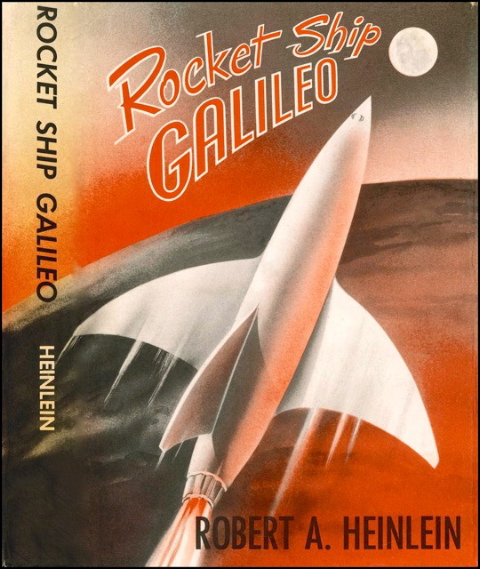
I’ve always been embarrassed to recommend Rocket Ship Galileo to science fiction fans because it’s so dated, unrealistic, and naive. Yet, I’ve enjoyed reading it several times over my lifetime. This 1947 novel for kids sets the stage for much of science fiction to come. Rocket Ship Galileo was Robert A. Heinlein’s first published novel. It was written in 1946, just a year after the war, and published by Charles Scribner’s Sons. That was quite a coup for Heinlein, since science fiction was just starting to be published by fan presses, and his first book was coming from the same publisher as Ernest Hemingway, F. Scott Fitzgerald, and Thomas Wolfe.

Heinlein’s writing is several steps up from most science fiction being written in 1947, but Rocket Ship Galileo is not much more than an updated Tom Swift novel. The story is set in the late 1950s, when Heinlein speculates that commercial rockets have been established for transporting freight and passengers. Military jets were being tested in 1947, but there were no commercial jets, so Heinlein expected rocket technology to be the winning technology.

Heinlein based his speculation on Werner von Braun’s rockets and our use of atomic bombs in 1945. However, I thought Heinlein was overly naive and incredibly unrealistic to suggest that three high school students and one Manhattan Project scientist could retrofit a commercial chemical rocket with an atomic drive and fly to the Moon. That’s why I find the book embarrassing to recommend to modern readers. Even more embarrassing are the Nazis found hiding on the Moon.

I first read Rocket Ship Galileo in 1964. This was just before the Project Gemini manned missions in 1965. It was obvious that three teenagers and an adult could never build a rocket in one summer capable of traveling to the Moon. I was in the 8th grade. That kind of belief was common in the Tom Swift and Tom Swift, Jr. books I read in the 5th grade. I should have been savvy enough in 1964, at age 13, to quit reading Rocket Ship Galileo after a few pages. Why didn’t I? And why have I read it another four times since then?

In the fall of 1964, I loved the new TV show Gilligan’s Island, but whenever I watch an episode of it today, I wonder if my brain was damaged as a teenager. Why wasn’t I more discerning about what I read and watched? However, I was a dumbass kid of twelve and thirteen when I first read Heinlein’s fourteen novels for young adults. (I’m adding in Starship Troopers and Podkayne of Mars to the twelve from Charles Scribner’s Sons.)

This is going to sound weird. I now consider embracing science fiction as a kid was psychologically similar to becoming religious. Accepting fantastic science fiction beliefs gave me the same comforts as accepting Jesus. I just wanted to travel to the heavens before I died.

Now Heinlein wasn’t trying to be irrational or promote silly ideas. Rocket Ship Galileo is full of scientific digressions, also called info dumps. I felt Heinlein was speculating as scientifically as possible with what people knew in 1947. He uses his own ideas about the possibilities of applied atomic power. But he doesn’t think things through. Heinlein understood that radioactivity could superheat fuel and create a more powerful exhaust than chemical combustion. However, to suggest liquid zinc or mercury as a rocket fuel is insane. Did they have no concept of pollution back in 1947?

Heinlein also understood that computers would be used to navigate to the Moon. He references ENIAC, built in 1945, the first general-purpose digital computer.

Because of rockets, computers, and atomic bombs in 1945, the guiding philosophy of science fiction became, if we can do this now, why can’t we do something like it in the future? Heinlein was leading the charge for science fiction to speculate and extrapolate. The twelve Heinlein juveniles, published from 1947 until 1958, became my gospels and epistles to a religion founded on science fiction. Heinlein became my guru, my substitute father, yet I missed all his advice that could have been considered mentoring.

All the Heinlein juveniles advocated studying science and mathematics, especially math. I read these books in the mid-1960s, believing I’d grow up and travel into space in the 1970s and 1980s. But I didn’t follow Heinlein’s guidance. In the 1920s, Heinlein had worked hard at school, making his way through the Naval Academy at Annapolis. Heinlein repeatedly emphasized studying.

Most Christians want easy Christianity. All they want to do to get to heaven and have everlasting life is to say, “I believe.” I was no better in my approach to science fiction. I have read several accounts from rocket scientists who claimed Heinlein inspired them to become who they were. There are millions like me, who aren’t rocket scientists, who also read Heinlein.

I’ve criticized some science fiction stories for using comic book science. You know the kind, exposure to Z-rays leads to superpowers. In the early years of science fiction, the public considered it moronic trash. And kids who loved it justified reading science fiction to their parents, claiming they learned science from science fiction. The frequency of science lecture infodumps in the Heinlein juveniles is high. They were respected by librarians and teachers. Ultimately, their appeal was adventure. They were crack for geeks. They preached that humanity’s manifest destiny was exploring space. Each book took readers further away from Earth. (Chart provided by CoPilot.)

YearTitlePrimary SettingScope of Exploration
1947Rocket Ship GalileoEarth ↔ MoonFirst lunar mission; atomic propulsion
1948Space CadetEarth ↔ Solar SystemVenus and outer planets via military service
1949Red PlanetMarsColonial life and rebellion
1950Farmer in the SkyGanymede (Jupiter moon)Terraforming & settlement life
1951Between PlanetsEarth ↔ VenusInterplanetary conflict and diplomacy
1952The Rolling StonesEarth ↔ Mars ↔ Jupiter systemFreewheeling space travel by a family
1953Starman JonesEarth ↔ Deep SpaceGalactic navigation and far-flung trade routes
1954The Star BeastEarth ↔ Galactic CivilizationsAlien ambassador pet and interstellar law
1955Tunnel in the SkyUnknown planetSurvival and societal formation via teleportation
1956Time for the StarsEarth ↔ Deep SpaceRelativistic travel and twin-linked telepathy
1957Citizen of the GalaxyVarious worlds in Galactic EmpireSlavery, social caste, and galactic society
1958Have Space Suit—Will TravelEarth ↔ Pluto ↔ Intergalactic TribunalKidnap into deep space; galactic ethics debate

While rereading Rocket Ship Galileo this time, I noticed many of Heinlein’s lifelong pet ideas, which Heinlein elaborated on in his adult science fiction in the 1960s. Heinlein wanted to be a philosopher and teacher. The Heinlein philosophy is gentle in these books for young people. One of my pet theories is that Heinlein was influenced by Ayn Rand in her 1957 novel, Atlas Shrugged. After that, he switched to writing novels for adults, and the Heinlein philosophy became more pronounced.

Heinlein’s core philosophy in the twelve juveniles is that space exploration is humanity’s manifest destiny. In Rocket Ship Galileo, the first of the twelve, is about going to the Moon. In Have Space Suit-Will Travel, the twelfth and last, it’s about travel across the galaxy. Each new book goes further out into space, expanding on Heinlein’s pet ideas. Strangely, after the juveniles, Heinlein turns to politics in his adult science fiction novels. Space travel is part of these stories, but it’s no longer being promoted. It’s just accepted.

I first read the twelve Heinlein juveniles just after Project Mercury and just before Project Gemini. I had followed all the manned flights of Project Mercury. Was I a space enthusiast because of NASA or Heinlein? When Heinlein began his series for boys in 1946, few people thought about actual space travel. Science fiction was considered that Buck Rogers stuff, and if you’ve seen any of the Buck Rogers serials, you know that’s a put down.

Heinlein does contribute to a long line of books speculating about the first mission to the Moon. Verne imagined a giant gun. Wells imagined anti-gravity. Heinlein imagined rockets evolving from V-2s. Heinlein just didn’t imagine how difficult the task would be to send a human to the Moon but had anyone else. I asked CoPilot and got this answer:

EraTitle & AuthorMode of TravelNotable Themes
2nd century CETrue History by Lucian of SamosataWhirlwindSatire of fantastical travel tales
1634Somnium by Johannes KeplerLunar demons during eclipsesEarly scientific speculation; heliocentrism
1638The Man in the Moone by Francis GodwinMigrating swansUtopian society; weightlessness
1657States and Empires of the Moon by Cyrano de BergeracFireworks & dew bottlesSatirical science; proto-rocketry
1705The Consolidator by Daniel DefoeWinged chariotPolitical satire; lunar governance
1835The Unparalleled Adventure of One Hans Pfaall by Edgar Allan PoeBalloonComic realism; early space travel logic
1865From the Earth to the Moon by Jules VerneSpace cannonTechnological optimism; post-Civil War science
1901The First Men in the Moon by H.G. WellsAntigravity material (Cavorite)Alien civilizations; imperialism
1926The Moon Maid by Edgar Rice BurroughsSpaceshipHollow Moon; hidden civilizations
1947Rocket Ship Galileo by Robert A. HeinleinAtomic rocketYouthful ingenuity; Cold War anxieties
1950The Man Who Sold the Moon by Robert A. HeinleinCorporate-funded rocketCapitalism and space exploration
1956Mission to the Moon by Lester del ReyRocketRealistic Moon landing prep
1977Inherit the Stars by James P. HoganArchaeological discoveryHuman origins; Moon as historical site

Rocket Ship Galileo will probably not appeal to modern science fiction readers. But for science fiction fans who study the evolution of the genre, is it worth reading? I was surprised by how many things I had forgotten about the novel. All I remembered was the Nazis on the Moon. I had forgotten all the details about creating an atomic rocket engine based on nuclear thermal propulsion, ballistics, space navigation, space suits, autopilots, airlocks, weightlessness, space sickness, computers, radio communication, and more.

After Apollo 11, reading books about the first landing on the Moon is problematic. However, Mary Robinette Kowal’s Lady Astronaut Universe series and Apple TV’s series For All Mankind have succeeded uniquely by creating retro histories. Because I grew up reading pre-NASA science fiction, I can still enjoy stories that are obviously dated because of nostalgia. I also love reading old science fiction because I love studying how the genre evolved.

But is Rocket Ship Galileo really worth reading five times over sixty-plus years? I imprinted on the Heinlein juveniles like baby ducks imprint on their mother. I loved these books so much that I ordered all twelve in hardback directly from Charles Scribner’s Sons with my first paycheck at age sixteen in 1967. I still have them.

At 73, I’m trying to understand how my personality was created. There are the genes I inherited from my parents. And my upbringing and education. I also believe a great deal of who I am came from pop culture – books, movies, TV shows, and music. One of the biggest factors was science fiction. When I reread old favorite books from childhood, I look for clues about how my personality formed.

I’m forced to ask myself: Did I really believe I would go into space someday? I thought I did, but was it a realistic belief? Do kids really believe they will grow up to be football players, or rock stars, or astronauts?

Here’s the thing. If I truly paid attention to Heinlein’s books, I should have modeled myself after his characters. I didn’t. I half-ass did. I read easy popular science books. I built Estes model rockets. I even tried to grind my own telescope mirror but failed. However, I mostly read science fiction. The Heinlein characters didn’t read science fiction.

Today, we have the Maker Culture. That’s what Heinlein was really promoting. Heinlein wanted his readers to become junior scientists. Reading his books made me fantasize about doing that. Instead, I just read more science fiction.

I’ve often pondered how many science fiction books anyone should read. Taking psychedelics back in the 1960s opened the doors of perception. Science fiction was like that. But like people asked back in the 1960s, how many times do you need to go through the doors of perception?

In retrospect, I feel I read too much science fiction and didn’t do enough of other things. I’ve often wondered what my life would have been like if I had stopped with Have Space Suit-Will Travel and gotten busy doing things. Rereading Rocket Ship Galileo reminds me of what I wanted to be as a kid, but reveals I took the wrong path.

James Wallace Harris, 8/5/25

What is the Shelf Life of Science Fiction?

My library constantly discards science fiction from its holdings. I know that because I see those books in the Friends of the Library book sale stamped DISCARD. Often, they are books I would consider SF blasts from the past. Evidently, if they aren’t checked out for a certain period, they get discarded. I used to believe libraries were supposed to preserve the past, but I don’t think that’s true anymore.

But that’s not my only clue that science fiction has a shelf life. At the used bookstore I visit every week I see the same old books week after week – no one is buying them. It’s the newer books that come and go so quickly.

For years now, I’ve been watching people review science fiction books on YouTube. I can sense that many authors and their books are falling out favor over time. A major example is Robert A. Heinlein. When I was growing up, he was considered the #1 science fiction author. He was my favorite SF writer. I still love his books published before 1960, but the ones after that haven’t aged well with me. Reviewers generally pan Heinlein nowadays. I often see critical comments about Heinlein on Facebook. He’s just not popular anymore. I see many of his books at the used bookstore, but only a couple at the new bookstore.

Whitney at the YouTube channel Secret Sauce of Storycraft has been reviewing old Hugo winning novels by decades. She didn’t like over half of the winners. Five of the ten (The Wanderer, Stranger in a Strange Land, The Moon is a Harsh Mistress, This Immortal, and Lord of Light) have stopped working for me too.

If I gave the Hugo Award now for the 1960s, my list would be:

  • 1960 – STARSHIP TROOPERS by Robert A. Heinlein
  • 1961 – ROGUE MOON by Algis Budrys ( for A CANTICLE FOR LEIBOWITZ)
  • 1962 – STRANGER IN A STRANGE LAND by Robert A. Heinlein
  • 1963 – THE MAN IN THE HIGH CASTLE by Philip K. Dick
  • 1964 – THE MAN WHO FELL TO EARTH by Walter Tevis (for WAY STATION)
  • 1965 – THE MARTIAN TIME-SLIP by Philip K. Dick (for THE WANDERER)
  • 1966 – DUNE by Frank Herbert
  • 1967 – FLOWERS FOR ALGERNON by Daniel Keyes (THE MOON IS A HARSH MISTRESS)
  • 1968 – no award
  • 1969 – STAND ON ZANZIBAR by John Brunner

I thought there would be hundreds of science fiction books that would be Hugo worthy from the 1960s, but there weren’t. I used CSFquery.com and ISFDB.org to look at each year 1960-1969 and there just was’t that many older books that’s being read today that people still admire.

I love A Canticle for Leibowitz still, but it’s a fixup novel, and I mostly love it for the first story. And reviewers aren’t as wowed as they used to be for it. I kept Stranger on the list even though I no longer like it, because it’s so ambitious for the times, and historically, it is the standout novel of the year. I love Way Station, but I don’t think people still read it much. The Man Who Fell to Earth has grown in popularity since 1963. The Martian Time-Slip is way better than The Wanderer, and people still read it. I definitely think Flowers for Algernon has aged better than Mistress. I’d give No Award over Lord of Light, or any other novel I remember from 1967.

All the books on my list are in print, and all are available as audiobooks. That’s a good indicator that they are still being read.

I was shocked by how few science fiction books from the 1960s I still admire. Twelve years ago I wrote a series about the best SF books from each decade. Looking at my essay for the 1960s shows damn few books that people still read.

I remember back in the 1960s when old guys would gush about E. E. “Doc” Smith books from the 1920s and 1930s. I tried them, and they were horrible. I guess today’s young readers would feel the same about most of the books I loved back in the 1960s. Is anyone still reading Keith Laumer, John Boyd, Mack Reynolds, A. Bertram Chandler, etc.

Here is a list of 242 popular SF books from 1920-1990. How many do you think are still being read?

What are the best science fiction books from the 1960s that you still read and think young people should try?

You might like to read An Information History of the Hugo Awards by Jo Walton. This was first published at Tor.com and many of the comments from readers are included.

James Wallace Harris, 5/5/25

INHERIT THE STARS by James P. Hogan

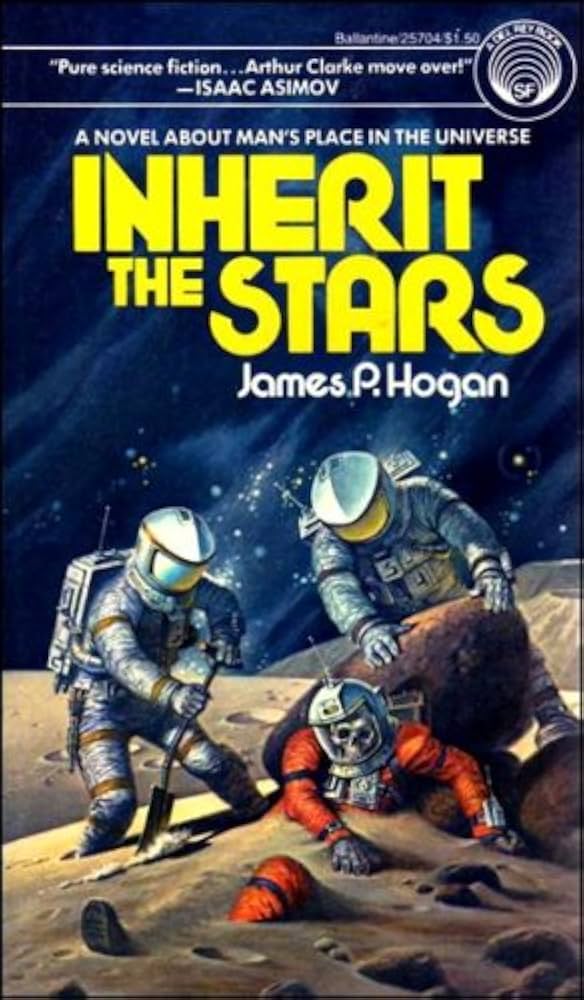
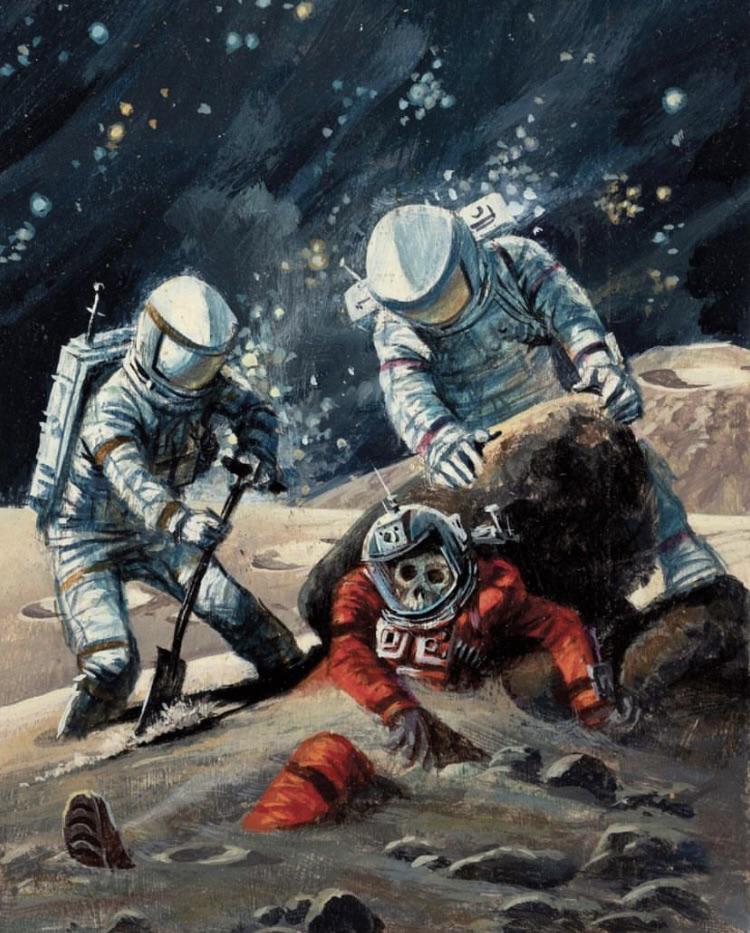
The original paperback, Inherit the Stars by British writer James P. Hogan (1941-2010), had a terrific cover – the kind that made you buy the book. The artwork appears to show astronauts on the Moon finding a dead astronaut, but that is deceptive. Hogan creates a scientific mystery because the dead astronaut has been there for 25,000 years.

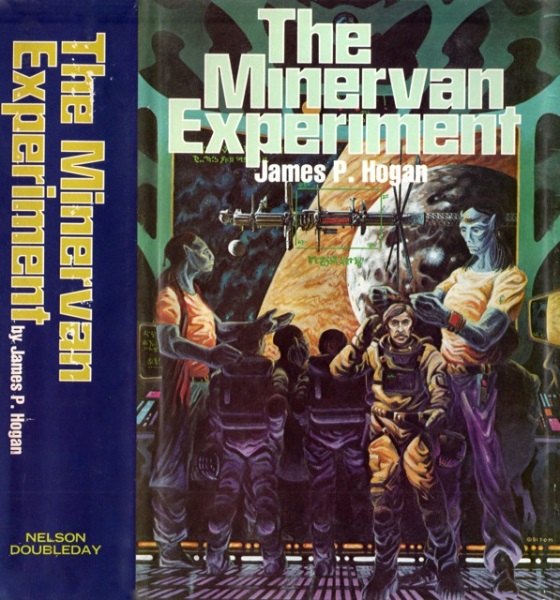
I first read Inherit the Stars in 1992 but after seeing Whitney’s review on YouTube, I wanted to reread the story. I went to Amazon but couldn’t find the book. Was it out of print? I did find it on Audible. Later, I discovered that Inherit the Stars and its sequel The Gentle Giants of Ganymede are now being sold together as The Two Moons for the Kindle. A bargain for $6.99, especially since Whitney also praised the second book. It turns out that there are five books in the series being sold as three Kindle editions. The series is called Giants. Only the first three novels are available on Audible. The Science Fiction Book Club once published the first three novels as The Mirnervan Experiment. Ballentine also published a paperback called The Giants Novels that contains all three.

Before anyone rushes out to buy Inherit the Stars, I need to describe it more, but not enough to give spoilers. Hogan’s story is the kind you want to figure out for yourself. It kept me guessing for the entire novel even though I had read it before. That worried me. Why wasn’t it more memorable? Was that an indication it was a bad book? I don’t think so. How the story is told isn’t very memorable, but the ideas are big-time fun. I did remember some of those, but not connected to the book.

Inherit the Stars is basically scientists talking about one mystery after another. There’s no real plot. A lot happens, but it’s not dramatic. With each discovery, there’s a new puzzle, which makes you think and try to guess what caused each mystery. Inherit the Stars is science fiction focused on ideas and not storytelling. I’ve told you the first mystery, but I don’t want to give away any others.

However, I will give you some fun clues. Inherit the Stars reminds me a lot of Rendezvous With Rama by Arthur C. Clarke. Hogan’s prose is similar to Clarke’s. At one point, the story reminded me of the classic short story “Omnilingual” by H. Beam Piper. The novel also triggered memories of Gateway by Frederik Pohl. At other times it reminded me of the Winston Science Fiction, a series of young adult SF that came out in the 1950s, especially the entries where the protagonists find relics of ancient alien technology. If you love alien archeology stories, you might like Inherit the Stars.

I call Inherit the Stars Pre-NASA Science Fiction, by which I usually mean science fiction written before Mariner 4 photographed Mars in July 1965. Until NASA started exploring the solar system with robotic probes, many people hoped that we would find life, even intelligent life somewhere on other planets in our solar system. For example, Heinlein’s Stranger in a Strange Land from 1961 imagines Mars being inhabited by a dying race. However, after Mariner 4, serious science fiction assumed we were alone in the solar system. (I must admit, that I still love Pre-NASA science fiction. Growing up in the 1950s and 1960s, I desperately wanted us to find Martians.)

I consider Hogan’s 1977 Inherit the Stars Pre-NASA Science Fiction because Hogan maintains the hope that we had neighbors. However, some readers might feel Hogan’s ideas might come across like those of Erich von Däniken, who wrote Chariot of the Gods? Another reviewer dismissed this book as unbelievable. Personally, I find Erich von Däniken’s theories to be insulting to humanity. But I consider Hogan’s speculation to be great science fictional fun.

James Wallace. Harris, 3/1/25

The Disciples of Science Fiction

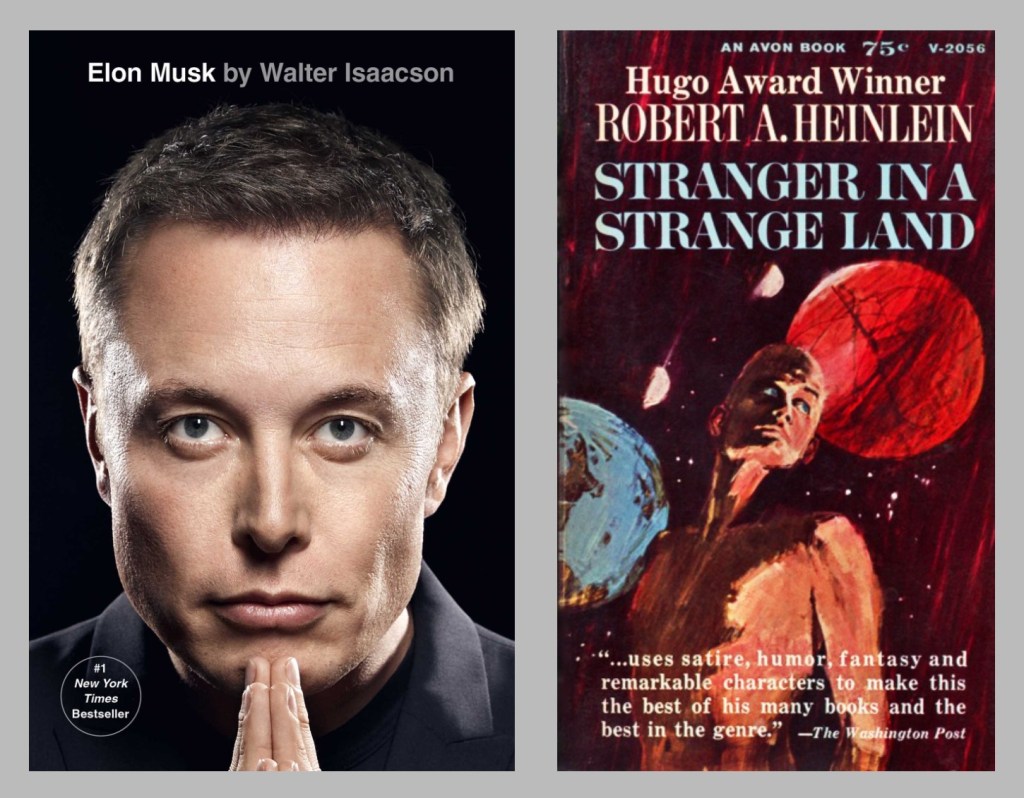
I’m reading Elon Musk by Walter Isaacson. I’m a big fan of Walter Isaacson, but I was going to skip this new book because I’m not a fan of Elon Musk. Then I saw the 92NY YouTube interview, between Michael Lewis and Walter Isaacson, and decided I should read it after all. Even though Musk has a repellant personality, and expresses political ideas I dislike, he is achieving many ambitions that science fiction has dreamed about for centuries.

Elon Musk and other tech billionaires use their wealth to make science-fictional concepts a reality. Walter Isaacson makes it absolutely clear it’s more than just having billions. Isaacson’s biography of Elon Musk shows Musk’s specific genius and drive were needed to create SpaceX, Tesla, and all those other technological enterprises. However, throughout the biography, we’re told that Musk was inspired by Heinlein and Asimov, by the Culture novels of Iain M. Banks, and by other science fiction books, movies, and games.

I read the same SF books as Musk. If I had billions to hire the best engineers in the world I couldn’t have created SpaceX. I lack Musk’s drive. If I had one one-hundredth of his drive, I would have achieved all the ambitions I ever dreamed about and never did. And if Musk has a million times more money than me, does that mean he has a million times more drive and intelligence?

Musk is Heinlein’s Delos D. Harriman, from the stories “The Man Who Sold the Moon” and “Requiem.” Heinlein would have loved Elon Musk, or at least his achievements. In an early SpaceX experiment, when the Grasshopper landed on its rocket thrust, Jerry Pournelle said it landed like “God and Robert Heinlein intended.” Heinlein believed a private enterprise would take us to the Moon, so it’s fitting that SpaceX and Musk might be the private company that takes humans to Mars.

The political philosophy of Musk and other tech billionaires also reflects the libertarian teachings of Heinlein’s The Moon is a Harsh Mistress and Starship Troopers. And Musk’s personality and marriages remind us of Stranger in a Strange Land.

Musk isn’t the only tech billionaire that works to make science-fictional concepts a reality. Jeff Bezos wants to create space tourism and orbital habitats, Peter Thiel wants to see AI and life extension, and Mark Zuckerberg wants to create an AR metaverse like we saw in Stephenson’s Snow Crash. (See “Tech Billionaires Need to Stop Trying to Make the Science Fiction They Grew Up on Real” by Charles Stross in Scientific American.)

I have to ask though: How important was science fiction as their inspiration? Wouldn’t they have created all this new technology if they had never read science fiction? Of course, we should also ask: Would America and Russia have built their 1960s space programs if science fiction had never existed? Humans have fantasized about traveling to the Moon and other planets for thousands of years. Doesn’t that mean it’s just a human desire? But then, did Robert H. Goddard and Konstantin Tsiolkovsky read science fiction as kids?

Is science fiction the John the Baptist of space exploration?

We must also remember that millions, if not billions of people are asking if going to Mars is worthwhile. Or if we should create artificial intelligence and robots. Musk believes creating robots could create an economy of abundance. But do people want to live on a guaranteed income while robots do all our work?

When I was young I would have given anything to live on Mars. That wish came from reading science fiction. But now that I’m old, and know what Mars is like, I’d consider living on Mars to be hell.

Musk believes electric cars will save the environment. But will they? One of the many insights Isaacson reveals about Musk is Musk’s ability to question assumptions. By challenging how rockets are manufactured Musk is leaving NASA in the dust. But shouldn’t we question whether or not colonizing Mars by launching thousands of giant rockets is a good idea?

I love science fiction. As a kid I wanted humanity to colonize the solar system and head to the stars. I wanted humanity to create intelligent robots, uplift animals, and build utopian cities. Science fiction inspired a science-fictional religion in me, instilling faith in certain futures. Evidently, if you have billions and the drive, it’s possible to pursue that faith. I admire Musk’s abilities but I question his faith. And doesn’t that mean questioning science fiction?

Isaacson’s biography of Elon Musk should be a riveting read for any science fiction fan because it reads like a science fiction novel, one Heinlein would have written.

James Wallace Harris, 1/7/25

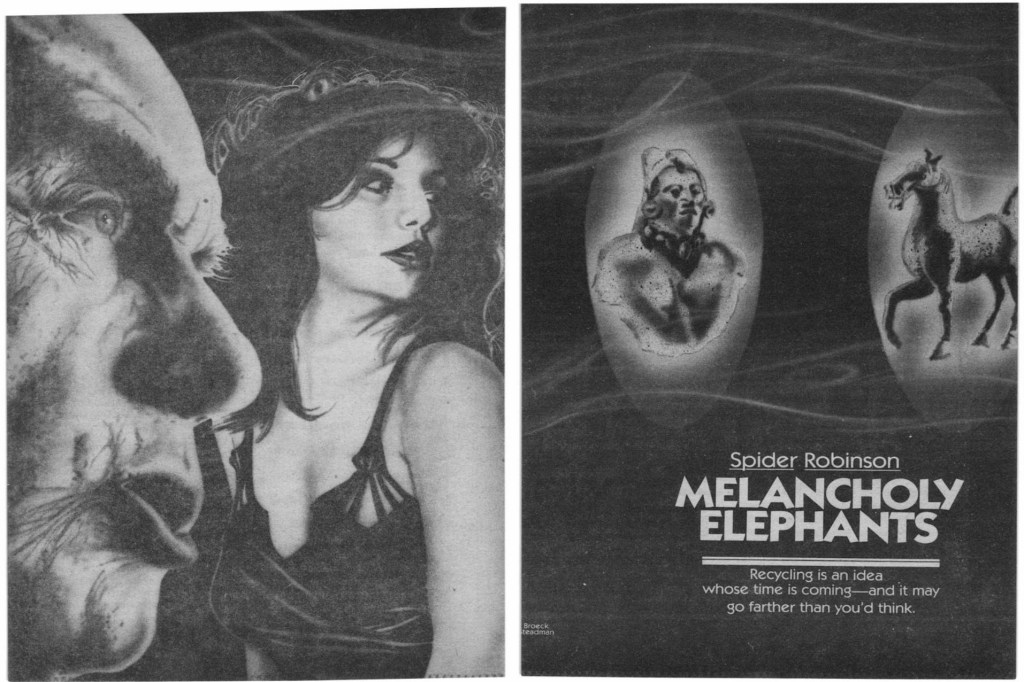
“Melancholy Elephants” by Spider Robinson

Our Facebook group is reading and discussing all the Hugo award winning short stories and novelettes that we’ve haven’t covered in all our previous years. “Melancholy Elephants” by Spider Robinson is a 1983 Hugo winner that I have no memory of even hearing about before. It first appeared in the June 1982 issue of Analog and came in first in the Analog Readers Poll. But then, that’s the fun thing about Group Read 69, we’re discovering stories that should be remembered, or at least consider why they haven’t.

“Melancholy Elephants” is about extending the copyright lifetime. It’s set in the future, and powerful entities want to pass a bill to make copyright perpetual. Dorothy Martin feels this will be a threat to civilization and it’s vital that the bill be stopped. She goes to see a powerful senator she hopes to convince or bribe into killing the proposal.

Most of the story is infodumping about copyright laws. It talks about how there are limits to creativity and if fiction and music are locked down by copyright, it will destroy them. The story even gives examples, including Harlan Ellison and A. E. van Vogt suing movie companies and winning, and George Harrison unconsciously cribbing “He’s So Fine” to write “My Sweet Lord” by the Chiffons. In the future of this story, there will be powerful computer programs that test for previous use and reject copyright violations. Mrs. Martin’s husband committed suicide when he realized his latest and greatest work was inspired by music he heard in childhood.

I don’t see why this story won the Hugo and Analog Readers Award, but then I don’t remember any of the short stories it competed with either. Also, I disagree with Mrs. Martin’s conclusion. I don’t think long copyright terms keeps artists from innovating, but I do think it keeps some works from being remembered. For example, copyright keeps me from linking to a copy of this story for you to read.

What I found fascinating by “Melancholy Elephants” was how much the story felt like a Heinlein story. Spider Robinson was a huge fan and friend of Heinlein, and this story feels like he stole from Heinlein in the same way Harrison appears to have stolen from The Chiffons.

The story starts out with Dorothy Martin killing a mugger. She justifies it because she couldn’t be late with the meeting with the Senator, ruining her only chance of saving the world from a fate worse than death. “Gulf” by Robert A. Heinlein starts with the protagonist causally killing an attacker and justifying it by his righteous cause. And if memory serves me right, the same thing happened in Heinlein’s novel, Friday. Heinlein like to promote the value of his characters beliefs and causes by casually killing people. He equates the end justifies the means with these quick scenes. I always thought they represented massive egos believing their way of thinking puts them above all others.

“Melancholy Elephants” could have been done without the scene of Mrs. Martin killing someone and hiding the body under the car. It gave the story a repulsive beginning. The story really needed to be an essay, but Spider Robinson sells fiction, so he took the idea and fictionalized it much like Robert A. Heinlein would he wanted to promote his beliefs.

Mrs. Martin visits the Senator, who comes across like Heinlein’s Jubal Harshaw. The way she makes her case and the way the Senator makes his is exceedingly Heinleinesque At one point Mrs. Martin tries to buy off the Senator and he explains he can’t be bought off because he’s already been bought off and it would be unethical to go against the original deal. Heinlein was big on representing government as being corrupt and things got done by big egos battling it out. Heinlein loved to write scenes where his character persuades others on a particular super-vital issue. However, Heinlein’s scenes often come across as character promoting their righteousness, rather than logic.

In the end the Senator sees Mrs. Martin’s side of things and reverses himself, but the way he does it also reminds me of Heinlein characters when they do give in.

It’s ironic that “Melancholy Elephants” is about protecting a creative person’s rights to borrow from the art that inspired them because this story is obviously inspired too much by Heinlein.

James Wallace Harris, 3/5/24

Has Science Fiction Changed?

I often encounter the opinion that science fiction has changed. Is it true? Over my lifetime novels have gotten longer, trilogies and series have become more common, there are more female authors, and the genre has been heavily influenced by fantasy. Before Star Trek in 1966, the world of science fiction seemed tiny, and that TV show brought in millions of new SF fans. Then Star Wars in 1977 brought in tens of millions of new SF fans. (But I’m not sure how much the population of science fiction readers grew.)

But these are all externals. I’m wondering if the essence of science fiction itself has changed. Yes, the writing has gotten better, and the literary world has become more accepting, but do modern readers get something different out of reading science fiction than what I found in the 1960s? Why do I prefer older science fiction? Is it more than just because I imprinted on it when I was young? I’m not the only one who feels this way. Many aging Baby Boomers say they prefer older science fiction too, but so do some young book reviewers.

Over the last forty days I’ve read five novels by Philip K. Dick written between 1959-1963, plus Ammonite by Nicola Griffith and The Player of Games by Iain M. Banks. These aren’t new novels, but newer than what I’m talking about, and they feel different. Over the last year I’ve read such new SFF books as Sea of Rust by C. Robert Cargill, Babel by R. F. Kuang, and The Mountain in the Sea by Ray Nayler. I know this is a small sample, but I’ve also read hundreds of science fiction short stories, both old and new, over the last couple of years.

All I can say is science fiction from the first half of my life (1951-1987) feels much different than the second half (1988-2024). The change started around the time of Star Wars in 1977. George Lucas and Steven Spielberg might be the main factors changing the genre. I confess that I’ve long thought that science fiction ran out of original ideas at some point, and the genre has been living on recycling ever since. But women writers, literary standards, and fantasy radically changed the flavor of science fiction since the 1970s too.

But what if the change in science fiction is due to other factors? Yesterday I watched a video by Bookborn, “Do SFF authors think we are stupid now” that offered two innovative ideas. Bookborn suggests that current science fiction lacks subtlety. She also suggests that newer science fiction requires less critical thinking because newer authors tell their readers what to think rather than letting the readers draw their own conclusions. Bookborn also felt authors wrote about topical problems too obviously. Even with books she likes, presenting viewpoints she agrees with, she felt they were too explicit, lacking subtly. She admits this problem is not measurable and highly subjective.

Bookborn then cites an essay, “The Death of the Author” by Roland Barthes. The essay in long, so I suggest reading Wikipedia’s summary instead, but to give you a quick idea, here’s a quote from the first paragraph at Wikipedia:

"The Death of the Author" (French: La mort de l'auteur) is a 1967 essay by the French literary critic and theorist Roland Barthes (1915–1980). Barthes's essay argues against traditional literary criticism's practice of relying on the intentions and biography of an author to definitively explain the "ultimate meaning" of a text. Instead, the essay emphasizes the primacy of each individual reader's interpretation of the work over any "definitive" meaning intended by the author, a process in which subtle or unnoticed characteristics may be drawn out for new insight.

Bookborn is quite articulate at explaining her position, and her position is more complex than what I’m conveying here, so I recommend clicking on the link above to watch her video. Bookborn goes on to say that current authors hide from their readers because of social media. They fear attacks on what they say so they are overly careful about what they put forth. I had an additional insight. Because modern science fiction is often about elaborate world building, modern authors struggle to be precise so readers will see clearly what they have worked so hard to invent.

In Ammonite by Nicola Griffith and The Player of Games by Iain M. Banks, I was disappointed by the blandness of the author’s voice. And I never felt the presence of Griffith or Banks in their stories. Yes, in both cases their world building is beautifully detailed, but both authors left no mysteries about their stories or their personal views for me to ponder. I have theories to explain this too.

Modern writers prefer a close personal third point of view, or first person, to the older omniscient point of view which is better suited for conveying the author’s voice. I also find that the novels I admire most are ones written by authors I love reading about. Maybe what I love about older science fiction is my connection to the author.

Any science fictional world that’s set far from Earth becomes a fantasy world, and thus far less complex than our reality. Such fictional worlds are far from the infinite complexity of contemporary controversies. Writers can avoid personal philosophy by using allegory. Reading such fantasies means passively consuming what the book describes. Such stories don’t lend themselves to ambiguity and complexity, which makes the reader think. Our reality is infinitely full of shades of gray. Made up fictional worlds tend to be consistently designed because authors want them to be understandable to readers unless you’re Gene Wolfe writing The Book of the New Sun.

The five Philip K. Dick novels were far more compelling and thought provoking than the books by Griffith and Banks. I often try newer science fiction, but they usually come across as merely fun stories. Overall, newer science fiction stories are like going to Disneyland. They dazzle but when the ride is over, are quickly forgotten. I’m still thinking about those Philip K. Dick novels. When nothing else thrills, switching to a Philip K. Dick story will get my mind excited. Why is that? I believe it’s because his Dick’s books are closer to real life, and that makes them ambiguous and mysterious. They offer endless room for speculation. I’m reading another biography of Philip K. Dick, my sixth, I think, because Dick’s novels make me crave understanding.

Dick’s novels were compelling, Ammonite and The Player of Games were not. They aren’t bad, in fact, they’re exceptionally good stories, just not compelling. Dick was obsessed with deciphering reality. He doubted that what we perceive is real. He was horrified by other people, often thinking they were machines, disguised supernatural beings, or illusions of the mind. Paranoia fueled his narratives. Our reality was too complex for Philip K. Dick, and it drove him into insane states of mind trying to figure it out. Every Philip K. Dick novel is another exciting speculative assumption about reality.

Interestingly, Dick doesn’t fit the theory about the author being dead. Yes, his stories are wonderful without knowing anything about Philip K. Dick, but their complexity increases the more you do know about him. I want stories where the authors aren’t dead by Barthes criteria.

By coincidence, both The Player of Games and Time Out of Joint are about game playing. However, the first novel feels contrived. It’s hard to believe. But the second, which is far more fantastic, yet feels very real and believable. Why is that?

I believe the reason I love older science fiction is because it speculates about reality. Whereas newer science fiction is focused on telling a delightful story. Lucas and Spielberg overly inspired newer writers to focus on entertaining the masses.

I loved the Heinlein novels of the 1950s because they speculated about future space travel. That was before NASA showed us what real space travel would be like in the 1960s. Heinlein’s stories honestly tried to speculate about traveling to the Moon or Mars. Space travel in Star Trek, Star Wars, or the Culture novels of Iain M. Banks are really fantasies. Space travel in Red Mars by Kim Stanley Robinson is somewhat speculative.
Most science fiction isn’t very speculative, even the old stuff. However, novels like Flowers for Algernon or Earth Abides feel far closer to reality. And I’m sure many people will point out that stories by Philip K. Dick are extremely fantastic, yet their characters feel like ordinary real people, and that grounds them.

For all his insanity, Philip K. Dick struggled to understand reality. And I think the reason I admire many older science fiction writers is because they were commenting on reality. I do love entertaining stories, but pure storytelling seldom offers much to think about.

I’m not sure I understand “The Death of the Author” in the same way as Bookborn. It seems to me that classics were written by authors whose personality dominated their fiction. Think about Jane Austen, Charles Dickens, F. Scott Fitzgerald, Eudora Welty, Ernest Hemingway, Flannery O’Conner, Jack Kerouac, or the science Fiction writers like H. G. Wells, Robert Heinlein, Philip K. Dick, Theodore Sturgeon, Ursula K. Le Guin, Harlan Ellison, Zenna Henderson, Samuel R. Delany, John Brunner, etc. If you want to write a great science fiction novel, I think it must connect with reality. Just think how silly and fantastic Slaughterhouse-Five is, yet Vonnegut points to reality, and that makes it a great novel.

James Wallace Harris, 2/4/24

Heinlein’s Juveniles I Read in the 1960s vs. Philip K. Dick’s 1960s Novels I’m Reading in My 70s

I’ve been gorging on Philip K. Dick books this month. It occurred to me, that I’m consuming vast quantities of PKD in my old age like I did Heinlein books in my youth. Why was Heinlein my #1 science fiction writer in the 1960s when I was a teen? Is it for the same reasons that Philip K. Dick is my #1 sci-fi writer in my seventies in the 2020s?

The short answer is Heinlein’s juveniles were great reads and perfect escapism for a young person growing up in a problem family hoping to find a bright future. While PKD’s books are great escapes for an old guy living through troubled times when the future looks quite bleak. Both offer escapism from troubled times, but their imagined futures were distinctly different. Heinlein’s was best for the young, while Dick might be better for old age.

For some reason I resonate with Heinlein and PKD. I’ve written about that before, read “The Ghosts That Haunt Me.” There are certain writers I can’t stop reading their books, and biographies about them. I’m now curious why Philip K. Dick appeals so much to me late in life.

I discovered Heinlein in the Fall of 1964, just months before the first manned Project Gemini missions in March 1965. This was after Project Mercury was over. I had followed every manned space mission in the 1960s starting with Alan Shepard’s suborbital flight in May of 1961. I grew up as a final frontier true believer, and Heinlein’s twelve juvenile novels shaped my hopes for the future. This was before the psychedelic 1960s hit.

I don’t remember when I changed, but like many teenagers growing up in the 1960s, I radicalized. I tuned in, turned on, and dropped out. I was still living at home, and I was still going to high school, but I wasn’t in either place.

I can’t say I contracted the weirdness of Philip K. Dick back then, but science fiction was getting weird. My favorite writers shifted from Heinlein/Clarke/Asimov to Samuel R. Delany, Jack Kerouac, and Mark Twain as the 1960s ended. My ideas about the final frontier and the future were changing, especially after reading Stand on Zanzibar by John Brunner in 1969.

I didn’t discover Philip K. Dick until 1968 when I checked out Do Androids Dream of Electric Sheep? from the 7-day bookshelf at the Coconut Grove Library in Miami. What a strange ride that was. Before the decade was over, I also read The Three Stigmata of Palmer Eldritch and a couple of others, but I can only dredge up specific memories of those two titles right now. I didn’t seriously get into PKD until after the Paul Williams article ran about Dick in The Rolling Stone magazine in November of 1975, then I started reading PKD for real. Back in the 1980s I told my friend Mike about Philip K. Dick, and we started collecting his books and both of us became big fans. We’ve been discussing PKD ever since. In 1991 I even went to Ft. Morgan to visit Dick’s grave.

This past month, I’ve been binge reading PKD again. I do that from time to time. And something struck me. I discovered Heinlein when I was twelve, just before I turned thirteen at the end of 1964. I read nearly all of Heinlein’s back catalog in the following two years, ending my Heinlein binge by reading The Moon is a Harsh Mistress and The Past Through Tomorrow in 1967 as they came out.

But it was the twelve Heinlein juveniles published from 1947-1958 that made me a science fiction fan. At the end of 1967, with my first paycheck from working at the Kwik Check in Coconut Grove, I ordered all twelve of those books in hardback from Scribners because I loved them so much. I still have them. Those books define my love of science fiction. So, it’s weird that I’m ending up in PKD’s landscape. Heinlein and Dick saw the future vastly different. But then, the future I envisioned for myself in the 1960s is nothing like the future I’m living in the 2020s.

What’s interesting, that I realized this week, is Philip K. Dick’s 1960s science fiction are shaping how I think about science fiction in my old age. And there’s quite a contrast between how Heinlein and Dick wrote science fiction. I just finished five books Dick hammered out in 1963:

Heinlein’s fiction from the 1950s had a consistency to them, with each juvenile novel going step-by-step further from Earth. Heinlein was always adamant that his philosophy was represented in the three novels Starship Troopers (1959), Stranger in a Strange Land (1961) and The Moon is a Harsh Mistress (1966). But those books represent his third philosophical stage. Heinlein’s first stage was his Future History stories of the 1940s, but what I cared about most was his Space Exploration stage of the 1950s. Both Heinlein and Dick wrote many books that shared a common vision of the future. Heinlein’s vision of tomorrow in his 1950s books are quite consistent. But then, so is Dick’s science fiction from the 1960s.

I’m sensing that Philip K. Dick went through different philosophical stages too. In the 1950s he was cranking out science fiction to make a living, but Dick really wanted to become a respected mainstream writer. Then from The Man in the High Castle (1961) through Our Friends from Frolix 8 (1969) he wrote twenty-one very strange science fiction novels that all have consistent themes and elements. In the 1970s, he shifted to more serious writing, some of which was based on firsthand experiences.

Many readers accused Dick of being a 1960s sci-fi writer on drugs, suffering from mental illness, and producing psychedelic science fiction. I don’t think that’s accurate. I think his 1959 novel, Confessions of a Crap Artist (published 1975) is a key to PKD’s 1960s fiction. Dick learned a lot about writing from producing all those unsold mainstream novels in the 1950s. Yes, he grew up reading science fiction and falling in love with the genre, but he was well acquainted with the real world and real literature. He had to accept that he could only make money selling science fiction, but he compromised by putting reasonable realistic characters into bizarre science fictional fantasies.

When I was growing up and embracing the Heinlein juveniles, I didn’t understand how unrealistic they were. I wanted space travel as Heinlein described it to be possible, but it would be decades before I realized how unrealistic those expectations were. Philip K. Dick was 23 years older than I was, and he obviously knew how crazy science fiction was back in the 1950s. I imagine he told himself, if science fiction sells, I’ll write science fiction but with the weirdness knob turned to eleven.

Dick’s science fiction in the 1960s got very psychedelic before the 1960s got psychedelic. He lived in California, and that helped put him at the forefront of the counterculture. As I grew up with the counterculture, but slightly delayed in Miami, I was still rereading the Heinlein juveniles. They were fantasies that kept me sane, but they were delusional. It’s a shame I didn’t discover PKD sooner, or even first. Dick knew science fiction was delusional. At least, I think he did. I believe with his VALIS experience, he started wondering if the universe wasn’t far stranger than what even science fiction writers imagined. I want to believe that Dick knew he was a crap artist for most of his career before he started believing in the crap. Evidently, you can’t toy with crap ideas all your life and not get infected.

What’s weird on another level was Heinlein turned strange in the 1960s too. It’s my theory that he too realized that 1950s science fiction wasn’t going anywhere, and thus he needed to go in another direction to stay at the top. My guess is he read Atlas Shrugged and decided he wanted to be a writer like Ayn Rand. One whose political ideas were taken seriously. In some ways, Stranger in a Strange Land is just as weird as PKD’s work in the 1960s.

Heinlein’s lost his mojo in the 1970s, and I quit reading him. Over the years, I’ve become disenchanted with Heinlein’s work after 1960 too. Philip K. Dick took a new direction in the 1970s and found a higher calling. Science fiction, as a genre, also cchanged in many ways in the 1970s. Since then, science fiction books have gotten better written, and more creative, but have mostly retreated into itself, into fantastic feats of world building. I still love 1950s science fiction. I think that’s when the genre peaked in terms of exploring science fictional ideas. Movies and novels are better constructed now, but most of the ideas are retreads.

I guess I haven’t progressed much in life. I started in the 1960s with 1950s science fiction, and now in the 2020s I’m focused on 1960s science fiction. Maybe before I die, I’ll get around to digesting 1970s science fiction. But before I do that, I need to use up PKD’s books from the 1960s. I need to figure them out.

I only reread Heinlein juveniles now for nostalgic reasons. I think I’m reading Dick’s 1960s novels for a reason, but I’m not sure what it is. PKD seemed to be writing about something, and I’m trying to figure out what that was. But I could be wrong. He could have just been cranking out a bunch of crazy sci-fi books to pay the bills. However, I’m not the only one trying to figure out PKD. Lots of people are writing monographs and dissertations on him.

In the 1950s and 1960s Heinlein was king of the genre hill. At the time, I thought he would be seen by people in the 21st century as the Charles Dickens of science fiction. That hasn’t happened. Philip K. Dick is the top dog when remembering 20th century science fiction. I would not have predicted that back in the 1960s. Nor would I have imagined that as an old man I would be so hung up on Philip K. Dick.

James Wallace Harris, 1/21/23

How Should We Judge Heinlein’s Stranger in a Strange Land in 2023?

I recently watched a devastating “review” of Stranger in a Strange Land on YouTube. (Watch it below.) The short film summarized the plot of the novel, but in a way that made the story ridiculous. When I first watched it, I didn’t think the sarcasm and satire was unfair. I first read Stranger in 1965 when I was thirteen, and I loved it. I’ve reread it many times over the decades, but with each rereading I became more disappointed with the story. So, the criticisms made by Overly Sarcastic Productions resonated with the memories I have of listening to the audiobook version in 2004, and my last reading in 1991. Even though Robert A. Heinlein is still my favorite science fiction writer; I haven’t liked his books published after 1959 for a long time. However, I’m wondering if I shouldn’t reevaluate that dislike.

Today, I started reading A Martian Named Smith by William H. Patterson, Jr., the man who wrote a two-volume biography of Heinlein and who edited The Heinlein Journal. I wouldn’t call Robert A. Heinlein: In Dialogue with His Century an official biography, but it was written with the support of Virginia Heinlein. Patterson makes a great case that Heinlein was trying something quite different with Stranger, and it shouldn’t be judged like traditional science fiction. Patterson considers Stranger to be a classic satire, and that the satire has a different structural form than the novel.

In the 1960s and 1970s, Stranger in a Strange Land might have been the most famous science fiction novel. It was a cult classic on college campuses and embraced by many in the counterculture. I’m not sure Heinlein liked that. It was also embraced by the growing libertarian political movement. The more Heinlein was embraced by the Right, the more readers on the Left moved away from his works. That put me in a bind. I’m liberal. What eventually happened is I focused on his books published before 1960.

But I thought of something today. Stranger in a Strange Land could be considered an early work of New Wave Science Fiction, at least by some of its goals. The New Wave movement wanted science fiction to move away from pulp writing, escape from the old tropes in science fiction, embrace the latest literary standards, experiment in new forms of writing styles, deal with emerging social issues, and be more relevant. Heinlein was obviously doing all that with Stranger in a Strange Land. The New Wave was mostly out of England, and on the left politically. Heinlein made public proclamations that divided the science fiction community between conservative and liberal, so no one considered him New Wave at the time.

Patterson, in A Man Named Smith makes a very intellectually grounded case that Stranger in a Strange Land works on multiple levels, some of which are deep and seldom observed. What if Patterson is right? What if my liberal leanings are prejudicing me from giving the novel a fair chance? To find out I’ll need to reread the book, even both versions, and read Patterson’s book, along with other critical works and studies on the novel. That will be a huge project. That means this blog post will have another ongoing series — and I have too many of those unfinished right now. I’ve been meaning to get back to my Rereading Heinlein project. I expected to reread Stranger in a Strange Land after I read everything Heinlein wrote before it. I’m still stuck in 1940, where I planned to read “The Devil Makes the Law” (renamed “Magic, Inc.”) next.

I also got inspired to reread Stranger in a Strange Land this week when I watched the above video review. Then I read an essay on Book Riot where the writer was proposing to replace eight classic literary novels, four of which are among my favorites. I wrote about this on Auxiliary Memory, where I criticized younger writers for wanting to replace older books they hated, with newer books they loved. I said, if you want to replace a classic, it should be from the same years as the original work and cover the same thematic territory — that classics are how we view the past.

Then I read Joachim Boaz’s review of Davy by Edgar Pangborn. He called it a masterpiece. That led me to finding my copy of Davy and begin reading. It’s quite an impressive novel, but what’s interesting is its overlap with Stranger in a Strange Land. Both are about young males and their education before they become revolutionaries and try to create new social systems. Both these books precede the counterculture of the 1960s by just a few years. At first, I wondered if modern woke readers would accept Davy as a substitute science fiction classic for Stranger in a Strange Land. But if you read my essay linked above, you’ll see that I don’t believe in removing classics from the canon, but adding works that will supplement that.

I believe Stranger in a Strange Land, Davy, and The Man Who Fell to Earth by Walter Tevis make an interesting trilogy of works that reflect the early 1960s in science fiction. To write that will be another huge writing job that will take a lot of researching, reading, and writing. And I unfortunately have dwindling physical and psychic energy.

When I was growing up in the 1950s and 1960s Heinlein was considered the top science fiction author by most readers, even if they didn’t like his books. He was just that successful. He was made the first Grand Master by the SFWA in 1974.

Ever since Stranger in a Strange Land was first published, it was considered controversial, and even polarizing. Since the 1960s, Heinlein’s reputation has been in decline, but that might be relative. So many new writers have had so much success that Heinlein just had much more competition. However, in the 21st century there does seem to be a growing dislike of Heinlein among younger readers.

I love studying how books become popular and how they are slowly forgotten. Is Heinlein and Stranger on their way out? Or is there something to that novel that will keep people reading it for another century? I want to think about that.

Right now, people focus on Heinlein’s flaws. But what about Heinlein’s virtues?

I also want to think about the differences between what makes a literary novel a classic and what makes a science fiction novel a classic. There is an overlap in reasons, but each form has its unique qualities that determine whether they will become a classic novel. I believe literary novels must give significant insight into their story’s physical setting, and both the time in which the story is set, and when it was written.

We judge science fiction stories over their plots and ideas. But what if what makes a classic science fiction novel the same as what makes a classic literary novel? What does Stranger in a Strange Land say about America in 1961, and the decade before when Heinlein was writing it? My guess is it is something like what Pangborn and Tevis were saying. It’s going to take a lot of deep reading for me to find out.

James Wallace Harris, 8/12/23