“The Language of Love” by Robert Sheckley

Group Read 72: The Best Science Fiction Stories of 1957

“The Language of Love” by Robert Sheckley #06 of 20 (Read)

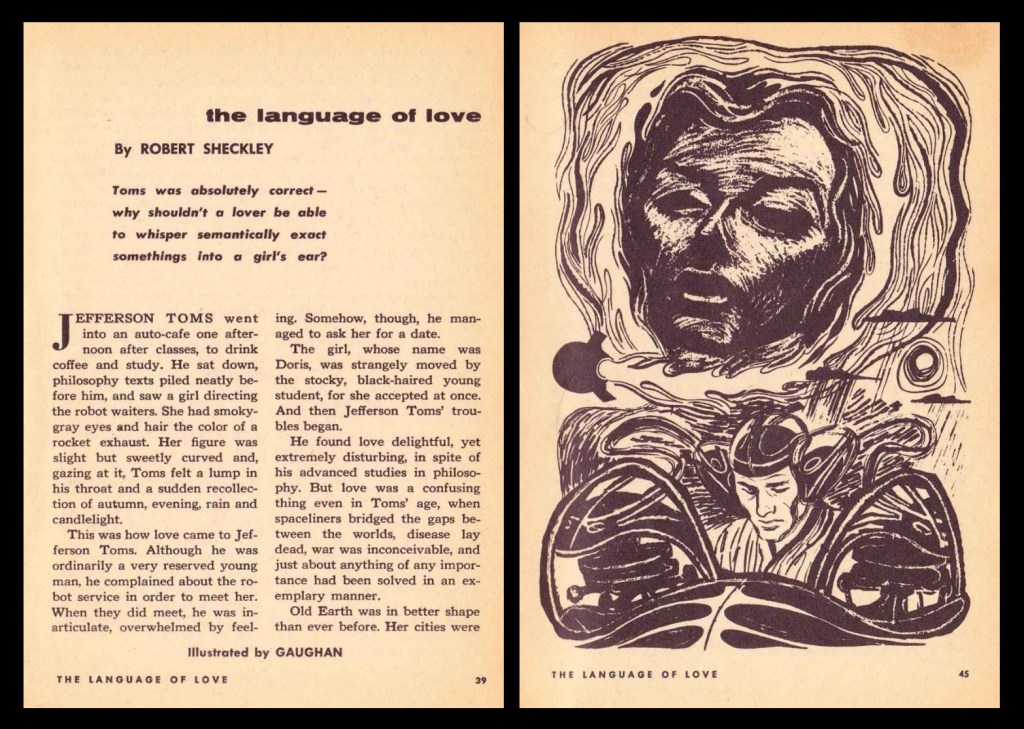
I added “The Language of Love” by Robert Sheckley to the list of best science stories of 1957 because me and my high school buddies loved this story back then, and it has stuck with me for over fifty years. I’ve often talked about it to other people. “The Language of Love” is a silly humorous piece that also offers interesting philosophical insights. I won’t talk about them right away because I hope you will go read the story, but I will eventually spoil the ending by explaining the story.

Robert Sheckley is becoming a forgotten science fiction writer and I think that’s sad. Everyone recalls The Hitchhiker’s Guide to the Galaxy when the topic of humor and science fiction comes up, but they should be using Robert Sheckley as the poster boy for funny Sci-Fi instead of Douglas Adams. And don’t get me wrong. I like Douglas Adams too, but Sheckley mined the funny bone of science fiction far deeper and wider.

Sheckley wrote a lot of short stories in the 1950s and 1960s and they just aren’t remembered. Probably he’s remembered, if he’s remembered at all, for two novels, Dimension of Miracles and Mindswap. Both are available on audiobook, and that’s how you should read them. Neil Gaiman introduces the audiobook version of Dimension of Miracles where he tells a funny/sad anecdote about Sheckley. Gaiman produced several audiobooks for Audible where he promotes forgotten titles and authors. You might like to look at that page.

“The Language of Love” is about a young Earth man, Jefferson Toms, who falls for a girl named Doris. He was overwhelmed by what he felt for her, but when Doris expected Jefferson to tell her he loved her he couldn’t. Jefferson wanted to find the perfect words to express exactly what he felt for her. So, he went on a quest across the galaxy to learn everything he could about love and language.

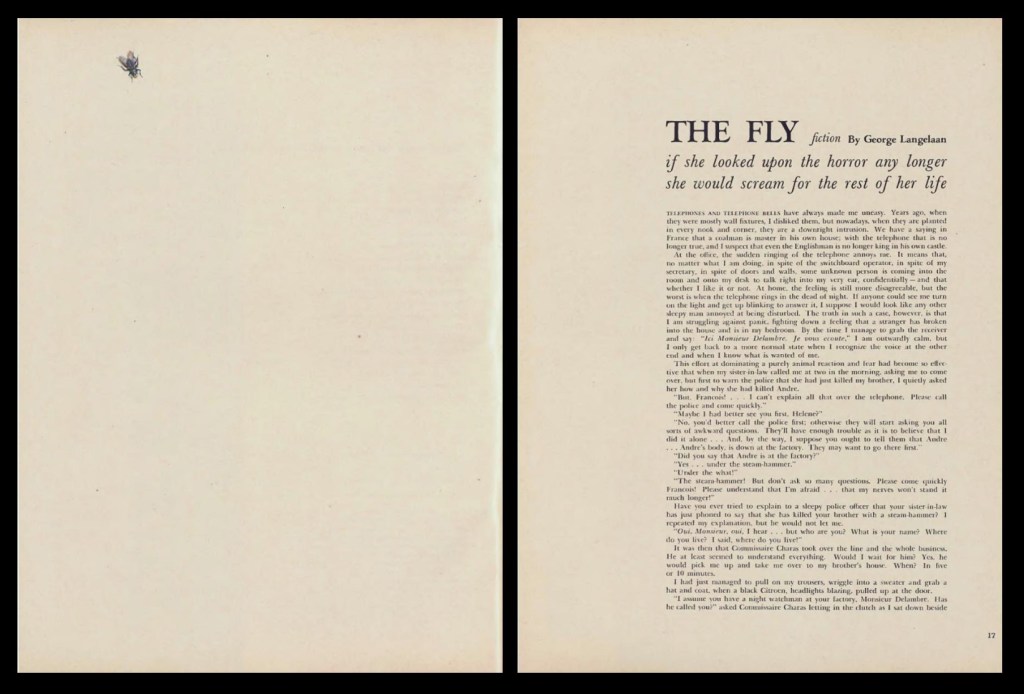
To get you to click on the read link above, I thought I would post the first two pages of the story. Sheckley has a wonderful writer’s voice, and I think you need to hear a bit of it. Maybe that will convey what I mean more than my own words trying to describe it.

When Jefferson returns to Doris and utters the precise words that express his feelings for her, poor Doris is upset. I changed my mind. I won’t give you those words. Or explain the double surprise ending. Just go read the story.

I think “The Language of Love” also captures one of the dominant flavors of Galaxy Science Fiction back in the 1950s. Galaxy loved satire. Often stories in Galaxy were light, jaunty, and sometimes biting. It wasn’t a hard science fiction magazine like Astounding. I’m not sure the type of science fiction Galaxy presented in the 1950s has survived well. H. L. Gold was a much different editor than Frederik Pohl in the 1960s. Only three of the twenty stories our group is reading as the best of 1957 are from Galaxy, I added two of them, “The Language of Love” and “Time Waits for Winthrop” by William Tenn. I added them by abusing my power as moderator. I hope it just isn’t me that fondly remembers this kind of science fiction from the 1950s. I’m looking forward to seeing how the others react.

James Wallace Harris, 3/23/24

“Between the Thunder and the Sun” by Chad Oliver

While my Facebook group is reading twenty stories selected as the best short science fiction of 1957, I’m also searching for other stories from that year that also deserve to be remembered. I think I found one with “Between the Thunder and the Sun” by Chad Oliver, from the May 1957 issue of F&SF.

The trouble is I can find no other recognition for this story. That makes me doubt my own interest in the story. I want to advocate “Between the Thunder and the Sun” not because it’s an exceptional story but because it tackles a serious subject, one that might be new to science fiction in 1957. If you know of early stories on this theme, leave a comment.

Chad Oliver was an anthropologist who worked at the University of Texas. He wrote a fair amount of science fiction, but I only remember him for Mists of Dawn, a 1952 Winston Science Fiction juvenile I read as a kid. Oliver had more success as a western writer. “Between the Thunder and the Sun” was only anthologized in one notable anthology, The Best from Fantasy and Science Fiction, Seventh Series edited by Anthony Boucher, which is essentially the best of 1957 from F&SF, so it’s picking its own children to praise. Still, I need to remember that anthology in my search for other standout SF stories from 1957.

What makes “Between the Thunder and the Sun” significant is it’s a Prime Directive story, a concept that emerged from Star Trek: The Original Series. Evan Schaefer is a professor contacted secretly about a mission to a planet where the population of intelligent beings were dying off on one continent. Because those beings have not reached a stage where they could survive the culture conflict of meeting a technologically superior species from Earth, it is against all our laws to even contact them, much less help them. However, a secret group wants to break those laws and save those beings. Their method of helping the aliens is to get them to understand ecology, because their current practices are self-destructive. And even still, their altruistic efforts only reinforced the Prime Directive laws.

What made this story stand out to this afternoon was I had just watched a YouTube review of Hard to Be a God by Arkady and Boris Strugatsky, a 1964 Russian novel that was translated into English in 1973 that is also about the Prime Directive. This made me wonder when the concept first appeared in science fiction or as a public concept. I can’t answer that question, but I hope readers of this blog can, and will comment below.

“Between the Thunder and the Sun” is a pleasant enough story to read, but it lacks suspense, drama, tension, and when conflict does arrive near the end, it just happens. Oliver wrote the story as an unfolding narrative. There’s lot of interesting ideas in the story, lots of imaginative details, but the story just doesn’t zing.

Should we remember a science fiction story just for its ideas? If you look at a list of the most remembered SF short stories, they are often based on remarkable ideas. But nearly all of them have remarkable storytelling too.

Neither Judith Merril, T. E. Dikty, or Asimov and Greenberg included “Between the Thunder and the Sun” in their anthologies of the best science fiction stories of 1957. That’s striking out three times. However, Merril did include the story in her honorable mentions.

If you get a chance, read “Between the Thunder and the Sun” and let me know what you think. Here’s the link again.

James Wallace Harris, 3/19/24

The Sea and Summer by George Turner

A few weeks ago, I wrote “Deadly Serious Science Fiction” that reviewed The Deluge by Stephen Markley, comparing it to the classic Stand on Zanzibar. A guy named Bruno on Facebook read my piece and recommended I read The Sea and Summer by George Turner. And now I have. Because of Bruno’s advice, I went to Amazon to research The Sea and Summer, and its description of the novel intrigued me. I was further persuaded by the fact that it’s Book #86 of the SF Masterworks series, and that Amazon had the Kindle edition on sale for $1.99. It’s still on sale. Here’s the description I found at Amazon:

Francis Conway is Swill - one of the millions in the year 2041 who must subsist on the inadequate charities of the state. Life, already difficult, is rapidly becoming impossible for Francis and others like him, as government corruption, official blindness and nature have conspired to turn Swill homes into watery tombs. And now the young boy must find a way to escape the approaching tide of disaster.

The Sea and Summer, published in the US as The Drowning Towers is George Turner's masterful exploration of the effects of climate change in the not-too-distant future. Comparable to J.G. Ballard's The Drowned World, it was shortlisted for the Nebula and won the Arthur C. Clarke Award.

Winner of the Arthur C. Clarke Award for best novel, 1988

The Sea and Summer was first published in 1987 and is about the impact of global warming on the mid-21st century. The novel is told through multiple first-person tales with a third-person frame. The summer of the title is the period of global warming. The frame is set in the far future, with the autumn people, humans who have survived global warming and are waiting for winter, a new ice age.

The frame is about archeologists exploring sunken high rises. Andra wants to write a play about the people who once lived in the towers. Lenna tells him she’s already written a novel about civilization’s collapse, just at the beginning of the global warming summer. It’s about a man named Billy Kovacs. Lenna lends Andra her novel hoping it will provide him inspiration for his play. The main part of The Sea and Summer is her novel.

The Sea and Summer is so good that I’m surprised it’s not famous. I’m also surprised I didn’t already know about it. For a science fiction novel, it’s up there with Earth Abides by George R. Stewart in terms of literary quality. It covers the same territory as The Deluge and The Ministry of the Future by Kim Stanley Robinson, but with deeper emotion and insight.

The story is set in Australia after things begin to go bad, and the seas are washing in on coastal cities. Because of a failing economy and automation, a huge percentage of the population are out of work. To solve that problem, the government builds gigantic high rises seventy stories tall, that house a thousand people on each floor. These towers are segregated away from the city center.

In this future Australia, there are three social-economic levels. The Sweet are people who have jobs and normal lives, the Swill, are the unemployed who live in the towers, and the Fringe, who have lost their jobs but can still afford to avoid the towers.

The story begins in 2061 with the Conway family. Alison is the mother of two boys, Teddy, and Frances. When the father loses his job, the family is forced to move into Fringe housing, within the shadows of the tower. They are terrified they will soon be forced into the towers when their savings run out.

The most interesting character of the whole novel is Billy Kovacs, the Swill boss of tower twenty-three, who tells the family he will protect them for ten dollars each a week and keep them out of the towers. Billy starts out as a vicious, disgusting individual that grows and grows on you. He is warm-hearted about helping people survive but is completely cold-blooded in making sure it happens.

Teddy and Frances are terrified of falling out of the fringe into the towers, so they each find a way to get back into the Sweet economy, cruelly abandoning their family. Ultimately, they learn a great deal about surviving in a world that is quickly falling apart.

Along the way we encounter several fascinating characters, especially Nick and Nola, who become mentors to Teddy and Frances. Eventually the plot turns into a thriller, as one conspiracy reveals itself to Teddy, and it draws all the characters into it.

There is a hard political/philosophical edge to The Sea and Summer that reminds me of Heinlein’s fictionalized philosophy. However, Turner does an excellent job of not pontificating like Heinlein. Turner is also far better at dramatizing his political views and developing a tight plot. Still, that tinge of Heinlein makes me think Turner must have been a Heinlein fan.

There are two reasons why I compared The Sea and Summer to Earth Abides. First, they both have a similar solution for helping future generations survive the collapse of civilization. And the second is The Sea and Summer felt as personally engaging as Earth Abides. They both are emotionally driven. The problem with The Deluge and The Ministry of the Future is they were too intellectual and dry. I never felt for their characters or that I was living in the world they described. Both are impressive intellectual speculations and writing experiments, but not moving. Earth Abides and The Sea and Summer are.

I love discovering forgotten science fiction classics. I felt the same excitement discovering The Sea and Summer as I did when I discovered The Hopkins Manuscript by R. C. Sherriff. I need to read more by both authors.

Rating: *****

James Wallace Harris, 3/17/24

“Melancholy Elephants” by Spider Robinson

Our Facebook group is reading and discussing all the Hugo award winning short stories and novelettes that we’ve haven’t covered in all our previous years. “Melancholy Elephants” by Spider Robinson is a 1983 Hugo winner that I have no memory of even hearing about before. It first appeared in the June 1982 issue of Analog and came in first in the Analog Readers Poll. But then, that’s the fun thing about Group Read 69, we’re discovering stories that should be remembered, or at least consider why they haven’t.

“Melancholy Elephants” is about extending the copyright lifetime. It’s set in the future, and powerful entities want to pass a bill to make copyright perpetual. Dorothy Martin feels this will be a threat to civilization and it’s vital that the bill be stopped. She goes to see a powerful senator she hopes to convince or bribe into killing the proposal.

Most of the story is infodumping about copyright laws. It talks about how there are limits to creativity and if fiction and music are locked down by copyright, it will destroy them. The story even gives examples, including Harlan Ellison and A. E. van Vogt suing movie companies and winning, and George Harrison unconsciously cribbing “He’s So Fine” to write “My Sweet Lord” by the Chiffons. In the future of this story, there will be powerful computer programs that test for previous use and reject copyright violations. Mrs. Martin’s husband committed suicide when he realized his latest and greatest work was inspired by music he heard in childhood.

I don’t see why this story won the Hugo and Analog Readers Award, but then I don’t remember any of the short stories it competed with either. Also, I disagree with Mrs. Martin’s conclusion. I don’t think long copyright terms keeps artists from innovating, but I do think it keeps some works from being remembered. For example, copyright keeps me from linking to a copy of this story for you to read.

What I found fascinating by “Melancholy Elephants” was how much the story felt like a Heinlein story. Spider Robinson was a huge fan and friend of Heinlein, and this story feels like he stole from Heinlein in the same way Harrison appears to have stolen from The Chiffons.

The story starts out with Dorothy Martin killing a mugger. She justifies it because she couldn’t be late with the meeting with the Senator, ruining her only chance of saving the world from a fate worse than death. “Gulf” by Robert A. Heinlein starts with the protagonist causally killing an attacker and justifying it by his righteous cause. And if memory serves me right, the same thing happened in Heinlein’s novel, Friday. Heinlein like to promote the value of his characters beliefs and causes by casually killing people. He equates the end justifies the means with these quick scenes. I always thought they represented massive egos believing their way of thinking puts them above all others.

“Melancholy Elephants” could have been done without the scene of Mrs. Martin killing someone and hiding the body under the car. It gave the story a repulsive beginning. The story really needed to be an essay, but Spider Robinson sells fiction, so he took the idea and fictionalized it much like Robert A. Heinlein would he wanted to promote his beliefs.

Mrs. Martin visits the Senator, who comes across like Heinlein’s Jubal Harshaw. The way she makes her case and the way the Senator makes his is exceedingly Heinleinesque At one point Mrs. Martin tries to buy off the Senator and he explains he can’t be bought off because he’s already been bought off and it would be unethical to go against the original deal. Heinlein was big on representing government as being corrupt and things got done by big egos battling it out. Heinlein loved to write scenes where his character persuades others on a particular super-vital issue. However, Heinlein’s scenes often come across as character promoting their righteousness, rather than logic.

In the end the Senator sees Mrs. Martin’s side of things and reverses himself, but the way he does it also reminds me of Heinlein characters when they do give in.

It’s ironic that “Melancholy Elephants” is about protecting a creative person’s rights to borrow from the art that inspired them because this story is obviously inspired too much by Heinlein.

James Wallace Harris, 3/5/24

“Legwork” by Eric Frank Russell

“Legwork” was first published in Astounding Science Fiction, April 1956. You can read it on Archive.org. It is story #10 of 22 for The Best SF Stories of 1956 group read. “Legwork” was a finalist for the 1956 Hugo Award for novelette, but it was not collected into any of the best of the year anthologies even though I think it’s a four-star-plus story. It did get an honorable mention by Judith Merril.

“Legwork” was rarely anthologized, but Mike Ashley reprinted in Future Crimes in 2021 as part of his British Library Science Fiction Classics series. Here’s Ashley’s introduction for “Legwork.” It makes me want to read more Eric Frank Russell, but then I say that every time I review one of his stories. I need to do what I say.

Eric Frank Russell (1905–1978) was one of Britain’s leading sf writers in the 1950s, alongside Arthur C. Clarke and John Wyndham, but his reputation has faded since he more-or-less stopped writing in 1965. He honed his craft on reading American pulps in the 1930s and could muster a passable American idiom. He enjoyed pulp crime fiction. When he finalized his first novel, Sinister Barrier, which involves the investigation by a special government agent into a series of unusual and unexplained deaths, Russell modelled it on the American pulp G-Men. It clearly worked. John W. Campbell, Jr., bought it for the first issue of Unknown, and the novel, about aliens controlling humans, became instantly popular. Russell enjoyed creating strange mysteries investigated by the police in such early stories as “Shadow-Man” (1938) where the police try and find an invisible criminal, or “Seat of Oblivion” (1941) with the police trying to find a criminal who can possess other people. One of his last books, With a Strange Device (1964), issued in America as The Mindwarpers, was an expansion of a novella which first appeared in a detective pulp in 1956 and many critics argued it was not science fiction at all, but a Cold War thriller about the manipulation of scientists’ minds. I have no doubt Russell would have made a good crime-fiction writer had he put his mind to it. The following story, written and set in 1955, pits human ingenuity against alien ability.

Future Crimes: Mysteries and Detection Through Time and Space. British Library Publishing. Kindle Edition.

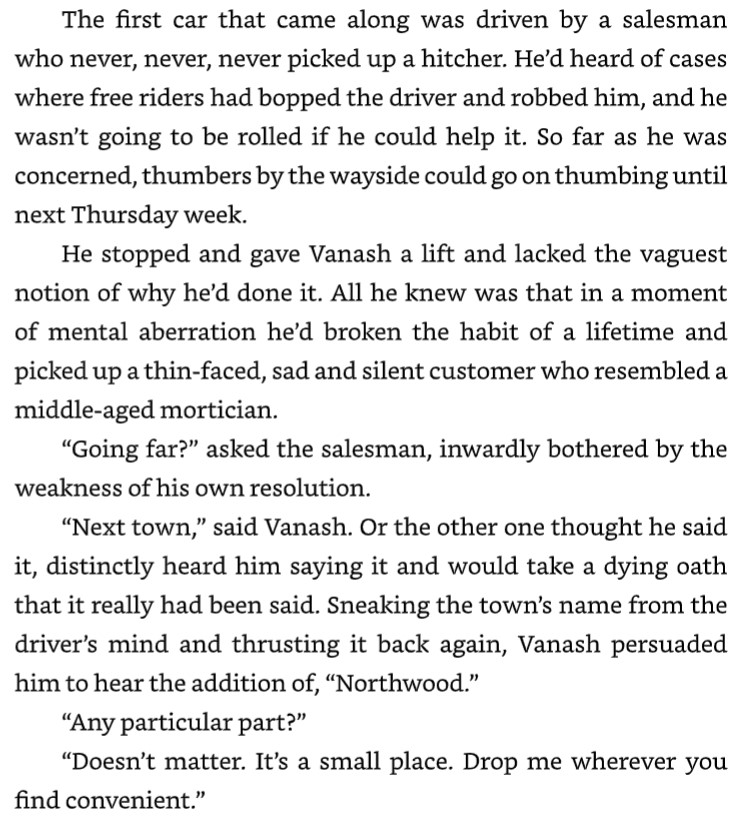
“Legwork” introduces us to Harasha Vanash, an invader from Andromeda, who can control minds for a radius of one mile. This allows him to pass as anything his victims can imagine. For all intents and purposes, Vanash is a shapeshifter. “Legwork” begins with Vanash landing his spaceship out in the middle of nowhere, sending the spaceship back up into a parking orbit, hiding the ship’s remote controller in a hollow stump, and heading out to invade Earth alone. Vanash has invaded fifty worlds and is quite confident he will quickly take over our planet. Vanash makes himself seen as a human to the people who see him, hitches a ride to a nearby city, gets a room in a boarding house, and starts studying our ways. Here’s how Russell’s prose sounds:

Once settled and observing that money is essential to our way of life, Vanash sets out to get a steady supply. The story then cuts to Edward G. Rider, a genuine human who works at the United States Treasury. Rider is a big guy, weighing two hundred and fifty pounds. He’s recently married and is quite annoyed by his boss assigning him to an out-of-town job investigating a rather strange bank robbery.

Wikipedia has a fascinating article about the long history of shapeshifting in myth and fiction. It’s a theme that comes up in science fiction often. In myth and fantasy, magic causes shapeshifting, but in science fiction, the writer must come up with a good explanation for it.

Who Goes There?” by John W. Campbell, Jr. is a famous 1938 science fiction shapeshifting story that might have inspired Russell. I especially wonder that after reading Ashley’s introduction. Campbell asks us to believe in “Who Goes There?” that an alien organism can restructure its body instantly, and the mystery is how to detect such an organism. In “Legwork” the shapeshifting is all illusion, and the humans don’t even know there is a shapeshifter. A good portion of the story is working out how mysterious bank robberies are taking place and coming up with a theory about a shapeshifting crook.

Eric Frank Russell’s “Legwork” could have been a great 1950s film noir movie because it’s about gritty routine detective work. Orson Welles was about the right size in 1956 to play Eddie Rider if you think about his 1958 film Touch of Evil. Russell does an excellent job of producing a police procedural in “Legwork.” In fact, it’s exactly the kind of police procedurals people saw in black and white movies of the 1950s. Imagine seeing The Asphalt Jungle, Odds Against Tomorrow and The Thing from Another World mixed into a slick film noir. I would love to see it. That’s how I imagined “Legwork” when I read it.

And thinking about shapeshifting science fiction and 1950s black and white films, I’m also reminded of Invasion of the Body Snatchers from 1956. It was a metaphorical take on shapeshifting, designed to make us think about communism. “Legwork” isn’t metaphorical, it’s straight-ahead science fictional alien invasion story. What’s weird is our short story reading group just read “Counterfeit” by Alan E. Nourse, another shapeshifting themed story, but not as good as “Legwork” because Nourse’s prose showed bad pulp fiction writing habits while Russell’s did a slick writing job with “Legwork.”

Russell has a light touch in this story, it’s not humorous like his two most famous SF stories, “Allamagoosa” and “… And Then There Were None,” but “Legwork” has just enough subtle sarcasm and faintly absurd situations that we know that Russell is making fun of Vanash’s overconfidence in conquering us humans. Russell also throws in some nice touches along the way. A teen who is an amateur astronomer with a home built 8″ reflector telescope discovers Vanash’s spaceship in orbit. Me and my buddies tried to grind an 8″ inch telescope mirror and failed when I was a teenager. There are two places where dogs start yelping and run off. That lets us know dogs that see what Vanash really looks like and it must be pretty damn scary.

“Exploration Team” by Murray Leinster won the novelette Hugo in 1956. I thought it a pretty good story, but until now in our group read 67, I thought “Brightside Crossing” by Alan E. Nourse should have gotten that Hugo. Now I’m thinking “Legwork” deserved the trophy. I wonder how many times I will change my mind when we read the next twelve stories?

My friend Mike also liked “Legwork” and sent me these comments:

“Legwork” is an interesting humans vs. aliens story, a well-worn science fiction trope that is skillfully manipulated by Eric Frank Russell.


Russell immediately introduces us to Harasha Vanash, an Andromedan thought-form whose “…natural power had been tested on fifty hostile worlds and found invincible.” Vanash is a menace to Earth when “…he’d discovered an especially juicy plum, a world deserving of eventual confiscation by the Andromedon horde.”

Russell’s genius is that he sets the stage for the impending confrontation by contrasting the Andromedon and human problem solving abilities.

The Andromedons depend upon “…flashes of inspiration that come spontaneously, of their own accord. They cannot be created to order no matter how great the need.”

Humans depend on hard work: “Variously it was called making the grade, slogging along, doing it the hard way, or just plain lousy legwork. Whoever heard of such a thing?”

As the story progresses, the humans work tirelessly to solve the problem of the mysterious bank robberies perpetrated by Vanash. Eddie Rider, a special investigator with the feel of a Sydney Greenstreet character, leads the investigation with aplomb.

The humans ultimately triumph and the alien is vanquished. Mankind is preserved. An entertaining and worthwhile story.

James Wallace Harris, 12/18/23

“Silent Brother” by Algis Budrys

“Silent Brother” was first published in Astounding Science Fiction, February 1956. It was by Algis Budrys writing as Paul Janvier. You can read it on Archive.org. It is story #4 of 22 for The Best SF Stories of 1956 group read.

Harvey Cable has a fascinating mystery to solve in “Silent Brother.” The spaceship Endeavor has returned from the first interstellar mission. Harvey might have been on that mission but was badly injured in a test flight of an earlier spaceship. He lives alone. Harvey must use a wheelchair or braces on his legs and a cane in both hands to get around the house. After watching the crew of the Endeavor return home on TV, he goes to bed hoping his old astronaut companions will come to see him soon. The next day he wakes up to find that someone has stolen the picture tube from his television.

After carefully searching his house, Harvey finds the picture tube on his basement worktable. He can prove that no one broke into the house. He even tests the picture tube for fingerprints and only finds his own. But Harvey is incapable of carrying a large TV picture tube downstairs because with leg braces, he must firmly hold onto the handrails. If no one broke into his house, who took the picture tube downstairs while he slept?

Harvey goes to bed the next night after rigging his house so he can’t sleepwalk out of his bedroom. Yet, once again he wakes up refreshed and discovers more work has been done on the picture tube in the basement. None of his traps to keep him in his bedroom have been disturbed.

“Silent Partner” is a fun story that sets up a good lock-room mystery. It has a satisfying solution, but I don’t want to tell you about it just yet. I encourage you to go to the link above and read the story. It won’t take long. “Silent Brother” was reprinted in both Merril’s and Asimov & Greenberg’s best of the year anthologies, but it’s not been reprinted in any major anthology since. My friend Mike who is reading these stories along with me emailed me quite a positive review. I’ll post it below after I get into the spoilers. I also liked the story, but does two guys liking a story sixty years later mean it was one of the best of 1956, or a forgotten classic science fiction story?

I’ve been thinking about the levels of good stories. There are good stories, and then there are good stories. A great story is a good story that launches into orbit for the reader. Not everyone who reads a group of stories will love every story, and different readers will pick different stories they think are the good ones. Here’s a hierarchy:

  • One of the good stories in a magazine
  • One of the good stories in a best-of-the-year anthology
  • One of the good stories that are finalists for an award
  • One of the good stories in a general anthology
  • One of the good stories that are in theme anthology
  • One of the good stories that are in a retrospective anthology
  • One of the good stories in a list of the all-time best stories.

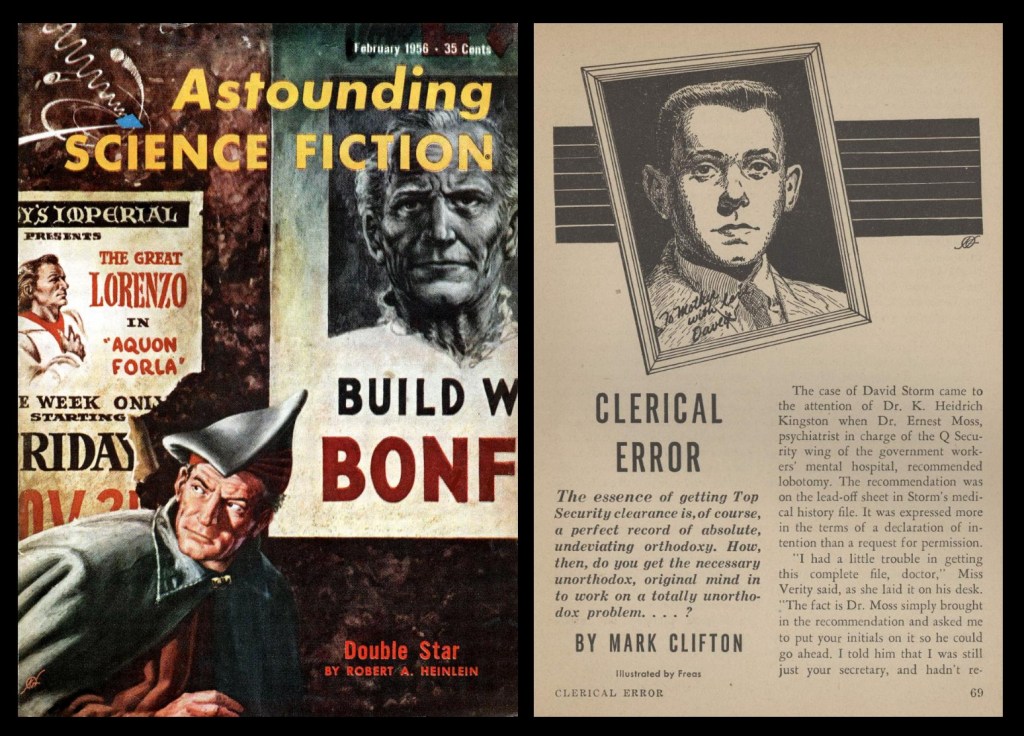
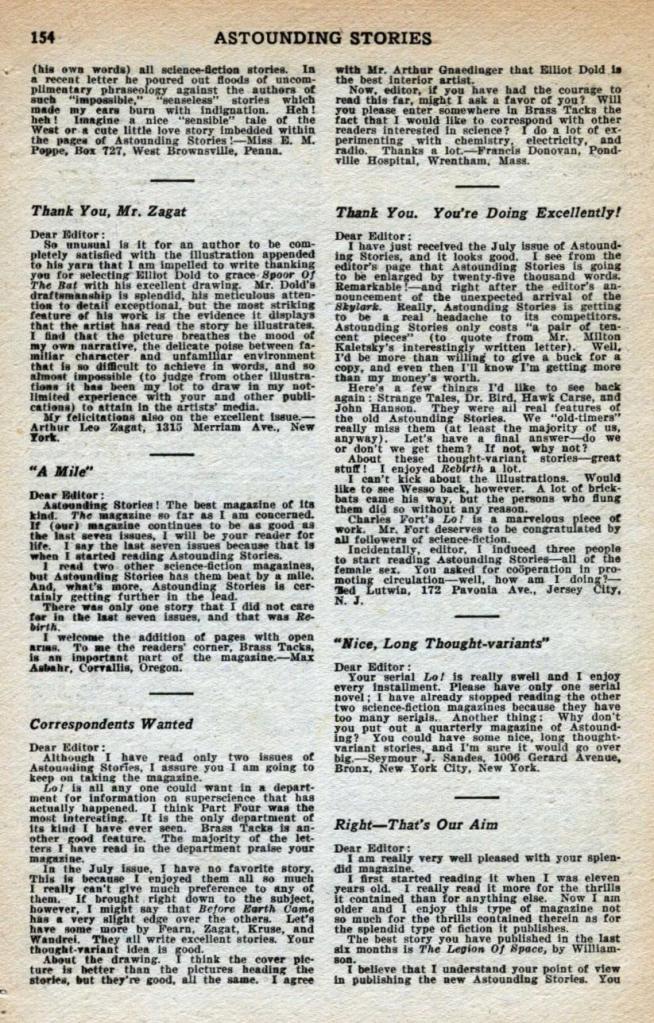
“Silent Brother” was in the same 1956 issue of Astounding Science Fiction with the first part of Double Star, one of Heinlein’s best novels, and it won the Hugo award. The issue also contained “Clerical Error” by Mark Clifton which I reviewed last time. Our short story club generally didn’t like “Clerical Error” but Astounding readers back in 1956 picked it as their second favorite after the Heinlein serial in The Analytical Laboratory poll. “Silent Brother” came in third. I like both “Clerical Error” and “Silent Brother,” but I wouldn’t reprint either if I was an anthologist. I thought “Clerical Error” was more ambitious but poorly written, and I thought “Silent Brother” nicely written, and very enjoyable, but far from great. I can easily say it’s a good story, but what does that mean?

If you look at the table of contents for Merril’s best-of-1956 anthology, none of the stories stand out to me except “Stranger Station” by Damon Knight. That story has shown up three times already in our short story reading group because it’s often reprinted. I haven’t read most of Merril’s selection, and “Silent Brother” might be among the good ones. But “Silent Brother” is not in the same league as “Stranger Station.”

Looking at the table of contents from Asimov and Greenberg’s best-of-1956 anthology, we see five stories that stand out: “The Country of the Kind” by Damon Knight, “Exploration Team” by Murray Leinster, “The Man Who Came Early” by Poul Anderson, “The Last Question’ by Isaac Asimov, and “Stranger Station” by Damon Knight. These are all stories our group has encountered several times in the many anthologies we’ve already read. I have read The Great SF Stories 18 (1956), and “Silent Brother” falls toward the back of the pack. (It is interesting that Asimov and Greenberg with thirty-two years of hindsight were able to create such a solid lineup of 1956 SF stories.)

“Silent Brother” wasn’t a finalist for the Hugo award, and it’s never been anthologized for a major theme or retrospective anthology. Nor is it on any fan poll for being an all-time great SF story. Now, do you sense the relative nature of good? What I want to find are the most memorable, most powerful of the SF stories from 1956 that most people consider good. I liked “Silent Brother” a fair amount, but I wouldn’t anthologize it if I was creating an anthology of the best SF short stories of 1956. I might include it in a theme anthology if it worked well with the other stories.

Still, it was a pretty good story. And I think it would be interesting to analyze why? For me, the mystery about who was rebuilding the television made the story a page turner. However, it was the conclusion that elevated the story with a particular kind of happy ending. The crew of the Endeavor brought back invisible aliens who they had developed a highly beneficial symbiotic relationship. The silent brother was a new alien being that lived inside of you. Now, if you had just read Heinlein’s The Puppet Masters you might not think this was so wonderful, but Algis Budrys pulled it off. Why?

I think the idea of having a silent brother that heals and helps you if awful lot like what religion promises, like believing that Jesus will save us, or becoming one with God who will watch over all his followers. “Silent Brother” represents a story of transcendence. It reminds me of the ending to Childhood’s End. Harvey Cable was lonely and suffering from a damaged body. He, and the Endeavor crew welcomed the alien into their bodies and passed them on. But isn’t this the same story as The Invasion of the Body Snatchers? But that story was a metaphor for communism. Budrys presents the alien as a brother. Is it little brother to big brother? Harvey’s personality isn’t changed or possessed; he just has a very helpful invisible friend living inside of him.

Algis Budrys was a savvy guy. I’m guessing he consciously knew about the religion connection in his story, and he knows that most people would love to have a personal god to help them. Instead of inventing a theological being, Budrys creates an alien that serves the same function.

Here’s what Mike had to say:

I think "Silent Brother" is an excellent story.

The genius of the story is what Budrys leaves out. He gives us bits and pieces, and our imagination fills in the blanks.

For example, Harvey Cable has obviously been seriously injured in the past. We don't know for sure what happened to him, but we imagine some kind of space flight misfortune left him damaged. Was it radiation? Was it an equipment failure, or a spaceship catastrophe? Budrys gives us room to speculate.

Budrys relates that Cable's struggle is both physical and mental. He "...trembled on the brink of admitting to himself that his real trouble was the feeling that he'd lost all contact with the world." He is in trouble and "The idea was to hang on to reality."

It's slowly revealed that Cable is disassembling his TV set and reworking it into something else. Budrys writes beautifully descriptive sentences: "How did one shot-up bag of rag-doll bones and twitchless nerves named Harvey Cable accomplish all this in his sleep?" and "What in the name of holy horned hell am I building?"

Once the TV rebuild is complete, Budrys never reveals its exact purpose, but it's obviously of great importance because afterwards "...he felt his silent brother smile within him." Again, we get to fill in the blanks on our own.

A parasitic alien has entered Cable, and healed him. "Who wants symbiosis until he's felt it?"

Budrys explains "...we were born in a solar system with one habitable planet, and we developed the star drive. And on Alpha's planet, a race hung on, waiting for someone to come along and give it hands and bodies

Cable's final act is to send part of his silent brother to each of the three men who have come to interview him. The parasitic alien is passed on.

No long info dumps. No discursions. A concise, heartfelt, beautifully written story.

I think Mike admired the story far more than I did. I thought the rebuilt TV with its flashing lights helped Harvey connect with his new brother and helped him to retrain him to reprogram his damaged body. It’s like when Dr. Cal Meacham builds an “interocitor” in the film “This Island Earth” — the gadget allowed him to connect with aliens.

Mike and I have talked about “Silent Brother,” discussing how stories affect readers differently. Critics often write about fiction as if there were objective standards, but that’s not possible. Fiction is like a day, for some people the day might be wonderful, and for others horrible, and for many just another day.

I’m looking forward to seeing how many members in the Facebook group like or dislike “Silent Brother.”

James Wallace Harris, 12/4/23
“Clerical Error” by Mark Clifton

“Clerical Error” was first published in Astounding Science Fiction, February 1956. You can read it on Archive.org. It is story #3 of 22 for The Best SF Stories of 1956 group read. I selected “Clerical Error” for our best SF stories of 1956 group read because Asimov and Greenberg, and T. E. Dikty selected this story for their best-of-1956 anthologies, and Judith Merril listed it in her anthology for 1956 as an honorable mention.

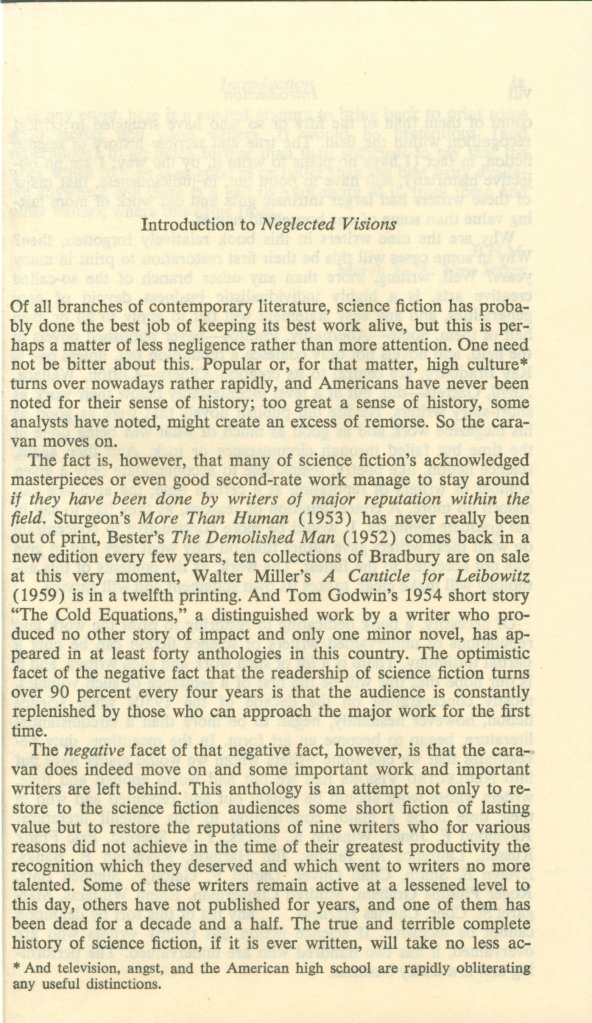
The only significant anthology that reprinted the story was Neglected Visions (1979) edited by Barry Malzberg, Martin H. Greenberg, and Joseph Olander, whose goal was “an attempt to restore the reputations of eight writers who did not achieve the recognition they deserved.” “Clerical Error” was also reprinted at SciFiction.com in 2002, an early internet effort to reprint classic science fiction online. Barry Malzberg also edited The Science Fiction of Mark Clifton back in 1980. Long out of print, but copies are available on ABEbooks.

In other words, “Clerical Error” has its fans who have tried to save it over the years, but the first time I read it, I found the whole beginning muddled, too full of info dumping. This time I also found the first part impenetrable and stopped reading. I then gave it a rest and started researching the story online. I could tell Clifton was trying to do several things at once in the first half of the story. He was setting up the much simpler second half, but he was also using the story to expound on science, scientists, and the perception of science, among other things.

Clifton also worked hard to develop his characters, and convey them psychologically, and even have us understand the psychological understanding of the psychiatrist. But this requires close reading.

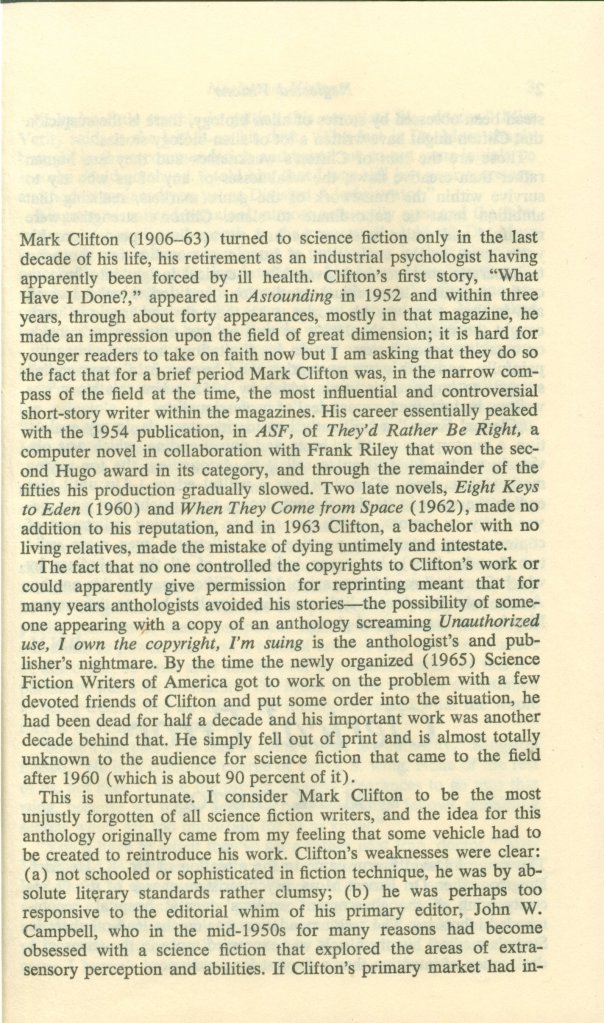
I then read Barry Malzberg’s introduction to “Clerical Error” where he gives us some background on Mark Clifton. After reading that, and thinking about what I had read so far, I went back and started the story for a third time. For some reason I was in the right mood, and I zoned in on what Clifton was doing. This time the story worked great. Here’s Malzberg’s introduction.

I really wanted to hear this story too, but I couldn’t find any audiobook narration of the story. I even downloaded a pirated copy of a Mark Clifton collection in .pdf format and loaded it into the Edge browser which has a very good text to speech function. It works to a degree, but ultimately, I had to give up.

The story’s set up involves a scientist, David Storm, going insane. Because Storm works for the government in a high security job, the government doesn’t want to release him to outside doctors. He babbles about technology that will change the world. Dr. Ernest Moss, the psychiatrist with security clearance in charge of Storm requests that Storm be given a lobotomy. Dr. Kingston, the psychiatrist administrator over Dr. Moss doesn’t want to allow the lobotomy until he understands the case, but he doesn’t have top level security.

Dr. Kingston tries several end-runs around bureaucracy desperately to save Storm. Each step gives Clifton a chance to pontificate about science versus the government. Since Malzberg points out that Clifton was an industrial psychologist, this means his insights have some weight.

One reason why the story is so hard to get into is it digresses in so many directions. Clifton focuses on Dr. Kingston and his secretary Miss Verity. She is the top secretary in the psychiatric division, and Clifton represents them as the two most powerful people in the story. Miss Verity has a mind of her own concerning how things should be done. She wants to protect her boss Dr. Kingston. Dr. Moss tries to bypass Dr. Kingston by trying to get Miss Verity to sign off on the lobotomy for Kingston. That’s when she alerts Kingston to the problem. The rest of the story is Kingston trying to get help for David Storm, which would require sending him to doctors without security clearances.

This is all straightforward. Clifton complicates things by using the power struggle between Kingston and Moss to comment on psychiatry and science. This is why the story is in Astounding, because John W. Campbell Jr. loved these kind of discussion stories that challenge how people think, how they contend with authority, and how the status quo should be questioned.

I can understand how an insane scientist who babbles about government secrets could be a problem, but would a lobotomy even stop him from talking? It could quiet his constant anxiety and rage, but would it erase what he knows? I’m not sure how lobotomies work. Storm has also gone through a series of electroshock treatments that hasn’t shut him up.

Clifton uses “Clerical Error” to promote psychiatry as a science. But he also develops each character with a lot of psychological insight. This adds another layer to the story. And it’s why I said the story is hard to get into. Clifton is doing three things at once. Expressing politics, showcasing psychiatry and psychology, and telling a story. Along the way he also gives several reasons for the title of the story.

Like I said, it all came together for this third reading. I think if I read “Clerical Error” a fourth or fifth time, I’d get even more out of it. There’s a lot to it. It’s a shame that Clifton’s stories aren’t in print. But that’s why we’re doing this group reading for The Best SF Stories of 1956, to find forgotten classics that deserve more attention. I really like what Barry Malzberg said in his introduction to Neglected Visions. I hope he doesn’t mind me reprinting it here.

Unfortunately, Mark Clifton seems to be mostly out of print. You can find his original magazine publications using ISFDB and Archive.com. However, Amazon does have The Second Golden Age of Science Fiction MEGAPACK ®: Mark Clifton for 99 cents. It doesn’t have “Clerical Error,” but it does have a handful of stories and a couple of serials. In 2020 Dover published What Have I Done?: The Stories of Mark Clifton. The paperback is currently $7.48 for 288 pages, but the ebook is $3.99 but claims to only have 21 pages. That worries me. It appears to only be the first story.

James Wallace Harris 11/30/23

“Brightside Crossing” by Alan E. Nourse

Brightside Crossing” was first published in Galaxy Science Fiction, January 1956. You can read it on Archive.org or Gutenberg.org or listen to it on YouTube. It is story #1 of 22 for The Best SF Stories of 1956 group read.

“Brightside Crossing” begins in a bar on Earth, the Red Lion, with James Baron sitting at a table. A grizzled old man comes in to see him, Peter Claney. We learn that Baron is planning an expedition to the planet Mercury, hoping to trek across the sun side surface and reach the equator when the Sun is at its closest and hottest position. Temperatures will reach 770 degrees Fahrenheit. When this story was written it was thought Mercury always had one side facing the Sun, the Brightside, like how one side of the Moon always faces the Earth. We’ve since learned that Mercury does slowly rotate three times for every two solar orbits Mercury makes.

Peter Claney was part of a team that previously tried to make the Brightside crossing, and he’s come to the Red Lion to warn Baron not to try. This implies Peter’s team failed, and Peter’s story is how we learn about that failed attempt. Nourse’s story is what we now call hard science fiction, although the term wasn’t coined until a year later. Even for 1956, I had several nit-picks about this story’s realism, but nothing that detracted from it being a great science fiction adventure tale. It was a finalist for the Hugo.

“Brightside Crossing” reminds me of reading books by polar explorers, or about the men who tried to find the Northwest Passage, especially of Franklin’s lost expedition. It’s about the kind of person who will endure extreme hardship to be first somewhere.

I agree completely with what my friend Mike emailed me about the story:

1. Nourse avoided the info dump trap. He succinctly describes the equipment used to make the Mercury crossing without falling into the endless info dumps found in some stories. 

2. The characters have depth and nuance. Ted McIvers is described as “kind of a daredevil.” At first, we think he’s just foolhardy, but we eventually realize that they will die if they don’t move faster and McIvers is trying to save them. Peter Claney admits “A man like McIvers was necessary. Can’t you see that?” Jack Stone is fearful and reveals “I’m scared.” However, when McIvers needs to be rescued, Jack agrees to go down and help. He overcomes his fear. And Peter Claney states categorically that the crossing is impossible, but he still wants to try again and be part of another attempt.

3. The story echoes the courage and heroism of the great Antarctica explorers Robert Scott and Ernest Shackleton.  

4. Nourse’s descriptions of the terrain are beautiful and terrifying. Every word is carefully chosen. We can feel the heat. The danger is visceral.

“Brightside Crossing” also reminds me of what I loved about science fiction as a kid back in the 1960s, but I don’t think I read “Brightside Crossing” then. I do vaguely remember a few science fiction stories set on Mercury. It is exactly the kind of story that would have wowed me as a kid because I loved science fiction stories that I wanted to feel were possible. This is my second reading of “Brightside Crossing” and I’m even more impressed than the first time I read it in The Great SF Stories 18 (1956) a couple of years ago.

This time as I read it, I thought “Brightside Crossing” represents the kind of science fiction I would use in creating my definition of science fiction. The story is believable in the way I want to define science fiction. Sure, Nourse’s speculation might be faulty or even impossible by today’s scientific knowledge and technology, but in the 1950s the story seems possible, at least to a kid who embraced the theology of the final frontier.

My disappointment with a lot of science fiction, especially science fiction from recent decades, is it’s not believable. I don’t know why when I was a kid, I wanted to believe humans would explore all the planets and moons of the solar system. I thought science fiction was propaganda to make such exploration happen. I knew there were two kinds of science fiction. The kind I like imagined either a probable future we should avoid or a future we should want to create. The other kind of science fiction was just stories that got its ideas from the first type. And like the degradation of originals from making copies of copies, too much science fiction seems inspired from science fiction cliches.

Over time, I think science fiction has become the label for any fantastic tale that involved the future or outer space. A splendid example of the second kind is “Fondly Fahrenheit” by Alfred Bester. It’s still a classic story, but not the kind of science fiction I’m talking about. Bester was both having a go at the genre and pushing it to its limits. Unfortunately, I think writers have settled on the second kind of science fiction as the preferred kind and see it as a Disneyland to work out their wildest ideas, rather than serious speculation about reality.

Like Busby Berkeley always working to top his previous dance routine, science fiction keeps trying to top itself. And like Busby Berkeley, the results have gotten absurdly wild. Busby Berkeley expected the movie audience to believe that his dance routines would be what an audience in a cabaret or Broadway theater would see, in the same way science fiction writers now expect their readers to believe their stories would fit into our little old reality. Sure, it’s fun to see fabulous big productions created by wild fancies of the mind but there’s something to be said about real people confined to Earthly possibilities. In case you have no idea, who Busby Berkeley was, or my analogy, I’ll include this film clip:

Alan A. Nourse was never a big name in science fiction, but I have encountered his work now and then, but I only vaguely remember him. “Brightside Crossing” inspires me to find more of his work. The two I think I might have read as a kid; are ones I want to try:

But I’d also like to find the collection below because of its neat cover, but it will probably be easier to get Alan E. Nourse Super Pack at Amazon for $1.99, which has several of the same stories, including “Brightside Crossing.”

By the way, “Brightside Crossing” had three things I couldn’t believe, but they were just little bumps in the road. The first are the suits that protected them from the horrendous heat. They plan to stay in them for over a hundred days. How did they handle peeing and pooping? A kid would wonder that and so did I as an old man. I also found it unbelievable that Ted McIvers could just show up late by hitching a ride on a Venus supply rocket, days after the others had arrived. That bothered me because trips would be rare to the planet Mercury. Finally, when Ted McIvers goes off course and stumbles upon the remains of the last expedition that tried to make the Brightside crossing. That seemed like way too much of a coincidence. They are crossing a whole planet, and they just happen to discover what happened to the previous explorers.

James Wallace Harris, 11/27/23

“The Short Life” by Francis Donovan

Who was Francis Donovan? He has exactly one story listed in ISFDB, this one, “The Short Life.” That story first appeared in the October 1955 issue of Astounding Science Fiction. It was reprinted in three editions of Best SF Four edited by Edmund Crispin, and in a large retrospective anthology, The Best Science Fiction Stories (1977) – no editor listed. Since both of those anthologies were published in England, I assume Donovan may have been English.

You can read “The Short Life” online at Project Gutenberg and on the Internet Archive. You might want to get an EPUB version for your ebook reader since it’s a novella.

I’m recommending this story to my reading group who are discussing the best short science fiction of 1955. I was asking the group which novelettes or novellas they thought should have won the Hugo award back then if they didn’t like “The Darfsteller” by Walter M. Miller, Jr. I think “The Darfsteller” is an outstanding story, but then so is “The Short Life.”

I find it quite fascinating when I discover a great science fiction story by a forgotten science fiction writer, especially one that published only a handful of stories. Donovan only published one. If you know anything about Francis Donovan, please post it in the comments? And if you’ve read “The Short Life” leave a comment about what you think of the story, and how you discovered it.

“The Short Life” is about telepathy. I’m not going to tell you the plot, there’s not much of one, and all the explanations are withheld to the end, but it really gets into the ramifications of telepathy. It’s also about Homo Superior. And it’s about first contact. I hope that’s enough to entice you into trying it.

“The Short Life” reminds me a bit of “In Hiding” by Wilmar H. Shiras and The Man Who Fell to Earth by Walter Tevis. It belongs among the best short science fiction of 1955.

p.s.

I did find one other clue to Francis Donovan, a letter to the editor in the September 1934 issue of Astounding Science Fiction. Evidently, he wasn’t English if this is the same Francis Donovan.

James Wallace Harris, 9/23/23

“The Dead Past” by Isaac Asimov

The Dead Past” by Isaac Asimov is story #27 of 52 from The World Treasury of Science Fiction edited by David G. Hartwell (1989), an anthology my short story club is group reading. Stories are discussed on Tuesdays, Thursdays, and Saturdays. “The Dead Past” first appeared in Astounding Science Fiction (April 1956). I can find no ebook or audiobook edition of this story.

Normally, I don’t link to the Internet Archive because I worry it’s going to be taken down. But for “The Dead Past” you can read it here in a scan of the April 1956 Astounding.

Let’s imagine that “The Dead Past” is a robot Isaac Asimov built. This robot has a specific function, to trigger certain ideas and emotions in readers. I believe we can understand this story in terms of the motors and gears Asimov used to design his robot.

  1. The first motor is Arnold Potterley, Ph.D., a Professor of Ancient History. Arnold is obsessed with ancient Carthage. He desperately wants to use a time viewer to prove that specific history about Pre-Roman Carthage is untrue, and were lies created by their enemies the Greeks and Romans.
  2. The second motor is academic control, as viewed through The Department of Chronoscopy, which has the power to view the past using the science of neutrinics, an area of physics created by a man named Sterbinski.
  3. The third motor is Jonas Foster, a new instructor in the physics department.
  4. The first gear system is a dystopian society that rigidly controls all academic research. Asimov used this feature to satirize the real-life academic bureaucracy that he had to deal with. Arnold fights against this bureaucracy to get access to the time viewer to do his research. Jonas becomes intrigued with why the bureaucracy suppresses the time viewer. The two men’s motives mess to work together secretly to build their own time viewer.
  5. The fourth motor is Caroline Potterley, Arnold’s wife. She is obsessed with the death of their child, Laurel, who died twenty years earlier at age 3. She wants the time viewer to see Laurel again.
  6. The second gear system is the mystery of Laurel’s death. Arnold is afraid that if Caroline could see the event he might be blamed. I believe Asimov added this system to his machine because he wanted an emotional component.
  7. The fifth motor is Ralph Nimmo, a popular science writer.
  8. The third gear system links Ralph and Jonas and allows Asimov to express views on science writers, as well as enable the building of a home time viewer.
  9. The sixth motor is Thaddeus Araman, Department Head of the Division of Chronoscopy. He is in charge of suppressing the technology of time viewing for a very specific reason.
  10. The last gear is between Arnold, Caroline, Jonas, and Thaddeus. The first three want to view the past, and the last wants to stop them. The why is the revelation of the story.

“The Dead Past” is one of Asimov’s better stories, even a favorite to some. I liked it quite a lot but found it clunky. The driving force behind Arnold is to prove ancient Carthage didn’t practice child sacrifice, and the driving force behind Caroline is to see her dead child again. Jonas is so intrigued by a possible conspiracy theory that he throws over his budding career in physics. I thought all three of these fictional motives were melodramatic. They do work, adding complexity and emotion to a rather dry final idea, but it’s a shame that Asimov didn’t come up with a more sophisticated emotional linkage.

I think Asimov would have shown more finesse if he had foreshadowed the ending. There is a cross-link between Arnold’s and Caroline’s desire to see the past, but neither predicts the real reason why Thaddeus wants to suppress the time viewer. This might be simplistic on my part, but if Arnold, Caroline, and Jonas each had a reason to use the time viewer, and one of their reasons should have foreshadowed the real reason why Thaddeus thought the time viewer was so dangerous. I believe the story would have been tighter if Jonas has wanted to use the time viewer to uncover the conspiracy, and Caroline wanted to use it to spy on Arnold and Jonas.

I don’t think Asimov was a very mature person. From what I’ve read about him, and from reading his stories, he comes across as a rather clever child prodigy who as an adult had trouble comprehending human relationships. This is often reflected in his stories. His fiction focuses on ideas, and his characters are constructed to present those ideas. In “The Dead Past,” Asimov tries harder than usual to present adult emotions, but they come across as contrived. Still, “The Dead Past” is a good example of Asimov trying to overcome his weakness. I give him credit for that.

Two or three years ago I read or reread all of Asimov’s robot stories. They were all hampered by this problem. I could always see how Asimov added human emotion to his stories. When I was young, that effort worked unseen, but as I got older, the stories succeeded in their ideas but felt clunky in their efforts to deal with genuine humans and relationships. In fact, I was sometimes horrified by some of Asimov’s emotional conclusions – but that’s for another essay.

“The Dead Past” is a nicely worked-out science fiction story. Asimov adds psychological depth to a neatly complex plot. Unfortunately, he uses B-movie creativity for creating the psychological drivers of this story.

Finally, regarding “The Dead Past,” I want to make a protest, or maybe a lament. This is my third reading of the story, and this time I wanted to read “The Dead Past” with my eyes, and then listen to it again from an audiobook. But I could find no audiobook edition. Nor could I find an ebook edition. This annoyed and depressed me. “The Dead Past” is one of Asimov’s best works of short fiction. You can find it in print in The Complete Stories, Volume 1. There are US and UK versions on Amazon, but they don’t have the same number of pages, so I don’t know which to recommend. However, used copies of the US edition are quite common and much cheaper.

I now prefer consuming fiction via ebooks and audiobooks. I hate that Asimov’s short fiction, as well as other science fiction writers’ short fiction, is either not available or is no longer available in these formats. A friend eventually found an epub version for me to read, and that visually easier-to-read format made reading the story far more enjoyable.

I recently noticed that all English language versions of Brian W. Aldiss audiobooks have been pulled from Audible. Classic old science fiction is slowly disappearing. There’s still plenty to buy and read, but it’s disappearing at the edges. I hate that.

James Wallace Harris, 7/6/23

.