“Earth for Inspiration” is a comic science fiction story by Clifford Simak set millions of years into the future about a science fiction writer and his robot visiting a forgotten Earth. The pair go there hoping to find inspiration to write new science fiction stories. You can read it online in the April 1941 issue of Thrilling Wonder Stories.
I read “Earth for Inspiration” by Clifford D. Simak because I read When the Fires Burn High and the Wind is From the North: The Pastoral Science Fiction of Clifford D. Simak by Robert J. Ewald. I bought that book after I read and reviewed A Heritage of Stars by Simak which made me want to know more about Clifford D. Simak. I mentioned my interest in Simak on the Clifford Donald Simak Facebook group and the Ewald book was one of two books about Simak that was recommended. I forgot I already owned the second book, Clifford Donald Simak: An Affectionate Appreciation by Francis Lyall. I haven’t read that one yet because I leant it to my friend Mike who had recently read the twelve volumes of Simak’s short stories. Mike is who got me to read A Heritage of Stars in the first place. I guess that puts me into some kind of inspiration loop.
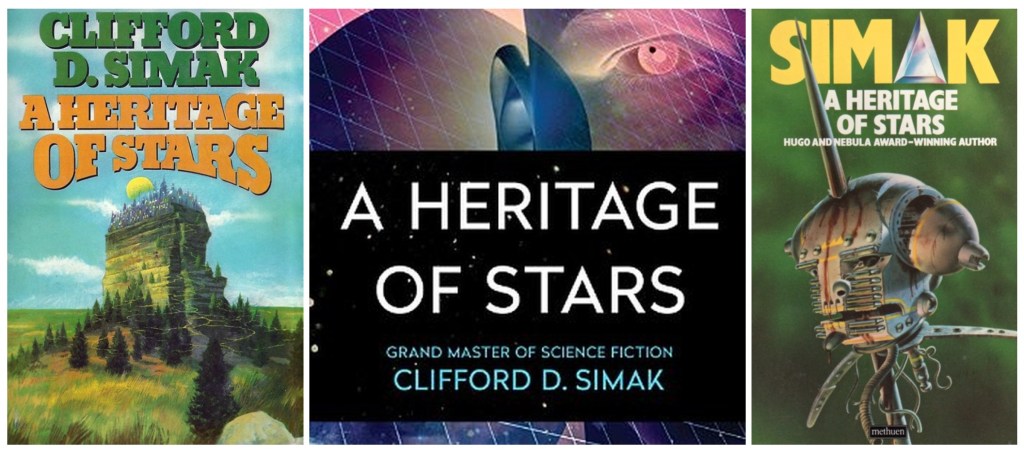
A Heritage of Stars involved a post-apocalyptic America with few humans and some robots. In that story, most robots had been destroyed except for their brain cases which were saved as trophies after a war with the robots. Unknown to the humans, the robots continued to be conscious inside their brain cases for a thousand years. That idea of a conscious mind without outside sensory data intrigued me. Then I read in the Ewald monograph about “Earth for Inspiration,” involved a dying Earth, robots, and isolated robot brain cases. I had to read it. The story is also included in Simak’s collection Earth for Inspiration and Other Stories: The Complete Short Fiction of Clifford D. Simak Volume Nine. Amazon now sells 14 volumes in the complete stories. Audible.com now offers ten of those volumes in audiobook editions.
Version 1.0.0
Most of the famous science fiction short stories we remember from the 1940s were first published in Astounding Science Fiction. Thrilling Wonder Stories was aimed at younger, less educated science fiction fans, and we seldom see reprints from that pulp magazine. For the most part, its stories are less sophisticated with far more action. And that’s true for “Earth for Inspiration.” I thought it was a funny story, but somewhat simple and hyper paced. It has an old fashion voice because of all old-timey colloquialisms. Simak is known for his pastoral prose and midwest settings.
“Earth for Inspiration” was more fun than I expected to find in Thrilling Wonder. Usually, when we think about robots in science fiction, we think of Isaac Asimov, but I’m seeing how important robots were to Simak stories.
When I read it with my eyes, “Earth is Inspiration” felt like cliched pulp science fiction from the 1930s. However, when I listened to the story after buying the audiobook edition, I thought the writing was much better than my first impression, except for all the saidisms. (I think the worse was — “Look at that, will you!” he jubilated.) The second reading with my ears made me notice how many ideas Simak was using to develop the story. It’s a satire on writing science fiction, maybe even the first example of recursive science fiction.
However, “Earth for Inspirations” gives us a few clues about how Clifford D. Simak thought when comparing them to his other work. The more Simak I read, the more I spot common ideas, characters, and elements that he used and reused.
The Ewald monograph has a few pages of biographical information, almost just a list of dates. Most of the 155 pages describe Simak’s stories and novels. I was hoping to find a biography of Simak, something like William H. Patterson did for Heinlein, but such a book doesn’t exist as a far as I can tell for Simak. Second to that, I was hoping to find an analysis of the impact of Simak’s stories, like what Alexei and Cory Panshin did for Heinlein, Asimov, and van Vogt in The World Beyond the Hill. It’s not that either. When the Fires Burn High and the Wind is From the North, is a standalone journal, volume 73 of The Milford Series: Popular Writers of Today. The content is like Alva Rogers A Requiem for Astounding, which is a description of the stories in all the issues of Astounding Science Fiction in chronological order.
I thought it fascinating that Simak was thinking of robots in the same way in 1941 and 1977. He obviously had a fondness for the idea of robots and had developed an idea of what they would be like early in his career and stuck with it until he died. Robots were faithful servants who were also friends. Simak imagines them with bodies that can break down, but with nearly indestructible brain cases. I assume those brain cases have an internal power supply that could last for millions of years. A couple years ago I read a collection called The Complete Robot by Isaac Asimov. I wonder if Simak has enough robot stories to warrant such a collection?
Reading Simak, we can assume he didn’t like cities or corporations and had a low opinion of mankind’s ability to survive in the long run. Although, “Earth for Inspiration” is set millions of years in the future after humans have colonized the galaxy, but long after we’ve used up Earth’s resources and abandoned it.
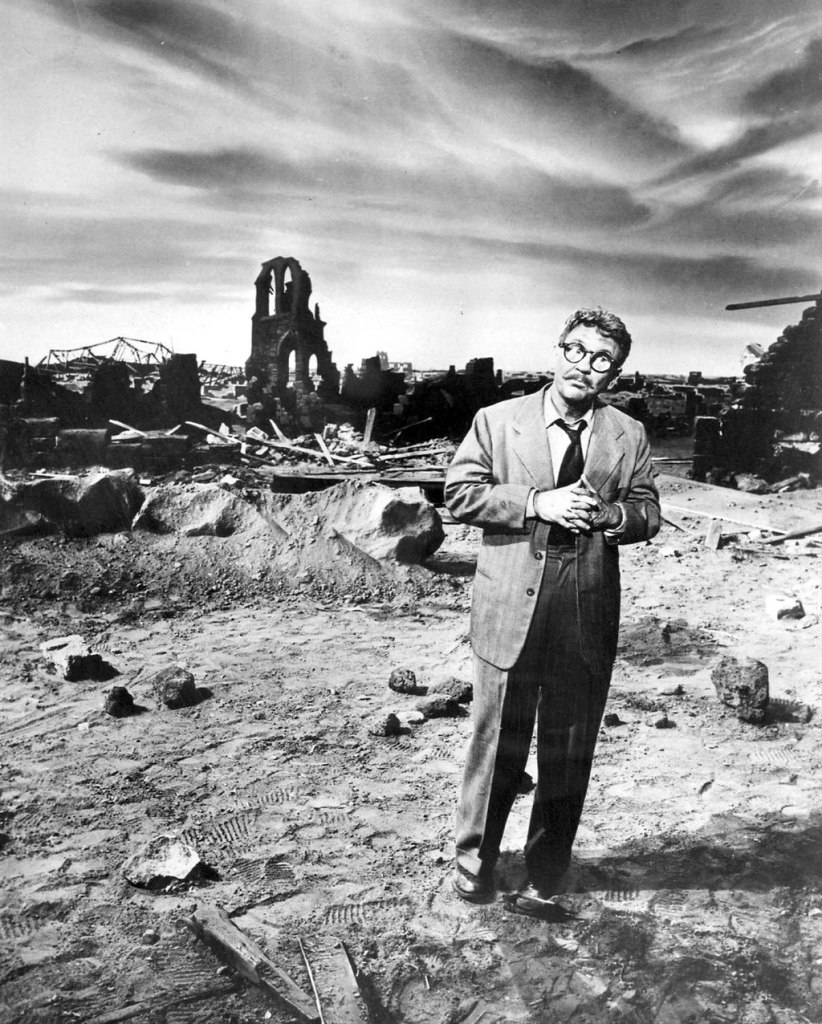
The first scene of “Earth for Inspiration” opens with a short tale about a robot named Philbert who became inert after his body rusted up. Eventually, his body rusted away and Philbert lived inside his braincase for millions of years. This reminds me of the Tin Woodsman of Oz.
The second scenes jumps to Jerome Duncan, a once successful science fiction writer who is again getting rejection slips after a successful career. Duncan lives millions of years from now. It’s amusing that Simak thinks science fiction will last that long.
Anyway, Duncan’s robot Jenkins suggests going to Earth to get inspiration for writing a new story. Jenkins is also the name of the robot in City, Simak’s most famous book, a fix-up-novel. Duncan is famous for writing Robots Triumphant. I won’t tell you what it was about because it becomes part of the story.
The next scene has Duncan and Jenkins arriving on Earth with a lot of camping equipment and meeting an old-timer, Hank Wallace, who has been waiting for new tourists for over a thousand years. He manages the Galactic Trainsport station, but no one informed him that the line had been shut down a thousand years earlier. Duncan and Jenkins had hired a private rocket. This points to another idea that Simak loved, that humans would eventually have very long lives. In this story, we last for ten thousand years. And his second most famous novel, Way Station, is about an old-timer who manages a transport station and who doesn’t age. By the way, the old-timer in that novel was named Enoch Wallace.
Should we assume that Simak had been thinking about writing his most famous novels for years?
I don’t think I should tell you any more of “Earth for Inspiration.” It’s a fun enough story so that I shouldn’t spoil it for you. I’ll just hint at a few more scenes. Earth in the far future is dry, and has lost most of its air. There’s a confrontation with humans living in primitive tribes in dry deep sea canyons where the air is thicker. That makes it a dying Earth story. There are slapstick scenes with a crazy robot and another confrontation with horde of runaway robots.
“Earth for Inspiration” has decent humor, although not sophisticated. It would make a great humorous episode for Love Death & Robots. The humor is slapstick Sheckley with a touch of Frederic Brown’s ironic weirdness. I’m not sure if Simak intended it to be entirely comic, although, he probably did, but I bet a lot of young readers in 1941 took it straight realistic action.
Today I read “The Cartesian Theater” by Robert Charles Wilson for our discussion group. That Facebook group is reading one story every Sunday from Science Fiction: The Best of the Year: 2007 edited by Rich Horton. I got a big kick out of “The Cartesian Theater” and wanted to hear it on audio. But when I went looking for an audiobook that included it, I couldn’t find one. Bummer.
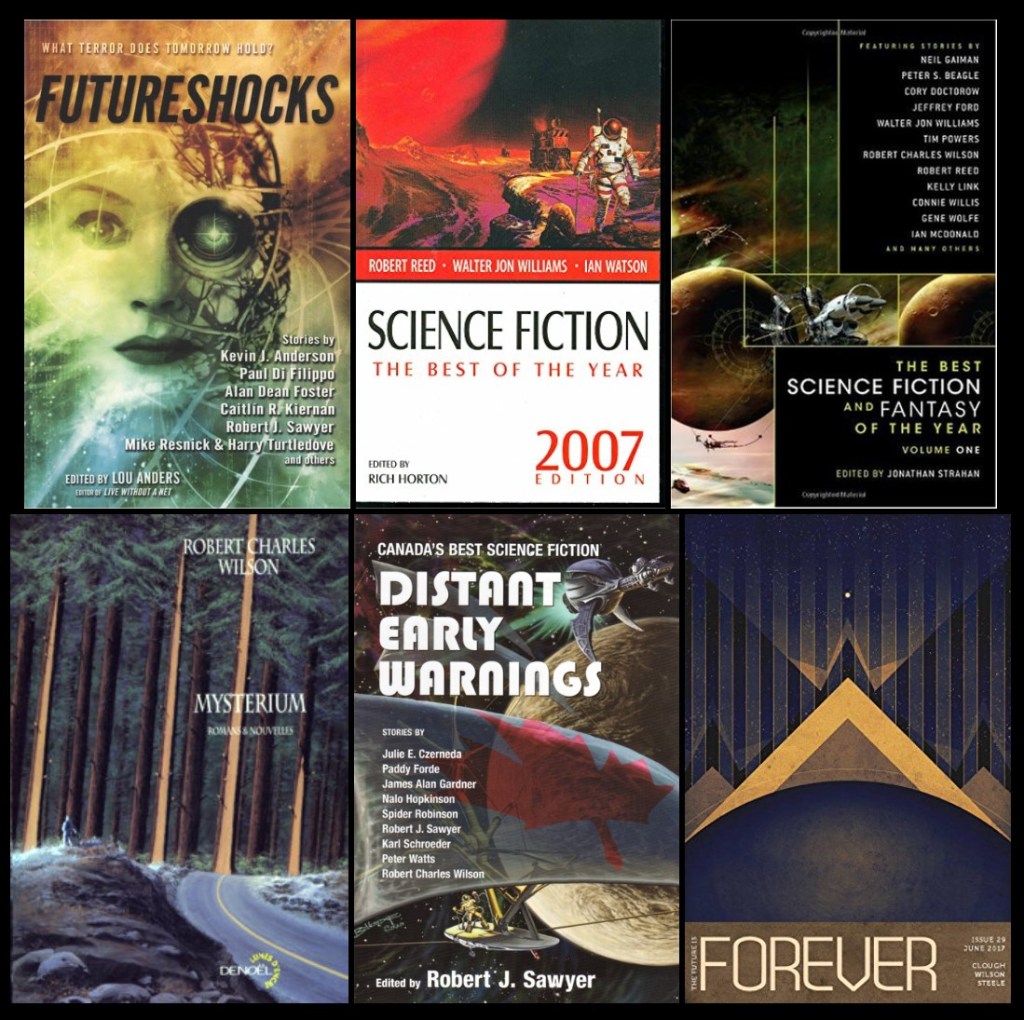
My inner reading voice is nothing compared to the professional narrators who read audiobooks. I read “The Cartesian Theater” in Horton’s 2007 best-of-the-year anthology which I own in paperback. When I write about a story I like I want to help people find a copy to read. It’s always great when I can put a link to where it can be read or heard online. You can read the Horton anthology at Archive.org if you have set up a free account. You can read the Jonathan Strahan anthology for free if you subscribed to Kindle Unlimited. It’s $11.99 to buy that anthology for the Kindle. The one Wilson story collection shown above is a French edition. All those other editions will require tracking down used physical copies. For most people, this won’t be an easy story to find.
Most bookworms don’t read short stories, and short stories don’t make much money for publishers either. Short stories are a kind of training ground for novelists. Often when a writer becomes a success their short stories are collected, and even kept in print. And sometimes those collections have audiobook editions. If there was The Best of Robert Charles Wilson audiobook I would have bought it today. I would have also bought The Best of Charles Sheffield this week if it existed on audiobook. I did listen to my audiobook copy of The Best of Connie Willis twice this week to read “Even the Queen” and “Death on the Nile.” The narration was perfect for each, and I got so much more out of the story than when I just read them on paper.
The best narrators do voices for each character. That highlights the dramatic quality of stories that my inner voice doesn’t generate. But more than that, audiobooks are read much slower than my inner reading voice, sounding out every word, and that makes an enormous difference. When I read, I read too fast, often skipping words. I can’t help myself, I read too fast. I miss clues to what’s happening. Listening makes me pay attention to every word. And I’m very disciplined in my listening. If I miss something I hit the jump back button.
“The Cartesian Theater” is about a world where everyone lives on a guaranteed income and economic activity is driven by robots. People still make extra money, usually from creating something entertaining. (Picture everyone being a YouTuber or something like it.) In the story an anonymous rich person hires Lada Joshi to track down an elusive artist, Jafar Bloom, and offer to back a showing of his work with no strings attached. Joshi hires Toby Paczovski, an operative skilled finding people living on the dole who don’t want to be found. And then she had Toby find Philo Novembre, a retired philospher, to get him to attend the first showing of the “Cartesian Theater.” What Bloom has create is a device that proves something philosophical, something that science can’t prove. I don’t want to say too much.
Beside coming up with a nice gimmick for the premise of the story, Wilson creates an interesting setting, a setting that our world seems to be heading towards. AI and robots do most of the real work, pushing people onto the dole. The robots aren’t considered sentient. That’s the trouble with AI robots. If they ever become sentient we can’t make them our slaves. In Wilson’s society they seem to be on the cusp of awareness. Humans in this story also have a lot of smart technology that supplement their bodies. And in Wilson’s world, a certain amount of brain activity can be duplicated in machine. Toby’s grandfather is dead, but enough of his memories hang around so Toby can still talk to him. The whole story is a Cartesian theater. And it has a nice surprise ending I didn’t guess.
Is this story worth keeping in print? Should it be available for the Kindle and on Audible? I don’t know. Such publishing might be a money loser. Which short stories should be preserved? And which should we forget?
We also read “Georgia On My Mind” by Charles Sheffield which won the Hugo and Nebula awards for best novelette back in 1994. You’d think every award winner should be preserved. It is in a collection called Georgia On My Mind and Other Places which can be read on Archive.org or bought for the Kindle for $5.99. But no audiobook. It was originally published in the January 1993 issue of Analog.
I loved “Georgia On My Mind” even more than “The Cartesian Theater.” Sheffield uses a narrative structure that was common in the pulps before WWII, where a mystery is discovered in a far distant place on Earth. In this case New Zealand. The story is set in modern times. We seldom believe such mysteries are possible anymore. But in the old days, readers loved these setups where the story felt possible. In this case, in a rundown tool shed to an old farm house in a remote part of New Zealand, Bill Rigley finds pieces of Charles Babbage’s computer from the 19th century, along with old letters, and information about programming. The mystery is how did Babbage’s work get to New Zealand and why.
If you like a Weird Tales type of story, computers and computer history, and even a bit of recursive science fiction, then you should like “Georgia On My Mind.” I think Sheffield rush the story at the end. He should have kept the slow pace and followed through on the setup and made this story a novel. I dislike the title, but it fits the cutsy ending. However, I didn’t want a cutsy ending. Obviously, Sheffield didn’t want to write a whole novel, and wrapped up the story with a direct appeal to science fiction fans. I wanted a Weird Tales ending. Still, I got a big kick out of this story.
It’s sad to think these two stories will be forgotten. They just aren’t easy to find. I think what’s needed is for Audible to publish all the best-of-the-year anthologies, from 1939 to the present. That would put most great short SF in audiobook print. At least do the Asimov/Greenberg/Silverberg books covering 1939-1964. Then Wollheim from 1965 to 1990. The 14 Carr anthologies, and all the Gardner Dozois anthologies. Or get some young editor to create new anthologies for each year.
If Audible doesn’t want to keep best-of-the-year anthologies in print, I think they should at least put all the Hugo and Nebula winners and finalists in audiobook print. That would catch “Georgia on My Mind” but not “The Cartesian Theater.”
JWH
p.s. I haven’t been blogging as much lately. I’m just getting old and running out of energy. Finishing this short blog gave me a sense of accomplishment.
My friend Mike and I decided to pursue the same reading goal separately, probably because we each discovered book YouTuber Benjamin McEvoy on our own. We both concluded we wanted to become better readers, diving deeper into the books, to develop a note-taking system, and remember more of what we read. Mike brought it all up with me when he told me about reading A Heritage of Stars by Clifford D. Simak. I told him I would read the same book, develop a note system, and then we could compare notes and methods of taking notes when I finished.
Mike also told me about different videos he was watching about taking notes while reading. One covered writing notes in the book while you read. I could never do that. Another suggested stopping at the end of each page you’ve read and jotting down some notes. That’s too much for me. Another suggested making notes after reading each chapter. That’s the method I’m trying here.
A Heritage of Stars came out in 1977, near the end of Simak’s career, and it’s one of many of his forgotten novels. Simak is most famous for his award-winning books City and Way Station. A Heritage of Stars is currently available on Amazon as a $1.99 ebook, but there’s also an audiobook edition on Audible.com. I don’t recommend you buy either until you’ve read some of my notes. A Heritage of Stars is not a worthy read unless you have the right reading background.
I discovered I already owned the Kindle and Audible edition, but I don’t remember reading either, but my reading log says I’ve listened to it twice, first on 12/1/15 and again on 6/1/16. That’s damn weird that I’ve listened to it twice, just six months apart, and don’t remember it at all.
This makes it a perfect book for this experiment in deep reading. One of my goals for becoming a better reader at age 72 is to at least remember that I read the book, and to remember at least one significant detail about the book. My ambition for developing a note taking system is to write down enough to trigger the memory of reading the book.
Starting this goal at 72 is probably a bad idea since I obviously have a memory problem, but that’s also part of my ambition to improve my memory. I want to read fewer books but get so deeply into them that I remember something about them. I’m tired of remembering reading books in the same way I remember each potato chip I’ve eaten.
What’s even crazier, after doing a web search I discovered I wrote a long review of A Heritage of Stars for the Worlds Without End website. This changes the whole deep reading project. If I can’t remember what I read, then note taking becomes more important. I’ve thought in recent years that maybe I need to make a wiki of my thoughts as an external memory. I’ve started using Obsidian, a note taking program that hyperlinks ideas, but I’ve only piddled with it. Obviously, I need to get serious and use it faithfully. This is not the first time I’ve discovered I read a book and wrote a review and completely forgotten both. It’s not even the second or third time. I’ve lost count.
My plan for this essay is to read A Heritage of Stars and take notes chapter by chapter giving a synopsis, my reaction, and maybe some quotes. I’m going to use screenshots for quotes to say me typing. I wish I could write concise synopses like I see in Wikipedia, but that’s going to take some time to train myself.
A Heritage of Stars
Chapter 1
This sets up the story as a post-apocalyptic novel. It also zeroes in on the theme that our civilization is long gone and we’re mostly forgotten. What people know of us is more like the histories of Herodotus or myth.
The image of pyramids of robot brain cases is quite striking. It suggests the collapse might have been due to a war with robots, making this novel a little more appealing to today, since real robots are just around the corner.
Chapter 2
We’re introduced to Thomas Cushing, who farms potatoes. Times are tough, he must fight potato beetles by hand and worries that roving bandits will steal his crop. Food is limited.
Thomas Cushing is also a writer and scholar, who studies Wilson’s history, which was written in ancient times. Cushing has access to Wilson’s notes and contemplates a myth that Wilson left out of his history, one about “the Place of Going to the Stars.”
Cushing is at a university and has access to the library stacks. It might be the last university left, and it’s protected by fortified walls and geography.
Thomas was sponsored by Monty and Nancy Montrose, becoming their unofficial adopted son. As Cushing became a scholar he became obsessed with Wilson’s history, especially about the Place of Going to the Stars.
This chapter reminds me of A Canticle for Leibowitz. Cushing lives a kind of monastic life, doing subsistence farming while also working as a scholar by candlelight reading ancient books. This is one of my favorite themes in science fiction, where people thousands of years in the future try to figure out what our civilization was like.
Chapter 3
We learn that Wilson’s first name is Hiram, and he started his history on the first day of October in 2952 at the University of Minnesota. That’s a thousand years into our future, but our civilization had collapsed five hundred years earlier. Hiram Wilson writes this in his introduction to his history:
We also learn that nearly all texts concerning technology, and any references to technology in other books were destroyed. Wilson is piecing together from scant sources what our technology must have been like. He says the censorship over technology came from extreme fanaticism and hatred. He figured the collapse was due to the depletion of non-renewable resources, pollution of the environment, and massive unemployment. He also deduces that our civilization got too big to manage, especially the corporations and governments. Evidently automation and robots were involved, and there was a revolt. The rebellion destroyed the robots and technology. This caused the collapse that killed billions, and mankind went back to subsistence farming, simple villages, and nomadic raiders. Isolated communities survive behind walls while chaos ruled beyond the walls. Wilson struggles to survive at the university. Evidently some universities were able to create protected communities so mankind could survive the new Dark Ages. Often the universities were the target of attacks and they were destroyed or reduced to tiny enclaves.
This reminds me of The Stars Are Ours by Andre Norton, which was about a post-apocalyptic religious society that hated all science. It also reminds me of The Long Tomorrow by Leigh Brackett.
Chapter 4
We learn that Monty’s full name is Dwight Cleveland Montrose. That Monty and Nancy’s dead son would have been the same age as Thomas Cushing, but he had died of measles, along with sixteen other people in the enclave.
The three talk about the Place of Going to the Stars. We learn that our civilization had gone to the Moon and Mars, and maybe to the stars. Monty and Nancy let Thomas know they understand why he wants to leave and search for the Place of Going to the Stars.
The old couple say they wanted Thomas to stay with them but could see he was restless to find out about the Place of Going to the Stars and suggests he get it out of his system.
Thomas tells the old couple about how he grew up where the farming, fishing, and hunting was good, and he lived in a small community. It’s very prosaic. It describes a way of life that I imagine Clifford Simak did growing up in Wisconsin where he was born in 1904. But we eventually learn that Tom’s family all died. From stories his grandfather told, Thomas learned of the university enclave. After his grandfather died, Thomas traded the farm and left, taking to the road, and leading a life of “woods runner” at age sixteen. But finally remembered the university and went there. Now, he was ready to go roaming again. I figure Thomas is about 21-23.
Chapter 5
The point of view shifts to two aliens, #1 and #2. They refer to the Ancient and Revered (A and R) who is a robot. #1 insists that humanity has reached a decline that it will not recover from. #2 says there might be more than meets the eye because of their interviews with the robots on Earth. #1 replies the Earth’s robots are not reliable because they are incoherent telling meaningless stories.
Of course this reminds me of Simak’s classic fix-up novel, City, where dogs and robots remain on Earth after humanity has gone off to the stars.
Chapter 6
Thomas Cushing is on the move. He silently travels at night across a river, and up a stream to an abandoned city. There he follows a road until he is almost killed by an arrow shot from a device set off by trip wire. After that Thomas must travel over the rough land of decayed houses, fallen trees, and worry about the pits of old basements.
Thomas hears drumming and sounds of a tribal celebration. He sneaks up on their fires and sees primitive dancing around a pyramid of robot skulls. This scares Thomas and he backs off, sneaking away as fast and far as possible. He takes shelter in a depression hidden by a thicket of trees near an abandoned mansion, one that had obviously been looted many times long ago.
I think it’s significant that the city is collapsed and decayed. Simak often writes science fiction about people who live away from cities. In the first City story, written in the 1940s, Simak predicted that our society would spread out and abandon cities because of the helicopter.
There is a common thread in post-apocalyptic stories, a fantasy to live without people, or at least many people. That for readers who love this sub-genre, they have a secret desire for civilization to go away.
When Thomas leaves the thicket the next afternoon an old woman is waiting for him. She calls herself “Ole Meg, the hilltop witch.” She claims she sensed Thomas sneaking through the woods. She tells him he has the mark of greatness. Meg informs Thomas that she is coming with him, along with her horse Andy, and Thomas adamantly refuses. But as we learn in chapter 7, they all go off together to avoid the approaching horde. Meg knows a lot, and has powers.
Chapter 7
We are now in The Wizard of Oz territory. Thomas Cushing is off to see the Place of Going to the Stars and he’s acquired company for his quest, a witch with magical powers and friendly horse.
Chapter 8
This reminds me of all the young adult science fiction I read as a kid that was first published in the 1950s, the Heinlein juveniles, all the early science fiction of Andre Norton, and the Winston Science Fiction series. Of course, it also recalls The Hero With A Thousand Faces by Joseph Campbell about the hero’s journey in storytelling.
Again, this story reminds me of The Wizard of Oz. Thomas is Dorothy, Meg is the Scarecrow, Andy is nothing yet. Soon we will meet the Tins Woodsman.
Simak would have been around seventy-three when he published A Heritage of Stars, around my age right now. Who was he writing for? Is it an escapist fantasy he thought readers wanted, or was it a daydream that he enjoyed himself?
Chapter 9
Thomas scouts ahead leaving Meg and Andy hidden. There’s a nice scene of Thomas observing nature including a fox, deer, and a badger. He also spots a band of twenty riders heading east. This scene is one of two in the book that I thought was well described. For the most part, Simak doesn’t spend much time describing scenes or developing his characters.
Thomas Cushing knows the raiders are heading towards the town where he saw the dancers, figures they plan to sack them. Returning to Meg and Andy, Thomas hears a voice call him for help. It turns out to be a robot named Rollo trapped under a fallen tree because of a tornado. This really is getting into The Wizard of Oz territory. Rollo even has rust problems and has survived for hundreds of years because he’s learned to make lubricant from bear fat. Simak was known for his robots, and this paragraph recalls old science fiction stories. Is Simak trying to recapture his own past?
Like Baum’s Tin Woodsman, Rollo didn’t want to kill humans or animals. But to survive, he defended himself in a bear attack and broke his programming when he killed the bear.
Chapter 10
This chapter is from the perspective of trees. Simak is mystical here.
We’ve had one chapter with two aliens observing us, and now we have a chapter with trees. Civilization is gone. Technology is gone. Humans are roaming bands of plunderers, tribes of living off the land like Native Americans before Europeans, and monastic enclaves of scholars.
Chapter 11
In this chapter Rollo tells us about his past. He was a yard robot before the fall, but he has lived for centuries by avoiding humans for the most part. Rollo is excessively talkative, from all the loneliness. Rollo confirms the stories Thomas has heard about a Place of Going to the Stars. He’s able to give a few additional details, that it’s out on the Great Plains atop Thunder Butte.
Chapter 12
This chapter is another excerpt of Wilson’s History. It’s about psychic powers. ESP was a cherished topic of 1950s science fiction. It was equated with evolved humans. Wilson suggests that our scientific society suppressed psychic abilities, and now that our technological civilization is gone, they have reemerged.
Chapter 13
Rollo tells us about the collapse, how after the collapse humans started destroying the robots, and eventually how people started collecting robot brain cases. He even carries a brain case he’s found. Here we learn something special.
Where is Simak going with the story? Is it just a book he’s thrown together to make another sale, one which is assembled from standard off the shelf parts? Simak dies in 1988, eleven years after this book was published. He’s essentially living in the last decade of his life. Is Simak making a philosophical statement about science fiction in this novel? Or was he like Robert A. Heinlein, who would also die in 1988, writing personal fantasies for his own pleasure? Heinlein’s last books recycled all his old favorite characters he had created. It seems like here, that Simak is recycling all his favorite science fictional concepts. Or do old writers get to a place where they can’t create anything new?
Cushing, Meg, Rollo, and Andy must hide from marauders, about forty strong. After the horde leaves, Cushing finds a leather pouch left behind. It contains some knives, a children’s book, and four maps. One of them shows where Thunder Butte lies, the place Rollo believes is where the Place of Going to the Stars is located. This is another hard-to-believe coincidence in this story, and they eventually stack up.
Chapter 14
The group is crossing some rough land without water. At one point Cushing offers his buckskin pants to make water bags, but the others say he shouldn’t risk weather exposure on the chance they could carry some water. This chapter is about hardships, dealing with heat, drought, rattlesnakes, lack of food, and so on. The Shivering Snake that follows Rollo stays with them now, and they are trailed by shadowy shapes they start calling the Followers who Meg says will eat their souls and minds. Rollo’s bear grease is running out and he hopes to find a grizzly bear. This chapter is full of woo-woo stuff.
Then they come across an old man and his granddaughter. They find the old man, Ezra, standing in a hole staring at sunflowers. It turns out the old man talks to plants, and his granddaughter, Elayne, is some kind of weird psychic. So the motley crew grows to seven.
I have to wonder if Simak was influenced by the New Age book called The Findhorn Garden that came out in the 1970s. I remember people back then talking about plants having consciousness.
Chapter 15
This is another transitional chapter where we mainly learn more about Ezra and Elayne. We also learn that Rollo only wants grizzly bear fat, and now black bear or deer. Thomas tells him all animal fat is the same, but Rollo seems to prefer grizzly bear because they are fierce fighters, and he feels killing an animal should involve some risk to himself.
The Tin Woodsman in The Wizard of Oz did not eat meat and wouldn’t kill animals, or even insects.
Chapter 16
The group finally reach Thunder Butte by are met by five wardens who guard it. The wardens believe for centuries they are the designated guardians of Thunder Butte where strange beings sleep. The sleepers are destined to take over the world from men, so they don’t want anyone to awaken them. The wardens say Thunder Butte is also guarded by intelligent trees and rocks that can move.
Ezra tells the wardens that he can talk to the trees, and they will let them though. It’s quite a coincidence that Cushing and comrades found a person that spoke tree. I wonder if Simak was into plant consciousness. In the 1970s, there were lots of New Age theories about that.
By luck (or coincidence) a grizzly bear attacks the wardens and their horses, and they run off. Rollo, Cushing, and Andy kill the bear, and head towards the trees guarding the Butte.
Chapter 17
They make it the trees that block their way, and the living rocks circle behind our troop of characters. Ezra can talk the trees into letting them pass, which disturbs the wardens who have regathered back a way to watch. There is a bit of mystical mumbo-jumbo. Makes me wonder if Simak was a New Ager himself, or was he just using these ideas because they were popular with young people and the counter-culture.
Chapter 18
This is another transitional chapter where our characters talk philosophy amongst themselves and ponder what has happened to them so far.
Then they discover cylinders hovering above them. They have lots of eyes, but no mouth, yet they broadcast strange speeches to the group.
This is weird gobbledygook. However, it will make more sense when it’s explained in a later chapter. But what is your guess now? Our heroes suffer from all this machine chatter, and again do a lot of speculation amongst themselves.
Chapter 19
Next, our heroes head up the butte towards the buildings they’ve spotted.
Our group finally meets the aliens #1 and #2 that we encountered in that early chapter. They call the aliens collectively, The Team. The aliens tell our humans how they are explorers studying collapsed technological civilizations. One of them believes such civilizations never recover, and the other wonders if it might be possible. They mention the Ancient and Revered, a robot that’s been teaching them about Earth. Our group asks about meeting the A & R, but the aliens tell them it’s hard to get an audience with him. Do I have to say it again? (The Wizard of Oz.)
Chapter 20
Our group explores the outside of the city trying to find a way in. There is a lot of speculation about the city, and history. Cushing finds an immense door. He goes in a way and finds hundreds of shining snakes. He tries to go further in, but can’t. Elayne comes up behind him and tells Cushing that they are standing on the edge of eternity.
This reminds me of Methuselah’s Children by Robert A. Heinlein. At one point, Lazarus Long and gang meet aliens that are so far ahead of humans that meeting them directly face to face causes humans to go insane. Back in the 1940s and 1930s, some science fiction writers worried about meeting advanced beings. But that stopped for the most part in Astounding in the 1950s. Various writers have said that John W. Campbell, Jr. didn’t like the idea of any aliens being superior to humans. Simak, in 1977 hasn’t given up on that idea.
Then a cylinder appeared and informed the group that A and R would like to meet them.
Chapter 21
Three days later, we still haven’t got to meet the Wizard. The Ancient and Revered. But first the group has another conversation with the aliens, #1 and #2. The aliens want to know how humans could imagine being replaced by a later evolved species. The aliens haven’t found that to be a common realization.
This is one of my favorite science fiction themes, but it’s seldom explored in SF.
This chapter goes on with more effort to explore the city, and more conversations with the aliens. Ezra learns that the guardian trees are from outer space. I had already assumed that. The group ponders that. And the living rocks. A lot of this pondering is things I’ve already assumed. Did Simak think only people who didn’t know much about science fiction would be reading this book?
Chapter 22
This chapter involves a long psychic session by Elayne trying to break into the city. She fails. Then Meg tries. She makes psychic contact that she describes as a million little bugs.
Can you guess what this is? I did. I won’t say yet.
At one point, Rollo gives Meg the robot brain case he owns to act as her crystal ball. The robot inside the case combined with Meg’s psychic ability finally contacts the Ancient and Revered. He invited them in.
Chapter 23
The A and R explains everything. The cylinders are space probes returned from the stars, each reporting what they found. Their findings are stored in a giant database, which is what Meg had contacted. The A and R has no machines left that can retrieve information from the database. However, the group figures with more psychics like Meg and Elayne, each with a robot brain case, they could mine the data and start rebuilding civilization.
We learn about the fall of civilization. Our efforts to explore space. And the state of the world. We learn that the A and R has a library that hasn’t been censored of technical information. The group decides they also need to find people who can read.
Chapter 24
Short chapter where Cushing argues he alone must confront the wardens.
Chapter 25
This is a nice chapter. It’s also the second example of good description that I mentioned earlier. Simak also wrote westerns, and you get a feel for that here as Cushing walks into the camp of the wardens. It’s a shame this story didn’t have more of this kind of writing.
There’s a lot of action in this chapter, but ultimately, they fail to convince the wardens to help.
Chapter 26
Everything wraps up here, and it’s incredibly positive and gung-ho. They return to Cushing’s old university to get people who can read. But they still worry about technology.
Most of Simak’s science fiction had an anti-technology feel to it. The Heritage of Stars is an interesting book to read today since civilization is heading towards a collapse just as we’re about to give birth to AI and intelligent robots. This novel is relevant to today, but I also think it might be too dated. The New Age died back in the 1970s. There are esoteric believers still around, but they aren’t common.
Final Thoughts
This novel touches on many of the themes in science fiction. It’s almost like a New Testament of science fiction because of its faith in science fictional ideas. But it’s also transcendental, suggesting there’s more to outer space than stars and planets. There’s a lot of woo-woo in the book.
I’ve read all the Oz books when I was a kid. Back in the 1950s some libraries started banning Oz books because librarians felt those books gave young people unrealistic expectations about life. I completely agree because I embraced those unrealistic expectations when I read the Oz books. And I believe science fiction also promotes the same unrealistic expectations.
I believe The Heritage of Stars is Clifford Simak’s version of Heinlein’s The Number of the Beast. Both books are flawed. Both books are personal fantasies by fantasy writers that reference their own work and the formative fiction they read as kids growing up.
James Wallace Harris, 9/10/24
p.s.
I reread my original review and its very similar to what I’ve written here. I did make at least one mistake. I thought #1 and #2 were robots. On this reading, I don’t think they are. I also thought I’d remember this book, but I didn’t. I did predict I would return to it someday, so I was right on that account.
What would it be like to experience living through an emerging apocalyptic crisis? Forget about sinister aliens conquering the Earth, or silly zombie invasions, or even biker gangs running around in their skimpy S&M outfits. No, what would it be like if civilization collapsed, and you had to live in an emerging dark age? Reading The Memoirs of a Survivor by Doris Lessing will make you think about it.
It’s what the English call a cozy catastrophe. An unspecified crisis happens, and England slowly unravels. An unnamed narrator, of unspecified gender writes in their memoir about living through such an event. They eventually take in a twelve-year-old girl named Emily, and her pet named Hugo. Hugo is sometimes described as looking like a cat or dog, and it sometimes purrs and other times whimpers. Lessing likes to explore both gender and species identity.
The memoirs narrate two story threads. The more interesting of the two involves the narrator watching society fall apart while Emily grows up. The second thread is episodes in the narrator’s fantasy life, which might be called exploring inner space. This is a science fiction novel that was published in 1974, when Ursula K. Le Guin was becoming famous as a women science fiction writer. Lessing’s style is much different from other women writing science fiction in the 1970s. Imagine Virginia Woolf writing a post-apocalyptic novel.
Doris Lessing (1919-2013) was a British novelist who won the Nobel Prize for Literature in 2007. She also wrote several science-fiction novels, including the five-volume Canopus in Argos (1979-1983) series as well as The Memoirs of a Survivor. She was most famous for her novel The Golden Notebook (1962), which is considered a story of inner space written at the dawn of exploring outer space. Lessing was born in what’s now called Iran and grew up in what was called Rhodesia. She moved to England as a young woman, becoming a writer, and radical.
Lessing’s birth was one year before Isaac Asimov’s, so if she had been considered a science fiction writer, she would have been among the Heinlein-Clarke-Asimov generation. However, her science fiction reminds me of the Ballard-Brunner-Aldiss generation. The Memoirs of a Survivor came out in the era of the best-selling nonfiction books about threats to civilization: The Limits of Growth, The Population Bomb, Future Shock. Those same books inspired John Brunner’s novels Stand on Zanzibar, The Jagged Orbit, The Sheep Look Up, and The Shockwave Rider. The 1970s felt like a pre-apocalyptic time, like our 2020s.
The Memoirs of a Survivor is a very British post-apocalyptic novel, far cozier than American novels covering the same theme. American male writers like to imagine life after the apocalypse as a new wild west. American female writers picture things a good less violent but acknowledge our violent heritage. British writers of both genders often write about characters getting along after the collapse. Their novels do have violence, but it’s not all kill-or-be-kill. The Memoir of a Survivor has a small amount of violence, even some guns, but it’s very minimal.
The setting is a city where the lights and water still work, but the economy is coming undone, and refugees from other parts of the country that have totally collapsed, are streaming through on their way north. The unnamed narrator, presumably an older woman because of how she characterizes people and things, watches the slow unfolding of the collapse from her window. The story become more interesting when a man abandons Emily and Hugo to her care.
Lessing is rather ambiguous in The Memoirs of a Survivor. The gender of the narrator isn’t clear, but the narrator’s personality feels like an old woman. Emily is quite well-defined by the narrator, who spends most of her time observing her and Hugo. Lessing had taken in a young adolescent girl, Jenny Diski, for a while in her life, and I assume much of the novel comes from that experience. Although, Lessing had three children of her own, so she had plenty of experience observing children growing up.
There are two parallel stories within the novel. The one I liked best was about Emily, her growth, and her fascination with the hordes of young people streaming through the city. In the other thread, the narrator stares at a wall, and fantasizes about exploring other apartments in the city, where she cleans, repairs, and paints. Lessing has said this is an autobiography of dreams. I felt it was a metaphor for repairing society because the narrator is always trying to renovate the rooms. However, these fantasies are important for the ending.
What’s beautiful about The Memoirs of a Survivor is it describes the early days of an apocalypse. Young people are on the move, anxious to build a new society, while older people huddle in their houses and apartments, trying to maintain and remember the old society. Since I feel we’re in the early years of a slow decline, The Memoirs of a Survivor is an interesting read for our times. Sadly, this book isn’t well known. There’s no ebook or audiobook edition, although it’s still available in trade paper. I looked everywhere for an audiobook edition because the writing is lovely and serene. I wanted to hear this story, rather than read it because I prefer listening to literary writing.
The growth and transformation of Emily is described in psychological detail that is realistic for most young girls of any time. When Emily first saw the refugees, she desperately wanted to join them but felt rebuffed. She decided to make her own clothes, which the narrator and I felt was a way of creating her own identity. At first, her outfits sounded like something Stevie Nicks would have designed for the bedroom, witchy lingerie, but Emily never even wore them outside. Next, her designs seemed like Madonna’s outfits from the early 1980s. Finally, Emily designed something close to punk and grunge. Remember, this novel was written in the early seventies.
The story is noticeably quiet, and the details of Emily’s relationship with her pet, Hugo, are heart wrenching. Emily wants to run away with the young people but can’t go because she knows they will eat Hugo. Obviously, Hugo is her emotional anchor after losing her parents, but she’s moving into the boy-crazy years. Emily, and many of the city girls fall in love with the various young men who are the leaders of the various roving bands, and these young men take advantage of their attractive powers to create harems of little adoring girls. I wonder if that’s how things were in our cave dwelling days — all the young women wanting the alpha male.
Like I said, The Memoirs of a Survivor is not a Mad Max post-apocalypse. Lessing tells us some people have guns, but guns aren’t part of the story. When you read this story it’s not hard to think about people living in Haiti or Sudan, or the many other countries in the world with failing economies, decaying infrastructures, gangs, which send out hordes of refugees into countries with more civilization.
This novel will make you think about what you would do if things fell apart. What if the electricity stopped working and water stopped flowing from your taps? What would you do? Would you join a group marching north to better economies? Or would you hunker down, learning to live with less, giving up money to barter, accepting violence and mob rule? Would you learn how to grow food and make things?
The Memoirs of a Survivor is like Earth Abides by George R. Stewart in that it assumes the young will quickly invent new ways out of the old, while the youngest children, who were never educated, will become feral. Gerald, a young leader whom Emily loves, does everything he can to save these feral children. What would you do with them? Ish, in Earth Abides, had a tremendous insight into their future survival, but I think Lessing’s take was more cynical, and maybe realistic.
I doubt current generations of science fiction readers will find this novel very appealing. I think it’s becoming a forgotten novel. And I tend to feel Lessing is becoming a forgotten writer, even though her name continues to show up now and then, such as this recent piece “10 of the best Booker Prize-nominated books with a political slant” that includes Lessing’s novel, The Good Terrorist.
I would have rated The Memoirs of a Survivor 5-stars if it had only been about Emily and the collapse. The inner space sequences dragged the story down. However, if I reread this book in the future I might like those part better. For now, 4-stars.
For me, the most rewarding pages of Dangerous Visions were the introductions by Harlan Ellison and the afterwards by the authors. When I first read this anthology back in the late 1960s, I felt those introductions gave me insight into the family of science fiction writers, one I wanted to join. At the time I was sixteen and I totally bought Ellison’s enthusiasm and promises. Fifty-six years later, I reacted to this anthology and its stories very differently.
Ellison honors del Rey by putting his story in the pole position, and he praises his friend and mentor Lester for being a giant of the genre. Back in 1968, Lester del Rey was not a major figure to me. I had read some of his Winston Science Fiction juveniles, but unknowingly, because they were published under his pen names. However, one had his name on the cover, Marooned on Mars. It wasn’t a standout, and I didn’t remember he wrote it. Lester del Rey was not a giant in the field to me. Later on, I’d discover he wrote “Helen O’Loy” and “Nerves” when I read The Science Fiction Hall of Fame anthologies. I don’t think Lester del Rey was ever a great writer of science fiction, but he became a great editor and publisher.
Ellison hyped Dangerous Visions for publishing stories that editors couldn’t or wouldn’t because they contained ideas that challenged the norms of society, or were too mature for the typical youthful science fiction reader, or were written in creative styles that average science fiction reader would reject.
“Evensong” is about hunting down a fugitive. That fugitive was God. At sixteen that excited my young atheist mind. But at seventy-two, it felt like Mad Magazine’s Alfred E. Neuman saying, “What, me believe?”
Was that really a dangerous vision that no publisher would accept? Then how could Fred Pohl publish del Rey’s “For I Am a Jealous People!” in Star Short Novels in 1954? In that story, mankind is fighting aliens and learns that God has sided with the enemy, so humans declares God is their enemy too. In other words, del Rey gave Ellison a dangerous vision that he’d already used years earlier.
That’s something I keep finding as I reread Dangerous Visions. Ellison was wrong that science fiction publishers wouldn’t take them. It made me wonder if Ellison could have assembled a reprint anthology called Dangerous Visions and collected all the science fiction stories that were published that had been quite startling for the times. Many classics come to mind that I think had more impact than those in Dangerous Visions, such as “Fondly Fahrenheit” by Alfred Bester and “Lot” by Ward Moore. I also think “For I Am a Jealous People!” is a better story than “Evensong.”
Ellison quotes del Rey’s letter to him about the afterward he wrote for the anthology. I thought this part was rather telling:
The afterword isn’t very bright or amusing, I’m afraid. But I’d pretty much wrapped up what I wanted to say in the story itself. So I simply gave the so-called critics a few words to look up in the dictionary and gnaw over learnedly. I felt that they should at least be told that there is such a form as allegory, even though they may not understand the difference between that and simple fantasy.
I was bothered that del Rey didn’t think critics wouldn’t know what an allegory was and couldn’t tell it from fantasy. That suggests del Rey felt a naive self-importance about his writing. But I also felt that Ellison showed a naive sense of self-importance about Dangerous Visions.
Allegory always seemed to me to be lazy way to tell a story in modern times. And I don’t think “Evensong” is total allegory either because we’re told God’s thoughts and perspective. Would John W. Campbell (Analog), Frederik Pohl (Galaxy), or Edward L. Ferman (F&SF) have rejected “Evensong” in 1967 because it was too dangerous? My guess is they would have run it because of del Rey’s name, although they might have rejected it for being too bland and simple in construction. It’s not a very sophisticated story and comes across as something a precocious student would write who was trying to be daring.
In 1967 revolution and rebellion were in the air. The youth of the 1960s were revolting against the status quo. Looking back, I feel Ellison was trying to do the same thing in the science fiction genre. Ellison was loud, outrageous, and pugnacious, so we might consider him the Abbie Hoffman of the science fiction counter-culture.
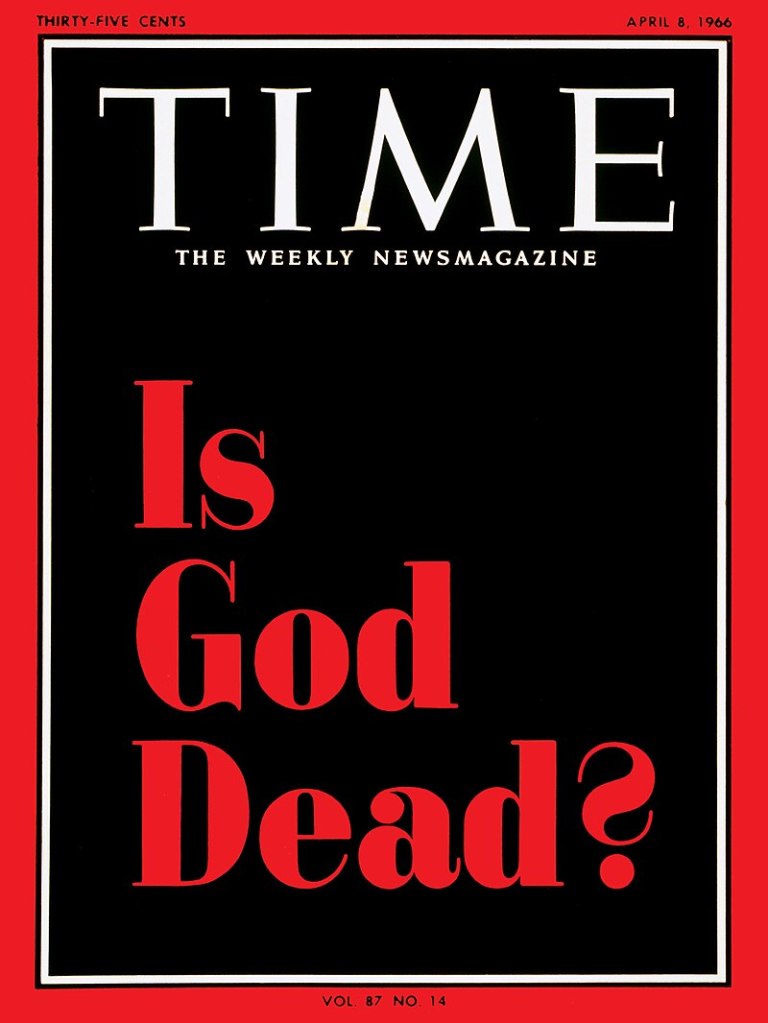
As I go through the stories in Dangerous Visions I’m expecting to find psychological snapshots of Ellison, the genre, the writers, and the times. The April 8, 1966, cover of Time Magazine asked if God was dead. Had del Rey forgotten his earlier story and “Evensong” was merely a science fiction riff on the Time cover?
Were the writers in Dangerous Visions thinking about old science fiction, or current events? Was Dangerous Visions anticipating the future, or reacting to an already fading pop culture rebellion?
“The Man from the Atom” by G. Peyton Wertenbaker was first published in the August 1923 issue of Science and Invention before being reprinted in the first issue of Amazing Stories. All the stories in the famous April 1926 issue of Amazing Stories were reprints. However, Wertenbaker has the honor of having the first original science fiction story, “The Coming of the Ice,” published in Amazing Stories, in the June 1926 issue.
Today I’ve been meditating on the idea of science fiction before science fiction was a concept with a label. People who love to read what we now call science fiction back in April 1926 didn’t know they were science fiction fans because the term didn’t exist. Hugo Gernsback was trying to get people to call it scientifiction, a word hard to say. Putting the names “H. G. Wells,” “Jules Verne,” and “Edgar Allen Poe” on the cover in large red letters was the perfect bait for readers who hankered after what we now call science fiction. Although they misspelled Poe’s middle name.
I’ve always assumed readers who bought the first issue of Amazing Stories discovered the kind of fiction they like by reading magazines and newspapers, including pulps. But checking my database I found 108 titles now considered science ficton (or fantastic) published from 1900-1925. But that brings up another question.
How many people had access to bookstores before 1926? I don’t think paperbacks as we know them existed back then. What percentage of Americans were readers? I just finished reading Chasing the Last Laugh: How Mark Twin Escaped Debt and Disgrace with a Round-the-World Comedy Tour by Richard Zacks. It focuses on the years 1893-1895 and discusses book selling. Publishers sold a significant percentage of Twain’s books via door-to-door salesmen. That suggests bookstores were not common.
My guess is would-be science fiction fans mostly read magazines and newspapers. This was an era when radio was becoming popular, but it wasn’t widely adopted yet. That meant most people got their information about the world from newspapers and magazines.
What did people think of “The Man from the Atom?” By today’s standard it’s both stupid and silly. A guy named Kirby has a friend, Professor Martyn, who is an inventor. Kirby enjoys volunteering to be an experimental subject for the professor’s experiments. In this story he’s invited over to test a machine that can do what Alice in Wonderland experienced when eating the food that made her bigger or smaller. Professor Martyn wants to use the device to explore the stars and atoms.
Wertenbaker was likely inspired by The Girl in the Golden Atom by Ray Cummings, which was serialized in All-Story Magazine in 1919. And Cummings was probably inspired by The Diamond Lens (1858) by Fitz james O’Brien and The Time Machine (1895) by H. G. Wells. And maybe young readers of Amazing Stories had already read those stories. I don’t know if any science fiction story is ever completely original. There are always stories that inspired that story, and if the writer is good, their story inspires future science fiction stories.
Kirby is given a space suit to provide oxygen and protect him from heat and cold. He then presses the button to grow larger, and he expands and expands. First, he steps off the earth, then out of the solar system, and then out of the Milky Way, but that’s not said explicitly. That’s because Edwin Hubble was still proving the existence of galaxies in the 1920s and the nature of The Milky Way.
Like many other stories, Kirby grows until he sees our universe as an atom among many, and then expands until he emerges into the water of another world. He realizes that he could never go back to Earth, and for two reasons. First, he couldn’t pick out the atom that was our universe, and two because expanding evidently meant time speeded up, and he figures he was millions of years into the future.
Ultimately, I liked “The Man from the Atom” even though it’s absolute horseshit. It’s just so damn imaginative for 1926. As the hippies use to say, “‘That’s far out, man!” And what kid hasn’t imagined the solar system as an atom?
Of course, I’m curious if readers back then believed any of this story was possible or scientific? Our knowledge of cosmology and subatomic physics in 1926 wasn’t very much. Wertenbaker was savvy enough to give Kirby a space suit. And he figured expanding meant speeding up time. Kirby had to grow much faster than light.
In the July issue, Gernsback wrote “Fiction Versus Facts” and quotes Wertenbaker. He contrasts scientifiction with “sex-type” literature, which I assume he means stories about romance, and says, “Scientifiction goes out into the remote vistas of the universe, where there is still mystery and so still beauty. For that reason, scientifiction seems to me to be the true literature of the future.” Evidently, right from the beginning readers of Amazing Stories, attracted readers of proto-science fiction that were true believers in human potential.
“Time Waits for Winthrop” by William Tenn #16 of 20 (Read)
Virgil Finlay usually created drawings and paintings that featured beautiful or fantastic subjects, but the interior illustration for “Time Waits for Winthrop” is hideous to see. But then, the 25th-century future William Tenn describes is supposed to be hideous to people from the 20th century, and the title character’s personality is downright hideous too, so Finlay does an excellent job preparing us for the story.
“Time Waits for Winthrop” is a plodding piece of fiction that speculates about the future in ways that make it worth reading, but just barely. That same statement could be made about much of science fiction. It’s a shame that “Time Waits for Winthrop” wasn’t better told because it could have been a genre classic.
The setup for “Time Waits for Winthrop” involves five people from 1958 swapped with five people from 2458 for two weeks. Tenn’s science fictional hypothesis is the future will be so different to us that we’ll find it repulsive. Tenn then plots the story around a clock driven conflict. At the appointed hour of return, all five people from both groups must return to the time travel depo to make the exchange possible. The kicker is Winthrop who loves the 25th century and doesn’t want to return to the 20th century. And the 25th century has one cardinal rule, you can’t make anyone do anything they don’t want to.
This means Dave Pollock, Mrs. Brucks, Mary Ann Carthington, and Oliver T. Meed will be stuck in the future that unnerves them, and the time travelers from the future will be stranded in the past.
“Time Wait for Winthrop” is a rather long story, a novella, and the plot involves the four 20th century people who desparately want to go home each trying to convince Winthrop or someone else to make Winthrop want to return to the 20th century. This gives Willian Tenn a chance to describe the 25th century. Sure, it’s pure speculation from the vantage of 1957, but I thought Tenn imagined some neat possibilities.
The first time I read this story over fifty years ago, I was under twenty, and I didn’t tune into what Tenn was trying to do in his story. I thought “Time Waits for Winthrop” was a somewhat funny potboiler. For my 2024 reading, I saw the story in a completely different light. In my first reading “Time Waits for Winthrop” came across as lame Sheckley. In this reading, “Time Waits for Winthrop” came across as Heinlein trying to be funny.
Winthrop and Mrs. Brucks were the old folks of the five 20th century travelers, and the group of four who wanted to return picked Mrs. Brucks to visit Winthrop and appeal to his moral decency. The other three thought since she was about the same age as Winthrop he would understand her best. Mrs. Brucks was a grandmother of two, and mother of six, and kind and genteel. Everything Winthrop was not.
Winthrop is the only person from the past who embraces all the new ways. It’s a rather wild future where clothes and floors appear to be alive and inanimate objects respond to human needs. You’ll need to read the story to get all the gosh-wow details. Winthrop relishes the opportunities offered and takes advantage of them all. He feels his companions from the past are rigid and scared. After Mrs. Brucks polite pleas, he still refuses. Winthrop says he’s obviously better off as a person in the future than he was in the past. Mrs. Brucks fails in her mission.
Next, Mr. Oliver T. Mead then agrees to plead their case with Mr. Storku, The Chief of Protocol for the State Department. This is where the story took off for me. Mead must track down Storku, but he’s at Shriek Field. In the future, humans are very well adjusted but that’s because they regularly visit Shriek Field or Panic Stadium to experience psychological release and transcendence. This 2024 reading now reminds me of many of the New Age therapies from the 1970s. I didn’t know of their existence the first time I read this story around 1969. Were such techniques already emerging in the 1950s?
Mr. Meads experience at Shriek Field is so prophetic that I decided to reprint those pages. How did Tenn guess this in 1957?
Doesn’t that sound like Primal Scream therapy? I believe Tenn also anticipates therapies like Erhard Seminars Training (EST) and other similar New Age personal development programs. This section of the story goes on for several more pages, and I felt begins the real purpose of the story.
Mr. Mead gets nowhere too.
Next up, the group decides Mary Ann Carthington, a pretty young woman, should try to convince Edgar Rapp from the Temporal Embassy to help them make Winthrop go back. She ultimately locates Rapp, but he’s in a microscopic world battling tiny cellular creatures. This section allows Tenn to explain what individual freedom means in the future. It was here that I was sure I knew what the ending would be, but I was wrong. This is the most fantastic part of the story, because Edgar Rapp can shrink himself down to thirty-five microns. This section reminded me of “Surface Tension” by James Blish, and Fantastic Voyage by Isaac Asimov.
I’ve tried to read “Time Waits for Winthrop” one or two times between 1969 and 2024, and in each case, I thought the story was over long and dragged. I again thought that this reading, but I liked the story a whole lot more this time and was more forgiving. If that trend continues, one day I might actually love “Time Waits for Winthrop.”
The story is episodic. It’s a shame that it wasn’t fleshed out into a short novel and told with more realistic drama that tied the sections together better. Tenn is mainly known for writing short stories, but I absolutely loved his novel Of Men and Monsters, see my review, and heed my warning. Don’t read anything about the book or even the blurbs on the cover, because the book is so much more fun coming to it cold. But my point, that novel is also episodic, but it has a well-integrated plot with lots of drama.
All too often, science fiction writers hacked out their stories. Probably most are just tweaked first drafts. “Time Waits for Winthrop” feels like Tenn sat down one day and came out with the setup, then for four days in a row used four characters to describe a different aspect of an imagined future, then on the last day produced a quick solution to the plot. Now, I might be unfairly damning Tenn because I didn’t experience everything Tenn intended. There’s a whole lot to “Time Waits for Winthrop,” especially when you consider the last section.
Dave Pollock is a young guy who is a science teacher in the 20th century. The group gives him the unpleasant task of consulting the Oracle Machine about their problem. Pollock finds that distasteful because he feels it’s beneath his scientific mind to consult anything with the trappings of primitive religion. I’m guessing Tenn imagined the Oracle Machine as a kind of AI. Tenn even mentions chess in his story and predicts that machines will outplay humans in the future. He also predicts that humans will continue to enjoy playing chess and will even work together with machines to play. And this is what has happened, just sixty years into the future, not five hundred.
Again, the Dave Pollock section gives Tenn another platform to speculate about the future. And like the other three sections, speculation about the future also means commentary on the present. “Time Waits for Winthrop” is a wonderful contrivance for William Tenn to express himself on many topics. Each time he stops to philosophically tap dance, the plot freezes and the story’s momentum slows to a crawl. However, if readers enjoy the philosophical tap dancing, then they might forget the plot is about how to get back to the 20th century.
Rereading “Flight to Forever” made me realize something about the core of my personality. There are a limited number of science fictional ideas that I resonate with that I like to regularly recall.
I consider “The Time Machine” the epitome of science fiction because it explored so many new science fiction themes. New to me at age twelve, and maybe new to the world in 1895. Poul Anderson’s “Flight to Forever” recalls many of those same ideas. “Flight to Forever” was first published in Super Science Stories, the November 1950 issue. You can read it here, or listen here. I first read it in Year’s Best Science Fiction Novels: 1952 edited by Bleiler and Dikty. I just read it in The Last Man on Earth edited by Asimov, Greenberg, and Waugh. Here’s a listing of other reprintings.
“Flight to Forever” also reminds me of Last and First Men by Olaf Stapledon and Tau Zero, also by Poul Anderson. The writing style, pace, and plotting feels like science fiction from the 1930s. I’m trying to give you enough hints to get you to go read the story before I give spoilers. This cover might also entice you to go read it too, especially if you discovered science fiction before Star Trek.
While reading “Flight to Forever” I kept thinking how it contained several scenes that inspired the kind of sense of wonder I loved experiencing as an adolescent when I first started reading science fiction. I know as an adult that all those mind-blowing concepts are completely unrealistic, just complete bullshit fantasy, but I still love encountering them over and over. Why?
Am I a 72-year-old kid still being enchanted by fairy tales? I like to think of myself as finally growing up and accepting reality for what it is, but I keep retreating into science fiction. Why? Could a good psychiatrist explain the psychology to me? Is it a neurosis? I will admit that science fiction was a coping mechanism for a turbulent adolescence in the 1960s, and maybe it helps me escape the constant chaos in the news of 2020s. Still, that doesn’t explain the specific appeal of science fiction and the way this story triggers my endorphins.
The story begins with Martin Saunders and Sam McPherson setting off in a time machine to travel one hundred years into the future to see why their automatic test time machines haven’t returned. Martin assures his lovely girlfriend Eve Lang that he will return quickly.
Having one’s own time machine is a wonderful fantasy, especially if it’s one you built yourself in your home laboratory. That’s why “The Time Machine” was so appealing. As a kid, I wanted to be Danny Dunn and have access to wonderful time machines and spaceships. It’s why Back to the Future was so much fun in the 1980s even though I was an adult.
Martin and Sam arrive one hundred years into the future without a problem, but when they try to return to their own time, they discover it takes ever more energy to go back in time. They eventually calculate that the amount of energy needed approaches infinity around the seventy-year mark. Poul Anderson has imagined a natural way for time to protect itself from paradoxes. It’s a neat idea.
Martin and Sam decide to head further into the future to see if they can find a time when scientists might know how to break through the going back in time barrier. This is where the story parallels Wells’ unnamed time traveler, stopping now and then to see how society and mankind has changed. This portion of the story also reminds me of Stapledon’s Last and First Men and many science fiction stories about speculated societies.
Sam is soon killed off, so Martin becomes a lone time traveler hoping to find his way back to his beautiful Eve. He acquires another companion, Belgotai, a mercenary from the year 3000 AD. Together they keep going further and further into the future, meeting society after society. They encounter humans that colonize the galaxy, and aliens that conquer Earth. This gives Anderson a chance to dazzle the reader with all kinds of science fictional speculation.
Eventually, Martin and Belgotai join a deposed monarch fighting a renegade galactic empire. That’s when the story becomes an epic space opera. Martin falls for a regal redhead, Empress Taurey. You’d think Martin will settle here, but Anderson has many other adventures for Martin to experience before the story ends. Martin goes further into the future than the time traveler in Wells’ classic story. Like that story, “Flight to Forever” could be considered a dying Earth tale, and it becomes a last man on Earth story too.
I got the feeling Anderson wanted to include every science fictional cliche he could cram into “Flight to Forever.” I won’t tell you anymore. It’s not an exceptional story, but it is appealing. I must wonder if Anderson wasn’t trying to understand the underlying siren song of science fiction when he wrote this story. Of course, he sold it to a cheap market, so he could have been just hacking out a quick novella to thrill kids and pay his rent.
Reading “Flight to Forever” made me wonder if I could collect a small set of stories that pushed all my sense-of-wonder buttons and just reread them whenever I needed therapy. Sort of like what Kip’s father does in Have Space Suit-Will Travel by always rereading Three Men in a Boat by Jerome K. Jerome. I could create a highly distilled tincture of science fiction to consume when needed, sort of like the playlist of my all-time favorite songs on Spotify.
If I did create a playlist of favorite science fiction stories, would I include “Flight to Forever?” I guess not, because I would keep “The Time Machine” instead. That suggests something to me. Haven’t I been reading one science fiction story after another my whole life just to push the same buttons again? Shouldn’t I explore other stimuli to discover other buttons?
“Flight to Forever” is a nice reminder that certain concepts within my brain like to be remembered, at least every now and then. I’m finding a lot of them in the anthology, The Last Man on Earth. It’s amusing to think about, but I have six large bookcases of science fiction that I could probably reduce to a handful of anthologies that would trigger every type of sense of wonder science fiction ever discovered.
I had a friend that died back in the 1990s. Before he died, he lost interest in the many things he cared about over his lifetime. They went one by one, until he only had two loves left, Benny Goodman and Duane Allman. I call this The Williamson Effect. At 72, I feel I’m in the beginning stages of The Williamson Effect. I’m starting to shed interests. I have a long way to go because I’ve collected an exceedingly long list of interests over my lifetime. I don’t count science fiction as just one interest. Rereading “Flight to Forever” made me see science fiction really is many interests, although a finite set.
“Small World” by William F. Nolan #15 of 20 (Read, Listen)
I’ve always loved post-apocalyptic novels about the last man on Earth, or at least, the last few people on Earth. I’m not saying I want everyone else to die, but if flying saucers hauled y’all all away, I wouldn’t complain. Ever since I was a kid, the thought of being the only kid in a deserted city was a fun fantasy for fueling daydreaming. The idea that I could roam around and survive by plundering anything I needed from abandoned stores and houses was deliciously appealing. I bet Henry Bemis implanted this idea in me via the 1959 episode of The Twilight Zone, when I was eight.
William F. Nolan imagines a man named Lewis Stillman left alone in Los Angeles after aliens invade in the August 1957 issue of Fantastic Universe. I remember when I first read this story I was genuinely surprised by the ending. If you don’t want me to spoil it, follow your chosen link above before reading any more of this essay.
In 1967 Harlan Ellison edited Dangerous Visions because he claimed science fiction writers couldn’t get certain kinds of science fiction stories published. I call bullshit on that idea. I think his hypothesis was wrong. Nolan produces a nice little gritty dangerous vision in “Small World” in 1957. Of course, he had to write a few thousand words of character development and setting to entertain us before he could pop the surprise.
Stillman hides out in the storm drains of Los Angeles avoiding the invaders. He only comes out at night, and has collected a nice arsenal of weapons, but he survives by going unnoticed. There have been several movies that used those famous storm drains, so I imagined scenes from Them as I read the story.
One night Stillman fondly recalls a three-volume set of medical textbooks that belonged to his father. Stillman had gone to medical school in southern California but had dropped out to become a laborer and work with his hands. Sitting alone in his hideaway, he remembered seeing those books at a used bookstore and decided he wanted to see them again. That night he arms himself and heads out. He finds the books, but they find him.
He was attacked not by aliens, but by children. The aliens had killed everyone over the age of six, so they cities were swarming with feral children. Picture Lord of the Flies. And the children would kill any surviving adult they could find. All along, Nolan had us believing Stillman was hiding from little green men, but he was really hiding from hordes of rugrats.
In the end Stillman starts shooting the tykes to get away. I pictured him blowing away Jerry Mathers, and little Billy Mumy and Angela Cartwright, as well as Jay North. Of course, I would have been the right age too in 1957 if I had lived in LA. Eventually, the children overwhelm Stillman and I assume he was torn apart. But he must have killed a pile of youngsters before they got him.
I wonder why Nolan wrote this story. It’s sick if you think about it, especially since I read it the first time after Sandy Hook. Was he just trying to gross us out? Or did Nolan secretly hate kids? Lord of the Flies came out in 1954, and that could have inspired him. The 1950s was full of public fear regarding juvenile delinquents, so maybe the story was symbolic. And the age group also applied to the early Baby Boomers, so maybe Nolan was trying to be prophetic.
Yes, Ellison was wrong. Science fiction writers often got dangerous visions published. Two of my favorites were “Lot” by Ward Moore, and “The Last Day” by Richard Matheson, both from 1954.
Also from 1954 was “The Good Life” by Jerome Bixby. Maybe it inspired “Small World.” I’ve always found that story too creepy, maybe Nolan was providing us psychological release for that story.
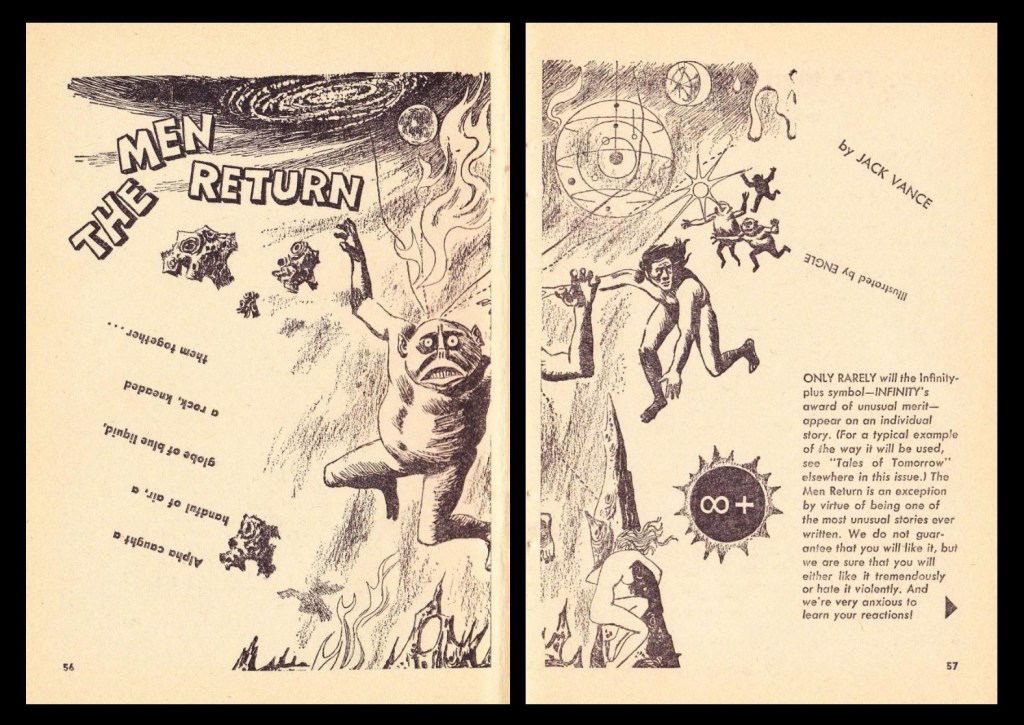
“The Men Return” by Jack Vance #12 of 20 (Read, Listen)
My initial reaction to “The Men Return” was “WTF! Far Out!” It’s not a great SF story, but Vance does produce a different idea.
I’ve often wondered why SF/F writers don’t imagine more far out possibilities when writing fantasy and science fiction because those genres allow for imagining anything. Well, Jack Vance does just that in “The Men Return.” We are told early in the story:
This reminds me of Poul Anderson’s Brain Wave, where our solar system moves into an area of the galaxy with different energy fields and all animal life on Earth becomes five times smarter. It also triggered the memory of Vernor Vinge’s A Fire Upon the Deep and its sequels that features the idea of Zones of Thought, where there are four different regions in the Milky way, each with a different kind of physics. Finally, “The Men Return” made me remember Hothouse by Brian W. Aldiss, and its far future beings.
And until just before the end of “The Men Return,” I thought the story could have been another of Vance’s Dying Earth tales, one closer to the end of humans. It also fits into the Dying Earth theme. Amazon is selling the Kindle edition of The Jack Vance Treasury for $4.99. It collects “The Men Return” and many classic Vance stories, including “Liane the Wayfarer” a classic story from The Dying Earth.
I read “The Men Return” today, and then listened to it, and I’m still not sure what’s happening. There are two groups of beings that talk, but each considers the other group a source of food. The Organisms are named Alpha and Beta. While the Relicts are Finn, our main point-of-view character, two females, Gisa and Reak, and two ancient males, Boad and Tagart. Both groups constantly search for food in a surreal landscape where physics and gravity don’t seem to be working. I might need to read this story several times before I get what Jack Vance was painting in this picture.
From the story I can’t tell if the two groups are simply different tribes of humans, or if in the far future, humans have evolved into two separate species, or if one of the groups is aliens. The artwork suggests one group is different looking than the other group. I assume the Organisms are either aliens or mutants.
Larry T. Shaw, the editor of Infinity Science Fiction presents “The Men Return” with a new designation, the Infinity + symbol.
Infinity Science Fiction was published from November 1955 through November 1958, and even though it was a second-string SF magazine, it published quite a lot of good science fiction from major names in the genre. The classic SF story, “The Star” by Arthur C. Clarke was published in its first issue.
Shaw’s Infinite + designation reminds me of F. Orlin Tremaine, Astounding Science Fiction second editor, Thought Variant designation for special stories. Asimov wrote “Nightfall” as an imagined Thought Variant story. John W. Campbell later tried to do the same thing with his NOVA designated stories.
Here are the comments Shaw received on “The Men Return” from the October issue.
Finally, here’s the cover from the July 1957 issue of Infinity Science Fiction where “The Men Return” appears.












 Classics of Science Fiction