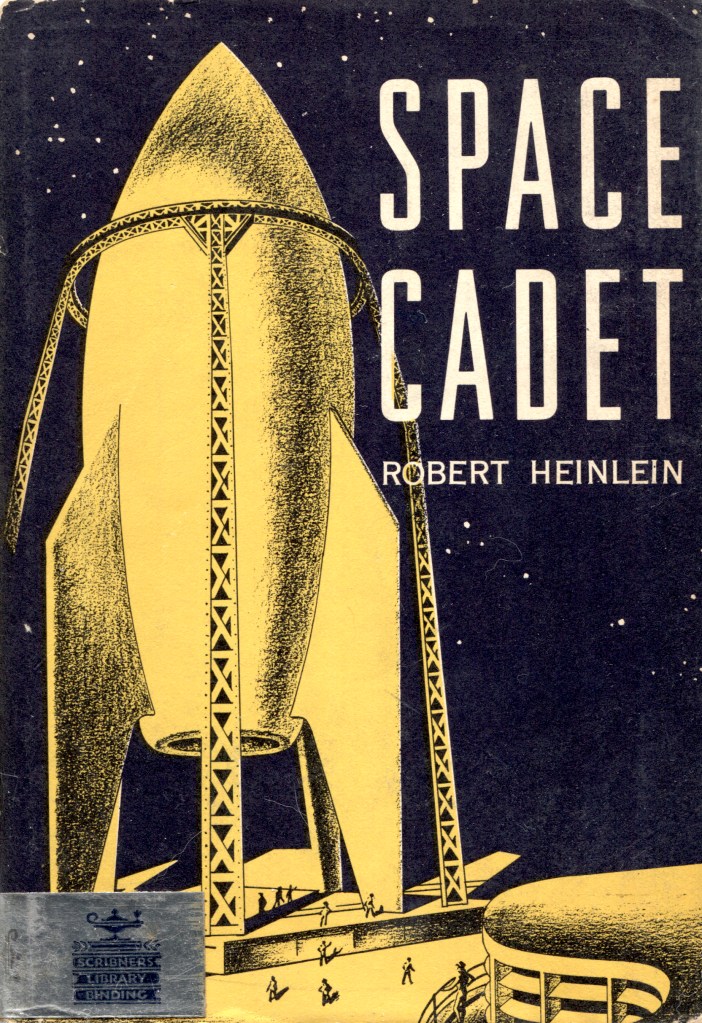
1948: SPACE CADET by Robert A. Heinlein

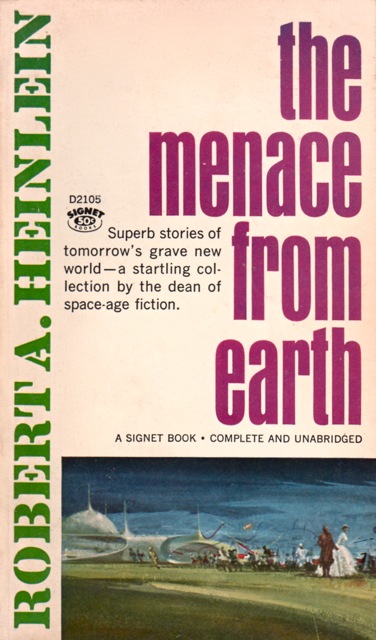
We often judge old science fiction books by what writers got right about the future. It is equally valuable to understand what they got wrong. In an experiment, disproving a hypothesis is still informative. Robert A. Heinlein was famous in the 1940s for writing a series of science fiction stories he labeled Future History. Heinlein also wrote fourteen young adult novels from 1947 to 1963 that can also be considered another Future History.

I’ve read thousands of science fiction novels and short stories over the past sixty-plus years. I no longer enjoy reading science fiction in the same way I did when I was young. That was when I could forget that I was a reader and immerse myself in the story. Now, when I read science fiction, I’m constantly thinking: What is the writer trying to create, how are they doing it, and why? When I read old science fiction, I think about the year it was written and what the author used as grounds for speculation.

I believe that at one time, Robert A. Heinlein was as brilliant in his speculations as H. G. Wells in his heyday. Space Cadet was written during a particularly stressful time in Heinlein’s life. He had left his second wife, Leslyn, whom he had married in 1932. I do not have the space here to describe how remarkable Leslyn was as a woman in the 1930s. Leslyn had a master’s in philosophy, was politically liberal, and sexually adventurous. Robert and Leslyn had a remarkable fifteen-year relationship, with an enviable social life among highly creative people in Los Angeles. Robert had left Leslyn, waiting for the divorce to allow him to marry his third wife, Virginia (“Ginny”) Gerstenfeld. She became his muse and companion for the rest of his life. (See Robert A. Heinlein: Volume I: Learning Curve, 1907–1948 by William H. Patterson.)

Space Cadet follows four boys, Matt, Tex, Oscar, and Pierre, through a series of episodic adventures as they train in the Interplanetary Patrol. Heinlein was a graduate of the United States Naval Academy and modeled Space Cadet on his training at Annapolis. The story begins on Earth, then moves to a military school in Earth’s orbit. (The boys take leave on a giant space habitat.) Next, the boys are assigned to a rocket searching for a lost exploration vessel in the asteroids. Finally, end up on a rescue mission on Venus. For the most part, the story is a page turner. Each episode combines personal conflicts and learning experiences. Heinlein promotes education, especially in math. Heinlein provides a certain amount of infodumps about space navigation, orbital mechanics, rocket science, space suits, weightlessness, space sickness, and other realistic details involved in exploring space that were usually ignored in science fiction before Heinlein.

The Heinlein juveniles took space exploration seriously, at least by what was known at the time. This was especially true in the early books of the series. However, each book went further away from Earth. Eventually, the series went well beyond anything scientific to explain the methods of transportation used in them. I’ve often felt that Heinlein was focused on the details of realistic space exploration during the late 1940s and early 1950s, but after Sputnik and NASA, Heinlein shifted to making his novels about politics and society. Those later novels might be set in space, but Heinlein no longer concerned himself with the details of rocket science.

Although Heinlein was experiencing the success of his first book being published in 1947, a string of sales to slick magazines, and Hollywood types contacting him about making a movie, he was living in poverty in a tiny trailer. He desperately needed money. Heinlein left California and everyone he knew to hide out in Fort Worth, Texas. He was living in sin with Ginny, his future third wife. They had to keep their relationship secret until the divorce went through with Leslyn. Heinlein felt guilty for abandoning Leslyn, but she had become an uncontrollable alcoholic. Heinlein had met Ginny in Philadelphia while working as a civilian for the war effort. Ginny was a biochemical engineer with math skills who worked well with Heinlein on planning the science in his science fiction. The two of them spent their days in Fort Worth working out the math for the orbital mechanics in Space Cadet. Heinlein’s future depended on this second book for Scribner’s, but he had a difficult time writing it. He claimed that Ginny offered many suggestions that he initially rejected but ultimately used to finish the novel.

In 1948, Heinlein didn’t know his 1947 novel, Rocket Ship Galileo, would be the basis for Destination Moon, the first major science fiction film of the 1950s, and Space Cadet would be connected to Tom Corbett, Space Cadet, a 1950 TV show that influenced later science fiction television. Heinlein had been the star of John W. Campbell’s Astounding Science Fiction in the 1940s. Nor did he have any inclination that his twelve young adult novels for Charles Scribner’s Sons would have such a major impact on readers in the 1950s. In 1947 and 1948, Heinlein was at a low point in his career. He had no idea how big a success his writing would become, or how Ginny would become the love of his life. They believed in a fantastic future of space travel, but they were so poor that they had to sell their belongings to survive.

Heinlein dominated science fiction in the 1950s, like H. G. Wells did in the 1890s. When I reread Heinlein, it’s to see how he changed the course of science fiction. When I was young, I felt Heinlein would one day be considered the Mark Twain of science fiction by the time I got old. That hasn’t happened.

Robert Heinlein’s reputation as a science fiction writer has dropped dramatically over my lifetime. When I was growing up, if two SF fans met, both assumed each other’s favorite author was Heinlein, and they’d argue over who was the next best science fiction writer. Today, many modern readers shun Heinlein, usually for what they believe are Heinlein’s personal views, or because they’ve read one of Heinlein’s later works, and assume all of his books are just as bad. Personally, I dislike all of Heinlein’s books published after The Past Through Tomorrow (1967). I have significant problems with anything he wrote after Starship Troopers (1959) and before he published The Past Through Tomorrow.

Science fiction becomes dated after a few decades, which is the main reason why Heinlein’s fiction is falling out of favor. Only three SF novels from the 19th century are commonly read today: Frankenstein, The Time Machine, and The War of the Worlds. Eventually, I believe fewer than a dozen science fiction novels from the 20th century will be widely read in the 22nd century.

Heinlein will continue to be read until his original fans all die. Then, readers yet to be born will decide if any of his books will be worth reading after that. I’m rereading Heinlein’s books, speculating if they will survive in the future. I started with Heinlein’s first published novel, Rocket Ship Galileo (1947), an essay I already need to revise.

Rereading his second Scribner’s novel, Space Cadet from 1948, it’s easy to dismiss it as a young adult novel for boys. But when you examine it in comparison to science fiction published up until 1948, and consider the philosophical issues it deals with, it’s a standout SF novel.

In judging Heinlein’s long-term prospects, I’ve decided to use H. G. Wells, Aldous Huxley, George Orwell, and George R. Stewart as models, specifically for The Time Machine, The War of the Worlds, Brave New World, Nineteen Eighty-Four, and Earth Abides. Heinlein wanted Starship Troopers, Stranger in a Strange Land, and The Moon is a Harsh Mistress to be the three books by which he would be remembered. Heinlein felt those novels were his most mature works, and which best expressed his views. They are the ones that are still found in bookstores. They are also the Heinlein novels modern readers often dislike.

Heinlein might be right, and those books will be his literary legacy. Heinlein has twenty-nine other books published in his lifetime to consider. I plan to reread nineteen of them as possible works that might be remembered instead. So far, I’ve reread three, and my memory of the others suggests that Heinlein does not have a novel equal to my five models. In terms of ambition and complexity, only Heinlein’s favorite three come close to the five models I’ve chosen in ambition. However, I’m not sure if Heinlein’s philosophical intent in those works will be well-regarded in the future.

I believe there’s another way Heinlein might be remembered. Heinlein will often be discussed in books about science fiction. Heinlein is a significant figure in the evolution of science fiction. For example, in a taxonomy tree showing the evolution of the genre, Starship Troopers will be the main branch for Military SF. Rocket Ship Galileo is situated on a major branch of fiction about the first trip to the Moon. And Space Cadet is a major contribution to exploring the solar system.

In the 21st century, Heinlein is often ignored. Many readers have the prejudice that Heinlein is an unlikable conservative; some even think he’s a fascist and misogynist. But Space Cadet expresses extremely liberal views.

If you read Space Cadet today, it will feel like a simple story for young people that’s quite dated. Readers need to understand events in 1948 to appreciate the novel. Heinlein imagines a need for a world government and an agency to control nuclear weapons. Russia didn’t have the atomic bomb until 1949, but Heinlein was worried about the day when multiple countries had weapons of mass destruction. Throughout the 1940s, Heinlein wrote stories that speculated about how we’d apply atomic energy in peacetime and control nuclear weapons to prevent wars. That’s a heavy topic for fiction found in elementary school libraries.

Heinlein was also concerned with the human race destroying itself. Heinlein believed only one international agency should control nuclear weapons. And if any country violated their policies, their ability to create a nuclear bomb would be targeted with nukes. In an early draft of Space Cadet, Heinlein had Matt, his young protagonist, nuking his hometown. Wisely, Heinlein decided that was too much for a young adult novel and reduced the idea to a bull session between cadets.

To emphasize the importance of this idea, he has the cadets discover evidence that the asteroids are the remains of a planet that blew itself up in an atomic war.

The Interplanetary Patrol is racially integrated. Heinlein makes a point that black males are cadets and officers. The U.S. military integrated in 1948. Heinlein takes this further by emphasizing that intelligent beings on Venus and Mars are equally human, even if they don’t look human. However, human females don’t have equal rights in this story. But Heinlein quickly liberates women in later books in this series. However, even in Space Cadet, the Venusians are a matriarchal society.

Ideas about a space based military from Space Cadet will show up again in Starship Troopers. The novel also has an orbital battle school that prefigures Ender’s Game. And the Interplanetary Patrol will influence several TV shows in the 1950s, which will eventually lead to Star Trek. Of course, Heinlein was inspired by E. E. “Doc” Smith’s Lensman series.

Throughout the novel, Heinlein tosses out ideas that will become part of reality. At the beginning of the story, Matt uses a pocket phone that depends on cell towers. He gets to orbit via a reusable rocket. They are stationed at a geosynchronous orbit. But Heinlein also missed on things, too. In 1948, Heinlein didn’t foresee the impact that computers, networks, and robots would have on our world.

Space Cadet is set in 2075. Heinlein assumes that by then, humanity will have traveled the solar system and settled colonies on the Moon, Venus, Mars, and Ganymede. Heinlein also thought we’d find intelligent life on Venus and Mars, and it once existed on the planet that blew up and became the asteroids. All of Heinlein’s young adult novels have overlapping futures with similar details. That’s why I say they represent another Future History.

Many science fiction writers before 1950, including Ray Bradbury, hoped we’d find Martians and Venusians. I call that kind of thinking pre-NASA science fiction. In the 1960s, when NASA’s probes discovered that those planets were lifeless, I was tremendously disappointed. I still love pre-NASA science fiction. But I have to wonder if younger generations have completely dismissed such stories because of what science has discovered? I must point out that they accept Star Trek and Star Wars. We know those popular series are just as unscientific as pre-NASA science fiction, but they haven’t been rejected. Why?

I doubt many readers will read Heinlein because of his historical value to the genre. Few readers today read E. E. “Doc” Smith, and his series were once beloved. At 73, I sometimes wonder if I shouldn’t give up on Heinlein, too. However, rereading books by Heinlein and Philip K. Dick provides far more enjoyment than reading new science fiction. I both love that and regret it. It reminds me of all my old boomer friends who won’t listen to any music created after 1975. I don’t want to be stuck in pop culture nostalgia, but obviously, I am.

I once read science fiction to think about the future.

I now read science fiction to think about the past.

James Wallace Harris, 9/31/25
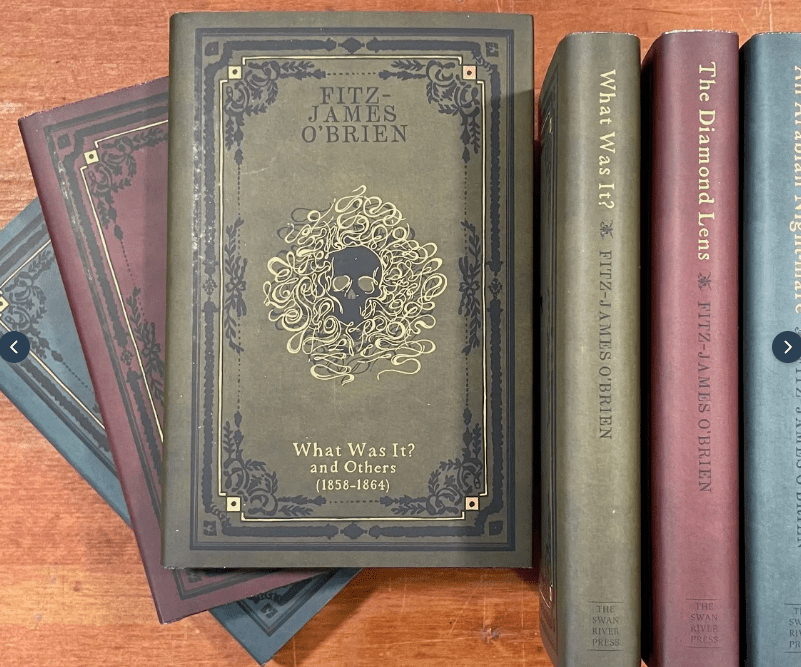
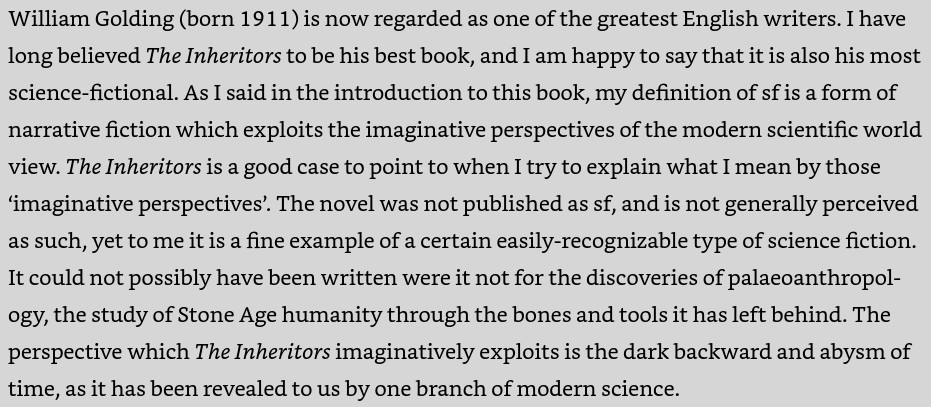
THE INHERITORS by William Golding

Our species, Homo sapiens, have been around for 300,000 years, but we only have recorded history for about 5,000 years. Neanderthals date back even further in time. For hundreds of thousands of years, people created societies and maybe even forgotten civilizations that existed before history. Science fiction is mostly known for imagining possible futures, but a subgenre exists that speculates about human life in prehistory.

Probably, many science fiction fans would consider stories about our cave-dwelling ancestors as historical fiction or historical fantasy. David Pringle claims the novel was inspired by science, so it should be science fiction. Of course, that opens up a whole can of worms. But I’m willing to embrace these kinds of stories into our genre.

I read The Inheritors by William Golding because I’m reading or rereading the classics of science fiction. I’m going through David Pringle’s Science Fiction: The 100 Best Novels. The Kindle edition of the Pringle book is $1.99. The Kindle edition of The Inheritors is just 99 cents. You can read a list of Pringle’s 100 recommended SF titles here.

William Golding’s first novel was The Lord of the Flies (1954). His second novel, published in 1955, was The Inheritors. Lord of the Flies is about a group of schoolboys forced to live like primitives. The Inheritors is about a small band of Neanderthals confronting Homo Sapiens. It’s obvious Golding was exploring similar themes in these two novels.

Writers have long speculated about Neanderthals in fiction. Neanderthals thrived for 400,000 years but became extinct 40,000 years ago. Modern humans may have coexisted with them for up to 100,000 years. William Golding portrays Neanderthal life based on scientific speculation in 1955. It’s quite sympathetic.

Most of the novel is in third-person Neanderthal point of view, following a male named Lok. Golding expects his readers to decode action from the limited awareness of Lok’s mind. He does not say “bow and arrow” but describes them in terms that a Neanderthal would understand. Quite often, the narrative is confusing, but that’s intentional. Golding wants the reader to struggle in the same way that Lok struggles to understand.

Golding offers several interesting speculative theories. He suggests that Neanderthals had no sense of time but understood past and possibly future events by talking about pictures in their minds. Their language consists of simple nouns and verbs. The members of the tribe spend a lot of time comparing mental imagery. Their social bonding suggests they felt an almost telepathic connection with each other. Golding suggests that gender roles were divided. Males, especially the leader, decided on actions, while females, through a primitive religion, decided on meaning.

This speculation about how Neanderthals thought reminded me of The Origins of Consciousness in the Breakdown of the Bicameral Mind by Julian Jaynes, first published in 1976. Jaynes theorized that humans didn’t always have the same kind of internal consciousness that we have now. Golding anticipates this idea in 1955.

Throughout the novel, characters are forced into an original concept. The plot begins with crossing a stream. The Neanderthals are terrified of water. They have always depended on a fallen log to cross a stream, but one day it’s no longer there. It takes a great deal of group effort to come up with a solution.

The leader of the Neanderthal band is Mal, an old man. An unnamed old woman, maybe Mal’s mate, leads the group in other ways. There are indications that tribe members mated with whomever. There are four adults, Lok and Fa are the younger ones, and they become the main characters. Ha and Nil are the other two. There is a little girl named Liku and a baby.

Liku and the baby go missing. Then Ha and Nil. We follow Lok as he tries to track them down. Lok eventually discovers a new animal that Lok hasn’t seen before. After observing them, he starts calling them the new ones. They are Homo Sapiens, or Cro-Magnon, but it’s never said.

The women carry a small figurine they call Oa and treat it as if it were alive. My guess is the Oa is a Venus figurine, but I’m not sure. The Venus figurines came much later, well after Neanderthals went extinct. I assume Golding is speculating that such a religious symbol might have existed far back into time, so that intellectual attributes we speculate began with modern humans had early antecedents in Neanderthals.

In chapter 11, the penultimate chapter, we follow Lok at first through a close third-person narrative. But near the end, the point of view changes to omniscient. This lets Golding describe the scene as if we were seeing it through the modern mind. We are told Lok holds something in his hand: “It was a root, old and rotted, worn away at both ends but preserving the exaggerated contours of a female body.” I’m sure this is Oa.

In Chapter 12, the final chapter, we get a third-person account from the perspective of the Homo sapiens. This lets us know what they thought about the Neanderthals. It also allows Golding to speculate about their state of consciousness.

The Inheritors is not a breezy read. In some ways, it reminds me of A Clockwork Orange and how I had to struggle to understand what was going on. I’m quite sure if I reread The Inheritors two or three times, I would discover many more layers of speculation and narrative devices. With just this one reading, I’m left puzzled over several scenes.

The Inheritors is not famous enough to have a current audiobook edition. I believe hearing the story would help me understand it better. I did find an old audiobook edition on YouTube. Listening to it did indeed make the action clearer. I have long known that I tend to read too fast. Audiobooks make me slow down. Listening makes certain parts of the prose easier to understand. However, I need to read with my eyes to understand other parts. I believe The Inheritors deserves to be read with both my eyes and ears. By the way, Audible is scheduled to publish a new audiobook edition next year.

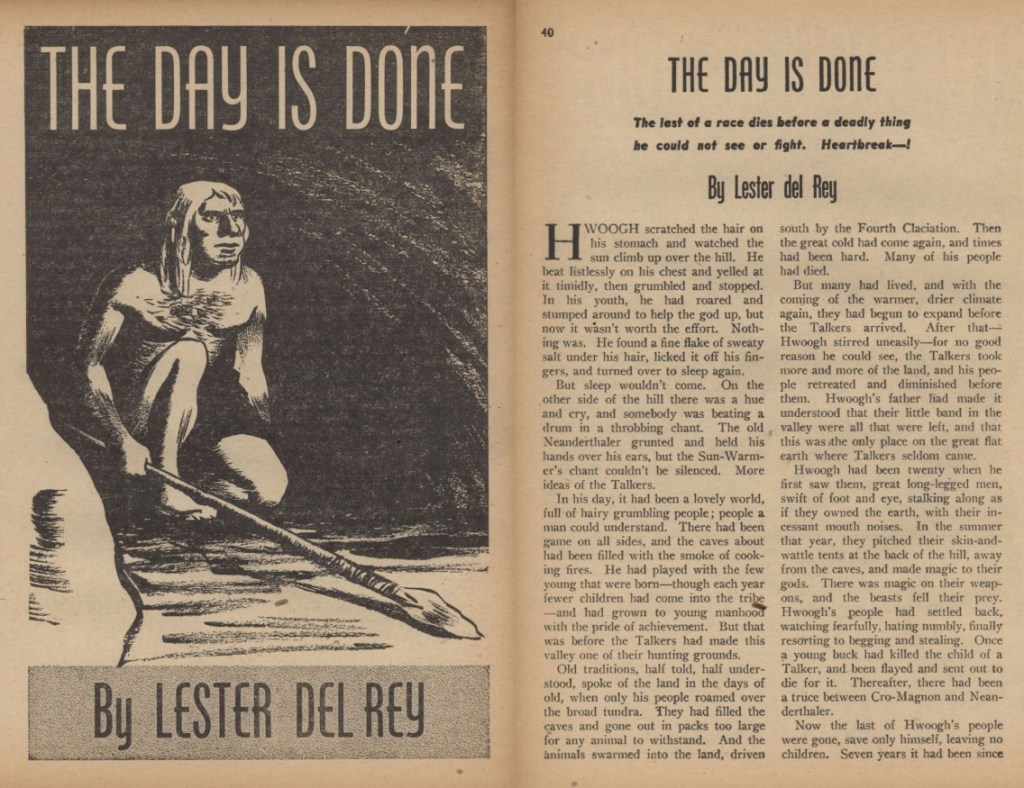
The Inheritors reminds me of the short story, “The Day is Done” by Lester del Rey, first published in the May 1939 issue of Astounding Science-Fiction. It’s another tale of a Neanderthal confronting Homo sapiens. You can read it here. I wonder if William Golding had read “The Day is Done.”

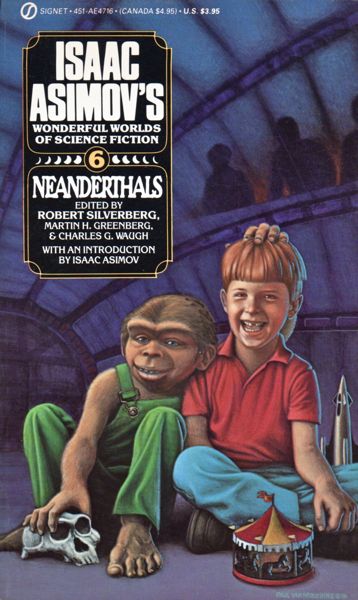
There is an anthology of science fiction stories, Neanderthals, edited by Robert Silverberg, Martin H. Greenberg, and Charles G. Waugh. View the table of contents here.

H. G. Wells wrote “The Grisly Folk” in 1921, an unflattering look at Neanderthals.

Of course, the most famous fiction featuring Neanderthals is Earth’s Children series, by Jean M. Auel.

James Wallace Harris, 7/8/25

What is the Shelf Life of Science Fiction?

My library constantly discards science fiction from its holdings. I know that because I see those books in the Friends of the Library book sale stamped DISCARD. Often, they are books I would consider SF blasts from the past. Evidently, if they aren’t checked out for a certain period, they get discarded. I used to believe libraries were supposed to preserve the past, but I don’t think that’s true anymore.

But that’s not my only clue that science fiction has a shelf life. At the used bookstore I visit every week I see the same old books week after week – no one is buying them. It’s the newer books that come and go so quickly.

For years now, I’ve been watching people review science fiction books on YouTube. I can sense that many authors and their books are falling out favor over time. A major example is Robert A. Heinlein. When I was growing up, he was considered the #1 science fiction author. He was my favorite SF writer. I still love his books published before 1960, but the ones after that haven’t aged well with me. Reviewers generally pan Heinlein nowadays. I often see critical comments about Heinlein on Facebook. He’s just not popular anymore. I see many of his books at the used bookstore, but only a couple at the new bookstore.

Whitney at the YouTube channel Secret Sauce of Storycraft has been reviewing old Hugo winning novels by decades. She didn’t like over half of the winners. Five of the ten (The Wanderer, Stranger in a Strange Land, The Moon is a Harsh Mistress, This Immortal, and Lord of Light) have stopped working for me too.

If I gave the Hugo Award now for the 1960s, my list would be:

  • 1960 – STARSHIP TROOPERS by Robert A. Heinlein
  • 1961 – ROGUE MOON by Algis Budrys ( for A CANTICLE FOR LEIBOWITZ)
  • 1962 – STRANGER IN A STRANGE LAND by Robert A. Heinlein
  • 1963 – THE MAN IN THE HIGH CASTLE by Philip K. Dick
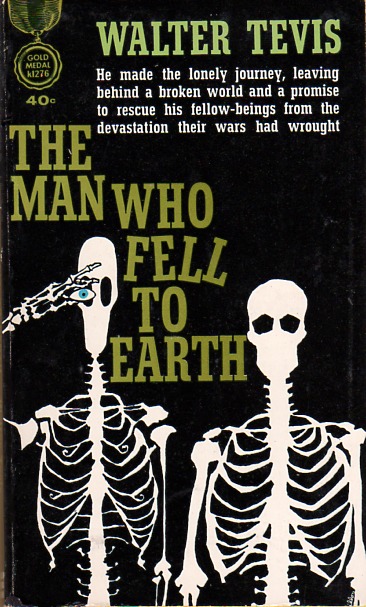
  • 1964 – THE MAN WHO FELL TO EARTH by Walter Tevis (for WAY STATION)
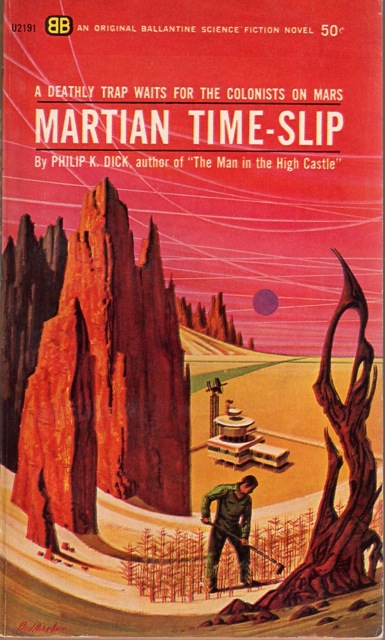
  • 1965 – THE MARTIAN TIME-SLIP by Philip K. Dick (for THE WANDERER)
  • 1966 – DUNE by Frank Herbert
  • 1967 – FLOWERS FOR ALGERNON by Daniel Keyes (THE MOON IS A HARSH MISTRESS)
  • 1968 – no award
  • 1969 – STAND ON ZANZIBAR by John Brunner

I thought there would be hundreds of science fiction books that would be Hugo worthy from the 1960s, but there weren’t. I used CSFquery.com and ISFDB.org to look at each year 1960-1969 and there just was’t that many older books that’s being read today that people still admire.

I love A Canticle for Leibowitz still, but it’s a fixup novel, and I mostly love it for the first story. And reviewers aren’t as wowed as they used to be for it. I kept Stranger on the list even though I no longer like it, because it’s so ambitious for the times, and historically, it is the standout novel of the year. I love Way Station, but I don’t think people still read it much. The Man Who Fell to Earth has grown in popularity since 1963. The Martian Time-Slip is way better than The Wanderer, and people still read it. I definitely think Flowers for Algernon has aged better than Mistress. I’d give No Award over Lord of Light, or any other novel I remember from 1967.

All the books on my list are in print, and all are available as audiobooks. That’s a good indicator that they are still being read.

I was shocked by how few science fiction books from the 1960s I still admire. Twelve years ago I wrote a series about the best SF books from each decade. Looking at my essay for the 1960s shows damn few books that people still read.

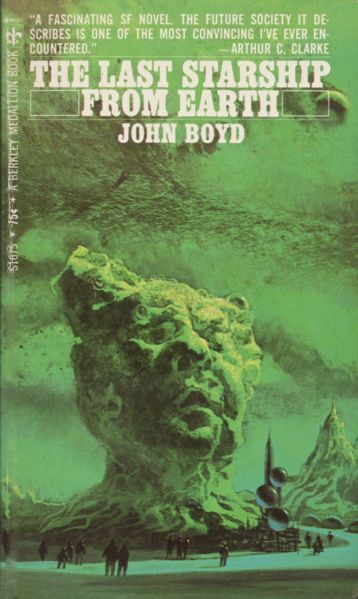
I remember back in the 1960s when old guys would gush about E. E. “Doc” Smith books from the 1920s and 1930s. I tried them, and they were horrible. I guess today’s young readers would feel the same about most of the books I loved back in the 1960s. Is anyone still reading Keith Laumer, John Boyd, Mack Reynolds, A. Bertram Chandler, etc.

Here is a list of 242 popular SF books from 1920-1990. How many do you think are still being read?

What are the best science fiction books from the 1960s that you still read and think young people should try?

You might like to read An Information History of the Hugo Awards by Jo Walton. This was first published at Tor.com and many of the comments from readers are included.

James Wallace Harris, 5/5/25

How to Judge Hack Writing?

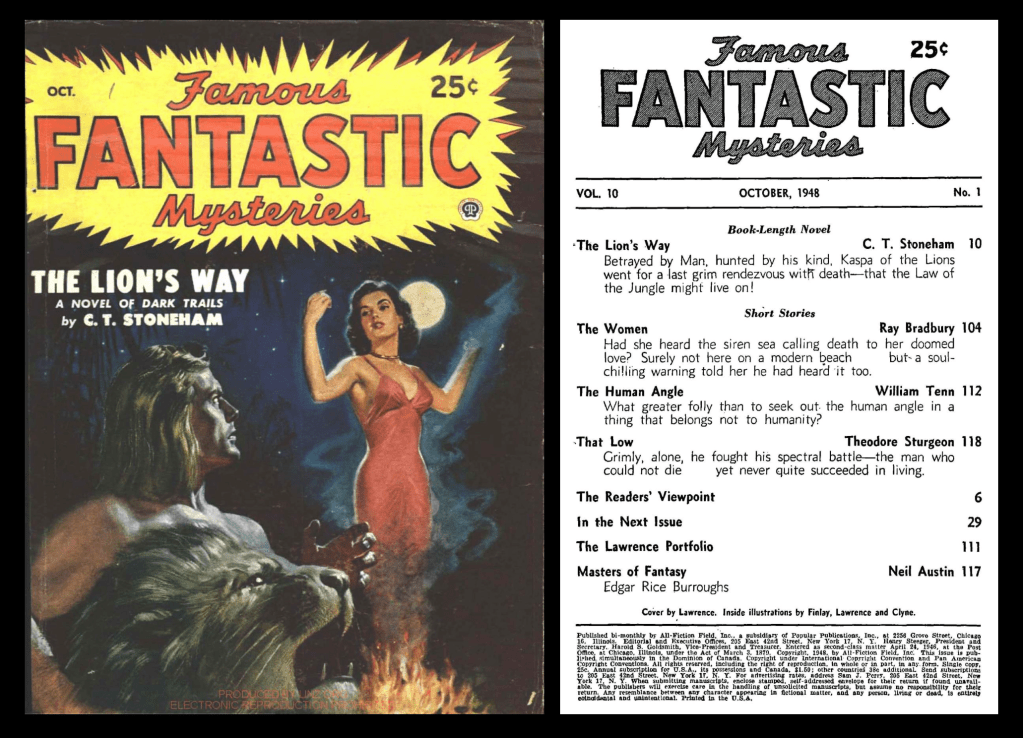
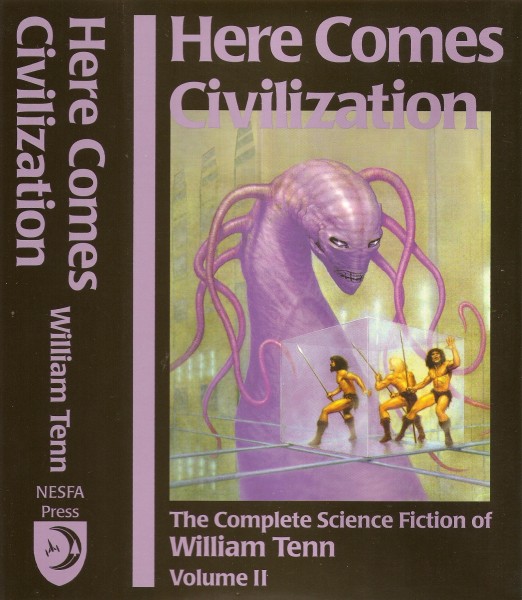
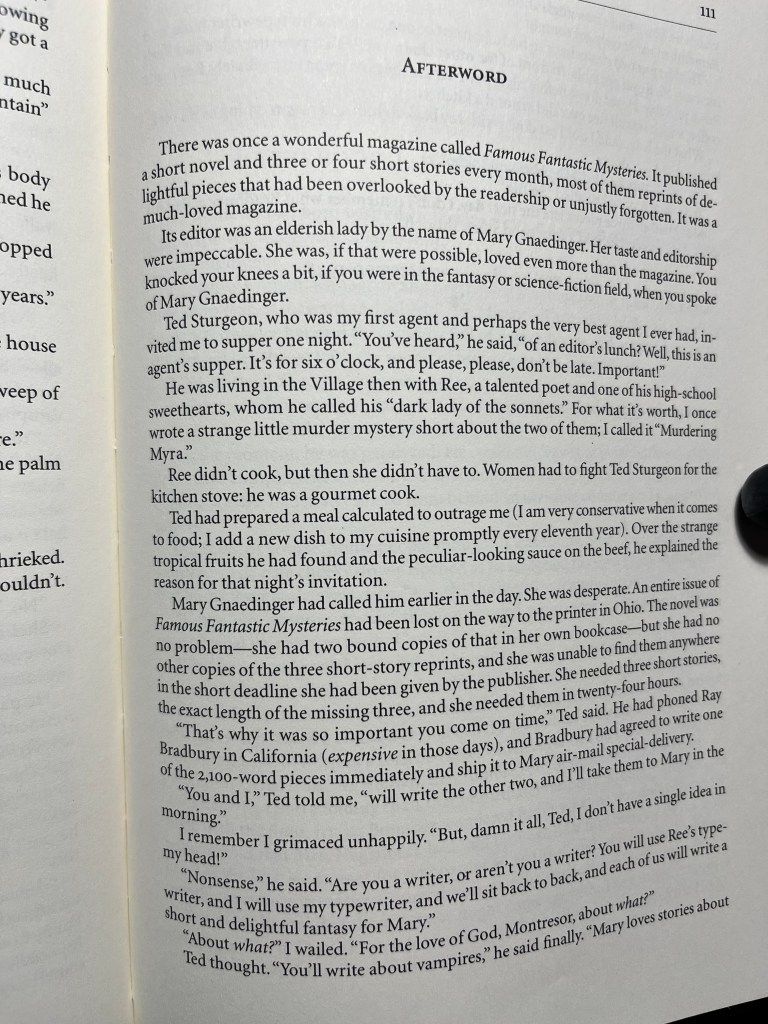
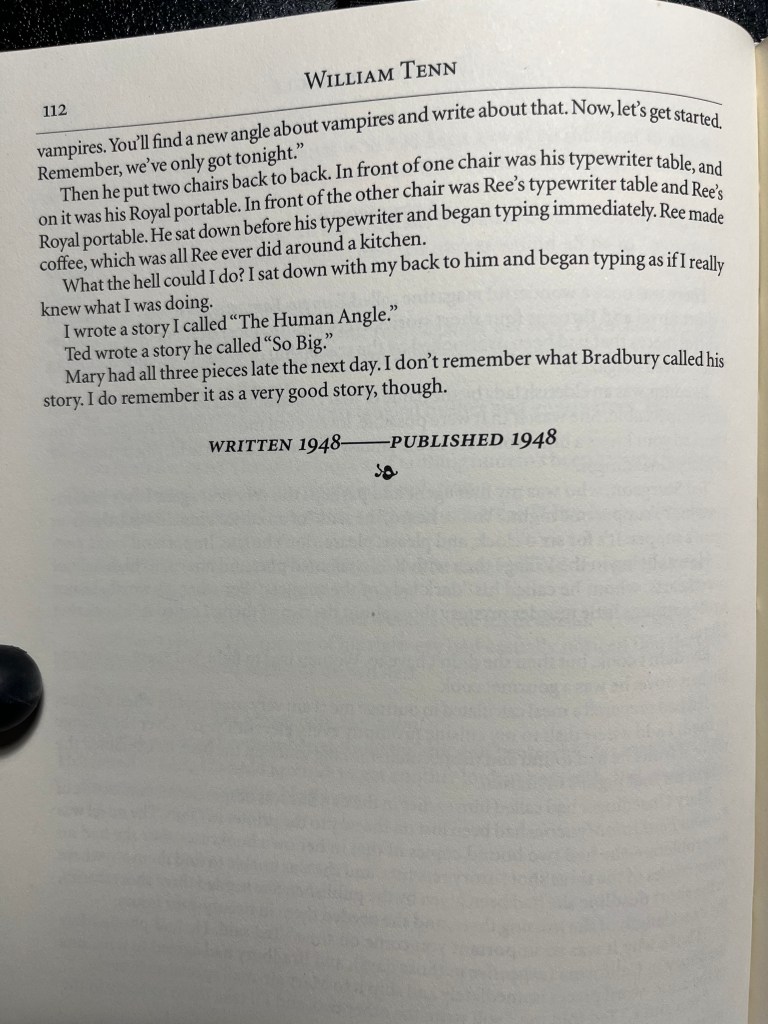
My friend Mike recently told me an anecdote from Here Comes Civilization: The Complete Science Fiction of William Tenn Volume 2. It was in the afterward to the story “The Human Angle.” It seems Ted Sturgeon invited William Tenn over for dinner with a hidden agenda. When Tennn arrived, Sturgeon told him that Mary Gnaedinger, the editor of Famous Fantastic Mysteries needed three short stories by tomorrow and they would write two of them that night. Ray Bradbury was going to write the third and air mail it special delivery to Mary from California. (See the “Afterward” below for the full tale.)

Tenn, Sturgeon, and Bradbury did come through in twenty-four hours and their stories were printed in the October 1948 issue of Famous Fantastic Mysteries. You can read that issue at Archive.org.

There were many legendary science fiction writers (and pulp writers) who bragged they could crank out a short story in a day, or a novel in a weekend. But is this hack writing any good? That’s hard to say. What is good? All three stories, “The Women,” “The Human Angle,” and “That Low” were readable stories and even entertaining. However, they are also quite forgettable. But not completely forgettable. Follow the links to view their reprint histories.

Men and women who wanted to make a living writing science fiction back in the 1930s, 1940s, and 1950s had to produce a lot of content. Many science fiction writers made a half-ass living churning out short stories for magazines. But are these speedy productions worth your time to read today? That depends.

Short stories can achieve several levels of quality and recognition. Getting published in a magazine is the first rung up in a ladder of publishing success. The next step up in recognition of quality is being nominated for an award or getting reprinted in an anthology, especially an annual best-of-the-year anthology. Winning an award is another step up. After that, recognition comes slowly. Having an author include a story in one of their short story collections at least says the author is proud of that story. But having a story reprinted in a retrospective or theme anthology means the story stands out over the other stories that came out in the year it was first published. Even greater recognition is when a short story is used in a textbook and taught in school or optioned for a film or television show.

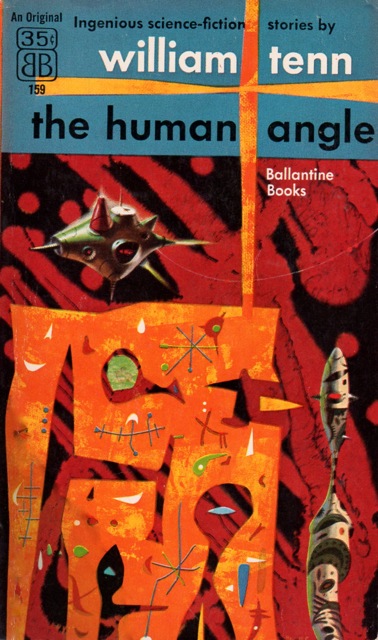
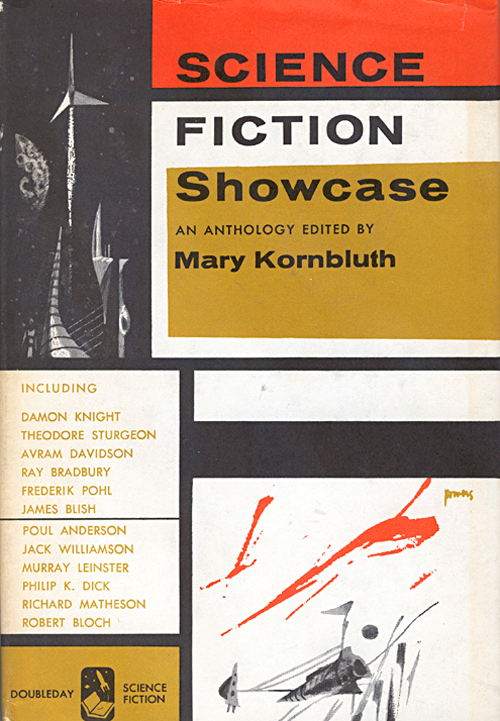
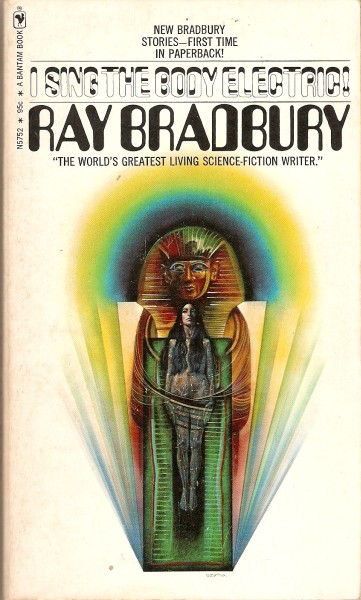
The Bradbury and Tenn were anthologized in a few minor theme anthologies as well as a few author collections. Bradbury included “The Women” in his famous I Sing the Body Electric collection. Tenn used “The Human Angle” for the title of a collection. Sturgeon’s story was reprinted in Mary Kornbluth’s Science Fiction Showcase, which was a special anthology probaby to help the widow of C. M. Kornbluth. “That Low” was only reprinted in Sturgeon’s complete stories series, suggesting that Sturgeon never liked it much. They were not major stories. However, these stories were sold several times, and they are in print today.

But back to my title question: How to judge hack writing. First, we must consider what kind of reader you are. Are you an indiscriminate reader, like someone who comes home from work and turns on the television and quickly finds something to watch by flipping through the channels? Or, are you the kind of person who Googles to find the critically admired shows that just came out this month? Maybe, you’re the person who looks at lists of the best TV series of all-time hoping to find something amazing to watch.

The Bradbury, Tenn, and Sturgeon stories are perfectly good stories if you’re capable of being entertained by an average episode of an average TV series. And that might be good enough for most people. But if you’re the kind of person who thinks in terms of the “Ten Best Episodes of The Twilight Zone,” these stories don’t even come close. And, if you compare them to “Fondly Fahrenheit” by Alfred Bester, or “The Story of Your Life” by Ted Chiang, or “The Ones Who Walked Away from Omelas” by Ursula K. Le Guin, then they aren’t even in the same galaxy.

I’ve developed a rating system I sometimes use in group discussions about short stories. One star is an amateur effort, and two stars is a story that still needs work and shouldn’t have been published. I seldom even mention these stories. Three stars to me is a professional story acceptable for magazine publishing. Four stars is a story that is good enough for me to look forward to rereading. Five stars is a story I’ve read many times and consider a classic.

Hack writers can routinely crank out three-star stories. The stories by Bradbury, Tenn, and Sturgeon are all three-star stories. I didn’t mind reading them, but at my age, they are a waste of my precious reading time – a commodity that’s dwindling. They were fun to look up and read because of Tenn’s anecdote about how and why they got written, but that’s about all.

When I’m restless, I still enjoy reading old science fiction anthologies. I have trouble watching TV, but I can still read for fun. I enjoy looking for gems. The trouble is I seldom find stories like “The Star Pit” by Samuel R. Delany or “Flowers for Algernon” by Daniel Keyes. But that’s what I’m really hoping to find, stories that work at that level.

I also want to know why and how stories work at the highest level of short story writing. I assume there must be definable qualities I can list, but I can’t list those qualities now. I plan to study my favorite 5-star stories and make a list in the future.

I will say the Bradbury story had the most writing qualities of the three stories. It had the most emotional tension. It had the most vivid details. It had the most poetic imagery. I cared for the wife in the black bathing suit. And it was the least predictable of the three stories.

The Tenn story was a vampire story. It has an unusual setting for a vampire story, which was a plus, and it had a different kind of vampire, another plus. But it was the most predictable of the three stories, and the least developed. Bradbury just had way more tension and conflict in his story. Sturgeon’s ending was the most surprising, but it wasn’t a very insightful surprise.

The obvious thing I can say about hack writing is it needs more drafts. Many hack stories could have been far better if they had baked longer in the oven. Writers who are proud of their first-draft writing might regularly sell their work, but it will never be considered great. A good example is Barry Malzberg. Some of his stories and novels are quite appealing, but none of them are books I want to reread. The absolute measure of great fiction is how often readers reread such work.

Robert Silverberg at the beginning of his career cranked out science fiction. Some of it was readable, but neither memorable nor something I’d want to reread. Then at the end of the sixties he changed. I assume he spent more time rewriting, although in some of those same years he cranked out four novels. But Downward to the Earth was different. I’ve read it twice and look forward to rereading it again.

I’m currently reading book 20 of The Great SF Stories 1-26 (1939-1964) edited by Isaac Asimov and Martin H. Greenberg with Robert Silverberg doing #26 with Greenberg after Asimov died. I’ve been reading them in order, along with the other best of the year anthologies that covered the same year. For any given year, I’d say there were less than five stories that I’d rate 5-stars. On average I’d say it’s two 5-star stories in each year. Most of the other stories are 3-stars and 4-stars.

I’m not sure if there are even three hundred 5-star stories in all the years of science fiction. Most would-be science fiction writers who achieve some success publish a handful of stories before starting on novels. I’m not sure if hack writers still exist. There are bestselling writers who crank out one or two novels a year who might be considered hack writers because of their productivity, but I don’t know if they are hack writers like Philip K. Dick, Ray Bradbury, Clifford Simak, Harlan Ellison, Robert Silverberg, and Theordore Sturgeon were early in their career when they could publish a dozen short stories and a couple of novels in a year. Ray Bradbury was quite proud of selling one short story a week pace, and he published in both the pulps and slicks.

Just because a story was written fast, doesn’t mean it’s bad. But the odds of it being great are low. I’m in a handful of online groups whose members love short fiction. There are many readers out there who appreciate good hack writing, especially those old readers who love pulp fiction. I don’t want to criticize such stories and their fans. I have often enjoyed a fun average story, but I’ve forgotten thousands of them.

James Wallace Harris, 4/9/25

INHERIT THE STARS by James P. Hogan

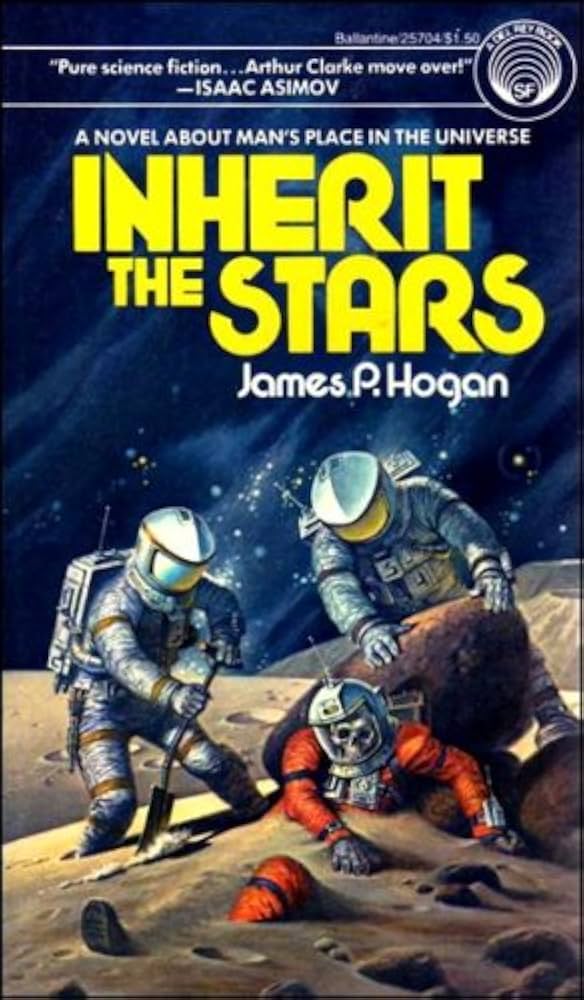
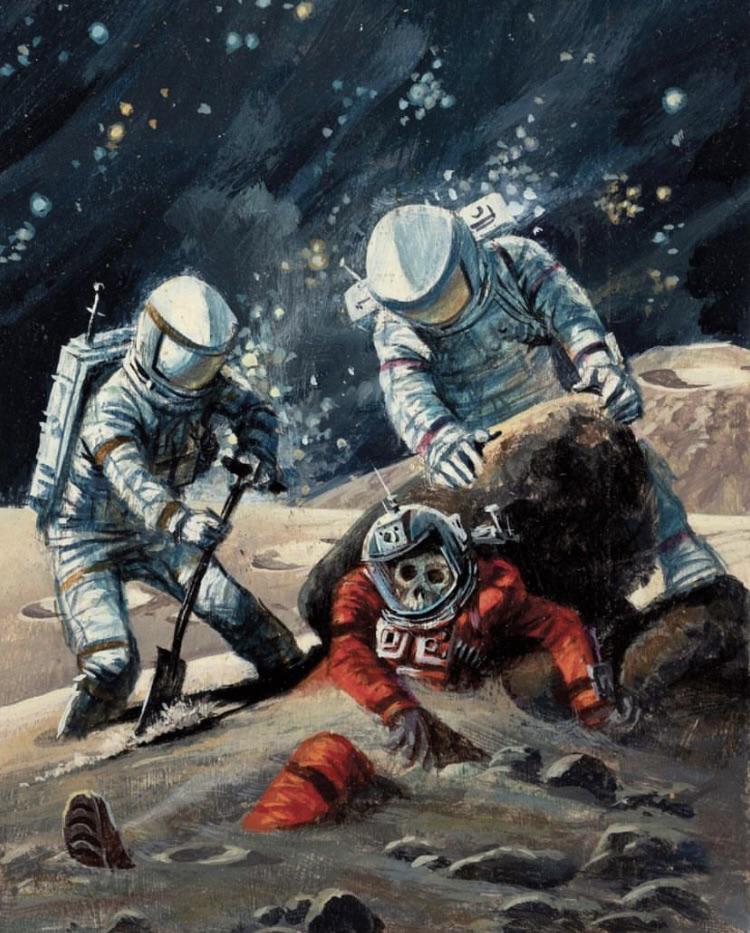
The original paperback, Inherit the Stars by British writer James P. Hogan (1941-2010), had a terrific cover – the kind that made you buy the book. The artwork appears to show astronauts on the Moon finding a dead astronaut, but that is deceptive. Hogan creates a scientific mystery because the dead astronaut has been there for 25,000 years.

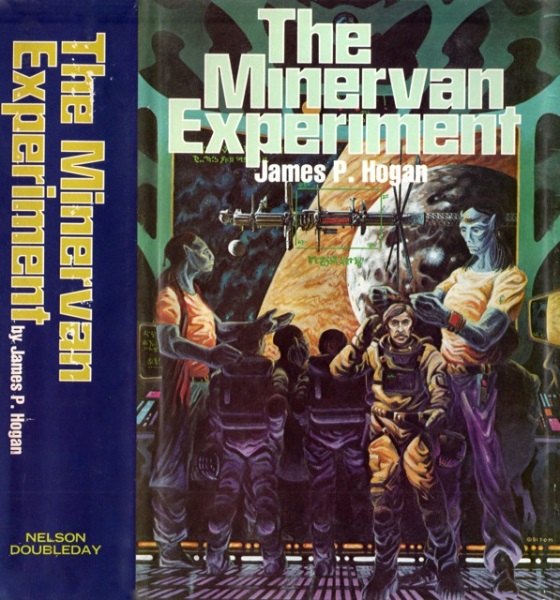
I first read Inherit the Stars in 1992 but after seeing Whitney’s review on YouTube, I wanted to reread the story. I went to Amazon but couldn’t find the book. Was it out of print? I did find it on Audible. Later, I discovered that Inherit the Stars and its sequel The Gentle Giants of Ganymede are now being sold together as The Two Moons for the Kindle. A bargain for $6.99, especially since Whitney also praised the second book. It turns out that there are five books in the series being sold as three Kindle editions. The series is called Giants. Only the first three novels are available on Audible. The Science Fiction Book Club once published the first three novels as The Mirnervan Experiment. Ballentine also published a paperback called The Giants Novels that contains all three.

Before anyone rushes out to buy Inherit the Stars, I need to describe it more, but not enough to give spoilers. Hogan’s story is the kind you want to figure out for yourself. It kept me guessing for the entire novel even though I had read it before. That worried me. Why wasn’t it more memorable? Was that an indication it was a bad book? I don’t think so. How the story is told isn’t very memorable, but the ideas are big-time fun. I did remember some of those, but not connected to the book.

Inherit the Stars is basically scientists talking about one mystery after another. There’s no real plot. A lot happens, but it’s not dramatic. With each discovery, there’s a new puzzle, which makes you think and try to guess what caused each mystery. Inherit the Stars is science fiction focused on ideas and not storytelling. I’ve told you the first mystery, but I don’t want to give away any others.

However, I will give you some fun clues. Inherit the Stars reminds me a lot of Rendezvous With Rama by Arthur C. Clarke. Hogan’s prose is similar to Clarke’s. At one point, the story reminded me of the classic short story “Omnilingual” by H. Beam Piper. The novel also triggered memories of Gateway by Frederik Pohl. At other times it reminded me of the Winston Science Fiction, a series of young adult SF that came out in the 1950s, especially the entries where the protagonists find relics of ancient alien technology. If you love alien archeology stories, you might like Inherit the Stars.

I call Inherit the Stars Pre-NASA Science Fiction, by which I usually mean science fiction written before Mariner 4 photographed Mars in July 1965. Until NASA started exploring the solar system with robotic probes, many people hoped that we would find life, even intelligent life somewhere on other planets in our solar system. For example, Heinlein’s Stranger in a Strange Land from 1961 imagines Mars being inhabited by a dying race. However, after Mariner 4, serious science fiction assumed we were alone in the solar system. (I must admit, that I still love Pre-NASA science fiction. Growing up in the 1950s and 1960s, I desperately wanted us to find Martians.)

I consider Hogan’s 1977 Inherit the Stars Pre-NASA Science Fiction because Hogan maintains the hope that we had neighbors. However, some readers might feel Hogan’s ideas might come across like those of Erich von Däniken, who wrote Chariot of the Gods? Another reviewer dismissed this book as unbelievable. Personally, I find Erich von Däniken’s theories to be insulting to humanity. But I consider Hogan’s speculation to be great science fictional fun.

James Wallace. Harris, 3/1/25
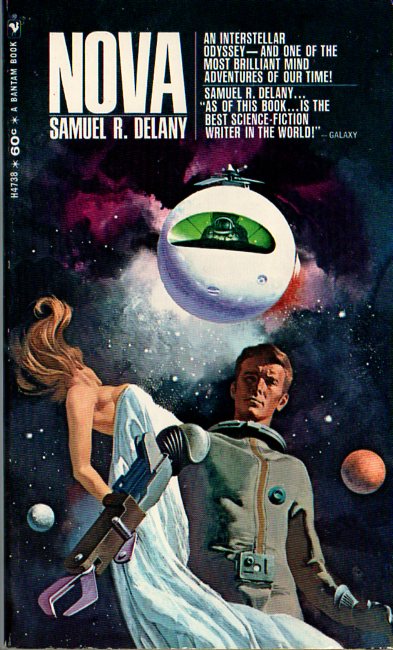
Gimme That Old Time Science Fiction

Whitney at the Secret Sauce of Storycraft YouTube channel recently reviewed several science fiction books she called Just D@mn Good Vintage Science Fiction Reads. She intentionally avoided books considered classic science fiction and defined the kind of books she was looking for in used bookstores as vintage science fiction. She defined vintage science fiction as books published before barcodes appeared on their covers. That would be the mid-1980s. This would be science fiction her parents and grandparents would have read.

She reviewed these books (Links will bring up the video at YouTube):

I have read most of these books with Empire Star and Downward to the Earth being two of my Top 25 science fiction novels. Whitney’s reviews made me think about all the old books I found in used bookstores that weren’t famous but were fun reads. Maybe not outstanding examples of the genre, but the fun kind of science fiction that made you forget about your worries.

Her video makes me want to make my own list of Vintage SF Gems. Books to look for at library book sales that maybe no one is buying. Books you don’t see reprinted in new editions at new bookstores. If you don’t want to hunt used editions, these vintage SF titles are often reprinted as Kindle books at Amazon, sometimes for just $1.99. Kindle and Audible editions are the best sources for finding vintage science fiction today after the demise of the mass-market paperback.

My favorite science fiction books back in the 1960s were Heinlein’s Juveniles. Robert A. Heinlein’s reputation is fading, and I think that’s partly due to online reviewers reviewing the wrong books. Heinlein wanted to be remembered for Starship Troopers, Stranger in a Strange Land, and The Moon is a Harsh Mistress. And those are generally the titles found on new bookshelves and often reviewed. But they are also Heinlein’s novels that many people dislike including myself. And the novels written after that are even worse.

I wish modern reviewers would review Heinlein’s work from the 1950s. If you see old copies of these books give them a try. These science fiction books have given me the most fun over my entire lifetime. I’ve reread them many times. They are how I epitomize science fiction. All by Robert A. Heinlein.

  • Have Space Suit-Will Travel
  • Tunnel in the Sky
  • Time for the Stars
  • The Rolling Stones
  • Farmer in the Sky
  • Citizen of the Galaxy
  • Starman Jones
  • The Star Beast
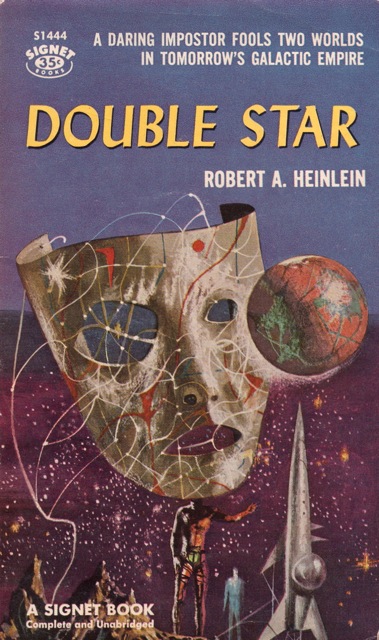
  • Double Star
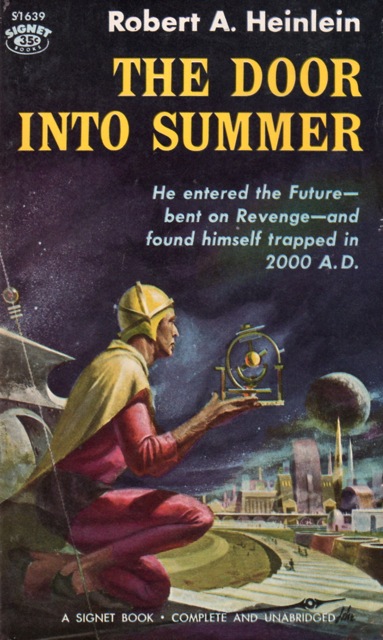
  • The Door Into Summer

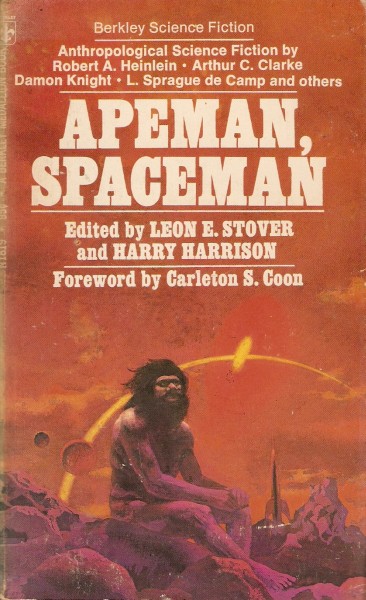
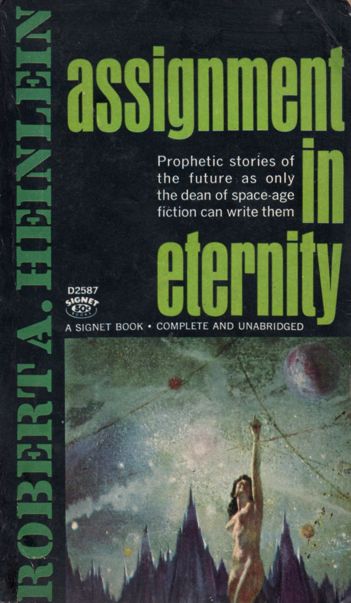
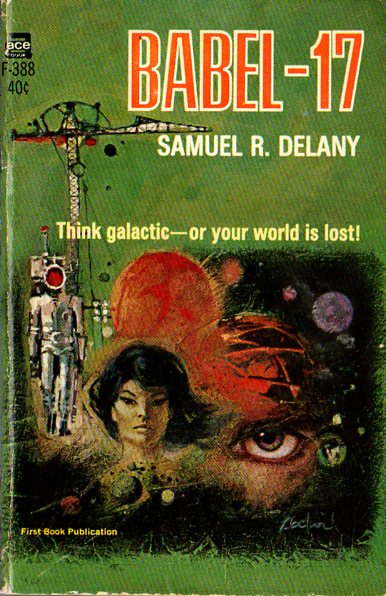
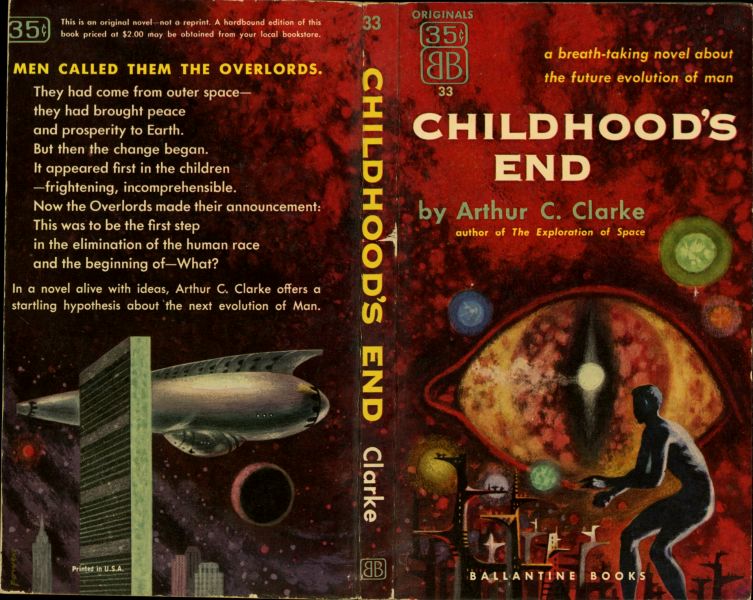
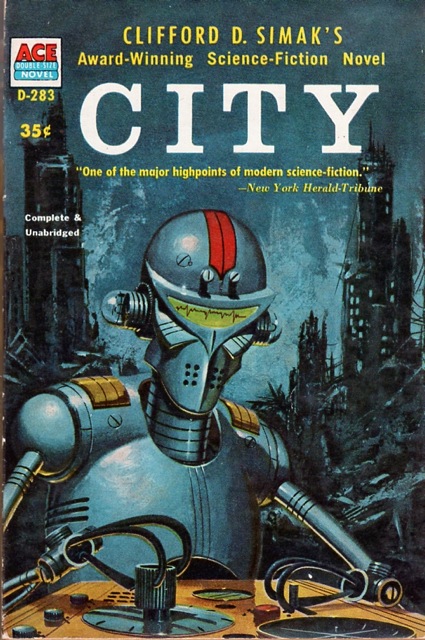
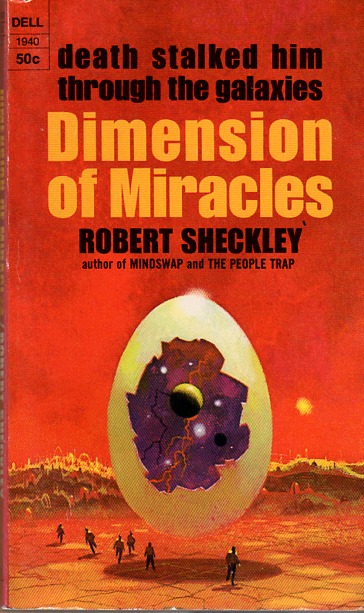
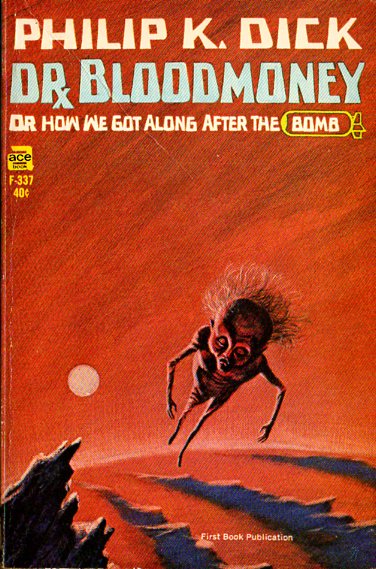
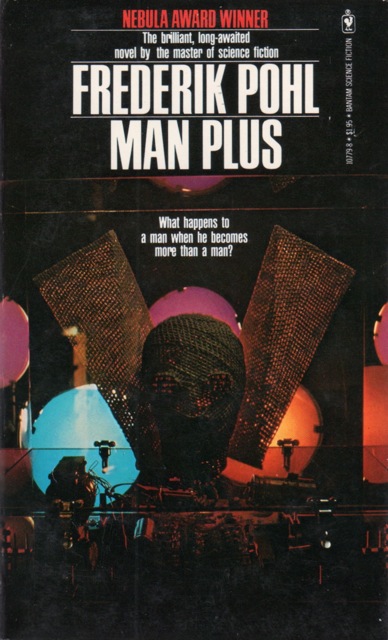
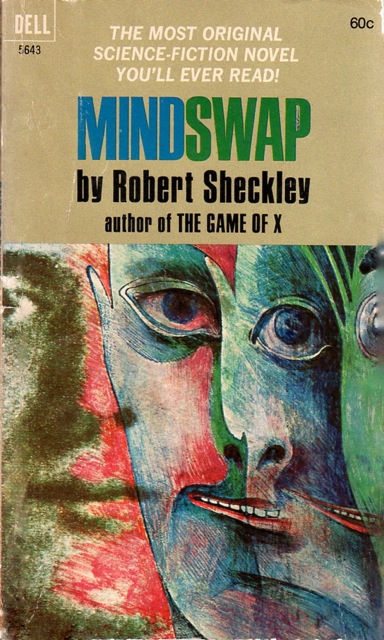
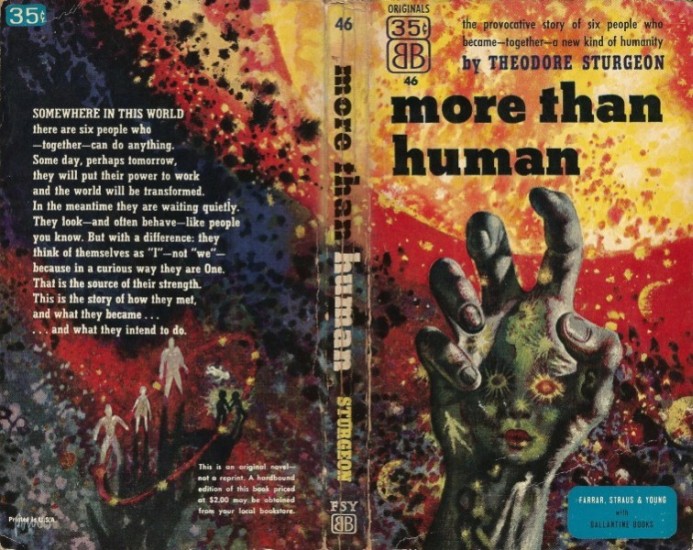
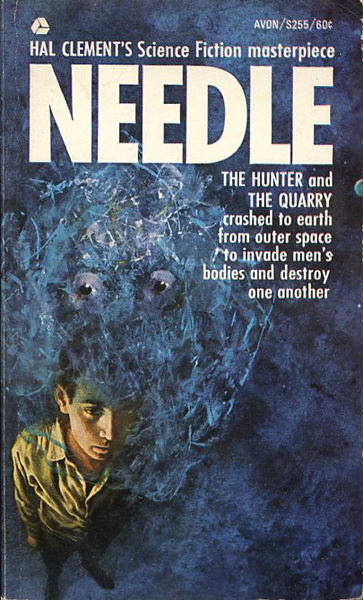
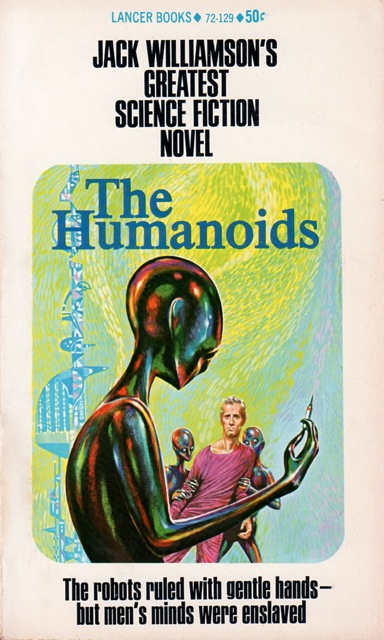
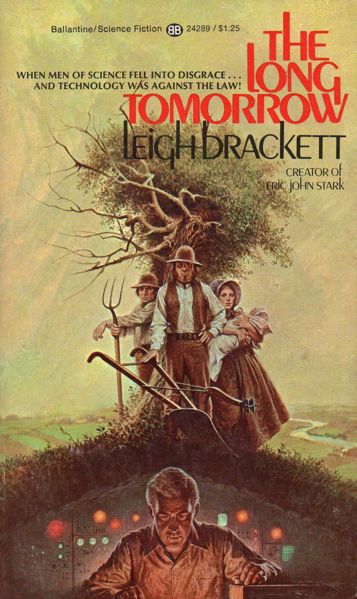
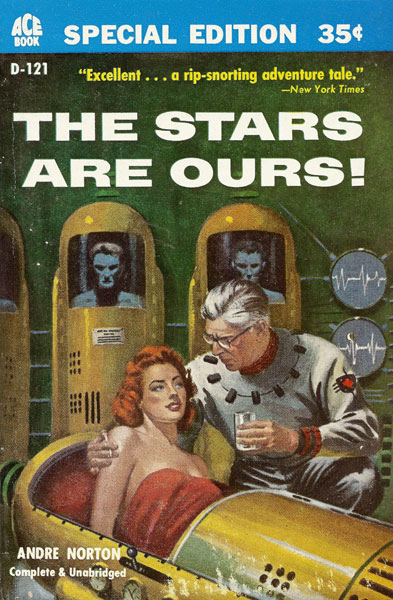
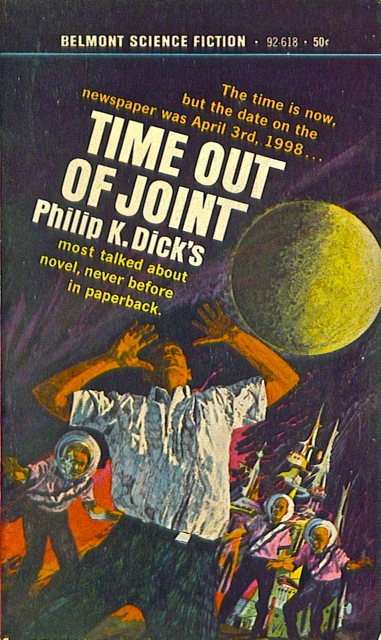
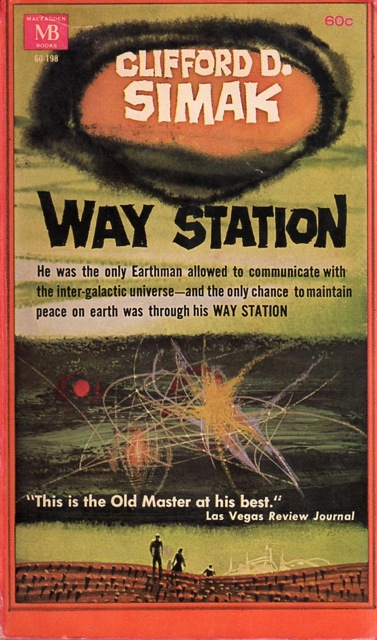
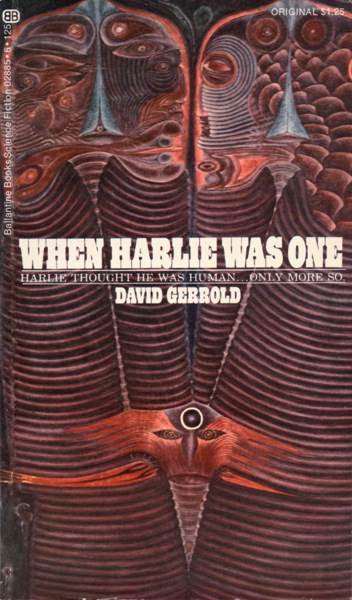
After this plug for Heinlein, I want to remember those vintage science fiction titles I believe deserve more readers. I’m just going to post images of the covers I fondly remember. Hopefully, you might spot these books at used bookstores, charity shops, and friends-of-the-library sales in their funky old editions. For me, old covers are essential to the vintage science fiction experience.

These are just a handful of books I could recall from memory this morning.

James Wallace Harris, 2/23/25
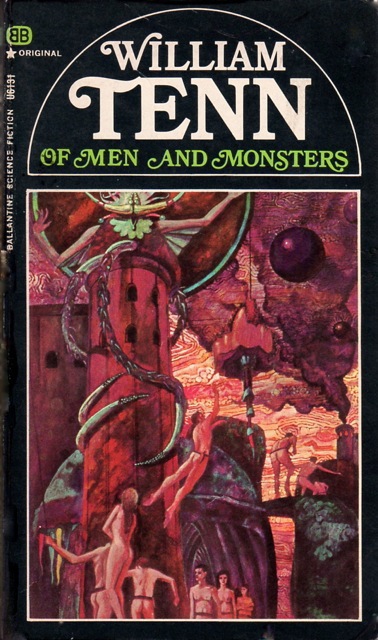
THE HEADS OF CERBERUS by Francis Stevens (Gertrude Barrows Bennett)

Most science fiction stories seem to go stale after a couple decades. This week, I listened to The Heads of Cerberus by Frances Stevens, initially published 106 years ago. The story had passed its expiration date decades ago, but I still found it mildly enjoyable as a historical curiosity.

If you’re not fascinated by the evolution of science fiction, I’ll understand you leaving this essay now. The Heads of Cerberus is not a forgotten classic. It gets points for being an early example of time travel and dystopian fiction written by a woman, but it’s not a good example. At best, it’s a sample from 1919, the kind that MIT Press is reprinting in its Radium Age science fiction series.

Gertrude Barrows Bennett (1884-1948) published several fantasy and science fiction stories between 1917 and 1923 as Francis Stevens. This makes her a pioneering author in the pre-Amazing Stories era, especially as a woman writer, but she is practically forgotten today. I just learned about Francis Stevens by reading a two-part review of “Sunfire” on Science Fiction and Fantasy Remembrance (Part 1, Part 2) by Brian Collins. That review inspired me to research her, and what I learned inspired me to read The Heads of Cerberus.

The Heads of Cerberus was first serialized in five 1919 issues of The Thrill Book. It was first printed in hardback in 1952. It’s been reprinted at least a dozen times since.

I listened to a free copy on LibriVox. There are several public-domain ebook editions available, here is one at Gutenberg Australia. Lisa Yaszek who edited The Future is Female! series for the Library of America recently published a collection of Francis Stevens’ stories at MIT Press Radium Age series called The Heads of Cerberus and Other Stories. Gertrude Barrows Bennett is getting rediscovered. However, she’s been rediscovered before, it just never sticks.

The Heads of Cerberus is about three people from 1918 Philadelphia traveling to Philadelphia in 2118. Bob Drayton is a disbarred lawyer. Terry Trenmore is his Irish friend who is a powerfully built giant. And Viola Trenmore, Terry’s beautiful little sister, and just seventeen. In 2118 they find a dystopian society run by a handful of weird characters. The story is painfully simple, although I enjoyed it somewhat. The fun in reading these old science fiction tales is not the storytelling, but seeing how people imagined science fictional ideas before the concept of science fiction was invented.

The 19th century had several tales of people traveling to the future that could have inspired Bennett, each with a unique method of time travel. In “Rip Van Wrinkle,” Washington Irving has his title character sleep for twenty years after drinking potent liquor. Edward Bellamy had Julian West sleep for 113 years via hypnosis in Looking Backward. Frances Stevens has her characters jump ahead two hundred years by sniffing grey dust from a vial of mysterious ancient origins. The vial’s stopper is shaped like Cerberus.

As I said, The Heads of Cerberus isn’t very sophisticated. Its tone reminded me of the Oz books by L. Frank Baum, which were for children. Those books were often about ordinary people meeting extraordinary beings in strange places. Bennett’s imagined future is minimalistic, and somewhat goofy, reminding me of Alice’s Adventures in Wonderland. However, Stevens lacks the creative imagination of Baum and Carroll.

Edward Bellamy created a complex economic system for his future society that inspired many readers in the 19th century to form over five hundred Nationalist Clubs based on socialist ideas in Looking Backward. Francis Stevens imagines an economy based on the number of hours worked. Her society was ruled by an elite called The Superlatives. Ordinary people didn’t have names but numbers, and the Superlatives had names based on cardinal virtues like the Loveliest, The Bravest, the Fastest, the Strongest, etc.

The main problem with Stevens’ science fiction is her future society isn’t a philosophical idea she believed in or promoted, but merely conjured up quickly to fit a plot. Bennett was a young widow, with a child and mother to support after her dad died. She was a stenographer but made extra money by writing for the pulps. She quit writing after her mother died. The Thrill Book that serialized The Head of Cerberus was a low-paying market, but Stevens sold three novels to Argosy, a much-admired pulp after it. They were Claimed, The Citadel of Fear, and Possessed: A Tale of the Demon Serapion. Even though they are dark fantasies, a genre I’m uninterested in, I should try one to see if her writing improved. Her first serial, The Labyrinth, was to All-Story in 1918, another legendary pulp.

James Wallace Harris, 2/21/25
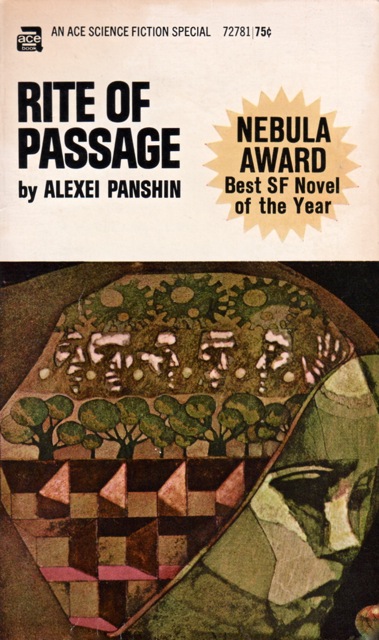
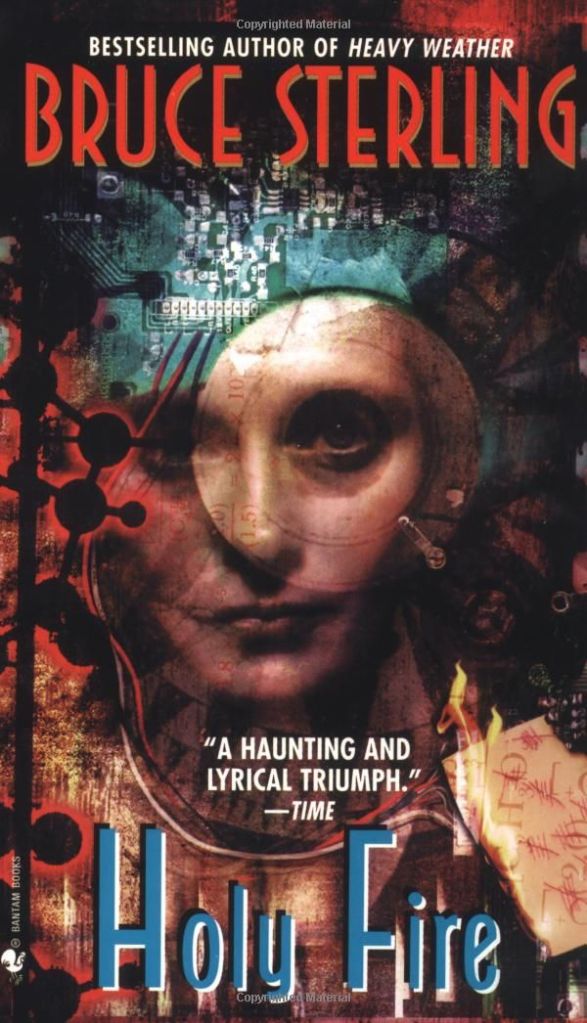
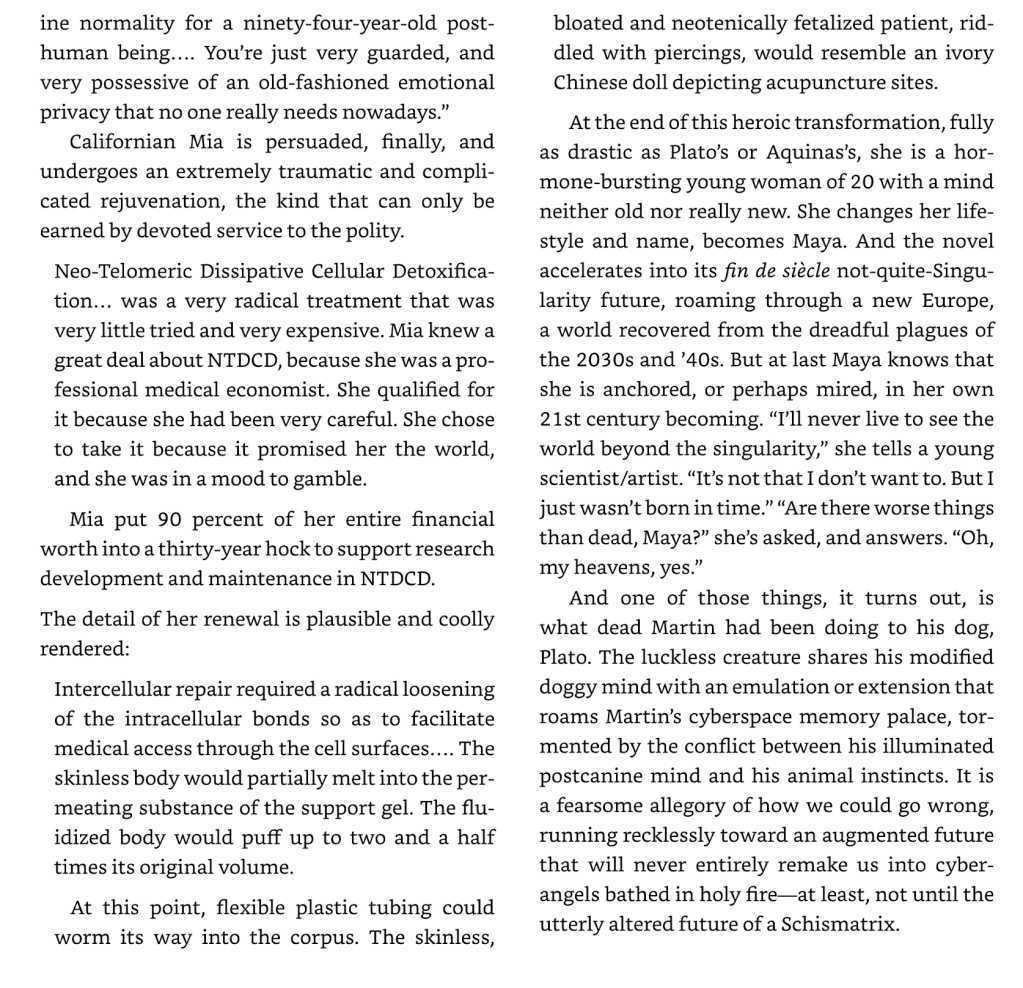
HOLY FIRE by Bruce Sterling

Science fiction writers can’t predict the future but some aim to speculate on times to come by extrapolating current trends. One of the most famous SF novels to do this was Stand on Zanzibar by John Brunner, his 1968 novel that anticipated the world of 2010. Bruce Sterling’s 1996 novel Holy Fire tries to imagine life in 2096 via speculation and extrapolation. Do I recommend it? That’s hard to say, even at the current Kindle price of $1.99.

How self-aware are you regarding the selection of the science fiction you read? Does your mind crave a tightly plotted story? If so, Holy Fire by Bruce Sterling might not be for you. Or do you love reading novels with characters you care about, even identify with, and want to vicariously live their fictional adventures? Again, Holy Fire might not be your cup of tea. If you are the kind of science fiction reader who resonates with dense science fiction speculation, reading Holy Fire should definitely be for you.

We judge such speculative fiction in two ways. Does it jive with our own efforts to imagine the future, and now that the novel is almost thirty years old, how well has it done so far? Evidently, back in 1996, Sterling saw that medical technology, changing trends in family size, and population demographics would lead to a world where there were far more old people than young people. The exact opposite of the Baby Boom generation I grew up with. All the current 2024 demographics point to such a future.

Sterling solved the overpopulation problem that many science fiction writers before him saw by having a great pandemic in the 2020s. And he imagined that networks, artificial reality, and artificial intelligence would reshape society. Instead of predicting gloom and doom like so many science fiction novels from the late 20th century, Sterling imagines a near-liberal utopia and a post-scarcity society. The problems faced by the characters in this novel divide between the old and young. The old strive to find purpose with an ever-lengthening lifespan, while the young feel crushed under the weight of a gerontocracy that advises the youth to learn from their experience and live longer.

Because humans have been trying out medical life-extension procedures for decades, a growing percentage of the population is old. These elders have the wealth and power and dominate politics with their gerontocracy. Mia Ziemann, Holy Fire’s protagonist, is 94 at the start. Because she has led such a cautious life and is in such good shape, the medical establishment offers her the latest life extension treatment, one that goes way beyond any previous effort. The procedure is so arduous, that it can be fatal. Mia comes through the process and now looks 20, although some of her memories are gone.

Mia’s doctors consider her an expensive experiment and legally bind her to them for years of research. Mia runs away to Europe and hides as an illegal alien, living among a youthful bohemian crowd of revolutionaries. She changes her name to Maya. On nearly every page of Holy Fire, Sterling speculates about the future evolution of society, technology, and politics. Strangely, climate change is never brought up. But then, Holy Fire came out a decade before An Inconvenient Truth.

Sterling doesn’t focus on space flight, but it happened. The focus of the story is finding meaning in everyday living on Earth. Dogs and other animals have been uplifted, and talk with computer-aided voices. Governments take care of the needy. People use public transportation. People engineer their minds with designer hormones and neural transmitters. And the net and virtual reality is everywhere. Holy Fire makes me think that Bruce Sterling had abundant optimism for the future in the 1990s. I used to have such liberal optimism but it was crushed in 2016.

Sterling’s future is not quite a utopia, because segments of the population are discontented, especially the young who are too brilliant for their own good. That’s the crowd Mia/Maya, embraces. They want the freedom to fail.

Sterling calls Mia/Maya and others in this book posthumans, and that’s where this story shines. His posthumans aren’t silly comic-book superheroes like in many 21st-century SF books. Virtual reality is toned down too from 21st-century SF stories of people downloading themselves into virtual realities. Sterling tries to stay reasonably realistic and scientific. Holy Fire reminds me of the dense speculation in John Brunner’s Stand on Zanzibar. Sterling doesn’t take it to narrative gonzo extremes like Brunner.

Holy Fire is a somewhat picaresque novel, with one reviewer comparing it to Candide. Of course, Candide is considered a broad satire, and I’m not sure that’s true of Holy Fire. I didn’t read it that way, but I could see how a filmmaker could present Holy Fire as a satire. The novel attempts to be transcendental, you might have guessed that from the title. The youth rebellion in Sterling’s 2090s is like the 1960s involving art, music, drugs, and mind-expansion — adding networking, AI, and AR.

The problem with picaresque novels is they are episodic. The hero is exposed to a series of people and subcultures, and that’s what happens to Mia/Maya. There are so many different characters it’s hard to keep up with them or even care about them. Most of the story is about how they impact Mia/Maya, whereas I believe a novel about a 94-year-old woman becoming 20 again should be about her inner transformations.

Mia is an uptight old lady who protects herself by hiding from life, and Maya is a free-spirit young woman giving everything a try and throwing all caution to the wind. We are told that Mia lost some of her memories, but would she lose all wisdom from living to 94?

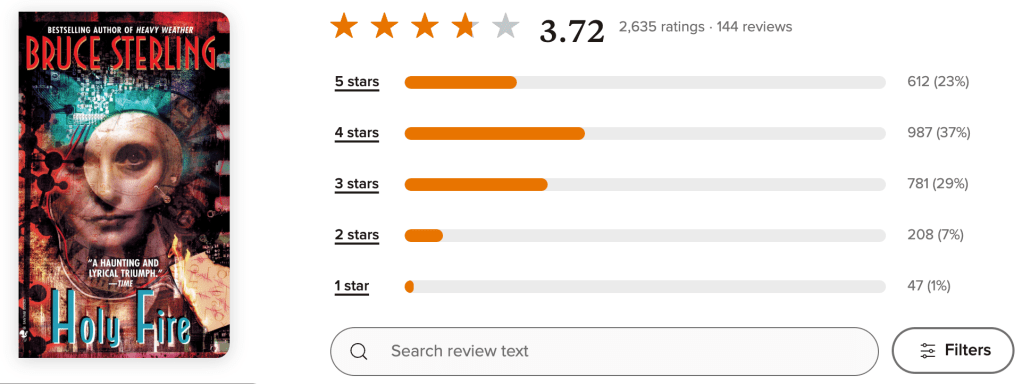
Response to Holy Fire is all over the place. Hundreds at Goodreads gave it five stars, a few more hundred gave it four stars, but plenty of folks just didn’t care for the story.

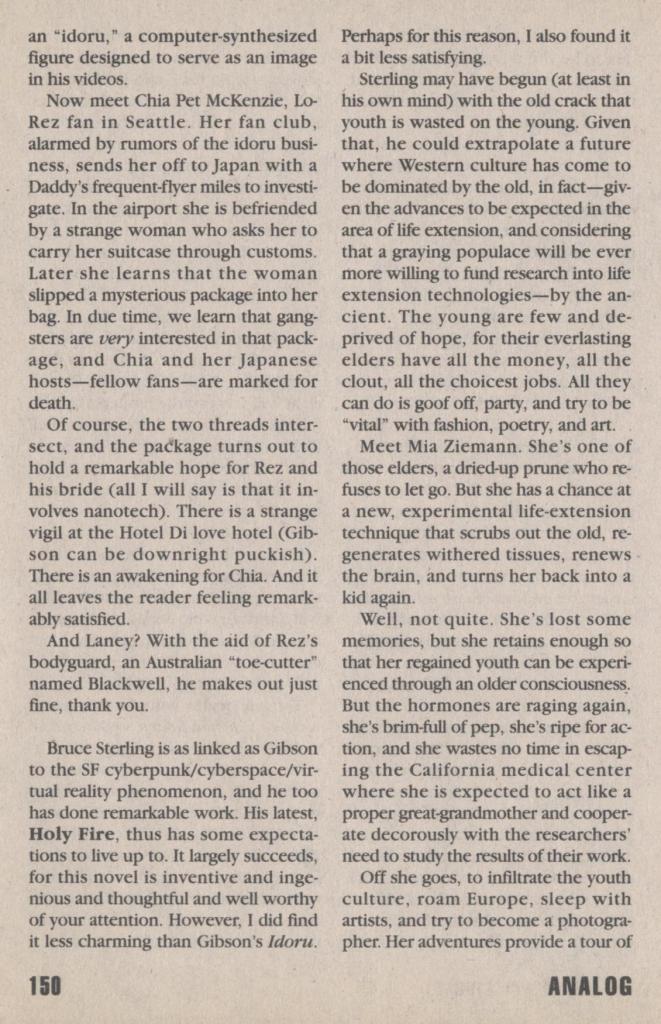
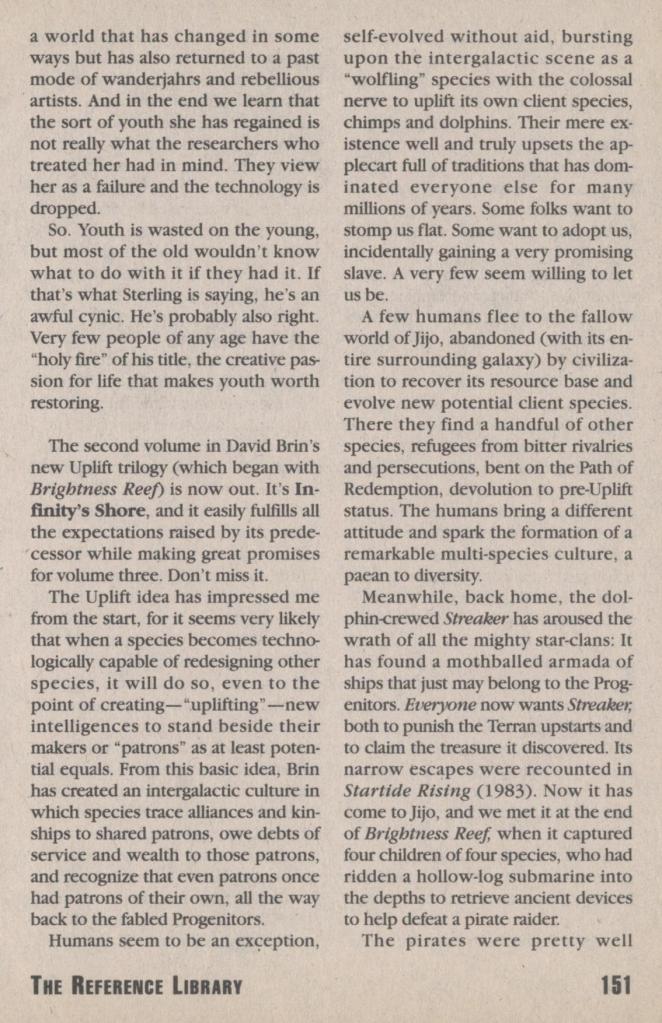
Reviews were also mixed. Tom Easton in “The Reference Library” for the March 1997 issue of Analog has this to say:

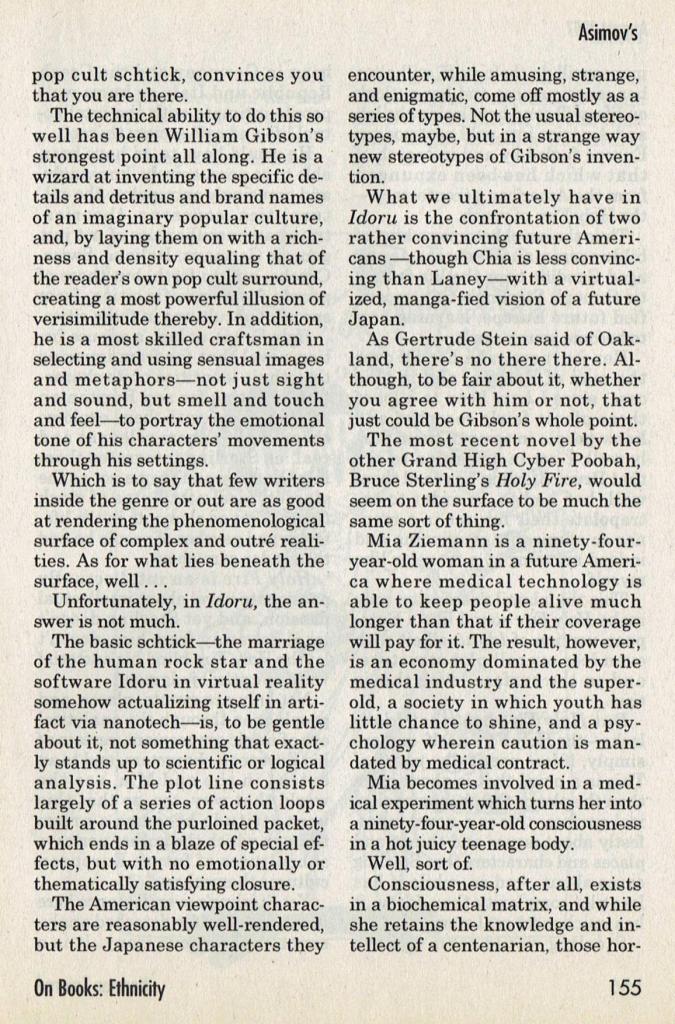
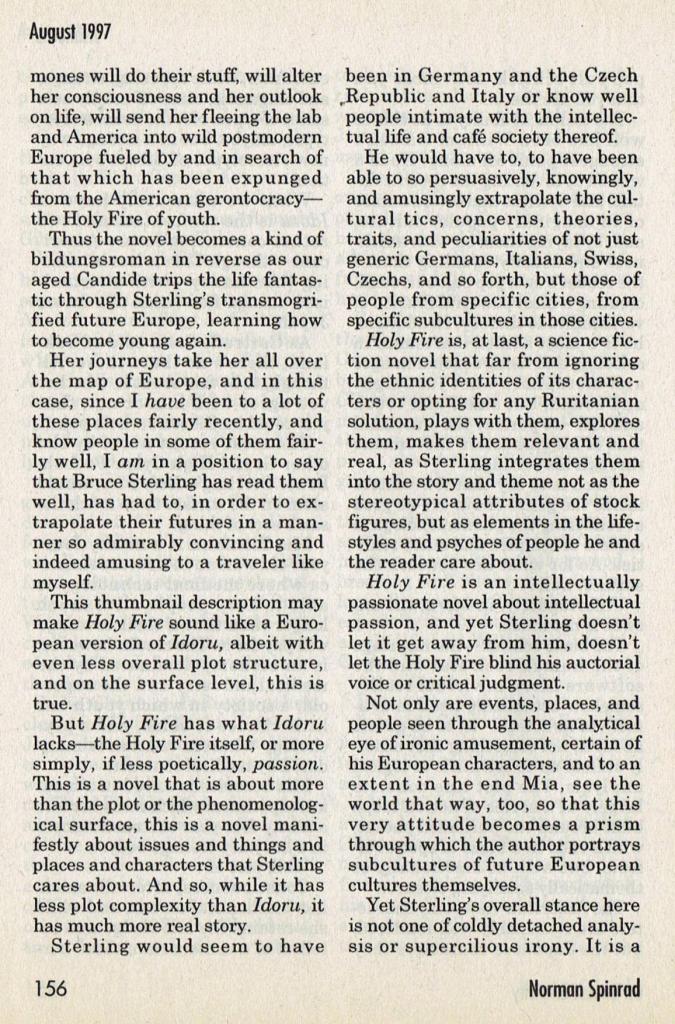
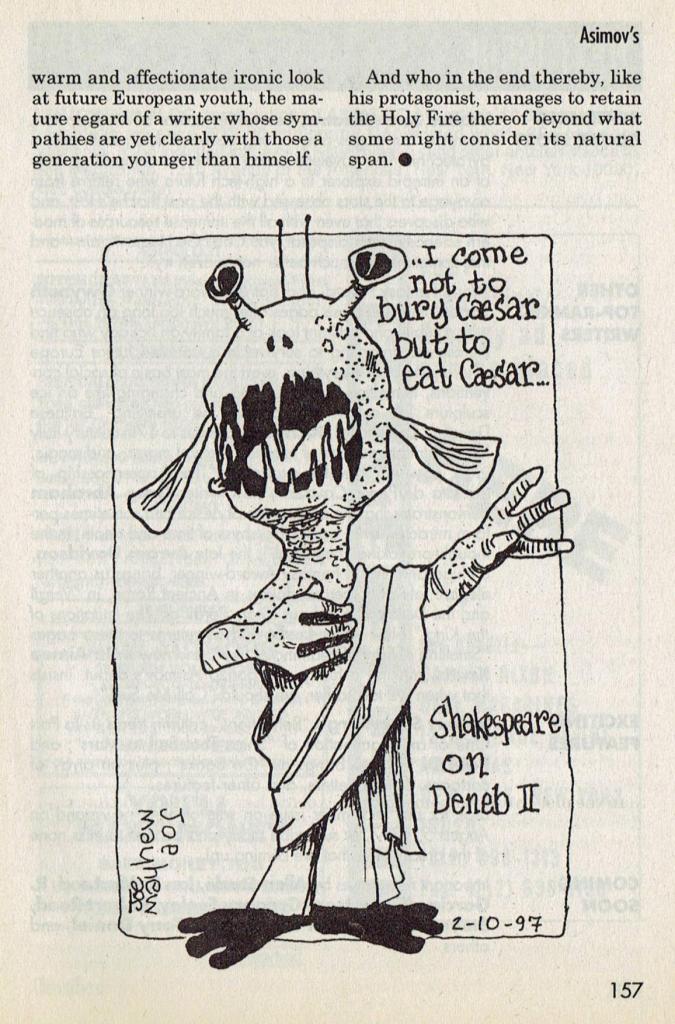
Norman Spinrad’s “On Books” from the August 1997 issue of Asimov’s Science Fiction also compares Holy Fire to William Gibson’s Idoru but comes to a different conclusion. Both novels are later cyberpunk works from the two leading founders of the cyberpunk movement, so it was logical to review them together. Spinrad is the more insightful of the two reviewers.

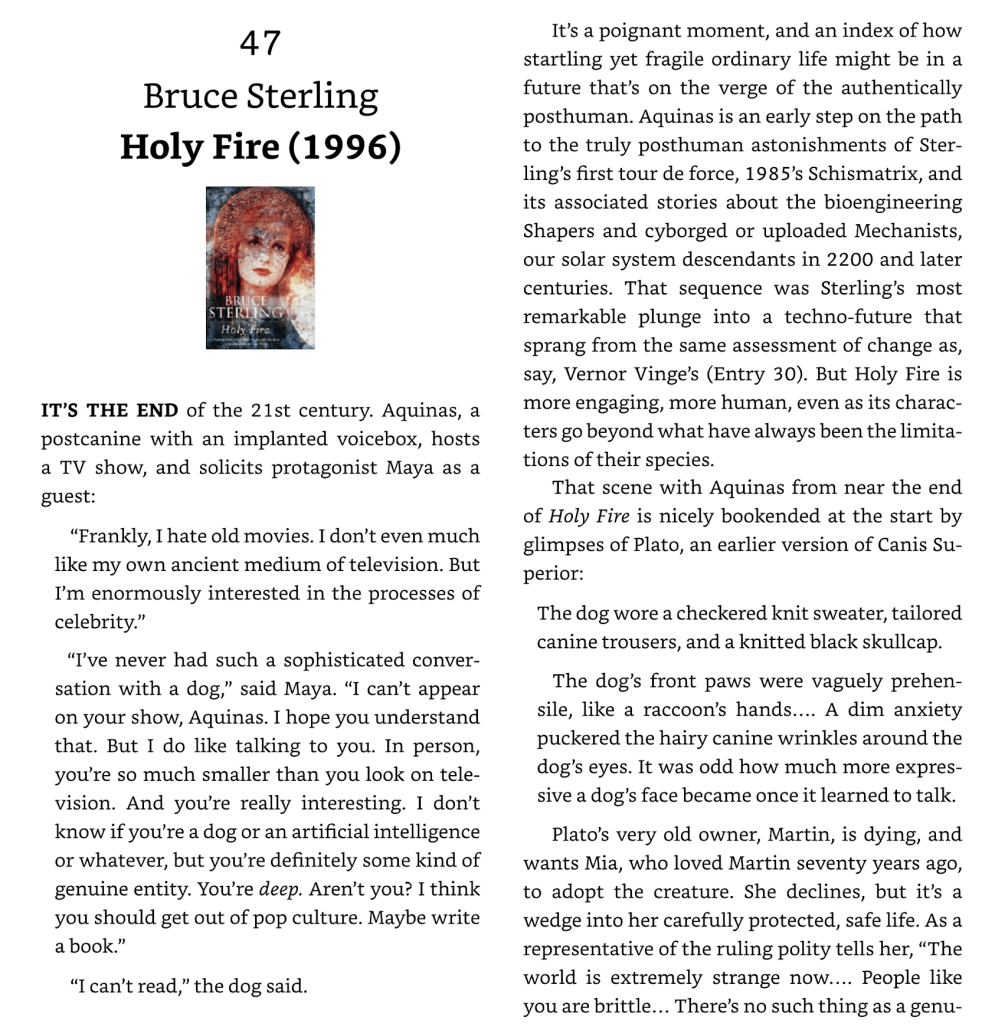
Damien Broderick and Paul Di Filippo in Science Fiction: The 101 Best Novels 1985-2010 had this to say about Holy Fire.

That Damien Broderick and Paul Di Filippo would recommend Holy Fire as one of the best SF novels from 1985-2010 is high praise. But why don’t I hear more about this novel after all these years? My assumption, is most science fiction readers don’t particularly care for serious speculation about the future and would prefer to read stories that compel you to turn the pages because of tight plots and characters they care about.

This is my second reading of Holy Fire. I first read it when it came out from the Science Fiction Book Club. I bought it then because its plot sounded similar to a 1926 novel I was trying to find, Phoenix by Lady Dorothy Mills. That book was also about an old woman undergoing a rejuvenation process and then running off to Europe to join a bohemian crowd. I finally found Phoenix several years ago and it’s more of a love story than science fiction. I need to reread it and compare the two.

For my second reading, I listened to it on audio. I’ve started rereading it again with my eyes. I never developed an emotional bond with Holy Fire like I have with the novels I consider my favorites. However, I admire it intellectually. It could have had the emotional impact of Flowers for Algernon because Mia/Maya goes through a similar arc of intellectual development. We just don’t see her experiences as tragic.

I think Sterling tried though. Throughout the novel, Mia/Maya experiences epiphanies that should have had a deep emotional impact. To me, they were just intellectually interesting. The ending should have been profoundly spiritual, like something from Hermann Hesse. Instead, it just seemed like a logical way to end the story. The choices Mia/Maya and her former husband, Daniel made in the end are vivid, even dramatic in concept. That just didn’t make an emotional impact on me. I assume Bruce Sterling wanted the ending to be an emotional epiphany. The ending does say a lot about how a posthuman would react to becoming posthuman.

Please leave a comment if you’ve read Holy Fire. I’m curious if you had an emotional response to the story. I found it intellectually exciting. I would recommend it on that level. However, it didn’t touch me, so I’m hesitant to say it’s good. I gave it four stars on Goodreads.

James Wallace Harris, 12/18/24

HOTHOUSE by Brian W. Aldiss

Science fiction is best when it’s full of wonder. When I first read The Time Machine by H. G. Wells, I was awed by the idea of time travel, but two other ideas wowed me even more. Wells got me to imagine future human evolution and posthumans, and he introduced me to the idea that the Earth would someday end. It was easier to imagine the Earth being created, but it was overwhelming to think about it dying.

Hothouse by Brian W. Aldiss is one of the great works of the Dying Earth subgenre of science fiction. There are various ideas about what constitutes a dying Earth setting. Some people consider it to happen when humanity dies off. I like to think it’s when the Earth is about to be destroyed. That’s the approach Aldiss takes in Hothouse. He tells us the Sun will go nova in a few generations, but Aldiss doesn’t quite take us to Earth’s death

Jack Vance’s famous novel The Dying Earth (1950) is set in the far future, too. The sun is nearing the end of its life, and the Earth and humanity have drastically changed. In The Time Machine, the Time Traveler visits the far future just before the sun, as a red giant destroys the Earth. In The Night Land (1912) by William Hope Hodgson, the Sun Is going dark, and humanity is almost gone.

Only Wells and Aldiss imagined the final productions of evolution. Olaf Stapledon pictures eighteen more species of humans coming after us in Last and First Men (1930). Aldiss imagines a variety of descendants for humanity in Hothouse, all exceedingly small. He also imagines the plant kingdom going bonkers, which reminded me of The Forgotten Planet (1954) by Murray Leinster. That novel was based on three stories, first published in 1920, 1921, and 1953. It was about a world we had colonized. Those explorers eventually evolved becoming tiny beings, competing with giant plants and insects for survival.

I reread Hothouse by Brian W. Aldiss because it was recently released in an audiobook edition on October 15, 2024. It’s a novel I’ve been waiting years to hear. I first read Hothouse in 1996 and thought it was an amazing story full of colorful imagery and adventure. I wanted to see it as a movie because of Aldiss’ powerful visual imagination. After I got into audiobooks in 2002, I wanted to reread all my favorite science fiction books by listening to them. I finally got my wish with Hothouse, with excellent narration by Nick Boulton.

In this fix-up novel, the sun is swollen, and Earth’s rotation is locked so only one side faces the Sun. The Moon trails the Earth’s orbit in a Trojan orbit that keeps it stationary in the sky. Earth is a riot of vegetation that has supplanted most of the animal kingdom. Humans have evolved into tiny beings one-fifth our size, while insects have grown monstrously large. Plants have mutated into countless strange configurations, including those that traverse between the Earth and the Moon on giant webs.

Hothouse is a fixup novel composed of five stories that appeared in The Magazine of Fantasy & Science Fiction in 1961.

  • “Hothouse” (novelette)
  • “Nomansland” (novelette)
  • “Undergrowth” (novella)
  • “Timberline” (novelette)
  • “Evergreen” (novella)

Hothouse was originally published in the United States as The Long Afternoon of Earth in a slightly abridged format. At the 1962 Worldcon, the five stories as a series won the Hugo Award for best short story. I prefer the forgotten American title, it’s more poetic.

I thoroughly enjoyed listening to this novel, but it didn’t have the impact it had on first reading. (Imagine watching The Sixth Sense for a second time.) Aldiss produces some wonderful science fictional ideas in this story, ones I won’t mention because that might spoil the story. This is one of those tales you should experience without knowing too much. The story feels like a children’s fantasy with all the funny names for evolution’s new creations, but I believe Aldiss was serious in trying to make it science fiction.

Think of the writing challenge of describing an impossible-to-imagine far future. Jack Vance pictured humans with magical powers as if evolution would eventually create them. Magic makes his Dying Earth stories fun, but not realistic. William Hope Hodgson imagined Earth in darkness where humanity clings to one giant city. I guess Clarke did that too. Aldiss imagines species descendants from us living in another kind of Garden of Eden, a very violent one. We could call it Darwin’s Eden, rather than God’s.

Hothouse is mostly a forgotten classic. I seldom meet people who have read it. Brian W. Aldiss’s reputation and back catalog aren’t well-remembered in today’s popular culture. Now that several of his books have been republished in audio, I’m giving him another chance. I hope other SF fans do too.

My favorite work by Aldiss is “An Appearance of Life” which I’ve reviewed three times. I keep hoping to find more Aldiss stories that impress me as much. Hothouse comes close. So does “The Saliva Tree.” Greybeard isn’t on the same level as those tales, but it’s still thought-provoking.

James Wallace Harris, 11/8/24

“Earth for Inspiration” by Clifford D. Simak

“Earth for Inspiration” is a comic science fiction story by Clifford Simak set millions of years into the future about a science fiction writer and his robot visiting a forgotten Earth. The pair go there hoping to find inspiration to write new science fiction stories. You can read it online in the April 1941 issue of Thrilling Wonder Stories.

I read “Earth for Inspiration” by Clifford D. Simak because I read When the Fires Burn High and the Wind is From the North: The Pastoral Science Fiction of Clifford D. Simak by Robert J. Ewald. I bought that book after I read and reviewed A Heritage of Stars by Simak which made me want to know more about Clifford D. Simak. I mentioned my interest in Simak on the Clifford Donald Simak Facebook group and the Ewald book was one of two books about Simak that was recommended. I forgot I already owned the second book, Clifford Donald Simak: An Affectionate Appreciation by Francis Lyall. I haven’t read that one yet because I leant it to my friend Mike who had recently read the twelve volumes of Simak’s short stories. Mike is who got me to read A Heritage of Stars in the first place. I guess that puts me into some kind of inspiration loop.

A Heritage of Stars involved a post-apocalyptic America with few humans and some robots. In that story, most robots had been destroyed except for their brain cases which were saved as trophies after a war with the robots. Unknown to the humans, the robots continued to be conscious inside their brain cases for a thousand years. That idea of a conscious mind without outside sensory data intrigued me. Then I read in the Ewald monograph about “Earth for Inspiration,” involved a dying Earth, robots, and isolated robot brain cases. I had to read it. The story is also included in Simak’s collection Earth for Inspiration and Other Stories: The Complete Short Fiction of Clifford D. Simak Volume Nine. Amazon now sells 14 volumes in the complete stories. Audible.com now offers ten of those volumes in audiobook editions.

Version 1.0.0

Most of the famous science fiction short stories we remember from the 1940s were first published in Astounding Science Fiction. Thrilling Wonder Stories was aimed at younger, less educated science fiction fans, and we seldom see reprints from that pulp magazine. For the most part, its stories are less sophisticated with far more action. And that’s true for “Earth for Inspiration.” I thought it was a funny story, but somewhat simple and hyper paced. It has an old fashion voice because of all old-timey colloquialisms. Simak is known for his pastoral prose and midwest settings.

“Earth for Inspiration” was more fun than I expected to find in Thrilling Wonder. Usually, when we think about robots in science fiction, we think of Isaac Asimov, but I’m seeing how important robots were to Simak stories.

When I read it with my eyes, “Earth is Inspiration” felt like cliched pulp science fiction from the 1930s. However, when I listened to the story after buying the audiobook edition, I thought the writing was much better than my first impression, except for all the saidisms. (I think the worse was — “Look at that, will you!” he jubilated.) The second reading with my ears made me notice how many ideas Simak was using to develop the story. It’s a satire on writing science fiction, maybe even the first example of recursive science fiction.

However, “Earth for Inspirations” gives us a few clues about how Clifford D. Simak thought when comparing them to his other work. The more Simak I read, the more I spot common ideas, characters, and elements that he used and reused.

The Ewald monograph has a few pages of biographical information, almost just a list of dates. Most of the 155 pages describe Simak’s stories and novels. I was hoping to find a biography of Simak, something like William H. Patterson did for Heinlein, but such a book doesn’t exist as a far as I can tell for Simak. Second to that, I was hoping to find an analysis of the impact of Simak’s stories, like what Alexei and Cory Panshin did for Heinlein, Asimov, and van Vogt in The World Beyond the Hill. It’s not that either. When the Fires Burn High and the Wind is From the North, is a standalone journal, volume 73 of The Milford Series: Popular Writers of Today. The content is like Alva Rogers A Requiem for Astounding, which is a description of the stories in all the issues of Astounding Science Fiction in chronological order.
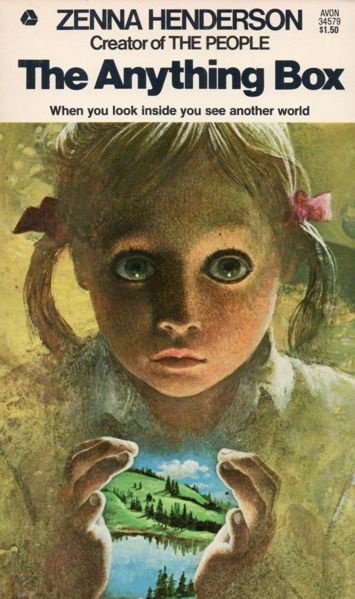
I thought it fascinating that Simak was thinking of robots in the same way in 1941 and 1977. He obviously had a fondness for the idea of robots and had developed an idea of what they would be like early in his career and stuck with it until he died. Robots were faithful servants who were also friends. Simak imagines them with bodies that can break down, but with nearly indestructible brain cases. I assume those brain cases have an internal power supply that could last for millions of years. A couple years ago I read a collection called The Complete Robot by Isaac Asimov. I wonder if Simak has enough robot stories to warrant such a collection?

Reading Simak, we can assume he didn’t like cities or corporations and had a low opinion of mankind’s ability to survive in the long run. Although, “Earth for Inspiration” is set millions of years in the future after humans have colonized the galaxy, but long after we’ve used up Earth’s resources and abandoned it.

The first scene of “Earth for Inspiration” opens with a short tale about a robot named Philbert who became inert after his body rusted up. Eventually, his body rusted away and Philbert lived inside his braincase for millions of years. This reminds me of the Tin Woodsman of Oz.

The second scenes jumps to Jerome Duncan, a once successful science fiction writer who is again getting rejection slips after a successful career. Duncan lives millions of years from now. It’s amusing that Simak thinks science fiction will last that long.

Anyway, Duncan’s robot Jenkins suggests going to Earth to get inspiration for writing a new story. Jenkins is also the name of the robot in City, Simak’s most famous book, a fix-up-novel. Duncan is famous for writing Robots Triumphant. I won’t tell you what it was about because it becomes part of the story.

The next scene has Duncan and Jenkins arriving on Earth with a lot of camping equipment and meeting an old-timer, Hank Wallace, who has been waiting for new tourists for over a thousand years. He manages the Galactic Trainsport station, but no one informed him that the line had been shut down a thousand years earlier. Duncan and Jenkins had hired a private rocket. This points to another idea that Simak loved, that humans would eventually have very long lives. In this story, we last for ten thousand years. And his second most famous novel, Way Station, is about an old-timer who manages a transport station and who doesn’t age. By the way, the old-timer in that novel was named Enoch Wallace.

Should we assume that Simak had been thinking about writing his most famous novels for years?

I don’t think I should tell you any more of “Earth for Inspiration.” It’s a fun enough story so that I shouldn’t spoil it for you. I’ll just hint at a few more scenes. Earth in the far future is dry, and has lost most of its air. There’s a confrontation with humans living in primitive tribes in dry deep sea canyons where the air is thicker. That makes it a dying Earth story. There are slapstick scenes with a crazy robot and another confrontation with horde of runaway robots.

“Earth for Inspiration” has decent humor, although not sophisticated. It would make a great humorous episode for Love Death & Robots. The humor is slapstick Sheckley with a touch of Frederic Brown’s ironic weirdness. I’m not sure if Simak intended it to be entirely comic, although, he probably did, but I bet a lot of young readers in 1941 took it straight realistic action.

James Wallace Harris