“Sooner or Later or Never Never” by Gary Jennings

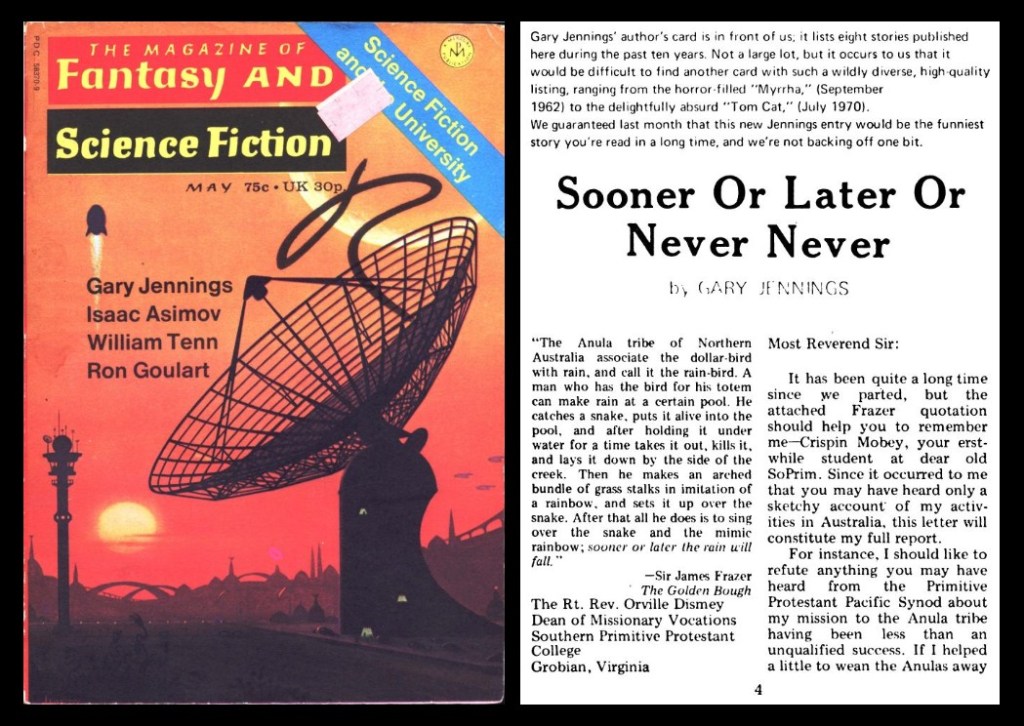
What exactly is fantasy? “Sooner Or Later Or Never Never” by Gary Jennings has no magic, no fantastic creatures. Its setting is present-day Australia. The story is both comic and absurd. Yet, it’s based on a somewhat realistic premise. Yes, the characters and plot are made up, but so is most fiction. I can find no reason to call this a fantasy. I assume Edward L. Ferman published it in the May 1972 issue of The Magazine of Fantasy & Science Fiction because he admired the creative prose — and he had the power to publish it.

Gary Jennings (1928-1999) is known for writing historical fiction, but also published many stories in F&SF. You can read the story online here.

“Sooner or Later or Never Never” is told as a letter to The Rev. Orville Dismey, Dean of Missionary Vocations, at the Southern Primitive Protestant Seminary in Grobian, Virginia. Crispin Mobey narrates his effort to bring Christ to the Anula tribe in the Australian outback. Mobey was inspired by a quote from The Golden Bough by Sir James Frazer. The quote describes a ritual Frazer witnessed. Mobey wants to use that ritual to bring Christianity to a rather primitive tribe.

I’ve read “Sooner or Later or Never Never” before, but I’m not sure where and how. I don’t normally read this kind of fiction. However, the prose is quite entertaining. Normally, I dislike dialect, but Jennings captures outback Aussie hilariously. I wish I had an audiobook version.

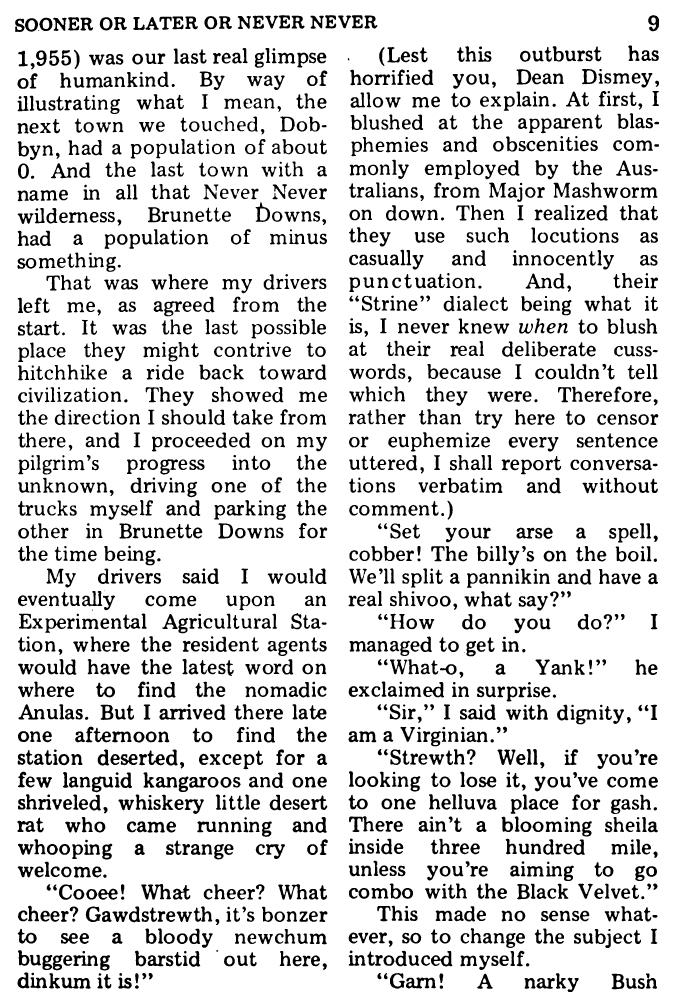
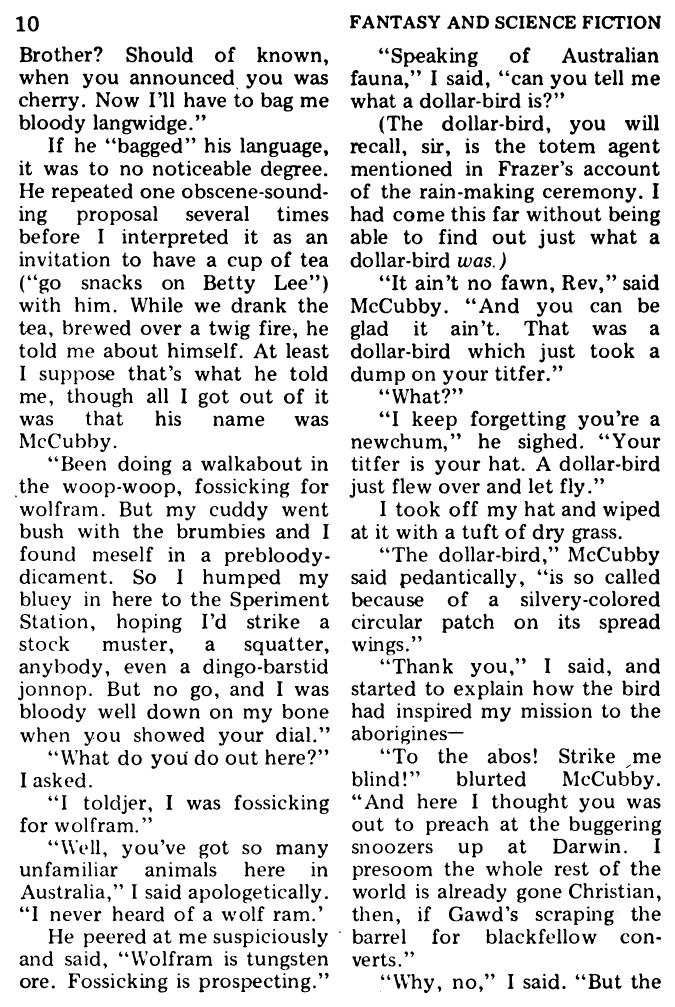
There is no way I can describe this story, so I’m just going to give you two pages to read as a sample.

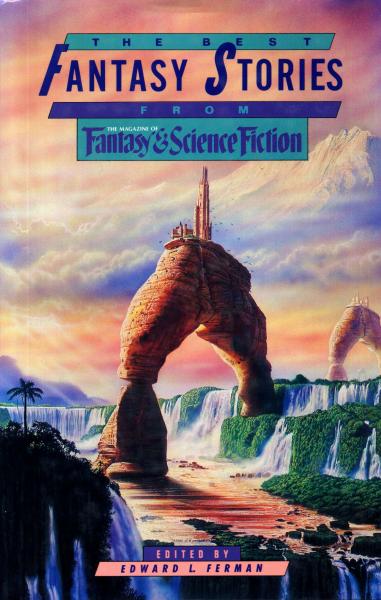
I know this is cheating, but I’m taking the easy way out. I’m posting this merely to encourage people to read this story. I read it today because my Facebook short story club is reading The Best Fantasy Stories from The Magazine of Fantasy and Science Fiction. Reading this 792-page anthology demonstrates the range of what people call fantasy.

I routinely tell people I dislike fantasy. But of the stories we’ve read in this anthology, the ones set in the present about ordinary people have been the most entertaining to read. And the ones that people consider traditional fantasy were no fun to read. I guess when I say I dislike fantasy, I dislike only a subset of the genre.

However, I also think Ferman is cheating to call “Sooner or Later or Never Never” fantasy. It could have been published in almost any kind of fiction magazine.

James Wallace Harris, 7/14/25

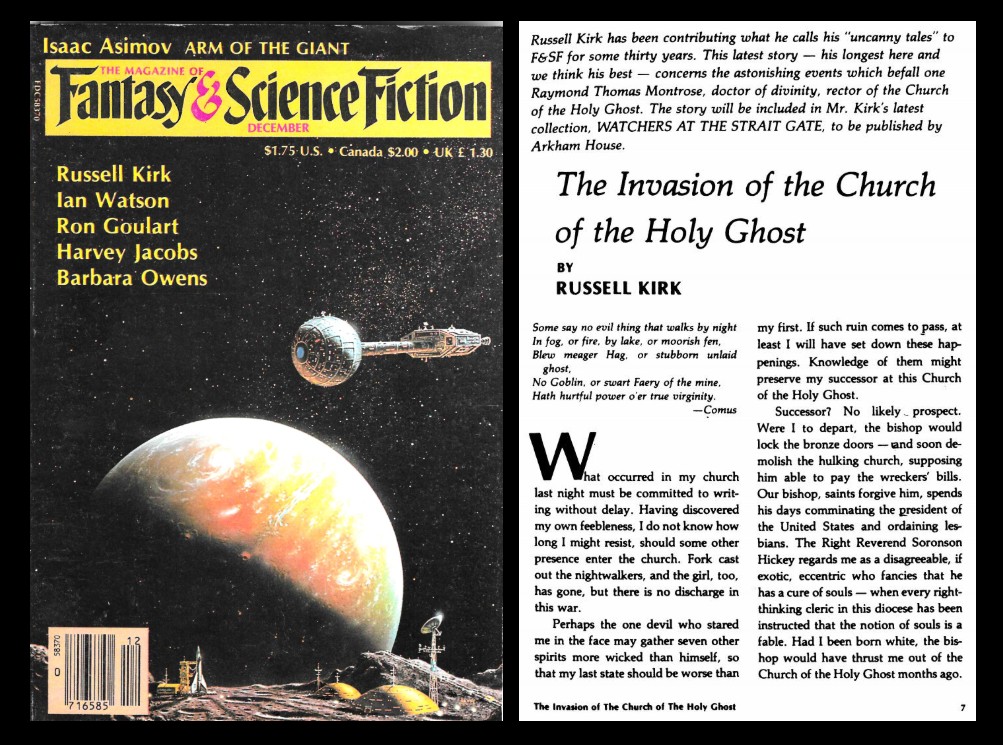
“The Invasion of the Church of the Holy Ghost” by Russell Kirk

I’m an atheist who doesn’t normally enjoy reading fantasy fiction; however, I found “The Invasion of the Church of the Holy Ghost” by Russell Kirk, a religious ghost story, to be quite entertaining and well-written. The characters of Father Raymond Thomas Montrose and Fork Causland are so well developed that it’s hard not to like this story. Plus, the story is set in a seedy, rundown section of town filled with hustlers, prostitutes, and con men, has all the feel of a Damon Runyon tale.

You can read this story online.

I had no idea who Russell Kirk was, but after reading about him on Wikipedia, the philosophy behind the story made more sense. Kirk was a major conservative intellectual and a distinguished fellow at the Heritage Foundation. Since I’m a liberal, this doesn’t endear me to him. Kirk was also a convert to Catholicism and enjoyed writing ghost stories.

Kirk’s significant spiritual, political, and philosophical background forces me to look deeper into “The Invasion of the Church of the Holy Ghost.” Kirk was a serious thinker. That makes it hard to dismiss the story as a silly, inconsequential ghost story.

Even while liking “The Invasion of the Church of the Holy Ghost” very much, it proposes ideas I find totally repugnant. Both Father Montrose and Fork Causland are possessed. Kirk suggests that when people do bad things, it’s because they are influenced by evil ghosts, and when they do good things, they are empowered by higher-order beings. He doesn’t specifically say angels, but that’s how I interpreted the story.

In old religious philosophy, good comes from God, and evil from Satan. If humans do good, it’s because of the influence of the divine, and if we do bad, it’s because of the devil working through us. At one point, the normally good Father Montrose starts thinking about raping a young woman. Kirk proposes that those thoughts come from being possessed by an evil spirit.

I don’t believe in free will, but I also refuse to believe that our thoughts and actions originate with ghosts or other metaphysical beings. I don’t know if Russel Kirk believes that either, but “The Invasions of the Church of the Holy Ghost” is based on such a religious foundation. This fantasy is a religious reality to some. On the other hand, it might just be Kirk’s way of scaring us.

However, if I ignore what this story is suggesting, it’s an exceptionally creative work. Russell Kirk does an amazing amount of world-building. When I like fantasy, it’s often because it’s set in our present-day world. For example, It’s a Wonderful Life or The Bishop’s Wife.

Yesterday, I was pondering the value of fiction and nonfiction. Writers of nonfiction strive to be as accurate as possible. We read nonfiction to understand reality. Fiction is elaborate lies, but sometimes fiction writers work to express a truth they perceive at a deep, personal level. Knowing the kind of person Russell Kirk was, I can’t help but believe that he might believe in ghosts and possession.

James Wallace Harris, 7/3/25

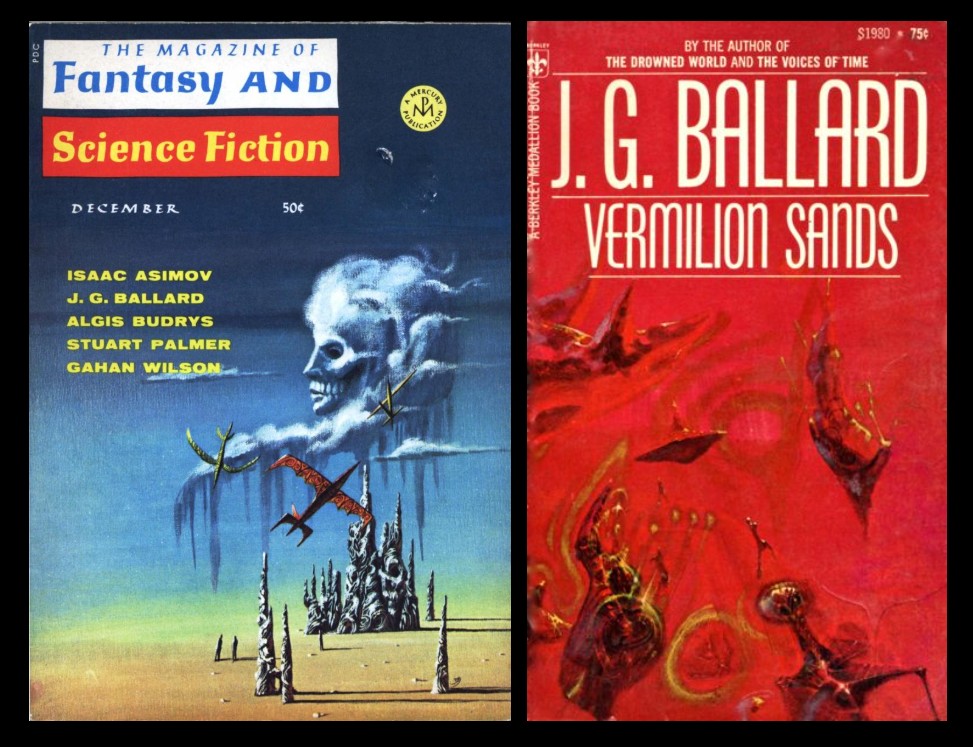
“The Cloud-Sculptors of Coral D” by J. G. Ballard — Fantasy or SF?

I reread “The Cloud Sculptors of Coral-D” by J.G. Ballard because my short story reading group is reading The Best Fantasy from The Magazine of Fantasy and Science Fiction. Inclusion in this volume suggests its fantasy. However, it was also included in The Great Science Fiction Series edited by Martin H. Greenberg, Joseph Olander, and Frederik Pohl. The story contains no magic, no dragons or elves, and it’s set in our present day, but in a fictional resort called Vermillion Sands.

Vermillion Sands feels like a decadent playground for the rich, which also features the many kinds of parasites that live off the wealthy. It’s also an artist and expat colony. We don’t know its location, but it feels like Palm Springs, California. Many worldly travelers come and go there.

“The Cloud Sculptors of Coral-D” was my first introduction to J. G. Ballard back in the 1960s. Other stories from that setting make up the series, collected into Vermillion Sands.

  • “Prima Belladonna” (Science Fantasy, December 1956)
  • “Venus Smiles” (Science Fantasy, June 1957)
  • “Studio 5, the Stars” (Science Fantasy, February 1961)
  • “The Thousand Dreams of Stellavista” (Amazing Stories, March 1962)
  • “The Singing Statues” (Fantastic Stories, July 1962) (not in original collection)
  • “The Screen Game” (Fantastic Stories, October 1963)
  • “Cry Hope, Cry Fury!” (F&SF, October 1967)
  • “The Cloud-Sculptors of Coral D” (F&SF, December 1967)
  • “Say Goodbye to the Wind” (Fantastic, August 1970)

Wikipedia provides an excellent overview of the stories, highlighting that each dealt with a different artistic medium being affected by technology.

When I first read “The Cloud Sculptors of Coral-D” as a teen, it felt very grown-up to me. The characters were the kinds of people I met growing up in Miami, not the typical heroes of science fiction stories I spent so much time reading. It never occurred to me to think of the story as fantasy, but it didn’t seem like science fiction either. At the time, I was just discovering British science fiction writers like Brian Aldiss and John Brunner and the New Wave SF. The stories were set in the present or near future and took place on Earth. No rockets or robots. Was this actual science fiction?

“The Cloud Sculptors of Coral-D” is about a band of glider pilots who shape clouds with silver iodide. At first, their audience and patrons are people who park their cars along the lagoon road to watch. Eventually, the Garbo-like Leonora Chanel hires them to perform for her party. Sculpting clouds is a neat idea, but far from realistic. Does that make the story science fiction? Ballard does throw in a creature called sand rays, which I suppose are like manta rays that live under the sand instead of the sea. Do they make the story a fantasy?

Science fiction has often been the dumping ground for any kind of weird story that can’t be classified. The Vermillion Sands stories would have been rejected by mainstream and literary magazines. They fit nicely in The Magazine of Fantasy & Science Fiction. They were also published in the British magazine Science Fantasy and the American Fantastic. Only one was published in a straight-ahead science fiction magazine, Amazing Stories. I doubt John W. Campbell would have accepted them in Astounding or Analog. Nor would he have published them in Unknown. I wonder if Rod Serling would have used “The Cloud Sculptors of Coral-D” for The Twilight Zone?

I’m not fond of traditional fantasy, and many of the stories in The Best Fantasy from The Magazine of Fantasy and Science Fiction aren’t enjoyable for me to read. But I did enjoy “The Cloud Sculptors of Coral-D.” The story has a pleasant, surreal feel. The setting is very close to this world, but just a smidge off. I love the artist colony atmosphere, the hint of decadence, the ever-so-slight sense of unreality. The story combines barnstorming, carny folks, and the ugly rich. I visualize it as a cross between early Faulkner and Fellini.

The shortest description would be to say the story has atmosphere.

James Wallace Harris, 7/1/25

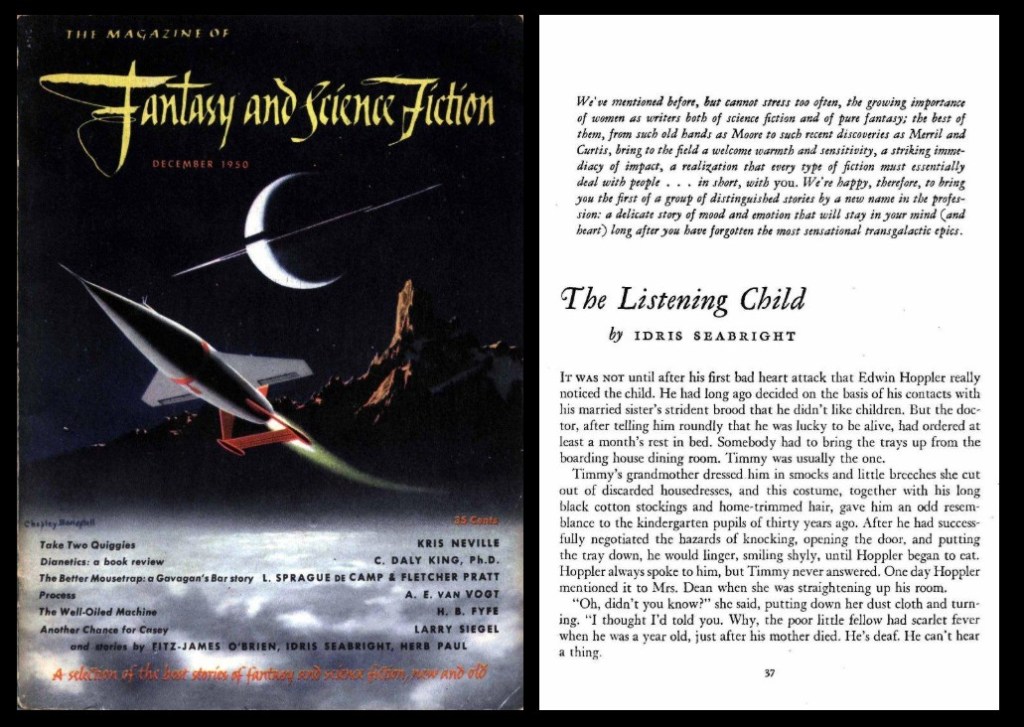
“The Listening Child” by Margaret St. Clair

“The Listening Child” was first published in The Magazine of Fantasy and Science Fiction (December 1950) by Margaret St. Clair using the pseudonym Idris Seabright. You can read it online here. It is short story #1 of 25 that our Facebook group will be discussing as Group Read 92. (See the reading schedule at the end of this review.) Group Read 92 consists of 25 stories picked by five group members that we haven’t read before. That was a challenge since we’ve been discussing a short story daily for years. The group is public.

In the 1950s, extrasensory perception (ESP) was a popular theme in science fiction and fantasy magazines. It was often speculated that people with physical or mental abnormalities might have additional senses to compensate for the loss of one of their primary senses. I assume the assumption came from blind people who had keener hearing.

After Hiroshima, science fiction and comic book writers often used radiation as a cause of ESP. However, in the 1930s and 1940s, John W. Campbell was impressed by the Rhine experiments, and science fiction writers often supposed that advanced aliens had psychic powers. Arthur C. Clarke, who was normally a hard SF writer, proposed that the evolution of human development led to ESP in two of his most famous novels, Childhood’s End and 2001: A Space Odyssey. Soft science and fantasy writers leaned towards psi-powers in physically and mentally damaged humans, like Theodore Sturgeon’s More Than Human.

Margaret St. Clair imagines a deaf mute having a rather unique ESP talent. Timmy can “hear” when death is near. Many famous stories personify death, so this isn’t too out there, but it’s not as believable as other ESP talents, even though it is well proven that ESP does not exist. Still, hearing death makes for a nice story idea.

St. Clair’s setup for her story is rather quaint. Edwin Hoppler is 63 and suffers from a weak heart. He lives in a boarding house. Boarding houses have disappeared, but were common in old movies and science fiction short stories before the 1960s. Quite a few episodes of The Twilight Zone were set in boarding houses. It’s a shame they don’t still exist. Living with several other individuals who ate communal meals fixed by a nice old lady sounds pleasant.

Timmy is the landlady’s grandson, and Edwin feels sorry for him. Edwin befriends Timmy when he realizes that the other kids don’t play with Timmy. Edwin notices that Timmy “listens” intently at times, and eventually notices that these listening moments precede a person or animal dying. Edwin decides to use Timmy as the canary in a coal mine to detect his own impending heart episodes.

“The Listening Child” is a pleasant little story, but rather slight. Timmy and Edwin are only developed enough as characters to present the idea for the story. There’s little conflict or tension. The story also lacks color or voice. The idea is slight, but writers can flesh out simple ideas into complex characterization and plots. For example, compare it to “Jeffty is Five” by Harlan Ellison. Jeffty is a boy who is perpetually five, and always lives in the year he was five, with the popular culture never changing. Or read “Baby is Three” by Theodore Sturgeon; it’s tremendously dramatic for a boy with psychic powers talking to a psychiatrist.

I don’t want to tell you the ending, but I expected St. Clair thought her readers would find it emotional and poignant. It was presented too casually for me to be moved, but I’m curious if other members from our short story reading group will be moved. I wanted the ending to be like in Platoon when we see Elias still alive, and the emotional impact we felt watching him die.

I’m working on a project to find my all-time favorite science fiction stories I’ve read over the past sixty years. Identifying such stories means learning what makes a story work. Most published stories succeed at a basic three-star level, which is how I’d rate “The Listening Child.”

For this story to reach the four-star level, Timmy and Edwin would need to become vivid characters. To make it to a five-star story would require elevating the story gimmick of hearing death into something metaphorical and philosophical that I would want to contemplate over several readings.

James Wallace Harris, 4/21/25

Group Read 92 Schedule

  • 01 (04/22/25) – The Listening Child, by Margaret St. Clair (ss) F&SF, December 1950 (DH)
  • 02 (04/24/25) – Brightness Falls from the Air, by Margaret St. Clair (ss) F&SF, April 1951 (FP)
  • 03 (04/26/25) – The Rose, by Charles L. Harness (na), Authentic Science Fiction, 15 March 1953 (PF)
  • 04 (04/29/25) – The Last Day, by Richard Matheson (ss), Amazing, April/May 1953 (FP)
  • 05 (05/01/25) – Watershed, by James Blish (ss), If, May 1955 (RH)
  • 06 (05/03/25) – The Certificate, by Avram Davidson (ss), F&SF, March 1959 (FP)
  • 07 (05/06/25) – To See the Invisible Man, by Robert Silverberg (ss), Worlds of Tomorrow, April 1963 (FP)
  • 08 (05/08/25) – A Two-Timer, by David I. Masson (nv), New Worlds 159, February 1966 (PF)
  • 09 (05/10/25) – The Adventuress, by Joanna Russ (nv), Orbit 2, ed. Damon Knight (Putnam, 1967) (RH)
  • 10 (05/13/25) – No War, or Battle’s Sound, by Harry Harrison (nv), If, October 1968 (FP)
  • 11 (05/15/25) – The Milk of Paradise, by James Tiptree, Jr. (ss), Again, Dangerous Visions, ed. Harlan Ellison (Doubleday, 1972) (RH)
  • 12 (05/17/25) – Pale Roses, by Michael Moorcock (nv), New Worlds 7, ed. Hilary Bailey & Charles Platt (Sphere, 1974) (PF)
  • 13 (05/20/25) – Concepts, by Thomas M. Disch (nv), F&SF, December 1978 (PF)
  • 14 (05/22/25) – Gate of Faces, by Ray Aldridge (nv), F&SF, April 1991 (PF)
  • 15 (05/24/25) – On Sequoia Time, by Daniel Keys Moran (ss), Asimov’s, September 1996 (PN)
  • 16 (05/27/25) – Journey into the Kingdom, by M. Rickert (nv), F&SF, May 2006 (PN)
  • 17 (05/29/25) – Roxie, by Robert Reed (ss), Asimov’s, July 2007 (PN)
  • 18 (05/31/25) – 26 Monkeys, Also the Abyss, by Kij Johnson (ss), Asimov’s, July 2008 (DH)
  • 19 (06/03/25) – Passage of Earth, by Michael Swanwick (ss), Clarkesworld 91, April 2014 (PN)
  • 20 (06/05/25) – Cimmeria, by Theodora Goss (ss), Lightspeed 50, July 2014 (RH)
  • 21 (06/07/25) – Sadness, by Timons Esaias (ss), Analog, July/August 2014 (RH)
  • 22 (06/10/25) – Ten Poems for the Mossums, One for the Man, by Suzanne Palmer (nv), Asimov’s, July 2016 (PN)
  • 23 (06/12/25) – The Secret Lives of the Nine Negro Teeth of George Washington, by P. Djèlí Clark (ss), Fireside Magazine, February 2018 (DH)
  • 24 (06/14/25) – The Virtue of Unfaithful Translations, by Minsoo Kang (nv), New Suns, ed. Nisi Shawl (Solaris, 2019) (DH)
  • 25 (06/17/25) – One Time, a Reluctant Traveler, by A. T. Greenblatt (ss), Clarkesworld 166, July 2020 (DH)

“You Know Willie” by Theodore R. Cogswell

Group Read 72: The Best Science Fiction Stories of 1957

“You Know Willie” by Theodore R. Cogswell #05 of 20 (Read)

I was disappointed that “You Know Willie” is not science fiction. It’s a story about racism that uses fantasy to make a surprise ending. The story isn’t bad. Both Merril and Asimov/Greenberg included it in their anthologies covering 1957. I remember the racism of the 1950s, and it horrified me as a kid, and I’m white. I remember visiting Mississippi in 1960 and being frightened by the violent emotions of the racists. Such people were sadly all too common. So, I can understand why this story was written. In fact, its fantasy depends on a similar thought I had as a kid.

Back then I wondered what racists would do if they woke up one morning looking like the people they hated. At the time I thought it would cure them of their racist beliefs. Later, when I was a bit older, I wondered if that would be true. Back then I felt if a baby from a fundamentalist protestant family was switched at birth with a baby of a fundamentalist Muslim family, they would grow up to be whatever religion their parents believed.

People seldom break free of their upbringing. That’s why it is important to teach Critical Race Theory. I can remember specific lessons I had as a kid that helped me avoid becoming a racist. I’m not sure a story like “You Know Willie” would have helped. I do remember reading books about race in my late teens, ones that would be banned from classrooms today, that did enlighten me.

I’m sure stories like “You Know Willie” would have made good people feel better about themselves when they read it back in the 1950s, but I don’t think it would have altered the thinking of bad people. I’m sure Cogswell was well-intended when he wrote this story, but he should have aimed higher.

Would racists have a come-to-Jesus moment if they suddenly turned the color of the people they hated? We don’t get to find that out in “You Know Willie.” This story goes for the easy win and doesn’t explore anything deeper. Willie experiences a kind inverse Golden Rule — have others do unto you what you have done to others. We saw the surprise ending coming from a long way off.

For this story to be truly memorable, we needed Willie to have lived long enough to see how a change in color would have affected his thinking. For me, the story brings up the ugliness of racism only to play it for a laugh. I didn’t like that.

James Wallace Harris, 3/23/24

Has Science Fiction Changed?

I often encounter the opinion that science fiction has changed. Is it true? Over my lifetime novels have gotten longer, trilogies and series have become more common, there are more female authors, and the genre has been heavily influenced by fantasy. Before Star Trek in 1966, the world of science fiction seemed tiny, and that TV show brought in millions of new SF fans. Then Star Wars in 1977 brought in tens of millions of new SF fans. (But I’m not sure how much the population of science fiction readers grew.)

But these are all externals. I’m wondering if the essence of science fiction itself has changed. Yes, the writing has gotten better, and the literary world has become more accepting, but do modern readers get something different out of reading science fiction than what I found in the 1960s? Why do I prefer older science fiction? Is it more than just because I imprinted on it when I was young? I’m not the only one who feels this way. Many aging Baby Boomers say they prefer older science fiction too, but so do some young book reviewers.

Over the last forty days I’ve read five novels by Philip K. Dick written between 1959-1963, plus Ammonite by Nicola Griffith and The Player of Games by Iain M. Banks. These aren’t new novels, but newer than what I’m talking about, and they feel different. Over the last year I’ve read such new SFF books as Sea of Rust by C. Robert Cargill, Babel by R. F. Kuang, and The Mountain in the Sea by Ray Nayler. I know this is a small sample, but I’ve also read hundreds of science fiction short stories, both old and new, over the last couple of years.

All I can say is science fiction from the first half of my life (1951-1987) feels much different than the second half (1988-2024). The change started around the time of Star Wars in 1977. George Lucas and Steven Spielberg might be the main factors changing the genre. I confess that I’ve long thought that science fiction ran out of original ideas at some point, and the genre has been living on recycling ever since. But women writers, literary standards, and fantasy radically changed the flavor of science fiction since the 1970s too.

But what if the change in science fiction is due to other factors? Yesterday I watched a video by Bookborn, “Do SFF authors think we are stupid now” that offered two innovative ideas. Bookborn suggests that current science fiction lacks subtlety. She also suggests that newer science fiction requires less critical thinking because newer authors tell their readers what to think rather than letting the readers draw their own conclusions. Bookborn also felt authors wrote about topical problems too obviously. Even with books she likes, presenting viewpoints she agrees with, she felt they were too explicit, lacking subtly. She admits this problem is not measurable and highly subjective.

Bookborn then cites an essay, “The Death of the Author” by Roland Barthes. The essay in long, so I suggest reading Wikipedia’s summary instead, but to give you a quick idea, here’s a quote from the first paragraph at Wikipedia:

"The Death of the Author" (French: La mort de l'auteur) is a 1967 essay by the French literary critic and theorist Roland Barthes (1915–1980). Barthes's essay argues against traditional literary criticism's practice of relying on the intentions and biography of an author to definitively explain the "ultimate meaning" of a text. Instead, the essay emphasizes the primacy of each individual reader's interpretation of the work over any "definitive" meaning intended by the author, a process in which subtle or unnoticed characteristics may be drawn out for new insight.

Bookborn is quite articulate at explaining her position, and her position is more complex than what I’m conveying here, so I recommend clicking on the link above to watch her video. Bookborn goes on to say that current authors hide from their readers because of social media. They fear attacks on what they say so they are overly careful about what they put forth. I had an additional insight. Because modern science fiction is often about elaborate world building, modern authors struggle to be precise so readers will see clearly what they have worked so hard to invent.

In Ammonite by Nicola Griffith and The Player of Games by Iain M. Banks, I was disappointed by the blandness of the author’s voice. And I never felt the presence of Griffith or Banks in their stories. Yes, in both cases their world building is beautifully detailed, but both authors left no mysteries about their stories or their personal views for me to ponder. I have theories to explain this too.

Modern writers prefer a close personal third point of view, or first person, to the older omniscient point of view which is better suited for conveying the author’s voice. I also find that the novels I admire most are ones written by authors I love reading about. Maybe what I love about older science fiction is my connection to the author.

Any science fictional world that’s set far from Earth becomes a fantasy world, and thus far less complex than our reality. Such fictional worlds are far from the infinite complexity of contemporary controversies. Writers can avoid personal philosophy by using allegory. Reading such fantasies means passively consuming what the book describes. Such stories don’t lend themselves to ambiguity and complexity, which makes the reader think. Our reality is infinitely full of shades of gray. Made up fictional worlds tend to be consistently designed because authors want them to be understandable to readers unless you’re Gene Wolfe writing The Book of the New Sun.

The five Philip K. Dick novels were far more compelling and thought provoking than the books by Griffith and Banks. I often try newer science fiction, but they usually come across as merely fun stories. Overall, newer science fiction stories are like going to Disneyland. They dazzle but when the ride is over, are quickly forgotten. I’m still thinking about those Philip K. Dick novels. When nothing else thrills, switching to a Philip K. Dick story will get my mind excited. Why is that? I believe it’s because his Dick’s books are closer to real life, and that makes them ambiguous and mysterious. They offer endless room for speculation. I’m reading another biography of Philip K. Dick, my sixth, I think, because Dick’s novels make me crave understanding.

Dick’s novels were compelling, Ammonite and The Player of Games were not. They aren’t bad, in fact, they’re exceptionally good stories, just not compelling. Dick was obsessed with deciphering reality. He doubted that what we perceive is real. He was horrified by other people, often thinking they were machines, disguised supernatural beings, or illusions of the mind. Paranoia fueled his narratives. Our reality was too complex for Philip K. Dick, and it drove him into insane states of mind trying to figure it out. Every Philip K. Dick novel is another exciting speculative assumption about reality.

Interestingly, Dick doesn’t fit the theory about the author being dead. Yes, his stories are wonderful without knowing anything about Philip K. Dick, but their complexity increases the more you do know about him. I want stories where the authors aren’t dead by Barthes criteria.

By coincidence, both The Player of Games and Time Out of Joint are about game playing. However, the first novel feels contrived. It’s hard to believe. But the second, which is far more fantastic, yet feels very real and believable. Why is that?

I believe the reason I love older science fiction is because it speculates about reality. Whereas newer science fiction is focused on telling a delightful story. Lucas and Spielberg overly inspired newer writers to focus on entertaining the masses.

I loved the Heinlein novels of the 1950s because they speculated about future space travel. That was before NASA showed us what real space travel would be like in the 1960s. Heinlein’s stories honestly tried to speculate about traveling to the Moon or Mars. Space travel in Star Trek, Star Wars, or the Culture novels of Iain M. Banks are really fantasies. Space travel in Red Mars by Kim Stanley Robinson is somewhat speculative.
Most science fiction isn’t very speculative, even the old stuff. However, novels like Flowers for Algernon or Earth Abides feel far closer to reality. And I’m sure many people will point out that stories by Philip K. Dick are extremely fantastic, yet their characters feel like ordinary real people, and that grounds them.

For all his insanity, Philip K. Dick struggled to understand reality. And I think the reason I admire many older science fiction writers is because they were commenting on reality. I do love entertaining stories, but pure storytelling seldom offers much to think about.

I’m not sure I understand “The Death of the Author” in the same way as Bookborn. It seems to me that classics were written by authors whose personality dominated their fiction. Think about Jane Austen, Charles Dickens, F. Scott Fitzgerald, Eudora Welty, Ernest Hemingway, Flannery O’Conner, Jack Kerouac, or the science Fiction writers like H. G. Wells, Robert Heinlein, Philip K. Dick, Theodore Sturgeon, Ursula K. Le Guin, Harlan Ellison, Zenna Henderson, Samuel R. Delany, John Brunner, etc. If you want to write a great science fiction novel, I think it must connect with reality. Just think how silly and fantastic Slaughterhouse-Five is, yet Vonnegut points to reality, and that makes it a great novel.

James Wallace Harris, 2/4/24
Has Science Fiction Left Me Behind?

The above books were the finalists for the 2023 Hugo Awards. I have not read any of them. Nor do they look interesting to me. Each year the Hugo and Nebula award finalists seem further and further away from what I want to read.

The other day I went into a new bookstore for the first time in many months. I went up and down the aisles of the science fiction section and I was shocked by how many books were by authors that were unknown to me.

I turn seventy-two next month and I wonder if I’ve gotten too old for science fiction. Or, has the genre left me in the dust? I can accept that I might be too old to keep up. Could the genre have changed, and I’ve just lost interest? Who knows?

In the 20th century I’m sure I read at least a thousand science fiction books, probably many more. Here’s a list of the 69 SF&F books I’ve read in the 21st century:

  • 2000 – Harry Potter and the Goblet of Fire by J. K. Rowling (Hugo winner)
  • 2000 – Calculating God by Robert J. Sawyer (Hugo finalist)
  • 2001 – American Gods by Neil Gaiman (Hugo winner)
  • 2001 – Perdido Street Station by China Miéville (Hugo finalist)
  • 2002 – Altered Carbon by Richard K. Morgan
  • 2003 – The Time Traveler’s Wife by Audrey Niffenegger
  • 2004 – Cloud Atlas by David Mitchell
  • 2004 – Jonathan Strange & Mr. Norrell by Susanna Clarke (Hugo winner)
  • 2004 – The Plot Against America by Philip Roth
  • 2005 – Spin by Robert Charles Wilson (Hugo winner)
  • 2005 – Old Man’s War by John Scalzi (Hugo finalist)
  • 2005 – Never Let Me Go by Kazuo Ishiguro
  • 2006 – The Road by Cormac McCarthy
  • 2006 – Life As We Knew It by Susan Beth Pfeffer
  • 2007 – The Yiddish Policeman’s Union by Michael Chabon (Hugo winner)
  • 2008 – The Hunger Games by Suzanne Collins
  • 2008 – Little Brother by Cory Doctorow (Hugo finalist)
  • 2008 – Flood by Stephen Baxter
  • 2008 – Marsbound by Joe Haldeman
  • 2009 – The City & The City by China Miéville (Hugo winner)
  • 2009 – The Windup Girl by Paolo Bacigalupi (Hugo finalist)
  • 2009 – Boneshaker by Cherie Priest (Hugo finalist)
  • 2009 – Julian Comstock by Robert Charles Wilson (Hugo finalist)
  • 2009 – Catching Fire by Suzanne Collins
  • 2009 – Wake by Robert J. Sawyer
  • 2010 – Feed by Mira Grant (Hugo finalist)
  • 2010 – Mockingjay by Suzanne Collins
  • 2010 – Watch by Robert J. Sawyer
  • 2010 – Hull Zero Three by Greg Bear
  • 2011 – Among Others by Jo Walton (Hugo winner)
  • 2011 – Leviathan Wakes by James S. A. Corey (Hugo finalist)
  • 2011 – The Martian by Andy Weir
  • 2011 – Ready Player One by Ernest Cline
  • 2011 – Wonder by Robert J. Sawyer
  • 2012 – Redshirts by John Scalzi (Hugo winner)
  • 2012 – 2312 by Kim Stanley Robinson (Hugo finalist)
  • 2012 – The Dog Stars by Peter Heller
  • 2012 – The Age of Miracles by Karen Thompson Walker
  • 2012 – vN by Madeline Ashby
  • 2014 – The Three Body Problem by Cixin Liu (Hugo winner)
  • 2014 – Annihilation by Jeff VanderMeer
  • 2014 – Station Eleven by Emily St. John Mandel
  • 2014 – The Girl with All the Gifts by M. R. Carey
  • 2014 – The Book of the Unnamed Midwife by Meg Elison
  • 2014 – Yesterday’s Kin by Nancy Kress
  • 2015 – Seveneves by Neal Stephenson (Hugo finalist)
  • 2015 – Children of Time by Adrian Tchaikovsky
  • 2015 – Binti by Nnedi Okorafor
  • 2015 – Aurora by Kim Stanley Robinson
  • 2015 – The Water Knife by Paolo Bacigalupi
  • 2016 – All the Birds in the Sky by Charlie Jane Anders (Hugo finalist)
  • 2017 – New York 2140 by Kim Stanley Robinson (Hugo finalist)
  • 2017 – All Systems Red by Martha Wells
  • 2017 – Sea of Rust by C. Robert Cargill
  • 2017 – Under the Pendulum Sun by Jeanette Ng
  • 2017 – Noumenon – Marina J. Lostetter
  • 2018 – The Calculating Stars by Mary Robinette Kowal (Hugo winner)
  • 2018 – Semiosis by Sue Burke
  • 2018 – The Fated Sky by Mary Robinette Kowal
  • 2018 – The Feed by Nick Clark Windo
  • 2019 – Children of Ruin by Adrian Tchaikovsky
  • 2019 – Machines Like Me by Ian McEwan
  • 2020 – The Ministry for the Future by Kim Stanley Robinson
  • 2020 – The Midnight Library by Matt Haig
  • 2021 – Project Hail Mary by Andy Weir (Hugo finalist)
  • 2021 – Klara and the Sun by Kazuo Ishiguro
  • 2022 – Babel by R. F. Kuang
  • 2022 – The Mountain in the Sea by Ray Nayler
  • 2022 – Sea of Tranquility

That’s an average of 2.8 SF&F books a year. Assuming I read a thousand SF books from 1963-1999, means I averaged 27.78 SF books a year. I think I could have easily read 1,500 SF books, or 41.67 SF books a year. In other words, I don’t read SF like I used to. And my 21st century list includes quite a few fantasies. I rarely read fantasy in the 20th century. I really don’t like fantasy books. I only read them when they reach a certain pop culture status.

One reason for the shift is I read more literary works and nonfiction books. Another reason is after reading thousands of science fiction books, I seldom read reviews of new science fiction books that sound different enough to be appealing.

I used to keep up with the genre by belonging to the Science Fiction Book Club, which offered two new titles a month. I subscribed to several science fiction magazines and fanzines that reviewed new books. And I would visit one or two new bookstores a week.

Fanzines disappeared, and I stopped having time for the prozines even though I still subscribed. After Amazon and Audible, I stopped shopping in new bookstores, and they eventually disappeared. Back in the 1970s I went to conventions and even published fanzines. In the 1980s I ran a BBS devoted to science fiction. Since the 1990s I’ve run websites and databases devoted to SF. Once upon a time all my friends were SF readers. But active participation in fandom ended when I got married and settled down to work in 1978. I became a different person socially.

Since 2002, I’ve been rereading the science fiction I first read in the 20th century by listening to audiobook editions from Audible.com. It’s a kind of nostalgic trip. I also caught up on a lot of 20th century science fiction I missed. That also kept me from reading many new SF books.

But in all honesty, I prefer old science fiction to new science fiction. There’s been some great exceptions, but I think that’s the real reason I’ve let the genre pass me by.

I wish the Science Fiction Writers of America never embraced fantasy. I wish the Hugo Awards had focused exclusively on science fiction. Fantasy should have their own fan-based award. I can’t help but wonder if the science fiction genre would be more vibrant today if it hadn’t been married to the fantasy genre. Even books marketed as science fiction often feel like fantasies. Looking back, I would have preferred a smaller, focused SF genre, one I could have kept up with.

Science fiction used to have some realism, or at least some speculative integrity. Now, any old wild idea works. Science fiction used to be inspired from reality, now new writers are inspired mostly by science fiction movies. It’s as if all science fiction is recursive science fiction.

Who knows, maybe I left science fiction behind.

James Wallace Harris, 10/22/23

The King of Elfland’s Daughter by Lord Dunsany

For most of my life I’ve had a prejudice against the fantasy genre. When I was ten I was crazy about the Oz books, but not long after that I discovered science fiction. I know it’s possible to enjoy both science fiction and fantasy, but I associate fantasy with the unscientific, with religions and myths, and with the belief in magic. On rare occasions I’ve fallen for fantasy tales, like the Harry Potter books and The Golden Compass trilogy. I believe they were acceptable to me because they were for kids and I assume fantasy stories are fine for children. Although, that might suggest that part of my prejudice against fantasy is because I believe fantasy is for children — and that at a certain age we should give it up.

However, I mainly dislike fantasy stories because fantasy embraces magic. I hate the concept of magic for scientific and philosophical reasons. I have always hoped that scientific thinking would supplant religious thinking. Christianity has a problem with magic too. Christianity has always hoped to supplant belief in magic, and I can understand why. Because for a new paradigm to take old the old one has to be erased. But for me, Christianity is just another form of magical thinking, and I expected science to replace it.

You might be thinking this is a weird way to review a book, but reading The King of Elfland’s Daughter by Lord Dunsany deals with these philosophical issues — and I wonder if it’s message isn’t anti-magic. I’m not sure what it’s exact stance on the subject is, which is why I want to talk about it. And you might think I’m even more confused because I’m reading a classic adult fantasy novel when I just declared I’m too old for fantasy novels.

I decided to read The King of Elfland’s Daughter when the unnamed reviewer on Bookpilled, my favorite science fiction reviewer channel on YouTube, reviewed it. The Bookpilled guy praised The King Of Elfland’s Daughter so highly I felt I should try and overcome my fantasy prejudice and give it a read.

The King Of Elfland’s Daughter came out in 1924, and according to Wikipedia it made quite an impact. Over the years, some of my favorite science fiction writers from the mid-20th century mentioned an admiration for Lord Dunsany. In 1969 Ballantine reprinted the novel as the second book in its second series of Adult Fantasy novels. That series if often cited as reviving fantasy as a popular genre for adult readers. I remember that Ballantine Adult Fantasy books coming out back then, and I liked them for their covers, but never wanted to read them. Over the years, I have ended up reading a few of them. I wish I had bought and saved those Ballantine editions because many of them sell for hundreds nowadays.

The King of Elfland’s Daughter might not appeal to modern fans of fantasy though. It’s prose sounds like something out of Chaucer, and there is very little character development, dramatic action, or even dialogue. Lurulu, the troll, who is mostly a comic character seems to have had the most lines. I say that because in the audiobook edition I listened to the narrator did voices for the characters and about the only one that stood out was the troll’s. I also read along with a 99 cent Kindle edition from Amazon.

The story is set in the village/valley of Erl and the neighboring fantasyland of Elfland. The setting is sometime before 1530 — Dunsany makes a specific point of bringing that up. Erl is ruled by a hereditary lord who lives in a castle, but a Parliament of elders comes to visit the lord of Erl telling him they want more magic in their land. The lord tells his son, Alveric, to go into Elfland, find and bring back the King of Elfland’s daughter, Lirazel, and marry her. This happens early in the book and they have a son named Orion. Unfortunately, Lirazel can’t adapt to human ways and returns to Elfland. Most of the rest of the story is about Alveric trying to find his way back to Elfland to recapture Lirazel, and Orion growing up to be a hunter, first of stags, but then of unicorns.

This novel was pleasant enough to read, but it’s structure was primitive, much like a long fairytale. Alveric and Lirazel have practically no personal traits at all, and there’s barely any for Orion. Lirazel is beautiful, and that’s about it. Orion is good at hunting and loves his hunting dogs.

On the other land, the prose is rather nice.

The real meat of this story is the contrast between Earth and Elfland. Elfland is another dimension that borders Erl on the east. Elfland is timeless. Immortal beings that leave Elfland to visit Earth age. When Alveric is in Elfland capturing Lirazel, ten years pass by in Erl. Lord Dunsany sets up his story so that Erl is Christian and its citizens believe they will go to heaven. But we’re also told there is no path to heaven from Elfland. The choice for some of the characters is between living, growing old, dying and going to heaven, or choosing to live in Elfland where nothing happens and everything is eternal. Dunsany constantly reminds us of the timelessness of Elfland.

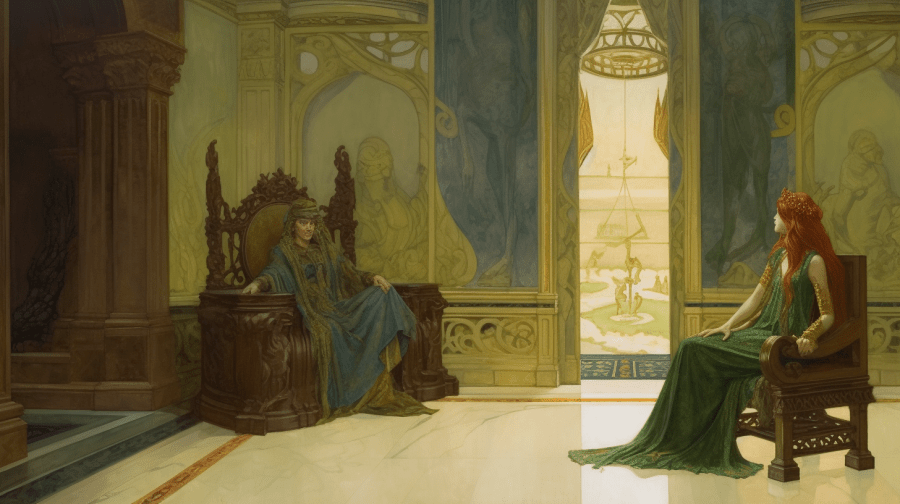
Sometimes I picture everything in Elfland frozen in one beautiful tableau. When Lirazel returns she sits on her father’s knee the entire time Orion grows up. I tried to get Midjourney to create an image of that scene but it kept making Lirazel a little girl in her father’s lap. I settled for what I have above.

During that same time, Alveric is on a never ending quest to reenter Elfland. His quest is longer than Odysseus’ journey home after the Trojan War.

Eventually, Orion discovers the edge of Elfland and sees a unicorn. Now, in this story, unicorns are magical, but not special like in modern fantasy stories. In fact, Orion hunts them, and mounts their heads. I bet modern readers will be horrified at that. Orion also discovers trolls and the trolls start visiting Erl.

I’m not sure if I should tell the whole story, but I’m going to say that the Parliament of Erl come to regret their desire for more magic in their land. They thought it would make their valley famous, but instead magic scares them. And it’s here where I wonder if Dunsany isn’t making a case against magic. At one point the Freer (friar?) speaks to the village:

I won’t tell what the ending is but it involves a transformation that I can’t decide if it’s wonderful or horrifying.

My theory is belief in magic existed before Christianity all across Europe, and for two thousand years the Church has been trying to stamp it out. Lovers of fantasy hate to let magic go. And I wonder if Lord Dunsany’s book, The King of Elfland’s Daughter isn’t about that. On one hand, I tend to think Dunsany is siding with Christianity and is against magic, but on the other hand, I think he’s just as enchanted by the magical.

The reason why I believed fantasy is for children is because I felt pretending is something kids like to do. But I also assume when we grow up we need to get real. Now, I’m no longer sure if it is okay to allow fantasy in books for children. Too many kids never grow up. I thought reading science fiction was taking the road to realism, but I realized late in life that much of science fiction is just as magical as fantasy. The reality is we don’t like reality and wish it was something its not. On the other hand, fiction allows us to cope with a reality that is difficult to comprehend.

Back in the 1800s there was a lot of opposition to reading fiction. Serious people thought it rotted the mind. People thought fiction mainly appealed to children, women, and men who couldn’t cope with the real world. I’m not sure they were wrong. And I wonder if Lord Dunsany wasn’t touching on this issue in The King of Elfland’s Daughter.

If I had the time I would like to make a case comparing the L. Frank Baum Oz books to The King of Elfland’s Daughter. There were 14 Oz books published from 1900 to 1920. The King of Elfland’s Daughter came out in 1924. I’d like to study what people thought of fantasy in the years 1900 to 1940 before science fiction started getting popular.

As a ten-year-old I wanted Oz to exist like Elfland. As a teenager, and even into my twenties, I used to tell people I never wanted to adultify.

Does anyone know of a good study on the evolution of fantasy fiction? I might not want to read it but I might want to read about it.

James Wallace Harris, 4/13/23

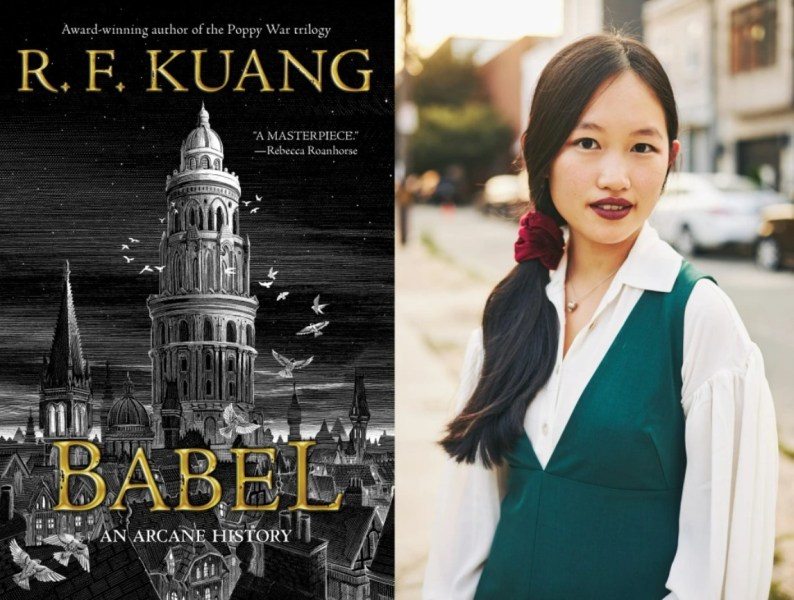
Babel by R. F. Kuang

Normally I avoid reading fantasy books but will make an exception for outstanding works of the genre, such as Babel by R. F. Kuang. I became intrigued by this novel when reviews described it being a fantasy about language translation, set in Oxford at the beginning of Queen Victoria’s reign. I love reading about how books are translated, and I’m fond of poking around in the 19th century. Then I saw that LitHub found Babel on 7 best-books-of-2022 lists. That convinced me to try it.

I find most fantasy novels to be mediocre. This is due to the genre being flooded with works, and because exceptional works of fantasy have set the bar so high that reading anything less is boring. Babel reminded me of Harry Potter books, The Golden Compass trilogy, and Jonathan Strange & Mr. Norrell.

Babel is mostly set in Oxford, England in the 1830s. Follows four students who study at the Royal Institute of Translation – known as Babel. It is the most powerful college at Oxford in Kuang’s fantasy world. Babel is a fantasy novel rather than a historical one because silver can be embued with powerful charms via knowledge in language translation. This magical silver powers the industrial revolution and is a metaphor for capitalism. Actually, for the evils of capitalism.

I would call this a YA novel except that the protagonists are college students. Kuang is impressively creative in her writing and plotting but I was somewhat disappointed with her characterization. I would say they were excellent for genre writing — because genre fans will love them. But I thought her characters lacking compared to literary writing. The main character, Robin Swift, is half Chinese and half English and grew up in Canton, China before being taken to England to study languages. He never felt Chinese. He always felt English. Ramy is a Muslim kid from India, his cultural background doesn’t come through either. People are prejudiced against these two for their physical appearance, but I never felt they were different from the English characters internally. The only character that emotionally acts a bit different is Victoire, a girl originally from Haiti. Letty, the fourth in the cohort, is a privileged English girl and acts exactly that.

Even though this is a fantasy it focused on the historical sins of England in the 19th century. It judges Imperial England harshly, which it deserves. Actual history is like studying the Holocaust — full of horrors. There is an infinite amount of history to hate, but finding any real understanding is rare. I question making an attack on the past for the basis of a fantasy novel, but then I don’t take fantasy novels seriously. I feel they are mostly fun, and mostly for young people.

The story comes across as another YA tale of Blows Against the Empire that’s no more realistic than a Star Wars sequel or The Hunger Games. It’s hard to take its plot seriously since it involves magic. But maybe young readers will be inspired to read nonfiction history about the period, such as Empire of Cotton by Sven Beckert. On the other hand, the plot is compelling from a reading point of view.

And I do believe R. F. Kuang is deadly serious. That makes me worry about her solution supporting violence. Her novel is really a metaphor for our times. It asks: How can we enjoy the fruits of evil when we know the price of them will be so much suffering? But the woken judge the past so severely without realizing the future will judge them just as harshly. We all need to read What We Owe the Future by William MacAskill. I’m afraid the future will look back on the 21st century and judge anyone who flew in an airplane or ate meat like we feel about 19th-century slave owners.

If Babel is just a fun fantasy that mixes in history and uses the English imperialists as its bad guys, how should we judge it? But what if it’s a philosophically deep challenge to history? Then, how should we judge Babel? Does it condemn the past fairly? Or is it more complicated? How many nonfiction books will we have to read to really answer that question?

James Wallace Harris, 1/15/23

Near vs. Far Science Fiction

I’ve recently turned 71 and beginning to realize, once again, that my taste in science fiction is changing due to aging. I’m in a Facebook group where we read and discuss one science fiction short story a day. That exposes me to many different kinds of science fiction, both old and new, covering the endless possible themes that science fiction explores.

I push myself to read every story, even when I’m not enjoying them. I try to give each story the best possible chance but things are starting to change. That could be for several reasons. After reading a couple thousand SF short stories over the last five years, I might be burning out on certain kinds of science fiction. And I’ve been having health problems, and I only have half the vitality I did just a few years ago. Meaning, I might not have the psychic energy to consume as much science fiction. Ultimately, I believe it’s because getting older is making me more down to Earth, changing what I want from science fiction. Then again, I might be getting old and just losing my patience.

For some of my Facebook comments, I’m starting to use the excuse that I didn’t like the story because it’s science fiction is too far away for me. By that I mean, the setting is too far away in space or time. I’ve never been much of a fan of fantasy, and science fiction that’s far away in space or time feels like fantasy fiction. Some of these stories are beautifully written, with fantastic world-building, and wonderful character development. I should like them just for the storytelling, but I don’t. I feel like I’m wasting my time. I just don’t care about characters that live in unbelievable settings.

I’m not sure this attitude is entirely consistent. I’ve been meaning to reread Hothouse by Brian Aldiss, which is set in the far future and is very fantasy-like. I’ve read it twice in the last half-century, and it’s a beautiful tale. Would I still like a book I loved before if its setting is too far away? I don’t know, but I’ll report if I ever reread it again. Right now, I tend to be forgiving of old science fiction. I’m harder on new science fiction.

I keep trying to read the New Space Opera writers, and I just can’t get into them. I want to read the Culture novels by Ian M. Banks. Theoretically, they’re something I think I’d love, but I just can’t get into them. They are too far away.

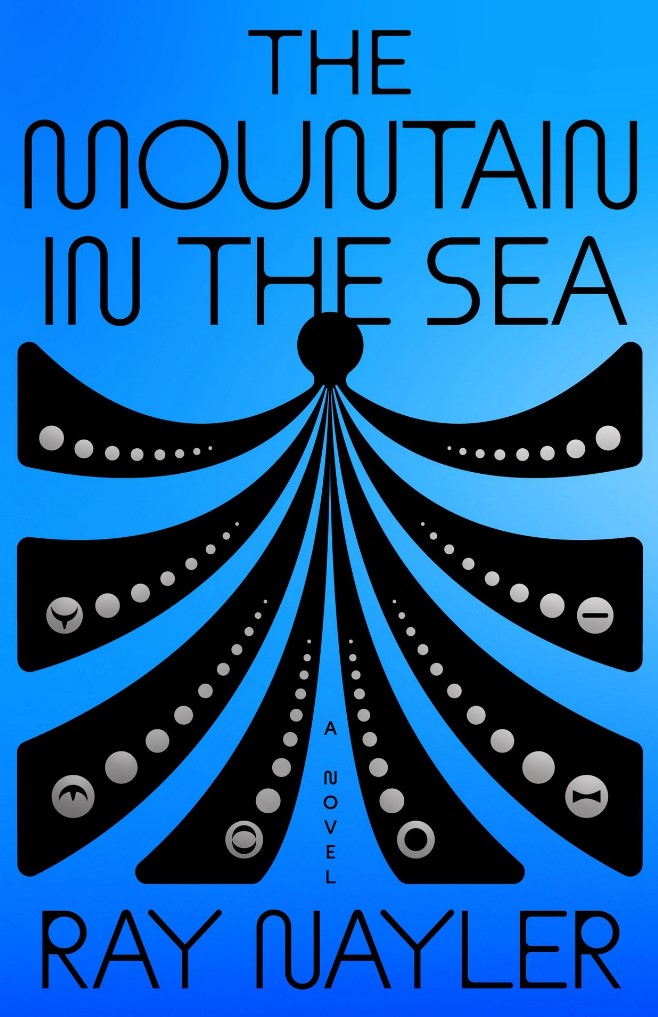
This week I started listening to The Mountain in the Sea, Ray Nayler’s first novel I believe. I’m loving it, but then its setting is very near, on Earth, in the foreseeable future. The basic plot is about discovering a species of octopus that are social, tool-making, and developing a language. Since I’ve recently read The Soul of an Octopus by Sy Montgomery and watched My Octopus Teacher on Netflix, Nayler’s speculation is very realistic. And that makes his science fiction very near.

A second major theme of The Mountain in the Sea is artificial intelligence, and Nayler handles it in a very realistic way too, again making his science fiction very near. I’ve been admiring Nayler’s short stories for a while now, but sometimes they are about AI and downloading human minds into machines or people, and I find that science fiction too far away for me. In fact, I dislike the whole theme of brain downloading and uploading.

One thing Nayler does in his novel is quote two future nonfiction books: How Oceans Think by Dr. Ha Nguyen and Building Minds by Dr. Arnkatla Mínervudóttir-Chan in chapter headings. These two authors are also characters in the book. This gives Nayler a clever way to infodump in his story and injects his story with philosophy and science.

There are several other themes in the novel that are valid to us today, slavery, over-fishing, exploiting the environment, loneliness, self-destruction on a personal and species level, and so on. This is a heavy book. I have a few hours left, so I can’t give away the ending, but I’m most anxious to find out what happens.

The Mountain in the Sea reminds me of other great near science fiction novels, such as Stand on Zanzibar by John Brunner, Timescape by Gregory Benford, The Windup Girl by Paolo Bacigalupi, and The Ministry of the Future by Kim Stanley Robinson. It also reminds me of the popular science books by Dr. John C. Lilly, who was a famous dolphin researcher back in the 1960s, and who went on to explore states of inner space. I’m especially reminded of The Mind of the Dolphin: A Nonhuman Intelligence and Programming and Metaprogramming in the Human Biocomputer: Theory and Experiments. Books I read when I was young that has made me think about some of the things which Ray Nayler is making me think about again now that I’m old. It’s interesting that in the 1960s we thought dolphins were the closest intelligent species to us, but now we’re thinking it might be octopuses.

James Wallace Harris, 11/27/22