We often judge old science fiction books by what writers got right about the future. It is equally valuable to understand what they got wrong. In an experiment, disproving a hypothesis is still informative. Robert A. Heinlein was famous in the 1940s for writing a series of science fiction stories he labeled Future History. Heinlein also wrote fourteen young adult novels from 1947 to 1963 that can also be considered another Future History.
I’ve read thousands of science fiction novels and short stories over the past sixty-plus years. I no longer enjoy reading science fiction in the same way I did when I was young. That was when I could forget that I was a reader and immerse myself in the story. Now, when I read science fiction, I’m constantly thinking: What is the writer trying to create, how are they doing it, and why? When I read old science fiction, I think about the year it was written and what the author used as grounds for speculation.
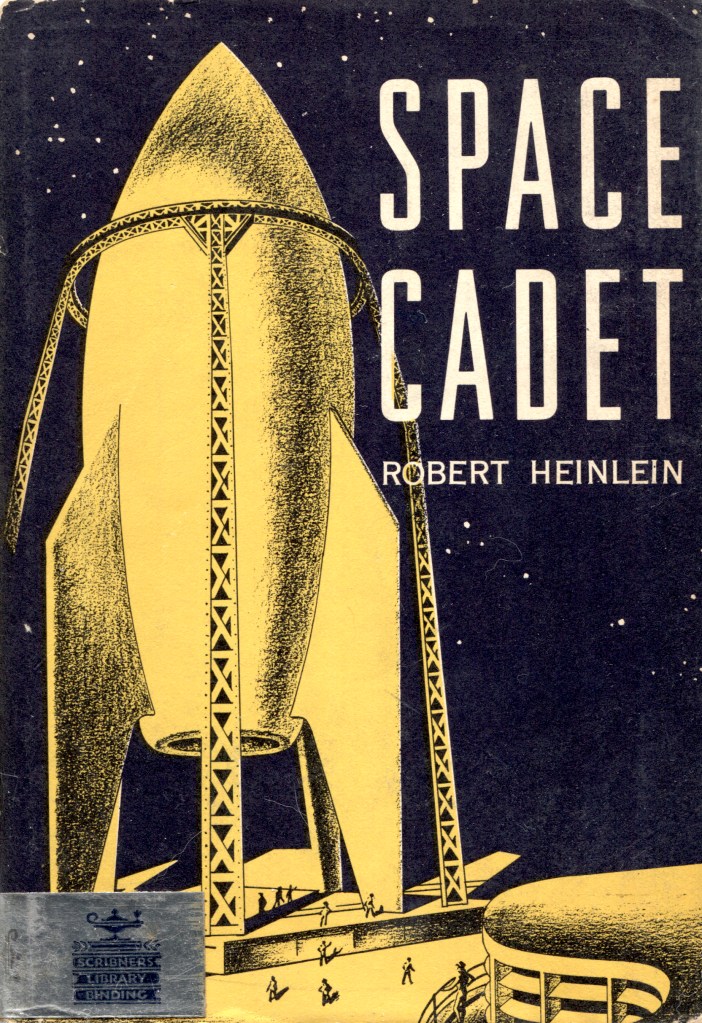
I believe that at one time, Robert A. Heinlein was as brilliant in his speculations as H. G. Wells in his heyday. Space Cadet was written during a particularly stressful time in Heinlein’s life. He had left his second wife, Leslyn, whom he had married in 1932. I do not have the space here to describe how remarkable Leslyn was as a woman in the 1930s. Leslyn had a master’s in philosophy, was politically liberal, and sexually adventurous. Robert and Leslyn had a remarkable fifteen-year relationship, with an enviable social life among highly creative people in Los Angeles. Robert had left Leslyn, waiting for the divorce to allow him to marry his third wife, Virginia (“Ginny”) Gerstenfeld. She became his muse and companion for the rest of his life. (See Robert A. Heinlein: Volume I: Learning Curve, 1907–1948 by William H. Patterson.)
Space Cadet follows four boys, Matt, Tex, Oscar, and Pierre, through a series of episodic adventures as they train in the Interplanetary Patrol. Heinlein was a graduate of the United States Naval Academy and modeled Space Cadet on his training at Annapolis. The story begins on Earth, then moves to a military school in Earth’s orbit. (The boys take leave on a giant space habitat.) Next, the boys are assigned to a rocket searching for a lost exploration vessel in the asteroids. Finally, end up on a rescue mission on Venus. For the most part, the story is a page turner. Each episode combines personal conflicts and learning experiences. Heinlein promotes education, especially in math. Heinlein provides a certain amount of infodumps about space navigation, orbital mechanics, rocket science, space suits, weightlessness, space sickness, and other realistic details involved in exploring space that were usually ignored in science fiction before Heinlein.
The Heinlein juveniles took space exploration seriously, at least by what was known at the time. This was especially true in the early books of the series. However, each book went further away from Earth. Eventually, the series went well beyond anything scientific to explain the methods of transportation used in them. I’ve often felt that Heinlein was focused on the details of realistic space exploration during the late 1940s and early 1950s, but after Sputnik and NASA, Heinlein shifted to making his novels about politics and society. Those later novels might be set in space, but Heinlein no longer concerned himself with the details of rocket science.
Although Heinlein was experiencing the success of his first book being published in 1947, a string of sales to slick magazines, and Hollywood types contacting him about making a movie, he was living in poverty in a tiny trailer. He desperately needed money. Heinlein left California and everyone he knew to hide out in Fort Worth, Texas. He was living in sin with Ginny, his future third wife. They had to keep their relationship secret until the divorce went through with Leslyn. Heinlein felt guilty for abandoning Leslyn, but she had become an uncontrollable alcoholic. Heinlein had met Ginny in Philadelphia while working as a civilian for the war effort. Ginny was a biochemical engineer with math skills who worked well with Heinlein on planning the science in his science fiction. The two of them spent their days in Fort Worth working out the math for the orbital mechanics in Space Cadet. Heinlein’s future depended on this second book for Scribner’s, but he had a difficult time writing it. He claimed that Ginny offered many suggestions that he initially rejected but ultimately used to finish the novel.
In 1948, Heinlein didn’t know his 1947 novel, Rocket Ship Galileo, would be the basis for Destination Moon, the first major science fiction film of the 1950s, and Space Cadet would be connected to Tom Corbett, Space Cadet, a 1950 TV show that influenced later science fiction television. Heinlein had been the star of John W. Campbell’s Astounding Science Fiction in the 1940s. Nor did he have any inclination that his twelve young adult novels for Charles Scribner’s Sons would have such a major impact on readers in the 1950s. In 1947 and 1948, Heinlein was at a low point in his career. He had no idea how big a success his writing would become, or how Ginny would become the love of his life. They believed in a fantastic future of space travel, but they were so poor that they had to sell their belongings to survive.
Heinlein dominated science fiction in the 1950s, like H. G. Wells did in the 1890s. When I reread Heinlein, it’s to see how he changed the course of science fiction. When I was young, I felt Heinlein would one day be considered the Mark Twain of science fiction by the time I got old. That hasn’t happened.
Robert Heinlein’s reputation as a science fiction writer has dropped dramatically over my lifetime. When I was growing up, if two SF fans met, both assumed each other’s favorite author was Heinlein, and they’d argue over who was the next best science fiction writer. Today, many modern readers shun Heinlein, usually for what they believe are Heinlein’s personal views, or because they’ve read one of Heinlein’s later works, and assume all of his books are just as bad. Personally, I dislike all of Heinlein’s books published after The Past Through Tomorrow (1967). I have significant problems with anything he wrote after Starship Troopers (1959) and before he published The Past Through Tomorrow.
Science fiction becomes dated after a few decades, which is the main reason why Heinlein’s fiction is falling out of favor. Only three SF novels from the 19th century are commonly read today: Frankenstein, The Time Machine, and The War of the Worlds. Eventually, I believe fewer than a dozen science fiction novels from the 20th century will be widely read in the 22nd century.
Heinlein will continue to be read until his original fans all die. Then, readers yet to be born will decide if any of his books will be worth reading after that. I’m rereading Heinlein’s books, speculating if they will survive in the future. I started with Heinlein’s first published novel, Rocket Ship Galileo (1947), an essay I already need to revise.
Rereading his second Scribner’s novel, Space Cadet from 1948, it’s easy to dismiss it as a young adult novel for boys. But when you examine it in comparison to science fiction published up until 1948, and consider the philosophical issues it deals with, it’s a standout SF novel.
In judging Heinlein’s long-term prospects, I’ve decided to use H. G. Wells, Aldous Huxley, George Orwell, and George R. Stewart as models, specifically for The Time Machine, The War of the Worlds, Brave New World, Nineteen Eighty-Four, and Earth Abides. Heinlein wanted Starship Troopers, Stranger in a Strange Land, and The Moon is a Harsh Mistress to be the three books by which he would be remembered. Heinlein felt those novels were his most mature works, and which best expressed his views. They are the ones that are still found in bookstores. They are also the Heinlein novels modern readers often dislike.
Heinlein might be right, and those books will be his literary legacy. Heinlein has twenty-nine other books published in his lifetime to consider. I plan to reread nineteen of them as possible works that might be remembered instead. So far, I’ve reread three, and my memory of the others suggests that Heinlein does not have a novel equal to my five models. In terms of ambition and complexity, only Heinlein’s favorite three come close to the five models I’ve chosen in ambition. However, I’m not sure if Heinlein’s philosophical intent in those works will be well-regarded in the future.
I believe there’s another way Heinlein might be remembered. Heinlein will often be discussed in books about science fiction. Heinlein is a significant figure in the evolution of science fiction. For example, in a taxonomy tree showing the evolution of the genre, Starship Troopers will be the main branch for Military SF. Rocket Ship Galileo is situated on a major branch of fiction about the first trip to the Moon. And Space Cadet is a major contribution to exploring the solar system.
In the 21st century, Heinlein is often ignored. Many readers have the prejudice that Heinlein is an unlikable conservative; some even think he’s a fascist and misogynist. But Space Cadet expresses extremely liberal views.
If you read Space Cadet today, it will feel like a simple story for young people that’s quite dated. Readers need to understand events in 1948 to appreciate the novel. Heinlein imagines a need for a world government and an agency to control nuclear weapons. Russia didn’t have the atomic bomb until 1949, but Heinlein was worried about the day when multiple countries had weapons of mass destruction. Throughout the 1940s, Heinlein wrote stories that speculated about how we’d apply atomic energy in peacetime and control nuclear weapons to prevent wars. That’s a heavy topic for fiction found in elementary school libraries.
Heinlein was also concerned with the human race destroying itself. Heinlein believed only one international agency should control nuclear weapons. And if any country violated their policies, their ability to create a nuclear bomb would be targeted with nukes. In an early draft of Space Cadet, Heinlein had Matt, his young protagonist, nuking his hometown. Wisely, Heinlein decided that was too much for a young adult novel and reduced the idea to a bull session between cadets.
To emphasize the importance of this idea, he has the cadets discover evidence that the asteroids are the remains of a planet that blew itself up in an atomic war.
The Interplanetary Patrol is racially integrated. Heinlein makes a point that black males are cadets and officers. The U.S. military integrated in 1948. Heinlein takes this further by emphasizing that intelligent beings on Venus and Mars are equally human, even if they don’t look human. However, human females don’t have equal rights in this story. But Heinlein quickly liberates women in later books in this series. However, even in Space Cadet, the Venusians are a matriarchal society.
Ideas about a space based military from Space Cadet will show up again in Starship Troopers. The novel also has an orbital battle school that prefigures Ender’s Game. And the Interplanetary Patrol will influence several TV shows in the 1950s, which will eventually lead to Star Trek. Of course, Heinlein was inspired by E. E. “Doc” Smith’s Lensman series.
Throughout the novel, Heinlein tosses out ideas that will become part of reality. At the beginning of the story, Matt uses a pocket phone that depends on cell towers. He gets to orbit via a reusable rocket. They are stationed at a geosynchronous orbit. But Heinlein also missed on things, too. In 1948, Heinlein didn’t foresee the impact that computers, networks, and robots would have on our world.
Space Cadet is set in 2075. Heinlein assumes that by then, humanity will have traveled the solar system and settled colonies on the Moon, Venus, Mars, and Ganymede. Heinlein also thought we’d find intelligent life on Venus and Mars, and it once existed on the planet that blew up and became the asteroids. All of Heinlein’s young adult novels have overlapping futures with similar details. That’s why I say they represent another Future History.
Many science fiction writers before 1950, including Ray Bradbury, hoped we’d find Martians and Venusians. I call that kind of thinking pre-NASA science fiction. In the 1960s, when NASA’s probes discovered that those planets were lifeless, I was tremendously disappointed. I still love pre-NASA science fiction. But I have to wonder if younger generations have completely dismissed such stories because of what science has discovered? I must point out that they accept Star Trek and Star Wars. We know those popular series are just as unscientific as pre-NASA science fiction, but they haven’t been rejected. Why?
I doubt many readers will read Heinlein because of his historical value to the genre. Few readers today read E. E. “Doc” Smith, and his series were once beloved. At 73, I sometimes wonder if I shouldn’t give up on Heinlein, too. However, rereading books by Heinlein and Philip K. Dick provides far more enjoyment than reading new science fiction. I both love that and regret it. It reminds me of all my old boomer friends who won’t listen to any music created after 1975. I don’t want to be stuck in pop culture nostalgia, but obviously, I am.
I once read science fiction to think about the future.
I now read science fiction to think about the past.
James Wallace Harris, 9/31/25


 Classics of Science Fiction