Science Fiction for Boys and Girls

I’ve been on a vacation from reading science fiction but yesterday I read two SF stories to see if I wanted to come home. The first was “The Year Without Sunshine” by Naomi Kritzer published online at Uncanny Magazine. The second was “Detonation Boulevard” by Alastair Reynolds published online at Tor.com now called Reactor. The Kritzer story has won both the Hugo and Nebula awards, and the Reynolds story has the pole position in Best of British Science Fiction 2023 edited by Donna Scott.

What struck me about both were the gender generalizations I could make about each. I know it’s sexist to make generalizations about gender but how do you explain the differences I sense in post-apocalyptic books written by women and those by men?

“The Year Without Sunshine” is about a neighborhood that experiences a small, maybe temporary, apocalypse. The story is very readable, uplifting, moving, positive, and suggests people will cooperate to survive. It made me tear up many times. However, it ignores the common tropes of post-apocalyptic fiction that American men use in related stories where civilization collapses. In those stories it’s time to whip out the guns and go full auto on being Darwinian.

I felt “The Year Without Sunshine” leaned towards the feminine side of things because I enjoy the sub-genre of post-apocalyptic fiction, and the examples I can recall written by women are different than the ones I can recall by American men. I also sense a difference between American and British post-apocalyptic novels. Most American post-apocalyptic novels written by guys bring back the Wild West, usually with a Mad Max tone. Whereas many British post-apocalyptic novels could be called cozy catastrophes.

Examples of post-apocalyptic novels written by women that pop into my mind are Station Eleven by Emily St. John Mandel, Memoirs of a Survivor by Doris Lessing, Life as We Knew It by Susan Beth Pfeffer, The Age of Miracles by Karen Thompson Walker. A couple recent British post-apocalyptic novels that come to mind are The Hopkins Manuscript by R. C. Sherriff and Survivors by Terry Nation (the basis of a BBC TV show back in the 1970s).

Naomi Kritzer presents a view in her story that I feel is both feminine and more mature than most typical science fiction. She presents a realistic future with what I consider unrealistic hope. Alaistair Reynolds presents a completely fantasy future that’s squarely aimed at the stereotype story for boys.

While reading “The Year Without Sunshine,” which I loved, Kritzer’s male characters were too nice, even the ones that were supposed to be bad. I can’t but believe that they were how Kritzer hoped guys would act in her fictionalized situation. Unfortunately, tough times are when the true nature of males will come through. I’d say the 2023 film Leave the World Behind is more like how I predict things will happen, especially the scene when the characters played by Mahershala Ali and Ethan Hawke confront the Kevin Bacon character hoping to barter for medicine. That’s how men will be when they are still somewhat civilized and rational, but I also expect the real reality will be like The Road by Cormac McCarthy. In “The Year Without Sunshine” too many people readily want to help Susan, who has COPD, and either give or trade her canisters of propane to keep her oxygen generator going. I don’t think that would happen. But it is the way mature people should wish it will be.

I’m not criticizing Kritzer’s story when I claim some of her males act unrealistic in that situation. I have my fantasies and my speculations, and they are different from the kinds of science fiction I’ve read, and I believe because I’m male. I could be wrong, and people, all people will act more like Kritzer’s characters in such a real-life situation.

“A Year Without Sunshine” is immensely popular and loved. It’s the kind of story that readers of The New Yorker would have enjoyed too because it’s SF that’s relevant to today and to literary readers.

In “Detonation Boulevard” Alastair Reynolds gives us the boys fantasy of space travel. It’s a visually exciting story that would make an eye-popping science fiction film. Just study the above artwork for it from Reactor. Imagine a race under a sky full of Jupiter! When I was twelve, I would have loved this story and considered it thrilling. Cyborgs on Io, a moon of Jupiter, race gigantic moon buggies completely around its circumference. At 72, that seemed silly. Like Kritzer’s hopeful fantasy for how people should act when civilization collapses, Reynolds is a hopeful fantasy for the future when we can have car races all over the solar system. But it is also an unrealistic fantasy that ignores the reality of space exploration and ignores all the scientific extrapolations about the future of Earth. It’s what boys want, of all ages.

Without giving too much of a spoiler, I did like the mature insight of the older cyborg and how it tried to pass it on to the younger one. Reynolds offers us a twist near the end, but I thought it contrived for modern audiences.

I remember back in the 1970s there were several articles in mainstream magazines by major literary writers attacking science fiction for being immature, claiming the genre offered power fantasies for adolescent boys. Readers and writers in the genre were outraged and insulted, but there is a certain amount of truth in those attacks. It’s interesting at the same time those criticisms were being made Ursula K. Le Guin and Joanna Russ were publishing works that began to mutate the genre towards more maturity.

Back in the late 1950s, my sister Becky and I formed two clubs. She called hers the Please and Thank You Club for the girls on our street, and I called my club The Eagles club for us boys. “The Year Without Sunshine” would fit nicely in a Please and Thank You Club, while Detonation Boulevard” would fit in with the Eagles.

I’m currently reading My Brilliant Friend by Elene Ferrante and Rabbit, Run by John Updike while on vacation from science fiction. It’s interesting to compare the gender perspectives of their characters to those in science fiction. Ferrante begins her book with two eight-year-old girls whose perceptions of the world were far more mature than I was at that age. I know it’s sexist to observe differences in males and females, but whenever I read literary work by women writers, I’m described powers of observations regarding other people’s emotions that I’ve never had. I saw that in Kritzer’s story too, but not Reynold’s.

It’s like trying to imagine how dogs perceive the world through smells when their sense of smell is thousands of times more powerful than ours. I can’t help but believe I am blind to things that women can perceive. Sure, it could just be me. And sure, it’s possible that plenty of males have this skill too, or plenty of females don’t. There are people who have theorized that Elena Ferrante could be a male. She has kept her identity secret. However, most of her fans hate that idea because they consider Ferrante such a perfect example of female perception. I guess it’s theoretically possible for a male writer to perfectly imitate the best female writer – but I doubt it. Reynolds tries to portray a female character in his story, but I don’t think he even came close.

I have heard, in person, and online, many males criticize the state of modern science fiction bellyaching that women writers have taken over and changed the genre. The genre is constantly evolving, and improving, and I think it’s possible that some of those improvements are due to female insight. But what has gone missing that the males want back?

Unfortantely, I think it’s what was bad about science fiction, something I once loved, and something that only a few girls admired at the time. Part of it is illustrated by “Detonation Boulevard.” And that is the immature childhood dreams of science fiction. We just don’t want to grow up, and that’s the old style science fiction that guys mostly loved, and some girls did too, both now and then. That quality is irrisistable fun and make believe. It’s why Transformers were so popular. It’s why the comic book culture has gained appeal with all ages and genders. It’s why we don’t want to grow up and adolescence now extends for decades. It’s why people are addicted to video games and crave virtual reality. Science fiction was always the 12-year-old boy’s daydreaming come true. It’s also why young wives want to divorce their immature husbands. However, that immaturity of story action is widely popular, even with girls and women.

But it ain’t helpful for growing up in a the real world. It doesn’t matters in a story like “Detonation Boulevard,” but it does in stories like “A Year Without Sunshine.” That story has no alpha males, no assholes that demand or take what they want. And those kind of guys will show up with things fall apart. It had a couple of teens that lamely tried to take what they wanted, but that made the story somewhat less realistic. There’s also a different between vicarious violence for fun, and fictional violence that portrays the real world.

I guess I’m making a case for more realism in science fiction. I think young people, of either gender, want less realism. But isn’t it the realistic details of “A Year Without Sunshine” that made it worthy of a Hugo and Nebula? To make his story somewhat realistic, Reynolds had to have cyborgs rather than humans. But wouldn’t two AI robots competing on Io been even more realistic, more gritty, hard, and believable, especially if we were shown how their knowledge and ability to perceive reality was hundreds of time more powerful than human beings? Robots are perfect for Io, we’re not. We still want to be the heroes of space exploration, but I don’t think we will.

I’m also listening to the audiobook of A City On Mars by Kelly and Zack Weinersmith. It’s subtitle is: Can We Settle Space, Should We Settle Space, and Have We Really Thought This Through? Kelly Weinersmith is a professor of biosciences and she takes a long hard look at the final frontier dream. Her husband Zack illustrates the book. On the dedication page she writes:

The book brings realism to the dreams of science fiction and space enthusiasts. Even pointing out some harsh truths, I think the Weinersmiths are still overly optimistic. I’ve been reading widely on the possibilities of space exploration and the limitations of what we have to work with leave little room for what science fiction has dreamed. But even if technology could give us the colonization of Mars, only delusional people will want to live there.

I know it’s sexist to say women writers have something to offer that is unique to them, but I think we need their gender’s perspective. But I also think even more, we need more maturity of the kind they have. Maybe I’m too old to be reading a children’s literature. Maybe it’s unfair to be inside stories for children expecting more grownup’s perspectives.

When I read these two stories this weekend I felt I was reading the fantasies from two different genders of young people, stories for girls and boys. Two stories that imagined a positive future, although one was more realistic and mature than the other.

Sure, my sample size is two, but they’re consistent with many other science fiction stories I’ve read. Personally I think the genders are no closer in understanding each other than the Democrats and Republicans, and that all youth, and most adults have a grasp of reality that’s only slightly superior to reality TV. We just aren’t a rational species. Most people accept that fantasy and science fiction are merely ways to pretend, especially for children, but I believe what we pretend, especially as children, says something about how we will think when we grow up.

Both “A Year Without Sunshine” and “Detonation Boulevard” are good stories. I just enjoyed “A Year Without Sunshine” a great deal more. Is it sexist of me to say I like it more because it offers a female perspective I don’t get in post-apocalyptic tales written by males?

If you disagree that there is a difference go read “A Boy and His Dog” by Harlan Ellison, and then read “A Year Without Sunshine.” I can’t find an online copy, but here’s an audio reading at YouTube. It also won a Nebula award, and was nominated for a Hugo. I can’t believe Ellison hasn’t been canceled because of this story. You might have it in one of these anthologies. I can’t believe I once admired this story – it’s truly repellant.

JWH

“Flight to Forever” by Poul Anderson

Rereading “Flight to Forever” made me realize something about the core of my personality. There are a limited number of science fictional ideas that I resonate with that I like to regularly recall.

I consider “The Time Machine” the epitome of science fiction because it explored so many new science fiction themes. New to me at age twelve, and maybe new to the world in 1895. Poul Anderson’s “Flight to Forever” recalls many of those same ideas. “Flight to Forever” was first published in Super Science Stories, the November 1950 issue. You can read it here, or listen here. I first read it in Year’s Best Science Fiction Novels: 1952 edited by Bleiler and Dikty. I just read it in The Last Man on Earth edited by Asimov, Greenberg, and Waugh. Here’s a listing of other reprintings.

“Flight to Forever” also reminds me of Last and First Men by Olaf Stapledon and Tau Zero, also by Poul Anderson. The writing style, pace, and plotting feels like science fiction from the 1930s. I’m trying to give you enough hints to get you to go read the story before I give spoilers. This cover might also entice you to go read it too, especially if you discovered science fiction before Star Trek.

While reading “Flight to Forever” I kept thinking how it contained several scenes that inspired the kind of sense of wonder I loved experiencing as an adolescent when I first started reading science fiction. I know as an adult that all those mind-blowing concepts are completely unrealistic, just complete bullshit fantasy, but I still love encountering them over and over. Why?

Am I a 72-year-old kid still being enchanted by fairy tales? I like to think of myself as finally growing up and accepting reality for what it is, but I keep retreating into science fiction. Why? Could a good psychiatrist explain the psychology to me? Is it a neurosis? I will admit that science fiction was a coping mechanism for a turbulent adolescence in the 1960s, and maybe it helps me escape the constant chaos in the news of 2020s. Still, that doesn’t explain the specific appeal of science fiction and the way this story triggers my endorphins.

The story begins with Martin Saunders and Sam McPherson setting off in a time machine to travel one hundred years into the future to see why their automatic test time machines haven’t returned. Martin assures his lovely girlfriend Eve Lang that he will return quickly.

Having one’s own time machine is a wonderful fantasy, especially if it’s one you built yourself in your home laboratory. That’s why “The Time Machine” was so appealing. As a kid, I wanted to be Danny Dunn and have access to wonderful time machines and spaceships. It’s why Back to the Future was so much fun in the 1980s even though I was an adult.

Martin and Sam arrive one hundred years into the future without a problem, but when they try to return to their own time, they discover it takes ever more energy to go back in time. They eventually calculate that the amount of energy needed approaches infinity around the seventy-year mark. Poul Anderson has imagined a natural way for time to protect itself from paradoxes. It’s a neat idea.

Martin and Sam decide to head further into the future to see if they can find a time when scientists might know how to break through the going back in time barrier. This is where the story parallels Wells’ unnamed time traveler, stopping now and then to see how society and mankind has changed. This portion of the story also reminds me of Stapledon’s Last and First Men and many science fiction stories about speculated societies.

Sam is soon killed off, so Martin becomes a lone time traveler hoping to find his way back to his beautiful Eve. He acquires another companion, Belgotai, a mercenary from the year 3000 AD. Together they keep going further and further into the future, meeting society after society. They encounter humans that colonize the galaxy, and aliens that conquer Earth. This gives Anderson a chance to dazzle the reader with all kinds of science fictional speculation.

Eventually, Martin and Belgotai join a deposed monarch fighting a renegade galactic empire. That’s when the story becomes an epic space opera. Martin falls for a regal redhead, Empress Taurey. You’d think Martin will settle here, but Anderson has many other adventures for Martin to experience before the story ends. Martin goes further into the future than the time traveler in Wells’ classic story. Like that story, “Flight to Forever” could be considered a dying Earth tale, and it becomes a last man on Earth story too.

I got the feeling Anderson wanted to include every science fictional cliche he could cram into “Flight to Forever.” I won’t tell you anymore. It’s not an exceptional story, but it is appealing. I must wonder if Anderson wasn’t trying to understand the underlying siren song of science fiction when he wrote this story. Of course, he sold it to a cheap market, so he could have been just hacking out a quick novella to thrill kids and pay his rent.

Reading “Flight to Forever” made me wonder if I could collect a small set of stories that pushed all my sense-of-wonder buttons and just reread them whenever I needed therapy. Sort of like what Kip’s father does in Have Space Suit-Will Travel by always rereading Three Men in a Boat by Jerome K. Jerome. I could create a highly distilled tincture of science fiction to consume when needed, sort of like the playlist of my all-time favorite songs on Spotify.

If I did create a playlist of favorite science fiction stories, would I include “Flight to Forever?” I guess not, because I would keep “The Time Machine” instead. That suggests something to me. Haven’t I been reading one science fiction story after another my whole life just to push the same buttons again? Shouldn’t I explore other stimuli to discover other buttons?

“Flight to Forever” is a nice reminder that certain concepts within my brain like to be remembered, at least every now and then. I’m finding a lot of them in the anthology, The Last Man on Earth. It’s amusing to think about, but I have six large bookcases of science fiction that I could probably reduce to a handful of anthologies that would trigger every type of sense of wonder science fiction ever discovered.

I had a friend that died back in the 1990s. Before he died, he lost interest in the many things he cared about over his lifetime. They went one by one, until he only had two loves left, Benny Goodman and Duane Allman. I call this The Williamson Effect. At 72, I feel I’m in the beginning stages of The Williamson Effect. I’m starting to shed interests. I have a long way to go because I’ve collected an exceedingly long list of interests over my lifetime. I don’t count science fiction as just one interest. Rereading “Flight to Forever” made me see science fiction really is many interests, although a finite set.

James Wallace Harris, 4/15/24

“Small World” by William F. Nolan

Group Read 72: The Best Science Fiction Stories of 1957

“Small World” by William F. Nolan #15 of 20 (ReadListen)

I’ve always loved post-apocalyptic novels about the last man on Earth, or at least, the last few people on Earth. I’m not saying I want everyone else to die, but if flying saucers hauled y’all all away, I wouldn’t complain. Ever since I was a kid, the thought of being the only kid in a deserted city was a fun fantasy for fueling daydreaming. The idea that I could roam around and survive by plundering anything I needed from abandoned stores and houses was deliciously appealing. I bet Henry Bemis implanted this idea in me via the 1959 episode of The Twilight Zone, when I was eight.

William F. Nolan imagines a man named Lewis Stillman left alone in Los Angeles after aliens invade in the August 1957 issue of Fantastic Universe. I remember when I first read this story I was genuinely surprised by the ending. If you don’t want me to spoil it, follow your chosen link above before reading any more of this essay.

In 1967 Harlan Ellison edited Dangerous Visions because he claimed science fiction writers couldn’t get certain kinds of science fiction stories published. I call bullshit on that idea. I think his hypothesis was wrong. Nolan produces a nice little gritty dangerous vision in “Small World” in 1957. Of course, he had to write a few thousand words of character development and setting to entertain us before he could pop the surprise.

Stillman hides out in the storm drains of Los Angeles avoiding the invaders. He only comes out at night, and has collected a nice arsenal of weapons, but he survives by going unnoticed. There have been several movies that used those famous storm drains, so I imagined scenes from Them as I read the story.

One night Stillman fondly recalls a three-volume set of medical textbooks that belonged to his father. Stillman had gone to medical school in southern California but had dropped out to become a laborer and work with his hands. Sitting alone in his hideaway, he remembered seeing those books at a used bookstore and decided he wanted to see them again. That night he arms himself and heads out. He finds the books, but they find him.

He was attacked not by aliens, but by children. The aliens had killed everyone over the age of six, so they cities were swarming with feral children. Picture Lord of the Flies. And the children would kill any surviving adult they could find. All along, Nolan had us believing Stillman was hiding from little green men, but he was really hiding from hordes of rugrats.

In the end Stillman starts shooting the tykes to get away. I pictured him blowing away Jerry Mathers, and little Billy Mumy and Angela Cartwright, as well as Jay North. Of course, I would have been the right age too in 1957 if I had lived in LA. Eventually, the children overwhelm Stillman and I assume he was torn apart. But he must have killed a pile of youngsters before they got him.

I wonder why Nolan wrote this story. It’s sick if you think about it, especially since I read it the first time after Sandy Hook. Was he just trying to gross us out? Or did Nolan secretly hate kids? Lord of the Flies came out in 1954, and that could have inspired him. The 1950s was full of public fear regarding juvenile delinquents, so maybe the story was symbolic. And the age group also applied to the early Baby Boomers, so maybe Nolan was trying to be prophetic.

Yes, Ellison was wrong. Science fiction writers often got dangerous visions published. Two of my favorites were “Lot” by Ward Moore, and “The Last Day” by Richard Matheson, both from 1954.

Also from 1954 was “The Good Life” by Jerome Bixby. Maybe it inspired “Small World.” I’ve always found that story too creepy, maybe Nolan was providing us psychological release for that story.

James Wallace Harris, 4/13/24

“The Men Return” by Jack Vance

Group Read 72: The Best Science Fiction Stories of 1957

“The Men Return” by Jack Vance #12 of 20 (ReadListen)

My initial reaction to “The Men Return” was “WTF! Far Out!” It’s not a great SF story, but Vance does produce a different idea.

I’ve often wondered why SF/F writers don’t imagine more far out possibilities when writing fantasy and science fiction because those genres allow for imagining anything. Well, Jack Vance does just that in “The Men Return.” We are told early in the story:

This reminds me of Poul Anderson’s Brain Wave, where our solar system moves into an area of the galaxy with different energy fields and all animal life on Earth becomes five times smarter. It also triggered the memory of Vernor Vinge’s A Fire Upon the Deep and its sequels that features the idea of Zones of Thought, where there are four different regions in the Milky way, each with a different kind of physics. Finally, “The Men Return” made me remember Hothouse by Brian W. Aldiss, and its far future beings.

And until just before the end of “The Men Return,” I thought the story could have been another of Vance’s Dying Earth tales, one closer to the end of humans. It also fits into the Dying Earth theme. Amazon is selling the Kindle edition of The Jack Vance Treasury for $4.99. It collects “The Men Return” and many classic Vance stories, including “Liane the Wayfarer” a classic story from The Dying Earth.

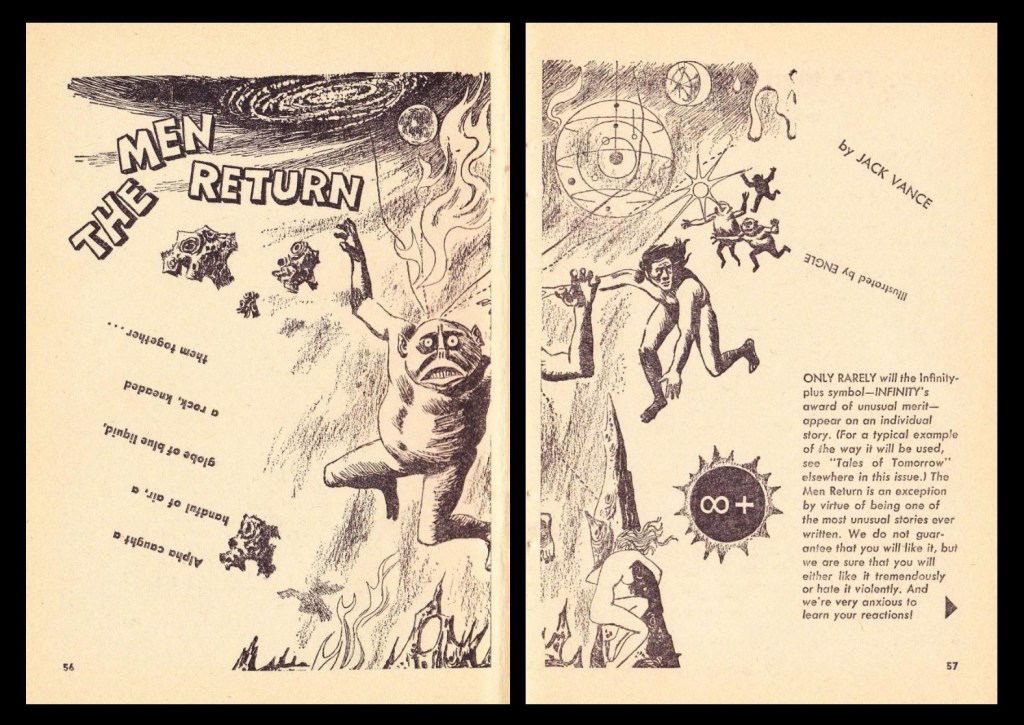
I read “The Men Return” today, and then listened to it, and I’m still not sure what’s happening. There are two groups of beings that talk, but each considers the other group a source of food. The Organisms are named Alpha and Beta. While the Relicts are Finn, our main point-of-view character, two females, Gisa and Reak, and two ancient males, Boad and Tagart. Both groups constantly search for food in a surreal landscape where physics and gravity don’t seem to be working. I might need to read this story several times before I get what Jack Vance was painting in this picture.

From the story I can’t tell if the two groups are simply different tribes of humans, or if in the far future, humans have evolved into two separate species, or if one of the groups is aliens. The artwork suggests one group is different looking than the other group. I assume the Organisms are either aliens or mutants.

Larry T. Shaw, the editor of Infinity Science Fiction presents “The Men Return” with a new designation, the Infinity + symbol.

Infinity Science Fiction was published from November 1955 through November 1958, and even though it was a second-string SF magazine, it published quite a lot of good science fiction from major names in the genre. The classic SF story, “The Star” by Arthur C. Clarke was published in its first issue.

Shaw’s Infinite + designation reminds me of F. Orlin Tremaine, Astounding Science Fiction second editor, Thought Variant designation for special stories. Asimov wrote “Nightfall” as an imagined Thought Variant story. John W. Campbell later tried to do the same thing with his NOVA designated stories.

Here are the comments Shaw received on “The Men Return” from the October issue.

Finally, here’s the cover from the July 1957 issue of Infinity Science Fiction where “The Men Return” appears.

James W. Harris 4/6/24

“The Education of Tigress Macardle” by C. M. Kornbluth

Group Read 72: The Best Science Fiction Stories of 1957

“The Education of Tigress Macardle” by C. M. Kornbluth #10 of 20 (ReadListen)

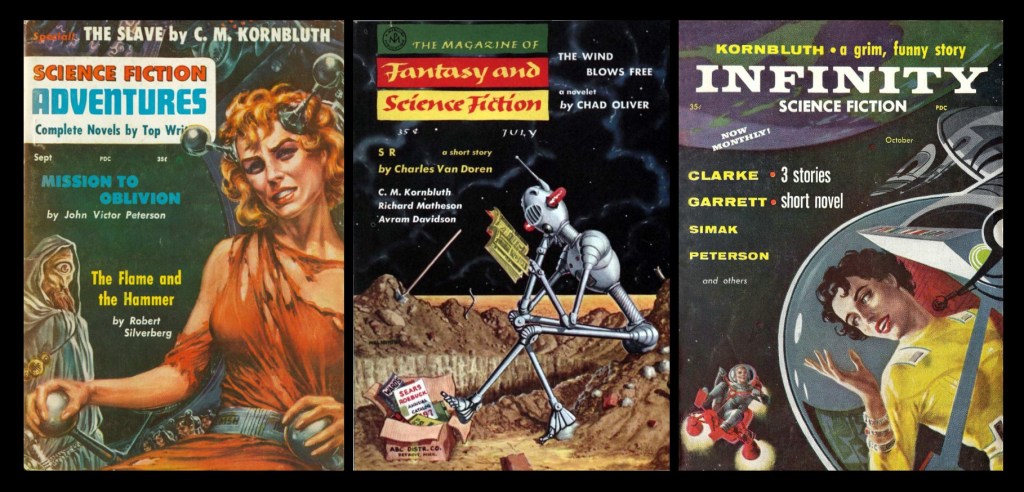
C. M. Kornbluth came out with four short stories in 1957 – “MS. Found in a Chinese Fortune Cookie,” “The Education of Tigress Macardle,” “The Slave,” and “The Last Man Left in the Bar.” None of them stood out as an obvious favorite among readers, with each story having its fans. Isaac Asimov and Martin H. Greenberg couldn’t decide between “The Education of Tigress Macardle” and “The Last Man Left in the Bar” so they published both in The Great SF Stories 19 (1957). Kornbluth died in early 1958, at age 34, so these were the last of his short stories that Kornbluth got to see in print.

I picked “The Education of Tigress Macardle” for the best of 1957 because it had two citations in CSFquery, and the others only had one. However, I’ve had people tell me they preferred either “The Last Man Left in the Bar” or “MS. Found in a Chinese Fortune Cookie.” After reading all three, I feel CSFquery was right, but what do you all think? Follow the links to read the two other stories. I don’t have a link to “The Slave” but it was a novella promoted as a short novel.

Kornbluth was famous for his sharp satire. His brutal wit stabs at several topics in “The Education of Tigress Macardle.” The bit that amused me the most was a throwaway paragraph about the Civil War Book-of-the-Week Club. I chuckled at Mightier than the Sword: A Study of Pens and Pencils in the Army of the Potomac, 1863-1865. There really is a seemingly endless amount published about the Civil War.

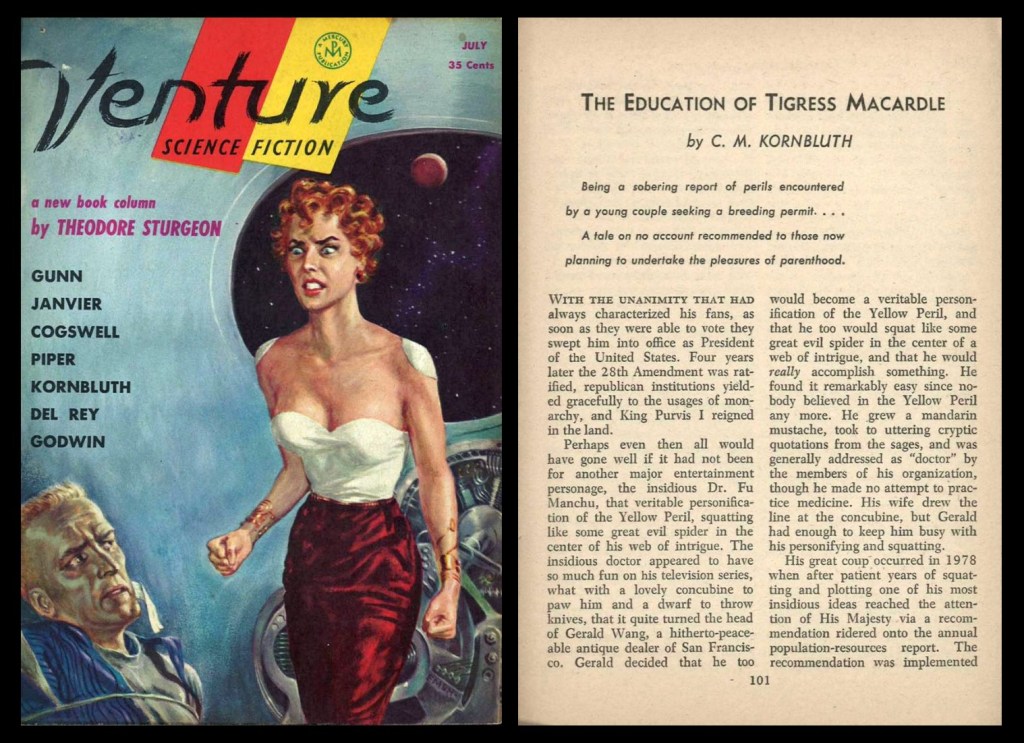
“The Education of Tigress Macardle” begins by informing its readers that in the future, a popular personality was elected President, and he got the 28th Amendment passed that made him King Purvis I. (I hope that’s not prophetic.) King Purvis inspired a guy name Gerald Wang to play at Dr. Fu Manchu and unfold a sneak attack on the United States. We learn all of this because the story is told from the year 2756 A.D. in a class at Columbia University called Chronoscope History Seminar 201. The students of this class watch what happens to George and Diana “the Tigress” Macardle on a chronoscope.

You must read between the lines to pick up all the well-hidden sexual innuendo, and if you miss what little there is, the story might lose a lot of its charm. Kornbluth is aiming at humor, but I’m not sure how many of his jokes I get. George thought he had achieved bachelor nirvana when the Tigress would have sex with him on his bear skin rug in his downtown bachelor pad. Then she whined that she wanted to get married. Then she whined she wanted to have a house in the suburbs. Evidently, George kept getting all the sex he wanted because he kept giving in. Then the Tigress whined to have a baby.

Now here’s where the fun starts. King Purvis degreed that all Americans who wanted to have children must pass a Parental Qualifications Program (P.Q.P.). And Dr. Wang devises a doozy of a potential parent exam that secretly works at his plan to take over America. Parents are given a robotic toddler to take care of for three months. If it’s black box records proper care George and the Tigress will get a permit to breed.

You can imagine the fun Kornbluth provides with this setup. You might not guess the surprise ending. I didn’t.

Another reason I preferred “The Education of Tigress Macardle” over the other two Kornbluth short stories, is because the story is more to the point and clearer. I’m not saying it’s perfectly clear. Kornbluth writing style includes a constant flourish of asides. His prose is baroque with allusions that he hopes will make us smile or admire his wit.

But those filigrees also make it hard to read Kornbluth. Kornbluth relies heavily on things from the future, or beings from other dimensions, or observers from the future. They’re usually a gimmick, a foundation, a diving board, for him to riff with his clever wordiness. Usually, his stories are fun, but seldom have much impact. He has twenty-four stories in CSFquery, but most of them don’t have many citations. I wonder if Kornbluth would have been a good standup comedian. It helps to hear his stories read by a narrator that does voices.

Personally, I believe “The Education of Tigress Macardle” would have been a far superior story if Kornbluth would have hacked off the sections with King Purvis, Gerald Wang, and students from the future. He should have focused entirely on George and the Tigress and spent all his energy making the story subtle, funny, and insightful. The setup with the tryout toddler is great by itself. And he should have worked on the characterizations of George and the Tigress. In 1957 the Playboy bachelor and the emerging liberated woman were ripe for satire.

James Wallace Harris, 4/2/24

“The Fly” by George Langelaan

Group Read 72: The Best Science Fiction Stories of 1957

“The Fly” by George Langelaan #09 of 20 (Read, Listen)

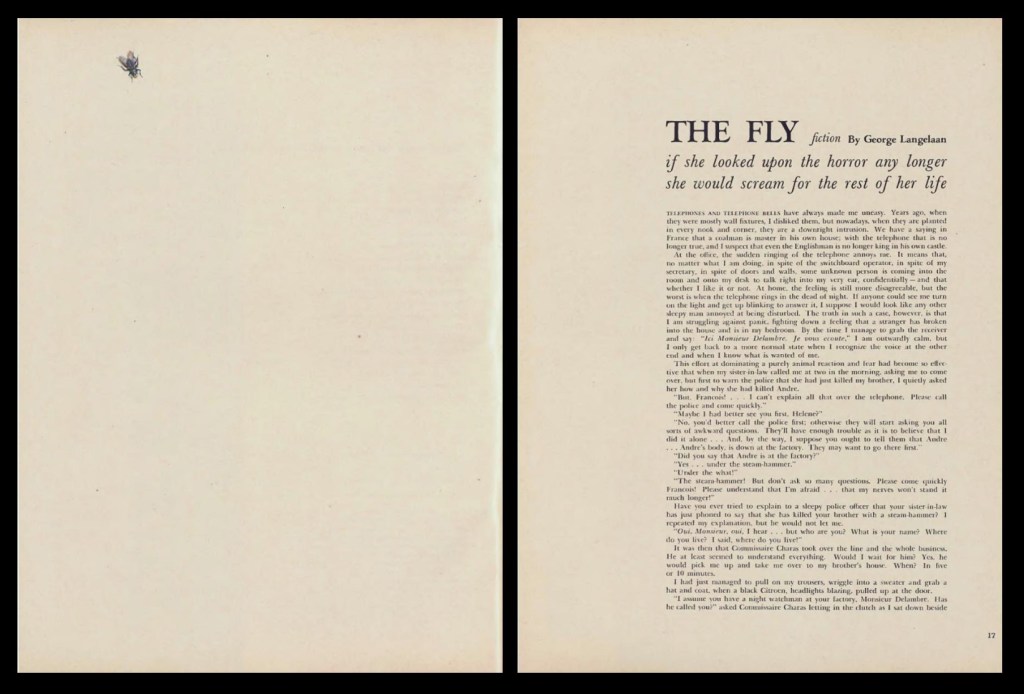
“The Fly” by George Langelaan is far more famous as a horror movie than as a science fiction story, but it’s a novelette about a mishap with a matter transmitter, obviously putting it into the territory of science fiction. Judith Merril did include it in her collection of the best SF of 1957, but it’s mostly remembered in horror story anthologies.

I rewatched the original 1958 version of The Fly about a year ago, so it was reasonably fresh in my mind. While reading “The Fly” today I was surprised how well the film stuck to Langelaan’s original story. The film grossed reviewers out back in 1958, but since then it’s become somewhat of a classic. Back in the day, me and my school friends talked quite a lot about the movie version. I’m surprised the original story doesn’t get more recognition.

“The Fly” explores two common science fictional ideas, the matter transmitter, and the mad scientist. I thought the story was well told, but it seemed a bit archaic in its storytelling style. That might be because it’s a translation from the French. I often feel translated stories sound like they are from 19th century Europe. But then, that might be due to most of the translated stories I’ve read were from 19th century Europe. “The Fly” also feels a bit like Edgar Allan Poe to me too. Then again, it might reflect a storytelling style favored by non-English speaking writers. I don’t know since I use no other language but English.

I’m not going to repeat the plot of the story because it’s so famous, and if you haven’t read it, I don’t want to spoil it. Even the concept of a matter transmitter comes up late in the tale. Like many 19th century stories, “The Fly” takes a roundabout way to get to the point. It’s told after the action has happened. I have a theory about that. I believe old timey writers liked to tell stories with an “as heard by” structure. We used to believe that eyewitnesses were the gold standard of implying validity. Francois, tells the story about Helene, his sister-in-law, confessing she murdered his brother. The tale takes a winding path before it gets to the science fictional element.

Matter transmitters were made famous by Star Trek and its transporter. That show has dealt with transmitter mishaps too. But my all-time favorite matter transmitter story is Rogue Moon by Algis Budrys. It works out several fascinating aspects to the concept. Some of those aspects were later made famous in “Think Like a Dinosaur” by James Patrick Kelly. But there is one other story I’d like to mention, that’s a variation of the matter transmitter idea. In “The Four Sided Triangle” by William F. Temple, which uses a matter transmitter as a matter duplicator — an unintended side-effect to avoid in some matter transmitter stories. “The Four Sided Triangle” is a neat little love story that was made into a decent film.

André Delambre in “The Fly” is also a splendid example of a mad scientist in a science fiction. Like many Sci-Fi mad scientists, he works alone and invents something that should require all the resources of creating fusion power. Mad scientists and lone inventors now belong in the realm of fantasy, but there’s something heartwarming about mad scientists to folks who used to wear propeller beanies. I believe that appeal is why we had Doc Brown in Back to the Future. (The mad scientist is a popular idea in children’s stories still.)

In 2019, “The Fly” was reprinted in Promethean Horrors: Classic Tales of Mad Science. I thought that an apt title for anthologizing this story. Unfortunately, the table of contents was disappointing. I was expecting a big anthology full of mad scientist stories. That’s a shame because I would have bought a large retrospective anthology that highlighted the evolution of the mad scientist in science fiction.

I kept thinking about the classics of mad scientist stories and went looking for anthologies that might collect them. I found two.

I went ahead and took a chance on The Mad Scientist Megapack since it was only ninety-nine cents. The Mad Scientist’s Guide to World Domination edited by John Joseph Adams is more money, $11.99 for the Kindle edition. However, there’s an audiobook version, and I might get that. I was disappointed that neither volume collected “The Fly.” If ever there was a mad scientist in science fiction, André Delambre is one. There is one story I know well in the table of contents to The Mad Scientist Megapack, “The Man Who Evolved” by Edmond Hamilton. I hope all the others I haven’t read are in that vein.

James Wallace Harris, 3/30/24

“Hunting Machine” by Carol Emshwiller

Group Read 72: The Best Science Fiction Stories of 1957

“Hunting Machine” by Carol Emshwiller #04 of 20 (Read, Listen – @05:40)

“Hunting Machine” by Carol Emshwiller is a rather short, but effective anti-hunting story that was first published in the May 1957 issue of Science Fiction Stories. Ruthie and Joe McAlister are on a three-day hunting trip with a robotic hunting dog rented from the park service. The robot was set by the warden for three birds, two deer and one black bear. However, Joe tinkers with the governor on the robot so he can hunt a 1,500-pound brown bear.

Most of the story is satire about how in the future people bring all kinds of gadgets to make their time in the rugged wilderness as comfortable as staying at home. Because hunting with their automatic rifles and robot is like shooting fish in a barrel, Joe overrides the controls in the robot to make the bear put up a fight. We see some of the story from the robot’s and bear’s perspective, both of which are more in tune with nature. Humans come across as schmucks in this story.

I’ve read “Hunting Machine” before, but it hasn’t stuck in my mind. It’s too slight, too simple, and too obvious. I’m surprised by both T. E. Dikty and Asimov/Greenberg included it in their anthologies that collected the best SF shorts of 1957. That suggests it is liked more than I think it should be. It’s a nice enough little yarn, fine for a magazine, but lacks the punch needed to make it worthy of an anthology in my opinion.

W. M. Irwin felt the story was more than an anti-hunting story, about how sports and outdoor adventures are ruined by automation. I can buy that. I agree with Paul Fraser that the ending was anti-climactic. I wanted the bear to win, to destroy the robot and to kill and eat Ruthie and Joe. And second to that possible ending, I wanted the robot to kill Joe because he was within the new weight limit that Joe had illegally changed. But Carol Emshwiller kept the story lighthearted.

This story should have been published in a hunting magazine in 1957. I’m sure real hunters would have enjoyed the satire even more. I don’t think “Hunting Machine” adds much to our understanding of 1950s science fiction. The definitive 1950s hunting story with a science fiction theme is “A Sound of Thunder” by Ray Bradbury, first published in Collier’s in 1952. It’s about hunting dinosaurs. Following that is “A Gun for Dinosaur” by L. Sprague de Camp, that first appeared in Galaxy in 1956. It’s another hunting story that plays off Hemingway’s classic Africa stories. Finally, there’s yet another classic dino hunt story, “Poor Litte Warrior!” from F&SF in 1958, where Brian Aldiss satirizes the first two.

I’m sure if I made a concentrated effort, I could track down more titles to define hunting as a sub-theme of science fiction. But my memory can’t dredge up any more from my brain, and I’m worn out on Googling.

James Wallace Harris

“The Crystal Spheres” by David Brin

The Crystal Spheres” by David Brin was first published in Analog, January 1984. You can read it at Lightspeed Magazine or can listen to it at StarShipSofa. It won the Hugo award in 1985 and won the Analog reader poll for 1984 short stories.

Literary short stories are generally small in scope, covering brief slices of time, using few characters, placed in limited settings, which make an emotional impact from a personal insight. This is my preferred form for a short story, even for science fiction. However, this doesn’t keep science fiction writers from spanning galaxies over eons featuring multiple intelligence species all in under 7,500 words. I loved these epic sci-fi stories when I was young. They had intellectual emotional impact if that makes any sense. Generally, I prefer small personal short stories in my old age, but I still admire the universe spanning imagination displayed in stories like “The Crystal Spheres.”

But something has changed in me as I’ve gotten older.

“The Crystal Spheres” breaks the cardinal rule of fiction writing classes, show don’t tell, but it proves rules can be broken — sometimes. I must wonder if Brin had used 350,000 words and told this story in a 1,000-page epic called The Crystal Spheres, if the sense of wonder would have been any greater? Could Olaf Stapledon have condensed The Last and First Men and Star Maker down to short stories and had them succeed just as well? David Brin does a lot with this short story.

“The Crystal Spheres” answers the question the Fermi Paradox asks: Where is everyone? It borrows an idea from the ancient Greeks, placing around every star a crystal sphere that keeps visitors out. Brin doesn’t go into whether these protective barriers are natural, or God made, or a product of intelligent design, but the end results is it keeps one intelligent space faring species from colonizing the universe like a plague.

This reminds me of the novels Spin by Robert Charles Wilson and Quarantine by Greg Egan, and to a lesser degree, the novel Out of a Silent Planet by C. S. Lewis, but for an odder reason. I read Spin first, and I marveled at the time that Wilson had produced a unique science fictional idea. But evidently, there is a tiny sub-genre of science fiction stories about barriers around the Earth or the solar system. I need to check into its history and look for other examples.

“The Crystal Spheres” evokes both the theological and the teleological. It reminds me of the Omega Point philosophized by Pierre Teilhard de Chardin. Brin thrills his reader with vast theories.

Although “The Crystal Spheres” isn’t a very satisfying short story on the personal insight level, its big fun alluding to many science-fictional concepts. Set in the future after humans have developed star travel, cold sleep, and immortality, it describes how humanity has become depressed because we’re alone in the universe. The story begins when a recently reawaked Joshua learns of a new discovery.

But to put that discovery into context Brin needs to set up a backstory. When humans sent out its first interstellar ship it crashed into an invisible sphere that shattered and created centuries of comets raining down on Earth, nearly wiping us out. Bummer. After things settle down, we start sending out starships again, but they keep crashing into spheres around other solar systems. They don’t break the spheres but do destroy themselves. Eventually, we learn how to avoid crashing into spheres and discover a few inhabited planets, mostly by hive-like beings. When we do discover races like us, we can’t communicate with them. We can listen to their broadcasts which can penetrate out the crystal spheres, but we can’t communicate into the spheres to say “Howdy.”

This throws humanity into a deep depression and most people go into hibernation hoping to wake up one day after we find planets we can visit. The story begins with Joshua learning there’s a solar system with a shattered crystal sphere and several possible planets orbiting that star.

It’s in another galaxy. Joshua and friends go there taking hundreds of years, using four diverse types of faster-than-light travel. When they arrive, they discover an abandoned civilization. I love science fiction about abandoned alien civilizations. At first Joshua and friends don’t know if these aliens have died off, committed species suicide, or just left for parts unknown.

Should I tell you everything? I’ve already told you a lot. I never know how much to give away. I want to discuss stories as if you’ve read them too, but I must assume that most of you haven’t read the story so I should keep from spoiling it. But how much should I tell to entice you into reading the story?

Let’s just talk about what I’ve already revealed. The idea of crystal spheres is a neat way to explain the Fermi paradox. Isaac Asimov even suggests this idea came about at Worldcon with writers suggesting ideas for a story, but he doesn’t specifically say David Brin was in that group.

Brin doesn’t give us any hard science speculation why the crystal spheres would be there, or how they work. It states that physical objects can’t penetrate them from the outside. But we know of extrasolar objects visiting the solar system. But was Oumuamua the first one we detected? Maybe when Brin wrote the story in 1984, no such visitor had been discovered. Or maybe only objects with intelligent beings in them can’t penetrate the spheres? And what about random bodies within the system? Why couldn’t some rock leaving the solar system have broken the crystal sphere long before the first spaceship?

See, that’s the fun thing about science fiction, it makes you question the story. Challenging questions. Sense of wonder questions. And in this case, are the crystal spheres naturally made, or from intelligent design? Now that takes us into some fun speculation. In Quarantine Greg Egan came out with a wonderful idea of why humans are locked out from the rest of the galaxy. I won’t give the answer because that would spoil the whole novel.

“The Crystal Spheres” is the kind of science fiction story that makes us think big, gigantically big. I loved that kind of science fiction when I was young. And reading “The Crystal Spheres” conjured that exciting old feeling. But my older wiser self, is more cynical. All those big sci-fi ideas are just childish fantasies. I have serious doubts we’ll ever make it to Mars, and believe interstellar travel is next to impossible. We can’t even save ourselves from self-destruction, so why imagine such exciting futures?

We face real barriers that keep us from colonizing the planets and traveling to the stars. But they are all within us. Our greed, our xenophobia, our petty resentments, our violent nature, our cancerous consumption of natural resources, and the list goes on and on. Our human nature is the crystal sphere that keeps us here.

I should stop reading science fiction, but I have a life-long addiction I can’t throw off. However, the older I get, the more acutely I recognize my childhood hopes about the future are just fantasies. I now crave realistic science fiction that deals with possible futures. Unfortunately, science fiction is written to sell to young people, and realistic science fiction is too depressing for them.

I got a big kick out of reading “The Crystal Spheres” because it encapsulated so many science fiction fantasies that I once loved. It’s still a wonderful story. But now that I’m old, it has a bittersweet twinge to it.

“The Crystal Spheres” reminds me of one last thing, the famous speech Marlon Brando makes in On the Waterfront, where he says, “You don’t understand! I coulda had class. I coulda been a contender. I coulda been somebody instead of a bum, which is what I am.” It’s sad that humanity won’t become what Brin and science fiction imagines.

James Wallace Harris, 3/8/24

Deadly Serious Science Fiction

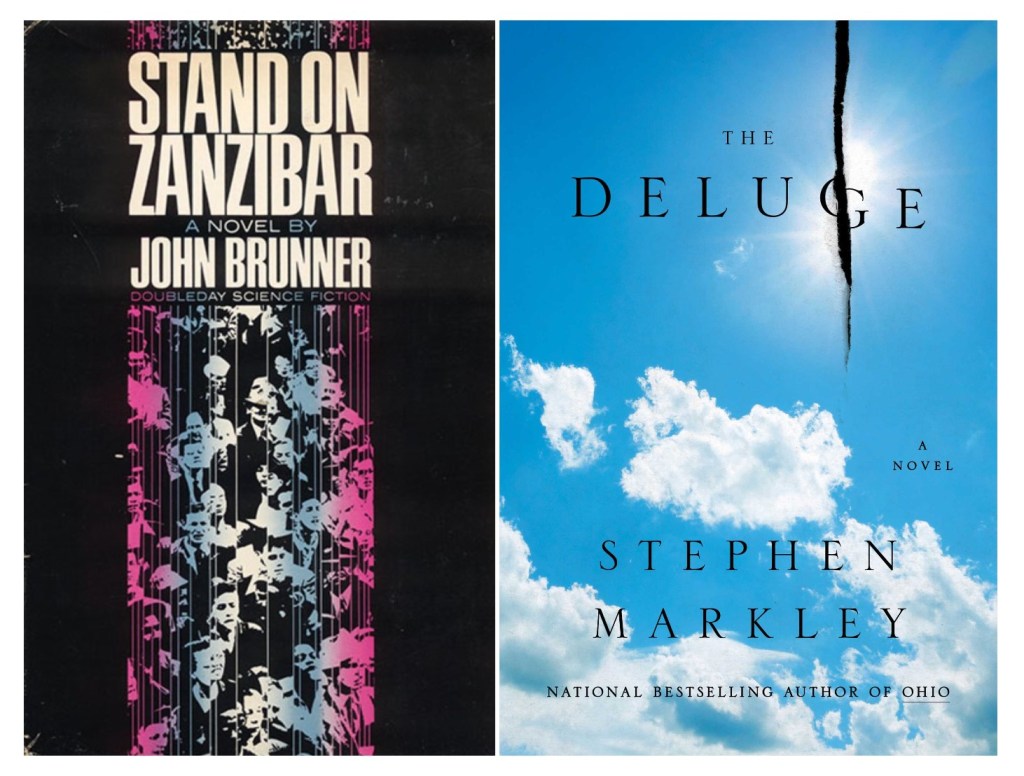
Out of the thousands of science fiction novels I’ve read, I thought Stand on Zanzibar by John Brunner took itself the most seriously. It addressed world problems John Brunner thought threatened humanity in 1968. I read Stand on Zanzibar in 1969 and it made me dread the future he depicted of 2010. It wasn’t the most thrilling SF novel I’ve ever read, nor was it easy to read, but it was most impressive stylistically and made me think about the future more than any other science fiction novel. The Deluge by Stephen Markley now follows in the footsteps of Stand on Zanzibar. Both books describe futures we should want to avoid at all costs. They are deadly serious science fiction.

There aren’t that many serious SF novels that intentionally warn us about the future. Other famous ones are Brave New World by Aldous Huxley, Nineteen Eighty-Four by George Orwell, The Handmaid’s Tale by Margaret Atwood, and The Ministry for the Future by Kim Stanley Robinson.

Everyone wants to predict the future, but that’s impossible, so science fiction writers sometimes extrapolate current trends, fictionalizing a possible near future. This is what both Stand on Zanzibar and The Deluge do. We can judge Brunner’s speculation since we’ve now lived past the time he imagined. He got a lot wrong, but he got other stuff right, especially how terrorism would spread across the world. Stephen Markley speculates about the politics of climate change will play out over the next sixteen years and five presidential elections.

Did Brunner and Markley hope we’d change our ways because we read their books? Markley warns his readers what will happen if we don’t act soon regarding climate change. His book asks: What will it take for humanity to give up fossil fuels? Kim Stanley Robinson does the same thing in The Ministry of the Future. Both novels spend a substantial number of words on terrorism. I really hope that isn’t the incentive that pushes us to change. Can we avoid these horrible futures because we read about them today?

My other review of The Deluge, intended for people who don’t read science fiction, I focused on the question: Can we change? For this review I want to focus on the question: Can science fiction influence society at large? If it can’t, why write such SF novels? Both The Deluge and Stand on Zanzibar are huge ambitious works that use a large cast of characters, shifting points of view, interspersed with chapters of pseudo journalism and pop culture, giving a multifaceted view of the near future. The Deluge is almost nine hundred pages in print and runs nearly forty-one hours on audio. It’s big and profoundly serious.

Serious science fiction often warns us we’re heading towards specific scary futures we could avoid if we make the effort. Do we ever heed such warnings? Scientists currently studying free will say it looks like humans are not in conscious control of our lives. I agree with them. If that’s true, can we change the way we act based on things we read? Maybe the authors of serious science fiction never hoped to change the course of history, but only wanted to appeal to certain individuals and influence their thinking. Are such novels part of an extended conversation about the future taking place in the genre of science fiction? Do they expect their readers to change the world, or just for other novelists in the future to reply? Are books about possible futures just an extended conversation that’s taken place in print?

Wasn’t Orwell’s Nineteen Eighty-Four a reply to Huxley’s Brave New World? Wasn’t John Brunner having his turn in the discussion when he wrote Stand on Zanzibar and his Club of Rome Quartet? And didn’t Margaret Atwood jump into the conversation with The Handmaid’s Tale? And aren’t such nonfiction books of futurism like The Limits of Growth and Future Shock also part of the conversation? I believe Robinson’s and Markley’s books are just the latest things said in a never-ending conversation about the future. Sure, many readers consider these books a genre of gloom and doom, but do they have a greater purpose and impact?

It’s interesting that all the books I’ve mentioned so far worry about issues that we continue to face. Is that because we’ll always face those issues? Or do their authors expect us readers to change the way we live and act and eventually solve these problems?

Science fiction writers and futurists know they can’t predict the future, but do they believe readers can divert the present away from possible futures they fear? Isn’t that a kind of free will? A kind of hope for the group mind? The reason scientists don’t believe individuals have free will is because they detect brain activity at the unconscious level before we think we claim to consciously make our decisions. Isn’t the world of intellectual speculation only a kind of unconscious group mind thought process?

People like to think we can become captains of our fate, so is it surprising that writers might hope that society can consciously choose what it will become? But does a meta-conversation about what human society could or should be really represent a kind of free will? I’m sure in their heart of hearts that Orwell, Brunner, Atwood, and Markley wanted to influence society and avoid the horrors they saw coming.

Self-help books are bestsellers because some people do change their habits, so isn’t that evidence that if enough people read serious science fiction it might influence the larger society? Scientists studying free will say no because the desire to change comes from our unconscious minds. But does that matter if science fiction influences us on a conscious or unconscious level? Isn’t the woken social movement mainly due to reading?

I do believe certain books about the future, both fiction and nonfiction, represent an ongoing conversation, but I don’t know if we change our lives because we listened to the conversation. I’m liberal, and have a lot of liberal friends, who claim to be very worried about climate change, but none of us have tried to significantly shrink our carbon footprint.

Back in 1969 when I read Stand on Zanzibar, I was frightened by Brunner’s vision of the future. Over the decades I’ve read and discussed its ideas on overpopulation and the limits of growth with my friends, but we’ve never acted on those fears. I’ve been talking with people about the dangers of climate change for over twenty years now, but we haven’t done anything significant either. That’s why in my other essay about The Deluge I titled it: “Will People Change vs. Can People Change?

I don’t think we will change. So, why read science fiction that warns us about the future? Likely, we don’t have free will, but we might have an existential awareness of who we are, and I believe books speculating about the future expand that awareness.

Most science fiction is written to entertain. Most science fiction readers seldom read serious science fiction. John Brunner got some critical attention for his Club of Rome Quartet novels, but I’ve read he was depressed because they made no real impact on society. Few writers can achieve George Orwell’s and Margaret Atwood’s social impact.

The Deluge got a fair amount of good mainstream press, but I’m the only person I know who has read it. I doubt Stephen Markley intended it for science fiction readers. He’s a mainstream literary writer. However, because it attempts to do what Brunner did all those decades ago, I believe some science fiction writers will find it interesting.

Reviews of The Deluge:

by James Wallace Harris, 2/29/24

Have You Read Any of These Ten Science Fiction Books from 2023?

I was surprised that I hadn’t heard of any of these ten novels and authors from The Shades of Orange YouTube review “The Top Science Fiction Books Published in 2023.” Is this an indication of how out of touch I am with new science fiction, or do my tastes just run much different from the reviewer? When and why did I stop reading new science fiction?

Here are Shades of Orange’s Top 10 SF novels for 2023. The numbers in parenthesis are from Goodreads. They are (average rating / # of raters / # who left reviews). Those numbers are from Goodreads users who have marked the title read. It would also be interesting to see the number of people who have the book in their library marked “Want to read.” Titles with an asterisk have audiobook editions.

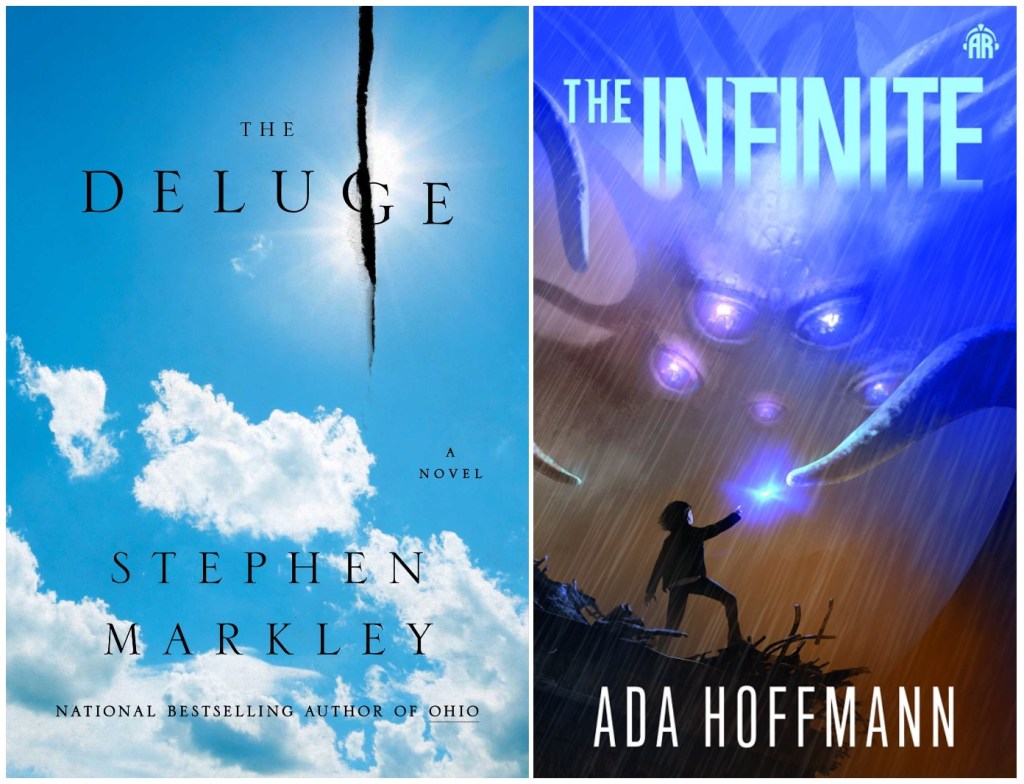
  1. The Deluge by Stephen Markley (4.22 / 3,107 / 738) *
  2. The Infinite by Ada Hoffmann (4.27 / 241 / 55) *
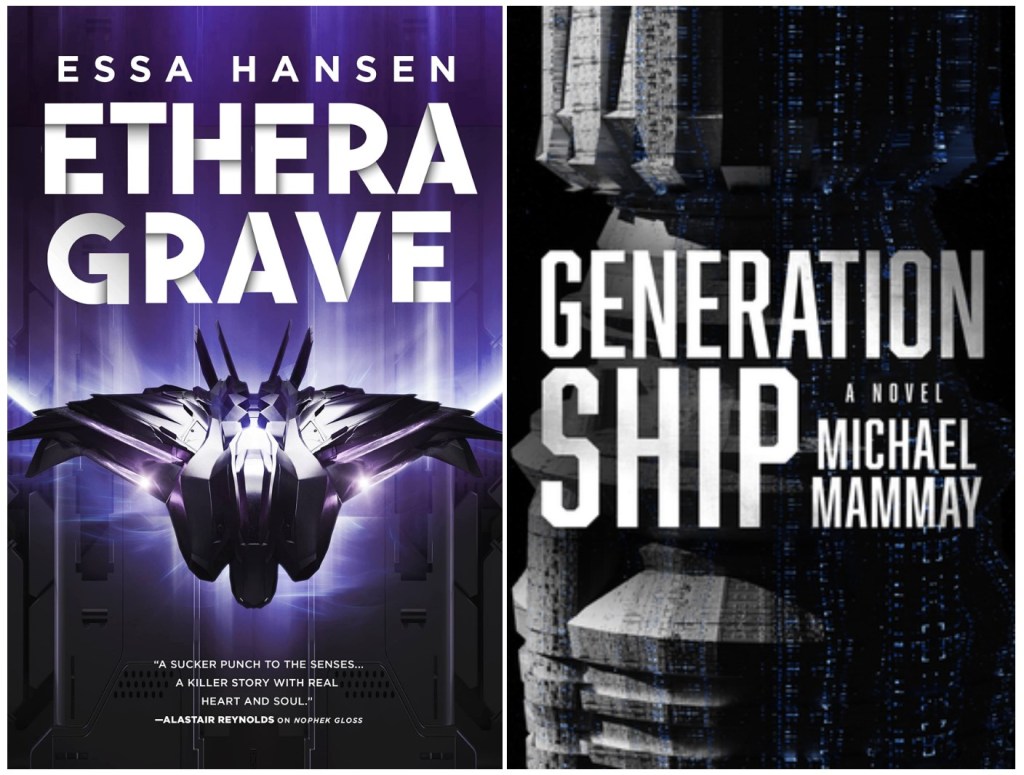
  3. Ethera Grave by Essa Hansen (4.09 / 141 / 29)
  4. Generation Ship by Michael Mammay (3.83 / 805 / 187) *
  5. The Scourge Between Stars by Ness Brown (3.6 / 3,006 / 808) *
  6. The Archive Undying by Emma Mieko Candon (3.3 / 1,091 / 391) *
  7. Saint Elspeth by Wick Welker (4.11 / 44 / 28) *
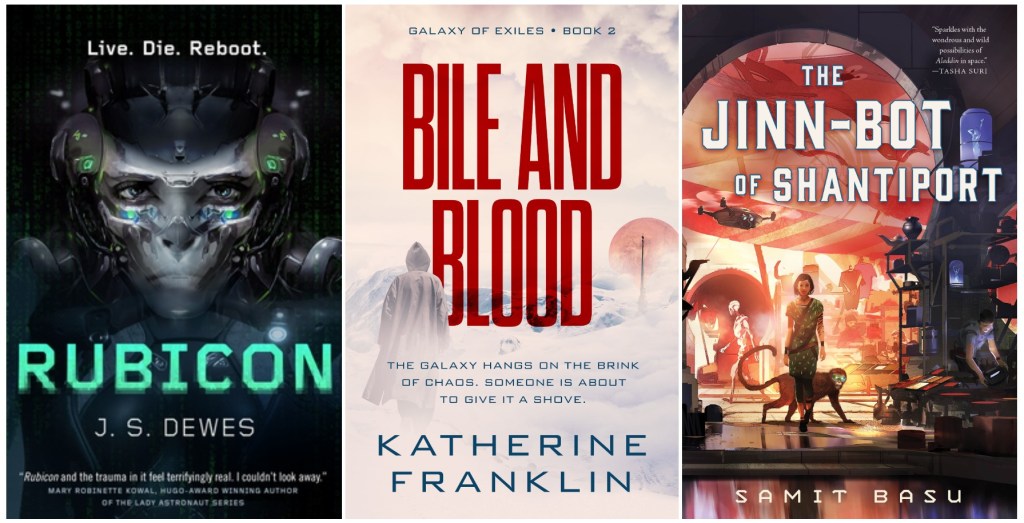
  8. The Jinn-Bot of Shantiport Samit Basu (3.67 / 684 / 255)
  9. Bile and Blood by Katherine Franklin (4.50 / 2 / 2)
  10. Rubicon by J. S. Dewes (3.95 / 1,632 / 324) *

I wonder if science fiction fans growing up in the 1930s felt the way I do now when they read best-SF-of-the-year lists in the 1990s? Nearly all my favorite science fiction writers I got to know growing up are dead, and the living ones that became popular during my lifetime evidently aren’t favorites with young readers in 2024 anymore.

If I read these new books, would I find the same kind of excitement I did sixty years ago? Even more interesting to contemplate: Do young readers today find the same kind of excitement that I did in the 1960s and older generations did in the 1930s? Both Doc Smith and Samuel Delany wrote space operas, but were their intent and appeal the same?

If I could somehow get every generation of science fiction readers to write an essay “What I Discovered in Science Fiction” would the revelations be similar?

I am intrigued by the tiles: The Deluge, The Archive Undying, and Generation Ship. Since all three are available as part of my Spotify subscription, I’m going to try them. I keep forgetting that Spotify includes 15 hours of audiobook listening with my music subscription. I think I’ll use that feature to test out new science fiction books since it won’t cost me anything extra.

I’m also impressed with many of the YouTube book reviewers. I assume YouTube is making an enormous impact on what books readers buy today. However, many of my favorite YouTube reviewers only review older science fiction. This is still great because I’ve missed a lot of great science fiction, but it seems to indicate new science fiction gets less attention.

My absolute favorite YouTube reviewer is Bookpilled. He has 36.6 thousand subscribers. I’m absolutely fascinated by which books and authors from the past he still finds significant. Bookpilled doesn’t review new SF.

After Amazon and Audible, I stopped going to new bookstores every week. I think that’s where and why I used to keep up with new releases. Another reason I quit discovering new science fiction at new bookstores is because the science fiction sections grew too large. There was just too much choice, so I gave up.

Shades of Orange has done me a favor by limiting my choices to ten.

by James Wallace Harris, 2/17/24