The King of Elfland’s Daughter by Lord Dunsany

For most of my life I’ve had a prejudice against the fantasy genre. When I was ten I was crazy about the Oz books, but not long after that I discovered science fiction. I know it’s possible to enjoy both science fiction and fantasy, but I associate fantasy with the unscientific, with religions and myths, and with the belief in magic. On rare occasions I’ve fallen for fantasy tales, like the Harry Potter books and The Golden Compass trilogy. I believe they were acceptable to me because they were for kids and I assume fantasy stories are fine for children. Although, that might suggest that part of my prejudice against fantasy is because I believe fantasy is for children — and that at a certain age we should give it up.

However, I mainly dislike fantasy stories because fantasy embraces magic. I hate the concept of magic for scientific and philosophical reasons. I have always hoped that scientific thinking would supplant religious thinking. Christianity has a problem with magic too. Christianity has always hoped to supplant belief in magic, and I can understand why. Because for a new paradigm to take old the old one has to be erased. But for me, Christianity is just another form of magical thinking, and I expected science to replace it.

You might be thinking this is a weird way to review a book, but reading The King of Elfland’s Daughter by Lord Dunsany deals with these philosophical issues — and I wonder if it’s message isn’t anti-magic. I’m not sure what it’s exact stance on the subject is, which is why I want to talk about it. And you might think I’m even more confused because I’m reading a classic adult fantasy novel when I just declared I’m too old for fantasy novels.

I decided to read The King of Elfland’s Daughter when the unnamed reviewer on Bookpilled, my favorite science fiction reviewer channel on YouTube, reviewed it. The Bookpilled guy praised The King Of Elfland’s Daughter so highly I felt I should try and overcome my fantasy prejudice and give it a read.

The King Of Elfland’s Daughter came out in 1924, and according to Wikipedia it made quite an impact. Over the years, some of my favorite science fiction writers from the mid-20th century mentioned an admiration for Lord Dunsany. In 1969 Ballantine reprinted the novel as the second book in its second series of Adult Fantasy novels. That series if often cited as reviving fantasy as a popular genre for adult readers. I remember that Ballantine Adult Fantasy books coming out back then, and I liked them for their covers, but never wanted to read them. Over the years, I have ended up reading a few of them. I wish I had bought and saved those Ballantine editions because many of them sell for hundreds nowadays.

The King of Elfland’s Daughter might not appeal to modern fans of fantasy though. It’s prose sounds like something out of Chaucer, and there is very little character development, dramatic action, or even dialogue. Lurulu, the troll, who is mostly a comic character seems to have had the most lines. I say that because in the audiobook edition I listened to the narrator did voices for the characters and about the only one that stood out was the troll’s. I also read along with a 99 cent Kindle edition from Amazon.

The story is set in the village/valley of Erl and the neighboring fantasyland of Elfland. The setting is sometime before 1530 — Dunsany makes a specific point of bringing that up. Erl is ruled by a hereditary lord who lives in a castle, but a Parliament of elders comes to visit the lord of Erl telling him they want more magic in their land. The lord tells his son, Alveric, to go into Elfland, find and bring back the King of Elfland’s daughter, Lirazel, and marry her. This happens early in the book and they have a son named Orion. Unfortunately, Lirazel can’t adapt to human ways and returns to Elfland. Most of the rest of the story is about Alveric trying to find his way back to Elfland to recapture Lirazel, and Orion growing up to be a hunter, first of stags, but then of unicorns.

This novel was pleasant enough to read, but it’s structure was primitive, much like a long fairytale. Alveric and Lirazel have practically no personal traits at all, and there’s barely any for Orion. Lirazel is beautiful, and that’s about it. Orion is good at hunting and loves his hunting dogs.

On the other land, the prose is rather nice.

The real meat of this story is the contrast between Earth and Elfland. Elfland is another dimension that borders Erl on the east. Elfland is timeless. Immortal beings that leave Elfland to visit Earth age. When Alveric is in Elfland capturing Lirazel, ten years pass by in Erl. Lord Dunsany sets up his story so that Erl is Christian and its citizens believe they will go to heaven. But we’re also told there is no path to heaven from Elfland. The choice for some of the characters is between living, growing old, dying and going to heaven, or choosing to live in Elfland where nothing happens and everything is eternal. Dunsany constantly reminds us of the timelessness of Elfland.

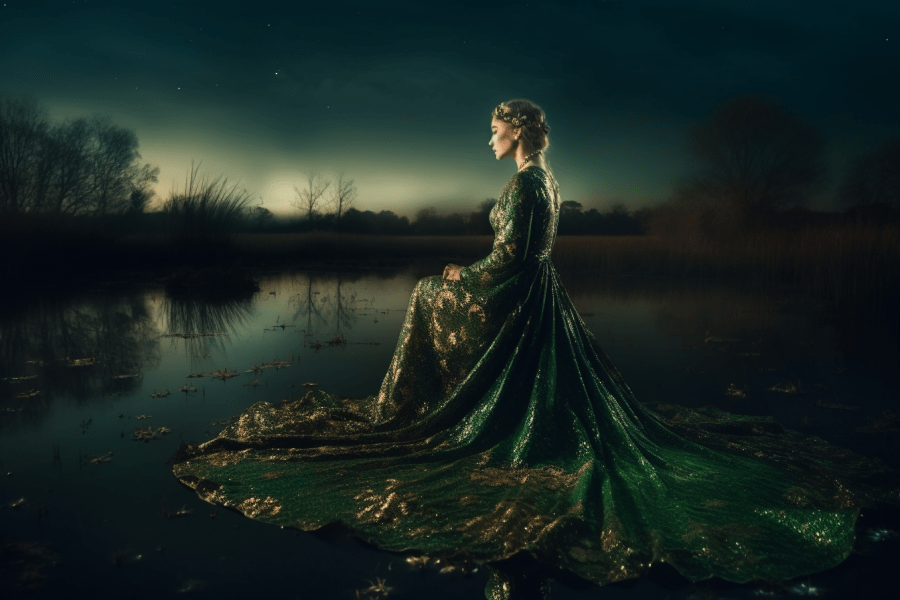
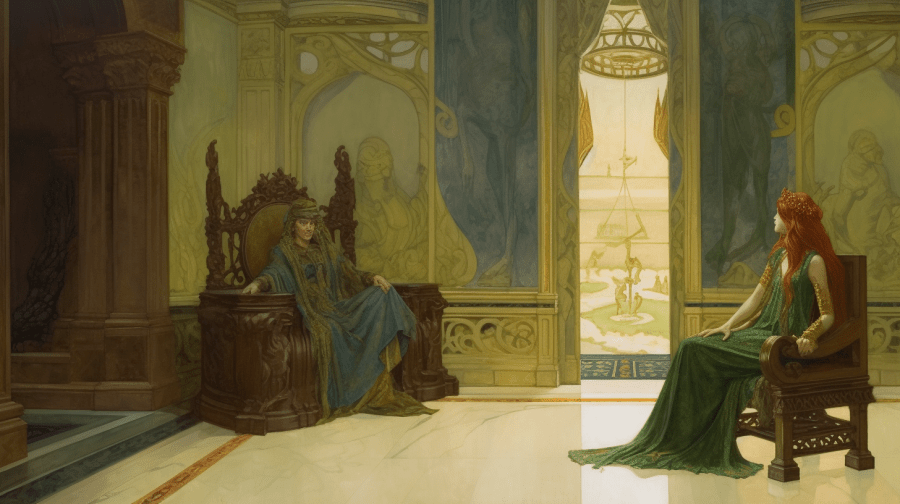
Sometimes I picture everything in Elfland frozen in one beautiful tableau. When Lirazel returns she sits on her father’s knee the entire time Orion grows up. I tried to get Midjourney to create an image of that scene but it kept making Lirazel a little girl in her father’s lap. I settled for what I have above.

During that same time, Alveric is on a never ending quest to reenter Elfland. His quest is longer than Odysseus’ journey home after the Trojan War.

Eventually, Orion discovers the edge of Elfland and sees a unicorn. Now, in this story, unicorns are magical, but not special like in modern fantasy stories. In fact, Orion hunts them, and mounts their heads. I bet modern readers will be horrified at that. Orion also discovers trolls and the trolls start visiting Erl.

I’m not sure if I should tell the whole story, but I’m going to say that the Parliament of Erl come to regret their desire for more magic in their land. They thought it would make their valley famous, but instead magic scares them. And it’s here where I wonder if Dunsany isn’t making a case against magic. At one point the Freer (friar?) speaks to the village:

I won’t tell what the ending is but it involves a transformation that I can’t decide if it’s wonderful or horrifying.

My theory is belief in magic existed before Christianity all across Europe, and for two thousand years the Church has been trying to stamp it out. Lovers of fantasy hate to let magic go. And I wonder if Lord Dunsany’s book, The King of Elfland’s Daughter isn’t about that. On one hand, I tend to think Dunsany is siding with Christianity and is against magic, but on the other hand, I think he’s just as enchanted by the magical.

The reason why I believed fantasy is for children is because I felt pretending is something kids like to do. But I also assume when we grow up we need to get real. Now, I’m no longer sure if it is okay to allow fantasy in books for children. Too many kids never grow up. I thought reading science fiction was taking the road to realism, but I realized late in life that much of science fiction is just as magical as fantasy. The reality is we don’t like reality and wish it was something its not. On the other hand, fiction allows us to cope with a reality that is difficult to comprehend.

Back in the 1800s there was a lot of opposition to reading fiction. Serious people thought it rotted the mind. People thought fiction mainly appealed to children, women, and men who couldn’t cope with the real world. I’m not sure they were wrong. And I wonder if Lord Dunsany wasn’t touching on this issue in The King of Elfland’s Daughter.

If I had the time I would like to make a case comparing the L. Frank Baum Oz books to The King of Elfland’s Daughter. There were 14 Oz books published from 1900 to 1920. The King of Elfland’s Daughter came out in 1924. I’d like to study what people thought of fantasy in the years 1900 to 1940 before science fiction started getting popular.

As a ten-year-old I wanted Oz to exist like Elfland. As a teenager, and even into my twenties, I used to tell people I never wanted to adultify.

Does anyone know of a good study on the evolution of fantasy fiction? I might not want to read it but I might want to read about it.

James Wallace Harris, 4/13/23

Visualizing Fiction with AI

I am reading The King of Elfland’s Daughter by Lord Dunsany, first published in 1924. Normally, I do not like reading fantasy, but Bookpilled praised this novel so extensively and claimed it was so influential that I had to try it. I’ll review the book itself in the future. What I’m writing about now is how I tried to visualize the story using AI software.

I have a condition called aphantasia, which means I can’t visualize images well in my head. Most people can close their eyes and see things. I can’t. I didn’t discover this until I was in my sixties. I’ve often read that ordinary people when they read a story visualize it in their mind’s eye. When I discovered Midjourney I got the idea that maybe I could use that program to help me see what fiction was describing. I’m just beginning to learn Midjourney. It’s easy to make striking pictures, but very hard to make specific striking pictures.

In The King of Elfland’s Daughter, the Elfland’s daughter is Lirazel, a princess who leaves her magical world to live in our ordinary world to marry Alveric and become his queen in the nonmagical land of Erl. Lirazel has a hard time coping without magic. Alveric wants her to become Christian and worship his way. Lirazel can’t understand why. She wants to worship the stars, but Alveric considers that evil. She tries to skirt his commands by worshipping the reflections of stars in a lake. That’s what the picture at the top of the page is trying to show.

Midjourney will draw almost anything, in any style you request. However, you have to describe what you want in words and codes, and Midjourney does its best to guess what they mean. It’s very hit-and-miss, and quite often Midjourney will ruin a beautiful image with weird deformities of the human form. If you look closely at the image at the top of the page, the women’s hands are ugly. Or look at this image. At first, it’s beautiful, until you see her arms. So many attempts have to be thrown out because of these deformities.

Here is another go at the same scene but asking for a more artistic view. However, I definitely didn’t imagine The King of Elfland’s Daughter looking like this art style. Mentally, I pictured the setting of the story to be a darkly medieval world lit by natural light. That’s why the picture at the top fits better in my mind. But the picture below does have an enchanting fantasy flavor. I can imagine that some readers see the story like this picture.

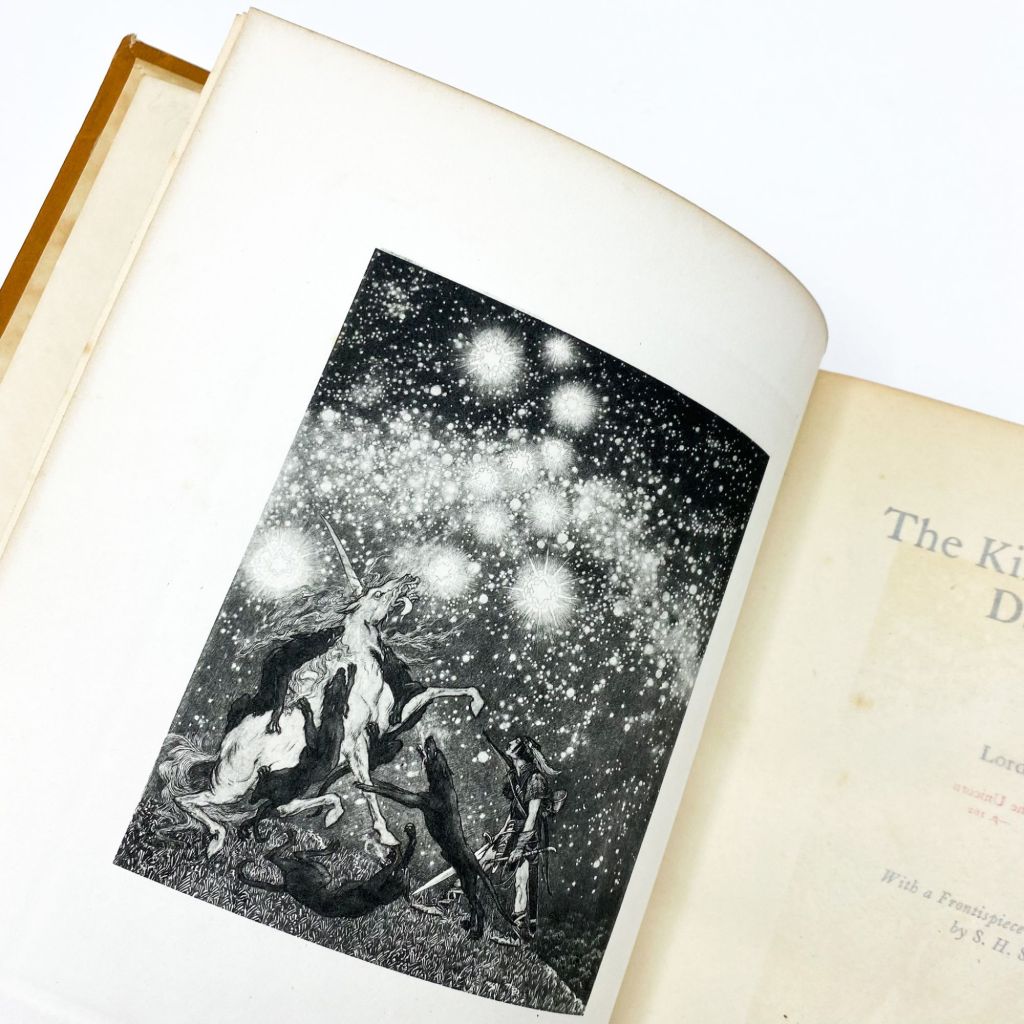
I went looking for previous artwork used for The King of Elfland’s Daughter but didn’t find much. Here is some artwork from an early edition, maybe even the first. I’m not sure. It’s very stylized. And it’s from the 1920s, so maybe this is how they pictured fantasy worlds.

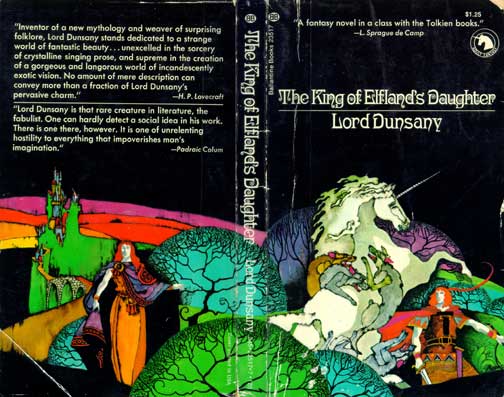
This is how they pictured it in the 1960s when Ballantine reprinted this novel for its Adult Fantasy series. Notice how stylized the art is compared to how I’m trying to picture it.

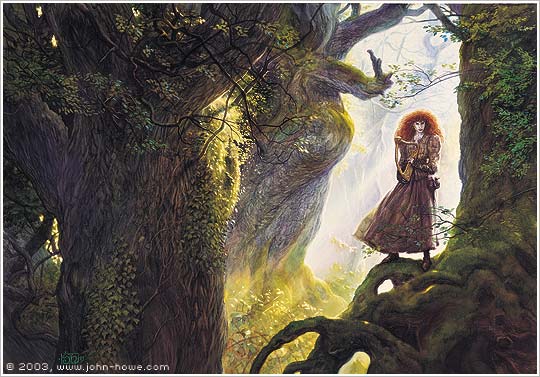
These illustrations aren’t from The King of Elfland’s Daughter but show art styles that I think people associate with fantasy. However, probably they are more suited for children’s books. Using Midjourney you can apply any artistic style you want. The trick is convincing the program to use it and that can be hard.

People are using Midjourney to create art that can be used as digital art, book covers, illustrations, or in a series for comic books, graphic novels, and even animation. There are many hurdles. The first is to develop a consistent character out of a program that generates art from randomness. This can be done by using the same random seed number. You can also guide the program by uploading illustrations or photos, or even crude hand-drawn sketches. And there are endless keywords, styles, switches, datasets, etc. that can be applied. It really is something to be learned. And using Midjourney is a skill requiring artistic understanding. You either need to know about art or you need to learn about it quickly.

This is why it will be a while before I could ever read a book and routinely picture scenes in Midjourney. But while I’m reading The King of Elfland’s Daughter I’m often finding scenes I would like to see. There is one with a troll talking to a fox. Another with Lirazel, her small son, his nurse who is a witch, and the troll. And I just read one where Alveric is walking across a vast deserted landscape. He starts out with a bag of food thrown over his shoulders, enough to last him two weeks, a blanket around him as a coat for warmth, carrying a bundle of firewood, and a sword at his side. I’d like to visualize those scenes.

You can try Midjourney for free, but when I did, it warned me there were too many free users at the moment. I joined for $10 a month, but I soon realized that learning the program requires cranking out more images than the $10 account limit, and upped my account to the $30 version. And it’s not easy to use. You have to be a member of the Discord community because you send commands to Midjourey through that social site and view the results there too. There are tons of videos on YouTube that show how to do all of this if you’re interested.

You can view a gallery of Midjourney art here. It’s dazzling. If you crave beautiful pictures, this program might become addictive.

James Wallace Harris, 4/8/23

“Blowups Happen” by Robert A. Heinlein

Only dumbasses, egotists, and the delusional think they can predict the future, although there are a number of professions that try. I do believe Robert A. Heinlein was smart and sane enough to know he couldn’t see beyond the horizon of the moment, but he wrote plenty of stories that tried. “Blowups Happen” is one that stands out. Heinlein’s 1940 novelette imagines the dangers of commercializing atomic energy in peacetime. That was five years before Hiroshima.

I grew up being taught that atomic research during the war was an extremely well-guarded secret. What I didn’t know, and I assume most other people didn’t either, was how much atomic energy was widely discussed before the war. John W. Campbell, Jr. liked to brag about how the FBI came to his offices in 1944 because of Cleve Cartmill’s story “Deadline,” implying the G-men thought it gave away some of the secrets of the atomic bomb. I thought Heinlein’s story felt far more knowledgeable. I now have to assume the well-educated public before WWII knew far more than I ever imagined regarding atomic physics.

“Blowup Happens” is set in the near future from 1940 in the Astounding Science Fiction magazine version, and from 1950 as it was rewritten for the collection, The Man Who Sold The Moon. Those two dates are important because the story is about atomic power, and the magazine version was written before Hiroshima and the book version afterward.

The setup of the story is the United States has come to depend on atomic power even though a breeder reactor in Arizona could theoretically destroy the country or even the planet. The General Superintendent of the plant, King, has to hire one psychiatrist for every three engineers to monitor their work with the reactor because engineers have nervous breakdowns after a short career and must be continually replaced. King brings in Dr. Lentz, one of the country’s top psychiatrists to find ways that allow engineers to handle the stress.

Later in the story, Superintendent King learns that mathematical models that previously showed the reaction in the breeder reactor is probably controlled are wrong. New mathematics prove the reactor could go into a runaway reaction that would destroy the planet. If they bring down the breeder reactor the country would lose a good portion of its industrial power and ruin the economy. King knows the corporation that owns the plant won’t accept the new research because it would be financial ruin for it.

The solution to the problem has been emerging all along in a tangential subplot about two engineers, Erickson and Harper, developing atomic power for rockets.

“Blowups Happen” has a great deal of infodumping where Heinlein tries to educate his readers about the science behind atomic energy. Reading those passages today is tedious unless you are researching early speculation about atomic energy. So, how do we judge “Blowups Happen” as a story in 2022?

We want science fiction that is visionary. We want the future to be exciting. Ultimately, most, if not all science fiction becomes historical curiosities. Time has a way of eroding our genre. I didn’t like “Blowups Happen” when I first read it as a teen back in the 1960s. It was already too dated. Now that I’m rereading it in my seventies in 2022 I have to admire Heinlein’s speculation. “Blowups Happen” is an ambitious story. I’m starting to think science fiction writers are at their most ambitious when they are working closest to the present.

In “Blowups Happen” Heinlein explores the impact of atomic energy before the world is startled by the reality of Hiroshima. Sure, the idea of atomic power had been around since Einstein’s most famous equation. The reason why the science fiction of the 1950s had been so exciting is it just preceded NASA of the 1960s. And the reason why cyberpunk was so exciting in the 1980s is that it just preceded the World Wide Web in the 1990s. Science fiction writers get the details wrong, but they still anticipate the wonder and the chaos. This thought makes me rethink Heinlein’s Stranger in a Strange Land anticipation of the 1960s.

When we judge an old science fiction story for its visionary qualities I think it’s important to look at the story’s original publication. “Blowups Happen” was first published in September 1940. It was first reprinted in The Best of Science Fiction edited by Groff Conklin in 1946, and then in 1950, it was rewritten for The Man Who Sold the Moon. However, for that edition, Heinlein rewrote the story to include the knowledge of the bombing of Hiroshima in 1945. By 1950 the public and science readers knew much more about atomic energy. I’m guessing “Blowups Happen” was already outdated even in 1950.

Ten years makes a lot of difference in a science fiction story, although I doubt anyone in 1940 could have imagined what the next five years would bring, much less ten. Science fiction writers do not and cannot predict the future, but we do have to admire Heinlein for imagining the political implications of a country having atomic energy in 1940, and what the dangers might be for developing peacetime uses of atomic power. He gets the details wrong, but what he gets right is the essence of great science fiction. By the way, in the 1940 version, the power plant is called a bomb, but in 1950 the label was changed to pile. I’m guessing Heinlein imagined the power plant as being a controlled explosion.

Within the 1940 version, Heinlein described a nuclear explosion as “forty million times as explosive as TNT. The figure was meaningless that way. He thought of it, instead, as a hundred million tons of high explosive, two hundred million aircraft bombs as big as the biggest ever used.” To give his readers a better picture, Heinlein has his character say to himself about ordinary big bombs, “He had once seen such a bomb dropped when he had been serving as a temperament analyst for army aircraft pilots. The bomb had left a hole big enough to hide an apartment house. He could not imagine the explosion of a thousand such bombs, much, much less a hundred million of them.”

Then in the 1950 version, the same character thinks of it as “a hundred million tons of high explosive, or as a thousand Hiroshimas.” Heinlein didn’t need to write anything more. By then, readers had seen films about atomic explosions. They knew exactly what that meant, but in 1940 I doubt readers could imagine anything close to reality.

Psychiatry and psychology are so commonly talked about today that we also forget that it was new at one time. I’m an old movie fan, and psychiatry became a hot subject matter for films after WWII and into the 1950s. I’m guessing Heinlein was doing just as much speculation about the future impact of psychiatry as he was doing for atomic energy in “Blowups Happen.” But how sophisticated his Heinlein’s expectations about the field? Heinlein loved popular scientific speculations published in popular books of the 1930s. But he also was a fan of many pseudo-scientific works too, stuff we’d consider New Age today. In his Future History stories, Heinlein seemed just as interested in the soft sciences as the hard sciences.

Heinlein describes Dr. Lentz, the top psychiatrist of the day this way:

Notwithstanding King’s confidence, Lentz did not show up until the next day. The superintendent was subconsciously a little surprised at his visitor’s appearance. He had pictured a master psychologist as wearing flowing hair, an imperial, and having piercing black eyes. But this man was not overly tall, was heavy in his framework, and fat—almost gross. He might have been a butcher. Little, piggy, faded-blue eyes peered merrily out from beneath shaggy blond brows. There was no hair anywhere else on the enormous skull, and the apelike jaw was smooth and pink. He was dressed in mussed pajamas of unbleached linen. A long cigarette holder jutted permanently from one corner of a wide mouth, widened still more by a smile which suggested non-malicious amusement at the worst that life, or men, could do. He had gusto.

Heinlein, Robert. The Man Who Sold the Moon and Orphans of the Sky (p. 131). Baen Books. Kindle Edition. 

Is Heinlein serious about giving us a shrink that goes around in public in his pajamas? Is Heinlein just imagining a colorful future with odd fashions? Or is this satire? Would 1940 science fiction readers believe the fashions we see on TV today? Heinlein had his sociological speculations too. There is another scene at a bar where the atomic energy scientists go to unwind, that features a B-girl who is also a prostitute. Such women were common in the 1930s, but it was a lower-class thing. I got the feeling that Heinlein expected society would change its attitudes toward these women in the future.

But, we’re back to my original question. Is “Blowups Happen” a fun science fiction story to read in 2022? I don’t think so. Scientific lectures can slow a story, or even ruin it, but scientific lectures about out-of-date science are even harder to endure. Would “Blowups Happen” read better today if he had left out all the lectures? They weren’t needed for the story. Lester del Rey’s “Nerves” is another story about atomic energy from the 1940s that’s outdated, but it still works dramatically. It has problems with length, and some plotting, but overall, I remember it being a better story. I don’t know if Heinlein wanted to be educational, show off his knowledge, or provide evidence for his speculation, but I don’t think the story needed those infodumps.

“Blowups Happen” does offer one lesson for would-be science fiction writers. Speculating about the near future will have the greatest impact on current readers, but you risk writing a story with a limited shelf life. Most stories never become classics anyway, so I think Heinlein boosted his career significantly in 1940 by writing “Blowups Happen.” And there is a downside to writing far-future science fiction that’s pure storytelling. I find science fiction that feels like fantasy fiction far less appealing. Although “Blowups Happen” is now just a historical curiosity I still admire it for Heinlein’s ambition. I seldom find science fiction stories with that kind of ambition being written today.

Near-future SF stories with serious speculation do show up but are rare. I am impressed with The Mountain in the Sea by Ray Nayler, and even though it just came out, I’ve already heard good things about it from several readers. There’s something exciting about science fiction that speculates about the near future with ideas that could come true.

James Wallace Harris, 12/12/22

Who Were the Korlevalulaw?

Brian W. Aldiss

A funny thing happened on the way to writing this essay. I sat down to review the short story “Appearance of Life” by Brian W. Aldiss. I thought I’d check Google before I started to see if I could find any history about the story. The first item returned was ‘“Appearance of Life” by Brian W. Aldiss‘ – a review of the story I had written back in 2009. I know my memory is deteriorating, but I found it hilarious that I had completely forgotten something I had written and I was about to write the very same thing then years later. I wish I had finished writing this new review before discovering my old review so I could have compared the two. I know I should be depressed over the existential holes in my memory, but nowadays, I just laugh at myself. I’m going to worry when I stop laughing.

Reading that forgotten review from a decade ago shows I damned the story with faint praise and use it for a jumping-off point to discuss the nature of science fiction. I will quote parts of it in this review. I liked “Appearance of Life” much better this time around. Most stories do get better with rereading. I’ve also learned since 2009, that the more I read works by a single author, the more I can map their range of abilities and interests. Back in the 1960s, Aldiss was among the Big Three of British SF writers: Aldiss, Ballard, and Clarke. His legacy has been fading in recent decades — but then so has most of the science fiction writers I grew up reading. I know I’ve pretty much forgotten about Aldiss since the end of the 1970s.

For the last couple of years, I’ve been gorging myself on science fiction short stories. I haven’t completely logged my 10,000 hours yet, but I’ve acquired a decent sense of the art form. Every SF short story must stand on its own, but it also competes with all other science fiction short stories. Science fiction by its nature is in conversation with itself. Science fiction is about ideas. The challenge to a creative SF writer is to come up with fresh insights to old ideas, and if they want to be cutting-edge, add a new idea to the genre’s repertoire.

Science fiction wants to be infinite in novelty but is often repetitious in routine, improvising on old melodies. Long term readers who have consumed a critical mass of science fiction will understand the genre recycles all the great concepts for each generation of young readers. Neophyte fans often feel they are experiencing a mind-blowing concept for the first time when reading current SF. They believe those ideas are new to them and original with the author they are reading. They can’t tell if the presentation is a brilliant revision or a tired retread. Nor do new SF readers understand that science fiction has evolved over time and gone through many revolutions in writing styles. It isn’t easy to spot the changing prose styles in science fiction as it is flipping through art history textbooks.

I’ve only read four novels by Aldiss, but only vaguely remember two, Hothouse and Non-Stop which I’ve read twice each. (Called The Long Afternoon of Earth and Starship when I read them in their first American editions back in the 1960s.) Over the decades I’ve only read a scattering of his short stories. I’m currently listening to The Best SF Stories by Brian W. Aldiss from Audible.com.

What got me interested in Aldiss again was Joachim Boaz’s review of The 1977 Annual World’s Best Science edited by Donald Wollheim. It contains “Appearance of Life” which Boaz rated 5/5 (Near Masterpiece). How could I resist that? Boaz said of the story, “It is powerful and mysterious. Aldiss at the height of his powers.”

Here is my original description of the story:

“Appearance of Life” can be found in these anthologies, but it’s not a very famous story.  I’m reading it because it’s the opening story from The 1977 Annual World’s Best SF edited by Donald A. Wollheim, a collection we’re reading in the Classic SciFi reading group.

The story opens with two sentences that sum up the story, “Something very large, something very small: a galactic museum, a dead love affair.  They came together under my gaze.”  The story immediately evokes the awe associated with tales about mysterious missing aliens who leave galactic ghost worlds behind, like the Krell that once lived on Altair IV in the film Forbidden Planet, or the strange civilization that once existed on Bronson Beta, from the novel After Worlds Collide. These were my first encounters with the sense of wonder brought on by discovering long dead alien cultures back in the 1960s, but it’s a very common cliché in science fiction that I see over and over again.  It’s odd what Aldiss does with this common idea.  His aliens are called the Korlevalulaw, a tongue-twisting name to say or think.

One cool idea in the story is the Korlevalulaw abandoned written writing, which is something our culture is doing now because of the Internet.  What will aliens discovering our civilization ever make of keyboards and LCD monitors?  Reading this short story also makes me wonder what if anything could be made of my life from the possessions I’ll leave behind.  Think about it.  Photographs tell more than anything else.  How long will this blog endure?

On the planet Norma, humans find a vast building that girdles the planet for sixteen thousand kilometers.  Humans have decided to use this alien construct that is impervious to the electro-magnetic spectrum as a museum to house the history of mankind.  Androids tirelessly store humanity’s artifacts, supervised by twenty human female staff members.  The narrator is a “Seeker” who gets to prowl the collection and develop theories.  The entire structure was left empty by the Korlevalulaw, and after ten centuries humans have filled several thousand hectares of space.

Seekers are specially trained people to intuit understanding from scant evidence, perfect for studying the junk left in this vast Smithsonian like attic a thousand light years away from Earth.  At the current rate it will take 15,500 years to fill the alien structure.  To the Seeker, the human artifacts are almost as alien to him as the Korlevalulaw is to us, because humans have been around for so long that they no longer look like 20th century people.  That’s a nice science fiction speculative concept to come up with, to be a far future anthropologist, and it’s not an uncommon idea.  H. G. Wells’ Time Traveler spent time in a far future human museum trying to figure out that changes that people experienced over 802 millennia.  So far, Aldiss hasn’t presented us with anything new in this story, yet.

The Seeker explores a spaceship from the time when humans were split 50-50 by gender and discovers a wedding ring.  In the Seeker’s time, gender population is 10 to 1 in favor of females.  We readers don’t know why, but it’s an interesting thing for Aldiss to throw out.  Eventually the Seeker discovers two cubes, from different spaceships, that were holographic recording devices.  By unbelievable luck, they are from a married couple that recorded messages to each other fifteen years apart, and were design to only respond to the face of their beloved, so the Seeker sets them together and lets the holograms chat out a long dead love affair in an out of sequence conversation of regret and love that is sixty-five thousand years old.

Jean and Chris’ love story takes a couple of pages to play out, but ultimately it seems completely mundane to me, even though they were separated by interstellar war.  I’m surprise Aldiss didn’t invent something new to add to marriage and love.

Now we come to the intent of the story, called the “secret of the universe” by the Seeker in his epiphany, “Like the images I had observed, the galactic human race was merely a projection.  The Korlevalulaw had created us – not as a genuine creation with free will, but as some sort of a reproduction.”  Then the Seeker decides his flash of intuition is nonsense, but we know that isn’t true by his final actions.

In the end the Seeker flees the world Norma to desperately seek out an isolated world to hide away from humanity, fearing that if he communicated his secret it would doom mankind.  And this is why I’m writing this review.  What is Aldiss really implying?  I think he’s saying something philosophical that’s more than making up a spooky SciFi story ending.  I feel Aldiss wants his story to be disturbing like those Mark Twain stories written in his collection Letters from the Earth, which featured Philip K. Dick paranoia about existence.

Experience SF readers will have read many stories about our species exploring the galaxy. Galactic empires are an over-explored territory. When considering intelligent life in the galaxy stories tend to fall into three camps: humans are the only intelligent beings (Foundation series by Asimov), intelligent beings show up infrequently (“Appearance of Life”) and the galaxy is teaming with life (Star Wars, Star Trek). One of the common assumptions of the infrequent model is intelligent beings evolve, spread through the galaxy, and then die out or evolve into a higher nonmaterial existence leaving the galaxy unoccupied again. Childhood’s End and 2001: A Space Odyssey both take the evolution to a higher plane of existence route.

The stories of alien archaeology where humans only find the material remains of a vast civilization of disappeared inhabitants is one of my favorite themes. Often in these stories, the mystery is to solve why the ancient aliens disappeared. Characters usually feel that will lead to either of three outcomes. First, such as the works of Olaf Stapledon, show humans an evolutionary/spiritual purpose to follow. Second, they feel it’s some kind of test, a rite of passage, to joining the league of advanced beings. Third, there is a drive to acquire the knowledge and technology of these senior beings. I believe Aldiss was trying to come up with something different in “Appearance of Life.”

The famous science fiction editor John W. Campbell didn’t like the idea of humans being inferior to aliens, so we often see Homo sapiens as the top dog in the galaxy. I’d say most science fiction writers assume the galaxy is full of intelligent life, but humans will play a significant role, and no species will truly dominate. Most galactic empire stories are about the high tech potential of humans but fall short of becoming non-physical energy beings.

In “Appearance of Life” Aldiss opens with:

Something very large, something very small: a galactic museum, a dead love affair. They came together under my gaze.

The museum is very large. Less than a thousand light years from Earth, countless worlds bear constructions which are formidably ancient and inscrutable in purpose. The museum on Norma is such a construction.

We suppose that the museum was created by a species which once lorded it over the galaxy, the Korlevalulaw. The spectre of the Korlevalulaw has become part of the consciousness of the human race as it spreads from star-system to star-system. Sometimes the Korlevalulaw are pictured as demons, hiding somewhere in a dark nebula, awaiting the moment when they swoop down on mankind and wipe every last one of us out, in reprisal for having dared to invade their territory. Sometimes the Korlevalulaw are pictured as gods, riding with the awfulness and loneliness of gods through the deserts of space, potent and wise beyond our imagining.

The two opposed images of the Korlevalulaw are of course images emerging from the deepest pools of the human mind. The demon and the god remain with us still.


I believe that opening captures the routine reactions of most science fictions stories about missing ancient aliens. Humanity has spent thousands of years speculating what God and Satan, or gods and demons, are like. How is that any different than speculating about possible superior alien beings? There is an ineffable quality to that problem that we never tire of putting into words.

Most SF stories predict we will be able to communicate with any alien species we encounter. Aldiss has major doubts. In “The Failed Men” also from The Best SF Stories by Brian W. Aldiss Aldiss casts more doubts on our ability to communicate between vastly different cultures. In “Appearance of Life” Aldiss uses a clever analogy with the talking holographic heads of Jean and Chris to explain why humans will never understand the Korlevalulaw. Aldiss’ insight is we can’t talk to each other, so there will be no communication possible between humans and gods, or humans and advanced aliens, or even humans and average aliens.

The Seeker who narrates this story is trained to synthesize ideas and experiences. In the end, he claims to have an insight into the secrets of the universe. However, like his insight at the beginning of the story, it parallels ancient theology, that the Korlevalulaw created us as their art. How is that different from the Biblical idea that we’re created in God’s image?

In my original essay I concluded:

Aldiss doesn’t sell his idea to me.  Having humanity be the art of an alien culture is no more real to me than believing man was made in God’s image, although I find it fascinating that billions of humans desperately refashion their lives to fit three thousand year old writings that shaped the long lost twelve tribes of Israel.

The trouble with science fiction writers is they don’t believe their own ideas, they just like to churn out weird concepts to mess with our heads.  The best science fiction concepts are the ones we want to accept, like space travel and life extension, so I’m surprised this story has even gotten the attention it has.   I’m betting most people liked it for the setup, for the sense of wonder buildup, even though it wasn’t original, and the weird ending didn’t mean much to most readers, but I could be wrong.

Now for the second thoughts a decade later. 

With each science fiction story I read I ask myself a number of question:

  1. Do I want to read this story again?
  2. Is this story worth writing about?
  3. Should I recommend it?
  4. Is it on the Classics of Science Fiction Short Stories list?
  5. Is it a story that contemporary readers will like?
  6. Is it a story that is essential in the history of science fiction?
  7. Would I put it on my all-time favorite SF short story list?

For this review, I read the story, then bought the audiobook collection so I could listen to it, and I’m even reading it again for writing this review because I find it pleasantly compelling. And I’m pretty sure I’ll come back to it again in the future, maybe many times.

Since I’m writing about it, that answers question #2. I do recommend it, but the chance of readers finding a copy is damn small unless they own one of these old anthologies, or is willing to buy it on audio. I can’t find any print or ebook editions for sale.

“Appearance of Life” did not make it to the final Classics of Science Fiction Short Stories list. It only got 2 citations, one for the Wollheim anthology, and one for the Gunn anthology, The Road to Science Fiction Volume 5: The British Way. Currently, the minimum number of citations to get on the list is 8, and that grows over time. It’s extremely doubtful “Appearance of Life” will become a classic, either for our list or with science fiction fans.

Would young new readers of science fiction like the story today? My one data point is Joachim Boaz who is in his early thirties. But Boaz isn’t like most fans, he’s a historian, and also loves the history of science fiction.

Compared to other classic SF short stories, it’s doubtful many will consider “Appearance of Life” significant in the history of science fiction. Part of the problem is it came out in an obscure original anthology, and then it’s never been reprinted in an enduring retrospective anthology. Another factor in hiding its light under a bushel is the Aldiss star is fading.

Two of the definitive retrospective anthologies from recent years  The Big Book of Science Fiction (2016) edited by Jeff and Ann VanderMeer and Sense of Wonder (2011) by Leigh Grossman had a large percentage of stories from the Classics of Science Fiction Short Stories list. Huge anthologies like these come out every few years and help keep SF short stories alive in the minds of new readers. Between them and fan polls, it’s about the only way older stories are remembered. But who knows, maybe between Joachim Boaz and myself we can get more people to read “Appearance of Life.”

Finally, I am considering putting “Appearance of Life” on my all-time favorite SF short story list I’m constructing. However, that list is limited. If I was creating 1,000 Science Fiction Short Stories to Read Before You Die it would be on it. Even if I was creating something like Billboard’s Top 100 All-Time Great SF Stories I might include it. However, I’m not sure if it will fit on my Jim Harris’ Top 40 playlist.

My Top 40 playlist is the science fiction stories I want to keep rereading as I get old and approach checking out. The ones I want to remember as my mind fades away. But what makes a story worth cherishing in your fading memory tontine? Before my friend John Williamson died, he got down to loving only two things: the music of Duane Allman and Benny Goodman. My favorites list is growing now, still below 50 titles, and it might eventually reach 100 before my mind pushes me to start thinning it out.

What ultimately matters with a short story or even a novel, is what lingers in the mind. With “Appearance of Life” the images of a giant museum, two memory cubes of lovers in an endless loop of conversation, and the Seeker running away to find absolute solitude. That ending keeps reminding me of the ending to ” Press Enter ▮” by John Varley.

Isn’t getting old and approaching death also a withdrawal into solitude? Do we keep the stories we understand best, and throw out the rest? Or do we keep the stories we don’t understand, and winnow out those that become obvious? I don’t know what my last novel will be, the one I’ll keep reading to the end. But I do know the short story that will win the tontine, “The Star Pit” by Samuel R. Delany. “Appearance of Life” is still in the rotation for now.

I do believe Brian W. Aldiss had a personal epiphany writing “Appearance of Life.” I’m not sure how well he expressed it, or how well I’m perceiving it. Like the story suggests, communication is not possible. But don’t we always keep trying? This is my second attempt to communicate my reaction to “Appearance of Life.” I don’t know if I’ve done a better job or not.

James Wallace Harris
Science Fiction Art

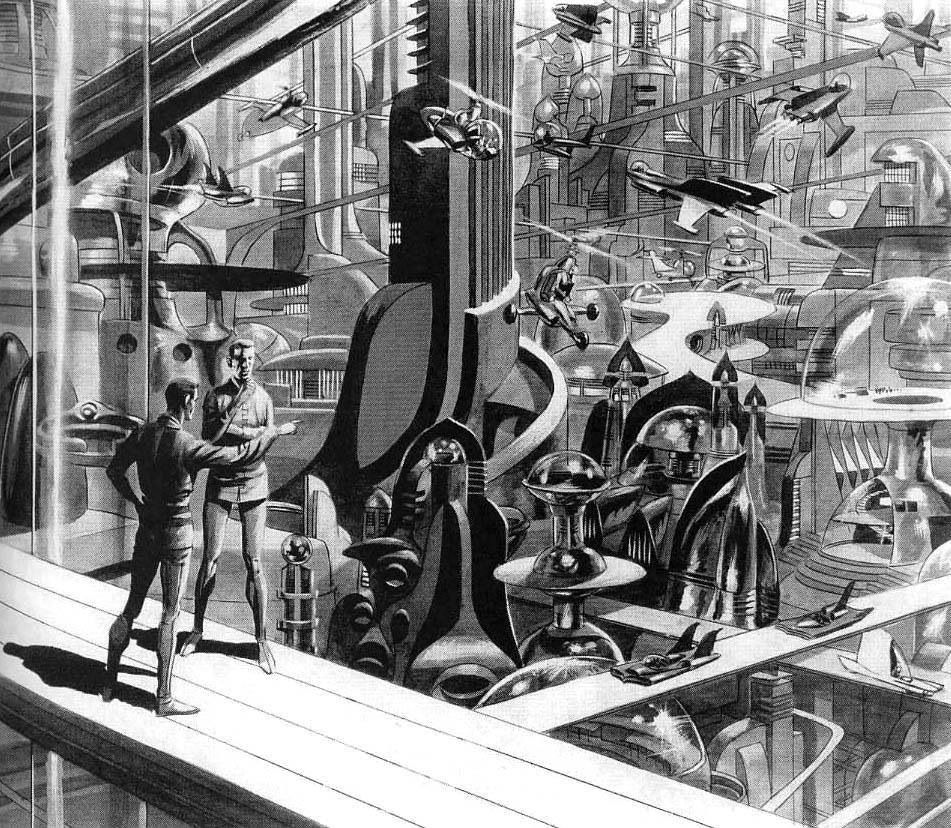
Wally Wood, Creative Artist

Science fiction fans often discuss their favorite science fiction books and movies, but we forget there is another category of creative people who envision the future – artists. I’ve started a page to collect the art that visually illustrates the history of science fiction. I’m using a page rather than a blog post because it’s part of the permanent menu under Essays – see The Classics of SF Art.

There’s no way I can make a statistical case for which works of art are classic, so I’m just going by my own tastes. Right now it has 28 images. I’m going to keep adding to it until the page loading times breaks down. I have many coffee table books for SF art, so this page will be my personal gallery that competes with them. Be sure an leave comments here and there about your own favorite works of science fiction art. I may include them in my gallery.

I’ve tried to size the images so look good on a computer screen, phone, and tablet. Let me know if you have any trouble viewing them.

The above illustration is by Wally Wood, but I can’t locate its original publication. I think it’s from Galaxy Science Fiction. If anyone knows, let me know.

James Wallace Harris