Science fiction stories are fairytales for teenagers that fuel their imaginations about the future. Science fiction creates myths about tomorrow for each new generation. And science fiction offers both hopes and fears about what’s to come. Readers from each new generation embrace their own flavor of science fiction.
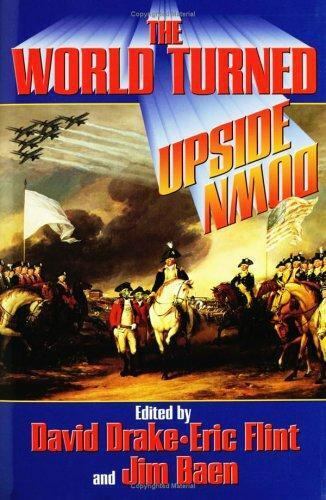
The World Turned Upside Down is an anthology where the editors picked science fiction stories that wowed them when they were teens. Currently available in print for the Kindle for $8.99 or free online for misers and the poor. And for collectors, the hardback is readily available used. I dearly wish there were an audiobook edition because I’d love to hear these stories read by a professional reader.
David Drake (b. 1945) and Jim Baen (b. 1943) are from the Silent Generation (1925-1945). Eric Flint (b. 1947) is from the second year of the Baby Boomers (1946-1964). I was born in 1951, the fifth year. All three editors started reading science fiction in the 1950s and I started in 1962. I believe science fiction fans that discovered the genre in the 1950s and 1960s during the Baby Boomer era imprinted on a certain type of science fiction that’s distinctly different from later generations’ science fiction. I believe the stories in The World Turned Upside Down will appeal the most to Baby Boomers.
One significant extra to this anthology is the personal recollections from the three editors. The introductions and follow-ups are bite-size memoirs. The editorial comments added extra enjoyment to reading this anthology. And I felt on the same wavelength as the editors.
Picture a graph with a bell curve stretched out on the trailing edge. Each year hundreds (thousands?) of science fiction stories are published, but only a small number become popular and are embraced as favorites by a generation. The newest stories are the leading edge of the curve. Then the long stretched-out trailing edge is where stories are remembered as they fade away in pop culture memory. Growing up I mostly read science fiction short stories that were at the peak of the curve. They were mostly 5-20 years old. Now those stories are 55-70 years old.
As I’ve gotten older, that bulge has diminished. In The World Turned Upside Down 5 stories are from the 1930s, 5 from the 1940s, 15 from the 1950s, and 4 from the 1960s. You should be able to visualize the curve just from that tiny bit of data. Readers today from the current generations will like or know very few of these stories. They are now far away from the leading bulge of popular stories. In 20 years, that bulge in the 1950s will thin away in future anthologies. Anthologists whose teen years were during the 1980s or 2010s will seldom pick stories that old.
For the past couple of months, our Facebook group has been reading and discussing the 29 stories from The World Turned Upside Down. I thought the age of the group member had an impact on which stories they liked. Current with reading these old stories on Tuesdays, Thursdays, and Saturdays, we read newer stories from The Good New Stuff edited by Gardner Dozois on Mondays, Wednesdays, and Fridays. I also thought the contrast to it in the comments was age-related. Austin Beeman reviewed The World Turned Upside Down on his blog and overall liked most of the stories, but the stories he responded to best were a bit different from my favorites. And I thought he liked stories in The Good New Stuff a lot more than I did. I believe he’s 25-30 years younger than I am. Jeppe Larsen reviewed the anthology on his blog and liked fewer stories. My hunch is he is younger. But it’s also possible, he’s not young, and like many people, just likes to keep up with the times. I actually prefer the older stuff, even if it feels old. And to also skew my impression, most of the active members are hardcore SF fans that love a wide range of science fiction.
Generally, a great story is usually liked by any age group, but less famous stories seem to have a generational appeal. My guess is writers write under the assumption they are speaking to the current generation but some of them end up speaking across the ages.
The stories in The World Turned Upside Down were first published from 1933 through 1967, but the most common decade represented was the 1950s. Here are the stories with my ratings (1-5 stars).
1930s
- Shambleau • (1933) • novelette by C. L. Moore (*****)
- Who Goes There? • (1938) • novella by John W. Campbell, Jr. (*****)
- Black Destroyer • (1939) • novelette by A. E. van Vogt (*****)
- Heavy Planet • (1939) • short story by Milton A. Rothman (***+)
- Spawn • (1939) • novelette by P. Schuyler Miller (****+)
My father (b. 1920) would have been a teen when these stories came out. He was from the Greatest Generation (1901-1924). These are also stories that appeared with the generation of First Fandom. Those were the old guys of science fiction when I was a teen. I’m not sure if any of them are around anymore. The star of that era was E. E. “Doc” Smith. Most of the fiction from then felt dated in the 1960s and even more so in the 2020s, even to me, a guy who loves to read old science fiction.
1940s
- Quietus • (1940) • short story by Ross Rocklynne (****)
- Environment • (1944) • short story by Chester S. Geier (***+)
- Rescue Party • (1946) • novelette by Arthur C. Clarke (*****)
- Thunder and Roses • (1947) • novelette by Theodore Sturgeon (*****)
- The Only Thing We Learn • (1949) • short story by C. M. Kornbluth (***+)
These stories came out during the teen years of the Silent Generation. This has been called The Golden Age of Science Fiction, but people who felt that are mainly dead. Stories collected in anthologies stay around for a few decades, and I was reading these stories as a teen in the 1960s. I thought 1940s SF was science fiction from the good old days. They felt somewhat dated when I read them in the 1960s, but they were still fun. Today, even to me, they feel quite quaint.
1950s
- Liane the Wayfarer • (1950) • short story by Jack Vance (****)
- Trigger Tide • (1950) • short story by Wyman Guin (***+)
- A Pail of Air • (1951) • short story by Fritz Leiber (****+)
- All the Way Back • (1952) • short story by Michael Shaara (***+)
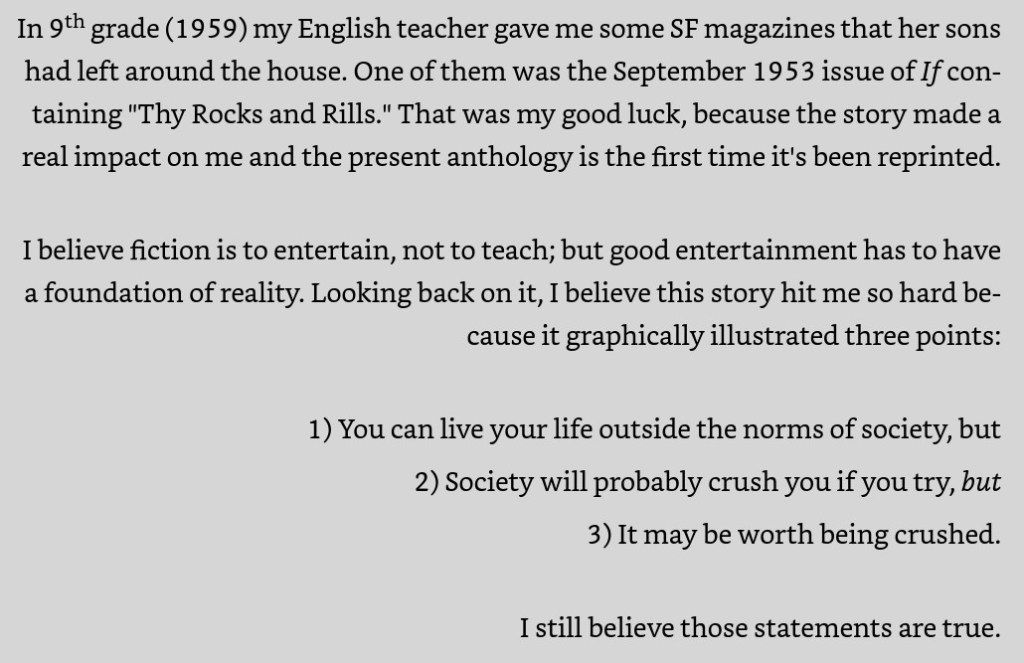
- Thy Rocks and Rills • (1953) • novelette by Robert E. Gilbert (****+)
- Answer • (1954) • short story by Fredric Brown (*****)
- The Cold Equations • (1954) • novelette by Tom Godwin (*****)
- Hunting Problem • (1955) • short story by Robert Sheckley (****)
- A Gun for Dinosaur • (1956) • novelette by L. Sprague de Camp (****)
- The Last Question • (1956) • short story by Isaac Asimov (****+)
- The Gentle Earth • (1957) • novella by Christopher Anvil (***+)
- The Menace from Earth • (1957) • novelette by Robert A. Heinlein (*****)
- Omnilingual • (1957) • novelette by H. Beam Piper (*****)
- St. Dragon and the George • (1957) • novelette by Gordon R. Dickson (****)
- The Aliens • (1959) • novelette by Murray Leinster (****)
Now, these were stories that were often anthologized in the 1960s when I was a teen and a number of them are considered classics. They seem just a little bit old to me when I was a teen. Like 1950s Rock and Rollers, who were in their twenties when I was a teen in the 1960s, but they were still so cool!
1960s
- Code Three • (1963) • novella by Rick Raphael (***+)
- Turning Point • (1963) • short story by Poul Anderson (***+)
- Goblin Night • (1965) • novelette by James H. Schmitz (****)
- The Last Command • (1967) • short story by Keith Laumer (****)
It’s interesting that these stories did come out when I was a teen, but they were some of my least favorites in the anthology, although still a lot of fun to read. I’m surprised Flint, Drake, and Baen picked them because none of them became classics. These kinds of stories were the salt of the Earth content of the SF magazines in the 1960s, but not the stories I thought defined the generation. At the time, Samuel R. Delany, Roger Zelazny, J. G. Ballard, and Ursula K. Le Guin were the bright stars in the sky.
Even though fiction being called science fiction was around in the 1920s, 1930s, and 1940s, it wasn’t until the 1950s that the general public recognized it. The 1950s was a boom time for science fiction when it regularly began appearing in book form – both paperback and hardback. Plus, it became popular in the movies and in the early days of television. In 1953 there were three dozen science fiction magazine titles being published. When I grew up stories from the 1950s boom felt like they defined the genre.
I felt the most famous SF from the 1950s would be the classics all my life and into the future. However, I’ve now lived long enough to see those stories age and fade away. It sometimes hurts me to see my favorite science fiction novels and short stories being forgotten, rejected or even vilified. This is why it’s difficult to recommend The World Turned Upside Down to younger readers. But I feel its stories capture an era so nicely. The stories aren’t the most famous Baby Boomer science fiction stories, but then the most famous stories are often over-anthologized while so many other good stories need to be remembered. I’m guessing Drake, Flint, and Baen wanted to preserve a picture of our era taken from a different angle. Of the stories I hadn’t read before, I was very glad to be introduced to them.
I would love to review each story one by one and natter about how they each aged and guess how each appealed to their generation. But this post is already longer than what 99% of internet readers read. I know, I’m way too verbose.
JWH




 Classics of Science Fiction