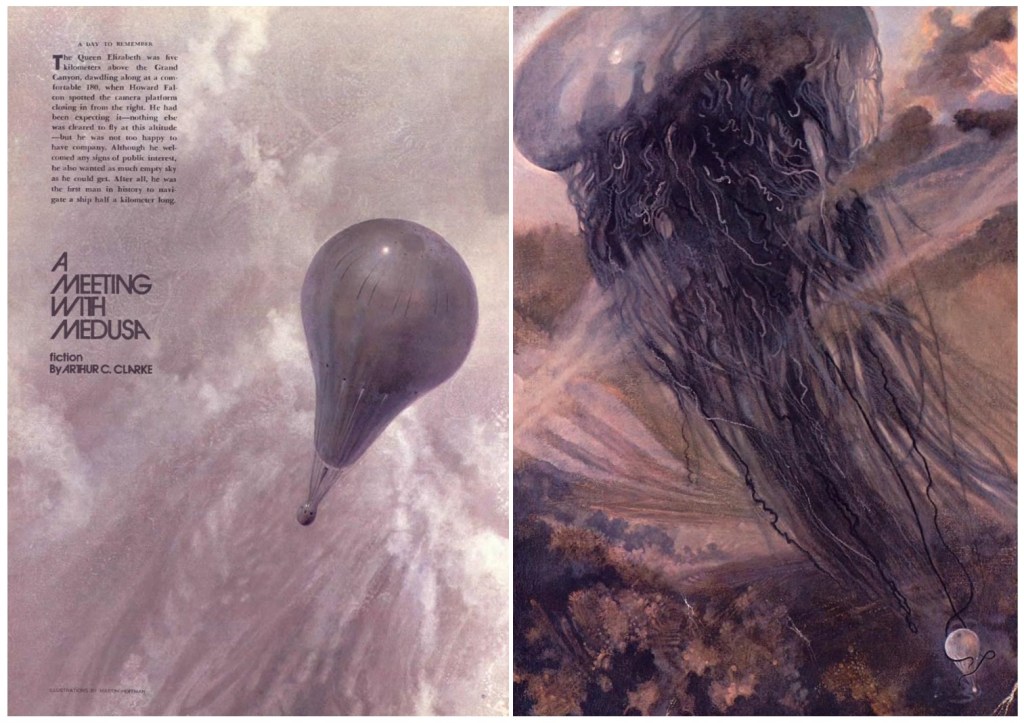
“A Meeting With Medusa” by Arthur C. Clarke is story #10 of 52 from the anthology The World Treasury of Science Fiction edited by David G. Hartwell (1989) that my short story club is group reading. Stories are discussed on Tuesdays, Thursdays, and Saturdays. “A Meeting With Medusa” first appeared in Playboy, inDecember 1971.
“A Meeting With Medusa” is among Arthur C. Clarke’s best works of science fiction, including Childhood’s End, Rendezvous with Rama, 2001: A Space Odyssey, and The City and The Stars. And I like it better than any of his more famous shorter works including, “The Nine Billion Names of God,” “The Star,” “The Sentinel,” and “Rescue Party.” I believe it’s his best work of hard science fiction, and probably one of the best works of hard science fiction by anybody.
The story is set up with Howard Falcon surviving a dramatic crash of a giant dirigible on Earth. Years later, he is descending into the atmosphere of Jupiter where he mans a monstrous hot-hydrogen balloon. Clarke was never known for writing literary fiction and wasn’t particularly good with characterization and drama, but this story has both.
“A Meeting With Medusa” reminds me of two other classic science fiction stories, “The Martian Odyssey” by Stanley G. Weinbaum and “Call Me Joe” by Poul Anderson. I don’t want to explain why because I don’t want to spoil the reading of “A Meeting With Medusa.” If you know those two stories, you’ll have a couple of hints.
“A Meeting With Medusa” has been reprinted often, and it won the Nebula Award for Best Novella in 1973. It has also been translated into many languages. This is not a story to miss if you love science fiction. I believe this is the third time our SF short story group has read “A Meeting for Medusa,” and it is well admired.
“A Meeting With Medusa” resonates with our deepest desires for science fiction. We want to explore the universe, and we want to find amazing wonders of nature and lifeforms, and I think most of all, we don’t want to be alone. Most of us will never leave Earth, so science fiction empowers our imaginations to go where we can’t.
I’ve always thought of science fiction as a tool for speculating about the future. History is a tool that lets us know the past, but we can’t know the future like history teaches us about the past. Science fiction can only extrapolate upon endless possibilities. I’d love to know the history of the future, to what will come after I die, but that’s impossible. Science fiction gives me hints, enough to soothe that desire to know the future just a tiny bit.
To me, the best hard science fiction leaves me with the feeling that whatever it imagines might possibly come to be after I die.
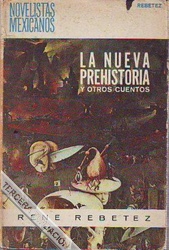
“The New Prehistory” by René Rebetez-Cortes is story #9 of 52 from the anthology The World Treasury of Science Fiction edited by David G. Hartwell (1989) that my short story club is group reading. Stories are discussed on Tuesdays, Thursdays, and Saturdays. “The New Prehistory” was evidently first published as a short story in a periodical in 1964 according to the only record I can find. It was collected in La Nueva Prehistoria Y Otros Cuentos in 1967, translated as The New Prehistory and Other Tales by René Rebetez. The site linked above lists 19 short stories, all labeled science fiction.
According to David Hartwell in his introduction to the story, “The New Prehistory” was translated by Damon Knight and was first published in 1972. So the publishing history varies. Hartwell says Rebetez-Cortes was Columbian but the cover of the author collection above suggests something different. Google says he was born in Subachoque, Columbia in 1933 and died on December 30, 1999, in Isla de Providencia, Columbia.
“The New Prehistory” is a very short literary allegory that could be called introverted horror. It’s about a man going to a movie but hates waiting in line. He steps away from the line while watching his friend wait in the queue. Then the line becomes possessed by some unseen force and all the people in the line start acting like they’re part of one giant snake-like organism. People who stood in groups became giant amoeba-like organisms. Individuals stayed individuals. Eventually, the new giant organisms take over the world and hunt the individuals.
Even though a lot of people are calling “The New Prehistory” science fiction I’m not. It’s the kind of fantastic story I heard read in creative writing classes from high school to graduate school. In every writing class there always seemed to be one student who everyone thought was brilliant who would write these kinds of fantastic allegories. They were popular with both the teachers and students because they always seemed so damn clever.
I believe writers, and even oral storytellers, have always used the fantastic in their tales. But that doesn’t mean they are science fiction. Some scholars in science fiction have been trying to claim more territory for the genre for decades. They want to both up the reputation of the genre and claim more types of stories as ours. When I was young, I agreed with this. I wanted the genre to have prestige. But after a lifetime of reading, I realize I’m a consumer of science fiction and I want real science fiction, not ersatz sci-fi.
Science fiction is impossible to define so editors can call anything they want science fiction, but as a consumer, I know what I want, and this kind of story is not it. I remember when I was young back in the 1960s and wondering what science fiction must be like written in other countries in other languages. Then in the early 1970s, we got some Soviet science fiction anthologies and I got my wish. Slowly, the idea of world science fiction has grown, but all too often I believe editors have grabbed anything they could to fill their anthologies. I think that’s a disservice to the genre, and dishonesty to the literary world.
I know that other SF readers will accept these stories as science fiction because their definitions of the genre are different. And that’s cool. The reality is we don’t all think alike. But I would like to think that science fiction was a term with validity and to me, the intent of the genre is more specific, even quite narrow.
Just because a story has elements of the fantastic doesn’t make it science fiction or fantasy. I also believe fantasy as a genre covers definite territory too. As an emerging bookworm back when I was in grade school, I’d go up and down the library shelves looking for certain kinds of stories. Stories about space travel, robots, new technology, and time travel. They were always about the future, or they were set in current times when things changed. “The New History” is set in current times and things changed, but I still don’t consider it science fiction. Why? Because of the tone of the story.
I never believed while reading the story that people could become group organisms. If the author had made some kind of case for that it would have been science fiction. But that wasn’t his intent. He was obviously making a case about the horrors of being in a group. As an introvert, I completely understand that angle. It’s a good story for that purpose. But that’s a completely mundane purpose. Science fiction is not about the mundane. Science fiction is about the far out, but as a real possibility, even in humor. I never thought the people in “The New Prehistory” were becoming group monsters, nor did I think the author wanted us to believe that. I felt the author was giving us an allegory about how he felt about the real world.
For me, science fiction has to be about what the real world could become. The fantasy genre is about make-believe worlds, but believable worlds within their own concepts. I know most science fiction is unbelievable, or has become so. For me to think of it as science fiction, I have to believe it’s possible, or at least think people once thought it possible.
“The Golem” by Avram Davidson is story #8 of 52 from the anthology The World Treasury of Science Fiction edited by David G. Hartwell (1989) that my short story club is group reading. Stories are discussed on Tuesdays, Thursdays, and Saturdays. “The Golem” was first published in the March 1955 issue of The Magazine of Fantasy and Science Fiction.
You can read or listen to “The Golem” online here.
Avram Davidson (1923-1993) uses his own childhood pop culture references to get us to visualize the setting “The Golem” at the beginning of this 1955 story:
Anyone who attended the movies in the twenties or the early thirties has seen that street a thousand times. Past these bungalows with their half-double roofs, Edmund Lowe walked arm-in-arm with Leatrice Joy, and Harold Lloyd was chased by Chinamen waving hatchets. Under these squamous palm trees Laurel kicked Hardy and Woolsey beat Wheeler upon the head with a codfish. Across these pocket-handkerchief-sized lawns, the juveniles of the Our Gang comedies pursued one another and were pursued by angry fat men in golf knickers. On this same street—or perhaps on some other one of five hundred streets exactly like it.
And he does the same thing at the end:
Presently the sound of the lawnmower whirred through the quiet air in the street just like the street where Jackie Cooper shed huge tears on Wallace Beery’s shirt and Chester Conklin rolled his eyes at Marie Dressler.
I assume that Davidson was nostalgic for the films he saw as a kid in the 1920s and 1930s but how many readers today will know them? I was familiar with all those names and images, but his story keyed in another era for me, the late 1950s and The Twilight Zone. I visualized Mr. and Mrs. Gumbeiner, an old Jewish couple sitting on their porch with their uninvited Golem guest as one of the comic episodes of that classic TV show.
The tone of the story reminded me of Ray Bradbury, Charles Beaumont, and Richard Matheson, so in 1955, Avram Davidson was ahead of his times — by four years.
Of course, in 2023 we’re starting to get worried about AI and real robots while science fiction readers are still enchanted by stories about friendly androids, cute robots, or sexy sexbots. So I assume modern readers could still be enchanted by this quaint old-fashion story. It’s the kind of Jewish comedy schtick that was once very popular, but I wonder if modern readers concerned with cultural correctness might consider it a stereotype? Essentially, “The Golem” is a time capsule of history, that mixes 1955 science fiction with Jewish folklore while asking us to remember old Hollywood films that kids loved twenty and thirty years earlier.
It’s interesting that David Hartwell included “The Golem” in The World Treasury of Science Fiction. How many stories in that anthology are there because of Hartwell’s own nostalgia? Other editors have loved this story too, just look at the long list of reprints it’s gotten over the last several decades.
However, even though I enjoyed this little blast from the past, I have to wonder if its storytelling hasn’t become too quaint for modern readers. Right after reading it, I started listening to “The Affinity Charm” by Jennifer Egan, the first story in her fix-novel The Candy House. The setting for that story is an apartment where people have gathered after a lecture to discuss what everyone thought. Egan presents a diverse group of intellectuals all arguing from different academic perspectives. To these modern sophisticates, “The Golem” would be an overly simplistic tale they’d quickly dismiss. I wonder if even uneducated young people today would be too sophisticated intellectually to enjoy this story?
I only considered “The Golem” mildly entertaining, mostly for its nostalgia. But then I can remember 1955. How will people born after 1985 or 1995 see it? Hartwell’s anthology came out in 1989, and I’m starting to wonder from its first eight stories if it isn’t already a relic of the past?
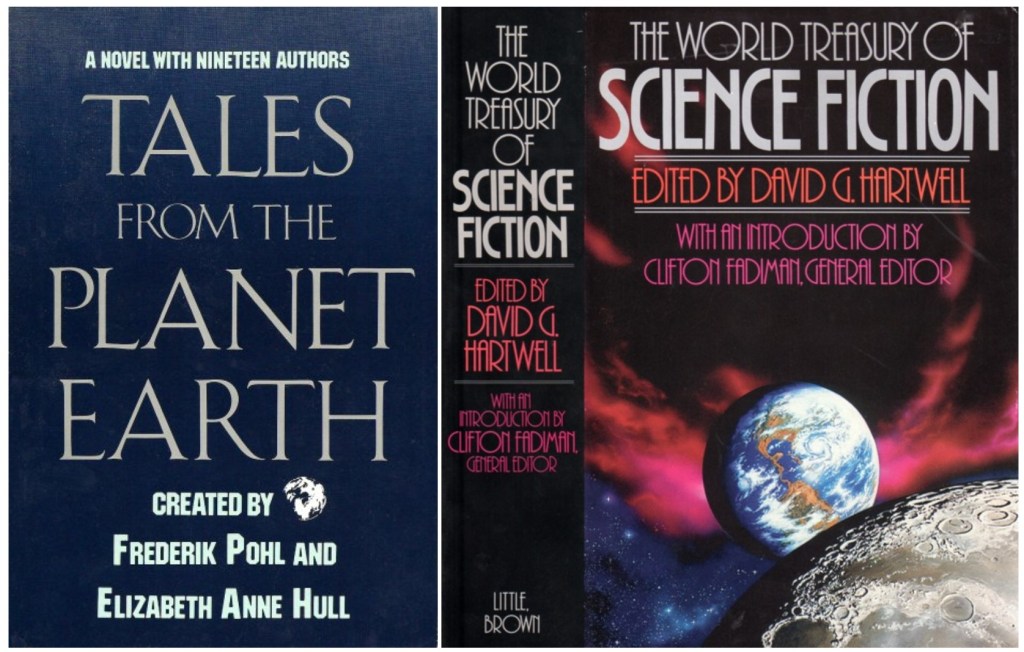
“On the Inside Track” by Karl Michael Armer is story #7 of 52 from the anthology The World Treasury of Science Fiction edited by David G. Hartwell (1989) that my short story club is group reading. Stories are discussed on Tuesdays, Thursdays, and Saturdays. “On the Inside Track” was first published in the original anthology, Tales From the Planet Earth in 1986, edited by Frederik Pohl and Elizabeth Anne Hull. As far as I can tell from ISFDB.org, those are its only publications.
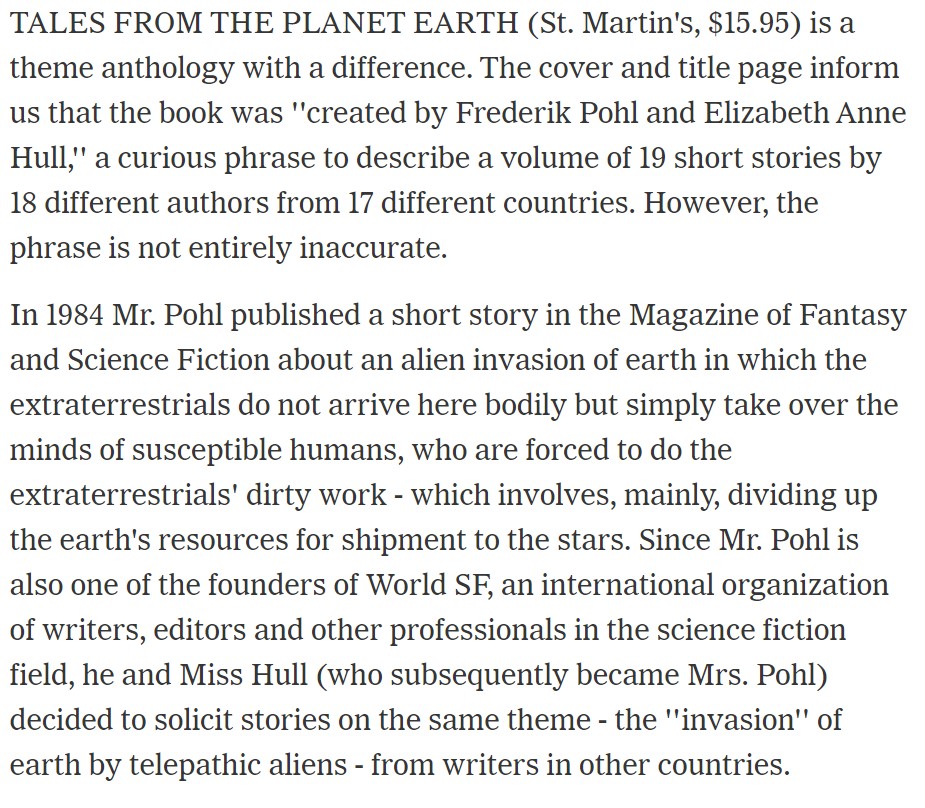
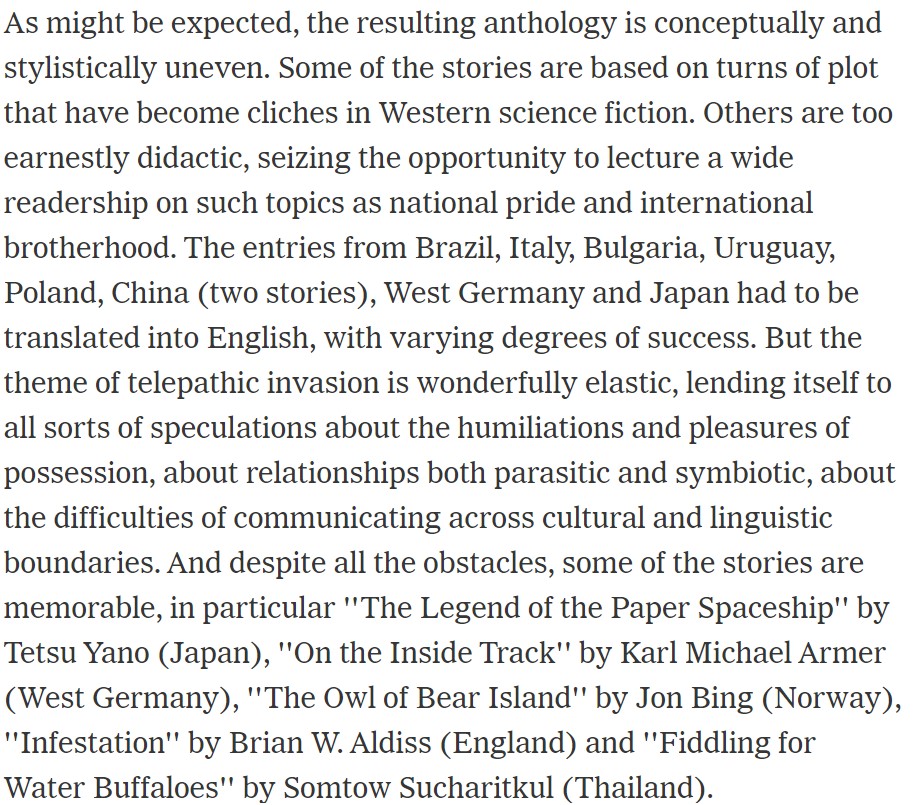
“On the Inside Track” is by a German writer, Karl Michael Armer, and it’s set in Europe, but it seems like a typical American science fiction story. It’s also a good story, one that I’ll want to reread in the future. Actually, I might want to read all the stories in Tales From the Planet Earth after reading the review it got in The New York Times.
One reason I liked “On the Inside Track” is its protagonist, Robert Förster is 70 years old, and I’m 71. Förster is well-to-do and unhappy. I’m happy but not well-to-do, but we both share quite a lot of observations and reactions about being old. Förster’s life is interrupted when an alien, Sassacan, moves into Förster’s mind. In this story, aliens conduct interstellar travel by mind projection. Sassacan visits Earth to conduct business negotiations with other aliens who are occupying other human bodies.
Förster doesn’t mind being used because it’s a diversion from being bored and lonely. In fact, he gets to like the company. This story reminds me of Sheckley’s novel, Mindswap but without the humor. “On the Inside Track” is pleasant, but slightly predictable. I guessed two of its surprises, but that didn’t mar the reading experience.
However, I’ve got to ask a question: Is World SF really any different than American science fiction? World SF is set in other countries, and sometimes it even references cultural differences or tries to exploit local myths and beliefs, but mostly science fiction is science fiction. “On the Inside Track” makes a decent addition to the anthology but I didn’t think about Germany while I was reading it. Förster’s desire to be commanding is alien to me, but I don’t think that as a German trait, but as an alpha male trait of a person wanting to be successful.
I guess I need to wait and see if Hartwell finds a story from another country that feels truly alien to me. Alien in the sense that it’s completely foreign, and not space alien.
“The Man Who Lost the Sea” by Theodore Sturgeon is story #6 of 52 from the anthology The World Treasury of Science Fiction edited by David G. Hartwell (1989) that my short story club is group reading. Stories are discussed on Tuesdays, Thursdays, and Saturdays. “The Man Who Lost the Sea” was first published in the October 1959 issue of The Magazine of Fantasy and Science Fiction.
My third reading of “The Man Who Lost the Sea” left my eyes stinging with tears, just like they had for the second reading. Nearly everything I felt while reading the story for the third time I had said in my second review. My first review was all about trying to get everyone to read the story.
I found Sturgeon’s prose while reading “The Man Who Lost the Sea” this time far more vivid than the first two times, and I look forward to reading it again in the future. A couple weeks ago I watched a YouTube video by a guy reviewing classic litature (Joyce, Proust, Pynchon). He said his professor had taught him to really get to know a book required reading it ten times.
I have a self-imposed rule when reading anthologies. Whenever I’m reading a new anthology and it has stories in it that I’ve read before, I reread them — even if they were in the last anthology I just finished. Even if I didn’t like them. Sometimes a story I didn’t like on my first reading, or the second, becomes a favorite.
“The Man Who Lost the Sea” is the kind of story that I use for my 5-star ratings. Those are stories I want to read and reread over my entire lifetime. I’ve probably read “The Man Who Lost the Sea” more than three times because I can’t remember everything I read years or decades ago. I’ve just read and reviewed it three times in a little over two years for this blog. The great thing about doing this blog is documenting my memory, it’s highly unreliable, and getting more so.
Memory is one of my favorite subjects and themes, and “The Man Who Lost the Sea” is also about memory and memories.
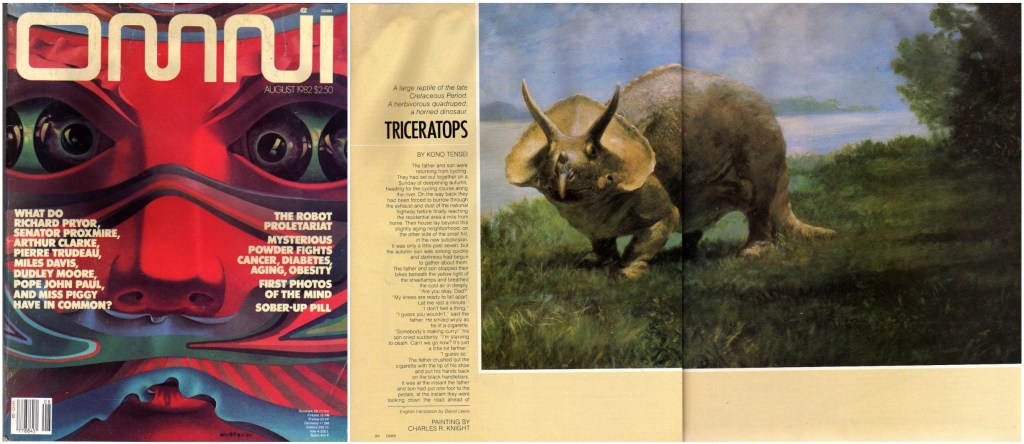
“Triceratops” by Kono Tensei is story #5 of 52 from the anthology The World Treasury of Science Fiction edited by David G. Hartwell (1989) that my short story club is group reading. Stories are discussed on Tuesdays, Thursdays, and Saturdays. “Triceratops” was first published in the August 1982 issue of Omni.
On one level, “Triceratops” isn’t much of a story. Nice enough. Sort of a bland version of Bradbury. A dad and his son are out biking and they see something out of the ordinary. Eventually, they learn it’s a triceratops, and conclude they alone, for some reason that’s not clear, can see into another dimension. Father and son bond over secretly watching a Cretaceous landscape superimposed over their Japanese subdivision.
David Hartwell’s aim is to showcase science fiction from around the world in this anthology, but hopefully, this story isn’t representative of the best SF from Japan or the world. And I’d hate to think Hartwell picked it because he characterizes Japan as a country of big monster fans.
It’s a challenge to find an essay hook for this story. I think I’ll use a video I watched from the Outlaw Bookseller (Steven E. Andrews) this morning on conceptual breakthroughs in science fiction. Andrews begins by talking about the first lines of classic science fiction stories.
The ones we remember have great first lines that announce a paradigm shift. His first example was from Orwell’s Nineteen Eighty-Four, “It was a bright cold day in April, and the clocks were striking thirteen.” The second was from Christopher Priest’s The Inverted World, “I had reached the age of six hundred and fifty miles.”
Unfortunately, Tensei begins his story with “The father and son were returning from cycling.” That’s a rather mundane first sentence. Tensei waits for quite a few paragraphs before bringing on his paradigm shift.
Andrews then goes on to say the best SF stories have a conceptual breakthrough that comes near the end that inspires a sense of wonder. “Triceratops” does depend on a conceptual breakthrough, but it’s in the middle. The father and son decide if they think that the Cretaceous can intersect dimensionally with the present then they can see the two together. The logic of “if you believe it to be true it will be true” isn’t much of a conceptual breakthrough, although the film version of The Wizard of Oz pulled it off nicely.
This is the first story I would have left out of this anthology. Unfortunately, it was the first example of world SF. Not a good start.
I recommend watching the whole video, Top 10 Science Fiction Conceptual Breakthrough Stories: The Elements of Science Fiction Part 1. I should use it as a foundation for evaluating the stories in The World Treasury of Science Fiction. However, it might be aiming too high for the average science fiction story — or should every science fiction story aim to hit one out of the park?
“Chronopolis” by J. G. Ballard is story #4 of 52 from the anthology The World Treasury of Science Fiction edited by David G. Hartwell (1989) that my short story club is group reading. Stories are discussed on Tuesdays, Thursdays, and Saturdays. “Chronopolis” was first published in the June 1960 issue of New Worlds.
“Chronopolis” is set in the future where society has outlawed keeping time. Ballard imagined a future where our high-tech global civilization collapsed from the complexity of overpopulation. In this new world, the population is much smaller having giving up the rat race.
The story begins in a holding cell. Conrad Newman is awaiting trial for as of yet unspecified crimes. Newman is obsessed with making his south-facing jail cell window into a sundial so he can accurately keep the time while everyone else is unconcerned about when things will happen. Gradually we learn that this society operates without a schedule, and clocks are illegal. They allow timers, which people use to cook eggs, time a math class, or how long they should sleep, but not clocks that force schedules onto life’s activities.
Ballard has come up with a nifty idea. You don’t know if this new world he described is better or worse for not knowing the time, but Conrad Newman is a renegade who secretly embraces keeping time, allowing him to outcompete other people. Newman’s world is the opposite of Harlan Ellison’s “‘Repent, Harlequin!’ Said the Ticktockman.” Conrad Newman is the polar opposite of Everett C. Marm. It’s funny, but we root for each character in their separate stories.
I got to say, I really liked this story a lot even though when you think about it, there’s not much to it. On the one hand, it’s the old fashion kind of science fiction that’s based on a neat idea. On the other hand, it feels different from the other science fiction of 1960 or before. J. G. Ballard is considered one of the pathfinders of the New Wave movement in science fiction in the mid-1960s. “Chronopolis” isn’t really New Wave yet. Probably why it feels different is it’s British science fiction, and British science fiction always felt more grown-up to me.
I’ve only read a couple novels by Ballard, and maybe a dozen short stories, but they’ve all impressed me as being “heavy” in the old hippie sense of the word. I assume that was another way of saying weighty. I recently read “The Terminal Beach” by Ballard and was equally impressed, and it felt equally heavy. Years ago, I bought The Complete Short Stories of J. G. Ballard on audiobook. It’s 55 hours long. I also have it on the Kindle. Whenever one of his stories comes up on the discussion group I like listening to them. They feel mature and atmospheric. I also like reading them because I’m impressed with Ballard’s prose. Each time I read one of his stories, I tell myself I need to listen to the entire 55-hour audiobook and I really want to get into Ballard’s work.
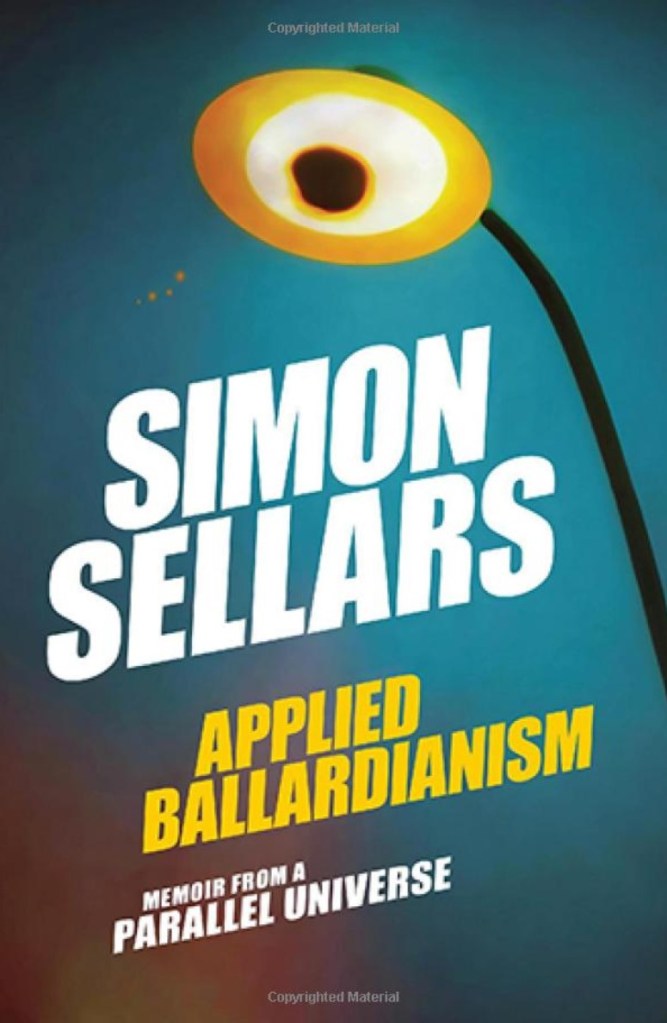
The other day at the Friends of the Library used bookstore I found Applied Ballardianism by Simon Sellars. I couldn’t tell if it was a novel, memoir, monograph, or what, but I bought it. This is how it’s described at Amazon:
An existential odyssey weaving together lived experience and theoretical insight, this startling autobiographical hyperfiction surveys and dissects a world where everything connects and global technological delirium is the norm.

The mediascapes of late capitalism reconfigure erotic responses and trigger primal aggression; under constant surveillance, we occupy simulations of ourselves, private estates on a hyperconnected globe; fictions reprogram reality, memories are rewritten by the future…

Fleeing the excesses of 1990s cyberculture, a young researcher sets out to systematically analyse the obsessively reiterated themes of a writer who prophesied the disorienting future we now inhabit. The story of his failure is as disturbingly psychotropic as those of his magus—J.G. Ballard, prophet of the post-postmodern, voluptuary of the car crash, surgeon of the pathological virtualities pulsing beneath the surface of reality.

Plagued by obsessive fears, defeated by the tedium of academia, yet still certain that everything connects to Ballard, his academic thesis collapses into a series of delirious travelogues, deranged speculations and tormented meditations on time, memory, and loss. Abandoning literary interpretation and renouncing all scholarly distance, he finally accepts the deep assignment that has run throughout his entire life, and embarks on a rogue fieldwork project: Applied Ballardianism, a new discipline and a new ideal for living. Only the darkest impulses, the most morbid obsessions, and the most apocalyptic paranoia can uncover the technological mutations of inner space.

An existential odyssey inextricably weaving together lived experience and theoretical insight, this startling autobiographical hyperfiction surveys and dissects a world where everything connects and global technological delirium is the norm—a world become unmistakably Ballardian.
Some of that description faintly feels like “Chronopolis” but it’s an early story for Ballard, that hints at things to come. Also, by serendipity, I came across this YouTube video by the Outlaw Bookseller on the New Wave. Ballard figures heavily in it. Warning though, this video is one hour and twelve minutes long.
“Chronopolis” is another story that’s pushing me into the world of J. G. Ballard. One of these days, and hopefully soon, I’ll start gorging on Ballard’s books.
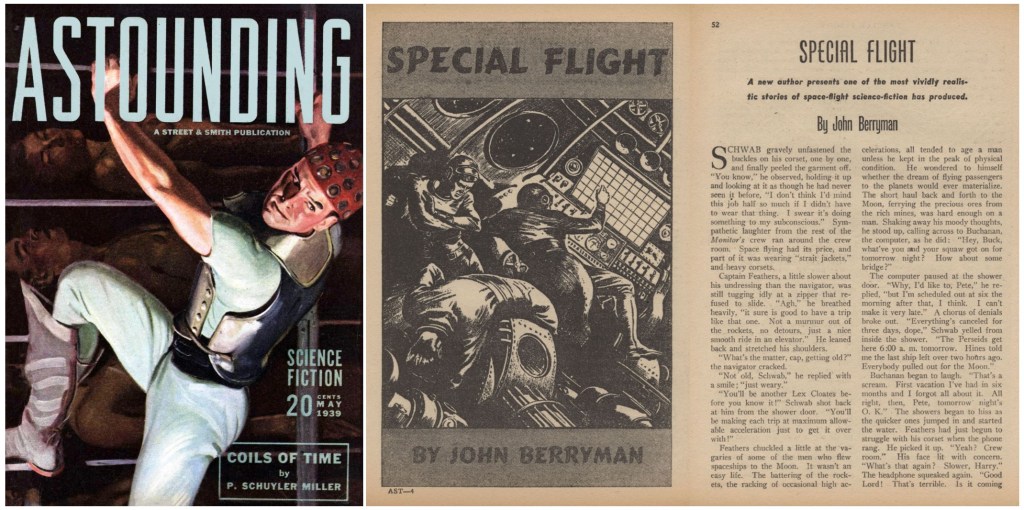
“Special Flight” by John Berryman is story #3 of 52 from the anthology The World Treasury of Science Fiction edited by David G. Hartwell (1989) that my short story club is group reading. Stories are discussed on Tuesdays, Thursdays, and Saturdays.
Editors assembled anthologies to reprint and promote stories they believe people should read — stories they feel should be kept alive. I have to wonder why Hartwell selected “Special Flight” because to most modern readers, or even readers in 1989, the story is a clunker. Kingsley Amis and Robert Conquest selected “Special Flight” for their anthology Spectrum in 1961, but other than those two anthologies no other editors have wanted to save this story from oblivion.
John Berryman, according to ISFDB, only published 21 science fiction stories, and some of them were occasionally reprinted. However, John Berryman is not a name I remember. He is a forgotten author. So why read his story in 2023? I’ve never read “Special Flight” before, or even heard of it, but it’s an impressive science fiction for 1939 if you think about it in a certain way. “Special Flight” was first published in the May 1939 issue of Astounding, just months before the July issue that many consider the first issue of the Golden Age of Science Fiction. Then why didn’t Hartwell choose one of the more famous stories from that year?
Reading “Special Flight” brings up a long queue of questions. The sole quality that makes this story impressive is it tries to scientifically imagine routine space flight in 1939 in a realistic manner. So, do I recommend you track it down and read it? Not really, because it gets the science all wrong. However, if you happened to have an academic bent and like to study science fiction as a subject, then “Special Flight” is an interesting read.
If you’ve ever wondered how people in 1939 imagined space flight actually working, and not just being silly Buck Rogers stuff, “Special Flight” can provide some answers. Berryman was trying to imagine a near future where we mined the Moon for minerals and rocketships were much like merchant ships or cargo aircraft. “Special Flight” reminds me of what Heinlein was trying to do in the 1950s and it also reminds me of the original Star Trek.
Shouldn’t we forgive “Special Flight” for its mistakes if it was solid scientific speculation in 1939? Jules Verne got nothing right scientifically in Journey to the Center of the Earth but it’s still a well-loved story today. Why? Because the storytelling is fun. Then what about the storytelling in “Special Flight?” It’s not bad but it’s not great either. It’s about the level of a science fiction B-movie from 1953. Remember all those old black-and-white movies where the big danger of space flight was meteors? That’s what happens in “Special Flight”
“Special Flight” is action-packed. It’s about an emergency rocket flight to the Moon to save the lives of over a hundred miners. Everything possible that could go wrong does, including a giant tank of milk busting and flowing all over the rocket ship. Berryman spends a lot of his wordage on math and navigation and not that much on characterization. The crew is often knocked around like Captain Kirk and his crew — remember how the actors threw themselves around on the sets of Star Trek? In other words, the action is cheesy. But on the other hand, the focus is on getting to the Moon, and quite a lot of detail that Berryman imagined feels realistic. For instance, Berryman imagines that spaceflight causes tiny blood clots in the brain that produces a list of effects that can make operating a spaceship difficult. He talks about the three-body problem, something I didn’t know about until I read the Cixin Liu book. He imagines an automatic pilot and system that controls chemical rockets to maneuver in space while atomic rockets provide the main thrust using water as fuel. He talks about orbital velocities, g-forces, and take-off speeds. Stuff that just wasn’t in science fiction in the 1930s.
If you like to chart how science fiction evolved or are curious about how people before WWII imagined realistic space travel, then read “Special Flight.” If you’re used to modern well-told science fiction stories, you’ll probably want to skip it.
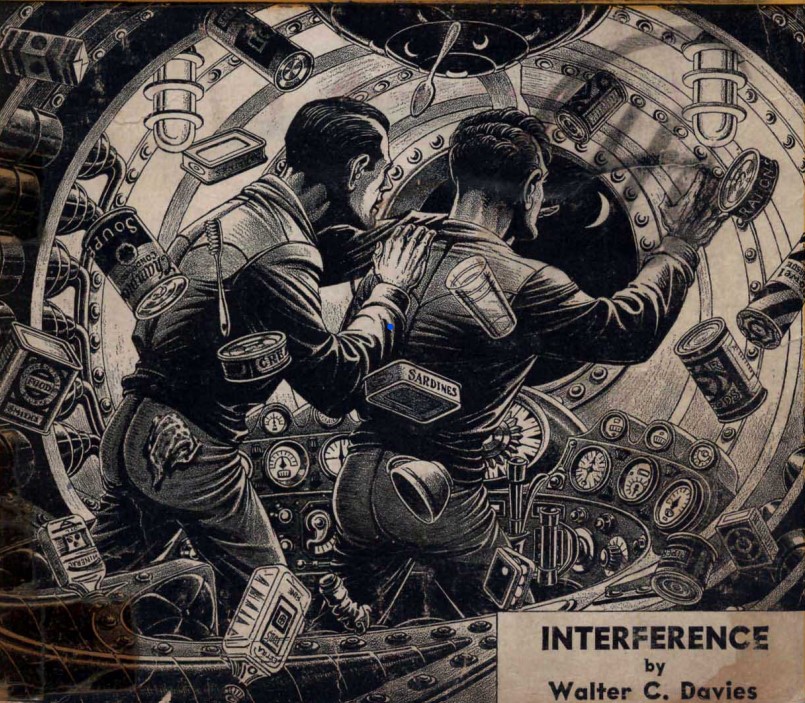
By the way, here’s an illustration from the cover of Cosmic Stories (July 1941) that imagines being in space in a rather realistic way for the time. I do like picturing how people imagined space travel before NASA. That’s why I enjoyed “Special Flight.”
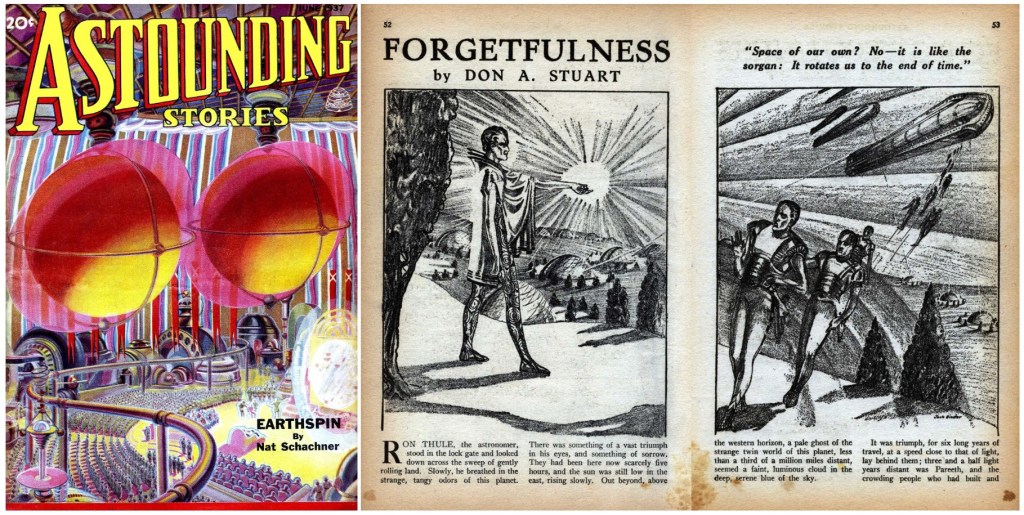
“Forgetfulness” by John W. Campbell, Jr. is story #2 of 52 from the anthology The World Treasury of Science Fiction edited by David G. Hartwell (1989) that my short story club is group reading.
Instead of counting all the titles and authors of science fiction books I’ve read, I’m starting to tally all the far-out concepts science fiction has given me. In “Forgetfulness” John W. Campbell took one of my favorite concepts, walking in ancient dead alien cities, which was probably an old SF concept even in 1937, and gave it a couple twists. It’s going to be impossible to talk about this story without giving spoilers so think of this essay as an analysis of SF concepts and not a review. You can read the story online here, or buy it in a $2.99 Kindle edition of Campbell’s collection Cloak of Aeshir. However, I don’t recommend buying unless you’re a big fan of John W. Campbell.
“Forgetfulness” begins with a spaceship landing on the planet Rhth, one of nine planets in the system. The main point-of-view character is Ron Thule, an astronomer, from the planet Pareeth. They have traveled for six years, in a spaceship 2,500 feet long and 400 feet in diameter, covering 3.5 light-years, traveling at nearly the speed of light. These people from Pareeth are looking for a world to colonize, and are disappointed that Rhth is already inhabited. They hope to settle in the remains of a majestic city that was built by spacing-faring race millions of years ago and discover its secrets.
Try and pronounce Rhth. If nine planets weren’t a giveaway, the name Rhth should be. There they meet Seun, a very tall, graceful human-shaped being, clothed in a golden outfit, with a beautiful colored cape. All the people of Rhth wear gold suits and colored capes and live in opalescent domes twenty to thirty feet in diameter situated under giant green trees near the dead city. The buildings of that titanic city are three thousand feet high, but the winds have filled the streets with five hundred feet of dirt.
Seun has told Ron Thule and the commander of the Pareeth mission, Shor Nun, that the builders of the city had once visited their world. And that their world, Pareeth, once orbited the same sun as Rhth, but had been torn away by a rogue star. This hints that maybe the builders had conducted a kind of panspermia across the galaxy. As the story progresses the achievements of the builders become greater and greater. However, the people of Pareeth eventually discover secrets that can shatter their minds and their hopes.
Most of us find a great sense of wonder reading about the rediscovery of lost cities. So, it’s not a remarkable feat of creativity for a science fiction writer to imagine humans finding long-dead alien cities. Still, it’s one that sets off a powerful sense of wonder and has been used time and again in science fiction.
Campbell puts a twist on this concept, by having aliens discover a city from a long-dead civilization of mankind. John W. Campbell has a reputation that claims he wanted humans to be the galactic crown of creation, and this story supports that. In his earlier story, “Twilight” he had a human time traveler discover a far future deserted human civilization. That gave him a chance to imagine the engineering marvels of what we could achieve someday. In “Forgetfulness” he has aliens discover dead human civilization, but this time, Campbell imagined an even more impressive future for us built by super-science. You should read both stories to see just how hopeful Campbell was for the human race.
Both “Twilight” and “Forgetfulness” could be considered Dying Earth stories, although H. G. Wells in “The Time Machine,” William Hope Hodgson in The Night Land, and Olaf Stapledon in Last and First Men, took that idea, even much further.
Unfortunately, “Forgetfulness” is hard to read. Part of that is due to a dated writing style, but also because Campbell didn’t really have much of a story to tell. They came, they discovered wonders, they were frightened, they were disappointed. There’s no drama or revealed emotions. “Forgetfulness” was reprinted in the classic 1946 anthology Adventures in Time and Space but has been mostly forgotten since. Damon Knight remembered it in his 1966 anthology Cities of Wonder, and Brian Aldiss and Harrison brought it back again in 1973 for The Astounding-Analog Reader. Both are very minor anthologies. The second contained just seven stories from Astounding covering 1937-1941, a rather odd collection.
It’s interesting that a story about remembering has been forgotten. The big concept in “Forgetfulness” is visiting the remains of an astonishing civilization millions of years after its citizens have gone. Campbell puts his own twist on it by having that civilization be a future version of ours. However, there’s another important concept he wanted to get across, and that’s how we forget the past. Shor Nun and Ron Thule can’t understand why Seun doesn’t understand how the city works. But then Campbell reminds us we couldn’t explain the technology of cavemen, or from other periods of human civilization. Remember all the discussions about how did the Egyptians build the pyramids? Well, it turns out Seun has even newer technologies that are even further advanced than the builders and they have merely forgotten earlier primitive technology.
I have to wonder if Arthur C. Clarke’s story “Rescue Party” wasn’t inspired by “Forgetfulness” and “Twilight.” Or that the screenwriters for Forbidden Planet hadn’t read “Forgetfulness” too. Or were their ideas independently invented?
That’s the thing about science fiction. Concepts keep getting reused. Are they forgotten and then reinvented? Or does science fiction evolve over time as concepts merge and mutate? Will some young writer in the 2020s come up with a story about a far-future space race discovering a future Earth and finding the ruins of what our civilization will become? How will this writer imagine the pinnacle of our success? Campbell wanted to believe that humanity will evolve until it has god-like powers. That idea has shown up in science fiction over and over again. But do we still believe that? Right now the peak of our civilization might end this century.
“Harrison Bergeron” is a political satire set in the year 2081. Kurt Vonnegut imagines everyone is not only equal under the law but handicapped to be made equal in all ways. Stronger people are weighed down, talented people are made less talented, and intelligent people have to wear earplugs that make various kinds of noises to distract them from thinking deeply. In this rather short story, George and Hazel Bergeron are watching a ballet on television. They have forgotten their 14-year-old son Harrison has been arrested for being too handsome, too smart, and too strong. During the course of the TV show, their son appears on the ballet stage having escaped to start a rebellion. (You can read it here, or read a detailed synopsis on Wikipedia.)
“Harrison Bergeron” is not a subtle satire, instead it goes for the absurd. It’s a very likable story. Vonnegut tells it in simple language with vivid details. You immediately agree with him that this dystopian world is wrong. This short story has become quite famous, having been adapted to the screen four times. National Review, the conservative magazine founded by William F. Buckley even reprinted the story. The National Review keeps using “Harrison Bergeron” – here’s it being used again in 2015 against economic inequality in “Inching Towards ‘Harrison Bergeron.’“
Usually, satire attacks something, and I have to wonder what Vonnegut was attacking. While reading it I thought maybe he was protesting laws designed to create equal opportunity. Then when I read about National Review and that Supreme Court Justice Antonin Scalia quoted the story in PGA Tour, Inc. v. Martin then I began to wonder even more. And it’s referenced in academic papers, including a 2013 one about transgender athletes. I thought Vonnegut was liberal. Wikipedia did say he wasn’t against his story being used in a Kansas court situation, he didn’t agree with their interpretation.
So why have conservatives embraced “Harrison Bergeron” so thoroughly? Are they using its satire the way Vonnegut intended? A site called What So Proudly We Hail promotes the story with a very pointed introduction:
Central to the American creed is the principle of equality, beginning with the notion that all human beings possess certain fundamental rights and equal standing before the law. Our concern for equality has expanded over the past half century to focus also on inequalities in opportunities, wealth, achievement, and social condition. What good is an equal right to pursue happiness if one lacks the native gifts or the social means to exercise it successfully? In this satirical story (1961), set in a future time in which “everybody was finally equal . . . every which way,” Kurt Vonnegut Jr. (1922–2007) challenges our devotion to equality and invites us to consider the costs of pursuing it too zealously. Although the story is not explicitly about racial, ethnic, or gender equality, the questions it provokes about the kind of equality we should want, and the costs of pursuing it, are relevant also to campaigns to eliminate inequalities among racial and ethnic groups or between the sexes. Does the society portrayed here represent a fulfillment of the ideal of equality in the Declaration of Independence, or rather a perversion of the principle? Does opposing invidious distinctions, envy, and feelings of inferiority require reducing all to the lowest common denominator, and is this the true path to “social justice”? Would homogeneity attained by artificially raising up the low, producing a nation of Harrisons rather than a nation of Hazels—a prospect offered by biotechnological “enhancement”—be any more attractive?
The story does resonate with conservative thinking and even more so today. Are there other ways to read it? On the surface, the bad guys in the story are the government and laws that try to make everyone equal in every way. However, was that what Vonnegut was protesting. Was he all fired up and wrote this story the way the conservatives have used it?
I have no idea, but I do wonder about something. Vonnegut’s story is silly, absurd, and far from real. Vonnegut was often silly and absurd. I wonder if he just didn’t get the idea of a government taking the idea that everyone should be equal, and imagining how they could go about making it happen. It was published in a science fiction magazine. If Vonnegut was serious about his satire, why didn’t he publish it in a serious magazine? And back then, bizarre speculation on social change was common in SF stories.
The story came out in 1961, well before the liberal sixties. Eisenhower was probably president when he wrote it. A similar idea about making everyone equal had been used in the 1959 novel, The Sirens of Titan. In the 1950s the main political push to make people equal was providing equal education to African Americans. And that effort was to make people better educated, not dumber. My guess is “Harrison Bergeron” is based on a silly idea that came to Vonnegut and he wrote a story to illustrate it. Conservatives have just run with it.
What’s also interesting is Hazel, the wife, has no handicapping applied to her. She’s average. Was Vonnegut saying something about women? 1961 was also before the Second Wave of feminism in the 1960s. Was he being liberal to make the Handicapper General of the United States, a woman? She had the funny name Diana Moon Glampers? Was this a dig at women?
I don’t think I’ve read “Harrison Bergeron” before. Its basic idea is so memorable that I can’t believe I’d forget it. I could have since it’s been around since the October 1961 issue of The Magazine of Fantasy and Science Fiction. It’s also been reprinted quite often and I could have read it and thought it so absurd as to be completely minor, and did forget it. “Harrison Bergeron” has 9 citations in The Classics of Science Fiction Short Stories v. 2. I just read it because our short story club has just started reading The Treasury of World Science Fiction edited by David G. Hartwell. That anthology is a monster of over one thousand pages of classic science fiction where Hartwell also introduces science fiction from around the world.
Despite its fame, I still think “Harrison Bergeron” is a silly story. I’d only rate it ***+ in my system – three stars mean well-written, and a + means I liked it a lot. Four stars would mean it’s a story I’ll want to reread now and then, and I don’t feel that.
I’m going to try and review as many of the stories as possible from The Treasury of World Science Fiction. I haven’t given up on my Heinlein project, but after gorging on his work for months, I’ve been taking a break. I’ve wanted to get into a science fiction novel I never read but I’m still on a short story kick.





 Classics of Science Fiction