“Enchanted Village” by A. E. van Vogt has been extensively reprinted. It first appeared in the July 1950 issue of Other Worlds Science Fiction. I just read the story in Possible Worlds of Science Fiction edited by Groff Conklin. I first read it in The Great SF Stories 12 (1950) edited by Isaac Asimov and Martin H. Greenberg several years ago, although today, I had no memory of reading it before. I can’t tell if it’s a forgettable story, or I’m just forgetting everything.
Bill Jenner is the lone survivor of the first mission to Mars after his rocket crashes. Jenner crosses hundreds of miles of Martian desert on foot with just a bit of food and one bag of water. Jenner thinks he’s saved when he stumbles upon a deserted alien village.
The story is nicely told. Who doesn’t love a Robinson Crusoe type story? Isn’t that why The Martian by Andy Weir was a bestseller and blockbuster? “Enchanted Village” takes a left turn though, one that reminds me of Solaris by Stanislaw Lem. It’s amusing how A. E. van Vogt anticipated so many modern science fiction stories (Forbidden Planet, Star Trek, Alien, etc.).
Jenner eventually realizes the village is an organism or machine, even an intelligent one, and he must learn to communicate with it. The village produces food automatically in low troughs but is poison to Jenner. Through a series of observations Jenner discovers the village could make food for him, but he doesn’t have enough human food for it to model.
Now here is where you should leave this essay if you don’t want spoilers.
“Is it possible?” is the number one criterion I use to define and judge science fiction. All too often science fiction readers are given magic rather than honest speculation. There is nothing wrong with magic in a story if you enjoy fantasies, but the belief in magic is why our species never grows up. To me, fantasy is the fentanyl of fiction. It will make you feel great, but eventually, it will kill you.
The surprise ending of “Enchanted Village” is when Bill Jenner dies, he wakes up to discover he’s a kind of creature that can consume the nourishment the village provides. Bill Jenner is reborn. We are not told how. We are not told anything, but that Jenner now has sharp teeth and a snout allowing him to slurp up the alien food. I pictured the reborn Jenner looking like a lizard creature, suitable for the dry Martian desert.
The alien village is like Jesus, or other deities that tell us to accept them and be saved. Van Vogt’s use of the word enchanted should have warned us this was a story about magic. I don’t know if van Vogt was intentionally parodying religion, or he just needed a quick ending to sell a story. It’s interesting to compare “Enchanted Village” to “A Martian Odyssey” by Stanley G. Weinbaum. That story has strange aliens that accomplish bizarre feats, but I believe it’s within the realm of possibility, and honest science-fictional speculation.
Even with my criticism, I enjoyed the story. It’s the old fashion kind of pre-NASA science fiction I’ve always liked most. But then, science fiction was my substitute for religion. I wanted to believe in the fantasies that science fiction sold me. If we could only fly beyond the Earth, they would all come true. I never really wanted to grow up in Earthly reality but be reborn in outer space. I’ve always known that science fiction was just storytelling, but it did leave me with a kind of secret hope that I should have ignored. There’s a reason Marx said religion was the opiate of the masses, it’s because it makes us want to believe in magic. There’s a safe kind of making believing while turning pages, but if you let science fictional beliefs go beyond them, they can be dangerous.
If you think I’m being silly, read “Racked by Pain and Enraptured by a Right-Wing Miracle Cure” from yesterday’s New York Times. It’s quite moving, and I feel deserves some kind of journalism award. These people hope for a science fictional cure, ones I’ve seen in science fiction stories.
I’m getting worried that I’m becoming too critical of science fiction, and I should stop reviewing it. I don’t want to come across as a downer. I know science fiction should be judged just on its merit as a story, but I can’t help but evaluate it psychologically and philosophically as a kind of hope for the future. I assume my growing doubts and rejection of SF is because I’m getting older and thinking about how things have impacted me psychologically.
“Small World” by William F. Nolan #15 of 20 (Read, Listen)
I’ve always loved post-apocalyptic novels about the last man on Earth, or at least, the last few people on Earth. I’m not saying I want everyone else to die, but if flying saucers hauled y’all all away, I wouldn’t complain. Ever since I was a kid, the thought of being the only kid in a deserted city was a fun fantasy for fueling daydreaming. The idea that I could roam around and survive by plundering anything I needed from abandoned stores and houses was deliciously appealing. I bet Henry Bemis implanted this idea in me via the 1959 episode of The Twilight Zone, when I was eight.
William F. Nolan imagines a man named Lewis Stillman left alone in Los Angeles after aliens invade in the August 1957 issue of Fantastic Universe. I remember when I first read this story I was genuinely surprised by the ending. If you don’t want me to spoil it, follow your chosen link above before reading any more of this essay.
In 1967 Harlan Ellison edited Dangerous Visions because he claimed science fiction writers couldn’t get certain kinds of science fiction stories published. I call bullshit on that idea. I think his hypothesis was wrong. Nolan produces a nice little gritty dangerous vision in “Small World” in 1957. Of course, he had to write a few thousand words of character development and setting to entertain us before he could pop the surprise.
Stillman hides out in the storm drains of Los Angeles avoiding the invaders. He only comes out at night, and has collected a nice arsenal of weapons, but he survives by going unnoticed. There have been several movies that used those famous storm drains, so I imagined scenes from Them as I read the story.
One night Stillman fondly recalls a three-volume set of medical textbooks that belonged to his father. Stillman had gone to medical school in southern California but had dropped out to become a laborer and work with his hands. Sitting alone in his hideaway, he remembered seeing those books at a used bookstore and decided he wanted to see them again. That night he arms himself and heads out. He finds the books, but they find him.
He was attacked not by aliens, but by children. The aliens had killed everyone over the age of six, so they cities were swarming with feral children. Picture Lord of the Flies. And the children would kill any surviving adult they could find. All along, Nolan had us believing Stillman was hiding from little green men, but he was really hiding from hordes of rugrats.
In the end Stillman starts shooting the tykes to get away. I pictured him blowing away Jerry Mathers, and little Billy Mumy and Angela Cartwright, as well as Jay North. Of course, I would have been the right age too in 1957 if I had lived in LA. Eventually, the children overwhelm Stillman and I assume he was torn apart. But he must have killed a pile of youngsters before they got him.
I wonder why Nolan wrote this story. It’s sick if you think about it, especially since I read it the first time after Sandy Hook. Was he just trying to gross us out? Or did Nolan secretly hate kids? Lord of the Flies came out in 1954, and that could have inspired him. The 1950s was full of public fear regarding juvenile delinquents, so maybe the story was symbolic. And the age group also applied to the early Baby Boomers, so maybe Nolan was trying to be prophetic.
Yes, Ellison was wrong. Science fiction writers often got dangerous visions published. Two of my favorites were “Lot” by Ward Moore, and “The Last Day” by Richard Matheson, both from 1954.
Also from 1954 was “The Good Life” by Jerome Bixby. Maybe it inspired “Small World.” I’ve always found that story too creepy, maybe Nolan was providing us psychological release for that story.
“You Know Willie” by Theodore R. Cogswell #05 of 20 (Read)
I was disappointed that “You Know Willie” is not science fiction. It’s a story about racism that uses fantasy to make a surprise ending. The story isn’t bad. Both Merril and Asimov/Greenberg included it in their anthologies covering 1957. I remember the racism of the 1950s, and it horrified me as a kid, and I’m white. I remember visiting Mississippi in 1960 and being frightened by the violent emotions of the racists. Such people were sadly all too common. So, I can understand why this story was written. In fact, its fantasy depends on a similar thought I had as a kid.
Back then I wondered what racists would do if they woke up one morning looking like the people they hated. At the time I thought it would cure them of their racist beliefs. Later, when I was a bit older, I wondered if that would be true. Back then I felt if a baby from a fundamentalist protestant family was switched at birth with a baby of a fundamentalist Muslim family, they would grow up to be whatever religion their parents believed.
People seldom break free of their upbringing. That’s why it is important to teach Critical Race Theory. I can remember specific lessons I had as a kid that helped me avoid becoming a racist. I’m not sure a story like “You Know Willie” would have helped. I do remember reading books about race in my late teens, ones that would be banned from classrooms today, that did enlighten me.
I’m sure stories like “You Know Willie” would have made good people feel better about themselves when they read it back in the 1950s, but I don’t think it would have altered the thinking of bad people. I’m sure Cogswell was well-intended when he wrote this story, but he should have aimed higher.
Would racists have a come-to-Jesus moment if they suddenly turned the color of the people they hated? We don’t get to find that out in “You Know Willie.” This story goes for the easy win and doesn’t explore anything deeper. Willie experiences a kind inverse Golden Rule — have others do unto you what you have done to others. We saw the surprise ending coming from a long way off.
For this story to be truly memorable, we needed Willie to have lived long enough to see how a change in color would have affected his thinking. For me, the story brings up the ugliness of racism only to play it for a laugh. I didn’t like that.
“Hunting Machine” by Carol Emshwiller #04 of 20 (Read, Listen – @05:40)
“Hunting Machine” by Carol Emshwiller is a rather short, but effective anti-hunting story that was first published in the May 1957 issue of Science Fiction Stories. Ruthie and Joe McAlister are on a three-day hunting trip with a robotic hunting dog rented from the park service. The robot was set by the warden for three birds, two deer and one black bear. However, Joe tinkers with the governor on the robot so he can hunt a 1,500-pound brown bear.
Most of the story is satire about how in the future people bring all kinds of gadgets to make their time in the rugged wilderness as comfortable as staying at home. Because hunting with their automatic rifles and robot is like shooting fish in a barrel, Joe overrides the controls in the robot to make the bear put up a fight. We see some of the story from the robot’s and bear’s perspective, both of which are more in tune with nature. Humans come across as schmucks in this story.
I’ve read “Hunting Machine” before, but it hasn’t stuck in my mind. It’s too slight, too simple, and too obvious. I’m surprised by both T. E. Dikty and Asimov/Greenberg included it in their anthologies that collected the best SF shorts of 1957. That suggests it is liked more than I think it should be. It’s a nice enough little yarn, fine for a magazine, but lacks the punch needed to make it worthy of an anthology in my opinion.
W. M. Irwin felt the story was more than an anti-hunting story, about how sports and outdoor adventures are ruined by automation. I can buy that. I agree with Paul Fraser that the ending was anti-climactic. I wanted the bear to win, to destroy the robot and to kill and eat Ruthie and Joe. And second to that possible ending, I wanted the robot to kill Joe because he was within the new weight limit that Joe had illegally changed. But Carol Emshwiller kept the story lighthearted.
This story should have been published in a hunting magazine in 1957. I’m sure real hunters would have enjoyed the satire even more. I don’t think “Hunting Machine” adds much to our understanding of 1950s science fiction. The definitive 1950s hunting story with a science fiction theme is “A Sound of Thunder” by Ray Bradbury, first published in Collier’s in 1952. It’s about hunting dinosaurs. Following that is “A Gun for Dinosaur” by L. Sprague de Camp, that first appeared in Galaxy in 1956. It’s another hunting story that plays off Hemingway’s classic Africa stories. Finally, there’s yet another classic dino hunt story, “Poor Litte Warrior!” from F&SF in 1958, where Brian Aldiss satirizes the first two.
I’m sure if I made a concentrated effort, I could track down more titles to define hunting as a sub-theme of science fiction. But my memory can’t dredge up any more from my brain, and I’m worn out on Googling.
“A Work of Art” was first published in Science Fiction Stories, July 1956 as “Art – Work.” You can read it on Archive.org. It is story #14 of 22 for The Best SF Stories of 1956 group read. Asimov and Greenberg picked “A Work of Art” for The Great SF Stories #18 (1956). It was widely reprinted. Its quality is inferred by the fact that I own “A Work of Art” in seven anthologies:
Science Fiction Showcase (1959) edited by Mary Kornbluth
The Worlds of Science Fiction (1963) edited by Robert P. Mills
The Best of James Blish (1979)
Science Fiction of the Fifties (1980) edited by Martin H. Greenberg and Joseph Olander
The Great SF Stories #18 (1956) (1988)
The Science Fiction Century (1997) edited by David G. Hartwell
Masterpieces: The Best Science Fiction of the Century (2001) edited by Orson Scott Card
“A Work of Art” is James Blish’s third most cited story in our database after “Surface Tension” and “Common Time.” James Blish isn’t very well known today, but he had a fair reputation when I was growing up in the 1960s. Among writers who knew Blish, he was remembered for being a scholarly intellectual writer. Older science fiction fans know him for the novel A Case of Conscience and the series Cities in Flight.
I first encountered Blish with his paperback series that converted the original Star Trek episodes into short stories. That was fun reading when I was a teen watching the show back in the 1960s, but it gave me the wrong impression that Blish was a hack writer. It took me decades to throw off that prejudice. “A Work of Art” offers me new hope for Blish.
It’s funny how we start off in our adolescence following a few writers as our favorites, and then years or even decades later, we learn that we should have read more of their contemporaries. Heinlein, Asimov, and Clarke dominated my formative years of science fiction reading. Now in my fading years, I’m discovering the 1950s and 1960s had other interesting science fiction writers — ones I should have been reading.
“A Work of Art” is the first story by Blish that backs the reputation I’ve gotten from reading about Blish. I’ve read A Case of Conscience twice, but I never considered it great, just particularly good. And I never liked the Cities in Flight stories. I keep hoping to discover more by Blish that matches the reputation he has with other readers. I’ve bought Black Easter and The Day After Judgment but haven’t read them yet. I’ve read “A Work of Art” twice and feel it’s closer to Aldiss and Ballard, which makes me want to try harder at finding the better Blish stories.
My friend Mike has been emailing me his thoughts on the Best SF Short Stories of 1956 and I’ll quote his comments to describe “A Work of Art” because I think he’s done a better job than I would have of summing up the story.
In James Blish's "A Work of Art," the mind sculptor Dr. Barkun Kris has "...superimposed memories..." of Richard Strauss onto Jerom Bosch, who "...had no talent for music at all..."

At first, "A Work of Art" seems little more than Blish's satirical take on modern music. For Strauss (Bosch), "Music was, he quickly began to suspect, a dying art, which would soon have a status not much above that held by flower arranging back in what he thought of as his own century." Composers "...openly used a slide-rule-like device called a Hit Machine..."

Strauss composes a new opera with the intention to "...strike out afresh..." and not depend on his "...old tricks..."

During the opera's premiere, Blish introduces an epiphany for Strauss, who realizes during the performance that there "...was nothing new about the music. It was the old Strauss all over again--but weaker, more diluted than ever."

Strauss's anguish is palpable: "Being brought to life again meant bringing to life as well all those deeply graven reflexes of his style."

"His eyes filled; his body was young, but he was an old man, an old man. Another thirty-five years of this? Never."

The audience is ecstatic about the result of the mind sculpture. But Jerom Bosch has a depth of understanding that Dr. Kris never suspects. Bosch knows that the Strauss that Kris created "...was as empty of genius as a hollow gourd. The joke would always be on the sculptor, who was incapable of hearing the hollowness of the music..."

Bosch's moment of epiphany adds depth and dimension to the story by creating a nuanced character who will soon be returned to his regular life even though he feels that "I am Richard Strauss until I die, and will never be Jerom Bosch, who was unable to carry even the simplest tune." We feel his grief when Kris "...turned to him to say the word that would plunge him back into oblivion..."
One reason I like “A Work of Art” is it deals with an alternative to mind downloading that I think might be vaguely possible. Mind downloading/uploading has been a popular theme in SF for several decades, but I’ve never thought it possible. However, I’ve wondered if we could create an AI personality based on all the works of a famous person. In “A Work of Art” Dr. Kris sculpts minds in living people. I guess it’s a kind of temporary brainwashing. I don’t think that’s possible, but it’s a good enough idea for the story.
“A Work of Art” gives Blish the opportunity to show off his knowledge of classical music, something I know next to nothing about, but always wished I did. And Blish gets to speculate about the nature of personality, both real, and copied. Richard Strauss’ artificial personality struggles to create a new opera but is faced with two problems. The first is he’s old and has done everything already, so he tends to repeat himself. But the second, and the revelation of the story, is because he’s a copy his creativity is limited by what’s known about him. It begs the question: Can creative work be used to be creative? That’s pertinent today regarding LLM AIs.
Now Mike focuses on something I missed, or something Mike has added to the story. He sees Bosch as being a participant in this mind sculpting artwork. I didn’t. I assumed Bosch had temporarily left the building, so to speak, while the Strauss personality occupies it. Mike evidently saw mind art as a blend of the two. Mike assumes Bosch had the final epiphany, while I think the Strauss personality had it before it was erased.
Even though I disagree with Mike’s take, I like the idea of Bosch being there all along too, being part of the art. I’ll need to read “A Work of Art” for a third time to see if I see clues for that. That’s the fun thing about exceptional stories, that they can be interpreted in diverse ways.
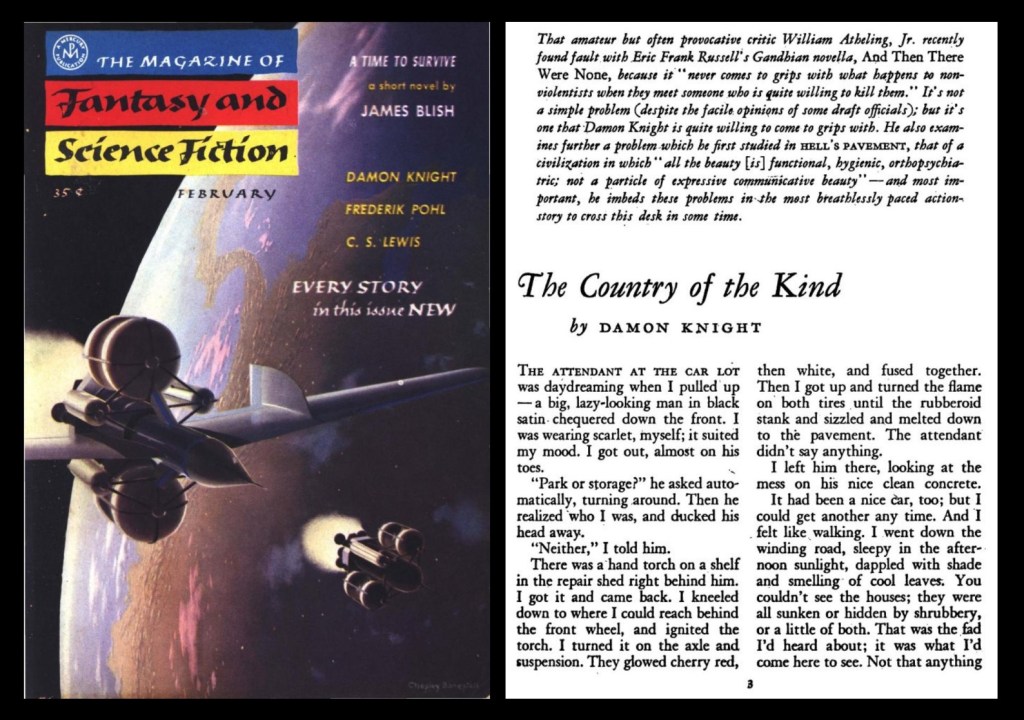
“The Country of the Kind” was first published in The Magazine of Fantasy & Science Fiction, February 1956. You can read it on Archive.org. It is story #5 of 22 for The Best SF Stories of 1956 group read. “The Country of the Kind” is one of the highest rated stories on The Classics of Science Fiction Short Stories v. 2 list, with eleven citations. It is by far the most remembered science fiction short story from 1956. Here are the eleven citations we used:
“The Country of the Kind” is set in an unnamed utopia and is told by an unnamed narrator. When the narrator was fifteen, he killed a girl who spurned him. In this utopian society they couldn’t punish him directly because it doesn’t allow violence. They fixed the narrator so whenever he tried to hurt someone else, he’d have an epileptic fit. And to warn others of his presence, his body odor and breath were made to smell repulsive. He was then left free to do whatever he wanted. For thirty years he has wandered about the Earth trying to retaliate by sabotaging other people’s activities or destroying their property. People ignored him, so he suffered endless loneliness. The narrator creates small works of art which he leaves everywhere with a message inviting other people to join him and be free.
My friend Mike sends me emails with comments about these 1956 science fiction stories since he doesn’t want to use Facebook. Here’s what he had to say:
A good science fiction tale draws you in completely, overriding your skepticism about the implausibility (or impossibility) of events.

Damon Knight asks us to accept the notion that a murderous psychopath is allowed by society to indulge himself in an endless destructive rampage. Although he is prevented from physically harming others by induced epileptic seizures, the community allows him to wreak havoc without restraint.

Perhaps Knight is exposing the passivity and weakness of that society, but it beggars the imagination that any group would allow such extreme behavior to go unchecked, no matter how kind and understanding they profess to be.

After the "king of the world" murdered his girlfriend named Elen when he was fifteen, he tells us "...if I could do it to Elen, I thought, surely they could do it to me. But they couldn't. They set me free: they had to."

Why did "they" have to? Are we to believe that a seemingly well run country is so "kind" that even a psychopath is allowed free rein? That's a bridge too far for me.
Remember, I talked about how believability was very important to me regarding science fiction when reviewing “Brightside Crossing.” I could understand why Mike didn’t think the world of “The Country of the Kind” was believable, but I said to him in a phone call, didn’t we both believe the world of “Brightside Crossing” was impossible? Yet, we still found the story believable. I asked him what crossed the line for him in “The Country of the Kind.” Mike said he just didn’t believe people would allow a person like the narrator in any society, that was too much for him to believe that people wouldn’t stop the narrator from damaging their property.
I said, wasn’t “The Country of the Kind” unbelievable in the same way “The Ones Who Walk Away from Omelas” is unbelievable, and didn’t you love that story? Mike replied that story was metaphorical.” I countered, doesn’t “The Country of the Kind” seem just as metaphorical in the same way? Both are about utopias that that are held together by the suffering of one person. After I said that, I even wondered if Ursula K. Le Guin wasn’t in some way inspired by “The Country of the Kind” when she wrote “The Ones Who Walk Away from Omelas.” Mike said he would reconsider “The Country of the Kind” as a metaphor. Maybe he will post a reply.
Are the fictional worlds of Brave New World, Nineteen Eighty-Four, or The Handmaid’s Tale believable? Aren’t they metaphorical too, because their authors have something to say about our reality? Dune, The Foundation trilogy, The Left Hand of Darkness and even The Man in the High Castle create worlds that we are asked to believe are realistic. Obviously, Alan E. Nourse wanted us to believe “Brightside Crossing” was realistic. But we aren’t expected to believe the fictional universes of The Hitch-Hiker’s Guide to the Galaxy or Sheckley’s Mindswap were realistic.
In other words, fantasy, humor, satire, and metaphorical fiction don’t ask us to believe their settings are realistic. But most literary works, especially of the mimetic type, and some kinds of science fiction do ask us to believe that they are reality based.
Of course, if “The Country of the Kind” is metaphorical, then what is the metaphor? That even kindness can cause great suffering. To be free in a utopia you need to be able to commit evil deeds. 1956 was a time of conformity in America, and many people were freaked out by juvenile delinquents, motorcycle gangs, and other nonconformists. Remember, a year later in 1957, On the Road by Jack Kerouac came out. Kerouac called his kind of nonconformists Beats, and society renamed them beatniks. A few years later, society turned against hippies too. I say On the Road wasn’t metaphorical. But I would say One Flew Over the Cuckoo’s Nest or Catch-22 are.
In the 1950s there was a lot of talk about crime being caused by society, and that criminals were a product of bad biology or a bad environment. Damon Knight’s unnamed narrator is an awful person, but he gets our sympathy. Unlike the tortured child in “The Ones Who Walk Away from Omelas,” the unnamed narrator isn’t the engine of utopia. Or is he? Wouldn’t a perfect utopia be dull and boring? What if evil is needed as the engine of goodness? I’m reminded of a phrase, “What if our world is their heaven?”
What if all fiction is metaphorical? What if “Brightside Crossing” was a metaphor for extreme adventurers?
Fiction is based on a suspension of disbelief. If Mike can’t suspend his disbelief that’s perfectly okay. If he doesn’t like “The Country of the Kind” does it matter that I do?
I’m fascinated by the nature of memory. I’m particularly fascinated by fiction that our culture remembers, like works by Jane Austen or Charles Dickens. But I’m also fascinated by the stories I find personally memorable. “The Country of the Kind” and “The Ones Who Walk Away from Omelas” are such stories. A year for now, I might forget “Brightside Crossing.” As I read and reread these old science fiction stories, I’m amazed by which ones I remember and which ones I don’t.
“The Country of the Kind” was voted into The Science Fiction Hall of Fame Volume One because it was so remembered by the first members of the Science Fiction Writers of America. I wish SFWA would poll their membership every ten years on their favorite stories. I’d love to see what every generation of science fiction writers remember.
With this December 2023 reading; it’s probably the fourth or fifth time I’ve read this story, I am somewhat sympathetic to the unnamed narrator of “The Country of the Kind.” I wasn’t before. I totally loathed the narrator. However, this time I still think his actions are still horrific, but I feel the utopian society has imposed a cruel and unusual punishment upon him.
And I’m still unsure of Knight’s intentions in writing this story. Whatever meaning it has could be entirely accidental. Knight might have thought of the situation without considering its implications.
The epileptic pain the narrator experiences is brought on by his own actions. But the loneliness is caused by the utopian society imposing the punishment. And this society is supposedly incapable of causing harm. Such a society would know that social contact is a necessity.
Writers often make their stories ambiguous but this one might be too unclear. I wonder if Knight has ever written an explanation of “The Country of the Kind.”
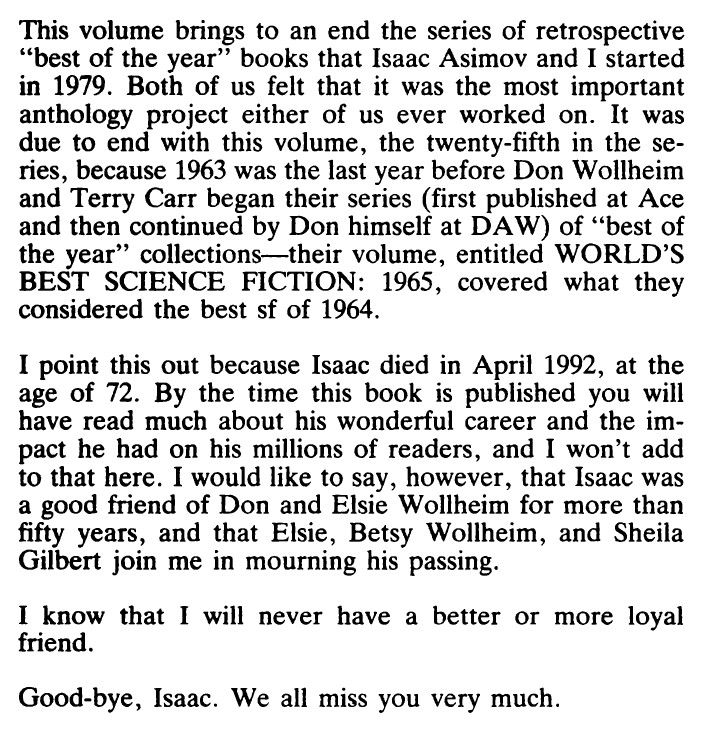
Isaac Asimov died on April 6, 1992. The Great SF Stories 25 (1963) was published in July 1992 and was the last volume in the series. On the last page Greenberg let us know:
I had assumed all along that Martin H. Greenberg (who died June 25, 2011) had been doing most of the editorial work for The Great SF Stories series, but felt that hunch confirmed when Isaac Asimov’s introductory comments went missing from volumes 24 and 25. I’ve now read volumes 1-18 and 25. I love this series. I read volume 25 out of order because my short story discussion group voted to group read it after Christmas.
This series has always been unique because Asimov and Greenberg were reevaluating the best stories of the year with many decades of hindsight. Here are the stories they picked as the best of 1963 from 1992:
Back in 1964, Judith Merril picked these stories as her favorites for 1963:
For some reason, Merril included “A Rose for Ecclesiastes” in her 10th Annual in 1965.
In 2022 the Classics of Science Fiction Short Stories list remembers 41 titles from 1963 in its database, but here are the stories that got at least two citations. 1963 wasn’t a remarkable year, especially since it takes eight citations to get on the final list. Meaning, only “A Rose for Ecclesiastes” is really remembered today.
After all these years, “A Rose for Ecclesiastes” is the obvious best SF story for 1963, and the one most remembered. Most science fiction fans discover it today in The Science Fiction Hall of Fame v1. “They Don’t Make Life Like They Use To” is another favorite, but it’s mostly forgotten in 2022, as is “New Folks’ Home.” “No Truce With Kings” won the Hugo for short fiction that year but I just don’t think it holds up or is remembered, even though the ideas within it are interesting. The more remembered Poul Anderson story should be “The Man Who Came Early.” The surprise story is “Turn Off the Sky” by Ray Nelson, however, it will probably only appeal to fans of the Beat writers.
I doubt many of these stories will get reprinted in the future. It’s a shame that The Great SF Stories 1-25 (1939-1963) hasn’t stayed in print. They are becoming collector items and can be a bit expensive to collect. Scans were available on the internet, but they’ve been taken down from the obvious places.
Below are my stories notes for the group discussion:
Story 01 of 13 – “Fortress Ship” by Fred Saberhagen If Magazine (January 1963) Retitled for collections as “Without a Thought” 1st story in the Berserker series
In not a very auspicious beginning to the Berserker series, “Fortress Ship” introduces us to the idea of alien intelligent robotic spaceships programmed to destroy all life in the galaxy — a doomsday weapon. This story was interesting because it proposed programming a game of checkers with boxes of colored beads and a set of cards for specific moves. The first computer checker game was in 1952. I wonder if Saberhagen knew about computers? The Berserker series is about AI minds, but I don’t know if that concept was known in 1963.
In “Fortress Ship” a Berserker ship the size of New Jersey is destroyed by three small human spaceships. I haven’t read the series, but I bet Saberhagen made it more difficult in later stories. Berserker minds understand human minds and can use our languages. I’ve read on Wikipedia that other alien species also fight the Berserkers. I’d like to read more in this series.
Rating: ***
Story 02 of 13 – “Not in the Literature” by Christopher Anvil Analog (March 1963)
Anvil imagines a world where people haven’t discovered electricity but are still trying to orbit a satellite. Not sure if the story takes place on an alternative history Earth or on another planet. But at the beginning of the story, the attack of a wasp-like creature called a drill on Alarik Kade suggested another world to me. On first reading, I thought the drill was some kind of assassin’s drone device. Rereading it makes me think it was only some kind of insect. That means it could be an alternate Earth story I suppose, where a wasp is called a drill.
I found the whole beginning of the story odd. It was a kind of slapstick physical comedy. It doesn’t match the tone in the second part of the story.
I assume Asimov and Greenberg liked this one because of the chemical-engineered world that couldn’t conceive of electricity. And that’s a neat idea. Especially trying to imagine how they could build a rocket with telemetry without electricity. On the other hand, the storytelling was disjointed at best.
Rating: ***+
Story 03 of 13 – “The Totally Rich” – John Brunner Wor
The setup for “The Totally Rich” reminded me slightly of “Vintage Season” or “Sailing to Byzantium” with Brunner imagining a class of rich people who live undetected by us ordinary folks. It reminded me of those classic stories because of the elite vacationers in time, and the elite far future citizens who party at one recreated city after another, are like the elite rich in this story, who can have nearly anything they want.
Derek Cooper is tricked by Naomi, one of the elusive rich in Brunner’s story. She’s had a whole picturesque village built with actors playing all the citizens just to fool Derek into working for her. That’s the power of her wealth. But she wants something impossible, something her money can’t even buy. She hopes Derek, given enough time and money can invent what she needs.
This is a great setup for a science fiction story. I thought it was going to be at least a 4-star story. But then, Brunner doesn’t satisfy my expectations, leaving me with a 3-star story.
I tend to think it would have taken a full novel to play out the idea Brunner began, and he didn’t want to do that. The quick tragic ending just didn’t work for me.
Rating: ***+
Story 04 of 13 – “No Truce With Kings” – Poul Anderson F&SF (June 1963) (Hugo Award – Best Short Fiction)
I was really looking forward to reading “No Truce With Kings” after enjoying Anderson’s “The Man Who Came Early” so much a couple weeks ago. Plus, Kings had won a Hugo, even though I find it impossible to believe it beat “A Rose for Ecclesiastes.”
Unfortunately, my expectations were misplaced. “No Truce with Kings” is too long, too muddled, and just too damn political. Did Poul Anderson really believe humans were better off living under feudal societies? Did he really want to downsize the government that much?
I thought “No Truce With Kings” was murky because I never could picture the battles, or even know which side to sympathize with. I wanted to side with the aliens, the nation builders, and even the feudalists.
If anything, this story made me feel humans are too stupid to deserve to survive. It glorifies war in the worst ways.
On the other hand, there’s lots of good writing in this story.
Rating: ***
Story 05 of 13 – “New Folks’ Home” – Clifford D. Simak Analog (July 1963)
“New Folks’ Home” is a lovely little tale that reminds me of WAY STATION, another Simak story about a human serving as a contact on Earth for an alien interstellar community. I identified with Frederick Gray because I’m seventy. It’s interesting that Simak was only 59 when he wrote this story. I guess it was his fantasy for old age.
Rating: ****+
Story 06 of 13 – “The Faces Outside” – Bruce McAllister If (July 1963)
Odd story about humans kept in a giant aquarium. As I read it I thought it would be a story that would fit in the VanderMeer anthology. Then I noticed that Merril had included it in her 9th Annual, which reinforces that thought. Not my cuppa tea.
Rating: ***
Story 07 of 13 – “Hot Planet” – Hal Clement Galaxy (August 1963)
“Hot Planet” by Hal Clement reminded me of “Brightside Crossing” by Alan E. Nourse, another hard SF story about surviving on Mercury. Both stories have been invalidated by time and newer science, but both still present good old fashion science fiction adventure.
What was significant about “Hot Planet” was Clement’s use of women scientists.
Rating: ***+
Story 08 of 13 – “The Pain Peddlers” – Robert Silverberg Galaxy (August 1963) (2nd story from this issue)
Silverberg’s writing in “The Pain Peddlers” is what I consider great hack writing. He’s obviously mastered the technique of writing short stories for the pulp/digest markets. This isn’t a great story, but it’s very readable and competently entertaining, and a solid addition to the magazine, even a worthy entry for an anthology, but to be honest, not one that will be remembered.
Rating: ***+
Story 09 of 13 – “Turn Off the Sky” – Ray Nelson F&SF (August 1963)
Wikipedia says Nelson was the guy who invented the propeller beany as a symbol for science fiction fans. It also says he gave LSD to Philip K. Dick. The F&SF intro said he was working on a book about beatniks in Chicago. I’d like to read that.
“Turn Off the Sky” was quite an interesting read, especially if it was written four years before it was published. Mainly for the satire on radicals and beatniks. It appears to be pro-capitalist, but I’m not sure. I thought it funny with its quip about arguing over Marx and Robert Heinlein.
The story was readable and fun, but it was more impressive in its dealing with the 1950s subculture, especially, anticipating a lot of stuff that happened in the 1960s counter-culture. It even has a sitar being played years before George Harrison made it famous.
Rating: ****
Story 10 of 13 – “They Don’t Make Life Like They Used To” by Alfred Bester F&SF (October 1963)
Linda Nielsen thinks she’s the last person on Earth. Like Ralph Burton, played by Harry Belafonte in the 1959 film THE WORLD, THE FLESH, AND THE DEVIL, Linda is fixing up her apartment by taking whatever she wants from a deserted New York City. I mention this movie because it’s a favorite movie and I pictured it as I read “They Don’t Make Life Like They Use To.” I love the last person on Earth stories. My all-time favorite novel is this type is EARTH ABIDES by George R. Stewart.
However, I’ve always thought it would be neat if the last person on Earth was actually the last person, but in these stories, someone else always shows up. In the movie, it was Sarah Crandall, played by Ingar Stevens. Since Bester describes Linda as Nordic, I wondered if he saw the movie with the Nordic Stevens and decided to just start with a blonde. Also, in the last people on Earth stories, the second person is generally of the opposite sex, so the plot develops sexual tension. In a number of these stories, a third person shows up. Usually, it’s two males fighting over one female. Another movie example of this is THE QUIET EARTH (1985).
Bester brings about an interesting twist in the end that finally convinces Jim Mayo and Linda Nielsen to get it on. This satisfies us readers who have been waiting for that action, but it wraps up the story too quickly, at least for me.
Rating: ****+
However, the ending reminds me of another last Adam and Eve story, “Quietus” by Ross Rocklynne. It’s in THE WORLD TURNED UPSIDE DOWN. Read it here:
Story 11 of 13 – “Bernie the Faust” – William Tenn Playboy (November 1963)
“Bernie the Faust” captures a certain time and place in New York City that I’ve only learned about indirectly from plays, movies, and books. It reminds me of stories about Seventh Avenue such as I CAN GET IT FOR YOU WHOLESALE, and makes me wonder if Willian Tenn was intentionally trying to create Jewish humor science fiction?
“Bernie the Faust” has a kind of funniness that needs to be acted out in a play or episode of the old TWILIGHT ZONE, or at least heard in an audiobook.
Rating: ***+
My favorite book by Tenn is OF MEN AND MONSTERS, which isn’t humorous. It’s a wonderful adventure tale that if you haven’t read, please don’t read about, not even the blurbs on the book cover. Everyone gives too much away.
Story 12 of 13 – “A Rose for Ecclesiastes” – Roger Zelazny F&SF (November 1963)
I’ve forgotten how many times I’ve read “A Rose for Ecclesiastes” over the past fifty years. I wish I could find the words to explain how much I admire this tale. This time as I read the story, I was noticing how effective Zelazny was using short and medium-length sentences to convey information but imply a great deal more. My own prose is too verbose. Zelazny isn’t Shakespeare, or even particularly literary, but he moves the story along without wasting words.
Rating: *****
Story 13 of 13 – “If There Were No Benny Cemoli” – Philip K. Dick Galaxy (December 1963)
As I read this story, I marveled that Philip K. Dick even imagined this story. What a creative mind. Earth has been through an atomic war. Human colonists from Mars have returned to rebuild civilization, but their work is interrupted by another faction of human colonists from Proxima Centauri returning to Earth to rebuild civilization. There is political strife between the two groups. A neat invention in this story is a kind of AI that produces The New York Times. It seems to know everything going on in the world and influences the rebuilding of civilization.
Story #56 of 107: “Vaster Than Empires and More Slow” by Ursula K. Le Guin
Our group has read this story before, and I reviewed it for my essay “What Makes a Great SF Short Story?” I had quite a lot to say, so I don’t see any reason to repeat myself. But I will say it’s a solid 5-star story and enjoyed rereading it. Again, it makes me want to read or reread Le Guin’s Hainish series of novels. I’m retired and I still can’t find time to read everything I want.
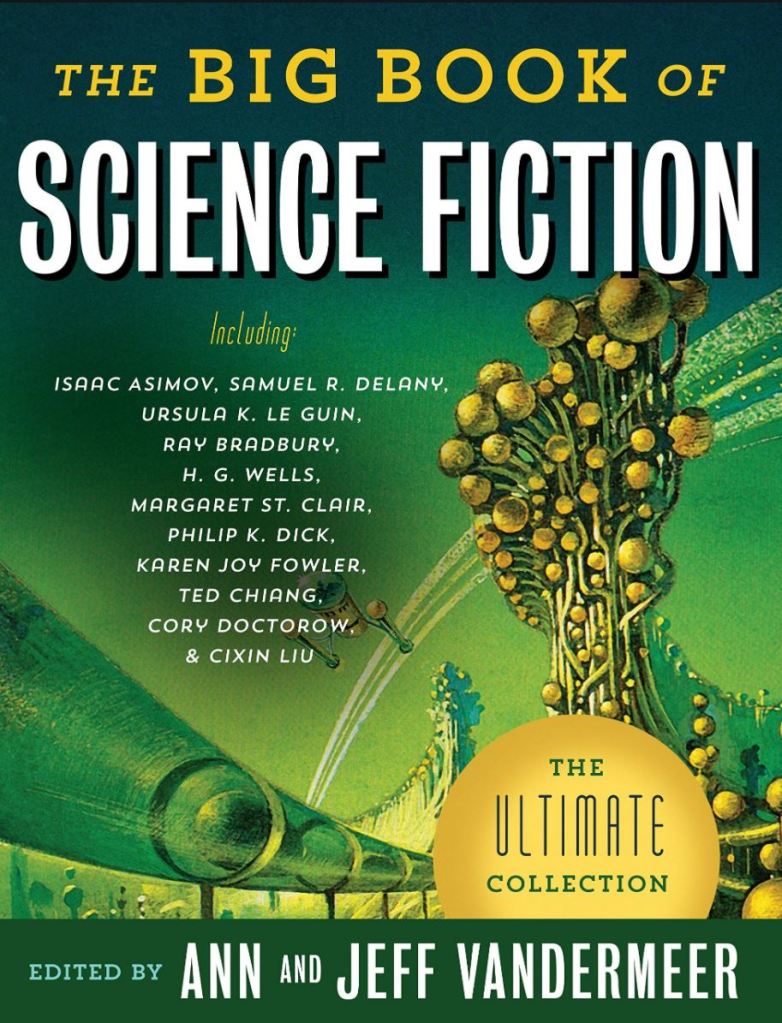
We’ve just passed the 50% counter on my Kindle edition of The Big Book of Science Fiction. What a long journey so far. What a long way to go. I’m no longer reading a short story a day for the group, but just reporting on stories every other day for this anthology. I’m taking that day off to read stories I find on my own.
Paul is doing Christmas-related science fiction stories on those alternate days. I feel bad about skipping out on his group read. However, after Christmas he wants me to lead the group read for The Great SF Stories 25 (1963) edited by Isaac Asimov and Martin Greenberg. I’m looking forward to that. I started reading The Great SF Stories 1 (1939) in 2018 and I’m currently up to The Great SF Stories 18 (1956). The group voted for volume 25, so I’ll jump ahead. Thus, I’ll be back to reading and reporting on a story a day for the group.
The Sinister Science blog just finished reading the Great SF series. That’s quite an accomplishment. George Kelley blogged about reading the series a couple years ago. If you’re into old science fiction and love short stories, The Great SF Stories is a fun reading project. Unfortunately, the books are out-of-print and they’re starting to get pricey on the used book market. All 25 are available in the pdf format on the web if you search around. I don’t link to them because that might cause a take-down. Here’s my list of the stories with links to ISFDB, and my review of The Great SF Stories 1 (1939). Austin Beeman is also reviewing the series.
I’m hoping our Facebook group will eventually discuss all 25 volumes.
I was reading The Great SF Stories 18 (1956) edited by Isaac Asimov and Martin H. Greenberg when I got diverted by the group reading of The Big Book of Science Fiction edited by Ann and Jeff VanderMeer. I had left off at the beginning of “Rite of Passage” by Henry Kuttner and C. L. Moore. The story originally appeared in the May 1956 issue of F&SF and might be Kuttner’s last SF magazine publication before he died in 1958. It was the last story that Asimov and Greenberg ran in their Great SF series by the husband and wife team.
I’ve been reading The Great SF Stories 1-25 (1939-1963) in order since 2018 and want to get back to that series and finish it. This really is a great anthology series but they’re out of print. That’s a shame. You can find them on ABEbooks and eBay but they are going up in price every year. There are pdf copies on the net if you look around. I wish DAW would reprint them and get someone to continue the series. Robert Silverberg did do #26 (1964) with Greenberg for NESFA Press which connects nicely into Wollheim/Carr’s World’s Best Science Fiction anthology series that began in 1965. However, I like how Asimov and Greenberg were reevaluating SF stories for each year decades after the fact.
I can’t say I agree with all their choices. “Rite of Passage” is a well-written tale full of ideas but little emotion, something I’ve been talking about lately. Lloyd Cole is the Black President for the Communications Corporation. Kuttner and Moore have imagined a future where people believe in magic, and Cole is the president of black magic. Corporations also have white presidents.
Here’s the kicker, magic isn’t real, but everyone believes in it. Cole’s job is to cast evil spells under contract for his clients. “Rite of Passage” is about how Cole wants to get revenge on a man who stole his wife by appearing to kill him for a client, thus providing a cover-up for his own intentions.
“Rite of Passage” is rather long, a novelette that feels like a novella. Most of the content is world-building Kuttner and Moore use to flesh out the background of the story. I only enjoyed two pages of the story, which I believe is the inspiration that Kuttner and Moore used for writing the story:
Evidently, the stress of 20th-century life made people lose their critical thinking abilities embracing magic, with corporations exploiting that vulnerability. This is a neat idea. It’s even somewhat prophetic, but political parties are exploiting peoples’ irrationalities. This neat idea is not enough to give this story a heart. Lloyd Cole is not a nice guy, so we’re not sympathetic for his devious efforts to get his wife back. It’s somewhat ironic that others use magic against Cole, and he succumbs even though he knows magic is not real.
“Rite of Passage” is a case where the story is dominated by ideas, appealing only to our intellect. I’m sure some readers will find it amusing and even entertaining. Obviously, Asimov and Greenberg did, but I didn’t. If I had felt for Lloyd’s love for Lila, I might have cared more. Lila drives Lloyd’s revenge, but she’s only an idea, not a real character. It’s a shame that “Rite of Passage” didn’t have the depths of emotions shown in “Vintage Season.” They both seem to have the same amount of world-building.
The classic science fiction story from 1956 that Asimov and Greenberg did include having powerful emotions is “The Country of the Kind” by Damon Knight. It’s doubly impressive because the protagonist is truly unlikable. Yet Knight eventually gets us to sympathize with him.
Probably the most remembered SF story today from 1956 is “The Last Question” by Isaac Asimov. It’s another intellectual story, but it has a tremendous sense of wonder, the favorite emotion of science fiction readers.











 Classics of Science Fiction