Story #15 of 107: “Tlön, Uqbar, Orbis Tertius” by Jorge Luis Borges
“Tlön, Uqbar, Orbis Tertius” by Jorge Luis Borges is not science fiction. Some might call it fantasy, but I don’t think it belongs to that genre either. Oh, it’s a story F&SF could publish, but I doubt it’s eerie enough that Rod Sterling would have used it for The Twilight Zone. By accident, “Tlön, Uqbar, Orbis Tertius” speculates about what science fiction does, as if Borges’s story is about a man who stumbles upon the possibility of science fiction and science fiction writers in a world where they never existed.
I don’t think our genre can claim all forms of speculation, even when it speculates about other worlds, other realities, and weird possibilities that are the territory that science fiction has long claimed. “Tlön, Uqbar, Orbis Tertius” is not genre, but a literary work. Literary writers sometimes accidently wander into our territory, and some even intentionally write a science fiction story, such Klara and the Sun by Kazuo Ishiguro, or The Handmaid’s Tale by Margaret Attwood. But in the case of “Tlön, Uqbar, Orbis Tertius” I don’t believe Borges has trespassed on our property.
Sure, maybe I’m splitting hairs, but it points to a distinction I’d like to make. Literary works are aimed at everyone, science fiction is aimed at science fiction fans. That’s why it’s a genre. Ishiguro and Attwood expect everyone to read their books, not just science fiction fans. And although science fiction writers wished that everyone read their books, they got to know they’re writing for a specific audience. Science fiction is a term used to shelve books separately in libraries and bookstores, to make it easier for its readers to find them. Science fiction is the term printed on books to assure science fiction readers they’ll be buying what they want to read. Branding something science fiction that’s not meant to be science fiction is unfair to both the writer and reader.
“Tlön, Uqbar, Orbis Tertius” is a story science fiction readers should like because it’s about playing around with reality, which is what science fiction does, but I’m pretty sure Borges never intended it to be science fiction. It’s almost as if he separately co-invented the concept, but his story is still not quite the same.
By the way, “Tlön, Uqbar, Orbis Tertius” reminds me of a charming episode of Nova I saw decades ago about physicist Richard Feynman and friends making an expedition to an obscure unknown country, Tannu Tuva.
Borges is playing on the idea of obscure knowledge and hidden wisdom. His story also reminds me of Herman Hesse’s Journey to the East. We all want reality to be more than the mundane reality that bores us. We all want to find a hidden clue to esoteric possibilities. If anything, “Tlön, Uqbar, Orbis Tertius” is another kind of SF – spiritual fiction because it alludes to the magic of the mystical.
Story #14 of 107: “The Microscopic Giants” by Paul Ernst
The VanderMeers didn’t have to go far to find “The Microscopic Giants.” It was in the same October 1936 issue of Thrilling Wonder Stories that the last story we just read had been reprinted (“The Last Poet and the Robots” retitled as “Rhythm of the Spheres”) . I’ve often wondered why anthologists focused so much on Astounding Science Fiction, but these two stories suggest that there was a good reason – science fiction stories in the other pulp magazines just wasn’t as good. The whole time I was reading “The Last Poet and the Robots” I wondered why the VanderMeers hadn’t picked Sturgeon’s “Microcosmic God” instead. It featured the same kind of monomaniacal megalomaniac mad scientist acting like a god, but in a much better developed tale.
However, “The Microscopic Giants” is a somewhat better story than Merritt’s. It’s still a crappy story by modern storytelling conventions, but it has several good SF speculations in it. I’ve always liked the idea of humans existing in the far past where geological changes hides any evidence of them. Unfortunately, that theory isn’t the solution to the mystery within this story. The introduction sets us up for a hollow Earth story, but it’s not that either. “The Microscopic Giants” is about lifeforms that are much denser than rock, existing deep within the Earth, who can move through ordinary matter. That’s a keen idea, but it was handled in the most basic way. First contact is simplistic and xenophobic, and the humans are left hoping never to encounter this new superior species again. Rather a chickenshit resolution.
Finding better undiscovered stories is the challenge to assembling any retrospective anthology that covers science fiction in the 20th century, especially if you have reasons not to reprint the fan favorites. All the old pulps have been mined time and time again. I’m sure new editors want to discover previously unrecognized stories whose enlightened qualities could only be recognized by contemporary readers. These two stories were duds in that regards. Like I said, the current champ for a SF story about a monomaniacal megalomaniac mad scientist acting like a god is Kidder in “Microcosmic God” by Theodore Sturgeon.
If I was going to offer a substitute for “Microscopic Giants” using the hollow Earth theme it would be “DP!” by Jack Vance from the April 1953 issue of Avon Science Fiction and Fantasy Reader. It’s about the world being overrun with refugees from the hollow Earth and how countries of the surface world try to deal with the crisis. I read it during the Syrian refugee crisis which gave “DP!” depth. “Microscopic Giants” offer no insights to modern readers and it’s really not worth saving.
However, I can’t think of any short stories that deal with super-dense beings living and moving around inside the Earth. The Star Trek episode “The Devil in the Dark” featured a creature called the Horta that could move through rock. And I also thought of the classic comedy-horror film Tremors (1990). I do vaguely remember stories that used the emptiness of matter to allow characters to move through solids, but my old brain can’t dredge any titles up right now.
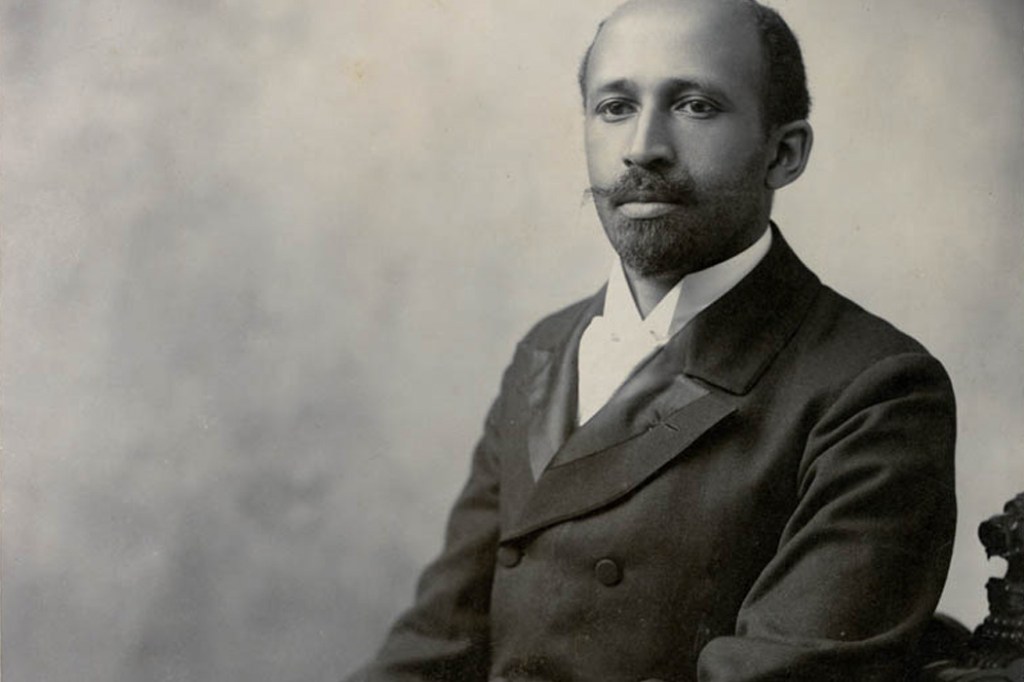
Reading The Big Book of Science Fiction has been interesting, but so far few of the fourteen stories we’ve read have been quality stories by modern reading standards. Too many have been intellectual/historical curiosities. I keep hoping the VanderMeers will find gems I haven’t read before. So far, their best find new to me is “The Comet” by W. E. B. Du Bois. I thought his story was well-told for 1920, and Du Bois nicely finessed the point he wanted to get across. So far the other stories have done little finessing.
Paul Ernst had several ideas he wanted to explore, but he didn’t know how to put them into a story. His solution was a minimalist frame with cliché conflict. That’s common for our genre. I’m also listening to The Best of Walter M. Miller, Jr. and with every story I’m amazed by how Miller sets up his story with an excellent dramatic conflict. Well, at least the later stories. I’m hoping to see more of that skill as we progress through this anthology.
Story #13: “The Last Poet and the Robots” by A. Merritt
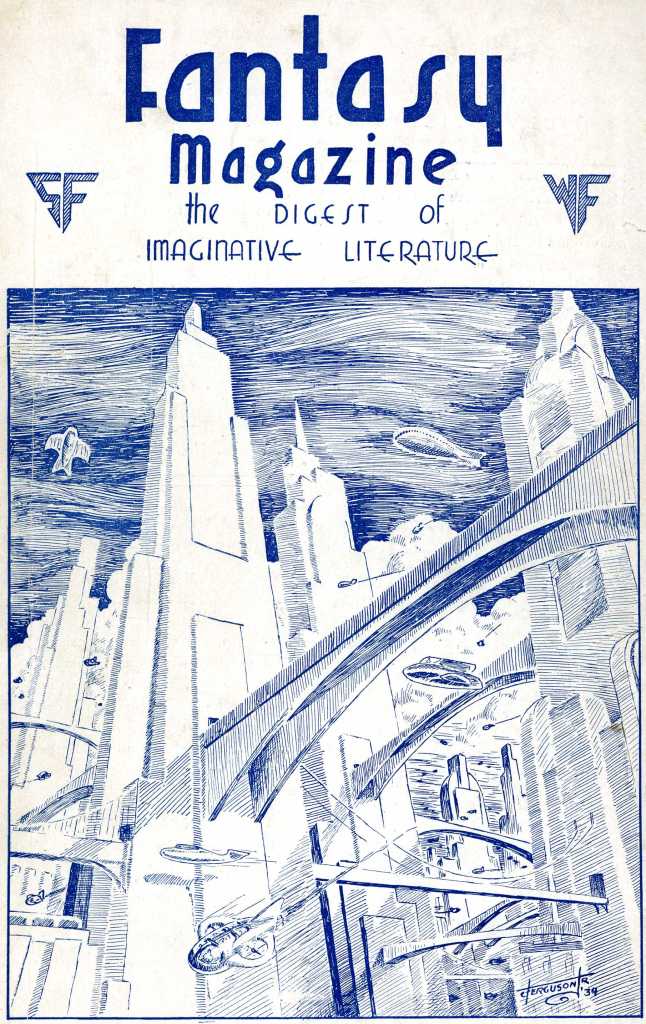
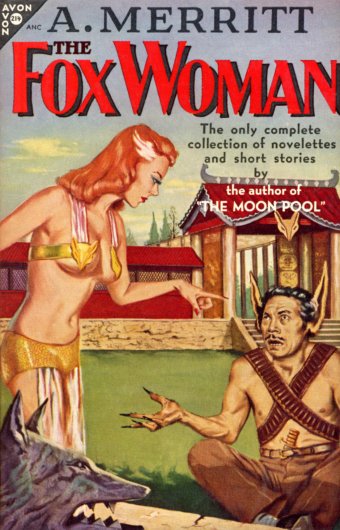
“The Last Poet and the Robots” by Abraham Merritt has a rather interesting publication history. It was part of a round-robin novel first published in the April 1934 issue of Fantasy Magazine, a fanzine. The website The Cosmos Project gives the history of the story and reprints the novel written chapter-by-chapter by 18 famous SF writers from the early 1930s. Besides Merritt, John W. Campbell, E. E. “Doc” Smith, and Edmond Hamilton contributed, as well as many authors whose names aren’t familiar today. “The Last Poet and the Robots” was chapter 11, and many consider it the best chapter. It was the only chapter to be reprinted as a story in a professional magazine (Thrilling Wonder Stories, October 1934). In 1949 it was published in book form in the collection The Fox Woman.
What’s notable about “The Last Poet and the Robots” is it’s a very early story about robots, especially mechanical robots with conscious minds. We get the word “robot” from the 1921 Czech play, R.U.R., that was first translated into English in 1923. It’s amazing how fast this word was embraced around the world. Mechanical men and other android like beings had existed before. In the play, the robots are slave workers that have a biological basis, closer to the replicants in Blade Runner. In the 1920s and 1930s the idea of mechanical robots came into being but they weren’t sentient at first. And the term “artificial intelligence” emerged from computer science in the 1950s. So Merritt might get some credit here with this 1934 story. It would be interesting to trace the history of sentient machines in science fiction.
The story also presents a number of common science fiction themes from that era such as the mad scientist, evolved humans, immortality, robot overlords, a subterranean world, and super-science technology. Unfortunately, I didn’t find the story particularly interesting or memorable. It was somewhat forward thinking that the super-beings are multiracial, but aren’t they really monsters? Narodny, the Russian mad scientist and poet, and ruler of the renegade super-humans, feels no qualms at killing normal humans when needed, even when trying to save humanity from the robots. That was a common aspect to superior beings in SF back then, they had god-like attitude regarding life and death. Merritt describes him like van Vogt’s evolved beings in his novel Slan.
Narodny did not hate mechanization. He was indifferent to it. Being truly intelligent he hated nothing, Also he was indifferent to the whole civilization man had developed and into which he had been born. He had no feeling of kinship to humanity. Outwardly, in body, he belonged to the species. Not so in mind. Like Loeb, a thousand years before, he considered mankind a race of crazy half-monkeys, intent upon suicide. Now and then, out of the sea of lunatic mediocrity, a wave uplifted that held for a moment a light from the sun of truth—but soon it sank back and the light was gone. Quenched in the sea of stupidity. He knew that he was one of those waves.
Later on Merritt continues his characterization of Narodny as a superman.
All were one with Narodny in indifference to the world; each with him in his viewpoint on life; and each and all lived in his or her own Eden among the hundred caverns except when it interested them to work with each other. Time meant nothing to them. Their researches and discoveries were solely for their own uses and enjoyments. If they had given them to the outer world they would have only been ammunition for warfare either between men upon Earth or men against some other planet. Why hasten humanity's suicide? Not that they would have felt regret at the eclipse of humanity. But why trouble to expedite it? Time meant nothing to them because they could live as long as they desired—barring accident. And while there was rock in the world, Narodny could convert it into energy to maintain his Paradise—or to create others.
This kind of evolved human is something science fiction presented time and again in roughly the same way. After van Vogt’s book came out, some science fiction fans called themselves slans. And L. Ron Hubbard’s Dianetics: The Modern Science of Mental Health (1950) promised to be a kind a pseudo-science guide to creating such a being. John W. Campbell, Jr. and A. E. van Vogt went nuts over it. These superior being characters are especially repugnant when we remember the 1920s and 1930s was the time of eugenics, KKK, and National Socialists. Robert A. Heinlein used a similar superior being in his novella “Gulf” in 1949, which was a test flight for Stranger in a Strange Land.
I’m kind of surprised that the VanderMeers used this story, since their selection process attempts to show science fiction’s past in a better light than its current reputation for sexism and racism. Merritt does present Narodny as a poet/artist/creator though, so I’m sure he didn’t think of his character as being repugnant like I do. This description of Narodny’s creations and interests makes him epic and god-like, but his portrayal as a monomaniacal megalomaniac worries me.
But deep down in earth, within the caverns, were music and song and mirth and beauty. Gossamer nymphs circled under the little moons. Pan piped. There was revelry of antique harvesters under the small suns. Grapes grew and ripened, were pressed, and red and purple wine was drunk by Bacchantes who fell at last asleep in the arms of fauns and satyrs. Oreads danced under the pale moon-bows and sometimes Centaurs wheeled and trod archaic measures beneath them to the drums of their hoofs upon the mossy floor. The old Earth lived again.

Narodny listened to drunken Alexander raving to Thais among the splendors of conquered Persepolis; and he heard the crackling of the flames that at the whim of the courtesan destroyed it. He watched the siege of Troy and counted with Homer the Achaean ships drawn up on the strand before Troy's walls; or saw with Herodotus the tribes that marched behind Xerxes—the Caspians in their cloaks of skin with their bows of cane; the Ethiopians in the skins of leopards with spears of antelope horns; the Libyans in their dress of leather with javelins made hard by fire; the Thracians with the heads of foxes upon their heads; the Moschians who wore helmets made of wood and the Cabalians who wore the skulls of men. For him the Eleusinian and the Osirian mysteries were re-enacted, and he watched the women of Thrace tear to fragments Orpheus, the first great musician. At his will, he could see the rise and fall of the Empire of the Aztecs, the Empire of the Incas; or beloved Caesar slain in Rome's Senate; or the archers at Agincourt; or the Americans in Belleau Wood. Whatever man had written—whether poets, historians, philosophers or scientists—his strangely shaped mechanisms could bring before him, changing the words into phantoms real as though living.

He was the last and greatest of the poets—but also he was the last and greatest of the musicians. He could bring back the songs of ancient Egypt, or the chants of more ancient Ur. The songs that came from Moussorgsky's soul of Mother-earth, the harmonies of Beethoven's deaf ear, or the chants and rhapsodies from the heart of Chopin. He could do more than restore the music of the past. He was master of sound. To him, the music of the spheres was real. He could take the rays of the stars and planets and weave them into symphonies. Or convert the sun's rays into golden tones no earthly orchestras had ever expressed. And the silver music of the moon —the sweet music of the moon of spring, the full-throated music of the harvest moon, the brittle crystalling music of the winter moon with its arpeggios of meteors—he could weave into strains such as no human ears had ever heard.

So Narodny, the last and greatest of poets, the last and greatest of musicians, the last and greatest of artists—and in his inhuman way, the greatest of scientists—lived with the ten of his choosing in his caverns. And, with them, he consigned the surface of earth and all who dwelt upon it to a negative Hell—Unless something happening there might imperil his Paradise!
I’m not really familiar with Merritt’s work. I’ve read quite a bit about his popularity, but not his famous novels, which are now mostly forgotten. From what the VanderMeers say in their introduction, he was a lot more successful than I knew. Merritt’s biography at Wikipedia is quite fascination. It says he was a major influence on H. P. Lovecraft and Richard Shaver. That combination right there makes me wonder though. He even influenced the creators of the game Dungeons and Dragons.
Story #12: “A Martian Odyssey” by Stanley G. Weinbaum
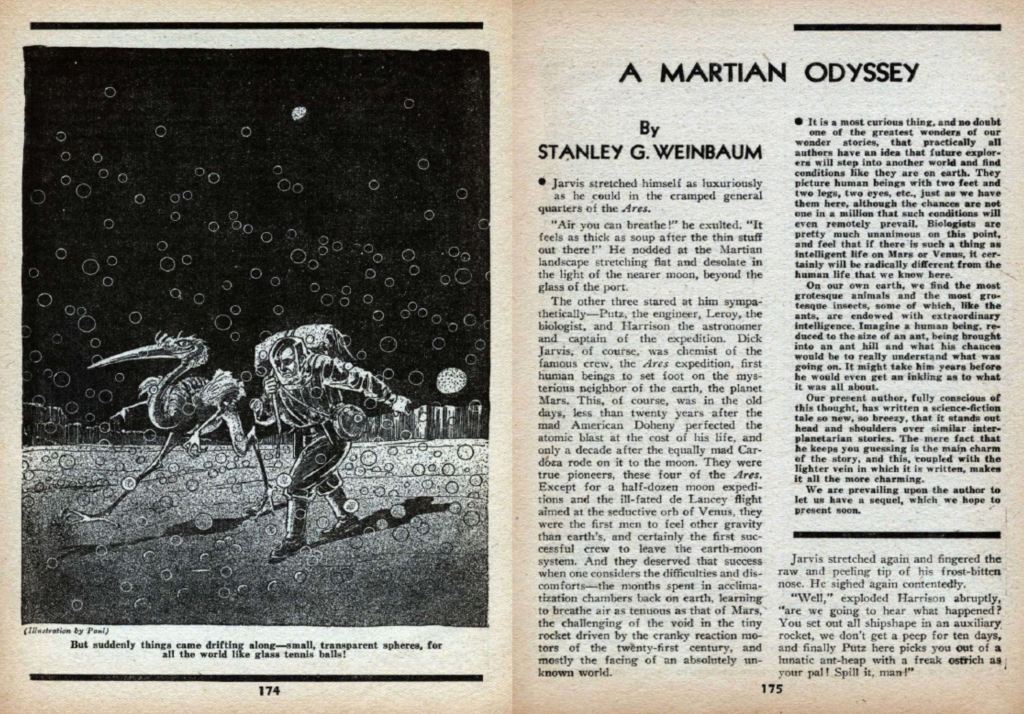
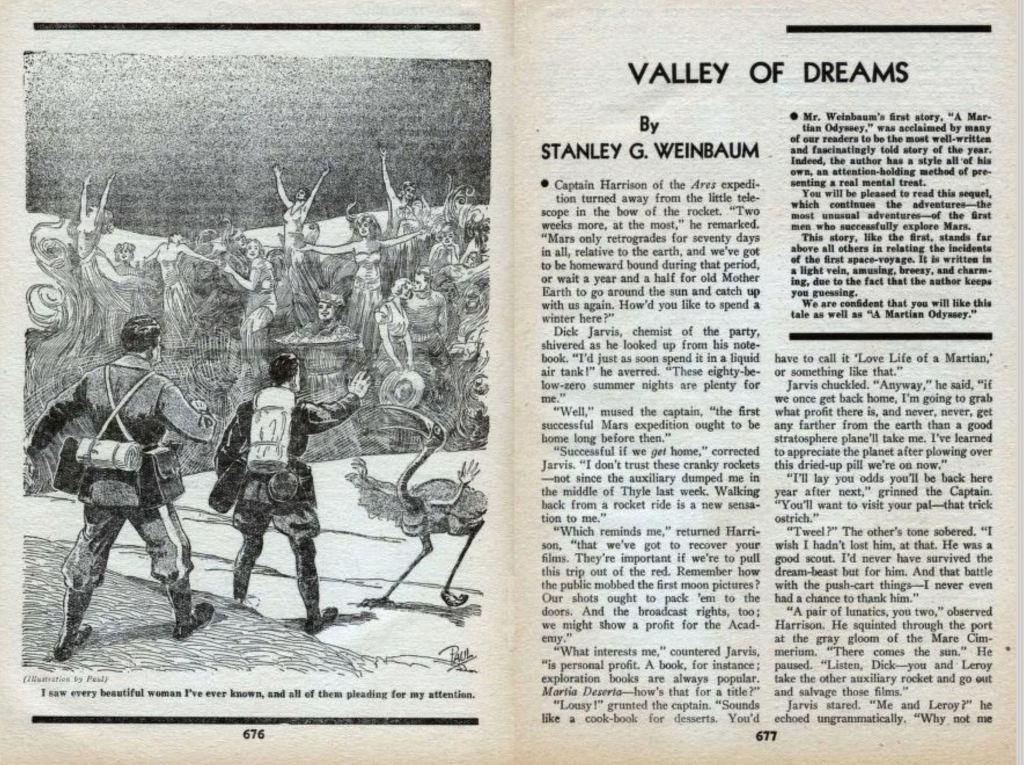
This is the fifth time I’ve read “A Martian Odyssey” and the third time reading “The Valley of Dreams,” the lesser known second part of the story. It’s a shame the Mars of that story isn’t the Mars that NASA’s rovers explore. Humans have been piddling around in LEO since 1972 when all along we’ve known that Mars is our real destination. Maybe we haven’t gone because we know the Mars out there isn’t the Mars of Stanley Weinbaum or Ray Bradbury.
I’m watching For All Mankind on Apple TV+. It’s an alternate history story that begins in 1969 when the Russians become the first nation to land men on the Moon. Our failure spurs us to build a permanent base on the Moon, and from then on, history keeps changing. I call this kind of story a “I could of been a contender” tale after the Marlon Brando character in On the Waterfront. Ever since Apollo 17 space enthusiasts have wondered what could have been if we’d kept going. This show soothes those regrets. I’m seeing more science fiction that retells recent history but with better results. Mary Robinette Kowal is doing the same thing with her Lady Astronaut series.
The alternate history I’d want to relive would be where “A Martian Odyssey” was incorporated into our reality, and not fiction. My favorite era of science fiction is from “A Martian Odyssey” from 1934 to “A Rose for Ecclesiastes” by Roger Zelazny in 1963. Those two stories are the alpha and omega in the table of contents for The Science Fiction Hall of Fame Volume One edited by Robert Silverberg. That’s where I first read “A Martian Odyssey” over fifty years ago.
What can I say about “A Martian Odyssey” that hasn’t been said before? If you haven’t read it and its sequel “Valley of Dreams” from the November 1934 issue of Wonder Stories, then go read them here and here. And if you don’t want to do that, here’s an excellent summary of “A Martian Odyssey” at Wikipedia.
What I want to write about is the legacy of the story. “A Martian Odyssey” was first published in Wonder Stories, July 1934, and then reprinted just five years later in Startling Stories, in the November 1939 issue. Then in 1943, Donald Wollheim reprinted it in The Pocket Book of Science Fiction, a book some consider the first real SF anthology. But the next jump is a big one, when members of SFWA voted it into The Science Fiction Hall of Fame Volume One in 1970. Why hadn’t Groff Conklin, or any of the other classic anthology editors of the 1950s and 1960s reprinted it? Did they feel that everyone had a copy of Wollheim’s 1943 paperback, or bought the 1949 hardback, A Martian Odyssey and Others from Fantasy Press (or its Lancer paperback reprint in the 1960s)? After that big gap from 1943-1970, “A Martian Odyssey” has been regularly reprinted almost every year or two since.
“A Martian Odyssey” is now considered a classic. This novelette epitomizes science fiction about Mars. But is it really about Mars? Well, not the Mars NASA explores. Martians aren’t quite as well known in literature as ghosts, goblins, fairies, elves, wee folk, and other imagined creatures of fantasy, but almost. Mars has always been our best hope for another planet for humanity, one where our sense of wonder runs rampant. Once all of Earth had been explored in the early 20th century, Mars became the location for lost civilizations and exotic lands.
“A Martian Odyssey” is a first contact story and all it involves. Tweel is everybody’s favorite alien. “A Martian Odyssey” anticipates both ET and Arrival. And I think that’s the heart of what I’m trying to get at in these essays. The best science fiction stories are those that come closest to the ideal forms of science fiction. And, like I said before, I believe the ideal forms of our genre are not very many. Mars has become the ideal planet, but the ideal doesn’t have to be Mars. Like Tweel is the ideal first contact with an alien, but the ideal doesn’t have to be Tweel.
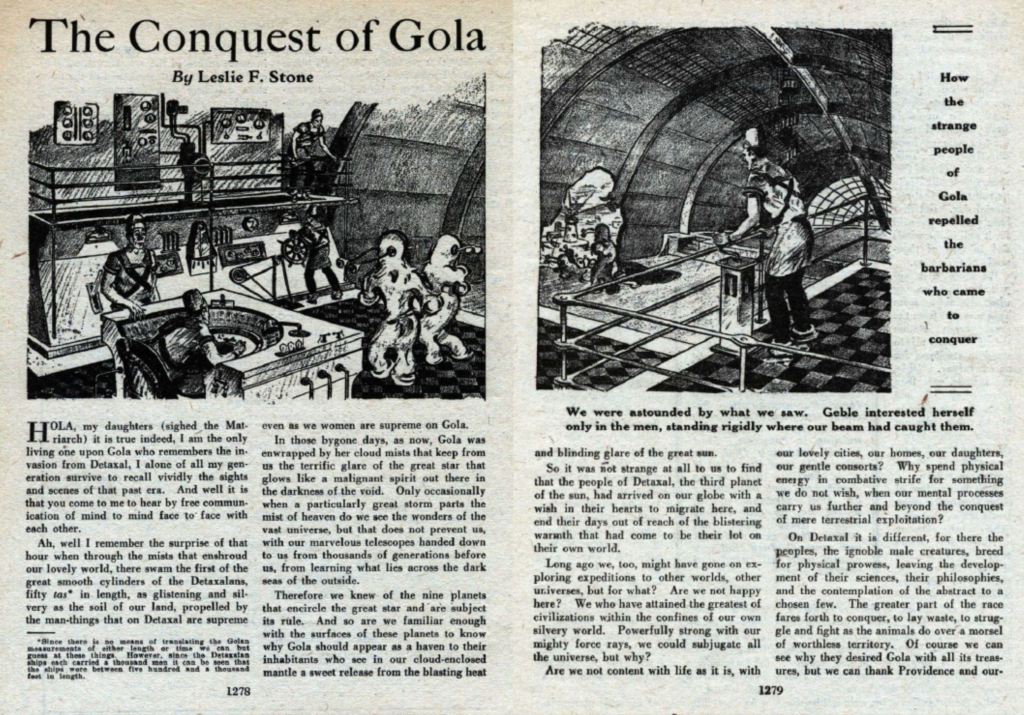
Then why isn’t “The Conquest of Gola” remembered as well? Why don’t we remember Venus and the first contact with Golans from that story like we do Mars and Tweel from “A Martian Odyssey?” Even though the females from Gola are described as being very interesting beings, they weren’t likable. And their world, Venus wasn’t appealing either.
Dick Jarvis, the human that befriends Tweel has a great adventure on Mars, seeing many wonderous things and beings. Mars is as magical as Oz. “The Conquest of Gola” reminds us of the battle of the sexes on Earth. It reminds us that humans exploit other lands and peoples for profit. It reminds us we’re violent, intolerant, and can’t communicate.
If you want to write an enduring science fiction classic be positive. Make the humans, aliens, and planet appealing. We want enchantment more than scolding. I first fell in love with Mars when I read The Red Planet by Robert A. Heinlein in 1964. I was twelve. It had Willis and the Old Ones, mysterious Martians, and Mars was full of exciting adventures for Jim and Frank. However, Heinlein’s bad guys, the bureaucrats from Earth contrasted the bad old ways of Earth against the good life of pioneers on the red planet. That worked. Leslie F. Stone just didn’t inspire us to colonize Venus.
Finally, I don’t know why “Valley of Dreams” isn’t nearly as popular as “A Martian Odyssey since it continues the same story.
Story #11: “The Conquest of Gola” by Leslie F. Stone
“The Conquest of Gola” first appeared in the April, 1931 issue of Wonder Stories, but more importantly, it was reprinted in The Best of Science Fiction edited by Groff Conklin, one of two giant retrospective anthologies published in 1946, the other being Adventures in Time and Space edited by Healy & McComas. Those two volumes were widely acquired for library collections. Over the next three decades, baby boomers would discover those anthologies and others, learning about the history of the science fiction magazines, and expand the growing population of science fiction fans. Conklin was the John the Baptist of the genre, editing over forty anthologies from 1946-1968. I loved his anthologies growing up, always searching for them when I went to a library. (See “Why Anthologies are Important to Science Fiction.”)
In recent years “The Conquest of Gola” has been reprinted many times in both genre retrospectives and anthologies showcasing women science fiction writers. Beside being written by a woman in the early days of pulp science fiction, it’s also about a matriarchal society on Venus. Story #11 is the second tale featuring a female dominated utopia. However, in both stories, it was a dystopia for the males.
In “The Conquest of Gola,” Gola is the planet Venus, which is ruled by female super-beings. Males are considered gentle consorts, kept for pleasurable companionship. When two ships from Earth arrive, crewed only by men who want to exploit Venus by promoting trade and tourism, the female rulers of Venus are annoyed. They see males from our planet as vastly inferior. They assume the females of Earth have allowed their males extra freedom and gave them spaceships as playthings. When the rulers of Gola discover the Earthmen are the dominant gender from our planet, that blows their minds. After repeatedly being told to leave, the Earthmen turn to violence, destroying the capital, and conquering the other cities. Earthmen then start convincing the males of Gola to join them. Finally, the females of Gola have enough, kill all the humans, and put their males back in their old roles, and live happily ever after.
“The Conquest of Gola” is a pretty good yarn, a bit clunky sounding today because of the typical writing quality common to SF pulps back then. Yet, it has many interesting bits of speculation. First, and this was common for the time, was the idea that superior beings possessed telepathy and other extrasensory powers. “The Man Who Evolved” was in the same issue of Wonder Stories. That’s another SF theme I’d like to trace over time. Second, is the focus on gender. Like in “Sultana’s Dream,” males are considered stupid and violent, whereas females are peaceful and intelligent, the obvious gender to be lead society. But I don’t think that originated in science fiction. People have long speculated what it would be like if women ruled the world. Another idea in the story I’ve seen in other SF stories, is the belief that once a species reaches a certain level of maturity, it will become less materialistic. The inhabitants of Gola had spaceships long ago but gave them up.
Reading this story has me thinking about building a subject database for the science fiction stories I read. I struggle with memory. First, I’m getting old, and my recall is flaky, but second, I’ve read thousand of science fiction stories. Often, I only vaguely remember a story by a particular topic, and can’t remember the title or author. I’d love to have a database that would allow me to retrieve stories by themes, topics, or subjects. For example, list all stories about societies ruled by women. That query should help me remember “Sultana’s Dream” and “The Conquest of Gola.”
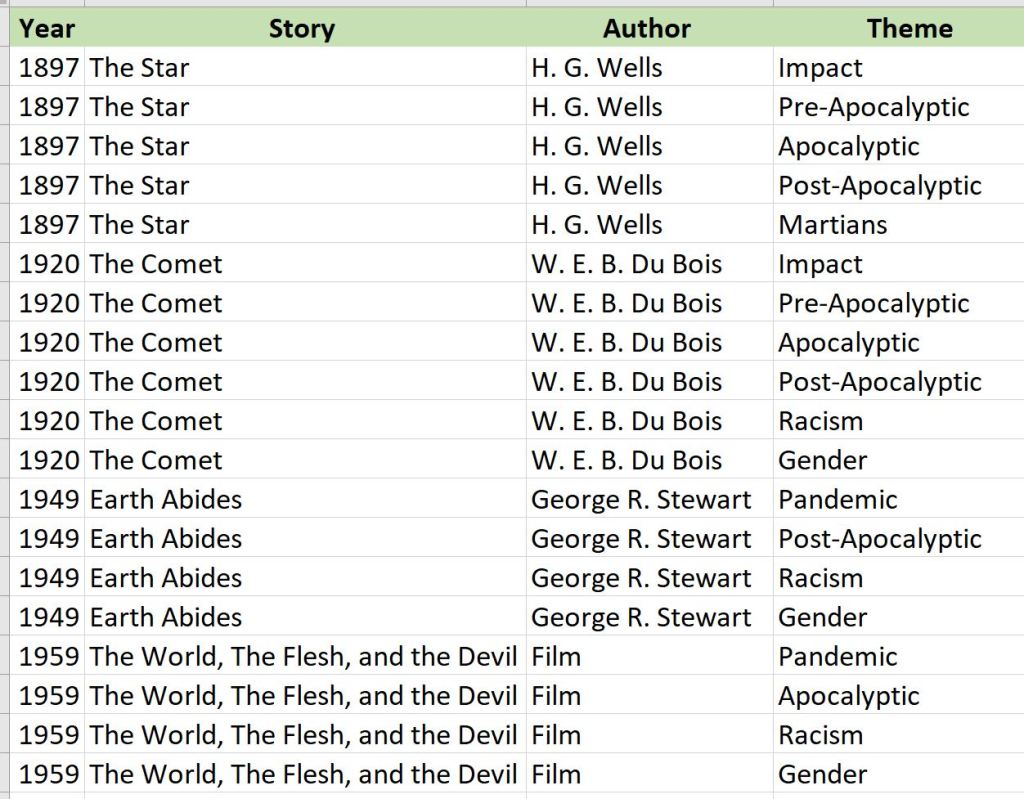
I showed a spreadsheet sample for remembering subjects when I reviewed “The Comet” by W. E. B. Du Bois. That was a quick and dirty solution, but to really get the job done would require a relational database because I’d want each story to be able to have unlimited subjects attached to it.
And is subject the right word? Should it be theme? Or concept, or idea? What is the right word for describing what a science fiction story is about? For “The Conquest of Gola” there are several keywords I’d like to link with the story so when I want a list of stories that deal with a specific subject, it would add “The Conquest of Gola” to the listing. For this story I’d link it to these subjects:
Aliens
Venus
Gender
Superior Being
Utopia
Female
Feminism
Telepathy
ESP
Conquest
You can probably see how this gets tricky fast. Why do I need Gender and Female? Or even Feminism? What if I wanted to list all SF stories that deal with gender roles in society? (Think The Left Hand of Darkness.) But another time, wanted a list of all stories where females are the dominate gender? Will all such stories be about feminism? What if I wanted just a list of stories that promoted feminism? Is “The Conquest of Gola” really about feminism? I’m not sure. It’s often used as an example for women writing science fiction, but does that fact make it about feminism? The Handmaid’s Tale is obvious a work I’d tag with feminism in the subject field. I’d put feminism in “Sultana’s Dream” subject field for sure, but I don’t think I would for “The Conquest of Gola.”
See why creating a subject database for science fiction stories is tricky? It’s probably why we don’t see any. ISFDB started the “Tag” field, and if you search for “Feminism” it brings up only 13 entries. My guess is they gave up on that project, suggesting it I might be waste my time.
However, as I review the 107 stories of The Big Book of Science Fiction I might build a test database. It sure would help me to remember SF stories if I had a database with a carefully designed subject field. Each title could have any number of subjects tagged to it, but does that mean the number of subjects would be unlimited? Would it help manage complexity if I used two fields: Theme and Subject? We’ll see.
It only took us to the tenth story in this giant retrospective science fiction anthology to get to the galactic civilization, probably the the most cherished of all science fiction concepts, and the destination fantasy of true fans. “The Star Stealers” anticipates both Star Trek and Star Wars. The galactic civilization is to science fiction what Middle-Earth is to fantasy.
“The Star Stealers” is the second of seven stories (1928-1930) in Hamilton’s early space opera series, Interstellar Patrol. Those stories are among the earliest science fiction about interstellar travel, and among the few to leave the galaxy. This story could have been the inspiration for Star Trek since it involved a Federation governing the galaxy, a captain commanding from a bridge of a Federation ship, and even a second officer who is a woman. Edmond Hamilton and E. E. “Doc” Smith were the pioneers of space opera.
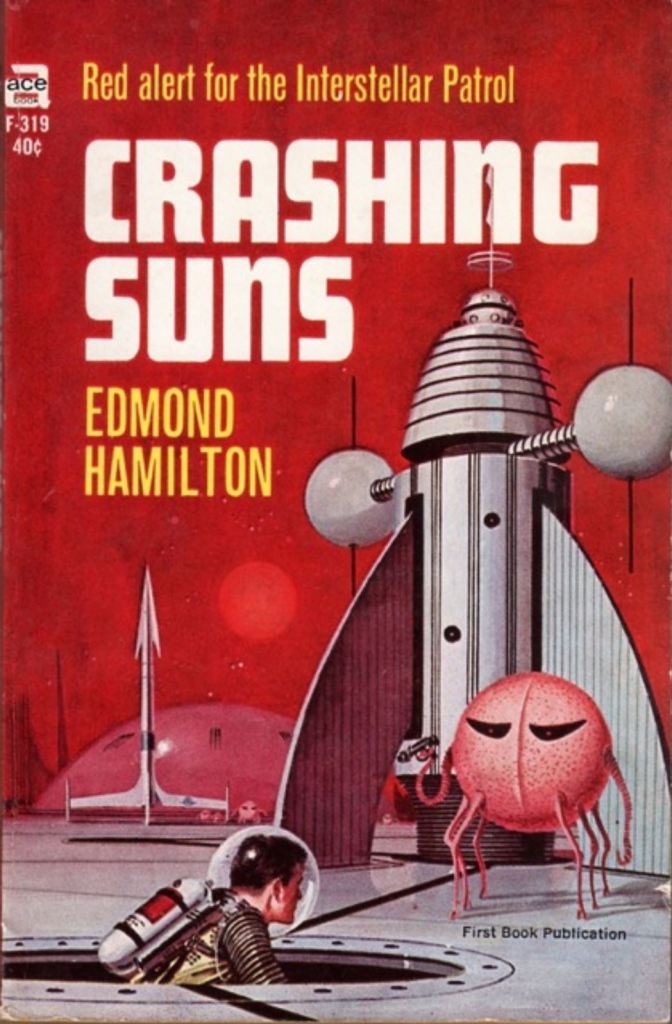
Five of the Interstellar Patrol stories were first published in book form in 1965 as Crashing Suns, the year before Star Trek premiered. All of them were republished in 2009 as The Star-Stealers: The Complete Adventures of The Interstellar Patrol, The Collected Edmond Hamilton, Volume Two, a collector’s edition from Haffner Press that’s now out of print and costs hundreds of dollars used, if you can find a copy. However, because it took decades for these stories to be reprinted suggests they weren’t fan favorites. Most of Hamilton’s early magazine work wasn’t published in book form until the late 1960s or 1970s. Edmond Hamilton is most famous for his Captain Future series, but even those fan favorite stories from the 1940s weren’t reprinted as books until 1969, and then as cheap Ace paperbacks. Hamilton’s appeal seems rather limited. “Doc” Smith’s Skylark and Lensman series vastly overshadowed Hamilton’s space operas.
I’m still trying to discern the VanderMeers’s methodology for the stories they collect in The Big Book of Science Fiction. Anthologies usually have a design behind them. The simplest approach is to bundle a bunch of stories you expect readers will enjoy. Because this anthology is a retrospective of 20th century science fiction I assume the stories showcase the genre. In the introduction the VanderMeers tell us they want to broadening the history of the genre by including women writers and foreign-language stories in translation. I thought that was an excellent ambition. But I assumed when they did include traditional SF stories, those stories would be the classics, and maybe the best example of each writer’s work.
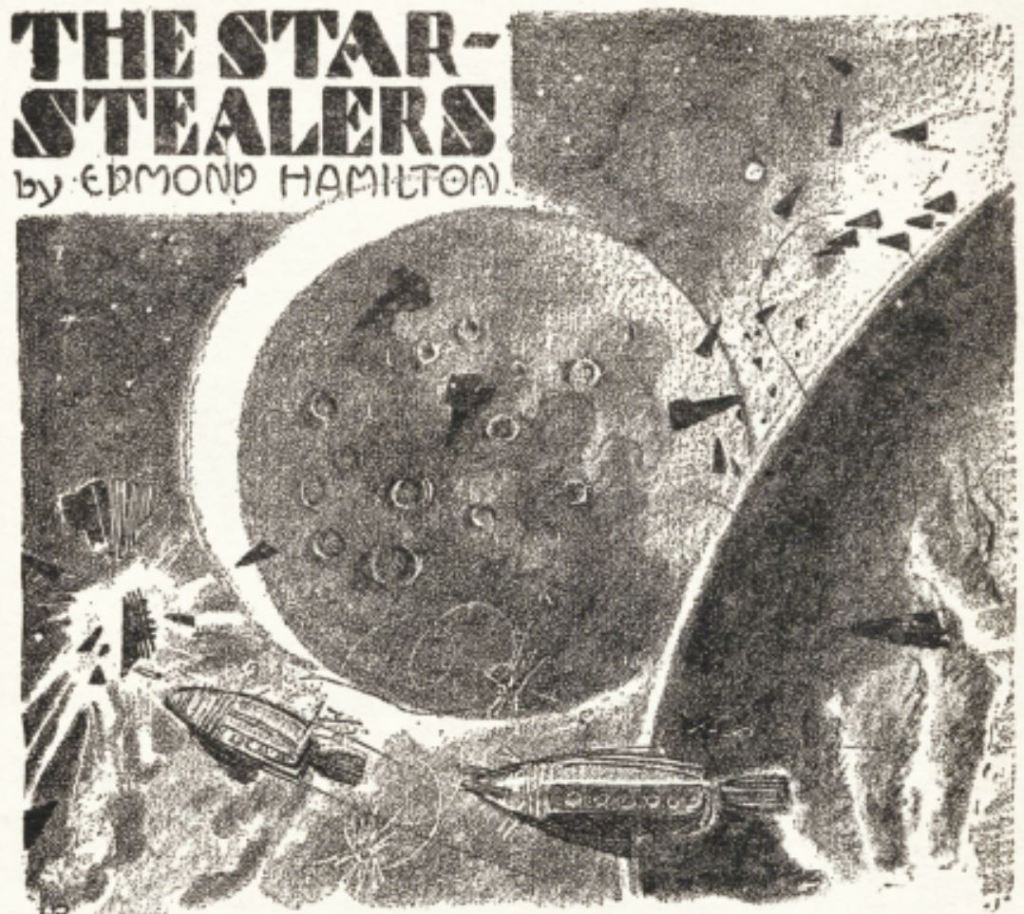
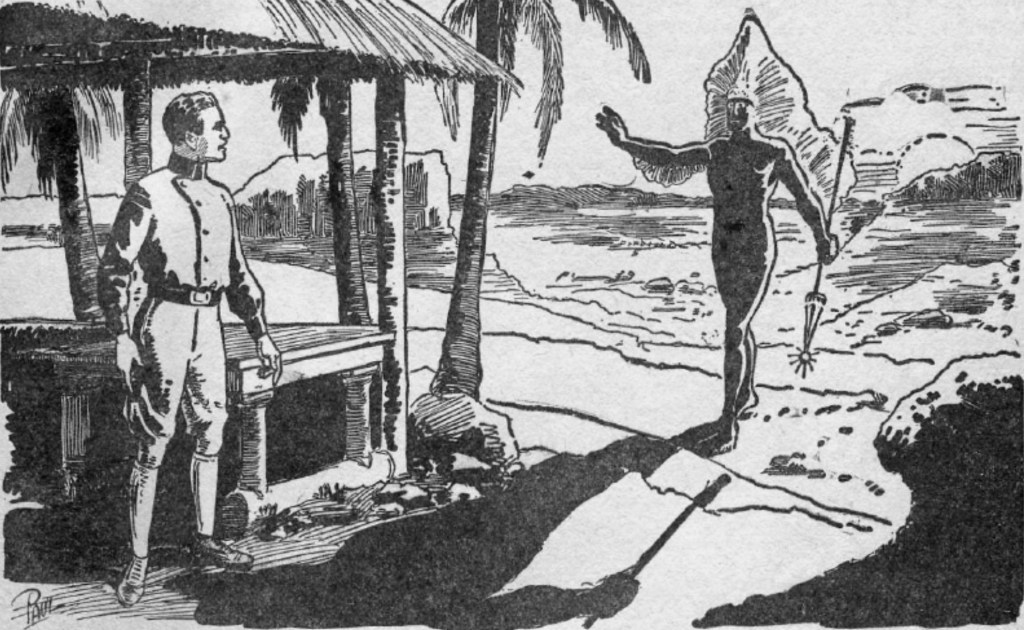
This has happened some, but not to the degree I assumed. For example, “The Star Stealers” is not Edmond Hamilton’s best. Hamilton was never a good writer, and it shows in “The Star Stealers,” which is little better than a comic book without pictures. Hamilton wrote two stories, “The Man Who Evolved” and “What’s It Like Out There?” I believe belong in retrospective SF anthologies. The original use of the term space opera was as a put down for the kind of writing “The Star Stealers” epitomizes. I even wonder if Hugo Gernsback, who had no ear for prose, had turned down “The Star Stealers.” Weird Tales is a legendary magazine today, but it’s content was often amateurish. But Hamilton was practically a house writer for them, so he probably didn’t submit it to Amazing. This story was no more sophisticated than the illustration that went with “The Star Stealers” at the top of the page.
Still, there’s plenty to like about “The Star Stealers,” and it makes an interesting entry for the anthology. The plot parallels the story by Wells, “The Star,” which was about a rogue astronomical body flying through the solar system, swinging too close to Earth. In “The Star Stealers” a giant sun is detected coming from outside the galaxy that will swing too close to Earth. For this story, the object is traveling many multiple speeds of light and will reach the solar system in four months. This is ridiculous, but Hamilton’s Federation space cruisers can travel a thousand times the speed of light, so its no problem. (By the way, how do astronomers detect objects approaching Earth traveling faster than light in their telescopes?)
“The Star Stealers” was published the year before Clyde Tombaugh discovered Pluto, and just five years after Edwin Hubble proved the existence of galaxies outside of the Milky Way, and less than two decades since Einstein explained that nothing could travel faster than light. Hamilton has his space cruiser traveling from Alpha Centauri to our system in twelve hours. This is almost as fast as they travel in Star Wars, but a good deal slower than what they can do in Star Trek. We might forgive Hamilton for breaking Einstein’s speed law in 1929, but even modern writers can’t let go of FTL.
In recent decades we’ve been seeing more stories following Einstein’s laws for interstellar travel, but for the most part writers keep coming up with theoretical gimmicks to go faster. Readers want science fiction where humans roam the galaxy at will, and we see this in “The Star Stealers.” However, the super-science of that story and other early space operas has been deemed excessive by modern fans. “The Star Stealers” feels as archaic today as a silent movie. At one time, “Doc” Smith had his characters hurling galaxies at each other, but nowadays, science fiction readers are happy with space opera that span just a few hundred light years. Vernor Vinge’s Zones of Thought series is the last science fiction I’ve read that covers the entire galaxy. The only other SF story I know that has characters traveling between galaxies is “The Star Pit” by Samuel R. Delany. I should forgive Hamilton because “The Star Pit” is not ridiculous to me at all, in fact, it’s my all-time favorite SF novella.
But as I said, “The Star Stealers” is a fascinating choice for this anthology. It anticipates the ultimate setting of science fiction fans who want to dwell in a galactic civilization, with countless exotic worlds to visit, and plenty of exotic races of intelligent aliens to be friends and foes. Edmond Hamilton grasped the final frontier early, and the idea of a federation of star systems. “Doc” Smith’s first space opera, The Skylark of Space has a lone Elon Musk like inventor competing with a mad scientist, Blackie DuQuesne to explore the galaxy. Hamilton jumps ahead of Smith by imagining a civilized galaxy. Unfortunately, Hamilton’s prose was painful, and he never achieved the popularity of Smith. “Doc” Smith’s second space opera series, The Lensman series actually popularized the galactic civilization which eventually led to Star Trek. It was Asimov, with the Foundation series, that popularized the galactic empire, which led to Star Wars. I keep mentioning those two franchises because they represent the most loved examples of science fiction today, and these earlier stories represented how thousands of fans eventually turned into hundreds of millions of fans.
So, in that sense, the VanderMeers have made an exceptional pick. Unfortunately, “The Star Stealers” is also a perfect example of bad writing, even for old timey science fiction. First, the bad characterization.
The hero of this tale is Ran Rarak. We expect him to be dashing, but there is no supporting description, even though he’s the admiral of a mighty space fleet. We expect Ran to be heroic, but in the big fight he gets knocked out and is unconscious for ten weeks. We eventually see Ran duking it out with one alien, but it’s an ordinary non-superhero punch out. And the one problem he solves is by ramming the enemy’s pivotal machine with his space cruiser.
Hamilton should get credit for introducing a female character in early SF. Dal Nara, pilot, second officer, is a woman who gets to be part of the story action but her only insight is to yell, “Hey, look!” warnings on a few occasions. Her only action is to use her long legs to grab a means of escape. And finally, her chosen reward for help saving the solar system is to visit a beauty parlor. But she’s not the love interest. Hamilton, we give you a gold star, but it doesn’t stick and falls off.
And like in Star Trek, characters are comically tossed around the bridge to show conflict in space. Only one named character in the story is killed, Nal Jak, but he does nothing, and we don’t even know the color of his shirt. Hurus Hol we’re told is the brilliant scientist, but we’re never shown him being brilliant. However, he does commit one of the cardinal sins of bad science fiction, he infodumps on Ran Rarak in a completely condescending way:
He was silent again for a moment, his eyes on mine, and then went on. “You know, Ran Rarak, that the universe itself is composed of infinite depths of space in which float great clusters of suns, star-clusters which are separated from each other by billions of light-years of space. You know, too, that our own cluster of suns, which we call the galaxy, is roughly disklike in shape, and that our own particular sun is situated at the very edge of this disk. Beyond lie only those inconceivable leagues of space which separate us from the neighboring star clusters, or island universes, depths of space never yet crossed by our own cruisers or by anything else of which we have record.

“But now, at last, something has crossed those abysses, is crossing them; since over three weeks ago our astronomers discovered that a gigantic dark star is approaching our galaxy from the depths of infinite space—a titanic, dead sun which their instruments showed to be of a size incredible, since, dark and dead as it is, it is larger than the mightiest blazing suns in our own galaxy, larger than Canopus or Antares or Betelgeuse—a dark, dead star millions of times larger than our own fiery sun—a gigantic wanderer out of some far realm of infinite space, racing toward our galaxy at a velocity inconceivable!

“The calculations of our scientists showed that this speeding dark star would not race into our galaxy but would speed past its edge, and out into infinite space again, passing no closer to our own sun, at the edge, than some fifteen billion miles. There was no possibility of collision or danger from it, therefore; and so though the approach of the dark star is known to all in the solar system, there is no idea of any peril connected with it. But there is something else which has been kept quite secret from the peoples of the solar system, something known only to a few astronomers and officials. And that is that during the last few weeks the path of this speeding dark star has changed from a straight path to a curving one, that it is curving inward toward the edge of our galaxy and will now pass our own sun, in less than twelve weeks, at a distance of less than three billion miles, instead of fifteen! And when this titanic dead sun passes that close to our own sun there can be but one result. Inevitably our own sun will be caught by the powerful gravitational grip of the giant dark star and carried out with all its planets into the depths of infinite space, never to return!”

Hurus Hol paused, his face white and set, gazing past me with wide, unseeing eyes. My brain whirling beneath the stunning revelation, I sat rigid, silent, and in a moment he went on.
The plotting of the story is about at the level of old Buck Rogers serials, which were more primitive than the Flash Gordans. Humans detect a giant sun heading towards the Milky Way and calculate it will swing near enough to the Sun to capture Sol and pull it into intergalactic space. They quickly assemble a fleet of fifty Federation space cruisers and take off. When they reach the giant sun which turns out to be populated death star, their fleet is almost completely destroyed, and our heroes get immediately captured. Like so many episodes of Star Trek where Captain Kirk is confined by ropes, chains, jails, cells, dungeons, and sexy space-babes, the plot pivots on merely escaping confinement and performing one little act, thus saving the Earth, solar system, galaxy, or universe. It turns out not all the fleet was destroyed, and good old Federation cruiser Number Sixteen escaped to fetch back a fleet of 5,000 Federation ships in the nick of time. Hamilton couldn’t even be bothered to name his ships, even the one that saves the day.
Edmond Hamilton seems to know little about astronomy or physics. He keeps mentioning three billion miles like it’s a tremendous distance, yet that’s just a tiny fraction light travels in one year: 5,878,625,370,000 miles. His ships accelerate but never decelerate. And a Federation spaceship can suddenly stop or hover in relation to each other even though they’ve been traveling a thousand times the speed of light. Another foreshadowing of Star Trek and Star Wars.
Like I said, this story was written just a few years after Hubble made the measurements to calculate that other galaxies were outside the Milky Way. It appears that Hamilton thinks our galaxy and the universe is terribly tiny. Was that true for all people back in the 1920s? Maybe it was for teenage readers of SF.
Even though E. E. “Doc” Smith was far more famous than Edmond Hamilton, he wasn’t much better as a writer. “The Star Stealers” is typical for both storytelling and science back in the 1920s and 1930s. There’s a reason why John W. Campbell, Jr. is so famous, because he attracted both stories and writers that were a quantum leap in quality and talent. And it explains why it’s hard so hard to find good science fiction stories between H. G. Wells and Robert A. Heinlein. This brings us back to the anthology.
Should we remember the all the bad stories that helped evolve the genre? There is a kind of fun academic appeal to reading old clunkers like “The Star Stealers” but is that what most buyers of retrospective anthologies want? And I still wonder if there were truly good stories from back then that could be rescued.
Look at it this way. There was thousands and thousands of short stories published in the 19th century, but how many are still embraced by readers today? Is the number even greater than 25? Or 10? I’m talking by bookworms, not scholars.
When a century separates readers from the 20th century, how many of these SF stories will still be read? At what point should we let go? Just how big would The Big Book of Science Fiction be if it only reprinted four and five star stories? My definition of a four-star story is any story on reading the first time leaves you knowing you’ll want to reread it. My definition of a five-star story are stories which bookworms cherish and read many times over their lifetime.
“The Star Stealers” fits neither definition for me. My definition for three-star stories are solid well-written stories that deserve to be published in a professional periodical, and might even deserve to be reprinted in an annual best-of-the-year anthology. It’s hard to judge the quality of “The Star Stealers” today by whether it deserved a magazine editor’s acceptance. But I’m guessing Farnsworth Wright was excited about the ideas in “The Star Stealer” and knew Hamilton wasn’t much of a writer. Wright and Gernsback knew their readers weren’t mature or educated, just enthusiastic. Even in 1929 I probably would have considered it a 2-star story, but I probably would have bought it if I was a magazine editor. It was different.
I enjoyed reading and writing about “The Star Stealers” because I’m an autodidactic scholar of science fiction, but I have to wonder what the average science fiction fan today will think of it.
With the ninth story of The Big Book of Science Fiction edited by Ann and Jeff VanderMeer, we’ve finally reached the land of science fiction. In our group discussions many have questioned whether the earlier stories were truly science fiction. With “The Fate of the Poseidonia” by Clare Winger Harris from the June 1927 issue of Amazing Stories we’ve finally reached the era of pulp science fiction magazines. If anything defined the concept, it was the science fiction magazines.
Clare Winger Harris images a much different winter of 1994-95. George Gregory discovers his girlfriend Margaret has taken up with another guy, a Mr. Martell. Martell looks odd, and acts suspicious. George tells Margaret of his worries, but she defends Martell and dumps Gregory. Mr. Gregory starts spying on Mr. Martell out of jealousy, and learns that Martell is a Martian spy. Unfortunately, no one will believe him, and he’s committed to a mental hospital.
Is “The Fate of the Poseidonia” the earliest example of Martians living amongst us stories? My two favorites of that theme are A Mirror for Observers (1954) by Edgar Pangborn and The Man Who Fell to Earth (1963) by Walter Tevis. Both of these novels have a quiet beauty you don’t often find in science fiction. This theme was also used on The Twilight Zone and The Outer Limits. The idea of Martians passing for humans is very entertaining to me which caused me to like “The Fate of the Poseidonia” more than it probably deserves. It’s a decent story, mainly suffering from an unskilled writer, but Harris did win third prize for it at Amazing Stories.
What makes this story so distinctive among those we’ve read so far is how the reader in thrown into the future. This isn’t a dream, or an experiment in storytelling, a political allegory, or philosophical musing. This story contains the real essence of science fiction. The setting is science fictional, and the intent of the story is science fictional. Clare Winger Harris asks us to believe that there are intelligent beings on Mars who come to Earth to steal our water. Their planet has dried up and they have the technology to lower ocean levels by many feet. Harris has created an entertaining example of “What if …?”
In 1927 it was widely assumed there could be life elsewhere in the solar system, especially Mars and Venus. Until Mariner 4 flew by Mars in July of 1965, hope was held out for life on Mars, even intelligent life. I’m not sure people growing today can understand how it was almost a common assumption that Mars and Venus could actually be inhabited. Sure, most scientists held little hope, but the public did, and it was reflected in Pre-NASA science fiction. From H. G. Wells to Roger Zelazny there were endless science fictional speculations about Martians. I loved the idea of Martians as a kid, and even wrote an essay, “I Miss Martians.”
I also grew up with NASA, so I quickly gave up all hope for finding any kind of life within our solar system. The more I read popular science, the more skeptical I became about science fiction. Eventually, I doubted most of what science fiction hoped. But in my old age I realized I still love the old unscientific science fiction. (I’m really digging listening to The Best of Walter M. Miller, Jr.)
I’ve mentioned this before, but I grew up reading Oz books before I discovered science fiction. At the beginning of the 20th century L. Frank Baum produced a series of children’s books about a fictional location that existed somewhere on Earth, but in a geography that had eluded all explorers. Over the series, the Land of Oz became richly complex. As a gullible nine-year-old in 1962 I wanted Oz to actually exist. I knew it didn’t, but I wanted it to be a real place. Hell, it was crushing to lose Santa Claus at 6, then Oz at 9, and Christianity at 12. So I turned to science fiction. My 69-year-old self realizes that for most of my lifetime, science fiction was my replacement for Oz and religion. I always rationalized that reading science fiction prepared me for the future, and inspired me to learn about science, but in reality, it was my way to escape the mundane.
This is very different from my middle-age self who wanted science fiction to be scientific. Now I see very little difference between science fiction and fantasy. Both are fairytales for readers who have left childhood. Both are about world building fictional universes. There seems to be some differences because some readers show preferences for one over the other. Maybe science fiction are those tales that seem more realistic. However, in 2021 how realistic is “The Fate of the Poseidonia” then? It’s far from scientific. In 1927 it was thought to be more realistic, but not if you were properly educated.
I’m using these essays reviewing the stories in The Big Book of Science Fiction to understand the evolution of the genre, but also to psychoanalyze myself. Why do I love science fiction so much? I want to define the term science fiction because it seems to point to exactly something that pushes my buttons. A good deal of pop culture is now science fiction, so I’m not alone in my attraction. Maybe we should all analyze this fixation?
We could say science fiction is fiction set is the future. That might be the one telling trait that defines science fiction for me, but maybe not everyone. Fantasies are set in the past, present, or never-never land. When they are set in the future, like Jack Vance’s The Dying Earth, I want to call them science fiction. This lets us file steampunk and alternate history in the fantasy bin. I like that, because neither of those types of stories feel like science fiction to me. We could split the difference on time travel stories. If characters head to the past, it’s fantasy, but if they go forward, it’s science fiction. But there’s a problem. All those stories about visiting dinosaurs are definitely science fiction to me.
What if someone today wrote a story set in the future where we discover an ancient dying civilization on Mars, something that’s been proven to be impossible? I can amend my definition by saying even fantasies set in the future belong in the science fiction bin too. In fact, older unscientific SF has become my favorite kind of science fiction in recent years. And I’ve notice a trend for writers to produce alternate history science fiction, like the novel The Calculating Stars by Mary Robinette Kowal, or the Apple TV+ series For All Mankind. I might not be the only person nostalgic for what science fiction used to be.
As I read and review the stories in The Big Book of Science Fiction, and our Facebook group discusses them, I’m trying to find a reason to keep the term science fiction. I swing back and forth from wanting to throw out all genre labels, to finding a practical meaning for the term science fiction that most people can agree on.
Right now my working definition is “Science fiction is fiction set in the future.” That leaves a lot of holes, but then we have almost a hundred stories yet to consider.
“The Comet” by W. E. B. Du Bois is the first story we’ve read in The Big Book of Science Fiction that reads like a modern short story, and feels like modern science fiction. Is there a name for the form of fiction we now consider the standard model? All the stories we’ve read so far felt quaint, experimental, philosophical, pretentious, or unnatural. “The Star” by H. G. Wells was the closest to normal, but it did feel old fashioned, like other stories from the 19th century. Du Bois story is from 1920, yet felt more polished and modern than most science fiction from the 1920s, 1930s, and into the 1940s.
I know I’m not being very precise here when trying to talk about writing styles or forms. I just don’t have the terminology. I’m trying to describe something I’ve observed from personal experience that might have precise labels among academics. The prose of Charles Dickens, Henry James, or Edith Wharton has a quality that makes them feel old to me, but they are still very readable. Then in the 1920s, Hemingway and Fitzgerald and other writers made their prose more streamlined, and thus created what I think of as the modern form of fiction. Modern fiction has a greater percentage of dialog, and that dialog rings more natural. In the 19th century, the narrative part of fiction was quite wordy, especially with writers like Henry James. H. G. Wells was long on narrative and short on dialog, and his characters sounded Victorian.
The prose in 1920s Amazing Stories and early 1930s Astounding feels oldy too, and has a clunky quality of bad writing. Science fiction has always had the extra burden of explaining the science fictional aspects. This is called info-dumping, and is comparable to 19th descriptive narration that would spend paragraphs describing a mantelpiece.
“The Comet” feels more like Fitzgerald in its storytelling techniques, which are more advanced than the first decades of science fiction of the 1920s and 1930s. A large part of Heinlein’s success when he made a splash in the early 1940s was his use of modern streamline writing. The focus was on dramatic dialog, while minimizing the infodumping and narrative descriptions. Heinlein’s prose sounds snappy, even breezy compared to his predecessors. Heinlein’s style immerses the reader into the fantastic with the minimum of fuss and notice.
In other words, I’m quite impressed with W. E. B. Du Bois writing in “The Comet.” It’s a shame he didn’t become a genre writer during the pulp era. “The Comet” is pre-apocalyptic, apocalyptic, and post-apocalyptic, as was “The Star” by Wells. The difference was Wells was narrating a ponderous worldwide overview, while Du Bois used the POV of one person.
Both are good stories, but “The Comet” points the way to the future. As we progress through the stories in The Big Book of Science Fiction, we’re seeing both science fiction themes evolve, as well as the techniques of fiction writing.
I would love if I could quantify these two progressions. I have no idea how to track changes in fiction writing. For science fiction themes I picture myself building a database of theme examples. Designing the structure of such a database will take considerable thought. Most science fiction stories have multiple themes. For example:
Notice that Earth Abides and The World, The Flesh, and The Devil do away with Pre-Apocalyptic and Apocalyptic phases of the story, jumping immediately into the Post-Apocalyptic phase. The direction of storytelling is towards getting into a tale quicker, and when there, conveying the action in prose that is speedier to read. Modern bestsellers are very easy to read, dominated by near realistic dialog. Older fiction have archaic dialog, sometimes sounding like lectures, that slow the story.
Written fiction, novels and short stories, can convey the inner world of thoughts and opinions, that media fiction, movies and television shows, seldom attempt to express. But written fiction seems to be moving away from this unique attribute in favor of speed. But it would be a shame to abandon it entirely. (As an aside, some modern written fiction comes across like the young writers were inspired by movies rather than books.)
All stories have a setup and something to say. In “The Comet” Du Bois wants to say things about race, using the setup of a science fiction theme to express himself. The collapse of civilization allows Jim Davis, a black man from 1910s New York City to connect with Julia, a white woman. This connection was impossible before the apocalypse. Like Rod Sterling talking about a character entering the twilight zone, science fiction allowed Du Bois to put Jim Davis in a setting to show how race is an artificial construct of society.
Because Du Bois’ goal was to change readers’ minds about race, can “The Comet” still be science fiction? In an earlier essay, I said science fiction are those stories set within specific themes, like the future, traveling in space, or after the collapse of civilization. Racism is a universal theme that SF can’t claim. Science fiction is the setup of “The Comet,” but the story was written to say things about racism.
This brings us to an interesting question: Do both the setup and the intent of the story have to be science fictional to make the story science fiction? Eventually, in The Big Book of Science Fiction, we’ll reach such stories. I expect that will be soon, maybe with “The Star Stealers” by Edmond Hamilton. Both Earth Abides by George R. Stewart and The World, the Flesh, and The Devil use both science fiction as a setup, and to say things about living in a post-apocalyptic world. Sure, they also say things about us and our society, but the purpose of these stories is to speculate about life after the apocalypse, in that territory of the future belonging to science fiction.
Because W. E. B. Du Bois brings back civilization at the end of “The Comet,” we’re not really in the future. “The Comet” feels like science fiction, even great science fiction, until the end, that is. We’re jerked back to the present like in the earlier story “Sultana’s Dream.” Du Bois ventured into the shadows of the twilight zone, but didn’t stay.
On one hand, does the label science fiction really matter? “The Comet” is an excellent short story. The literary world has had several major writers rejecting the science fiction label on their work. They have good reason to reject the label. On the other hand, if a literary writer strays into science fiction’s territory, using science fictional techniques for their story’s setup, and especially when what they have to say is science fictional, shouldn’t the work be called science fiction? On our third hand, if the term science fiction isn’t precise, isn’t it unfair to use the label on those who don’t want it? And if science fiction is just a marketing term, shouldn’t it be restricted to genre fiction? “The Comet” is literary fiction. The Handmaid’s Tale and Nineteen Eighty-Four are literary fiction and science fiction by my definition. But I can understand why literary writers wouldn’t want the science fiction label if its also equated with genre writing.
I believe we’re still on the road to science fiction, but we haven’t gotten there yet. But I’m starting to wonder whether or not I’m painting myself into a corner. I do not know our ultimate destination, but my intuition tells me I’m going to define science fiction in way that only I use. Most people will gladly accept “The Comet” as a perfectly good example of science fiction. I’m sure old Hugo Gernsback would have reprinted this story in Amazing Stories if he had known about it.
What would W. E. B. Du Bois think? 1920 was well before the term science fiction existed, but Du Bois lived until 1963. Did anyone ever ask him, “Were you writing science fiction when you wrote ‘The Comet?'” I believe he had a very clever idea for a story setup to express significant insights about racism. I’m not familiar with his work, but did he ever write a story about the future where racism didn’t exist? “The Comet” almost goes there. Such a story would be fully within my definition of science fiction.
Didn’t Du Bois pull back at the last moment because he knew most of his readers couldn’t go all the way? My point is science fiction is about going places we haven’t thought about going before. Du Bois got so very close. I’d like to even imagine he wanted to write that story.
Reading The Big Book of Science Fiction is causing me to reevaluate my relationship with science fiction. For most of my life I wanted science fiction to be serious speculation about the future. I considered ideas the pinnacle of science fiction’s virtues. But after reading a couple thousand science fiction short stories over the last decade, I realize storytelling is the primary consideration. Insights and ideas are secondary. Anyone can have a cool idea, it’s how they’re presented that determines the success of a story.
“The Doom of Principal City” by Yefim Zozulya reeks of Western Union. It might be an interesting example of an early dystopia, but that’s all it has, academic appeal. The reason why Nineteen Eighty-Four is still read and why its still so damn readable, is because we care about Winston Smith. The next reason we read Nineteen Eighty-Four is the marvelously crafted world building. We don’t have a character to care about in “The Doom of Principal City” and the setting only feels didactic. I’ve come to really dislike satire. Too often satire is buckshot broadsides, whereas beautiful storytelling uses precisely placed bullets. Of course, when I was young, satire was easy to love because it made us feel grown up and superior, but now that I’m old satire feels childish and snooty. “The Doom of Principal City” came across as vague cleverness, but then the writer might have feared political reprisals.
I should give Zozulya credit for the context in which was written, but I can’t. There was a certain level of cleverness in having the city conquered by peaceful means that turn oppressive, but the solution is the same old violence and destruction. I should give Zozulya credit because the story is still topical. Principal City could be Kabul. Think about it. Reread the story. But like I said, real art is about specifics. Its easy to be vaguely clever, but much harder to be vividly detailed.
Which gets me back to my new realization of what I love about science fiction. Storytelling is becoming everything. Science fiction only grabs me now with how the story is told. It can be simplistic or sophisticated, but its got to suck me in. Philosophical fiction, satire, social protest, experimental fiction just doesn’t dance anymore. I can admire writers for what they’re trying to do intellectually, but not as science fiction that moves me emotionally.
And I think this is due to aging. When I was young, I was easily amused, and easily impressed. “The Doom of Principal City” might have struct me as clever, or meaningful. Now, not so much. And partly that’s due to its narrative style. It feels like a parable, or allegory, rather than modern fiction. It’s setup reminds me of “The Illustrated Biography of Lord Grimm” by Daryl Gregory about a small country under attack by a powerful country with a superhero military force. I’m not fond of superhero stories, but Gregory’s storytelling was vivid and rich. That’s what’s missing from “The Doom of Principal City.” I have to wonder if writers back in 1910s didn’t have such abilities, or we’re just getting the weak examples of what they could do. I don’t think its the translation. “The Dead” by James Joyce was from that decade, so we do know what’s possible, although it might be fairer to use Arthur Conan Doyle or Edgar Rice Burroughs to compare, since they were genre writers.
I worry that the poor storytelling examples we’ve had at the beginning of The Big Book of Science Fiction is because the genre lacked for better ones. Or, are the VanderMeers more impressed with ideas?
“Two Truths and a Lie” by Sarah Pinsker is a recent example of what I consider captivating storytelling. It does have plenty of sparkly ideas, but what really sparkles is how they’re presented.
In his very first sentence in “Mechanoplis,” Miguel de Unamuno, lets us know his story was inspired by reading Erewhon by Samuel Butler. That 1872 novel is considered one of the first books to imagine artificial intelligence. Butler extended Charles Darwin’s recent ideas on natural selection to apply to the machines of the industrial revolution. Could machines develop consciousness and become self-replicating? This makes it hard not to consider Erewhon a major science fiction novel of the 19th century. However, I’m still on the fence about whether or not genre science fiction can claim utopian literature. My current thought is those old utopian novels inspired the birth of genre science fiction by getting people to think about the future. But along the way there was a fork in the road. Some science fiction has continued to worry about the future, like the recent novel The Ministry for the Future by Kim Stanley Robinson. But most genre SF has made the future into a Disneyland of thrills, adventures, and fun. The future becomes a place we want to visit.
It’s hard to trace the evolution of ideas in utopian novels and proto-SF stories of the 19th century to mid-20th century genre science fiction. Butler used the future to comment on Victorian society with satire closer to Jonathan Swift’s 18th century work than how Heinlein, Clarke, and Asimov used the future in the 20th century science fiction. But I do see stepping stones, from story to story.
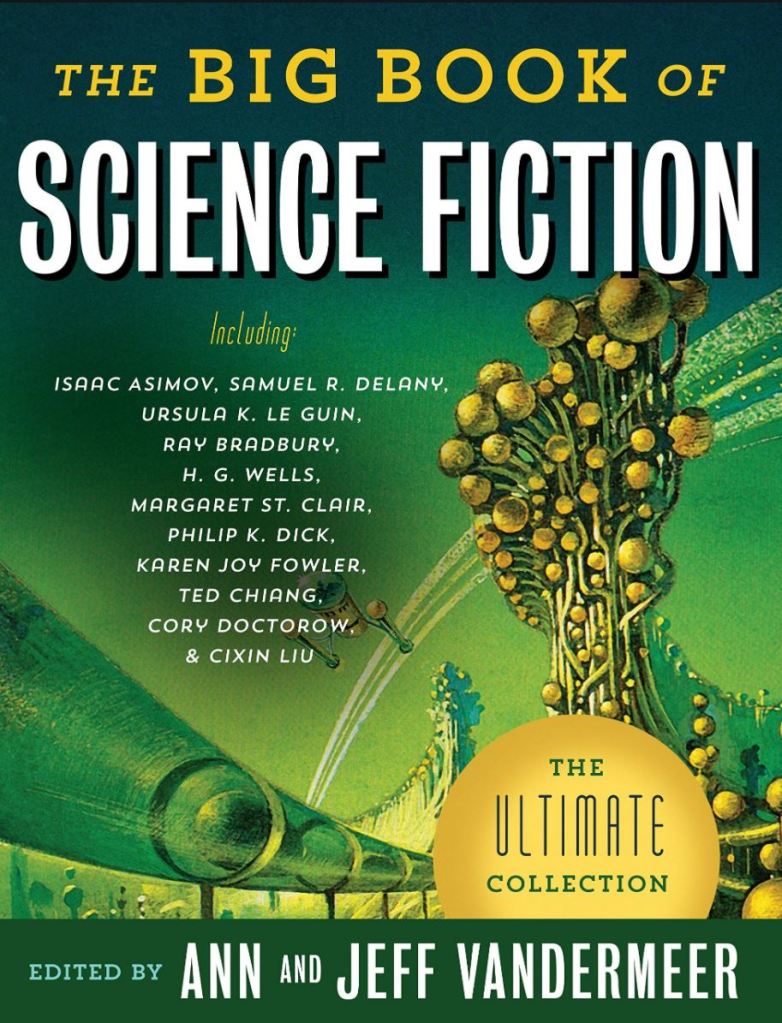
Reading “Mechanopolis” by Miguel de Unamuno in The Big Book of Science Fiction edited by Ann and Jeff VanderMeer provided an immediate sense of déjà vu. I can’t remember if I read this 1913 story from the Spanish writer Unamuno in another anthology, or because it feels so much like other science fiction stories I’ve read, especially, “Twilight” by John W. Campbell, Jr. from 1934.
“Mechanopolis” begins with an unnamed narrator lost in a desert, nearly dead, who happens upon an oasis where he finds an automated railway system that takes him into a deserted city where machines maintain an automated society long after humanity has left. The forgotten cafeterias allow our narrator to eat. That was true in the Campbell story too. However, in this story the narrator goes mad as he realizes the machines have souls, and even write about his activities in their daily newspaper, spooking the hell out of him. The abandoned cities in “Twilight” still functioning by self-repairing machines, but they inspire a great sense of wonder, not fear.
In the end of “Mechanopolis,” the narrator escapes the city and returns to the desert. He encounters Bedouins who save him. When the narrator returns home he works to stay as far away from machinery as possible. Of course, this reminds me of the ending to the 1984 classic SF story “Press Enter ▮” by John Varley. I’ve written about it before. Victor Apfel, in the Varley story becomes so afraid of machines he rips the wiring out of his house.
“Mechanopolis” is a rather brief expression of a theme that shows up time and again in science fiction. We are definitely on the road to science fiction with this story. Unamuno completely ignores how his narrator finds his way to the mechanical city. In “Twilight,” Campbell has his story told to a man of our times by a wayward time traveler he picks up hitchhiking.
This reveals an interesting aspect to the evolution of science fiction. Writers of the 19th and early 20th centuries had a difficult time setting their story in the future. Often, those early tales about the future have people from the present stumble into some kind of suspended animation. In 1819 Washington Irving has his title character in “Rip van Wrinkle” fall asleep for twenty years. In 1888 Edward Bellamy has his character, Julian West, go under a hypnotic sleep for 113 years to get to the future described in Looking Backward. Of course, the most famous solution was by H. G. Wells in 1895, when he sent his character into the future via a time machine. But then in 1928 Buck Rogers returns to the old method getting to 2419 by being trapped in a cave in where radioactive gas puts him into suspended animation.
All these writers evidently felt there must be some connection between the present day and the future. Maybe they thought we needed a POV like ourselves to react to the future. However, Ray Bradbury did away with the human viewer altogether in “There Will Come Soft Rains” where he describes an automated house working after the humans are gone, and we assume extinct because of WWIII. It’s a beautiful story. However, the machines aren’t sentient, and we don’t fear them. We’re just wistful to see them working without us.
Unamuno has his character take a strange train ride. Does his narrator ever realize he’s in the future? Or is it possible that this mechanical city is somewhere on Earth like the land of Oz, in current time but having a quite divergent development from the rest of the world? Or is Mechanopolis in another dimension? I’m not sure we know. The train is a portal, but not much else is explained. I’m assuming Mechanopolis is in the future. Art the narrator sees in the machine’s museums he feels are the originals might imply the narrator was in the future. But he also wondered if our museums held perfect forgeries. That could imply Mechanoplis was not in the future.
One of the surprising aspects to the 1909 story, “The Machine Stops,” is E. M. Forster just puts his readers into the future. That approach eventually becomes the standard for science fiction. We read science fiction so we can jump into the future. Any comparison to the present is at an unconscious level.
“Mechanopolis” anticipates automated cities in future stories like The Dying Earth by Jack Vance or The City and the Stars by Arthur C. Clarke. In those two the humans aren’t quite gone but our species is fading away. I just remembered, The Night Land by William Hope Hodgson from 1912. He took his readers to the far future too, where the remaining humans survive in the remnants of a technological civilization. Hodgson got his readers there with a reincarnated character from our times. Some editions of that book lop off that introductory section, and jump immediately to the future. Evidently, those editors felts modern readers didn’t need the connection with the present day.
Another story where the humans are gone but the machines remain is the connecting filler to the fix-up novel City by Clifford Simak. We are told humans have left and only intelligent machines and uplifted dogs remain. The gimmick of the fix-up is the robots and dogs are telling tales about humans, which are just reprints of Simak short stories. With Simak, we love the machines.
“Moxon’s Master” the 1899 story by Ambrose Bierce features a chess playing machine killing a human. We have a long history of anthropomorphizing animals and objects, so when did the idea of sentient machines first develop in science fiction? Unamuno’s 1913 story is way before computers, or even the concept of robots were developed. That was even more true of Erewhon. Why does Butler or Unamuno imagine machines will become aware? It’s one thing to assume automated machinery will keep running, or could even be made self-servicing. It’s a whole other concept to imagine that machines could observe people, and in this story, feel concern for the narrator’s state of mind. Evolving machines was quite a leap for Butler, but Darwin inspired all kinds of fears about evolution. A great case could be made that Darwin is really the father of science fiction.
In this very short story, Unamuno comes up with automated cities, the extinction of humans, cities that keep functioning without humans, self-aware machines, and even machine inheriting the Earth. He also comes up with the fear or paranoia of intelligent machines. It’s doubtful many English writers and readers knew about Unamuno’s story. Could there have been any chance of Campbell reading it? I wonder what Spanish writers Unamuno influenced with science fictional ideas?




 Classics of Science Fiction