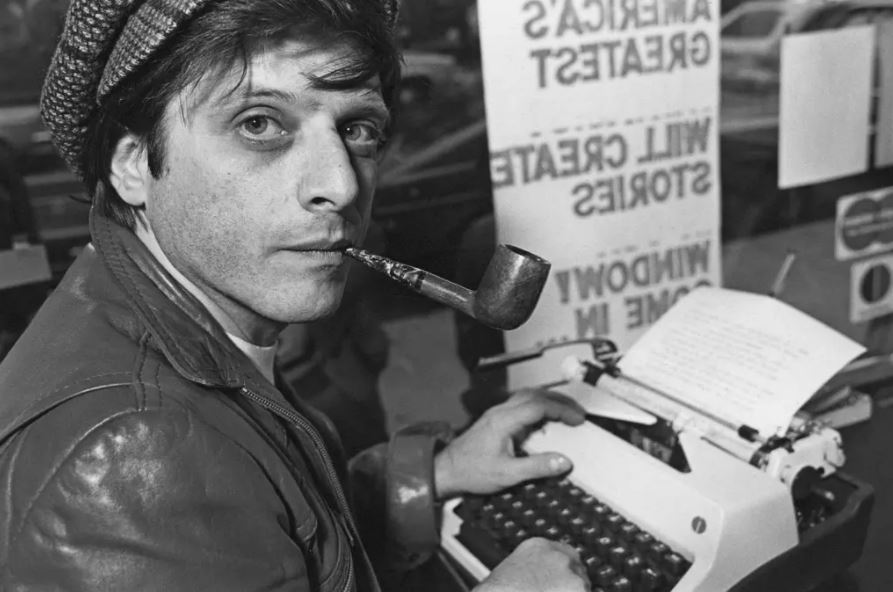
“‘Repent, Harlequin!’ Said the Ticktockman” by Harlan Ellison

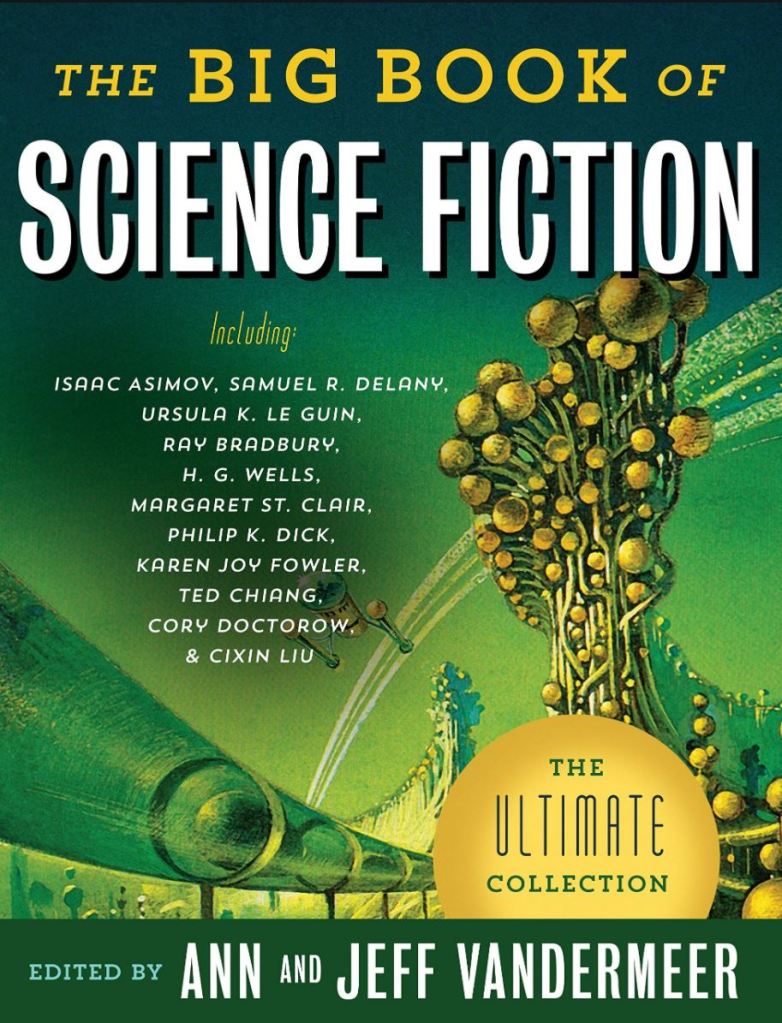
Group Read 27The Big Book of Science Fiction

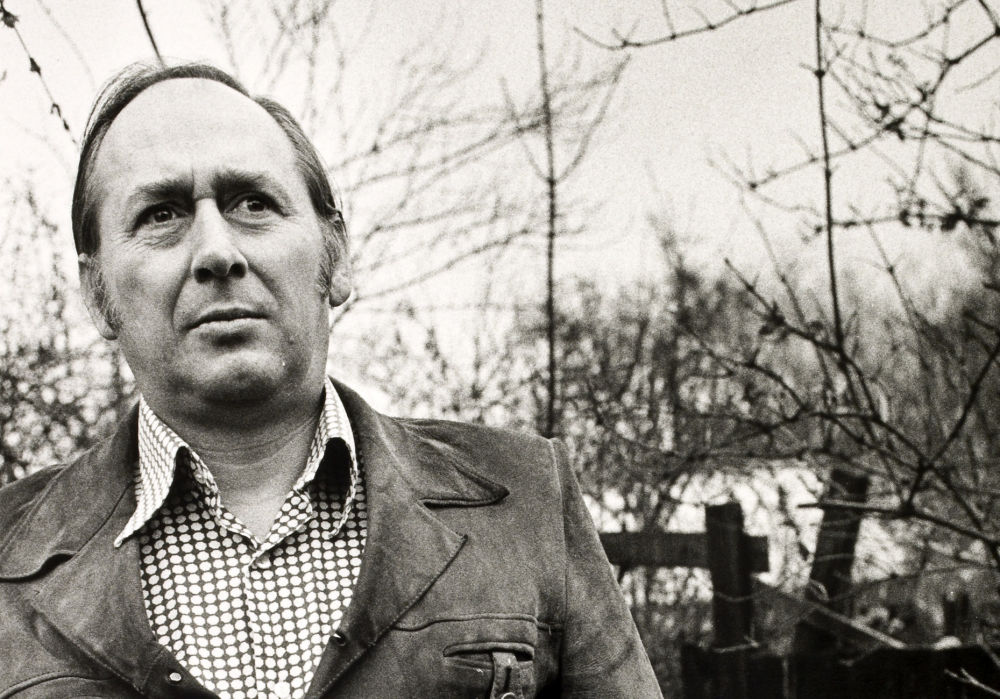
Story #45 of 107: “‘Repent, Harlequin!’ Said the Ticktockman” by Harlan Ellison

“‘Repent, Harlequin!’ Said the Ticktockman” by Harlan Ellison is #3 out of 125 on Dave Hook’s Recommended Reading List of SF short stories. That’s pretty impressive since Hook’s list is a meta-list generated from several lists. And we’ve finally reached the time period in The Big Book of Science Fiction when I began reading stories as they came out in the magazines. However, I didn’t catch this Ellison in the December 1965 issue of Galaxy, but in Wollheim’s World’s Best Science Fiction: 1966. (I did buy that issue of Galaxy a year or so later in a used bookstore, probably for about 10 cents. That’s when I first learn to love science fiction magazines.)

If you noticed, Ellison wasn’t mentioned on either cover nor did the story get any interior illustrations. Evidently, “‘Repent, Harlequin!’ Said the Ticktockman” wasn’t immediately recognized as a future classic. But it didn’t take long to become one of the most anthologized SF stories ever.

“‘Repent, Harlequin!’ Said the Ticktockman” won both the Hugo and Nebula awards in 1966.

But I don’t know why. Ellison’s razzle-dazzle prose to me is merely yelling, “Look at me! Look at me!” Sure, it’s a fun anti-establishment story from the 1960s. And I liked it a lot better back then. But now, I find its over-the-top wordy antics felt just like I felt watching the first episode of Batman back in 1966 — campy to the point of being embarrassing.

Like I said, when I was young Ellison’s stories impressed me with all their screaming and sneering and self-righteousness. Abbie Hoffman and Timothy Leary were cool too, in the sixties. But looking back through decades of hard-earned maturity, they now only look like clowns.

I got to see Ellison lecture twice, and both times I hung around afterward when young people tried to disagree with him. He was the fast draw that all the gunslingers wanted to take on. You didn’t want to be standing too close to them either because Ellison would roast them with his fire-breathing dragon replies. When I was young I enjoyed seeing Ellison’s skill with words, especially when he used his sharpest wit. Now, not so much.

That doesn’t mean I dislike this story or dislike Ellison. I will always love the guy who wrote: “Jeffty is Five.” I’m just burned out on all his famous pyromaniac-prose stories. I need to read through his collections and find some quiet tales suitable for my old age.

Besides, I like being on time and I get irked at having to wait for people that aren’t.

Main Page of Group Read

James Wallace Harris, 11/15/21

“Darkness” by André Carneiro

Group Read 27The Big Book of Science Fiction

Story #44 of 107: “Darkness” by André Carneiro

The VanderMeers made my reading expectations too high when they quoted A. E. van Vogt saying that “Darkness” by André Carneiro was one of the greatest science fiction stories ever written. It was good, very good indeed, but not great. Also, they misled me by saying it was a “depiction of a world where people are suddenly blind.” It is a story about everyone not being able to see, but they do not go blind. I read the story twice trying to discern exactly what happens and the best I can tell, light stopped working. The people could still see, but light from the sun slowly dimished, as did light from flashlights, matches, stoves, fires, etc. The world is thrown into darkness.

This is a disaster story with its usual plot arc. A man, Waldas comes home and begins saving water and gathering foodstuffs when he realizes that all sources of light are beginning to fade. Finally, when no one can see anything, people outside his apartment begin yelling for help. Waldas decides to share his resources with his neighbors with children but ignores all other pleas from other apartments and outside on the street. Eventually, Waldas realizes he must go out and search for food and plans to steal it from a nearby market, but when he gets there finds the shelves empty. On his way home be becomes lost and his finally rescued by a blind person, Vasco. Vasco is already skilled at getting around the city and takes Waldas back to the Institute for the Blind. Members there are helping a few people, and agree to help Waldas and his adopted family in exchange for water Waldas had saved in his bathtub. They bring back the water and family and live at the Institute until they realize the food is running out. The group then decides to go to a farm owned by the Institute, and the blind people lead the non-seeing people out of town. Eighteen days later light begins to seep out of light sources again, within a day or two, light returns to normal. Waldas returns to town to see how people have survived and found more people living than he assumed.

Near the end, we are told:

But, as their eager eyes took in every color, shade, and movement, they gave little thought to the mysterious magnitude of their universe, and even less to the plight of their brothers, their saviors, who still walked in darkness.

What is Carneiro telling us? Is he saying people are blind to the wonders of reality, even after they’ve been given a great object lesson? Is he saying people just adapt to any situation without wondering about the why of things? Maybe I’m taking this story too much for granted like Waldas and the people of his world took light for granted. Maybe I’ll appreciate this story more in the future.

Rating: ****

Main Page of Group Read

James Wallace Harris, 11/15/21
“The Hands” by John Baxter

Group Read 27The Big Book of Science Fiction

Story #43 of 107: “The Hands” by John Baxter

“The Hands” by John Baxter is a unique alien invasion story. I’m not sure I’ve ever read anything quite like it. Not that’s it’s experimental or strange, quite the contrary, it’s very readable and vivid. It is a horror story and kind of gross, but it’s also true blue science fiction.

The VanderMeers tag the story as New Wave, but I’m not sure why. Maybe because it originally appeared in New Writings in S-F 6 edited by Ted Carnell which came out in 1965. That’s two years before Judith Merril came up with The New Thing in a 1967 issue of F&SF, during the era when she anthologized a lot of British science fiction, but really before the term New Wave was popular with fans.

Back then I thought I knew what New Wave stories were on sight, but not anymore. The Tempest in Teapot fan wars over the New Wave was more real than any literary movement in our genre. There is nothing experimental or cutting edge about “The Hands” at all. It’s beautifully written for what it does, but what it does isn’t that much other than its trick idea for an alien invasion. Baxter’s prose and story idea remind me a lot of what Theodore Sturgeon wrote years earlier. I admired the prose and the way Baxter presented the story the whole time I was reading it. Good job. Not great. Rating: ***+

I’ll quote the first two paragraphs just to give y’all a taste of what the story was like.

They let Vitti go first because he was the one with two heads, and it seemed to the rest that if there was to be anything of sympathy or honour or love for them, then Vitti should have the first and best of it. After he had walked down the ramp, they followed him. Sloane with his third and fourth legs folded like the furled wings of a butterfly on his back; Tanizaki, still quiet, unreadable, Asiatic, despite the bulge inside his belly that made him look like a woman eight months gone with child; and the rest of them. Seven earth men who had been tortured by the Outsiders. 

When the crowd saw Vitti, they shouted, because that was what they had gathered there to do. Ten thousand sets of lungs emptied themselves in one automatic, unthinking cry. The sound was a wave breaking over them, a torrent of sound that made them want to fall on the ground and wait for its passing. But there was only one shout. By the time the cry was half over, the people had seen Vitti and the rest of them, and when their lungs were empty they had neither the will nor the ability to draw them full for another shout. There were some who did; a few standing at the back. But their shouts were like the cries of seabirds along the edge of the ocean. From the others, there was no sound but the susurrus of whispers like the melting of sea foam after a wave has receded. Nobody had anything to say. At that moment, Alfred Binns realized for the first time that he was a monster.

The Big Book of Science Fiction (p. 479). Knopf Doubleday Publishing Group. Kindle Edition. 

Main Page of Group Read

James Wallace Harris, 11/13/21 (Happy Birthday Becky)

“Day of Wrath” by Sever Gansovsky

Group Read 27The Big Book of Science Fiction

Story #42 of 107: “Day of Wrath” by Sever Gansovsky

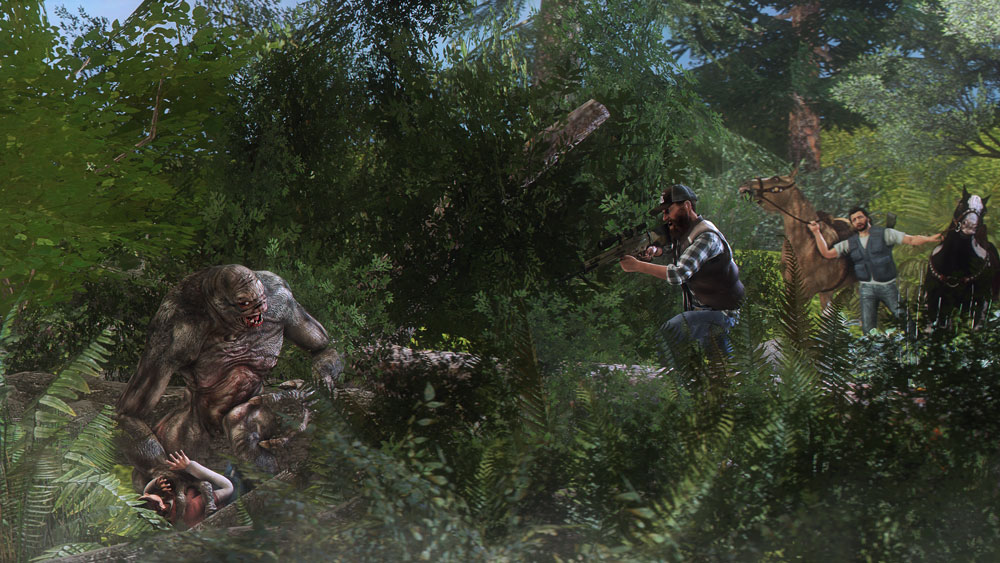
Even though “Day of Wrath” is translated from Russian, it sounded completely American. The story is about two men riding on horseback into a backcountry settled by folks who work the land, live in cabins, and who fear people they don’t consider humans. I don’t know if Gansovsky intentionally wanted us to think of Native Americans but I did. There is one scene that reminds me of The Searchers.

“Day of Wrath” reminded me of stories I read in old issues of Astounding, Analog, or Galaxy from the 1950s and 1960s. Stories like those written by Poul Anderson, Gordon Dickson, or Jack Vance. Stories that began with two riders, sometimes on horses, and sometimes on strange alien mounts, with one rider who knows the country, and one rider who doesn’t. That setup lets us the reader learn the backstory with the newcomer. I assume we’re on Earth, but that might not be true.

The two characters are Meller, the forester, and Betly, the journalist. Betly wants to find out what people think of the otarks, superintelligent creatures that escape from a science lab years ago and are now populating that rural area. They are pushing out the humans. The city people have heard about the otarks and are fascinated by the fact they know advanced mathematics. But the local people only know the otarks as killers, and consider them inhuman. Gansovsky also tells us this society has intelligent machines but doesn’t make much of them.

“Day of Wrath” wants us to consider the old question: What is human? That’s a favorite science-fictional theme I enjoy. Like the androids in Do Androids Dream of Electric Sheep? by Philip K. Dick, we’re told the otarks have no empathy, no compassion. They do have brilliant analytical minds that do higher mathematics and understand the Theory of Relativity. But the otarks also kill wantonly. To portray them as the ultimate evil, Gansovsky has them eat humans and even each other. Does he do this so we’ll think they are worth exterminating? But then, does he tell us they understand Einstein as a reason to save them?

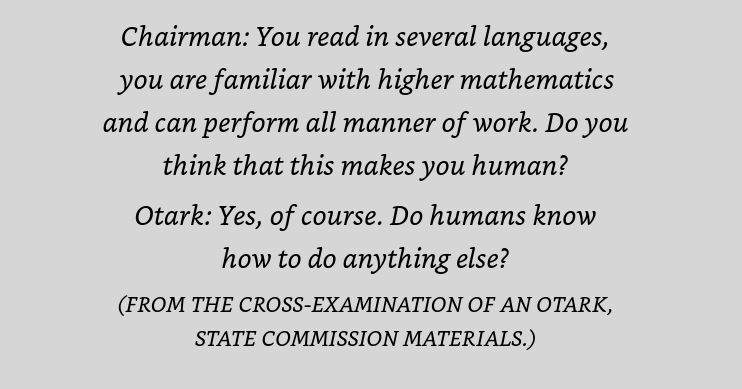
Gansovsky brings us these issues, but the ending suggests he’s on the side of extermination. I assume the ending is the day of wrath. That’s an interesting word to use since we usually associate it with God. We are the gods of the otarks, and it’s our wrath that will destroy them. It’s telling that Gansovsky begins his tale with this quote from a hearing:

The key to the story is deciding if humans have qualities the otarks don’t. This is my first reading of “Day of Wrath” and I expect to reread it because I believe it’s a deeper story than possible to understand from one reading.

But I have a question for Gansovsky: Does killing make us inhuman? Humans kill all the time. Sometimes we’re even cannibals. Maybe we lack that divine spark we think we see in ourselves. In Do Androids Dream of Electric Sheep? Dick does advocate extermination because the androids lack empathy. His novel focuses on what makes us inhuman. But the film version Blade Runner focuses on what makes the Replicants human. I tend to feel, that Gansovsky is positioning himself closer to PKD here, and not seeing the otarks as a Roy Batty who gives us a “Tears in the Rain” speech. But when I reread this story in the future I might change my mind.

Rating: ****

Main Page of Group Read

James Wallace Harris, 11/10/21

“A Modest Genius” by Vadim Shefner

Group Read 27The Big Book of Science Fiction

Story #41 of 107: “A Modest Genius” by Vadim Shefner

“A Modest Genius” by Vadim Shefner is another story in The Big Book of Science Fiction that I wouldn’t consider science fiction. Yes, it has an inventor of science-fictional gadgets, but those inventions are used as a fantasy writer would use them, not science fiction. “A Modest Genius” is told in a fable or parable-like style about a man and three women he’s interested in. I don’t know what to call this style, but it involves more telling than showing. We’ve seen this mode of storytelling mostly in the translated stories in this anthology. I wonder if it’s just a popular narrative approach in other countries?

Maybe this style of writing should be called the oral storytelling mode because it sounds like what you’d hear if the narrator was telling us the story out loud. Oral storytellers usually don’t have a lot of dialogs — probably because it would make them sound like they had multiple personalities. This technique is more common in fantasy stories because it conveys an old-timey feel. Unfortunately, I don’t like its use in science fiction, probably because it reminds me of 19th-century fiction, and I like to think of SF as future-oriented.

“A Modest Genius” is still a pleasant little tale but one I would never choose to anthologize. The story’s core insights are about picking the right kind of spouse for your personality. That’s hardly science-fictional. The crazy inventions just gives Sergei the patina of being an oddball, or add a bit of humor.

This disappoints me because I was looking forward to reading Soviet science fiction. I was hoping the translated stories would give us insights into the traditional themes of science fiction with unique perspectives from other cultures. All too often they’ve been about mundane topics with some science-fictional elements.

Science fiction is notoriously hard to define. Everyone has their own definition. But for me, it’s essential that the story is science-fiction at heart. “A Modest Genius” is about a lonely man trying to find the right woman. If the story had centered on his future vision gadget to solve his romance conundrum I would have considered it science fiction, but that idea was only tossed out and ignored.

Main Page of Group Read

James Wallace Harris, 11/8/21

“2 B R 0 2 B” by Kurt Vonnegut Jr.

Group Read 27The Big Book of Science Fiction

Story #40 of 107: “2 B R 0 2 B” Kurt Vonnegut Jr.

I believe we should talk about context — the context of when and why we read science fiction. I became addicted to science fiction during the 7th (63/64) and 8th (64/65) grades because I went to four different junior high schools during those two years. My parents’ marriage was coming apart, and my father had a heart attack, and we just kept having to move. It was a very stressful time and reading science fiction was how I coped. If my life had been stable I’m not sure I would have read so much. I would have been more involved with the real world. My consumption of sci-fi would have been moderate, maybe even casual.

I’m reading a lot of science fiction now because that’s about all I physically feel like doing. I turn 70 this month. Being retired, and discussing science fiction on the internet is something enjoyable to do, somewhat social, letting me interact with folks with a similar reading interest.

When I read a science fiction story today it has to mean something in my current context of life. I’ve been trying to explain that context as I’ve reviewed the stories in The Big Book of Science Fiction.

2 B R 0 2 B” by Kurt Vonnegut is a famous short story that’s often taught in schools. It’s fun. It’s slick. It’s entertaining. It has a surprise ending. However, I thought the story thin and expected more from the famous Kurt Vonnegut. Of course, when this story was published it was when he was selling to the science fiction magazines, and before he disavowed being a science fiction writer to become a major literary writer. That’s a kind of context too.

In one of my recent reviews, I talk about how I enjoyed a story because I was in the right mood. I had read the story just after getting up in the morning. That’s when I’m at my best. I read “2 B R 0 2 B” while feeling uncomfortable from an overactive bladder and a cranky prostate, while feeling pains in my ass from a recent flareup of the piles, and a stuffy head from the side effects of the drugs I have to take that makes it hard to think clearly. Maybe I would have liked “2 B R 0 2 B” more if I had felt better when I read it?

However, I felt just as bad when I raced through twenty hours of To Say Nothing of the Dog by Connie Willis, enjoying every minute of it. That book made me forget that I felt crappy. As soon as I finished that novel I started listening to Crossroads, the new novel by Jonathan Frazen, which is twenty-six hours on audio. I’m just as delighted with it, and it helps me to forget my yucky physical situation too. However, I tried reading Three Men in a Boat by Jerome K. Jerome, a book considered one of the funniest from the 19th century and the book that inspired Willis to write To Say Nothing of the Dog. Jerome K. Jerome didn’t work. It’s just a series of humorous sketches that aren’t that compelling as a page-turning novel.

Evidently, having an addictive plot is what I need. And Vonnegut’s little story about a man whose wife is having triplets in a world where the population is severely controlled doesn’t last very long or isn’t very diverting. But I’m not sure if the length is a necessity. “The Voices of Time” by J. G. Ballard drew me deeply into it.

There are aspects of “2 B R 0 2 B” that were more important back in the 1960s. Even before The Population Bomb (1968) and The Limits of Growth (1972) science fiction magazines ran essays and stories about the dangers of overpopulation. It was a popular topic for Arthur C. Clarke and Isaac Asimov, and Harry Harrison wrote a vivid 1966 novel Make Room! Make Room! about the problem. Vonnegut’s facetious treatment of the idea is a quick bit of satire, that really ignores the seriousness of the problem just to get a sick laugh. That’s another context. Now, almost sixty years later, overpopulation is a major factor in climate change, and it’s even more serious of an issue. Shooting people is not a very funny solution because we now live in a world where too many people are whipping out guns and shooting other people. That’s another context.

As a classic story “2 B R 0 2 B” probably desires 4-stars, but as a pleasant trifle, I feel like only giving it 3-stars. And each of those is a different context.

I’ve got 67 more stories to read and review in The Big Book of Science Fiction. The context of reading so much science fiction weighs on each story I read. After forty stories it’s getting harder and harder to impress me.

Supposedly, all the stories in the collection are exceptional. But reading them together shows something different. If I was in the 8th grade and “2 B R 0 2 B” was my only reading assignment, I would probably consider “2 B R 0 2 B” a really good story. It was easy to read and funny. It would also be easy to talk about in class, or a snap to write a paper on. In that context, I would have thought English class that day wasn’t the drag it usually is. Compared to the other 39 stories we’ve read so far, it would rank maybe 28.

But in my present context of annoying bodily sensations and having to read this story because I set my goal to review all the stories in a giant anthology, Vonnegut’s story was barely a blip.

Main Page of Group Read

James Wallace Harris, 11/7/21

“The Squid Chooses Its Own Ink” by Adolfo Bioy Casares

Group Read 27The Big Book of Science Fiction

Story #39 of 107: “The Squid Chooses Its Own Ink” by Adolfo Bioy Casares

“The Squid Chooses Its Own Ink” by Adolfo Bioy Casares is a nice enough little tale, but it really didn’t do much for me. It’s another story about an alien that comes to Earth to save humanity from itself and protect outer space from us crazy people who have the bomb. We never get to meet the alien, and the story is told in a rather roundabout comic tone. I’m not even sure the alien is the important aspect of this story, but since we’re science fiction readers we zero in on it. I wonder if we were just ordinary fiction readers living in Argentina at the time if the focus of the story wasn’t the teacher and the small-town characters.

The narrative structure, style, and voice felt like other Hispanic stories I’ve read. Since I haven’t read a lot of Spanish-translated stories I don’t know if I’m missing out on literary allusions that might make the story more impressive to people that do. For example, I just finished To Say Nothing of the Dog by Connie Willis. It’s a comedy of manners that riffs off of many classic English novels. Since I am familiar with those novels, it made Willis’ style an important part of the story.

Since I don’t have that experience with Hispanic novels I could be missing something very delightful in “The Squid Chooses Its Own Ink.”

Like I said above, the science-fictional elements of this story were already tired by 1962 when this story first came out. Maybe those ideas were new and novel in Argentina at the time. The idea behind this story reminds me of The Man Who Fell To Earth by Walter Tevis from 1963. It takes the old idea and gives it deeper pathos. Do not think you know the Tevis novel if you’ve only seen the horrible film version with David Bowie. It’s a beautifully poignant story of a Martian who comes to Earth to save his world and ours but painfully fails. Casares’ SF idea also reminds me of the 1951 film The Day the Earth Stood Still and the 1954 novel A Mirror for Observers by Edgar Pangborn.

Casares only hinted at the theme, but having an alien from space that comes to save us in a Christ-like role is a good idea though. Maybe it’s even time to resurrect that idea. I do like that the alien fails and some of the town’s people didn’t feel humans were worth saving.

“With my hand on my heart,” Aldini murmured, “I say to you that the traveler did not lie. Sooner or later we’ll blow ourselves up with the atomic bomb. There’s no way past it.” 

As if he were speaking to himself, Badaracco said: 

“Don’t tell me that these old people have destroyed our last hope.” 

“Don Juan doesn’t want to change his way of living,” the Spaniard proposed. “He would rather that the world blew up than that salvation came from outside. I suppose it is a way of loving mankind.” 

“Disgust in the face of things you don’t know,” I said. “Obscurantism.” 

They say that fear makes one’s mind run more clearly. The truth is that there was something strange in the bar that night and we all brought our ideas to the discussion. 

“Come on, fellows, let’s do something,” Badaracco said. “For the love of humanity.” 

“Señor Badaracco, why do you have so much love for humanity?” the Spaniard asked. 

Badaracco blushed and stammered: 

“I don’t know. We all know.” 

“What do we know, Señor Badaracco? If you think about men, do you think them admirable? I think the exact opposite: they are stupid, and cruel, and mean and envious,” Villaroel declared. 

“Whenever there are elections,” Chazarreta agreed, “then your beautiful humanity stands revealed naked, just as it really is. It’s always the worst ones who win.” 

“So love of humanity is just an empty phrase, then?” 

“No, my dear teacher,” Villaroel replied. “Let us call love of humanity the compassion for other people’s pain and the veneration we have for the works of our great minds, for the Immortal Cripple’s Quixote, for the paintings of Velázquez and Murillo. In no sense does this love serve as an argument to delay the end of the world. These works only exist for humans to experience, and after the end of the world—and the day will come, whether brought by the bomb or by natural causes—they will have no justification or support, believe you me. As for compassion, it will disappear as the end approaches….As no one can escape death, let it come quickly, for everyone, so the sum of pain will be as small as possible!”

The Big Book of Science Fiction (p. 444). Knopf Doubleday Publishing Group. Kindle Edition. 

I feel there is humorous cynicism throughout this story, but I can’t be sure. I sense that Casares is poking fun at people who live in small towns, but again I’m not sure. The way the characters address and talk to each other seems like it’s meant to be humorous, but I’m behind both a language and cultural barrier, and Casares might have intended no quaint humor at all. Because the alien figures so little in this story, I’m not sure if the story isn’t mostly poking fun at small-town characters.

Main Page of Group Read

James Wallace Harris, 11/3/21

“The Astronaut” by Valentina Zhuravlyova

Group Read 27The Big Book of Science Fiction

Story #38 of 107: “The Astronaut” by Valentina Zhuravlyova

The thing about getting old is running down. I have good days and bad days. Actually, I have good hours and bad hours. This morning started off nice. I woke up early this morning to the sound Messenger makes to notify me of a new message. It was still dark outside, just a bit after six. Piet Nel has sent me a link to John O’Neill’s review of Modern Classic Novels of Short Fiction edited by Gardner Dozois. That’s an anthology I’ve wished the group would pick to read, especially because it has my all-time favorite science fiction novella in it, “The Star Pit” by Samuel R. Delaney. Reading O’Neill’s review and comments put me in the mood to read science fiction.

Ozzy the cat was sleeping soundly on my legs, so I decided not to bother him. Instead of getting up to start my day, I tapped on the Kindle app to read “The Astronaut” by Valentina Zhuravlyova. The VanderMeers introduction got me interested in the story right away when they gave away the part about the astronauts having to reduce the weight of the spaceship to make the return voyage back to Earth. That same idea is used in Destination Moon (1950). I’ve always used that idea about jettison mass to minimize the weight to take off as a metaphor for succeeding at efforts in life. Often I’m weighted down by too many desires, so to get something done I have to toss out everything but the one thing I want to accomplish.

As soon as I started reading the story I liked it. The narrative was simple and engaging. I often write about why we like or dislike a story. In our group discussions, I’m amused by how some of us praise a story while others dismiss it. It’s so easy to get annoyed by a story, to fail at enjoying it. This morning while still snug under my covers and cat, and having just finished an upbeat essay about the joys of great science fiction, and still fresh from a night’s sleep, I got into this story in a big way.

“The Astronaut” is the kind of story I wanted to find when we voted to read The Big Book of Science Fiction. I hoped to find stories I loved as much as the stories I loved in the classic anthology The Science Fiction Hall of Fame. I wanted to read stories I had never read and were unknown to all the famous SF anthologists. I have no memory of Valentina Zhuravlyova, and I’m quite certain I will soon forget her name. And I’ll probably even forget the name of this story, but I will remember three things about this tale.

I will remember a story about astronauts needing to throw out equipment so they could take off because I often remember Destination Moon. I now will remember two stories that used that idea.

I will remember I’ve read a story where the space administration decided it was important for astronauts to have hobbies for their long space voyages. I’m surprised I haven’t seen this idea before.

And I will remember I read a story about a lone stranded astronaut who put his soul into two paintings. Valentina Zhuravlyova has put a bit of her soul into “The Astronaut.” She is dead now, but she coded part of herself into this story.

I have another metaphor I often use to explain the limitations of communication. I compare all our efforts to speak across the void between conscious minds as throwing a message in a bottle upon the ocean hoping someone will find it. The astronaut Zarubin threw two paintings upon the void hoping to express himself, and “The Astronaut” is Valentina’s message in a bottle to us.

This is the second time I tried to write this essay. After I read “The Astronaut” I drained away the rest of my night’s store of energy by doing the exercises that keep my aches and pains away. I tried to write this later this morning, but I was too weary. I had to even nap to feel like eating lunch. And then I had to nap again. But that gave me time to think about this story and what to write. Getting old means running out of energy. I have to jettison many things I want to do just to accomplish one thing during my day. This was it. For the rest of the day, I will store up energy by napping or listening to books.

I’m alternating between two novels right now, To Say Nothing of the Dog by Connie Willis and Crossroads by Jonathan Franzen. Both provide psychic food that gives me the energy to think. Exercise and proper eating give me physical energy. The thing about being old is my batteries drain so damn quickly. Napping and reading are my ways of recharging. But I need a quality reading diet to generate psychic energy. “The Astronaut” gave me that.

Main Page of Group Read

James Wallace Harris, 11/2/21

“The Voices of Time” by J. G. Ballard

Group Read 27The Big Book of Science Fiction

Story #37 of 107: “The Voices of Time” by J. G. Ballard

Whenever I read stories by J. G. Ballard I feel like I’m reading science fiction for grownups. This is my second reading of “The Voices of Time” and it has very adult vibes. Sure, the story ideas are the same old science-fictional bullshit, but they feel literary and serious. Maybe because the theme is death and decay. That’s very heavy. There’s a mature acceptance of death in this story. Youthful science fiction is always about rejecting and defying mortality. However, J. G. Ballard was only around thirty when he wrote “The Voices of Time.” Could Ballard’s upbringing under the conditions described in the autobiographical Empire of The Sun explain his wiser-than-his-years outlook?

Is it me, or do Ballard’s stories from the 1960s focus on decay and decline? Was that just a schtick he developed or personal philosophy? Or should we tag that as his entropic period? When I was young I didn’t dig Ballard that much. I admired him, especially the Vermillion Sands stories, but his end-of-the-world novels didn’t have the violence and excitement as American end-of-the-world novels. They felt decadent. I also associated them with how I imagined the British felt about the decline of their empire. Now that I’m older, Ballard’s stories resonate with my current moods. One of those moods is the belief that the American empire is in decline.

The story begins with a doctor named Powers contemplating the suicide of a colleague who had spent his last days carving a giant symbol at the bottom of an empty pool. Powers knows he’s about to die too and has his own compulsions to leave a message. Powers knows he’s been infected with a plague that makes people comatose. He is sleeping more each day and plots his remaining hours of consciousness to wrap up his affairs. This lets us readers observe a world undergoing bizarre changes. Earth is experiencing a rise in radiation from space, and animals are starting to mutate and adapt, including some plants and animals absorbing lead to produce protective shielding.

Initially, however, Powers was too preoccupied with completing his work at the Clinic and planning his own final withdrawal. After the first frantic weeks of panic he had managed to accept an uneasy compromise that allowed him to view his predicament with the detached fatalism he had previously reserved for his patients. Fortunately he was moving down the physical and mental gradients simultaneously—lethargy and inertia blunted his anxieties, a slackening metabolism made it necessary to concentrate to produce a connected thought-train. In fact, the lengthening intervals of dreamless sleep were almost restful. He found himself beginning to look forward to them, and made no effort to wake earlier than was essential.

“The Voices of Time” is a 4-star story for me that I look forward to reading, again and again, it might even become a 5-star story if I can ever decipher what Ballard is doing. I can’t yet tell if Ballard has accidentally included enough elements to make this story into a philosophical mystery, or if it was intentional. It’s the kind of story that college students analyze and write papers about.

There is a beautiful epic passage towards the end that explains the title.

Like an endless river, so broad that its banks were below the horizons, it flowed steadily towards him, a vast course of time that spread outwards to fill the sky and the universe, enveloping everything within them. Moving slowly, the forward direction of its majestic current almost imperceptible, Powers knew that its source was the source of the cosmos itself. As it passed him, he felt its massive magnetic pull, let himself be drawn into it, borne gently on its powerful back. Quietly it carried him away, and he rotated slowly, facing the direction of the tide. Around him the outlines of the hills and the lake had faded, but the image of the mandala, like a cosmic clock, remained fixed before his eyes, illuminating the broad surface of the stream. Watching it constantly, he felt his body gradually dissolving, its physical dimensions melting into the vast continuum of the current, which bore him out into the centre of the great channel, sweeping him onward, beyond hope but at last at rest, down the broadening reaches of the river of eternity.

Why did Ballard imagine this immense view of time? Was he smoking dope or meditating and this vision appeared to him? Or did some classic poem or writer inspire it? For whatever reason, he worked it into a lovely science fiction story. It justifies creating a dying character, even a dying Earth.

Main Page of Group Read

James Wallace Harris, 10/31/21

“Plenitude” by Will Worthington

Group Read 27The Big Book of Science Fiction

Story #36 of 107: “Plenitude” by Will Worthington

[I’ve gotten a complaint about my hyperlinks being hard to see. I’m going to bold them to see if that helps. Let me know what you think.]

Who the hell was Will Worthington? According to ISFDB.org, he was the pen name for Will Mohler, and they list just twelve short stories by him, published in the SF magazines from 1958-1963. His name only appeared on a cover twice, and according to the VanderMeers in the introduction of “Plenitude” Mohler’s identity is still quite a mystery. But ISFDB is full of people like Mohler, would-be writers who had a few publications and then disappeared. Forgotten writers intrigue me. I even maintain a webpage for Lady Dorothy Mills, a forgotten writer from the 1920s. Most days, that site gets no hits.

Plenitude” appeared in the November 1959 issue of The Magazine of Fantasy & Science Fiction, and then was reprinted by Judith Merril twice, first in her annual for 1959, and then again in her The Best of the Best, which was her favorite stories from the first five years of the annual. For some reason, it was reprinted in two different forgotten anthologies in 1974. Four of his other stories were reprinted, but none of them ever made it into a major anthology until The Big Book of Science Fiction. And I’m not sure it belongs there. Evidently, the VanderMeers like forgotten writers too.

“Plenitude” is a pretty good SF story, but not a classic. It’s the second time I’ve read it. The VanderMeers reprint twenty stories from the 1950s and none of them were about post-apocalyptic times after the bomb, a very favorite theme from that decade. However, Mohler’s story is about a family, a dad, a wife, and two kids living out in the woods after a major change in society — so it’s kind of post-apocalyptic.

Actually, it’s anti-utopian, or post-technology. The dad has moved his family back to nature to escape the modern life of living in a pod jacked into artificial reality. I picture this future somewhat like The Matrix, but the inhabitants know what they are doing, and can still see the real world if needed.

Mohler was doing exactly what Silvina Ocampo was doing in “The Waves,” protesting a future designed by science and technology. However, Mohler took the time to work up a real story with decent characterization. The dad in this story comes across like a proto-hippy or 20th-century Luddite. He makes his family work hard at farming and is proud of his son for being a good bow hunter. This family is part of a small mountain community that has rejected techno-life. I pictured these people being the kind who joined communes in the 1960s and 1970s and read Mother Earth News, CoEvolution Quarterly, Communities, and the Whole Earth Catalog. Oh wait, I read those mags. I guess that’s why I feel a kinship with Mohler. Mohler was ahead of his time in 1959, but maybe not, because there are back-to-nature folks in every era. But he predates the back to the land movement of the 1960s.

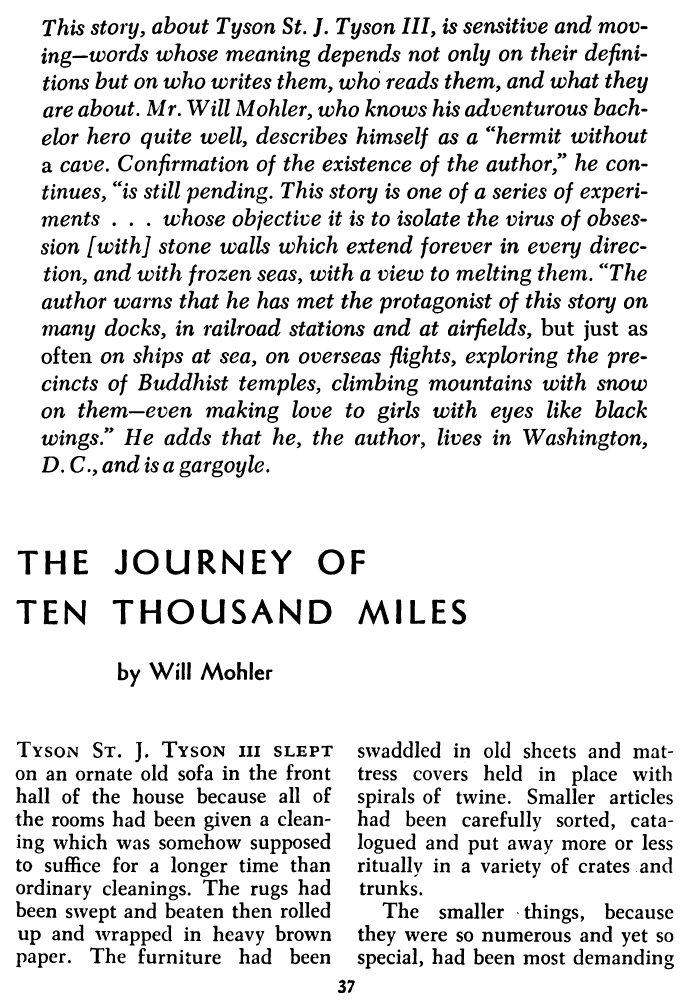
The F&SF editorial blurb that introduced “Plenitude” said of Mohler, “As of this writing, Will Worthington is living on a wild island off the coast of Maine, where he is leading a Thoreau-like existence which will inspire him, it is to be hoped, to more stories like the following.” I’m tempted to read Mohler’s other eleven stories to see if I can guess more about what he might have been like. A few years later, another blurb says he’s living in Washington, DC.

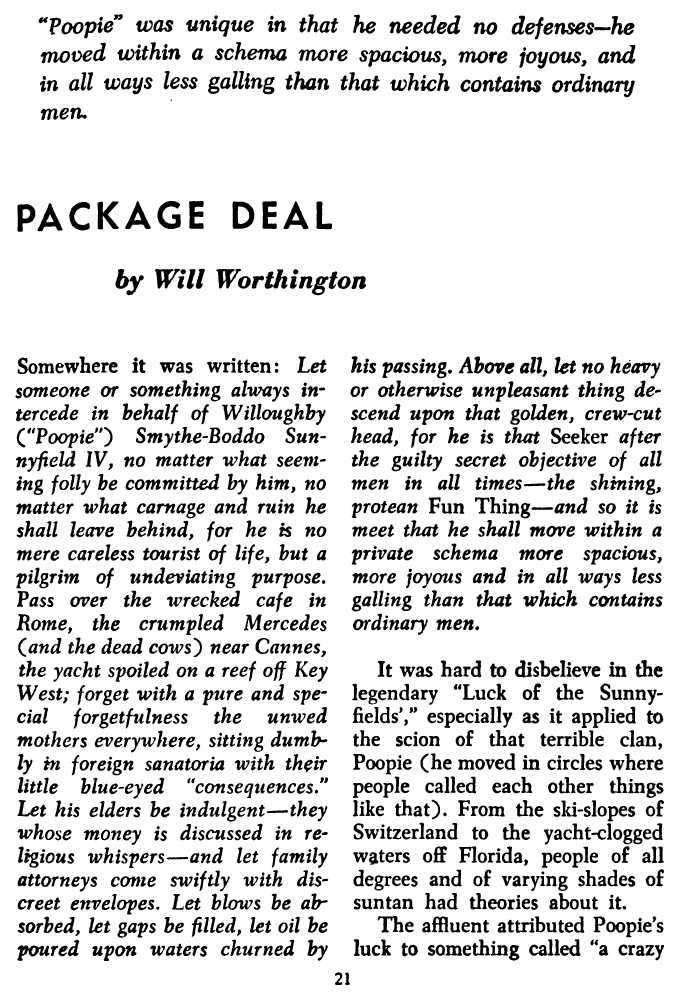
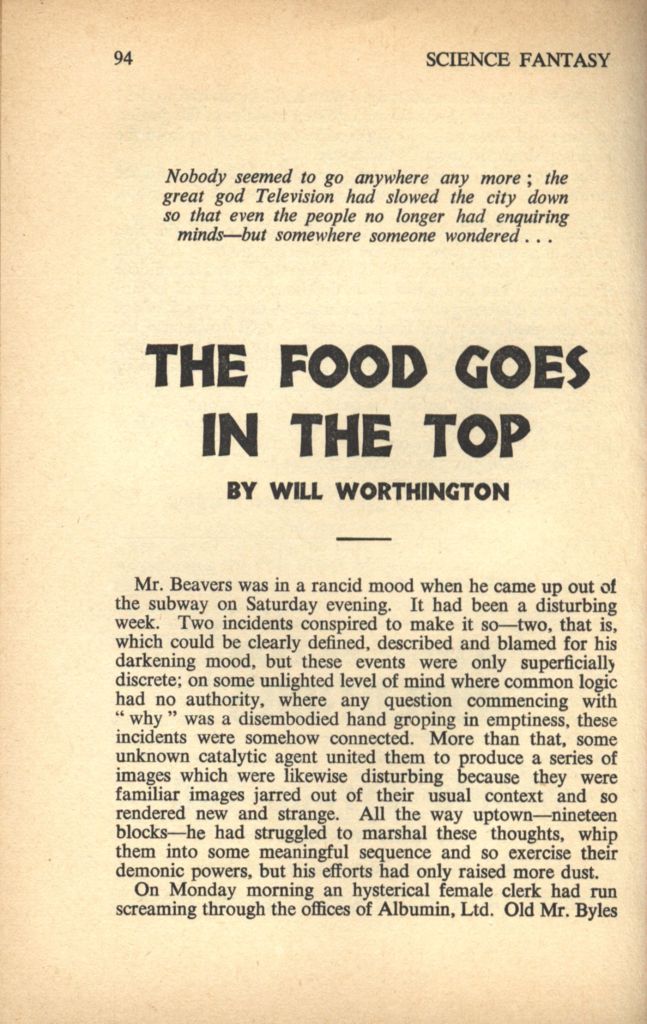
Since I don’t have time to read those other stories I thought I’d post the first page of each of them to see if they give any more clues about Mohler. But I’m also posting links to where you can read the stories online, just in case you’re like me and wonder about forgotten authors.


If, December 1958


Fantastic, June 1959


The Magazine of Fantasy & Science Fiction, November 1959


Fantastic, January 1960


The Magazine of Fantasy & Science Fiction, February 1960


The Magazine of Fantasy & Science Fiction, June 1960


The Magazine of Fantasy & Science Fiction, November 1960


The Magazine of Fantasy & Science Fiction, July 1961


Science Fantasy, August 1961


The Magazine of Fantasy & Science Fiction, March 1963


Galaxy Science Fiction, December 1963

I can’t say any of these beginnings grabbed my interest, nor was much revealed about Mohler. When I get time I want to read all the stories. I’m curious about Mohler. He seemed to disappear just as the 1960s got going. Did he drop out, or begin his real career? I bet he loved the 1960s though, at least from the vibes I get from reading “Plenitude.”

Main Page of Group Read

James Wallace Harris, 10/28/21