“Good News from the Vatican” by Robert Silverberg

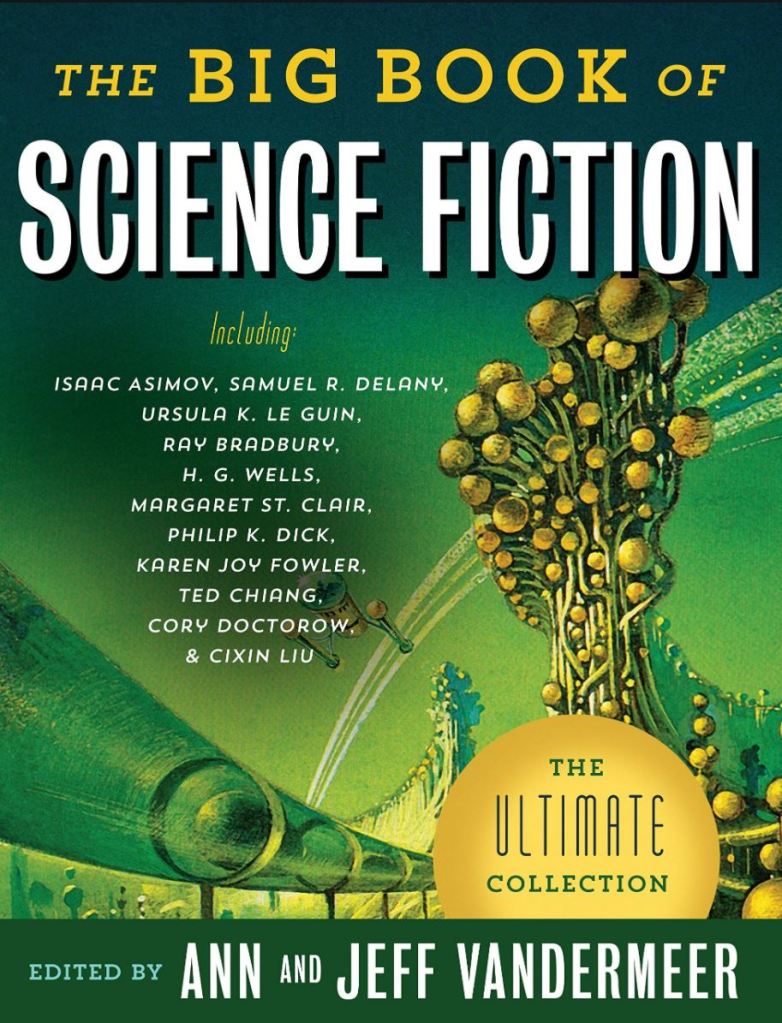
Group Read 27The Big Book of Science Fiction

Story #57 of 107: “Good News from the Vatican” by Robert Silverberg

“Good News from the Vatican” by Robert Silverberg first appeared in Universe 1 edited by Terry Carr in 1971. The Universe series was the next big original anthology series after Damon Knights Orbit if I remember right. Original anthologies were just becoming a thing, and it seemed stories published in them were of a higher order than those that first appeared in the magazines. “Good News from the Vatican” also won the Nebula award for the best short story the following year. Oddly, Carr didn’t include it in his new best-of-the-year anthologies, Best Science Fiction of the Year, nor did Wollheim for The 1972 Annual World’s Best SF, but Lester del Rey did include it in his new best-of-the-year anthology series, Best Science Fiction Stories of the Year. 1972 was a big year for best-of-the-year volumes, and our Facebook group has read two of them.

This is a long roundabout way of wondering if “Good News from the Vatican” was the best SF short story from 1971. Why do we remember the stories we do? We just read another one, “Vaster Than Empires and More Slow” by Ursula K. Le Guin. And 1971 was famous for Larry Niven’s “In Constant Moon.” Don’t get me wrong, I like “Good News from the Vatican.” Silverberg is a skilled writer with worldly experience and a lot of acquired knowledge and it shows in the story. “Good News from the Vatican” is just as literary as something Graham Greene would have written at the time.

The VanderMeers picked two stories from 1971 to remember. I liked both choices, but they were not the stories I recall for remembering 1971 science fiction. I think of “Inconstant Moon” and “A Meeting with Medusa” by Arthur C. Clarke. I’m not disagreeing with the VanderMeers’ choices. And I’m not even considering that different people have different tastes in stories.

No, I want to explore the idea that there are different flavors of science fiction. And there might be fans that strongly prefer one over the other. I’m not sure what to call these flavors, but I believe I see two in the stories from 1971.

To “Good News from the Vatican” I’d group “No Direction Home” by Norman Spinrad and “All the Last Wars at Once” by George Alec Effinger, and probably “Gehenna” by Barry Malzberg and “How Can We Sink When We Can Fly?” by Alexei Panshin.

To “Inconstant Moon” and “A Meeting With Medusa” I would add “The Queen of Air and Darkness” by Poul Anderson. Now you might guess I would add “Vaster Than Empires and More Slow” but I’m not sure. It is a story involving outer space but it’s not quite the same, it’s more like the other group. Why?

If you’re familiar with the history of science fiction in 1971 you might say I’ve divided the stories up into New Wave and Old Wave. And that might be true, but I think my unconscious mind is getting at something else.

The first type allows the author to be clever, intellectual, opinionated, and philosophical. The plot or story takes a back seat, allowing the writer to become a commentator. The other type takes the reader on an adventure, giving them a virtual experience.

“Good News from the Vatican,” asks the reader: What would ordinary people, and religious professionals think about a robot being a spiritual leader? “Inconstant Moon,” asks the reader what they would do if they knew the world was about to end?

I don’t know if I’m conveying the insight I’m having, but it’s working for me. I’m zeroing in on why I like different stories and why.

Main Page of Group Read

James Wallace Harris, 12/10/21

“Vaster Than Empires and More Slow” by Ursula K. Le Guin

Group Read 27The Big Book of Science Fiction

Story #56 of 107: “Vaster Than Empires and More Slow” by Ursula K. Le Guin

Our group has read this story before, and I reviewed it for my essay “What Makes a Great SF Short Story?” I had quite a lot to say, so I don’t see any reason to repeat myself. But I will say it’s a solid 5-star story and enjoyed rereading it. Again, it makes me want to read or reread Le Guin’s Hainish series of novels. I’m retired and I still can’t find time to read everything I want.

We’ve just passed the 50% counter on my Kindle edition of The Big Book of Science Fiction. What a long journey so far. What a long way to go. I’m no longer reading a short story a day for the group, but just reporting on stories every other day for this anthology. I’m taking that day off to read stories I find on my own.

Paul is doing Christmas-related science fiction stories on those alternate days. I feel bad about skipping out on his group read. However, after Christmas he wants me to lead the group read for The Great SF Stories 25 (1963) edited by Isaac Asimov and Martin Greenberg. I’m looking forward to that. I started reading The Great SF Stories 1 (1939) in 2018 and I’m currently up to The Great SF Stories 18 (1956). The group voted for volume 25, so I’ll jump ahead. Thus, I’ll be back to reading and reporting on a story a day for the group.

The Sinister Science blog just finished reading the Great SF series. That’s quite an accomplishment. George Kelley blogged about reading the series a couple years ago. If you’re into old science fiction and love short stories, The Great SF Stories is a fun reading project. Unfortunately, the books are out-of-print and they’re starting to get pricey on the used book market. All 25 are available in the pdf format on the web if you search around. I don’t link to them because that might cause a take-down. Here’s my list of the stories with links to ISFDB, and my review of The Great SF Stories 1 (1939). Austin Beeman is also reviewing the series.

I’m hoping our Facebook group will eventually discuss all 25 volumes.

Main Page of Group Read

James Wallace Harris, 12/7/21

“Let Us Save the Universe” by Stanislaw Lem

Group Read 27The Big Book of Science Fiction

Story #55 of 107: “Let Us Save the Universe” by Stanislaw Lem

“Let Us Save the Universe” by Stanislaw Lem was first published in The New Yorker. That’s rather prestigious. It’s currently in print from MIT Press in the collection Memoirs of a Space Traveler. Strangely, the paperback at Amazon is cheaper than the $13.99 Kindle edition, and that seems rather steep for a small ebook.

“Let Us Save the Universe” is a bit of humor about human tourists trashing the galaxy. It is lightly clever, and a bit amusing, but I found it only mildly entertaining. More and more, as I go through these stories in The Big Book of Science Fiction, I realize there are all kinds of science fiction and all kinds of fans for each kind of science fiction. Probably, if I had read “Let Us Save the Universe” back in 1981 when it came out, I might have enjoyed it a lot more. I might have even praised it and recommended my friends read it. But now I’m old and crotchety and don’t have much patience for fluff.

At the Facebook group where we discuss these stories reaction to them is all over the place. We’ve read many anthologies and have discussed how well we like them. The evidence shows that it’s extremely difficult to assemble an anthology with a high hit rate for a majority of readers. Hell, it seems an impossible task to assemble an anthology that any two readers will agree on which are the best stories.

At this time in my life, I’m looking for great stories. I want to find the stories I love best, and then reread them. It’s beginning to annoy me to have to wade through so-so stories. But what I’m trying to say is “Let Us Save the Universe” didn’t push my buttons but it could push yours. It’s not a story I’ll add to my ultimate list of favorite SF stories.

I wish Amazon would offer a feature like playlists in Spotify where we could assemble our own anthology of favorite stories. I’d want mine to be both a Kindle and an Audible book. And I understand I could only add stories from books, magazines, and audiobooks I own or purchased separately. Although, wouldn’t it be neat if there was a Spotify for short stories? You pay one monthly price and could read/listen to any short story. I wonder if people realize how cool short stories work for smartphones? I like rereading my favorite stories in the same way I like replaying my favorite tunes.

Piet Nel in the group mentioned he’s has a list of 150 science fiction stories he loves most. This made me think I should assemble my own list of favorites. I have a couple of tall Billy bookcases from Ikea stuffed with anthologies. That’s a lot of short stories. However, I probably only love maybe 100-200 of them at most, maybe less.

When I was young I rarely re-read fiction. I’d say 100% of my input was new. But as I’ve aged, I tend to reread old favorites more often, and that’s especially true for short stories. Being in this short story Facebook group we’re reading many whole anthologies and quite often I’m rereading stories. This has turned out to be a good thing. I’m learning that rereading is often better than new reading. That the experience of getting deeper into a story is superior to the excitement of reading a new story — unless that new story is great. It’s always wonderful to discover something great. Of course, that doesn’t happen often.

But to the point, I feel like I’m wasting my time reading so-so stories, or even merely very good stories. When I was young and it was exciting to try a lot of different kinds of stories, “Let Us Save the Universe,” would have been fun. Now it’s mildly entertaining, but mostly a waste of my time. I’m jaded. I’ve developed a tolerance for certain kinds of fiction. I need the hardcore great stories, the really good stuff to get off.

That’s why I’d like an anthology of my favorite stories — more often than not, to get the most out of my reading time, it’s a bigger thrill to reread something I know.

Main Page of Group Read

James Wallace Harris, 12/5/21

Three From Moderan: David R. Bunch

Group Read 27The Big Book of Science Fiction

Story #52, 53, 54 of 107: Three From Modern by David R. Bunch

How and why do we read old science fiction stories and novels? Our Facebook group reading of The Big Book of Science Fiction is one explanation. The VanderMeers picked stories they want to save from obscurity and published them in this anthology. Their author introductions tempt us to read other stories and novels. Most people pick books that look interesting to them at the bookstore or read books friends or famous people on television recommend. A few readers might even read stories I write about on this blog. But sometimes readers pick books on specific themes or styles.

The past is full of great stories, but then new great stories are being published all the time. We’re torn between reading the latest versus the classic. Do you ever contemplate what you read and why? Or do you merely stumble upon your next read?

Our next three selections to discuss are three sections/stories from Moderan by David R. Bunch: “No Cracks or Sagging,” “New Kings Are Not For Laughing,” and “The Flesh Man From Far Wide.” The last appeared in the November 1959 issue of Amazing Stories, but the other two might have been written for the book, which first appeared in 1971. Evidently, Bunch was working on this weird theme for a very long time.

There is a new 2018 edition of Moderan from the prestigious New York Review of Books that contains an introduction by Jeff VanderMeer. That might explain why the VanderMeers chose to include three stories by Bunch for our anthology. It’s kind of significant that NYRB reprinted this book. Here’s their sales blurb for it:

Welcome to Moderan, world of the future. Here perpetual war is waged by furious masters fighting from Strongholds well stocked with “arsenals of fear” and everyone is enamored with hate. The devastated earth is coated by vast sheets of gray plastic, while humans vie to replace more and more of their own “soft parts” with steel. What need is there for nature when trees and flowers can be pushed up through holes in the plastic? Who requires human companionship when new-metal mistresses are waiting? But even a Stronghold master can doubt the catechism of Moderan. Wanderers, poets, and his own children pay visits, proving that another world is possible.

“As if Whitman and Nietzsche had collaborated,” wrote Brian Aldiss of David R. Bunch’s work. Originally published in science-fiction magazines in the 1960s and ’70s, these mordant stories, though passionately sought by collectors, have been unavailable in a single volume for close to half a century. Like Anthony Burgess in A Clockwork Orange, Bunch coined a mind-bending new vocabulary. He sought not to divert readers from the horror of modernity but to make us face it squarely.

This volume includes eleven previously uncollected Moderan stories.

What’s kind of funny is while I was researching Moderan, I discovered I owned a Kindle copy of the NYRB edition, which I haven’t read, and probably picked up as a $1.99 bargain book. I wish I could reprint VanderMeer’s introduction. However, you can read it by going to the Look Inside feature at Amazon.

Obviously, some people think this book is special, but my reading of these three sections has only mildly interested me. Reading the hype and history of the book intrigues me more, so I might be tempted to read the entire fix-up novel. I’d be even more likely if there was an audiobook edition, but there’s not. I tend to get into iffy books easier when I’m listening and a good narrator is helping me out.

Moderan first appeared fifty years ago. It was quirky then, written for a quirky time. We live in a much different time and quirky in a much different way. We live in what’s some people are calling the Post Doom era. That catchphrase merely means civilization is on the decline, and we’re already suffering climate change. The advocates for this philosophy suggest instead of hoping society will change and do something to avoid climate catastrophes, that we should start adapting to the new reality. This is an interesting concept for science fiction readers. Instead of reading endless Max Max post-apocalyptic futures, or scenarios of escaping Earth into space, imagine futures where we hunker down and endure.

Moderan is a book about post-civilization, thus making it timely for today’s readers. But will it resonate with them? Unfortunately, I think not. It’s too far future-ish. It’s told in an almost allegorical style. And it’s not literary enough, in my opinion, to widely appeal to readers of eccentric works. I believe being so long out-of-print attests to that.

Moderan imagines a post-civilization of cyborgs and mechanical beings, but not a realistic one. It doesn’t work as science-fictional speculation or extrapolation, thus making it a kind of odd fantasy world. Thus I believe its appeal is going to be limited. I imagine readers who love outré fictional worlds, such as the novels by Mervyn Peake or the short stories of R. A. Lafferty could enjoy Moderan. That kind of fiction only works for me when I’m in rare strange reading moods.

Yet, thinking about this book makes me think about post-civilization novels. I’m afraid science fiction hasn’t done a very good job of imagining the real possibilities. The only works I can think of are recent novels by Kim Stanley Robinson, especially New York 2140 and The Ministry of the Future.

Because we’ve actually entered into a post-civilization phase I have to wonder how readers will react to all the old science fiction that imagined a much different post-civilization existence? Science fiction has produced endless speculations, but now that we opened Schrödinger’s box and reality is gelling on what will be, will science fiction change course?

Main Page of Group Read

James Wallace Harris, 12/1/21

“Soft Clocks” by Yoshio Aramaki

Group Read 27The Big Book of Science Fiction

Story #51 of 107: “Soft Clocks” by Yoshio Aramaki

“Soft Clocks” by Yoshio Aramaki is an entertaining New Wave/experimental story told with traditional storytelling techniques that first appeared in English in the January-February 1989 issue of Interzone but originally appeared in Japanese in 1968. I don’t know how translations work, but “Soft Clocks” feels very English, like something from the Mod/New Wave 1960s. Strangely, it reminds me of “A Rose for Ecclesiastes” by Roger Zelazny, but then both are about a love story set on Mars.

“Soft Clocks” blends the imagery of Salvador Dalí with science fiction and psychiatry to create an antic avant-garde science fiction tale. The setup for the story is DALI OF MARS, a rich artist living on the Red Planet, hires a psychiatrist from Earth to select the best suiter for his granddaughter, Vivi. Vivi has many suitors, either because of her money, or her beauty, but probably not her personality. She is anorexic and has been treated by the first-person narrator from Earth when Vivi is 18 and visiting Tokyo. This psychiatrist referred to as Doctor, has come to Mars to interview Vivi’s many suitors. She is now 21. The Doctor is also in love with Vivi but considers it unprofessional to vie for her. He interviews several strange men who want Vivi, hoping to find a man who can handle her fragile personality. Vivi is technophobic, creating several problems for the story.

“Soft Clocks” comes across as a collaboration of the weirdness of Philip K. Dick and the silliness of Robert Sheckley. I would never have guessed it was written by a Japanese science fiction writer. Soft clocks are an invention of professor Isherwood, mechanical devices made from rheoprotein. They are editable and look like the floppy timepiece in the famous Salvador Dalí painting.

This story was entertaining, but not great. “Soft Clocks” has tasty ingredients. It has decent characters, a decent plot, a good setting, and zany imagery, but doesn’t quite bake into a delicious dessert. I never cared for Vivi, who is the object of desire for many of the characters. Actually, I was more drawn to Carmen, a kleptomaniac prostitute, a minor character. Humor in science fiction is hard to pull off. On another day, this story might have tickled my funny bone, but not today. “Soft Clocks” reprint history suggests it was never a popular story.

This not quite working was often true for Sheckley’s funny science fiction stories. However, Sheckley’s stories sometimes transcended their silliness. That’s what’s missing from “Soft Clocks” for me.

Rating: *** (close, but no cigar)

Main Page of Group Read

James Wallace Harris, 11/27/21

“The Hall of Machines” by Langdon Jones

Group Read 27The Big Book of Science Fiction

Story #50 of 107: “The Hall of Machines” by Langdon Jones

“The Hall of Machines” by Langdon Jones was so uninteresting to me that I wasn’t going to write about it. Then I got to thinking about the comments posted by Joachim Boaz for the last story. He didn’t like my statement “And fiction works best when it’s not intellectual.” Besides disagreeing with it, he thought I was being too absolute. I should have clarified things by saying, “For me, fiction works best when it’s not solely intellectual.”

There’s nothing emotional in “The Hall of Machines” and it has generated lackluster support on our discussion of it. But Austin Beeman commented, “Since so much of Sf is setting, story and characters are not always necessary. Found this story beautiful and haunting. Really enjoyed it.” Evidently, stories without emotions do have their fans.

I could have amended my original statement to say, “Since I’ve gotten older, fiction works best when it’s not only intellectual” because I can remember a time when I liked stories just for their neat ideas. But even then, none of those stories would rank in my list of favorite stories.

I remember trying to read The Crying of Lot 49 by Thomas Pynchon. It’s a novel with many fans and critical support. However, I thought Pynchon was only being clever and just couldn’t find anything to love about the characters or plot and quit reading. My guess is fiction that focuses on intellectual entertainment has admirers and that’s why Joachim was so annoyed with my statement. But I still assume most readers want an emotional connection with fiction. That doesn’t mean those same books can’t have intellectual value, I’m just saying it’s the emotional connection that makes readers love a story.

If you look at any list of best novels or short stories, most, if not all, succeed because of their emotional impact. “The Hall of Machines” has nothing for the reader who wants a character to care about. I was surprised by how little I could find on Langdon Jones. Wikipedia redirects queries on his name to the entry on New Worlds magazine. I could only find one photo of him on Google. I haven’t read anything else by Jones, but if “The Hall of Machines” is typical for his fiction, I can understand why he’s not remembered.

Evidently, the VanderMeers do like stories with an intellectual focus. It explains why I haven’t liked several of these stories we’ve already read. I should be less critical of their inclusion because I’m guessing from Joachim’s complaint such stories do have their admirers. I apologize.

Main Page of Group Read

James Wallace Harris, 11/27/21

“Aye, and Gomorrah” by Samuel R. Delany

Group Read 27The Big Book of Science Fiction

Story #50 of 107: “Aye, and Gomorrah” by Samuel R. Delany

Samuel R. Delany was my favorite young SF writer I discovered back in the 1960s when I was growing up. I started out reading Verne, Wells, Heinlein, Asimov, Clarke, but they were all old writers who had been around for years. Delany, Le Guin, and Zelazny were a new generation, SF writers who began publishing in the 1960s as I began to read new science fiction as it came out. They felt exciting and different from the old writers I loved. My all-time favorite short work of science fiction is still “The Star Pit.” But looking back, I realized I only liked a very few works by Delany: “The Star Pit,” Empire Star, Babel-17, Nova, and Dhalgren. I bought his collections, Driftglass (1971), Distant Stars (1981), and Aye, and Gomorrah (2003) as they came out, but I never got into his short works, or later novels like those stories I first read in high school.

I’ve read “Aye, and Gomorrah” several times over the years and I think it’s an impressive work, especially when you consider it’s Delany’s first published story, and was the closing story in the legendary Dangerous Visions anthology edited by Harlan Ellison. However, it doesn’t excite me like my favorite Delany stories. And when I think about that, I think it’s because I resonated with Delany’s colorful space opera at a time when I was an immature teenager daydreaming of space adventure. Later on, in the late 1970s I read Dhalgren, and I was impressed with its adultness and size. Actually, I was impressed that I finished such a large novel. It was full of vivid imagery but not thrilling action, like my favorites.

Most of the stories in Driftglass except “The Star Pit,” but including “Aye, And Gomorrah” are interesting to me intellectually because I’ve read some of Delany’s nonfiction books, and they hint that his short stories were somewhat autobiographical. Delany was traveling during those years and he put his life experiences into his science fiction stories. I’ve been wanting to find the time to read In Search of Silence: The Journals of Samuel R. Delany, Volume 1, 1957-1969 to see if that hunch is true. Delany does appeal to my literary side and there are times I want to study his early work by delving into his biographical information, and literary criticism. But that’s a whole different kind of fun than just reading a science fiction story for science fiction fun.

“Aye, and Gomorrah” uses science fiction to explore sexuality and gender, but it feels more literary than science fiction. That isn’t a criticism, but a way to explain why I like it less than Delany’s space opera. And I must also admit, sexuality and gender have never been important themes in my fiction reading. If you’re part of the lowest common denominator in any group, then understanding unique members is via abstractions. I do a lot of nonfiction reading about sexuality and gender in hopes of achieving insight, but it’s always intellectual. And fiction works best when it’s not intellectual.

Maybe here’s another angle of explanation. I love the music of Bob Dylan. I’ve bought most of his albums over my lifetime as they came out. But I favor Highway 61 Revisited and Blonde on Blonde way above all the other periods of Dylan’s career. There are times I’m into his folk period, and other times I’m into his Christian albums, and other times I’m into Blood on the Tracks and Desire, but nothing compares to his 1965-1966 period to me. I’m the same way with Delany. I can get into his other periods, but I’m really hung up on “The Star Pit,” Empire Star, Babel-17, and Nova.

I’m sure artists hate when their fans fixate on a period. I bet Le Guin got tired of everyone talking about The Left Hand of Darkness, The Dispossessed, and The Lathe of Heaven and not reading her many later novels. And Heinlein probably got sick of all his fans who couldn’t get beyond his 1950s novels.

When I read “Aye, and Gomorrah,” I want to analyze it like an English assignment. And that has its fun aspects, but it’s not why I read science fiction. And I believe this line of thinking explains why the VanderMeers included so many stories I don’t like. They get excited about literary aspects of science fiction that I don’t. And that’s cool.

Rating: ****

Main Page of Group Read

James Wallace Harris, 11/23/21

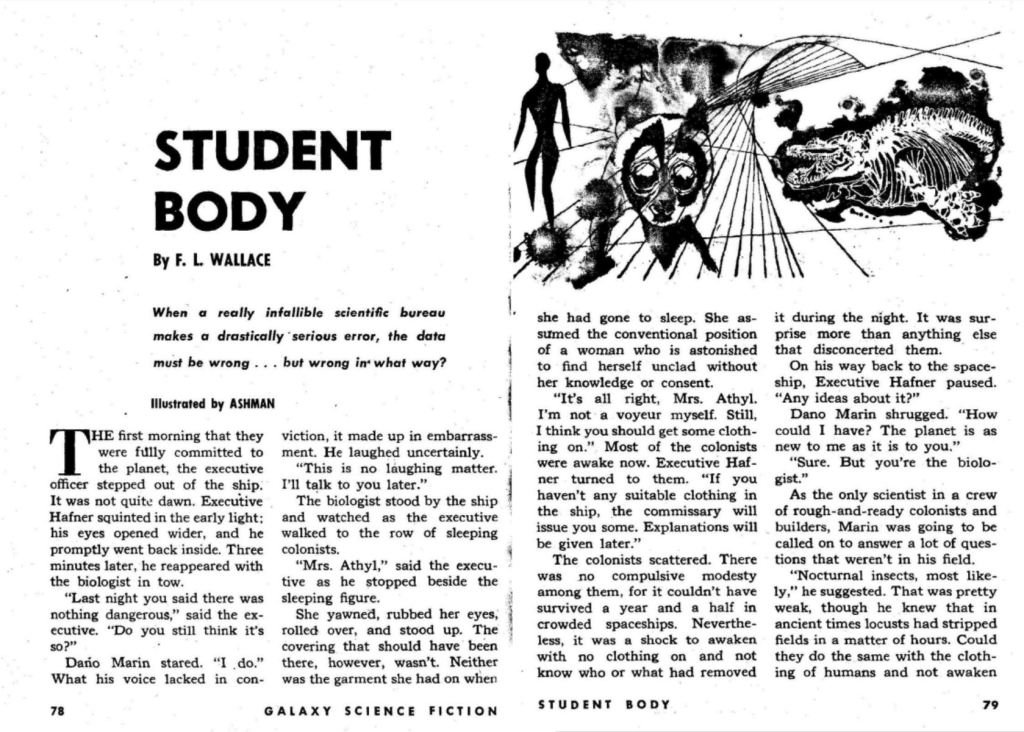
“Student Body” by F. L. Wallace

Group Read 27The Big Book of Science Fiction

Story #49 of 107: “Student Body” by F. L. Wallace

I’m curious why the VanderMeers jumped back to 1953 with “Student Body” by F. L. Wallace? Our last story, “Day Million” was from 1966, and we’ve been going pretty much in year order. And even though “Student Body” has a small level of popularity, it is a big step backward. Project Gutenberg reprints “Student Body” online probably because the copyright wasn’t renewed for the March 1953 publication in Galaxy Science Fiction.

F. L. Wallace, according to ISFDB, produced science Fiction from 1951 to 1961, mostly short stories in the magazines, with only one novel to his name, Address: Centauri, published by Gnome Press in 1955. F. L. Wallace is essentially a forgotten SF writer. ISFDB doesn’t even have a photo for him. Nine of his stories were reprinted in one of those cheap megapacks on Amazon, again probably from copyright neglect.

In their introduction to the story, the VanderMeers writes:

“Student Body” (Galaxy, 1953) showcases Wallace’s adroit handling of environmental issues in a manner more sophisticated than that of most writers of the era other than Frank Herbert (at novel length). Complex issues involving both alien contact and the impact of invasive species are housed within a tense plot. Although “Student Body” received no particular accolades upon publication, it endures as an example of a work ahead of its time—a future classic.

I’m sorry, but I didn’t find the story adroitly handling environmental issues or being more sophisticated on the topic than other writers. Neither is the plot tense or first contact complex. “Student Body” is a nice little magazine story based on a somewhat interesting idea. Like many SF stories from that era, Wallace gets an idea and clobbers together a minimal plot and characters to present the idea. Just compare it to “Grandpa” by James H. Schmitz, a story we read earlier from 1955. That story was no great shake of a story but deals with alien ecology far more adroitly, with more tension, complexity, and characterization.

“Student Body” has been reprinted in some decent anthologies, so it does have its fans, but I’m not one. The problem of the story, a constant threat of new animal life on the colony planet is somewhat interesting, unfortunately, its solution is unbelievable. Undermining what charm “Student Body” does offer, is spoiled by a plodding narrative structure. My hunch is Wallace was inspired by stories by Eric Frank Russell, especially “… And Then There Was None” from 1951, but “Student Body” lacks its charm and sophistication in dealing with an alien world.

I will admit the story starts out promising a load of fun. The colonists sleep outside the ship on the first night and wake up naked. That’s a promising premise for a potential funny story. Unfortunately, Wallace abandons that tack quickly, asking us to believe a small rodent-like creature gnawed the clothing off the people while they slept, and no one notices or woke up. If Wallace had solved that mystery in a different clever way, this could have been a fun story. But it’s like that old advice to writers, don’t show a gun unless you use it in the plot. Don’t titillate the reader with mass nudity unless you have a funny plot solution.

Rating: **+

Main Page of Group Read

James Wallace Harris, 11/21/21

“Day Million” by Frederik Pohl

Group Read 27The Big Book of Science Fiction

Story #47 of 107: “Day Million” by Frederik Pohl

“Day Million” by Frederik Pohl comes in at #25 on Dave Hook’s 125 Top SF Stories list. That’s pretty good for a story that appeared in a third-rate men’s magazine back in 1966. I was 14, so I wasn’t buying Rogue at the time, although I would have been mightily excited to have any men’s magazine back then. (Full nostalgic disclosure – I wouldn’t have read “Day Million” or any of the printed matter.) I did read World’s Best Science Fiction: 1967 edited by Wollheim and Carr, which reprinted the story, but I don’t remember reading “Day Million.” When I reread that anthology last year I remembered most of the stories, but not that one. Either I didn’t like it and skipped it, or it was so over my head that it made no impression.

When I finally got around to reading “Day Million” a few years ago I was impressed. And I’m still impressed. Pohl’s speculation about the far future and post-humans is quite nifty, and I think his philosophical points are still valid today. However, I’m not so sure it’s a short story. If the table of contents had listed it as nonfiction, and the editor introduced it as a speculative essay about future sex and romance I wouldn’t have quibbled.

Pohl tells us about Dora and Don in this hipster-voice that’s 50% of the entertainment value of the story. Of course, I don’t know if hipster would have been the right word for 1966. Playboy, the famous competitor of Rogue, promoted itself as the sophisticated guide for the swinging male, AKA, The Playboy Philosophy. I wonder if Pohl originally submitted “Day Million” hoping it would run right after the centerfold.

I thought Pohl’s idea of imagining day million was brilliant, although I’m not so sure humans will be around for our millionth day, and if we are, be that different. A lot of science fiction written since “Day Million” seems to assume we will — does that mean Pohl set the trend? Many modern stories have post-humans like those in “Day Million.” And Pohl seems pre-enlightened for our emerging acceptance of transexuals.

I’m not really attacking this story when I quibble about it sounding like an essay. Pohl knows how to tell a real story. Pohl is jazzing out by rifting on the structure of storytelling, but I also think he’s cheating. I’m talking about the old rule of show, don’t tell. Infodumping is telling a story. And this story is all infodumping. Pohl tells us that Dora and Don have a genuine relationship. It would have been masterful storytelling if Pohl have shown Dora and Don being in love so we truly felt and understood it, and not just told to us by a smart-alec narrator begging us to disbelieve him.

Pohl should have taken the time to give us The Crying Game, but revealing Dora’s lack of X-chromosome in some less crude but clever science-fictional way. And as we’ve already learned way sooner than day million, that a beautiful transexual female isn’t hard to accept. It would actually be much harder to make his readers believe an amphibious post-human would be attracted to cyborg post-human. Even harder to make believable, is showing people in the future being emotionally satisfied with a virtual mate.

Remember, Pohl only tells us these things will be true. Intellectually, we might want to believe the future will offer all these possibilities, but when it comes down to it, Pohl never even offers us any intellectual evidence, much less triggers emotional resonance through showing us dramatic evidence.

Main Page of Group Read

James Wallace Harris, 11/19/21

“Nine Hundred Grandmothers” by R. A. Lafferty

If my memory serves me right, and more and more I suspect it seldom does, “Nine Hundred Grandmothers” was the first story I ever read by R. A. Lafferty. I’m pretty sure I read it in World’s Best Science Fiction 1967. The last scenes. where Ceran Swicegood is winding his way down into the hill seeing smaller and smaller grandmothers is what stuck with me. I vaguely remember being somewhat charmed and feeling somewhat WTF. This was weird science fiction, but it was amusing. The next thing I read by Lafferty, was half of an Ace Double called Space Chantey. I passed this book to my friend Connell and George and the three of us got a lot of laughs out of it. After that, I read Lafferty’s stories but none of them were as much fun as these two. I often wanted to like them, and sometimes I was mildly amused or even somewhat impressed but never entirely loved.

This time when I read “Nine Hundred Grandmothers” I was far more taken with the story than any of the other times. Maybe it was because I was listening to When You See Yourself by the Kings of Leon and they were putting me into a receptive state. Music sometimes does that for me when I’m reading. Or maybe the story fairy sprinkled magic reading dust on me. Who knows, but this time I enjoyed “Nine Hundred Grandmothers” sentence by sentence, paragraph by paragraph. That’s always wonderful when it happens.

Check out these opening paragraphs to see if you’re charmed by Lafferty’s words:

Ceran Swicegood was a promising young Special Aspects Man. But, like all Special Aspects, he had one irritating habit. He was forever asking the question: How Did It All Begin? 

They all had tough names except Ceran. Manbreaker Crag, Heave Huckle, Blast Berg, George Blood, Move Manion (when Move says “Move,” you move), Trouble Trent. They were supposed to be tough, and they had taken tough names at the naming. Only Ceran kept his own—to the disgust of his commander, Manbreaker. 

“Nobody can be a hero with a name like Ceran Swicegood!” Manbreaker would thunder. “Why don’t you take Storm Shannon? That’s good. Or Gutboy Barrelhouse or Slash Slagle or Nevel Knife? You barely glanced at the suggested list.” 

“I’ll keep my own,” Ceran always said, and that is where he made his mistake. A new name will sometimes bring out a new personality. It had done so for George Blood. Though the hair on George’s chest was a graft job, yet that and his new name had turned him from a boy into a man. Had Ceran assumed the heroic name of Gutboy Barrelhouse he might have been capable of rousing endeavors and man-sized angers rather than his tittering indecisions and flouncy furies.

The Big Book of Science Fiction (p. 502). Knopf Doubleday Publishing Group. Kindle Edition. 

There are times in my life when I also tried to contemplate how it all began so I can’t help but identify with Ceran Swicegood’s quest. I’ve always thought there should be nothing — our existence should be impossible. I wish Lafferty could have given us the explanation. I’ve always concluded that because we’re here, that means never-existing-nothingness is an impossible state. From that assumption, I assume reality is the unfolding of every possible state of being. And that includes a dimension where a guy name Ceran Swicegood visits a planet where there’s an infinite number of grandmothers that might know the real reason.

R. A. Lafferty knows the pain of contemplating our existential origins and considers it a big joke.

“Tell me,” he pleaded in agony. “All my life I’ve tried to find out how it began, how anything began. And you know!” 

“We know. Oh, it was so funny how it began. So joke! So fool, so clown, so grotesque thing! Nobody could guess, nobody could believe.” 

“Tell me! Tell me!” Ceran was ashen and hysterical. 

“No, no, you are no child of mine,” chortled the ultimate grandmother. “Is too joke a joke to tell a stranger. We could not insult a stranger to tell so funny, so unbelieve. Strangers can die. Shall I have it on conscience that a stranger died laughing?” 

“Tell me! Insult me! Let me die laughing!” But Ceran nearly died crying from the frustration that ate him up as a million bee-sized things laughed and hooted and giggled: 

“Oh, it was so funny the way it began!” 

And they laughed. And laughed. And went on laughing…until Ceran Swicegood wept and laughed together, and crept away, and returned to the ship still laughing. On his next voyage he changed his name to Blaze Bolt and ruled for ninety-seven days as king of a sweet sea island in M-81, but that is another and much more unpleasant story.

The Big Book of Science Fiction (p. 507). Knopf Doubleday Publishing Group. Kindle Edition. 

I was only sixteen during this period in my life when I first read these stories. I attended Coral Gables High School in Miami, Florida, and worked at the Coconut Grove Kwik Chek bagging groceries. I was into science fiction, rock music, space exploration, and the counter culture. It was a time when I was discovering new science fiction as it was published after several years of reading old science fiction books I got from various libraries. Heinlein, Clarke, and Asimov were my big three during the 1964-1966 years. My next big three were Samuel R. Delany, Philip K. Dick, and Roger Zelazny. Plus I was discovering all kinds of new writers in the annual anthologies edited by Donald Wollheim and Judith Merril. It was during this period, I began subscribing to F&SF, Galaxy, and Analog, and joined the Science Fiction Book Club. By then I was a science fiction addict.

For over forty stories I’ve been waiting to reach this period in the VanderMeers’ anthology. And in just a few stories we’re going to zip right past this time period I love so much. I wish we could stay much longer. Plus, there are some other stories from 1966-1967 that people really should know:

  • “The Light of Other Days” by Bob Shaw
  • “Behold the Man” by Michael Moorcock
  • “For a Breath I Tarry” by Roger Zelazny
  • “The Keys to December” by Roger Zelazny
  • “The Last Castle” by Jack Vance
  • “Neutron Star” by Larry Niven
  • “We Can Remember It for You Wholesale” by Philip K. Dick
  • “Faith in Our Fathers” by Philip K. Dick
  • “Gonna Roll the Bones” by Fritiz Leiber
  • “The Star Pit” by Samuel R. Delany

And that’s not counting the memorable novels from those two years:

  • Babel-17 by Samuel R. Delany
  • Empire Star by Samuel R. Delany
  • The Crystal World by J. G. Ballard
  • The Dream Master by Roger Zelazny
  • Mindswap by Robert Sheckley
  • The Moon is a Harsh Mistress by Roberg A. Heinlein
  • Make Room! Make Room! by Harry Harrison
  • This Immortal by Roger Zelazny
  • Lord of Light by Roger Zelazny

Using Lafferty’s idea from this story, I wish humans made a little copy of themselves from each year of life. I’d love to have a shelf of little Jims that perfectly remembered each year. That way I could ask my former selves what really happened.

Main Page of Group Read

James Wallace Harris, 11/16/21