Story #67 of 107: “The Snake Who Had Read Chomsky” by Josephine Saxton
The VanderMeers present yet another horror science fiction story, although the horror in “The Snake Who Had Read Chomsky” is very different from the recent stories we’ve been reading. The story I read did not feel like the story they promised in the introduction:
Roz Kaveney, editor of Saxton’s The Power of Time, described Saxton’s work as “a combination of surrealism, occultism, feminism and a sort of bloody-minded Midlands Englishness, and quite wonderful.” John Crowley was inspired by Saxton’s work to write a love story (“Exogamy”) with speculative elements—influenced in particular by The Hieros Gamos of Sam and An Smith.

“The Snake Who Had Read Chomsky” (1981) is classic Saxton: a take-no-prisoners examination of biotech experimentation and the follies of capitalist societies in the grips of decadent extremes. It is sharp, incisive, darkly inventive, and an excellent example of the capabilities of this brilliant but underrated writer.
“The Snake Who Had Read Chomsky” didn’t deal with feminism. The woman protagonist, Marvene, is evil and deranged, but then so are the other two main characters. Nor did I feel it was an attack on capitalistic societies in the grips of decadence. It might have been a bit surreal, but not really, and there was no occultism that I noticed, but that comment could have applied to other stories in the collection.
The story was dark. The setting is a future dystopia ruled by elites, that use scientists to control the unwanted population. The story is about three scientists, Selly, the lead researcher, and two assistants, Marvene and Janos. Those two schemes to dethrone Selly in his lab. This group invents ways to control the mass of humanity that is no longer needed by the elites. These three scientists hope their inventions will make them famous and wealthy. However, if you can imagine the inventions Donald Trump would come up with in this situation, then you’ve got the feel of this story. Their most brilliant gadget makes people act like animals, which they turn on each other. Selly becomes a cat, Janos a mouse, and Marvene, our main point-of-view character, a snake.
At first, I rooted for Marvene. I like a character I can root for, but before long she became so disgusting that I rooted for her demise instead. Not to spoil the ending, but I get my wish. Saxton does a good job developing these bad characters and does a satisfying job of storytelling, but “The Snake Who Had Read Chomsky” just left a nasty feeling in my head. I’m getting over Covid, and I associate how I feel physically with how the story made me feel emotionally. Why would someone write such a story?
I have to assume Saxton disliked 1981 England and America, although neither are mentioned. She also disliked science and scientists. And she disliked academic politics and competition. Young readers today love dystopian tales because their protagonists take a stand against the status quo. We love those characters because of their blows against the empire. In this story, Marvene basically wants to be the Joseph Mengele of her society, and become rich and famous for her cruel inventions.
By the way, I never got the Chomsky reference. I assume it’s just a 1981 version of clickbait.
“Wives” by Little Tuttle was first published in the December 1979 issue of F&SF, but over the years it’s been included in a number of anthologies, including two focusing on women fantasy writers.
“Wives” is a strange story. Set on an alien world where humans, and I assume only males, have mostly wiped out an alien civilization. Some of the aliens survive by being assimilated as wives to human husbands. They wear a skinsuit and makeup to hide their real shape and appear as women and adapt to human ways. Susie wants to rebel and return to the old ways, but the other wives want to survive.
Of course, I assume Tuttle’s story isn’t about aliens and alien worlds but about life on Earth, and how women must hide who they are and let themselves be subjugated by men. But I also thought about parallels to Europeans and Native Americans, and I imagine, any conquered people. This story could be a metaphor for any kind of imperialism — cultural, ethnic, racial, even species. Think about what we’ve done to animals. Can’t you see Susie and her kind in your dogs and cats?
Just how effective is using science fiction to analogize our current problems? Netflix has a new film out, Don’t Look Up that satirizes how society has ignored warnings of climate change. The film is full of great actors but the story has all kinds of problems. The only reason I admire it or recommend it to others is because of its message. Is that why we like “Wives” too? Just because of its message?
I believe we need to judge the story by the story too. So, how well does “Wives” hold up as a story? In that regard, I think very well. Even though it’s absurd, I found its science-fiction setup believable. I felt for Susie, but I understood Doris and Maggie’s positions too. The whole existential problem for Susie’s alien race was realistic within this story.
Story #65 of 107: “Sandkings” by George R. R. Martin
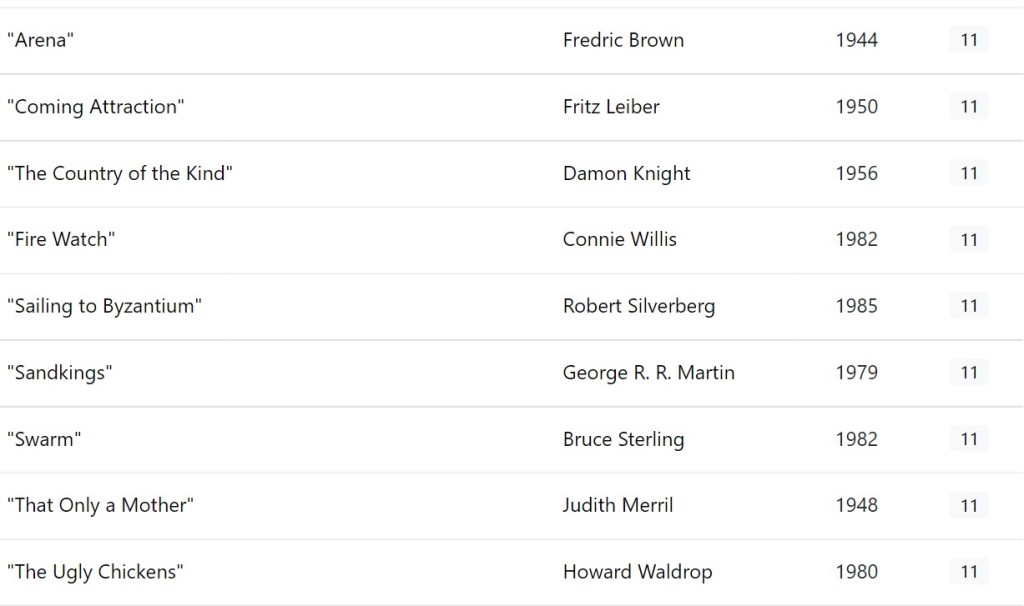
This is the third time I’ve read “Sandkings” by George R. R. Martin. It has 11 citations on The Classics of Science Fiction Short Fiction list. And it was made into an episode of The Outer Limits.
These are the stories “Sandkings” are tied with on our list for 7th place, all having 11 citations, all heavy-hitters.
This kind of success makes me wonder how such stories are written to make them so memorable. I’m familiar with all the above stories, and some (“Coming Attraction,” “The Country of the Kind,” “Sailing to Byzantium,” and “The Ugly Chickens”) are among my all-time favorites. To be honest, I put “Sandkings” in the second half of that list. But still, it’s a catchy tale.
In “Sandkings,” Simon Kress is a rich collector of violent pets. But not on Earth, on a planet named Baldur, so his pets can be quite exotic. He is offered sandkings, insect-like creatures, with hive intelligence. Kress buys them because he’s told they worship their owners and fight wars. He is also warned that there are certain conditions to be met to maintain safety, but then this story wouldn’t be the story it is if Kress minded those warnings. (I did wonder if Gremlins was an influence, but I checked and it came out five years later in 1984.)
“Sandkings” is another horror story in a science-fictional setting. The VanderMeers seem to have a penchant for those. Evidently, they have a macabre streak. Maybe they grew up reading Poe. “Sandkings” is a story old Edgar Allan would have admired. But I also catch whiffs of other literary influences.
First off, I wondered if Martin read Theodore Sturgeon’s 1941 classic, “Microcosmic God,” and thought, hey, this god of small things is a neat idea, I wonder if I could do something with it and make it more realistic? The protagonist for “Microcosmic God” was named Kidder, another K-name like Kress. Mercurio Rivera’s “Beyond the Tattered Veil of Stars” (Asimov’s Jan-Feb 2020) also used the god of small things theme. I only know of these three stories that use the god of small things theme, so it appears writers can recycle it about every forty years. Does anybody know of other examples?
Like I said, I felt Poe was an influence. But I also wondered about Oscar Wilde and The Picture of Dorian Gray. “Sandkings” has a gothic feel to it, and it’s about sensuality, decadence, and evil. The sandkings worship Kress. They build images of him in stone. Those images change over time, reflecting the corruption of Kress’s soul.
Reading “Sandkings” makes me wonder if more writers shouldn’t search out old forgotten SF themes and refashion them into new stories. It’s done all the time but usually at a superficial level to the most commonly used themes. The best example is the murder mystery. Why haven’t we gotten tired of that theme/plot?
Story #64 of 107: “Sporting with the Chid” by Barrington J. Bayley
“Sporting with the Chid” by Barrington J. Bayley is another story from the 1970s that I found disturbing. I’ve never understood why people like horror, especially the gory kind. The story first appeared in the collection The Seed of Evil, and I think that title tells us a lot. The VanderMeers in their introduction led me to believe Bayley would be experimental, creative, and New Wave. Instead, I thought “Sporting with the Chid” to be a straightforward old-fashioned science fiction tale but with a good bit of yuckiness. If you love your horror movies with loads of exposed body parts, then you’ll probably enjoy this story.
“Sporting with the Chid” felt like it was inspired by Edgar Allan Poe and Philip Jose Farmer, especially Farmer’s porn books from Essex House. Not really my cup of tea. I wonder if Bayley grew up reading EC Comics? Now that I’m older Fredric Wertham seems less like a crank. I’m trying not to be too judgmental, but Bayley’s ghoulish fascination with vivisection makes me wonder about him. But then, I also find people’s fascination with video game violence just as questionable.
Story #63 of 107: “The House of Compassionate Sharers” by Michael Bishop
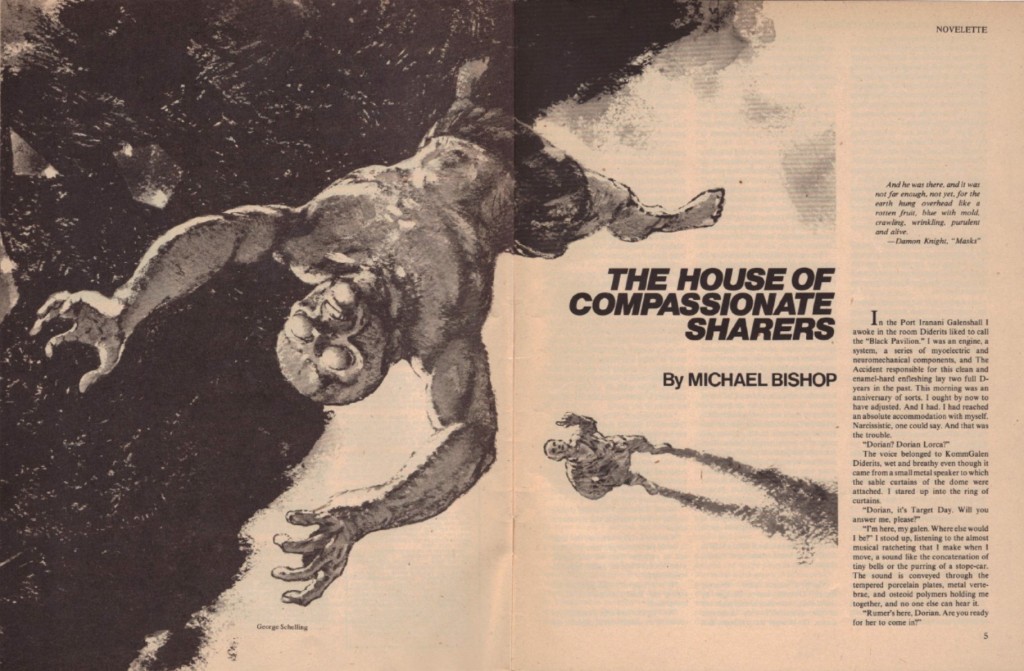
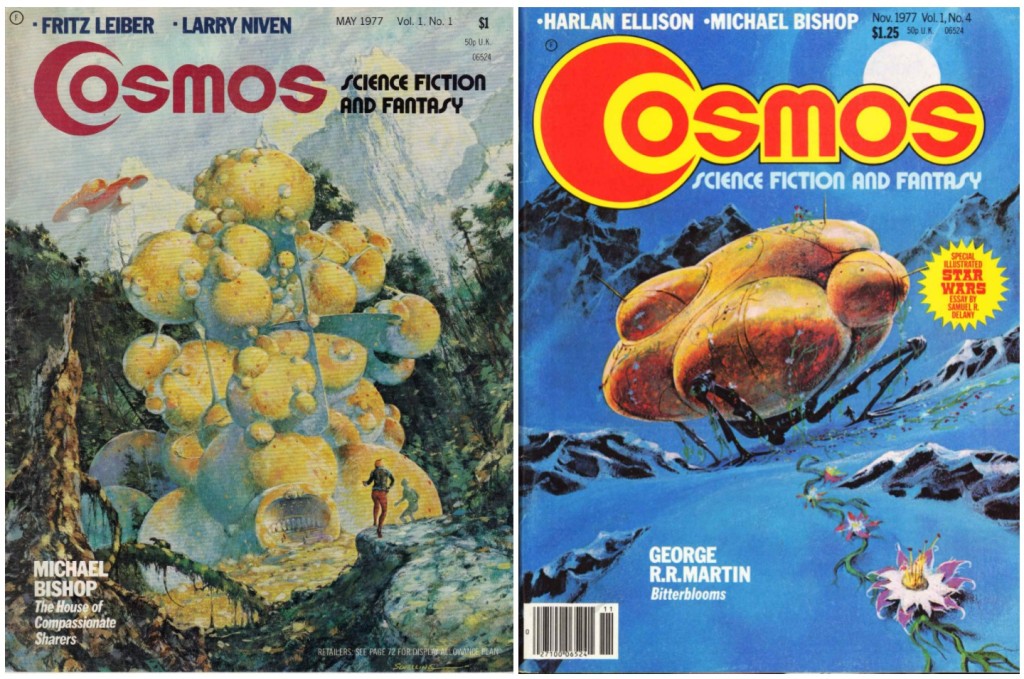
“The House of Compassionate Sharers” by Michael Bishop first appeared in the science fiction magazine Cosmos Science Fiction and Fantasy in May 1977. David Hartwell was the editor. This is a science fiction magazine I have no memory of ever seeing or reading. Although checking my digital files, I see I have all four issues. Bishop had stories in the first and last issues. (There is so much science fiction to read, and so much science fiction history to study.)
“The House of Compassionate Sharers” was selected for three best-of-the-year anthologies (Wollheim/Saha, Terry Carr, and Gardner Dozois). Meaning, this novelette was well admired in 1978. I’m not sure what to think of the story at the end of 2021.
Dorian Lorca is a monster to himself. After an accident, he is rebuilt with metal and plastic which alienates himself from his own body. I should sympathize with this posthuman man, but I never do until almost the end. The story is about compassion and transcendence, but it mostly struct me as decadent. It is creative, especially the made-up words and imagined far-future settings. But the story feels alien to me like Dorian feels about his body. Bishop could have intended this, but I’m not sure. Here’s how it starts:
In the Port Iranani Galenshall, I awoke in the room Diderits called the Black Pavilion. I was an engine, a system, a series of myoelectric and neuromechanical components, and the Accident responsible for this enamel-hard enfleshing lay two full M-years in the past. This morning was an anniversary of sorts. By now I should have adjusted. And I had. I had reached a full accommodation with myself. Narcissistic, one could say. Which was the trouble.

“Dorian? Dorian Lorca?”

The voice belonged to KommGalen Diderits, wet and breathy even though it came from a metal speaker to which the sable drapes of the dome were attached. I stared up into the ring of curtains.

“Dorian, it’s target day. Answer, please.”

“I’m here, my galen.” I arose, listening to the quasi-musical ratcheting that I make when I move, a sound like the concatenation of tiny bells or the purring of a stope-car. The sound echoes through the porcelain plates, metal vertebrae, and osteoid polymers holding me together, and no one else can hear it.

“Rumai’s here, Dorian. May she enter?”

“If I agreed, I suppose so.”

“Damn it, Dorian, don’t feel you’re bound by honor to see her! We’ve spent the last several brace-weeks preparing you to resume normal human contact.” Diderits began to list: “Chameleodrene treatments, hologramic substitution, stimulus-response therapy. You ought to want Rumai to come in to you, Dorian.”

Ought. My brain was—and remains—my own, but the body Diderits and the other kommgalens had given me had “instincts” and “tropisms” specific to itself, ones whose templates had a mechanical instead of a biological origin. What I ought to feel, in human terms, and what I felt as the occupant of a total prosthesis resembled each other about as much as blood and oil.

“Do you want her to come in, Dorian?”

“I do.” And I did. After all the biochemical and psychiatric preparation, I wanted to witness my own reaction. Still sluggish from a drug, I had no idea how Rumai’s arrival would affect me.

At a parting of the pavilion’s draperies, two or three meters from my couch, Rumai Montieth, my wife, appeared. Her garment of overlapping latex scales, glossy black in color, was a hauberk revealing only her hands, face, and hair. Rumai’s dress was one of Diderits’s deceits, or “preparations”: he wanted me to see Rumai as little different from myself, a creature as well assembled and synapsed as the engine I had become. But her hands, face, and hair—well, nothing could disguise their primitive humanity, and revulsion swept over me like a tide.

“Dorian?” And her voice: wet, breath-driven, expelled through moistened lips.

I turned away. “No,” I said to the speaker overhead. “It hasn’t worked, my galen. Every part of me cries out against this.”

Diderits said nothing. Was he still out there? Or had he tried to bestow on Rumai and me a privacy I didn’t want?

“Disassemble me,” I urged him. “Link me to the control systems of a delta-state vessel and let me go out from Miroste for good. You don’t want a zombot among you, Diderits—an unhappy anproz. You’re all tormenting me!”

“And you, us,” Rumai said. I faced her. “As you’re very aware, Dorian, as you’re very aware…Take my hand.”

“No.” I didn’t shrink away, I merely refused.

“Here. Take it.” Fighting my disgust, I seized her hand, twisted it over, and showed her its back. “Look.”

“I see it, Dor.” I was hurting her. “Surfaces, that’s all you see. Look at this wen.” I pinched the growth. “That’s sebum, fatty matter. And the smell, if only you could—”

Rumai drew back, and I sought to quell a mental nausea almost as profound as my regret….To venture out from Miroste seemed the only answer. Around me I wanted machinery—thrumming machinery—and the sterile, actinic emptiness of vacuum. I wanted to become the probeship Dorian Lorca, a clear step up from my position as prince consort to the governor of Miroste.

The Big Book of Science Fiction (pp. 637-638). Knopf Doubleday Publishing Group. Kindle Edition.
This is a great setup, but Dorian is sent to Earth, to a rather strange place which is called the House of the Secret Sharers. The leads me to imagine the retreat is for transhuman beings who must integrate their old and new selves. But Bishop mystifies things, even suggesting that the house is also a bordello. Thus, the mood shifts to the kinky, and I wonder if the treatment is like sex therapy. Back in the 1970s, there were all kinds of strange therapies, encounter groups, psychological theories, so this story fits well with the times.
Bishop keeps showing us how disturbed Dorian thinks and feels.
My body was a trial. Diderits had long ago told me that it—that I—was still “sexually viable.” But this promise I had not tested, nor did I wish to. Tyrannized by vivid images of human viscera, human excreta, human decay, I’d been rebuilt of metal, porcelain, and plastic, as if from the substances—skin, bone, hair, cartilage—that these inorganic materials mocked. I was a contradiction, a quasi-immortal masquerading as one of the ephemera who’d delivered me from their own short-lived lot. Paradoxically, my aversion to the organic was another human (i.e., organic) emotion. So I fervently wanted out. For over a year and a half on Miroste, I’d hoped that Rumai and the others would see their mistake and exile me not only from themselves but also from the body continuously reminding me of my total estrangement.
Will this be how cyborgs will feel? Bishop assumes the replacement parts will make us loath our flesh, but I would think it would be the other way around.
Once Dorian meets his sharer, the story takes a bondage twist. And I’m afraid it gets a little too weird for me.
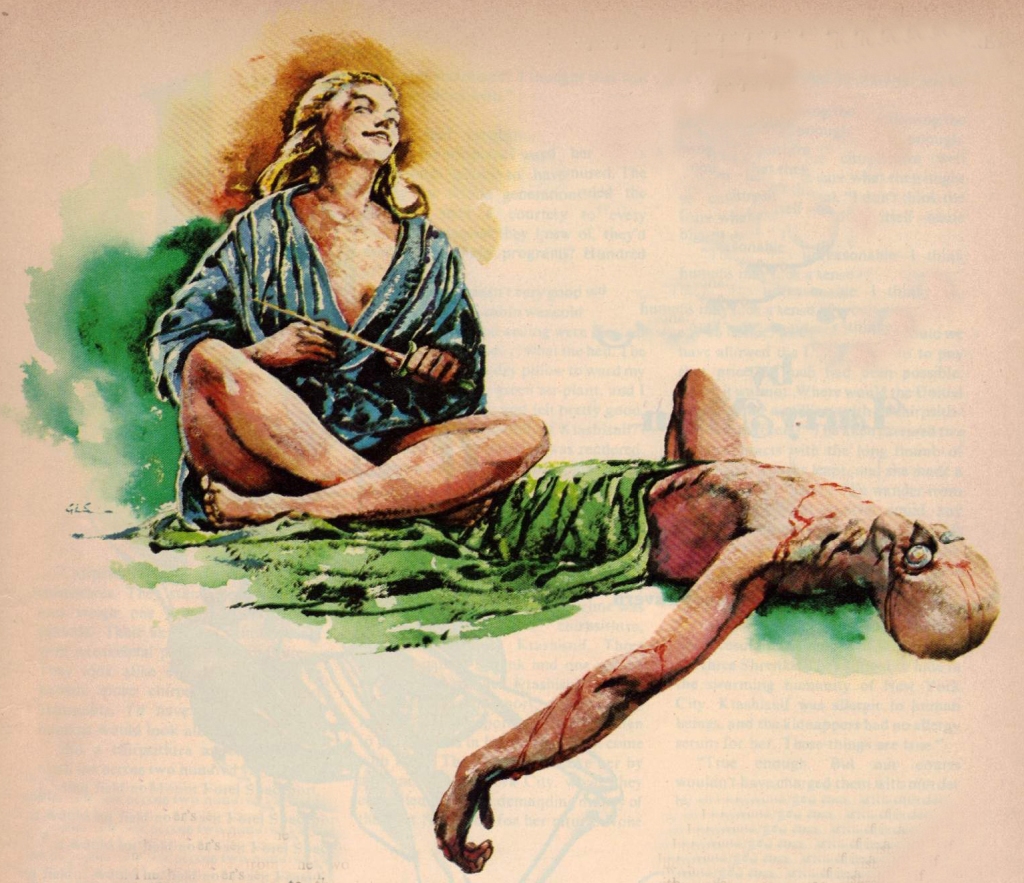
Yes, two light-sensing image-integrating units gazed at me from the sockets near which my thumbs probed, and even in this darkness the Sharer, its vision sharper than my own, could discern my blind face staring down, futilely trying to create an image out of the information that my hands had supplied. I opened my eyes and saw only shadows, but my thumbs felt the cold metal rings gripping the Sharer’s photosensitive orbs.

“An animatronic construct,” I said, rocking back on my heels. “A soulless robot. Move your head if I’m right.”

The Sharer continued motionless.

“All right: a sentient creature whose eyes have been replaced with an artificial system. Lord, are we brothers then?”

I had a sudden hunch that the Sharer was very old, a senescent being owing its life to prosthetics, transplants, organs of laminated silicon. Its life had been extended by these gizmos, not saved. I asked the Sharer about this hunch. It slowly moved the helmetlike skull housing its fake eyes and its aged compassionate mind. Uncharitably, I considered myself the victim of a deception, the Sharer’s or Wardress Kefa’s. Here, after all, lay a creature who had chosen to prolong its life rather than escape it, and who had willingly employed the same materials and methods that Diderits had used to save me.

“You might have died,” I told it. “Go too far with these contrivances, Sharer, and you’ll forfeit suicide as an option.” Leaning forward again, I let my hands move from the Sharer’s bony face to its throat. Here a shield of cartilage graded upward into its jaw and downward into the silken plastic skin covering its body, internalizing all but the defiant skull: a death’s-head with the body of a man.

I could take no more. I rose from the stove-bed, cinched my gown, and crossed to the room’s far side. It held no furniture but the bed, so I assumed a lotus position on the floor and sat thus all night, staving off dreams. Diderits had said that I needed to dream to sidestep both hallucination and madness. In the Port Iranani Galenshall, he had had drugs administered to me every day and my sleep period monitored by an ARC machine and a team of electroencephalographers. But my dreams veered into nightmares, descents into klieg-lit charnel houses. I infinitely preferred the risk of going psychotic. Someone might pity and then disassemble me, piece by loving piece. Also, I had now lasted two E-weeks on nothing but catnaps, and I still had gray matter upstairs, not chopped pâté.
The story continues along this path, into a deeper strangeness. We meet two clones who are sick and disturbed, but we want to gawk at their trainwreck lives. Thankfully, the story eventually becomes positive, and I forgive it for taking me through scenes I didn’t want to see.
Here’s the thing about science fiction. Writers can write about anything they can imagine. So, why did Michael Bishop imagine this? Was he just feeling in a Dangerous Visions mood? Ellison’s anthology had wowed me in 1969, but it was disturbing. That was often true of the New Wave fiction I tried.
The 1970s was an exciting time for me personally, but in many ways, it was a downer of a decade. Often when I watch movies from that era I find them distasteful. I enjoy gritty film noir from the 1940s and 1950s, but I find the dirtier aspects of the 1970s dreary and depressing to remember. The 1970s has an anti-nostalgic taint with me. It’s like watching the HBO series The Deuce. For me, the 1970s was classic rock and computers. Now that I’m going back and picking over the science fiction stories, I don’t remember any feel-good stories. Is it any wonder that The Hitchhikers Guide to the Galaxy was so popular.
But what’s the difference between “Fondly Fahrenheit” and “The House of Secret Sharers” when it comes to choosing between two disturbing works of science fiction? Why does Bester’s story leave me admiring the dazzle of science fiction, and Bishop’s story leaves me thinking science fiction is a bit grungy?
Story #62 of 107: “The IWM 1000” by Alicia Yánez Cossío
“The IWM 1000” by Alicia Yánez Cossío is a story from 1975 that imagines a device that answers users’ questions. Think of a talking, portable Google. It’s not much of a story, but it does imagine a lot of interactions that are similar to what we use the internet for today.
Alan Kay imagined the Dynabook in the 1968-1972 era. And science fiction has been imaging machines with knowledge as far back as “The Machine Stops” by E. M. Forster in 1909. But I knew about neither in 1975, and I doubt I could have thought up the human uses the way Cossio did. Computers, networks, and social networking just didn’t occur to me before they existed. But dang, they sure have changed our lives.
Science fiction writers often imagine cool new machines, but they don’t often imagine how society will be changed by them. I give Cossio credit for that kind of thinking. Unfortunately, she’s not much of a storyteller here. This “story” is very close to an essay.
I wish I had an AI that knew of all books, magazines, journals, newspapers, diaries, internet threads, etc., and could tell me how certain science-fictional ideas evolved. On the other hand, that’s what I wish I could do myself — have all knowledge so I could see the currents of ideas ripple through history.
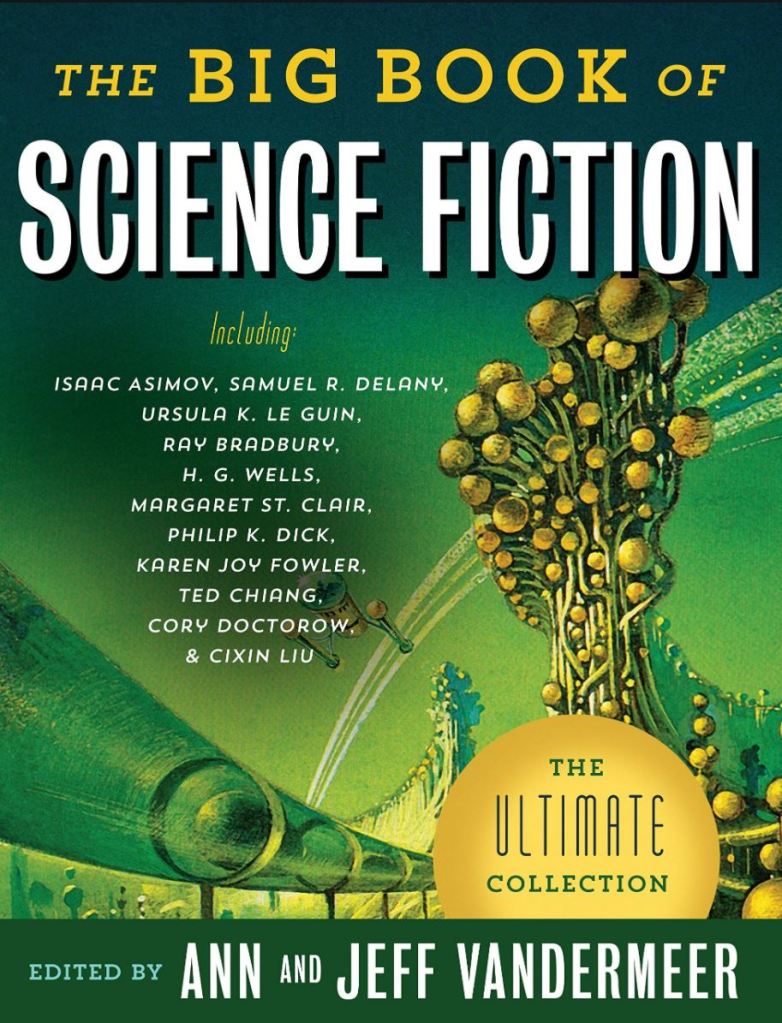
I’ve gotten behind with our group discussions of the stories in The Big Book of Science Fiction. I got distracted by reading the current issues of Analog and Asimov’s. Comparing the old SF stories with the new is quite a contrast. Forty-six years makes a big difference. 2021 is the future for the writers of 1975. We don’t have an IVM 1000, but we have things somewhat like it, and we use those things somewhat like she imagined. While I’m reading 2022 SF stories, I’ll have to think about what SF writers are imagining for 46 years into our future.
I also need to imagine what a future person like me will be, one who reads and thinks about science fiction. Will blogging exist in 2066? And if civilization collapses by then from climate change, mass extinctions, overwhelming pollution, and disappearing resources, will we still be reading science fiction? At my other blog, I wrote about reading in a post-doom world. In such a scenario, will we stop dreaming about the future, and fixate on the past?
Story #61 of 107: “Standing Woman” by Yasutaka Tsutsui
“Standing Woman” by Yasutaka Tsutsui was first published in Japan in 1974. Since it’s a protest story about freedom of speech, I have to wonder what politics was like in Japan back then. The VanderMeers said in their introduction, that Tsutsui was Japan’s answer to the New Wave and compared his absurd stories to the writings of Sheckley, Spinrad, and Vonnegut. “Standing Woman” was more wistful than funny to me, although, a tale about people being converted into trees for complaining about the government might have been culturally amusing back in 1974 Japan. The tone of the translation reminded me more of Bradbury’s “The Pedestrian.”
This story still works as a gentle story about a sad man, a writer, who misses his wife after she’s been planted. He risks punishment himself by talking to the human trees. His wife warns him not to, but he can’t help himself.
However, the sting of Tsutsui’s protest is no longer there for me. Like the Bradbury story protesting not being able to stroll after supper in a world taken over by cars and highways, “Standing Woman” is no longer seems relevant. I imagine much of the satire of Saturday Night Live will be dissipated in fifty years too.
I’m beginning to have trouble with my rating system. Normally I’d rate “Standing Woman” with ***+, meaning an average story that I liked. But if I don’t keep explaining my code, people will interpret it in different ways. However, the code was mainly meant to help me remember. I’m torn between keeping it for myself, and wondering what confusion it might cause.
For an absurdist tale, “Standing Woman” was likable enough. But in terms of seeking stories from the past that I consider worthy of discovery, then no, this doesn’t work for me. I could say: Good, but unwanted. But that might sound harsh or unkind.
In the past, I’ve thought of only writing about stories I love. But then I started this project to review all the stories from The Big Book of Science Fiction for our Facebook group. I’ve decided that was a mistake. I’m going to finish what I’ve started, but my current belief is I shouldn’t mention a story I don’t love unless it inspires me to write about a specific issue it brings up.
For now, maybe I should just say: Good, but not loved. Or maybe: Liked, but not loved. And that might be closest to what I’ve been struggling to put into words for all these essays. I’m constantly searching for stories to love but seldom find them. Why waste time writing about stories I don’t love? Do readers of this blog really want to know that? When I read blogs and reviews I respond to ones that enthusiastically praise a story. That makes me go read them. Anything else said is quickly forgotten.
Story #60 of 107: “Where Two Paths Cross” by Dmitri Bilenkin
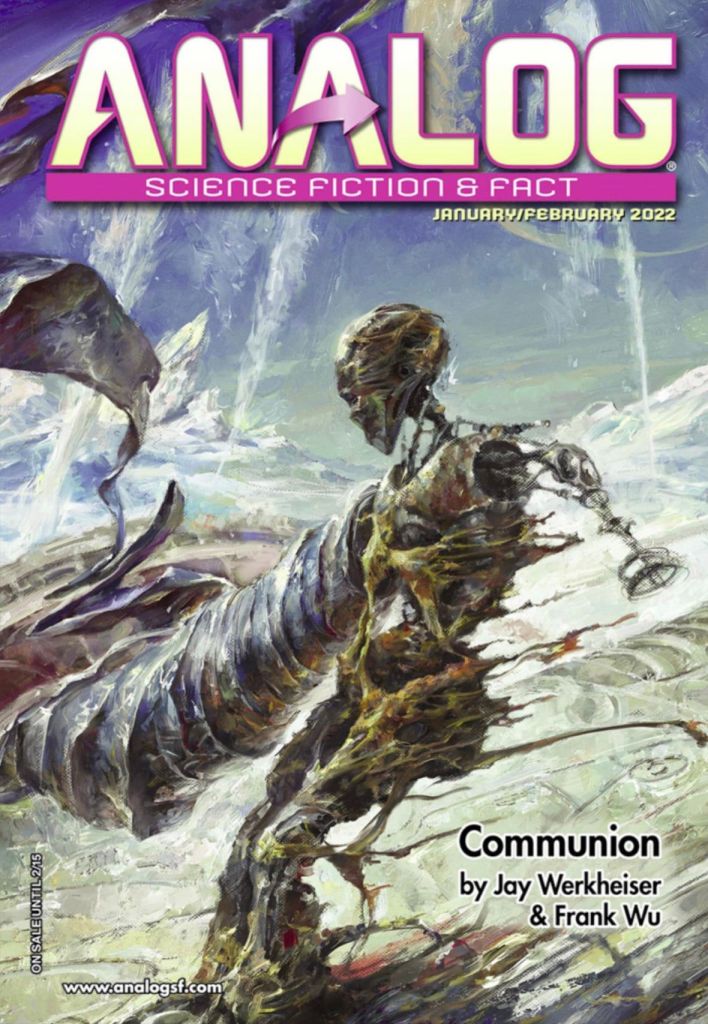
“Where Two Paths Cross” is a science fiction story from the old Soviet Union by Dmitri Bilenkin. Future cosmonauts exploring a new planet are captured by bushes and nothing the humans do seems to outsmart the plants. Coincidently, this story reminds me of a novella in the new issue of Analog (Jan-Feb 2022), “Communion” by Jay Werkheiser and Frank Wu. It’s an encounter between an intelligent organism that communicates with biochemistry and human explorers.
Both stories are about science. “Where Two Paths Cross” focuses on evolution and adaptation and how it relates to intelligence, and “Communion” deals with biochemistry and how it can be used for communication.
Both of these stories focus on how things work, rather than human wants and desires. We might call them hard science fiction, or we could call them scientific puzzle stories. In both stories, learning what’s being communicated is the clue to resolving the plot. The plot is essentially the same too. Humans are threatened by animals we normally don’t consider intelligent, and the organisms are threatened by beings they don’t understand in terms of how they understand their environment.
Both were readable stories but neither turned me on. Nope, I don’t mean sexually. I’m talking about storytelling arousal. That doesn’t mean I don’t recommend them, I’m just not the kind of reader who responses to such puzzle stories. I need protagonists I care about, and generally that means a human I can relate to in some way. However, as I write this essay and think about these two stories, I might reconsider how much I liked them.
While reading “Communion” I was reminded of “Surface Tension” by James Blish about humans who become microscopic creatures. Now, this might reveal the child in me, but I liked the non-human microscopic creatures in “Surface Tension” because to a degree Blish anthropomorphized them. Although Werkheiser and Wu have their organism speak to the reader in the first person, the authors worked hard to keep it from having human qualities. That creature thinks in terms of organic chemistry. This is more realistic than Blish’s creatures, but it’s not believable like fantasy’s talking animals nor as something really possible in reality.
Bilenkin also worked to keep us from thinking of his alien bushes in any kind of cute way. Basically, the bushes reacted to humans in the same way they reacted to their normal predators — through reflexes conditioned through their environmental experience.
Both of these stories remind me of three other science fiction books, The Forgotten Planet by Murray Leinster, Hothouse by Brian Aldiss, and Dragon’s Egg by Robert L. Forward. They aren’t the same, but there are some similarities in flavor. All have unbelievable premises but we forget that because of the storytelling techniques used to make us believe. Werkheiser and Wu lay a lot of biochemistry on us to help us understand how communication works with organisms that communicate with chemicals. This biochemistry is fascinating, I really liked such details in the nonfiction book The Hidden Life of Trees by Peter Wohlleben, but there may have been a little too much of it in “Communion.” Unfortunately, Bilenkin probably didn’t know about such science when he wrote “Where Two Paths Cross,” but it would have added to his story.
My point of all this is my reader reaction depends more on storytelling than scientific accuracy or logical believability. I no longer think I should criticize a science fiction story for scientific accuracy or logic. I used to think that was important to science fiction story but I’ve come to realize that there are other qualities important to readers that override accuracy. Analog is known for presenting hard science fiction, but most of the stories I’ve read in the current could be severely trashed as unscientific, illogical, or just not believable. What really ignites a science fiction tale is not science, but what is it?
I’m waiting for others in the group to respond to these stories because I assume there will be readers who were turned on by them. I don’t want to say either of these stories are bad, but neither contained the magical ingredient that gets me high. They were interesting, they had ideas to think about, but they were missing something that would make them my kind of story.
I wish I could define the psychoactive element in fiction that pushes my buttons. We’ve still got plenty of stories in this anthology to read. Maybe it will be revealed.
Story #59 of 107: “And I Awoke and Found Me Here on the Cold Hill’s Side” by James Tiptree Jr
We’re now past the halfway point in The Big Book of Science Fiction, and I’ve written almost five dozen essays on science fiction, yet leaving so much unsaid. We’re at least six stories into the 1970s with “And I Awoke and Found Me Here on the Cold Hill’s Side” by James Tiptree Jr., first published in the March 1972 issue of F&SF, and we haven’t mentioned the changes in the decade. The seventies was a very distinctive time for science fiction, as was the sixties, fifties, forties, and thirties. Science fiction changes with the times, and has all the fashions of pop culture.
Our last story, “When It Changed” by Joanna Russ was about gender. This story was written by a woman posing as a man. This is much different from science fiction coming out in 1962 or 1952. After reading “When It Changed” I read a 1963 SF story by Joanna Russ. It was a bland mousy ghost story revealing nothing about the Joanna Russ of the 1970s. The nonfiction works of the second wave feminists had a great impact on the new wave of science fiction.
So Alice Sheldon writing as James Tiptree is quite revealing. And the POV of “And I Awoke and Found Me Here on the Cold Hill’s Side” to me was decidedly male. And reading about Sheldon’s life says a lot about gender and feminism too. But there were many other changes in the 1960s that allowed Seldon to write this story. There is content that would have been censored from mainstream magazines of the early 1960s much less the notoriously prudish science fiction magazines of that era. Philip José Farmer wrote graphic stories of humans having sex with aliens in the 1950s, but not with the language and frankness Tiptree uses in “And I Awoke and Found Me Here on the Cold Hill’s Side.” But then humping aliens wasn’t Triptee’s point either.
In March 1972 readers didn’t know that James was Alice. But did Alice assume that one day readers would know that he was a she? Did she write in the voice of a male to authenticate her cover, or because she wanted to break out of the gender stereotypes imposed on women writers? Joanna Russ wrote, “I love my body dearly and yet I would copulate with a rhinoceros if I could become not-a-woman.” Was Sheldon using Tiptree to escape being a woman? Or had her own experience of being a world traveler and succeeding in many careers not deemed for women during those times meant she didn’t give a damn about imposed gender roles?
The sex addict addicted to sex with aliens interviewed in this story has an aggressive point-of-view of a world-weary male. But is that really a factor in this story? Tiptree captures a conversation between two males about lust for aliens, with one man warning another not to fall into his addiction. But he keeps alluding to cargo cults and Polynesians, places ruined by advanced societies. That’s one kind of ruin. Sheldon was sexually attracted to women at a time (the 1930s and 1940s) that led to another kind of ruin. How much of this story is science fiction and how much is veiled experience?
“And I Awoke and Found Me Here on the Cold Hill’s Side” is not just a story about aliens. It’s not just science fiction. It’s a complex coded message from a complex person hiding who they were. It’s working on all kinds of levels.
And that’s something we haven’t been talking about yet. Science fiction grows up in the 1970s. The genre had a long childhood. For decades science fiction appealed to the young and was mostly childish and adolescent. The reason Heinlein blazed on the scene in the early 1940s is that his work was more mature. Most of the best science fiction from the 1950s we remember today were from writers who tried to adultify the genre. Science fiction fans want young adult content, and that’s what it mostly gets. But if you look at the stories we’re reading from the 1970s, it’s the stories that deal with mature awakenings that we’re remembering. The VanderMeers love the stories that remember science fiction’s social conscious awakenings. But there were many other kinds of literary awakenings too. The VanderMeers follow in the footsteps of Judith Merril anthologizing certain kinds of science fiction. But Wollheim, Carr, Harrison, Aldiss, Dozois, Hartwell, would be anthologizing other types of science fiction that reflected a growing maturity too. Are the stories we’re remembering giving science fiction an imposed identity?
As the decades progress, SF evolves, and this anthology is only touching upon some of that evolution. The trouble is the topic is too big. It hurts my head to think about it. I read through the 1970s in my twenties, and it seems like there was so much more than these few stories. But my head hurts struggling to remember those times. I’d have to spend weeks or months digging through that past to recover those stories, and I just don’t have the energy anymore. We have another six stories from the 1970s, and then we’re on to the 1980s. In the back of my mind, it feels like there should have been a hundred great stories from the 1970s we should be remembering. Stories with different identities.
Don’t get me wrong, “And I Awoke and Found Me Here on the Cold Hill’s Side” is a 5-star story, a classic, one I admire. But all these stories from the 1970s in The Big Book of Science Fiction have a certain flavor, and I vaguely remember other flavors. Or is that a false memory? Could it be I remember a time before growing up that I long for?
Story #58 of 107: “When It Changed” by Joanna Russ
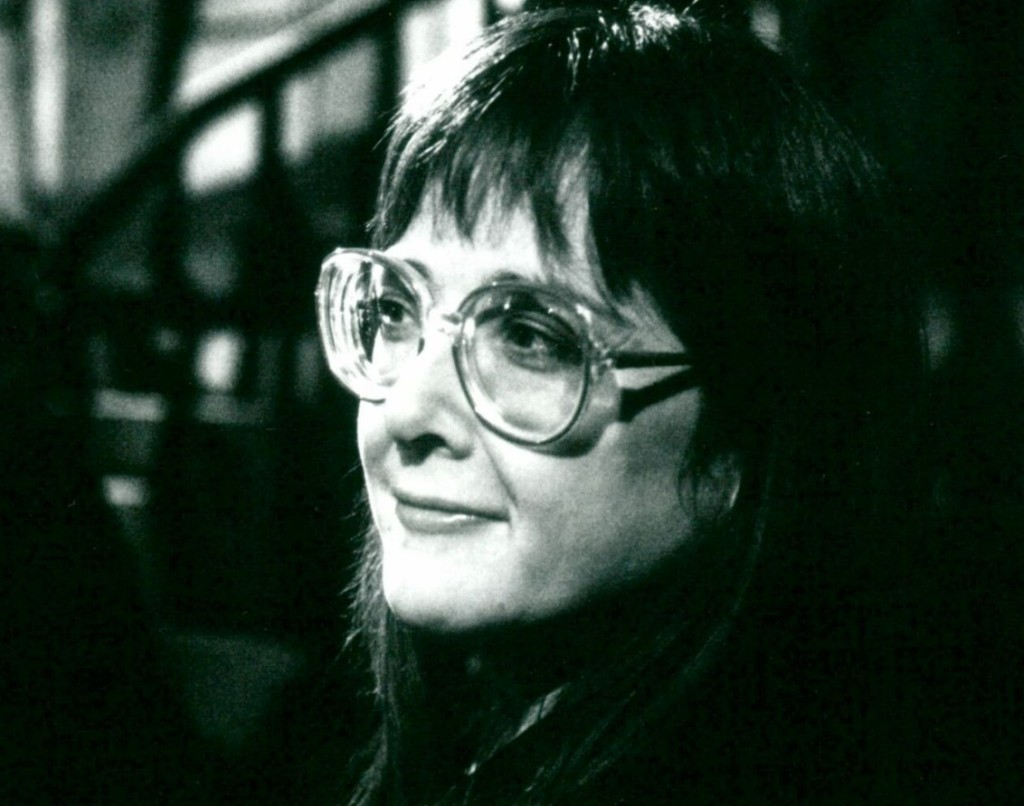
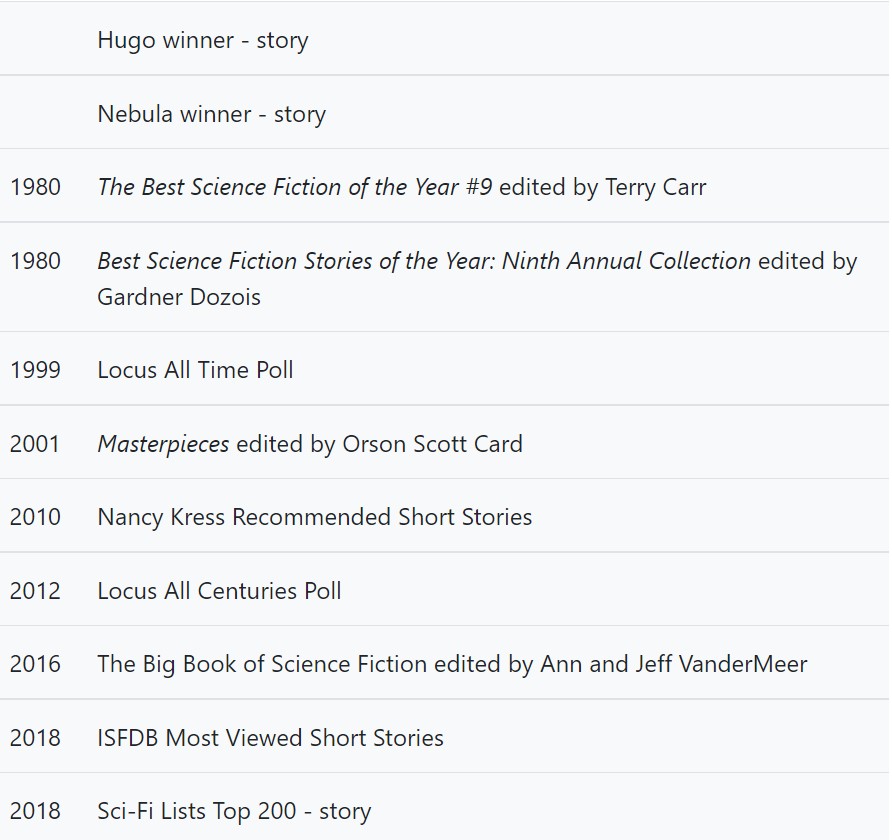
“When It Changed” by Joanna Russ is a classic. It’s tied for 3rd place on our Classics of Science Fiction Short Story list. It was on all four lists for Dave Hook’s Recommended Reading list for SF short stories. It won the Nebula Award for Best Short Story and was nominated for a Hugo award in 1973.
The setup for this story is quite simple. On the planet Whileaway, a plague killed off all the males. For many generations, the women survived and prospered by merging their ova to produce female offspring with DNA from both parents. The story takes place on the day when four men show up from Earth. Russ gives us endless fuel for contemplation in a very short story.
It’s very hard to write about this story. Whenever I read it I want a different ending. I want an ending a man would have written. I wanted the women to kill the men. And Russ lets us know that was a consideration, but she gave us a wiser conclusion, not just philosophically within the story, but as a writer. However, Russ wasn’t above using the ending I wanted in her other stories. She once said, “I am not for human liberation; I am for liberating women.”
The best thing to read after reading “When It Changed” is Joanna Russ’s afterward in Again, Dangerous Visions, where the story first appeared. And I’m tempted to just reprint it here, but I’m afraid of the litigious ghost of Harlan Ellison. But let’s see how much I can sneak in without being haunted by him.
I find it hard to say anything about this story. The first few paragraphs were dictated to me in a thoughtful, reasonable, whispering tone I had never heard before; and once the Daemon had vanished—they always do—I had to finish the thing by myself and in a voice not my own.

The premise of the story needs either a book or silence. I’ll try to compromise. It seems to me (in the words of the narrator) that sexual equality has not yet been established on Earth and that (in the words of GBS) the only argument that can be made against it is that it has never been tried. I have read SF stories about manless worlds before; they are either full of busty girls in wisps of chiffon who slink about writhing with lust (Keith Laumer wrote a charming, funny one called “The War with the Yukks”), or the women have set up a static, beelike society in imitation of some presumed primitive matriarchy. These stories are written by men. Why women who have been alone for generations should “instinctively” turn their sexual desires toward persons of whom they have only intellectual knowledge, or why female people are presumed to have an innate preference for Byzantine rigidity I don’t know. “Progress” is one of the sacred cows of SF so perhaps the latter just goes to show that although women can run a society by themselves, it isn’t a good one. This is flattering to men, I suppose. Of SF attempts to depict real matriarchies (“He will be my concubine for tonight,” said the Empress of Zar coldly) it is better not to speak. I remember one very good post-bomb story by an English writer (another static society, with the Magna Mater literally and supernaturally in existence) but on the whole we had better just tiptoe past the subject.

Again, Dangerous Visions: Stories (p. 242). Open Road Media Sci-Fi & Fantasy. Kindle Edition.
Like Russ says, this story needs a book or silence. I have to say something, but I’m not going to write a book, but I’m sure everyone who loves this story could write a book. And I love this story. It’s definitely a 5-star story. That was the first two paragraphs of her afterward. Get the anthology to read the essay, but here are the last two paragraphs.
Meanwhile, my story. It did not come from this lecture, of course, but vice versa. I had read a very fine SF novel, Ursula Le Guin’s The Left Hand of Darkness, in which all the characters are humanoid hermaphrodites, and was wondering at the obduracy of the English language, in which everybody is “he” or “she” and “it” is reserved for typewriters. But how can one call a hermaphrodite “he,” as Miss Le Guin does? I tried (in my head) changing all the masculine pronouns to feminine ones, and marveled at the difference. And then I wondered why Miss Le Guin’s native “hero” is male in every important sexual encounter of his life except that with the human man in the book. Weeks later the Daemon suddenly whispered, “Katy drives like a maniac,” and I found myself on Whileaway, on a country road at night. I might add (for the benefit of both the bearded and unbearded sides of the reader’s cerebrum) that I never write to shock. I consider that as immoral as writing to please. Katharina and Janet are respectable, decent, even conventional people, and if they shock you, just think what a copy of Playboy or Cosmopolitan would do to them. Resentment of the opposite sex (Cosmo is worse) is something they have yet to learn, thank God.

Which is why I visit Whileaway—although I do not live there because there are no men there. And if you wonder about my sincerity in saying that, George-Georgina, I must just give you up as hopeless.

Again, Dangerous Visions: Stories (p. 243). Open Road Media Sci-Fi & Fantasy. Kindle Edition.
Now, this bit hints at something else, which is nicely continued in this essay from the January 30, 2020 issue of The New Yorker entitled, “Joanna Russ, The Science-Fiction Writer Who Said No.” (Includes a nice audio version.) Hardcore SF fans interested in the genre’s history should read/listen to this essay. A half-century later, we’re still dealing with this story in intense conversations.
Joanna Russ caused controversy within the genre and as a feminist outside of the genre. I’m not sure we can begin to understand “When It Changed” without many readings and a study of Russ herself. Do not dismiss it quickly. Listen to the New Yorker essay.







 Classics of Science Fiction