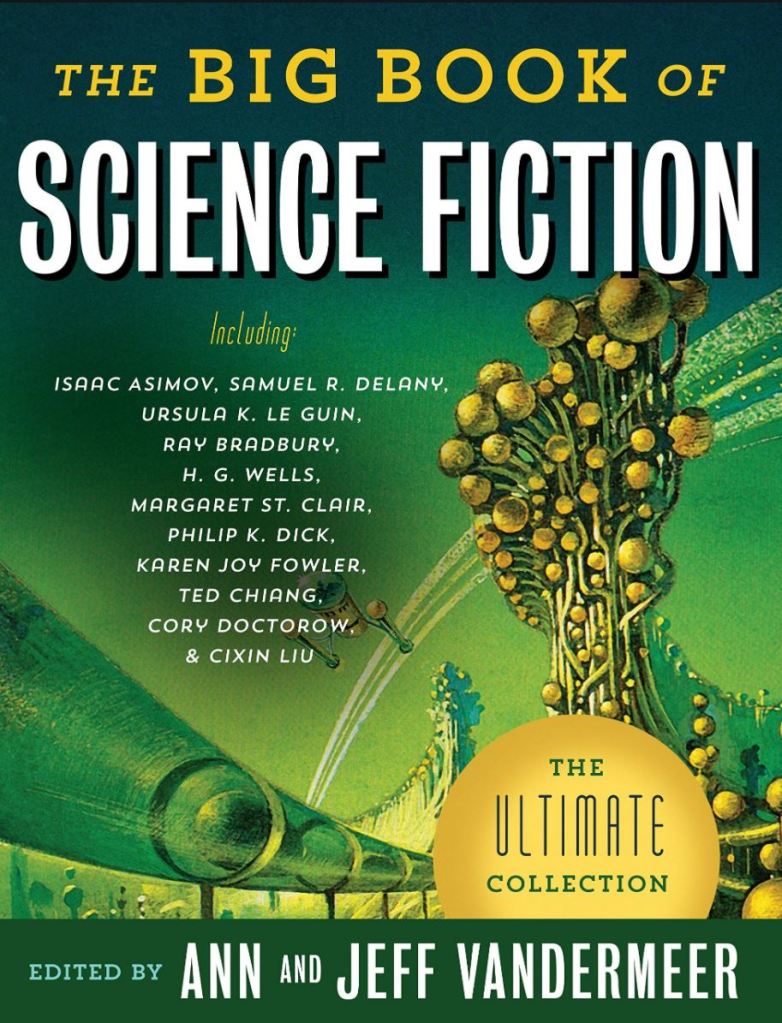
Group Read 27: The Big Book of Science Fiction
Story #91 of 107: “Two Small Birds” by Han Song
“Two Small Birds” by Han Song is a beautiful story that I admired for the writing and imagery, with many sentences that I twanged my heartstrings, especially, “I’m shocked to smell the flavor of olden days.” There’s not a moment that crawls by that I don’t feel that.
But here I go again being a little pissant. I don’t believe “Two Small Birds” is science fiction, or at least I don’t want to believe it. I’m not sure what label to give this story, but somehow I feel it’s unfair to shanghai every beautiful work of the fantastic and force it to sail upon our great clipper ship the Science Fiction. This is another case where I believe like their mentor Judith Merril, the VanderMeers want to uplift the genre by claim jumping other folks’ goldmines.
Now I will have to defend my position by going all verbose on you. Sorry about that. Let’s start with the simplest way to make my case. We make generalizations and classifications to find an agreement on what we’re pointing at with our words. Even though they are very similar, we like distinguishing between dogs and cats.
Nowadays anything that mentions anything that has the slightest whiff of science fiction gets slapped with the label science fiction. We need more labels. More precise labels. I saw an interview with David Brin the other day, and he came up with a lovely label, “speculative history.” Science fiction has become too trendy, too broad. It’s a monopoly that needs to be broken up.
I don’t have a label for “Two Small Birds,” but I don’t want to use science fiction for the job. I already have a lifetime of reading that uses that label, and this story is not really like those stories.
This reminds me of a book I recently read, The Horse, the Wheel, and Language by David W. Anthony about determining the location of the culture that produced the Proto-Indo-European language. Somewhere in pre-history, there exists a proto-fantastic-storytelling form that is the mother of all the genres. And like English, German, Spanish, etc. share elemental sounds from the Proto-Indo-European, science fiction, and whatever we should label “Two Small Birds” share common story elements that are similar, but they are as different as English and Italian.
I’m also reminded of the book I’m reading now, The Dawn of Everything by David Graeber and David Wengrow who argue against singular generalizations about human societies in pre-history because they certainly took a myriad of forms. And every shaman, guru, seer, witch-doctor, medicine man, mystic, astrologer, came up with a different creation story to explain reality. Out of thousands of years and countless refined perspectives we created science. It’s a very precise label. That makes it useful. I believe science fiction has a similar distillation from all the proto-fantastic storytelling forms, and we could make it precise too. We could if we tried.
“Two Small Birds” reminds me of Carlos Castaneda, Bob Dylan, Walt Whitman, Samuel Taylor Coleridge, and a certain work of Thomas De Quincey, among many others. You wouldn’t call any of those dudes science fiction writers, would you? And I will admit there are lines in “Two Small Birds” that sound science fictional. I just don’t think it fits into the taxonomy of how we should classify science fiction.
Now, I will admit things are evolving, and language is never static, and it appears that younger generations want to slap the Sci-Fi label onto any kind of strange story they love because they feel the genre should be all-encompassing. But I say it’s valuable to have a word other than calling every creature an animal because sometimes it’s important to distinguish a giraffe from an elephant.
James Wallace Harris, 2/15/22







 Classics of Science Fiction