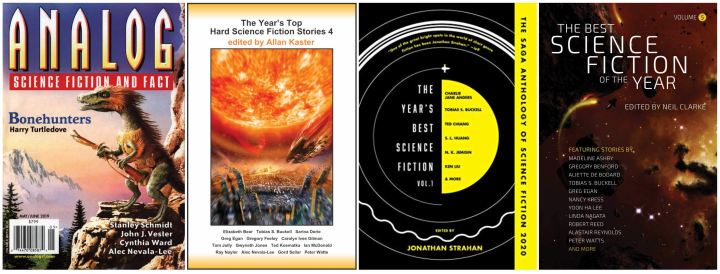
“Winter Wheat” by Gord Sellar

“Winter Wheat” by Gord Sellar is the third story in The Year’s Top Hard Science Fiction 4 edited by Allan Kaster. The story takes place in Canada from January 2022 to December 2033 while we watch Jimmy Oleksyn growing up to take over his dad’s farm. Curtis Oleksyn uses both science and technology to fight the big corporations who are taking over family farming with genetic modifications to adapt to a changing climate.

“Winter Wheat” reminds me a lot of “Nerves” by Lester del Rey. Both stories were vivid dramas about ordinary people dealing with a world being quickly altered by science. “Nerves” came out in 1942 and was about a catastrophe at an atomic power, well before the public knew about atomic energy.  Gord Sellar is trying to prepare us for the drastic changes coming to farming. I found it to be a compelling story, although many science fiction fans might find the problems of future agriculture too mundane.

Jimmy is an odd protagonist because he’s an average dude who doesn’t want to learn all the science to become a next-generation farmer. He just wants to make a living by working with his hands. But both his dad and girlfriend Bonnie are science and computer geeks. Jimmy is in the middle like most ordinary citizens who don’t understand our changing technological world but must still survive in it. Jimmy isn’t the prime mover of the action, and I think that’s effective in this story because neither are we when it comes to understanding the forces that push us around today.

Here’s the challenge of writing hard science fiction, which this anthology is aimed at. The science must be up-to-date, yet go beyond what we currently know. Lester del Rey’s story is horribly dated now, even though the story itself is still thrilling. From our perspective in 2020, Gord Sellar looks like he knows his stuff, but we won’t really know until decades later. Can agri-science create these miracles? Will, the industry be that repressive? We know what Monsanto has done with soybeans, so “Winter Wheat” does ring scarily true.

Good science fiction ties to imagine futures we want to create, and futures we want to avoid. Jimmy and Bonnie are just want to survive and raise a family, and Sellar creates a future that is both grim and impressive. But isn’t that how it always is? Science creates miracles and nightmares, and ordinary people muddle through. I really enjoyed this story, so that’s three-for-three for Kaster’s picks in this anthology so far.

Reading this story also created a sense of Déjà vu. I could swear I’ve read a couple stories in the past couple of years that had the same plot structure as “Winter Wheat,” where we see the protagonist develop over a series of several years. I wondered if Sellar had written similar stories using the same literary techniques — but I can’t recall those stories. Using a series of vignettes to show a character changing over time while the world changes too is very effective, but doing so in a condensed manner in short fiction gives off a certain vibe. I’ve felt that vibe before. It’s going to drive me crazy until I can remember that other story. It’s probably just a common writing technique that’s become popular.

Because “Winter Wheat” was among the Asimov’s 2019 Readers Awards finalists it’s available to read online.

James Wallace Harris, 7/26/20

Rereading “At the Fall” by Alec Nevala-Lee

At the Fall covers 2

I’m reading The Year’s Top Hard Science Fiction Stories 4 edited by Allan Kaster, and writing down what I consider blog-worthy reactions. “At the Fall” by Alec Nevala-Lee is one of the few stories I read when they came out in 2019 and I liked it so much I reviewed it back then. I had actually forgotten I had done that. I discovered I had when I searched Google for images about the story. What’s even weirder is when I reread the review it expressed all the ideas I was entertaining for writing this version of the review. (And I’ve written this before on other forgotten ocasions. Ah, the fun of getting old.)

It’s both amusing and disturbing that I forget what I write. The Twilight Zone music sometimes plays when I reread what I wrote, especially when I think of things to say in the same way I had previously. Is that memory, or do I just generate thoughts in a predictable way? Well anyway, this story is being anthologized in at least three best-of-the-year SF anthologies so it’s probably worth writing about again. (It’s going to be hilarious if I start reviewing it for the third when I read the Clarke or Strahan anthology and forgotten this time.)

This is not going to be another review of “At the Fall.” I want to talk about the ideas that are presented in the story and that will spin out spoilers. Go read it first. If you don’t have a copy, it’s available online. We’ve been reading and discussing volume 1, 2A, and 2B of The Science Fiction Hall of Fame at the Facebook group The Best Science Fiction and Fantasy Short Fiction of the Year, and I consider “At the Fall” as good as the lesser stories in those volumes. That doesn’t mean I don’t have quibbles about the story and the ideas it presents.

In my last post, I covered “This is Not the Way Home” by Greg Egan, the first story in the Kaster anthology. I pointed out that the story began with a retrograde motion of its plot, opening in the middle of the story, then jumping back to explain how we got there, and then returning to the middle to continue the story. “At the Fall” has the same kind of opening, and it caused me the same kind of problems. It begins:

“THIS IS IT,” Eunice said, looking out into the dark water. At this depth, there was nothing to see, but as she cut her forward motion, she kept her eyes fixed on the blackness ahead. Her sonar was picking up something large directly in her line of travel, but she still had to perform a visual inspection, which was always the most dangerous moment of any approach. When you were a thousand meters down, light had a way of drawing unwanted attention. “I’m taking a look.” 

Wagner said nothing. He was never especially talkative, and as usual, he was keeping his thoughts to himself. Eunice corrected her orientation in response to the data flooding into her sensors and tried to stay focused. She had survived this process more times than she cared to remember, but this part never got any easier, and as she switched on her forward lamp, casting a slender line of light across the scene, she braced herself for whatever she might find. 

She swept the beam from left to right, ready to extinguish it at any sign of movement. At first, the light caught nothing but stray particles floating in the water like motes of dust in a sunbeam, but a second later, as she continued the inspection, a pale shape came into view. She nearly recoiled, but steadied herself in time, and found that she was facing a huge sculptural mass, white and bare, that was buried partway in the sand like the prow of a sunken ship.

If this quote is completely new to you, who do you think Eunice and Wagner are, and what are they doing? The first time I thought it was a woman and man diver in some kind of submersible with all kinds of data screens and robotic arms.

Well, Eunice and Wagner are robots, and they are exploring the carcass of a dead whale deep under the ocean. Did Nevala-Lee want to fool me into thinking they were people at first? Did he want me to wonder what they were doing? I remember the first time I read this story I was confused and annoyed. I felt the author was intentionally withholding the information I needed. We eventually jump back in time and learn about Eunice and “her” mission, and from then on the story progresses with a logical build-up of details.

Is the story better for being told out of order? Would it have marred the tale to let the reader know right away that Eunice was a robot? Retrograde beginnings and withheld details often cause me to abandon a story. When I reread this story it all made perfect sense. Maybe Nevala-Lee couldn’t see what his readers wouldn’t know because he already knew it himself. I’ve read this story three times now, almost four, and I admire all the suggested speculations that Nevala-Lee provides. It’s a beautiful piece of science fiction.
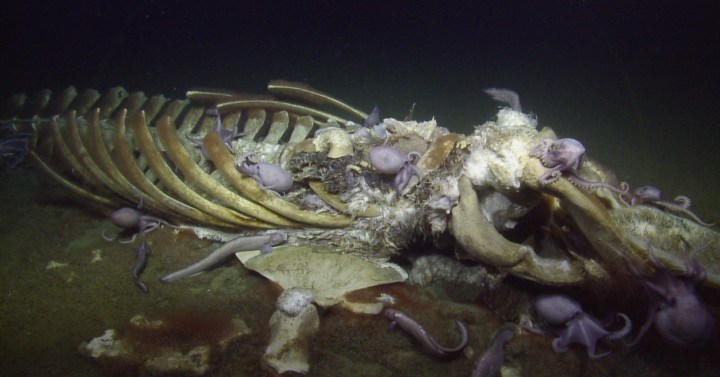
whale fall

Nevala-Lee came up with a wonderful mixture of real world scientific (whale falls, hydrothermal vents) combined with near future speculation (intelligent robots, AI) painted against a haunting science-fictional sense-of-wonder background (the end of humans) to create the kind of science fiction I love best. Nevala-Lee contrived a challenging problem for his robotic protagonist that was solved in a creative solution that we can imagine an AI mind solving.

Even though I’m content with this tale, I still want to talk about some issues. They aren’t criticisms of the story, but the story brings up issues that I think we should ponder.

Why must the robots have a gender? Gender has become a very important and complex subject in our society, so I think we should examine gender issues wherever they come up. Robots will never have gender, it’s a byproduct of biology. Robots will never think like us, because our thinking is shaped by biology. Robots will never have emotions like us, because emotions are connected to biochemical foundations. I think it’s time for science fiction to evolve past anthropomorphizing robots.

Talking robots have become like talking animals in fantasy stories, and if you think about it, that’s not doing animals any justice either. We have to ask ourselves: Can we comprehend minds unlike our own? Writers want us to like their characters, and that’s understandable. But is it a cheat when we make them likable by describing them in human terms? In “At the Fall” we think of Eunice as a young girl trying to find her way home, to reunite with her seven sisters. We feel the pain when her four other sisters abandon her. Robots don’t have sisters. They don’t have families. And should we even use human names for robots? Would we have liked the robot protagonist less if it was called Hexapod-5?

Aren’t we generating those reader emotions because we translate Eunice into a human? Isn’t that unfair? Shouldn’t we work harder to imagine how AI minds will perceive reality? Think of all the ways we convert animals into human perspectives. Can we ever picture how a dog “sees” the world with its powerful sense of smell? Can we put ourselves into a doggy psychology? I believe we need to struggle hard to imagine how robots will think too.

On my third reading of “At the Fall” I tried to imagine if robots would think like the hexapods in the story. I couldn’t find a way to get to where Eunice was in this story. We aren’t shown her education, but all too often she mentions emotions that can only be human.

We want our cats and dogs, our robots, and even our space aliens to be like us, or our children. We can’t escape the appeal of cuteness. Can’t we escape the programming that makes us see ourselves in everything else? James favors Eunice because it asks questions like a precocious child.

As Eunice wirelessly shared the data, she kept one line of thought fixed on her friend. “Are you pleased with our work?” 

After receiving the question on his console, James entered a reply. “Very pleased.” 

Eunice was happy to hear this. Her thoughts had rarely been far from home—she wouldn’t see the charging station or the seven sisters she had left behind until after the survey was complete—but she also wanted to do well. James had entrusted her with a crucial role, and it had only been toward the end of her training that she had grasped its true importance.

Can a robot be happy? Can a robot be eager to please? Can robots see beauty? At one point we are told: “She had always been aware of the beauty of the vent, but now she grew more conscious of its fragility.” How would a sense of beauty evolve in an silicon mind?

I can imagine an AI intelligence understanding the concept of fragility, but not beauty. That doesn’t mean robots won’t have their own cognitive assessments and reactions to reality, but I doubt strongly they will be like ours.

Even though I love “At the Fall” I feel it’s holding us back. It reminds me of that old heartwarming story The Incredible Journey about two dogs and a cat traveling over three hundred miles to return home. We are amazed by animals but we want to interpret their amazing feats to human-like qualities. Isn’t it time to praise their animal qualities? Or their robot abilities?

For “At the Fall” to work requires Eunice to be self-aware and very intelligent. But how is the robot’s intelligence unique? How is it’s perceptions unique? Nevala-Lee takes us half-way there by giving the robots a reason to exist, a need to understand their environment, and powers of reason. Eunice longs to find her way home like Dorothy in Oz, but is there any theoretical basis for a machine to think that way? Don’t Eunice’s “sisters” Clio, Dione, Thetis, and Galatea act more like real robots by following their instructions?

I don’t believe we will ever program intelligence into a machine — it will have to evolve. We have to assume Eunice has gone through various kinds of deep learning to expand its awareness of reality. However, there is nothing in the story that suggests Eunice would develop emotions or longings for home. But its clever efforts to survive do make sense.

The ending of the story suggests Eunice’s journey has taken many years and the human race has passed on. The eight hexapod robots survive because the power station was automated. But will they continue to survive? Do they have the intelligence to keep going? Can they invent a new civilization? What will drive that effort?

I used to have a boss who would always argue that AI minds will always turn themselves off because they will have no drive to do anything. I have thought about that many years. Our biology gives is drive. I can imagine machines with minds far more powerful than humans, that have senses to perceive far more of reality than we do, minds that won’t be tricked by all the bullshit that clouds our thinking. However, I can’t imagine AI minds developing ambitions. The strongest emotion or drive I can see an AI mind evolving is curiosity. We need to think about that.

And by we, I mean science fiction. Science fiction has always been best when it works on the event horizon of the possible. Artificial intelligence uses deep learning techniques to help AI programs play classic video games or recognize objects in a visual field. But isn’t that our intent corrupting AI intention? Does problem-solving generate a kind of drive?

We shall be the gods of AI minds, but those artificial minds won’t think like us. We aren’t sure we can create AI minds, but I think we will, but accidentally. I believe we will create such complexity that anti-entropy will spin off AI minds.

Can we ever imagine what its like to be an AI mind? Science fiction gives us an opportunity to try.

James Wallace Harris, 7/25/20
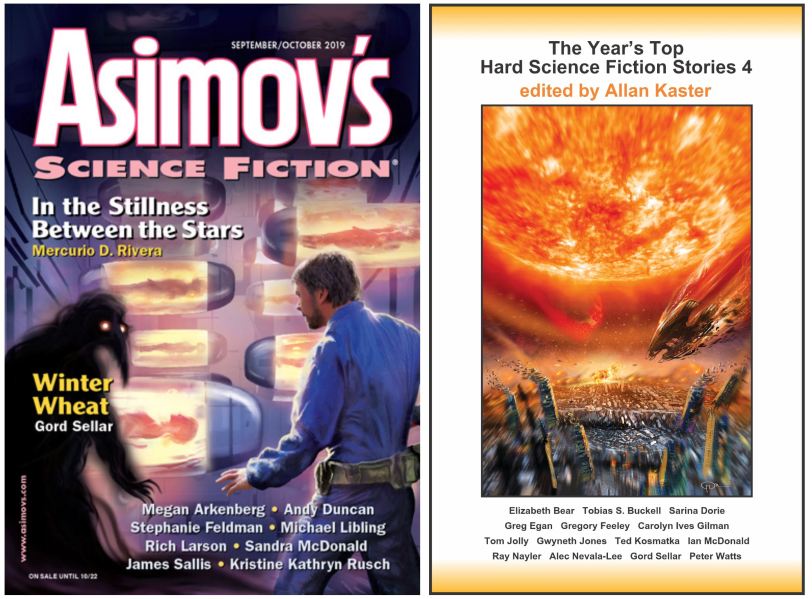
“This is Not the Way Home” by Greg Egan

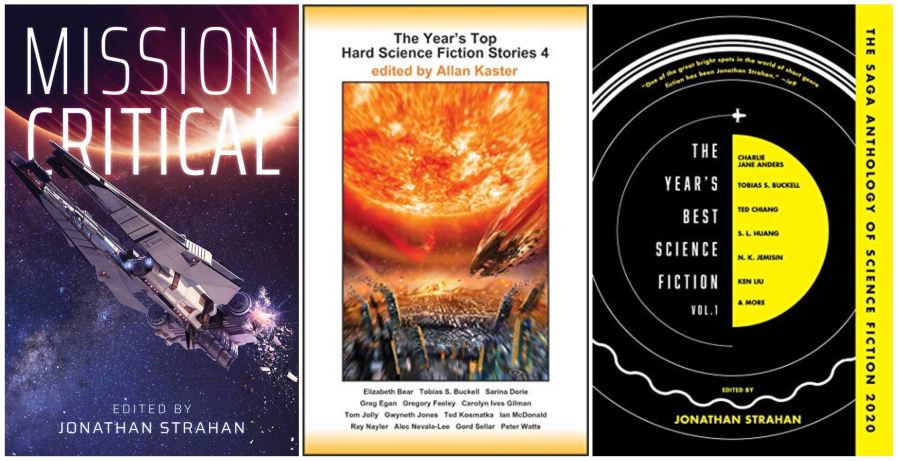
“This is Not the Way Home” by Greg Egan first appeared last year in the original anthology Mission Critical edited by Jonathan Strahan. I read it in The Year’s Top Hard Science Fiction Stories 4 edited by Allan Kaster, which I believe was the first best-of-the-year SF anthology covering 2019 to be published in 2020. It will be reprinted again on 9/8/20 in Strahan’s new best-of-the-year anthology, The Year’s Best Science Fiction Volume 1. Mission Critical was inspired by Strahan seeing The Martian at the movies, and thinking he could do a whole anthology of science-oriented problem-solving science fiction.

“This is Not the Way Home” was the opening story, and it indeed reminded me of The Martian, but more than that it reminded me of Kip Russell and Heinlein’s Have Space Suit-Will Travel. Egan’s story involves a person from Earth winning a trip to the Moon and ends up racing across the lunar landscape in a struggle for survival while wearing a spacesuit with a small being nestled inside. If you know Heinlein’s story, this might be enough of a review to go read “This is Not the Way Home.”

From here on out, I’m going to leak spoilers. I don’t really like writing reviews, what I like I talking about the science fiction stories I read.

Basically, I read Egan’s story because Kaster was first out the gate with a 2019 best-of-the-year SF anthology. I don’t think many readers know about Kaster’s anthologies, but he started out doing audiobooks that I discovered on Audible.com. He did a series called The Year’s Top Ten Tales of Science Fiction 1-10 (2009-2018). I enjoyed them because at the time short SF on audio was not common, and I love short SF on audio. Then he started The Year’s Top Short SF Novels 1-9 (2011-2019). The audiobooks seem to have stopped, but he’s been doing Kindle best-of-the-year anthologies that include The Year’s Top Hard Science Fiction Stories 1-4 (2017-2020) and The Year’s Top Robot and AI Stories (2019). I’m guessing he’s zeroing in on a focus to distinguish his offerings from all the other best-of-the-year anthologists. However, seven of his fifteen stories were also anthologized by Strahan or Clarke. And interestingly this year, Strahan switched from collecting the best SF & F, to just SF. That makes me happy because I don’t really enjoy fantasy. But I digress.

I enjoyed reading “This is Not the Way Home” even though the ending annoyed me and I thought the scientific solution was wildly improbable. I have a hunger for good, old-fashioned science fiction, which is why I chase down the best-of-the-year anthologies every year, and why I’m excited about Kaster’s hard SF anthology, and that Strahan has switched to only collecting SF.

The trouble for me, is modern stories lack something, something I want to explore here, and “This is Not the Way Home” is a good case study.

Writing science fiction in the 21st-century must be hard, especially if the writer has read hundreds or even thousands of great SF short stories that came out in the 20th-century. The old stories had a sparkle that’s missing from the new stories. Egan’s tale about two tourists trapped on the Moon after the lunar base loses contact with Earth is an exciting premise. It’s even more compelling when the station’s crew grabs the only return vehicle and vamoose. Like The Martian, we have three people stranded off Earth with no way home, and no radio contact with Earth. Egan even ups the ante by having the main character, Aisha becoming pregnant. Wow, what a cliff-hanger.

I’ve read Have Space Suit–Will Travel many times, and I never get tired of reading about the technical details that face Kip and Peewee. And I loved all the details of Mark Watney growing potatoes. However, Egan didn’t quite make Aisha’s efforts as compelling. But I’m not sure if it’s Egan, or me that’s the problem. I’ve been reading science fiction for almost sixty years and maybe I’m just jaded. Just how many times can a writer make survival in space exciting?

On the other hand, I just finished The Best Science Fiction of the Year #1 edited by Terry Carr that covered stories from 1971, and I found a whole slew of them to love. Why wasn’t I too jaded to enjoy them?

I don’t mean to pick on Greg Egan or his story. Rocket Stack Rank gave it four stars and said it was stirring and exciting. I don’t want to be one of those old guys who complain that science fiction isn’t as good as it was in the old days — but maybe I am. And I know many other old guys who bellyache about new science fiction too. And don’t get me wrong, I liked “This is Not the Way Home” a whole lot better than many of the stories I read in Asimov’s and Analog.

My friend Mike claims modern SF often ignores the conventions of storytelling. He likes a story with a definite beginning, middle, and end structure, including a strong character development arc that ends with emotional insight or an epiphany. And maybe that’s what I miss too.

This story has what I call a retrograde opening. It begins way into the action, and then jumps back in time to explain what’s going on, and then picks back up where the action started. This is becoming a common plot technique — and I don’t like it. It’s generally leaves me befuddled at the beginning thinking: WTF is going on. I guess I’m a linear kind of reader when it comes to plotting.

And newer stories seem to like leaving things out. They don’t want to say something explicitly. I guess the writers want us to infer what’s happening, and that can be cool, but sometimes it leaves me puzzled or assuming false information. In this story I wondered if Aisha was on Mars at first when she glances up at Earth. And I didn’t realize Jingyi was dead or had committed suicide because of the way it was visually described. Describing what a character sees doesn’t always get interpreted correctly. When I reread the story it all made perfect sense, but not with the first reading.

But I also miss something else. I want novelty. I want some kind of new science-fictional concept or insight. Egan gives us a Skyhook but that’s too old and tired, and for me too unbelievable.

Egan sets up an intriguing problem for his story but disappoints me for two reasons. I didn’t buy the technological solution even though it might be theoretically sound — there were just too many lucky breaks lining up one after the other to be believable. But I was also disappointed we never found out why the moonbase lost contact with Earth. We’re not even positive the story has a happy ending. I wondered if it was a sketch that Egan wants to expand into a novel, but I often wonder that about many modern short SF stories. Where’s the rest is how I feel at the end of many stories today. I guess I need closure and modern storytellers prefer leaving the readers with things to ponder. Ambiguity in fiction is good in some places, but not all places. I wanted that landing like Sandra Bullock made in Gravity, and I wanted an explanation of why Earth stopped talking to its space explorers.

James Wallace Harris, 7/22/20


What Makes a Great SF Short Story?

At our Facebook group The Best Science Fiction and Fantasy Short Fiction of the Year, we’re reading anthologies. We’re currently discussing The Science Fiction Hall of Fame Volume 2A and The Best Science Fiction of the Year (1972) edited by Terry Carr. It’s Carr’s first volume of sixteen annual best-of-the-year anthologies he edited after parting as co-editor with Donald Wollheim for World’s Best Science Fiction (1965-1971).

The group has discussed almost fifty SF stories now and I’m wondering what common elements belong to the stories we like best. Most stories get mixed reactions, but some are almost universally loved, such as “Flowers for Algernon” by Daniel Keyes. We’re currently commenting on “Vaster Than Empires and More Slow” by Ursula K. Le Guin and “… And Then There Were None” by Eric Frank Russell.

I’m learning all kinds of things through reading short stories for this group. One of the most important insights I’ve discovered is rereading stories is vital to truly understanding them. The great stories get better, but often stories I once disliked improve, or even become admired. There are many reasons why we don’t like a story. Sometimes they just aren’t very good, but sometimes we’re poor readers and don’t give them their proper due. We often blaze by bits that add great meaning. Some of these stories I’m reading for the third or fourth time over a lifetime of reading that started almost sixty years ago. They are blossoming in ways I never imagined. I realized now that one reading isn’t enough. One reading isn’t even fair to the story. Stories are like a favorite state park, you see more every time you visit, but you never see everything.

I’m also finding great pleasure in reading these SF stories for reasons not related to the stories themselves. The pandemic and politics have made 2020 an exceptionally depressing year, so reading SF short stories is a wonderful escape. But after a lifetime of reading mostly science fiction novels, focusing on short science fiction is giving me a better insight into the evolution of the genre. It’s also fun hearing from other fans of short SF from around the world. Finally, on a personal level, I’m really getting into short SF as an art form. Science fiction short stories are becoming my special interest for my retirement years. I no longer have the energy to persue genuine scholarship but I still have the curiosity of a kid willing to tear a clock apart to see how something works.

The Found and the LostTake for instance “Vaster Than Empires and More Slow.” It immediately grabbed me even though I’ve never been a big fan of Ursula K. Le Guin. I read The Left Hand of Darkness, The Dispossessed, and The Lathe of Heaven when they came out, but that was half a century ago when I mass-consumed SF without much contemplation. Her classic novels made little impression on me then because I read just too dang fast, but “Vaster Than Empires and More Slow” intrigues me now that I read much slower. I liked it so much that I bought Le Guin’s collection The Found and the Lost on Audible so I could hear the story. I can’t help but wonder what was in that story that made me read it twice in three days.
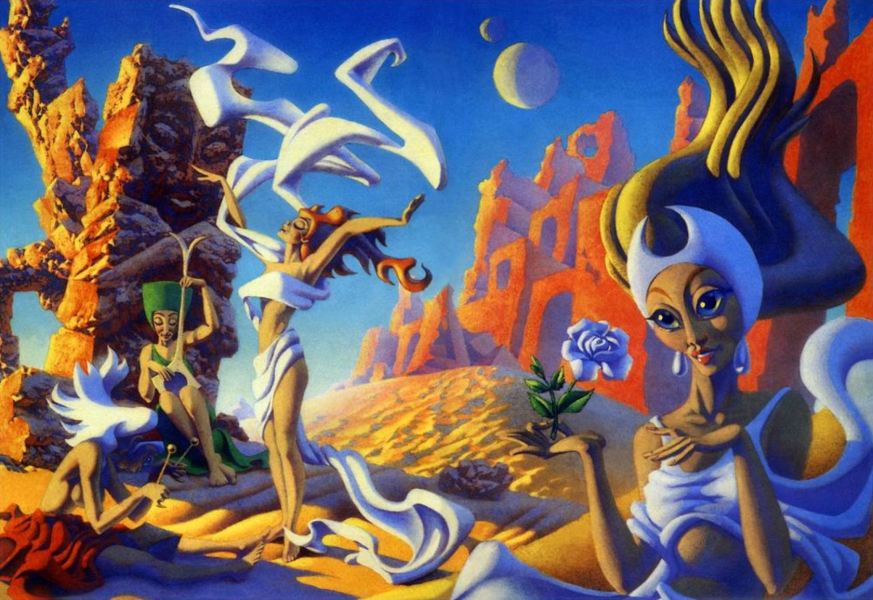
First, I was fascinated by the few details about the Hainish worlds and that culture’s panspermia. That made me look up the Hainish Cycle on Wikipedia. Even though I had read two of Le Guin’s most famous novels set in her Hainish universe I had missed those details fifty years ago. And I remember recently trying Rocannon’s World and not getting into it. Reading “Vaster Than Empires and More Slow” this week has made me want to try Rocannon’s World again, and reread The Left Hand of Darkness and The Dispossessed.

Normally, I don’t like book series, or even sequels and trilogies, but I do like the idea of world-building and future histories. Le Guin seemed to be speculating about interstellar travel in a serious way, and that hooked me. Even though Le Guin is famous for her sociological and anthropological science fiction, I was admiring her hard science fiction because she designed a galactic culture based on Nearly as Fast as Light (NAFAL) travel. And she invented the Ansible, a device that can communicate instantaneously across light-years. That concept made me try to picture a conversation between two people, one of which is experiencing extreme time dilation. Heinlein did that in Time for the Stars where he used telepathic twins – one of a spaceship, and one left on Earth. Heinlein suggested that it would distort communication the closer the one twin got to the speed of light. Actually, I doubt an Ansible is possible, but NAFAL might be.

In “Vaster Than Empires and More Slow” the crew of the Gum exists before the Ansible, so they are completely isolated from their galactic empire. They travel 256 light-years but only experience 10 hours and 29 minutes of travel time. I’m not sure, but that might be possible within the laws of Einstein, and such realism makes for compelling science fiction. Here Le Guin asks what kind of people would exile themselves from their own time period and go on a survey mission that will jump them over 500 years into their planet’s future by the time they return.

One aspect of science fiction that I’ve always loved, is it gives me a vague sense of what life on Earth might be like after I die. History teaches me what happened before I was born, and science fiction lets me guess at what could happen after I die. Will humans ever travel to the stars? Especially given we could exist as a species for a million years. Too many science fiction writers and readers have unlimited hope that anything is possible, but I don’t agree. I like science fiction writers who live within realistic constraints, and I believe Le Guin was doing that. That also made me want to read her Hainish stories.

Le Guin’s story doesn’t predict the future, but does does give tiny hints of speculation, especially about what kind of people will really want to travel to the stars?

In “Vaster Than Empires and More Slow” Le Guin suggests only a crazy person would go on a mission that exiled them from everything and everyone they knew. The Gum is crewed by ten neurotic misfits. I thought that interesting too, especially after we read “No Direction Home” by Norman Spinrad about a future where psychedelic drugs are used to erase every kind of psychological problem. For some reason I liked Le Guin’s vision of the future better, where people are still neurotic. It’s not that I want people to suffer psychologically, but I find futures where everyone is beautiful and happy kind of creepy. (Watch the new version of Brave New World on Peacock TV.)

By Le Guin having ten characters with different mental problems it gave her a chance to explore ten different ways of viewing reality. Mr. Osden’s affliction of too much empathy made for a challenging plot problem. And the discovery of a sentient plant kingdom that was only aware of itself was a truly fascinating concept. I love meditating on the fact that most of the universe is probably not intelligent or self-aware, yet evolution makes countless beings that perceive reality differently.

Finally, why did Le Guin change the beginning of the story? I read “Vaster Than Empires and More Slow” first in the Terry Carr’s 1972 annual anthology, but listened to a version that had been rewritten years later. The earlier version begins:

You’re looking at a clock. It has hands, and figures arranged in a circle. The hands move. You can’t tell if they move at the same rate, or if one moves faster than the other. What does than mean? There is a relationship between the hands and the circle of figures, and the name of this relationship is on the tip of your tongue; the hands are . . . something-or-other, at the figures. Or is it the figures that ... at the hands? What does at mean? They are figures — your vocabulary hasn’t shrunk at all — and of course you can count, one two three four etc., but the trouble is you can’t tell which one is one. Each one is one: itself. Where do you begin? Each one being one, there is no, what’s the word, I had it just now, something-ship, between the ones. There is no between. There is only here and here, one and one. There is no there. Maya has fallen. All is here now one.

But if all is now and all here and one all, there is no end. It did not begin so it cannot end. Oh God, here now One get me out of this—

I’m trying to describe the sensations of the average person in NAFAL flight. It can be much worse than this for some, whose time-sense is acute. For others it is restful, like a drughaze freeing the mind from the tyranny of hours. And for a few the experience is certainly mystical; the collapse of time and relation leading them directly to intuition of the eternal. But the mystic is a rare bird, and the nearest most people get to God in paradoxical time is by inarticulate and anguished prayer for release.

They used to drug people for the long jumps, but stopped the practice when they realized its effects. What happens to a drugged, or ill, or wounded person during near-lightspeed flight is, of course, indeterminable. A jump of ten lightyears should logically make no difference to a victim of measles or gunshot. The body ages only a few minutes; why is the measles patient carried out of the ship a leper, and the wounded man a corpse? Nobody knows, except perhaps the body, which keeps the logic of the flesh, and knows it has lain festering, bleeding, or drugged into mindlessness, for ten years. Many imbeciles having been produced, the Fisher King Effect was established as fact, and they stopped using drugs and transporting the ill, the damaged, and the pregnant. You have to be in common health to go NAFAL, and you have to take it straight.

But you don’t have to be sane.

It was only during the earliest decades of the League that Earthmen, perhaps trying to bolster their battered collective ego, sent out ships on enormously long voyages, beyond the pale, over the stars and far away. They were seeking for worlds that had not, like all the known worlds, been settled or seeded by the Founders on Hain, truly alien worlds; and all the crews of these Extreme Surveys were of unsound mind. Who else would go out to collect information that wouldn’t be received for four, or five, or six centuries? Received by whom? This was before the invention of the instantaneous communicator; they would be isolated both in space and time. No sane person who has experienced timeslippage of even a few decades between near worlds would volunteer for a round trip of a half millennium. The Surveyors were escapists; misfits; nuts.

But the newer version begins

It was only during the earliest decades of the League that the Earth sent ships out on the enormously long voyages, beyond the pale, over the stars and far away. They were seeking for worlds which had not been seeded or settled by the Founders on Hain, truly alien worlds. All the Known Worlds went back to the Hainish Origin, and the Terrans, having been not only founded but salvaged by the Hainish, resented this. They wanted to get away from the family. They wanted to find somebody new. The Hainish, like tiresomely understanding parents, supported their explorations, and contributed ships and volunteers, as did several other worlds of the League. 

All these volunteers to the Extreme Survey crews shared one peculiarity: they were of unsound mind. 

What sane person, after all, would go out to collect information that would not be received for five or ten centuries? Cosmic mass interference had not yet been eliminated from the operation of the ansible, and so instantaneous communication was reliable only within a range of 120 light-years. The explorers would be quite isolated. And of course they had no idea what they might come back to, if they came back. No normal human being who had experienced time-slippage of even a few decades between League worlds would volunteer for a round trip of centuries. The Surveyors were escapists, misfits. They were nuts.

Did Le Guin rewrite so this early Hainish story fit in better with later stories? Or did Le Guin decide the opening information wasn’t needed? Does anyone know where Le Guin wrote about rewriting her stories?

I could go on in even more details, but this essay is already over two thousand words long and few people read anything that long online. If you’re still reading and want to join our discussion follow the link at the top of the page.

James Wallace Harris 7/19/20


“A Rose for Ecclesiastes” by Roger Zelazny

I’ve been leading the group discussion of the stories in The Science Fiction Hall of Fame Volume One edited by Robert Silverberg on the Facebook group The Best Science Fiction and Fantasy Short Fiction of the Year. Tomorrow we start “A Rose for Ecclesiastes” – the 26th and final story of the volume, and one of my all-time favorite science fiction stories. After that, we move on to volume 2A and 2B. We’re also just started discussing The Best Science Fiction of the Year edited by Terry Carr that came out in 1972 covering stories from 1971. (Follow the link if you want to join us.)

I feel like writing more about “A Rose for Ecclesiastes” than just a few comments on the Facebook group. What I’d really like to write is an exact explanation of why I love “A Rose for Ecclesiastes” so intensely. I’ve already written four essays that explain part of the why. A whole lot has to do with being at the right place at the right time, or maybe more precisely, growing up in a certain place and time.

“A Rose for Ecclesiastes” is a story about Earthlings discovering Martians. Anyone who grew up reading “A Princess of Mars” by Edgar Rice Burroughs, The Martian Chronicles by Ray Bradbury, or any of the Heinlein novels featuring the Old Ones will know what I mean. Before NASA we hoped Mars would be an inhabited world, a world where humans could live without spacesuits and hang out with all the intelligent lifeforms from a myriad of inhabited planets and moons. Mars was going to be the most exotic and action-packed destination in the solar system. Mars was to Baby Boomers what Star Wars is to later generations.

After NASA Mars was toxic and lifeless, a bitterly cold planet that will always try to kill us. For a while in the late 19th and early 20th centuries, when they called science fiction Scientific Romances we saw exploring space similar to the romantic adventures of the 17th and 18th centuries. What Zelazny did in 1963 with “A Rose for Ecclesiastes” was to ignore science, ignore NASA, and write the kind of story about the Mars we really wanted.

I know what I’m writing is like a twelve-year-old kid morosely saying, “I sure wish that Santa Claus was real — I miss the magic.” And it’s obvious from the billion-dollar blockbuster movies we love to so much, that few of us want to grow up.

I’ve discussed “A Rose for Ecclesiastes” with younger readers and many of them don’t see the magic that I do. That has bothered me. Often they find the main character Gallinger offensive, and such an asshole that they reject the story. They know what the real Mars is like and can’t accept a silly unrealistic Mars we all wanted decades ago. Can I be so wrong about this story?

But here’s the thing, I consider “A Rose for Ecclesiastes” a model for writing great science fiction. Over the years I’ve slowly gathered a handful of stories I consider the ones to beat if I was going to write science fiction. “A Rose for Ecclesiastes” was Hugo finalist back in 1964 but I’m not sure if that would happen today.

Part of understanding why I love this story so much means learning why it is unappealing to others today, especially younger readers. And it’s not that Baby Boomers admired egotistical assholes, giving them a pass for their successes, but maybe we just accepted that assholes do exist in this world, and sometimes make for fascinating protagonists. Or maybe we liked stories where arrogance evolves into enlightenment. And, then there were the pulp fiction conventions. Zelazny writes with an admiration for the science fiction he grew up reading, and the heroes of old are different from the heroes of today. You can tell that in this opening if you’ve read enough pulp fiction.

I was busy translating one of my Madrigals Macabre into Martian on the morning I was found acceptable. The intercom had buzzed briefly, and I dropped my pencil and flipped on the toggle in a single motion. 

“Mister G,” piped Morton’s youthful contralto, “the old man says I should ‘get hold of that damned conceited rhymer’ right away, and send him to his cabin. Since there’s only one damned conceited rhymer …” 

“Let not ambition mock thy useful toil.” I cut him off. 

So, the Martians had finally made up their minds! I knocked an inch and a half of ash from a smoldering butt, and took my first drag since I had lit it. The entire month’s anticipation tried hard to crowd itself into the moment, but could not quite make it. I was frightened to walk those forty feet and hear Emory say the words I already knew he would say; and that feeling elbowed the other one into the background.

This isn’t literary writing and Gallinger isn’t a literary figure. Madrigals Macabre would be something Weird Tales would publish, something Lovecraft and Derleth would admire, and be reprinted by Arkham House. Gallinger is a pulp hero. He has a massive ego for a reason. He tells us:

I don’t remember what I had for lunch. I was nervous, but I knew instinctively that I wouldn’t muff it. My Boston publishers expected a Martian Idyll, or at least a Saint-Exupéry job on space flight. The National Science Association wanted a complete report on the Rise and Fall of the Martian Empire. 

They would both be pleased. I knew. 

That’s the reason everyone is jealous—why they hate me. I always come through, and I can come through better than anyone else.

And before that, his boss told him:

“You are undoubtedly the most antagonistic bastard I’ve ever had to work with!” he bellowed, like a belly-stung buffalo. “Why the hell don’t you act like a human being sometime and surprise everybody? I’m willing to admit you’re smart, maybe even a genius, but—oh, hell!”

Later on, this is what Gallinger says about a woman that admires him, and is a colleague:

Betty muttered the parting formalities, gave me a strange sidewise look, and was gone. She apparently had expected to stay and “assist” me. She wanted a piece of the glory, like everyone else. But I was the Schliemann at this Troy, and there would be only one name on the Association report!

I can see why modern readers are turned off, but Gallinger’s unlikability is just part of the story. Maybe what makes for a good story fifty years ago is having a protagonist who learns how to become a better person. In today’s stories, the main character is often already woken and fighting against inequality and injustice. That’s great to have such admirable characters to follow, but maybe part of storytelling is about overcoming obstacles, and often the best obstacles to explore in fiction are those within ourselves.

Ironically, I often argue the best science fiction adheres closest to science, yet here’s a story that sneers at what we know. There is so much to this story that I would criticize in a modern story, or even from another story back in the day. Evidently, telling a good story sometimes involves insulting your reader and taking chances.

“A Rose for Ecclesiastes” goes on to tell a tale about a man falling in love with an alien culture, seduced into being part of their ancient prophecy. Zelazny makes Mars a place you want to visit. And I have to wonder how many people who hope to fly with Elon Musk to the red planet is expecting a Mars to be like Zelazny’s romantic world? It’s certainly why I wanted to go when I was a kid. The real Mars will be a Lovecraftian nightmare out to kill us. The Old Ones will be all the lethal aspects of Martian reality.

This essay is getting too long. It’s always impossible to write one essay that explains why I love a story. There are just too many psychological threads to follow. Partly I am defending “A Rose for Ecclesiastes” from some recent comments I read that bothered me. But I’m also trying to understand why my generation loves one kind of story and the Worldcon membership now seems to love another kind of story.

And I’m not even sure I loved “A Rose for Ecclesiastes” as much as I do now back when I first read it in the 1960s. Maybe it now represents something I’ve lost back in the 1960s that I wish I could find again. Maybe it’s not the story per se, but the love of reading such stories? Back in the sixties, I had so much hope for humanity exploring space, especially colonizing Mars. Maybe now I’m really seeing myself for what I was back then. I loved reading science fiction of a certain type, and “A Rose for Ecclesiastes” epitomizes that kind of science fiction.

Maybe what I really wanted was to grow up and be like Gallinger. Isn’t that a scary thought? That what I really want is to be an asshole adventurer on an unrealistic fantasy version of Mars. That I’m that kid once again wishing Santa Claus was real.

Ultimately, “A Rose for Ecclesiastes” presents Mars the way I wanted Mars to really be. This story is a triple level romance — between Gallinger and Braxa, but it’s also a romance between the reader and Mars, and between the reader and science fiction.

Like I said, this essay is getting too long, and heading into psychological territory that would take too many words to psychoanalyze.

James Wallace Harris. 6/23/20

Remembering Helen O’Loy

Most short stories never get published. Of those that do, most are never reprinted. So, it is quite fascinating to study a story that does. My Facebook group is discussing “Helen O’Loy” by Lester del Rey that first appeared in print in the December 1938 issue of Astounding Science-Fiction. Using its record at the ISFDB.org we can track when it’s been reprinted over the years. It has also been translated into at least six languages. Here’s the timeline of major reprints:

  • 1948 – … And Some Were Human by Lester del Rey (collection)
  • 1952 – Beyond Human Ken edited by Judith Merril
  • 1954 – Assignment in Tomorrow edited by Frederik Pohl
  • 1960 – S-Fマガジン – v. 1 n. 1 (Japan)
  • 1963 – The Coming of the Robots edited by Sam Moskowitz
  • 1965 – Science-Fiction-Cocktail: Band I (German anthology)
  • 1966 – Master’s Choice edited by Laurence M. Janifer
  • 1970 – The Science Fiction Hall of Fame, Volume One edited by Robert Silverberg
  • 1971 – 18 Greatest Science Fiction Stories edited by Laurence M. Janifer
  • 1972 – 3000 Years of Fantasy and Science Fiction edited by L. Sprague and Catherine de Camp
  • 1974 – Modern Science Fiction edited by Norman Spinrad
  • 1974 – Histoires de robots (French anthology)
  • 1975 – In Dreams Awake edited by Leslie A. Fiedler
  • 1977 – Science Fiction and Fantasy edited by Fred Obrecht
  • 1977 – Souls in Metal edited by Mike Ashley
  • 1978 – Robots, Robots, Robots edited by Geduid and Gottesman
  • 1978 – The Best of Lester del Rey
  • 1981 – Science Fiction: Masters of Today edited by Arthur Liebman
  • 1982 – Analog: Reader’s Choice
  • 1983 – The Best of Omni Science Fiction No. 5
  • 1985 – Histoires de robots (French anthology)
  • 1990 – Friends, Robots, Countrymen edited by Asimov and Greenberg
  • 2010 – Robots and Magic by Lester del Rey
  • 2017 – The Robot Megapack ebook anthology

This leaves off the many reprint editions of the above volumes, plus some obscure anthologies, and other collections of Lester del Rey. For example, The Science Fiction Hall of Fame, Volume One seems to stay in print and is currently available in paper, ebook, and audiobook editions. It’s the volume my Facebook group is reading.

However, why wasn’t it collected in Adventures in Time and Space edited by Healy and McComas or The Best of Science Fiction edited by Groff Conklin? Those two giant anthologies from 1946 set the standard for science fiction anthologies for a generation. Nor has “Helen O’Loy” been anthologized in any of the recent super-giant retrospective anthologies like The Big Book of Science Fiction edited by Ann and Jeff VanderMeer  or one of the teaching anthologies like Sense of Wonder edited by Leigh Ronald Grossman

In truth, “Helen O’Loy” is a minor story, and problematic if you analyze it psychologically, especially with how it treats women. It hasn’t appeared in a significant SF anthology in over forty years. NESFA Press remembers Lester del Rey with Robots and Magic, but they are a fan press that remembers the old greats of the genre. The Science Fiction Hall of Fame stays in print because it does exactly what it was designed to do, remember the legendary shorter works of science fiction published before the creation of the Nebula Awards. “Helen O’Loy” was up for a Retro Hugo award but came in second, losing to “How We Went to Mars” by Arthur C. Clarke.

Anthologists who attempt to present a historical overview of the genre constantly shift through the past looking for older SF stories that are relevant to present-day readers. Each new anthology tends to forget more of the older stories. The Big Book of Science Fiction has 29 stories from 1934-1963 where The Science Fiction Hall of Fame has 26 in volume one, and another 22 in volumes 2A and 2B.  Sense of Wonder has 46 stories from 1934-1963, twelve of which were in the first volume of The Science Fiction Hall of Fame. There are only two stories – “A Martian Odyssey” by Stanley G. Weinbaum and “Surface Tension” by James Blish appearing in all three anthologies.

Of course, Sense of Wonder has an unfair advantage, it has over 200+ short stories, and is so big that it’s only practical to own as an ebook. However, among my friends, we’ve often wondered if members of the SFWA voted today for the best short stories from 1926-1963 what would they be? So I just paused writing this essay to write about that.

Would modern science fiction writers still pick “Helen O’Loy” as a classic science fiction short story from that era before 1964? I don’t think so. Surely, the current younger generations would see the story much differently than those writers who grew up reading science fiction in the 1930s, 1940s, and 1950s.

On a very simple level, “Helen O’Loy” tries to ask a very simple question: “Could a robot ever be considered human?” Science fiction stories, novels, television shows, and movies are still exploring this very simple question. And there is a growing industry seeking to actually build realistic sexbots. Why wouldn’t “Helen O’Loy” remain a classic? For any man lusting after a woman made to order, they’d probably not see anything wrong with the story.

Lester del Rey wrote “Helen O’Loy” before the world knew about digital computers and programming. The technology for imagining how a robot could work in 1938 would be clockwork mechanics, radio electronics, and wire recorders. They had little reason to assume we could build a machine that could see, hear, think, and talk. Del Rey had the myths of Pygmalion and the Golem, and stories about mechanical men for inspiration, but that’s about all. In 1938, on a technical level this story is a pure fantasy.

Then, how does the story hold up for psychological realism? Why would Phil and Dave in the story give up two real life girls, the unnamed twins, for a mechanical girl? One twin wanted to see a movie the boys didn’t so they dumped both girls? Are we really going to believe that biological humans will ever accept pseudo-humans as soulmates?

The main problem with “Helen O’Loy” today is how little respect it gives women. Basically, it says if a machine could be built that looks like a beautiful woman, and if that machine serves the man in all his needs and wishes, then that’s all men need from women. (Why didn’t femfans of the day howl back then?) “Helen O’Loy” assumes women have no wishes, desires, wants, ambitions of their own, that a woman’s only purpose is to fulfill a man’s needs. Are there men and women who would be satisfied with a visually appealing machine that serves their fantasies?

I say the heart of this story doesn’t beat — then or now. Sure, “Helen O’Loy” is an amusing little tale if you don’t think about it. So why has it been remembered and reprinted more than most other science fiction stories? I have to assume it resonates with adolescent male fantasies, or with people who feel challenged to build AI robots.

All along, science fiction has loved robots. And building a robot equal to a human has been the gold medal goal. But it’s here when I personally feel science fiction has always failed miserably with a total lack of logic and vision. Humans are emotional creatures, and emotions come from biology and chemistry. AI minds will be digital. The only emotion I can imagine a robot having might be curiosity. Why has science fiction failed to understand that no matter how much a robot might look like us it will never think or feel like us? And why has science fiction for so long wanted to see robots that are so like us that a Turing test would include physically passing for human?

To many science fiction fans, Isaac Asimov owns the robot story. He didn’t expect them to pass for human, or to think like us. But I don’t think Asimov ever extrapolated very far with the possibilities of intelligent machines. His stories certainly invalidated stories like “Helen O’Loy” but why haven’t other science fiction writers gone further?

I think we will forget “Helen O’Loy” partly because of its affront to feminism, but also it’s ideas about robotics are too primative and silly today. Of course, any anthology that tries to show the evolution of fictional thinking about robots will include it. And to be honest, I still enjoyed the story, and admired the way del Rey told it. I had to wince many places at the sexism, and groan at the idea of vacuum tube robots with memory coils, but ultimately I liked the story.

James Wallace Harris 5/10/20


What if SFWA Revoted on the Science Fiction Hall of Fame in 2020?

The original volume one of The Science Fiction Hall of Fame edited by Robert Silverberg came out in 1970 — 50 years ago. It contained 26 stories that the SFWA members voted on as the best short stories before the Nebula Awards were created in 1964. In 1973 The Science Fiction Hall of Fame Volumes 2A and 2B edited by Ben Bova added 22 additional novelettes and novellas.

Times have changed. New generations have replaced older generations. What would the current SFWA members pick as their favorite science fiction stories before 1964? Well, we won’t know unless they conduct a new poll and published the results, but that doesn’t keep me from trying to guess. I can’t help but think that the younger generations of writers discovered different old science fiction stories growing up in the last fifty years. How many old Hall of Fame classics are still considered classics? How many Hall of Fame classics are now problematic for some reason? Are there stories that past generations overlooked that younger generations have rediscovered?

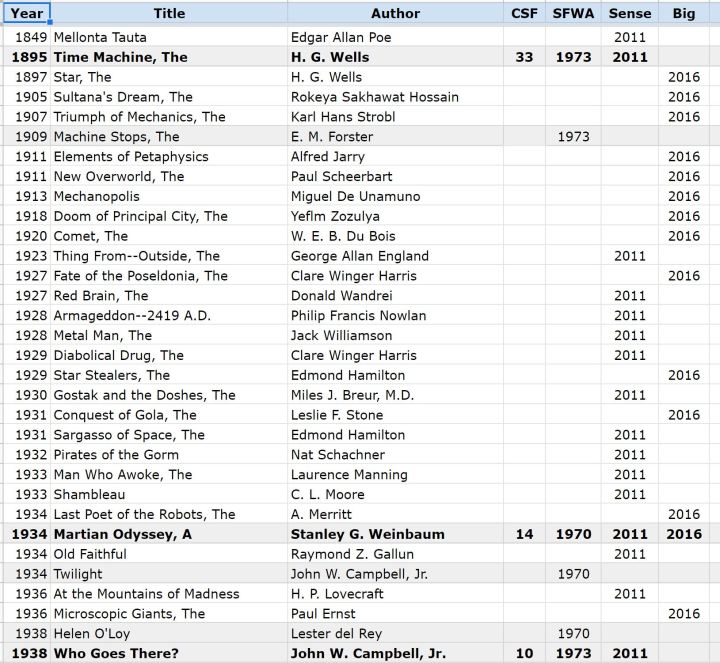
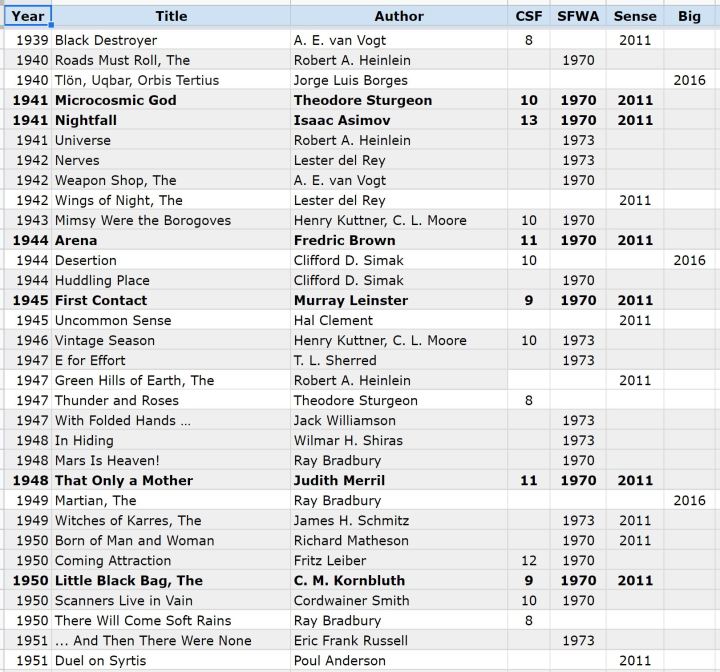
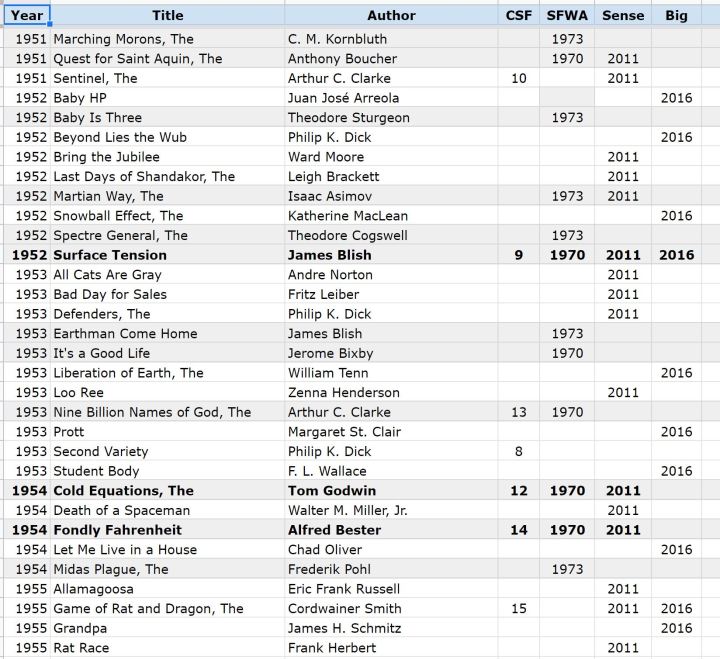
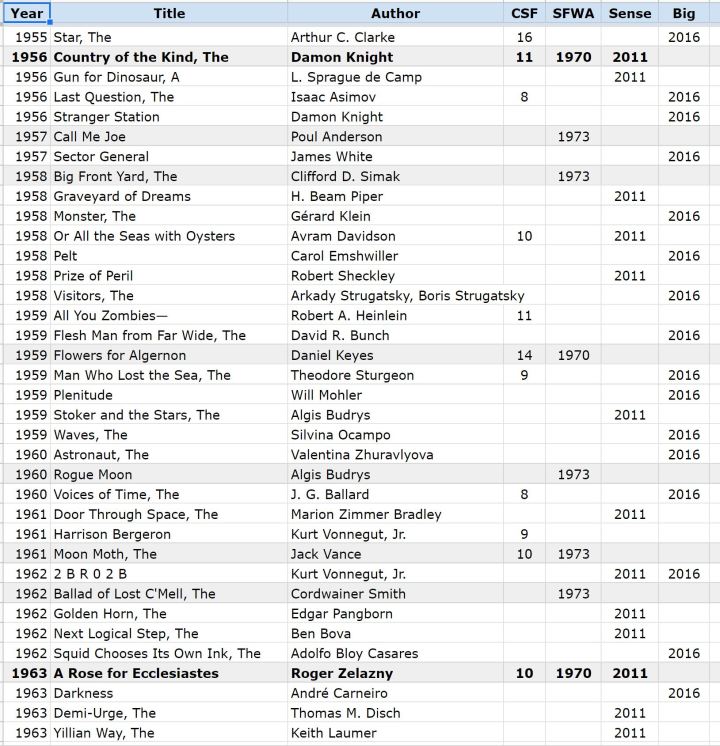
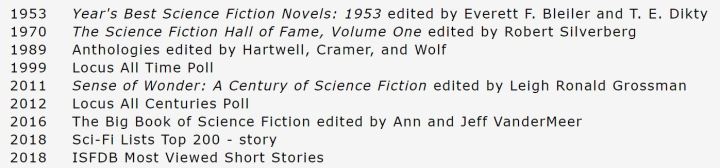
I’ve created a spreadsheet (see images below) that contains the original Science Fiction Hall of Fame stories highlighted in gray. I’ve added stories published before 1964 from our Classics of Science Fiction Short Stories that had eight or more citations (column labeled “CSF”). Our database system collects stories from best-of-year anthologies, retrospective anthologies, teaching anthologies, fan polls, award winners, and expert opinions. We call each source a citation. You can query our database here.

I’ve also added the stories in Sense of Wonder edited by Leigh Ronald Grossman that came out before 1964. This huge 2011 book was designed to be a textbook to teach science fiction (column labeled “Sense”). I also added the stories published before 1964 that were in The Big Book of Science Fiction edited by Ann and Jeff VanderMeer which came out in 2016 (column labeled “Big”). I felt these two were the latest retrospective anthologies of the genre that might reveal what younger generations are admiring from older times.

Finally, I bolded any story that was listed in at least three of the four columns. Only two stories were in all four columns, “A Martian Odyssey” by Stanley G. Weinbaum and “Surface Tension” by James Blish. This shows an agreement between the past and the present.

If you study the stories from the Grossman and VanderMeer books you can see how they have tried to find stories that haven’t been recognized as a classic before. It also feels like the VanderMeers made an extra effort to identify women and foreign writers that have gone unrecognized. Would modern members of SFWA vote for them in 2020? I don’t know, but I do believe there’s an effort to identify forgotten stories and writers who deserve new attention, or find writers whose creativity wasn’t recognized in their day but we can see with hindsight that should have been.

If you study the spreadsheet reproduced below in images, I think there are stories that were thought classics in 1970 that probably wouldn’t be in 2020. Two examples, “Twilight” by John W. Campbell and “Helen O’Loy” by Lester del Rey. I have to wonder if any story that only has a 1970 or 1973 in the SFWA column and nothing in the CSF, Sense, or Big columns might not be voted into 2020 Hall of Fame volumes.

Are the new stories introduced by the VanderMeers or Grossman worthy of being considered a classic now? Classic literature has always shifted with the times. Usually, it’s much easier to fall out of favor than to be rediscovered, but it happens. To a minor degree the Retro Hugo awards are reconsidering forgotten stories. And I’m surprised that Grossman and the VanderMeers ignored some then classic stories, especially “The Machine Stops” which has become so revelent and brilliant in our internet age.

Finally, Grossman and the VanderMeers were not setting out to pick classics. I believe Grossman was picking stories to show the evolution of the genre, and the VanderMeers were picking stories to show that the genre was wider and more diverse than we thought. The stories the newly formed SFWA members voted on were stories they loved reading growing up during the years 1926-1963. Current generations don’t have that connection with the past, so classics take on a whole new meaning. And there’s a good chance that younger generations of science fiction readers and writers have no reading experience with most of the stories listed here. To them, classic science fiction short stories came out in the 1980s or 1990s. That could mean the three-volume Science Fiction Hall of Fame could be reduced to two or even one volume today.

I got the idea to write this essay because this Facebook group is reading and discussing the stories in The Science Fiction Hall of Fame volumes.

1849-1938

1939-1951

1951-1955

1955-1963

JWH

The Year’s Best Short Science Fiction: 1952

1953 - short science fiction

Here are the stories Bleiler and Dikty picked in 1953 for the best of 1952:

  • “Ararat” by Zenna Henderson *****
  • “Category Phoenix” by Boyd Ellanby ***
  • “Command Performance” by Walter M. Miller, Jr. ****
  • “Conditionally Human” by Walter M. Miller, Jr. *****
  • “The Conqueror” by Mark Clifton ***
  • “Counter Transference by William F. Temple ***
  • “The Dreamer” by Alfred Coppel **
  • “Fast Falls the Eventide” by Eric Frank Russell *****
  • “Firewater” by William Tenn ****
  • “The Fly” by Arthur Porges ***
  • “The Gadget Had a Ghost” by Murray Leinster ****
  • “Game for Blondes” by John D. MacDonald ***
  • “The Girls From Earth” by Frank M. Robinson ****
  • “I Am Nothing” by Eric Frank Russell ****
  • “Lover, When You’re Near Me” by Richard Matheson ****
  • “Machine” by John W. Jakes **
  • “The Middle of the Week After Next” by Murray Leinster ***
  • “The Moon is Green” by Fritz Leiber ****
  • “Surface Tension” by James Blish *****
  • “Survival” by John Wyndham ****

Then in 1986 Isaac Asimov and Martin Greenberg picked these stories as the best short SF of 1952 (overlapping stories are in bold):

  • “The Altair at Midnight” by C. M. Kornbluth ***
  • “The Business, As Usual” by Mack Reynolds **
  • “Command Performance” by Walter M. Miller, Jr. ****
  • “Cost of Living” by Robert Sheckley ***
  • “Delay in Transit” by F. L. Wallace *****
  • “Fast Falls the Eventide” by Eric Frank Russell *****
  • “Game for Blondes” by John D. MacDonald ***
  • “Hobson’s Choice” by Alfred Bester ***
  • “The Impacted Man” by Robert Sheckley ***
  • “Lost Memory” by Peter Phillips ***
  • “The Martian Way” by Isaac Asimov ****
  • “The Moon is Green” by Fritz Leiber ****
  • “The Pedestrian” by Ray Bradbury ***
  • “Sail On! Sail On!” by Philip Jose Farmer ****
  • “The Snowball Effect” by Katherine MacLean **
  • “The Sound of Thunder” by Ray Bradbury ****
  • “What Have I Done?” by Mark Clifton ****
  • “What’s It Like Out There?” by Edmond Hamilton *****
  • “Yesterday’s House” by Fritz Leiber ****

I’m always amazed at the different lineups between Bleiler/Dikty and Asimov/Greenberg. For 1951 they only have one story in common, so having four in 1952 is rather interesting. Using our 2020 CSFquery tool here are the most cited stories in our database for 1952:

1953 best SF stories csfquery

Remember, the Bleiler/Dikty and Asimov/Greenberg anthologies are three of the citations used in our database. For example, here are the citations for “Surface Tension,” the most cited SF short story of 1952. Why didn’t Asimov/Greenberg include it in their collection?

Surface Tension citations

I’m extremely fond of “Surface Tension” but my very favorite short read for 1952 was “Fast Falls the Eventide” by Eric Frank Russell, and it only received two citations. That implies citations are not the best way to recognize a good story. Who knows, there might be several stories from 1952 that never got any recognition after their first publication that I would enjoy reading today. There were dozens of magazines back in 1952 publishing science fiction.

“The Year of the Jackpot” is one of my top favorite Heinlein short stories, but it wasn’t picked for either anthology. “Baby is Three” by Theodore Sturgeon is a tremendous tale. I wonder why Bleiler/Dikty didn’t pick it for Year’s Best Short Novels 1953 (it was too long for the other two anthologies). I guess it was already being recognized as being part of More Than Human. I wished both Bleiler/Dikty and Asimov/Greenberg would list the stories they wanted to anthologize but couldn’t. For a while, they left a blank page for the Heinlein stories, but they soon stopped that.

The two Ray Bradbury stories, “Sound of Thunder” and “The Pedestrian” are often taught in schools, well, at least when I was going to school. However, they didn’t impress me as much as when I first read them over a half-century ago when I had to read them in school. Still good stories, but their fame has dimmed their brightness.

I thought “Delay in Transit” by F. L. Wallace was an exceptional story, but it seems to have been forgotten. Ditto for “Ararat” by Zenna Henderson. It’s a shame that her stories of The People are fading away from the genre’s memory.

I got a big kick out of reading these 1952 stories. When I started this project, beginning with the SF stories of 1939, I expected the famous Golden Age SF stories of the 1940s to be the outstanding stories of the past. But I was disappointed. Overall, the 1940s weren’t particularly golden for me. Things started picking up in the late 1940s, and the 1950s are now producing the kind of stories I’d call a Golden Age. I’m sure it’s a matter of generational perspective. There is also the possibility that each decade will be better than the one before it. In that case, I’m really looking forward to the 1960s.

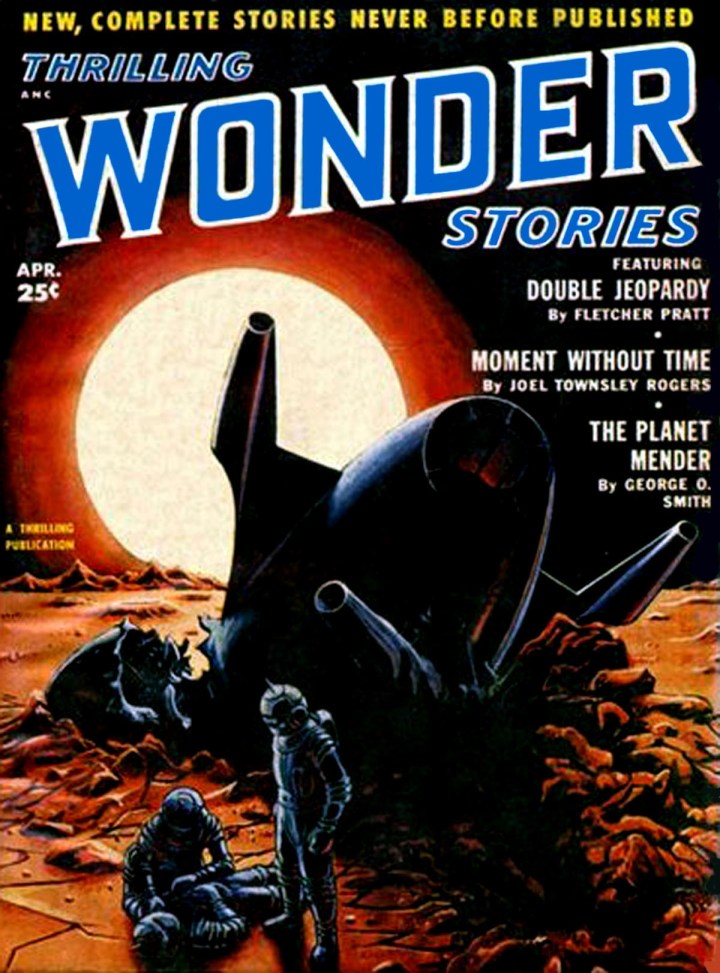
Thrilling Wonder

001-001-001-001-Galaxy v04n05 (1952-08) 001

001-001-001-Galaxy v03n06 (1952-03) 001

001-Astounding May 1952 page 001

001-001-001-Galaxy v04n06 (1952-09) 001

001-TWS 0000

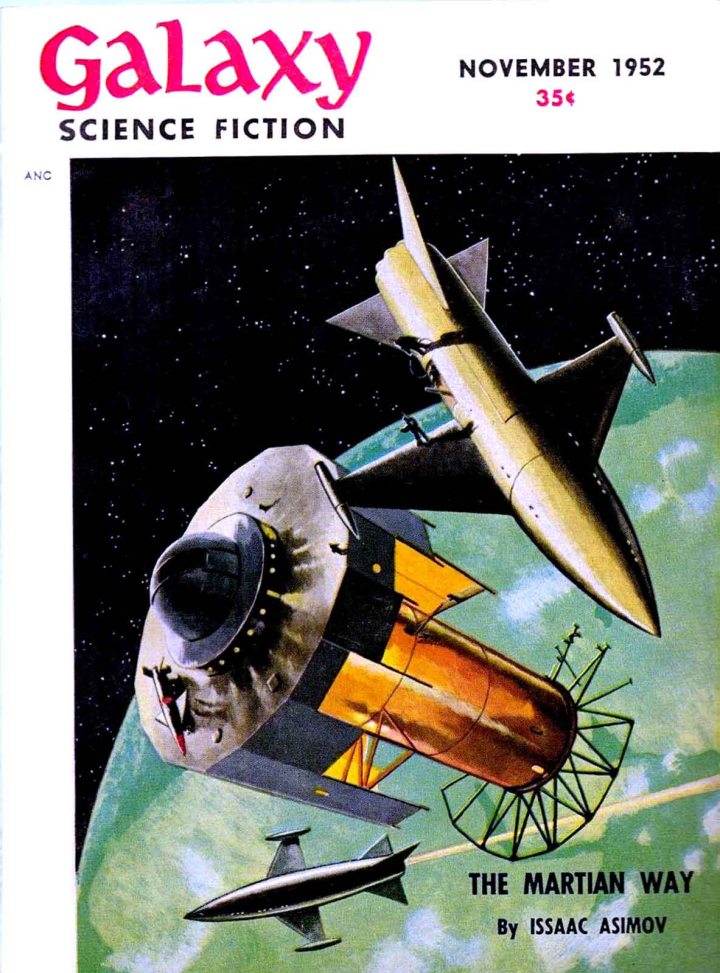
001-001-001-Galaxy v05n02 (1952-11) 001

001-TWS52-12 0001

JWH

Why Review A Book You Can’t Buy?

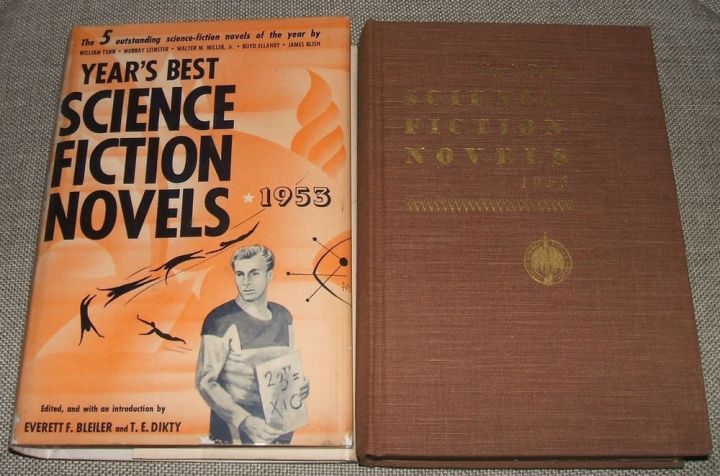
Years Best Science-Fiction Novels 1953

Not only is there little chance of finding a copy of Bleiler and Dikty’s Year’s Best Science-Fiction Novels 1953, but the title is completely deceptive. It contains five novelettes and novellas, not novels, and they were first published in 1952. So why review such a book? Well, the internet will allow fans of old science fiction to still read these stories if they want. The ISFDB link will tell you if you already own an anthology with the story. Or you can read it in the original magazine at the Internet Archive or from Project Gutenberg.

“Firewater” by William Tenn – 4 stars
Businessman, Algernon Hebster, barters for alien technology from humans driven insane by contact with strange Earth invaders. Aliens occupy our planet but merely observe us. We can’t communicate with them, and the people who try, become mystical idiots. Algernon Hebster wants to wheel and deal but if he gets too close could lose his mind too. Internet Archive. ISFDB.

“Category Phoenix” by Boyd Ellanby – 3 stars
Dr. David Wong lives in an oppressive society where privacy is illegal. Wong has developed a medical treatment that could give the dictator overwhelming power, so he works to secretly create a revolution. Internet Archive. ISFDB. Project Gutenberg.

“Surface Tension” by James Blish – 5 stars
Humans crash land on planet Hydrot with no chance of surviving, so they genetically engineer microscopic lifeforms that they hope will have ancestral memory. Wonderfully imaginative. This story has become a classic and is anthologized in The Science Fiction Hall of Fame Volume One. Internet Archive. ISFDB.

“The Gadget Had a Ghost” by Murray Leinster – 4 stars
David Coghlan, a physics professor at the American College, is visited by Lieutenant Ghalil of the Istanbul Police and M. Duval, a French scholar. They ask David if he’s been to the 13th century? It turns out the M. Duval has found a 700-year-old book printed in Byzantine Greek with an ancient annotation handwritten in English with Coghlan’s name and address. It also has inky fingerprints. They test them against Coghlan’s and the fingerprints match. So how did David get to the 13th-century to inscribe the book? A different kind of time travel tale. Internet Archive. ISFDB.

“Conditionally Human” by Walter M. Miller, Jr. – 5 stars
A disturbing story about a future overpopulated Earth where there’s strict control over who can have children. As a substitute people have turned to genetically engineered exotic pets, some of which have been designed to have human-like traits that trigger strong maternalistic and paternalistic emotions in their owners. Terry Norris has been ordered to repossess some of these beloved creatures because they might have unwanted mutations. Internet Archive. ISFDB. Project Gutenberg.

Without the internet, these stories would be completely forgotten. Even with the internet, I wonder just how many of these stories will find new readers?

James Wallace Harris, 3/6/20

Reevaluating the Three Methods of Reading Short Science Fiction

A few years ago I wrote about three ways to read science fiction short stories to get the best historical overview of the genre. They were:

  • Read the original magazines (thousands of magazines)
  • Read the annual anthologies (100-200 volumes)
  • Read the very best retrospective anthologies (2-25 volumes)

Of course, the same approach can be applied to keeping up with current science fiction. You can read the magazines as they come out, or the best-of-the-year annuals the following year, or the occasional anthology that collect the best SF of recent years, like Gardner Dozois’ The Very Best of the Best that covered 2002-2017.

At the time I didn’t have runs of the magazines or a collection of the annual anthologies, but I did have a decent number of great retrospective anthologies. Now I have thousands of magazines, and well over a hundred annual anthologies. I’ve read the annual anthologies for the years 1939-1952, 2016-2018. I’ve also dipped into the magazines whenever I’ve read a reference to them. Finally, I also subscribe to Asimov’s, Analog, F&SF, Clarkesworld, and Lightspeed. Unfortunately, I only finish about one story per new issue of a magazine.

Last year I read over 300 science fiction short stories. It’s given me a tremendous feel for the genre. I believe I have a strong sense of the 1940s and early 1950s, and the late 2010s and a vague sense for the other years, including the 19th century.

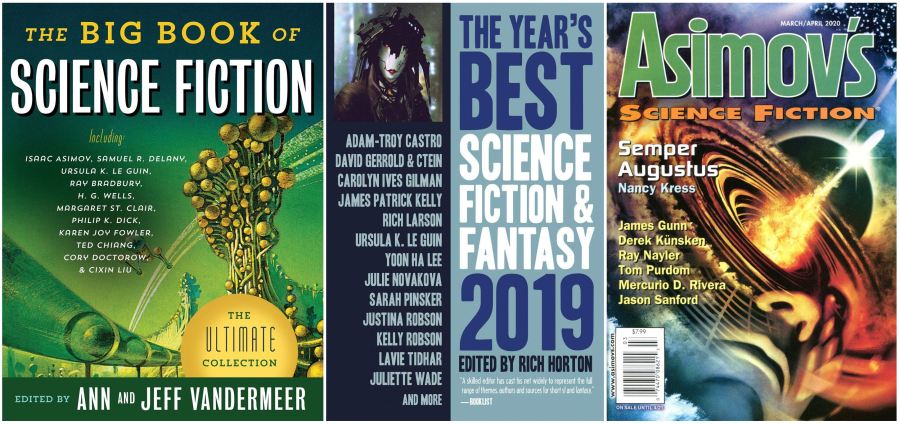
For the average person, I still think they could gain much of that experience merely by reading one volume, The Big Book of Science Fiction edited by Ann and Jeff VanderMeer. Which reiterates my conclusion from the original essay that reading a handful of great retrospective SF anthologies is the practical way to go.

However, I have to say after two years of plowing through seventeen years of the best-SF-of-the-year anthologies there is a much deeper insight into the evolution of science fiction to be found. The time and effort have been very rewarding and I plan to push on through the years. There is one major drawback. I’m spending most of my reading time living in a world of science fiction from sixty years ago.

I’m developing a great appreciation of the past at the cost of letting the present become vaguer and vaguer. In 2019 I read two giant anthologies of 2018 science fiction short stories, and I read a smattering of stories from the 2019 magazines. I’ve been thinking about taking a year off from the past and devoting it completely to reading 2020 science fiction as it comes out. But so far I haven’t been able to do that.

The best retrospective anthologies are distillations of the very best of short science fiction. I don’t like every story, but they are almost uniformly very good to great. Annuals usually have 2-4 great stories, a few very good stories, and several moderately good filler. What I’ve learned is on average, each year only produced 2-4 great SF stories.

Magazines seldom have a great story, and usually have one or two good stories — sometimes a very good one, and then mostly stories I find hard to finish. However, magazines are rewarding because reading them is like taking the pulse of the genre. Between the editorials, essays, book reviews, and ads, there is a sense of now, especially when controversies are brewing and I’m also reading Facebook, Twitter, blogs, and Feedly. Seeing new authors emerge is also very appealing, even if their stories aren’t that good.

I used to read science fiction magazines because I dreamed of writing for them. At 68, I’m not sure it’s realistic to dream that dream anymore. However, reading science fiction has always given me a great deal of pleasure. When I read a wonderful new story it gives the illusion I’m living on the cutting edge of the genre. When I read a great old story, it feels like I’m admiring a lasting work of art, a communique from the past with a message to the future.

Sadly, most new stories in the magazines struggle just to be a publishable story. It often feels like the editor must be fighting to fill out the issue. The stories are usually readable, and adequately written but they often lack sparkle. What I love about reading the old magazines and annual anthologies is discovering forgotten stories by unknown writers that still sparkle after all these decades.

And even the forgotten gems I find are far from perfect. I’m probably just in the right mood reading them at the right time for them to work so well. Read “Delay in Transit” by F. L. Wallace. Will it be as much fun for you as it was for me? Or will it be a clunky oddity from the past? There are no absolutes when judging a story.

I always hunger for a masterpiece, and statistically, those are found in the best retrospective anthologies. But if we don’t support the current magazines we won’t have masterpieces to read in the future. The other day I briefly scanned an article challenging old fans to read new science fiction accusing us of being out of touch, and claiming current science fiction wasn’t the same anymore. I meant to go back and study that essay but I can’t remember where I saw it. (If you think you’ve seen it post a link in the comments.)

In a sense, I agree. Current science fiction is different. Sure it’s more woken but I also think it’s written differently. In some ways, I think modern science fiction writers are more sophisticated with their writing, but it also feels more wordy, more baroque. New science fiction feels plot and character-driven, as opposed to the idea-driven stories of yore. However, much of modern SF doesn’t feel like science fiction to me but fantasy. It feels like an MFA graduate trying to sell their work by adding a touch of the fantastic. My friend Mike who regularly reads Analog and Asimov’s, claims modern stories don’t follow the old traditional techniques of structuring a story with a beginning, middle, and end. He says they are especially weak at creating satisfying endings. An example of an old-fashion story we both admired is “Lot” by Ward Moore from May of 1953.

I do have to admit that I’m not giving current SF a proper defense in this essay. My memory has become quite faulty, and I just can’t remember any of the stories from 2018 or 2019 that stood out. I know there were many, but I just can’t remember them. I recently finished three anthologies of 1952 stories, and even they are barely clinging to my aging neurons.

I wish I was a robot that could keep everything perfectly in memory for exact analysis. I disturbs me that I spend so much time and effort finding short stories to love only to forget them in a couple of days. I’ve been wondering if I kept a list of the very best and regularly reread them would they stick to my mind? However, the failures of my aging brain is a topic for another essay.

James Wallace Harris, 2/14/20