“Riders of the Purple Wage” by Philip José Farmer

[The Facebook group Best Science Fiction and Fantasy Short Fiction is discussing one story a week from Dangerous Visions.]

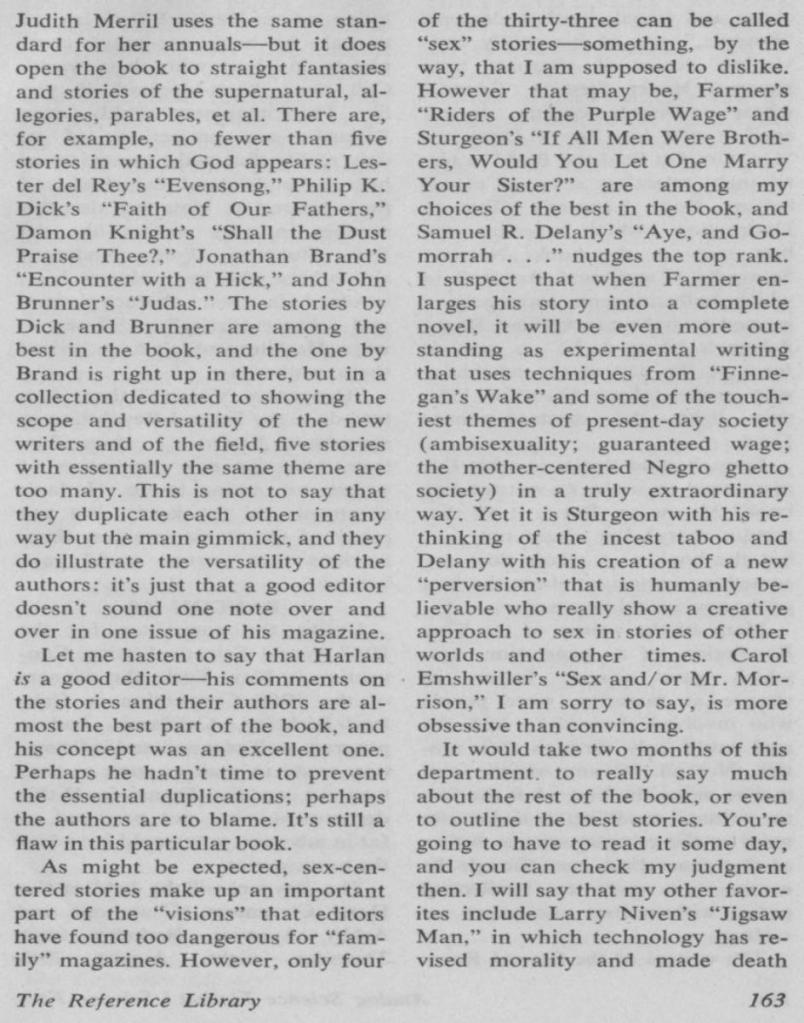
First off, let me say that I believe “Riders of the Purple Wage” by Philip José Farmer is as complex and ambitious as John Brunner’s Stand on Zanzibar, which came out the year after Dangerous Visions. It’s not an easy story to read, and at 30,000 words it will feel overly bloated if you’re not in the mood for Farmer’s purple prose. It co-won the Hugo Award for best novella in 1968 and was up for a Nebula too. When I first read “Riders of the Purple Wage” back in the 1960s, I was still in high school, had not yet discovered James Joyce. I was clueless at what Farmer was attempting to do in the story. Still, it was my favorite story in the anthology.

When Dangerous Visions came out in audio a couple of months ago, I listened to “Riders of the Purple Wage.” It made all the difference at revealing Farmer’s literary ambitions and philosophical insights. Then before writing this review, I listened to the story again, and it was even more revealing. Unless you’re the kind of person who reads very slowly, working out all the intended voices, decoding all the allusions, I doubt you’ll get a fraction of what Farmer intended. I’ve listened to it twice now in two months, and I’ve hardly begun to comprehend everything Farmer is doing. To really understand “Riders of the Purple Wage” will require many close readings and listening, taking lots of notes. It’s easily worth a dissertation.

I highly recommend listening to “Riders of the Purple Wage.” Check your library. If you subscribe to Spotify for music, it’s there as part of your membership. I won’t recommend you buy Dangerous Visions at Audible just for one story unless you really want the whole anthology.

I also expect many people will read “Riders of the Purple Wage” and go “WTF is this crap!” I know that me liking something doesn’t mean others will like it.

Farmer is not working on the same literary level as James Joyce, but he’s trying his best to imitate the guy. Farmer was never a major science fiction writer despite Ellison’s introduction. His one major work, To Your Scattered Bodies Go, the first of his Riverworld series in 1971, shows tremendous imagination, but was a cheat in my book because he used Sir Richard Burton as his protagonist. I consider fiction that uses historical people for characters equal to doping a horse to win a race. And for much of his career after that, Farmer wrote pastiches based on famous real people and famous fictional people. In other words, I consider “Riders of the Purple Wage” the peak of Farmer’s creative efforts. (Although, Blown and Image of the Beast were very impressive.)

I don’t agree with Farmer in what he says in places, but I do admire his ambition.

Don’t let my enthusiasm for the story give you unfillable expectations. Farmer was born in 1918, and was almost fifty when he wrote “Riders of the Purple Wage.” His mid-1960s conservative views might offend some people, especially modern readers, but so will some of his liberal views. “Riders of the Purple Wage” is intentionally vulgar, gross, and punny. The setting is mid-22nd century, where most people live on a guaranteed income, the purple wage, and the government tries to eradicate wars by homogenizing the world’s population by forcing citizens to relocate to other countries. This story is both utopian and dystopian, and gives Farmer a chance to comment on politics, history, sexuality, psychology, literature, and anything else he can squeeze in.

“Riders of the Purple Wage” has a simple plot. Chibiabos Elgreco Winnegan, known as Chib, wants to win a grant for his artwork so he and his mother won’t be forced to emigrate to Egypt. He also wants to get away from his mother whom he had a sexual relationship with until adolescence, when she stop fulfilling his needs. Incest is accepted in this future society. Chib also hides his great grandfather from the authorities. Grandpa Winnegan is the philosopher of this story. He’s supposed to be dead, but the IRB thinks he’s still alive and sheltering a fortune. This plot description is just the skeleton. From just the bones, you won’t be able to imagine how big the full body of this story really is. Whether it’s all bloat will be up to you. Farmer does some furious tap dancing, but I can’t promise you’ll like his routine. I just marveled, thinking, “Look at that old man go!”

I wanted to describe everything in this novella and give my reaction, but I just don’t have the time, energy, or concentration. I’ve tried several times to collect appropriate quotes that would give a sense of the story, but that’s almost impossible. Taken out of context it makes them seem weird and confusing. Even listening to them in context requires a great deal of concentration. Farmer expects you to keep up.

To properly experience this story requires listening to it. Think of it as a one man show on Broadway. An intense experience that runs over two hours. But also imagine that one man one stage morphing between Jonathan Winters and Frank Zappa, to James Joyce and Bob Dylan, to R. A. Lafferty and Robert Sheckley, and at other times Robert A. Heinlein and Edgar Rice Burroughs doing imitations of Shakespeare, Dante, and Laurence Sterne. And if you can recognize them, several ancient Greeks, and Romans.

I get the feeling that Farmer was well educated and was bursting with ideas about how everything is interrelated. I’d love to see the letter Harlan Ellison sent Phil requesting he submit to the anthology. Farmer must have thought he had free rein to write anything. In his afterward, Farmer admits to originally producing 40,000 words, then cutting it to 20,000. Ellison says Farmer asked him if he could expand on that, which Ellison agreed, so Farmer built the story back to 30,000 words. Evidently, Farmer just ran with this story. I picture Farmer typing like a madman for days, just screaming and laughing manically at his own wittiness. I bet he loved writing this story. It runs 2 hours and 31 minutes on audio.

Farmer, in his afterword, also explains the story was inspired by an Ad Hoc Committee report to Lyndon B. Johnson. Farmer calls it the Triple Revolution document that covers (1) the Cybernetion Revolution, (2) the Weaponry Revolution, and (3) the Human Rights Revolution. And you can see all of that in “Riders of the Purple Wage.” The story does some major extrapolation, like I said, comparable to Stand on Zanzibar.

James Wallace Harris, 5/25/24
“The Day After the Day the Martians Came” by Frederik Pohl

After reading a story about hunting down God and another story about vicious attacks on women, Frederik Pohl anti-prejudice story seems downright pleasant. It is a breezy tale about how people recycle all their old ethnic jokes when NASA brings home a Martian.

“The Day After the Day the Martians Came” reminded me of how things were back in the 1950s and 1960s. People often retold jokes they had heard, and many of them depended on ethnic stereotypes. I seldom hear people tell a joke anymore, and I can only remember one that I heard that I retold in the last few years. It went something like this:

A young guy is out hitchhiking, and he gets a ride with an old man driving a new car. The young guy doesn’t know how to strike up a conversation but finally says, “Aren’t you afraid of giving rides to hitchhikers? They might be a serial killer.” And the old man laughs, “Oh no, I’m not afraid. What are the odds of two serial killers being in the same car?”

Now, that joke is based on a stereotype, but until people start feeling sorry for serial killers, I assume it will be politically correct to use them in a joke. That’s the thing about humor, it usually has a target, and it’s often about cruelty or pain, or someone being the butt of the joke.

Essentially, Pohl’s story is a civil rights tale. It was written during the peak years of the Civil Rights movement. However, its punchline conveys a stereotype about black people. “The Day After the Day the Martians Came” is well-intended, but simplistic. It lacks sophistication.

The setting is a hotel where reporters are staying to report on NASA bringing back a Martian. The hotel is managed by a man, Mr. Mandala, who sounds like he’s from India, who bosses around two black men, one who is the bell captain. Pohl doesn’t use the old word bellboy here. It describes a lobby that is overflowing with reporters who all take turns making up jokes about Martians. We are told Martians are quite ugly and look a lot like seals. All the characters are based on stereotypes. The reporters sound like they came out of the 1940 screwball comedy, His Girl Friday.

It seems rather odd that Pohl is satirizing joke tellers for using stereotypes when his story depends on stereotypes. I wonder if Pohl was aware of this on meta level. I don’t think so. Science fiction evolved out of pulp fiction magazines, and the best pulp fiction writers were brilliant at typing out stories fast and furiously. They depended on stereotypes and caricatures. And like movies from the 1930s and 1940s, readers and audiences loved a good character creatively based on a type, such as a newspaper reporter.

For Pohl to have explored this situation in a deeper way, he would have had to create a unique individual reporter observing a unique individual Martian and realistically portraying unique individual humans reacting to the Martian with specific prejudices regarding specific physical details and characteristics. Something James Joyce or Flannery O’Conner or even Raymond Chandler might have written. I think some New Wave writers knew this in theory, but not in practice.

I’m afraid people will think I’m picking on Dangerous Visions. Ellison claims its stories point to a new way of writing in science fiction, but so far, I don’t think the first three stories have demonstrated a new kind of writing. I think science fiction will change in the decades after the 1960s, but I’m not sure it has changed much in 1967.

James Wallace Harris, 5/19/24

“Flies” by Robert Silverberg

The first story in Dangerous Visions was by Lester del Rey, an old friend and mentor to Harlan Ellison. The second story is by Robert Silverberg, one of Ellison’s best friends from the 1950s. And the next story is by Frederik Pohl, another editor and mentor from the 1950s. I get the feeling Ellison said to all his friends, “Hey gang, let’s put on a show!” (in his best imitation of Micky Rooney from 1939). But “Flies” by Silverberg is one disturbing performance, making me think this anthology should have been called Disturbing Visions.

I thought it interesting in Ellison’s introduction, where he’s bragging what a great writer Silverberg is, and listing all Silverberg’s great works, that none of them were the famous science fiction stories we know today. Then I realized that in 1967, Silverberg had not yet become a famous science fiction writer, the one who wrote the stories we associate with him today. I don’t think anyone will ever list “Flies” as great Silverberg. However, Silverberg would take off in 1967 with his story “Hawksbill Station,” which was a finalist for both the Hugo and Nebula and was anthologized in two best-of-the-year annuals. In the following few years Silverberg would become a giant in the genre.

“Flies” is about an astronaut, Richard Henry Cassiday, who nearly dies in space, but aliens find and repair him. They are God-like beings, who make him physically perfect again. But before sending him back to Earth, they turn up the sensitivity of his brain and fix it so he can telepathically report back to them.

Cassiday returns to Earth and proceeds to track down his three ex-wives. With each, he cruelly hurts them. The story is quite vivid, describing what he does. The alien watchers make him come back to be fixed. On being returned to Earth again, he suffers and reports back on his suffering. We are told that Cassiday is “nailed to his cross.” Are we to wonder if Jesus came to Earth to experience God’s sins against humans? I don’t know.

Cassiday even explains himself by quoting Shakespeare, “As flies to wanton boys are we to the gods. They kill us for their sport.” Is Silverberg explaining suffering with theology? Are these two references to religion making the story deeper, or just bullshitting us?

All I know, while reading this unpleasant story, all I felt was horror. Why would Silverberg write such a disgusting tale? Often the stories in Dangerous Visions seem like they were written to top all other stories in grossness. Here’s what Silverberg wrote for his afterward, suggesting the story is about vampirism.

I’ve recently been reading dozens of science fiction stories published before 1930. And one of the most common themes is horror. Before space opera ramped up in the late 1920s, I would say horror was the number one theme of science fiction stories. And if you think about it, horror is still a common theme. A thrilling alien invasion film like Independence Day is full of horrible things happening to people — but the peak thrill of the film is when we do horrible things to the aliens. Isn’t science fiction often being Romans at the Colosseum?

Kurt Vonnegut had advice to budding writers, “Do mean things to your protagonist.” We love characters who overcome adversity. But do we love characters who create adversity? I’m reminded of “Fondly Fahrenheit” by Alfred Bester. In that story, James Vandaleur and his android servant kill people, even children, in horrendous ways. That’s one of my all-time favorite science fiction short stories. But it didn’t disgust me. Why?

One of the reasons why I’m reading all those old pre-1930 science fiction stories is because it shows that science fiction stories were inspired by previous science fiction stories, and if they are successful, inspire later science fiction stories.

Here’s my problem with Dangerous Visions. I can find antecedents for its stories, but I’m having trouble finding stories that DV inspired in the years since. For all its success, Dangerous Visions is a kind of dead end, at least so far in my reading. Is that because science fiction as a genre decided to head off in another direction after Dangerous Visions? Probably not, probably I just can’t recall stories that follow the trajectories of DV stories. Maybe DV taught me to avoid them.

But so far, Dangerous Visions feels like a combination of the 1969 rock festival at Altamont and Charles Manson. Those were two years into the future. Maybe DV was being prophetic.


I thought I’d add this review of Dangerous Visions.

James Wallace Harris, 5/11/24

“Evensong” by Lester del Rey

For me, the most rewarding pages of Dangerous Visions were the introductions by Harlan Ellison and the afterwards by the authors. When I first read this anthology back in the late 1960s, I felt those introductions gave me insight into the family of science fiction writers, one I wanted to join. At the time I was sixteen and I totally bought Ellison’s enthusiasm and promises. Fifty-six years later, I reacted to this anthology and its stories very differently.

Ellison honors del Rey by putting his story in the pole position, and he praises his friend and mentor Lester for being a giant of the genre. Back in 1968, Lester del Rey was not a major figure to me. I had read some of his Winston Science Fiction juveniles, but unknowingly, because they were published under his pen names. However, one had his name on the cover, Marooned on Mars. It wasn’t a standout, and I didn’t remember he wrote it. Lester del Rey was not a giant in the field to me. Later on, I’d discover he wrote “Helen O’Loy” and “Nerves” when I read The Science Fiction Hall of Fame anthologies. I don’t think Lester del Rey was ever a great writer of science fiction, but he became a great editor and publisher.

Ellison hyped Dangerous Visions for publishing stories that editors couldn’t or wouldn’t because they contained ideas that challenged the norms of society, or were too mature for the typical youthful science fiction reader, or were written in creative styles that average science fiction reader would reject.

“Evensong” is about hunting down a fugitive. That fugitive was God. At sixteen that excited my young atheist mind. But at seventy-two, it felt like Mad Magazine’s Alfred E. Neuman saying, “What, me believe?”

Was that really a dangerous vision that no publisher would accept? Then how could Fred Pohl publish del Rey’s “For I Am a Jealous People!” in Star Short Novels in 1954? In that story, mankind is fighting aliens and learns that God has sided with the enemy, so humans declares God is their enemy too. In other words, del Rey gave Ellison a dangerous vision that he’d already used years earlier.

That’s something I keep finding as I reread Dangerous Visions. Ellison was wrong that science fiction publishers wouldn’t take them. It made me wonder if Ellison could have assembled a reprint anthology called Dangerous Visions and collected all the science fiction stories that were published that had been quite startling for the times. Many classics come to mind that I think had more impact than those in Dangerous Visions, such as “Fondly Fahrenheit” by Alfred Bester and “Lot” by Ward Moore. I also think “For I Am a Jealous People!” is a better story than “Evensong.”

Ellison quotes del Rey’s letter to him about the afterward he wrote for the anthology. I thought this part was rather telling:

The afterword isn’t very bright or amusing, I’m afraid. But I’d pretty much wrapped up what I wanted to say in the story itself. So I simply gave the so-called critics a few words to look up in the dictionary and gnaw over learnedly. I felt that they should at least be told that there is such a form as allegory, even though they may not understand the difference between that and simple fantasy.

I was bothered that del Rey didn’t think critics wouldn’t know what an allegory was and couldn’t tell it from fantasy. That suggests del Rey felt a naive self-importance about his writing. But I also felt that Ellison showed a naive sense of self-importance about Dangerous Visions.

Allegory always seemed to me to be lazy way to tell a story in modern times. And I don’t think “Evensong” is total allegory either because we’re told God’s thoughts and perspective. Would John W. Campbell (Analog), Frederik Pohl (Galaxy), or Edward L. Ferman (F&SF) have rejected “Evensong” in 1967 because it was too dangerous? My guess is they would have run it because of del Rey’s name, although they might have rejected it for being too bland and simple in construction. It’s not a very sophisticated story and comes across as something a precocious student would write who was trying to be daring.

In 1967 revolution and rebellion were in the air. The youth of the 1960s were revolting against the status quo. Looking back, I feel Ellison was trying to do the same thing in the science fiction genre. Ellison was loud, outrageous, and pugnacious, so we might consider him the Abbie Hoffman of the science fiction counter-culture.

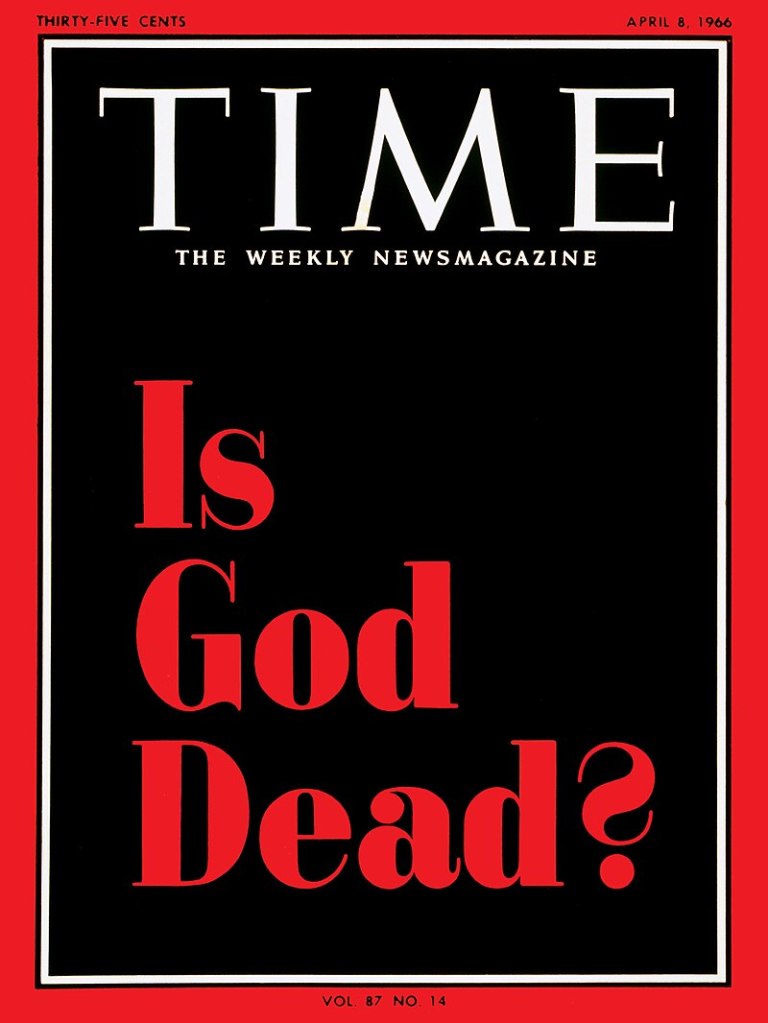
As I go through the stories in Dangerous Visions I’m expecting to find psychological snapshots of Ellison, the genre, the writers, and the times. The April 8, 1966, cover of Time Magazine asked if God was dead. Had del Rey forgotten his earlier story and “Evensong” was merely a science fiction riff on the Time cover?

Were the writers in Dangerous Visions thinking about old science fiction, or current events? Was Dangerous Visions anticipating the future, or reacting to an already fading pop culture rebellion?

JWH

Four Forewords and Two Introductions to Dangerous Visions

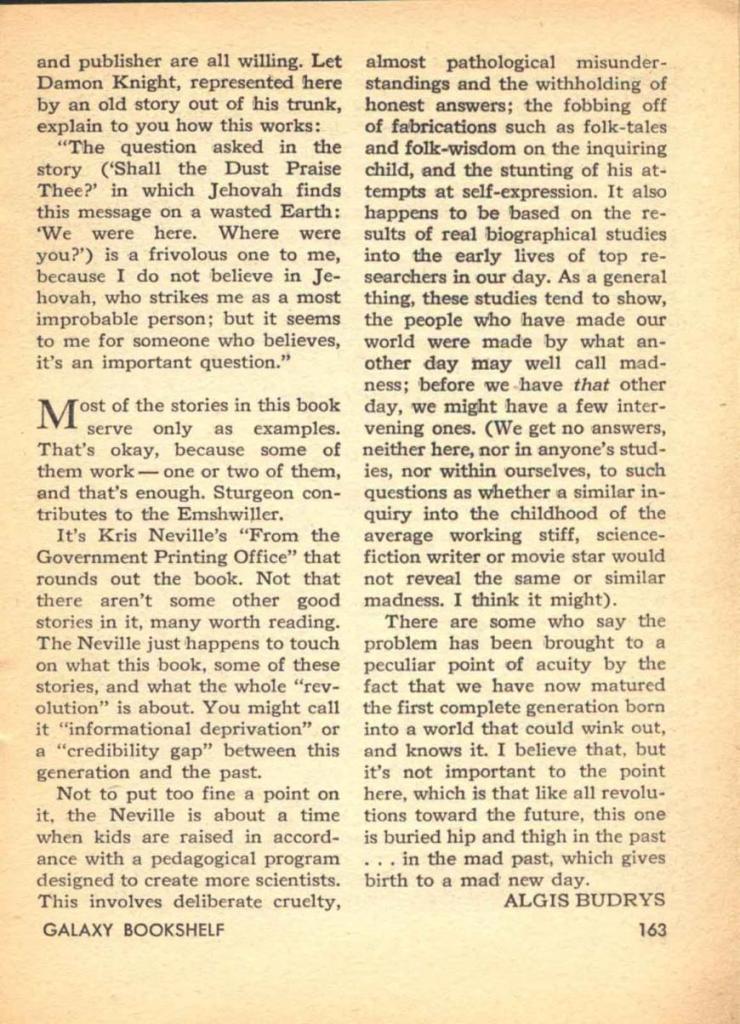
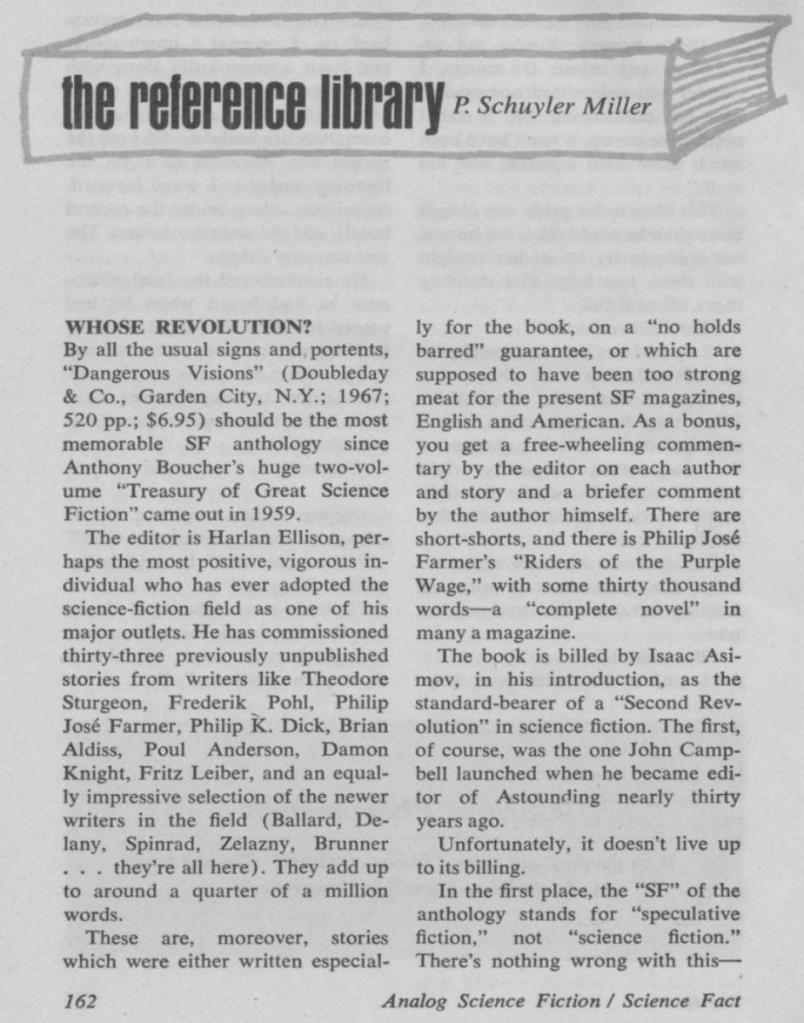
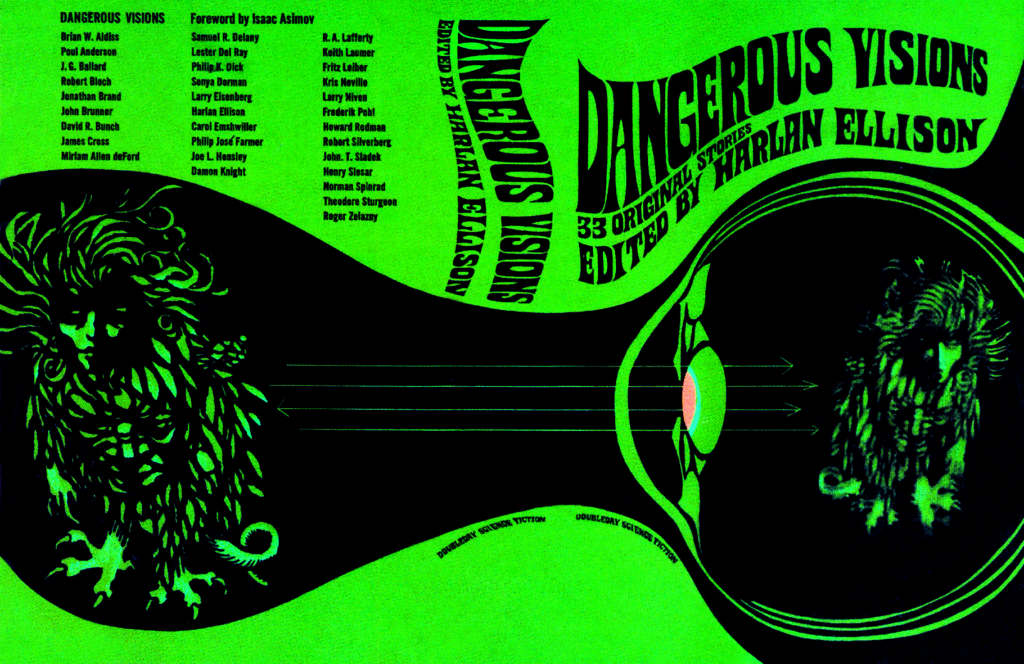
Starting May 5, 2024, our Facebook group read for Sundays will be Dangerous Visions edited by Harlan Ellison. It will be designated GR76W. I thought I’d announce it today so people will have a week to get a copy of the book. There’s a new edition with a new a foreword and introduction, that also includes the 2002 foreword and introduction, and two forewords from the original 1967 edition. Otherwise, the stories are the same. If you have the older editions already, you can read all the forewords and introductions online at Amazon in the Read Sample feature.

I’m going to go over all those forewords and introductions to analyze all the claims for the book that’s been made since 1967. Dangerous Visions is probably the most famous science fiction anthology ever, yet I’m not sure if it ever lived up to the hype. I’m going to cover the forewords and introductions in reverse order.

Foreword 2: “Harlan and I” by Isaac Asimov

It’s interesting Ellison includes two forewords by Asimov, especially since they’re mainly about the two men trading insults. Asimov does not have a story in this collection, and I’m not sure if Asimov isn’t offering the sales value of his name in exchange for slyly warning the reader about Harlan Ellison, who wasn’t famous in 1967, and is one pugnacious little guy.

As we’ll come to see, Dangerous Visions is really all about Harlan Ellison. The success of this anthology is due completely to Ellison’s force of will. And this new 2024 edition is a tribute to his memory. I highly recommend renting Dreams with Sharp Teeth, a documentary about Harlan Ellison. It’s $3.99 at Amazon. Here’s a trailer.

Foreword 1: “The Second Revolution” by Isaac Asimov

In this forward Asimov talks about himself, which was typical, and about the history of science fiction leading up to 1967. Asimov describes Campbell’s Golden Age as the First Revolution in science fiction, and what we’ll be reading in this anthology represents the Second Revolution in science fiction. Readers back in 1967 didn’t know it yet, but this new type of SF will soon be labelled The New Wave in science fiction, something Michael Moorcock and the writers at New Worlds in England had already exploring since the early sixties, and that Judith Merril would call The New Thing in her 1968 anthology England Swings SF. What was great fun was reading all the arguments over New vs. Old in Science Fiction Review in the coming years. That was a fanzine published by Richard Geis that won many Hugo awards. You can read old issues of that fanzine here.

Since its publication, Dangerous Visions has gotten the reputation for being a groundbreaking anthology of New Wave writing. I don’t think Ellison anticipated that. He aimed to be groundbreaking, but I don’t think he intended to start the new wave in science fiction.

Introduction to the 2002 Edition by Harlan Ellison

In this piece, Ellison does a lot of bragging, but it’s been thirty-five years, and he knows how successful and influential Dangerous Visions has been. He asserts that the anthology was a milestone, not because his ego believes it, but because everyone else believes it. But he also says:

Did this really happen? I think over the thirty-three weeks we’ll be discussing Dangerous Visions we need to decide if Ellison was right or not. Was Dangerous Visions the shape of things to come in science fiction? And did the old-style science fiction die off? Personally, I believe readers tried New Wave science fiction, digested it, and then spit out the rest. What happened was another new wave hit in the 1980s after Star Wars came out, when new writers, often with university creative writing experience, entered the genre, and aimed to write SF best sellers. Their work wasn’t daring or literary, but modern writing styles applied to retreading old science fiction themes.

Foreword to the 2002 Edition by Michael Moorcock

I’m surprised by what Moorcock says. He seems to give Harlan Ellison all the credit for the New Wave without even telling how he got the ball rolling in the first place.

What Ellison did next was the hard bit. By any means he knew—by challenging, by cajoling, by flattery and by confrontation—he persuaded the most brilliant Anglophone writers to raise their own standards and offer the world their personal best. He paid them top dollar for it, too—exceeding his publisher’s budget and reaching deep into his own pockets. And he didn’t stop there. He wrote a commentary, beginning with an introduction and running through the whole book, talking about his contributors, their talent and their potential. Singlehandedly he produced a new benchmark, demanding that in future nothing anyone of any ambition did should fall below that mark. He did what we had, as visionaries, wanted to do. He changed our world forever. And ironically, it is usually a mark of a world so fundamentally altered—be it by Stokely Carmichael or Martin Luther King, Jr. or Lyndon Johnson, or Kate Millett—that nobody remembers what it was like before things got better. That’s the real measure of Ellison’s success.

I believe that we need to remember this while we read the stories from Dangerous Visions. Was Moorcock, right? Did the DV writers set a new standard for writing science fiction? Did it change the genre?

Introduction to the Blackstone Publishing Edition of The Dangerous Visions Trilogy by J. Michael Straczynski

Straczynski greatly admired Harlan Ellison, and he’s doing everything he can to elevate and remember Ellison for new editions of the Dangerous Visions anthologies, and a greatest hits collection of Ellison’s own stories.

Straczynski talks about how writers in America have faced censorship and self-censorship. He puts Ellison and Dangerous Visions into a much larger context. He brings up Ralph Ellison, J. D. Salinger, John Steinbeck, F. Scott Fitzgerald, and Harper Lee. Has any science fiction writer ever been in that league of writers?

In the original foreword Ellison claims that science fiction writers couldn’t write what they wanted because science fiction magazine editors wouldn’t or couldn’t accept stories about certain topics. It’s also implied that old style science fiction was poorly written. I think as we discuss the Dangerous Visions stories 2024, we need to judge them by those two assertions.

My goal for this group read is to decide if the stories in Dangerous Visions couldn’t be expressed or published before 1967, and were they written to a higher literary standard that uplifted the genre. Was the anthology truly ground breaking, or just a tremendous sales pitch by Harlan Ellison?

James Wallace Harris, 4/28/24

“Small World” by William F. Nolan

Group Read 72: The Best Science Fiction Stories of 1957

“Small World” by William F. Nolan #15 of 20 (ReadListen)

I’ve always loved post-apocalyptic novels about the last man on Earth, or at least, the last few people on Earth. I’m not saying I want everyone else to die, but if flying saucers hauled y’all all away, I wouldn’t complain. Ever since I was a kid, the thought of being the only kid in a deserted city was a fun fantasy for fueling daydreaming. The idea that I could roam around and survive by plundering anything I needed from abandoned stores and houses was deliciously appealing. I bet Henry Bemis implanted this idea in me via the 1959 episode of The Twilight Zone, when I was eight.

William F. Nolan imagines a man named Lewis Stillman left alone in Los Angeles after aliens invade in the August 1957 issue of Fantastic Universe. I remember when I first read this story I was genuinely surprised by the ending. If you don’t want me to spoil it, follow your chosen link above before reading any more of this essay.

In 1967 Harlan Ellison edited Dangerous Visions because he claimed science fiction writers couldn’t get certain kinds of science fiction stories published. I call bullshit on that idea. I think his hypothesis was wrong. Nolan produces a nice little gritty dangerous vision in “Small World” in 1957. Of course, he had to write a few thousand words of character development and setting to entertain us before he could pop the surprise.

Stillman hides out in the storm drains of Los Angeles avoiding the invaders. He only comes out at night, and has collected a nice arsenal of weapons, but he survives by going unnoticed. There have been several movies that used those famous storm drains, so I imagined scenes from Them as I read the story.

One night Stillman fondly recalls a three-volume set of medical textbooks that belonged to his father. Stillman had gone to medical school in southern California but had dropped out to become a laborer and work with his hands. Sitting alone in his hideaway, he remembered seeing those books at a used bookstore and decided he wanted to see them again. That night he arms himself and heads out. He finds the books, but they find him.

He was attacked not by aliens, but by children. The aliens had killed everyone over the age of six, so they cities were swarming with feral children. Picture Lord of the Flies. And the children would kill any surviving adult they could find. All along, Nolan had us believing Stillman was hiding from little green men, but he was really hiding from hordes of rugrats.

In the end Stillman starts shooting the tykes to get away. I pictured him blowing away Jerry Mathers, and little Billy Mumy and Angela Cartwright, as well as Jay North. Of course, I would have been the right age too in 1957 if I had lived in LA. Eventually, the children overwhelm Stillman and I assume he was torn apart. But he must have killed a pile of youngsters before they got him.

I wonder why Nolan wrote this story. It’s sick if you think about it, especially since I read it the first time after Sandy Hook. Was he just trying to gross us out? Or did Nolan secretly hate kids? Lord of the Flies came out in 1954, and that could have inspired him. The 1950s was full of public fear regarding juvenile delinquents, so maybe the story was symbolic. And the age group also applied to the early Baby Boomers, so maybe Nolan was trying to be prophetic.

Yes, Ellison was wrong. Science fiction writers often got dangerous visions published. Two of my favorites were “Lot” by Ward Moore, and “The Last Day” by Richard Matheson, both from 1954.

Also from 1954 was “The Good Life” by Jerome Bixby. Maybe it inspired “Small World.” I’ve always found that story too creepy, maybe Nolan was providing us psychological release for that story.

James Wallace Harris, 4/13/24

“You Know Willie” by Theodore R. Cogswell

Group Read 72: The Best Science Fiction Stories of 1957

“You Know Willie” by Theodore R. Cogswell #05 of 20 (Read)

I was disappointed that “You Know Willie” is not science fiction. It’s a story about racism that uses fantasy to make a surprise ending. The story isn’t bad. Both Merril and Asimov/Greenberg included it in their anthologies covering 1957. I remember the racism of the 1950s, and it horrified me as a kid, and I’m white. I remember visiting Mississippi in 1960 and being frightened by the violent emotions of the racists. Such people were sadly all too common. So, I can understand why this story was written. In fact, its fantasy depends on a similar thought I had as a kid.

Back then I wondered what racists would do if they woke up one morning looking like the people they hated. At the time I thought it would cure them of their racist beliefs. Later, when I was a bit older, I wondered if that would be true. Back then I felt if a baby from a fundamentalist protestant family was switched at birth with a baby of a fundamentalist Muslim family, they would grow up to be whatever religion their parents believed.

People seldom break free of their upbringing. That’s why it is important to teach Critical Race Theory. I can remember specific lessons I had as a kid that helped me avoid becoming a racist. I’m not sure a story like “You Know Willie” would have helped. I do remember reading books about race in my late teens, ones that would be banned from classrooms today, that did enlighten me.

I’m sure stories like “You Know Willie” would have made good people feel better about themselves when they read it back in the 1950s, but I don’t think it would have altered the thinking of bad people. I’m sure Cogswell was well-intended when he wrote this story, but he should have aimed higher.

Would racists have a come-to-Jesus moment if they suddenly turned the color of the people they hated? We don’t get to find that out in “You Know Willie.” This story goes for the easy win and doesn’t explore anything deeper. Willie experiences a kind inverse Golden Rule — have others do unto you what you have done to others. We saw the surprise ending coming from a long way off.

For this story to be truly memorable, we needed Willie to have lived long enough to see how a change in color would have affected his thinking. For me, the story brings up the ugliness of racism only to play it for a laugh. I didn’t like that.

James Wallace Harris, 3/23/24

“Hunting Machine” by Carol Emshwiller

Group Read 72: The Best Science Fiction Stories of 1957

“Hunting Machine” by Carol Emshwiller #04 of 20 (Read, Listen – @05:40)

“Hunting Machine” by Carol Emshwiller is a rather short, but effective anti-hunting story that was first published in the May 1957 issue of Science Fiction Stories. Ruthie and Joe McAlister are on a three-day hunting trip with a robotic hunting dog rented from the park service. The robot was set by the warden for three birds, two deer and one black bear. However, Joe tinkers with the governor on the robot so he can hunt a 1,500-pound brown bear.

Most of the story is satire about how in the future people bring all kinds of gadgets to make their time in the rugged wilderness as comfortable as staying at home. Because hunting with their automatic rifles and robot is like shooting fish in a barrel, Joe overrides the controls in the robot to make the bear put up a fight. We see some of the story from the robot’s and bear’s perspective, both of which are more in tune with nature. Humans come across as schmucks in this story.

I’ve read “Hunting Machine” before, but it hasn’t stuck in my mind. It’s too slight, too simple, and too obvious. I’m surprised by both T. E. Dikty and Asimov/Greenberg included it in their anthologies that collected the best SF shorts of 1957. That suggests it is liked more than I think it should be. It’s a nice enough little yarn, fine for a magazine, but lacks the punch needed to make it worthy of an anthology in my opinion.

W. M. Irwin felt the story was more than an anti-hunting story, about how sports and outdoor adventures are ruined by automation. I can buy that. I agree with Paul Fraser that the ending was anti-climactic. I wanted the bear to win, to destroy the robot and to kill and eat Ruthie and Joe. And second to that possible ending, I wanted the robot to kill Joe because he was within the new weight limit that Joe had illegally changed. But Carol Emshwiller kept the story lighthearted.

This story should have been published in a hunting magazine in 1957. I’m sure real hunters would have enjoyed the satire even more. I don’t think “Hunting Machine” adds much to our understanding of 1950s science fiction. The definitive 1950s hunting story with a science fiction theme is “A Sound of Thunder” by Ray Bradbury, first published in Collier’s in 1952. It’s about hunting dinosaurs. Following that is “A Gun for Dinosaur” by L. Sprague de Camp, that first appeared in Galaxy in 1956. It’s another hunting story that plays off Hemingway’s classic Africa stories. Finally, there’s yet another classic dino hunt story, “Poor Litte Warrior!” from F&SF in 1958, where Brian Aldiss satirizes the first two.

I’m sure if I made a concentrated effort, I could track down more titles to define hunting as a sub-theme of science fiction. But my memory can’t dredge up any more from my brain, and I’m worn out on Googling.

James Wallace Harris

The Best SF Short Stories of 1957

Starting on March 12th, I’ll be moderating a group discussion of the best science fiction short stories from 1957 on Facebook. We discuss one story every Tuesday, Thursday, and Saturday. I’ll also review those stories here on this blog.

The stories were selected by using any story with at least two citations on CSFquery. I also added two stories because one had been made into a movie, and one into a television show. I then added a few recommendations from our group’s moderators. No stories were awarded a Hugo for 1957, so I used Rich Horton’s picks for 1957 instead.

Here’s the schedule:

Our group has already discussed three famous stories from 1957, “Call Me Joe” by Poul Anderson, “The Menace from Earth” by Robert A. Heinlein, and “Omnilingual” by H. Beam Piper. Those will be discussed on repeat day. I’m really looking forward to reading the twenty stories the group hasn’t read before, many of which I haven’t read either.

When I create the discussion thread for each story I’ll try and find a link to where the story can be read online and put a link to the ISFDB.org entry so people can see if they already own an anthology where the story has been reprinted.

During the Group Read 72 period (March 12 – April 30) we’ll also be open to people recommending stories from 1957 that they feel should be on our list too. Think of it as a kind of scavenger hunt for forgotten classic short science fiction from 1957. Dave Hook, one of our most industrious members, did an extensive study of 1956, and I expect him to do the same for 1957.

Even if you don’t join our discussion group, please recommend any SF story from 1957 that’s not on the list that you think should be in a comment below. I’ll pass your recommendation to the group.

We welcome anyone who loves reading science fiction short stories to join our group. If you do join our Facebook group, be sure and answer the two questions. They are designed to filter out spammers and confirm that we only discuss science fiction short stories, not novels, not movies, not television shows. We delete any message that brings up politics, self-promotes a book, is offensive to others, or that’s off topic.

We read and discuss science fiction stories from anthologies, magazines, award winners, stories up for awards, and by specific year. We also discuss author collections on Sundays. This group reading is our 72nd. Old science fiction stories are discussed on Tuesdays, Thursday, and Saturdays. New science fiction stories are discussed on Mondays, Wednesday, and Saturdays. We try to promote both print and online science fiction magazines.

James Wallace Harris, 3/9/24

“A Work of Art” by James Blish

“A Work of Art” was first published in Science Fiction Stories, July 1956 as “Art – Work.” You can read it on Archive.org. It is story #14 of 22 for The Best SF Stories of 1956 group read. Asimov and Greenberg picked “A Work of Art” for The Great SF Stories #18 (1956). It was widely reprinted. Its quality is inferred by the fact that I own “A Work of Art” in seven anthologies:

  • Science Fiction Showcase (1959) edited by Mary Kornbluth
  • The Worlds of Science Fiction (1963) edited by Robert P. Mills
  • The Best of James Blish (1979)
  • Science Fiction of the Fifties (1980) edited by Martin H. Greenberg and Joseph Olander
  • The Great SF Stories #18 (1956) (1988)
  • The Science Fiction Century (1997) edited by David G. Hartwell
  • Masterpieces: The Best Science Fiction of the Century (2001) edited by Orson Scott Card

“A Work of Art” is James Blish’s third most cited story in our database after “Surface Tension” and “Common Time.” James Blish isn’t very well known today, but he had a fair reputation when I was growing up in the 1960s. Among writers who knew Blish, he was remembered for being a scholarly intellectual writer. Older science fiction fans know him for the novel A Case of Conscience and the series Cities in Flight.

I first encountered Blish with his paperback series that converted the original Star Trek episodes into short stories. That was fun reading when I was a teen watching the show back in the 1960s, but it gave me the wrong impression that Blish was a hack writer. It took me decades to throw off that prejudice. “A Work of Art” offers me new hope for Blish.

It’s funny how we start off in our adolescence following a few writers as our favorites, and then years or even decades later, we learn that we should have read more of their contemporaries. Heinlein, Asimov, and Clarke dominated my formative years of science fiction reading. Now in my fading years, I’m discovering the 1950s and 1960s had other interesting science fiction writers — ones I should have been reading.

“A Work of Art” is the first story by Blish that backs the reputation I’ve gotten from reading about Blish. I’ve read A Case of Conscience twice, but I never considered it great, just particularly good. And I never liked the Cities in Flight stories. I keep hoping to discover more by Blish that matches the reputation he has with other readers. I’ve bought Black Easter and The Day After Judgment but haven’t read them yet. I’ve read “A Work of Art” twice and feel it’s closer to Aldiss and Ballard, which makes me want to try harder at finding the better Blish stories.

My friend Mike has been emailing me his thoughts on the Best SF Short Stories of 1956 and I’ll quote his comments to describe “A Work of Art” because I think he’s done a better job than I would have of summing up the story.

In James Blish's "A Work of Art," the mind sculptor Dr. Barkun Kris has "...superimposed memories..." of Richard Strauss onto Jerom Bosch, who "...had no talent for music at all..." 

At first, "A Work of Art" seems little more than Blish's satirical take on modern music. For Strauss (Bosch), "Music was, he quickly began to suspect, a dying art, which would soon have a status not much above that held by flower arranging back in what he thought of as his own century." Composers "...openly used a slide-rule-like device called a Hit Machine..."

Strauss composes a new opera with the intention to "...strike out afresh..." and not depend on his "...old tricks..."

During the opera's premiere, Blish introduces an epiphany for Strauss, who realizes during the performance that there "...was nothing new about the music. It was the old Strauss all over again--but weaker, more diluted than ever."

Strauss's anguish is palpable: "Being brought to life again meant bringing to life as well all those deeply graven reflexes of his style."

"His eyes filled; his body was young, but he was an old man, an old man. Another thirty-five years of this? Never."

The audience is ecstatic about the result of the mind sculpture. But Jerom Bosch has a depth of understanding that Dr. Kris never suspects. Bosch knows that the Strauss that Kris created "...was as empty of genius as a hollow gourd. The joke would always be on the sculptor, who was incapable of hearing the hollowness of the music..."

Bosch's moment of epiphany adds depth and dimension to the story by creating a nuanced character who will soon be returned to his regular life even though he feels that "I am Richard Strauss until I die, and will never be Jerom Bosch, who was unable to carry even the simplest tune." We feel his grief when Kris "...turned to him to say the word that would plunge him back into oblivion..."

One reason I like “A Work of Art” is it deals with an alternative to mind downloading that I think might be vaguely possible. Mind downloading/uploading has been a popular theme in SF for several decades, but I’ve never thought it possible. However, I’ve wondered if we could create an AI personality based on all the works of a famous person. In “A Work of Art” Dr. Kris sculpts minds in living people. I guess it’s a kind of temporary brainwashing. I don’t think that’s possible, but it’s a good enough idea for the story.

“A Work of Art” gives Blish the opportunity to show off his knowledge of classical music, something I know next to nothing about, but always wished I did. And Blish gets to speculate about the nature of personality, both real, and copied. Richard Strauss’ artificial personality struggles to create a new opera but is faced with two problems. The first is he’s old and has done everything already, so he tends to repeat himself. But the second, and the revelation of the story, is because he’s a copy his creativity is limited by what’s known about him. It begs the question: Can creative work be used to be creative? That’s pertinent today regarding LLM AIs.

Now Mike focuses on something I missed, or something Mike has added to the story. He sees Bosch as being a participant in this mind sculpting artwork. I didn’t. I assumed Bosch had temporarily left the building, so to speak, while the Strauss personality occupies it. Mike evidently saw mind art as a blend of the two. Mike assumes Bosch had the final epiphany, while I think the Strauss personality had it before it was erased.

Even though I disagree with Mike’s take, I like the idea of Bosch being there all along too, being part of the art. I’ll need to read “A Work of Art” for a third time to see if I see clues for that. That’s the fun thing about exceptional stories, that they can be interpreted in diverse ways.

James Wallace Harris, 12/28/23