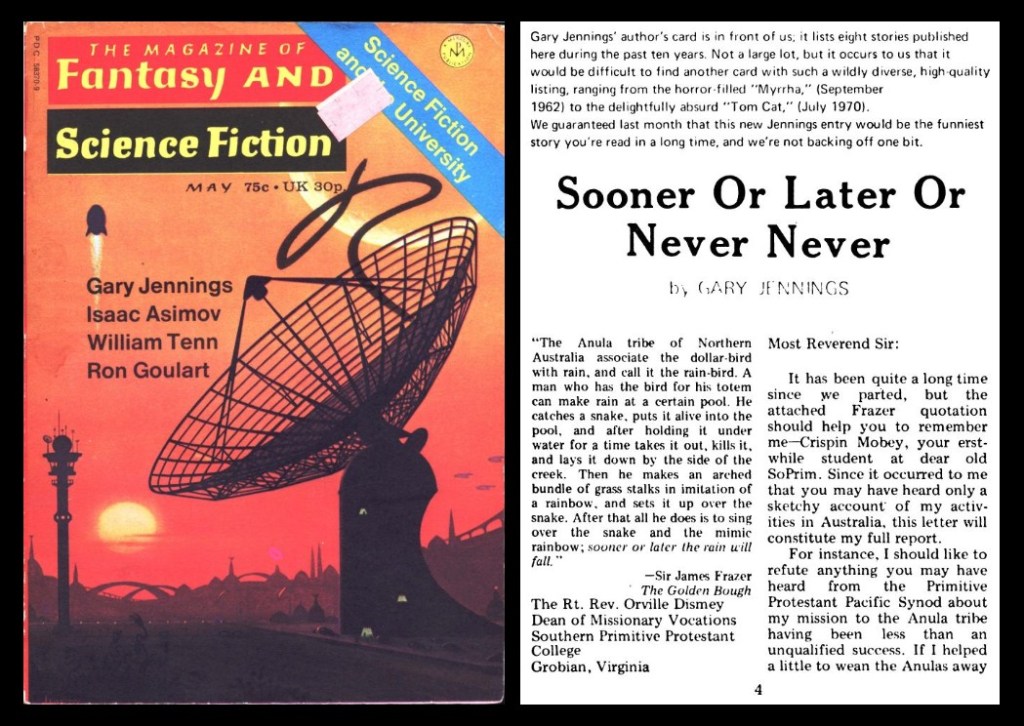
What exactly is fantasy? “Sooner Or Later Or Never Never” by Gary Jennings has no magic, no fantastic creatures. Its setting is present-day Australia. The story is both comic and absurd. Yet, it’s based on a somewhat realistic premise. Yes, the characters and plot are made up, but so is most fiction. I can find no reason to call this a fantasy. I assume Edward L. Ferman published it in the May 1972 issue of The Magazine of Fantasy & Science Fiction because he admired the creative prose — and he had the power to publish it.
“Sooner or Later or Never Never” is told as a letter to The Rev. Orville Dismey, Dean of Missionary Vocations, at the Southern Primitive Protestant Seminary in Grobian, Virginia. Crispin Mobey narrates his effort to bring Christ to the Anula tribe in the Australian outback. Mobey was inspired by a quote from The Golden Bough by Sir James Frazer. The quote describes a ritual Frazer witnessed. Mobey wants to use that ritual to bring Christianity to a rather primitive tribe.
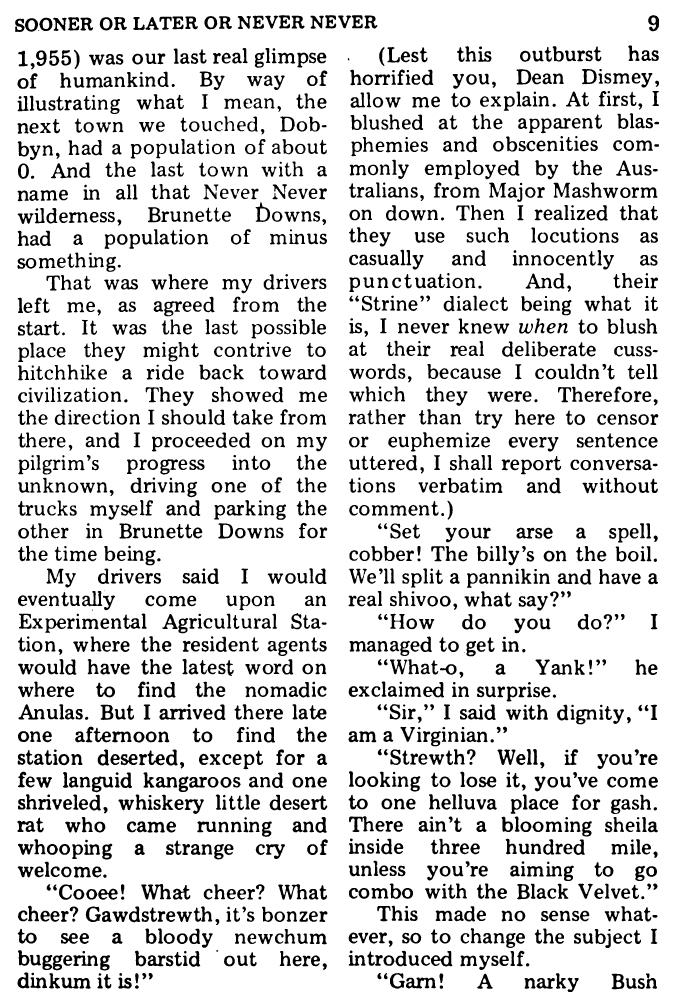
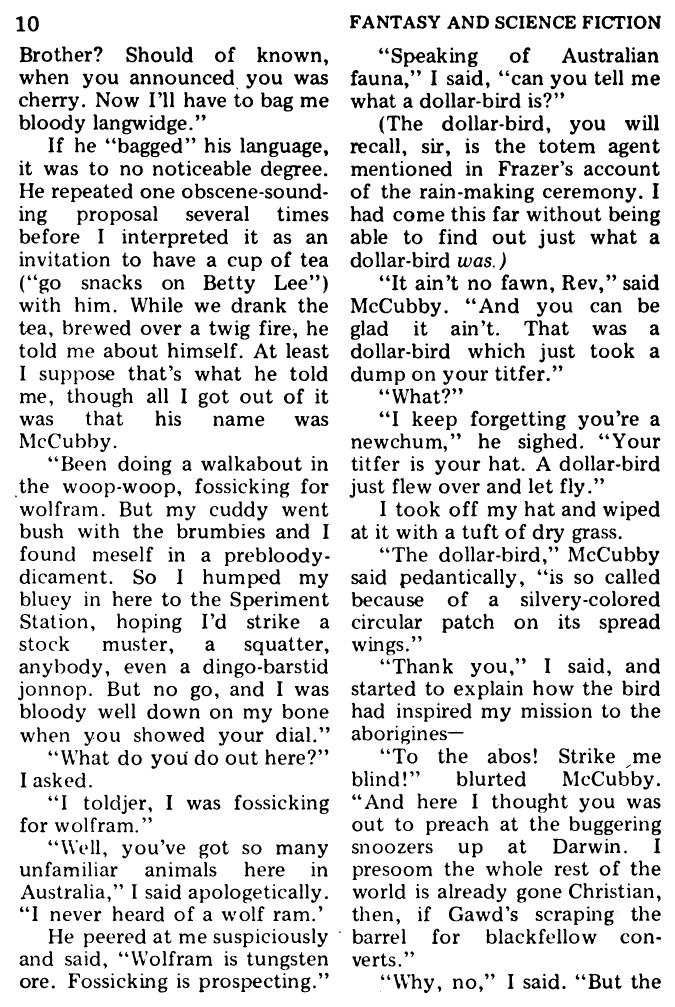
I’ve read “Sooner or Later or Never Never” before, but I’m not sure where and how. I don’t normally read this kind of fiction. However, the prose is quite entertaining. Normally, I dislike dialect, but Jennings captures outback Aussie hilariously. I wish I had an audiobook version.
There is no way I can describe this story, so I’m just going to give you two pages to read as a sample.
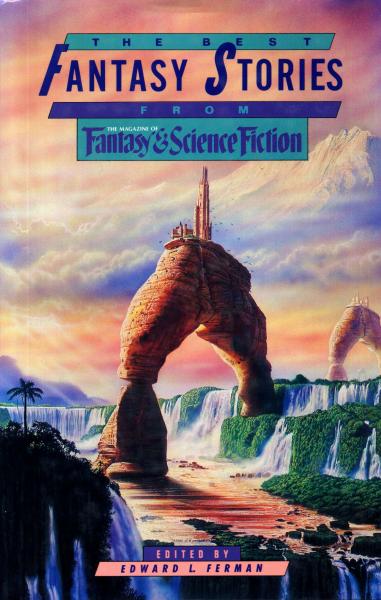
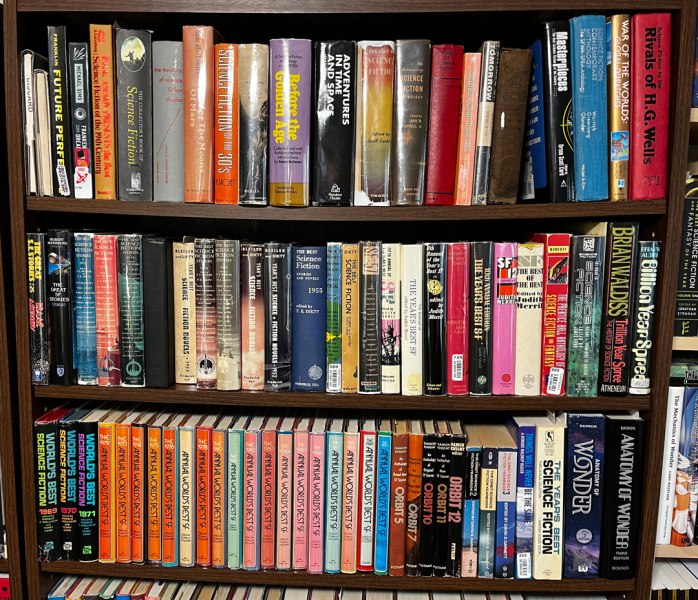
I know this is cheating, but I’m taking the easy way out. I’m posting this merely to encourage people to read this story. I read it today because my Facebook short story club is reading The Best Fantasy Stories from The Magazine of Fantasy and Science Fiction. Reading this 792-page anthology demonstrates the range of what people call fantasy.
I routinely tell people I dislike fantasy. But of the stories we’ve read in this anthology, the ones set in the present about ordinary people have been the most entertaining to read. And the ones that people consider traditional fantasy were no fun to read. I guess when I say I dislike fantasy, I dislike only a subset of the genre.
However, I also think Ferman is cheating to call “Sooner or Later or Never Never” fantasy. It could have been published in almost any kind of fiction magazine.
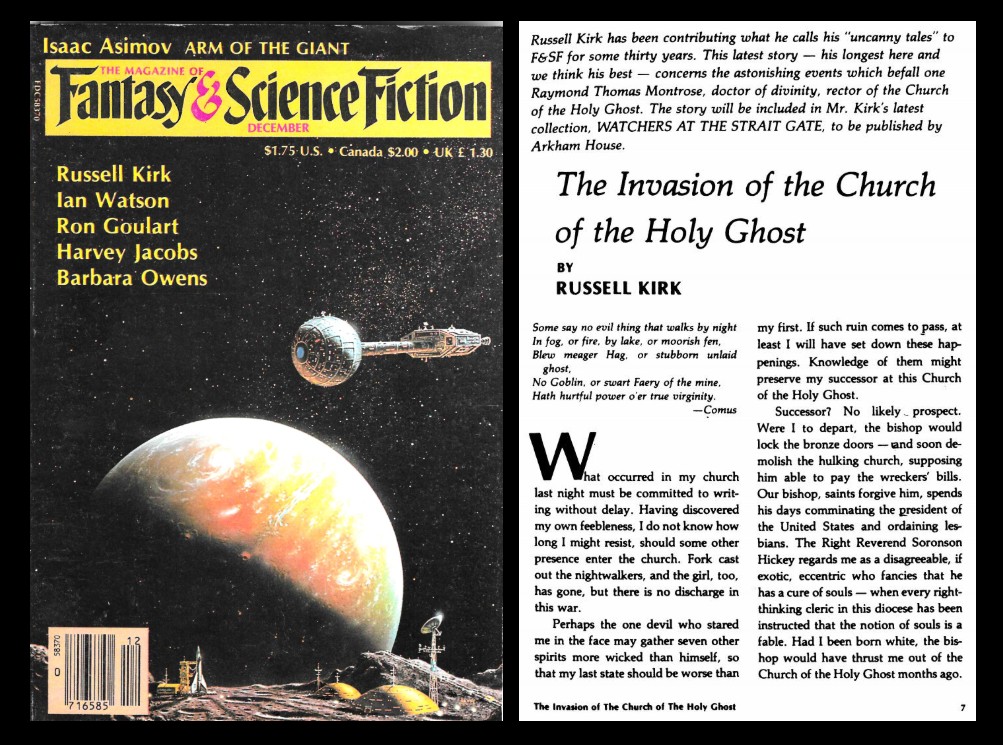
I’m an atheist who doesn’t normally enjoy reading fantasy fiction; however, I found “The Invasion of the Church of the Holy Ghost” by Russell Kirk, a religious ghost story, to be quite entertaining and well-written. The characters of Father Raymond Thomas Montrose and Fork Causland are so well developed that it’s hard not to like this story. Plus, the story is set in a seedy, rundown section of town filled with hustlers, prostitutes, and con men, has all the feel of a Damon Runyon tale.
I had no idea who Russell Kirk was, but after reading about him on Wikipedia, the philosophy behind the story made more sense. Kirk was a major conservative intellectual and a distinguished fellow at the Heritage Foundation. Since I’m a liberal, this doesn’t endear me to him. Kirk was also a convert to Catholicism and enjoyed writing ghost stories.
Kirk’s significant spiritual, political, and philosophical background forces me to look deeper into “The Invasion of the Church of the Holy Ghost.” Kirk was a serious thinker. That makes it hard to dismiss the story as a silly, inconsequential ghost story.
Even while liking “The Invasion of the Church of the Holy Ghost” very much, it proposes ideas I find totally repugnant. Both Father Montrose and Fork Causland are possessed. Kirk suggests that when people do bad things, it’s because they are influenced by evil ghosts, and when they do good things, they are empowered by higher-order beings. He doesn’t specifically say angels, but that’s how I interpreted the story.
In old religious philosophy, good comes from God, and evil from Satan. If humans do good, it’s because of the influence of the divine, and if we do bad, it’s because of the devil working through us. At one point, the normally good Father Montrose starts thinking about raping a young woman. Kirk proposes that those thoughts come from being possessed by an evil spirit.
I don’t believe in free will, but I also refuse to believe that our thoughts and actions originate with ghosts or other metaphysical beings. I don’t know if Russel Kirk believes that either, but “The Invasions of the Church of the Holy Ghost” is based on such a religious foundation. This fantasy is a religious reality to some. On the other hand, it might just be Kirk’s way of scaring us.
However, if I ignore what this story is suggesting, it’s an exceptionally creative work. Russell Kirk does an amazing amount of world-building. When I like fantasy, it’s often because it’s set in our present-day world. For example, It’s a Wonderful Life or The Bishop’s Wife.
Yesterday, I was pondering the value of fiction and nonfiction. Writers of nonfiction strive to be as accurate as possible. We read nonfiction to understand reality. Fiction is elaborate lies, but sometimes fiction writers work to express a truth they perceive at a deep, personal level. Knowing the kind of person Russell Kirk was, I can’t help but believe that he might believe in ghosts and possession.
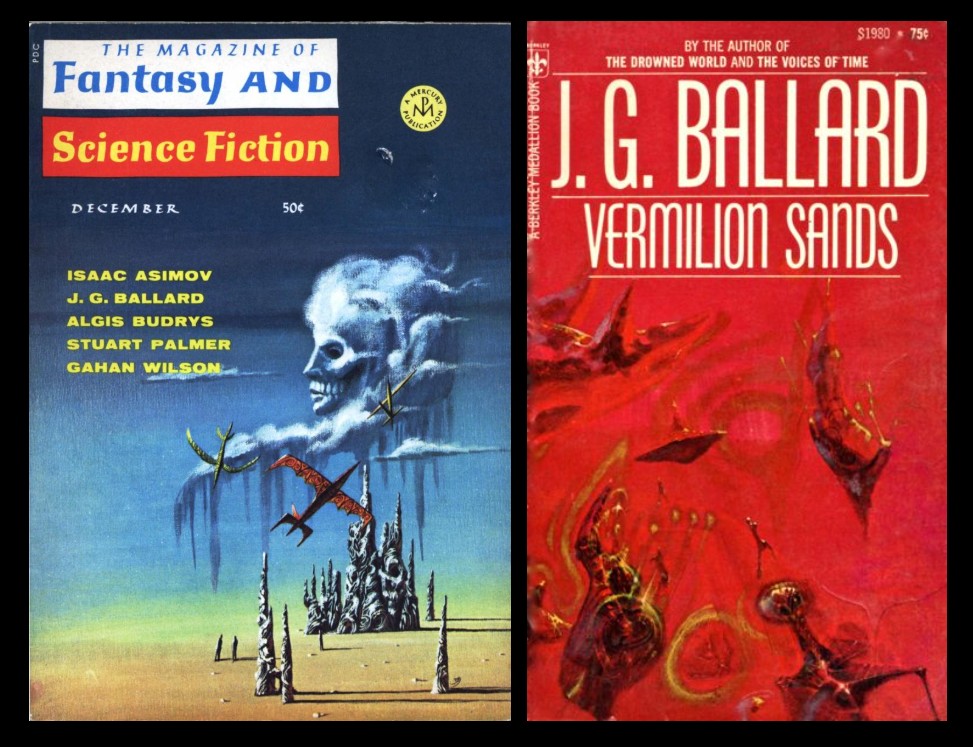
I reread “The Cloud Sculptors of Coral-D” by J.G. Ballard because my short story reading group is reading The Best Fantasy from The Magazine of Fantasy and Science Fiction. Inclusion in this volume suggests its fantasy. However, it was also included in The Great Science Fiction Series edited by Martin H. Greenberg, Joseph Olander, and Frederik Pohl. The story contains no magic, no dragons or elves, and it’s set in our present day, but in a fictional resort called Vermillion Sands.
Vermillion Sands feels like a decadent playground for the rich, which also features the many kinds of parasites that live off the wealthy. It’s also an artist and expat colony. We don’t know its location, but it feels like Palm Springs, California. Many worldly travelers come and go there.
“The Cloud Sculptors of Coral-D” was my first introduction to J. G. Ballard back in the 1960s. Other stories from that setting make up the series, collected into Vermillion Sands.
“Prima Belladonna” (Science Fantasy, December 1956)
“Venus Smiles” (Science Fantasy, June 1957)
“Studio 5, the Stars” (Science Fantasy, February 1961)
“The Thousand Dreams of Stellavista” (Amazing Stories, March 1962)
“The Singing Statues” (Fantastic Stories, July 1962) (not in original collection)
“The Screen Game” (Fantastic Stories, October 1963)
“Cry Hope, Cry Fury!” (F&SF, October 1967)
“The Cloud-Sculptors of Coral D” (F&SF, December 1967)
“Say Goodbye to the Wind” (Fantastic, August 1970)
Wikipedia provides an excellent overview of the stories, highlighting that each dealt with a different artistic medium being affected by technology.
When I first read “The Cloud Sculptors of Coral-D” as a teen, it felt very grown-up to me. The characters were the kinds of people I met growing up in Miami, not the typical heroes of science fiction stories I spent so much time reading. It never occurred to me to think of the story as fantasy, but it didn’t seem like science fiction either. At the time, I was just discovering British science fiction writers like Brian Aldiss and John Brunner and the New Wave SF. The stories were set in the present or near future and took place on Earth. No rockets or robots. Was this actual science fiction?
“The Cloud Sculptors of Coral-D” is about a band of glider pilots who shape clouds with silver iodide. At first, their audience and patrons are people who park their cars along the lagoon road to watch. Eventually, the Garbo-like Leonora Chanel hires them to perform for her party. Sculpting clouds is a neat idea, but far from realistic. Does that make the story science fiction? Ballard does throw in a creature called sand rays, which I suppose are like manta rays that live under the sand instead of the sea. Do they make the story a fantasy?
Science fiction has often been the dumping ground for any kind of weird story that can’t be classified. The Vermillion Sands stories would have been rejected by mainstream and literary magazines. They fit nicely in The Magazine of Fantasy & Science Fiction. They were also published in the British magazine Science Fantasy and the American Fantastic. Only one was published in a straight-ahead science fiction magazine, Amazing Stories. I doubt John W. Campbell would have accepted them in Astounding or Analog. Nor would he have published them in Unknown. I wonder if Rod Serling would have used “The Cloud Sculptors of Coral-D” for The Twilight Zone?
I’m not fond of traditional fantasy, and many of the stories in The Best Fantasy from The Magazine of Fantasy and Science Fiction aren’t enjoyable for me to read. But I did enjoy “The Cloud Sculptors of Coral-D.” The story has a pleasant, surreal feel. The setting is very close to this world, but just a smidge off. I love the artist colony atmosphere, the hint of decadence, the ever-so-slight sense of unreality. The story combines barnstorming, carny folks, and the ugly rich. I visualize it as a cross between early Faulkner and Fellini.
The shortest description would be to say the story has atmosphere.
I’ve decided to assemble an anthology of my favorite science fiction short stories. I’m not going to publish it. This book will be just for me to read. Before personal computers I would have created such an anthology by xeroxing all my favorite stories and putting them into a big folder, binder, or box. Now, with computers I can create a digital file that I can read with my iPad. I’ve discovered I can convert digital magazines, e-book pages, web pages, or even scan physical books to .pdf files that are easy to read on my iPad.
This project is only practical if you’re savvy with computers.
You can read .pdf files with almost any device, but for fiction reading, it’s best to read on a tablet. My method doesn’t work well with Kindles, other e-ink readers, or smartphones because the .pdf files are a collection of .jpg images. This system works great with both iOS and Android tablets.
The next step for this project to be practical is to have a convenient way to load files onto your tablet. I save .pdf versions of stories to a folder on Dropbox and read them with the Dropbox application on my tablets. Dropbox has a built-in reader for common file formats like .pdf files.
I create the .pdf files using Abbyy Finereader 15, but you can use any program that will convert a collection of images to a .pdf file. The free PDFgear works great on Windows. However, the Mac version doesn’t allow for no margins and centers all images on a white background. That works but annoys me.
There are other cloud storage providers that work with tablets if you don’t use Dropbox. Dropbox has a free basic account with 2GB’s of space that will hold hundreds of stories. If you’re a tablet user, you probably already know which cloud drive works well with it.
If you have these technical solutions solved, the next step is to find stories to read on your computer. They can be from an ebook, web pages, or a page you scan yourself. If you look around, many old science fiction magazines have been digitized in the CBR/CBZ format. I use a CBR reader call YACreader. YACreader allows me to right-click on any page and save it to a .jpg. I name each page by the title of the story – author – page number of the original publication.
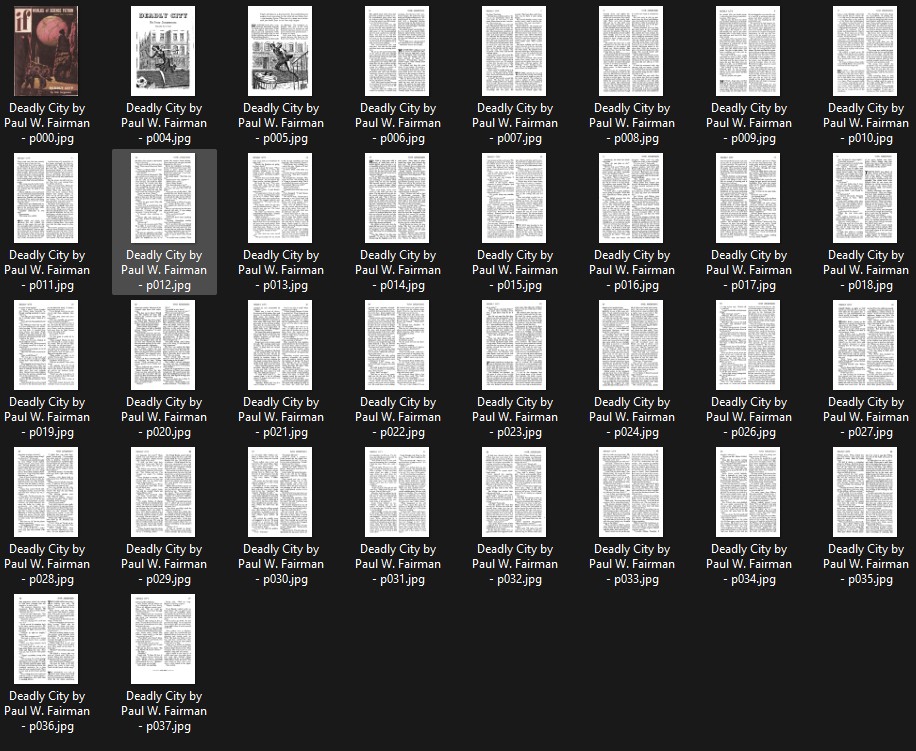
You can also use your screenshot utility to capture what you see on screen from a web page, ebook, or any program that displays stories to save as a .jpg file. I put all the .jpg pages in a folder that I name after the story. Here’s my folder for “Deadly City” by Paul W. Fairman from the March 1953 issue of If Magazine.
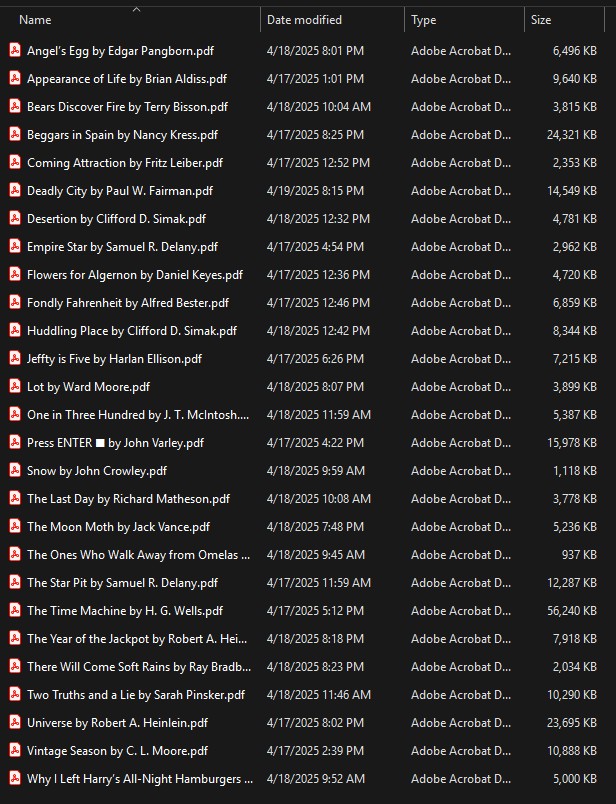
I then launch Abbyy Finereader (or PDFgear) and tell it to covert those pages to .pdf. I save the resulted file to a folder called “My Favorite SF Short Stories” and name the file by the title and author. Here are my first 27 stories. I just convert stories as I reread them and determine they are a favorite. Here’s my current folder on Windows:
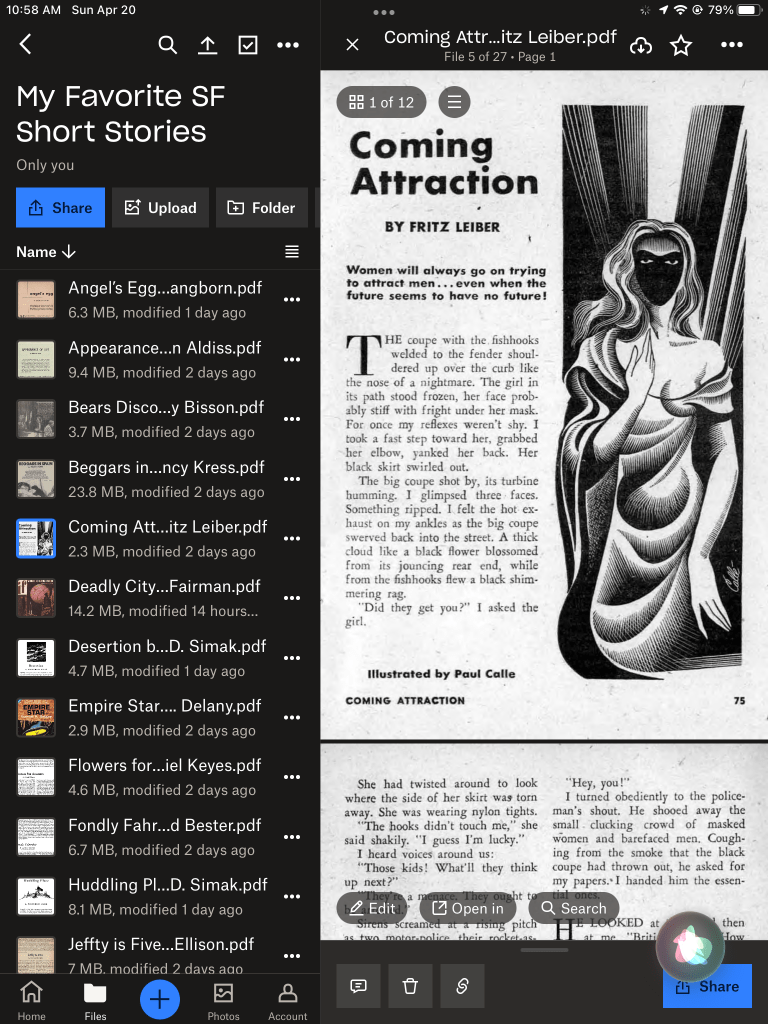
Here’s what my directory of favorite stories looks like in Dropbox on my iPad mini. The directory is on the left, and the preview is on the right. It’s very nice.
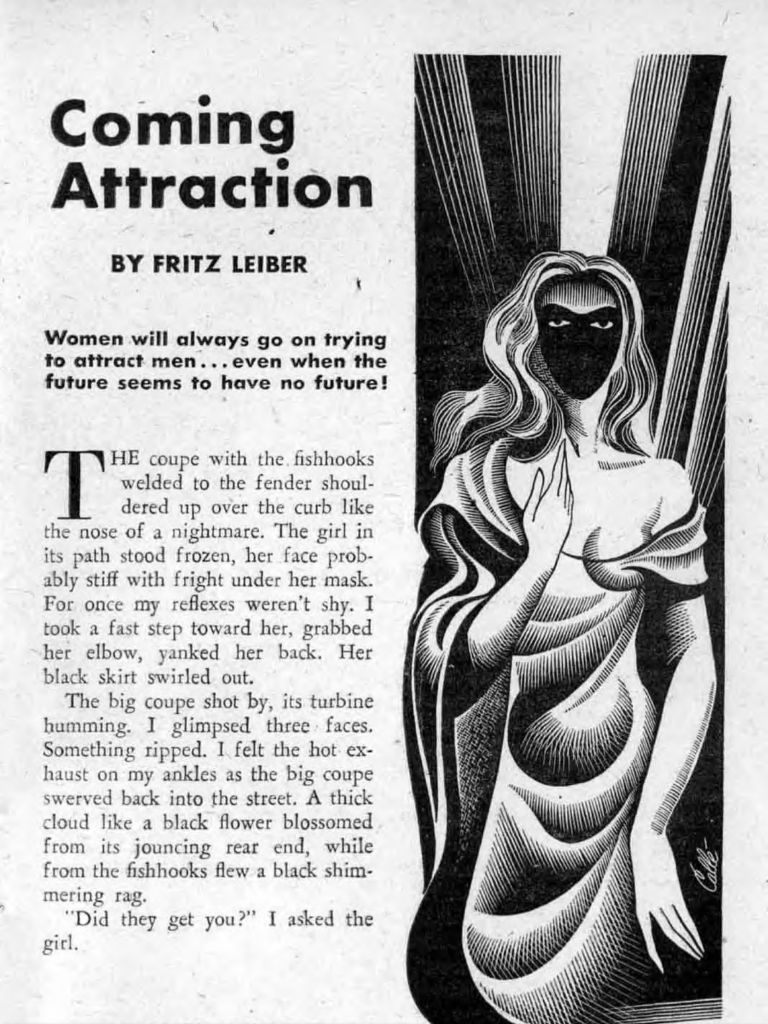
And here’s what the story looks like in the reader view of Dropbox:
As you can see, I’ve copied the story from a scan of the original magazine. You can find scans of old magazines all over the web, such as archive.org. However, sellers on eBay and Facebook are now selling complete collections of digitized old magazines fairly cheap. I bought DVDs years ago with complete runs of my favorite SF magazines.
I do own several hundred of hardback, paperback, ebook, and audiobook science fiction anthologies. I also own several hundred physical issues of science fiction magazines from the 20th century. And I can call up nearly every issue of any science fiction magazine published in the 20th century on my iPad. So, why would I want to take the trouble to make my own anthology of favorite SF stories?
I’ve read thousands of science fiction short stories over the last sixty-three years. Some I’ve read several times. Since I’ve gotten older, I’ve discovered that there’s a depth to fiction that’s only revealed through rereading and study. I’m working to get beyond just reading and pursue understanding. Creating this anthology is my way of narrowing down the list of stories I want to study. I will add and delete to “My Favorite SF Stories” folder for the rest of my life. It’s becoming a project.
I’m focusing on the science fiction short story because I’ve always believed the science fiction magazine was the true heart of science fiction. And besides, novels are too long.
Think of fiction as a symbolic message from another person. How often in day-to-day interaction with your friends would you let one of them talk to you for hours without stopping? Usually, it’s no more than a few seconds. If your friend went on for minutes, you’d get annoyed. But we listen to what the author of fiction says for hours on end because they tell entertaining stories.
When you read a story one time it feels like you got the message and you’re done. But if you reread that story, you’ll often discover that you missed many parts of the message. Sometimes the author is saying something that requires reading the story several times before it’s understandable. You’ll discover there was a lot more to the story than you imagined. Great fiction has great depths to explore. Authors of great fiction often have many things to say but don’t say it directly. Words have severe limitations, so writers must communicate with imagery, symbolism, poetry, psychology, philosophy, and in ways that have no label.
I had a friend who died a long time ago, his name was Williamson. Before Williamson died, he started rejecting everything he loved in life until he had only two interests that kept his interest. I didn’t talk to him just before he died, but I’ve always wondered if he chose his final favorite before leaving this existence.
I’ve notice this process in others who have died. Now that I’m getting old, I understand that process. Our psychic energy dwindles away, and we can’t hang onto everything we once loved, so we start triaging out passions. I call this The Williamson Effect.
I’m in the process of identifying the science fiction stories I still care about and want to remember. My ability to remember is fading. I forget new fiction as fast as I consume it, but some older fiction has lasting power. Like Williamson, I realize I’m letting things go to focus on what I loved best. However, I’m not down to two things yet. I can still hold onto to about a hundred stories. I know the number of stories in my anthology will dwindle over time as I let some stories go.
I have several goals in mind for assembling this anthology:
To decide on my all-time favorite science fiction short stories
To reread short remembered stories to see if they still hold up
To read recommended stories I haven’t read
To collect stories I will regularly reread and study
To collect stories that exhibit the best qualities of science fiction
To collect stories that convey a sense of genre history and evolution
To collect stories that were the most groundbreaking
To collect stories that cover all the essential themes
Hopefully find audio editions of all these stories
To collect stories to psychoanalyze as to why I liked them
To collect stories I feel had special messages in them by the authors
Currently, I’m contemplating how to organize this anthology. My first inclination is by date, like The Science Fiction Hall of Fame Volume One. It also occurs to me I should organize the stories by science fictional themes. Groff Conklin did that in The Best of Science Fiction.
Then, I’ve also had some ambitious ideas. Could I find a program where I could write a memoir of reading science fiction and provide links to all the stories where I could read the full text? Could a wiki or Obsidian handle that? What about feeding all my memories and texts into an AI? I once fed Google’s Notebook LM “The Star Pit” by Samuel R. Delany and it produced a podcast of two people talking insightfully about the story. That was damn neat.
One reason I’m inventing this project is because my memory is becoming unreliable. I’m hoping that working on the project will stenghten my mind. But I’m also running out of energy, so I need to keep things simple enough to get things done. Putting all my favorite stories in one anthology will be the easiest and quickest solution. Right now I remember too many favorite stories. I’ll need to create multiple volumes of this anthology at first, probably by decade.
Ultimately, my anthology of favorite stories will start to shrink as I distill the table of contents to my absolute favorites. I’m hoping, even assuming, that I will discover new insights about myself and my life-long addiction to fiction.
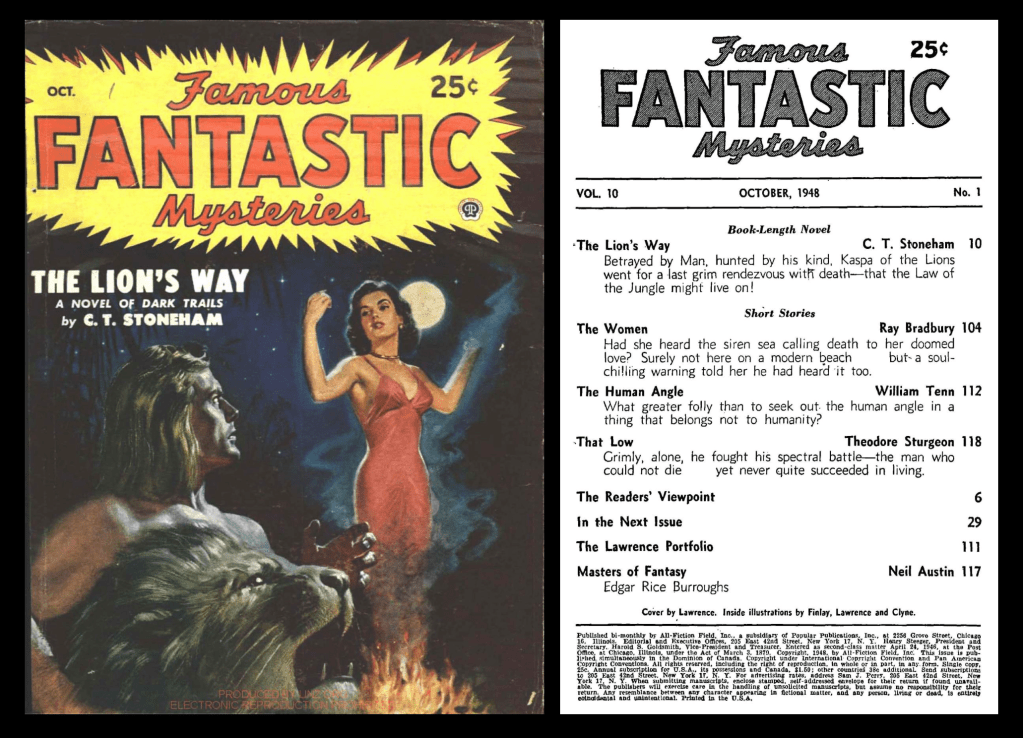
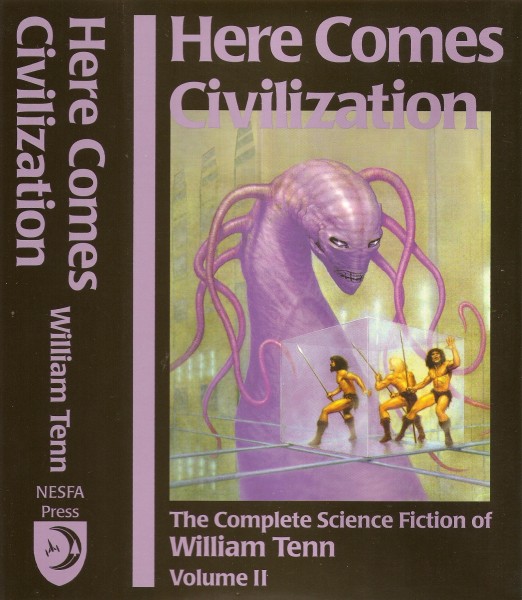
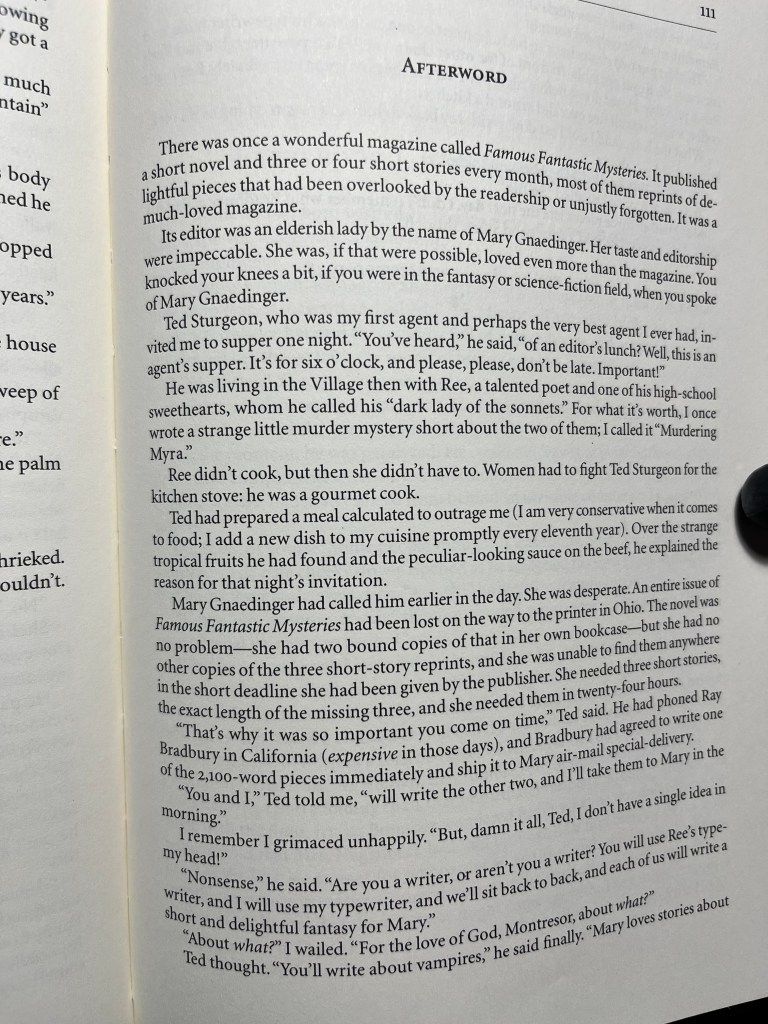
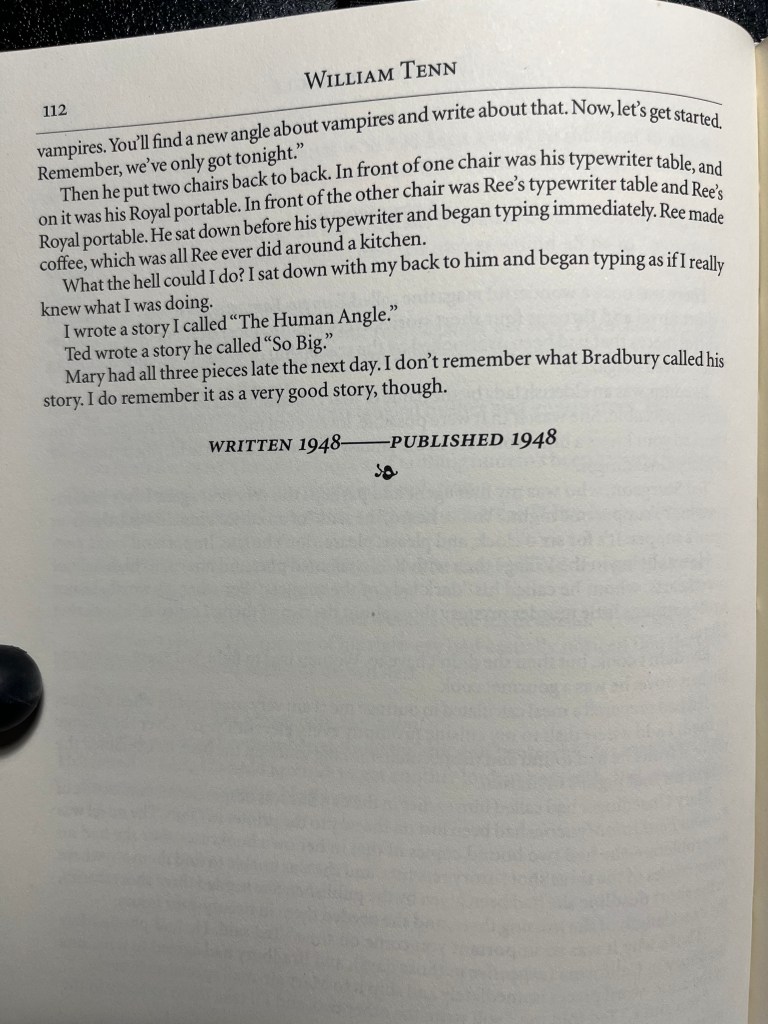
My friend Mike recently told me an anecdote from Here Comes Civilization: The Complete Science Fiction of William Tenn Volume 2. It was in the afterward to the story “The Human Angle.” It seems Ted Sturgeon invited William Tenn over for dinner with a hidden agenda. When Tennn arrived, Sturgeon told him that Mary Gnaedinger, the editor of Famous Fantastic Mysteries needed three short stories by tomorrow and they would write two of them that night. Ray Bradbury was going to write the third and air mail it special delivery to Mary from California. (See the “Afterward” below for the full tale.)
Tenn, Sturgeon, and Bradbury did come through in twenty-four hours and their stories were printed in the October 1948 issue of Famous Fantastic Mysteries. You can read that issue at Archive.org.
There were many legendary science fiction writers (and pulp writers) who bragged they could crank out a short story in a day, or a novel in a weekend. But is this hack writing any good? That’s hard to say. What is good? All three stories, “The Women,” “The Human Angle,” and “That Low” were readable stories and even entertaining. However, they are also quite forgettable. But not completely forgettable. Follow the links to view their reprint histories.
Men and women who wanted to make a living writing science fiction back in the 1930s, 1940s, and 1950s had to produce a lot of content. Many science fiction writers made a half-ass living churning out short stories for magazines. But are these speedy productions worth your time to read today? That depends.
Short stories can achieve several levels of quality and recognition. Getting published in a magazine is the first rung up in a ladder of publishing success. The next step up in recognition of quality is being nominated for an award or getting reprinted in an anthology, especially an annual best-of-the-year anthology. Winning an award is another step up. After that, recognition comes slowly. Having an author include a story in one of their short story collections at least says the author is proud of that story. But having a story reprinted in a retrospective or theme anthology means the story stands out over the other stories that came out in the year it was first published. Even greater recognition is when a short story is used in a textbook and taught in school or optioned for a film or television show.
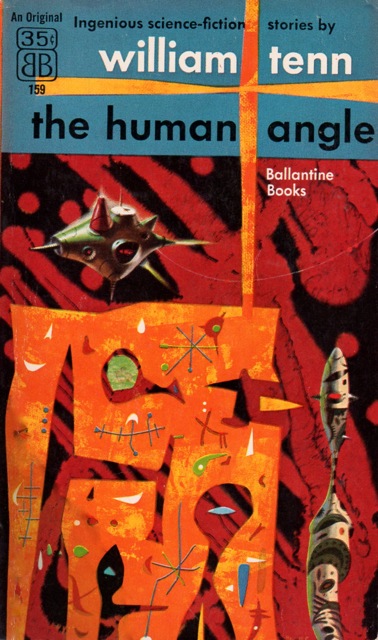
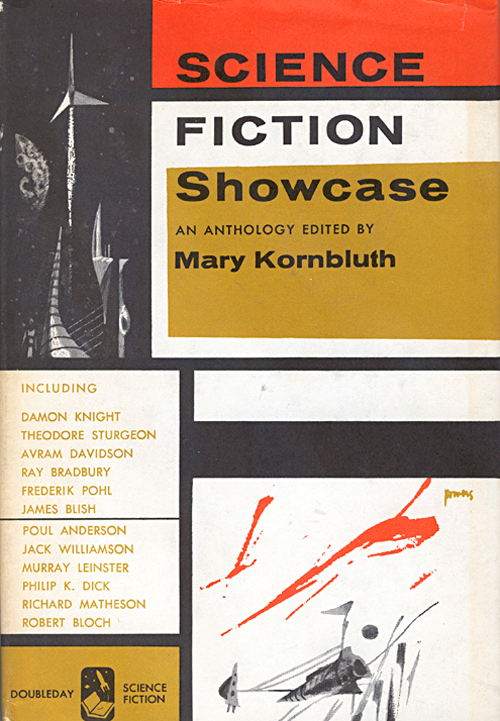
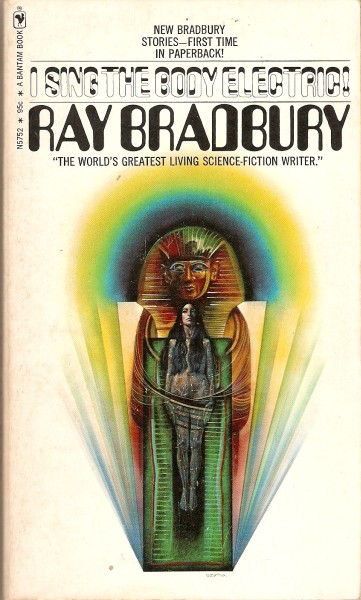
The Bradbury and Tenn were anthologized in a few minor theme anthologies as well as a few author collections. Bradbury included “The Women” in his famous I Sing the Body Electric collection. Tenn used “The Human Angle” for the title of a collection. Sturgeon’s story was reprinted in Mary Kornbluth’s Science Fiction Showcase, which was a special anthology probaby to help the widow of C. M. Kornbluth. “That Low” was only reprinted in Sturgeon’s complete stories series, suggesting that Sturgeon never liked it much. They were not major stories. However, these stories were sold several times, and they are in print today.
But back to my title question: How to judge hack writing. First, we must consider what kind of reader you are. Are you an indiscriminate reader, like someone who comes home from work and turns on the television and quickly finds something to watch by flipping through the channels? Or, are you the kind of person who Googles to find the critically admired shows that just came out this month? Maybe, you’re the person who looks at lists of the best TV series of all-time hoping to find something amazing to watch.
The Bradbury, Tenn, and Sturgeon stories are perfectly good stories if you’re capable of being entertained by an average episode of an average TV series. And that might be good enough for most people. But if you’re the kind of person who thinks in terms of the “Ten Best Episodes of The Twilight Zone,” these stories don’t even come close. And, if you compare them to “Fondly Fahrenheit” by Alfred Bester, or “The Story of Your Life” by Ted Chiang, or “The Ones Who Walked Away from Omelas” by Ursula K. Le Guin, then they aren’t even in the same galaxy.
I’ve developed a rating system I sometimes use in group discussions about short stories. One star is an amateur effort, and two stars is a story that still needs work and shouldn’t have been published. I seldom even mention these stories. Three stars to me is a professional story acceptable for magazine publishing. Four stars is a story that is good enough for me to look forward to rereading. Five stars is a story I’ve read many times and consider a classic.
Hack writers can routinely crank out three-star stories. The stories by Bradbury, Tenn, and Sturgeon are all three-star stories. I didn’t mind reading them, but at my age, they are a waste of my precious reading time – a commodity that’s dwindling. They were fun to look up and read because of Tenn’s anecdote about how and why they got written, but that’s about all.
When I’m restless, I still enjoy reading old science fiction anthologies. I have trouble watching TV, but I can still read for fun. I enjoy looking for gems. The trouble is I seldom find stories like “The Star Pit” by Samuel R. Delany or “Flowers for Algernon” by Daniel Keyes. But that’s what I’m really hoping to find, stories that work at that level.
I also want to know why and how stories work at the highest level of short story writing. I assume there must be definable qualities I can list, but I can’t list those qualities now. I plan to study my favorite 5-star stories and make a list in the future.
I will say the Bradbury story had the most writing qualities of the three stories. It had the most emotional tension. It had the most vivid details. It had the most poetic imagery. I cared for the wife in the black bathing suit. And it was the least predictable of the three stories.
The Tenn story was a vampire story. It has an unusual setting for a vampire story, which was a plus, and it had a different kind of vampire, another plus. But it was the most predictable of the three stories, and the least developed. Bradbury just had way more tension and conflict in his story. Sturgeon’s ending was the most surprising, but it wasn’t a very insightful surprise.
The obvious thing I can say about hack writing is it needs more drafts. Many hack stories could have been far better if they had baked longer in the oven. Writers who are proud of their first-draft writing might regularly sell their work, but it will never be considered great. A good example is Barry Malzberg. Some of his stories and novels are quite appealing, but none of them are books I want to reread. The absolute measure of great fiction is how often readers reread such work.
Robert Silverberg at the beginning of his career cranked out science fiction. Some of it was readable, but neither memorable nor something I’d want to reread. Then at the end of the sixties he changed. I assume he spent more time rewriting, although in some of those same years he cranked out four novels. But Downward to the Earth was different. I’ve read it twice and look forward to rereading it again.
I’m currently reading book 20 of The Great SF Stories 1-26 (1939-1964) edited by Isaac Asimov and Martin H. Greenberg with Robert Silverberg doing #26 with Greenberg after Asimov died. I’ve been reading them in order, along with the other best of the year anthologies that covered the same year. For any given year, I’d say there were less than five stories that I’d rate 5-stars. On average I’d say it’s two 5-star stories in each year. Most of the other stories are 3-stars and 4-stars.
I’m not sure if there are even three hundred 5-star stories in all the years of science fiction. Most would-be science fiction writers who achieve some success publish a handful of stories before starting on novels. I’m not sure if hack writers still exist. There are bestselling writers who crank out one or two novels a year who might be considered hack writers because of their productivity, but I don’t know if they are hack writers like Philip K. Dick, Ray Bradbury, Clifford Simak, Harlan Ellison, Robert Silverberg, and Theordore Sturgeon were early in their career when they could publish a dozen short stories and a couple of novels in a year. Ray Bradbury was quite proud of selling one short story a week pace, and he published in both the pulps and slicks.
Just because a story was written fast, doesn’t mean it’s bad. But the odds of it being great are low. I’m in a handful of online groups whose members love short fiction. There are many readers out there who appreciate good hack writing, especially those old readers who love pulp fiction. I don’t want to criticize such stories and their fans. I have often enjoyed a fun average story, but I’ve forgotten thousands of them.
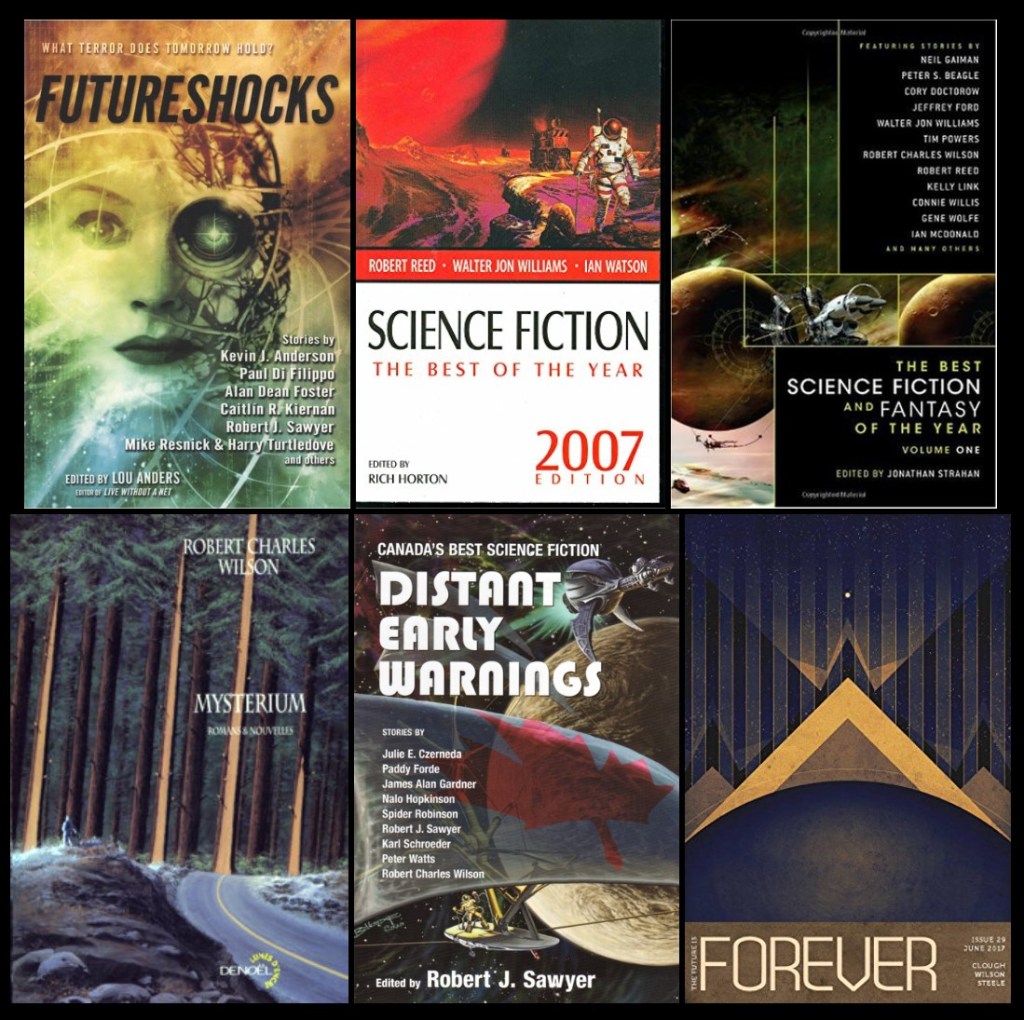
Today I read “The Cartesian Theater” by Robert Charles Wilson for our discussion group. That Facebook group is reading one story every Sunday from Science Fiction: The Best of the Year: 2007 edited by Rich Horton. I got a big kick out of “The Cartesian Theater” and wanted to hear it on audio. But when I went looking for an audiobook that included it, I couldn’t find one. Bummer.
My inner reading voice is nothing compared to the professional narrators who read audiobooks. I read “The Cartesian Theater” in Horton’s 2007 best-of-the-year anthology which I own in paperback. When I write about a story I like I want to help people find a copy to read. It’s always great when I can put a link to where it can be read or heard online. You can read the Horton anthology at Archive.org if you have set up a free account. You can read the Jonathan Strahan anthology for free if you subscribed to Kindle Unlimited. It’s $11.99 to buy that anthology for the Kindle. The one Wilson story collection shown above is a French edition. All those other editions will require tracking down used physical copies. For most people, this won’t be an easy story to find.
Most bookworms don’t read short stories, and short stories don’t make much money for publishers either. Short stories are a kind of training ground for novelists. Often when a writer becomes a success their short stories are collected, and even kept in print. And sometimes those collections have audiobook editions. If there was The Best of Robert Charles Wilson audiobook I would have bought it today. I would have also bought The Best of Charles Sheffield this week if it existed on audiobook. I did listen to my audiobook copy of The Best of Connie Willis twice this week to read “Even the Queen” and “Death on the Nile.” The narration was perfect for each, and I got so much more out of the story than when I just read them on paper.
The best narrators do voices for each character. That highlights the dramatic quality of stories that my inner voice doesn’t generate. But more than that, audiobooks are read much slower than my inner reading voice, sounding out every word, and that makes an enormous difference. When I read, I read too fast, often skipping words. I can’t help myself, I read too fast. I miss clues to what’s happening. Listening makes me pay attention to every word. And I’m very disciplined in my listening. If I miss something I hit the jump back button.
“The Cartesian Theater” is about a world where everyone lives on a guaranteed income and economic activity is driven by robots. People still make extra money, usually from creating something entertaining. (Picture everyone being a YouTuber or something like it.) In the story an anonymous rich person hires Lada Joshi to track down an elusive artist, Jafar Bloom, and offer to back a showing of his work with no strings attached. Joshi hires Toby Paczovski, an operative skilled finding people living on the dole who don’t want to be found. And then she had Toby find Philo Novembre, a retired philospher, to get him to attend the first showing of the “Cartesian Theater.” What Bloom has create is a device that proves something philosophical, something that science can’t prove. I don’t want to say too much.
Beside coming up with a nice gimmick for the premise of the story, Wilson creates an interesting setting, a setting that our world seems to be heading towards. AI and robots do most of the real work, pushing people onto the dole. The robots aren’t considered sentient. That’s the trouble with AI robots. If they ever become sentient we can’t make them our slaves. In Wilson’s society they seem to be on the cusp of awareness. Humans in this story also have a lot of smart technology that supplement their bodies. And in Wilson’s world, a certain amount of brain activity can be duplicated in machine. Toby’s grandfather is dead, but enough of his memories hang around so Toby can still talk to him. The whole story is a Cartesian theater. And it has a nice surprise ending I didn’t guess.
Is this story worth keeping in print? Should it be available for the Kindle and on Audible? I don’t know. Such publishing might be a money loser. Which short stories should be preserved? And which should we forget?
We also read “Georgia On My Mind” by Charles Sheffield which won the Hugo and Nebula awards for best novelette back in 1994. You’d think every award winner should be preserved. It is in a collection called Georgia On My Mind and Other Places which can be read on Archive.org or bought for the Kindle for $5.99. But no audiobook. It was originally published in the January 1993 issue of Analog.
I loved “Georgia On My Mind” even more than “The Cartesian Theater.” Sheffield uses a narrative structure that was common in the pulps before WWII, where a mystery is discovered in a far distant place on Earth. In this case New Zealand. The story is set in modern times. We seldom believe such mysteries are possible anymore. But in the old days, readers loved these setups where the story felt possible. In this case, in a rundown tool shed to an old farm house in a remote part of New Zealand, Bill Rigley finds pieces of Charles Babbage’s computer from the 19th century, along with old letters, and information about programming. The mystery is how did Babbage’s work get to New Zealand and why.
If you like a Weird Tales type of story, computers and computer history, and even a bit of recursive science fiction, then you should like “Georgia On My Mind.” I think Sheffield rush the story at the end. He should have kept the slow pace and followed through on the setup and made this story a novel. I dislike the title, but it fits the cutsy ending. However, I didn’t want a cutsy ending. Obviously, Sheffield didn’t want to write a whole novel, and wrapped up the story with a direct appeal to science fiction fans. I wanted a Weird Tales ending. Still, I got a big kick out of this story.
It’s sad to think these two stories will be forgotten. They just aren’t easy to find. I think what’s needed is for Audible to publish all the best-of-the-year anthologies, from 1939 to the present. That would put most great short SF in audiobook print. At least do the Asimov/Greenberg/Silverberg books covering 1939-1964. Then Wollheim from 1965 to 1990. The 14 Carr anthologies, and all the Gardner Dozois anthologies. Or get some young editor to create new anthologies for each year.
If Audible doesn’t want to keep best-of-the-year anthologies in print, I think they should at least put all the Hugo and Nebula winners and finalists in audiobook print. That would catch “Georgia on My Mind” but not “The Cartesian Theater.”
JWH
p.s. I haven’t been blogging as much lately. I’m just getting old and running out of energy. Finishing this short blog gave me a sense of accomplishment.
“Enchanted Village” by A. E. van Vogt has been extensively reprinted. It first appeared in the July 1950 issue of Other Worlds Science Fiction. I just read the story in Possible Worlds of Science Fiction edited by Groff Conklin. I first read it in The Great SF Stories 12 (1950) edited by Isaac Asimov and Martin H. Greenberg several years ago, although today, I had no memory of reading it before. I can’t tell if it’s a forgettable story, or I’m just forgetting everything.
Bill Jenner is the lone survivor of the first mission to Mars after his rocket crashes. Jenner crosses hundreds of miles of Martian desert on foot with just a bit of food and one bag of water. Jenner thinks he’s saved when he stumbles upon a deserted alien village.
The story is nicely told. Who doesn’t love a Robinson Crusoe type story? Isn’t that why The Martian by Andy Weir was a bestseller and blockbuster? “Enchanted Village” takes a left turn though, one that reminds me of Solaris by Stanislaw Lem. It’s amusing how A. E. van Vogt anticipated so many modern science fiction stories (Forbidden Planet, Star Trek, Alien, etc.).
Jenner eventually realizes the village is an organism or machine, even an intelligent one, and he must learn to communicate with it. The village produces food automatically in low troughs but is poison to Jenner. Through a series of observations Jenner discovers the village could make food for him, but he doesn’t have enough human food for it to model.
Now here is where you should leave this essay if you don’t want spoilers.
“Is it possible?” is the number one criterion I use to define and judge science fiction. All too often science fiction readers are given magic rather than honest speculation. There is nothing wrong with magic in a story if you enjoy fantasies, but the belief in magic is why our species never grows up. To me, fantasy is the fentanyl of fiction. It will make you feel great, but eventually, it will kill you.
The surprise ending of “Enchanted Village” is when Bill Jenner dies, he wakes up to discover he’s a kind of creature that can consume the nourishment the village provides. Bill Jenner is reborn. We are not told how. We are not told anything, but that Jenner now has sharp teeth and a snout allowing him to slurp up the alien food. I pictured the reborn Jenner looking like a lizard creature, suitable for the dry Martian desert.
The alien village is like Jesus, or other deities that tell us to accept them and be saved. Van Vogt’s use of the word enchanted should have warned us this was a story about magic. I don’t know if van Vogt was intentionally parodying religion, or he just needed a quick ending to sell a story. It’s interesting to compare “Enchanted Village” to “A Martian Odyssey” by Stanley G. Weinbaum. That story has strange aliens that accomplish bizarre feats, but I believe it’s within the realm of possibility, and honest science-fictional speculation.
Even with my criticism, I enjoyed the story. It’s the old fashion kind of pre-NASA science fiction I’ve always liked most. But then, science fiction was my substitute for religion. I wanted to believe in the fantasies that science fiction sold me. If we could only fly beyond the Earth, they would all come true. I never really wanted to grow up in Earthly reality but be reborn in outer space. I’ve always known that science fiction was just storytelling, but it did leave me with a kind of secret hope that I should have ignored. There’s a reason Marx said religion was the opiate of the masses, it’s because it makes us want to believe in magic. There’s a safe kind of making believing while turning pages, but if you let science fictional beliefs go beyond them, they can be dangerous.
If you think I’m being silly, read “Racked by Pain and Enraptured by a Right-Wing Miracle Cure” from yesterday’s New York Times. It’s quite moving, and I feel deserves some kind of journalism award. These people hope for a science fictional cure, ones I’ve seen in science fiction stories.
I’m getting worried that I’m becoming too critical of science fiction, and I should stop reviewing it. I don’t want to come across as a downer. I know science fiction should be judged just on its merit as a story, but I can’t help but evaluate it psychologically and philosophically as a kind of hope for the future. I assume my growing doubts and rejection of SF is because I’m getting older and thinking about how things have impacted me psychologically.
I was going to take a break from reading Dangerous Visions because it was depressing me, but I found “A Toy for Juliette” a fitting inspiration for a sermon I wanted to write. I’ve been reading Golden Multitudes: The Story of Best Sellers in the United States by Frank Luther Mott, which inspired me to buy and start reading The Sentimental Novel in America 1789-1860 by Herbert Ross Brown. Both books give impressions about how Americans, and I presumed other people around the world, got into reading fiction.
Printing began in the 15th century at a time when most people didn’t read. Storytelling has been around since we lived in caves. Although there were works in Japan and China that could be called novels long before the printing press, in Europe and America, the novel seemed to emerge with Don Quixote in 1605. What we think of as the modern novel matured in the 18th century.
Frank Luther Mott’s book, Golden Multitudes describes the kind of books people read in America before Ben Franklin printed Pamela by Samuel Richardson in 1745. Some considered Pamela, first published in England in 1740, to be the first English novel. Before this novel, Americans mostly read books on morality. The colonies were settled by various religious groups, so that’s kind of logical. Mott says the first American bestseller was The Day of Doom by Rev. Michael Wigglesworth. It was written in verse, and it was all about the horrible things that would happen to people in hell. The excerpts and quotes Mott gave from this poem made me think early Americans were fixated on horror.
To keep this sermon short, I need to cover the following decades quickly. Fiction slowly emerged out of all this moralistic reading. Another bestseller was The Pilgrim’s Progress from This World, to That Which Is to Come by John Bunyan in 1678. This book is an allegory that begins with a dream. But the point is, Bunyan spiffed up moralizing with a story and characters.
Pamela became a huge bestseller in America and Europe after 1740 because Richardson made moralizing every more entertaining. One reason Pamela is given credit for being one of the first English novels is because Richardson invents a lot of storytelling techniques we use today. After the success of Pamela countless imitators began producing similar type stories, and the focus on moralizing became less, and the shift to pure storytelling became common.
At that time, many intellectuals began protesting, claiming fiction was corrupt and corrupting. Magazines and newspapers ran articles about how fiction was ruining young people’s minds, especially young girls. That made me think about how people worry about smartphones and video games corrupting young people today. But those fiction protesters were crushed by bookworms wanting more fiction.
By the time the 19th century rolled around, especially after Edgar Allan Poe, many stories became free of moralization. Kids and adults devoured fiction about violence, horror, the supernatural, and other evil things in the world. Which is why Robert Bloch is a popular writer, and why people enjoy stories like “A Toy for Juliette.”
The problem is I don’t. I don’t like horror. And I can’t understand why other people do. Although Susan and I are currently watching Why Women Kill, which could be described as comic horror. Fiction writers have a tough time producing stories that don’t involve the horrible aspects of life. Fiction is often an art form about the ugliness of humanity, but isn’t the best fiction about transcendence of those horrors?
I quite enjoy reading Pamela. I’m only about half finished, but then the book is over forty hours long on audio. I admire Richardson for embedding his moral lessons into his story. The story is about 15-year-old girl servant efforts to avoid being raped by her employer. On one hand, the novel could be considered a handbook for girls warning them about all the ways guys will trick them into having sex. On the other hand, it’s rather entertaining to read about all the schemes Mr. B used to seduce Pamela. The novel is also entertaining because I’m watching Richardson invent plotting and characterization.
When reading “A Toy for Juliette” I was seeing the refinement of centuries of storytelling. But Bloch completely ignores moralizing. He returns to the purity of telling gruesome stories around a campfire. However, I miss moralizing. Bloch makes no effort to explain the psychology of Jack or Juliette. He makes no moral judgments on their actions. He just accepts that those kinds of people exist.
Sociologists claim there is no correlation between the consumption of violent entertainment and committing violence, but I find that hard to believe. But then, from Harlan Ellison’s introduction about Robert Bloch, he seems like a very nice guy — kind, considerate, and generous.
Maybe, “A Toy for Juliette” depresses me because it reminds me that there are people like that in this world. And it bothers me that people find stories about such people entertaining. But as I admitted, Susan and I found a comedy about murder fun. And even the Puritans, with all their emphasis on living a pure life, sure did love to read about the gruesome aspects of going to hell.
Back in the 1960s, I learned from health food nuts, “You are what you eat.” And from computer school I learned GIGO – garbage in garbage out. I can’t help but wonder if those 18th and 19th century pundits who attacked fiction weren’t right. Why should we pollute our mind with a story about a sadist being sadistically killed by another sadist? I guess I could claim Bloch was preaching that we reap what we sow, but I don’t think it’s true. I think people enjoy seeing Juliette get ripped by the Ripper.
Still, I find “A Toy for Juliette” a virus in my mind. I find reading nonfiction about the horrors of humanity enough of an education about the reality of humanity. Why do we want reminders of such horrors in our escapism? But we do. Think about all the fiction you consume. How much of it involves acts we’d be terrified of if they happened to us? Why do we dwell on the horrible?
Harlan Ellison makes a big to do about Miriam Allen deFord being an old lady in his introduction. She was born in 1888. I assume Ellison wanted us to picture a sweet little old woman before reading her story, “The Malley System.” Now I have to wonder what sick thoughts little old grannies are entertaining.
“The Malley System” opens with scene of child molestation and murder. In quick succession it goes through several more gruesome scenes. You begin to wonder if this story is just a smorgasbord of cruelty. Then you get to the science fictional explanation, which adds an extra bit of nasty horror.
Why is Dangerous Visions considered a classic of science fiction? Why isn’t it famous for being an anthology of horror? I’ve never been a fan of that genre. I don’t even like mysteries and thrillers. I get no vicarious thrills from virtual violence. I love science fiction for its sense of wonder. This anthology is full of visions of the grotesque.
I recently reread Ellison’s “A Boy and His Dog,” an extremely popular story of his. But it’s about a serial rapist who ends up feeding one of his victims to his dog. You know, I’m starting to wonder about Ellison’s psychology. I bet he loved EC Comics.
I just canceled my pre-order for Again, Dangerous Visions. I’m not sure how much more Dangerous Visions I can take. I’ve already reread some of the next few stories, and they are a gore fest. Why didn’t I remember how depressing this anthology was from when I read it as a kid? Is that the nature of childhood, to like this kind of fucked up shit?
Reading this story was about as much fun as removing the two dead decayed rats from my attic two weeks ago.
Still, I was impressed with how deFord threw in made-up science fiction bits. For an old lady, she kept up with the times.
I thought it would be fun to post the original reviews of Dangerous Visions. I remember 1967 well, but far from perfect. I subscribed to these magazines at the time, and I’m fairly sure I read these reviews. I remember in both the prozines and fanzines how the excitement for Dangerous Visions grew. It became legendary in its own time.
For me, these reviews are a blast from the past that remind me of my own life. More and more I identified with the science fiction community. I hope these reviews might reveal the past to younger people just now discovering Dangerous Visions. To me, DV is a time capsule for understanding 1967 that goes beyond the subculture of science fiction. Although science fiction often appears to be about the future, it’s always about the present.
First up is Judith Merril in the December 1967 issue of The Magazine of Fantasy and Science Fiction. That month was also significant to me because it’s when I went to see The Graduate at the movies. It was its own kind of dangerous vision. I believe all the arts were going through a revolution back then.
Next up is Algis Budrys, in the April 1968 issue of Galaxy. That seemed like a late review. I wonder how Merril got such an early jump on things?
Finally, there’s P. Schuyler Miller’s review in the May 1968 issue of Analog.