“The Lake Was Full of Artificial Things” by Karen Joy Fowler

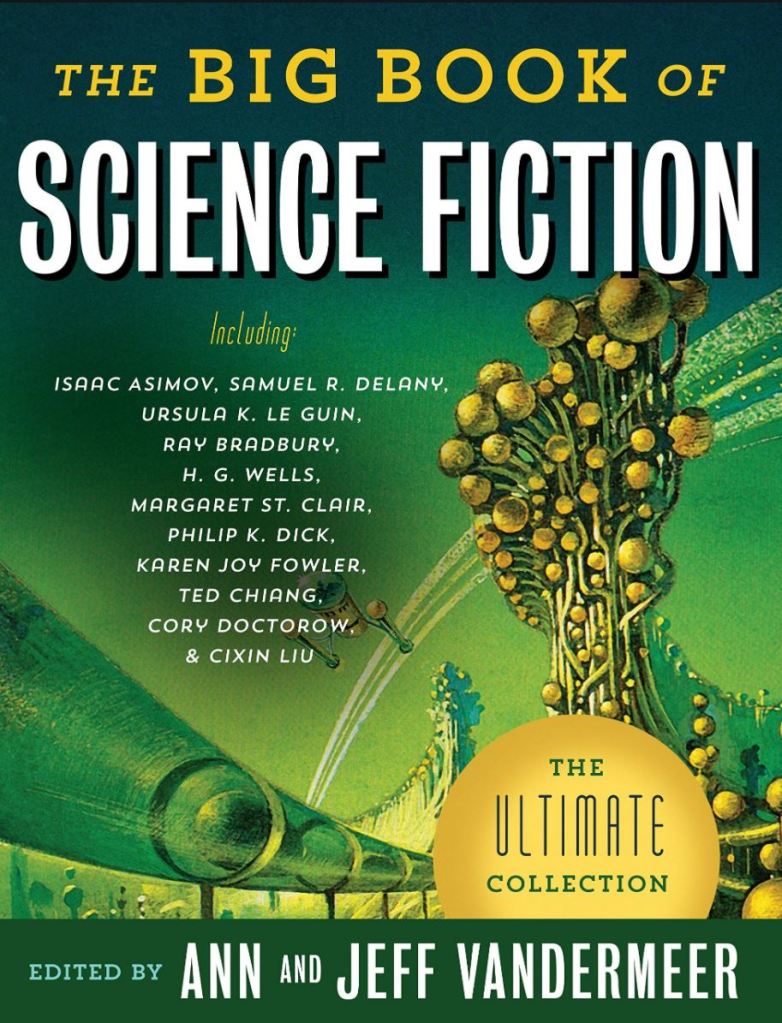
Group Read 27The Big Book of Science Fiction

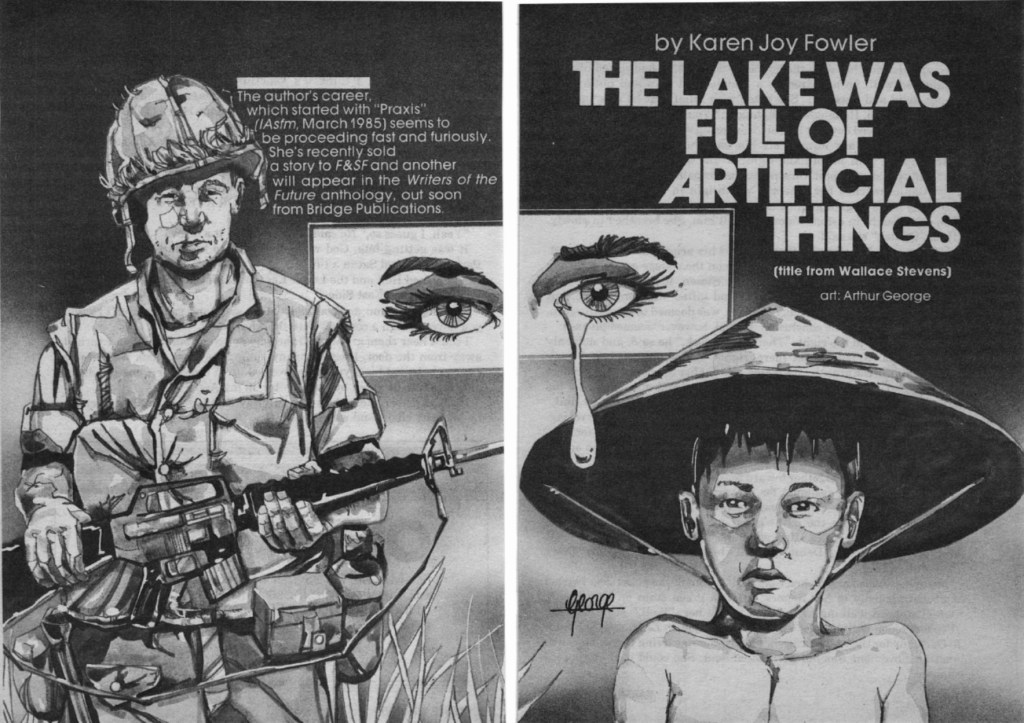
Story #78 of 107: “The Lake Was Full of Artificial Things” by Karen Joy Fowler

This is my third time reading “The Lake Was Full of Artificial Things” by Karen Joy Fowler, first published in the October 1985 issue of Asimov’s Science Fiction. It’s another science fiction story about memory, so it’s interesting to compare it with our last story, “Snow” by John Crowley. In that story, a man remembers his dead wife, in this story, a woman remembers her dead boyfriend. We should make a list of all the ways science fiction is used to play with memory.

In 1970, Miranda dumps Daniel a boyfriend she’s in love with because he’s being drafted. He dies in the Vietnam War two years later, and for thirty years Miranda has felt guilty. Especially, because she intentionally broke up with Daniel because she feared what the war could do to him.

The story takes place after Miranda is a grown woman, and her son is older than Daniel when he died. She goes to an experimental therapist, Dr. Anna Matsui, who uses induced lucid dreaming to get her patients to confront their inner demons.

I’ve been obsessed with memory my whole life, and even more so since I’ve become old my memory has begun to fail. When I was young I used to play around with lucid dreaming. So this story resonates with me strongly.

Miranda meets Daniel in her dreams twice under the control of Dr. Matsui. The first time is a satisfactory encounter according to Dr. Matsui, and she wants it to be the only dream session. Daniel had forgiven Miranda, and that was enough to work with Miranda in regular therapy. However, Miranda begs to go again, but things go badly. Dr. Matsui refuses to put Miranda under again. Up till now, the dreams are based on how Miranda remembers Daniel, from their time at college.

However, Miranda induces her own lucid dream at home, and she meets Daniel at Camp Pendleton, and they argue even more. This time Daniel tells her how he killed a young boy thinking the boy had a hand grenade but didn’t. These are experiences that Miranda could have never known. We have to wonder is she learning something real, or if this is her mind playing tricks on her?

Her final dream with Daniel happens in Vietnam, and Miranda tries to keep Daniel from killing the boy and getting killed himself. Everything is realistic, and Miranda is experiencing things beyond her imagination. This time she tries to stay with Daniel as she sees a bomb fall from the sky, but Daniel tells her to go. He tells her he never wanted that. While she pulls away from the scene she sees Daniel and other soldiers die.

I spotted something different this reading. At one point Daniel tells Miranda she could never know what it was like to have the draft hanging over her head, or getting a low number in the draft lottery because of her birthday. This time I wondered if Karen Joy Fowler is writing the story for all women who felt guilty about not going to war in Vietnam. The two times I read the story before, I saw it only as Miranda’s personal story. But now I wonder if Miranda is all of us who didn’t go to Vietnam. That makes it a much more powerful story.

Main Page of Group Read

James Wallace Harris, 1/25/22

“The Jaguar Hunter” Lucius Shepard

“The Jaguar Hunter” by Lucius Shepard
The Magazine of Fantasy and Science Fiction (May 1985)
The Year’s Best Science Fiction: Third Annual Collection edited by Gardner Dozois
The Best of Lucius Shepard (2011)

In 1925 D. H. Lawrence wrote “The Woman Who Rode Away” while living in New Mexico. It was a story about a bored housewife who seeks to escape reality by riding into the mountains and offering herself to the shamans of the native people she found there. In 1968 Carlos Castaneda wrote The Teachings of Don Juan about revealing ancient knowledge from a modern day shaman of the Yaqui Indians. This book became a series that was embraced by the New Agers of the 1970s. In 1985 Lucius Shepard wrote from his experiences of living in Central America “The Jaguar Hunter” about a descendent of the Aztecs escaping the modern reality by similar shamanism.

Why does this theme keep showing up? What is the allure of the far past? The belief in ancient knowledge keeps showing up in both fiction and nonfiction. It’s the basis of religion, and a major tenet of fantasy fiction. Most modern works of fantasy are slowly moving towards make believe realities, but the classics of fantasy have always been built on aspects of the past. Haggard, Burroughs, Merritt, Lovecraft, Howard, Leiber, and other classic fantasy writers of the 19th and 20th centuries wanted their readers to believe magic and magical beings were once part of our reality. You might scoff at that, but don’t all the sacred books of religion claim it too? Is it so absurd to question fun fantasy when our society teaches our children ancient fantasies as facts? If you asked kids and teens where they’d really like to live, how many would say in fantasylands like they read about or see on TV?

“The Jaguar Hunter” by Lucius Shepard is not science fiction, but magic realism that suggests we can return to a past reality destroyed by modernity. The setting appears to be current day Honduras and the plot focuses on Esteban Caax, 44, a farmer. Esteban loves living in the country and pursuing a simple life. However, his life is complicated when his wife Incarnación, 41, buys a battery-powered TV on credit from Onofrio Esteves. Incarnación wants to move into town and take up modern ways.

Onofrio sold the TV to Incarnación to force Esteban into debt so he has to return to jaguar hunting. There is a rare black jaguar that’s keeping a tourist resort from being built, one that Onofrio and his son want to develop. When Esteban goes hunting the jaguar he finds a beautiful woman in the jungle who seduces him. He eventually learns she is the black jaguar and wants Esteban to return to an older, magical reality, part of his true heritage. At first, Esteban refuses, but ultimately, he’s forced to follow Miranda into an ancient reality that modern life and science was destroying.

Shepard’s writing is amazing and beautiful, yet I have to wonder about the intent of this story. The setup is realistic, probably inspired by experiences of living in Honduras. The conclusion of the story is fantasy, and like the intent of much fantasy, it’s a rejection of modern life.

I find it odd that Dozois included this and a few other fantasy stories in his anthology of the best science fiction of the year. But even back in 1985 science fiction was beginning to be overrun with fantasy. To readers who just enjoy a good story, making the distinction between the two genres isn’t important. But I find there’s a philosophical difference that matters. Fantasy longs for the past, while science fiction dreams about the future.

I enjoyed reading “The Jaguar Hunter” but I also find it offensive because it rejects both reality and science. When I was young I read most of the Oz books by L. Frank Baum. I loved them. When I was grown I read an article from the 1950s that said that some librarians stopped carrying the Oz books because it gave children unrealistic expectations toward life. I was horrified by the censorship, but I knew they were right. The Oz books had given me unrealistic expectations.

That Esteban can escape his petty mundane problems by running away into the past with a beautiful woman/jaguar is a fun conclusion to the story, but isn’t that an unhealthy message? You might think I’m being ridiculous laying such a heavy criticism on a slight bit of make-believe. But look at our world today. Half the population embraces a philosophy of denialism, rejecting science and reality. We live in a culture where people never grow up, and many never escape the brainwashing of religion or storytelling. Start paying attention to how off fantasy is embraced by the people around you.

I believe every good story, has a setup and an intent. I admire Shepard’s setup, but I don’t like his intent.

James Wallace Harris, 8/15/21