I imprinted on science fiction in the early 1960s. At that time, I considered science fiction to be PR for the space program. I fell in love with science fiction concurrently with Project Mercury and Project Gemini. I mostly read books by Robert A. Heinlein for the first few years, so colonizing the solar system seemed like humanity’s true purpose to me.
In 1968, I discovered Do Androids Dream of Electric Sheep? by Philip K. Dick on the new book shelf at the Coconut Grove Library in Miami, Florida. His science fiction wasn’t about promoting space exploration. By then I had discovered the counter-culture, and PKD made a different kind of sense.
I started college in 1969, but in the fall of 1970, I dropped out because the university I was attending required ROTC, which I was willing to take, but the ROTC insisted I cut my hair, which I wasn’t willing to do. In 1971 I switched to a two-year technical school to study computers.
I was uncertain about my future and the future in general. My indecision led to reading 479 science fiction paperbacks in 1971 and 1972. That was another kind of education. I made friends at the local science fiction club and started publishing fanzines and going to cons. However, by the end of 1975, I was tired of science fiction and gafiated from fandom.
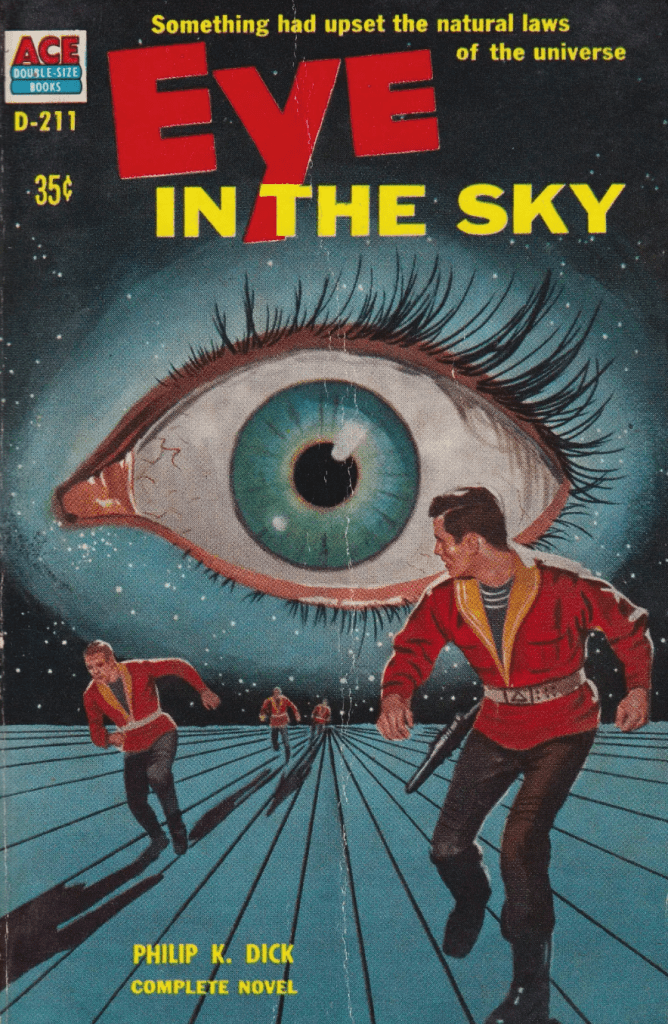
I just finished reading Eye in the Sky, an early novel by Philip K. Dick that was first published in 1957 as a cheap ACE paperback. It was vaguely familiar, and when that happens I assume it’s because it was one of those SF novels I read back in 1971-1972. Back then I consumed SF paperbacks like a stoner eating a bag of chocolate chip cookies. Each book was a momentary distraction from my confused life of not wanting to grow up. Each book provided escapism until I finished it and started the next one.
I spend more time thinking about what I read at seventy-three. Also, my world is very different than it was fifty years ago. In some ways, I’m no different, I’m still trying to figure out what I’m supposed to do with my life, but it is different because the perspective of the future at 23 and 73 is drastically different. I’ve thought a lot more about Eye in the Sky this time.
In the 1970s, I judged science fiction on how well it speculated on the near future, especially regarding space exploration and technology. I thought Philip K. Dick was so poor at this that I didn’t consider him a real science fiction writer. I classified him with Ray Bradbury and Kurt Vonnegut.
In the 2020s, I value Philip K. Dick for insights I never could have imagined back in the 1970s. Eye in the Sky asks us to imagine reality being shaped by subjectivity. In the story, eight people are involved in an accident. When they come to, the world is similar, but religion works instead of science. Eventually, they discover that the world is controlled by the thoughts of one of the eight. When the person controlling reality dies, they find themselves in another world but shaped by the mental perspective of another member of the eight.
This setup gives Dick a chance to explore the idea of subjective reality. What amazed me in this reading, is Dick covers all the themes in this early novel that he would later explore in all his other novels. I’ve always divided PKD’s books into three periods. The 1950s and early 1960s, the 1960s, and the 1970s novels. For example, Dick’s Valis novels of the 1970s explore Gnosticism. Well, Dick might not have known about Gnosticism in 1957, but Eye in the Sky reflects its ideas. Eye in the Sky also anticipates his paranoid reality-bending novels of the 1960s.
On the whole, I enjoyed Eye in the Sky, but it’s not without flaws. The story seems to promise eight stories about eight different realities because of the eight characters involved, but we only get to visit four realities. PKD skipped out on the four perspectives I wanted to see the most. We’re shown the realities of Arthur Sylvester, Joan Reiss, Edith Pritchet, and Charlie McFeyffe.
Our protagonist is Jack Hamilton. We never get his take on reality. But since he’s the main character should we assume the overall story is told from his perspective? It would have been fun to see how his subjective perspective differed from the external reality. I also wanted to see Marsha Hamilton’s reality, Jack’s wife. And most of all, I wanted to see Bill Laws’s reality because he’s African American and a Ph.D. student in physics. Black characters were rare in 1950s science fiction. And it would have been interesting to see David Pritchett’s reality since he was a young teen.
The reason why Eye in the Sky is so much better in my seventies is I see that reality is fought over by many different subjective perspectives in the 2020s. We were just as politically polarized back in the 1970s, but I was young and less aware of how other people thought. Back then I thought everyone was basically the same but with slightly different ideas about reality. Now, I realize that the umwelt of everyone is quite different.
Both then and now, I believe there is an external reality. I’m not one of those woo-woo people who think reality is unreal. I could be wrong, but I’m betting on an external reality and people are crazy. I really don’t want reality to be crazy. I do believe our view of reality is subjective. That we can never perceive the fullness of the external order.
Philip K. Dick in Eye in the Sky imagines reality is mutable, shaped by minds. I hope this doesn’t give anything away, but the eight characters do return to the reality they were in before the accident. Is that PKD affirming my idea that we live in an external reality that is universal? PKD wrote over forty more novels and over a hundred short stories that keep suggesting otherwise. At the end of his life, Dick seemed to believe in a gnostic view of reality, where we lived in a reality created by an evil god, and there’s a higher reality beyond this one, maybe ruled by a kinder diety.
Strangely, in my seventies, I find stories by Philip K. Dick to be comfort reads. His stories are compelling, told with prose that has the right mixture of dialog and detail for a pleasant reading pace. I find it interesting how his characters bash around in reality, struggling to find meaning.
Back in 1970 when I dropped out of the university, my father had died that May, the draft was looming over me, and my mother was nagging me to go to work if I wasn’t going to go to school. I was living in a new city and had no friends. Each science fiction book I read was an escape into a different reality.
Of course, reading science fiction in my seventies might be about trying to escape another reality, of getting old and dying.
Looking back I wonder what life would have been like if I hadn’t gotten addicted to science fiction. I could have cut my hair, finished a four-year degree in physics and astronomy (my childhood fantasy), and joined the Air Force as an officer (my father’s fantasy). Or I could have kept my hair and focused on computers and gotten a job at a Unix site with other long-haired computer geeks. Instead, I read science fiction and fantasized about going to Mars, which was just as crazy as the folks in Eye in the Sky.
Of course, thinking about what could have been, or could be, leads to the madness of PKD.
James Wallace Harris, 1/5/25







 Classics of Science Fiction